Author Archives: Paul Woodward

NEWS, ANALYSIS & OPINION: Iraq’s shifting balance of power

Shiite contest sharpens in Iraq

Posted at the door of Shiite cleric Moqtada al-Sadr’s office recently, a flier denounced the arrests of his followers. Up and down the barricaded street, soldiers and policemen loyal to his Shiite rivals stood sentry, some in tan armored personnel carriers, questioning anyone they suspected of links to the populist cleric.

Inside the shuttered office, five guards spoke frankly of their sense of vulnerability and weakness. Once in control of the streets of this southern city of holy sites, the Sadrists said they have been chased underground, their rivals at their heels.

The arrests of Sadr’s loyalists are part of a broader power struggle between the two most powerful Shiite factions seeking to lead Iraq: the Sadrists, who are pushing for U.S. troops to withdraw, and the Islamic Supreme Council of Iraq, the Bush administration’s main Shiite ally. Given the nation’s majority-Shiite population, this intensifying confrontation could play a major role in deciding Iraq’s future. [complete article]

Now Iraq needs a surge of political will for reconciliation

… despite the failure of the al-Maliki government to deliver vital legislation, or make anything function, things are changing politically in Iraq.

The changes are hard to see clearly because the country is still going through an ugly period of chaos and confusion, with Shiite militias battling each other in the south, and intra-Shiite violence in Baghdad. Fighting continues between Sunni tribal leaders and al-Qaida in parts of the country. And the al-Maliki government has failed to pass benchmark laws that had been viewed as signs of whether sects could reconcile.

But the sharp decline in sectarian killing has changed the way Iraqis look at politics and their post-Saddam Hussein leaders. “The less there is of sectarian killing, the more people will focus on their interests,” I was told by Sheik Humam Hammoudi, an astute leader of one of the largest Shiite political parties, the Islamic Supreme Council of Iraq (ISCI). “We are in a transitional phase, from competition over identity to a competition over interests,” the sheik continued.

Let me explain what that means. In the violent chaos of the post-Hussein era, even secular Iraqis turned to political groups that represented their sect as a form of protection. Long-oppressed Shiites, a numerical majority, were determined to gain the power they believed they had long been denied. Sunnis fought back to retain their old standing. Kurds focused on building their quasi-state in the north.

Now the violence has ebbed. “We have avoided a major sectarian war that could have spread,” Mr. Zebari said. “It is not over, but it has died down. The overall atmosphere has changed.”

Now people have the breathing room to assess their sectarian parties that have failed to deliver services or safety while indulging in astounding levels of corruption. The judgments I heard from every Iraqi I spoke with were unremittingly harsh. [complete article]

Top ten myths about Iraq 2007

Myth: The US troop surge stopped the civil war that had been raging between Sunni Arabs and Shiites in the Iraqi capital of Baghdad.

Fact: The civil war in Baghdad escalated during the US troop escalation. Between January, 2007, and July, 2007, Baghdad went from 65% Shiite to 75% Shiite. UN polling among Iraqi refugees in Syria suggests that 78% are from Baghdad and that nearly a million refugees relocated to Syria from Iraq in 2007 alone. This data suggests that over 700,000 residents of Baghdad have fled this city of 6 million during the US ‘surge,’ or more than 10 percent of the capital’s population.

Among the primary effects of the ‘surge’ has been to turn Baghdad into an overwhelmingly Shiite city and to displace hundreds of thousands of Iraqis from the capital. [complete article]

Three possible post-surge scenarios

Not only will five of the current 20 brigades be out of Iraq by July, but Secretary of Defense Robert Gates and the Army chiefs would like to cut troop-deployment terms from 15 months back to their normal 12 months (with 12 months back home for rest and further training). The 15-month terms were always seen as a temporary measure. Talk to soldiers, and they will tell you that 15 months of continuous combat duty is simply too wearing.

Enlistment rates are down; junior officers are dropping out at rates unseen since Vietnam days. The war in Iraq is the main reason for both trends. The Army is already stretched to the bone. Senior officers—and Gates—are deeply worried that maintaining this breakneck pace for much longer might break the all-volunteer Army.

However, if the terms of duty are cut back to 12 months of deployment, followed by 12 months home, it is not clear whether even 15 brigades can be sustained in Iraq for very long. And once troop levels fall below 15 brigades, it is not clear—as they approach 10 brigades, it is very unlikely—that the mission of securing the Iraqi population (the essence of counterinsurgency) can be sustained.

The clock is also ticking on the other games that are keeping ultraviolence at bay. After the Sunni-U.S. alliances defeat the jihadists, or reduce their ranks to a manageable level, nobody expects the Sunni fighters—who, before their “awakening,” spent much of their time shooting and blowing up American soldiers—to become pliant citizens. (Stalin didn’t join NATO or the IMF after he and the Western allies beat Hitler, either.) They will go back to shooting our soldiers, undermining the Shiite-led Iraqi government, or both; in fact, having gained the experience of fighting alongside U.S. troops, and the armaments that went with it, they will be a more formidable force in sectarian battles with Shiites.

If the Sunni insurgents resume their sectarian battles, it is doubtful that Sadr’s Mahdi Army will maintain its cease-fire.

In sum, U.S. forces may soon have more eruptions to damp down—or, to switch metaphors, more holes in the Iraqi dike to plug up. And the task will be more daunting still once the troop-levels decline. [complete article]

Reward Sunni fighters, US commander says

A top U.S. commander warned Tuesday that Sunnis who fight al-Qaida in Iraq must be rewarded and recognized as legitimate members of Iraqi society — or else the hard-fought security gains of the past six months could be lost.

But the Shiite-dominated government is deeply concerned about the Sunni tribal groups, made up of men who in the past also fought against them — not just the Americans.

The warning from Maj. Gen. Rick Lynch, the commander of U.S. forces south of Baghdad, came as two separate suicide attacks killed at least 35 people around Iraq and injured scores of others. One of the bombings targeted a funeral procession for two members of a Sunni tribal group who local police said were accidentally killed by U.S. forces in a dawn raid. [complete article]

U.S. presses for Iraqi self-sufficiency

It started with a broken generator at a water pumping station. Local officials did what they usually do when an important piece of machinery needs repairs: They turned to the U.S. forces stationed in town.

But this time, the answer was “No.” The time had come for officials here to rely on the central government in Baghdad for such things.

“It’s a rather new concept, empowering local leaders to take charge of their leaders,” said Maj. Randall Baucom of the 1st Brigade of the Army’s 1st Cavalry Division, as he recalled the June generator incident. “But unless these projects are vested at the national level, you can build schools but there are no teachers. You can build clinics but there are no nurses.”

U.S. officials call the process “transitioning.” Others might call it weaning. Whatever the name, it means the same thing: nudging Iraqi officials to stop turning to U.S. forces for services and logistics such as fuel deliveries and clinic construction, and to begin working through the relevant ministries in Baghdad. [complete article]

Military family members share public’s division on Iraq war, Bush

Close family members of U.S. troops are split on whether the Iraq invasion was a mistake, and 55% disapprove of President Bush’s job performance, according to USA TODAY/Gallup Polls focusing on immediate relatives of servicemembers.

“They’ve maxed out on the troops. You’ve got guys who are over there on their fourth or fifth tours. It’s ridiculous,” says Jeanette Knowles, 40, of Mountain Home, Idaho, whose brother, Jeff, served a tour in Iraq with the Oregon National Guard.

Knowles, who calls herself a Democratic-leaning moderate, says her disapproval of Bush stems from his handling of the war.

Military families are more supportive of the war than Americans without immediate family members in the military, the polls show. Among Americans without military relatives, 59% say the invasion was a mistake, compared with 49% of immediate family members. [complete article]

Turkey says its raids in Iraq killed 150 rebels

Turkish airstrikes on Kurdish rebels in northern Iraq have killed more than 150 rebels and hit more than 200 targets in recent days, the Turkish military said Tuesday, countering Kurdish claims that only a handful of people were killed in the attacks.

The air raids, on Dec. 16 and 22, were the first large-scale assaults on Iraqi territory since the Turkish Parliament approved cross-border operations in mid-October against hide-outs of the separatist Kurdistan Workers Party, known by its Kurdish initials P.K.K. [complete article]


Facebooktwittermail

NEWS: Muslims reach out to Christians

Muslims send warm Christmas message

More than 100 Muslim scholars have addressed warm Christmas greetings to Christians around the world, a message notable both for what it says and the fact that it was sent at all.

The greeting, sent by a group of 138 Sunni, Shiite, Sufi and other scholars who recently proposed a dialogue with Christian leaders, called for peace on Earth and thanked church leaders who have responded positively to their invitation. [complete article]

Muslims join Christians for Mass

Outside Mar Eliya church, not much had changed since last Christmas: Concrete blocks still surround the building and guards check the IDs of those entering.

But inside, hundreds of Iraqi worshipers — Christians and Muslims — were crammed into the overflowing Chaldean Catholic church Tuesday, celebrating the holiday and the fact that they felt safe enough to venture out of their homes to attend Christmas Mass. [complete article]

Iraqi Christians pack churches for Christmas Mass despite violence

Thousands of Iraqi Christians picked their way through checkpoints and along dusty streets lined with concrete blast walls, packing churches in Baghdad on Tuesday for Christmas Mass. [complete article]

Facebooktwittermail

NEWS: Syria waiting for Bush to go; Egypt critical of Israel Lobby; Israel not planning to reprimand itself for use of cluster bombs

Israel’s Foreign Ministry: Syria feels peace must wait for next U.S. president

She Syrian administration is waiting out the Bush presidency, and only intends to enter a serious diplomatic process with Israel when the next United States administration takes over in 2009, according to the Foreign Ministry’s intelligence assessment.

“Damascus is interested in an agreement with Israel, but only according to Syria’s conditions and with American involvement,” Nimrod Barkan, who heads the ministry’s political research department, told the Knesset Foreign Affairs and Defense Committee on Monday.

“The Syrian surface-to-surface missile threat has increased in the past year,” he added. “Israel’s deterrence against Syria and Hezbollah still exists and even increased during 2007, but we must watch closely for the possibility that the deterrence could weaken.”

Barkan added that the U.S. twice tried to “open a door for Syria” in 2007, but Damascus failed to meet the administration’s demands regarding its continued involvement in Lebanon. [complete article]

Egypt FM: Pro-Israeli lobby is harming our relations with U.S.

Egyptian Foreign Minister Ahmed Aboul Gheit on Wednesday accused the Israeli lobby in Washington of straining its relations with the United States by using the issue of smuggling across the Gaza border as an excuse to cut U.S. military aid to Cairo.

The remarks came hours before a scheduled meeting between Egyptian President Hosni Mubarak and Defense Minister Ehud Barak at the Red Sea resort of Sharm el-Sheik where they were expected to discuss the cross-border weapons smuggling to Gaza militants.

“The latest months have seen the Israeli lobby’s efforts to harm Egypt’s interests with the (U.S.)Congress,” Aboul Gheit told reporters. “The Israeli lobby inside the Congress was behind some positions adopted by Congress and the Israeli media campaign in the last few months falls within this trend.”

Another senior Egyptian official echoed Aboul Gheit’s comments, accusing Israel of trying to influence U.S. aid to Egypt. He referred to video footage that Israel passed to the United States in which Egyptian soldiers are seen taking part in the weapons smuggling. The official said that this is a “blatant attempt to interfere in internal Egyptian matters,” adding that “in the videos there is nothing” and that “the construction of settlements is very damaging the peace process”. [complete article]

Israel won’t prosecute for use of cluster bombs in Lebanon

Israeli military prosecutors announced Monday that they would not press charges over the army’s use of cluster bombs during the war against Hezbollah guerrillas in Lebanon, actions that had been widely criticized by human rights organizations.

The announcement came as Israeli and Palestinian negotiating teams met here Monday evening for the second time since the American-sponsored peace conference in Annapolis, Md.

Cluster bombs are not prohibited in warfare, but their use is criticized because they contain “bomblets” that explode over a wide area and may strike unintended targets. In addition, bomblets that fail to explode become, in effect, land mines that can be detonated by civilians long after fighting has stopped. More than 30 Lebanese are said to have been killed by munitions left behind after the monthlong war in 2006. [complete article]

Facebooktwittermail

December 24 – news and opinion roundup

Notes on the post-Bush Mideast

A year from now, the Bush Administration will be emptying its desks into cardboard boxes and preparing to hand over to its successor. And, it’s a relatively safe bet that the menu of foreign policy crises and challenges it will leave in the in-trays of its successors will be largely unchanged from that facing the Bush Administration today. A combination of the traditional lame-duck effect of the final year of a presidency, and the decline in relative U.S. influence on the global stage — a product both of the calamitous strategic and tactical mistakes by the Bush Administration and of structural shifts in the global political economy that will limit the options available to his successor — suggest that even as he goes scurrying about the Middle East in search of a “legacy,” very little is going to change in the coming year. Indeed, the recurring theme in many of the crises Washington professes to be managing is the extent to which it is being ignored by both friend and foe. [complete article]

The rise of a fierce yet fragile superpower

For Americans, 2008 is an important election year. But for much of the world, it is likely to be seen as the year that China moved to center stage, with the Olympics serving as the country’s long-awaited coming-out party. The much-heralded advent of China as a global power is no longer a forecast but a reality. On issue after issue, China has become the second most important country on the planet. Consider what’s happened already this past year. In 2007 China contributed more to global growth than the United States, the first time another country had done so since at least the 1930s. It also became the world’s largest consumer, eclipsing the United States in four of the five basic food, energy and industrial commodities. And a few months ago China surpassed the United States to become the world’s leading emitter of CO2. Whether it’s trade, global warming, Darfur or North Korea, China has become the new x factor, without which no durable solution is possible.

And yet the Chinese do not quite see themselves this way. Susan Shirk, the author of a recent book about the country, “The Fragile Superpower,” tells a revealing tale. Whenever she mentions her title in America, people say to her, “Fragile? China doesn’t seem fragile.” But in China people say, “Superpower? China isn’t a superpower.”

In fact it’s both, and China’s fragility is directly related to its extraordinary rise. Lawrence Summers has recently pointed out that during the Industrial Revolution the average European’s living standards rose about 50 percent over the course of his lifetime (then about 40 years). In Asia, principally China, he calculates, the average person’s living standards are set to rise by 10,000 percent in one lifetime! The scale and pace of growth in China has been staggering, utterly unprecedented in history—and it has produced equally staggering change. In two decades China has experienced the same degree of industrialization, urbanization and social transformation as Europe did in two centuries. [complete article]

Poll victory for Hindu firebrand is blow to government election plans

To fans he is the “Lion of Gujarat”, saviour of Hindus and the brains behind one of India’s richest states. To critics he is a “merchant of death” with the blood of thousands of Muslims on his hands.

But love or hate Narendra Modi, the Hindu nationalist and Chief Minister of the western state of Gujarat has now staked his claim to leadership of his party – and perhaps his country.

His Bharatiya Janata Party (BJP) won 117 out of 182 seats in a local assembly election yesterday that became a barometer for the looming national elections. Congress won just 59 seats in the state poll that was spread over two weeks and which revived claims that Mr Modi had encouraged the slaughter of at least 2,000 Muslims in rioting in Gujarat in 2002. [complete article]

Pakistan’s tyranny continues

The chief justice of Pakistan’s Supreme Court, Iftikhar Muhammad Chaudhry, and his family have been detained in their house, barricaded in with barbed wire and surrounded by police officers in riot gear since Nov. 3. Phone lines have been cut and jammers have been installed all around the house to disable cellphones. And the United States doesn’t seem to care about any of that.

The chief justice is not the only person who has been detained. All of his colleagues who, having sworn to protect, uphold and defend the Constitution, refused to take a new oath prescribed by President Pervez Musharraf as chief of the army remain confined to their homes with their family members. The chief justice’s lawyers are also in detention, initially in such medieval conditions that two of them were hospitalized, one with renal failure.

As the chief justice’s lead counsel, I, too, was held without charge — first in solitary confinement for three weeks and subsequently under house arrest. Last Thursday morning, I was released to celebrate the Id holidays. But that evening, driving to Islamabad to say prayers at Faisal Mosque, my family and I were surrounded at a rest stop by policemen with guns cocked and I was dragged off and thrown into the back of a police van. After a long and harrowing drive along back roads, I was returned home and to house arrest. [complete article]

Uranium traces found on N. Korean tubes

U.S. scientists have discovered traces of enriched uranium on smelted aluminum tubing provided by North Korea, apparently contradicting Pyongyang’s denial that it had a clandestine nuclear program, according to U.S. and diplomatic sources.

The United States has long pointed to North Korea’s acquisition of thousands of aluminum tubes as evidence of such a program, saying the tubes could be used as the outer casing for centrifuges needed to spin hot uranium gas into the fuel for nuclear weapons. North Korea has denied that contention and, as part of a declaration on its nuclear programs due by the end of the year, recently provided the United States with a small sample to demonstrate that the tubes were used for conventional purposes.

The discovery of the uranium traces has been closely held by senior U.S. officials concerned that disclosure would expose intelligence methods and complicate the diplomatic process. North Korea has steadfastly refused to open up about its past practices, simply asserting that it is not engaged in inappropriate activities. However, the uranium finding will force U.S. negotiators to demand a detailed explanation from Pyongyang. [complete article]

CIA chief to drag White House into torture cover-up storm

The CIA chief who ordered the destruction of secret videotapes recording the harsh interrogation of two top Al-Qaeda suspects has indicated he may seek immunity from prosecution in exchange for testifying before the House intelligence committee.

Jose Rodriguez, former head of the CIA’s clandestine service, is determined not to become the fall guy in the controversy over the CIA’s use of torture, according to intelligence sources.

It has emerged that at least four White House staff were approached for advice about the tapes, including David Addington, a senior aide to Dick Cheney, the vice-president, but none has admitted to recommending their destruction.

Vincent Cannistraro, former head of counterterrorism at the CIA, said it was impossible for Rodriguez to have acted on his own: “If everybody was against the decision, why in the world would Jose Rodriguez – one of the most cautious men I have ever met – have gone ahead and destroyed them?” [complete article]

Wagons circled at CIA over tapes’ demise

Shortly after he arrived as CIA director in 2004, Porter J. Goss met with the agency’s top spies and general counsel to discuss a range of issues, including what to do with videotapes showing harsh interrogations of Al Qaeda detainees, according to current and former officials familiar with the matter.

“Getting rid of tapes in Washington,” Goss said, according to an official involved in the discussions, “is an extremely bad idea.”

But at the agency’s operational levels — especially within the branch that ran the network of secret prisons — the idea of holding on to the tapes and hoping their existence would never be leaked to the public seemed even worse.

Citing what CIA veterans regard as a long record of being stranded by politicians in times of scandal, current and former U.S. intelligence officials said the decision to destroy the tapes was driven by a determination among senior spies to guard against a repeat of that outcome. [complete article]

CIA needs more taping, experts say

The controversy over destroyed CIA videotapes has highlighted weaknesses in American intelligence agencies’ methods of interrogation of Al Qaeda suspects, according to current and former officials and experts, who say those methods are compromising the ability to extract critically important information about the threat from Islamic extremism.

Congress, the Justice Department and the CIA inspector general are investigating why the CIA destroyed tapes of its 2002 interrogations of two alleged senior Al Qaeda leaders, Abu Zubaydah and Abd al Rahim al Nashiri. Investigators think Zubaydah was recorded being waterboarded — a controversial tactic that mimics the experience of drowning. The tapes were destroyed in 2005.

By their own accounting, the CIA and other U.S. intelligence agencies have not videotaped the interrogations of potentially hundreds of other terrorism suspects. That indicates an outmoded level of secrecy and unprofessionalism, the interrogation experts contend.

They say that the U.S. is behind the curve of current best practices, and that videotaping is an essential tool in improving the methods — and results — of terrorism interrogations. And the accountability provided by recording is needed to address international concerns about the United States’ use of harsh, potentially illegal techniques, these experts add. [complete article]

5 myths about torture and truth

So the CIA did indeed torture Abu Zubaida, the first al-Qaeda terrorist suspect to have been waterboarded. So says John Kiriakou, the first former CIA employee directly involved in the questioning of “high-value” al-Qaeda detainees to speak out publicly. He minced no words last week in calling the CIA’s “enhanced interrogation techniques” what they are.

But did they work? Torture’s defenders, including the wannabe tough guys who write Fox’s “24,” insist that the rough stuff gets results. “It was like flipping a switch,” said Kiriakou about Abu Zubaida’s response to being waterboarded. But the al-Qaeda operative’s confessions — descriptions of fantastic plots from a man who intelligence analysts were convinced was mentally ill — probably didn’t give the CIA any actionable intelligence. Of course, we may never know the whole truth, since the CIA destroyed the videotapes of Abu Zubaida’s interrogation. But here are some other myths that are bound to come up as the debate over torture rages on. [complete article]

Iran cited in Iraq’s decline in violence

The Iranian government has decided “at the most senior levels” to rein in the violent Shiite militias it supports in Iraq, a move reflected in a sharp decrease in sophisticated roadside bomb attacks over the past several months, according to the State Department’s top official on Iraq.

Tehran’s decision does not necessarily mean the flow of those weapons from Iran has stopped, but the decline in their use and in overall attacks “has to be attributed to an Iranian policy decision,” David M. Satterfield, Iraq coordinator and senior adviser to Secretary of State Condoleezza Rice, said in an interview.

U.S. Ambassador to Iraq Ryan C. Crocker said that the decision, “should [Tehran] choose to corroborate it in a direct fashion,” would be “a good beginning” for a fourth round of talks between Crocker and his Iranian counterpart in Baghdad. Although the mid-December date scheduled for the talks was postponed, Crocker said he expects that the parties will convene “in the next couple of weeks.” [complete article]

In a force for Iraqi calm, seeds of conflict

The thin teenage boy rushed up to the patrol of American soldiers walking through Dora, a shrapnel-scarred neighborhood of the capital, and lifted his shirt to show them a mass of red welts across his back.

He said he was a member of a local Sunni “Awakening” group, paid by the American military to patrol the district, but he said it was another Awakening group that beat him. “They took me while I was working,” he said, “and broke my badge and said, ‘You are from Al Qaeda.’”

The soldiers were unsure of what to do. The Awakening groups in just their area of southern Baghdad could not seem to get along: they fought over turf and, it turned out in this case, one group had warned the other that its members should not pay rent to Shiite “dogs.”

The Awakening movement, a predominantly Sunni Arab force recruited to fight Sunni Islamic extremists like Al Qaeda in Mesopotamia, has become a great success story after its spread from Sunni tribes in Anbar Province to become an ad-hoc armed force of 65,000 to 80,000 across the country in less than a year. A linchpin of the American strategy to pacify Iraq, the movement has been widely credited with turning around the violence-scarred areas where the Sunni insurgency has been based.

But the beating that day was a stark example of how rivalries and sectarianism are still undermining the Americans’ plans. And in particular, the Awakening’s rapid expansion — the Americans say the force could reach 100,000 — is creating new concerns. [complete article]

U.S. officials see waste in Pakistan aid

After the United States has spent more than $5 billion in a largely failed effort to bolster the Pakistani military effort against Al Qaeda and the Taliban, some American officials now acknowledge that there were too few controls over the money. The strategy to improve the Pakistani military, they said, needs to be completely revamped.

In interviews in Islamabad and Washington, Bush administration and military officials said they believed that much of the American money was not making its way to frontline Pakistani units. Money has been diverted to help finance weapons systems designed to counter India, not Al Qaeda or the Taliban, the officials said, adding that the United States has paid tens of millions of dollars in inflated Pakistani reimbursement claims for fuel, ammunition and other costs.

“I personally believe there is exaggeration and inflation,” said a senior American military official who has reviewed the program, referring to Pakistani requests for reimbursement. “Then, I point back to the United States and say we didn’t have to give them money this way.”

Pakistani officials say they are incensed at what they see as American ingratitude for Pakistani counterterrorism efforts that have left about 1,000 Pakistani soldiers and police officers dead. They deny that any overcharging has occurred. [complete article]

Israel rejects truce with Hamas

Israel’s prime minister pledged Sunday to continue attacking Gaza militants, ruling out truce negotiations with Hamas amid widespread skepticism about the Islamic group’s ability to halt rocket attacks.

An Israeli cabinet minister, meanwhile, angered moderate Palestinians with another plan for new Jewish housing in a disputed part of Jerusalem, complicating renewed peace talks.

There have been almost daily reports of truce feelers from the embattled Islamic Hamas regime in Gaza, and Israeli defense officials have said they are examining the proposals.

But at the weekly cabinet meeting Sunday, Prime Minister Ehud Olmert rejected negotiations with Hamas because it has rebuffed international demands that it recognize Israel, renounce violence and endorse past peace accords. [complete article]

Rice: US has ‘no permanent enemies’

Secretary of State Condoleezza Rice on Friday held out the prospect of improved relations with the remaining two members of President Bush’s “axis of evil,” Iran and North Korea, as long as they meet international demands over their nuclear programs.

Rice said the Bush administration in its remaining year would welcome fundamental changes in its dealings with the two countries, as well as with Syria, and as an example pointed to warming ties with Libya, which renounced weapons of mass destruction in 2003. [complete article]

Facebooktwittermail

FEATURE: Afghanistan is falling apart

Into the valley of death

By many measures, Afghanistan is falling apart. The Afghan opium crop has flourished in the past two years and now represents 93 percent of the world’s supply, with an estimated street value of $38 billion in 2006. That money helps bankroll an insurgency that is now operating virtually within sight of the capital, Kabul. Suicide bombings have risen eightfold in the past two years, including several devastating attacks in Kabul, and as of October, coalition casualties had surpassed those of any previous year. The situation has gotten so bad, in fact, that ethnic and political factions in the northern part of the country have started stockpiling arms in preparation for when the international community decides to pull out. Afghans—who have seen two foreign powers on their soil in 20 years—are well aware of the limits of empire. They are well aware that everything has an end point, and that in their country end points are bloodier than most.

The Korengal is widely considered to be the most dangerous valley in northeastern Afghanistan, and Second Platoon is considered the tip of the spear for the American forces there. Nearly one-fifth of all combat in Afghanistan occurs in this valley, and nearly three-quarters of all the bombs dropped by nato forces in Afghanistan are dropped in the surrounding area. The fighting is on foot and it is deadly, and the zone of American control moves hilltop by hilltop, ridge by ridge, a hundred yards at a time. There is literally no safe place in the Korengal Valley. Men have been shot while asleep in their barracks tents.
korengal.jpg
[…]

The sun pries itself over the eastern ridges and half the platoon gets to work filling hescos while the other half mans the heavy weapons. The men work around the outpost in teams of three or four, one man hacking at the rock shelf with a pickax while another shovels the loose dirt into sandbags and a third drops the biggest chunks into an ammo can, then walks over to a half-full hesco, muscles the can over his head, and dumps the contents in.

“Prison labor is basically what I call it,” says a man I know only as Dave. Dave is a counter-insurgency specialist who spends his time at remote outposts, advising and trying to learn. He wears his hair longer than most soldiers, a blond tangle that after two weeks at Restrepo seems impressively styled with dirt. I ask him why the Korengal is so important.

“It’s important because of accessibility to Pakistan,” he says. “Ultimately, everything is going to Kabul. The Korengal is keeping the Pech River Valley safe, the Pech is keeping Kunar Province stable, and hence what we are hoping is all that takes the pressure off Kabul.”

While we are talking, some rounds come in, snapping over our heads and continuing on up the valley. They were aimed at a soldier who had exposed himself above a hesco. He drops back down, but otherwise, the men hardly seem to notice.

“The enemy doesn’t have to be good,” Dave adds. “They just have to be lucky from time to time.”

The Korengal is so desperately fought over because it is the first leg of a former mujahideen smuggling route that was used to bring in men and weapons from Pakistan during the 1980s. From the Korengal, the mujahideen were able to push west along the high ridges of the Hindu Kush to attack Soviet positions as far away as Kabul. It was called the Nuristan-Kunar corridor, and American military planners fear that al-Qaeda is trying to revive it. If the Americans simply seal off the valley and go around, Taliban and al-Qaeda fighters currently hiding near the Pakistani towns of Dir and Chitral could use the Korengal as a base of operations to strike deep into eastern Afghanistan. Osama bin Laden is rumored to be in the Chitral area, as are his second in command, Ayman Al-Zawahiri, and a clutch of other foreign fighters. While thousands of poorly trained Taliban recruits martyr themselves in southern Afghanistan, bin Laden’s most highly trained fighters ready themselves for the next war, which will happen in the East.

[…]

In my time in the Korengal, only one soldier told me that he joined the army because of September 11. The rest are here because they were curious or bored or because their fathers had been in the army or because the courts had given them the choice of combat or jail. No one I talked to seemed to have regretted the choice. “I joined the infantry to get out of people work and shit,” one soldier told me. “My main thing was partying. What was I going to do, keep partying and living with my mom?” [complete article]

Facebooktwittermail

NEWS: CIA obstructed 9/11 commission inquiry

9/11 panel study finds that CIA withheld tapes

A review of classified documents by former members of the Sept. 11 commission shows that the panel made repeated and detailed requests to the Central Intelligence Agency in 2003 and 2004 for documents and other information about the interrogation of operatives of Al Qaeda, and were told by a top C.I.A. official that the agency had “produced or made available for review” everything that had been requested.

The review was conducted earlier this month after the disclosure that in November 2005, the C.I.A. destroyed videotapes documenting the interrogations of two Qaeda operatives.

A seven-page memorandum prepared by Philip D. Zelikow, the panel’s former executive director, concluded that “further investigation is needed” to determine whether the C.I.A.’s withholding of the tapes from the commission violated federal law.

In interviews this week, the two chairmen of the commission, Lee H. Hamilton and Thomas H. Kean, said their reading of the report had convinced them that the agency had made a conscious decision to impede the Sept. 11 commission’s inquiry. [complete article]

No immediate ruling on judicial inquiry

A federal judge said Friday that he would not rule immediately on whether to hold a judicial inquiry into the destruction of C.I.A. videotapes that showed the harsh interrogation of two suspected operatives of Al Qaeda. [complete article]

CIA seeks investigation of ex-officer’s claims

The CIA has asked the Justice Department to investigate whether a former agency officer illegally disclosed classified information in describing the capture and waterboarding of an al-Qaeda terrorism suspect, officials said yesterday.

In interviews last week with The Washington Post and other news organizations, former CIA officer John Kiriakou discussed details of the capture of Zayn al-Abidin Muhammed Hussein alleging that he resisted cooperating with interrogators until he was subjected to waterboarding, which makes a captive believe he is being drowned.

Kiriakou, who participated in the capture of the man commonly known as Abu Zubaida in Pakistan in March 2002, said he did not see the waterboarding but was given details by others who were there. He said waterboarding was effective in Abu Zubaida’s case, though Kiriakou now regards the technique as torture.

Kiriakou’s attorney, Mark Zaid, a Washington lawyer whose clients include former CIA employees, said the CIA routinely refers such cases to the Justice Department, though only rarely do the referrals result in criminal charges.

“If they do pursue it, they will open a Pandora’s box that will put the spotlight on whether the interrogations were lawful, and the extent to which they have been fully revealed by federal officials,” Zaid said in an interview. [complete article]

Facebooktwittermail

NEWS & OPINION: Overcoming America’s fear of the world

The power of personality

I never thought I’d be in this position. There’s a debate taking place about what matters most when making judgments about foreign policy— experience and expertise on the one hand, or personal identity on the other. And I find myself coming down on the side of identity.

Throughout the campaign, Barack Obama and Hillary Clinton have been squabbling over who has the better qualifications to lead the world’s only superpower.

Hillary’s case is obvious and perfectly defensible. She’s been involved in foreign policy for eight years in the White House (though in a sideways fashion as First Lady) and then seven years as a senator. Most of the Democratic Party’s blue-chip foreign-policy advisers support her. Plus, she has Bill.

Obama’s argument is about more than identity. He was intelligent and prescient about the costs of the Iraq War. But he says that his judgment was formed by his experience as a boy with a Kenyan father—and later an Indonesian stepfather—who spent four years growing up in Indonesia, and who lived in the multicultural swirl of Hawaii.

I never thought I’d agree with Obama. I’ve spent my life acquiring formal expertise on foreign policy. I’ve got fancy degrees, have run research projects, taught in colleges and graduate schools, edited a foreign-affairs journal, advised politicians and businessmen, written columns and cover stories, and traveled hundreds of thousands of miles all over the world. I’ve never thought of my identity as any kind of qualification. I’ve never written an article that contains the phrase “As an Indian-American …” or “As a person of color …”

But when I think about what is truly distinctive about the way I look at the world, about the advantage that I may have over others in understanding foreign affairs, it is that I know what it means not to be an American. [complete article]

Strictures in U.S. prompt Arabs to study elsewhere

A generation of Arab men who once attended college in the United States, and returned home to become leaders in the Middle East, increasingly is sending the next generation to schools elsewhere. This year, Australia overtook the United States as the top choice of citizens of the United Arab Emirates heading abroad for college, according to government figures here.

Ten percent fewer students in the Emirates elected to go to the United States in 2006 than in 2005, according to the New York-based Institute of International Education.

In neighboring Oman, the drop was 25 percent. Jordan, Kuwait and Lebanon recorded single-digit falls, continuing a trend begun amid the crackdowns on visas and security that followed the Sept. 11, 2001, attacks. [complete article]

FBI prepares vast database of biometrics

The FBI is embarking on a $1 billion effort to build the world’s largest computer database of peoples’ physical characteristics, a project that would give the government unprecedented abilities to identify individuals in the United States and abroad.

Digital images of faces, fingerprints and palm patterns are already flowing into FBI systems in a climate-controlled, secure basement here. Next month, the FBI intends to award a 10-year contract that would significantly expand the amount and kinds of biometric information it receives. And in the coming years, law enforcement authorities around the world will be able to rely on iris patterns, face-shape data, scars and perhaps even the unique ways people walk and talk, to solve crimes and identify criminals and terrorists. The FBI will also retain, upon request by employers, the fingerprints of employees who have undergone criminal background checks so the employers can be notified if employees have brushes with the law. [complete article]

Facebooktwittermail

NEWS & OPINION: Suicidal stupidity

Arrogance and warming

The Bush administration’s decision to deny California permission to regulate and reduce global warming emissions from cars and trucks is an indefensible act of executive arrogance that can only be explained as the product of ideological blindness and as a political payoff to the automobile industry.

The decision, announced Wednesday by Stephen Johnson, the administrator of the Environmental Protection Agency, overrode the advice of his legal and technical staffs, misconstrued the law and defied both Congress and the federal courts. It also stuck a thumb in the eyes of 17 other state governors who have grown impatient with the federal government’s failure to regulate greenhouse gas emissions and wanted to move aggressively on their own. [complete article]

Schwarzenegger: California will sue federal government

California Gov. Arnold Schwarzenegger plans to sue the federal government over its decision not to allow a California plan to reduce greenhouse gas emissions, he announced Thursday.
[…]
“It’s another example of the administration’s failure to treat global warming with the seriousness that it actually demands,” the governor said at a news conference Thursday.
[…]
… Schwarzenegger said he would like to set a higher standard for California. “Anything less than aggressive action on the greatest environmental threat of all time is inexcusable,” he said. [complete article]

Cheney repeatedly met with auto execs before White House killed California’s emissions law

Before EPA administrator Stephen L. Johnson “answered the pleas of industry executives” by announcing his “decision to deny California the right to regulate greenhouse gases from vehicles,” auto executives directly appealed to Vice President Cheney. EPA staffers told the LA Times that Johnson “made his decision” only after Cheney met with the executives.

On multiple occasions in October and November, Cheney and White House staff members met with industry executives, including the CEOs of Ford Motor Co. and Chrysler. At the meetings, the executives objected to California’s proposed fuel economy standards [complete article]

Facebooktwittermail

NEWS & ANALYSIS: Iraq’s shifting alliances; diminishing authority; imperiled culture

Ruthless, shadowy — and a U.S. ally

“Abu Abed, you’re a hero,” the retired Shiite teacher shouted from the home she had fled last winter, when the bodies of Shiites were being dumped daily in the streets of her Amiriya neighborhood.

The fighter, wearing green camouflage and dark wraparound sunglasses, kept walking, his hand swinging a black MP-5 submachine gun.

No more than 5 feet 6, with a roll of baby fat, this Sunni Muslim gunman is an unlikely savior of Amiriya: a former intelligence officer in Saddam Hussein’s army, a suspected onetime insurgent, a man who has photos of his brothers’ mutilated corpses loaded in his cellphone.

To many Iraqis, Abu Abed is a Sunni warlord whose followers have spilled the blood of Shiite Muslim civilians and U.S. troops. But to the people in Amiriya, he is the man who has, with ruthless efficiency, restored order to a neighborhood where the insurgent group Al Qaeda in Iraq held sway. [complete article]

Shiite lauds, warns ‘Awakening Councils’

Former Sunni insurgents – wearing masks and wailing in grief – joined a funeral procession Friday for a leader killed for turning his guns on Islamic extremists instead of America in a contested city that al-Qaida in Iraq once considered its capital.

The burial of 29-year-old Naseer Salam al-Maamouri, placed in a casket draped with the Iraqi flag, also served as a show of resolve for the tribes that have chosen to back the U.S.-led struggle to regain control of Baqouba, the strategic urban hub of Diyala province northeast of Baghdad.

For the moment, the tribal militias – known as Awakening Councils, Concerned Citizens and other names – have given U.S. and Iraqi forces a key advantage in seeking to clear extremist-held pockets in and around Baghdad. But the Sunni militiamen are demanding something in return: permanent jobs and influence in Iraq’s security forces.

The Shiite-led government has been slow to respond, despite Washington’s fears that the tribal support could collapse into chaos without swift integration into the standing forces. [complete article]

Do U.S. prisons in Iraq breed insurgents?

American officials have detained thousands of insurgents in the months since the surge of forces began this spring, in an effort that most agree has improved security in Iraq. But now the commander of the American detention facilities in Iraq is wondering aloud if holding all those detainees is breeding a “micro-insurgency” and asking whether it’s time to begin releasing thousands of people.

The two main detention facilities operated by the US military in Iraq, at Camp Bucca near Basra and Camp Cropper in Baghdad, have swollen to hold nearly 30,000 detainees. That’s not the 40,000 individuals Army Gen. David Petraeus allotted for when American forces began to implement the Baghdad security plan this spring. But it may be too many, says Marine Maj. Gen. Doug Stone, who oversees detainees for the US-led force.

Holding thousands of “moderate” detainees runs counter to the notion of winning over a population in a classic counterinsurgency, he says. General Stone believes many of these Iraqi insurgents were never motivated by anything more than money and most only desire to live peacefully. Many can be safely released back to society, back to their families and in their neighborhoods without straining security or their communities, he says. [complete article]

Disaffected Iraqis spurn dominant Shiite clerics

Two years after helping to bring to power a government led by Shiite religious parties, Iraq’s paramount Shiite clerics find their influence diminished as their followers criticize them for backing a political alliance that has failed to pass crucial legislation, improve basic services or boost the economy.

“Now the street is blaming what’s happening on the top clerics and the government,” said Ali al-Najafi, the son of Bashir al-Najafi, one of four leading clerics collectively called the marjaiya. Speaking for his father, the white-turbaned Najafi said he wished that the government, all but paralyzed by factionalism and rival visions, was more in touch with ordinary Iraqis.

“We were hoping that it would have been better,” he said.

The marjaiya, led by Grand Ayatollah Ali Sistani, still wield enormous power in Iraq. But if a critical mass of Iraqis stops listening to them, it could hinder efforts toward political reconciliation and strain the fragile unity of the Shiite parties that head the government. The loss of clerical influence could also hurt the political fortunes of Abdul Aziz al-Hakim, one of Iraq’s most powerful Shiite politicians and America’s main Shiite ally, who has closely aligned himself with Sistani. [complete article]

Can Iraqi sites that have survived seventeen centuries survive the US military?

American soldiers in Iraq have been issued with thousands of packs of playing cards urging them to protect and respect the country’s archaeological sites, in an effort to curb the destruction and plunder of Iraq’s antiquities.

Each card in the deck is illustrated with an ancient artefact or site, with tips on how to preserve archaeological remains and prevent looting.

The seven of clubs, for example, is illustrated with a photograph of the great Ctesiphon arch in Iraq, with the words: “This site has survived for seventeen centuries. Will it survive you?” The seven of spades declares: “Taking pictures is good. Removing artefacts for souvenirs is not.” The jack of diamonds is even more blunt. Alongside a picture of the Statue of Liberty, it asks: “How would you feel if someone stole her torch?” The effort to induce greater cultural awareness among US troops comes amid dire warnings from international archaeologists that Iraq’s ancient heritage is in greater peril than ever. [complete article]

U.S. convoys struggle to adjust to policy change

In the first month that they were in Iraq, someone threatened, shot at or tried to blow up the soldiers of the Kentucky National Guard’s B Battery, 2nd Battalion, 138th Field Artillery 12 times. Last month, there were only three such incidents.

But confirmation that the roads have become safer came a few weeks ago when a flier went up in the 2-138’s office at this base 20 miles north of Baghdad.

“Effective immediately,” it read, “assume all civilian vehicles are friendly.” [complete article]

Facebooktwittermail

NEWS & OPINION: Pakistan bombing; Qaeda shift; nuclear vulnerabilities

Pakistan bombing toll rises above 50

As U.S. officials warned of a renewed focus by Islamic miliants on attacks in Pakistan, the death toll climbed above 50 on Friday in a suicide bombing that could herald a perilous election campaign and a harsh new confrontation between extremists and government forces.

Even at the close of a year that has seen dozens of suicide attacks across the country, Pakistanis were horrified by the circumstances of this one in Charsadda, in North-West Frontier Province. The attacker blew himself up in a mosque, killing and maiming worshipers as they gathered to mark one of the holiest days of the Muslim calendar. [complete article]

Gates warns of Al Qaeda shift

Defense Secretary Robert M. Gates said today that Al Qaeda insurgents who were launching attacks in Afghanistan have now shifted their emphasis to Pakistan, increasing the threat in that nation.

Gates said the number of Al Qaeda insurgents and other fighters coming into Afghanistan from Pakistan was down about 40% in Regional Command East, the volatile section of the country controlled by U.S. forces.

Al Qaeda, Gates said, maintains its base in the loosely governed tribal areas on Pakistan’s border with Afghanistan. But the Al Qaeda fighters, he said, were not focused on attacking Afghanistan from Pakistan. [complete article]

A nuclear site is breached

An underreported attack on a South African nuclear facility last month demonstrates the high risk of theft of nuclear materials by terrorists or criminals. Such a crime could have grave national security implications for the United States or any of the dozens of countries where nuclear materials are held in various states of security.

Shortly after midnight on Nov. 8, four armed men broke into the Pelindaba nuclear facility 18 miles west of Pretoria, a site where hundreds of kilograms of weapons-grade uranium are stored. According to the South African Nuclear Energy Corp., the state-owned entity that runs the Pelindaba facility, these four “technically sophisticated criminals” deactivated several layers of security, including a 10,000-volt electrical fence, suggesting insider knowledge of the system. Though their images were captured on closed-circuit television, they were not detected by security officers because nobody was monitoring the cameras at the time.

So, undetected, the four men spent 45 minutes inside one of South Africa’s most heavily guarded “national key points” — defined by the government as “any place or area that is so important that its loss, damage, disruption or immobilization may prejudice the Republic.” [complete article]

Facebooktwittermail

NEWS, ANALYSIS & OPINION: Working with Iran

The case for talking to Tehran

Israel is in state of strategic paralysis. Its longstanding policy on Iran — depict Tehran as a global threat, pressure Washington to prevent Iran from going nuclear, and evade an American-Iranian dialogue — has been dealt a severe blow by the recently released National Intelligence Estimate.

The Iran policy Israel has pursued to date must now be put aside and a genuine effort must be made to develop a Plan B that recognizes the new strategic realities in the region. A broad diplomatic opening between Washington and Tehran is increasingly likely, and it is a distinct probability that an American-Iranian deal will entail some level of enrichment on Iranian soil. Arab states can be expected to step up efforts at rapprochement in order to avoid lagging behind the United States in warming up to Iran, making a policy of containing and isolating Tehran more and more difficult to pursue.

Israeli interests, therefore, would best be served by Jerusalem throwing its weight behind genuine diplomacy with Tehran in order to ensure that it is not left out of an American-Iranian deal. [complete article]

Russia, Iran tighten the energy noose

Foreign ministers are busy people – especially energetic, creative diplomats like Russia’s Sergei Lavrov and Iran’s Manouchehr Mottaki, representing capitals that by tradition place great store on international diplomacy.

Therefore, the very fact that Lavrov and Mottaki have met no less than four times in as many months suggests a great deal about the high importance attached by the two capitals to their mutual understanding at the bilateral and regional level.

Moscow and Tehran have worked hard in recent months to successfully put behind them their squabble over the construction schedule of the Bushehr nuclear power plant in Iran. The first consignment of nuclear fuel for Bushehr from Russia under the International Atomic Energy Agency safeguards finally arrived in Tehran on Monday. “We have agreed with our Iranian colleagues a timeframe for completing the plant and we will make an announcement at the end of December,” said Sergei Shmatko, president of Atomstroiexport, which is building Bushehr. [complete article]

U.S. releases Iranian detained in Kurdish city in 2004

The American military has released an Iranian detainee, officials from the U.S. and Iran said Wednesday, as the two countries prepared for a new round of talks on security in Iraq.

The Iranian Embassy identified the man as Haydar Alawi, who was detained in the northern Kurdish city of Sulaymaniya in July 2004. The U.S. military gave a different version of the name, Sayed Hadir Alawi Mohammed, but provided no other information.

The detention of Iranian nationals by U.S. forces in Iraq has been an ongoing issue in relations between the three countries. [complete article]

Facebooktwittermail

NEWS: Fighting in Gaza; Israel moves forward while standing still

Gaza missiles and Israeli operations continue

Five Palestinian fighters were killed and an Israeli soldier was badly wounded Thursday in central Gaza, about a mile from the border with Israel, the Israeli Army and Palestinian medics said.

In the afternoon, Palestinian militants fired three rockets toward southern Israel. One hit about 40 yards from a school in downtown Sderot, and 12 students were treated for shock, the Israeli police said.

At least two other Israeli soldiers were slightly wounded Wednesday night, when the operation began, and about 20 Palestinians were wounded Thursday, including a Reuters television journalist and a 7-year-old boy. Another Palestinian fighter was critically wounded in the combat, which the Israeli Army described as a routine raid to suppress rocket and mortar fire into Israel.

The casualties occurred in a week when Israel has stepped up day-to-day operations against Palestinian militants, especially Islamic Jihad, which has fired most of the rockets from Gaza. The Israeli soldier was severely injured when the Palestinians fired an antitank rocket. A helicopter took him to a hospital in Beersheba, and his family was notified, the army said. An army news release said that seven Palestinian gunmen had been killed in the operation. But Dr. Muawiya Hassanein, director of emergency services in Gaza, said that only five had died. [complete article]

Rice welcomes ‘good step’ from Israel on settlements

Israel took a “good step” when it dropped plans for a new Jewish settlement in east Jerusalem, US Secretary of State Condoleezza Rice said Thursday, adding it would have undercut new peace talks.

“I think it’s a good step,” Rice said in an exclusive interview with AFP after Israel’s housing ministry abandoned the plans for the Atarot area in east Jerusalem, which the Palestinians want as the capital of their future state.

“I don’t know the calculations that went into it, but obviously it’s helpful that you don’t have that decision to contend with,” she said, noting such moves “undermine confidence.”

Rice did not say whether or not she had talked to Israeli government officials after Housing Minister Zeev Boim mentioned the plans on Wednesday, but suggested that they took heed of previous criticism over similar moves. [complete article]

Facebooktwittermail

NEWS, OPINION & EDITOR’S COMMENT: Torture tapes — Watergate of our times?

CIA to cooperate with House on tapes

The Central Intelligence Agency has agreed to make documents related to the destruction of interrogation videotapes available to the House Intelligence Committee and to allow the agency’s top lawyer, John A. Rizzo, to testify about the matter, Congressional and intelligence officials said Wednesday.

But it remained unclear whether Jose A. Rodriguez, who as chief of the agency’s clandestine service ordered the tapes destroyed in 2005, would testify. Officials said Mr. Rodriguez’s appearance before the committee might involve complex negotiations over legal immunity at a time when the Justice Department and the intelligence agency were reviewing whether the destruction of the tapes broke any laws.

The agreement marked at least a partial resolution of a standoff between the Bush administration and Congress. [complete article]

See also, Bush faces questions about CIA tapes (AP) and White House: NYT wrong about CIA tapes (CNN).

Torture tapes are the Watergate of our times

In an administration facing an ocean of scandal on multiple and multiplying fronts, this scandal above all will be the Watergate of our times because it involves extremely probable crimes of torture, extremely probable obstructions of justice, and a steady stream of revelations that will only escalate until the inevitable special prosecutor is named. [complete article]

Editor’s Comment — Starting with the most obvious difference between the torture tapes and the Watergate tapes, the latter were tampered with while the former were destroyed — call it a Watergate lesson-learned. But perhaps more important is the political context. America in the early ’70s had the capacity to be shocked and the willingness to challenge power. Back in those days, the New York Times had the guts to defy the White House by publishing the Pentagon Papers. Now the White House asks them to change a subheading and the paper of record meekly says, OK. As for Congress, is an anemic Democratic “opposition” ready to challenge the administration, no-holds-barred? That really would be shocking.

Facebooktwittermail

NEWS & EDITOR’S COMMENT: In Iraq, division will undermine reconciliation

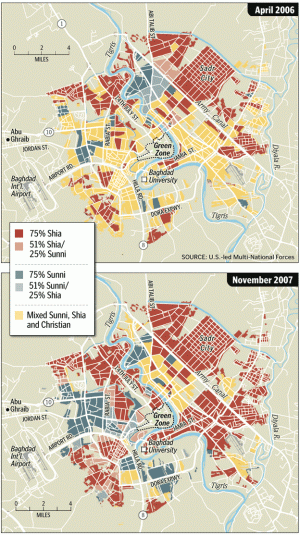
Editor’s Commentchanging-baghdad.gif — The good news coming out of Iraq is that most Iraqis see an end to the U.S. occupation as being the key to national reconciliation. The bad news is that the damage done to Iraq’s social frabric over the last five years is going to be extremely difficult to repair. The problem is starkly depicted in these two maps of Baghdad. In the space of eighteen months, the city has transformed from being predominently made up of mixed neighborhoods (depicted in yellow), to being sharply divided between Shia and Sunni sectors. Now, colliding with this division are returning refugees:

A small fraction of the millions of refugees who fled Iraq have come back. While the government trumpeted their return as proof of newfound security, migration experts said most of them were forced back by expired visas and depleted savings…

The American military has expressed deep concerns about the Iraqi government’s ability to feed and house its returnees, or manage people who wish to reclaim their homes. It is widely feared that property disputes or efforts to return to newly homogenized neighborhoods could set off fresh waves of sectarian attacks.

For most Iraqi refugees, the trip home is just the beginning of their troubles. Many return to find their homes destroyed or filled with squatters, most of them displaced people themselves. But the government committee that decides property disputes is charged with hearing only cases that predate the invasion of 2003.

Strategy that is making Iraq safer was snubbed for years

[A] USA TODAY investigation shows that the strategy now used to defeat the bombmaking networks and stabilize Iraq was ignored or rejected for years by key decision-makers. As early as 2004, when roadside bombs already were killing scores of troops, a top military consultant invited to address two dozen generals offered a “strategic alternative” for beating the insurgency and IEDs.

That plan and others mirroring the counterinsurgency blueprint that the Pentagon now hails as a success were pitched repeatedly in memos and presentations during the following two years, at meetings that included then-Defense secretary Donald Rumsfeld, Secretary of State Condoleezza Rice and Vice President Cheney’s chief of staff, Lewis “Scooter” Libby.

The core of the strategy: Clear insurgents from key areas and provide security to win over Iraqis, who would respond by helping U.S. forces break IED networks and defeat the insurgency.

Bush administration officials, however, remained wedded to the idea that training the Iraqi army and leaving the country would suffice. Officials, including Cheney, insisted the insurgency was dying. Those pronouncements delayed the Pentagon from embracing new plans to stop IEDs and investing in better armored vehicles that allow troops to patrol more freely, documents and interviews show.

Even after the Pentagon began committing substantial resources to combat IEDs, USA TODAY found, its spending focused mostly on high-tech devices with limited utility. Some silver-bullet solutions, such as microwave beams designed to destroy IEDs before they blew up, never worked.

By the time the Pentagon moved to a counterinsurgency strategy at the end of last year, the bombs had been the top killer of U.S. troops for three years, claiming more than 1,160 lives. To date, they are responsible for more than 60% of combat deaths. [complete article]

Facebooktwittermail

NEWS & EDITOR’S COMMENT: Torture complex uncovered

Torture house, mass graves discovered in Iraq

Coalition forces found 26 bodies buried in mass graves and a bloodstained “torture complex,” with chains hanging from walls and ceilings and a bed connected to an electrical system, the military said Wednesday.
[…]
The complex was in an area thought to be an al Qaeda in Iraq haven and operating base, the military said. Iraqis had told the military about the site during an earlier operation.

“Evidence of murder, torture and intimidation against local villagers was found throughout the area,” the military statement said. [complete article]

Editor’s Comment — The unfortunate but predictable effect of a report such as this is that it will empower those who want to argue that “their torture is worse than ours.” But the more important question is this: Have their torturers been empowered by ours? To imagine that Abu Ghraib, Guantanamo, Bagram, renditions and secret CIA prisons have had little impact on the outlook of America’s enemies (and friends) is both ignorant and naive.

Facebooktwittermail

NEWS & EDITOR’S COMMENT: Promoting democracy in Israel; war on Hamas

Adalah center says it may seek supranational regime in ‘all historic Palestine’

The Arab minority rights center, Adalah, is considering a proposal calling for a “democratic constitution for a supranational regime in all of historic Palestine,” including the territory of Israel and the Palestinian Authority. This constitutes a shift from the proposed Democratic Constitution that Adalah offered as a constitution for Israel.

While it is not clear when this change occurred, Adalah sources said Wednesday that the effort does not aim to do away with Israel or delegitimize its existence.

Adalah announced in its monthly newsletter Wednesday that it seeks to establish a group of international experts, including Palestinians and Israelis, to help “finalize the text of the Democratic Constitution.”

In its proposal for a constitution for all historic Palestine, Adalah points to the European Convention on Human Rights as a model. [complete article]

For Israel’s Arab citizens, isolation and exclusion

Fatina and Ahmad Zubeidat, young Arab citizens of Israel, met on the first day of class at the prestigious Bezalel arts and architecture academy in Jerusalem. Married last year, the couple rents an airy house here in the Galilee filled with stylish furniture and other modern grace notes.

But this is not where they wanted to live. They had hoped to be in Rakefet, a nearby town where 150 Jewish families live on state land close to the mall project Ahmad is building. After months of interviews and testing, the town’s admission committee rejected the Arab couple on the grounds of “social incompatibility.” [complete article]

Editor’s Comment — The difference between Israel and South Africa is that the South African whites took pride in their racism and thus gave it a name and a rationale. Most Israeli Jews on the other hand are too attached to their pluralistic Western image and thus an approach described as ensuring “social compatibility” refuses to accept its real name: apartheid.

Israelis cool to an offer from Hamas on a truce

Officials in the Israeli prime minister’s office reacted coolly on Wednesday to an indirect approach by the Hamas leader in Gaza offering talks on a truce.

The offer was relayed through an Israeli reporter, Sleman al-Shafhe, of Channel 2 television. On a news broadcast on Tuesday night, Mr. Shafhe said Ismail Haniya, the leader of the Hamas government in Gaza, had called him earlier in the day to convey a message to the Israelis.

According to Mr. Shafhe, Mr. Haniya said he had the ability to stop the rocket fire directed at Israel from Gaza, on condition that Israel stopped the killing of Palestinians there and lifted the blockade of Gaza.

Mr. Haniya’s call followed Israeli military strikes that killed at least 10 Palestinians in Gaza between Monday night and Tuesday morning, in a concerted effort to suppress the rocket fire. Eight of those killed were from Islamic Jihad, which has been responsible for most of the recent rocket fire, and included a top commander of the group’s military wing, Israeli officials said. [complete article]

Israeli operations in Gaza meet little resistance in Washington

As Israel stepped up air attacks on Gaza this week, the Bush administration refrained from blocking any measures or criticizing Israel’s activity.

The Israeli Air Force last week renewed the practice known as “targeted killing” against members of the Palestinian Islamic Jihad group in Gaza. Israeli officials have said in recent weeks that if rocket fire against Israeli towns is not stopped, further escalation might be imminent, including a full-scale ground incursion into the Hamas-controlled strip.

Administration officials have directed all the blame for the deteriorating situation in Gaza onto Hamas, which seized control of the area in June. Israel, according to diplomatic sources in Washington, was not asked to scale down its actions or to refrain from a ground operation. “I haven’t heard of any red light,” an Israeli official said. The administration’s policy since the recent Annapolis, Md., peace summit entails a two-pronged approach toward the Palestinian Authority. On one hand, Washington will allow Israel to take tough measures against Hamas-ruled Gaza. On the other hand, assistance will be increased to the government of Fatah leader Mahmoud Abbas in the West Bank. At a December 17 donor conference in Paris, the administration pledged $550 million in aid to Abbas’s P.A., an amount that exceeds any previous American financial assistance to the Palestinians. [complete article]

Facebooktwittermail

NEWS: Syria turned away A.Q. Khan

Syria spurned atom smuggler approach in 2001: Assad

Syria rebuffed a possible approach in 2001 from Pakistani-led traffickers in nuclear arms technology, President Bashar al-Assad said.

In an interview with Austrian daily Die Presse, Assad said an unnamed person delivered to Syria a letter purportedly from A.Q. Khan, the now-disgraced father of Pakistan’s atom bomb who supplied Iran, Libya and North Korea with nuclear parts and know-how.

“At the beginning of 2001 someone brought us a letter from a certain Khan. We did not know if the letter was genuine or a forgery by Israel to lure us into a trap,” Assad was quoted by Die Presse on Wednesday as saying. [complete article]

Facebooktwittermail

EDITORIAL: The torture tapes

The torture tapes

Spooks and crooks have a lot in common. Success in either field depends on not getting caught. And as every criminal and spy knows, success depends in large part on the ability to destroy evidence. No evidence, no crime — thus the criminal logic works. So why would the CIA create an evidentiary trail in the first place? Why document torture?

Documentation is institutional insurance. We’ve long known that CIA interrogators are afraid of being hung out to dry. Their fears are well-based, given that they are working for an administration notorious for the lack of accountability among its top officials. Anyone instructed to engage in torture would obviously want to be sure that a clear record would be maintained showing that they had been following their orders with rigorous discipline and precision. The torture tapes must have been created by CIA officers who wanted to be sure that they wouldn’t be disowned by the chain of command. It thus seems reasonable to ask: have all the tapes actually been destroyed? Were no copies made? Contrary to official statements, the interests of the interrogators would more likely be protected by keeping the tapes than by destroying them.

Indeed, it should come as no surprise that the most eager desire to have the tapes destroyed appears to have come from outside the CIA and straight from the White House. As the New York Times today reports:

One former senior intelligence official with direct knowledge of the matter said there had been “vigorous sentiment” among some top White House officials to destroy the tapes. The former official did not specify which White House officials took this position, but he said that some believed in 2005 that any disclosure of the tapes could have been particularly damaging after revelations a year earlier of abuses at Abu Ghraib prison in Iraq.

The lesson from Abu Ghraib was that the worst political damage came not from the abuse itself but from the images. If the photos had never been leaked, the haunting images of abuse would still be locked inside the minds of the torturers and their victims. In America, outside the Pentagon, no one would even have heard the name Abu Ghraib.

The political calculation that was weighed in deciding whether to destroy the torture tapes would thus seem to have been quite simple. Which would exact a higher cost: dealing with questions about the destruction of evidence, or dealing with the repercussions of indisputable evidence that as a matter of policy and practice, the United States Government engages in torture?

George Bush and Dick Cheney don’t want to be remembered as the president and vice-president who undermined American democracy by sanctioning torture. The alternative — to be seen as underhand, duplicitous, and unaccountable — that’s just the dirty world of politics-as-usual.

Facebooktwittermail