When Bahrain’s army opened fire on unarmed protesters yesterday there was little reason to suppose that this was anything other than a cold and calculated show of force. The lesson from Cairo for many Arab leaders was that a regime that is timid about killing its own people will quickly fall. Political dissent cannot be crushed by thugs marauding on camels and horses. The decisive message comes as a government’s marksman steadies his sight with a protester’s head fixed in the cross-hairs. There was nothing random about this act of violence:
But then comes the stunningly eloquent Crown Prince Salman bin Hamad bin Isa Al Khalifa, expressing remorse about the tragic events of recent days.
Are we to supposed that an army captain at Pearl Roundabout was responsible for yesterday’s bloodshed. Or was it that Crown Prince Salman’s consternation was not in response to recklessness in the lower ranks but because the Al Khalifa royal family was under pressure from a higher level?
Rumours burned like petrol in Bahrain yesterday and many medical staff were insisting that up to 60 corpses had been taken from Pearl Square on Thursday morning and that police were seen by crowds loading bodies into three refrigerated trucks. One man showed me a mobile phone snapshot in which the three trucks could be seen clearly, parked behind several army armoured personnel carriers. According to other demonstrators, the vehicles, which bore Saudi registration plates, were later seen on the highway to Saudi Arabia. It is easy to dismiss such ghoulish stories, but I found one man – another male nurse at the hospital who works under the umbrella of the United Nations – who told me that an American colleague, he gave his name as “Jarrod”, had videotaped the bodies being put into the trucks but was then arrested by the police and had not been seen since.
Why has the royal family of Bahrain allowed its soldiers to open fire at peaceful demonstrators? To turn on Bahraini civilians with live fire within 24 hours of the earlier killings seems like an act of lunacy.
But the heavy hand of Saudi Arabia may not be far away. The Saudis are fearful that the demonstrations in Manama and the towns of Bahrain will light equally provocative fires in the east of their kingdom, where a substantial Shia minority lives around Dhahran and other towns close to the Kuwaiti border. Their desire to see the Shia of Bahrain crushed as quickly as possible was made very clear at Thursday’s Gulf summit here, with all the sheikhs and princes agreeing that there would be no Egyptian-style revolution in a kingdom which has a Shia majority of perhaps 70 per cent and a small Sunni minority which includes the royal family.
At a town-hall-style meeting in Bahrain two months ago, Secretary of State Hillary Rodham Clinton got a pointed question from a member of Bahrain’s Parliament: was the United States letting Bahrain, a Persian Gulf ally, off the hook for a string of arrests of lawyers and human rights activists?
The moderator rebuked the questioner for “hijacking the mike,” but Mrs. Clinton replied anyway. “I see the glass as half full,” she said, pointing to Bahrain’s recent elections. “I think the changes that are happening in Bahrain are much greater than what I see in many other countries in the region and beyond.”
When it came to Bahrain, Mrs. Clinton was not the only American diplomat who tended to see the glass as half full. Her rosy assessment, which seems incongruous in light of the army’s bloody crackdown on protesters, illustrates how the United States government has overlooked recent complaints about human rights abuses in a kingdom that is an economic and military hub in the Persian Gulf.
And it leaves the White House once again scrambling to deal with an Arab ally facing a tide of popular discontent. In this case, its calculations are complicated by signs that Bahrain is being pressed by its neighbor Saudi Arabia, the most strategically important country in the region.
In cables made public by WikiLeaks, the Bush and Obama administrations repeatedly characterized Bahrain as more open and reform-minded than its neighbors, and pushed back when human rights groups criticized the government.
In a January 2010 cable, the American Embassy in Bahrain criticized the human rights group Freedom House for downgrading Bahrain’s rating from “partly free” to “not free” in its global survey of political rights and civil liberties. The cable asserted that Freedom House had been successfully lobbied by a radical Shiite movement, known as Haq, which rejects the government’s reform efforts.
Another cable passed along doubts about a Human Rights Watch report that said the police were using torture in interrogations — saying it relied heavily on allegations made by members of the same group — though the embassy did urge the Bahraini authorities to undertake a “timely and credible” investigation.
“The embassy was feeding this happy talk for years,” said Tom Malinowski, Washington director for Human Rights Watch. “Bahrain was moving on a genuine reform path for several years, but it did a significant U-turn in the last year, and I think the U.S. government was well behind the curve.”
“Torture is back in the repertoire of Bahrain’s security services,” said Joe Stork, deputy Middle East director at Human Rights Watch. “The return of torture is especially distressing since Bahrain showed the political will a decade ago to end this scourge.”
Bahrain’s reversion to these discredited practices has come with rising political tensions. Street demonstrations by young men from the country’s majority Shia Muslim population protesting alleged discrimination by the Sunni-dominated government have deteriorated with increasing regularity into violent confrontations with security forces. Arrests have often followed. Security officials appear to be using painful physical techniques to elicit confessions from many of those arrested.
These techniques include electro-shock devices, suspension in painful positions, and beatings. Some of those who were detained reported that security officials threatened to kill or rape them or members of their families. Many were subjected to more than one of these practices.
A month later, the State Department’s annual report on human rights downplayed the torture allegations and seemed to insinuate that the victims’ credibility should be questioned. The report repeatedly cited official denials of the use of torture as though such denials constituted some form of evidence. It also repeatedly referred to rioters using Molotov cocktails — as though anyone engaged in political violence should expect to become a target of violence when held in detention, or, that anyone who riots can’t be trusted.
There are indications that the Obama administration did not simply view Bahrain in the way its rulers wanted the kingdom to be seen. State Department cables revealed by WikiLeaks to the Daily Telegraph, show in detail the administration’s interest in the power dynamics within the royal family and perhaps expose the US government’s desire to manipulate how the Al Khalifa family exercises its power.
To the extent that the US feels empowered and entitled to control other states, it would seem inevitable that a transition to democracy in those states would be regarded as a threat to American interests.
The US State Department secretly asked its diplomats in Bahrain to report any “derogatory” information about two of the King’s sons and evidence of “rivalry” with senior members of the ruling royal family, leaked documents show.
The office of Hillary Clinton, the Secretary of State, wanted to know if Prince Nasir bin Hamad al Khalifa or Prince Khalid bin Hamad al Khalifa took drugs, drank alcohol or “caused problems” within the monarchy.
Embassy staff in the Bahraini capital of Manama were also asked whether the princes had any friends among the country’s Shia Muslim majority, which is behind this week’s protests against the minority rule of the Sunni regime.
Prince Nasir, 23, who is serving in the Bahrain Defence Force, and Prince Khalid, 21, are King Hamad’s sons by his second wife and there have been fears in the region that hardliners from neighbouring countries might try to influence them.
Another cable reveals that the princes’ father, King Hamad, saw Bahrain’s strategic relationship with the US as so indispensable that he wanted to be sure the US Fifth Fleet would remain for decades:
He said he wanted to ensure a U.S. naval presence in Bahrain “for the next fifty years” and wondered aloud what kind of commitment Bahrain could offer that would serve this purpose. He suggested, for example, that Bahrain could increase production of crude or refined products to meet the Navy’s fuel requirements.
As an extra incentive, Bahrain considered offering the US Navy long-term fuel contracts at a fixed price. And keep in mind that Bahrain is a relatively minor oil producer.
Meanwhile, Eric Avebury provides some political background on the tiny Gulf state.
Bahrain is an hereditary dictatorship masquerading as a parliamentary democracy. The state has been ruled by the al-Khalifa family since the end of the 18th century, and still today all ministers are appointed by the King, who chooses 80 per cent from his near relations. The Prime Minister, who is the King’s uncle, has occupied the post since 1971, when Bahrain got its independence.
The al-Khalifas are Sunnis, but the majority of the population was Shia, at least until very recently. The regime has engaged in long-term demographic engineering, by granting citizenship, jobs and housing to Sunni immigrants. At the same time a clandestine organisation headed by another relative, Shaikh Ahmed bin Ateyatalla Al Khalifa, works to ensure that the Shia remain powerless, economically and politically. Gerrymandering at the last election saw to it that although 60 per cent of the votes were for Shia candidates, only 16 of them were elected to the lower house of parliament.
Who would have thought that two years after George W Bush’s departure from the White House we could look back and say: there was a man with greater integrity and moral stature than the current occupant.
Believe me, that is not a compliment to Bush. It is an expression of utter contempt for Barack Obama and his inability to take a stand and speak unequivocally with moral clarity (a virtue the neocons insisted they owned yet never convincingly displayed).
This is what happened today in Bahrain on one of the streets approaching Pearl Roundabout. No commentary or explanation is required.
This is how the Al Khalifa royal family handles non-violent political dissent.
And this is Obama’s response:
I am deeply concerned by reports of violence in Bahrain, Libya and Yemen.
The United States condemns the use of violence by governments against peaceful protesters in those countries and wherever else it may occur. We express our condolences to the family and friends of those who have been killed during the demonstrations.
Wherever they are, people have certain universal rights including the right to peaceful assembly.
The United States urges the governments of Bahrain, Libya and Yemen to show restraint in responding to peaceful protests, and to respect the rights of their people.
The United States is deeply indebted to the Al Khalifa family for being so gracious as to host the US Fifth Fleet. It would be impolite to do anything more than urge them to show restraint. After all, if — God forbid — in the near future they were all to end strung up through a swift application of justice as Bahrain came under Shia majority rule, then the strategic implications for the United States would be unthinkable.
So, a strong but carefully tempered presidential condemnation was in order. But note that America’s “model partner” did not get singled out. The rebuke was dished out collectively and universally as an observation about behavior that the United States condemns without consequence.
And this is what the world has come to see as Obama’s signature: empty words from a hollow man.
Yet again, Bahrain’s government has initiated a brutal crackdown on demonstrators — and this time the army is reported to be firing live rounds. A doctor has been killed and paramedics injured while trying to help injured protesters. Ambulances are being denied access to the scene of the massacre.
The United States last year provided Bahrain about $20.8 million in military assistance, a substantial amount for such a small country and almost double what it received in 2009. The vast majority of the funds went to pay for improvements to Bahrain’s F-16 fighter fleet and to its navy’s flagship frigate, supplied by the United States in 1996.
In the past, Bahrain has sent more than 100 police to Afghanistan to help build up that country’s force. Overall U.S. counterterrorism aid to Bahrain doubled last year to almost $1.1 million.
Much of that assistance likely went to police and military forces that are suppressing the current protests.
If the US is Egypt’s primary patron, in Bahrain it is among the ruling family’s biggest tenants, as the country is home to the Fifth Fleet, one of the US military’s most important naval armadas, crucial to protecting Persian Gulf shipping and projecting US power against Iran.
But while Bahrain has long been depicted as relatively moderate compared with its Salafi neighbor, Saudi Arabia, the reality is that the country is repressive and far from free, as citizens have almost no ability to transform their government, which according to the State Department “restricts civil liberties, freedoms of press, speech, assembly, association, and some religious practices.”
In the wake of Egypt, where many people harbor resentment against the Administration for its lack of early support for the democracy movement what can Obama do now? Can he in good conscience acquiesce to the brutal suppression of pro-democracy protesters so soon after his eloquent words and late coming to supporting the Egyptian revolution?
The larger question is: What is more essential to American security today, convenient bases for its ships, planes and troops across the Middle East, or a full transition to democracy throughout the region?
The answer is clearly the latter, as evidenced by the fact that America’s two primary antagonists in the Middle East, al-Qaeda and the Iranian government, have seen their standing sink in proportion to the rise of the pro-democracy movements.
In any war, cold or hot, propaganda is crucial, and here it is impossible to lose sight of the fact that al-Qaeda has had little if anything to say about the Egyptian revolution precisely because it was a massive non-violent jihad that succeeded miraculously where a decade of al-Qaeda blood and vitriol have miserably failed.
As for Iran, the government’s rhetorical support for the Egyptian revolution while it continues to suppress its own democracy movement is clearly emptying the Iranian regime of any remaining credibility as an alternative to the US-dominated order.
In this sense the success-so far-of the Egyptian revolution has presented Obama with a unique window of opportunity to forcefully advocate and press for the same kind of democratic transition across the Middle East and North Africa.
The signs on Tuesday were somewhat optimistic, as the President warned all regional leaders that they should “get ahead of the wave of protest” by moving towards democracy as quickly as possible. Yet Obama refused to mention Bahrain by name in his press conference, even as the government was cracking down on the protesters.
Instead, the US president argued that “each country is different, each country has its own traditions; America can’t dictate how they run their societies,” an utterly meaningless declaration since it contradicts the very advocacy of democracy that the President has made out of the other side of his mouth.
And now, once again, in the wake of government violence against peaceful citizens, the Obama administration stands silent, refusing to openly condemn the Bahraini government. Is the administration incapable of learning from mistakes in the immediate past?
Colonel Ian Henderson, who from 1966 until 1998 was Bahrain’s security chief, is alleged to have instituted and overseen a brutal torture regime in the Gulf state, as a result of which he came to be known as the “Butcher of Bahrain.” Numerous human rights organizations have investigated and confirmed the allegations against him, yet an investigation by British police was suspended in 2008 due to a lack of co-operation from the Bahrain government.
“Ian Henderson has played a very dirty role,” said Saeed Shehabi, Bahrain Freedom Movement, in 2002. “Ever since he came to Bahrain in 1966, he embarked upon an era of terror and thousands of people were arrested — arbitrarily arrested — and tortured under his command. Until he retired, two or three years ago, he was the strong man behind the whole repressive regime in Bahrain.”
Blind Eye to the Butcher (2002)
In a report on Bahrain’s reliance on foreign nationals in its security services, Ian Black adds:
Bahrainis often complain that the riot police and special forces do not speak the local dialect, or in the case of Baluchis from Pakistan, do not speak Arabic at all and are reviled as mercenaries. Officers are typically Bahrainis, Syrians or Jordanians. Iraqi Ba’athists who served in Saddam Hussein’s security forces were recruited after the US-led invasion in 2003. Only the police employs Bahraini Shias.
The secret police – the Bahrain national security agency, known in Arabic as the Mukhabarat – has undergone a process of “Bahrainisation” in recent years after being dominated by the British until long after independence in 1971. Ian Henderson, who retired as its director in 1998, is still remembered as the “Butcher of Bahrain” because of his alleged use of torture. A Jordanian official is currently described as the organisation’s “master torturer”.
Channel 4 report on human rights abuses in Bahrain (1999)
The pro-democracy rally at Bahrain’s Lulu Roundabout was brought to a violent end at 3am this morning when police launched a brutal assault against what at that time were mostly sleeping protesters.
Was this one of the “difficulties along the way” down “the democratic path that Bahrain is walking on” for the nation Hillary Clinton described as a “model partner” for the US less than three months ago?
When security forces launch a brutal crackdown on peaceful protesters, killing five, injuring hundreds and then the government prevents ambulances reaching the injured, there’s only one way this can be described: state terrorism.
And when the state in which this is occurring, Bahrain, is of preeminent importance to the US government because it serves as the base for the US Fifth Fleet and US naval operations in the Gulf, this becomes US-back state terrorism.
Mealy-mouthed statements from the White House on the need for “both sides” to exercise restraint and avoid violence, do nothing to disguise American complicity as yet again Washington attempts to shield one of its allies.
Here’s some of what the New York Times‘ Nicholas Kristof has reported in the last few hours:
At hospital in #Bahrain. 600 brought here w/ injuries as of 8 am, more since. Beatings, shotgun pellets, rubber bullets.
Nurse told me she saw handcuffed prisoner beaten by police, then executed with gun.
Abt 10 ambulance paramedics attacked by #Bahrain police. I interviewed them, saw their injuries.
#Bahrain govt has ordered ambulances to stop going out, hospital says.
1 #Bahrain ambulance driver told me #Saudi army officer held gun to his head, said wld kill him if helped injured.
Witnesses say #Bahrain police cursed Shia as they attacked peaceful demonstrators. I haven’t found 1 Sunni victim.
Crowd growing at main #Bahrain hospital, chanting slogans against royal family. Will govt attack them here?
In morgue, I spoke to brother of 22 year old killed by police shotgun blast. He says King Hamad must step down.
Maryam Alkhawaja from the Bahrain Centre for Human Rights tweets that “several Bahraini officers are being prosecuted for refusing to take part in violence against peaceful protesters.”
Meanwhile, Amnesty International provides the following chilling account of torture conducted by the Egyptian army, just days before Hosni Mubarak stepped down:
An 18-year-old secondary school student from Cairo told Amnesty International that he was tortured after he was arrested at about 1500hrs on 3 February 2011 by soldiers near Tahrir Square:
“I was walking with a friend towards the square when soldiers stopped us and asked for our IDs. They seemed to be suspicious of my friend, because he holds a UK residence permit. They took us to the area museum which is controlled by the army and held us there in an outdoor area. After some while we were blindfolded and handcuffed and I could not see what happened to my friend. I could only hear him screaming and believe he was severely beaten. I was only slapped in the face but not severely beaten while held at the museum.
“That night we were transferred to another location about 30 minutes away from Tahrir Square. When we got out we had to lie down on the floor and were beaten. Then I was taken for interrogation where they insulted me and my family. They said things one should not say. They took off my handcuffs, because they ordered me to take off my clothes, except my underwear, but I remained blindfolded. Then they handcuffed me again and tied my legs. They put a chain or rope to my legs and lifted me up, so that my head was hanging down. From time to time they would let me down into a barrel that was filled with water. They told me to confess that I was trained by Israel or by Iran. They also put electric shocks to my body and I fainted. This continued for several hours. After the torture finished I was so exhausted that I slept for hours.
“The next day I was taken in a group of about 30 people to another location, which – as I learned later – was Sign al-Harbi [a military prison at El Heiksteb, northeast of Cairo]. When we got out of the vehicle our blindfolds were taken off and soldiers started beating us with whips and truncheons. There are still scares on my back from the beatings. We were lead to our cells where I soon fell asleep. They kept beating us, including when we went to the bathroom. The last days of my detention I refused to eat to protest against the treatment. Finally we were released. They left us on the road to Cairo and told us to walk back.”
He was released with hundreds of other detainees from the military prison on 10 February 2011. Amnesty International delegates interviewed him several days later when scars were still visible on his back.
During an era in which Americans have been told that the threat from terrorism should be preeminent among this nation’s national security concerns, the gravest omission in public debate on this issue has been consideration of the relationship between state-sanctioned brutality and terrorism.
We have been led to believe that terrorism arising in the Middle East is spawned by extremist Islamist ideology while overlooking its much more transparent secular roots: the willingness of autocratic rulers to use violence as an instrumental and indispensable tool through which they can exercise and sustain their power.
When the word “stability” gets bandied around as though it was describing a condition of civic calmness and social order, we should remember that when someone has a gun pointed to their head they are able to sit in perfect stillness — this is stability under the threat of violence, the condition in which most people in the Middle East have lived for generations.
Where violence provides the backbone of governance, should we be surprised that similar forms of brutality would be adopted by some individuals and groups that want to challenge their rulers? And should we imagine that when these rulers are counted as America’s friends, that the US could provide its support with impunity?
What we should really marvel at is the fact that people across the region are now rising in their thousands driven, in part, by the audacious idea that non-violence can overcome violence.
The top U.S. military officer says the relationship between the American and Israeli militaries is especially relevant while Mideast nations are steeped in unrest.
Adm. Mike Mullen, the chairman of the Joint Chiefs of Staff, discussed the instability in Egypt with Israeli President Shimon Peres on Monday. He said the American-Israeli alliance is “something we both depend on.”
As the recipient of $3 billion in military aid annually, it’s clear how Israel is dependent on the United States, but much less clear how the dependence is mutual. Perhaps Mullen had personal dependence in mind, given that his principal adviser, Dr Lani Kass, grew up in Israel and was a major in the IDF.
As the train of democracy gathers steam in Egypt, there are those nearby who seem eager to throw themselves under its wheels.
No doubt an observer such as the Israeli historian, Benny Morris, is vain enough to imagine that he is not about to get run over but, on the contrary, hopes his grave warnings will encourage others to seize the train’s brakes and prevent an imminent catastrophe.
What is more likely to happen is that we will only need wait a matter of months before Morris and fellow fearmongers will be exposed as hysterical fools or intellectual rogues.
Morris believes that those of us in the West currently intoxicated by the glorious vision of democracy taking birth in Egypt, have only been able to indulge in such emotions because we don’t understand what Egyptians really want.
Alas, I fear, Westerners will see what most Egyptians actually think and want if and when the country holds free and fair general elections (perhaps in September-October). And I fear that they will be surprised—perhaps even shocked—by the results, and by what the Egyptian masses then say about what they actually think and want. I fear that at that point, “Death to Israel,” “Death to America,” and “Allahu Akbar” will drown out every democratizing and liberalizing chant.
But by then the genie will be well out of the bottle; by then, it will be too late.
Trapped inside a misanthropic Zionist mindset, Morris seems incapable of recognizing that at the core of the Egyptian and Tunisian revolutions, the driving force is not ideological. It is a universal and human demand for respect.
Sensing themselves newly visible on a world stage, ordinary Tunisians and Egyptians stood up, individually and collectively, and said: we refuse to be treated as less than human. We are reclaiming the dignity that is everyone’s birthright and will no longer tolerate the abuse of brutal rulers or the indifference of foreign powers. We demand to be heard and respected.
To the extent that the call from the dignity revolutions is being heard far beyond the Arab world, it resonates most with those who to differing degrees and for different reasons, share the same experience. That many of us live in democracies does little to diminish a sense that our governments do not represent our interests. And that so many of our fellow citizens respond to this reality with indifference only makes us envy the courage and imagination of people who do otherwise as they rise up, declare and discover: we have the power to change the world.
Even though the Egyptian revolution has frequently been described as leaderless and it clearly enjoyed support from all sections of Egyptian society and beyond being a demand for democratic rights was non-ideological, it was not unplanned.
An article in the Wall Street Journal and a documentary by Al Jazeera reveal new details of some of the ingenious and meticulous organization that translated the will of the Egyptian people into a viable force capable of toppling a regime.
The youth organizers of the uprising knew their challenge was to outwit police who were expert at containing demonstrations and keeping ordinary Egyptians away.
They met daily for two weeks [in early January] in the cramped living room of the mother of Ziad al-Alimi. Mr. Alimi is a leading youth organizer for Mr. ElBaradei’s campaign group. His mother, a former activist who served six months in prison for her role leading protests during the bread riots in 1977, lives in the middle-class neighborhood of Agouza on the west bank of the Nile.
Those present included representatives from six youth movements connected to opposition political parties, groups advocating labor rights and the Muslim Brotherhood.
They chose 20 protest sites, usually connected to mosques, in densely populated working-class neighborhoods around Cairo. They hoped that such a large number of scattered rallies would strain security forces, draw larger numbers and increase the likelihood that some protesters would be able to break out and link up in Tahrir Square.
The group publicly called for protests at those sites for Jan. 25, a national holiday celebrating the country’s widely reviled police force. They announced the sites of the demonstrations on the Internet and called for protests to begin at each one after prayers at about 2 p.m.
But that wasn’t all.
“The 21st site, no one knew about,” Mr. Kamel said.
To be sure, these activists weren’t the only ones calling for protests that day. Other influential groups rallied their resources to the cause. The Facebook page for Khaled Said, the young man beaten to death by police in Alexandria, had emerged months earlier as an online gathering place for activists in Egypt.
There was an Arabic page and an English page, and each had its own administrators. Mr. Ghonim, the Google executive, has now been identified as one. The pages’ other administrators remain anonymous.
An administrator for the English-language page, who uses the online moniker El-Shaheed, or The Martyr, recounted the administrators’ role in the protests in an interview with The Wall Street Journal via Gmail Chat. El-Shaheed recalled exchanging messages with the site’s Arabic-language administrator on Jan. 14, just as news broke of the Tunisian president’s flight from his country. Mr. Kamel and his cohorts, who had already begun plotting their protest, now had another powerful recruiting force.
“I was talking with Arabic admin and we were watching Tunisia and the moment we heard Ben Ali ran away, he said, ‘We have to do something,’ ” said El-Shaheed, whose true identity couldn’t be determined.
The Arabic administrator posted on the Arabic page an open question to readers: “What do you think we should give as a gift to the brutal Egyptian police on their day?”
“The answer came from everyone: Tunisia Tunisia : ),” wrote El-Shaheed.
For the final three days before the protest, Mr. Kamel and his fellow plotters say they slept away from home, fearing police would come to arrest them in the middle of the night. Worrying their cellphones would be monitored, they used those of family members or friends.
They sent small teams to do reconnaissance on the secret 21st site. It was the Bulaq al-Dakrour neighborhood’s Hayiss Sweet Shop, whose storefront and tiled sidewalk plaza—meant to accommodate outdoor tables in warmer months—would make an easy-to-find rallying point in an otherwise tangled neighborhood no different from countless others around the city.
The plotters say they knew that the demonstrations’ success would depend on the participation of ordinary Egyptians in working-class districts like this one, where the Internet and Facebook aren’t as widely used. They distributed fliers around the city in the days leading up to the demonstration, concentrating efforts on Bulaq al-Dakrour.
“It gave people the idea that a revolution would start on Jan. 25,” Mr. Kamel said.
In the days leading up to the demonstration, organizers sent small teams of plotters to walk the protest routes at various speeds, to synchronize how separate protests would link up.
On Jan. 25, security forces predictably deployed by the thousands at each of the announced demonstration sites. Meanwhile, four field commanders chosen from the organizers’ committee began dispatching activists in cells of 10. To boost secrecy, only one person per cell knew their destination.
In these small groups, the protesters advanced toward the Hayiss Sweet Shop, massing into a crowd of 300 demonstrators free from police control. The lack of security prompted neighborhood residents to stream by the hundreds out of the neighborhood’s cramped alleyways, swelling the crowd into the thousands, say sweet-shop employees who watched the scene unfold.
At 1:15 p.m., they began marching toward downtown Cairo. By the time police redeployed a small contingent to block their path, the protesters’ ranks had grown enough to easily overpower them.
The other marches organized at mosques around the city failed to reach Tahrir Square, their efforts foiled by riot-police cordons. The Bulaq al-Dakrour marchers, the only group to reach their objective, occupied Tahrir Square for several hours until after midnight, when police attacked demonstrators with tear gas and rubber bullets.
It was the first time Egyptians had seen such a demonstration in their streets, and it provided a spark credited with emboldening tens of thousands of people to come out to protest the following Friday. On Jan. 28, they seized Tahrir Square again. They have stayed there since.
Egyptians triumphed over their police state without Western help or even moral support. During rigged parliamentary elections, the West barely raised an eyebrow. And when the protests began at Tahrir Square, Secretary of State Hillary Rodham Clinton said that the Mubarak government was “stable” and “looking for ways to respond to the legitimate needs and interests of the Egyptian people.”
Commentators have repeatedly referred to the Obama administration playing catch-up during the Egyptian revolution, yet its seeming inability to track fast-changing events was merely an expression of its unwillingness to embrace the direction those events were heading.
Immediately after Hosni Mubarak resigned, Jake Tapper from ABC News tweeted that he couldn’t find anyone in the administration who thought that whatever comes next would be better for U.S. interests than Mubarak had been.
The dictator’s departure is not being celebrated in Washington. The leaders of the free world have a singular lack of enthusiasm for freedom.
The administration has not merely repeatedly stumbled, but has functioned as a dead weight, attempting to slow the pace of what may become the most significant transformation in world order since the birth of Western colonial power.
America’s friends in Israel have been equally unenthusiastic about the turn of events. After Mubarak’s defiant speech on Thursday night when he insisted he would sit out his term as president, “Israel breathed a sigh of relief,” according to Israeli commentator, Alex Fishman. The respite must have felt dreadfully brief.
But if Americans want to grasp the significance of the Egyptian revolution, they need look no further than this country’s much bloodier assertion of people power: the American revolution.
For the first time in Egypt’s history, the Egyptian people have made a declaration of sovereignty and claimed their right of self-governance. Is that not something that every person on the planet who cherishes life and liberty can joyfully celebrate?
As Western leaders now line up, having no choice but to express their support for the revolution, while sagely offering guidance and assistance in managing an “orderly transition” to a democratic system, they do so with a palpable ambivalence.
People power is in jeopardy of sweeping the Middle East and undoing the carefully constructed “stability” through which for most of the last century the West has managed the control of its most vital resource: oil.
Worse for the United States, the Egyptian revolution now undermines the US government’s ability to sustain an unswerving loyalty to the preeminence of Israel’s security interests.
A democratic Egyptian government will not have the autocratic latitude that until now enabled Mubarak’s complicity in the siege of Gaza or his willingness to participate in the charade of a peace process going nowhere.
Stepping back from the most obvious regional implications of what is now unfolding, there is a more far-reaching dimension.
When in 1990 President George HW Bush used the phrase “new world order”, his words had an ominous ring both because they implied that this would be an American-defined order but also — on the brink of the first Gulf War — a militarily-imposed order. The new order was synonymous with the dubious claim that the collapse of the Soviet Union represented an American “victory” in the Cold War.
A new world order worthy of the name, however, should represent something much more significant than the strategic reapportioning of power on a geopolitical level. It should involve the reapportioning of power through which global affairs become the people’s affairs. It should mean that international relations can no longer be conducted within the confines of intrinsically undemocratic arenas where ordinary people have no voice.
The people-power unleashed in Egypt has the potential to serve as a democratizing force that not only threatens autocratic leaders in the Middle East but also technocratic and nominally democratic leaders in the West — those whose complacent style of governance has depended on the political passivity of the populations they nominally serve while providing ready access for corporate interests to exercise their undemocratic influence.
The West, far from representing a model of democracy ripe for export has instead long been mired in a post-democratic phase where the foundational concept of demos, the people, has withered.
Individual wealth has supplanted the need for social solidarity as citizenship has been substituted by consumerism. Our material self-sufficiency has robbed us of the experience of mutual reliance and worn thin the fabric of society.
In a new world order, a new democracy might spread not just further east but also further west.
There is also a bittersweet note in this moment.
The Western exporters of democracy delivered the war in Iraq and yet as we witness events unfold in Egypt, it’s hard not to wonder what might have been possible had the people of Iraq, without Western help or hindrance, been allowed the same opportunity to claim their own freedom.
Live updates:
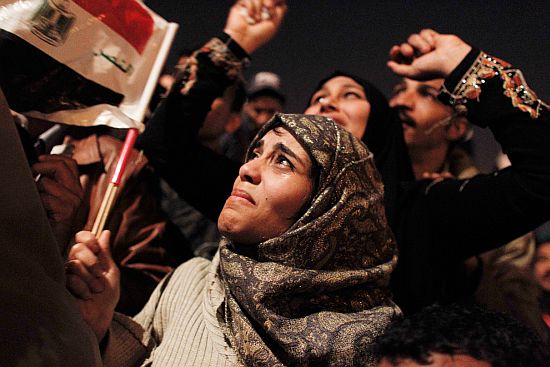
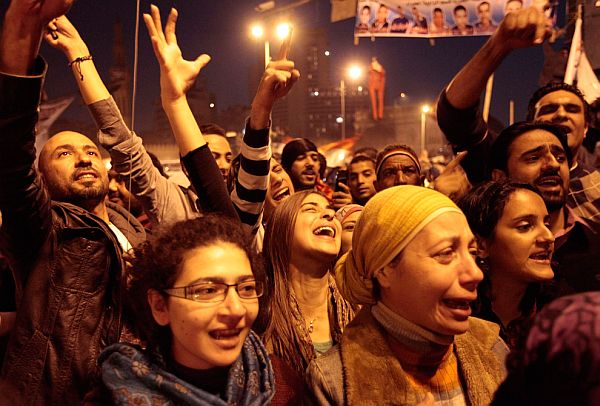
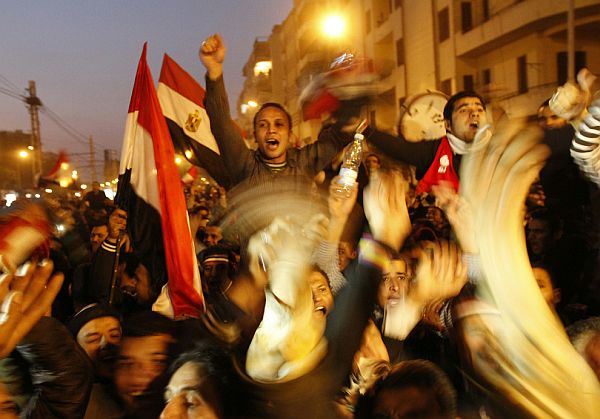
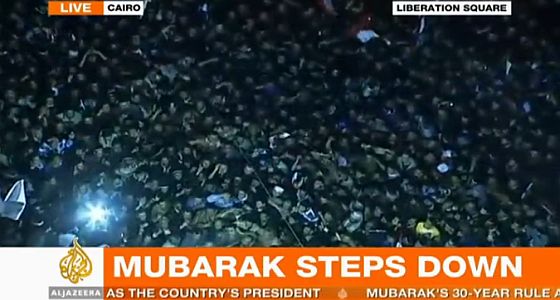
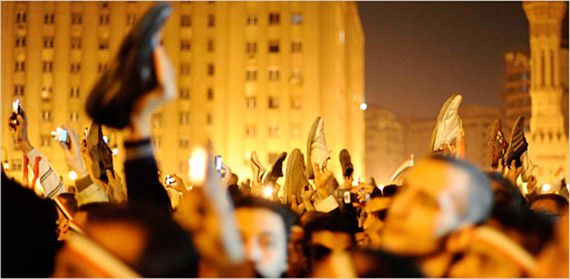
FINALLY MUBARAK RESIGNS! Suleiman announces the armed forces are now in control of Egypt.
Wall Street Journal — How young activists outwitted Egypt’s feared security forces to spur an uprising many here had long thought impossible.
7.20 — @avinunu: BBC Arabic: Switzerland has frozen Mubarak’s bank accounts.
Al Jazeera — Brief profiles of country’s Supreme Council of the Armed Forces as Hosni Mubarak hands over power to the body.
Reaction from Washington – ABC’s Jake Tapper: “cant find anyone in O admin who thinks whatever comes next will be better for U.S. interests than Mubarak was.”
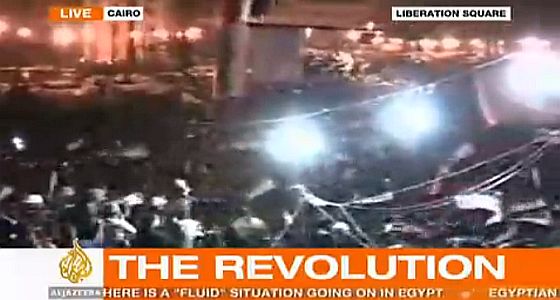
Al Arabiya — nearly 20 million Egyptians are in the street today.
4.05pm — @ashrafkhalil: Everybody calm down about reports that Mubarak has “left Cairo.” He runs country from Sharm El Shiekh more than half the time#egypt #jan25
One cannot but note the “miraculous” nature of the events in Egypt: something has happened that few predicted, violating the experts’ opinions, as if the uprising was not simply the result of social causes but the intervention of a mysterious agency that we can call, in a Platonic way, the eternal idea of freedom, justice and dignity.
The uprising was universal: it was immediately possible for all of us around the world to identify with it, to recognise what it was about, without any need for cultural analysis of the features of Egyptian society. In contrast to Iran’s Khomeini revolution (where leftists had to smuggle their message into the predominantly Islamist frame), here the frame is clearly that of a universal secular call for freedom and justice, so that the Muslim Brotherhood had to adopt the language of secular demands.
The most sublime moment occurred when Muslims and Coptic Christians engaged in common prayer on Cairo’s Tahrir Square, chanting “We are one!” – providing the best answer to the sectarian religious violence. Those neocons who criticise multiculturalism on behalf of the universal values of freedom and democracy are now confronting their moment of truth: you want universal freedom and democracy? This is what people demand in Egypt, so why are the neocons uneasy? Is it because the protesters in Egypt mention freedom and dignity in the same breath as social and economic justice?
Der Spiegel — Mubarak has rejected an offer to put him up in a German luxury clinic to provide him with a dignified exit from power. He doesn’t need medical treatment, his vice president said.
3.50pm — @arabist: America is really a push-over. Govts. in TelAviv and Cairo take its money and then tell it to fuck off. Americans deserve better FP leaders.
Associated Press — Binyamin Ben-Eliezer of Israel’s Labor Party said he spoke with Mubarak just hours before the Egyptian president’s speech late Thursday.
Describing his conversation with Mubarak, Ben-Eliezer said: “He knew that this was it, that this was the end of the road.”
“He was looking for only one thing – give me an honorable way out. Let me leave in an honorable fashion,” Ben-Eliezer told Israel’s Army Radio.
Control of Egypt’s economy appeared to be slipping out of the government’s hands, as strikes multiplied across the country and leading business figures sought to disassociate themselves with the Mubarak regime.
Thousands of workers in key industries walked out from their jobs, piling pressure on a political leadership already rocked by the 17th straight day of street protests calling for the president to stand down.
In a further blow to leading NDP members, who in recent years have styled themselves as pro-business reformers, several large companies took out adverts in local newspapers putting distance between themselves and the regime.
Israelis deeply confused about the nature of political stability — still cling to the idea that Mubarak is a stabilizing force:
“Israel breathed a sigh of relief,” Israeli commentator Alex Fishman wrote in Friday’s daily Yedioth Ahronoth after Mubarak’s speech. Fishman noted that now it was unlikely there would be any shifts in Egypt’s foreign policy until at least September. “We’ve received an extension. Which will make it possible for the State of Israel to study the developments closely and to try to prepare for them,” Fishman wrote.
By the standards of any modern politician, it was truly dreadful: in turns vain, arrogant, patronising, condescending and defiant. Above all, it showed Mubarak totally out of touch with the mood of the country and the will of the people that he governs. The only thing to be said in its favour is that it illustrated, in just a few hundred words, all the reasons why he ought to go (even if he’s still refusing to do so).
He began by addressing the people as his “sons and daughters” – a phrase that might slip past unnoticed, though in fact it encapsulates the fundamental problem with Arab leaders and how they perceive themselves and their citizens. They behave like the traditional head of an Arab household, the paterfamilias – a remote, supposedly wise and almost God-like figure who rarely speaks but, when he does, must always be obeyed because he knows what’s best for his children.
3.45pm — @alaa: I’m not religious, and I want a secular egypt, but those secularists who think religion has no role in political life know nothing #Jan25
Most Egyptians cannot make heads or tails of the strangest evening since the crisis began on January 25th. But the night’s events confirm a few things. Mr Mubarak appears to be delegating more power, both formally and de facto, to Mr Suleiman. Even some senior officials now say he is a mere figurehead. The army continues to send mixed messages, perhaps reflecting an internal split, and the political elite that fronts for the military appears ever more out of the loop.
But most of all, the young men and women who form the bulk of the protest movement and have had some success in recent days in spreading dissent to ministries, factories and public services—postal workers, telecommunication workers, bus drivers and hospital staff have staged partial strikes—are becoming increasingly convinced that their country’s leadership is deaf to their pleas.
Earlier today, the Egyptian blogger Sandmonkey wrote the following post: “Mubarak’s Gamble”
Earlier yesterday, I spoke to Wael Ghonim and he told me to expect some very good news around 5 pm that night, but he never elaborated what it is. Around 10 am, we heard that Saudi Arabia, alongside UAE and Kuwait, are creating an aid package to Egypt to possibly replace that of the US. Around 4 pm last night, we recieved the news that the President itends to step down tonight and give all of his responsbilities to the VP, Omar Suleiman. The Army then convened and issued its first statement, in a meeting without Mubarak or his VP around 5 pm. Around 9 pm Egypt time, Obama did a speech congratulating the people of Egypt for their march for democracy, so it seemed like a done deal. Finally, an hour later than originally announced, President Hosny Mubarak , against all expectations and information, refused to step down from his post, and said that he refuses any foreign interference in Egypt. The White House then announced that it has been double-crossed by the Egyptian regime.
Now, what does this all mean?
Well, 4 main things:
1) Mubarak is not going to leave Office without bloodshed. Any attempt for a peaceful exit has been discarded by his regime, and they are intending to fight the will of the people until the end.
2) Mubarak has burned the image of Hossam Badrawy and the Wisemen council with his speech. Hossam Badrawy, the secretary general of the NDP, was the face of the NDP that announced Mubarak’s intenetion to abdicate power later tonight. Now the man has no credibility. Same goes for the Wiseman Council, since Mubarak’s speech was focused on how he has met their demands, which don’t include him leaving. If most of them don’t quit their posts today, I would be greatly surprised.
3) We are seeing the first possible split in the power structure in Egypt: It seems that the Armed forces are in one camp, and the president, intelligence agencies and the republican guard in another camp. If you add to the equation the Ministery of Interior and the protesters, you have 4 players right now in an intensely unpredictable power struggle. We are now awaiting the second statement from the High council of amred forces to clearify their position once and for all. Whether the Army is with or against the people will determine a lot of today’s outcome.
4) Mubarak has now put the US in a corner: He double-crossed the White House, and announced his intentions to fight foriegn intervention. Adding to that the news of the arab aid, he is sending the US a clear message: “I could tell you and your aid to go to hell, and get the money from the arabs instead. Where does this leave your precious Israel? If you don’t want us to cause problems on that front, you better shut up about what we will do and get with the program, or else!”
If you take all of those factors into consideration, the situation starts looking intensely ominous. If the regime and the army has split, we could see major fighting and bloodshed today. If the Army is with the President, then they will all turn their guns on the Protesters, who are determined not to live under Mubarak rule for one extra day. It also means that he put on the line the future of the transitional government with Omar Suleiman in charge, because Suleiman’s fate seems intensely intertwined with the President now. This has become a fight for survival: it’s either the regime or the people. The bad news is, the regime has all the weapon and organization. The good news is, the people are determined and increasing in numbers and the army might step in and save us all unnecessary bloodshed.
Lyrics: “I went down and I said I am not coming back, and I wrote on every street wall that I am not coming back.
“All barriers have been broken down, our weapon was our dream, and the future is crystal clear to us, we have been waiting for a long time, we are still searching for our place, we keep searching for a place we belong too, in every corner in our country.
“The sound of freedom is calling, in every street corner in our country, the sound of freedom is calling..
“We will re-write history, if you are one of us, join us and don’t stop us from fulfilling our dream.”
In President Obama’s latest statement on events in Egypt, he does not swerve from the position he has maintained from day one: that of a concerned but impotent spectator.
“In these difficult times, I know that the Egyptian people will persevere, and they must know that they will continue to have a friend in the United States of America.”
But does this friend intend to do anything other than express beliefs and hopes about a desirable outcome?
“As we have said from the beginning of this unrest, the future of Egypt will be determined by the Egyptian people.” And in another nod to people power: “The Egyptian people have made it clear that there is no going back to the way things were: Egypt has changed, and its future is in the hands of the people.”
And yet the whole world knows that the US is not an impotent and innocent onlooker — it is deeply invested in supporting Egypt’s military.
The White House claims it supports democracy in Egypt and that the US should have no role in determining who governs, yet Obama can certainly make the continuation of military aid contingent on the existence of a democratic government.
At this decisive moment when the Egyptian military has to choose between supporting an embattled and increasingly desperate president or siding with the people, the risk of losing one third of the country’s military funding could bring some much-needed clarity to the generals’ thinking.
Remarkably it appears that state television made a crude attempt to convince its viewers that Wael Ghonim, the protest organizer who was just released after nearly two weeks in detention, had encouraged protesters to return home following President Hosni Mubarak’s speech.
According to Egyptian bloggers, state television reported on Thursday night that Mr. Ghonim had called for an end to protests online — although he posted no such message on his Twitter feed. A short time later, a friend of Mr. Ghonim’s wrote on Twitter: “Wael is in Tahrir and can’t access Internet. He no longer thinks demands are met. He thought that before the speech.” He added that Mr. Ghonim said: “I have NOT made any statements to anyone since Mubarak’s speech…. I did NOT tell people to go home.”
Al Jazeera: John Bradley, author of Inside Egypt: The Land Of The Pharoahs On The Brink Of A Revolution, tells us: “The revolution starts tomorrow. We will see unprecedented numbers of Egyptians on the streets.”
The Obama administration has gone silent following the latest speech by Egyptian President Hosni Mubarak, in which he seemed to cede some powers to Vice President Omar Suleiman but refused to step down from office.
“We don’t have any immediate comment,” National Security Spokesman Tommy Vietor told The Cable. Follow-up requests for information about how the White House was processing the latest news from Cairo went unreturned. The State Department cancelled its daily press briefing and State Department spokesman P.J. Crowley’s latest tweet on the matter was several hours ago.
Egypt’s ambassador to the United States, Sameh Shoukry, later told CNN that Mubarak has transferred “all his presidential authority to the vice president,” whom he said is now “the de facto president.” Shoukry said Mubarak remains the “de jure president.”
Mubarak also said in his speech that he was taking steps to lift a widely despised emergency law.
Suleiman, addressing the nation after Mubarak spoke, urged the protesters to go home. Like Mubarak, he did not explain the transfer of powers.
Israeli lawmaker Benjamin Ben-Eliezer — who spoke with the Egyptian president by phone on Thursday before his speech — described Mubarak as “different from what I heard on the news.”
“He sounded very strong and defiant,” Ben-Eliezer said. “He analyzed the situation properly and tried to predict the future of the Middle East.”
In Saudi Arabia, officials have offered Mubarak a place to live, but have advised him not to leave, an Arab diplomatic source told CNN.
Saudi Arabia has denounced the “flagrant interference of some countries” in the internal affairs of Egypt, the official Saudi Press Agency reported late Wednesday, citing the kingdom’s foreign minister, Prince Saud al Faisal.
Saudi Arabia is confident that Egypt will “overpass the ordeal and seek a peaceful solution to the crisis” in a way that would “not negatively affect its economy or tamper with its stability and security,” the official news service cited Prince Saud as saying.
People are stunned here. Everybody expected Mubarak and his regime — they lost all credibility, all legitimacy — to step aside. People were expecting that we would then move into a transitional period where you would have a government of national unity, to carry on for a year to prepare for fair and free elections. There is no way that the Egyptian people right now are ready to accept either Mubarak or his vice president….
Suleiman is considered to be an extension of Mubarak, they are twins. Neither of them is acceptable to the people- even Suleiman is less acceptable.
Egypt’s international partners, including the United States and European Union members, should make clear that continued assistance to Egypt’s security forces depends on immediate progress towards full respect for human rights and a democratic transition.
Tweets immediately after Mubarak’s speech:
@Sandmonkey: Mubarak is staying. The bastard is staying. #jan25
@asadabukhalil: He is not getting it. He is begging the Egyptian people to storm the Bastille.
@asadabukhalil: This speech will go down in history as the dumbest speech ever delivered by a dictator.
@3arabawy: Chants in Tahrir Square: Down with Mubarak! Down with Mubarak! #Jan25
@Sandmonkey: People are going crazy in the street. We are joining them. #jan25
@Sandmonkey: People are leaving in big groups chanting “tomorrow tomorrow” #jan25
@Ghonim: [No tweets yet. Perhaps embarrassed by “Mission Accomplished” four hours ago.]
@avinunu: Remember that US has not suspended aid to Mubarak regime’s security forces. Words aside, Obama still supports Mubarak.
@blibrahim: Every Egyptian is asking the Supreme Military Council — where is the good news you promised us today?
Whatever Mubarak has to say, the people in Tahrir Square will deliver the verdict. The more certain Mubarak’s departure seems, the bigger the question mark hanging over Omar Suleiman.
The fundamental question is whether the Egyptian military is ready to relinquish its grip on the state and usher in a new era of civilian and democratic governance.
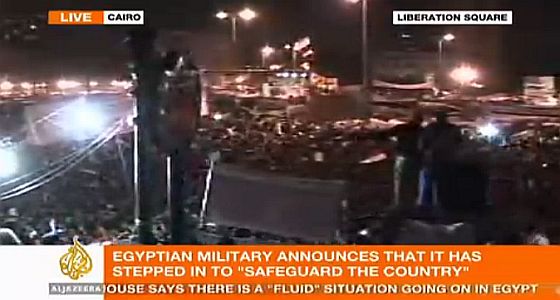
“Ambiguous” statement from military confirms its “commitment and responsibility to safeguard the people and to protect the interests of the nation, and its duty to protect the riches and assets of the people and of Egypt”. Mentioned the demands of the people are “lawful and legitimate”. Understood the military council met separately from Mubarak.
“Never insult the Arabs,” advised Amos Gilead, former head of Israel’s Political-Military Bureau, speaking on Monday at the influential Herzliya national security conference.
But he wasn’t appealing for an improvement in Israeli-Arab relations since he only had a few Arabs in mind — Hosni Mubarak and other leaders “that are supporting stability and are coping with terror and have proven themselves along decades.”
As for Gilead’s views about the advance of democracy in the region, such a prospect presents nothing less than a path to hell.
“If we allow,” Gilead said, then edited himself realizing that democracy should not be presented as something Israel can allow (or forbid) and thus he continued in less instrumental terms, “or if there is democrative process in the Middle East, it will bring for sure — or, let’s say, quite sure — dictatorships which will make this area like hell.”
The Obama administration — which has yet to face any form of governmental pressure it was willing to resist — is now showing itself in much deeper sympathy with those voices who present democracy as a threat than those who claim democracy as their right.
As the Obama administration gropes for the right response to the uprising in Egypt, it has not lacked for advice from democracy advocates, academics, pundits, even members of the previous administration. But few voices have been as urgent, insistent or persuasive as those of Egypt’s neighbors.
Israel, Saudi Arabia, Jordan and the United Arab Emirates have each repeatedly pressed the United States not to cut loose Egypt’s president, Hosni Mubarak, too hastily, or to throw its weight behind the democracy movement in a way that could further destabilize the region, diplomats say. One Middle Eastern envoy said that on a single day, he spent 12 hours on the phone with American officials.
There is evidence that the pressure has paid off. On Saturday, just days after suggesting that it wanted immediate change, the administration said it would support an “orderly transition” managed by Vice President Omar Suleiman. Secretary of State Hillary Rodham Clinton said that Mr. Mubarak’s immediate resignation might complicate, rather than clear, Egypt’s path to democracy, given the requirements of Egypt’s Constitution.
“Everyone is taking a little breath,” said a diplomat from the region, who spoke on the condition of anonymity because he was discussing private conversations. “There’s a sense that we’re getting our message through.”
While each country has its own concerns, all worry that a sudden, chaotic change in Egypt would destabilize the region or, in the Arab nations, even jeopardize their own leaders, many of whom are also autocrats facing restive populations.
Like frogs that refuse to jump out of pot of hot water because its temperature is only rising slowly, those autocrats and their Western allies who now equate stability with their ability to act as a judicious brake on change, have a will to survive that is guiding them down a path of self-destruction.
Slow but sure are the watchwords of the proponents of an “orderly transition” to democracy in Egypt. Yet even as they profess a desire to see democratic change unfold and claim no interest in dictating the outcome of a democratic process, this posture of non-interference is contradicted by a clear intent to dictate the pace of change. The will of the Egyptian people will be respected — but not just yet.
What the West is telling the Arab world is this: be patient living under dictators we like because if you get rid of them you’ll end up being ruled by dictators we don’t like. Now, as ever, the West treats Arabs as being incapable of building their own democracies.
But beneath this veneer of contempt lies a much deeper fear: that a Middle East made up of truly self-governing independent nations fully in control of resources upon which the West depends will no longer bow to Western interests. That’s a prospect the West dreads to contemplate.
This website or its third-party tools use cookies, which are necessary to its functioning. By closing this banner, you agree to the use of cookies.




 Colonel