Author Archives: Paul Woodward

How to resist the will of the people

How can you placate the frustrations of a disenfranchised population without giving them real political power?

The answers to this question describe the common ground that unites Western leaders with their authoritarian counterparts in the Middle East. The game is to come up with political formulae that will make a potentially rebellious population feel heard just enough so that the fire of revolution can be dampened.*

Egyptian Armed Forces Chief-of-Staff Sami Annan, along with a delegation from the Egyptian Army, happen to be visiting Washington this week. I doubt that their counterparts in the Pentagon will be advising them on the fastest way to prepare Egypt for democracy.

Issandr El Amrani comments on al-Sayed Badawi, the president of the Wafd party (the most established of Egypt’s legal opposition parties) who appeared on Al Jazeera, demanding the formation of a new national unity government, the dissolution of parliament, and new elections under a proportional representation system.

My gut reaction: this is either a significant break with the Wafd’s behavior for over 30 years, or he is making this announcement on behalf of the regime. Why the conspiracy theory? Because he doesn’t mention the question of the presidency, a chief demand of the protestors. Perhaps he should be given the benefit of the doubt.

Meanwhile, the National Association for Change has made its own demands, including asking Mubarak to step down and [his son] Gamal to be disqualified from the presidency, as well as the dissolution of the parliament. Other groups have other demands, including a new minimum wage and the firing of the interior minister.

These people should be coordinating — and remember they are not the ones who protested tonight.

The cautiousness of some of the Egyptian opposition leaders demonstrates exactly why an authoritarian regime provides space for an opposition to operate: so that at a moment such as this, opposition leaders will not place themselves at the vanguard of revolutionary change and that by holding back, they will undermine the popular will.

*Am I implying that any Western countries harbor the seeds of revolution? Far from it. The “success” of Western democracy has been to depoliticize populations through the anesthetizing power of consumerism. People don’t care too much if government by the people is a fiction, so long as they can get their hands on the latest iPhone. Once the anesthetic is applied sufficiently widely and sufficiently frequently, there ceases to be such a thing as the will of the people.

Facebooktwittermail

After Egypt’s ‘Day of Wrath’ protesters say ‘there’s a revolution coming’

“I’ve never seen men so angry, yet so happy to be expressing their anger,” Courtney Graves, an American living in Giza told the BBC, describing what she witnessed in Tahrir square in Cairo today. “I walked next to girls in hijabs screaming for the downfall of Hosni Mubarak. I walked behind men begging God for freedom.” At least three people died in clashes between police and demonstrators.

In Hillary Clinton’s assessment, “the Egyptian Government is stable,” although Gamal Mubarak, Egyptian president Hosni Mubarak’s son who is widely tipped as his successor, has fled to London with his family, Arabic website Akhbar al-Arab said on Tuesday.

The Mubarak regime is clearly rattled and has blocked Twitter.

Christian Science Monitor reports:

A popular uprising in Tunisia may have just pushed out President Zine El Abidine Ben Ali, but Egypt — the Arab world’s largest country with a vast security establishment — is something else again.

But activists, political analysts and average people in Egypt insist that something crucial shifted for Egypt today. Egyptian political scientist Mustapha Kamel Al Sayyid predicts that now the dam has broken, protests will continue. “the reservoir of discontent is huge,” he says. He adds it is much too soon to talk about a revolution in Egypt, where several factors would make a Tunisia-style toppling of Mubarak much more difficult.

Though both nations suffer from high unemployment and a have a large youth population, Egypt has a much smaller middle class than Tunisia. The regime’s power is not only concentrated in the security forces, as Tunisia’s was, but also in the Army. Tunisia’s military is credited with helping to bring about Ben Ali’s demise, while Egypt’s military is loyal to Mubarak, he says.

And while the corruption of Tunisia’s ruling family was a rallying point for protesters, corruption in Egypt extends further, meaning a widespread base of people who would have much to lose from the fall of the regime. Yet Egyptians have hope.

“All this is happening because we are not afraid,” said Shaimaa Morsy Awad, a young woman who held aloft an Egyptian flag during the protest. “Every day more people will join us. We are still weak, and there’s a lot of work we have to do. But there’s a revolution coming.”

Facebooktwittermail

Palestine Papers can’t slow down a stationary peace process

Jerusalem Post:

The US State Department acknowledged Monday that the “Palestine Papers,” released by Al-Jazeera, complicated American efforts to forge an Israeli-Palestinian peace agreement. But it said it wouldn’t slow the Obama administration’s work toward that goal.

George Mitchell can be as busy as a hamster in a treadmill without actually getting anywhere. Still, the key rhetorical marker that the administration’s efforts have reached their termination point will be transparent when State Department spokesman PJ Crowley starts responding to questions about Israel with what has become Obama’s signature expression: “We’re monitoring the situation.”

Facebooktwittermail

The demand for dignity surpasses all others

There are those who want to portray the emerging trend of self-immolation across the Middle East as the expression of suicidal desperation. For instance, Adam Lankford, attempts to explain away the death of Mohamed Bouazizi — the man who triggered the Tunisian revolution — suggesting that:

By setting himself on fire near a government building during a period of political turmoil, Bouazizi must have anticipated that his act would be interpreted as a sign of political protest. And those who followed him were also no doubt aware of how their actions would be interpreted in this climate. However, it is relatively common for depressed and suicidal people to try to latch on to something bigger and more significant than themselves in their last moments on Earth — regardless of their primary agenda.

Subsequent deaths have been referred to as “copycats” — as though the most intensely solitary moment of anyone’s life would be shaped by thoughts of imitation.

Such observations are glib interpretations of death made by those who view it from a comfortably safe distance.

Michael Slackman recounts the story of an Egyptian man, Abdo Abdel-Moneim Hamadah, which is strikingly similar to that of Mohamed Bouazizi.

Mr. Hamadah had a small sandwich shop in Ismailia. The government bureaucracy suddenly denied him access to a monthly allowance of cheap, state-subsidized bread. After he set himself on fire, the government-controlled media said he was suicidal over that issue.

A relative said, however, that his protest was not about bread but dignity, the same intangible that drove Mr. Bouazizi to light himself on fire and that the governments here and around the region have yet to redress. The relative said Mr. Hamadah snapped after a government official agreed to give him back the bread, not because he was entitled to it, but as charity.

“They spoke to him like he was a beggar,” said the relative, who spoke anonymously for fear of government retribution. After Mr. Hamadah burned himself, the relative said, the government turned over the cheap bread.

“He got his rights,” the relative said. That, he said, was all Mr. Hamadah had been seeking.

In these acts of self immolation, individuals when stripped of every other power are asserting the one and only power they still possess: the power to end their own lives. Whether or not conceived as a revolutionary trigger, this is without question, a political action. It is a demand that the state not treat an individual life as worthless — a demand that such a life not be disregarded and treated with contempt.

The New York Times reports on the political shifts now evident in many quarters of the Middle East, through which ideology is being set aside in response to an even more urgent demand for the restoration of human dignity and liberation from oppression.

Egypt’s most powerful and proscribed opposition movement, the Muslim Brotherhood, has decided that it will not participate in an antigovernment demonstration this week for a curious reason: The protest conflicts with a national holiday honoring the police.

“We should all be celebrating together,” said Essam el-Erian, a senior member of the group, offering an explanation that seemed more in line with government thinking than that of an outlawed Islamist organization whose members are often jailed.

That type of calculation, intended to avoid a direct confrontation with the state, is helping build momentum, many here say, for a political evolution — in Egypt and around the region — where calls for change are less and less linked to a particular ideology like Islamism. Instead, analysts and activists say the forces that brought people to the streets in Tunisia and excited passions across the Middle East are far more fundamental and unifying: concrete demands to end government corruption, institute the rule of law and ease economic suffering.

This is a relatively nascent development in a society like Egypt, which has been depoliticized over the past three decades of President Hosni Mubarak’s one party, authoritarian rule, experts said. But the shift seems to be striking fear in the country’s leadership, which has successfully pacified opposition by oppressing those it cannot co-opt, but which remains anxious about the prospect of a popular revolt, political analysts and activists said.

“Ideology now has taken a back seat until we can get rid of this nightmare confronting everyone,” said Megahed Melligi, 43, a longtime member of the Muslim Brotherhood in Egypt who said he quit the group three years ago out of frustration. “This nightmare is the ruling party and the current regime. This is everyone’s nightmare.”

In 1979, the Iranian revolution introduced the Muslim world to the force of political Islam, which frightened entrenched leaders, as well as the West. That ideology still has a powerful hold on people’s imaginations across the region, which continues to feed fighters to jihadist movements. But like Arabism and socialism before it, the political Islam of Ayatollah Ruhollah Khomeini of Iran and the radicalized ideology of Al Qaeda and Osama bin Laden have failed to deliver in practical ways for the millions of people across the Middle East who live in bastions of autocratic rule.

That failure — and now the unexpected success of Tunisians in bringing down their government — appears to be at the heart of a political recalculation among some about how best to effect change in the Arab world. The Tunisians were joined together by anger at oppression and corruption rather than any overarching philosophy.

Facebooktwittermail

A president with no principles

Maybe Barack Obama thinks of himself as some kind of Taoist president — attuned to the moment, like water that effortlessly flows around rocks, the warrior who can deflect every blow through the power of non-resistance.

Before he entered office, he exhibited a certain kind of poise that allowed some of us to indulge in fantasies about how radically different he might be from his predecessor.

An abundance of possibility was wrapped in an equal amount of mystery, but once he assumed office we’d all get to find out who Obama really is — except, two years later it sometimes seems harder to determine what, if anything, this president stands for than it was when he was a candidate.

Midway through his first term, some observers will say it’s too early to make judgments about the man, but if we can’t judge him now, what’s the basis on which to judge whether he’s worth voting for again? The next two years during which most of his actions will have been tailored to enhance his re-electability?

When it comes to determining what Obama stands for, I’d say the absence of evidence is already evidence of absence. We don’t know what Obama stands for because he doesn’t stand for anything — which is precisely why some of his wild-eyed enemies see him as some kind of Manchurian candidate.

That suspicion no longer seems so far off the mark. There is plenty of evidence that he has allowed himself to become an instrument of external forces — those forces simply aren’t as exotic as the ones the conspiracy theorists imagined.

Jacob Bronsther writes:

Quick quiz: In one sentence, describe FDR’s political philosophy. Good, now summarize Reaganism. Pretty easy, right?

OK, do the same for President Obama. Still thinking? Don’t worry, Mr. Obama is, too. And that’s bad news for all of us. Because no matter how you feel about Obama, his lack of clear philosophical values is not only a political problem for Democrats but a moral problem for America.

It didn’t start like this. Obama surfed into the White House on a wave of seeming principle: change, bipartisanship, reason, deliberation, pragmatism. What we didn’t realize is that all these concepts are methodological. They concern the process of forming public policy. But they are not bedrock principles upon which we can orient the ends of government.

They are so general that they provide little analytical or moral traction. Who objects to deliberation and evidence-based policy? Well, maybe George W. Bush, which is why Obama’s “change” narrative worked so well in the election. But since his inauguration, Obama’s methodological political theory has proved thin and sometimes incoherent. He will never support tax cuts for the rich, until he will. He criticizes Bush’s expansive view of presidential war powers, then adopts it. The list goes on.

It’s not that he breaks his policy promises more than other politicians. It’s not that he seeks compromise – a virtue. It’s not even that his policies are wrongheaded. It’s the fact that when he compromises, when he reaches policy conclusions, there’s no sense that it derives from anything other than ad hoc balancing.

There is no well of enduring principle upon which he seems to draw. Even if he’s a pragmatist, eschewing universal principles in favor of context-specific values and concerns, we still don’t know what those temporal values and concerns are, or why he believes in them. So far he’s the piecemeal president.

Facebooktwittermail

Turkey’s dynamic role in the Middle East

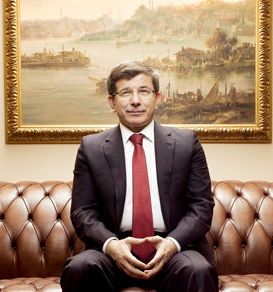
James Traub writes:

In the fall of 2009, relations between Serbia and Bosnia — never easy since the savage civil war of the 1990s — were slipping toward outright hostility. Western mediation efforts had failed. Ahmet Davutoglu, the foreign minister of Turkey, offered to step in. It was a complicated role for Turkey, not least because Bosnia is, like Turkey, a predominantly Muslim country and Serbia is an Orthodox Christian nation with which Turkey had long been at odds. But Davutoglu had shaped Turkey’s ambitious foreign policy according to a principle he called “zero problems toward neighbors.” Neither Serbia nor Bosnia actually shares a border with Turkey. Davutoglu, however, defined his neighborhood expansively, as the vast space of former Ottoman dominion. “In six months,” Davutoglu told me in one of a series of conversations this past fall, “I visited Belgrade five times, Sarajevo maybe seven times.” He helped negotiate names of acceptable diplomats and the language of a Serbian apology for the atrocities in Srebrenica. Bosnia agreed, finally, to name an ambassador to Serbia. To seal the deal, as Davutoglu tells the tale, he met late one night at the Sarajevo airport with the Bosnian leader Haris Silajdzic. The Bosnian smoked furiously. Davutoglu, a pious Muslim, doesn’t smoke — but he made an exception: “I smoked; he smoked.” Silajdzic accepted the Serbian apology. Crisis averted. Davutoglu calls this diplomatic style “smoking like a Bosnian.”

Davutoglu (pronounced dah-woot-OH-loo) has many stories like this, involving Iraq, Syria, Israel, Lebanon and Kyrgyzstan — and most of them appear to be true. (A State Department official confirmed the outlines of the Balkan narrative.) He is an extraordinary figure: brilliant, indefatigable, self-aggrandizing, always the hero of his own narratives. In the recent batch of State Department cables disclosed by WikiLeaks, one scholar was quoted as anointing the foreign minister “Turkey’s Kissinger,” while in 2004 a secondhand source was quoted as calling him “exceptionally dangerous.” But his abilities, and his worldview, matter because of the country whose diplomacy he drives: an Islamic democracy, a developing nation with a booming economy, a member of NATO with one foot in Europe and the other in Asia. Turkey’s prime minister, Recep Tayyip Erdogan, is a canny, forward-thinking populist who has drastically altered Turkish politics. Erdogan and Davutoglu share a grand vision: a renascent Turkey, expanding to fill a bygone Ottoman imperial space.

In as much as this New York Times Magazine article is filled with interesting anecdotes, it presents a useful portrait of Davutoglu. At the same time, it is peppered with insinuations and overt claims that Davutoglu and the government he represents have over-sized ambitions which implicitly infringe on America’s “right” to impose its power.

This image of the Turks as upstarts is epitomized in a statement from one of Traub’s sources. Noting the opposition Turkey faces in Washington, Traub writes:

The truth is that for all his profound knowledge of the history of civilizations, Davutoglu misread the depth of feeling in the U.S. about both Israel and Iran, or perhaps overestimated Turkey’s importance. This is the danger of postimperial grandiosity. “They talk as if they expect a merger between Turkey and the E.U.,” says Hugh Pope, head of the Turkish office of the International Crisis Group. “They think they’re more important than Israel.”

Turkey — a country with a population close to 80 million; 17th largest economy in the world; located at a strategic hub between three continents that could reasonably be called the center of the world; a bridge between the West and the Islamic world — and they have the audacity to imagine they are more important than a country smaller than New Jersey that throughout its existence has been a center and source of strife?! How dare the Turks!

Traub’s account is at its worst when he deals with the Mavi Marmara massacre — an event he clearly didn’t take the trouble to research with any care. “The flotilla refused Israel’s demands to alter course, and a helicopter-borne commando assault on the Mavi Marmara, the lead ship, turned deadly, with eight Turkish citizens and one American killed.” In fact, it had altered course, was heading west and was in international waters. But such details would obscure the intended narrative that the flotilla was in some sense a Turkish act of provocation and Israel’s response unavoidable.

Traub notes:

One of Davutoglu’s greatest diplomatic achievements was the creation of a visa-free zone linking Turkey, Jordan, Lebanon and Syria, thus reconstituting part of the old Ottoman space. The four countries have agreed to move toward free trade, as well as free passage, among themselves. As part of the zero-problems policy, Turkey moved to resolve longstanding tensions with Cyprus and Armenia and, more successfully, with Greece and Syria. Turkey’s decades of suppression of Kurdish demands for autonomy put it at odds with the new government of Iraqi Kurdistan, which sheltered Kurdish resistance fighters. But the Erdo­gan government reached out to Kurdistan, America’s strongest ally in the region. Relations with the Bush administration had been rocky since 2003, when Turkey’s Parliament voted against permitting U.S. forces to enter Iraq through southeastern Turkey. But by now the U.S. was eager to use Turkey as a force for regional stability. The rapprochement with Kurdistan thus smoothed relations with Washington and made Turkey a major player in Iraqi affairs. Turkish firms gained a dominant position not only in Kurdistan but also, increasingly, throughout Iraq. And Iraqi Kurdish leaders had cracked down on the rebels. It was a diplomatic trifecta.

But Davutoglu’s vision extended far beyond securing the neighborhood for Turkish commerce. One of his pet theories is that the United States needs Turkey as a sensitive instrument in remote places. “The United States,” he says, in his declamatory way, “is the only global power in the history of humanity which emerged far away from the mainland of humanity,” which Davutoglu calls Afro-Eurasia. The United States has the advantage of security and the disadvantage of “discontinuity,” in regard to geography as well as history, because America has no deep historic relationship to the Middle East or Asia. In Davutoglu’s terms, the U.S. has no strategic depth; Turkey has much. “A global power like this, a regional power like that have an excellent partnership,” Davutoglu concludes with a flourish.

Davutoglu’s point about the effects of America’s geographic isolation is well made, though it clearly doesn’t impress Traub.

Perhaps it would have been helpful if the reporter had made some attempt to contextualize the Turkish foreign minister’s initiatives by contrasting them with the diplomatic successes of the US in the Middle East over the last decade, or the vision that animates the work of the current US Secretary of State.

Facebooktwittermail

Truth and politics

“An opinion can be argued with; a conviction is best shot,” wrote TE Lawrence in The Evolution of a Revolt.

Whatever ones views about the legitimacy or morality of the use of violence, it’s hard not to at least sympathize with the sentiment. How indeed is it possible to reason with those who are impervious to reason?

Consider, for instance, the Jewish settler in the video below. This is his argument in favor of the theft of Palestinian land and property: “The Bible says that we have to conquer the land. So we believe… the land is ours. We believe in the Bible.” As if to say, I can’t think; I can only believe. I can’t see through my own eyes; I can only see what the Bible reveals. I am a slave to ideas crafted from afar — ideas whose authority I gladly and blindly trust.

But here’s the problem in Lawrence’s proposition: in the contest between reason and conviction, it’s the man with the conviction who most likely holds the gun.

Hendrik Hertzberg recounts one such instance:

On October 5, 1995, as the Knesset was meeting to ratify the second Oslo agreement, thirty thousand Greater Israel zealots, Likud Party supporters, militant West Bank settlers, and right-wing nationalists rallied in Jerusalem’s Zion Square. For months, certain ultra-Orthodox rabbis and scholars had been suggesting that, because Prime Minister Yitzhak Rabin was willing to consider territorial concessions in negotiations with the Palestinians, it would be permissible, even obligatory, to kill him. In Zion Square, protesters carried pictures of Rabin, doctored to show him in Nazi uniform or with crosshairs over his face. The crowd chanted “Rabin boged!”—“Rabin is a traitor!”—and, again and again, “Death to Rabin!” From a balcony, prominent opposition politicians, including Benjamin Netanyahu, looked on benevolently and uttered no rebukes. A month later, at another, larger rally, this one for peace, Rabin was assassinated.

In 1995 in Jerusalem, the connection between talk and action was direct and unmistakable. The killer, Yigal Amir, a student of Jewish law, was an activist of the organized religious right. He was neither delusional nor incoherent. “I did this to stop the peace process,” he explained at a court hearing. “We need to be coldhearted.” He acted with a clear political purpose, one that he shared with much of the mainstream religious and secular right. Within six months, Netanyahu was Prime Minister; Rabin’s widow, Leah, and many other Israelis never forgave him for what they saw as his cynical tolerance of the extremist stew that had nurtured the murderer.

The context for Hertzberg’s re-telling of this well-known narrative is the ongoing debate, following the Tucson shootings, about the dangerous effects of hate-filled rhetoric.

In President Obama’s Tucson speech last week — “his finest speech as President, and the truest to his essential character,” at least in Hertzberg’s opinion — Obama noted: “We are far too eager to lay the blame for all that ails the world at the feet of those who happen to think differently than we do.”

Intolerance does indeed color much of the political discourse in America and the attitudes that make this such a fractured world. But let’s not pretend that a shift in tone initiated by conciliatory words from this president either have much depth or will have any lasting effect.

This is a president who, with the words “Predator drones,” once made light of his ability to shred and vaporize the bodies of men, women and children whose names will never be known beyond the villages and valleys where they once lived.

This week we learned that in October, during what in the euphemistic language of war is dubbed the Afghan “surge” — a wave of death and destruction designed to diminish the Taliban’s strength — 25 tons of explosives were used by US forces to reduce a whole village to dust.

Obama might have brought a change in tone and manner to the White House but violence is no less the American way now than it was under the Bush administration.

A Democratic party less inclined to use the vitriolic language of its gun-loving counterparts, is disingenuous in its claim to be a party of civility while it acquiesces to the perpetuation of an unwinnable war and the funding of a military machine that dwarfs all others.

The reactions to the Tucson shootings revealed less about the inflammatory effect of hateful language and much more about America’s unwillingness to face the fact that this is a nation that condones, honors, venerates and at times worships the use of violence.

On the one hand in its religious bearings America adopts the posture of an Old Testament moral absolutism, yet when it comes to that fundamental injunction: thou shalt not kill, there are a hundred and one caveats which expose the chasm separating moral principle and moral practice.

I make this observation, however, not for the purpose of condemning violence but in order to point to a more fundamental issue: the need for truthfulness.

Embedded in the reason which is impervious to reason — the conviction which has a voice but no ears — is a false relationship to language. It demands from its audience the very thing it lacks: receptivity. It simultaneously expresses a demand to communicate and an unwillingness to communicate. It is, in a word, dishonest.

At the same time, those who are to a much lesser degree the slaves of conviction, nevertheless rarely have a greater love of truth, since for most, the guiding force in their approach to politics is not a ruthless honesty but the power of affiliation. Tribal instincts are at play just as much on the left as on the right.

After Obama’s speech, the “atmosphere smelled cleaner,” declared Hertzberg, but is that all that is called for — the occasional squirt of presidential air freshener?

If Obama truly had the capacity and desire to courageously lead, he would have to do something much more profound than change the ambiance in political discourse. He would have to inject a level of honesty that two years into his presidency he no longer has the ability to credibly project. He would have to replace a willow spine with some steel. He would have to acknowledge that the political center is not sacred territory — it provides just as much a refuge for political opportunists as do the ideological extremes.

Facebooktwittermail

Mahmoud Abbas fears the same fate as Tunisia’s ousted president

It seems natural that residents in the occupied West Bank where two intifadas failed to drive out the Israelis would want to celebrate Tunisia’s successful uprising — but that isn’t allowed under Mahmoud Abbas’ watch. He, it would seem, identifies more strongly with Tunisia’s ousted president, Zine al-Abidine Ben Ali.

When Palestinians gathered in Ramallah on Wednesday to rally in support of the revolution in Tunisia, the Palestinian presidency ordered the police to prevent any demonstrations or flying of the Tunisian flag, Le Monde reports [h/t Ali Abunimah].

The incident provides further evidence, that as Aisling Byrne writes below, the West Bank under Mahmoud Abbas’ rule is being turned into a police state.

“If we are building a police state — what are we actually doing here?” So asked a European diplomat responding to allegations of torture by the Palestinian security forces. The diplomat might well ask. A police state is not a state. It is a form of larceny: of people’s rights, aspirations and sacrifices, for the personal benefit of an élite. This is not what the world meant when it called for statehood. But a police state is what is being assiduously constructed in Palestine, disguised as state-building and good governance. Under this guise, its intent is to facilitate the authoritarianism which creates sufficient popular dependency — and fear — to strangle any opposition.

The transition from the lofty aspiration of statehood to a scheme intended to usher West Bank Palestinians into a new alleviated containment — a new form of remotely-managed occupation — is not some unfortunate error. The roots of this manipulation of the Palestinian aspiration into its opposite — cynically dressed up and sold as statehood — were present from the outset. Professor Yezid Sayyigh has shown how U.S. and EU rhetoric “promoting democratic development and the rule of law is pious at best, at worst disingenuous”. Both America and Europe bear responsibilities for this betrayal.

The seed of this deception which was to grow into a new police state in the region was the US and European acquiescence to Israel’s self-definition of its own security needs — and by extension, Israel’s definition of the requirements for Palestinian security collaboration. This Faustian pact, which prioritized Israel’s security-led criteria as the boundaries for negotiations — above any principles of justice — set the scene for the inevitable inflation of Israeli demands of security collusion by the Palestinian leadership — demands on which America’s ‘war on terrorism’ poured fuel. [Continue reading…]

Facebooktwittermail

How the Obama administration hyped the WikiLeaks threat

Glenn Greenwald writes (and my comments follow):

To say that the Obama administration’s campaign against WikiLeaks has been based on wildly exaggerated and even false claims is to understate the case. But now, there is evidence that Obama officials have been knowingly lying in public about these matters. The long-time Newsweek reporter Mark Hosenball — now at Reuters — reports that what Obama officials are saying in private about WikiLeaks directly contradicts their public claims:

Internal U.S. government reviews have determined that a mass leak of diplomatic cables caused only limited damage to U.S. interests abroad, despite the Obama administration’s public statements to the contrary.

A congressional official briefed on the reviews said the administration felt compelled to say publicly that the revelations had seriously damaged American interests in order to bolster legal efforts to shut down the WikiLeaks website and bring charges against the leakers. . . .

“We were told (the impact of WikiLeaks revelations) was embarrassing but not damaging,” said the official, who attended a briefing given in late 2010 by State Department officials. . .

But current and former intelligence officials note that while WikiLeaks has released a handful of inconsequential CIA analytical reports, the website has made public few if any real intelligence secrets, including reports from undercover agents or ultra-sensitive technical intelligence reports, such as spy satellite pictures or communications intercepts. . . .

National security officials familiar with the damage assessments being conducted by defense and intelligence agencies told Reuters the reviews so far have shown “pockets” of short-term damage, some of it potentially harmful. Long-term damage to U.S. intelligence and defense operations, however, is unlikely to be serious, they said. . . .

Shortly before WikiLeaks began its gradual release of State Department cables last year, department officials sent emails to contacts on Capitol Hill predicting dire consequences, said one of the two congressional aides briefed on the internal government reviews.

However, shortly after stories about the cables first began to appear in the media, State Department officials were already privately playing down the damage, the two congressional officials said.

In response to Hosenball’s story, Obama officials naturally tried to salvage the integrity of their statements, insisting that “there has been substantial damage” and that there were unspecified “specific cases where damage caused by WikiLeaks’ revelations have been assessed as serious to grave.” But the only specific cases anyone could identify were ones where the U.S. was caught by these documents lying to its own citizens or, at best, concealing vital truths — such as the far greater military role the U.S. is playing in Yemen and Pakistan than Obama officials have publicly acknowledged.

And this, of course, has been the point all along: the WikiLeaks disclosures are significant precisely because they expose government deceit, wrongdoing and brutality, but the damage to innocent people has been deliberately and wildly exaggerated — fabricated — by the very people whose misconduct has been revealed. There is harm from the WikiLeaks documents, but it’s to wrongdoers in power, which is why they are so desperate to malign and then destroy the group.

On Saturday, the New York Times revealed that the Stuxnet malware attack on Iran’s uranium enrichment program was a joint US-Israeli operation. The report illustrates the officially sanctioned relationship between the US government and the US press when it comes to the publication of classified information. Indeed, this relationship is so well understood that on matters of national security, the New York Times can be regarded as effectively serving as the US government’s ministry of information.

Although the report does not cite government sources — even anonymous officials — there seems little doubt that on an intelligence issue such as this (there could not be one of greater sensitivity) the newspaper’s editors would at least have shown the report to administration officials before publication. Which is to say, the New York Times would not publish a story of this nature without government approval. That is not to say that the accuracy of the report was being vouched for but that, at the least, the government could tolerate (and might well welcome) the disclosure of the classified information it contained.

This gets to the heart of the Obama administration’s fight against WikiLeaks: it’s not about the protection of secrecy; it’s about control of classified information. In other words, it’s about the exercising of the political power to pick and choose when the law should be upheld and when it can be disregarded.

WikiLeaks presents a challenge to centralized power; not governance by law.

Facebooktwittermail

Could Egypt follow Tunisia?

Investors are often among the most sober of political analysts — after all, their single interest is in finding the safest and most profitable places to put their money and right now, Egypt does not look like such a location.

Reuters reports, “Cairo’s stock index tumbled to an 11-week low on Wednesday on fears of a contagion from the unrest that toppled Tunisia’s president and further volatility is expected as investors eye Egypt’s 2011 presidential election.”

At the same time, analysts say that the greater political freedom enjoyed by opposition groups in Egypt — relative to their Tunisian counterparts — serves as a pressure valve that can release political tension without undermining the Mubarak regime.

Even so, The Guardian now reports:

The Egyptian dissident Mohamed ElBaradei has warned of a “Tunisia-style explosion” in his country as self-immolation protests proliferated and anti-government activists announced plans for a nationwide “day of anger” next week.

But the former UN nuclear weapons chief stopped short of calling on his supporters to take to the streets, prompting scathing criticism from opposition campaigners who believe ElBaradei is squandering a rare opportunity to bring an end to President Hosni Mubarak’s three decades of autocratic rule.

Today Ahmed Hashem el-Sayed, 25, from the Mediterranean port city of Alexandria, died in hospital after setting himself alight on the roof of his home. It was the latest in a series of self-immolation incidents that have spread through Egypt over the past two days, after the Tunisian vegetable trader Muhammad Bouazizi’s self-immolation provided the catalyst for the toppling of his country’s president last week.

“What has transpired in Tunisia is no surprise and should be very instructive both for the political elite in Egypt and those in the west that back dictatorships,” ElBaradei told the Guardian. “Suppression does not equal stability, and anybody who thinks that the existence of authoritarian regimes is the best way to maintain calm is deluding themselves.”

Within hours of Elbaradei refusing to throw his weight behind street protests as he told The Guardian “I would like to use the means available from within the system to effect change, such as the petition we are gathering demanding political reform,” he expressed a different sentiment on Twitter: “Fully support call 4 peaceful demonstrations vs. repression & corruption. When our demands for change fall on deaf ears what options remain?”

Swiftly and sarcastically, Demagh MAK in Cairo responded: “@ElBaradei Are u going to join us in the streets or you just supporting on twitter #Egypt #Jan25?”

Not withstanding pro forma expressions of support for “democratic reform,” it seems unlikely the Obama administration would welcome the prospect of democracy in Egypt.

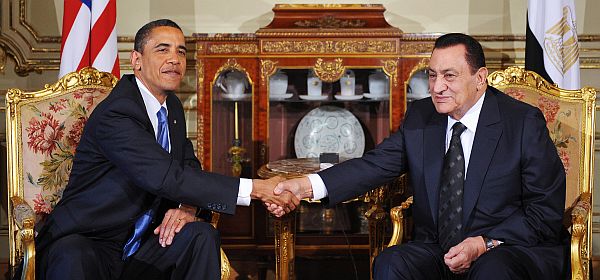
When President Obama addressed the Muslim world from Cairo in 2009 he did so without a murmur of criticism directed at his dictator host, Hosni Mubarak. If Mubarak was to fall from power or fail to successfully pass the presidency to him son Gamal, the inevitable result would be an Egyptian government in which the Muslim Brotherhood would wield significant power — a prospect that both Washington and Israel fear.

Facebooktwittermail

Worse than Bush

While George W Bush was president it was possible to sustain what turned out to be a naive hope: that much of the harm he had done could be undone once he was out of office and the neoconservatives had been dislodged from power. But the harm personified by Bush and Cheney is now being institutionalized and by the removal of ideological baggage, lightened, with the effect that the post-Bush era is nowhere near in sight.

As President Obama sucks up to Wall Street (a sure way of financing his 2012 campaign, given that he will not be able to rely on the same level of grassroots support he enjoyed in 2008) and as his Justice Department argues that whistle-blowers are more dangerous than Americans who commit treason, Glenn Greenwald notes that the latest neocon singing Obama’s praise is Dick Cheney:

In the early months of Obama’s presidency, the American Right did to him what they do to every Democratic politician: they accused him of being soft on defense (specifically “soft on Terror”) and leaving the nation weak and vulnerable to attack. But that tactic quickly became untenable as everyone (other than his hardest-core followers) was forced to acknowledge that Obama was embracing and even expanding — rather than reversing — the core Bush/Cheney approach to Terrorism. As a result, leading right-wing figures began lavishing Obama with praise — and claiming vindication — based on Obama’s switch from harsh critic of those policies (as a candidate) to their leading advocate (once in power).

As early as May, 2009, former Bush OLC lawyer Jack Goldsmith wrote in The New Republic that Obama was not only continuing Bush/Cheney Terrorism policies, but was strengthening them — both because he was causing them to be codified in law and, more important, converting those policies from right-wing dogma into harmonious bipartisan consensus. Obama’s decision “to continue core Bush terrorism policies is like Nixon going to China,” Goldsmith wrote. Last October, former Bush NSA and CIA Director Michael Hayden — one of the most ideological Bush officials, whose confirmation as CIA chief was opposed by then-Sen. Obama on the ground he had overseen the illegal NSA spying program — gushed with praise for Obama: “there’s been a powerful continuity between the 43rd and the 44th president.” James Jay Carafano, a homeland-security expert at the Heritage Foundation, told The New York Times’ Peter Baker last January: “I don’t think it’s even fair to call it Bush Lite. It’s Bush. It’s really, really hard to find a difference that’s meaningful and not atmospheric.”

Those are the nation’s most extreme conservatives praising Obama’s Terrorism policies. And now Dick Cheney himself — who once led the “soft on Terror” attacks — is sounding the same theme. [Continue reading…]

Facebooktwittermail

Change without change in Tunisia’s “unity” government

Before it was even clear it was a revolution, the Tunisian uprising had been dubbed the Jasmine Revolution — as though revolutionary change was about to sweep the Arab world as rapidly as color revolutions transformed former Soviet states.

That might still happen, but the name most fitting for what has happened in Tunisia is the name used on the streets of Tunis: intifada. The eventual outcome of the uprising remains unknown.

The Guardian reports:

There was little sign of jubilation in Tunisia today when the prime minister announced his new “unity” government. Even though several opposition figures were included, Tunisians who had spent the past few weeks battling to oust the president, Ben Ali, expressed disappointment. There were too many old faces in the “new” regime, especially in key ministries such as defence, interior, finance and foreign affairs.

The prime minister himself, 69-year-old Mohamed Ghannouchi, is a Ben Ali loyalist of long standing, having served since 1999. In Tunisia, he became known as “Monsieur Oui Oui” for always saying yes to the president.

To many ordinary Tunisians, these are worrying signs. In the words of a trade unionist quoted on Twitter: “Tunisia has got rid of the dictator but hasn’t got rid of the dictatorship yet.”

The veteran Tunisian dissident and journalist Taoufik ben Brik writes (in French — translation provided by Issandr El Amrani):

In Tunisia, as elsewhere, a tyrant can hide another. Mohamed Ghannouchi, Ben Ali’s prime minister, and Fouad Mebazaa, the speaker of parliament (unelected) and right hand of Ben Ali have taken over a vacant presidency. Change without change. We’ve cut off the duck’s head, but the body continues to move. Ben Ali ran off, but left behind a whole system that relies on three Ps: Police, Profiteers and Party. Here, everything depends on the karakouz, the Turkish shadow puppet theater. And we know all too well who is puppeteer and who is puppet. No one is fooled. Power is still in the hands of Ben Ali’s old stalwarts. “A bloodbath would not make them back down” is the general opinion. The police, the ruling RCD party and the profiteers won’t let go that easily. They are not a charity.

Power is never relinquished without a struggle and in Tunisia the struggle continues.

AFP now reports:

The resignation of three ministers rocked Tunisia’s fledgling unity government on Tuesday as protesters vented their anger at the new leadership just days after the ouster of the Arab state’s strongman.

The ministers, representing Tunisia’s main trade union, announced their withdrawal after the union refused to recognise an administration that contains eight ministers from president Zine El Abidine Ben Ali’s discredited regime.

“We are resigning from the government after a call from our union,” said Houssine Dimassi, training and employment minister in the transitional unity government unveiled only on Monday.

Dimassi said the two other ministers resigning were Abdeljelil Bedoui, a minister working in the prime minister’s office, and Anouar Ben Gueddour, a junior transport minister.

Facebooktwittermail

Stuxnet attack on Bushehr: Russia warns of ‘Iranian Chernobyl’

Following Saturday’s New York Times report that the Stuxnet malware targeting Iran’s nuclear program was a joint US-Israeli operation, the Daily Telegraph reports that Russian nuclear scientists are concerned that the Bushehr nuclear plant could suffer catastrophic damage.

Fuel rods were inserted in the new reactor at the end of November and the plant is due to start producing electricity in the coming weeks. Ralph Langner, whose German team first identified Iran’s nuclear program as Stuxnet’s target, says the plant’s steam turbine is vulnerable to attack and in November wrote: “If you blow a 1000 Megawatt turbine, you will very likely be able to see the impact by satellite imagery.”

Con Coughlin writes:

Russian scientists working at the plant have become so concerned by Iran’s apparent disregard for nuclear safety issues that they have lobbied the Kremlin directly to postpone activation until at least the end of the year, so that a proper assessment can be made of the damage caused to its computer operations by Stuxnet.

The Iranian government is bitterly opposed to any further delay, which it would regard as another blow to national pride on a project that is more than a decade behind schedule. While Western intelligence officials believe Iran’s nuclear programme is aimed at producing nuclear weapons, Iran insists the project’s goals are peaceful.

The Russian scientists’ report to the Kremlin, a copy of which has been seen by The Daily Telegraph, concludes that, despite “performing simple, basic tests” on the Bushehr reactor, the Russian team “cannot guarantee safe activation of the reactor”.

It also accuses the Iranian management team, which is under intense political pressure to stick to the deadline, of “not exhibiting the professional and moral responsibility” that is normally required. They accuse the Iranians of having “disregard for human life” and warn that Russia could find itself blamed for “another Chernobyl” if it allows Bushehr to go ahead.

While it’s natural that the Russians would be concerned about being blamed, in such a scenario it’s a bit difficult to see how US interests would be served if vital shipping lanes and America’s Gulf allies were also put in jeopardy.

An American expert in nuclear intelligence told the New York Times “that Israel worked in collaboration with the United States in targeting Iran, but that Washington was eager for ‘plausible deniability'” — plausible deniability that the US no longer has.

Does this raise the possibility that the US might need to discreetly intervene to prevent an Israeli-made disaster?

Facebooktwittermail

In the Middle East, no one thinks Obama is serious about democracy

In Washington, when a cabinet level official is facing calls for his resignation, he is likely to take cover behind that regal phrase, “I serve at the president’s pleasure.” Most of the Arab world’s autocratic leaders could use the same expression since most would find their positions untenable without American support.

Last Wednesday, when Hillary Clinton said “we are not taking sides,” as demonstrators clashed with Tunisian security forces, she could have dispensed with protocol and said with more honesty, “we are no longer taking sides.”

Up until that moment the United States had unequivocally taken sides with Tunisia’s dictatorial ruler, Zine el-Abidine Ben Ali, but thereafter he knew he was on his own. He rapidly lost his grip on power.

The Obama administration’s relationship with the Tunisian regime was mirrored on a smaller scale by that of the Washington Media Group, a consulting firm that severed its contract with the Tunisian government on January 6.

“We felt on principle that we could not work for a government that was shooting its own citizens and violating their civil rights with such abuse,” said WMG’s President Gregory L. Vistica. Was he claiming that his client’s record had suddenly taken a turn for the worse, or that his firm had only just discovered it had principles?

The point is that WMG, just like the US government, prefers to blur the distinction between statements of principle and actions of self-interest.

On Friday, when President Obama said, “I applaud the courage and dignity of the Tunisian people,” observers across the region might have appreciated the sentiment yet seen no reason to attach much gravity to his words. After, Ben Ali had already fled.

“No one thinks Obama is serious about democracy,” says Shadi Hamid from Brookings Doha Center. “In some ways they have given up hope. And that I think is one of the key post-Cairo Speech stories: that after a lot of optimism about Obama’s election, people realized that when it comes to the issue of democracy-promotion in the Arab world — and that is a very important one for many Arabs — Obama’s really not on board.”

What more damning an indictment could be made against an American president than to say that he does not support democracy?

Hamid is joined in conversation with fellow Middle East analyst Issandr El Amrani from The Arabist, for a fascinating discussion on the implications on the people’s uprising in Tunisia.

Facebooktwittermail

Social media and the internet as an arena for revolutionary fantasy

On Friday, Andrew Sullivan — who heralded Iranian unrest 18 months ago as the Twitter revolution — was quick to dub the popular uprising in Tunisia a “WikiLeaks revolution” :

There seems little doubt that the Wikileaks-released cable describing the opulence of now former president Ben Ali’s lifestyle played a key part in bringing him down.

But what did WikiLeaks reveal?

In a July 2009 cable published by The Guardian on December 7, US Ambassador Robert F. Godec wrote:

The problem is clear: Tunisia has been ruled by the same president for 22 years. He has no successor. And, while President Ben Ali deserves credit for continuing many of the progressive policies of President Bourguiba, he and his regime have lost touch with the Tunisian people. They tolerate no advice or criticism, whether domestic or international. Increasingly, they rely on the police for control and focus on preserving power. And, corruption in the inner circle is growing. Even average Tunisians are now keenly aware of it, and the chorus of complaints is rising. Tunisians intensely dislike, even hate, First Lady Leila Trabelsi and her family. In private, regime opponents mock her; even those close to the government express dismay at her reported behavior. Meanwhile, anger is growing at Tunisia’s high unemployment and regional inequities. As a consequence, the risks to the regime’s long-term stability are increasing.

Average Tunisians were keenly aware of the corruption of their rulers, hated the president’s wife and his family and were expressing growing anger about unemployment — and all of this put the regime at risk. And yet — here’s the inexplicable element — somehow, all of these observable facts once encapsulated in a cable from the US embassy and then leaked by WikiLeaks became a “revelation” confirming what the average Tunisian already knew.

Tunisia is a small country that usually garners little international attention, so WikiLeaks can be given some credit for enlightening the rest of the world about the political instability of this Arab backwater, but to claim that WikiLeaks “played a key part” in bringing down the Tunisian president seems a bit of a stretch.

If the cable did include an important revelation, it was one unlikely to fuel Tunisians’ revolutionary fervor: that the Obama administration was being advised by it embassy to be less openly critical of the regime than the Bush administration had been.

For several years, the United States has been out in front — publicly and privately — criticizing the GOT [Government of Tunisia] for the absence of democracy and the lack of respect for human rights. There is a place for such criticism, and we do not advocate abandoning it. We do recommend a more pragmatic approach, however, whereby we would speak to the Tunisians very clearly and at a very high level about our concerns regarding Tunisia’s democracy and human rights practices, but dial back the public criticism.

In other words, the United States under Barack Obama’s presidency, would not stray from the longstanding American approach which attaches a higher value to stability than democracy — that sees US interests deeply invested in the continuity of autocratic rule in most of the Arab world’s so-called “moderate” states.

If dictators in the Middle East are seen as the bulwark preventing the rise to power of Islamists, then the US will nod in the direction of the oppressed by making calls for “democratic reform” even if the prospect of democracy is nowhere in sight. Indeed, democratic reform rather than being a stepping stone towards democracy is more likely seen as a preferable substitute, since democracy itself opens the door to those dreaded Islamists.

If the current administration preferred a “pragmatic” approach towards Tunisia and the instrumental role of WikiLeaks has been overstated, what about the influence of social media? Yesterday, Ben Wedeman from CNN tweeted: “No one I spoke to in Tunis today mentioned twitter, facebook or wikileaks. It’s all about unemployment, corruption, oppression.”

Jamal Dajani, who was in Tunis at the beginning of the month, writes:

It is very easy, but over-simplistic and naive to decide on a social media interpretation for the Jasmine Revolution, as we have been witnessing by many bloggers and self-appointed Middle East experts, many of whom neither speak Arabic nor have spent an extended period of time in the Middle East. They desperately want to convince us that Tunisians needed an external technological Western invention in order to succeed. A Twitter revolution of some sorts, as they previously labeled the Iranian Velvet Revolution, as though Arab masses were not capable on their own of saying “enough is enough.”

Certainly social media was used as a communication tool for Tunisians to air their frustrations with the economy, unemployment, censorship, and corruption. But many factors lead to its success, such as a well organized trade unions movement, and the most potent weapon in the Arab world, the youth.

Likewise during the 2009 summer uprising in Iran, Twitter only had a very minor role. In the London Review of Books, James Harkin notes:

In 2009, according to a firm called Sysomos which analyses social media, there were 19,235 Twitter accounts in Iran – 0.03 per cent of the population. Researchers at al-Jazeera found only 60 Twitter accounts active in Tehran at the time of the demonstrations, which fell to six after the crackdown.

Also, to the extent that the internet and social media did serve as revolutionary tools in Iran, they also served as a means to thwart the revolution.

Evgeny Morozov writes:

As we know from the post-protest crackdown in Iran, the Internet has proved a very rich source of incriminating details about activists; the police scrutinized Facebook groups, tweets, and even email groups very closely. Furthermore, the Iran government may have also analyzed Internet traffic and phone communications related to the opposition.

Now, Tunisia is no in Iran. Its long-ruling dictator is now gone and the new government is unlikely to engage in repressions on the same scale. Yet if Ben Ali’s regime didn’t fall, it appears certain to that the authorities would be brutally going after anyone who has ever posted a damning Facebook post or an angry email. As we have seen in the few weeks leading to Ali’s exit, the Tunisian cyber-police have proved to be far more skilled in Internet repression than their counterparts abroad: it’s safe to assume they would have dug as much evidence as the Iranians.

This brings me to a somewhat depressing conclusion: if the dictator doesn’t fall in the end, the benefits of social mobilization afforded by the Internet are probably outweighed by its costs (i.e. the ease of tracking down dissidents – let alone organizers of the protests).

It’s easy those of us in the West to celebrate a distant revolution from the comfort of an armchair, facing no risk of getting shot or being imprisoned, yet experiencing an illusion of participation through the immediacy of social media.

Swiftly named the Jasmine Revolution and now viewed as a domino that might lead to the collapse of authoritarian regimes across the region, it’s too early to know whether this is indeed a revolution.

AFP reports that Prime Minister Mohammed Ghannouchi:

… held consultations with the leaders of the main opposition parties in Tunis on the formation of a national unity government to fill the power vacuum left by Ben Ali’s abrupt departure after 23 years in power.

Two parties banned under Ben Ali — the Communist party and the Islamist Ennahdha party — have been excluded from the government talks.

Whatever the eventual outcome of the turmoil now raging in Tunisia, it may end up causing as much alarm on the Arab street as it does among the autocratic rulers. As Stephen Walt warns:

Tunisia’s experience may not look very attractive over the next few weeks or months, especially if the collapse of the government leads to widespread anarchy, violence and economic hardship. If that is the case, then restive populations elsewhere may be less inclined to challenge unpopular leaders, reasoning that “hey, our government sucks, but it’s better than no government at all.”

Brian Whitaker notes the fallout from Tunisia has already spread to Libya where demonstrators have clashed with security forces.

Will it develop into anything bigger? A month ago, I would have said the likelihood of that was zero. Post-Tunisia, though, it’s difficult to be quite so sure..

We can expect to see many more incidents like this over the coming months in various Arab countries. Inspired by the Tunisian uprising, people are going to be more assertive about their grievances and start probing, to see how far they can push the authorities. In the light of Tunisia we can also expect a tendency, each time disturbances happen, to suggest (or hope) that they are the start of some new Arab revolution. The reality, though, is that almost all of them will quickly fizzle out or get crushed. But one day – who knows when? – another of them will grow wings and bring down a regime.

Contrary to what many people imagine, protests and even large-scale riots are not uncommon in the Arab countries. They occur mostly in marginalised regions or among marginalised sections of the population and, normally, they pose no great threat to the regime.

Last month – one day before the trouble started in Tunisia – there was a Sunni-versus-Shia riot in the Saudi city of Medina. Eight hundred people are said to have taken part; windows were smashed and dozens of cars damaged or destroyed. Outside the kingdom, hardly anyone noticed.

Facebooktwittermail

What was Israel’s connection to the AQ Khan nuclear network?

The New York Times reports that the Stuxnet worm which was designed to attack Iran’s nuclear enrichment program was a joint US-Israeli operation. One of the crucial elements in developing the plan was being able to test the malware’s ability to disable P-1 centrifuges — the type that Iran employs in cascades of thousands of centrifuges in it Natanz enrichment facility. Israel has row upon row of this type of centrifuge at its clandestine nuclear weapons production facility in Dimona.

The question is: how did Israel come to possess so many P-1 centrifuges? Did Israel obtain the centrifuges from AQ Khan?

The CIA was tracking the AQ Khan network for decades before it eventually shut it down in 2003. Douglas Frantz, co-author of Fallout: The True Story of the CIA’s Secret War on Nuclear Trafficking, told NPR: “By the time they finally acted in 2003, an enormous amount of the world’s most dangerous technology had been sold to the world’s most dangerous regimes. And that, in our view, was a policy failure, a policy failure of enormous proportions, really.”

Perhaps the most secretive part of the Stuxnet story centers on how the theory of cyberdestruction was tested on enrichment machines to make sure the malicious software did its intended job.

The account starts in the Netherlands. In the 1970s, the Dutch designed a tall, thin machine for enriching uranium. As is well known, A. Q. Khan, a Pakistani metallurgist working for the Dutch, stole the design and in 1976 fled to Pakistan.

The resulting machine, known as the P-1, for Pakistan’s first-generation centrifuge, helped the country get the bomb. And when Dr. Khan later founded an atomic black market, he illegally sold P-1’s to Iran, Libya, and North Korea.

The P-1 is more than six feet tall. Inside, a rotor of aluminum spins uranium gas to blinding speeds, slowly concentrating the rare part of the uranium that can fuel reactors and bombs.

How and when Israel obtained this kind of first-generation centrifuge remains unclear, whether from Europe, or the Khan network, or by other means. But nuclear experts agree that Dimona came to hold row upon row of spinning centrifuges.

“They’ve long been an important part of the complex,” said Avner Cohen, author of “The Worst-Kept Secret” (2010), a book about the Israeli bomb program, and a senior fellow at the Monterey Institute of International Studies. He added that Israeli intelligence had asked retired senior Dimona personnel to help on the Iranian issue, and that some apparently came from the enrichment program.

Facebooktwittermail

Obama’s telling misalignment

“When we align our values with our actions, great things can happen,” says Bemporad Baranowski Marketing Group (BBMG), a New York-based branding agency dedicated to nonprofits and socially responsible businesses.

President Obama shares the same philosophy.

Addressing the memorial service in Tucson this week, Obama said:

We recognize our own mortality, and we are reminded that in the fleeting time we have on this Earth, what matters is not wealth, or status, or power, or fame -– but rather, how well we have loved — and what small part we have played in making the lives of other people better.

And that process — that process of reflection, of making sure we align our values with our actions –- that, I believe, is what a tragedy like this requires.

When two things are brought into alignment, repositioning can take place from both sides, but just as wheels can get knocked out of alignment with the chasis of a car, when it comes to values and actions, it is most often our actions that need moving into alignment with our values — not the other way around.

Americans score high when it comes to cherishing high values — the fall comes in our failing to align our actions with our values.

Mr Compromise might not be able to spot the difference. A man who so reflexively yields to pressure sees all things as relative. He yields so easily because he lacks an anchor to an unyielding center.

Facebooktwittermail

State Department clueless on Tunisia

The mystique of American power is sustained in no small measure by the ability of US government officials to convey the impression that they understand global affairs. In the last 48 hours the State Department has clearly shifted into overdrive in an effort to portray the US as being fully engaged with and attuned to fast moving events in the Arab world. “We’re ahead of the game,” the overarching message seems to be.

Hence the Christian Science Monitor provides this on-message piece of reporting under a headline emphasizing the prescience of the secretary of state: “Events in Tunisia bear out Hillary Clinton’s warning to Arab world”:

A day after Secretary of State Hillary Rodham Clinton warned Arab states that they risked “sinking into the sand” if they did not clean up corruption and quicken their glacial pace of political and economic reform, those sands took one of the Arab world’s long-reigning leaders.

Tunisia’s President Zine El Abidine Ben Ali on Friday fled the North African country he ruled in autocratic fashion for 23 years, chased away by a month of street protests that started in provincial cities but engulfed the capital, Tunis, this week. The country’s prime minister, Mohammed Ghannouchi, assumed temporary power. [Temporary turned out to mean for a day. He’s now been ousted and replaced by speaker of parliament, Fouad Mebazaa.]

In a statement Friday afternoon, President Obama hailed the “courage and dignity of the Tunisian people,” and said the United States joined the rest of the world in “bearing witness to this brave and determined struggle.” He called on the Tunisian government to “hold free and fair elections in the near future that reflect the true will and aspirations of the Tunisian people.”

Eleven days ago, State Department spokesman PJ Crowley didn’t make it sound like the US was paying close attention to what was happening in Tunisia. This was how he covered the issue on January 4:

QUESTION: On Tunisia, there’s continued, sort of, civil unrest there, and I was just wondering –

MR. CROWLEY: What country?

QUESTION: Tunisia. Tunisia. And I was wondering what you made of the situation there.

MR. CROWLEY: Actually, I didn’t get updated on Tunisia today. So we’ll save that question –

QUESTION: When was the last time you did get updated on Tunisia? (Laughter.)

The next day, Crowley seemed surprised that questions about Tunisia were still being raised. The sum of the State Department’s concern seemed to be the extent to which unrest might affect American travelers.

QUESTION: Do you have any reaction to the recent unrest in Tunisia?

MR. CROWLEY: Tunisia makes an appearance for the second day in a row. I mean, last month, there were some demonstrations that occurred in Tunisia over a several-day period. They appeared to us to be triggered by economic concerns and not directed toward Westerners or Western interests. As we do in various places around the world where we have concerns about the safety of our citizens, we did put out a Warden Message right at the end of the year urging Americans to be alert to local security developments, but – and it’s best to avoid these demonstrations, even ones that can appear peaceful.

QUESTION: But aren’t you concerned about economic reforms in Tunisia, or –

MR. CROWLEY: That is something that is part of our ongoing dialogue with Tunisia.

I guess the first question for Crowley on Monday should be: does the US still have an ongoing dialogue with Tunisia, or is it now simply in what has so often been the Obama administration’s default position — closely monitoring the situation?

That this administration expends so much of its energy making feeble gestures to demonstrate that it is on top of the situation, reflects a bigger problem — as one former State Department official recently noted in a different context — “which is that of a dysfunctional administration in which no one is in charge.”

Facebooktwittermail