Author Archives: Paul Woodward

Does Israel wish it might become invisible?

Humiliating journalists might not be a good way of generating positive coverage for ones country, but perhaps the treatment of foreign reporters covering a speech by Prime Minister Benjamin Netanyahu had a different purpose: to try and persuade the world’s media to ignore Israel altogether.

Either that, or this and two other stories below represent the small but unsightly rips in a nation that has set itself on a path of self-destruction.

Dimi Reider posts a statement released by the Foreign Press Association in Israel:

The Foreign Press Association is outraged over the treatment members received at the hands of Israeli security personnel during Tuesday night’s invitation-only gathering with the prime minister. While we appreciate the need for security, it is not remotely acceptable to invite people for cocktails at a five-star hotel and then make them undress at the door.

Several members were forced to remove their underwear, waiting for as long as 20 minutes in this humiliating situation while security checked their documents. Others, including the bureau chief of The Wall Street Journal, were strip-searched and forced to take off their pants. A number of members walked out of the event in disgust following this despicable treatment.

It is incomprehensible that anyone would think such humiliating treatment is necessary at such an event. All GPO card holders are known to authorities and have already undergone extensive background checks. All participants emptied their pockets, submitted their equipment to inspection and went through metal detectors to enter.

The Shin Bet has its responsibilities but it must also operate within reasonable parameters. In a democratic country security services are not permitted to do as they please. For a government trying to usher in a new era of relations with the foreign media, it is a peculiar way to start. We are confident the prime minister would not accept such abusive security checks for his friends or family.

We ask for assurances that this will not happen again or we will respectfully decline further invitations.

Meanwhile, in the latest expression of rabbinical contempt for non-Jews, sterile Jewish couples are being discouraged from taking the risk of producing “barbaric offspring” which would result the use of Gentile sperm.

Rabbi Dov Lior, a senior authority on Jewish law in the Religious Zionism movement, asserted recently that a Jewish woman should never get pregnant using sperm donated by a non-Jewish man – even if it is the last option available.

According to Lior, a baby born through such an insemination will have the “negative genetic traits that characterize non-Jews.” Instead, he advised sterile couples to adopt.

Lior addressed the issue during a women’s health conference held recently at the Puah Institute, a fertility clinic. His conservative stance negated a ruling widely accepted by rabbis, which states that sperm donated by a non-Jew is preferable to that of an anonymous Jew, who might pose a genealogical risk.

“Sefer HaChinuch (a book of Jewish law) states that the character traits of the father pass on to the son,” he said in the lecture. “If the father in not Jewish, what character traits could he have? Traits of cruelty, of barbarism! These are not traits that characterize the people of Israel.”

And if that wasn’t enough, Richard Silverstein writes about a rabbinical appeal for the extermination of Palestinians.

Back in the days of the Shoah, one of the slogans of the Jew haters was: “Jews to the Ovens.” Now, it causes me anguish to say, we have Israeli Orthodox rabbis saying the same about the Palestinians.

Thanks to Cicero for pointing me to a shocking passage in an Israeli Orthodox “family magazine,” Fountains of Salvation, which suggests that Israel will create death camps for Palestinians in order to wipe them out like Amalek.

Facebooktwittermail

Israel’s descent into ‘this unfortunate world’

As Israeli bulldozers demolish the Shepherd Hotel in East Jerusalem to make way for Jews-only apartments funded by the American Zionist, Irving Moskowitz, a retired casino magnate who lives in Miami Beach, Jeffrey Goldberg writes:

Peace will not come without the birth of a Palestinian state on the West Bank which has its capital in East Jerusalem. I’m as sure of that as I am of anything in the Middle East. Of course, peace may not come even with the birth of this state — I’m no longer quite so sure in the possiblity, or at least in the availability, of peace — but it will surely never happen without it. This is why, of course, certain right-wing Jewish groups, aided and abetted by different factions in Israel’s chaotic government, are seeking to populate East Jerusalem with Jews: to prevent the birth of a Palestinian state. These particular Jews operate under the delusion that Israel can keep control of the Arab neighborhoods of Jerusalem forever, and most of the West Bank forever, without negative consequences. They are drastically wrong. Eventually, something is going to give. At a certain point in the not-so-distant future, Israel will either cease to be a Jewish state, or it will cease to be a democracy. Attempts to abort the birth of a Palestinian state only hasten this moment of decision.

Israel will survive without the Arab neighborhoods of East Jerusalem. It will not survive if it becomes a pariah state, and, in this unfortunate world in which we must exist, Israel is in danger of becoming an outcast among nations.

When referring to “this unfortunate world in which we must exist,” Goldberg seems to be saying that Israel must reconcile itself to the fact that it cannot effectively divorce itself from the rest of the world — as if to say, if Israel could separate itself from the rest of the world and survive, then such a divorce would be desirable — as if in its dealings with “this unfortunate world” Israel necessarily succumbs to some of the world’s polluting influence.

The idea that Israel might benefit — not merely survive — through improving its relations with others, doesn’t come into the picture.

Facebooktwittermail

America unhinged

Will January 8, 2011, be remembered as yet another date that will live in infamy?

Rep. Bill Pascrell (D-N.J.) was having a beer and eating pizza at a New Jersey bar when he heard the news via the television. Soon thereafter, he was contacted by his staff and was on the phone with other House members.

“It’s somewhat overwhelming. We are all flabbergasted, stunned,” he said.

While noting the obvious differences between the two events, Pascrell said Saturday reminds him of 9/11.

“I couldn’t believe I was really seeing this. This can’t be real,” he told The Hill in an interview Monday.

A mass shooting in America. No, that’s never happened before.

What’s an American to do when contemplating that danger by the next Glock-wielding gunman? Why, go out and buy a Glock!

After Saturday’s shootings:

Greg Wolff, the owner of two Arizona gun shops, told his manager to get ready for a stampede of new customers.

Wolff was right. Instead of hurting sales, the massacre had the $499 semi-automatic pistols — popular with police, sport shooters and gangsters — flying out the doors of his Glockmeister stores in Mesa and Phoenix.

“We’re at double our volume over what we usually do,” Wolff said two days after the shooting spree that also left 14 wounded, including Democratic Representative Gabrielle Giffords, who remains in critical condition.

As for how to cool down the incendiary rhetoric that supposedly triggered Jared Lee Loughner’s rampage, well, maybe it would be better not just to cool it down but shut it down.

One lawmaker, Rep. Robert Brady (D-Pa.), has said he would introduce a bill to make it a crime to threaten or incite violence against a federal official.

Rep. Louise Slaughter (D-N.Y.) suggested the Federal Communications Commission was “not working anymore,” adding she would look at ways to better police language on the airwaves.

But isn’t it time to get serious about gun control?

The Huffington Post has the improbable headline: “Peter King, Leading Republican, To Introduce Strict Gun-Control Legislation.”

A ray of sanity from the most unexpected place! Unfortunately not. King’s idea of strict gun control is a law against bringing a gun within 1,000 feet of a government official.

Aside from the fact that this would practically speaking be an unenforceable law, what about the rest of us outside government who also like the idea of being able to move around inside a gun-free perimeter?

Facebooktwittermail

Mental health in the United States of Alienation

In his New York Times column, “Climate of Hate,” Paul Krugman writes: “It’s true that the shooter in Arizona appears to have been mentally troubled. But that doesn’t mean that his act can or should be treated as an isolated event, having nothing to do with the national climate.”

Because? Reality is constituted from a complex web of interdependent relationships in which one thing cannot be separated from everything else? Krugman doesn’t really connect the dots and show why Loughner’s violence is inextricably tied to the political climate that is the focus of the column.

The Washington Post, however, provides some background that suggests the gunman’s mind was populated with ideas far removed from the world around him and that his unusual behavior raised grave fears among teachers and classmates.

Referring to his Pima Community College attendance last year, the report said:

A student in the class, Lynda Sorenson, 52, said she was immediately worried about him. She said Loughner sat in class with a crazed-looking grin and she had seen him walking in tight circles, around and around, in the school courtyard. She feared that Loughner might become violent, and she would have to flee – concerns she shared with friends and family in a series of e-mails.

“We do have one student in the class who was disruptive today,” Sorenson wrote on June 1. “He scares me a bit . . . Hopefully he will be out of class very soon, and not come back with an automatic weapon.”

Ten days later, Sorenson was writing about Loughner again: “Class isn’t dull as we have a seriously disturbed student in the class, and they are trying to figure out how to get rid of him before he does something bad.”

Sorenson’s fears grew more acute four days after that, when her e-mail said that “we have a mentally unstable person in the class that scares the living crap out of me. He is one of those whose picture you see on the news, after he has come into class with an automatic weapon. Everyone interviewed would say, Yeah, he was in my math class and he was really weird.”

“I sit by the door with my purse handy,” the e-mail continued. “If you see it on the news one night, know that I got out fast.”

The instructor of the class, Benjamin McGahee was no less concerned. “I always felt, you know, somewhat paranoid,” he said. “When I turned my back to write on the board, I would always turn back quickly – to see if he had a gun.”

McGahee said Loughner disrupted his very first class by yelling, “How can you deny math instead of accepting it?” In later classes, he shouted, listened to his MP3 player and wrote nonsensical answers on his tests. One said “Eat + Sleep + Brush Teeth = Math.”

McGahee said he sought repeatedly for college officials to remove Loughner, but they did not.

“They just said, ‘Well, he hasn’t taken any action to hurt anyone. He hasn’t provoked anybody. He hasn’t brought any weapons to class,’ ” McGahee recalled. ” ‘We’ll just wait until he takes that next step.’ “

Three weeks later Loughner provided the college with what it deemed suitable grounds for action: he publicly denounced the college as “unconstitutional.”

There are two things that are immediately instructive in the college’s action:

  • That it needed a pretext for action that it could easily document — Loughner provided that in the form of his YouTube statements.
  • That the college’s view of an acceptable “solution” to the problem that Loughner presented was to persuade him to go away. In other words, that he could be turned into someone else’s problem.

Behind these two responses are two broader social trends that have had a highly corrosive effect on American society:

  • Where the fear of lawsuits and the coercive effect of social conformity have the combined effect of inhibiting the exercise of individual judgment, those who have the capacity to intervene in situations that demand intervention are more likely to hold back and sidestep the problem. And when they do act, it is with the preference of being able to say, “I had no choice,” rather than to intervene sooner by making a choice which would demand a higher level of personal accountability.
  • The assumption that it is easier and cheaper to physically or chemically restrain this society’s most troubled members than it would be to create the conditions in which their minds might heal.

When America dismantled its antiquated institutional psychiatric system, the result was that for many of the most seriously mentally ill there was little adequate community care — the most likely fate for society’s abandoned members became homelessness or prison.

America now incarcerates a higher percentage of its population than any country in the world and more than half of those in jail have symptoms or a recent history of mental health problems, according to Human Rights Watch.

As a tragic victim of senseless violence and as a prominent public figure, Gabrielle Giffords has been at the center of a story in which she might be more accurately be viewed as a random victim. The fact that Jared Loughner “specifically targeted” her says far less about the Congresswoman than it says about the condition of the gunman’s mind.

Rather than treat the shootings as a threat to American democracy, we should attend to the fact that dangerous thoughts can’t easily result in devastating consequences in the absence of easily available deadly weapons and that troubled minds won’t heal by being ignored.

Facebooktwittermail

The pitfalls of generalizing from the particular — what Jared Lee Loughner does and doesn’t tell us about the state of America

Was the shooting of Representative Gabrielle Giffords an historic moment in American politics?

The media frenzy, a presidential response and now a national moment of silence — all join together to suggest that at 10am on January 8, something happened not just in Tuscon, Arizona, but across the whole of America.

I suppose historic moments are by their nature social fabrications, yet some have a palpable authenticity that others lack.

The Tuscon shootings might have provided an opportunity for some national soul searching on the vitriol that now pollutes American political discourse, but it’s a bit premature to conclude that the wider phenomenon and Saturday’s bloodshed can be reduced to cause and effect.

The idle willingness with which the actions of individuals are treated as representations of the character of social groups is no more justifiable when Jared Lee Loughner is instantly tied to Sarah Palin and the Tea Party, than it is when Major Nidal Malik Hasan is tied to the American Muslim community. Granted, Palin and others on the right should now have pause to reconsider what kind of language and imagery they use, but in trying to understand why Loughner pulled the trigger it seems just as likely that he was motivated by anticipation of the reaction he would provoke as much as anything else.

At Salon, Laura Miller challenges those who want to read a great deal into Loughner’s reading favorites — books that ranged the gamut from Hitler’s Mein Kampf to Herman Hesse’s Siddhartha. She writes:

Loughner is almost certainly insane and, like the countless other mentally disturbed people who send similar ravings to media outlets around the world, his ideas would have been ignored as incoherent and irrelevant if he hadn’t fired a gun into a crowd of people Saturday. The fact that he did fire that gun, however, doesn’t make his delusions suddenly meaningful. It doesn’t make his list of favorite books significant. Crazy people who make headlines and change history are still crazy.

By studying Loughner’s book list for clues to the political leanings that somehow “drove” him to commit murder, commentators are behaving a lot like crazy people themselves. Paranoids are prone to scouring newspaper articles and the monologues of late-night comedians for imaginary coded messages that confirm their “secret knowledge” about the world. But those coded messages aren’t there — it’s just random stuff with no special significance. The truth about mental illness is that it strikes without regard to political affiliation or ideological orientation, and it turns beautiful minds into nonsense factories. We can debate a social order that allows its victims access to firearms and talk about finding better ways to intervene before the minority of mentally disturbed individuals with violent impulses are able to act on those impulses. But trying to find the cause for this disease in politics, ideas or books is just plain nuts.

The willingness of a journalist to glibly write that mental illness “turns beautiful minds into nonsense factories,” says less about the nature of mental illness than it says about the degree to which introspective reflection is undervalued in the contemporary world, fixated as we are on the stuff around us at the expense of our interior life.

It’s easy to marginalize the mentally ill by regarding them as people with broken minds filled with nonsense, but that neither advances a wider understanding of mental illness as it exists within the wild territory of human experience, nor addresses the need to bridge a divide between the mentally ill and the society in which they lack support.

Alienation — which can be described as the feeling of not being heard and of becoming socially invisible — is not a marginal dimension of modern life. On the contrary, the quest for identity in a world where electronic connections increasingly serve as substitutes for physical relationships, is an expression of the degree to which alienation has become so ordinary, universal and normal, that it is also now regarded as natural and thus unworthy of being named.

Mental illness exists on the continuum of alienation and although most people’s experience might not extend so far out on that continuum, those who regard themselves as mentally healthy derive a false comfort in imagining that the Loughners in our world merely reveal the distortions of their own troubled minds and nothing about the world they struggle to inhabit.

Facebooktwittermail

Amateur hour at DHS as anti-Semitism is raised as possible motive in Giffords’ shooting

“Gabrielle Gifford [sic] is the first Jewish female elected to such a high position in the US government.”

This comes from a Department of Homeland Security internal memo obtained by Fox News. Whether no name is attached to the memo or whether Fox wanted to save the author some embarrassment isn’t clear.

Memo to the DHS: Dianne Feinstein and Barbara Boxer are both Jewish US senators and they took office before Gabrielle Giffords had even decided she was Jewish (after visiting Israel in 2001), let alone sought high office.

The DHS memo also links Giffords’ assailant, Jared Lee Loughner, to a rightwing group called American Renaissance. “The group’s ideology is anti government, anti immigration, anti ZOG (Zionist Occupational Government), anti Semitic.”

American Renaissance refutes the accusation: “AR is not anti-government, anti-Semitic, or anti-ZOG, as is clear from the 20 years of back issues that are posted on our website. The expression “ZOG” has never appeared in the pages of AR, and we have has always welcomed Jewish participation in our work. Many of the speakers at American Renaissance conferences have been Jewish.”

The organization’s own testimony might seem less than persuasive but a report from the Southern Poverty Law Center adds some weight this claim. Referring to Jared Taylor, who edits American Renaissance, the report says:

One issue that has proven problematic for Taylor and his foundation [the New Century Foundation] has been anti-Semitism. Taylor, unlike many on the radical right, is known for his lack of anti-Semitism and for including racist Jews in his events. He told MSNBC-TV interviewer Phil Donahue in 2003 that Jews “are fine by me” and “look white to me.” At one point, he even banned discussion of the so-called “Jewish question” from American Renaissance venues, and, by 1997, he had kicked Holocaust deniers and neo-Nazis off his E-mail list. Despite these efforts, Taylor also has continued to allow people like Don Black, the former Klan leader who runs the neo-Nazi Stormfront.org web forum, and Jamie Kelso, a Stormfront moderator, to attend his biannual American Renaissance Conferences. The problem for Taylor is that many of the most active participants at the American Renaissance Conferences and the most committed members of the American radical right are openly and passionately anti-Semitic. To ban them would devastate Taylor’s efforts to make his journal and conferences flagship institutions of American radical right.

However prevalent anti-Semitism might be in the organization Loughner is being linked to, this doesn’t tell us that much about his own views. Even so, when someone attempts to assassinate a Jewish member of Congress one might expect that anti-Semitism would rank high among the possible motives.

Thus far the Anti-Defamation League has resisted suggesting this might be the gunman’s motive, and neither does anti-Semitism seem to have figured much in the vigorous wider debate the shootings have provoked. Is this because anti-Semitism has so frequently been linked to criticism of Israel that if Israel doesn’t enter the picture then neither does anti-Semitism?

Facebooktwittermail

The gun — preeminent symbol of the impotence of the American citizen

A paradox embedded in many popular symbols of power is that their greatest appeal is often found among those who perceive themselves as the most weak. Nowhere is this marriage of power and weakness more evident than in the American fetish of the handgun.

Jared Lee Loughner is apparently none too enamored with the US Constitution (though chooses right now to seek its protection), but if in the coming weeks he reveals more about the inner workings of his mind, it should come as no surprise if it turns out that he targeted Representative Gabrielle Giffords not solely because of what she represented politically but also in part because she was a woman. For an alienated young man in America, it is all too easy for sexual frustration to seek violent release through the culturally-validated possession and use of a gun.

Predictably there will now be renewed calls for stronger forms of federal gun control, though if she recovers, whether Giffords will modify her own position on gun control seems doubtful. She believes gun ownership is a constitutional right and an “Arizona tradition” and like her assailant, owns a Glock handgun.

The rational arguments in favor of tight restrictions on gun ownership are so numerous and so easy to grasp, the one thing their lack of traction makes clear is that thanks to the efforts of the gun lobby, “gun rights” has been turned into such an emotive issue that it has effectively been sequestered from rational debate.

Were any other major country to suddenly declare that it was going to adopt the American way and provide its citizens with ready access to weapons and ammunition, most observers — including most Americans — would surely recognize this as an act of national lunacy.

Gun rights in America rest solely on the claim that they represent a dimension of America’s national heritage and the character of its people. In other words, the right to bear arms can be reduced to a reason impervious to reason: because we are Americans — the Second Amendment is just a fig leaf.

But in spite of this rational dead end, I still can’t help wonder whether some leverage might be derived from linking the issue to other aspects of the American way of life which are regulated by law with little protest.

There is as far as I’m aware no movement defending the right of Americans to drive their automobiles without a licence or insurance — even though nothing underpins the American way of life more clearly than the right to drive.

If this American right can nevertheless by girded by legal restrictions, why should there not be limitations at least as equally rigorous on the ownership of guns?

If the use of a car is potentially so dangerous that it cannot be allowed without insurance, why shouldn’t someone who wants to own a lethal weapon also be required to have insurance? If legislators can’t agree on the risks involved in gun ownership, I doubt that insurance actuaries would suffer the same problem.

And if someone driving a car is required to carry a photo ID showing that they are licensed to drive, why shouldn’t every American who owns a gun?

When Arizona last summer made it legal to carry a concealed weapon without a permit, one of the cockeyed arguments among the proponents of the law was that armed Arizonans would be able to defend themselves when under attack.

It turned out yesterday in Tuscon that only one man had taken full advantage of the new law: Jared Loughner.

Facebooktwittermail

Taliban not quite twelve feet tall

The theory behind President Obama’s Afghan surge (beyond the moronically simplistic “if it worked in Iraq, it should work in Afghanistan”) was the notion that after “sustained pressure,” “a more robust approach” — or whatever euphemism one chooses for an operation designed to kill more people — the US and Nato would be in a better position to try and negotiate an end to the war.

Now comes an unofficial Nato assessment: in spite of the surge, the Taliban are standing tall. In fact, when presenting a resistance to foreign forces at a ratio of 1:12, you have to wonder what the Pentagon, fielding its million-dollar-a-year soldiers, is learning from the Taliban in terms of the economics of warfare.

The Associated Press reports:

The Taliban are pitted against about 140,000 ISAF troops — two-thirds of them Americans — and over 200,000 members of the government’s security forces.

This gives the allies a numerical advantage of at least 12:1 — one of the highest such ratios in modern guerrilla wars. At the height of the Vietnam War, the U.S. and its allies had an advantage of between 4-5 to 1 over their Communist foes.

When one Afghan fighter with no body armor and little more than an AK-47 can effectively stand up to a dozen modern soldiers (obviously not all of whom are actually on the battlefield), even the war’s most stalwart defenders should be paying attention to the fabulous waste of money. The allies so-called numerical advantage means that for every dollar the Taliban spends, the Pentagon is wasting several hundred.

For how many more decades can the Pentagon continue fighting wars that it is incapable of winning — and draining the US economy in the process — before the knuckleheads across America who have been spellbound by the words “national security” finally wake up and say, enough?

Facebooktwittermail

Sadr’s sure rise to power

If one believes in such a thing as an arc of destiny, the one clear line that has spanned the last seven years in Iraq almost without wavering has been the ascent of Muqtada al-Sadr — the man who for so many years was referred to derisively by Western journalists as a “firebrand cleric.” Even now, while the New York Times adopts the more neutral “populist cleric”, Sadr is defined by what he opposes (he is “the United States’ most enduring foe”) and he is put on a par with the prime minister (“the rare Iraqi figure who can compete in stature with Prime Minister Nuri Kamal al-Maliki”). But unlike Sadr, Maliki holds his power through political office and the backing that office receives from the United States. No sooner that Maliki becomes a former prime minister than almost as soon he will likely become a forgotten prime minister. Sadr’s power base is far less ephemeral.

Tony Karon writes:

Anyone remember what Jay Garner, the first U.S. viceroy in Baghdad in 2003, answered when asked how long American troops would be in Iraq? “Look back on the Philippines around the turn of the 20th century,” he told an interviewer. “They were a coaling station for the navy, and that allowed us to keep a great presence in the Pacific. That’s what Iraq is for the next few decades: our coaling station that gives us great presence in the Middle East.” Instead, as radical anti-American cleric Muqtada al-Sadr made a triumphant return this week from self-imposed exile in Iran to assume a central role in the newly elected government, it is looking increasingly likely that the U.S. military presence in Iraq will be terminated by the end of this year.

The end of 2011 is, of course, when all U.S. troops are required to leave Iraq under the Status of Forces Agreement negotiated with the Iraqi government by the Bush Administration in December 2008. To stay beyond that, they’d have to be asked by the Iraqi government. But the assumption ever since the agreement, often publicly stated, has been that as that the deadline would be renegotiated. Indeed, in the year that followed the agreement, the U.S. spent $496 million on base construction in Iraq — bringing the total spent on putting down military roots in Iraq since 2005 to $2.1 billion. Four “superbases” have been constructed as hubs of the U.S. military presence there.

But the recently completed formation of a new Iraqi government underscores the fact that Iraqi sovereignty is real and U.S. influence there is limited.

Facebooktwittermail

Another step towards fascism — Israeli parliament forms “committee of persecution”

Haaretz reports:

The Knesset plenum voted Wednesday to establish a parliamentary panel of inquiry to investigate left-wing Israeli organizations that allegedly participate in delegitimization campaigns against Israel Defense Forces soldiers.

The initiative, brought forth by Foreign Minister Avigdor Lieberman’s Yisrael Beiteinu faction, called primarily to investigate the sources of funding for these groups. The panel will essentially be charged with looking into where these groups have been attaining their funds, particularly whether this money is coming from foreign states or even organizations deemed to be involved in terrorist activities.

The knesset’s approval of the proposal comes after Attorney General Yehuda Weinstein ruled in August that no investigation should be launched against such groups. The initiative has been met with anger from both the opposition and human rights groups.

The discussion at the Knesset on Wednesday was charged, filled with heckling and interruptions. A significant number of security guards were on hand to prevent physical altercations between the opposing members of Knesset.

MK Fania Kirshenbaum (Yisrael Beiteinu ), who submitted the proposal, alleged during the debate that the groups targeted for investigation were to blame for foreign actions aimed at delegitimizing Israel and its officials.

“These groups provide material to the Goldstone commission [which investigated the Gaza war] and are behind the indictments lodged against Israeli officers and officials around the world,” Kirshenbaum said, referring to a series of arrest warrants issued over the last few years.

“They are trying to silence the very people who administrate the State of Israel’s foreign relations,” she declared. “These organizations are responsible for branding IDF soldiers as war criminals and encourage defamations.”

In her presentations, Kirshenbaum singled out one group which she claimed went into local Israeli schools to convince pupils that “joining the IDF is unethical” and to advise them how to dodge conscription. A panel of inquiry, said Kirshenbaum, would investigate just who was in charge of the bodies providing these Israeli groups with financial assistance.

While Yisrael Beiteinu had garnered a majority in favor of the proposal before it was brought to vote, the matter raised the ire of human rights groups and left-wing politicians alike.

Meretz MK Nitzan Horowitz called the initiative “a shame on the Knesset”, declaring Tuesday that: “The persecution campaign against human rights and citizens rights groups has reached a new low.”

The purpose of such a committee was essentially to silence criticism, Horowitz said, a move that should be seen as, “a brutal act of political persecution using a coalition majority and Knesset funding, under the legal guise of an investigation committee.”

“Human rights and citizens rights group save the honor of Israel in the world and maintain its character as a democratic state,” Horowitz said. “It is moves like that being led by Yisrael Beiteinu that lead to Israel’s delegitimization in the world and present Israeli democracy as fake. All to whom Israeli democracy is dear must oppose this committee of persecution.”

Sixteen human rights groups signed an open letter protesting the initiative, including ACRI, B’Tselem, Yesh Din, Machsom Watch, Adalah, Mossawa Center, Ir Amim and Hotline for Migrant Workers.

“Investigate us all, we have nothing to hide. You are invited to read our reports and our publications. We will be happy if for a change you relate in a germane way to our questions instead of trying to besmirch us. It did not work in the past and it will not work this time,” the letter said.

Facebooktwittermail

How the Dubai debacle showcased Israeli arrogance and Mossad’s incompetence

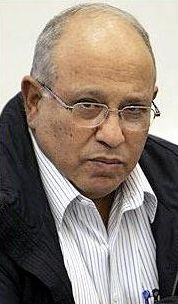
In a feature article for GQ Magazine, Ronen Bergman, senior political and military analyst for the Israeli newspaper Yedioth Ahronoth, describes the rise and fall of Israel’s Mossad under the leadership of Meir Dagan.

“Dagan’s unique expertise,” Israeli prime minister Ariel Sharon once said, “is the separation of an Arab from his head.”

Under Dagan’s command, dozens of Mossad’s elite operatives are now fugitives as a result of the bungled assassination of the Hamas commander, Mahmoud Al-Mabhouh, in Dubai in January 2010.

The organization Dagan is credited with having resuscitated from a coma has now been thrown into disarray.

[I]n 2002, Prime Minister Ariel Sharon tapped Dagan, a former military commander with a reputation for ruthless, brutal efficiency, to restore the spy agency to its former glory and preside over, as he put it, “a Mossad with a knife between its teeth.” “Dagan’s unique expertise,” Sharon said in closed meetings, “is the separation of an Arab from his head.”

Notorious for his aggressive, verbally abusive style of leadership, he is an ideologically rigid man who, according to several people inside the organization, shows the door to anyone who dares to voice an opinion different from his. As one Mossad veteran told me, “It is extremely difficult to get your opinion heard in his presence, unless it supports his. He is unable to accept criticism or even another opinion. It’s almost as if he treats his opposition like an enemy.” Dagan is also reported to have stated on several occasions that he does not believe there is anyone within the Mossad today who is worthy to replace him.

Bergman provides a detailed account of the Dubai operation and the numerous mistakes made by the Israelis in spite of the risks they were running, operating in a hostile country.

As far as the Mossad is concerned, there are two types of countries in the world. There are “base countries” (essentially, the West), in which the Mossad, like most other intelligence agencies, is able to operate with relative ease. In these countries, operatives have access to multiple getaway routes in case of emergency (and there are Israeli embassies to escape to as a last resort); it is assumed that if a Mossad spy is caught in a base country, a discreet solution can likely be found with the assistance of the local intelligence services—an option referred to in the Mossad as the “soft cushion”). “Target countries,” however, are enemy states in which operating undercover is significantly more dangerous. There are no easy escape routes (and no friendly embassy to run to), and being caught in these countries will almost certainly result in physical torture and either a protracted jail term or, quite possibly, death.

[On January 19, 2010] Al-Mabhouh is expected to land in Dubai at 3 p.m. At 1:30, Kevin Daveron [who along with Gail Folliard and Peter Elvinger were the operation’s commanders — each of these being assumed names] leaves his hotel and heads to the team’s designated meeting place—the lobby of a different hotel, where none of the team members is staying, that was selected in advance for its convenient location. On the way to the meeting, he walks through the lobby of a third hotel and enters the rest­room. When he emerges, he is no longer bald but now has a full head of hair and is wearing glasses. The security camera outside the entrance to the men’s and women’s bathrooms was recording all of this in real time. Had an alert guard noticed what was going on, the mission might have ended quite differently, with the target alive and the team members imprisoned in a hostile country.

Gail Folliard also leaves her hotel and on her way to the meeting uses the same restroom entrance as Daveron, from which she too emerges in a wig. Oddly, Folliard and Daveron are the only ones at the meeting who have changed their appearances. Given that the operatives are under the constant gaze of security cameras throughout the city, the “new” Daveron and Folliard run the risk of being linked to the “old” Daveron and Folliard through the identity of the individuals they’ve met with and passed by throughout the day—the kind of mistake that is almost incomprehensible for an elite Mossad team to make.

Despite the fact that Dubai is a hostile environment—a distant Arab state with ties to Iran—many details of the mission suggest the Mossad treated it as if they were operating inside a base country. The use of Payoneer cards is one obvious example. For the most part, prepaid debit cards are only used domestically within the United States, and while Payoneer does issue debit cards that are valid internationally, these are relatively rare. That several of the team members were using the same type of unusual card issued by the same company—one whose CEO, Yuval Tal, is a veteran of an elite Israeli Defense Force commando unit—gave the Dubai police a common denominator to connect the various members of the team.

Why did the Mossad permit things to go so wrong in Dubai? In a word, the answer is leadership. Because Dagan refashioned the Mossad in his own image, and because he drove out anyone who was willing to question his decisions, there was no one in the agency to tell him that the Dubai operation was badly conceived and badly planned. They simply did not believe that a minnow in the world of intelligence services such as Dubai would be any match for Israel’s Caesarea fighters.* As one very senior German intelligence expert told me: “The Israelis’ problem has always been that they underestimate everyone—the Arabs, the Iranians, Hamas. They are always the smartest and think they can hoodwink everyone all the time. A little more respect for the other side—even if you think he is a dumb Arab or a German without imagination—and a little more modesty would have saved us all from this embarrassing entanglement.”

The Dubai fiasco caused a great deal of damage to Israel, to the Mossad, and to its relations with other Western intelligence organizations. It led to unprecedented revelations of Mossad personnel and methods, far more than any previous bungled operation. A number of states who believe that their passports were forged or otherwise misused by the agency have expelled Mossad representatives. The British response in particular was furious. And Israel’s long-standing security-and-intelligence cooperation with Germany has also been dealt a hugely damaging blow. In early June, the head of the Caesarea unit in the Mossad—who had been considered the leading contender to eventually replace Dagan—offered his resignation. As for Dagan’s future, before Dubai he had hoped that the liquidation of Al-Mabhouh would ensure yet another extension of his tenure as director of the agency. But that has not come to pass. At the time of this writing, it is assumed that he will not continue. And so the Mossad “with a knife between its teeth” likely is entering another period of confusion and self-doubt.

“There is no doubt Dagan received an organization on the verge of coma and brought it back to its feet,” one Mossad veteran of many years told me. “He increased its budget, won great successes, and most important, he rebuilt its pride. The problem is that multiplying its volume of activity many times over came with the price of compromising on security protocols. And along with success came hubris. Together, they brought the Dubai debacle. And now, in some areas, his successor will find a Mossad even worse off than Dagan found in 2002.”

*Most of the operatives here are members of a secretive unit within the Mossad known as Caesarea, a self-contained organization that is responsible for the agency’s most dangerous and critical missions: assassinations, sabotage, penetration of high-security installations. Caesarea’s “fighters,” as they are known, are the elite of the Mossad. They rarely interact with other operatives and stay away from Mossad headquarters north of Tel Aviv, instead undergoing intensive training at a separate facility to which no one else in the agency has access. They are forbidden from ever using their real names, even in private conversation, and—with the exception of their spouses—their families and closest friends are unaware of what they do. As one longtime Caesarea fighter recently told me, “If the Mossad is the temple of Israel’s intelligence community, then Caesarea is its holy of holies.”

Facebooktwittermail

Once a terrorist, always a terrorist — unless you’re an Israeli

David Cole challenges the Supreme Court’s idiotic ruling on the definition of “material support” offered to designated terrorist organizations.

Did former Attorney General Michael Mukasey, former New York Mayor Rudolph Giuliani, Tom Ridge, a former homeland security secretary, and Frances Townsend, a former national security adviser, all commit a federal crime last month in Paris when they spoke in support of the Mujahedeen Khalq at a conference organized by the Iranian opposition group’s advocates? Free speech, right? Not necessarily.

The problem is that the United States government has labeled the Mujahedeen Khalq a “foreign terrorist organization,” making it a crime to provide it, directly or indirectly, with any material support. And, according to the Justice Department under Mr. Mukasey himself, as well as under the current attorney general, Eric Holder, material support includes not only cash and other tangible aid, but also speech coordinated with a “foreign terrorist organization” for its benefit. It is therefore a felony, the government has argued, to file an amicus brief on behalf of a “terrorist” group, to engage in public advocacy to challenge a group’s “terrorist” designation or even to encourage peaceful avenues for redress of grievances.

Don’t get me wrong. I believe Mr. Mukasey and his compatriots had every right to say what they did. Indeed, I argued just that in the Supreme Court, on behalf of the Los Angeles-based Humanitarian Law Project, which fought for more than a decade in American courts for its right to teach the Kurdistan Workers’ Party in Turkey how to bring human rights claims before the United Nations, and to assist them in peace overtures to the Turkish government.

But in June, the Supreme Court ruled against us, stating that all such speech could be prohibited, because it might indirectly support the group’s terrorist activity. Chief Justice John Roberts reasoned that a terrorist group might use human rights advocacy training to file harassing claims, that it might use peacemaking assistance as a cover while re-arming itself, and that such speech could contribute to the group’s “legitimacy,” and thus increase its ability to obtain support elsewhere that could be turned to terrorist ends. Under the court’s decision, former President Jimmy Carter’s election monitoring team could be prosecuted for meeting with and advising Hezbollah during the 2009 Lebanese elections.

At the heart of the Supreme Court justices view of terrorism is that it can be defined more in terms of who terrorists are than in what they do. In essence, it declares: once a terrorist, always a terrorist (unless the US government decides otherwise).

This view has become almost a religious orthodoxy in the United States over the last decade. Hence, it is only among hardcore advocates of human rights that the fact that men now being imprisoned primarily because of fears about what they might do in the future, is seriously being challenged.

But if this once-a-terrorist-alway-a-terrorist view was actually applied with rigor, how could the United States justify its support for Israel? Former prime minister Menachim Begin was a terrorist. Tzipi Livni’s parents were terrorists. Terrorism played a vital role in the creation of Israel. And yet material support from the US government to Israel flows in abundance. Different strokes for different folks, I guess.

Facebooktwittermail

Combined Systems Inc’s lethal products

Following the death of Jawaher Abu Rahmah, four American peace activist groups have written to the US manufacturer that supplies the Israeli military with CS gas products. The letter states:

As US groups committed to justice and peace, we are writing to ask that Combined Systems Inc. cease providing CSI equipment to the Israeli government in response to the Israeli military’s ongoing and foreseeable misuse of CSI crowd control equipment to kill and maim protesters in the Occupied Palestinian Territories. The Israeli military has demonstrated a pattern of misuse of your equipment, directly leading to the death and injury of unarmed demonstrators in the Occupied Palestinian Territories. Over the last two years alone, the Israeli military has used your products to kill two peaceful protesters from one family in the West Bank village of Bil’in, to severely injure two peaceful protesters from the US, and to seriously injure many more. According to the the Israeli human rights group B’Tselem, two other Palestinians were killed by Israeli tear gas in 2002.

As noted on CSI’s website, “Israeli Military Industries” are among CSI’s “military customers and development partners.” CSI has an ethical and legal responsibility to ensure that the Israeli government is using CSI products according to product guidelines. Unfortunately, the Israeli military has a well-documented track record of systematically using excessive force against civilians, including with CSI products as outlined below, and thus is not an appropriate customer for CSI.

Paul Ford, Vice President of Sales and Marketing for CSI, in a 2009 edition of Special Operations Report [PDF], described the company’s approach to “Non-Lethal Weapons” (NLW) for military forces and law enforcement agencies around the world.

“CSI’s goal is to continue to provide innovative new NLW technologies to save lives and enhance the options available to operators, rather than taking them away,” says Ford. “We’ve finally entered an age where we now have safer options and acceptance, set apart from otherwise conventional lethal force means, which offer immediate compliance by way of NLWs. We’re proud to be a company that has embraced the concept: we can do more by means of compliance with technology rather than with injury or death.”

If CSI takes its corporate mission seriously, it should recognize that its reputation is being seriously undermined by the Israeli military’s unwillingness or inability to use CSI products in compliance with the manufacturer’s directions. In the hands of Israeli conscript soldiers who have little concern for the life or welfare of unarmed protesters, CSI non-lethal weapons no longer live up to that name and instead are causing injury and death.

Facebooktwittermail

Why American journalists won’t stand up for the First Amendment

At Newsweek, Ben Adler asks: why aren’t American journalists standing up for WikiLeaks. He sees three reasons:

1. Refusal to engage in advocacy: American journalists, unlike many of their foreign counterparts, have a strong commitment to objectivity and nonpartisanship. At many mainstream media organizations, signing petitions is verboten, and many journalists impose such rules on themselves. According to Shapiro, who co-wrote the Columbia letter, when they circulated the document, “Some people said, ‘As a journalist, I make it my practice never to sign a petition.’ ” As an example, Bill Grueskin, the dean of academic affairs at Columbia’s Journalism School, did not sign. Asked why by NEWSWEEK, he said he’s “not much of one for signing group letters.”

2. Opposition to Assange’s purpose: That same notion of objectivity shared by journalists makes many of them suspicious of WikiLeaks’s journalistic bona fides. Assange has an advocacy mission: to disrupt the functioning of governments. Many investigative journalists, like the famous muckrakers at the turn of the last century, have had a similar orientation, says Shapiro, who wrote the book Shaking the Foundations: 200 Years of Investigative Journalism in America. “WikiLeaks springs from the same purpose as investigative journalism: a sense that the system is corrupt and the truth can be told,” says Shapiro. “It’s a reformist rather than radical agenda.” Even so, many mainstream reporters, editors, and producers might see associating with Assange as inappropriately endorsing an advocacy mission.

3. Opposition to Assange’s methods: Some journalists, while perhaps believing Assange should not be prosecuted, are so disgusted with his approach that they are reluctant to weigh in publicly. Sam Freedman, a journalism professor at Columbia University, did not sign the letter his colleagues circulated because, “I felt the letter did not adequately criticize the recklessness—the disregard for the consequences of human lives—of a massive dump of confidential info.” Freedman says prosecuting Assange would set a dangerous precedent for legitimate journalists. But many think, as Freedman does, that Assange did not exhibit the judiciousness that a journalist must when releasing classified information.

Some would take issue with that. WikiLeaks did, in fact, offer the State Department an opportunity to request that sensitive information be withheld. But pointing to WikiLeaks as a paradigm of a free press at work is not a position many journalists want to find themselves in. “From a legal perspective, the media may not want this to be the test case,” says Dan Abrams, NBC’s legal analyst and the founder of the Mediaite blog. “This example is almost a classic law school worst-case scenario for testing the bounds of the First Amendment. [Journalists] think it’s within his rights to do have done it, but they think he ought not to have done it. That’s the fundamental tension in the way the media’s covering the story, and the tepid defenses.”

In other words, American journalists are too objective and too highly principled to align themselves with WikiLeaks.

Or maybe it has more to do with the fact that most American journalists receive their pay checks from media corporations whose own cozy relations with the US government must not be put in jeopardy by an anarchic organization like WikiLeaks.

When self-interest and the status quo so closely coincide, why speak up? And when newspapers are constantly making staff cuts, who imagines that the fiercest advocates of First Amendment rights will also be seen as the most reliable “team players” — the ones who can be confident that they will be among the last thrown off board?

Facebooktwittermail

Israeli military tries to cover up killing of an unarmed Palestinian protester

As was widely reported on Saturday, Jawaher Abu Rahmah, a 36 year-old Palestinian woman from Bilin, died after inhaling tear gas at a demonstration in the West Bank village on Friday.

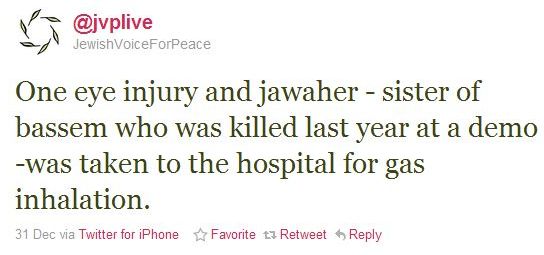
The moment at which Jawaher was evacuated by ambulance from the scene was recorded by Rebecca Vilkomerson Emily Schaeffer from Jewish Voice for Peace who tweeted: “One eye injury and jawaher — sister of bassem who was killed last year at a demo — was taken to the hospital for gas inhalation.”

Israeli Defense Forces officials are now propagating disinformation through a network of right-wing bloggers and stooges in the Israeli press, suggesting the Jawaher did not even attend the demonstration.

One such blogger, The Muqata, who attended an “exclusive” IDF briefing — exclusive, presumably, to bloggers willing to parrot whatever they were told — said: “We have never heard of anyone dying from inhaling tear gas…”

The U.S. Army Center for Health Promotion and Preventive Medicine warns that at a concentration of 2mg per cubic meter, CS gas “is immediately dangerous to life…” The Army advises, in the event of inhalation: “remove the victim to fresh air immediately; perform artificial respiration if breathing has stopped; keep the victim warm and at rest; seek medical attention immediately.”

The goal of the IDF and its apparatchiks is to sow doubt. But as Jerry Haber at The Magnes Zionist writes:

Even an idiot can see that the IDF is using the same “methodology” that Holocaust deniers use to raise questions about the number of Jews killed, or the presence of gas chambers to kill Jews, etc. That methodology is to “raise questions,” to “point out contradictions”, to suggest that the evidence is not convincing, to insinuate that those who make the claims are not to be trusted.

What is equally evident is that at a time when barely a day goes by without new evidence emerging of the racism which is endemic across Israel, the IDF feels acutely vulnerable when its disregard for human life is once again in the spotlight.

Denial is another name for desperation.

Facebooktwittermail

WikiLeaks: US government, acting on behalf of Monsanto, targeted EU over GM crops

[Updated below]

Make no mistake: Monsanto poses an infinitely greater threat to the world than al Qaeda.

The US government still marches in lockstep with this corporate behemoth which is intent and already frighteningly successful in its campaign to claim ownership over the global food supply.

The Guardian reports:

The US embassy in Paris advised Washington to start a military-style trade war against any European Union country which opposed genetically modified (GM) crops, newly released WikiLeaks cables show.

In response to moves by France to ban a Monsanto GM corn variety in late 2007, the ambassador, Craig Stapleton, a friend and business partner of former US president George Bush, asked Washington to penalise the EU and particularly countries which did not support the use of GM crops.

“Country team Paris recommends that we calibrate a target retaliation list that causes some pain across the EU since this is a collective responsibility, but that also focuses in part on the worst culprits.

“The list should be measured rather than vicious and must be sustainable over the long term, since we should not expect an early victory. Moving to retaliation will make clear that the current path has real costs to EU interests and could help strengthen European pro-biotech voices,” said Stapleton, who with Bush co-owned the St Louis-based Texas Rangers baseball team in the 1990s.

In other newly released cables, US diplomats around the world are found to have pushed GM crops as a strategic government and commercial imperative.

In a recent interview on Democracy Now!, Jeffrey Smith, executive director of the Institute for Responsible Technology, was asked to compare the Obama administration with the Bush administration on the issue of biotechnology.

President Obama, while he was campaigning here in Iowa, promised that he would require labeling of genetically modified crops. And since most Americans say they would avoid GMOs if labeled, that would have eliminated it from the food supply. But, you see, he and the FDA have been promoting the biotechnology. And unfortunately, the Obama administration has not been better than the Bush administration, possibly worse.

For example, the person who was in charge of FDA policy in 1992, Monsanto’s former attorney, Michael Taylor, he allowed GMOs on the market without any safety studies and without labeling, and the policy claimed that the agency was not aware of any information showing that GMOs were significantly different. Seven years later, because of a lawsuit, 44,000 secret internal FDA memos revealed that that policy was a lie. Not only were the scientists at the FDA aware that GMOs were different, they had warned repeatedly that they might create allergies, toxins, new diseases and nutritional problems. But they were ignored, and their warnings were even denied, and the policy went forth allowing the deployment GMOs into the food supply with virtually no safety studies. That person in charge is now the U.S. food safety czar in the Obama administration.

If you haven’t seen it already, watch Food Inc. (2008). This is the part of the documentary dealing with Monsanto’s ownership of the soy bean and the draconian means it uses to prevent farmers replanting seed grown on their own fields.

Update: Aaron Turpen writes:

Monsanto, the world’s largest producer of genetically modified seeds and of America’s most-used herbicide RoundUp, is finally showing signs of breaking. Earlier this year, the company was named Company of the Year by Forbes Magazine. Forbes has since apologized for that award while stock market commentator Jim Cramer has named Monsanto to be “the worst stock of 2010.”

So what’s happening to the GMO Giant?

Several things are happening at once, bringing the powerful company down to earth. First, Monsanto’s best-selling product, RoundUp (glyphosate), has seen its patent run out. This means cheaper competition, especially in large, foreign markets like Asia. Second, the company is also seeing many of its core seed buyers turning to other sources because of the growing threat of RoundUp-resistant crops.

Facebooktwittermail

Lieberman: ‘I am the mainstream’

Newsweek refers to Avigdor Lieberman as “Israel’s most popular politician,” but then calls him its “far-right” foreign minister. He is indeed, but since he is also — in his words — “the mainstream,” it’s time the American mainstream media desist from portraying him as being on the political fringe.

Lieberman is a mainstream politician in a far-right country.

Racism has been normalized in what should now be universally recognized as a racist state — Israel cannot claim to be nor should be characterized by others as a liberal democratic state. Were it such, Lieberman could not possibly have risen this far.

Lieberman talks about his plan to strip at least 10 percent of Israelis of their citizenship:

You’re talking about drawing a line so that how many Israeli Arabs will no longer be part of Israel?

At least half.

Polls suggest that 90 percent or more of Israeli Arabs don’t want that.

You have 20 percent of the population that’s the Arab minority. You have 80 percent that’s Jewish. From 80 percent of the Jewish population, 70 percent support this idea.

So even if a resident of [the Israeli Arab town] Umm al-Fahm, for instance, doesn’t want to become part of Palestine, if a majority in the country says he has to, he has no choice?

He can continue to live in his property, his house, his land [and become a citizen of Palestine], or he can move to Israel.

Facebooktwittermail

Never again? Elderly Palestinian women called ‘whores’ on Yad Vashem tour, while racism explodes across Israel

Max Blumenthal writes:

This week, a group of elderly Palestinian women were escorted to the Yad Vashem Holocaust Martyrs’ and Heroes’ Remembrance musuem to learn about the Jewish genocide in Europe. At the entrance of the museum, they were surrounded by a group of Jewish Israeli youth who recognized them as Arabs. “Sharmouta!” the young Israelis shouted at them again and again, using the Arabic slang term for whores, or sluts.

The Palestinians had been invited to attend a tour arranged by the Israeli Bereaved Families Forum, an organization founded by an Israeli whose son was killed in combat by Palestinians. They were joined by a group of Jewish Israeli women who, like them, had lost family members to violence related to the conflict. Presumably, both parties went on the tour in good faith, hoping to gain insight into the suffering of women on the other side of the conflict.

Unfortunately, the Palestinian members (who unlike the Israelis live under occupation and almost certainly had to obtain special permits just to go to Yad Vashem) learned an unusual lesson of the Holocaust: A society that places the Holocaust at the center of its historical narrative — that stops traffic for two minutes each year on the national holiday known as Yom Ha’Shoah — could also raise up a generation of little fascists goose-stepping into the future full of irrational hatred.

“In Palestinian culture, older women are most honored and they could not believe their ears,” said Sami Abu Awwad, a Palestinian coordinator of the tour. “We never talk like this to older women. The Palestinians, who were all grandmothers, were very shocked and offended.”

Facebooktwittermail