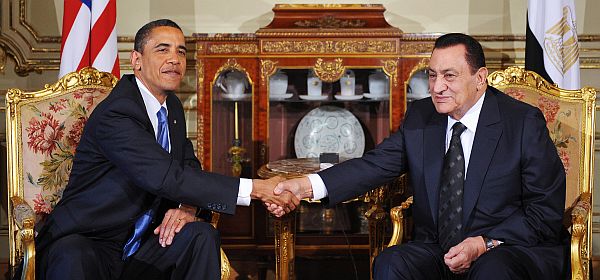
The New York Times, in its role as state storyteller, spins a fine yarn about how the White House artfully engineered Hosni Mubarak’s removal. A pivotal place in the narrative goes to “Frank G. Wisner, an adroit ex-diplomat whom President Obama had asked hours before to undertake a supremely delicate mission: nudging President Hosni Mubarak of Egypt out of power.”
Senior officials say that as Mr. Wisner traveled to Egypt, Obama officials in Washington were working on his message to Mr. Mubarak: to announce that he would not run for re-election (he did that), and to promise that his son would not run for election (he did not do that).
“No one wanted it to seem as if we were pushing him out,” one administration official said. “That would not serve American interests. It was important for President Mubarak to make the decision.”
Two hours after Mr. Wisner’s plane left Andrews Air Force Base, White House officials sent an e-mail to more than a dozen foreign policy experts in Washington, asking them to come in for a meeting on Monday morning. “Apologies for the short notice in light of a very fluid situation,” the e-mail said.
The Roosevelt Room meeting, led by Benjamin Rhodes, the deputy national security adviser for strategic communications, and two other National Security Council officials, Daniel Shapiro and Samantha Power, examined unrest in the region, and the potential for the protests to spread, according to several attendees.
Significantly, during the meeting, White House staff members “made clear that they did not rule out engagement with the Muslim Brotherhood as part of an orderly process,” according to one attendee, who like others interviewed for this article spoke on condition of anonymity because he did not want to talk publicly about the meeting. The Muslim group had been suppressed by Mr. Mubarak, and Bush administration officials believed it was involved in terrorist activities. It renounced violence years ago.
Several times, two other attendees said, White House staff members said that Mr. Obama believed that Egyptian politics needed to encompass “nonsecular” parties: diplomatic-speak for the Muslim Brotherhood.
“Orderly transition” is now the name of the game, but what remains unclear is whether Mubarak intends on sticking to the script.
After a half-hour conversation this evening, the only element of Mubarak’s thinking that Obama disclosed during his televised remarks was this: “He recognizes that the status quo is not sustainable and that a change must take place.”
That seems to leave open a wide range of possibilities — and one inconvenient fact: Mubarak is still Egypt’s president.
Dictators invariably see themselves as uber-nationalists — right to the point of seeing themselves as indivisible from the nation. Mubarak’s refusal to bow out swiftly means he has chosen chaos. The US and the rest of the world no longer have the luxury of meekly watching from afar.
Mubarak wants to stick around for a few more months — game not over.
Frank Wisner, a former ambassador to Egypt who has good relations with the Mubarak regime, traveled to Cairo at President Obama’s behest to talk to the Egyptian leader about the country’s future.
Wisner delivered a direct message that Mubarak should not be part of the “transition” that the U.S. had called for, according to Middle East experts who spoke on condition of anonymity.
One expert on the region said that in his regular conversations with the Obama administration about the unrest in Egypt, he learned that Wisner’s message to Mubarak was that “he was not going to be president in the future. And this message was plainly rebuffed.”
Reuters — Mubarak will say in a televised speech that he will step down at the next election but would stay in office till then to meet demands of protesters in that period, Al Arabiya TV reported on Tuesday.
New York Times — “President Obama has told the embattled president of Egypt, Hosni Mubarak, that he should not run for another term in elections in the fall, effectively withdrawing American support for its closest Arab ally, according to American diplomats in Cairo and Washington.”
The Rorschach test from Cairo: a dignified and disciplined act of collective prayer? Or a dangerously large gathering of Muslims?
Perhaps more than anything, American perceptions of Islam reveal the extent to which this nation celebrates religion without the slightest notion of piety — not surprising, given the degree to which religion and nationalism have become interwoven.
— —
“It needs to be understood that if the Egyptian government will fall, the Muslim Brotherhood will take its place, and that will cause even worse problems not only for the Middle East, but for the whole world.” This is the assessment of Israel’s Deputy Minister for Galilee and Negev Development Ayoub Kara.
What’s interesting about these kind of the-sky-is-falling predictions coming from Israel and its febrile supporters is that in a matter of months their fears are likely to be proved baseless. To begin with, the great Islamist bogeyman of Egypt, the Muslim Brotherhood, is likely to move from unofficial to legal participation in parliamentary politics quite cautiously. This is a conservative organization in the traditional sense of the term “conservative” — as opposed to the histrionic modern American meaning of the word. Indeed, I doubt that any single political group will be in a rush to grab power during the most difficult period of Egypt’s political rebirth.
The most immediate point of tension between a new Egyptian government and Israel will be over Gaza and this will be the test of the new government’s democratic credentials. Hopefully it will do the right thing and refuse to be complicit in the siege. But of course I’m getting way ahead of events now …
Jeff Jarvis: “Vital, world-changing news is occurring in the Middle East and no one — not the xenophobic or celebrity-obsessed or cut-to-the-bone American media — can bring the perspective, insight, and on-the-scene reporting Al Jazeera English can.”
As the region reconfigures itself, the US should help Israel adjust to a new reality – convincing Israel to withdraw from the Palestinian territories would be the best option, but just explaining to Israel that America now has to deal with an Arab politics that is in its post-dictatorship phase and will henceforth have to be more responsive to public opinion – that will be a necessity.
Indeed — but that could be asserted even more strongly, which is to say, come the day that the US government no longer has at its disposal a clutch of autocratic rulers who depend for their survival on US support, the US will no longer be able to afford the luxury of deferring to Israel’s interests. In other words, this is an opportunity for everyone to grow up — no more pandering to a whiny Zionist brat that has long relied on its ability to manipulate its over-indulgent American parent.
11.16 — Alaa Abd El Fattah: “it looks like across the nationion 4-6 million went out, that’s %5–%8 of the population folks”
The Guardian — Bibliotheca Alexandrina and other cultural sites across Egypt are being protected by Egypt’s young people:
In a statement on the library’s site, Ismail Serageldin tells “friends around the world” that the library is being protected by the city’s youth from the threat of looting by the “lawless bands of thugs, and maybe agents provocateurs” who have materialised since the popular protests sweeping through Egypt’s major cities began several days ago.
“The young people organised themselves into groups that directed traffic, protected neighborhoods and guarded public buildings of value such as the Egyptian Museum and the Library of Alexandria,” he states. “They are collaborating with the army. This makeshift arrangement is in place until full public order returns.”
The Clash of Conservatives! Egyptian revolution causes a split between right-wing xenophobic isolationist Glenn Beck and right-wing xenophobic US hegemonist Bill O’Reilly. Hopefully it won’t take long before all of their hysterical fear-mongering predictions are exposed as baseless. They and many other Americans would be well-served by remembering the courageous and inspiring example that many Egyptian Muslims showed in early January when they offered themselves as human shields, protecting fellow Egyptians who are Christians.
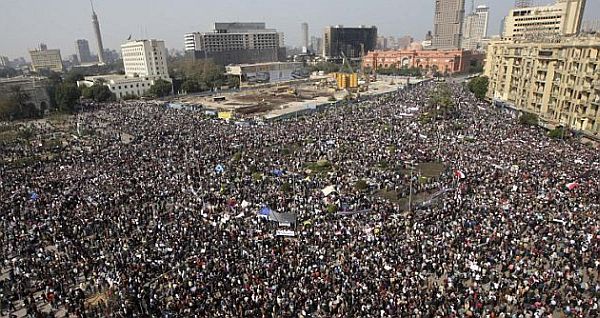
9.04 — While the US State Department is organizing the evacuation of American citizens from Egypt (even though the US acknowledges that there have been no signs of hostility towards Americans), Al Jazeera reports that some tourists from several countries, rather than trying to leave have instead joined the revolution. There are claims that as many as eight million Egyptians across the country are now protesting, calling for Mubarak to stand down. As many as two million are now gathered in Tahrir Square in the center of Cairo.
8.30 — Al Jazeera: Opposition leaders say they will enter into dialogue with Vice President Omar Suleiman after Mubarak stands down.
Simon Tisdall writes: “Suleiman is, in effect, heading a military junta at this point, with all the principal civilian power positions – the presidency, the vice-presidency, the premiership, the defence and interior ministries – held by former senior officers, and with the military itself in full support.
“Mubarak is now reduced to the role of figurehead, sheltering behind this clique. But they will not sacrifice him if they can avoid it. There will be no ignominious flight to Saudi Arabia, like Tunisia’s deposed president, Zine al-Abidine Ben Ali. Mubarak’s pride won’t allow it. The military’s pride won’t allow it.”
New York Times — Obama sends envoy, Frank G. Wisner, to meet Mubarak. No word on what if any message he’s carrying.
Scenes from Tahrir Square:
Interview with anti-government protester at Tahrir Square:
Ahdaf Soueif writes: “Today we have rejected the passivity our rulers have been imposing on us. Our country’s security is being provided by its citizenry. People have automatically taken over the running of their neighbourhoods. On the streets there is unfailing courtesy. The atmosphere in the square sit-ins is celebratory and inclusive.”
Al Jazeera — Erdogan calls for Mubarak to stand down:
EU calls for an orderly transition to a broad-based government:
Bloomberg — The Washington lobbyists in bed with Mubarak
Steven Cook writes: “If anyone ever doubted it, recent events highlight that the armed forces is the pillar of the regime. The National Democratic Party no longer exists. Big business has fled. The police (remember all those arguments about how the police supplanted the military?) forces have collapsed. Only the military remains and thus far they don’t seem to be budging. We are getting into existential territory. The result could be a drawn out stalemate with the military pursuing a holding action while Omar Soleiman’s intelligence service tries to split the opposition. These guys are brutal, but not dumb.”
Helena Cobban writes: “There are many objective reasons why Washington has been unable to intervene to prop up its longtime ally. What, after all, could Washington have hoped to do? It has no strike force of its own capable of swooping in and beating back the protesters, in the way that the British or French empires might have attempted in similar circumstances 100 years ago. And in an era in which protesters can immediately hold up for the cameras of the global media tear gas shells or rubber-coated steel bullets that clearly signal “Made in the USA,” there is not a lot of indirect help Washington could have given Mubarak’s security forces, either.”
Jeremy Scahill writes: “The real threat Al Jazeera poses to authoritarian regimes is in its unembedded journalism. That is why the Bush Administration viewed Al Jazeera as a threat, it is why Mubarak’s regime is trying to shut it down and that is why the network is so important to the unfolding revolutions in the Middle East. It is the same role the network plays in reporting on the disastrous US war in Afghanistan.”
Wadah Khanfar, Director General, Al Jazeera Network, says:
As I write, Egyptian President Mubarak is closing our offices and arresting our journalists. The Egyptian government has removed Al Jazeera from NileSat, the state-owned satellite carrier, delaying our ability to be found on the dial in Egypt and North Africa. We have reappeared through other carriers, while instructions on how to find us go viral across the Internet.
Elsewhere, in the United States, Al Jazeera faces a different kind of blackout, based largely on misinformed views about our content and journalism. Some of the largest American cable and satellite providers have instituted corporate obstacles against Al Jazeera English. We are on the air and on the major cable system in the nation’s capital, and some of America’s leading policymakers in Washington, D.C., have told me that Al-Jazeera English is their channel of choice for understanding global issues. But we are not available in the majority of the 50 states for much of the general public.
We believe all Americans, not just those in senior governmental positions, could benefit from having the option to watch Al-Jazeera English — or not to watch us — on their television screens.
We know the demand is there. We have seen a 2000 percent increase in hits on our English-language website, and more than 60 percent of that traffic originates in the United States. We have seen Jeff Jarvis, in the pages of the Huffington Post, make the case publicly that many are making privately. While millions of Americans have turned to the Internet and to Internet-connected-devices, many more millions should have the freedom to flip to our channel on their remotes — especially when the Middle East is on everyone’s mind.
As the Million Egyptian March takes to the streets of Cairo, is President Obama finally ready to take a strong stand on the side of the people?
In The Guardian, Michael Tomasky writes “Obama is in no position to offer the moral thunder the protesters and their supporters everywhere crave.” Why? Because “the US should not be dictating outcomes any more. The modern world requires a US posture that is more fluid and subtle, and that no longer seeks to call the global shots.”
Having watched events over the last week as closely as one can from a great distance, I would say there has been no lack of moral thunder. It has come from the voices of the Egyptian people.
Having demonstrated their pride, dignity, and collective power with such force, I don’t think they crave anything from Washington or anywhere else — bar the fulfillment of their single demand: that Hosni Mubarak stand down.
To the extent that the expectations of many Egyptians and others are directed towards Washington and Obama, it is perhaps with the hope that anyone who supports democracy would celebrate the extraordinary sight of democracy being born.
Obama’s inhibitions probably say less about the fear of being perceived in the Middle East as the leader of an imperial power which still insists on calling the global shots, than in being seen by his fellow Americans supporting a revolution that they fear.
Indeed, as Benjamin Netanyahu compares the Egyptian revolution of 2011 with the Iranian revolution in 1979, Obama surely fears some form of retribution from AIPAC in 2012 if he is portrayed as having undermined Israel’s security. Above all, the 2012 incumbent presidential candidate does not want to be cast as having played a role in shaping Egypt’s future.
The most courageous thing Obama could do at this point would not be to make some grandiose expression of American support for the Egyptian people — an expression which this late in the day would carry little credibility. No, if he wants to stand up in defense of democracy, he should addressing a domestic audience — one that apparently has lost faith that democracy is a good thing.
If Americans can’t support the democratic rights of Egyptians, what does that say about how seriously we want to protect our own rights? After all, the unalienable rights upon which America was founded were not conceived as American rights but universal human rights. If we don’t stand in solidarity with Egyptians, have we not also lost faith in the principles upon which America was founded?
Obama once declared:
I do have an unyielding belief that all people yearn for certain things: the ability to speak your mind and have a say in how you are governed; confidence in the rule of law and the equal administration of justice; government that is transparent and doesn’t steal from the people; the freedom to live as you choose. These are not just American ideas; they are human rights. And that is why we will support them everywhere.
But what held the greater significance? The sentiment and meaning of Obama’s words or the fact that he delivered them as the honored guest of Hosni Mubarak?
After for several years being convinced that it was 1938, Israel’s Prime Minister Benjamin Netanyahu who appears to live in a time warp, has now decided that it’s 1979. Iran was Germany and now Egypt is Iran.
From Jerusalem, the prospect of Egyptians fully-armed with votes looks more dangerous than Iranians stockpiling enriched uranium.
Further evidence of Israel’s concerns in response to the dangerous proliferation of freedom in Egypt is that hundreds of Egyptian troops are now being rushed into Sinai, heading towards Sharm el-Sheikh — the location where Hosni Mubarak is rumored to be mounting his last stand. Under the Israel-Egypt peace treaty, Sinai is a demilitarized zone and thus the troop movement required and received Israel’s consent.
Mubarak has ordered his new prime minister to begin talks with the opposition to find out their specific demands and protesters, recognizing that “Down With Mubarak!” might not be specific enough are now adding that he needs to be out by Friday.
Protesters gathering at Tahrir Square are now having their IDs check by the army. Heba Fatma Morayef, a Human Rights Watch Egypt researcher, said: “When I asked why a soldier replied: ‘it’s to keep the police out and make sure none of the escaped criminals get in.'”
Fear of public expressions of solidarity with Egyptians, now extends from Gaza, to the West Bank, and to China.
Israeli officials are appealing to Egypt’s newly-appointed Vice President Omar Suleiman to maintain the siege on Gaza.
Meanwhile, Washington dithers — I mean, continues to monitor the situation.
After emerging from a White House meeting on Egypt on Monday, Marc Lynch, a foreign policy expert who blogs on the Middle East as Abu Aardvark, wrote on his Twitter feed: “as usual a lot of what you’re hearing about the administration’s policy is wrong.”
He then responded on the social network to a plea from the Cairo-based blogger and journalist Issandr El Amrani – who wrote: “@abuaardvark Since they can’t explain themselves clearly, perhaps you can translate for us!” – by summing up the Obama administration’s current stance in this simple Twitbite:
@arabist U.S. Egypt policy translated: keep army from using violence + get transition to a post-Mubarak real democracy, but not sure how.
One of the experts at the meeting told Politico:
While the administration is considering various options — including the possibility of at some point telling Mubarak privately it’s time to leave — “I don’t think they are there yet.”
Israel called on the United States and a number of European countries over the weekend to curb their criticism of President Hosni Mubarak to preserve stability in the region.
Jerusalem seeks to convince its allies that it is in the West’s interest to maintain the stability of the Egyptian regime. The diplomatic measures came after statements in Western capitals implying that the United States and European Union supported Mubarak’s ouster.
Israeli officials are keeping a low profile on the events in Egypt, with Prime Minister Benjamin Netanyahu even ordering cabinet members to avoid commenting publicly on the issue.
Senior Israeli officials, however, said that on Saturday night the Foreign Ministry issued a directive to around a dozen key embassies in the United States, Canada, China, Russia and several European countries. The ambassadors were told to stress to their host countries the importance of Egypt’s stability. In a special cable, they were told to get this word out as soon as possible.
Stability is of course a political cypher — like moderate — a term far removed from its literal meaning.
When Israelis and Americans refer to Mubarak’s capacity to maintain stability, they are simply referring to his willingness to implement policies that serve Israeli and American interests. He’s been useful. And the fact that calls are now being issued from Western capitals making it clear that now is the time for him to step aside, have less to do with support for the democratic aspirations of the Egyptian people than the fact that Mubarak has clearly suddenly lost his utility.
Still, if the US and its allies have provided a less than spirited defense of democracy, this does not mean that whatever government eventually replaces the Mubarak regime will be a Western-approved government. Mubark’s rule and his departure reflect the limits of Western power, while those who see an American imperial hand shaping all events are in varying degrees victims of the most disabling political mindset — one born from surplus powerlessness.
What Mubarak demonstrates is that stability is not a function of the power to exercise control, but on the contrary the ability to adapt. In a world in flux, adaptation is the key to survival. Stasis is not stability — indeed the longer change remains frozen, the more violent the subsequent rupture.
When we can watch a revolution live on Al Jazeera and follow its minute-by-minute progress through Twitter and Facebook, it’s easy to overlook the degree to which a people’s uprising hinges on simply that: people rising up and taking to the streets. In the video below we witness the simple and visceral demand that came from the streets as marchers called out to their neighbors to join the demonstration.
Electronic Intifada: Philip Rizk (@tabulagaza on Twitter) took this remarkable video of huge popular protests in Cairo on 28 January. The crowds can be heard chanting “inzel! inzel!” — meaning “come down! come down!” — a call to neighbors to join the march, and “The people demand the fall of the regime.”
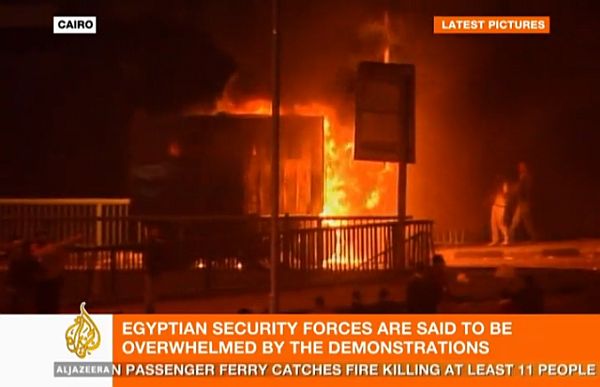
Following Friday prayers on January 28 we joined protesters marching through the streets of Imbaba in Cairo, Egypt. The crowd of 100 that we joined kept increasing and continuously joined with other marches in the same quarter North West of downtown Cairo. By about 1pm the protesters numbered around 15,000 marching towards Galaa Square and attempting to get across the Nile to Tahrir Square, downtown Cairo. In Galaa square we met two other large marches from Giza and Mohandiseen that had already tried to cross to Tahrir and had come under heavy tear gas fire. Shortly thereafter the converged protesters stormed past the security forces and streamed into Tahrir Square. Soon thereafter the security forces that had used brutal force to stop the protests disappeared and the central square of downtown filled with demonstrators sharing one united call: “down with Hosni Mubarak.” In the early evening protesters burnt down the regime’s National Democratic Party headquarters. The streets were filled with tear gas, burning police vehicles and chants of celebration.
Protesters in Tahir Square — just posted on YouTube (don’t know when it was recorded):
“Leave, leave, Mubarak! Tel Aviv is waiting for you!” Protesters at Tahrir Square, January 30 2011:
When a brutal regime is struggling to survive it turns to desperate measures.
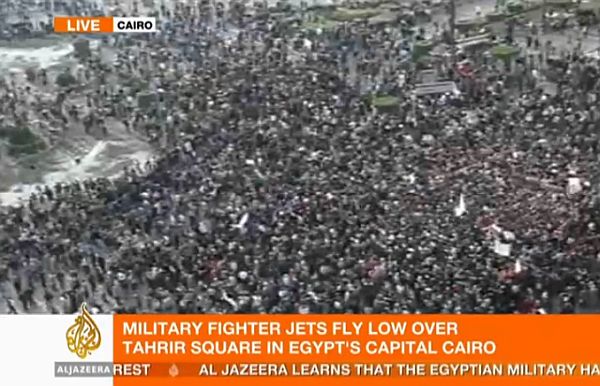
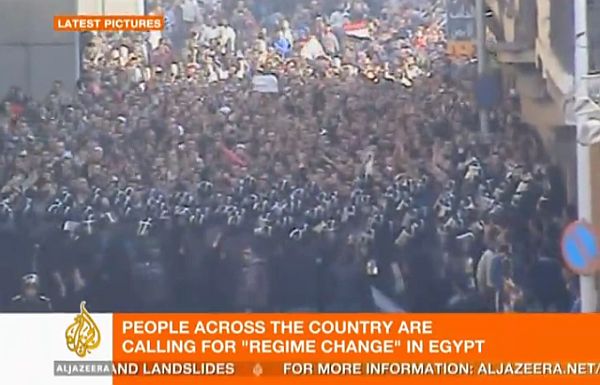
Even as low-flying Egyptian air force Lockheed F-16s are currently attempting to shake fear into the hundreds of thousands of people gathered now in the center of Cairo, the people are showing their increasing defiance. And even now the Obama administration remains afraid of taking a strong stand in support of the Egyptian people.
We cannot honor the revolution in Egypt as impartial observers, uncertain about its outcome or its virtue. To believe in the revolution is to hold the unshakable conviction that human beings have the capacity to govern themselves and the right to live in freedom.
Egypt exposes the divide between those who fearlessly feel the thrill of freedom and those for whom freedom has become an object of fear.
As freedom spreads across the Middle East the greatest test will be faced in Israel.
Let’s be absolutely clear that the timidity with which the United States government has at this time responded to the prospect of Egyptians’ freedom, is a measure of the extent to which the freedom of 80 million people appears to pose a possible threat to the security of seven million Israelis.
Many Israelis and Americans have come to accept an unspoken and inhuman proposition: that one person’s safety can be secured at the expense of another person’s liberty. This forced exchange is an assault on human freedom.
At the same time, many others, swept up in the spirit of this moment, will be tempted to declare, “We are all Egyptians now,” but we are not.
The giddiness of freedom is the reward for those who have risen above their fears.
For those who remain the hostage of their own fears, freedom itself is another source of danger.
Under the rule of the West’s national security states we have been indoctrinated to believe that the remedy for fear is safety.
It is not. Indeed, those who cling to the fiction of high security, merely compound their own fears.
If we are to rediscover the nobility and dignity of our common humanity it will only be by defying fear with courage.
Waseem Wagdi, an Egyptian human rights activist living in London who joined fellow Egyptians protesting outside their embassy today, talks about recent events in Egypt and their significance, not just for Egyptians or for all Arabs, but as something that every single human being who cares for freedom, can celebrate.
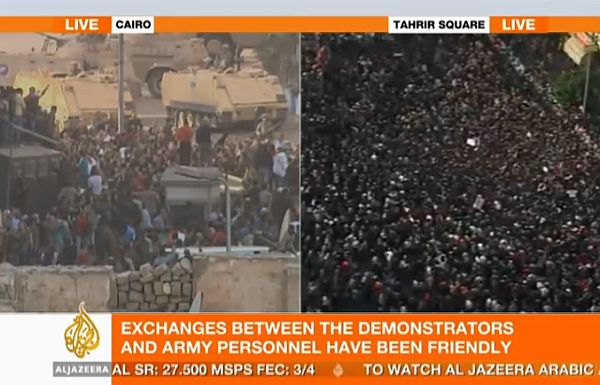
Even as the military-in-suits are being given positions in Mubarak’s newly-appointed government, there are signs that the troops and street-level commanders are willing to demonstrate their allegiance with the Egyptian people.
[Mubarak’s] grip on power was further challenged Saturday as the military that he had deployed to take back control of the streets showed few signs of suppressing the unrest, and in several cases the army took the side of the protesters in the capital and the northern port city of Alexandria.
In the most striking instance, members of the army joined with a crowd of thousands of protesters in a pitched battle against Egyptian security police officers defending the Interior Ministry on Saturday afternoon.
Protesters crouched behind armored trucks as they advanced on the ministry building, hurling rocks and a few Molotov cocktails and setting abandoned cars on fire. But the soldiers providing cover for the advancing protesters refused their pleas to open fire on the security police, while the police defending the ministry battered the protesters with tear gas, buckshot and rubber bullets. There were pools of blood in the streets as protesters carried a number of wounded back out of their ranks.
In other parts of the capital, soldiers invited protesters to climb aboard their armored personnel carriers to have their pictures taken, and in Alexandria, demonstrators took tea to troops.
On July 23, 1952, a small group of Egyptian military officers, later dubbed the “Free Officers,” took advantage of simmering popular resentments against the ineffectual King Farouk and the lingering British colonial presence to seize power. The military-backed regime they installed on that day has remained in power, in one form or another, ever since. The fate of the successor to that regime — President Hosni Mubarak — now hangs in the balance, to be determined by a different but still-powerful group of military officers. With Mubarak’s decision to retrench in the face of the unprecedented political demonstrations throughout the country, he must now rely on the military and its willingness to suppress the tens of thousands Egyptians still in the streets.
When armored personnel carriers filled with soldiers began making their way into the heart of Cairo and other cities in Egypt on Friday January 28th, they were greeted with receptivity by protestors, who saw in the much-respected military a potential ally in their uprising against the regime. No doubt, the recent experience in Tunisia, where the military stepped in resoundingly on the side of the demonstrations and hastened the fall of the repressive regime of President Ben Ali, was fresh in their mind. The Tunisian military had intervened against the police forces, burnishing their image as popular heroes who shared the patriotic concerns of the brave Tunisians who defied the regime. The scenes that unfolded in Egypt made clear that the protestors there hoped to force a similar split between the security forces, run by the Ministry of the Interior, and the military.
While Egypt’s military is no longer an active fighting force, it still retains more credibility as a public entity than Egypt’s civilian institutions, crippled after years of neglect and one-man rule. In recent years, even some democracy activists, despondent from years of state repression and ineffectual organizing, have seen the military as the last hope for Egyptians against Mubarak’s efforts to orchestrate his son, Gamal, as successor to the presidency. Now that demonstrators have overwhelmed the police forces and built popular momentum, the military, were it to shift its allegiance from Mubarak to the protesters, could effectively end the regime.
Despite the scenes that played out in Egypt after the military’s deployment yesterday, with the military exercising restraint from violence and engaging in occasional fraternization with protesters, the military’s ultimate intentions remain a mystery.
Recorded shortly before Friday prayers (yesterday), this discussion with three Egyptian political activists in Cairo reveals more about the passions that are driving the Egyptian revolution than any amount of analysis from outside observers.
The political power now unleashed across Egypt will topple the Mubarak regime not in spite of being leaderless but because it is leaderless — because it has no ideological or social bias but truly represents the will of the people.
Alaa Abd El Fattah, a prominent Egyptian blogger who was interviewed on Al Jazeera today, made the interesting observation that the uprising’s most effective organizational strength comes from a quarter that has been ignored by most of the media: soccer fans known as ultras.
“The ultras — the football fan associations — have played a more significant role than any political group on the ground at this moment,” Alaa said. “Maybe we should get the ultras to rule the country,” he joked.
James M. Dorsey, an expert on soccer in the Middle East, writes:
Established in 2007, the ultras—modelled on Italy’s autonomous, often violent fan clubs—have proven their mettle in confrontations with the Egyptian police, who charge that criminals and terrorists populate their ranks.
“There is no competition in politics, so competition moved to the soccer pitch. We do what we have to do against the rules and regulations when we think they are wrong,” said an El Ahly ultra last year after his group overran a police barricade trying to prevent it from bringing flares, fireworks and banners into the stadium. “You don’t change things in Egypt talking about politics. We’re not political, the government knows that and has to deal with us,” he adds.
The involvement of organized soccer fans in Egypt’s anti-government protests constitutes every Arab government’s worst nightmare. Soccer, alongside Islam, offers a rare platform in the Middle East, a region populated by authoritarian regimes that control all public spaces, for the venting of pent-up anger and frustration.
President Obama and other Western political leaders profess their respect for people power but claim that it loses legitimacy if it fails to eschew all forms of violence. Let the people march in their tens or hundreds of thousands holding up signs and perhaps roses, but whoever picks up a rock must be condemned. In other words, let the people demonstrate their power so long as they do it in such a way that it does not challenge the power of the state and the state’s monopoly on the use of violence.
The sad truth is that when the people attempt to make their voices heard through such dignified expressions of civility, those from whom they are demanding a response find it all too easy to ignore the people’s voice.
Egypt can call out with one voice that it is time for Mubarak to go, yet what captures his and the world’s attention are images of his security forces being over-powered — images of policemen being chased off the streets while their vehicles go up in flames.
The West would like to see someone like Mohamed ElBaradei become a face of moderation who might tame Egypt’s revolutionary forces, yet it is Egypt’s angry youth including an ample sprinkling of ultras who are at the vanguard of this revolution. An ElBaradei revolution would have been a revolution postponed.
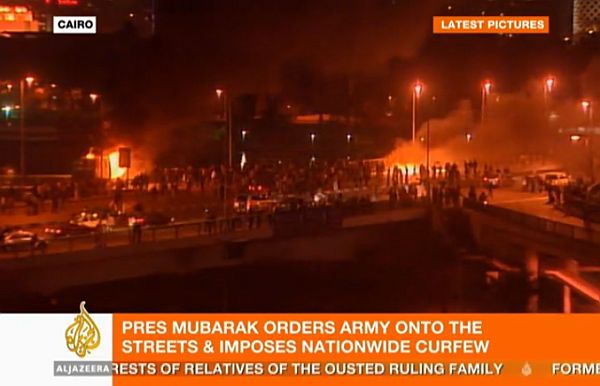
Whatever illusions Hosni Mubarak might have had about the uprising diminishing in strength, the scenes in Egypt right now in defiance of a curfew that was supposed to take force almost an hour ago, demonstrate that the power of the people is indomitable.
(Screen grab from Al Jazeera taken at 9.40 US Eastern.)
In its complacency, America views the democratic aspirations of others as the desire to possess what we already enjoy. Little do we imagine that these aspirations reveal what we have discarded or perhaps never even possessed.
President Obama packages what has driven Egyptians onto the streets within the banal phrase “the desire for a better life” — as though the world is captive to a vision of life in suburbia in which material comfort is the sum of human fulfillment.
We misinterpret the significance of the uprisings in Tunisia and Egypt if we look at these through the narrow prisms of dictatorial rule or economic hardship, because in truth they provide lessons about what it means to be human.
We are complex creatures and have advanced beyond the level of survival. Our needs go beyond material sufficiency.
Egyptians did not take to the streets today in order to fill their stomachs but in order to express their hearts. They were reclaiming their dignity by refusing to continue being the subjects of oppression.
But where is our dignity in accepting the fact that we have political representatives who do not represent our interests? Where is our dignity in having turned ourselves from citizens into consumers and having abandoned the idea of government by the people?
On the streets across Egypt today the single most important message from the people was this: we are not afraid.
Is this not a message that should shame the average American? Having spent a decade accepting the proposition that no expense should be spared to guard us against every imaginable fear, can we even imagine what it means to face danger yet not be afraid?
This perhaps more than anything else is the measure through which the bugaboo of 9/11 became the altar on which we sacrificed our dignity.
And should we pause to consider what the possible consequences are of empowering a national security state in the name of defense against terrorism, we could do no better than look at the example of the Mubarak regime.
*
One of the prevailing narratives in Washington has been that the US must tread a delicate line so that it does not undermine the flowering of democracy by providing unwelcome American support — as though the average Egyptian gives a damn about America’s position.
Egypt’s destiny is being determined by its people — not the Obama administration, which in its timidity and duplicity refuses to actually acknowledge the simple demand that is on the table: that Mubarak go.
And when from America we watch the Egyptian people assert their power, we should only imagine: what might this look like in America if we were not a nation filled with people so thoroughly convinced of our impotence?
7.55 — After 12 hours of near-uninterrupted viewing of Al Jazeera English live television I can only shower this news organization with praise. They should set up an intern program for American news editors to show them how it’s possible to deliver news without being enslaved by commercial interests or showing unwarranted deference to the political establishment. It’s sad that the average American TV viewer has no idea what international news broadcasting of this quality could add to their understanding of the world.
Ali Abunimah notes Israel’s admiration for Egypt’s security services as revealed in the Palestine Papers. In 2007 General Amos Gilad said: “I always believed in the abilities of the Egyptian Intelligence service (GIS). It keeps order and security among 70 millions – 20 millions in one city – this is a great achievement, for which you deserve a medal. It is the best asset for the middle east.”
6.38 — In his statement, Obama ducks the core issue: the demand from Egyptians for Mubarak to go. By prioritizing the need for the restoration of civil order — that security forces and protesters refrain from violence — Obama is treating the uprising as not being fully legitimate. Obama asserts that violence will not result in Egyptian citizens’ being met, yet the evidence is completely the contrary: the fearless and often violent resistance of the people in defying the intimidating strength of the security forces is what is driving change. And note: the administration has provided Mubarak with the key talking point with which he is attempting to retain his hold on power — the promise of “reform.” In their conversation, perhaps Mubarak sought Obama’s advice on what “reform” looks like. Perhaps something like “change.”
6.08 — Al Jazeera: Muslim Brotherhood calls for Mubarak to step down and for the military to intervene.
5.35 — Al Jazeera: Following Mubarak’s speech, protesters chant “Down, Down Mubarak! Down, Down Regime!”
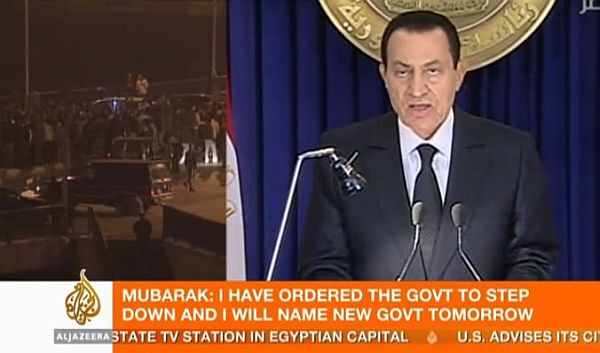
5.29 — Mubarak offers new government and old president.
Noting the non-ideological foundation of the Egyptian intifada, Amr Hamzawy says “Egyptians are rediscovering that politics, before anything else, is concerned with citizens’ living conditions within the borders of the relevant nation-state.”
Kuwait’s Emir Sheikh Sabah al-Ahmad al-Sabah figures out how to keep his people happy: 1,000 dinars ($3,580) to each Kuwaiti citizen plus free distribution of essential food items for 14 months.
“Sixty years of Western nations excusing and accommodating the lack of freedom in the Middle East did nothing to make us safe.” George W Bush, November 6, 2003.
Der Spiegel: Why Israel fears Mubarak’s fall — “Democracy is something beautiful,” said Eli Shaked, who was Israel’s ambassador to Cairo from 2003 to 2005, in an interview with SPIEGEL ONLINE. “Nevertheless, it is very much in the interests of Israel, the United States and Europe that Mubarak remains in power.” Democracy in Egypt opens the door to support for Hamas in Gaza.
3.53 — Al Jazeera — Protesters saying the army and the people are one.
3.38 — Wafik Moustafa (Conservative Arab Network) speaking on Al Jazeera says that he believes the army has now assumed control – that Mubarak is effectively no longer president.
2.52 — AP – Obama administration reviewing its $1.5 billion aid for propping up the Mubarak regime – Obama “monitoring a very fluid situation”
Caught off guard by the escalating unrest in Egypt, the Obama administration is desperate to avoid any public appearance of taking sides. But Washington’s close, longstanding political and military ties to President Hosni Mubarak’s regime, plus annual financial support worth about $1.5bn, undermine its claims to neutrality.
While the US favours Egyptian political reform in theory, in practice it props up an authoritarian system for pragmatic reasons of national self-interest. It behaved in much the same way towards Saddam Hussein’s regime in the 1980s, when Iraq was at war with Iran. A similar tacit bargain governs relations with Saudi Arabia. That’s why, for many Egyptians, the US is part of the problem.
Helena Cobban notes that while Obama monitors the situation in Egypt, he does so surrounded by a group of advisers none of whom know much about the region.
Via TPM’s intriguing new “Egypt wire”, this:
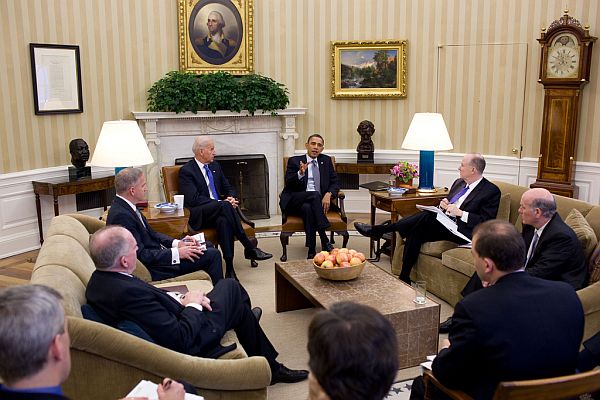
President Obama was reportedly briefed for 40 minutes on the situation in Egypt today. Here, a photo of his meeting with National Security Advisor Tom Donilon; Chief of Staff Bill Daley; Deputy National Security Advisor for Strategic Communication Ben Rhodes; Tony Blinken, National Security Advisor to the Vice President; National Security Council Chief of Staff Denis McDonough; John Brennan, Assistant to the President for Homeland Security and Counterterrorism; and Robert Cardillo, Deputy Director of National Intelligence for Intelligence Integration.
What is notable is the absence of anyone in the group who has any serious knowledge about either Egypt or the broader region.
So thorough-going has been the witch-hunt that AIPAC and its attack dogs have conducted over the past 25 years against anyone with real Middle East expertise that the U.S. government now contains no-one at the higher (or even mid-career) levels of policymaking who has any in-depth understanding of the region or of the aspirations of its people.
12.46 — Brian Whitaker‘s snap analysis of Clinton’s statement: “It looks to me as if Clinton is angling for a negotiated departure by Mubarak, accompanied by an increase in political freedom. I think the US is aiming to structure the solution in a way that would protect its key interests: the peace treaty with Israel, the Suez canal, and co-operation against terrorism.”
12.20 — Fawaz Gerges on Al Jazeera: the introduction of the army into Alexandria and Suez where the security services completely lost control, is an indication that the power is already shifting out of Mubarak’s hands over to the military. The military will decide Egypt’s future.
12.10 — Secretary Clinton reiterates the administration’s two-fold mantra: it is monitoring the situation and it presses the Egyptian regime to implement necessary reforms. The administration condemns violence on both sides. It refuses to support or utter the word democracy. It has yet to move to the position it took with Tunisia: “we don’t take sides.” In other words, Washington remains on the same side as its “partner”: Hosni Mubarak.
Dictatorial power is by its nature delusional in as much as it invests power in an individual which no individual can possibly possess. After it was announced over an hour ago that President Mubarak would address the nation, the longer the interval before he speaks, the more uncertain his power becomes. Has he been watching Al Jazeera or has he instead been briefed by advisers who played down the level of unrest and who assured him that the army would swiftly restore order? Mubarak’s silence now more say more than whatever he will have to say later.
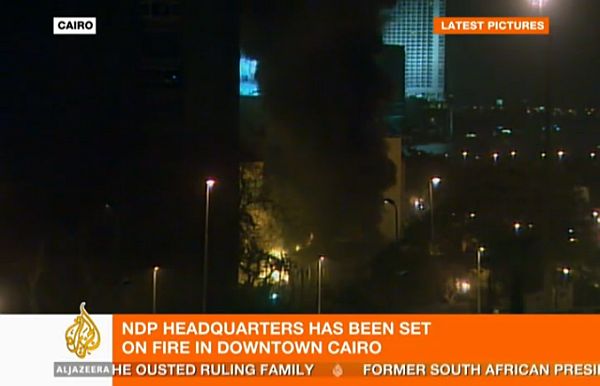
11.35 — Ruling National Democratic Party headquarters in Cairo on fire.
11.29 — Al Jazeera — Loud explosions heard, but protesters still chanting loudly.
11.00 — As curfew begins, army deployed to take control of streets of Cairo. Smoke rising from the vicinity of the National Democratic Party HQ.
10.32 — Curfew announced to begin at 6pm (local 11am US Eastern). State security has entered the building in which Al Jazeera is based.
10.07 — Al Jazeera: Protesters are celebrating the appearance of the army in Cairo.
Hossam el-Hamalawy, an Egyptian journalist and blogger for the website 3arabawy, underlines the significant role that the Palestinian resistance has played as a source of inspiration for Egyptian protesters. “The outbreak of the al-Aqsa intifada [in 2000] was especially important because in the 1980s-90s, street activism had been effectively shut down by the [Egyptian] government as part of the fight against Islamist insurgents. It only continued to exist inside university campuses or party headquarters. But when the 2000 intifada erupted and Al Jazeera started airing images of it, it inspired our youth to take to the streets, in the same way we’ve been inspired by Tunisia today.”
Meek resistance will be crushed and then ignored. The Egyptians who are now fighting for control of their own country refuse to be ignored and the only way to do that is to demonstrate that the people have more power than the regime.
9.21 — “AJ Arabic – Protestors control the streets of Suez”
9.12 — Al Jazeera presenter: There’s no turning back now. Egypt has reached the tipping point.
“In terms of regional affairs, Special Middle East Envoy Senator George Mitchell struck the right chord during his recent visit to Cairo when he told President Mubarak that he was here to ‘listen and hear your advice’.” — US Ambassador Margaret Scobey, February 9, 2009 (WikiLeaks)
“The Egyptian ‘people blame America’ now for their plight. The shift in mood on the ground is ‘mostly because of Mubarak and his close ties’ to the United States.” — US Ambassador Joseph E. LeBaron, February 12, 2010 (WikiLeaks)
8.17 — “Journalists working for The BBC and Al Jazeera have been beaten by the police in Cairo, the networks report. Minutes ago a heavily bandaged journalist for The BBC’s Arabic service in Cairo described being brutally beaten with iron bars by plainclothes officers who seemed to be ‘targeting journalists,’ attempting to report on a protest by about 15,000 people in a square.”
Vice President Joe Biden was asked on PBS this evening whether he views Egypt’s president as a dictator. Noting that President Mubarak has been a US ally and has normalized relations with Israel, Biden said: “I would not refer to him as a dictator.”
When asked whether the time has come for Mubarak to go, Biden responded:
No. I think the time has come for President Mubarak to begin to move in the direction that – to be more responsive to some… of the needs of the people out there.
The protesters are not shouting about wanting a better life or the need for political reform. They’re shouting “Down With Mubarak!”
If the Egyptian president had any interest in being responsive to that demand, he’d be gone. But note that Biden was not suggesting that Mubarak be responsive to the Egyptian people’s demands — merely that he should be responsive to some of their needs, and then presumably they will quieten down.
At his most disingenuous, Biden even claims to have no idea what the Egyptians want or whether their aspirations are legitimate.
“We’re encouraging the protesters to – as they assemble, do it peacefully. And we’re encouraging the government to act responsibly and – and to try to engage in a discussion as to what the legitimate claims being made are, if they are, and try to work them out,” Biden said. “I think that what we should continue to do is to encourage reasonable… accommodation and discussion to try to resolve peacefully and amicably the concerns and claims made by those who have taken to the street. And those that are legitimate should be responded to because the economic well-being and the stability of Egypt rests upon that middle class buying into the future of Egypt.”
Thus speaks the patrician who believes everyone has a price. Mubarak doesn’t need to go — he just needs to determine the right price for pacifying his subjects.
“No internet, no SMS, what is next? Mobile phones and land lines? So much for stability. #Jan25 #Egypt” tweets CNN’s Ben Wedeman.
The shutdown came shortly after the release of this AP video showing a protester being gunned down.
With major protests just hours away, scheduled to follow Friday morning prayers, Issandr El Amrani reports:
I have received eyewitness reports from three people that Central Security Forces (the riot control police) are pulling out of multiple locations in Cairo. Plainclothes security has been seen at various locations pouring gasoline on vehicles and setting them on fire, also trying to burn storefronts in the following Downtown Cairo locations:
Falaki Square
Omraneya
Near the American University in Cairo
Earlier in the day, I received an eyewitness report from a friend in Downtown Cairo (near Champollion Street) that policemen were loading vans with clubs, nails, metal bars and other objects that could be used as weapons by Baltaguiya, the hired thugs sometimes used by police to attack protestors.
Anonymous leaflets circulating in Cairo also provide practical and tactical advice for mass demonstrations, confronting riot police, and besieging and taking control of government offices.
Signed “long live Egypt”, the slickly produced 26-page document calls on demonstrators to begin with peaceful protests, carrying roses but no banners, and march on official buildings while persuading policemen and soldiers to join their ranks.
The leaflet ask recipients to redistribute it by email and photocopy, but not to use social media such as Facebook and Twitter, which are being monitored by the security forces.
Alaa Al Aswany, the Arab world’s bestselling novelist, describes his experience of participating in the demonstrations.
It was an unforgettable day for me. I joined the demonstrators in Cairo, along with the hundreds of thousands across Egypt who went on to the streets on Tuesday demanding freedom and bravely facing off the fearsome violence of the police. The regime has a million and a half soldiers in its security apparatus, upon which its spends millions in order to train them for one task: to keep the Egyptian people down.
I found myself in the midst of thousands of young Egyptians, whose only point of similarity was their dazzling bravery and their determination to do one thing – change the regime. Most of them are university students who find themselves with no hope for the future. They are unable to find work, and hence unable to marry. And they are motivated by an untameable anger and a profound sense of injustice.
I will always be in awe of these revolutionaries. Everything they have said shows a sharp political awareness and a death-defying desire for freedom. They asked me to say a few words. Even though I’ve spoken hundreds of times in public, this time it was different: I was speaking to 30,000 demonstrators who were in no mood to hear of compromise and who kept interrupting with shouts of “Down with Hosni Mubarak”, and “The people say, out with the regime”.
I said I was proud of what they had achieved, and that they had brought about the end of the period of repression, adding that even if we get beaten up or arrested we have proved we are not afraid and are stronger than they are. They have the fiercest tools of repression in the world at their disposal, but we have something stronger: our courage and our belief in freedom. The crowd responded by shouting en masse: “We’ll finish what we’ve begun!”
Mohamed ElBaradei, who many in Egypt are calling a latecomer to the revolution, returned to Cairo from Vienna on Thursday.
“This is a critical time in the life of Egypt and I have come to participate with the Egyptian people,” he said. “The regime has not been listening.
“If people, in particular young people, if they want me to lead the transition, I will not let them down. My priority right now … is to see a new regime and to see a new Egypt through peaceful transition.
“I advise the government to listen to the people and not to use violence. There’s no going back.”
In reference to reports from commentators who point to the apparently small role that the Muslim Brotherhood has played in the Egyptian intifada so far, Jonathan Wright says:
From my own experience on the streets (see my earlier reports passim), I believe people are understimating the level of participation by members of the Brotherhood, though I will readily concede that they have not taken part at full strength and at a level which reflects their demographic weight. There are several possible and obvious reasons for this. Let me offer a few of them:
The Brotherhood, from long experience of confrontation with the Egyptian authorities, is always wary of commitment to street protests. It will calibrate its level of participation to its assessment of the chances of success. If it overreaches, it runs the risk of a massive crackdown. For the moment, probably rightly, it is not convinced that the protests will overthrow the regime.
The Brotherhood knows that the world (especially the United States and Europe) are watching events in Egypt closely. If the protests appear to be Brotherhood-led, the government will feel free to use much more brutal methods to disperse protesters. For the moment it suits the Brotherhood’s interests to give the impression that there is a broad coalition united against Hosni Mubarak, including liberals and leftists. This explains why Brotherhood members who have taken part in the protests have refrained from chanting slogans with religious connotations. The impression of a broad coalition also helps domestically — if the Brotherhood take the lead, it would frighten off some of the other groups.
At Wired, David Kravets puts the significance of social media and the internet in perspective.
Don’t call it a Twitter Revolution just yet. Sure, protesters in the Middle East are using the short-messaging service — and other social media tools — to organize. And yes, there are sporadic reports coming out of Egypt that the Mubarak regime has shut off Internet access — despite Secretary of State Hillary Clinton’s call “not to prevent peaceful protests or block communications, including social media.”
But don’t confuse tools with root causes, or means with ends. The protests in Tunisia, Egypt and Yemen are against dictators who’ve held power — and clamped down on their people — for decades. That’s the fuel for the engine of dissent. The dozen or more protesters that self-immolated in Egypt didn’t do it for the tweets.
“It’s about years of repression and dictatorship. Revolutions existed before Twitter and Facebook,” Issandr el-Amrani, a Cairo-based writer and activist, says in a telephone interview from Tunisia. “It’s really not much more complicated than this.”
Only about a quarter of the Egyptian populace is online, el-Amrani estimates. So street protests have grown the old fashioned way: via leaflets and spontaneous amalgamation.
“I’ve seen a lot of small groups of people wandering the streets and people spontaneously joining them. At every house, they would yell, ‘Come Down,’” says an expert on Middle Eastern censorship in an interview from Cairo.
The source, who requested anonymity out of fear of retribution, added: “This is much, much bigger than Twitter and Facebook.”
Rising food prices, corruption, endemic poverty, high levels of youth unemployment and authoritarian governance are common factors linking street protests currently raging through the Arab world from Algeria to Egypt.
But as seasoned Middle East analysts such as the Financial Times‘s Roula Khalaf have noted, grassroots opposition to the increasingly prevalent practice of dynastic succession or tawrith – inherited rule – among non-monarchical, secular regimes is also fuelling the unrest. Across the region, Arab rulers are seeking to perpetuate their rule by passing on power to favoured sons or other male family members. But such cosy succession schemes are anathema to demonstrators pushing for expanded democratic rights. They also underscore the low status afforded to women.
After this month’s successful intifada in Tunisia, which overthrew the self-perpetuating ruling family, would-be dauphins, pretenders and heirs-apparent throughout the Middle East are wondering whether their dynastic great expectations may yet be thwarted.
There’s a thin line between well-organized and over-organized. On the one hand, the fact that the Muslim Brotherhood will be joining tomorrow’s regime-crushing demonstrations in Egypt looks likely to bring mass mobilization to a level that even an authoritarian government lacks the power to stop. At the same time, the fact that the Islamist movement has waited this long to join the action calls into question its capacity to lead the revolution and dominate a new government.
After decades of political apathy in this society of 80m people where few bothered to vote and protests usually drew tiny numbers, the explosion of anger has also taken the country’s opposition politicians by surprise.
Although the demonstrations are essentially leaderless, organised by youth activists on the internet, the opposition is now scrambling to use the opportunity to press for an end to the Mubarak era.
Politicians in Cairo say the National Association for Change headed by Mohamed ElBaradei, the Nobel laureate and former chief of the International Atomic Energy Agency who was due to land in Cairo last night, will emerge from the Egyptian “intifada”, or uprising, with enhanced credibility. But whether the regime will allow Mr ElBaradei to assume a leadership role remains to be seen.
The national association comprises several leading political figures and intellectuals, youth groups like April 6 which has been instrumental in mobilising demonstrations through the internet and a few political parties, including representatives from the Muslim Brotherhood.
The Islamist group is considered the movement with the largest grassroots support in the country but has always been reluctant to provoke the regime. It gave only timid support to the youth activists’ call for a “day of wrath” on Tuesday, though it is calling for participation in the rallies that are planned on Friday.
Opposition leaders say Mr ElBaradei, in particular, has played a crucial role in encouraging young Egyptians in their activism. He returned to Egypt a year ago, after living abroad for three decades, amid activists’ calls on him to run against Mr Mubarak in the September presidential elections.
His response was that he would heed the calls if the constitution was changed to allow independent candidates. Recent amendments to the constitution, as it stands today, give the ruling National Democratic party of Mr Mubarak control over the presidential election process.
Mr ElBaradei’s contribution, say opposition leaders, was to articulate the calls for reform and demonstrate that there are alternatives to Mr Mubarak. “No one can claim this wave . . . but what ElBaradei said and did helped light the flame,” said Osama el-Ghazali Harb of the Democratic Front party, which is part of Mr ElBaradei’s National Association. “He put forward the demands of the opposition and he gave them international attention.”
Issam el-Erian, a brotherhood leader, concurs. “El Baradei had a big role in starting this wave,” he says. “The system was always saying there is no alternative and the only one is the Ikhwan (Brotherhood), but he offered an alternative, and he has a Nobel prize, so he’s a respectable alternative.”
“The United States of America stands with the people of Tunisia, and supports the democratic aspirations of all people,” President Obama said on Tuesday, but he could not say the US stands with the people of Egypt, even though they are currently making their democratic aspirations crystal clear.
What the people of Egypt know, as do the citizens living under every US-backed autocratic ruler in the Middle East, is that if they are to win the prize of democratic freedom, they must surmount the obstacles that the US government throws in their way.
The Obama administration has made it perfectly evident that in spite of the pro-democracy platitudes it reluctantly espouses, it’s preeminent loyalties are with its undemocratic allies — thus Obama and Secretary of State Hillary Clinton’s reluctance to even utter the word “democracy.”
Instead of backing democracy in Egypt, the administration supports reform and it claims that Hosni Mubarak is capable of bringing about the necessary changes.
At the State Department yesterday, a Middle Eastern reporter challenged Clinton, saying:
[Y]ou seem to imply that the Egyptian Government is capable of reforming itself and meeting the expectation of the people. Yet the mood in the streets of Cairo today contrasts that, and people are demanding for radical change, removal of the government and President Mubarak not to nominate himself for another term. Are you unsure of what’s happening in Cairo?
Clinton responded:
I do think it’s possible for there to be reforms, and that is what we are urging and calling for. And it is something that I think everyone knows must be on the agenda of the government as they not just respond to the protest, but as they look beyond as to what needs to be done economically, socially, politically. And there are a lot of very well informed, active civil society leaders in Egypt who have put forward specific ideas for reform, and we are encouraging and urging the Egyptian Government to be responsive to that.
The message from Egypt is simple: the Egyptian people want democratic freedom and an end to dictatorship. They want an end to a brutal regime that still retains Washington’s support. The demonstrators are not calling on Mubarak to implement reforms; they are demanding that he go — and that is a demand that, so far, the Obama administration refuses to acknowledge.
When the status quo becomes untenable, people take to the streets in order to force political change. But Mubarak’s friends in Washington and Jerusalem are not ready to see him go — their preeminent interest is in stability.
Prime Minister Binyamin Netanyahu has met repeatedly since coming to power in March 2009 with Egyptian President Hosni Mubarak, and has said on a number of occasions that he has great respect for Mubarak as a statesman, and as a leader with vast experience and knowledge. Earlier this month he characterized the Egyptian-Israeli peace agreement as a “foundation for regional stability.”
There is not a prevalent sense among Egypt watchers in Jerusalem that the disturbances pose a threat to Mubarak’s regime. Rather, the concern is what comes after the 82-year-old Mubarak, and whether his successor – whether his son or someone else – will have the same authority and command the same degree of allegiance.
The sense in Jerusalem is that it would be a mistake to look at the events in Egypt and see an extension of what happened in Tunisia.
“This is not a Tunisian domino effect,” one official said.
Egypt, it was pointed out, is not as closed as Tunisia was under ousted president Zine al-Abidine Ben Ali – it has a different political culture, with more organized opposition and more outlets for letting off steam than existed in Tunisia.
Most importantly, the army is considered loyal to the government, whereas the commander of the Tunisian army determined that it would not face down the protestors there.
Labor MK Binyamin Ben-Eliezer, who is close to Mubarak and met on Tuesday with a senior Egyptian official, said Mubarak’s regime was strong and stable. He said there was no Egyptian who was serious enough competition for Mubarak to lead an effort against him.
“I don’t think it is possible [for there to be a revolution in Egypt],” Ben-Eliezer told Army Radio. “I see things calming down soon.
“Israel cannot do anything about what is happening there. All we can do is express our support for Mubarak and hope the riots pass quietly.”
Likewise, in an interview with Al Jazeera‘s Shihab Rattansi [see video below], State Department spokesman PJ Crowley said:
We want to see restraint on both sides. We want to see the Egyptian people have the opportunity to engage their government, to make clear what their aspirations of [sic], and we want to see that government respond in a meaningful way to meet those aspirations. That is our goal. That is the advice we are giving Egypt. We hope that Egypt will allow its people to protest peacefully but also open up the door for meaningful reforms.
Al Jazeera: Right, but we’re not talking in general terms here. Egypt is not letting its people protest peacefully. It’s deploying the full ranks of its US-backed $1.3 billion-backed security forces to beat up those protesters. Isn’t it time perhaps to be a little firmer with President Mubarak?
Crowley: We are giving Egypt advice publicly and privately. We have concerns about what is happening on the street. We are watching the situation carefully. We are in touch with the Egyptian government and we’re making clear that Egypt should allow its citizens to peacefully protest.
AJ: And if it doesn’t, is that funding — is that US support in jeopardy?
Crowley: We don’t see this as an either/or proposition. Egypt is an ally and friend of the United States. It’s an anchor of stability in the Middle East. It is helping us to pursue comprehensive peace in the Middle East.
But what every Egyptian knows today is that the United States government is not a friend of Egypt, it is a friend and ally of the Mubarak regime — a regime that does not represent the Egyptian people, nor should even be afforded the political shorthand of being referred to as “Egypt.”
Democracy is not the United State’s gift to the world and it will not be acquired under American tutelage. Real democrats don’t bankroll dictatorships.
We live — as politicians frequently repeat — under the rule of law and there is nothing the legal system frowns on more earnestly than perjury. Hence during trials the solemn ritual that witnesses must swear to tell the truth, the whole truth and nothing but the truth.
And then there is government, where the conduct of the people’s business apparently requires the economical expression of truth, the guarding of secrecy and a subtle contempt for honesty — as though only those who are ignorant about the way the world works would attach great value to truthfulness.
Tom Malinowski, the Washington director of Human Rights Watch, asked HRW staff to canvass sources in Tunisia to gauge the impact of the revelations from WikiLeaks and how they influenced the revolution.
The candid appraisal of Ben Ali by U.S. diplomats showed Tunisians that the rottenness of the regime was obvious not just to them but to the whole world — and that it was a source of shame for Tunisia on an international stage. The cables also contradicted the prevailing view among Tunisians that Washington would back Ben Ali to the bloody end, giving them added impetus to take to the streets. They further delegitimized the Tunisian leader and boosted the morale of his opponents at a pivotal moment in the drama that unfolded over the last few weeks.
This point might not be worth dwelling on, except that it suggests something interesting about how the United States, and the State Department in particular, approaches the challenge of promoting human rights and democracy in countries like Tunisia. Consider the following proposition: None of the decent, principled, conscientious, but behind the scenes efforts the State Department made in recent years to persuade the Tunisian government to relax its authoritarian grip — mostly through diplomatic démarches and meetings with top Tunisian officials — had any significant impact on the Ben Ali regime’s behavior or increased the likelihood of democratic change. Nor did the many quiet U.S. programs of outreach to Tunisian society, cultural exchanges and the like, even if Tunisians appreciated them and they will bear fruit as the country democratizes.
Instead, the one thing that did seem to have some impact was a public statement exposing what the United States really thought about the Ben Ali regime: a statement that was vivid, honest, raw, undiplomatic, extremely well-timed — and completely inadvertent.
Had anyone at the State Department proposed deliberately making a statement along the lines of what appears in the cables, they would have been booted out of Foggy Bottom as quickly as you can say “we value our multifaceted relationship with the GOT.” [Continue reading…]
This website or its third-party tools use cookies, which are necessary to its functioning. By closing this banner, you agree to the use of cookies.