Category Archives: Analysis

If he wanted to, Obama could end the slaughter in Yemen

The Associated Press reports: More than 1,000 mourners were packed into the funeral hall, including some of the most powerful figures in Yemen’s rebel movement. Ali al-Akwa, who was just about to start reciting the Quran, heard warplanes overhead — but that wasn’t strange for wartime Sanaa. Surely a funeral would be safe, he thought.

Moments later, a huge explosion struck, tearing bodies apart. The ceiling collapsed, walls fell in and a fire erupted. As people scrambled frantically to get out, a second missile struck, killing more of them.

Nearly 140 people were killed and more than 600 wounded in Saturday’s airstrike — one of the deadliest since Saudi Arabia and its allies began an air campaign in Yemen in March 2015. The coalition is trying to uproot the Shiite Houthi rebels who took over the capital and much of northern Yemen from the internationally recognized government of President Abed Rabbo Mansour Hadi.

The coalition seems to have been hoping to take out a significant part of the Houthis’ military leadership and its allies, who were expected at the funeral. Instead, the attack is likely to deepen the stalemate in a war that has already pushed the impoverished country into collapse.

The bloodshed has eclipsed new U.N. efforts to secure even a brief cease-fire. Amid popular anger, the coalition has lost potential tribal allies. In an attempt to expand the war, the Houthis have retaliated by firing rockets into neighboring Saudi Arabia and at U.S. warships.

The only hope for progress toward a resolution, many Yemenis say, is if the strike prompts Saudi Arabia’s top ally, the United States, and other Western nations to halt arms sales, pressure Riyadh to ease the war and move toward negotiations. [Continue reading…]

Akbar Shahid Ahmed writes: In the public consciousness, this brutal conflict blurs into the other bloody wars across the Middle East, each of them marked by its own complicated mix of players, incentives and grievances that make peace unlikely.

But Yemen is different. Here, Obama could single-handedly cause a major drop in the bloodshed, experts say. He simply doesn’t seem to want to do it.

Per Obama’s orders, planes belonging to the Saudis and others involved in their coalition currently receive aerial refueling from American planes, a defense official confirmed to The Huffington Post this week. U.S. military personnel stationed in Saudi Arabia offer intelligence and logistical support to the coalition, but don’t decide where it bombs, the official said. And the Obama administration has greenlit three new transfers of weapons ― ammunition, bombs, air-to-ground missiles and tanks ― to the kingdom to replenish stocks used in Yemen, according to arms trade expert William Hartung.

Obama could stop all of that at any time. [Continue reading…]

In September, The Atlantic reported: Obama has said little about the war in Yemen. With mere months left in his presidency, there is scarce indication that he will. Increasingly skeptical of America’s ability to shape events on the ground in the Middle East, Obama sees little incentive to overturn the status quo, even if that means supporting the apparently reckless military forays of a [Saudi] government he disdains.

A U.S. official who briefs the White House on regional national security matters summed up the Obama administration’s prevailing attitude. Yemen was already a “complete shit show” before the war, he argued, echoing Obama’s use of a phrase he is said to use privately to describe Libya. The Houthis are a nasty militia who deserve no favors and Yemen would be a “shit show” whatever the United States does. So why further degrade a sometimes-unpleasant, but necessary relationship with the Saudis to produce the same end result?

After a joint U.S.-Russian press conference held in Geneva to announce the abortive Syria ceasefire this month, journalists were served vodka from the Russians and pizza courtesy of the Americans. Yemen wasn’t even worth the takeout order, al-Muslimi said: “There is no pizza or vodka when it comes to Yemen. Only cluster bombs and arms deals.” [Continue reading…]


Facebooktwittermail

Vladimir Putin just won an international peace prize

Max Bearak writes: The past few weeks have been rough for Russian President Vladimir Putin’s international image.

Putin has been blamed for airstrikes in Syria that have killed hundreds of civilians, including children, dooming a cease-fire his government helped foster but may have never intended to abide by. A Dutch investigation said the antiaircraft missiles that downed Malaysia Airlines Flight 17 in July 2014, killing all 298 people aboard, came from Russia. And the Obama administration accused his government of a hacking campaign to interfere with this year’s U.S. presidential election.

But Friday, the day the Nobel Peace Prize was awarded, brought him some welcome news: Venezuelan President Nicolás Maduro bestowed on Putin the Hugo Chávez Prize for Peace and Sovereignty of the Peoples. Putin can put it on his mantel beside China’s Confucius Peace Prize, which he won in 2011.

Maduro, whose South American nation has been reeling amid a massive economic crisis, announced the prize during the unveiling of a statue (designed by a Russian artist) of his deceased predecessor, Chávez, in the latter’s home town of Sabaneta.

Referencing Putin, Maduro said the prize should be given to “a leader that I believe is the most outstanding there is in the world today, a fighter for peace, for balance, and a builder of a pluripolar, multicentric world.” [Continue reading…]

Josh Rogin writes: There is clear and abundant evidence the Assad regime and the Russian government are committing crimes that include, but are not limited to, deliberate attacks on civilians, collective punishment, starvation as a tool of war, torture, murder, inhumane treatment of prisoners and the use of chemical weapons on the battlefield.

Nevertheless, no near-term accountability seems likely. Last month, U.N. Secretary General Ban Ki-moon called on the U.N. Security Council to refer the situation in Syria to the International Criminal Court, a step dozens of countries have endorsed. But Russia would surely veto such a move and, since neither Syria nor Russia has ratified the ICC’s founding Rome Statute, the court’s power is limited without Security Council action.

The U.N. Commission of Inquiry on Syria fecklessly refuses to assign blame for atrocities — such as, for example, when a U.N. aid convoy was attacked last month, which the United States attributed to Russia and which was yet another violation of international humanitarian law. Congress has a sanctions bill that would punish the Syrian government, Russia and Iran for war crimes and crimes against humanity, but the White House opposes that legislation.

Justice for the innocent victims in Syria will likely take years, if not decades, to be realized. But there is both precedent and a legal path forward for such prosecutions.

Russian soldiers bear criminal responsibility not only for participating in the war crimes but also for aiding and abetting the Syrian regime, said Cherif Bassiouni, who led the U.N. investigations into crimes in Yugoslavia, Bahrain and Libya and helped create the ICC. And, he said, due to what’s known in international law as the doctrine of command responsibility, senior Russian military and political figures could also be prosecuted for the actions of their subordinates.

“The criminal responsibility applies to all of those in the chain of command who know of the commission of these crimes, all the way up to Putin,” said Bassiouni. “The law is not only applicable to he who gives an order, but he who knows it’s a war crime and does nothing to stop it.”

Under the Geneva Conventions, any state can assert what’s known as universal jurisdiction and bring prosecutions against Syrian and Russia leaders for war crimes.

“Every country if it wanted to could assert its jurisdiction if it could grab the person,” said Bassiouni. “Every Russian officer involved should know they are exposed to it.” [Continue reading…]

The Guardian reports: Russia should be investigated for war crimes in the Syrian city of Aleppo and risks becoming a pariah nation, Boris Johnson has said, taking the unusual step of calling for demonstrations by anti-war protesters outside the Russian embassy in London.

The British foreign secretary said “the mills of justice grind slowly, but they grind small” as he predicted those responsible for war crimes in Syria would eventually face charges before the international criminal court.

Johnson’s remarks underline the degree to which relations between Russia and the west have deteriorated to levels not seen since the end of the cold war. [Continue reading…]

Facebooktwittermail

Putin in Syria: Chechnya all over again

Oliver Bullough writes: Putin’s admirers often compare him to a chess player as a way of stressing his strategic nous (Barack Obama merely plays checkers). But that is to overstate his abilities. Any moderately capable politician could do what he does given a complicit media and control of all three branches of government. Where he does resemble a chess player, however, is in his insistence on linking unconnected issues: Ukraine, Syria, a joint U.S.-Russian program to dispose of radioactive material — all are pieces on his board, to be sacrificed for the ultimate good of the player, namely himself.

If Mr. Putin’s bombs allow his proxies to capture the square on the board labeled Syria, his Western admirers will hail him as a genius. But that victory would be as much a result of his weaknesses as his strengths. Seeing the world as a chess game means he believes the board is filled with pawns rather than people, with agency and ideas of their own.

In the fall of 2013, Mr. Putin thought he had convinced the Ukrainian government to reject a trade deal with the European Union and join a Russian project instead. He then promised it a $15 billion loan. But ordinary Ukrainians wouldn’t go along with the plan — they refused to be pawns — and their revolution ousted Mr. Putin’s allies in Kiev, turning his tactical victory into a strategic defeat.

In the years after Mr. Putin started his Chechen war in 1999, he had Chechnya’s leaders killed and imposed peace via a local strongman. The savagery necessary to maintain order has since driven out at least one-third of the prewar Chechen population, with most of them seeking asylum in Europe. The exodus continues today. Chechnya still requires vast annual subsidies from Moscow, and its peace remains just one assassination away from chaos.

Bombing Aleppo into submission and imposing Mr. Assad on the rubble via fake elections would allow Mr. Putin and RT to present the Syria problem as solved and give the Kremlin’s Western proxies an opportunity to praise their grandmaster’s cunning. But you cannot bomb someone into loving you. For as long as Putin fails to realize that ordinary people’s desires are ultimately more important than his own, any system he creates will remain as fragile as the one he built in Chechnya. [Continue reading…]

Facebooktwittermail

Martin Bosma — Geert Wilders’ brain

Politico reports: Look at photographs of Geert Wilders in the Dutch parliament, and the camera often shows a figure seated behind him: Martin Bosma, the polemicist of the Freedom Party (PVV).

A former journalist, whose side-swept brown hair keeps him a youthful 52, Bosma is often described in Dutch media as the PVV’s ideologist. “He’s the brain. He invented the PVV,” said Geert Tomlow, a former parliamentary elections candidate from the party.

Bosma’s ideas are bearing fruit at just the right time, with the PVV leading in the polls five months from a general election that could see the party double in size in the parliament. He and Wilders have helped push the center-ground of Dutch politics to the Right and mainstreamed positions once confined to the fringe.

Since entering parliament a decade ago, Bosma has published two books, each released to a flurry of television interviews and controversy.

The autobiographical “The Fake Elite of the Counterfeiters” takes aim at a left-wing clique he accuses of taking over cultural institutions and allowing immigration in an underhand coup to achieve radical aims by stealth.

“Minority in One’s Own Land” turns to South African history. Bosma argues that the predominantly Dutch-descended settlers, the Afrikaners, became outnumbered by black South Africans and subjected to “cultural genocide” and “Apartheid 2.0” in events he warns could foreshadow the fate of the Netherlands. [Continue reading…]

Facebooktwittermail

Barack Obama’s wrong: The new Cold War’s only just begun

Michael Weiss writes: In one of the better studies of Putinology to appear in the last year, Mikhail Zygar’s All the Kremlin’s Men does much to upend the conventional wisdom about U.S.-Russian relations, particularly as offered by the American architects of those relations over the past eight years.

“Vladimir Putin,” Zygar writes, “did not like the new American president from the start. For him, Barack Obama was both soft and intractable… Paradoxically, Obama, the most idealistic and peace-loving U.S. president in living memory, became a symbol of war in Russia, a target for Russian state propaganda and racist jokes, and a hate figure for millions of patriotic Russians. He was caricatured as an ill-fated enemy doomed to be defeated by Vladimir Putin.”

Surveying some much-buried news over the last seven days, one begins to appreciate the weight of this grim appraisal. [Continue reading…]

Facebooktwittermail

How Donald Trump is promoting Russian disinformation to American voters

Kurt Eichenwald writes: I am Sidney Blumenthal. At least, that is what Vladimir Putin — and, somehow, Donald Trump — seem to believe. And that should raise concerns about not only Moscow’s attempts to manipulate this election but also how Trump came to push Russian disinformation to American voters.

An email from Blumenthal — a confidant of Hillary Clinton and a man, second only to George Soros, at the center of conservative conspiracy theories — turned up in the recent document dump by WikiLeaks. At a time when American intelligence believes Russian hackers are trying to interfere with the presidential election, records have been fed recently to WikiLeaks out of multiple organizations of the Democratic Party, raising concerns that the self-proclaimed whistleblower group has become a tool of Putin’s government. But now that I have been brought into the whole mess — and transformed into Blumenthal — there is even more proof that the Russians are not only orchestrating this act of cyberwar but also really, really dumb.

The evidence emerged thanks to the incompetence of Sputnik, the Russian online news and radio service established by the government-controlled news agency, Rossiya Segodnya.

The documents that WikiLeaks has unloaded recently have been emails out of the account of John Podesta, the chairman of Clinton’s election campaign. Almost as soon as the pilfered documents emerged, Sputnik was all over them and rapidly found (or probably already knew about before the WikiLeaks dump) a purportedly incriminating email from Blumenthal.

The email was amazing — it linked Boogie Man Blumenthal, Podesta and the topic of conservative political fever dreams, Benghazi. This, it seemed, was the smoking gun finally proving Clinton bore total responsibility for the attack on the American outpost in Libya in 2012. Sputnik even declared that the email might be the “October surprise” that could undermine Clinton’s campaign. [Continue reading…]

Facebooktwittermail

Why Yemen conflict has become another Syria

Simon Tisdall writes: The brazen attempt by Houthi rebels to sink a US warship patrolling off Yemen marks a potentially significant escalation of a conflict that has been alternately fuelled and ignored by the western powers. The attack by the Houthis, whose main backer is Iran, coincides with an unprecedented ballistic missile strike 325 miles inside Saudi territory and suggests a spreading, region-wide conflagration could be nearer at hand than previously thought.

Insurrection and revolt have been endemic in Yemen since the early part of this century. But the conflict intensified in March last year when Saudi Arabia, Iran’s main rival, launched a large-scale intervention, backed by a coalition of Arab states.

Since then an estimated 10,000 Yemenis have died and many more have been injured, displaced or have faced famine conditions. The US and Britain back the Saudi coalition and have provided limited practical support such as intelligence-sharing and training, but have eschewed direct involvement in Yemen. The exception is the CIA’s repeated drone strikes, including those against alleged Islamic State and al-Qaida in the Arabian Peninsula terrorists.

As in Syria, the Obama administration has favoured a hands-off approach, preferring to act through proxies rather than engage directly. This diffidence stems from Barack Obama’s fear of the US being sucked into more Middle East wars. It is also the byproduct of his controversial attempt to mend fences with Iran through last year’s landmark nuclear deal. [Continue reading…]

Facebooktwittermail

The more you know about a topic the more likely you are to have false memories about it

By Ciara Greene, University College Dublin

Human memory does not operate like a video tape that can be rewound and rewatched, with every viewing revealing the same events in the same order. In fact, memories are reconstructed every time we recall them. Aspects of the memory can be altered, added or deleted altogether with each new recollection. This can lead to the phenomenon of false memory, where people have clear memories of an event that they never experienced.

False memory is surprisingly common, but a number of factors can increase its frequency. Recent research in my lab shows that being very interested in a topic can make you twice as likely to experience a false memory about that topic.

Previous research has indicated that experts in a few clearly defined fields, such as investments and American football, might be more likely to experience false memory in relation to their areas of expertise. Opinion as to the cause of this effect is divided. Some researchers have suggested that greater knowledge makes a person more likely to incorrectly recognise new information that is similar to previously experienced information. Another interpretation suggests that experts feel that they should know everything about their topic of expertise. According to this account, experts’ sense of accountability for their judgements causes them to “fill in the gaps” in their knowledge with plausible, but false, information.

To further investigate this, we asked 489 participants to rank seven topics from most to least interesting. The topics we used were football, politics, business, technology, film, science and pop music. The participants were then asked if they remembered the events described in four news items about the topic they selected as the most interesting, and four items about the topic selected as least interesting. In each case, three of the events depicted had really happened and one was fictional.

The results showed that being interested in a topic increased the frequency of accurate memories relating to that topic. Critically, it also increased the number of false memories – 25% of people experienced a false memory in relation to an interesting topic, compared with 10% in relation to a less interesting topic. Importantly, our participants were not asked to identify themselves as experts, and did not get to choose which topics they would answer questions about. This means that the increase in false memories is unlikely to be due to a sense of accountability for judgements about a specialist topic.

Continue reading

Facebooktwittermail

Lies, damned lies, and politics

Ned O’Gorman writes: Early into last night’s debate, Donald Trump found himself in an awkward position. No, I am not talking about the question first asked about the Access Hollywood tape on which he boasts of sexual assault. I am talking about a more subtle moment: early on Donald Trump found himself calling himself a “politician,” incredulously admitting, “I can’t believe I am saying that about myself.”

Almost one hundred years ago, the German social theorist Max Weber gave a lecture in Munich called “Politics as Vocation” in which he argued that there was a big difference between the “occasional” politician and the “professional” politician. We are all, he claimed, occasional politicians, in as much as we all may vote, circulate a pamphlet or petition, or give a stump speech. But professional politicians are a different breed: For them politics is a vocation, a calling, and with the vocation comes certain burdens and responsibilities.

The biggest problem with Donald Trump in this election cycle is that he is, in fact, no politician, at least not in a vocational sense. And contrary to popular belief, that is a very bad thing for a person running for president. [Continue reading…]

Facebooktwittermail

Everything Donald Trump says about Syria is crazy, wrong, or both

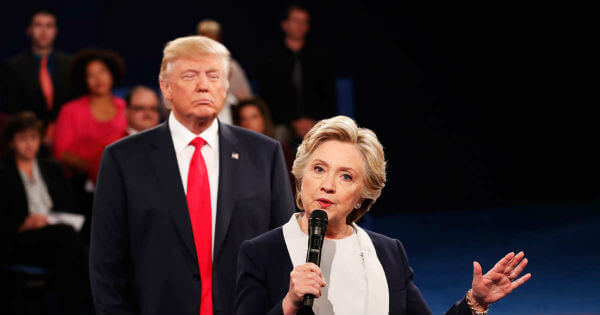
hovering-trump

Michael Weiss writes: Well, now I prefer the guy who didn’t know what Aleppo is.

In the second presidential debate, during which Hillary Clinton looked as if she could profit from her own no-fly zone against her menacingly hovering opponent, Donald Trump made a series of assertions about the five-year-old humanitarian catastrophe in Syria that no one with access to Google, much less classified intelligence, ever ought to make. That he managed to do this while both deferring to a theocratic—excuse me, Islamic terrorist—regime he claims to reprehend and also humiliating his own running-mate in the process was a masterstroke of Trumpist illogic and megalomania.

By way of reaffirming his faith in a better working relationship with the Kremlin (whose hacking of the Democratic National Committee he again doubted), Trump stated that “Assad is killing ISIS. Russia is killing ISIS. And Iran is killing ISIS.” He sees this as proof of absent American leadership, and is quite comfortable being on their side in a civilizational struggle, even though he hates the fact that Iran is richer and only able to war against the Sunni extremists thanks to Obama’s nuclear deal.

In point of fact, none of the parties Trump rattled off has demonstrated much of a keenness or willingness to fight ISIS in Syria, as a bevy of U.S. officials and independent monitors have repeatedly pointed out. [Continue reading…]

Facebooktwittermail

A short list of Trump’s debate lies

David Leonhardt writes: He lied about a sex tape.

He lied about his lies about ‘birtherism.’

He lied about the growth rate of the American economy.

He lied about the state of the job market.

He lied about the trade deficit.

He lied about tax rates.

He lied about his own position on the Iraq War, again.

He lied about ISIS.

He lied about the Benghazi attack.

He lied about the war in Syria.

He lied about Syrian refugees.

He lied about Russia’s hacking.

He lied about the San Bernardino terrorist attack.

He lied about Hillary Clinton’s tax plan.He lied about her health care plan.

He lied about her immigration plan.

He lied about her email deletion.

He lied about Obamacare, more than once.

He lied about the rape of a 12-year-old girl.

He lied about his history of groping women without their consent.

Finally, he broke with basic democratic norms and called on his political opponent to be jailed — because, in large part, of what he described as her dishonesty. [Continue reading…]

Facebooktwittermail

U.S. ‘could be implicated in war crimes’ in Yemen

Reuters reports: The Obama administration went ahead with a $1.3 billion arms sale to Saudi Arabia last year despite warnings from some officials that the United States could be implicated in war crimes for supporting a Saudi-led air campaign in Yemen that has killed thousands of civilians, according to government documents and the accounts of current and former officials.

State Department officials also were privately skeptical of the Saudi military’s ability to target Houthi militants without killing civilians and destroying “critical infrastructure” needed for Yemen to recover, according to the emails and other records obtained by Reuters and interviews with nearly a dozen officials with knowledge of those discussions.

U.S. government lawyers ultimately did not reach a conclusion on whether U.S. support for the campaign would make the United States a “co-belligerent” in the war under international law, four current and former officials said. That finding would have obligated Washington to investigate allegations of war crimes in Yemen and would have raised a legal risk that U.S. military personnel could be subject to prosecution, at least in theory.

For instance, one of the emails made a specific reference to a 2013 ruling from the war crimes trial of former Liberian president Charles Taylor that significantly widened the international legal definition of aiding and abetting such crimes.

The ruling found that “practical assistance, encouragement or moral support” is sufficient to determine liability for war crimes. Prosecutors do not have to prove a defendant participated in a specific crime, the U.N.-backed court found.

Ironically, the U.S. government already had submitted the Taylor ruling to a military commission at Guantanamo Bay, Cuba, to bolster its case that Khalid Sheikh Mohammed and other al Qaeda detainees were complicit in the Sept 11, 2001 attacks. [Continue reading…]

Facebooktwittermail

Iraq’s post-ISIS outlook darkens as factions turn on themselves

Financial Times reports: The turmoil began with a Shia-led parliamentary sit-in against Iraq’s Shia-dominated government. Next, a top Sunni minister was dismissed with the help of Sunni rivals. A few weeks later, the leading Kurdish minister was sacked — thanks partly to lawmakers in his own political bloc.

Sign up By signing up you confirm that you have read and agree to the terms and conditions, cookie policy and privacy policy.
Since the 2003 US invasion fostered splits along Iraq’s three main ethno-sectarian faultlines, Iraqis have grown accustomed to the country’s raucous factionalism. But now, those blocs are not only fighting each other, they are fighting among themselves, creating new schisms that risk fragmenting the political, social and tribal forces that keep Iraq patched together.

It is happening as Baghdad battles to recapture territory from Isis, with the military preparing an offensive on the northern city of Mosul, and to overcome an economic crisis triggered by falling oil revenues.

“One of the greatest challenges this country is going to face after Isis is the Shia-Shia, Sunni-Sunni and Kurdish-Kurdish conflicts that are going to happen,” says Hanan al-Fatlawi, a Shia lawmaker and opponent of Haider al-Abadi, the prime minister. “This next struggle is coming soon.” [Continue reading…]

Facebooktwittermail

A plan to defend against the war on science

Shawn Otto writes: Four years ago in Scientific American, I warned readers of a growing problem in American democracy. The article, entitled “Antiscience Beliefs Jeopardize U.S. Democracy,” charted how it had not only become acceptable, but often required, for politicians to embrace antiscience positions, and how those positions flew in the face of the core principles that the U.S. was founded on: That if anyone could discover the truth of something for him or herself using the tools of science, then no king, no pope and no wealthy lord was more entitled to govern the people than they were themselves. It was self-evident.

In the years since, the situation has gotten worse. We’ve seen the emergence of a “post-fact” politics, which has normalized the denial of scientific evidence that conflicts with the political, religious or economic agendas of authority. Much of this denial centers, now somewhat predictably, around climate change — but not all. If there is a single factor to consider as a barometer that evokes all others in this election, it is the candidates’ attitudes toward science.

Consider, for example, what has been occurring in Congress. Rep. Lamar Smith, the Texas Republican who chairs the House Committee on Science, Space and Technology, is a climate change denier. Smith has used his post to initiate a series of McCarthy-style witch-hunts, issuing subpoenas and demanding private correspondence and testimony from scientists, civil servants, government science agencies, attorneys general and nonprofit organizations whose work shows that global warming is happening, humans are causing it and that — surprise — energy companies sought to sow doubt about this fact.

Smith, who is a Christian Scientist and seems to revel in his role as the science community’s bête noire, is by no means alone. Climate denial has become a virtual Republican Party plank (and rejecting the Paris climate accord a literal one) with a wide majority of Congressional Republicans espousing it. Sen. Ted Cruz (R–Texas), chairman of the Senate’s Subcommittee on Space, Science and Competitiveness, took time off from his presidential campaign last December to hold hearings during the Paris climate summit showcasing well-known climate deniers repeating scientifically discredited talking points.

The situation around science has grown so partisan that Hillary Clinton turned the phrase “I believe in science” into the largest applause line of her convention speech accepting the Democratic Party nomination. Donald Trump, by contrast, is the first major party presidential nominee who is an outright climate denier, having called climate science a “hoax” numerous times. In his responses to the organization I helped found, ScienceDebate.org, which gets presidential candidates on the record on science, he told us that “there is still much that needs to be investigated in the field of ‘climate change,’” putting the term in scare quotes to cast doubt on its reality. When challenged on his hoax comments, campaign manager Kellyanne Conway affirmed that Trump doesn’t believe climate change is man-made. [Continue reading…]

Facebooktwittermail

Seagrass is a marine powerhouse, so why isn’t it on the world’s conservation agenda?

By Richard K.F. Unsworth, Swansea University; Jessie Jarvis, University of North Carolina Wilmington; Len McKenzie, James Cook University, and Mike van Keulen, Murdoch University

Seagrass has been around since dinosaurs roamed the earth, it is responsible for keeping the world’s coastlines clean and healthy, and supports many different species of animal, including humans. And yet, it is often overlooked, regarded as merely an innocuous feature of the ocean.

But the fact is that this plant is vital – and it is for that reason that the World Seagrass Association has issued a consensus statement, signed by 115 scientists from 25 countries, stating that these important ecosystems can no longer be ignored on the conservation agenda. Seagrass is part of a marginalised ecosystem that must be increasingly managed, protected and monitored – and needs urgent attention now.

Seagrass meadows are of fundamental importance to human life. They exist on the coastal fringes of almost every continent on earth, where seagrass and its associated biodiversity supports fisheries’ productivity. These flowering plants are the powerhouses of the sea, creating life in otherwise unproductive muddy environments. The meadows they form stabilise sediments, filter vast quantities of nutrients and provide one of the planet’s most efficient oceanic stores of carbon.

But the habitat seagrasses create is suffering due to the impact of humans: poor water quality, coastal development, boating and destructive fishing are all resulting in seagrass loss and degradation. This leads in turn to the loss of most of the fish and invertebrate populations that the meadows support. The green turtle, dugong and species of seahorse, for example, all rely on seagrass for food and shelter, and loss endangers their viability. The plants are important fish nurseries and key fishing grounds. Losing them puts the livelihoods of hundreds of millions of people at risk too, and exposes them to increasing levels of poverty.

Continue reading

Facebooktwittermail

Amid Syrian chaos, Iran’s game plan emerges: A path to the Mediterranean

Martin Chulov reports: Not far from Mosul, a large military force is finalising plans for an advance that has been more than three decades in the making. The troops are Shia militiamen who have fought against the Islamic State, but they have not been given a direct role in the coming attack to free Iraq’s second city from its clutches.

Instead, while the Iraqi army attacks Mosul from the south, the militias will take up a blocking position to the west, stopping Isis forces from fleeing towards their last redoubt of Raqqa in Syria. Their absence is aimed at reassuring the Sunni Muslims of Mosul that the imminent recapture of the city is not a sectarian push against them. However, among Iraq’s Shia-dominated army the militia’s decision to remain aloof from the battle of Mosul is being seen as a rebuff.

Yet among the militias’ backers in Iran there is little concern. Since their inception, the Shia irregulars have made their name on the battlefields of Iraq, but they have always been central to Tehran’s ambitions elsewhere. By not helping to retake Mosul, the militias are free to drive one of its most coveted projects – securing an arc of influence across Iraq and Syria that would end at the Mediterranean Sea.

The strip of land to the west of Mosul in which the militias will operate is essential to that goal. After 12 years of conflict in Iraq and an even more savage conflict in Syria, Iran is now closer than ever to securing a land corridor that will anchor it in the region – and potentially transform the Islamic Republic’s presence on Arab lands. “They have been working extremely hard on this,” said a European official who has monitored Iran’s role in both wars for the past five years. “This is a matter of pride for them on one hand and pragmatism on the other. They will be able to move people and supplies between the Mediterranean and Tehran whenever they want, and they will do so along safe routes that are secured by their people, or their proxies.”

Interviews during the past four months with regional officials, influential Iraqis and residents of northern Syria have established that the land corridor has slowly taken shape since 2014. It is a complex route that weaves across Arab Iraq, through the Kurdish north, into Kurdish north-eastern Syria and through the battlefields north of Aleppo, where Iran and its allies are prevailing on the ground. It has been assembled under the noses of friend and foe, the latter of which has begun to sound the alarm in recent weeks. Turkey has been especially opposed, fearful of what such a development means for Iran’s relationship with the PKK (the Kurdistan Workers’ party), the restive Kurds in its midst, on whom much of the plan hinges. [Continue reading…]

Facebooktwittermail

Seven reasons the new Russian hack announcement is a big deal

Julia Ioffe writes: It’s been buried under news of Donald Trump bragging about his ability to grab women by their genitals, but Friday afternoon’s news dump included a stunning declaration by the Department of Homeland Security: the first direct accusation from the Obama administration that Russia is trying to interfere with our elections.

“The U.S. Intelligence Community is confident that the Russian Government directed the recent compromises of e-mails from US persons and institutions, including from US political organizations,” the statement said, concluding that “these thefts and disclosures are intended to interfere with the US election process.” After the Democratic National Committee hack and the scattered hacks of voting machines, and months of talk in the press and on Capitol Hill, the Obama administration has openly called out the Kremlin for meddling in the election.

This was immediately followed by a new dump of documents from WikiLeaks, this time of Clinton campaign chair John Podesta’s emails, and news that the Russian ambassador to the United Nations lodged a formal complaint with the organization when another official criticized Trump. And all of this comes against the backdrop of Trump’s constant and effusive praise for Vladimir Putin, as well as a steady stream of revelations about his campaign’s shady ties to Russia.

As head-spinning as it might be and as distracted as we might be by #TrumpTapes, this is arguably the more important story. What’s really going on? The hacking war is a genuinely new development in the long and often fraught U.S. relationship with Russia, and carries profound implications. Here’s what’s behind Friday’s statement — and why it matters so much. [Continue reading…]

Facebooktwittermail

The alt-right’s fight against ‘the systematic browbeating of the white male’

Sanjiv Bhattacharya reports: It’s not every day that a brown journalist gets to sit in on a white-nationalist strategy meeting. But these are strange times. Racism is trending. Like Brexit, Trump has normalised views that were once beyond the pale, and groups like the AFP have grown bold. Their man’s stubby orange fingers are within reach of actual power, so maybe it’s time to emerge from the shadows at last.

I first met [William] Johnson [the chairman of the white nationalist American Freedom Party (AFP)] in May after he signed up as a Trump delegate before being swiftly struck off by the campaign when the press found out. He’s a surprising figure. An avid environmentalist, fluent in Japanese and, in person, not the bitter old racist I’d expected but rather a jolly Mormon grandfather, bright eyed and chuckling, a Wind in the Willows character. Eric is even more unexpected. Tall and impassioned, he came to racism via hypnotherapy, of all things. He sells solar panels for a living and practises yoga. Together with his friends Matt and Nathan, who are also here at lunch, he runs an alt-right fraternity in Manhattan Beach – “a beer and barbecues thing”. They’re called the Beach Goys. “We’re starting a parody band,” he beams. “We’ve found a drummer!”

Between them they represent two poles of a racist spectrum, young and old. And judging from this lunch, it’s the millennials who are the more extreme. Johnson wants white nationalists to appear less mean and he finds the “JQ”, the Jewish Question, archaic. But Eric loves the meanness of the alt right. “We’re the troll army!” he says. “We’re here to win. We’re savage!” And antisemitism is non-negotiable. In fact, he’d like to clear up a misnomer about the alt right, propagated by the Breitbart columnist Milo Yiannopoulos, who is often described, mistakenly, as the movement’s leader. Milo casts the alt right as principally a trolling enterprise, dedicated to attacking liberal shibboleths for the “lulz”– there’s precious little actual bigotry. But Eric insists otherwise. Yes, they like to joke, they have memes, they’re just as funny as liberals – have I heard of their satirical news podcasts, the Daily Shoah and Fash the Nation? But make no mistake, the racism is real. Eric especially enjoys The Daily Stormer, a leading alt-right news site, which is unashamedly pro-Hitler. [Continue reading…]

Facebooktwittermail