Category Archives: Editorials

Don’t underestimate Germany’s reaction to NSA surveillance

True partnership and true progress requires constant work and sustained sacrifice. They require sharing the burdens of development and diplomacy; of progress and peace. They require allies who will listen to each other, learn from each other and, most of all, trust each other. — Sen. Barack Obama, Berlin, July 2008.

Both among commentators and across America in general, there is a commonplace reaction to foreign anger provoked by offensive American actions: it is dismissive.

What are they getting worked up about? Aren’t they being hypocritical? What do they expect?

The pervasive attitude is one of indifference and beneath that an assumption that as much as others might protest, everyone ultimately bows to American might.

When Chancellor Merkel challenged President Obama on the issue of NSA surveillance, 62 percent of Germans approved of her harsh reaction, but an additional 25 percent felt she had not been harsh enough.

That’s German bluster, many Americans might now think.

But this outrage has the potential of being translated into a tangible, economic effect: opposition to a trans-Atlantic free-trade agreement.

Since the latest revelations came out, some 58 percent of Germans say they support breaking off ongoing talks, while just 28 percent are against it. “We should put the negotiations for a free-trade agreement with the US on ice until the accusations against the NSA have been clarified,” says Bavarian Economy Minister Ilse Aigner, a member of the Christian Social Union, the Bavarian sister party to Merkel’s Christian Democrats.

Facebooktwittermail

The American pathology

Matthew Aid, an intelligence historian and expert on the NSA, says: “I think most of us who have studied U.S. intelligence over the years naturally assume that there is no country on the face of the planet who does not receive some level of attention from the U.S. intelligence community. We have to because we are one of the few global superpowers left on the planet.”

Aid says this in conjunction with a hint of incredulity about the current expressions of shock and indignation being expressed by America’s allies who object to being spied upon.

While the expressions of shock coming from Europe and elsewhere may indeed be contrived, the indignation is not, and this distinction is one that many Americans fail to grasp.

Once again, American exceptionalism rears its ugly head and once again Americans fail to recognize its ugliness.

America has to spy on its allies. Why? Because the prevailing attitude in this country — the American outlook — is that on a fundamental level, American interests differ from the interests of everyone else on the planet.

This is a form of insanity, but insanity is difficult to recognize when it gets expressed collectively. When virtually everyone suffers from similar delusions, then crazy becomes normal.

In order to plausibly justify bugging the mobile phone of German Chancellor Angela Merkel or that of any of the U.S.’s other close allies, one would have to show how the benefits of doing so, outweigh the potential costs. In reality, the benefits are negligible to non-existent while the costs may prove enormous.

The argument that “everyone does it” simply doesn’t wash. Who has bugged President Obama’s Blackberry?

Let’s suppose that France succeeded in doing so. What’s America’s response going to be? Fair game. Everyone does it. I don’t think so.

But returning to the idea that the diplomatic crisis in which the U.S. is now embroiled is symptomatic of an American disease, the primary symptom which finds countless expressions is the idea that “because we are Americans” is a coherent and rational explanation for anything.

The idea that Americans are in some way intrinsically different from everyone else is baseless yet functions as a presupposition guiding so many of America’s actions.

In an op-ed at USA Today, Lisa Monaco, President Obama’s assistant for homeland security and counterterrorism, notes that the administration is currently reviewing U.S. surveillance capabilities, including with respect to foreign partners. “We want to ensure we are collecting information because we need it and not just because we can.”

The New York Times reports that the tapping of Merkel’s phone began a decade ago but that during his five years as president, Obama had no knowledge of this.

The same report also says: “In Washington, the reaction [from Europe] has set off a debate over whether it is time to put the brakes on the NSA, whose capabilities, Mr. Obama has hinted, have expanded faster than its judgment.”

A much more pointed response is reported coming from Germany:

So fierce was the anger in Berlin over suspicions that American intelligence had tapped into Ms. Merkel’s cellphone that Elmar Brok of Germany, the chairman of the European Parliament’s foreign affairs committee and a pillar of trans-Atlantic exchanges since 1984, spoke Friday of America’s security establishment as a creepy “state within a state.”

To cast the issue as one of capabilities expanding faster than judgment is one of Washington’s habitual deflections. It presents an image of breathless officials struggling to keep pace with the advance of technology. Everyone’s innocent. Technology relentlessly improves and frail humans struggle to keep up.

But the real issue is not technological; it is political.

For the NSA to be spying on the German chancellor while the U.S. president knows nothing about it, shows that the NSA has become a rogue operation.

This has nothing to do with plausible deniability; it’s about inexcusable ignorance and lack of oversight.

The ultimate irony is this: America’s “need” to spy on the world is a byproduct of a lack of curiosity about the rest of the world. Americans fear what they don’t understand.

A world that Americans knew better, engaged with more fully, and which thereby ceased being imbued with a pervasive otherness, would be a less scary world. It would no longer be a world from which America feels the need to set itself apart.

Facebooktwittermail

NSA scrambles to defend itself

Having intelligence community leaders like Director of the National Security Agency Keith Alexander and Director of National Intelligence James Clapper as front-line defenders for the NSA turned out to be an ineffective strategy when both were exposed as liars. So, the NSA must now communicate indirectly, relying on journalists who are willing to function as mouthpieces for the agency.

Following the latest revelations about eavesdropping on the private communications of German Chancellor Angela Merkel and other foreign leaders, the Associated Press’s intelligence writer, Kimberly Dozier, offers explanations on how and why the NSA spies on U.S. allies. It’s unlikely that the answers she offers are a summation of her own deep knowledge of the way the NSA works. Much more likely, this is simply the summation of an NSA background briefing. Read this as a paraphrase of the NSA speaking for itself.

First off comes this claim: that “intercepting foreign diplomats’ or leaders’ communications, like the alleged eavesdropping on Merkel, as well as on Brazilian President Dilma Rousseff and former Mexican President Felipe Calderon” is spying that the NSA “is authorized to do”. The intended takeaway from that statement is: we didn’t break U.S. law. The question which this statement fudges, however, is whether the NSA was directed to carry out such surveillance.

Then we come to the basic question:

Q: Why bug the phone of an ally?

A: Even a close ally like Merkel doesn’t share everything with the Americans, but decisions she makes can have a major impact on U.S. foreign, defense and economic policy overseas. Merkel’s center-right Christian Democratic party just won an election, and she is in the process of wooing other German political parties to form a coalition government. The party she chooses could pull her political policies in a different direction, in terms of counterterrorism cooperation with the U.S., for instance, or perhaps the new coalition might chill Merkel’s support of the NATO mission in Afghanistan.

Say what?! The NSA needs to bug Merkel’s phone so that the U.S. can receive advance notice of the political makeup of the coalition she is forming? It can’t simply rely on conventional diplomatic and political channels of communication? That’s ridiculous — unless it’s meant to imply that the U.S. wants to covertly exercise some influence on the outcome of that political process.

I don’t actually believe that’s the implication because I don’t think anyone in Washington or at the NSA is crazy enough to imagine that the U.S. could successfully interfere in the domestic politics of its allies in this way.

There is a much simpler answer to this question and it’s offered by a career American official with long experience in Europe who spoke to the New York Times. Why bug the phone of an ally? Because you can.

The report notes: “Administration officials say the National Security Agency, in its push to build a global data-gathering network that can reach into any country, has rarely weighed the long-term political costs of some of its operations.”

By all appearances, the NSA is now in cry-baby mode and instead of acknowledging that it is suffering the effects of self-inflicted wounds, it wants to cast itself as victim. The Washington Post provides emotional support:

U.S. officials are alerting some foreign intelligence services that documents detailing their secret cooperation with the United States have been obtained by former National Security Agency contractor Edward Snowden, according to government officials.

Snowden, U.S. officials said, took tens of thousands of documents, some of which contain sensitive material about collection programs against adversaries such as Iran, Russia and China. Some refer to operations that in some cases involve countries not publicly allied with the United States.

The process of informing officials in capital after capital about the risk of disclosure is delicate. In some cases, one part of the cooperating government may know about the collaboration while others — such as the foreign ministry — may not, the officials said. The documents, if disclosed, could compromise operations, officials said.

The notifications come as the Obama administration is scrambling to placate allies after allegations that the NSA has spied on foreign leaders, including German Chancellor Angela Merkel. The reports have forced the administration to downplay operations targeting friends while also attempting to preserve other programs that depend on provisional partners. In either case, trust in the United States may be compromised.

“It is certainly a concern, just as much as the U.S. collection [against European allies] being put in the news, if not more, because not only does it mean we have the potential of losing collection, but also of harming relationships,” a congressional aide said.

The Office of the Director of National Intelligence is handling the job of informing the other intelligence services, the officials said. ODNI declined to comment.

In one case, for instance, the files contain information about a program run from a NATO country against Russia that provides valuable intelligence for the U.S. Air Force and Navy, said one U.S. official, who requested anonymity to discuss an ongoing criminal investigation. Snowden faces theft and espionage charges.

The narrative thrust here is that while the NSA is dealing with damage control, the cause of the damage was not the agency’s operations; it was Snowden’s revelations.

Instead of facing reality, the intelligence community would apparently now rather engage in a farcical exercise: present itself as victim of what it regards as the mischievous actions as a single man. The problem with this narrative (apart from the fact that it clearly misrepresents Edward Snowden’s actions) is that it actually underlines the inherent weakness of the bloated post 9/11 intelligence edifice: that is, that its weakness derives in large part from its sheer size.

As much as the actions of the NSA should be viewed in geopolitical terms, they should also be seen as the result of the beguiling power of technology. That is to say, when something is presented as being technically feasible — such as recording all the metadata associated with global communications — then that possibility becomes so alluring, that more fundamental questions get shunted to one side.

An obsession with accumulating more and more information turns into a maniacal desire. The expansion of the intelligence gathering process becomes a self-justifying, blindly funded enterprise which loses sight of basic questions about the value of the data, the means through which it can be productively analyzed, and the social and political implications of sanctioning perpetually expanding mass surveillance along with highly ill-advised targeted surveillance.

Facebooktwittermail

Washington Post reporters collude with source of ‘secret memos’ on drone strikes in Pakistan

The Washington Post reports:

Despite repeatedly denouncing the CIA’s drone campaign, top officials in Pakistan’s government have for years secretly endorsed the program and routinely received classified briefings on strikes and casualty counts, according to top-secret CIA documents and Pakistani diplomatic memos obtained by The Washington Post.

The files describe dozens of drone attacks in Pakistan’s tribal region and include maps as well as before-and-after aerial photos of targeted compounds over a four-year stretch from late 2007 to late 2011 in which the campaign intensified dramatically.

Markings on the documents indicate that many of them were prepared by the CIA’s Counterterrorism Center specifically to be shared with Pakistan’s government. They tout the success of strikes that killed dozens of alleged al-Qaeda operatives and assert repeatedly that no civilians were harmed.

It’s easy to conjure an image of reporters Bob Woodward and Greg Miller studying these documents and their markings, amazed at the trove of information they stumbled upon. But who are they kidding?

The key word in the opening sentence of their report is “obtained.”

I have a hunch these documents weren’t obtained while rummaging through dumpsters behind the some State Department offices. Neither do I imagine were they were handed to Woodward in a dimly lit parking garage by an anonymous source. Neither do I believe a new whistle-blower is involved.

If the reporting was more honest it would not evoke an aura of mystery by using this shadowy expression, obtained. It would instead refer to memos provided to the Washington Post.

As gifts rather than a discovery, the key questions are who provided the memos and what was the source’s objective?

With Bob Woodward’s name in the byline, it’s reasonable to assume that this is a case of an official leak in exchange for services rendered.

The principle service comes in the form of the headline: “Secret memos reveal explicit nature of U.S., Pakistan agreement on drones”

It sounds like the CIA is pushing back against Pakistani Prime Minister Nawaz Sharif’s demand that the U.S. needs to respect Pakistan’s “sovereignty and territorial integrity” and end drone strikes.

The purpose of the CIA in leaking these memos is to show that drone strikes have been conducted with the Pakistani government’s cooperation. But given the relative power of the U.S. and Pakistan, that cooperation is more like the kind the mafia earns through a protection racket.

The report later says:

In a measure of the antagonism between the two sides, a 2010 memo sent by Pakistan’s Ministry of Foreign Affairs to its embassy in Washington outlined a plan to undermine the CIA.

“Kindly find enclosed a list of 36 U.S. citizens who are [believed] to be CIA special agents and would be visiting Pakistan for some special task,” said the memo, signed by an official listed as the country’s director general for Americas. “Kindly do not repeat not issue visas to the same.”

Referring to this as a plan to undermine the CIA, is a curious choice of phrase.

The report makes no mention of an event in early 2011 that seriously ruptured U.S.-Pakistani relations, revealing the threat the CIA poses far beyond Waziristan.

Raymond Davis, a 36-year-old former special forces soldier employed by the CIA, was arrested after he shot two suspected armed robbers in Lahore.

Shortly after the killings, The Guardian reported:

Pakistani prosecutors accuse the spy of excessive force, saying he fired 10 shots and got out of his car to shoot one man twice in the back as he fled. The man’s body was found 30 feet from his motorbike.

“It went way beyond what we define as self-defence. It was not commensurate with the threat,” a senior police official involved in the case told the Guardian.

The Pakistani government is aware of Davis’s CIA status yet has kept quiet in the face of immense American pressure to free him under the Vienna convention. Last week President Barack Obama described Davis as “our diplomat” and dispatched his chief diplomatic troubleshooter, Senator John Kerry, to Islamabad. Kerry returned home empty-handed.

Many Pakistanis are outraged at the idea of an armed American rampaging through their second-largest city.

A passage in the Post’s report that seems revealing in a way that doesn’t serve the CIA’s interests is this:

[T]he documents also reveal a major shift in the CIA’s strategy in Pakistan as it broadened the campaign beyond “high-value” al-Qaeda targets and began firing missiles at gatherings of low-level fighters.

The files trace the CIA’s embrace of a controversial practice that came to be known as “signature strikes,” approving targets based on patterns of suspicious behavior detected from drone surveillance cameras and ordering strikes even when the identities of those to be killed weren’t known.

At times, the evidence seemed circumstantial.

On Jan. 14, 2010, a gathering of 17 people at a suspected Taliban training camp was struck after the men were observed conducting “assassination training, sparring, push-ups and running.” The compound was linked “by vehicle” to an al-Qaeda facility hit three years earlier.

On March 23, 2010, the CIA launched missiles at a “person of interest” in a suspected al-Qaeda compound. The man caught the agency’s attention after he had “held two in-car meetings, and swapped vehicles three times along the way.”

Other accounts describe militants targeted because of the extent of “deference” they were shown when arriving at a suspect site. A May 11, 2010, entry noted the likely deaths of 12 men who were “probably” involved in cross-border attacks against the U.S. military in Afghanistan.

Although often uncertain about the identities of its targets, the CIA expresses remarkable confidence in its accuracy, repeatedly ruling out the possibility that any civilians were killed.

One table estimates that as many as 152 “combatants” were killed and 26 were injured during the first six months of 2011. Lengthy columns with spaces to record civilian deaths or injuries contain nothing but zeroes.

Those assertions are at odds with research done by human rights organizations, including Amnesty International, which released a report this week based on investigations of nine drone strikes in Pakistan between May 2012 and July 2013. After interviewing survivors and assembling other evidence, the group concluded that at least 30 civilians had been killed in the attacks.

White House spokesman Jay Carney acknowledged Tuesday that drone strikes “have resulted in civilian casualties” but defended the program as highly precise and said there is a “wide gap” between U.S. estimates and those of independent groups.

That someone targeted by a missile strike could be described as a “person of interest” is beyond Orwellian.

In law enforcement parlance, a person of interest is someone that authorities are investigating — someone who may end up being arrested.

To catch the “interest” of the Obama administration, however, apparently means marked for killing. Maybe the expression is an abbreviation: such-and-such is a person the U.S. would be interested in eliminating. A type of person who might be described in an addendum to Obama’s kill list — on his wish list. An opportunistic target; a person of interest.

What the report makes clear is that a person of interest turns out to be someone who catches the CIA’s attention on the basis of mere suspicion. The agency forms the impression this person’s up to no good and so kills him — just to be safe.

As damning as this account might sound, we then come to what can be called the bureaucrat’s defense: the records show…

Amnesty International can issue a damning report on the civilian casualties from drone strikes, but from Obama on downwards, everyone can plead innocence. How? By citing official records which show columns of zeros when it comes to civilians killed or injured.

Mistakes, there may have been a few, but every strike was launched on good faith by an honest American, serving this nation and blessed by God.

Facebooktwittermail

American myopia: spying on allies

An editorial in the Washington Post says: In response to the serial revelations of National Security Agency (NSA) spying against allied countries, the Obama administration offers two standard explanations. One is pragmatic: sweeping up phone records and other data in places such as France and Germany is an important counterterrorism operation that protects citizens of those nations as well as Americans. The other is tinged with cynicism: Many governments spy on one another, including on their friends, so no one should be shocked to learn that the United States does it as well.

These are reasonable answers, to a point. Germany and other European countries have been home to dangerous Islamist militants, including several perpetrators of the Sept. 11, 2001, attacks. At least some of the spying on such targets is done in cooperation with European intelligence services. And France — which summoned the U.S. ambassador on Monday to express “shock” at the latest revelation of NSA data mining — is known to conduct similar operations, as well as industrial espionage sometimes aimed at U.S. targets.

There are, however, a couple of problems with the administration’s response. Some of the spying, revealed in leaks originating with NSA defector Edward Snowden, has targeted top political leaders and diplomats, including the last two presidents of Mexico, Brazilian President Dilma Rousseff and embassies and offices of the European Union. The NSA apparently scooped up e-mails and text messages of Ms. Rousseff and her top aides, as well as Mexican President Enrique Peña Nieto — something that cannot be explained away as counterterrorism.

The breezy U.S. response also overlooks the damage that revelations of spying are doing to important relationships. A furious Ms. Rousseff canceled a state visit to Washington last month and her government is now busy concocting ways to lessen U.S. leverage on the Internet, including a new encrypted e-mail service. French protests may be hypocritical, but they could also lead to demands that anti-surveillance measures be included in a proposed transatlantic trade treaty. Already the European Parliament is considering legislation that would require technology firms such as Google to consult E.U. governments before complying with U.S. warrants seeking data.

There may be justification for some of this spying. Brazil, for example, has been a problematic partner in recent years, working at cross-purposes to U.S. policy on Iran and several Latin American countries. But the potential benefits of collecting intelligence on nominally friendly leaders has to be weighed against the potential blowback if the operations are exposed — which in the Internet era has become increasingly likely. It seems unlikely that anything gleaned from Ms. Rousseff’s e-mail is worth the trouble it has caused.

Without quite conceding this point, President Obama has been suggesting that U.S. surveillance practices may need adjustment. He promised Mr. Peña Nieto an investigation into the spying and told French President François Hollande in a phone call Monday that there were “legitimate questions for our friends and allies about how these capabilities are employed.” The review that’s underway surely will not lead to an end to foreign surveillance activity, nor should it. But better political controls are needed, along with an injection of common sense.

The core issue here is not about surveillance practices per se but rather the mentality that has facilitated those practices. America continues to strut around the globe with a sense of impunity — with the attitude that its unchallenged power insulates it from any lasting harm that might be caused by offending others. In other words, the American mindset has long been and continues to be: we can get away with anything.

The U.S. can launch preemptive preventive wars, conduct extrajudicial killings, engage in kidnapping, operate secret prisons, use torture, disregard basic human rights, and spy on the rest of the world, all without constraint. Were any other country to conduct itself in the same way, it would be branded by the U.S. government as a rogue state and face all kinds of threats and sanctions. But America defines itself as exceptional.

To the extent that this grandiosity once had an objective basis, this is now rapidly evaporating. The assumption that our allies need us more than we need them will eventually no longer hold. Indeed, in many ways it does not hold now.

New regulations that could soon be approved by the European Union will force companies such as Google to seek the authorization of European data protection authorities before complying with NSA data requests on European citizens. Any company failing to comply with these regulations could face fines of 5% of global revenue. That means, based on its current revenues, Google could get fined $2-3 billion for an infraction.

The U.S. government and U.S. companies will no doubt continue to fight against the imposition of these regulations, but as much as Americans may be in the habit of scoffing at European power, the fact is America is only two-thirds the size of the EU. The megalomania of NSA chief Keith Alexander notwithstanding, the interests of 500 million people can no longer be trampled on so easily in the name of America’s national security interests.

Facebooktwittermail

Learning from nature

Human beings have great skill and ingenuity in building machines, yet to the extent that we see ourselves as machine-builders and tool-users, we easily lose touch with the reality that we are organisms that can only exist because we coexist in an incredibly complex set of relations with constellations of other organisms.

Through a fixation on our capacities as agents of change, we see ourselves as distinct, individual, and set apart, yet in fact each of our bodies is really a society in which the cells we claim as our own are vastly outnumbered by bacteria that are not only essential for the assimilation of nutrients but also regulate our immune systems and even affect neurotransmitters in the brain. Our sense of autonomy is pure fiction.

When scientists re-engineer bacteria (see “Redesigning nature”), they are not simply making alterations to the DNA. They are also imposing the machine-builder’s mentality on the natural world. They are assuming that if nature can be shaped in accordance with human designs, it can be improved.

Patrick Blanc is a French botanist and creator of vertical gardens.

I just stumbled across Blanc’s work, so I actually have no idea what he thinks, yet his vertical gardens seem to be an expression of the opposite of the bioengineers’ orientation.

Turning the stark face of a building into a vibrant garden seems like a good way of showing that nature offers vastly more to the human world than we can produce by “enhancing” nature.

Instead of figuring out how we can redesign nature — as though we are its masters — we need to be informed by nature, that we might become better students.

L'Oasis d'Aboukir

L'Oasis d'Aboukir, Paris

Facebooktwittermail

Blogging for old media

News this week that eBay founder Pierre Morad Omidyar is ready to invest $250 million in a new media venture, should have come as unsettling news to staff at the Washington Post.

Jay Rosen says Omidyar “was one of the people approached by the Washington Post Company about buying the Post,” and since Amazon’s Jeffrey Bezos paid $250 million for the Post, it doesn’t sound like he outbid Omidyar. On the contrary, it sounds more like Omidyar felt like if he was going to spend that amount of money, it would be better spent creating a new organization than taking over an old institution.

Technology journalist David Kirkpatrick, describes the Post’s buyer like this: “Bezos is like a trickster. He’s like a very calculating, secretive genius.” Chances are, he views his purchase as a technologist and entrepreneur would: the acquisition of a platform and a strong brand. The bits inside that structure — traditionally known as journalists — must all be aware that they are each expendable.

So what’s a lowly blogger inside the newspaper going to do when afraid that he might seen get trimmed off like a piece of fat? Take new risks and try and stand out? Or curry favor inside the organization by flattering his superiors?

There is a social and journalistic taboo around speculating about motives. After all, since motives are inherently private, such speculation can easily be refuted — even if it happens to be accurate. Still, assessing motives is something that human beings do all the time, even if discretion usually dictates that those assessments, like the motives themselves, also remain concealed. Once in a while, though, it’s worth breaking the taboo.

On Wednesday, the Post’s associate editor and columnist, David Ignatius, revealed this:

The Turkish-Israeli relationship became so poisonous early last year that the Turkish government of Prime Minister Recep Tayyip Erdogan is said to have disclosed to Iranian intelligence the identities of up to 10 Iranians who had been meeting inside Turkey with their Mossad case officers.

Opinion writers like Ignatius revel in their occasional ability to break news, since it underlines their privileged access to high-level sources. At the same time, they have a habit of making themselves a mouthpiece for such sources. Ignatius, for instance, has been branded as “the CIA’s spokesman at The Washington Post.”

On Thursday, Max Fisher, the Post’s foreign affairs blogger, took the opportunity to give Ignatius’s column an extra boost and suggested that it might have helped resolve an enduring mystery: why it had taken the Israeli prime minister Benjamin Netanyahu, almost three years to apologize to Turkey for the deadly attack on the Mavi Marmara in 2010.

That refusal to apologize is now “much more understandable” — at least in Fisher’s mind — now that (thanks to Ignatius) we know about Turkey’s “effort to slap the Israelis” by outing their Iranian intelligence assets.

Under the headline, “Now we know why Netanyahu wouldn’t apologize for the Gaza flotilla raid,” Fisher is nevertheless forced to concede that this “explanation” explains virtually nothing: “This does not explain, of course, why Netanyahu wouldn’t have apologized between the initial 2010 raid and this reported 2012 spy outing.”

Indeed. On the other hand, Netanyahu’s unwillingness to apologize may in fact answer what Fisher regards as a remaining mystery: “Why did the Turkish government out these Israeli spies?” Urrmmm… how about because the Israelis wouldn’t apologize for killing nine Turkish citizens. (Note, Turkey now denies the outing ever occurred and says Ignatius’s story is a smear campaign.)

Now if Fisher really wanted to dig into the bad blood between Turkey and Israel, he might want to make a less complimentary reference to Ignatius and look back at the 2009 row at Davos which the columnist seriously mishandled.

Recep Tayyip Erdogan took exception to a thundering address delivered by Israeli president Shimon Peres who claimed that the IDF’s conduct, while slaughtering hundreds of Palestinians in Gaza, was above reproach. Ignatius tried to hush Erdogan by insisting that everyone would rather get to dinner, after which the Turkish prime minister famously stormed off the stage.

Fisher wants to point out that “many developments in international relations happen in secret,” as indeed they do, and that only later are some of these mysteries unraveled by sage-like columnists.

But in this case, the columnist was no sage and the most important developments were highly visible.

Facebooktwittermail

Documents reveal role of NSA’s targetted surveillance in drone warfare

NSA surveillance allowed the CIA to kill Hassan Ghul, a key al Qaeda operative, in a drone strike in Pakistan a year ago.

What further evidence could anyone need to accept that mass surveillance is necessary for America’s national security?

Sadly, that’s probably a strong argument in the sense that it’s an argument likely have its intended effect. Which is to say, if people believe that sifting through everyone’s email is what it takes to eliminate al Qaeda, then most Americans will probably acquiesce to this loss of privacy — a small price to pay in the fight against terrorism, so the thinking is meant to go.

The Washington Post reports:

It was an innocuous e-mail, one of millions sent every day by spouses with updates on the situation at home. But this one was of particular interest to the National Security Agency and contained clues that put the sender’s husband in the crosshairs of a CIA drone.

Days later, Hassan Ghul — an associate of Osama bin Laden who provided a critical piece of intelligence that helped the CIA find the al-Qaeda leader — was killed by a drone strike in Pakistan’s tribal belt.

The U.S. government has never publicly acknowledged killing Ghul. But documents provided to The Washington Post by former NSA contractor Edward Snowden confirm his demise in October 2012 and reveal the agency’s extensive involvement in the targeted killing program that has served as a centerpiece of President Obama’s counterterrorism strategy.

An al-Qaeda operative who had a knack for surfacing at dramatic moments in the post-Sept. 11 story line, Ghul was an emissary to Iraq for the terrorist group at the height of that war. He was captured in 2004 and helped expose bin Laden’s courier network before spending two years at a secret CIA prison. Then, in 2006, the United States delivered him to his native Pakistan, where he was released and returned to the al-Qaeda fold.

But beyond filling in gaps about Ghul, the documents provide the most detailed account of the intricate collaboration between the CIA and the NSA in the drone campaign.

The Post is withholding many details about those missions, at the request of U.S. intelligence officials who cited potential damage to ongoing operations and national security.

The NSA is “focused on discovering and developing intelligence about valid foreign intelligence targets,” an NSA spokeswoman said in a statement provided to The Post on Wednesday, adding that the agency’s operations “protect the nation and its interests from threats such as terrorism and the proliferation of weapons of mass destruction.”

So, for readers who don’t parse the reporting carefully, the narrative thread here is that contrary to the claims of its critics, the NSA isn’t in the business of spying on Americans; it has a vital role in hunting down terrorists.

But keep going — all the way down to paragraphs fourteen and fifteen:

The [leaked] documents do not explain how the Ghul e-mail was obtained or whether it was intercepted using legal authorities that have emerged as a source of controversy in recent months and enable the NSA to compel technology giants including Microsoft and Google to turn over information about their users. Nor is there a reference to another NSA program facing scrutiny after Snowden’s leaks, its metadata collection of numbers dialed by nearly every person in the United States.

To the contrary, the records indicate that the agency depends heavily on highly targeted network penetrations to gather information that wouldn’t otherwise be trapped in surveillance nets that it has set at key Internet gateways. [Emphasis mine.]

Or, to put it more bluntly, we have yet to be shown any evidence that mass surveillance plays any significant role in the war against al Qaeda. In tracking down Ghul, the crucial element appears to have been “a surveillance blanket over dozens of square miles of northwest Pakistan” — not a surveillance blanket covering the world.

And having said that, even while mass surveillance by the NSA seems to have prompted greater concern among Americans both inside and outside Washington than many other forms of America’s outlaw conduct over the last decade, the larger issue about which far fewer people show any interest is the policy of sanctioned assassination.

That an American president can now operate like a mafia boss is apparently OK — so long as every man on his hit list has an Arabic name.

Facebooktwittermail

Syria: ‘Chemical weapons sites’ and ‘rebel-held territory’

I get the sense that for some people, a belief that the chemical weapons attack near Damascus on August 21 was carried out by rebels, has some of the elements of religious conviction. Faith can be sustained by the smallest of infrequent ‘signs’ — such a sign appeared in a New York Times report on Tuesday.

A Western diplomat in the Arab world said that though the Syrian government was legally responsible for dismantling its chemical weapons under an international agreement, its opponents should also cooperate in the process, because several chemical weapons sites were close to confrontation lines or within rebel-held territory.

Emptywheel reads this as “the clearest indication yet that it isn’t just access routes to chemical weapons sites that the rebels control, but that the rebels control some of the sites themselves.”

Not so fast. Firstly, given the short shelf-life of armed chemical weapons, we shouldn’t assume that a chemical weapons site necessarily contains any chemical weapons. It may only contain the materials necessary for assembling such weapons. Moreover, there’s a big difference between having access to such a site and having the knowledge to make use of what it contains.

Secondly — and just as important — chemical weapons sites “within rebel-held territory” does not necessarily imply chemical weapons sites under rebel control. Since the Assad regime retains control of all of Syrian air space, even where rebels might have closed off land routes to a particular site, it may still remain under government control and still be receiving supplies by air.

Facebooktwittermail

Who wants to help improve the image of an oppressive government?

pr-execs

The deceit at the core of public relations is contained in the name.

Public Relations, or PR — it has a Stalinist blandness, as though it might perform the most benign, necessary, and mundane of functions. One might imagine that someone in public relations dealt with issues like making sure the trains run on time.

But if its name was more befitting of the function, then PR should be called mind twisting. It’s all about obscuring reality and shaping perceptions so that those perceptions meet the interests of the PR client, irrespective of the interests of the public.

The autocratic and brutal rulers of Bahrain have called out for the services of the best mind twisters in the business and bids have been made by companies that clearly have few concerns about tarnishing their own images. Why would they? After all, most PR outfits have less public visibility than intelligence agencies.

Bahrain Watch is calling attention to six major American and British PR firms that are hoping to win a new contract with the Bahrain government, those being, Bell Pottinger, Hill & Knowlton, Weber Shandwick, Portland Communications, Citigate Dewe Rogerson, and Consulum.

These aren’t household names and neither are the people who run them — but they should be, because these are people who not only advise Middle Eastern autocrats but just as often they counsel the leaders of Western governments.

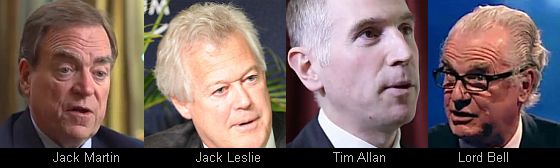
Lord Bell, chairman of Bell Pottinger, was an adviser to Margaret Thatcher during three general election campaigns. Jack Martin, chairman and CEO of Hill Knowlton, was a senior advisor to the Democratic National Committee and the U.S. Senate Democratic Committee. Jack Leslie, chairman of Weber Shandwick, was a senior aide to U.S. Senator Edward M. Kennedy. Tim Allan, founder of Portland Communications, was a key media adviser to Tony Blair and served as deputy press secretary in Number 10, Downing Street.

With advisers like these, it’s small wonder we have such little confidence in our own democratic leaders. If those who have perfected the art of lubricating the wheels of government in Washington and London, can just as easily offer their services to a government that “has received widespread condemnation from international human rights bodies for human rights abuses, including arbitrary detentions, torture, mass political sackings and severe restrictions on freedoms of expression and association,” what does this say about the condition of contemporary Western governance?

Everyone knows our political system is rotten, but far too little attention is given to the individuals who, outside the media spotlight, have played such an instrumental role in turning democracy itself into the practice of public relations.

Facebooktwittermail

Bashar al-Assad steered 2013 Nobel Peace Prize selection

The Norwegian Nobel Committee has decided that the Nobel Peace Prize for 2013 is to be awarded to the Organization for the Prohibition of Chemical Weapons (OPCW) for its extensive efforts to eliminate chemical weapons.

During World War One, chemical weapons were used to a considerable degree. The Geneva Convention of 1925 prohibited the use, but not the production or storage, of chemical weapons. During World War Two, chemical means were employed in Hitler’s mass exterminations. Chemical weapons have subsequently been put to use on numerous occasions by both states and terrorists. In 1992-93 a convention was drawn up prohibiting also the production and storage of such weapons. It came into force in 1997. Since then the OPCW has, through inspections, destruction and by other means, sought the implementation of the convention. 189 states have acceded to the convention to date.

The conventions and the work of the OPCW have defined the use of chemical weapons as a taboo under international law. Recent events in Syria, where chemical weapons have again been put to use, have underlined the need to enhance the efforts to do away with such weapons. Some states are still not members of the OPCW. Certain states have not observed the deadline, which was April 2012, for destroying their chemical weapons. This applies especially to the USA and Russia.

Disarmament figures prominently in Alfred Nobel’s will. The Norwegian Nobel Committee has through numerous prizes underlined the need to do away with nuclear weapons. By means of the present award to the OPCW, the Committee is seeking to contribute to the elimination of chemical weapons.

The committee offers no credit to Bashar al-Assad.

But suppose John Kerry had not unwittingly initiated the process leading towards Syria giving up its chemical weapons stockpile, and suppose Russia had not seized on the political opportunity the the U.S. provided for removing the threat of military action, and suppose the Syrian government had not quickly recognized that it would be strengthening its own grip on power by giving up CW. Would the OPCW have just received the Peace Prize? Almost certainly not.

The crucial decision in the process leading to that choice was made by Assad.

Just as George W Bush once honored another war criminal, Ariel Sharon, as a “man of peace,” it surely won’t be long before Nobel laureate Barack Obama offers the same praise to Syria’s president.

Facebooktwittermail

The Assad smokescreen

In an interview with Der Spiegel this week, Bashar al-Assad was questioned about the August 21 chemical weapons attack outside Damascus:

SPIEGEL: President Obama said after the investigation into this crime by the United Nations that there was “no doubt” that your regime used chemical weapons on Aug. 21 in an attack that killed more than 1,000 people.

Assad: Once again, I dare Obama to give a single piece of evidence, a single shred. The only thing he has is lies.

SPIEGEL: But the conclusions of the UN inspectors …

Assad: What conclusions? When the inspectors came to Syria, we asked them to continue the investigation. We are hoping for an explanation of who is responsible for this act.

SPIEGEL: Based on the trajectory of the rockets, it is possible to calculate where they were fired from — namely the positions of your Fourth Division.

Assad: That doesn’t prove anything, because the terrorists could be anywhere. You can find them in Damascus now. They could even launch a missile from near my house.

SPIEGEL: But your opponents are not capable of firing weapons containing Sarin. That requires military equipment, training and precision.

Assad: Who said that they are not capable? In the 1990s, terrorists used Sarin gas in an attack in Tokyo. They call it “kitchen gas” because it can be made anywhere.

SPIEGEL: But you really can’t compare these two Sarin attacks — they aren’t comparable. This was a military action.

Assad: No one can say with certainty that rockets were used — we do not have any evidence. The only thing certain is that Sarin was released. Perhaps that happened when one of our rockets struck one of the terrorists’ positions? Or perhaps they made an error while they were handling it and something happened.

“… some of the fighters handled the weapons improperly and set off the explosions” — remember that line?

It comes from the infamous Mint Press report that has since been disowned by Dale Gavlak, but whose name still appears in the byline.

So, here we have the Syrian president on the one hand asserting that there isn’t a “single piece of evidence” implicating his regime in the chemical attack, while on the other hand churning rumors about the attack first promulgated by a small website in Minnesota.

The Syrian state still retains significant power, yet apparently when it comes to the challenge of gathering evidence about the August attack it’s only tool of investigation is the internet.

Some observers might counter that in this case, since the location of the attack remains under rebel control, the regime can do no more than cite media reports, but this method of deflecting accusations by citing contrary claims from the media, long predates the revolution.

Back in 2007, after it was revealed in the Western media that on September 6, Israel had launched an attack on what was claimed to be a nuclear reactor under construction in the Deir ez-Zor region, the Syrian Vice-President Faruq Al Shara refuted the claim by asserting that the Arab Center for the Studies of Arid zones and Dry lands had in fact been the target. AFP quoted him:

“The images prove that the target that was attacked by air force jets in Syria was an academic research centre for the study of arid soil,” Shara told a news conference in Damascus.

“The last report appeared in European, American, and also a few Arab media outlets, and it noted that the attack was carried out at a research centre in Deir Ezzor.

“When I saw the photograph, it became evident that we were talking about the Desert Lands Research Center, a center that belongs to the Arab League. This is the picture, you can see it, and it proves that everything that was said about this attack was wrong.”

When the center itself denied that it had been attacked, Assad — in an interview with the BBC — claimed that the target had been an unused military building.

But if the Syrian government genuinely had nothing to hide, it had no need to rely on second-hand evidence or unsubstantiated claims — it could have swiftly invited international media to visit the site of the Israeli attack and also brought in UN inspectors to confirm that a nuclear reactor had not been under construction. After all, the IAEA strongly objected to Israel’s unilateral action, arguing that Israeli and U.S. concerns should have triggered IAEA inspections while the facility was still intact.

But instead of jumping on an opportunity to show the world that Syria had been the victim of unprovoked aggression, Assad sent in bulldozers to bury the evidence.

Facebooktwittermail

Banksy and Syria: The rebels who hide and the rebels who fight

No war has ever been captured on film more extensively than the war in Syria. Yet these images of war — mostly delivered by YouTube — seem to have done little to heighten awareness and trigger empathy among those who witness this war on the screen of a computer. On the contrary, the more we see, the less we feel; the image has become the analgesic.

Enter Banksy — the pseudonymous graffiti artist currently performing in New York City. He epitomizes the contradictions in the spirit of rebellion in the internet age — a craving to be seen, wrapped in a fear of being known.

The man whose public life began in the early 90s must by now be approaching middle age and yet he clings to his adolescent persona, convinced apparently that if his real name were to be known and his real face seen, the Banksy bubble would burst; the unmasked rebel would rebel be no more.

That Banksy would release a YouTube video mocking rebels in Syria probably says much more about the ways in which he finds his own rebel identity threatened than it says about the men fighting against the Assad regime.

That in two days, Banksy’s video would have been viewed more than four million times while an award-winning documentary film about Syria, Not Anymore: A Story of Revolution, directed by Matthew VanDyke, has only been viewed 61,000 times, shows how readily the internet caters to our insatiable appetite for mindless entertainment. In this era, the internet delivering YouTube, Twitter, endless apps and GIFs, is the opium of the people.

In VanDyke’s film, Omar Hattab (Mowya), standing next to a cat notes with irony that most Americans show more interest in cats than Syrians.

“I am sure that the animals have rights in America more than the people here. They don’t care about us… Maybe you filming three of four cats and putting it on YouTube — maybe one million will watch the video in one hour.”

It turns out that Syria animated by a Disney character is just as popular.

Syria is not short of satirists, as the residents of Kafranbel continue to demonstrate.

Banksy’s latest stunt is just that: a stunt which calls for attention yet speaks of little more than the universal desire to be noticed. It is a shout to be heard made by someone who has nothing to say — not a sharp piece of political commentary.

In Syria, teenagers have been thrust into adulthood by war, while in the West pseudo-rebels performing their acts of digital defiance turn out to be adults who lack the courage to leave their adolescence behind.

Facebooktwittermail

Debunking the radicalization narrative in Syria

Bashar al-Assad has played an instrumental role in the deaths of over 100,000 Syrians and in making close to a third of the country’s population homeless, but despite this and despite his lack of charisma, in many Western eyes he seems to retain a stubborn charm.

In his well-tailored suits, the fair-skinned, green-eyed Syrian leader, has a regal manner polished by British culture. He is, in a word, far too respectable to be effectively tarnished by the caricatures of a tyrant and butcher.

Thus the ease with which he is afforded the status of a statesman — a role after all which derives as much from style as anything else.

How easy it is for the West to project dignity on a man for no better reason than his willingness to wear a necktie and a suit. Add to that Assad’s fluent English and it sometimes seems that he might be able to get away with anything.

And then there is the fact that he has paid close attention to the ease with which the American mindset can be manipulated and it’s no wonder that his regime has been so willing to abandon chemical weapons.

It retains the unfettered use of a much more effective weapon which it deploys with minimal effort, since that weapon is nothing more than a word — a word that can render the average American brain-dead from a range of 10,000 miles. The word of course is terrorism.

From day one, Assad has insisted his opponents are terrorists. At first it was a claim dismissed as cynical propaganda and yet as the months have passed and the scale of destruction become massive, the terrorism meme has spread in the war-weary West. Here, any narrative will be given consideration if it leads to this conclusion: don’t venture there.

In this context, Scott Lucas offers a reality check on the latest developments in Syria.

Facebooktwittermail

Kerry praises Assad while Assad continues bombing Syria

Remember the refrain that used to come from all quarters of the Obama administration? Assad must go!

This was Secretary of State John Kerry speaking in London on February 25:

Less than two months after chemical attacks outside Damascus killed hundreds of Syrians, not only have U.S. officials stopped insisting Assad must go, but today Kerry praised the Syrian president. Kerry praised Assad even as his air force continued its daily bombing of Syrian cities. Of course none of those bombs were armed with chemical warheads.

Kerry is “very pleased” at progress in the chemical weapons disarmament plan which he called “a terrific example of global cooperation.” He added, “I think it is also credit to the Assad regime for complying rapidly as they are supposed to.”

Even among those observers who remain skeptical about the Assad regime’s responsibility for the August 21 chemical attacks, there should nevertheless be little debate about who has benefited, diplomatically, politically, and strategically: Bashar al-Assad.

The following videos of air attacks on several cities were uploaded to YouTube today and appeared on the Facebook page of the Local Coordination Committees of Syria.

Barrel bombs dropped on Kafr-Zeita, Hama:

An air strike on Dael, Daraa

An air strike on Hrak, Daraa

An air strike on Tafas, Daraa

Meanwhile, the Associated Press reports: Syrian government forces have reopened a key road leading to the embattled northern city of Aleppo after heavy fighting with rebels that left casualties on both sides, state media and activists said Monday.

The state news agency and the Britain-based Syrian Observatory for Human Rights said regime troops wrested control of the road Sunday night. It had been closed since rebels captured villages along the road in August.

President Bashar Assad’s regime built the desert road to bypass contested areas after rebels took the town of Maaret al-Numan late last year, cutting the main highway between the capital, Damascus, and Aleppo, Syria’s largest city.

“This road was a matter of life or death to the regime,” said Observatory director Rami Abdul-Rahman. He added that government troops now can send supplies to the north although the road remains “very dangerous.”

Facebooktwittermail

Syria beyond the binaries

Jaish al-Islam commanders from  50 insurgent groups who merged on Sunday.

Jaish al-Islam commanders from 50 insurgent groups who merged on Sunday.

I suspect that for quite a few observers there’s something vaguely comforting about the spectacle of the rise of extremism in Syria. Why comforting? Because it reinforces the idea that however bad the Assad regime might be, the alternative seems destined to be worse. On that basis one can take comfort in the belief that the best course of action for those outside Syria is no action at all.

Indeed, the Assad regime itself seems willing to cater to those who want to balance both humanitarian and non-interventionist concerns through facilitating a symbolic intervention by destroying Syria’s chemical weapons arsenal. If the Syrian government is sufficiently cooperative in this undertaking it will no doubt earn qualified praise for doing so.

Which brings me to a headline in yesterday’s Washington Post: “Foreign extremists dominate Syria fight“. As if carried away by the sentiment in those words, the security analyst Matthew Aid then reposted the article on Tumblr with an even more sensational headline: “Most Fighting in Syria Being Done by AQ-Linked Militants, Not Free Syrian Army“.

The problem is, neither headline actually reflected the details of the report. No doubt Liz Sly, reporting from Beirut, wanted to convey some sense of Syria being taken over by foreign jihadists, yet the second sentence in her report acknowledges: “The number of Syrians battling to overthrow the regime led by President Bashar al-Assad outstrips by a large margin the thousands of Arabs and other non-Syrian Muslims who have streamed into Syria over the past two years to join in the fight.”

Further in to the report she says that conservative estimates put the number of foreign fighters at between 6,000 to 10,000 — though she fails to put that in context by referring to the estimated size of the fighting opposition: 100,000.

Supposedly, what is happening in Syria can only be comprehended in binary terms: Syrian vs foreign; moderate vs extremist; secular vs Islamist; Sunni vs Allawite. But the overarching effect of the imposition of these simplistic labels is to reinforce the sentiment that Syria is bad news and the less we hear about it the better.

On the other hand, for those who retain an interest in being provided with a more nuanced picture of what’s happening on the ground, there are commentators like Hassan Hassan who are capable of explaining some of the complexity in an ever-changing landscape while underlining the fact that whatever fissures do indeed exist inside the opposition, this remains a fight to topple the Assad regime.

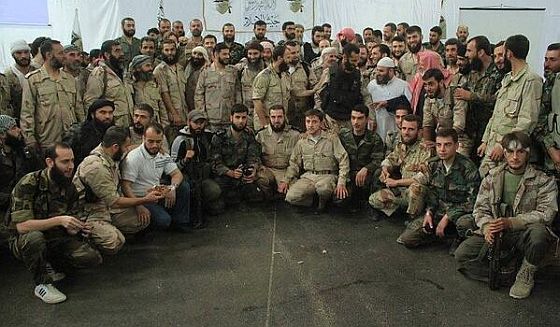
Hassan notes that in the liberated areas of Syria, Salafi-leaning fighters are now dominant and among these the newly formed Jaish al-Islam (“the Army of Islam”) composed of at least 50 groups operating mainly around Damascus, has now displaced the FSA as the strongest rebel force.

The emerging trend, far from that of Syria being taken over by foreign fighters, may actually be going in the opposite direction:

Significant grassroots hostility is building in liberated Syrian areas against foreign-funded extremists and al Qaeda affiliates. These tensions do not always develop into sustained clashes — for almost all rebel groups, toppling the regime is the priority, not fighting extremist forces, which have proved indispensable in the battlefield.

According to an activist based in the northern city of Raqqa, when clashes erupted between the al Qaeda-affiliated ISIS and Ahfad al-Rasoul in August, local residents threw their support behind one or the other side — but the strongest condemnation was for the infighting itself. “When they see the regime’s warplanes shelling the city without a single shot in their direction, they get angry at the fighters who could do something,” the activist explained.

The size of extremist groups is not an accurate indicator of the support for their ideology within Syrian society. Fighting groups are also not ideologically homogenous, as many fighters join groups for their effectiveness on the battlefield and disciple — not their religious beliefs. Ahrar al-Sham members in Daraa, for example, can be remarkably different in terms of religiosity from members in more conservative northern areas such as Idlib or the Aleppo countryside.

The situation inside the country is more fluid and nuanced than many groups’ hard-line slogans would suggest. Moderates can be members of hard-line groups and vice versa. Some groups, such as Suqour al-Sham, include both secular members and Islamist veterans of the insurgency against the U.S. occupation of Iraq. For example, a former judge at Aleppo’s cassation court, a secular Syrian who does not pray, nevertheless supports an Islamic identity to the state.

For this reason, many moderate fighters are more concerned with the foreign networks and leaders than the rank-and-file members of hard-line groups. “We are not too worried about Jabhat al-Nusra,” said one FSA-affiliated officer in the eastern governorate of Deir Ezzor who said he worked in intelligence operations. “Once the fighting ends, we’ll bring them back. We know them. They’re our brothers, cousins, and neighbors — they’re the sons of our tribes. Our true struggle will be against [ISIS] and the Nusra leaders.”

Facebooktwittermail

Israel puts ‘Iranian spy’ on display but has yet to charge him after 20 days of detention

Ali Mansouri, an Iranian-born Belgian citizen also known as Alex Mans, was arrested by Israel’s internal security services Shin Bet on September 11. His possession of a couple of nondescript photographs in which the U.S. embassy in Tel Aviv can be seen, has been presented as evidence that he was engaged in espionage. (Anyone who wants to find better photos of the embassy just has to use Google.)

The fact that after 20 days in detention (during the first nine of which Mansouri was prevented from consulting a lawyer) investigators don’t appear to have found sufficient evidence to put him on trial, might explain why he has yet to be charged.

At the same time, Israeli authorities were shameless in trying to exploit the political value of holding an Iranian in handcuffs as he was put on display for the press today.

Reuters reports: A man arrested on suspicion of being an Iranian spy appeared in an Israeli court on Monday and some Israeli analysts questioned the timing of the affair, suggesting it was being showcased as part of efforts to discredit Tehran’s new opening to Washington.

As Prime Minister Benjamin Netanyahu flew on Sunday to the United States for a visit focused on Iran’s nuclear program, Israel’s Shin Bet security service announced that Ali Mansouri had been arrested on September 11 on suspicion of spying for the Iranian Revolutionary Guards.

It said Mansouri, a 55-year-old Iranian-Belgian national, had photographed the U.S. Embassy in Tel Aviv and intended to establish business ties in Israel as a cover for espionage.

An Israeli official told reporters on Netanyahu’s flight that Mansouri’s picture-taking outside the embassy – whose exterior can be seen in numerous images on the Internet – was an attempt “to collect intelligence for a possible terror attack”.

That allegation was challenged by Mansouri’s lawyer, Michal Okabi, after a hearing on Monday in a court in the Tel Aviv suburb of Petah Tikva in which the suspect, who did not speak, was ordered held for eight more days.

“The apocalyptic picture that the Shin Bet is painting is a lot more complicated and the attempt to claim that our client came here in order to carry out attacks in Israel is far from reality and without foundation,” Okabi told reporters.

Some Israeli media commentators questioned the timing of the news, released in a Shin Bet statement that included photographs it said he had taken outside the beachfront mission and at Tel Aviv’s Ben-Gurion airport. No formal charges have been filed.

Asked by Reuters whether the decision to publicize Mansouri’s arrest was influenced by Netanyahu’s U.S. trip, the Shin Bet declined to comment.

Facebooktwittermail

Israel releases ‘Iranian spy’ story as Netanyahu heads to Washington

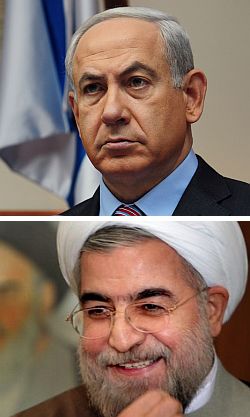
netanyahu-rouhaniOn September 11, Israel’s secret police (Shin Bet) arrested a Belgian windows and roofing salesman who is alleged to be an “Iranian agent … sent to Israel to set up a base for Iranian intelligence and terrorism networks”.


The Israeli government delayed releasing information about the arrest until Prime Minister Benjamin Netanyahu set off for Washington on his mission to counter the “the onslaught of smiles” that Americans have been subjected to over the last few days.

Reasons the Israelis give for regarding Ali Mansouri with suspicion, include:

  • The fact that when he became a Belgium citizen in 2006, he changed his name to Alex Mans. Were it not for the fact that the father of Israel’s prime minister shed his Polish identity when he migrated to Palestine, Bibi might now be generally known as Benjamin Mileikowsky. As millions of Americans can attest, the adoption of a new name in a new homeland is far from unusual.
  • Mans was found in possession of photos of the U.S. embassy in Tel Aviv. Much more detailed photos can be found on Google Maps.
  • “Iran offered him a million dollars in exchange for his activities.” But did he take a dime?

Mans left Iran the year after the revolution and has spent most of his adult life living in Turkey and Belgium.

The Jerusalem Post reports:

Public defense lawyers representing Mansouri said that their client is a Belgian businessman who is not motivated by any pro-Iranian agenda.

The attorneys, Michael Orkavi and Anat Yaari, said their client had been denied access to a lawyer for nine days. They added that a more complex picture exists than the one being presented by security forces, and that the full details would emerge in court after Mansouri is charged.

Mans’ cover as a ‘salesman’ seems quite convincing. But maybe that’s because he’s just a salesman. The only thing he’s definitely ‘guilty’ of is having been born in Iran.

Facebooktwittermail