Category Archives: Editorials

It’s up to Obama whether the siege of Gaza continues

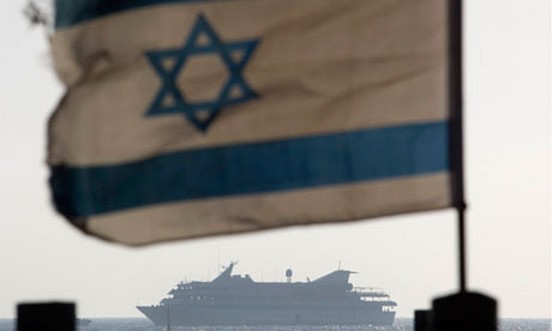
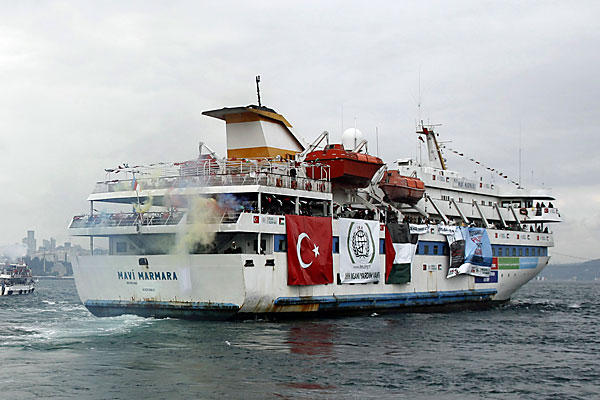
After the flotilla massacre committed by Israeli forces, Turkey’s call for an emergency meeting of the UN Security Council yesterday was to be expected. Turks are assumed to be among the dead — whose names and nationalities have still not been released. There are now hundreds of Turks being held in detention in Israel and Turkish ships were captured illegally in international waters in an action Turkey’s foreign minister described as “tantamount to banditry and piracy.”

What was equally predictable was that the Obama administration would only offer its support if action from the UN was so weak as to be worthless.

Had events of the last two days not disrupted their agendas, President Obama and Prime Minister Netanyahu would today have been servicing their individual political needs with smiles and handshakes on the steps of the White House. Absent that much-anticipated saccharine event, Obama was not about to turn around and support a stern rebuke to Israel.

The key Turkish demand presented to the Security Council was that the “blockade of Gaza must be ended immediately and all humanitarian assistance must be allowed in.”

Turkey was not alone. Britain’s new foreign secretary, William Hague, was equally unequivocal:

There can be no better response from the international community to this tragedy than to achieve urgently a durable resolution to the Gaza crisis.

I call on the Government of Israel to open the crossings to allow unfettered access for aid to Gaza, and address the serious concerns about the deterioration in the humanitarian and economic situation and about the effect on a generation of young Palestinians.

Universally there were calls for an inquiry. But the key to whether such an inquiry would be of any real value would be, minimally, its independence, and ideally that it would be international.

The statement finally issued by the Security Council is riddled with language surely crafted in the White House. It “calls for a prompt, impartial, credible and transparent investigation conforming to international standards.” Impartial, but not independent. International standards, but not international.

It does not call for an end to the siege but says “the situation in Gaza is not sustainable.” And there’s Obama’s lie.

Whether the siege of Gaza is lifted or sustained is up to Washington. If, when Netanyahu finally meets Obama, the US president was to say the embargo must end, Israel would have no choice. The siege of Gaza can only continue with US support and thus far, Obama refuses to withdraw that support. He says the situation is not sustainable, but through his actions Obama has a direct hand in perpetuating the suffering in Gaza.

“Unsustainable” is the signature of Obama’s self-declared impotence. It’s change over which he would like everyone else to believe he has no control. It’s the deceit through which he tells Americans and the world, I would if I could but I can’t.

Before the Security Council issued its statement and before it became clear that Obama was yet again going to throw away an opportunity to demonstrate his commitment to upholding international law, Stephen Walt wrote:

President Obama likes to talk a lot about our wonderful American values, and his shiny new National Security Strategy says “we must always seek to uphold these values not just when it is easy, but when it is hard.” The same document also talks about a “rule-based international order,” and says “America’s commitment to the rule of law is fundamental to our efforts to build an international order that is capable of confronting the emerging challenges of the 21st century.”

Well if that is true, here is an excellent opportunity for Obama to prove that he means what he says. Attacking a humanitarian aid mission certainly isn’t consistent with American values — even when that aid mission is engaged in the provocative act of challenging a blockade — and doing so in international waters is a direct violation of international law. Of course, it would be politically difficult for the administration to take a principled stand with midterm elections looming, but our values and commitment to the rule of law aren’t worth much if a president will sacrifice them just to win votes.

More importantly, this latest act of misguided belligerence poses a broader threat to U.S. national interests. Because the United States provides Israel with so much material aid and diplomatic protection, and because American politicians from the president on down repeatedly refer to the “unbreakable bonds” between the United States and Israel, people all over the world naturally associate us with most, if not all, of Israel’s actions. Thus, Israel doesn’t just tarnish its own image when it does something outlandish like this; it makes the United States look bad, too. This incident will harm our relations with other Middle Eastern countries, lend additional credence to jihadi narratives about the “Zionist-Crusader alliance,” and complicate efforts to deal with Iran. It will also cost us some moral standing with other friends around the world, especially if we downplay it. This is just more evidence, as if we needed any, that the special relationship with Israel has become a net liability.

In short, unless the Obama administration demonstrates just how angry and appalled it is by this foolish act, and unless the U.S. reaction has some real teeth in it, other states will rightly see Washington as irretrievably weak and hypocritical. And Obama’s Cairo speech — which was entitled “A New Beginning” — will be guaranteed a prominent place in the Hall of Fame of Empty Rhetoric.

Irretrievably weak and hypocritical — unfortunately the evidence was there even before Obama took office. His character, commitments, calculations and cynicism were all on open display as he watched in silence Israel’s war on Gaza.


Facebooktwittermail

Israel apologists and the Israeli national will

Depending on ones view of Israel, the deaths that occurred on the decks of the Mavi Marmara early today are either reprehensible, tragic, regrettable, or — a cause for celebration.

Someone just wrote to me: “Too bad you weren’t on that ship with the rest of the terror supporters. Anyone touching an IDF soldier deserves what they got.”

I know people in J Street who would find such sentiments deeply offensive; who would assure me that when they say they are pro-Israel it does not in any sense mean that they condone the actions of this Israeli government or the kind of red-blooded xenophobic Zionism that believes the IDF can do no wrong.

Yet the question I would pose to anyone who says they are pro-Israel is this: is the Israel you support the one that exists in 2010, or does it have a firmer foothold somewhere inside your imagination?

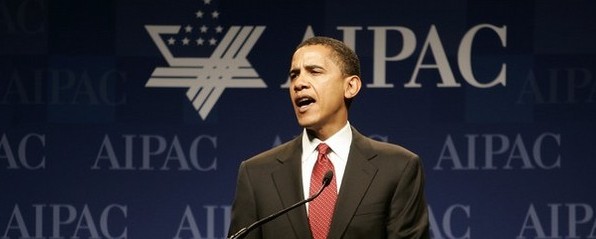
Which is the real Israel? The Israel cherished and trumpeted at an AIPAC convention? The Israel struggling to be defined at a J Street gathering? Or the Israel triumphantly being celebrated from the hilltops above Ashdod today?

This is how The Guardian describes the scene there and however representative these particular flag-clad Israelis might actually be, their claim to be pro-Israel has a distinction that many of their American counterparts lack: they are Israelis, they live in Israel and they are not on the political fringe.

If one was to describe a constellation that linked the IDF soldiers to either their flag-waving brethren or their more conflicted American cousins, the closest ties would surely coincide with geographical proximity.

[Above the Israeli port of Ashdod as the ships of the Freedom Flotilla were towed in] Jonah’s Hill itself was heaving. Shirtless Israeli men draped in their national flag waved placards declaring “Well done IDF” in both Hebrew and English, chanting, singing and applauding their support for the military operation.

Thick cables snaked across the ground from thrumming generators, delivering power to dozens of international TV crews, broadcasting across the globe against the backdrop of the shimmering Mediterranean.

Amid the crowd, a sophisticated public relations operation was underway. Spinners and spokesmen from the Israeli military and government departments politely answered questions and offered their own narrative of the day’s events. A barrage of emails and text message alerts firing into inboxes provided a background of electronic muzak.

Shahar Arieli, deputy spokesman for the ministry of foreign affairs, wearing a smart tie despite the heat, said two of the flotilla’s boats had been brought into port.

All activists would be offered the chance of immediate deportation at Israel’s expense “with their passports”, he said. “We want them to leave as soon as possible,” he added.

Those who declined would – “as long as they weren’t involved in attacks on our troops” – be processed through Israel’s justice system.

His patient courtesy was not matched by all those gathered on the hill. Chaim Cohen, a 52-year-old economic consultant from Givatayim, was dripping with both sweat and bile. “We have come to support our soldiers. It is obvious it [the Mavi Marmara] is a terrorist ship. We saw it on TV – they took out knives and put them in the stomachs of the IDF.”

There was nothing to challenge the Israeli version of events. Repeated attempts to reach the cell and satellite phones of activists on board the flotilla were rebuffed; it was unclear whether their phones had been confiscated, jammed or if they were simply out of range.

By late afternoon on Monday, activists with lesser injuries were being brought to hospitals in coastal towns and cities from the smaller passenger ships. At the Barzilai medical centre in Ashkelon, just north of the Gaza Strip, a Greek man in a neck brace told reporters: “They hit me.” Who? “Pirates,” he answered.

A dazed man with a striking black eye was unloaded from an ambulance. There had been “some brutality” on board, he said, but the activists were non-violent. “We are all Palestinian now,” he said as the doors of the ER closed behind him.

Facebooktwittermail

Facing armed attack in international waters

When a civilian passenger ship comes under military attack in international waters, should we be surprised — or even critical — when some of the passengers mount a defense?

According to CNN, which has made itself into a mouthpiece for the Israeli Defense Forces, the flotilla massacre was a “skirmish”, which the dictionary defines as a “minor battle in war, as one between small forces.”

CNN/the IDF would have the world believe that Israel’s elite commandos unexpectedly met an armed force on the decks of the Mavi Marmara. Some of the Israeli soldiers were so afraid they jumped into the sea to save themselves from Arabic-speaking assailants, Israeli officials claimed.

Yet Today’s Zaman reports:

Turkish officials have denied claims leveled by Israeli authorities that weapons were onboard one of the six aid ships attacked by Israel on Monday.

Officials from the Customs Undersecretariat said every passenger was searched before getting on the ship with the help of X-ray machines and metal detectors. Senior officials from the undersecretariat said Israel’s allegations were tantamount to “complete nonsense.”

Israel and its lackeys in the US media might try to characterize what happened in the Mediterranean today as an “incident,” or “skirmish,” or an “ambush.”

But if the IDF met “unexpected resistance,” what exactly did they expect? A reception committee with tea and breakfast? Didn’t they see the resistance the Viva Palestina convoy put up last year when challenged by Egyptian security forces?

The live video feed coming from the Mavi Marmara during its voyage from Turkey would have provided invaluable intelligence for the IDF and I have little doubt that they watched it carefully. A number of observations the Israelis must have made may have significantly influenced their calculations and miscalculations.

One of the striking demographic features of the group of passengers was the average age — having watched many hours of the feed, I’d put the average age at about 35-40 with a significant number of “retirees” — this was not a bunch of young hotheads.

Also, the group was overwhelmingly Middle Eastern and Turkish and male. The risk that Israeli violence would result in the death of another Rachel Corrie was relatively low.

Put together these two factors — the expectation that the age of the passengers might make them somewhat less volatile and the fact that they largely came from countries that Israel has less concern about offending — and you get the perfect cocktail for Israeli hubris.

As for the fact that elite Israeli soldiers can in one instant be portrayed as invincible and yet the next as hapless victims — that is a paradox that can be resolved only in the minds of Israelis.

In the eyes of much of the world, this was a massacre, the dead will be seen as martyrs, and the moral bankruptcy of the Jewish state revealed in sharper clarity than ever before.

Facebooktwittermail

Where is Israel’s self-respect?

Watch this video and pay attention to the victims — one an old man with a long gray beard. Are we supposed to believe that these men “ambushed” Israel’s elite navy commandos?

The narrative here is a familiar one: the plight of a people whose self-image as victims is so deeply internalized that they have lost the capacity to recognize their ability to do harm.

When evil is something that can only be seen as other, human conscience becomes silent and atrophies.

When violence has become the only language one knows how to speak, one has stepped outside the human family.

Facebooktwittermail

Ehud Barak blames the victims of Israeli violence

Israel’s Defense Minister Ehud Barak had the audacity to blame the casualties who died or were injured by Israeli commandos during an armed assault on the Freedom Flotilla in the early hours of Monday morning as it attempted to bring humanitarian aid to Gaza. Even though the Israeli Defense Forces have spent a week engaged in meticulous preparations for the assault, Israeli leaders are now portraying its elite military force as hapless victims of an “ambush”!

Benjamin Netanyahu is now considering the cancellation of his imminent trip to the United States. After receiving recent sycophantic overtures from the Obama administration in its effort to mend rifts with Tel Aviv, Israel’s prime minister may now decide that it is in both his and President Obama’s interests to avoid mutual embarrassment by not showing up in Washington. This particular decision will be affected by the extent to which the Israel-friendly US media attempts to minimize the flotilla massacre story.

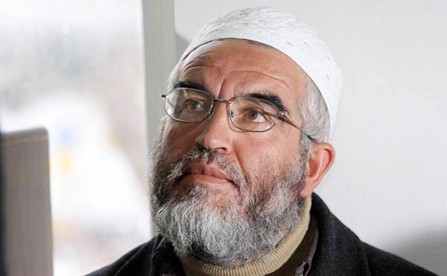
But after the Israeli government treated the flotilla’s mission as a PR challenge — in which regard Israel’s actions have been a stupendous failure — the worst fallout for the Jewish state may occur inside Israel itself if, as is rumored, the Israeli Arab leader, Raed Salah, head of the Islamic Movement’s northern branch, is among the casualties.
In Haaretz, Amos Harel writes:

If Salah is indeed among the casualties, the result could be a wave of riots led by Islamic Movement activists. Targeted provocations by Islamists and left-wing activists will now take on strategic significance. Under certain circumstances, and if both sides fail to take steps to calm the situation, this could even end in a third intifada, or Palestinian uprising.

Facebooktwittermail

Is Obama’s word worth anything?

President Obama is either a liar or he has lost control of his own administration.

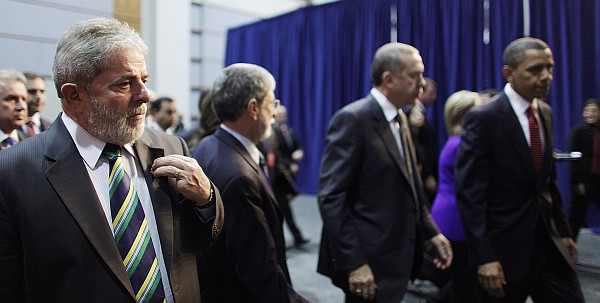
In a letter he sent to the president of Brazil in late April, Obama spelled out the terms on which the US would support a diplomatic initiative by Brazil and Turkey who hoped to revive a nuclear swap agreement that Iran had rejected last fall. Obama expressed his skepticism that Iran would make the necessary concessions. He was proved wrong, but then instead of welcoming Lula and Erdogan’s diplomatic accomplishment, Secretary Clinton dismissed it out of hand. If she did so with Obama’s consent, he has shown his word is worthless. If she did so on her own initiative, this president has lost his authority as chief executive.

This is what Obama wrote to Lula on April 20, 2010 (emphasis added):

His Excellency
Luiz Inácio Lula da Silva
President of the Federative Republic of Brazil
Brasilia
Dear Mr. President:

I want to thank you for our meeting with Turkish PrinIe Miuister Erdogan during the Nuclear Security Summit. We spent some time focused on Iran, the issue of the provision of nuclear fuel for the Tehran Research Reactor (TRR), and the intent of Brazil and Turkey to work toward finding an acceptable solution. I promised to respond in detail to your ideas. I have carefully considered our discussion, and I would like to offer a detailed explanation of my perspective and suggest a way ahead.

I agree with you that the TRR is an opportunity to pave the way for a broader dialogue in dealing with the more fundamental concerns of the intemational community regarding Iran’s overall nuclear program. From the beginning, I have viewed Iran’ s request as a clear and tangible opportunity to begin to build mutual trust and confidence, and thereby create time and space for a constructive diplomatic process. That is why the United States so strongly supported the proposal put forth by former International Atomic Energy Agency (IAEA) Director General EIBaradei.

The IAEA’s proposal was crafted to be fair and balanced, and for both sides to gain trust and confidence. For us, Iran’s agreement to transfer 1,200 kg of Iran’s low enriched uranium (LEU) out of the country would build confidence and reduce regional tensions by substantially reducing Iran’s LEU stockpile. I want to underscore that this element is of fundamental importance for the United States. For Iran, it would receive the nuclear fuel requested to ensure continued operation of the TRR to produce needed medical isotopes and, by using its own material, Iran would begin to demonstrate peaceful nuclear intent. Notwithstanding Iran’s continuing defiance of five United Nations Security Council resolutions mandating that it cease its enrichment of uranium, we were prepared to support and facilitate action on a proposal that would provide Iran nuclear fuel using uranium enriched by Iran — a demonstration of our willingness to be creative in pursuing a way to build mutual confidence.

During the course of the consultations, we also recognized Iran’s desire for assurances. As a result, my team focused on ensuring that the lAEA’s proposal contained several built-in measures, including a U.S. national declaration of support, to send a clear signal from my government of our willingness to become a direct signatory and potentially even play a more direct role in the fuel production process, a central role for Russia, and the IAEA’s assumption of full custody of the nuclear material throughout the fuel production process. In effect, the IAEA’s proposal offered Iran significant and substantial assurances and commitments from the IAEA, the United States, and Russia. Dr. EI Baradei stated publicly last year that the United States would be assuming the vast majority of the risk in the IAEA’s proposal.

As we discussed, Iran appears to be pursuing a strategy that is designed to create the impression of flexibility without agreeing to actions that can begin to build mutual trust and confidence. We have observed Iran convey hints of flexibility to you and others, but formally reiterate an unacceptable position through official channels to the IAEA. Iran has continued to reject the IAEA’s proposal and insist that Iran retain its low-enriched uranium on its territory until delivery of nuclear fuel. This is the position that Iran formally conveyed to the IABA in January 2010 and again in February.

We understand from you, Turkey and others that Iran continues to propose that Iran would retain its LEU on its territory until there is a simultaneous exchange of its LEU for nuclear fuel. As General Jones noted during our meeting, it will require one year for any amount of nuclear fuel to be produced. Thus, the confidence-building strength of the IAEA’s proposal would be completely eliminated for the United States and several risks would emerge. First, Iran would be able to continue to stockpile LEU throughout this time, which would enable them to acquire an LEU stockpile equivalent to the amount needed for two or three nuclear weapons in a year’ s time. Second, there would be no guarantee that Iran would ultimately agree to the final exchange. Third, IAEA “custody” of lran’s LEU inside of Iran would provide us no measurable improvement over the current situation, and the IAEA cannot prevent Iran from re-assuming control of its uranium at any time.

There is a potentially important compromise that has already been offered. Last November, the IAEA conveyed to Iran our offer to allow Iran to ship its 1,200 kg of LEU to a third country — specifically Turkey — at the outset of the process to be held “in escrow” as a guarantee during the fuel production process that Iran would get back its uranium if we failed to deliver the fuel. Iran has never pursued the “escrow” compromise and has provided no credible explanation for its rejection. I believe that this raises real questions about Iran’s nuclear intentions, if Iran is unwilling to accept an offer to demonstrate that its LEU is for peaceful, civilian purposes. I would urge Brazil to impress upon Iran the opportunity presented by this offer to “escrow” its uranium in Turkey while the nuclear fuel is being produced.

Throughout this process, instead of building confidence Iran has undermined confidence in the way it has approached this opportunity. That is why I question whether Iran is prepared to engage Brazil in good faith, and why I cautioned you during our meeting. To begin a constructive diplomatic process, Iran has to convey to the IAEA a constructive commitment to engagement through official channels — something it has failed to do. Meanwhile, we will pursue sanctions on the timeline that I have outlined. I have also made clear that I will leave the door open to engagement with Iran. As you know, Iran has thus far failed to accept my offer of comprehensive and unconditional dialogue.

I look forward to the next opportunity to see you and discuss these issues as we consider the challenge of Iran’s nuclear program to the security of the international community, including in the U.N. Security Council.

Sincerely,
Barack Obama

So what did Brazil and Turkey accomplish? An agreement by Iran to do exactly what Obama claimed he was seeking: that Iran would transfer 1200kg of LEU to be held in escrow by Turkey and in return for which, one year later, Iran would receive fuel rods for the TRR.

The US response? Secretary Clinton claimed there were “discrepancies” in the offer. These included that:

There is a recognition on the part of the international community that the agreement that was reached in Tehran a week ago between Iran and Brazil and Turkey only occurred because the Security Council was on the brink of publicly releasing the text of the resolution that we have been negotiating for many weeks. It was a transparent ploy to avoid Security Council action.

That is a truly Kafkaesque statement!

The US and its allies have been mounting diplomatic and economic pressure on Iran to force it to make concessions on the nuclear issue. As soon as Iran makes concessions, the US turns around and says the concessions are a “ploy” to avoid sanctions.

Facebooktwittermail

Obama: inconsistent, unimaginative, unengaged — or simply over-stretched?

Every disaster gets a name — Katrina, Exxon Valdez, The Tsunami — and now The Spill?
Even after the Gulf of Mexico oil spill has officially become the worst oil spill in US history, this is a disaster whose generic and mundane name has contributed to an underestimation of its significance. After all, how bad can something called a “spill” really be?

At the same time, the image of a president and his administration as passive observers of events over which they can exert little control, is now becoming the signature of the Obama presidency itself.

“Obama has appeared almost scarily unengaged from what the public increasingly recognizes is a genuine national emergency,” writes Dan Froomkin.

Obama’s effort on Thursday to show that he is engaged will have been far too technocratic in tone to satisfy many Americans, leaving serious doubts about his ability to operate effectively as a crisis manager.

Indeed, doubts about Obama’s approach now seem to spring up wherever his attention is demanded.

Stephen Walt points to the glaring disparity between Obama’s earlier promises to engage with Iran and the threatening posture that US has increasingly assumed.

[T]he U.S. approach to Tehran is deeply inconsistent. Obama has made a big play of extending an “open hand” to Tehran, and he reacted in a fairly measured way to the crackdown on the Greens last summer. But at the same time, the administration has been ratcheting up sanctions and engaging in very public attempt to strengthen security ties in the Gulf region. And earlier this week, we learned that Centcom commander General David Petraeus has authorized more extensive special operations in a number of countries in the region, almost certainly including covert activities in Iran.

Just imagine how this looks to the Iranian government. They may be paranoid, but sometimes paranoids have real (and powerful) enemies, and we are doing our best to look like one. How would we feel if some other country announced that it was infiltrating special operations forces into the United States, in order to gather intelligence, collect targeting information, or maybe even build networks of disgruntled Americans who wanted to overthrow our government or maybe just sabotage a few government installations? We’d definitely view it as a threat or even an act of war, and we’d certainly react harshly against whomever we thought was responsible. So when you wonder why oil- and gas-rich Iran might be interested in some sort of nuclear deterrent (even if only a latent capability), think about what you’d do if you were in their shoes.

But not only must Iran be suspicious of US intentions, likewise Turkey and Brazil have reason to wonder — as does Walt — who is actually steering US policy on Iran?

Robert Naiman points out that preceding last week’s announcement of a nuclear swap initiative — a bold piece of emerging powers’ diplomacy that the administration was nevertheless quick to dismiss — Obama had actually given clear support for their approach.

[I]f you get your information from major U.S. media, here’s something that you almost certainly don’t know: Brazil and Turkey say that before they reached the deal, they understood that they had the backing of the Obama Administration for their efforts. The available evidence suggests that Brazil and Turkey had good reason to believe that they had U.S. support, and that the Obama Administration has taken a 180 degree turn in its position in the last few weeks, and is now trying to cover its tracks, with the active collaboration of major U.S. media.

Reuters reports from Brasilia – in an article you won’t find on the web sites of the New York Times or the Washington Post:

Brazil argues Washington and other Western powers had prodded Brazil to try to revive the U.N. fuel swap deal proposed last October.

“We were encouraged directly or indirectly … to implement the October proposal without any leeway and that’s what we did,” said Amorim.

In a letter to Brazilian President Luiz Inacio Lula da Silva two weeks ago, U.S. president Barack Obama said an Iranian uranium shipment abroad would generate confidence.

“From our point of view, a decision by Iran to send 1,200 kilograms of low-enriched uranium abroad, would generate confidence and reduce regional tensions by cutting Iran’s stockpile,” Obama said, according to excerpts from the letter translated into Portuguese and seen by Reuters.

I haven’t seen any reference to this letter from President Obama to President Lula in the U.S. press – have you? But in Brazil, this letter from Obama to Lula was front-page news on Saturday morning – I saw it on the front-page of O Estado de S. Paulo, above the fold.

Note that the Reuters story, dated May 22, says Obama sent this letter two weeks ago. The deal was announced Monday, May 17. So, about a week before the deal was announced, Obama told Lula that from the U.S. point of view a decision by Iran to send 1,200 kilograms of low-enriched uranium abroad would generate confidence and reduce regional tensions. Note furthermore that Obama’s words – according to Reuters, this is a direct quote from Obama’s letter – actually specify an exact amount of transfer that would “generate confidence”: 1,200 kilograms, exactly what was agreed a week later. So the U.S. officials and media stenographers (like Glenn Kessler in the Washington Post – “Iran creates illusion of progress in nuclear negotiations“) saying a 1,200 kilogram transfer would have been great in October but would be worthless now are directly contradicting what President Obama himself wrote to President Lula one week before the deal was announced. But if course you wouldn’t know about that direct contradiction from the U.S. media, because in the U.S. media, the letter from Obama to Lula apparently doesn’t exist.

As Naiman wistfully suggests: “It’s a shame we don’t have a leader in the White House right now who is ready to lead on this issue. If only we had elected this guy:

As far as Dilip Hiro is concerned, Obama has already revealed that he lacks the qualities of a genuine statesman.

Irrespective of their politics, flawed leaders share a common trait. They generally remain remarkably oblivious to the harm they do to the nation they lead. George W. Bush is a salient recent example, as is former British Prime Minister Tony Blair. When it comes to foreign policy, we are now witnessing a similar phenomenon at the Obama White House.

Here is the Obama pattern: Choose a foreign leader to pressure. Threaten him with dire consequences if he does not bend to Washington’s will. When he refuses to submit and instead responds vigorously, back off quickly and overcompensate for failure by switching into a placatory mode.

In his first year-plus in office, Barack Obama has provided us with enough examples to summarize his leadership style. The American president fails to objectively evaluate the strength of the cards that a targeted leader holds and his resolve to play them.

Obama’s propensity to retreat at the first sign of resistance shows that he lacks both guts and the strong convictions that are essential elements distinguishing statesmen from politicians.

When candidate Obama spoke of the fierce urgency of now, he might have been employing hollow rhetoric, but I’m more inclined to believe that he used this expression with a genuine awareness of the historical moment. But that isn’t to suggest that he had much idea about how his rhetoric would translate into action.

Now as we witness the performance of what appears to be an inconsistent, unimaginative, unengaged president, we may in fact simply be seeing the results of the failing efforts of a man who can’t do enough because he is trying to do too much.

In the introduction to his newly-released National Security Strategy, Obama writes:

America’s greatness is not assured — each generation’s place in history is a question unanswered. But even as we are tested by new challenges, the question of our future is not one that will be answered for us, it is one that will be answered by us. And in a young century whose trajectory is uncertain, America is ready to lead once more.

Sorry, but neither the world nor America itself needs to hear more clichés about the revival of American leadership. We’re much less interested in what kind of high-minded declarations this president can make than in what he can actually do.

Facebooktwittermail

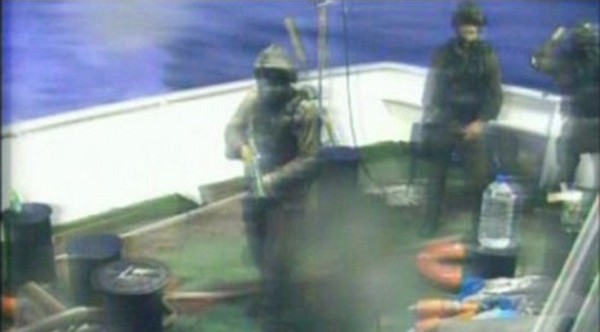
Masked Israeli commandos ready to capture Gaza-bound human rights activists

Israeli foreign ministry spokesmen Yigal Palmor told the Wall Street Journal that in dealing with the Freedom Flotilla, Israel faces the choice of either looking stupid or like brutes — or like pirates!

Masked Israeli commandos — with daggers clenched between their teeth? — will soon likely take control of the ships.

AP reports:

Israel on Thursday unveiled a massive makeshift detention center in the country’s main southern port and announced the end of days of intense naval maneuvers, vowing to stop a flotilla of hundreds of pro-Palestinian activists trying to break a 3-year blockade of the Gaza Strip this weekend.

Military authorities said that masked naval commandos would greet the eight ships deep out at sea, escort the vessels to port and give each of the activists a stark choice: leave the country or go to jail.

But the tough response threatened to backfire by breathing new life into the activists’ mission and drawing new attention to the oft-criticized blockade of Gaza.

“We know that we are sailing for a good cause,” said Dror Feiler, 68, an Israeli-born Swedish activist who was on board a cargo ship headed from Greece to Gaza. “If the Israelis want us to pay a price, we will pay a price, but we will come again and again.”

Some 750 activists, including a Nobel peace laureate and former U.S. congresswoman, have set sail for the Gaza coast in recent days, carrying 10,000 tons of humanitarian supplies. They are expected to reach the Israeli coast on Saturday.

The Wall Street Journal adds:

Israeli Defense Minister Ehud Barak named a team of public-relations experts and military officers to come up with ideas for how to blunt the public-relations blow from the aid fleet, according to members of the Labour Party that Mr. Barak leads. The Israeli military has launched an aggressive public-outreach effort. At an unusual, last-minute news conference on Gaza’s border Wednesday morning, officers emphasized that Israel was already allowing generous quantities of aid into Gaza and dismissed claims by organizers of the aid flotilla that Gaza is facing a humanitarian crisis.

“This is nothing more than media provocation and has nothing to do with actually providing aid to residents of the Gaza Strip,” said military spokeswoman Lt. Col. Avital Leibovitch. “They have everything they need.”

As Larry Derfner writes, mocking such claims: “I only wish somebody would treat us Israelis like we treat people in Gaza.”

The IDF, which seems to have adopted a scattershot approach in its messaging, tells the Christian Science Monitor that it fears the flotilla may attempt to smuggle militants and weapons into Gaza — two of the few resources in which the Strip is, by most accounts, already amply supplied.

As if to demonstrate that Israel’s officials have a talent for making the Jewish state look brutish and stupid, the one thing that seems to have escaped their attention is this: Western news organizations have a meager amount of interest in activist endeavors such as the Freedom Flotilla. The only thing that really grabs the mainstream media’s attention is Israel’s heavy-handed way of responding to such activism.

Yigal Palmor says: “If we let them throw egg at us, we appear stupid with egg on our face.” But here’s a thought: Israel doesn’t have to look stupid or brutish. It could lift the siege — a siege which by Israel’s own account clearly isn’t working — and show the world that there still are a few signs of intelligent life inside Israel.

Facebooktwittermail

Israel’s botched propaganda on life in Gaza

Al Jazeera reports on Israel’s propaganda campaign whose aim is to promote the message that the residents of Gaza, even while living under a severe economic blockade, “have everything they need.” As part of that effort, Israel distributed video footage of a guests enjoying fine cuisine in a gourmet restaurant in Gaza — guests including Mahmoud Abbas who hasn’t set foot in Gaza since the siege began!

Gisha, the legal center for freedom of movement based in Israel, reports (via Mondoweiss):

At a time when Israel’s security officials should probably be focused on this week’s extensive home front security drill, it seems that that most of their attention is being paid to the flotilla of ships on its way to the Gaza Strip, laden with humanitarian supplies. Frantic consultations between officials and the prime minister’s top military chiefs of staff have taken place, an urgent meeting of a forum of senior government ministers was held, and the Ministry of Foreign Affairs has engaged in extensive activities, and an urgent press conference was held at the Erez border crossing. In particular, the Israeli government’s public relations machine has been mobilized with the intent of persuading the public that there is no need for the flotilla, due to the fact that the humanitarian situation in Gaza is fine, the Strip’s markets are abundant, and its gourmet restaurants are thriving.

Sheikh Raed Salah, from the Islamic Movement in Israel, tells Al Jazeera:

The official Arab role in this campaign is missing but that of the Arab people is not. We have campaigners coming from Kuwait, Jordan and Mauritania, Yemen and Algeria and that is a message we sent to the leaders. How beautiful it would be if you would reconcile with the stance of your people in their support of the cause of the Palestinians.

Facebooktwittermail

Democrats afraid of Jewish revenge in midterms

The niceties of America’s often straight-laced political discourse generally preclude the use of a phrase as provocative as this: Jewish revenge. One of the virtues of the Israeli press, however, is that it can be refreshingly blunt.

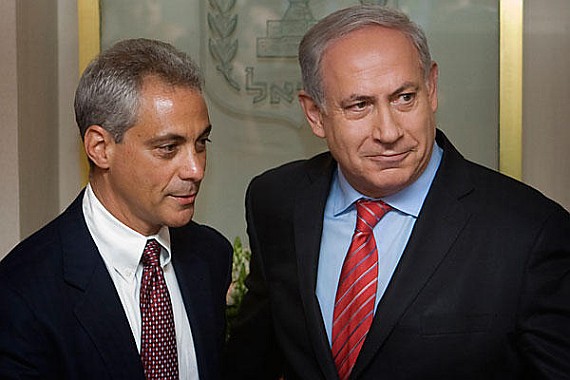
“Officials in the Democratic Party are afraid that the Jews will take revenge in the midterm elections, which is the reason for the vigorous courting of Israel,” reports Yedioth Ahronoth today. Some of the courting the paper refers to just came from White House chief of staff, Rahm Emanuel, whose recent trip to Israel was ostensibly a family affair — he was there to attend his son’s Bar Mitzvah — but it turned out that he also had important and very public business to take care of: a kiss-and-make-up session with Benjamin Netanyahu.

Didi Remez provides an English translation of the Hebrew report:

According to reports that reached Jerusalem, it is no coincidence that Obama and his staff have suddenly begun to speak warmly about Israel, to compliment it for the good will gestures it extended to the Palestinians and mainly to admit that they had erred by treating Israel unfairly in Obama’s first year. It appears that the Obama administration’s attack on Netanyahu after the publication of the tender to build 1,6000 new housing units in Ramat Shlomo backfired.

Information that was received by Israeli sources would seem to indicate that the principal reason for the change in approach to Israel is pressure from Democrat lawmakers who are running for election and are finding themselves hard put to enlist Jewish donors to their campaigns. There is a great deal of anger at Obama within the Jewish community and disappointment over his policy toward Israel. Officials in the Democratic Party are afraid that the Jews will take revenge in the midterm elections, which is the reason for the vigorous courting of Israel. In other words, the fear is that the Jewish vote will gravitate away from Democratic candidates to Republicans.

The report concludes by saying that the Obama administration is afraid of another clash with Netanyahu when the settlement “freeze” expires in September. “The hope is that Obama will be able to persuade Netanyahu to extend the construction freeze by means of a friendly request and thereby avoid a damaging confrontation.” Right!

The brief lull in West Bank colonization construction operations was surely timed to expire exactly when Obama could effectively be bound and gagged by the Israel lobby, right before the elections.

When ministers in the Israeli government triumphantly break ground on new settlement projects this fall, we shouldn’t expect to hear even a squeak of disapproval come out of Washington.

Facebooktwittermail

Israel: ineffective siege of Gaza must not be broken

As the Freedom Flotilla sails towards Gaza, the Israeli propaganda machine is working at full bore. In its frenzied effort, message discipline seems to have gone out of the window.

10,000 tons of supplies being carried in the nine-ship flotilla are, the Israelis suggest, superfluous to Gaza’s needs when Israel itself is delivering 15,000 tons a week. Still, if the human rights activists insist on completing their mission, Israel’s Ministry of Foreign Affairs says it would be more “efficient” if the flotilla, instead of docking at Gaza City, docks at an Israeli port where everything can be transferred to Israeli trucks. Then everyone can say a prayer as they wait to see how much gets confiscated at the land crossing into Gaza. Why take a direct route when you can take a longer less certain indirect route?

Not surprisingly, The Freedom Flotilla organizers have declined Israel’s “offer.” Israel’s police and prisons service are now on standby, ready to deal with the potential arrest of hundreds of activists in the event that the Netanyahu government decides to block the flotilla’s passage. I imagine some kind of internment camp may need to be set up for holding and interrogating the peaceful activists prior to their deportation.

Meanwhile, Israeli officials are citing a Financial Times report that the 200 to 300 smuggling tunnels from Egypt into Gaza “have become so efficient that shops all over Gaza are bursting with goods.”

In effect, the Israelis seem to be saying that the combination of supplies that it delivers, along with those coming through tunnels, means that for all practical purposes Gaza is no longer under siege.

The siege isn’t working — don’t break the siege!

Strange message.

While Israeli officials selectively cite reporting by the Financial Times, here is part of the same report which makes it clear that under siege, Gaza’s economy has effectively been crippled — in spite of the availability of goods coming through the tunnels.

“Everything I demand, I can get,” says Abu Amar al-Kahlout, who sells household goods out of a warehouse big enough to accommodate a passenger jet.

However, Mr al-Kahlout regards his suppliers in Rafah with distaste. “The tunnel business is not real business. They [the tunnel operators] are not respectable: if they were able to cut off your skin and sell it, they would do so,” he says.

His criticism is echoed by other business leaders in Gaza, who insist that the smugglers are creating a false sense of economic improvement while damaging the territory’s battered private sector.

They concede that the tunnels are providing essential goods, yet the smugglers are also bringing in precisely the simple consumer items that could be manufactured in Gaza, especially if sanctions were eased.

“We are just replacing legitimate businessmen with illegitimate businessmen” says Amr Hammad, a Gaza-based entrepreneur and deputy head of the Palestinian Federation of Industries. Flush with cash, the tunnel operators will soon “govern the whole economy of the Gaza Strip”, Mr Hammad predicts.

For most Gazans, the period since the end of Israel’s three-week offensive in January last year has brought little improvement. According to the United Nations Relief and Works Agency, the number of “abject poor”, who depend on food aid, trebled to 300,000 – or one in five of all Gazans – in 2009.

One western official says the tunnels act like a “humanitarian safety valve”, but cautions that they offer no solution to economic decline. As Mr Hammad says: “An economy cannot just depend on tunnels.”

The Ma’an news agency adds:

Over 60 percent of Gaza households are food insecure as a result of the ongoing blockade Israel imposed on the coastal enclave, leading to a collapse of its formal economy, the Association of International Development Agencies (AIDA) said Tuesday.

AIDA, which represents over 80 NGOs, called on Israel for “full and unfettered access into and out of the Gaza Strip for materials and exports necessary for the revival of the agriculture and fishing sectors.”

As Gaza’s population becomes increasingly dependent on aid, the organizations urged Israel to implement immediate measures which include the entry of agricultural input materials such as plastic irrigation piping, quality seeds/seedlings and veterinary drugs into Gaza “needed to jumpstart the agricultural sector and allow the export of produce” and the lifting of access restrictions on farming and fishing areas.

In the name of “security” — the catchall phrase used so often to justify brutality — through its siege on Gaza, Israel has engaged in a systematic campaign not merely to deprive a society of its physical needs but in order corrode, undermine and ultimately destroy the society itself.

Israel has vandalized Gaza in every possible way in a calculated effort to try and drive this society rip itself apart — to disarm Hamas by making Gaza implode. Gestures of solidarity and support for the people of Gaza from the Freedom Flotilla and elsewhere around the world are a way of saying that we can speak out even while our governments remain silent.

Facebooktwittermail

Obama and Clinton’s choice: humility or humiliation?

This week the Obama administration made what may come to be seen as a blunder of historic proportions. At a moment when tactical agility was a must, it stayed on course because it lacked the diplomatic finesse to show or perhaps even recognize the difference between being resolute and being inflexible.

The sanctions juggernaut plowed into the Iran diplomatic initiative masterminded by Brazil and Turkey and on the basis that these are “lesser” powers, Washington imagined its own agenda must be unstoppable. Or at least the administration felt compelled to bow in obedience to a fear that shackles every Democratic leader: the fear that flexibility will be seen as a sign of weakness.

Common sense and prudence made it clear that the smart way of responding to the new opening from Iran would have been with a cautious opening in return. Instead, Iran, Turkey and Brazil got the door slammed in their face. The calculation in Washington, no doubt, was that Iran, in its usual tempestuous style would swiftly reject the swap deal in the face of the continued threat of sanctions, and the diplomatic upstarts, Lula and Erdogan, would defer to the old world order.

Instead, it seems that Iran remains intent on seizing the initiative, will stick to the deal it signed and thereby demonstrate to the world that in the long-running nuclear dispute it is the United States that is now the intransigent party.

The Jerusalem Post reports:

Turkey’s prime minister is seeking international support for a deal under which Iran would ship much of its low-enriched uranium to Turkey.

Recep Tayyip Erdogan’s office said Saturday he had written to the leaders of 26 countries saying the deal would resolve the nuclear standoff with Iran by way of diplomacy and negotiation. The countries included all permanent and non-permanent members of the UN Security Council.

Iran will submit an official letter to the IAEA on Monday morning conveying its acceptance of the uranium enrichment deal brokered by Turkey and Iran, state-run news agency IRNA reported on Friday, citing a statement by the country’s National Security Council.

“Following the joint declaration by Iran, Turkey and Brazil, permanent representative of the Islamic Republic of Iran at the IAEA officially announced its readiness to submit our country’s letter to the IAEA Chief per paragraph six of the Teheran Declaration,” the statement reportedly read.

Also on Friday, IRNA quoted a top Iranian cleric as saying that the deal was a “powerful response” that “put the ball in the West’s court.” He reportedly stated that far from being a ploy meant to facilitate enrichment for military use, the deal should be seen as a confidence-building measure.

Meanwhile in Turkey, UN Secretary-General Ban Ki-moon expressed hope that the deal reached last week would “open the door to a negotiated settlement” between Iran and Western nations, according to a Reuters report.

Ban reportedly called the enrichment agreement “an important initiative in resolving international tensions over Iran’s nuclear program by peaceful means.” He went on to praise Turkey’s role and cooperation with Brazil in negotiating the deal, stressing that the International Atomic Energy Agency (IAEA) would have to make its own assessment concerning the issue at hand.

At this point, it looks like Hillary Clinton has driven the United States into a diplomatic ditch.

The American mindset now as always fixes its attention on power and while the US remains the pre-eminent global power it assumes that it must have its way. But this fixation on power blinds Washington to a more important issue — one that provides the foundation for effective diplomacy, namely, trust.

The Turkish commentator, Mustafa Akyol, says:

This issue of trust, I believe, is the key to not just the Iranian nuclear crisis, but also other conflicts in the region, including the Arab-Israeli one. On all these issues, America has all the eye-catching instruments that give her full confidence: The world’s most powerful military, the largest diplomatic corps, and the most sophisticated brain power with plentitude of universities, institutes and think-tanks.

Yet, I am sorry to say, she terribly lacks the trust of the peoples of the Middle East. So, it would be only wise for her to rely more on the regional actors that do have that trust – such as the new Turkey of the 21st century.

Rami G Khouri adds:

The agreement on Iran’s nuclear fuel announced on Monday after mediation by the Turkish and Brazilian governments should be good news for those who seek to use the rule of law to prevent nuclear weapons proliferation. From both the American and Iranian perspectives the political dimension of the current dynamics is more important than the technical one. The accord should remind us that the style and tone in diplomatic processes is as important as substance.

Iran and its international negotiating partners have not reached agreement on Iran’s nuclear programs in the past half-decade, to a large extent because American- and Israeli-led concerns have been translated into an aggressive, accusatory, sanctions-and-threats-based style of diplomacy that Iran in turn has responded to with defiance.

Iran’s crime, in the eyes of its main critics in Washington and Tel Aviv (they are the two that matter most, as other Western powers play only supporting roles), is not primarily that it enriches uranium, but that it defies American-Israeli orders to stop doing so. (The Iranian response, rather reasonable in my view, is that it suspended uranium enrichment half a decade ago and did not receive the promises it expected from the United States and its allies on continuing with its plans for the peaceful use of nuclear technology. So why suspend enrichment again?)

The Iranians are saying, in effect, that this issue is about two things for them, one technical and one political: The technical issue is about the rule of law on nuclear nonproliferation and the right of all countries to use nuclear technology peacefully. The political issue is about treating Iran with respect, and negotiating with it on the basis of two critical phenomena: First, addressing issues of importance to Iran as well as those that matter for the American-Israeli-led states; and, second, actually negotiating with Iran rather than condescendingly and consistently threatening it, accusing it of all sorts of unproven aims, and assuming its guilt before it is given a fair hearing.

The age in which the non-Western world could be expected to show deference to the dictates of the dominant global powers is over. Western leaders must either humbly adapt to a world that has changed or suffer the humiliations that arrogance now invite.

Facebooktwittermail

“For the world has changed, and we must change with it.”

Back in the days when Barack Obama scored political points for setting the right tone and hitting the right notes, this was one of his best lines, it’s significance underlined by the fact that it came in his inauguration speech.

… the world has changed, and we must change with it.

From America the hyperpower to America the adaptive power. From a president who liked to wield a chainsaw to a president who loved basketball — the blundering giant was going to give way to deft leadership, agile and attuned to the moment.

As cynical as I might sound, I still think Obama gets this. I think he understands what the possibility looks like, yet he also seems convinced that seemingly inviolable political realities dictate that he sticks to a script that could have been written for George Bush. Indeed, had it been possible for there to have been a third Bush term, the trajectory set from 2006 onward appeared to have been heading in the direction we have now landed.

So maybe it’s time Obama asked himself this question: does he want to be remembered as a continuation of the past or as a man who actually helped American embrace the future?

Luiz Inácio Lula da Silva and Recep Tayyip Erdoğan are men who represent the kind of future Obama really should believe in, yet having made himself a slavish tool of Washington’s institutional power, he operates with the calculations and lack of authenticity that have become synonymous with modern Western political leadership. Paradoxically, the art of securing political power now dictates that the power thereby acquired will be insufficient to bring about any significant change.

In spite of this, officials in Washington still harbor the conceit that they hold and are able to move all the major levers of global power — Washington still sees itself as the engine room of global change. No wonder the up-swell of indignation when two “lesser powers” have the audacity to become agents of change in an arena where this administration has thus far been manifestly impotent.

As Flynt and Hillary Mann Leverett note:

For months, Administration officials–and most U.S.-based Iran analysts–have asserted that the Islamic Republic is too internally conflicted to have a coherent international strategy or make important decisions. Senior Brazilian, Chinese, and Turkish officials who have invested significant amounts of time in substantive discussions with Iranian counterparts argued to Washington for months that a nuclear deal was possible. But Secretary Clinton and others in the Obama Administration thought they knew better–and said so publicly.

In fact, Iran has worked purposefully–dare we say strategically–to cultivate relations with important rising powers, like Brazil and Turkey, as well as China. And, this week, Tehran showed that it can take major decisions. Can the same things be said of the Obama Administration?

President Obama, who came to office professing a new U.S. approach to international engagement, allowed himself to be upstaged by new powers because he has been unwilling to match his rhetoric with truly innovative diplomacy that takes real notice of other countries’ interests.

The world was eager to forgive American arrogance when it appeared it could be more narrowly circumscribed as George Bush’s arrogance, but the heavy-handed approach now being applied by the current administration suggests that as the world changes, America is incapable of changing with it.

Simon Tisdall observes that the emerging realignment of global power does not simply involve America’s diminishing power but also a shift away from the American way of wielding power.

Brazil and Turkey, two leading members of a new premier league of emerging global powers, have a quite different approach. They stress persuasion and compromise. In the case of Iran, instead of ultimatums, deadlines and sanctions, they prefer dialogue. It helps that neither country feels threatened by Tehran.

Lula da Silva, Brazil’s popular president, typifies this outlook. He gave Clinton fair warning earlier this year that it was “not prudent to push Iran against a wall”. More broadly, Lula has championed the cause of emerging countries, challenged the rich world’s assumptions at the Copenhagen climate summit, and bearded the US over Cuba and Hugo Chávez.

Lula speaks for a world that was formed in the west’s image but is increasingly rejecting its tutelage and its ideas. China and India are the foremost members of this pack. But their leaders’ overriding priority is to build up their countries’ economic strengths. For most part, Beijing avoids open fights with the Americans and their west-European allies. The time will come when that will change – but not yet.

Reacting angrily to Clinton’s implied suggestion that somehow they had been suckered into the uranium deal by the crafty Iranians, Maria Luiza Ribeiro Viotti, Brazil’s ambassador to the UN, said Brazil would not co-operate with US-initiated security council discussions on a new resolution. Without unanimity in the council, new sanctions are even less likely to be honoured or effectively implemented than is already the case now.

Brazil’s foreign minister, Celso Amorim, also warned Washington to think again. “We have a chance to achieve a peaceful, negotiated solution [with Iran]. Those who turn down that possibility, or who think that sanctions or other measures would get us closer, they’ll have to take responsibility for that.” Such robust language is an eloquent expression of the changing power dynamic between the old superpower and its new rivals.

Recep Tayyip Erdogan, Turkey’s prime minister and, like Lula, the leader of an emerging regional power, has a more direct interest in what happens in Iran. The two countries have a common border and a common belief that the Middle East has seen too much interference by foreign powers. Ankara does not want a nuclear-armed Iran any more than it wants a nuclear-armed Israel. In fact, it seeks to empty the region of all weapons of mass destruction.

But Erdogan is increasingly resistant to the US way of doing things, whether it is turning a blind eye to Israel’s Gaza depredations, lecturing Turkey on Armenian history, or maintaining double standards on nuclear weapons. Like most Turks, Erdogan opposed the invasion of Iraq. He has led a rapprochement with Syria, another American bete noire. And he suggested this week that Washington was behaving arrogantly in dismissing the Iran deal.

“This is the time to discuss whether we believe in the supremacy of law or the law of the supremes and superiors,” he said. “While they [the US] still have nuclear weapons, where do they get the credibility to ask other countries not to have them?” Yet despite his obvious anger, Erdogan still answered Clinton’s criticism that the timeline for the uranium swap was “amorphous”. Iran was expected to fulfil its part of the deal within one month, otherwise it would “be on its own”, he said.

Ahmet Davutoglu, Turkey’s foreign minister, made clear Ankara’s opposition to further sanctions – and that he was not worried about upsetting the Americans. “We don’t want any new sanctions in our region because it affects our economy, it affects our energy policies, it affects our relations in our neighbourhood,” he said. Without Turkish co-operation, any new measures will struggle to have an impact.

That may prove to be the case anyway. Overlooked in the furore is the consideration that, thanks to stiff Chinese and Russian opposition, the proposed new sanctions, even if agreed as drafted, are fairly weak. This is nothing like the “crippling” package promised by Clinton, is largely voluntary or non-binding in nature, and will have no effect on Iran’s oil and gas sales – its main source of income.

Supplementary, tougher measures are expected from the EU at a later date while individual countries, such as the US and Britain, may take additional, unilateral steps. So what the US would like to portray as the international community’s united front against Iran is likely to boil down, in reality, to a narrowly-based coalition of the willing involving Washington and a handful of west-European states.

This week’s symbolically significant attempt by Brazil and Turkey to do things differently, and the divisions the subsequent row exposed, suggests this already rickety traditional international security architecture, maintained and policed by a few self-appointed countries, cannot hold much longer. Power is shifting away from the west. You can almost feel it go.

Facebooktwittermail

Obama — still a slave of the Israel lobby

Will sanctions against Iran work?

There seems to be a near-universal consensus that sanctions won’t persuade Iran’s leaders to abandon the Islamic republic’s uranium enrichment program — but maybe that’s besides the point. Maybe by now what would be the most cynical interpretation of the Obama administration’s objectives can also be treated as the most credible view.

In this instance, what does that mean? It means that the drive to impose sanctions on Iran has less to do with Iran than it has to do with calming the fears of the Democratic Party’s wealthiest Zionist donors ahead of this fall’s midterm elections.

Unnerved by the repeated warnings that Israel faces an existential threat, these donors won’t sign their checks until they’ve heard a sufficiently soothing answer to the question: “What are you doing about Iran?”

“We’ll do whatever it takes.” “We’re pushing for tougher sanctions than the Bush administration did.” “We’re absolutely dedicated to preventing Iran acquiring a nuclear weapons capability.”

But meanwhile in Israel it turns out that preparations are being made for the unthinkable — living with a nuclear Iran.

Haaretz reporters, Amos Harel and Avi Issacharoff, just attended a simulation held at the prestigious Herzliya Interdisciplinary Center where the assumption was that the US will not give a green light for Israel to attack Iran and that sanctions will not derail Iran’s nuclear program.

The IDC simulation centered on a confrontation between Israel and Hezbollah with a hypothetically nuclear Iran in the background. Similar to other simulations taken place in the West in the last two years, the premise is that an Iranian nuclear umbrella would give more freedom to organizations such as Hezbollah and Hamas, encouraging them to provoke Israel. The Herzliya panelists reached the conclusion that Hezbollah’s possession of a “dirty” or radioactive bomb would bring about the kind of American determination that would lead to an international military task force, which would in turn disarm Hezbollah. We’ll believe it when we see it.

Indeed. If consideration of the prospect of a nuclear Iran reflects the rise of realism among Israeli strategic thinkers, the idea that the US would disarm Hezbollah suggests that realism is still struggling to gain a firm foothold.

As noteworthy as anything else that the simulation revealed was the fact that — at least in the thinking of these Israelis — in the context of the Jewish state’s fears about regional threats, the Palestinians don’t even come into consideration.

Disarming the Israeli-Palestinian landmine, a central Obama administration claim has it, would aid in cooling the region, and maybe even in curbing Iran’s nuclear ambitions. But, at least as simulation participants found out, the Palestinians have turned into a negligible entity. The most significant maneuvers were led by the United States, Israel, and the European Union, with some aid offered by the more moderate Arab states. Hamas and the Palestinian Authority were virtually out of the game.

Facebooktwittermail

The fate of Israel

The fate of Israel will be decided in New York — at least that’s what quite a few people in New York seem to think.

From this vantage point, the American Jewish community is the umbilical chord that keeps baby Zionism alive. And for Peter Beinart, this life-support system appears in jeopardy of raising a monster.

Among American Jews today, there are a great many Zionists, especially in the Orthodox world, people deeply devoted to the State of Israel. And there are a great many liberals, especially in the secular Jewish world, people deeply devoted to human rights for all people, Palestinians included. But the two groups are increasingly distinct. Particularly in the younger generations, fewer and fewer American Jewish liberals are Zionists; fewer and fewer American Jewish Zionists are liberal. One reason is that the leading institutions of American Jewry have refused to foster—indeed, have actively opposed—a Zionism that challenges Israel’s behavior in the West Bank and Gaza Strip and toward its own Arab citizens. For several decades, the Jewish establishment has asked American Jews to check their liberalism at Zionism’s door, and now, to their horror, they are finding that many young Jews have checked their Zionism instead.

Morally, American Zionism is in a downward spiral. If the leaders of groups like AIPAC and the Conference of Presidents of Major American Jewish Organizations do not change course, they will wake up one day to find a younger, Orthodox-dominated, Zionist leadership whose naked hostility to Arabs and Palestinians scares even them, and a mass of secular American Jews who range from apathetic to appalled. Saving liberal Zionism in the United States—so that American Jews can help save liberal Zionism in Israel—is the great American Jewish challenge of our age.

Like many missions of salvation, there is a large measure of grandiosity in Beinart’s perspective.

As Jerry Haber points out at The Magnes Zionist:

The truth is that Israel never really needed the American Jewish community, as long as it could have the US government. One of the great successes of Israeli Zionism was to convince American Jews that Israel was an American style democracy, instead of a Eastern European ethnocracy with some of the trappings of a liberal democracy. It was founded by Russians, and for the most part, Russians and their descendants have run it. And now with the Russian aliyah, it will be even more Russian. True, Bibi has always thrown in a few Americans, Oren, Gold, etc., as this generation’s Abba Ebans. But there is nothing in common between the ethnic democracy of Israel and the liberal democracy of America. Beinart doesn’t get this; he thinks that the shift rightward is a shift away from Israeli style democracy.

Ross Douthat points out that the trend Beinart is observing has as much to do with the evaporation of the Jewishness of liberal American Jews as it has with Israel’s rightward tilt.

One reason, and perhaps the major reason, that young liberal Jews are less attached to Israel is that Israel has become less liberal. But they also may be less attached to the Jewish homeland because they themselves are simply less Jewish.

In an email exchange, Jeffrey Goldberg asks Beinart whether he considers himself a Zionist (a strange question given that Beinart’s essay clearly presents itself as a passionate defense of liberal Zionism) and Beinart responds:

My grandmother was born in Alexandria, Egypt, then moved as a girl to Elizabethville (now Lubumbashi) Congo, now she lives in a third dying Jewish community (albeit the most beautiful in the world) in Cape Town, South Africa. So I really believe that Jews–if not perhaps American Jews—need a Jewish state to go to in time of need. Whenever I waxed too patriotic about America, my grandmother used to say, “the Jews are like rats,” we leave the sinking ship. So yes, I’m a Zionist. I’m close enough to people who still have their bags packed.

And when the sinking ship turns out to be Israel? What then?

For Beinart and his fellow liberal Zionists the one idea that is so unpalatable that it doesn’t even get discussed is that Israel’s rightward shift, far from being an aberration, is, on the contrary, the logical expression of the contradiction inherent in the idea that a state can both support a form of ethnic supremacy and at the same time practice genuine democracy.

Israel’s challenge now as from the day of its creation is whether it wants to be a Jewish state or a democracy. For 62 years it has been perfectly evident that it cannot be both.

Facebooktwittermail

Lula’s new world order

In a world long dominated by Western powers, the global order has been one shaped by coercion. Although the twentieth century saw the end of formal colonialism — the most overt coercive system — the perpetuation of economic colonialism has meant that the United States and its allies still expect to have the final word on most issues of global importance.

It seems natural then as a new global order emerges, Western domination will not get replaced by another form of domination — the Western coercive paradigm itself will be rejected. This indeed, is the new approach to diplomacy that is being pioneered by Brazil and Turkey.

If Barack Obama really embodied a new way of thinking, we’d have reason to hope that he’d be nimble enough to adapt to the momentous period of change that is now unfolding, yet so far all the indications are that whatever his personal abilities might be, he remains firmly tethered to an arthritic diplomatic and political establishment.

The nuclear swap deal just struck by Brazil, Turkey and Iran could be grasped as an unexpected but welcome opportunity. Instead, Washington’s guarded response barely conceals the fact that it sees it own power as being usurped.

In the Financial Times, Jonathan Wheatley notes that the deal may vindicate Brazilian diplomacy and prove the skeptics wrong.

The idea that Iran would abandon its alleged nuclear weapons programme in favour of a peaceful nuclear energy programme in response to amicable talks rather than under the threat of UN-backed sanctions seemed unrealistic, even naïve. But it may well have paid off. Even a US official conceded today that the latest news was “potentially a good development.”

If so, Celso Amorim, Brazil’s foreign minister, can be forgiven some self-satisfaction. “We are holding conversations in a respectful manner and with conviction . . . Our language is not that of pressure. Our language is that of persuasion, friendship and cooperation,” he told reporters in Tehran on Monday.

Al Jazeera notes:

The recent visit by Luiz Inacio Lula da Silva, Brazil’s president, to Iran is part of a broad multilateral foreign policy that he believes is commensurate with his nation’s ever-growing importance in a changing world axis.

Brazil under Lula’s eight year reign has promoted trade between Israel and Latin America, while supporting talks with Hamas and Palestinian statehood. It has balked at US urges for sanctions on Iran over their nuclear programme, which Washington believes has nefarious intentions, while on Sunday it brokered an agreement in which Tehran exchanges low-enriched uranium for nuclear fuel.

Diplomatic ties have been created with more than 40 nations, including North Korea, and Brasilia maintains good relations across divides, for instance with foes Venezuela and Colombia.

Like India, Brazil is advocating for a permanent seat at the UN Security Council and wants reform of the International Monetary Fund (IMF) to better represent developing nations.

For as Lula said in an interview with Al Jazeera this week, international geopolitics is shifting and global governance needs to change with it.

The impact of the agreement on Israel — where coercion is generally regarded as the only effective tool of persuasion — was summed up by Yossi Melman:

The agreement on the transfer of Iran’s enriched uranium, achieved via Turkish-Brazilian mediation, is an important victory for Iranian diplomacy and a debacle for Israeli policy. The deal reduces the chances, which were slim to begin with, of new sanctions being imposed on Iran, and makes a military strike against Iran even less feasible.

Zvi Bar’el notes:

Turkey is the deal’s big winner. Trade between Iran and Turkey already stands at $10 billion annually, so if sanctions were imposed on Tehran, Turkey would suffer a massive blow to its economy – and Prime Minister Recep Tayyip Erdogan’s party would suffer a major political setback. Alternatively, should Turkey decide not to uphold the sanctions, it might find itself in a crisis with the United States and Europe. Hence the tremendous effort Turkey made to achieve the deal, despite American warnings that Iran might be using Turkey in order to buy time.

Why did Iran choose to see Turkey as an “honest broker” and make the deal with it instead of with the permanent Security Council members? The two countries’ good relations are not free of suspicion, but both Iran and Turkey have adopted a policy of expanding their influence in the Middle East, influence of the sort that relies on cooperation rather than competition.

The closer ties between Turkey and Syria, Iran’s ally; the similar attitude that Turkey and Iran have toward Hamas; their shared interests in Iraq; and a similar view of radical Islamic terrorism all combined with Turkey’s disappointment over European views of its candidacy to join the European Union to create a confluence of interests that, for the time being, trumps their disagreements. Moreover, from an ideological standpoint, Iran prefers Turkey to the U.S.: Any concession to Washington or its Security Council partners would be perceived as a surrender.

The Wall Street Journal adds:

China welcomed Iran’s new nuclear fuel-swap agreement, saying the deal supports Beijing’s long-held position that the international dispute over Iran’s nuclear ambitions can be resolved through diplomacy rather than sanctions or force.

“We hope this will help promote a peaceful settlement of the Iranian nuclear issue through dialogue and negotiation,” foreign ministry spokesman Ma Zhaoxu said Tuesday at a regular press briefing. “We believe dialogue and negotiation is the best approach to settle the Iranian nuclear issue.”

Under the deal arranged by Brazil and Turkey, Iran will ship out some of its uranium to Turkey, have it enriched and then shipped back to Iran for use in a medical research reactor. Western powers want to keep Iran from enriching uranium on its own soil, because it fears that fuel will end up being used for nuclear weapons, which Tehran denies. The latest deal is a weakened version of one that was negotiated last October but fell through after Iran’s government didn’t approve it.

For China, a deal brokered by Brazil and Turkey is in line with its broader vision of a more multipolar world order not dominated by Washington.

Julian Borger thinks that Iran might have overplayed its hand.

The initial western response to the new Turkish-Brazilian-Iranian uranium swap deal was akin to a chess player realising loss is inevitable. There was an awkward silence and quietly spreading panic as western capitals looked a few moves ahead and could not think of a way of escaping the trap they had fallen into. The deal would have to be accepted, even though it did little to slow down Iran’s nuclear drive, and the push for sanctions in New York would deflate.

And then, the Iranian foreign ministry decided to speak. The spokesman, Ramin Mehmanparast, declared: “Of course, enrichment of uranium to 20% will continue inside Iran.”

The announcement was stunning. Iran’s justification for beginning 20% enrichment in February, was that it needed the material to make medical isotopes for the Tehran research reactor, although it was unclear how the Iranians were going to fabricate the necessary rods. Under this new deal, the rods will be provided free of charge. What then would be the civilian use of Iran’s home-enriched uranium?

For those already convinced Iran is working its way to breakout nuclear weapons capacity, the point of enriching to 20% is clear. In engineering terms it is a lot more than half way to 90% weapons-grade material, and an important test of the reliability of Iran’s centrifuges in reaching that goal.

Within minutes, the western capitals, tongue-tied over their response for the first few hours, began to rally.

But if Washington hoped that there might at least be unity in the expression of Western reservations about the deal, that hope was swiftly undermined as the French President Nicholas Sarkozy said he sees this development as a “positive step.”

Facebooktwittermail

Floundering in Afghanistan

Last fall, President Obama faced criticism in the early months of his presidency during his exhaustive strategic review of the war in Afghanistan. The review had become so drawn out that his detractors claimed it presented an image of indecisiveness. Obama’s defenders responded by saying this was a process of careful and thorough deliberation from a commander in chief who, unlike his predecessor, had the interest and ability to think things through. If Bush was the decider, Obama was the studious deliberator.

The conclusion of those deliberations was less than impressive. Obama took the only idea that for Bush had acquired some brand value, on the assumption it could sell the war in Afghanistan just as it had helped rejuvenate the saleability of the war in Iraq. Obama followed what has become an American presidential tradition, which is to say, when you don’t know where you’re heading, move forward. Escalate the war — but give escalation a palatable name with the Viagra of American war-making: a surge.

This time around, with no counterpart to Iraq’s Sons of the Awakening offering a helping hand, the Pentagon’s latest efforts to prove the war is not being lost have been so unconvincing that the best face the US can now present is to say, “nobody is winning.”

Tom Engelhardt writes:

To all appearances, when it comes to the administration’s two South Asian wars, one open, one more hidden, Obama and his top officials are flailing around. They are evidently trying whatever comes to mind in much the manner of the oil company BP as it repeatedly fails to cap a demolished oil well 5,000 feet under the waves in the Gulf of Mexico. In a sense, when it comes to Washington’s ability to control the situation, Pakistan and Afghanistan might as well be 5,000 feet underwater. Like BP, Obama’s officials, military and civilian, seem to be operating in the dark, using unmanned robotic vehicles. And as in the Gulf, after each new failure, the destruction only spreads.

For all the policy reviews and shuttling officials, the surging troops, extra private contractors, and new bases, Obama’s wars are worsening. Lacking is any coherent regional policy or semblance of real strategy — counterinsurgency being only a method of fighting and a set of tactics for doing so. In place of strategic coherence there is just one knee-jerk response: escalation. As unexpected events grip the Obama administration by the throat, its officials increasingly act as if further escalation were their only choice, their fated choice.

This response is eerily familiar. It permeated Washington’s mentality in the Vietnam War years. In fact, one of the strangest aspects of that war was the way America’s leaders — including President Lyndon Johnson — felt increasingly helpless and hopeless even as they committed themselves to further steps up the ladder of escalation.

The hallmark of a floundering wartime leader is the extent to which whatever he says begins to ring hollow. Jeremy Scahill picked up on one such declaration last week.

During his White House press conference Wednesday with Afghan President Hamid Karzai, President Obama addressed the issue of civilian deaths caused by US operations in Afghanistan. “I take no pleasure in hearing a report that a civilian has been killed,” said Obama. “That’s not why I ran for president, that’s not why I’m Commander in Chief.”

“Let me be very clear about what I told President Karazi: When there is a civilian casualty, that is not just a political problem for me. I am ultimately accountable, just as Gen. McChrystal is accountable, for somebody who is not on the battlefield who got killed,” said Obama.

That statement is quite remarkable for a number of reasons, not the least of which is that it is not true. How are President Obama or Gen. McChrystal accountable? Afghans have little, if any, recourse for civilian deaths. They cannot press their case in international courts because the US doesn’t recognize an International Criminal Court with jurisdiction over US forces, Afghan courts have not and will not be given jurisdiction and Attorney General Eric Holder has made clear that the Justice Department will not permit cases against US military officials brought by foreign victims to proceed in US courts. So, what does it mean to be accountable for civilian deaths? Public apology? Press conferences? A handful of courts martial?

Meanwhile, David Ignatius remains convinced that the administration has some kind of strategic process in operation, but with his eyes set on the endgame, he suggests:

As the White House prepares its reconciliation strategy, it should ponder the Pashtun culture that spawned the Taliban insurgency. The United States has often lacked this sense of cultural nuance, which is why we have made so many mistakes in places such as Iraq and Afghanistan.

One thing that should be obvious by now is that you don’t make much progress with Pashtun leaders by slapping them around in public. This is a culture that prizes dignity and detests humiliation. Attempts to shame people into capitulation usually backfire.

And in which culture is dignity not prized and humiliation tolerated?

Ignatius is correct in suggesting that Washington needs to understand Pashtun culture — though that recommendation might have been more timely if delivered with some force nine years ago. But America’s problem consists equally in a lack of cultural self-awareness.

In a culture so deeply molded by what I will call the advertising gestalt, America’s most crippling deficit is a pervasive lack of interest in distinguishing between appearance and reality. Military campaigns have been turned into marketing campaigns viewed with the uncritical attention that attends most commercial communication.

We’ve got a government in a box, ready to roll in,” General Stanley McChrystal said on the eve of the Marja offensive. Billed as a “clear and hold” operation, the combat phase was declared a success at the end of February.

As has so often proved to be the case, the American declaration of victory turned out to be premature, McChrystal’s government in a box never got delivered and most of the clearing now taking place is by families clearing out of the battlefield.

Carlotta Gall, reporting from Lashkar Gah, says:

Marja residents arriving here last week, many looking bleak and shell-shocked, said civilians had been trapped by the fighting, running a gantlet of mines laid by insurgents and firefights around government and coalition positions. The pervasive Taliban presence forbids them from having any contact with or taking assistance from the government or coalition forces.

“People are leaving; you see 10 to 20 families each day on the road who are leaving Marja due to insecurity,” said a farmer, Abdul Rahman, 52, who was traveling on his own. “It is now hard to live there in this situation.”

One farmer who was loading his family and belongings onto a tractor-trailer on the edge of Lashkar Gah last week said he had abandoned his whole livelihood in Sistan, Marja, as soon as the harvest, a poor one this year, was done.

“Every day they were fighting and shelling,” said the farmer, Abdul Malook Aka, 55. “We do not feel secure in the village and we decided to leave. Security is getting worse day by day.”

“We thought security would be improving,” he said.

Those who remain in Marja voiced similar complaints in dozens of interviews and repeated visits to Marja over the last month.

“I am sure if I stay in Marja I will be killed one day either by Taliban or the Americans,” said Mir Hamza, 40, a farmer from Loye Charah.

Victory over the Taliban in Marja was supposed to be a prelude to forcing the insurgency out of its largest stronghold, Kandahar. But in light of the indecisive outcome of the earlier operation, US officials are back-pedaling hard in an effort to diminish expectations about what the much larger operation is meant to accomplish. And as they do so, the Taliban have mounted an assassination campaign which guarantees that this time around neither McChrystal nor anyone else will be making any idle promises about early success.

The Los Angeles Times reports:

In recent weeks, Western military officials in Afghanistan have stopped referring to the Kandahar campaign as an offensive.

“What we plan on is mainly an Afghan, politically led process … where you have slowly incremental changes of security, which enables governance and development,” said Army Col. Wayne Shanks, the chief public affairs officer for NATO’s International Security Assistance Force. “So this is not going to be anything that is immediate or quick.”

Such talk leaves many Kandaharis baffled. Rangina Hamidi, who runs a handicraft business that employs Afghan village women in Kandahar province, said it was difficult for local people to understand why the North Atlantic Treaty Organization began talking publicly months ago about Kandahar being the next big target for Western forces.

“Most of the women I work with are illiterate and hardly ever leave their homes — they are not involved in public life,” Hamidi said. “But even these women are saying, ‘If you are going to do an offensive, why are you going to announce it in advance?'”

As U.S. officials seek to emphasize the campaign’s political goals rather than its military ones, insurgent assassins are systematically targeting precisely the kind of people on whom Western planners are relying to help woo the populace to the side of the Afghan government: tribal elders, municipal employees, security officials, aid workers and others.

Facebooktwittermail

Obama wants US taxpayers to pay for an Israeli defense ‘scam’

Israel’s newly developed “Iron Dome” missile defense shield will supposedly provide vital protection from rocket attacks from Gaza or Lebanon.

The system’s manufacturer, Rafael Advanced Defense Systems, says:

The Iron dome is a cost effective system that can handle multiple threats simultaneously and efficiently [and] has been selected by the Israeli Defense Ministry as the best system offering the most comprehensive defense solution against a wide range of threats in a relatively short development cycle and at low cost.

Israel receives $3 billion annually in military aid from US taxpayers, so you’d imagine that the Israeli government would allocate some of that generous aid to pay for Iron Dome. No, instead President Obama just agreed that we should chip in an extra $205 million because Iron Dome “addresses an immediately existing threat to each Israeli citizen,” a senior administration official said.

But while Israel isn’t willing to cover the cost of deploying this system, it is already looking at opportunities to sell it to NATO.

As for the “low cost” the manufacturers tout, perhaps what they mean is that it will be a low cost for Israelis so long as its paid for by Americans. Whether the system would have any real value — that’s a completely different question.

Some of the harshest criticism of the system comes from inside Israel where Tel Aviv University professor and noted military analyst Reuven Pedatzur charged that despite the well-known ineffectiveness of Iron Dome and other missile defense systems, “for the aeronautics and defense industries, it’s a matter of money; and for politicians, supporting such projects allows them to tell the public that they’re doing something, they’re trying to find answers to the threats we face.”

“The Iron Dome is all a scam,” he said. “The flight-time of a Kassam rocket to Sderot is 14 seconds, while the time the Iron Dome needs to identify a target and fire is something like 15 seconds. This means it can’t defend against anything fired from fewer than five kilometers; but it probably couldn’t defend against anything fired from 15 km., either.”

Added Pedatzur: “Considering the fact that each Iron Dome missile costs about $100,000 and each Kassam $5, all the Palestinians would need to do is build and launch a ton of rockets and hit our pocketbook.

The David’s Sling is even worse, he said. “Each one of its missiles costs $1 million, and Hizbullah has well over 40,000 rockets. This issue has no logic to it whatsoever.”

Facebooktwittermail