Category Archives: Editorials

The end of an era?

A few hours before Gordon Brown resigned as Britain’s prime minister, Alastair Campbell, Tony Blair’s former communications director said: “I think the reason why I’ve got involved in the election campaign is because I really think it would be terrible for Britain if David Cameron was prime minister and there was a Tory government, but if that is what happens we’ll just have to accept that. I hope that can be prevented.”

Anyone who lived in Britain through the Thatcher era has good reason to view the return of a Tory government as potentially terrible, but there is one prospect that would be even worse: the continued influence of people like Alastair Campbell.

The final effort of the master of spin to thwart the return to power of the Conservatives was to conjure the prospect of a “progressive alliance” — even when the numbers didn’t quite add up — but as soon as it became clear that that wasn’t going to happen, Campbell rushed to announce the imminent publication of his tell-all diaries. His loss of political influence does no doubt open up fertile new commercial opportunities.

But as for the arrival of a much-dreaded Tory government, the fact that it will instead be a “Liberal Democrat-Conservative coalition” — it was the new Conservative prime minister David Cameron who put his partners first — should not, as Jonathan Freedland points out, be seen as a construction of mere political expedience.

Since taking over in 2005, the Tory leader has tried to recast his party as one with which liberal Britons could feel comfortable – modern, tolerant, environmentally aware. That has been an uphill struggle, as the failure to “seal the deal” in last week’s election confirms. Yet at a stroke, Cameron has rammed his point home. How, runs the logic, could anyone dispute the liberal credentials of the new prime minister now? His government is packed full of Liberals. Cameron had always tried to rebrand himself as a liberal Conservative. Today he could speak of his “liberal Conservative government” – and the phrase was no longer empty.

Indeed, Britain’s first coalition government since the Second World War opens up a possibility that should be watched with keen attention by observers who might otherwise have no particular interest in British politics. The era where image-makers such as Campbell turned policymaking into an utterly unprincipled message-shaping process, may finally be drawing to a close as the communications apparatus of a single party will no longer hold sway. David Cameron will not have the luxury of merely needing to sell his message to a friendly media but will have to persuade Liberal-Democrat partners much less willing to swallow the Conservative spin.

The political mechanics of consensus and compromise will be hard enough to manage without the additional strain of attempting to balance the competing demands of two communications teams. For that reason, there is a chance that the spin doctors will be sidelined or their influence at least diminished if they further complicate an already complex process.

Beyond Britain’s slavish allegiance to Washington during the Blair years, nothing represented the Labour government’s abandonment of principle more clearly over the last decade than the relentless erosion of civil liberties in the name of security. There is now the prospect that this trend will be reversed.

Yesterday, Andy Worthington wrote:

Those of us who are concerned about the erosion of civil liberties under the Labour government, and the assault on human rights as part of the “War on Terror,” will be watching the government closely. On ID cards, both parties pledged to scrap Labour’s much-criticized scheme, and wasted no time in announcing today that the scheme would indeed be scrapped. To follow, apparently, are plans to scrap the next generation of biometric passports, to review the libel laws in England and Wales “to protect freedom of speech,” and to regulate the use of CCTV cameras, in particular as used by local authorities. As Channel 4 News’ Home correspondent Andy Davies explained today, “There will almost certainly be a reduction in the capacity for the DNA database to store samples taken from people arrested but not convicted. The national child database in England (‘Contactpoint’) is likely to be abandoned.”

As Andy Davies also explained, civil liberties is “one area where the coalition parties have a struck a similar tone in recent years … In their manifestos, the Lib Dems complain[ed] that the UK has become a ‘surveillance state,’ the Tories bemoan[ed] a ‘database state.’ Both have made significant pledges to roll back what they describe as intrusive, authoritarian executive powers introduced under Labour.”

How this seemingly happy cooperation will translate to questions of terrorism and human rights remains to be seen. Andy Davies noted that “the controversial control order regime could be one of the first Labour counter-terror initiatives to disappear under the new National Security Council.” He added that “the Tories call the orders ‘inherently objectionable’ and want a review” and “the Lib Dems have said they’ll cancel the whole project.”

And if anyone is in any doubt about just how badly eroded civil liberties in Britain have become, watch David Hoffman, a photojournalist who lives in east London, describe how he got handcuffed by police officers who forced their way into his own home on election day after he displayed a mildly offensive political poster in his living room window.


Facebooktwittermail

Is Obama moving to escalate the war in Pakistan?

The United States is at war in Pakistan. It will be up to historians to decide when this war began.

“Drone Strikes Pound West Pakistan” says the headline above a brief report in the New York Times. After the CIA fired 18 missiles resulting in at least 14 deaths on Tuesday, the operation was described merely as “a continuation of the air campaign to degrade the capabilities of Al Qaeda, the Pakistani Taliban and the Afghan Taliban fighters now working together in North Waziristan” (my emphasis).

“Continuation” is another name for escalation when developments that should prompt alarm have already been inoculated with the name “necessity.”

A course of action that if it initiated by George Bush might have been seen as an expression of his intemperate nature, when pursued by no-drama Obama is instead billed as a judicious expansion in the use of force.

But the danger of escalation — now as always — is that the seemingly carefully calibrated expansion of a war has unintended and far-reaching consequences. Only after it’s too late do we learn that the calibration rested on nothing more than wishful thinking.

The logic behind the apparent necessity of expanding the war into Pakistan has been evident ever since the war in Afghanistan began. For Bush, the dangers implicit in crossing the Durand Line seemed to provoke fear, but his successor seems intent on showing he lacks such trepidation. North Waziristan is where Obama gets to prove that he has the steel that Bush lacked — or so the script says.

In this context the Times Square attempted bombing has acquired particular significance. If the lack of a credible endgame in Afghanistan would make it even more difficult to justify expanding the war, then a scare in New York could be useful in prompting a renewed sense of urgency.

In Pakistan’s Dawn newspaper today, Rafia Zakaria writes:

Security experts in Washington have since begun to call Shahzad’s bombing attempt a “game changer” in the war against terror and have been signalling the possibility of an incursion of US forces into Pakistani territory. Several factors point to the fact that such an option is indeed being considered by the Obama administration and Pentagon officials. First, conservative lawmakers on Capitol Hill have long been sounding alarm bells asking for a wider presence in Pakistan to accomplish the goals of the war on terror. Recent hearings held on Capitol Hill have focused on groups such as Jaish-i-Muhammad and Lashkar-i-Taiba that do not operate in the areas currently being targeted by aerial drone attacks.

In a hearing held in March, several US congressmen noted that the Lashkar “had put the world on notice that they intend to escalate the carnage and take it worldwide”. Other analysts have repeatedly pointed to the necessity of expanding drone strikes into Quetta to target the Quetta shura which supposedly runs the Taliban operations. While Shahzad’s connections are not currently traced to groups other than the Taliban, the fact that he spent time in Pakistan bolsters the position of those who insist that a wider military presence in Pakistan is crucial to eliminating the threat to the American homeland.

Second, the problems faced by the highly publicised US/Nato initiatives in Marja and Kandahar in Afghanistan have created a political demand for a more decisive endgame in the region. In the footsteps of the Marja offensive in early April, The New York Times reported that many of the gains made in the area by the US Marines’ costly offensive had largely been reversed and many Taliban had moved back into the area. The Kandahar offensive due to start soon has also been the subject of lowered expectations, with experts saying that the easy absorption of Taliban fighters into the local population and the lack of visible centres of Taliban control make it difficult to win a decisive victory in the area.

The reason why the failure of both offensives — one yet to begin — is relevant to the Pakistan equation is simple: with the beginning of a US withdrawal already announced for 2011, there is immense political pressure on the Obama administration to produce some semblance of victory. The expansion of the Afghanistan war into Pakistani territory would not only be a culmination of the Obama campaign’s slogans of Pakistan being the real problem, it would also provide a visible endgame to the vexing and increasingly intractable issue of whether the war in Afghanistan has really eliminated global terrorism.

If Obama is now a victim of his own campaign logic — the repetition of half-baked slogans must surely be as harmful to those who utter them as it is to those who hear them — this logic is nevertheless looking less persuasive outside the administration.

Noah Shachtman notes that the skepticism once only voiced by counter-insurgency wonks like David Kilcullen and Andrew Exum has now percolated right into the mainstream media.

“If you go into Pakistan and talk to college kids, which is what we did, these drone attacks are feeding this narrative: this is what we [Americans] are aiming to do. We’re aiming to kill Muslims,” Leslie Stahl said today on MSNBC’s Morning Joe.

“Let’s say China was launching drone attacks on Idaho, we would be pretty angry too. We are launching attacking against a people were not at war with, officially,” Joe Scarborough responded. “I would rather us go after the terrorists — individual terrorists — drag ‘em out, interrogate ‘em, get information — instead of dropping bombs that kill four year-old little girls. That dismember grandmoms that happen to be in the family compound. That seems immoral.”

The decision to dramatically escalate the drone war was done behind closed doors, with no public debate about whether the strikes were the best way to smash the jihadist networks based in Pakistan’s tribal wildlands. Perhaps now, we’ll have that discussion.

Visit msnbc.com for breaking news, world news, and news about the economy

Facebooktwittermail

America’s latest nemesis

Among the many problems the Obama administration inherited from the Bush administration, none may be more troublesome than the fact that the man once granted the status most dangerous man in the world still remains the most elusive man in the world.

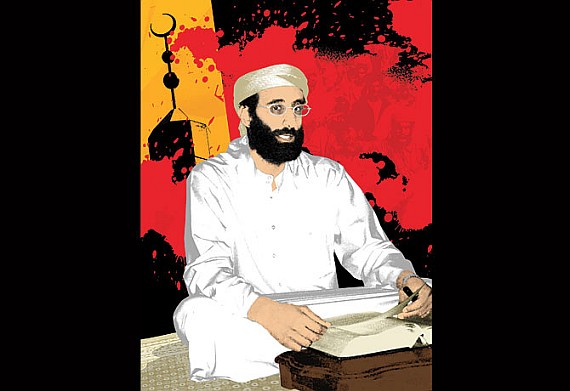
But if Osama bin Laden can’t be tracked down, maybe the alternative is to elevate an easier target to the same status in the hope of being able to claim an equal victory. It appears that the American-born and now fugitive imam, Anwar al-Awlaki, is being groomed for such a role.

This is how the New York Times is feeding the narrative:

One day in August 2001, Mr. Awlaki knocked at the door of Mr. Higgie, his neighbor [in San Diego], to say goodbye. He had moved the previous year to Virginia, becoming imam at the far bigger Dar al-Hijrah mosque, and he had returned to pick up a few things he had left behind.

As Mr. Higgie tells it, he told the imam to stop by if he was ever in the area — and got a strange response. “He said, ‘I don’t think you’ll be seeing me. I won’t be coming back to San Diego again. Later on you’ll find out why,’” Mr. Higgie said.

The next month, when Al Qaeda attacked New York and Washington, Mr. Higgie remembered the exchange and was shaken, convinced that his friendly neighbor had some advance warning of the Sept. 11 attacks.

In fact, the F.B.I. had first taken an interest in Mr. Awlaki in 1999, concerned about brushes with militants that to this day remain difficult to interpret. In 1998 and 1999, he was a vice president of a small Islamic charity that an F.B.I. agent later testified was “a front organization to funnel money to terrorists.” He had been visited by Ziyad Khaleel, a Qaeda operative who purchased a battery for Osama bin Laden’s satellite phone, as well as by an associate of Omar Abdel Rahman, the so-called Blind Sheik, who was serving a life sentence for plotting to blow up New York landmarks.

Still more disturbing was Mr. Awlaki’s links to two future Sept. 11 hijackers, Khalid al-Midhar and Nawaq Alhazmi. They prayed at his San Diego mosque and were seen in long conferences with the cleric. Mr. Alhazmi would follow the imam to his new mosque in Virginia, and 9/11 investigators would call Mr. Awlaki Mr. Alhazmi’s “spiritual adviser.”

The F.B.I., whose agents interviewed Mr. Awlaki four times in the days after the Sept. 11 attacks, concluded that his contacts with the hijackers and other radicals were random, the inevitable consequence of living in the small world of Islam in America. But records of the 9/11 commission at the National Archives make clear that not all investigators agreed.

One detective, whose name has been redacted, told the commission he believed Mr. Awlaki “was at the center of the 9/11 story.” An F.B.I. agent, also unidentified, said that “if anyone had knowledge of the plot, it would have been” the cleric, since “someone had to be in the U.S. and keep the hijackers spiritually focused.”

The 9/11 commission staff members themselves had sharp arguments about him. “Do I think he played a role in helping the hijackers here, knowing they were up to something?” said one staff member, who would speak only on condition of anonymity. “Yes. Do I think he was sent here for that purpose? I have no evidence for it.”

Let’s assume that the suspicions about Awlaki are well-founded. And let’s set aside questions about the legality or morality of Obama’s policy of targeted killing. The question this administration should soberly consider, now that Awlaki has been designated a target for assassination, is whether this influential imam poses a greater threat dead or alive?

Are we really to believe that while Awlaki remains a fugitive in Yemen and is dodging drone attacks, he is also handling an operational role in planning new attacks on the US? After all, one of George Bush’s favorite expressions, “on the run,” did actually have some practical and realistic implications.

And are we really to believe that once granted the status of martyr, Awlaki’s widely disseminated lectures and his iconic status would exert less and not more influence among those most likely to become radicalized in their hostility towards the United States?

In other words, right or wrong, is killing Anwar al-Awlaki really a smart idea?

Facebooktwittermail

The terrorism recruiting myth

After almost a decade of a US-led global war on terrorism, America’s approach to the issue has barely advanced from being a deadly game of Whack-a-Mole.

On CBS, Scott Pelley asked Secretary of State, Hillary Clinton: “I wonder if there’s anything about U.S. foreign policy that needs to change in your estimation to put more pressure on these terrorist groups where they live, like in Pakistan?”

“Well, we are doing that. And we’re increasing it. We’re expecting more from it. This is a global threat. We have probably the best police work in the world. But we are also the biggest target. And therefore, we just have to be better than everybody else,” Clinton replied.

Earlier in the interview she said: “We’ve made it very clear [to the Pakistani government] that, if, heaven forbid, that an attack like this [in Times Square], if we can trace back to Pakistan, were to have been successful, there would be very severe consequences.”

The US will start bombing Pakistan? Special Forces will start conducting operations in North Waziristan? Clinton would not specify what form these severe consequences might take.

In response to the Times Square incident, Richard Clarke, former counter-terrorism coordinator for the Bush administration writes:

The reason such attacks are hard to stop is rooted in the identity of the attackers. They often seem to be successful or well-educated members of society, uninvolved in any form of radicalism. But then, the drip-drip of terrorist propaganda — either on the Internet or circulated through friends — has its effect. They quietly make contact with radical groups overseas, perhaps even traveling abroad for training and indoctrination. They throw away the life they have made in the West and agree to stage an attack. Faisal Shahzad, the alleged Times Square terrorist, fits that profile, as have others in the United States and Europe.

For U.S. intelligence and law enforcement authorities, these newly minted terrorists are the hardest to stop. They may not be part of any known cell; there is no reason for their phones or e-mail accounts to come under surveillance. When they buy rifles, handguns, tanks of propane gas or fertilizer, they are doing nothing out of the ordinary in American society.

If they succeed in inflicting harm on us with terrorist acts designed to rivet media and public attention, our political debate may once again be as wrongheaded as it will be predictable. Some elected officials will claim that their party would have done a much better job protecting the country. Critics of America’s Middle East policy — or our energy policy, or our foreign policy writ large — will also fault whatever administration is in power.

Likewise, in a 60 Minutes report that aired last night, the prism through which the issue is filtered is one in which individuals are turned into the tools of a deadly ideology. Vulnerable young men are in jeopardy of being recruited by merciless ideologues and terrorist planners.

But as Scott Atran points out, the idea that Shahzad and those like him have to be recruited, does not fit the evidence.

Shahzad was also apparently inspired by the online rhetoric of Anwar al-Awlaki, a former preacher at a Northern Virginia mosque who gained international notoriety for blessing the suicide mission of the failed Christmas airplane bomber, Umar Farouk Abdulmutallib, and for Facebook communications with Major Nadal Hasan, an American-born Muslim psychiatrist who killed thirteen fellow soldiers at Fort Hood in November 2009. Although many are ready to leap to the conclusion that Awlaki helped to “brainwash” and “indoctrinate” these jihadi wannabes, it is much more likely that they sought out the popular Internet preacher because they already self-radicalized to the point of wanting reassurance and further guidance. “The movement is from the bottom up,” notes forensic psychiatrist and former CIA case officer Marc Sageman, “just like you saw Major Hasan send twenty-one e-mails to al-Awlaki, who sends him back two, you have people seeking these guys and asking them for advice.”

The CBS report, stuck on the track that recruitment is a central issue, homes in on the role of the internet. The would-be terrorist is someone whose deadly intent is sure to be triggered by something he sees online.

Phillip Mudd, who until a few months ago was the senior intelligence advisor to the FBI and its director says:

They’re seeing images, for example, of children and women in places like Palestine and Iraq, they’re seeing sermons of people who explain in simple, compelling, and some cases magnetic terms why it’s important that they join the jihad. They’re seeing images, and messages that confirm a path that they’re already thinking of taking.

CBS helpfully provides such an image, but predictably neglects to add any commentary.

What are we seeing? An Israeli soldier terrorizing a Palestinian mother and her two girls.

And there we have it: exactly the kind of image the foments terrorism.

Viewed through the American counter-terrorism lens, the problem lies with the propagation of the image and the violent reaction such an image can provoke. Why? Because any serious consideration of the foreign policy issues that the image signals is still off-limits.

But here’s what everyone in the Middle East sees: An Israeli Jew brandishing an American-made weapon, serving America’s closest ally in the Middle East, is threatening a Muslim family. This is the narrative that no amount of spin or cleverly fought battles in a war of ideas, can undo.

Yet here is the foreign policy dilemma for Washington: How can the United States adopt a posture in the Middle East that acknowledges the role America has played in fueling terrorism, without appearing to capitulate to terrorist demands?

The answer is to trust in the universally recognized truth: actions speak louder than words.

What Obama does in Pakistan matters more than what he said in Cairo.

In April 2003, the Bush administration made a step in the right direction when it withdrew American troops from Saudi Arabia. The moved turned out to be of little consequence since it was triggered by utterly false expectations about the war in Iraq. Yet there was an implicit recognition: the presence of American soldiers in close proximity to Islam’s holiest sites sends an ugly message to the Muslim world.

Seven years later, as the Obama administration puts increased pressure on the Pakistani government to launch a major offensive in North Waziristan — an operation that would yet again result in the displacement of tens of thousands of civilians — and as the CIA continues to expand a drone war that has resulted in hundreds of civilian deaths, what kind of signal is this sending to those who might now contemplate following in the footsteps of Faisal Shahzad?

Facebooktwittermail

To See If I Am Smiling

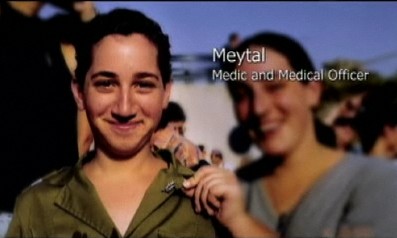
In the documentary, To See If I Am Smiling (released in 2007), six young Israeli women recount their experiences of military service in the occupied Palestinian territories.

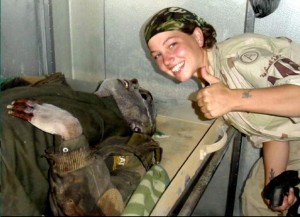
The title comes from a story told by Meytal, a medic and medical officer. Having described how cleaning the corpses of Palestinians after they had been brutalized by Israeli soldiers had become a routine part of her job, she goes on to recount a particular moment that still haunts her: when she posed for a photograph next to a corpse.

I’m not sure when it was, but at some point I became very ashamed of that picture. And I didn’t tell anyone about it, that it existed. I forgot about it a little. But I would like to see it. To see if I look different. I want to see if I’m still smiling.

The photograph is not shown in the documentary, but in the mind’s eye of most Americans it probably evokes memories of Abu Ghraib.
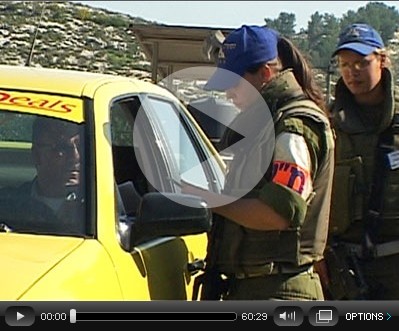
Such images are iconic because they capture the moment in which a soldier discovers that he or she has become the very thing they fear. The dehumanized other is a vortex from which there is no escape.

If a nation can have such a thing as a soul, To See If I Am Smiling, reveals how profoundly Israel’s soul has been scarred by 43 years of occupation. A fully militarized society has shackled itself to a conviction — we have no choice — whereby each individual can then bury their own awareness of complicity and moral responsibility under a collective weight of irresistible necessity.

But even among Israelis who are comfortably indifferent to the plight of Palestinians, one has to wonder: how do they account for what they have done to their own sons and daughters?

As a nation struggles to avoid looking at itself, no wonder the fury and passion with which it attacks those who hold up a mirror.

Watch this 60-minute documentary.

Tamar Yarom, the film’s director, gave the following interview in 2008 at the ZagrebDox international documentary film festival:

(H/t to Marsha Cohen.)

Facebooktwittermail

Israel still might not dodge a human rights threat from Britain

“Sighs of relief will have been heard in Israel’s London embassy on Friday morning as it emerged that Britain’s Liberal Democrat party had failed to capitalize on a surge in pre-election opinion polls,” Haaretz reported.

Cleggmania might have proven to be short-lived — or at least not translated well in a parliamentary system that disregards the size of the vote. Still, I’d says those breaths released in relief should probably have been held in. An Israeli nightmare might still come to pass: Foreign Secretary Nick Clegg in a coalition government. As of Friday afternoon, that outcome is still in the cards.

But why should Israel be so afraid of Britain’s newest political star?

Clegg is bad news for Israel,” one official here said. “His party is running on a human rights platform, and the atmosphere is hostile to Israel. We remind the Liberal Democrats of South Africa during apartheid. Even if Clegg decides not to take the foreign portfolio, the very fact that Liberal Democrats sit in the cabinet is likely to mean trouble for us.”

Israel’s Lieberman-run ministry of foreign affairs might make a mockery of diplomacy, but it should never be faulted for its bluntness: Good for human rights; bad for Israel. There’s a slogan to remember!

Facebooktwittermail

Lieberman’s TEA party and dual loyalty

Joe Lieberman’s Terrorist Expatriation Act is designed to strip the constitutional rights from any American who is accused of supporting terrorism, but the political sentiment he’s tapping into is simply, America first. Does Lieberman have no concern about where this might go?

How about this New Yorker who Max Blumenthal interviewed recently? Presumably she’s an American citizen, but it sounds like she puts Israel first:

As for where Lieberman is finding support, it isn’t coming from the White House but other Democrats have spoken favorably:

Several major Democratic officials spoke positively about the proposal, including Secretary of State Hillary Rodham Clinton. Noting that the State Department already had the authority to rescind the citizenship of people who declare allegiance to a foreign state, she said the administration would take “a hard look” at extending those powers to cover terrorism suspects.

“United States citizenship is a privilege,” she said. “It is not a right. People who are serving foreign powers — or in this case, foreign terrorists — are clearly in violation, in my personal opinion, of that oath which they swore when they became citizens.”

Speaker Nancy Pelosi said she supported the “spirit” of the measure, although she urged caution and said that the details of the proposal, like what would trigger a loss of citizenship, still needed to be fleshed out.

Interesting comment from Clinton… Makes me wonder: how does she feel about Rahm Emanuel serving in the Israeli Defense Force? I know that doesn’t count as an infraction of the law because Israel is not a country hostile to the US, but there’s no avoiding the fact that serving in the Israeli military is serving a foreign power.

As for the “spirit” of the measure, I guess Pelosi will have to explain what she means, but Megan McArdle is not alone in finding this spirit hard to discern:

Can someone explain to me–hopefully using graphs, and small words–why Joe Lieberman is willing to share the precious blessing of American citizenship with Charles Manson, Gary Ridgeway, and David Berkowitz, but wants citizenship stripped from a guy who strapped some firecrackers to a bag of non-explosive fertilizer?

Indeed. And if even Glenn Beck and Chuck Schumer both doubt the wisdom of Lieberman’s bill, that might be a hint that this truly is an act of idiocy.

Facebooktwittermail

An arrest warrant needs a name on it; a death warrant needs none.

In the narrative that sketches the legality of the war on terrorism, the tribal nature of the “battlefield” is the pretext used to justify killing people instead of attempting to arrest them. Counterterrorism experts scoff at the notion that FBI agents (or Pakistani law enforcement officials for that matter) could possibly waltz into a village in South Waziristan and handcuff a Taliban or al Qaeda suspect. The logistics of such an operation would indeed be daunting.

But here’s the thing: The United States is now killing people when it doesn’t even have a legal basis for even initiating their capture.

In the US — and most other legal jurisdictions — an arrest warrant needs to show probable cause connecting a crime that has been committed to the person named on the warrant.

In Pakistan, the CIA can target someone for assassination without knowing their name, without witnessing them commit a crime — simply on the Orwellian pretext that their “pattern of life” can be deemed a threat to the United States.

The Los Angeles Times reports:

The CIA received secret permission to attack a wider range of targets, including suspected militants whose names are not known, as part of a dramatic expansion of its campaign of drone strikes in Pakistan’s border region, according to current and former counter-terrorism officials.

The expanded authority, approved two years ago by the Bush administration and continued by President Obama, permits the agency to rely on what officials describe as “pattern of life” analysis, using evidence collected by surveillance cameras on the unmanned aircraft and from other sources about individuals and locations.

The information then is used to target suspected militants, even when their full identities are not known, the officials said. Previously, the CIA was restricted in most cases to killing only individuals whose names were on an approved list.

The new rules have transformed the program from a narrow effort aimed at killing top Al Qaeda and Taliban leaders into a large-scale campaign of airstrikes in which few militants are off-limits, as long as they are deemed to pose a threat to the U.S., the officials said.

At a time when Faisal Shahzad — a name that might not evoke much terror — is a name uppermost in many people’s minds, it’s worth remembering Mir Aimal Kasi.

In 1993 he too had conducted a pattern of life analysis, having noted the turn lane that directed traffic into the CIA’s Langley headquarters. In his targeted killing operation, he too had found the high-value targets of his choice — James Woollsey and Robert Gates — were too illusive and so he opted to shoot CIA employees whose names he didn’t know.

Soon before receiving a death sentence in 1998, Kasi told Salon:

“I am not against the USA or the American people. I am against the policies of the U.S. government toward Islamic countries or toward Muslims.”

“A lot of young people in Pakistan,” he said, “think mostly the same.”

Whoever follows in the footsteps of Faisal Shahzad may have less interest in constructing a Rube Goldberg type contraption than in causing mayhem the America way — as did Mir Aimal Kasi, John Allen Muhammad, and Nidal Malik Hasan.

“This is a blow back. This is a reaction. This is retaliation. And you could expect that,” Pakistani Foreign Minister Mahkdoom Qureshi told CBS News after the Times Square bombing attempt. “Let’s not be naive. They’re not going to sort of sit and welcome you eliminate them. They’re going to fight back.”

Facebooktwittermail

Predator warfare blowback

“Looks like you just lost that bet, Mr. Woodward. I’ll be waiting for your apology,” a reader said after I wrote on Sunday, “if I was to place a bet on who did this, I’d go with someone whose sympathies are probably more Tea Party than Taliban.”

Indeed I was wrong, though I’m not sure what I’m being asked to apologize for. Having engaged in premature speculation or having entertained the suspicion that there could be among the ranks of the Tea Party crowd anyone crazy enough to try and set off a bomb in Times Square?

Even if I and others were mistaken in suggesting that the Times Square incident might be connected to the Tea Party movement, the movement itself needs to engage in a bit of self-examination if it wants to understand its image problem — not pretend it’s simply the victim of unfair criticism.

Moving on, Noah Shachtman reports:

Federal agents have made an arrest in the Times Square bombing attempt. And YouTube may have provided some clues to the investigators.

Faisal Shahzad was attempting to board a plane for Dubai when he was apprehended at New York’s JFK airport. Law enforcement officials believe the Connecticut resident recently bought the 1993 Nissan Pathfinder that was rigged with explosives and fertilizer and left smoldering in Times Square.

One “clue in the investigation is a video posted online early Sunday morning by persons in Connecticut, who may have been involved in the bomb attempt and are being sought by law enforcement,” ABC News reports.

The video (below), features the voice of Qari Hussain Mehsud, the “Pakistani Taliban master trainer of suicide bombers,” according to the Long War Journal. The clip congratulates fellow Muslims for the “jaw-breaking blow to Satan’s USA.” “The attack a revenge” for the slaying of extremist leaders in Iraq and Pakistan, the video continues, and is a response to “the recent rain of drone attacks.”

If Faisal Shahzad was the best recruit the Pakistani Taliban could find, the threat they pose to the United States is probably limited, but DHS Secretary Janet Napolitano’s initial assessment that this was a “one-off” operation is clearly premature. Indeed, if the intense campaign of drone warfare in Pakistan has triggered enough outrage among a few Pakistani Americans to seek revenge in Times Square, then there is one word that this administration should now be thinking about seriously: blowback.

President Obama seems to pride himself in having been less hesitant to take the war to Pakistan than was his predecessor, yet as the reappearance of Hakimullah Mehsud should make clear, the successes of the drone campaign have not been as great as the CIA has often claimed, while the costs have just as frequently been understated.

Killing innocent people “over there,” inevitably elevates the risk that innocent people will again end up dying here.

The bomb-making abilities on display in Times Square may have made some observers respond dismissively — and I am guilty of having done so — but the Taliban’s threat to bring the war to the United States can no longer be regarded as empty rhetoric.

Facebooktwittermail

“I call this a Rube Goldberg contraption”

That’s a description of the Times Square incendiary devise provided by James M Cavanaugh. He spoke to the New York Times and is a former bomb expert with the federal Bureau of Alcohol, Tobacco, Firearms and Explosives who investigated car bombs and tracked the Unabomber, Theodore J Kaczynski, and Eric R Rudolph, the bomber of abortion clinics and other sites.

Now that a “person of interest” has been identified who is said to be a naturalized American citizen originally from Pakistan, it seems that those of us who were quick to point a finger of suspicion at the Tea Party crowd were wrong.

But, let’s imagine that this Rube Goldberg contraption had in fact been put together by a rightwing nut — or a group of them. The construction of the bomb would be taken as an indication of the severity of the threat. Which is not to say that the threat would be treated as insignificant, but neither would it be overstated.

Now the picture has turned international we will instead be encouraged to believe: first comes the Rube Goldberg contraption; next a dirty bomb or a nuclear weapon.

Add the jihadist element and suddenly the sky’s the limit.

Facebooktwittermail

Israelis have an un-American view of democracy

Imagine reading this report in an American newspaper:

More than half of white Americans think human rights organizations that expose immoral behavior by the United States should not be allowed to operate freely, and think there is too much freedom of expression here, a recent survey found.

The pollsters surveyed 500 white Americans who can be considered a representative sample of the adult white population.

They found that 57.6 percent of the respondents agreed that human rights organizations that expose immoral conduct by the United States should not be allowed to operate freely.

Slightly more than half agreed that “there is too much freedom of expression” in the US.

The poll also found that most of the respondents favor punishing journalists who report news that reflects badly on the actions of the US military.

Another 82 percent of respondents said they back stiff penalties for people who leak illegally obtained information exposing immoral conduct by the military.

In reality, the views related in the fictitious article above are not those of white Americans but come from Jewish Israelis and pertain to their own state, military, and press. The results of the poll commissioned by the Tami Steinmetz Center for Peace Research at Tel Aviv University, are reported by Haaretz.

During his recent visit to Israel, Vice President Joe Biden spoke about the “unbreakable bond borne of common values” shared by America and the Jewish state.

What the Israeli poll makes clear is that Jewish Israelis and Americans, far from having an unbreakable bond of common values, actually have significantly different views about how democracy works. As Daniel Bar-Tal, a professor at Tel Aviv university said: “The public recognizes the importance of democratic values, but when they need to be applied, it turns out most people are almost anti-democratic.”

Of course, even my attempt to contrive some kind of ethnic symmetry by juxtaposing the dominant ethnic group in the United States with that in Israel, is itself a tenuous parallel. We now have a non-white president but for as long as Israel remains a Jewish state it will surely never have a non-Jewish prime minister.

Most Americans understand that the separation of Church and State protects both democracy and religious freedom. In this era, we know that if any single ethnic or religious group were to assert a “right” to control this country, the United States would cease to be a democracy. The principle of equal rights does not come in different ethnic flavors.

Facebooktwittermail

Obama’s Middle East star gazing

“Despite the inevitable difficulties, so long as I am President, the United States will never waver in our pursuit of a two-state solution that ensures the rights and security of both Israelis and Palestinians.” President Barack Obama, Washington, April 26, 2010.

“There has never been in the White House a president that is so committed on this issue, including Clinton who is a personal friend, and there will never be, at least not in the lifetime of anyone in this room.” US Middle East envoy, George Mitchell, in a meeting during his most recent trip to Israel and the West Bank.

* * *

If the two-state solution is a destination, then any US president who claims he has an unwavering commitment to get their should demonstrate that by stating an estimated time of arrival. A goal is a dream with a deadline.

But if the two-state solution is a reference point — something akin to the North Star when viewed by an ocean navigator — then keeping it in sight has nothing to do with getting there.

Thus it is with President Obama’s carefully chosen words: his stated commitment is not to the resolution of the conflict but to the pursuit of a two-state solution — a star he promises to gaze at for at least three and maybe seven more years.

And if George Mitchell is right in saying that Obama is the best we can hope for in the White House in our lifetimes, should we abandon hope that the conflict will be resolved, or should we abandon the idea that in this foreign arena a US president is an indispensable agent of change?

Among Washington’s peace dreamers, the latest star upon which many are hoping to hitch a ride is “linkage”: the idea that the prospect of more dead American soldiers Afghanistan or Iraq — deaths that can loosely be associated to an adjacent festering conflict — will help galvanize a domestic sense of urgency, required for resolving the Israeli-Palestinian conflict.

But here’s a problem with that idea. If the president won’t set a target date for resolving the conflict, and he sees American troops thereby placed at further risk, are we to infer that he views the duration of the deployment of those troops with equal uncertainty?

To argue that the Middle East conflict endangers the lives of American troops in the Middle East would seem to make their withdrawal as great if not a greater imperative than resolving the conflict. After all, which is an American president more likely to be able to accomplish? Order the withdrawal of the troops under his command, or end a conflict that has lasted for most of the last century?

But if there is an imperative upon which those who seek Middle East peace should really be focused, it is not the national interests of the United States; not the need for solidarity in opposing Iran’s nuclear ambitions; nor the need for stability across a region fractured by conflict; but to address and make amends for the injustices upon which Israel was founded; injustices whose perpetuation have for 62 years fomented anger and resentment which will never be pacified until a just solution can be found.

Facebooktwittermail

Preparations for a military strike on Iran

Ten days ago, the New York Times published a story about a memo on Iran from Defense Secretary Robert Gates to National Security Adviser Gen James Jones.

David E Sanger and Thom Shanker reported on the contents of this memo, yet neither of them possesses a copy of the memo, nor have they read it, nor did they even report directly on its contents. In fact, it was not until after their story appeared that they received official confirmation of the memo’s existence.

In an interview on National Public Radio, when asked what the memo said, Sanger neglected to mention that he had never set eyes on the document. Were he to have made that clear, he could not have presumed to say anything about what the memo said — merely what he had been told about what it said. To position his source as the gatekeeper and shaper of the report would make it rather obvious that Sanger was a willing tool of a senior administration official, but no self-respecting journalist wants to be seen prostituting his services.

Sanger’s NPR interviewer, Warren Olney, also appeared willing to collude in this charade by skirting around the fact that the reporter had not set eyes on the memo, but nevertheless Olney pressed Sanger on the issue of his source’s agenda:

Olney: Can you say anything at all about the motivations of the people that revealed this memo to you?

Sanger: Um, no, the only thing I would say is that I would caution people against — I would do this in many kinds of story — the assumption that somebody just dropped off word of this memo in front of us.

A classified memo in an unmarked manila envelope could be dropped off, but how exactly would word of such a memo be “dropped off”?

Sanger wants to dispel an image of his being a passive recipient of information he is being fed, yet given that he has no means to independently interpret the contents of the memo and contrast that interpretation with the one being provided by his primary source, what he recounts is merely his source’s angle.

As I wrote when the article came out, the identity of Sanger’s source may be more significant than the existence of the memo. If it turns out that it was Dennis Ross, then the New York Times may yet again be serving a role in preparations for military action.

Flynt Leverett and Hillary Mann Leverett write:

We do not know who leaked the Gates memo. But the “senior officials” who did so were clearly seeking to use their selective description to catalyze more robust planning for potential military strikes against Iranian nuclear targets — the very option that Gates has consistently opposed.

This explains Gates’s public claim that his memo had been “mischaracterized” by the leaker. It also explains [Defense Undersecretary Michele] Fluornoy’s later statement that an attack against Iran is “off the table in the near term.” (Though, after White House intervention, Gates’s spokesman walked back Flournoy’s comment.)

The reality is that a cadre of senior National Security Council officials — including Deputy National Security Adviser Tom Donilon and Dennis Ross, senior director for the central region (including Iran) — is resisting the adoption of containment as the administration’s Iran strategy.

For some, containment is problematic because it would be interpreted in Israel and pro-Israeli circles here as giving up on preventing Iran from becoming a nuclear threshold state. Republicans could use this to label Obama as weak on national security.

Others in this camp may actually believe that Washington should be preparing for military action against Iran.

As Ross told us before he returned to government service in the Obama administration, President George W. Bush’s successor would probably need to order military strikes against Iranian nuclear targets.

Pursuing diplomatic initiatives early in Obama’s tenure, Ross said, would be necessary to justify potential military action to domestic and international constituencies.

That is precisely what the administration has done — first, by pursuing halfhearted diplomatic initiatives toward Tehran, then, when Iran did not embrace them, blaming Iran for the impasse.

Adopting containment as the administration’s posture toward Iran might undermine some White House officials’ efforts to prepare the political ground for an eventual presidential decision approving military strikes.

We have also heard former Bush administration officials close to Vice President Dick Cheney take note of the recent rise in U.S. public support for military action against Iran, as measured by some opinion polls.

Against that backdrop, these Republicans say, Obama — “a Chicago pol”— could ultimately see his way clear to ordering military strikes.

Facebooktwittermail

Speculation dismounts on Obama Middle East peace plan

I claim no special knowledge of the inside workings of the Obama administration — merely an ear that notes the difference between substance and flatulence and to my ear what sounded like a farting contest started on April 7 with a column by David Ignatius: “Obama weighs new peace plan for the Middle East.”

According to Ignatius — which is to say, according to the nameless officials he had been talking to — Obama was “seriously considering” proposing a peace plan. Chatter, chatter, chatter.

Even as late as Thursday, Ignatius wasn’t ready to completely pull the plug on the story he’d started. After all, one of the primary reasons it had been taken so seriously was because it came from such an august columnist. A Middle East peace plan is on Obama’s foreign policy checklist and he’s “still working on it,” Ignatius wrote last week.

Even yesterday, Agence France Press reported: “Washington’s foreign policy echo chamber is reverberating with speculation that President Barack Obama could try to blow open the deadlock between Israelis and Palestinians with his own peace plan.”

Enough. The man has now spoken — Rahm Emanuel, that is.

The Jewish Telegraph Agency reports:

The time is not ripe for a U.S.-promoted Middle East peace plan, President Obama’s chief of staff said.

“A number of people have advocated that,” Rahm Emanuel said Monday on the Charlie Rose show on Bloomberg Television.

“That time is not now,” Emanuel said. The “time now is to get back to the proximity talks, have those conversations that eventually will lead to direct negotiations…”

I guess George Mitchell can carry on snoozing in the back of his limo as he waits to start shuttling between Jerusalem and Ramallah.

Facebooktwittermail

Iran’s nuclear capabilities

Thomas Schelling, a Nobel laureate and an expert in nuclear strategy, spoke at the New America Foundation in Washington last week.

Having recently attended the highly influential Herzliya Conference in Israel, Schelling said:

I was impressed with how many Israelis speculate that what Iran wants to do is to get just about where Japan is in terms of nuclear capability. Get to where they could have a few bombs in a few months, or maybe a few weeks, but not overtly test anything to prove they have it and maybe not to claim they have it.

I don’t know where the Iranians might get that idea, but I’d heard about it for a couple of years from Americans who study Iranian apparent nuclear policy and it strikes me as an idea that might not occur to the Iranians but it strikes me as a good idea. I don’t see any way to make them back down from where they are, but it might be possible to persuade them not to take the final step…

Israel’s President Shimon Peres, who also attended the Herzliya Conference yet lacks the slightest nuance in his assessment of Iran’s intentions, yesterday declared that Iran poses a threat to the whole civilized world.

“A threat to the peace of the Jewish people always carries the danger of turning into a threat to the civilized world as a whole,” Peres said in Jerusalem on Sunday.

That’s a statement eerily reminiscent of something the Israeli historian, Martin van Creveld, said a few years ago while referring to Israel’s own nuclear arsenal: “We have the capability to take the world down with us. And I can assure you that that will happen before Israel goes under.”

Which begs the question, given that Israel has an arsenal of several hundred nuclear weapons and Iran so far has none: Of which state should we be more afraid?

In considering the Iranian nuclear threat, there is another reason for thinking that the Iranians may well have calculated that attaining a nuclear capability without assembling a nuclear arsenal is in their best interests — not simply because of the international ramifications but because of the regime’s own internally complex and fractious power dynamics.

For Iran to actually acquire the bomb and not simply the means to produce it, begs difficult questions of command and control. Could the regime withstand a potential power struggle that might ensue over how weapons might be dispersed and under whose authority? The prospect of the Iranian Revolutionary Guards becoming Iran’s nuclear masters might be sufficiently galling to everyone outside the IRG, that nuclear capability appears as full a measure of nuclear power that the Islamic state can safely handle.

When it comes to assessing Iran’s nuclear intentions there is an abundance of evidence that it is indeed a rational actor and virtually none that it operates in the thrall of an apocalyptic vision of the future.

Facebooktwittermail

Obama’s indiscriminate killing program

In The Price of Assassination, Robert Wright reflects on the pitfalls of President Obama’s policy of so-called targeted killing.

Wright comes closest to hitting the right target when he says:

Terrorists are nourished ultimately by a grass-roots sense of injustice.

And one good way to stoke a sense of injustice is to fire missiles into cars, homes and offices in hopes of killing terrorists, while in fact killing no few innocent civilians. Estimates of the ratio of civilians to militants killed are all over the map — 50 to 1 or 10 to 1 or 1 to 2 or 1 to 10 — but the estimate of the Pakistani people, which is all that matters, tends toward the higher end.

The higher end is actually off the scale that Wright cites since he only looks at American sources. And since it seems reasonable to assume that the Pakistanis count their own dead more carefully than Americans do, the high end, as reported by Dawn newspaper, may also be a more accurate count and measure of the accuracy of Obama’s targeted killing program: 140 innocents civilians killed each time an al Qaeda or Taliban “target” was hit in 2009.

Any policy of targeted killing — whether conducted by the US or Israel — faces an obvious problem that must surely have given rise to the name, targeted killing. These actions result in a significant amount of indiscriminate killing, yet indiscriminate killing is, we are constantly reminded, the province of terrorism.

So how does a state counter the charge that its methods mirror those of terrorists? By claiming — without much foundation — that the carnage it causes is precise. We are highly discriminating killers who hit our targets with pinpoint accuracy — pinpoints that often turn out to be occupied by an unfortunate number of untargeted people.

But to turn to another of Wright’s points — that terrorists are nourished by a grass-roots sense of injustice — here he glides over the issue that the very term terrorism is designed to conceal: that just causes very often spawn acts of violence and that those engaged in this violence are genuinely dedicated to those causes, not merely being nourished by them.

In other words, by invoking the word terrorism we refuse to look at its political roots. And even in those cases where a just political cause is widely acknowledged — such as with the Palestinian national movement — we imagine that its violent manifestations can be legitimately marginalized rather than seen as a compelling gauge of the depth of the grievance.

Facebooktwittermail

Obama ain’t no Spock

A US resolution to the Middle East conflict has become a national imperative and a logical necessity. Therefore it will happen.

At least it would if we lived in a world governed by logic…

I confess I don’t pay unswerving attention to everything that’s happening in Washington, so when I saw a headline in today’s New York Times, Obama Speech Signals a U.S. Shift on Middle East, my first reaction was: Huh. Obama gave a speech on the Middle East and I never even heard it was scheduled. How about that?

Then I read the article to find out when and where he gave this speech but it wasn’t mentioned. Then I read the headline again. Aha! Caught again by those cunning New York Times headline writers – Obama speech, not Obama’s speech.

Why does the so-called newspaper of record have to be parsed as carefully as the Soviet Izvestia?

OK. So the speech in question turns out to be a phrase: “vital national security interest.” That being, the vital national security interest that will be served to the United States by a resolution to the Middle East conflict.

This does indeed mark an important shift in perspective. But here’s the real question: Will that shift in perspective lead to a significant shift in policy?

Generally speaking, to call something out as a “vital national security interest” should demand a bold course of action. You can’t point to a vital national security interest and then do little to address it, can you?

In the minds of many observers, the shift Obama has signaled, will almost inevitably lead to a US peace plan. “It increases the likelihood that Mr. Obama, frustrated by the inability of the Israelis and the Palestinians to come to terms, will offer his own proposed parameters for an eventual Palestinian state,” the Times reported.

But did anything else Obama said at the same juncture indicate that he’s ready to act decisively? No.

Progress will be halting, Obama said. Indeed.

Moreover, and this might have been the most telling remark he made: “we can’t want it more than they do.”

So, if resolving the Middle East conflict is a vital national security interest of the United States, the US will nevertheless be held hostage by the willingness of the Israelis and Palestinians to resolve the conflict.

We must, but we can’t…

I guess it won’t become a campaign slogan.

Facebooktwittermail

The nuclear paradox

Here’s how President Obama states the nuclear paradox:

The risk of a nuclear confrontation between nations has gone down, but the risk of a nuclear attack has gone up.

Here’s how I define it:

Hypothetical nuclear threats provoke more fear than real nuclear threats.

Nowhere is this paradox more evident than in Tel Aviv and Tehran.

Which city is currently in greater jeopardy of nuclear annihilation? Tehran.

Which city’s residents are repeatedly being told by their political leaders they should be afraid of nuclear annihilation? Tel Aviv’s.

So, to return to Obama’s assessment, when he says the risk of nuclear confrontation between nations has gone down, he’s saying something that’s both obvious and deceptive. What’s obvious is that the Cold War risk of a nuclear war between nuclear-armed states has diminished, but what he purposefully did not say is that the risk of any nuclear-armed state actually using its nuclear weapons has gone down.

The risk that Israel could use tactical nuclear weapons to destroy Iran’s nuclear facilities is real. I don’t believe that Israel is likely to do so because its current leadership — despite its willingness to engage in hyperbolic rhetoric — probably recognizes that the regional and global impact of the first use of nuclear weapons in warfare since 1945 would seal Israel’s fate as a pariah state.

Still, the risk that Israel might use nuclear weapons is indisputably greater than the risk of nuclear weapons being used by any organization or state that is not currently armed with such weapons.

The risk of nuclear terrorism should not be dismissed, but as Brian Michael Jenkins notes, it’s important to distinguish between nuclear terrorism and nuclear terror. In 2008 he wrote:

Will terrorists go nuclear? It is a question that worried public officials and frightened citizens have been asking for decades. It is no less of a worry today, as we ponder the seventh anniversary of 9/11.

Might Iran’s nuclear weapons ambitions lead eventually to arming Hizbollah or Hamas with nuclear weapons? Might a financially desperate North Korea sell the wherewithal for nuclear weapons to terrorist buyers? Might a political upheaval in always turbulent Pakistan put a nuclear weapon in the hands of extremists? Could there, ultimately, be a nuclear 9/11?

We have to take the long-shot possibility of nuclear terrorism seriously, but we must not allow ourselves to be terrorized by it.

Nuclear terrorism and nuclear terror reside in different domains. Nuclear terrorism is about a serious threat — the possibility that terrorists might somehow obtain and detonate a nuclear weapon — while nuclear terror is about the anticipation of that event. Nuclear terrorism is about terrorists’ capabilities, while nuclear terror is about imagination.

Fear is not free. Fear can pave the way for circumventing established procedures for the collection of intelligence, for attempts to operate outside the courts, and perhaps for torture. Distinguished scholars discuss the durability of the U.S. Constitution in the face of nuclear terrorism.

Frightened populations are intolerant. Frightened people worry incessantly about subversion from within. They worry about substandard zeal. Frightened people look for visible displays to confirm unity of belief–lapel pin patriotism.

Fear creates its own orthodoxy. It demands unquestioning obeisance to a determined order of apprehension.

During the Cold War an all-out nuclear exchange would have meant planetary suicide. Today, we face one tyrant in North Korea with a handful of nuclear weapons, an aspirant in Iran enthralled by first-use fantasies, and a terrorist organization with an effective propaganda machine-dangerous, vexing, but not the end of the world, not the end of the nation, not the end of a single city.

Undoubtedly, a terrorist nuclear explosion of any size would have a huge psychological impact on America. But whether it would lead to social anarchy would depend heavily on the attitudes of the nation’s citizens and the behavior and communications of its leadership.

We may not be able to prevent an act of nuclear terrorism. But we can avoid destroying our democracy as a consequence of nuclear terrorism.

Whether or not we as citizens yield to nuclear terror is our decision.

John Mueller from Ohio State University’s department of political science wrote last year:

The evidence of al-Qaeda’s desire to go atomic, and about its progress in accomplishing this exceedingly difficult task, is remarkably skimpy, if not completely negligible. The scariest stuff — a decade’s worth of loose nuke rumor — seems to have no substance whatever. For the most part, terrorists seem to be heeding the advice found in an al-Qaeda laptop seized in Pakistan: “Make use of that which is available … rather than waste valuable time becoming despondent over that which is not within your reach.”

As Mueller and Mark G. Stewart note in an article in the current edition of Foreign Affairs, if America’s counterterrorism policy was actually based on objective risk assessment, we’d understand that the risk al Qaeda poses to each American is about the same as the risk posed by kitchen appliances.

As a hazard to human life in the United States, or in virtually any country outside of a war zone, terrorism under present conditions presents a threat that is hardly existential. Applying widely accepted criteria established after much research by regulators and decision-makers, the risks from terrorism are low enough to be deemed acceptable. Overall, vastly more lives could have been saved if counterterrorism funds had instead been spent on combating hazards that present unacceptable risks.

This elemental observation is unlikely to change anything, however. The cumulative increased cost of counterterrorism for the United States alone since 9/11 — the federal, state, local, and private expenditures as well as the opportunity costs (but not the expenditures on the wars in Iraq or Afghanistan) — is approaching $1 trillion. However dubious and wasteful, this enterprise has been internalized, becoming, in Washington parlance, a “self-licking ice cream cone,” and it will likely last as long as terrorism does. Since terrorism, like crime, can never be fully expunged, the United States seems to be in for a long and expensive siege.

Facebooktwittermail