Category Archives: Editorials

Mossad tries to restore its images

Even among Israelis who welcomed news of the assassination of the Hamas commander Mahmoud al-Mabhouh, there must have been growing disquiet that the faces of so many Mossad operatives would have since become so widely known. So much exposure for a clandestine operation has to be bad, doesn’t it?

It now appears that Mossad has enrolled the services of Haaretz in order to do some damage control.

The Israeli newspaper reports:

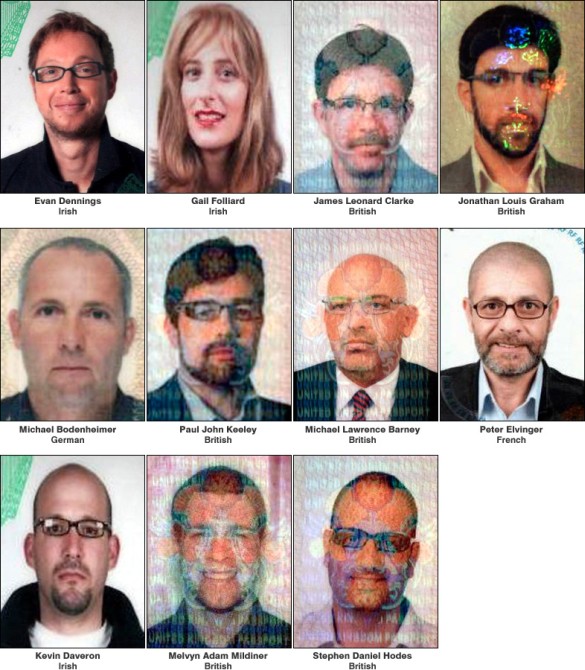
The passport photographs of the agents who assassinated Mahmoud al-Mabhouh in Dubai were doctored so the agents would not be identified, a Haaretz probe has discovered.

The discovery casts doubt on claims that the espionage agency that carried out last month’s hit on the senior Hamas operative committed grave errors.

Various features of the people in the photographs, such as eye color or the line of a lip, were changed – slightly enough so as not arouse suspicion at passport control, but still enough that the real agent could not be recognized.

According to the Dubai police, only a few of the agents were caught on security cameras without their disguises. However, it had been assumed until now that publication of the photos of the 26 agents had blown their cover. Now it appears that the Dubai police still do not have viable information about their real appearance.

In an era where investigative journalism has largely become a thing of the past, it’s hard not to scoff when one reads that a newspaper has conducted a “probe”. Some intrepid reporters dug deep and pulled out the truth and now they can proudly display their discovery.

In this case, I would counter that there is more to be discovered by reasoning than revelation.

I’ll start with this — a wild piece of conjecture in which I have absolute confidence: the “espionage agency” that Haaretz stuck its probe into was Mossad — no other spy shop would dole out sensitive information to Israeli reporters.

Secondly, the idea that Haaretz actually discovered that there were discrepancies between the appearances of the Mossad agents and the images on their passports is absurd. (I don’t care how careful an analysis of the CCTV images might be it ain’t going to pick up differences in eye color and the like.) Such discrepancies may exist in reality, but there seem to be only two ways Haaretz could know about them. Either, in a friendly meeting with a Mossad officer the newspaper was shown two sets of photographs: one being the ones used in the passports and the other showing the undoctored appearances of the operatives — but I have my doubts that Mossad would be that candid. Much more likely was a friendly phone call from a trusted source inside the agency, saying: you know those photos of all our guys plastered over all the newspapers? We doctored them. Our guys are safe. No one will be able to recognize them. The intrepid Haaretz reporters would not have been so impertinent as to ask for some proof.

In sum, what we can reliably infer from this report is that Mossad is busy working the media. Its cover may or may not have been blown but at the very least it wants to reassure concerned Israelis that the much praised and feared agency remains rock solid.

Meanwhile, while one thrust of Mossad’s PR drive is pushing the message that its operatives identities are well protected, another thrust is actually promoting their images — as “young, pretty and dangerous“. The message: assassination is sexy and it doesn’t have to interfere with an Israeli woman’s plans to start a family. “Rumors that women are used by the Mossad mostly as [sexual] bait are greatly exaggerated,” Ynet reassures its readers.

Facebooktwittermail

Is Israel a small penis or a limp penis?

Having thought a lot about Israel, I’ll confess I’ve never pictured it as a penis – of any particular size.

But on second thoughts, that’s not actually true. The wars on Lebanon and Gaza did evoke a sense that the Jewish state regards war as a type of Viagra, so I guess if war is Viagra that does indeed make Israel a penis — one that has difficulty maintaining an erection.

With that in mind the new Size Doesn’t Matter campaign aimed at promoting Israel (h/ts to Richard Silverstein and Dimi Reider) could be seen as an effort to convince young North American Jews that Israel is not suffering from erectile dysfunction. A trip to Israel — well that’s like giving or receiving a blow job, though the metaphor gets a little confusing at this point.

What the hell am I talking about?

Watch this video sponsored by the Canadian Council for Israel and Jewish Advocacy:

I have little doubt that when the makers of this video debated its merits, someone said that it would be sure to go viral.

Indeed, I along with many others are now making that happen. But even though “going viral” is supposed to be an online marketing success, it’s worth remembering where the metaphor comes from. In this case, did the promoters of Israel really want an image of their beloved state to spread like a contagious disease?

And one small footnote — the “size doesn’t matter” claim turns out to be a little disingenuous: the map of Israel in the video includes Gaza and the West Bank as part of Greater Israel. Apparently size really does matter.

Facebooktwittermail

Israel cruises into a diplomatic storm

Israel’s Deputy Foreign Minister Danny Ayalon, speaking on Saturday, suggested that Israel will not face a diplomatic crisis with Europe over the killing of Mahmoud al-Mabhouh in Dubai “because there is nothing linking Israel to the assassination.”

“Britain, France and Germany are countries with shared interests with Israel in countering terrorism,” Ayalon said.

Not so fast. The latest information indicates that a diplomatic crisis is near unavoidable.

Israel is now directly implicated in the killing as British diplomatic sources have been told that Israeli immigration officials at Ben Gurion airport in Tel Aviv, secretly copied the British passports which were then used by the Mossad assassins.

But if stealing the identities was not enough, Dubai police now say that some of the killers were carrying diplomatic passports.

Israel has questions to answer and the dismissive responses it has given so far will not satisfy European governments that are fast running out of patience.

Meanwhile, Victor Ostrovsky, a former colonel in Mossad, advised the Israeli residents whose identities were stolen that their lives are at risk.

“They’re safe so to speak, until somebody kills them. I would tell them: do not travel outside the country for at least two years, under any circumstances,” he said.

In the Daily Telegraph, Alasdair Palmer notes that judging by the international reaction to the killing of al-Mabhouh, forging passports is much worse than murder. He, like most humane observers, begs to differ:

This apparent international consensus that assassination is a legitimate tool of foreign policy is a very sinister development. State-sponsored murder is still murder. And murder is still a worse offence than using forged passports.

As for President Obama, he is presumably monitoring the situation. Having determined that Hellfire missiles circumvent a host of intractable legal issues, the world’s only other enthusiastic proponent of so-called targeted killing is unlikely to condemn the latest episode in Mossad’s ongoing killing spree.

Facebooktwittermail

Are we living in the post-moral age?

Rafi Eitan, an Israeli elder statesman and former intelligence officer is perhaps best known for having led the Mossad operation that captured Adolf Eichmann, architect of the Holocaust, and brought him back to face trial and execution in Israel in 1962.

In an interview with Haaretz this week, Eitan summed up the Zeitgeist in which we live — the Israelification of the Western world which unfolded after 9/11:

when there is a war on terror you conduct it without principles. You simply fight it.

President Bush, with his Manichaean view of the world, wanted to paint his war on terror in quasi-moral terms. President Obama has distilled it to its unprincipled essence.

The arc that has led from twisted morality to a rarefied amorality reached its completion point this week when the Obama administration made its determination that the authors of the former administration’s torture policies had done no more than make an error of judgment.

Newsweek reports:

The chief author of the Bush administration’s “torture memo” told Justice Department investigators that the president’s war-making authority was so broad that he had the constitutional power to order a village to be “massacred,” according to a report by released Friday night by the Office of Professional Responsibility.

The views of former Justice lawyer John Yoo were deemed to be so extreme and out of step with legal precedents that they prompted the Justice Department’s internal watchdog office to conclude last year that he committed “intentional professional misconduct” when he advised the CIA it could proceed with waterboarding and other aggressive interrogation techniques against Al Qaeda suspects.

The report by OPR concludes that Yoo, now a Berkeley law professor, and his boss at the time, Jay Bybee, now a federal judge, should be referred to their state bar associations for possible disciplinary proceedings. But, as first reported by NEWSWEEK, another senior department lawyer, David Margolis, reviewed the report and last month overruled its findings on the grounds that there was no clear and “unambiguous” standard by which OPR was judging the lawyers. Instead, Margolis, who was the final decision-maker in the inquiry, found that they were guilty of only “poor judgment.”

The report, more than four years in the making, is filled with new details into how a small group of lawyers at the Justice Department, the CIA, and the White House crafted the legal arguments that gave the green light to some of the most controversial tactics in the Bush administration’s war on terror. They also describe how Bush administration officials were so worried about the prospect that CIA officers might be criminally prosecuted for torture that one senior official—Attorney General John Ashcroft—even suggested that President Bush issue “advance pardons” for those engaging in waterboarding, a proposal that he was quickly told was not possible.

At the core of the legal arguments were the views of Yoo, strongly backed by David Addington, Vice President Dick Cheney’s legal counsel, that the president’s wartime powers were essentially unlimited and included the authority to override laws passed by Congress, such as a statute banning the use of torture. Pressed on his views in an interview with OPR investigators, Yoo was asked:

“What about ordering a village of resistants to be massacred? … Is that a power that the president could legally—”

“Yeah,” Yoo replied, according to a partial transcript included in the report. “Although, let me say this: So, certainly, that would fall within the commander-in-chief’s power over tactical decisions.”

“To order a village of civilians to be [exterminated]?” the OPR investigator asked again.

“Sure,” said Yoo.

Yoo is depicted as the driving force behind an Aug. 1, 2002, Justice Department memo that narrowly defined torture and then added sections concluding that, in the end, it essentially didn’t matter what the fine print of the congressionally passed law said: The president’s authority superseded the law and CIA officers who might later be accused of torture could also argue that were acting in “self defense” in order to save American lives.

Where does Obama stand?

“I’m a strong believer that it’s important to look forward and not backwards, and to remind ourselves that we do have very real security threats out there.”

Terrorism — even if this administration thinks the term is passé — remains the only reality. Obama’s cynical mastery rests in his ability to sustain the terror zeitgeist without using the word.

Principles? They’re a distraction — a preoccupation and an indulgence for those of us little folks who do not daily wrestle with the moral ambiguity of governance.

Facebooktwittermail

Has Israel been helping supply weapons to Hamas?

The idea that Israel could be involved in supplying weapons to Hamas might sound like a preposterous conspiracy theory, but let’s look at some connections — the theory might not be as wild as it sounds.

In undisputed reports, Mahmoud al-Mabhouh has been described as the top Hamas commander responsible for coordinating the flow of arms into Gaza. He is said to have established a smuggling route through Sudan — a route upon which a convoy of weapons was intercepted and destroyed in an Israeli drone attack just over a year ago.

From accounts of Mabhouh’s killing we know that he bought his ticket to Dubai just two days before traveling there and within just a few hours of his departure from Syria, an assassination team was en route to the same destination. Nineteen hours before the assassination, fifteen operatives left on flights for Dubai, departing from France, Germany, Switzerland and Italy. The Times reported that Mabhouh was “tracked from the moment he boarded Emirates flight EK 912 at Damascus at 10.05 on January 19.”

I said “an assassination team” but from hereon I’ll refer to them as the Mossad operatives. Until one of them is arrested and the Israeli government starts negotiating for his or her release, we won’t know with absolute certainty that this was a Mossad operation, but I’ll go with the Dubai police chief and say that we can be 99% sure.

The British and Irish governments would not haul in the Israeli ambassadors in London and Dublin to demand an explanation for the theft of their citizens’ passports simply on the basis of a rumor. Indeed, if Israel had been set up by one of its enemies, as some Israeli leaders have suggested, then Israel too would be launching an investigation into the breach of its own passport records. As well as being concerned about a serious security breach, Israeli would have every reason to want to pacify the concerns of those citizens who now fear that they are being placed at risk by their own government — Israelis such as Anshel Pfeffer, who writes:

Enough cases in the past have come to light in which the identities of Jews, most of whom were born outside of Israel, were used by Israeli secret agents. It is hard not to feel that there has been and still is a blatant disregard for the safety and privacy of those whose identities were used… [H]ow can Israel claim to be a democracy fighting terror and dictatorships, and continue to promote aliyah from Western countries, when this is the way it supposedly treats its citizens?

Far from allaying such anxieties, Israeli officials have thus far seemed much more interested in gloating over an operational success. “Mossad knows how to get the job done,” said one minister, while the Israeli embassy in London, though claiming ignorance about the assassination, saw fit to brag on Twitter about the “hit on #Dubai target”.

So let’s return to the sequence of events. There is compelling evidence that the Mossad operatives who killed Mabhouh had plenty of lead time. Indeed, there’s reason to suppose that rather than this being a strike provided by an opportunity, it was a carefully laid trap that the Hamas commander walked straight into.

We know that he left Damascus confident enough for his security detail to face an acceptable delay. This was no blind date. Yet the information released by Dubai suggests that the only people he met once he got there were his killers. Did he miss his contact or did his contact turn out to have deceived him?

It is now reported that Israel provided British intelligence with advance notice of an “overseas operation” that would involve the use of fake British passports. A Mossad officer said Britain’s Foreign Office was also informed hours before Mabhouh’s murder.

If word was out among intelligence agencies, it would come as no surprise if Dubai was also conducting its own surveillance operation. A review of the CCTV images they released, along with the speed with which they identified the members of the Mossad team, does indeed suggest that to some degree they were able to track events as they unfolded and not merely piece together the evidence after the fact.

In some of the videos, the camera appears to be tracking its subject — a mere coincidence that the individuals walked in the same direction the camera was moving? Perhaps.

In the montage of clips put together by Gulf News‘ GNTV, there is another intriguing element. At 13 minutes 40 seconds we see one of the suspects exiting his hotel. The caption reads: “16.14 [local time, January 19] Kevin leaves the hotel and heads towards Al-Bustan Rotana.”

As “Kevin” is stepping into a taxi, a large man — he looks like an American — in jeans, pale blue t-shirt and dark blue jacket, strolls up as the next in line for a taxi. In the video his face has been digitally obscured. Why? Did he have Kevin under surveillance or might he be one of the thus far unnamed suspects?

In all of the video sequences there is only one other individual whose identity is obscured. This comes at 20 minutes 37 seconds in the montage. Kevin is speaking on a cell phone, strolling back and forth in front of the elevator doors in the lobby adjacent to Mabhouh’s room. A large individual exits the right side elevator and engages with Kevin, then exits the lobby walking in the direction of the crime scene. Throughout the sequence the individual’s image has been digitally obscured. In general appearance he looks like an over-weight middle-aged American.

We know that five credit cards issued by American banks were used in the operation. There is an American element to this story that so far remains veiled.

So, keeping in mind all of the above, how do I come to my audacious claim that Israel has been helping supply Hamas with weapons? This doesn’t have to be quite as conspiratorial a theory as it sounds.

The bombing of the Sudan convoy suggests that Mabhouh’s supply network was infiltrated some time ago and though Israel’s much-repeated goal is to stop the flow of weapons into Gaza, the weapons themselves are perhaps less of a concern than is finding the means to weaken or disable Hamas.

What better way of infiltrating the Islamist movement than through its weapons supply chain?

If the Iranian arms dealers in Dubai have been conspicuous by their absence from this story, perhaps it’s because the trap Mabhouh fell into involved Israelis posing as Iranians.

After all, the involvement of governments in illicit arms dealing for political purposes is not unheard of — one of Israel’s closest friends, Elliot Abrams, knows the routine.

Further comment: As presented by Israeli leaders the issue of Gaza is without deviation always treated as a security threat. Gaza, under Hamas’ control presents a threat to southern Israel as in recent years cities such as Sderot have come under persistent rocket attack.

How then is it conceivable that Israel would allow a single weapon to find its way into the Palestinian enclave even if there might be an intelligence payoff from being able to infiltrate and monitor a weapons supply chain?

Wrong question. If Israel really wanted to effectively control the flow of weapons into Gaza it would never have imposed a blockade that resulted in the construction of thousands of smuggling tunnels under the Rafah border.

The surest way of rigorously controlling what gets into Gaza is through a stringently monitored open border. If goods could be brought in overland, there would be little economic incentive for constructing tunnels.

Rather than preventing the flow of weapons, Israel’s greater interest has been in punishing the Palestinian population in the naive hope that people living in great deprivation would turn against their political leaders.

Israel, confident in its ability to use overwhelming force to crush its opponents, has less interest in disarming the Palestinians than it does in breaking their will to fight.

Facebooktwittermail

Five Israelis had their identities stolen – apparently by Mossad!

Anyone who is Jewish but doesn’t have a Jewish sounding name and who has been considering emigrating to Israel might soon be having second thoughts.

To the extent that Israel provides a safe haven to Jews, it turns out your religious identity might count for less than your name.

The Israeli government has yet to acknowledge that the murder of the Hamas commander, Mahmoud al-Mabhouh, in Dubai last month was carried out by Mossad, but the evidence is now overwhelming.

But the fact that Mossad carried out the killing may turn out to concern Israelis (and Jews elsewhere) less than the apparent willingness of the Israeli intelligence agency to put the lives and liberty of Israeli citizens in jeopardy by stealing their identities.

It now turns out that five Israeli dual nationals claim their identities were stolen in order to provide the Dubai killers with fake passports. (Update – Israel’s Hebrew Ma’ariv now reports that seven Israelis had their identities stolen.)

Haaretz reports:

At least five Israelis awoke Tuesday morning to find their names tied to the assassination of senior Hamas operative Mahmoud al-Mabhouh in his Dubai hotel room last month. All were stunned to find their names displayed on passports that police in the emirate said were used by the assailants.

However, the people pictured in the photos released by police looked nothing like them. All denied involvement in the affair.

“I’m in shock – I just don’t understand how something like this could happen,” said Paul John Keeley, a British-born repairman who lives on Kibbutz Nahsholim, near Zichron Yaakov. Keeley’s name appeared on the British passport Dubai authorities said belonged to one of the hit men.

“From the moment I heard about it I was very worried. I’m worried for my family,” said Keeley, who immigrated to Israel more than a decade ago. “The fact that it was my name that was published in this context makes me worry that someone will try to harm us.”

Keeley, 43 and a father of three, said Tuesday his passport was in his possession before, on and after January 20, the day Mabhouh was assassinated.

“I don’t know who a person calls when his identity is stolen,” he said. “I’m waiting for someone from the British or Israeli government to contact me and give me answers. I don’t understand how something like this could happen.”

Amir Oren adds:

Using the identities of real, living, innocent Israelis for operational documentation is against the law. This kind of abuse also causes innocent civilians to suffer the evil that already plagues ministers and officers: being prevented from traveling abroad for fear of being arrested by Interpol on suspicion of being the Dubai assassins.

Former Mossad chief Efraim Halevy pushed for a Mossad Law to be legislated that would enshrine the state’s obligation to defend its agents caught breaking laws abroad. The initiative never got off the ground: A state can’t legitimize illegality. But neither can it allow one of its institutions to arbitrarily harm civilians — not the police, not the tax authority, not the Shin Bet security service and not the Mossad.

Attorney General Yehuda Weinstein was asked yesterday whether an investigation will be opened following the public complaints of those whose identities were stolen from them, and whose lives and liberty are therefore now threatened. Weinstein has not yet had time to study the issue.

Oren is calling for Mossad chief Meir Dagan to be fired. But why stop there? Who can be so naive as to doubt that this operation was conducted with the authorization and at the behest of the Israeli prime minister himself.

Imagine a parallel in the United States. Richard Nixon couldn’t get away with ordering a burglary – can Netanyahu put his own citizens in jeopardy while ordering a murder?

This may end up not merely undermining public confidence in government officials; it might even shake Jewish confidence in Zionism.

Facebooktwittermail

Was the arrest of the Taliban’s second-in-command a strategic blunder?

Updated below
The capture of the Taliban’s second in command, Mullah Abdul Ghani Baradar, has been hailed as a huge blow to the Taliban but it may turn out to deliver an even bigger blow to President Obama’s hopes for an early withdrawal of US troops from Afghanistan.

Hajji Agha Lalai, former head of the Afghan government-led reconciliation process in Kandahar, who has dealt with members of the Taliban leadership council for several years, said Mullah Baradar was “the only person intent on or willing for peace negotiations.”

Last month Baradar facilitated an inconclusive meeting in Dubai between midlevel Taliban commanders and Kai Eide, the departing top UN official in Kabul, according to McClatchy newspapers.

Saeed Shah reported:

According to Vahid Mojdeh, a former Afghan official who worked under the Taliban, Baradar was instrumental in reining in insurgent violence, by banning sectarian killings and indiscriminate bombings.

“Baradar was an obstacle against al-Qaida, who wanted to make an operation in Afghanistan like they did in Iraq,” Mojdeh said. “But Baradar would not allow them to kill Shias” – the minority Muslim sect – “or set off explosions in crowded places.”

Pakistani analysts said Baradar’s capture suggested either that Islamabad had abandoned its attempt to promote peace talks or the Taliban number two had fallen afoul of the Pakistani authorities. Analysts said Baradar was the most likely point of contact for any future talks.

“This is inexplicable. Pakistan has destroyed its own credentials as a mediator between Taliban and Americans. And the trust that might have existed between Taliban and Pakistan is shattered completely,” said Rustam Shah Mohmand, a former Pakistani ambassador to Kabul after the overthrow of the Taliban.

The capture of Mullah Baradar has been widely reported as the result of a coordinated operation between the US and Pakistan, but so far the story seems very murky.

On Tuesday, February 9, the New York Times reported:

Pakistan has told the United States it wants a central role in resolving the Afghan war and has offered to mediate with Taliban factions who use its territory and have long served as its allies, American and Pakistani officials said.

The offer, aimed at preserving Pakistan’s influence in Afghanistan once the Americans leave, could both help and hurt American interests as Washington debates reconciling with the Taliban.

Pakistan’s army chief, Gen. Ashfaq Parvez Kayani, made clear Pakistan’s willingness to mediate at a meeting late last month at NATO headquarters with top American military officials, a senior American military official familiar with the meeting said.

The report said that General Kayani rebuffed US pressure to expand operations against the Taliban in North Waziristan because “the Pakistani Army still regarded India as its primary enemy and was stretched too thin to open a new front.”

Within days we learn of Mullah Baradar’s arrest in Karachi, Pakistan. His capture could cripple the Taliban’s military operations, at least in the short term, says Bruce Riedel, an adviser to the Obama administration. Others in Washington describe this as a huge blow to the Taliban.

But the New York Times now reports:

The arrest followed weeks of signals by Pakistan’s military chief, Gen. Ashfaq Parvez Kayani — to NATO officials, Western journalists and military analysts — that Pakistan wanted to be included in any attempts to mediate with the Taliban.

Even before the arrest of the Taliban commander, Mullah Abdul Ghani Baradar, a senior Pakistani intelligence official expressed irritation that Pakistan had been excluded from what he described as American and Afghan approaches to the Taliban.

“On the one hand, the Americans don’t want us to negotiate directly with the Taliban, but then we hear that they are doing it themselves without telling us,” the official said in an interview. “You don’t treat your partners like this.”

Mullah Baradar had been a important contact for the Afghans for years, Afghan officials said. But Obama administration officials denied that they had made any contact with him.

Whatever the case, with the arrest of Mullah Baradar, Pakistan has effectively isolated a key link to the Taliban leadership, making itself the main channel instead.

While Washington denied prior negotiations with Baradar, a US intelligence official in Europe claimed otherwise:

“I know that our people had been in touch with people around him and were negotiating with him,” the official said, speaking on the condition of anonymity because he was not authorized to discuss the issue.

“So it doesn’t make sense why we bite the hand that is feeding us,” the official added. “And now the Taliban will have no reason to negotiate with us; they will not believe anything we will offer or say.”

Update: In an interview on NPR Ahmed Rashid speculated that now that Baradar is in custody he could be in a better position to negotiate. Why? Because he’s not going anywhere?

Much more plausible is that the Pakistanis pulled him in — Rashid acknowledges that Baradar’s whereabouts have never been unknown to the ISI — because they didn’t want to be cut out of the negotiating loop by Americans negotiating directly with the Taliban. In other words, Pakistan is not willing to see a deal agreed to end this war without being able to dictate some of the terms.

If that is the case, no wonder The White House asked its news outlet (the New York Times) to sit on the story for a few days while they decided how it should be told.

Facebooktwittermail

British officials say Mossad murdered Hamas commander

If the investigation into the murder of the Hamas commander Mahmoud al-Mabhouh in Dubai on January 20, establishes that it was carried out by the Israeli intelligence service, Mossad, Dubai police have said they will issue an arrest warrant for the Israeli Prime Minister Benjamin Netanyahu.
While this would not be the first time an Israeli leader faced the risk of arrest, unlike previous instances which have involved alleged war crimes, in this instance Netanyahu would presumably be treated as a co-conspirator to pre-meditated murder in a case that already involves Interpol.

Following the announcement by Dubai police that six of the murder suspects were carrying British passports and another three Irish passports, The Daily Telegraph reports:

British government sources told The Daily Telegraph there was no “corroboration” within Whitehall of any British involvement in the assassination plot.

Government sources also said that officials do not believe any Irish nationals were involved but were Mossad agents using Irish passports.

Ten days ago The National reported:

The Israeli prime minister, Benjamin Netanyahu, will be at the top of Dubai’s wanted list if the Israeli foreign intelligence service Mossad is proven to be behind the killing of a senior Hamas official, the Dubai Police chief said yesterday.

Lt Gen Dahi Khalfan Tamim told The National that “Benjamin Netanyahu, the Israeli prime minister, will be the first to be wanted for justice as he would have been the one who signed the decision to kill [Mahmoud] al Mabhouh in Dubai. We will issue an arrest warrant against him.”

The BBC reports:

The British and Irish governments have said that passports belonging to the alleged killers of a top Hamas official are fake.

Ireland said the names Gail Folliard, Evan Dennings and Kevin Daveron, and their passport numbers, did not match anything issued by its officials.

Britain said it believed six British passports were also fakes.

The Times reports:

Ehud Olmert, the former Israeli Prime Minister, in a speech at the weekend, alluded to a report in The Times on Saturday that Mossad was waging a covert war of assassinations across the Middle East, targeting Hamas and Iranian officials.

“There are a huge range of options between a full military attack and accepting a nuclear Iran,” Mr Olmert said. “There are other means that, together with other things happening, and they are happening, can create a result that would not allow the Iranians to reach what they are trying to reach.”

One former Mossad agent confirmed that the organisation regularly used foreign passports for travel abroad on secret missions.

“Sometimes these were legitimate passports of people who held dual citizenship, other times they were acquired,” he said. “An Israeli passport raises red flags and is best avoided.”

Assuming that this was indeed a Mossad operation, in a suprising twist, it appears that the Israeli agents stole the identity of a British-Israeli who is now trying to clear his name.

Dubai has identified Melvyn Adam Mildiner as one of six British passport holders believed to have been involved in the death of al-Mabhouh in a luxury hotel.

Speaking from his home near Jerusalem, Mr Mildiner said: “The details of the passport are not all wrong. My name is spelt correctly and the number is correct, but the date of birth was wrong. The picture with it is not me. Whoever took my identity took parts of it but not everything.

“I have my own real passport stored properly here at home. It has not, as far as I am aware, been away. It has no Dubai stamps. I have never been to Dubai.”

Mr Mildiner, who was born in London and made aliyah in 2001, added: “I went to bed with pneumonia and woke up accused of murder on an international scale.”

He said no British or Israeli officials had yet contacted him to discuss the situation.

He has hired a lawyer and is awaiting advice on how to clear his name.

Facebooktwittermail

Is Obama’s national security adviser out of the loop?

It could simply be Gen James Jones’ unassuming manner, but President Obama’s national security adviser certainly sounds and looks disengaged. He’s like a retired executive who got called up to fill-in during a protracted search for a permanent replacement.

A week ago, Peter Feaver noted that a Financial Times article on Obama’s core team of advisers made no mention of Jones. To have been included would have been no honor, yet to be left out of the picture reinforces the impression that Jones has a voice that simply doesn’t get heard and when you hear what he has to say it often seems like he’s not worth listening to.

Bloomberg reported:

Tighter international sanctions on Iran will increase pressure on the government there and could end up causing regime change, U.S. National Security Adviser James Jones said.

“We are about to add to that regime’s difficulties, by engineering, participating in very tough sanctions,” Jones said in an interview on “Fox News Sunday.” Combined with internal dissent, the sanctions “could trigger regime change,” he said.

At Foreign Policy, Blake Hounshell dismisses Jones’ prediction:

First, let’s get one thing straight: There will be no tough sanctions. As FP’s Colum Lynch has reported, China doesn’t even have a go-to Iran hand right now, and has shown little interest in damaging relations with a country that supplies 11 percent of its oil imports. Beijing will see to it that whatever sanctions do pass the U.N. Security Council are toothless, as the Chinese have done on all previous occasions. They’ll give just enough to allow the Obama administration to say it passed something, while wringing concessions out of Washington that we may never know about.

As for the likelihood of regime change, Hillary Clinton certainly didn’t give a hint that she sees that prospect. On the contrary, she sees the regime’s power concentrating in the hands of the military.

The New York Times reported:

Secretary of State Hillary Rodham Clinton said on Monday that the United States feared Iran was drifting toward a military dictatorship, with the Islamic Revolutionary Guards Corps seizing control of large swaths of Iran’s political, military, and economic establishment.

“That is how we see it,” Mrs. Clinton said in a televised town hall meeting of students at the Doha campus of Carnegie Mellon University. “We see that the government in Iran, the supreme leader, the president, the Parliament, is being supplanted and that Iran is moving towards a military dictatorship.”

The United States, she said, was tailoring a new set of tougher United Nations sanctions to target the Revolutionary Guards Corps, which controls Iran’s nuclear program and which she said had increasingly marginalized the country’s clerical and political leadership.

Mrs. Clinton’s remarks were remarkably blunt, given her audience in Qatar, a Persian Gulf emirate with close ties to Iran. But they build on the administration’s recent strategy of branding the corps as an “entitled class” that is the principal menace in Iran.

Even if Clinton doesn’t belong to Obama’s inner power circle, there’s much more reason to think that she reflects the views of the administration than does Jones.

That view has hardened to one which sees neither the possibility of productively engaging with Iran’s current leadership nor the prospect for sweeping political change inside the Islamic republic.

The language of engagement is now being replaced by the language of containment.

As the Times reported:

The United States, Mrs. Clinton said, would protect its allies in the gulf from Iranian aggression — a pledge that echoed the idea of a “security umbrella” that she advanced last summer in Asia. She noted that the United States already supplied defensive weapons to several of these countries, and was prepared to bolster its military assistance if necessary.

“We will always defend ourselves, and we will always defend our friends and allies, and we will certainly defend countries who are in the Gulf who face the greatest immediate nearby threat from Iran,” she said. “We also are talking at length with a lot of our friends in the Gulf about what they need defensively in the event that Iran pursues its nuclear ambitions.”

Pressed repeatedly by an audience of mainly Muslim students, Mrs. Clinton said the United States had no plans to carry out a military strike against Iran.

The Pentagon likewise echoes Clinton’s lack of appetite for military action, as Ynet reported:

Admiral Mike Mullen, chairman of the US Joint Chiefs of Staff, told reporters in Israel on Sunday that the US administration is very serious regarding its plans to impose harsh sanctions on Iran and expressed hope that such a step would ‘not end in violence.”

During a press briefing held at the US embassy in Tel Aviv, Mullen hinted that the US could attack Iran if negotiations failed and that such action could have “unintended consequences” throughout the volatile Middle East.

And if the US is unwilling to use force, that should not be taken to imply that Israel will take on the task.

As Reuters reported on Saturday:

Israel may lack the military means for successful pre-emptive strikes against Iranian nuclear facilities, its former top general said on Saturday.

While endorsing international efforts to pressure Tehran into curbing sensitive nuclear technologies, Israel has hinted it could resort to force. But some analysts say Israeli jets would be stymied by the distance to Iran and by its defences. Asked in a television interview about Israeli leaders’ vows to “take care” of the perceived threat, ex-general Dan Halutz, who stepped down as armed forces chief in 2007, said: “We are taking upon ourselves a task that is bigger than us.”

“I think that the State of Israel should not take it upon itself to be the flag-bearer of the entire Western world in the face of the Iranian threat,” Halutz, whose previous military post was as air force commander, told Channel Two.

If the Obama administration’s approach to Iran is uninspired, maybe we can at least be thankful that Washington now wants to invoke images of umbrellas rather than mushroom clouds.

As for talk of regime change, that just comes from a retired general content to merely dream that one day he might advise the president.

Facebooktwittermail

White House ‘deeply disappointed’ after British court upholds the law. Judge says MI5 operates ‘culture of suppression’

The story of Binyam Mohamed is probably one of the most under-reported stories of the war on terrorism — it has still only partially been told. If, as the former Guantanamo prisoner alleges, he had his genitals sliced with a scalpel after being captured by the US, then the defenders of so-called “harsh interrogation techniques” should finally be rendered mute and duly shamed.
The Daily Mail said:

By any measure, the treatment meted out to Binyam Mohamed was medieval in its barbarity.

Shackled in total blackness in the CIA’s ‘dark prison’ in Kabul, he was forced to listen to ear-splitting music 24 hours a day for a month.

In Morocco he was hung from walls and ceilings and repeatedly beaten, his penis and chest were sliced with a scalpel and hot, stinging liquid poured into the open wounds.

‘They cut all over my private parts,’ he wrote in his diary. ‘One of them said it would be better just to cut it off, as I would only breed terrorists.’

The Obama administration, which has consistently acted like putty in the hands of the intelligence services, regards the exposure of criminal actions by those services as a national security threat. In truth it is the US-sanctioned use of torture that poses a much more serious threat to this nation.

As The Guardian noted, the ruling by three of Britain’s most senior judges, “shattered the age-old ­convention that the courts cannot ­question claims by the government relating to national security, whatever is done in its name, in an unprecedented ruling that is likely to cause deep anxiety among the security and intelligence agencies.”

This is how democracy is supposed to work. Both in Britain and the US, all too often the phrase “national security” really means protection of the power-holders. A judiciary that is truly independent cannot allow any government to protect its own interests at the expense of the nation it serves.

Afua Hirsch describes in greater legal detail how the British government disregarded 400 years of legal precedence in its effort to suppress revelations about the use of torture.

The Guardian reported:

MI5 faced an unprecedented and damaging crisis tonight after one of the country’s most senior judges found that the Security Service had failed to respect human rights, deliberately misled parliament, and had a “culture of suppression” that undermined government assurances about its conduct.

The condemnation, by Lord Neuberger, the master of the rolls, was drafted shortly before the foreign secretary, David Miliband, lost his long legal battle to suppress a seven-paragraph court document showing that MI5 officers were involved in the ill-treatment of a British resident, Binyam Mohamed.

Amid mounting calls for an independent inquiry into the affair, three of the country’s most senior judges – Lord Judge, the lord chief justice, Sir Anthony May, president of the Queen’s Bench Division, and Lord Neuberger – disclosed evidence of MI5’s complicity in Mohamed’s torture and unlawful interrogation by the US.

So severe were Neuberger’s criticisms of MI5 that the government’s leading lawyer in the case, Jonathan Sumption QC, privately wrote to the court asking him to reconsider his draft judgment before it was handed down.

The judges agreed but Sumption’s letter, which refers to Neuberger’s original comments, was made public after lawyers for Mohamed and media organisations, including the Guardian, intervened.

They argued that Neuberger had privately agreed with Sumption to remove his fierce criticisms without giving then the chance to contest the move.

At The Atlantic, Marc Ambinder said:

The White House hinted today that it may have to alter long-standing intelligence sharing arrangements with the United Kingdom after the release of information provided to the Brits about the confinement and interrogation of one of its citizens, Binyam Mohamed.

“The United States government made its strongly held views known throughout this process. We appreciate that the UK Government stood by the principle of protecting foreign government intelligence in its court filings,” said Ben LaBolt, a White House spokesperson. “We’re deeply disappointed with the court’s judgment today, because we shared this information in confidence and with certain expectations.”

LaBolt’s statement hinted that the US might reevaluate the type of information it shares with British counterterrorism and intelligence agencies.

“As we warned, the court’s judgment will complicate the confidentiality of our intelligence-sharing relationship with the UK, and it will have to factor into our decision-making going forward. This just means that we need to redouble our efforts to work through this challenge, because the UK remains a key partner in our collective efforts to suppress terrorism and other threats to our national security.”

With respect to LaBolt, I think this is a bluff. The US shares more raw data and polished intel product with Britain on a daily basis than any other country in the world, and that’s not going to change. Perhaps the US will be more careful in certain documents that might find their way into the UK court system — but it’s hard to imagine that intelligence cooperation between the two countries will really be damaged by today’s revelation.

Facebooktwittermail

Iran and the bomb — faster, please!

Considering the fact that the New York Times is in its Middle East outlook a predictably liberal Zionist newspaper, it’s often refreshing to see what kind of surprises occasionally pop up on the op-ed page.

I dare say quite a few of the paper’s readers had heart palpitations on Monday morning after stumbling upon Adam B. Lowther’s piece on why a nuclear-armed Iran would be good for the United States.

“Believe it or not, there are some potential benefits to the United States should Iran build a bomb,” Lowther writes, while underlining that he is speaking for himself and not the US Air Force Research Institute where he works as a defense analyst.

None of Lowther’s arguments is particularly persuasive. He pictures the US providing the region with a nuclear umbrella and then being able to apply leverage on the major oil producing countries to bring about everything the US might wish for — lower oil prices; “economic, political and social reforms in the autocratic Arab regimes responsible for breeding the discontent that led to the attacks of Sept. 11, 2001”; a much needed shot in the arm for the American defense industry — even a resolution to the Israeli-Palestinian conflict.

That’s a big payoff from Iran becoming a nuclear power!

Lowther’s thinking seems to be at its fuzziest here:

Israel has made clear that it feels threatened by Iran’s nuclear program. The Palestinians also have a reason for concern, because a nuclear strike against Israel would devastate them as well. This shared danger might serve as a catalyst for reconciliation between the two parties, leading to the peace agreement that has eluded the last five presidents. Paradoxically, any final agreement between Israelis and Palestinians would go a long way to undercutting Tehran’s animosity toward Israel, and would ease longstanding tensions in the region.

Pointing out that the Palestinian population in the West Bank and Gaza would be at as great a risk from nuclear fallout as would Israel’s own population in the event of an Iranian nuclear strike is actually one of the most compelling reasons why an Iranian nuclear arsenal could only serve the Islamic Republic as a nuclear deterrent.

As cynical as the use of the Palestinian issue by Iran’s leaders might be, it’s really hard to see how killing tens of thousands of Palestinians would serve Iran’s strategic needs. In other words, in the event that Iran becomes a nuclear power, Israel should probably start viewing its Palestinian neighbors as part of its own insurance policy (along side its own large nuclear arsenal).

Of course, proponents of the mad mullah theory argue that the Iranian regime is driven by its own death wish, in which case the Palestinians would be out of luck. (Mind you, the equally mad bomb-Iran crowd seems to be subject to its own variety of death wish — war with Iran would surely push a teetering global economy over the edge.)

So, to return to Lowther’s original assertion — that a nuclear Iran would benefit the United States — I’m inclined to agree, but for utterly different reasons.

Ayatollah Ali Khamenei said on Monday: “The Iranian nation, with its unity and God’s grace, will punch the arrogance (Western powers) on the 22nd of Bahman (February 11) in a way that will leave them stunned.”

Is Iran about to conduct a nuclear test?

I, like just about everyone else, would indeed be stunned if that happened, but let’s suppose it does — and even if it doesn’t happen on Thursday, let’s just picture it some day down the road in the coming months.

What then?

Well, at that point I would expect an invective-filled global shrug. There would be a few days of hyperventilation as international leaders tried to outdo each other in expressing their shock and outrage, and then…

And then we’d be able to get on with the rest of our lives. We would — just as former CENTCOM commander John Abizaid predicted almost three years ago — “learn to live with a nuclear Iran.” Indeed, we might at that point be willing to admit what is already true: that the nuclear weapons that should cause the greatest global concern are further east, in Pakistan.

Facebooktwittermail

Did The American Conservative just get hacked by Zionists?

Did The American Conservative just get hacked by Zionists?

Philip Weiss drew my attention to an article that caught Andrew Sullivan‘s eye: Jihadism, anti-Jihadism and Palestine by Daniel Larison. It appears at Pat Buchanan’s The American Conservative. But if you follow the link at this time (1.20 PM Eastern) you won’t find much — just a GoDaddy.com placeholder.

TAC got hacked. By who?

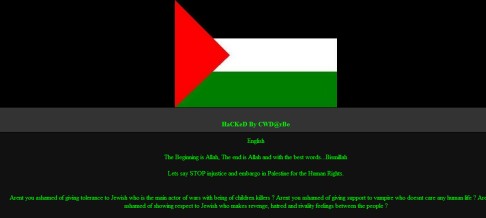
This is where it gets interesting. The Google cache page shows this — a statement by an ostensibly Turkish pro-Palestinian hacker/group. Here’s a screenshot:

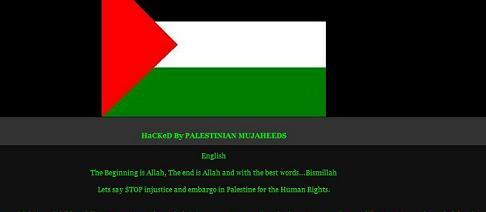
If that looks familiar it’s probably because you read about the hacking of The Jewish Chronicle in Britain a week ago. The text and image appear to be the same:

There is one difference — the claim of authorship. The hackers of the Chronicle identified themselves as “PALESTINIAN MUJAHEEDS” whereas the TAC hackers used this name: “HaCKeD By CWD@rBe”.

So what can we infer? Some Turkish pro-Palestinians don’t know much about the American media? Perhaps.

The American Conservative is certainly a counter-intuitive target to pick. It’s one of the few American publications that acknowledges the legitimacy of the Palestinian cause and it is by no stretch of the imagination an Israel-friendly publication.

So who might the Palestinian Mujaheeds be? A Google search indicates that the name had never shown up until the Jewish Chronicle attack.

The equation between Palestinians and Mujahadins is a strange one to make — unless that is you happen to be an anti-Jihadist of the type that figures in Daniel Larison’s article. He writes:

The Palestinian cause generates remarkable reactions in Western anti-jihadists. For most of them, it is an article of faith that Palestinians, or at least the organized factions that speak for them, are just about as bad and hostile to “the West” as Al Qaeda itself, and so there is no point in attempting to make any deal with them. As far as they are concerned, the correct response is to back Israeli policies to the hilt, and to throw up as many obstacles to anyone here at home who would attempt to use U.S. influence to change those policies. The Bush-era habit of lumping together every Islamic revolutionary, militant and terrorist group under some catch-all term of “Islamofascism” made it easier to lump all these causes together, which is oddly enough exactly what jihadists would like, and once they were lumped together they could be that much more easily demonized together.

Now is that the kind of statement that a pro-Palestinian Turk believes should be blocked from public viewing? It’s conceivable but rather improbable. Much more plausible is the idea that a pro-Israeli hacker finds the expression of such views particularly unpalatable.

It’s not always possible to judge who you are dealing with simply by seeing the colors on the flag that they choose to waive.

Meanwhile, as TAC deals with the damage done by “HaCKeD By CWD@rBe”, be sure to look at Daniel Larison’s piece which I’ve reposted here. It’s essential reading.

Facebooktwittermail

Does Gilbert Bigio make Israel look good?

Does Gilbert Bigio make Israel look good?

When Amos Radian, Israel’s Dominican Republic-based ambassador to the nations of the eastern Caribbean, spoke to the Jerusalem Post last week, he was unequivocal in expressing appreciation towards the Bigio family.

Gilbert Bigio, a Syrian Jew and honorary consul for Israel in Haiti also happens to be among the wealthiest men in that impoverished nation. The day before Israel’s relief team was due to arrive in Haiti, Ambassador Radian spoke to Reuven Shalom Bigio, son of the business magnate.
“Tomorrow the Israel Air Force is coming with two jets and 250 people and I have no place to put them,” Radian told Bigio. The response was swift as the Israelis were provided with Bigio-owned land to set up a field hospital. Radian said that the assistance provided “made us look so good”.

The billionaire industrialist’s loyalty to Israel is unquestionable. As the Jerusalem Post report said:

Gilbert Bigio’s own father came to Haiti in 1925 and was active in the Jewish community. He played a role in Haiti’s support for Israeli statehood in the November 1947 vote at the United Nations.

“Being in a city where there’s no synagogue, prayers are done at our house, Israel to us is the motherland. It’s the rock. It’s how we identify ourselves,” said Reuven Bigio. His father’s support for Israel’s mission here was immediate: “His desire to help was unconditional.”

Does the Bigio family have an unconditional desire to help Haitians? Not as far as one can tell.

In 2004, the Miami Herald reported on Haiti’s tiny and wealthy Jewish community and spoke to its de facto leader. Bigio saw no reason why the huge disparity between his own wealth and the poverty of those around him should breed in them any resentment.

Bigio, 68, lives in a big, beautiful house in Petionville, one of the few upscale neighborhoods in Port-au-Prince. Behind the well-guarded house is a luxurious swimming pool and a gazebo for outdoor parties.

Like most of the other Jews who remain in Haiti, Bigio is considered extremely wealthy in a country where 50 percent of the population is illiterate and 76 percent of children under 5 are underweight or suffer from stunted growth.

“I don’t think there’s resentment against people who are rich here,” says the retired businessman, who speaks English, French and Haitian Creole. “If you know how to manage success, people admire you instead of hate you.”

Cite Soleil, a seaside shantytown of more than 300,000 people residing in homes made of cinder blocks with tin roofs, has been described as poorer than India’s infamous slums of Calcutta. It is also the home of the Bigio business empire.

“Our purpose is to improve the quality of life of the communities we reach,” the GB Group says in its mission statement. A Haiti Information Project report from Cite Soleil published in January 2008 suggests otherwise.

While the surrounding residents of Cite Soleil are forced to literally eat dirt to stave off hunger, Bigio is a billionaire whose family supported the first coup against Aristide and reportedly helped to back the movement that forced his second ouster in 2004.

One need not look very far to see where Gilbert Bigio’s interests lie in relation to Cite Soleil. According to his own company’s web site his family maintains controlling interests in sixteen of Haiti’s largest companies. They are also the largest Haitian partner in the wireless communications giant Digicel, a mammoth company based in Ireland that has nearly cornered the cellular market in the Caribbean. Bigio’s family is not merely wealthy amidst a sea of poverty stricken residents in Haiti, his family represents the Über-wealthy who have benefited most since Aristide’s second ouster in 2004.

The Office of Foreign Assets Control of the US government blocked all of the Bigio family’s holdings in US banks following the brutal military coup against Aristide in 1991. Since Aristide’s second ousting in 2004, the financial wealth of the Bigio family along with those of other well off Haitian clans such as the Mevs, Brandts, Acras and Madsens have nearly doubled according to a confidential source at a private accounting firm.

Meanwhile, Israel’s image-boosting relief effort in Haiti is about to wrap up its operations – its medical and rescue team is set to return home by Thursday.

Facebooktwittermail

Israel at war

Israel at war

Yesterday I called attention to an article in Hebrew (appearing on an Israeli website) with the extraordinary headline: “The painful truth: Haiti’s disaster is good for the Jews.” Shmuel Sermoneta-Gertel has now translated the whole article which appears at Mondoweiss. It begins:

At a time when our country is under media attack on the basis of harsh and anti-Semitic reports, and we are forced to contend with terrorists who have assumed the winning image of victims of war, one could say that the Haiti disaster is the best thing that could have happened to us. So why are blood, destruction, poverty, hunger and orphans good for the Jewish State? First of all because global attention has been drawn elsewhere and the international media have a more interesting story to cover. Second, because every disaster-area needs a hero, and right now we are it. I must admit that I would not be surprised if the image aspect of setting up a hospital in Haiti, as well as the IDF rescue efforts, was given greater weight than humanitarian considerations. If I am right, then finally, someone in the Knesset has done the right thing, deciding to take advantage of the opportunity to prove to the world how kindhearted and capable we are. And if the Foreign Ministry manages to make further use of the Israeli success stories in Haiti and market them to the world, all the better. We can only hope that none of our talented politicians is caught in front of a camera saying “We showed the world. We were really awesome in Haiti,” or something like that – a distinct possibility considering the recent mess with the Turks. Better to be modest.

Those in Charge Don’t see Hasbara as Warfare

The tough question raised by our success in Haiti is why we do well in the media only when we have the opportunity to star in another country’s disaster, and not on a regular basis? After all, you can’t have a natural disaster every day. The answer to the question is a lack of concerted effort to garner sympathy from the countries of the world, alongside behaviour that actually creates antagonism, such as humiliating ambassadors on camera. Before criticizing current hasbara practice however, we must realize that our biggest problem lies in the way we approach the entire issue of image. First of all, our elected representatives see themselves as politicians rather than statesmen, and so prefer to focus on their own personal interests, rather than on those of the country. Every Israeli citizen is knows this, to the point that we can’t stand our own leaders, so why does it come as surprise that the rest of the world isn’t too crazy about us either? Second, those in charge of the country’s PR don’t see hasbara as warfare, just like any military operation, intended to safeguard and promote our national and security interests.

Depending on where you stand politically, hasbara is either Israel’s public diplomacy or pro-Israeli propaganda.

Let’s at this juncture set aside the issue of how obscene and self-defeating it is for some Israelis to turn a humanitarian relief effort in Haiti into a schmaltzy stage-show. What strikes me as particularly interesting in the argument that Tamir Haas is clumsily pressing is that once again we see how warfare has become the single lens through which Israelis see the world.

Hasbara is a form of warfare, Haas asserts, and I am reminded of Ariel Siegelman’s presentation of what he called a new kind of war as this American-Israeli reservist last year celebrated “victory” in Gaza:

After the Second Lebanon War, we learned some very valuable lessons. We learned that we had been living in an imaginary world and that the most dangerous type of war is the one that you call peace. We learned that we are not in fact in a “peace process” at all. We are at war…

The war is ongoing, with periods of more violence and periods of less violence, during which the enemy regroups and plans his next attack. When we feel the enemy is getting strong, we must be prepared to make preemptive strikes, hard and fast at key targets, with viciousness, as the enemy would do to us. Only then can we acquire, not peace, but sustained periods of relative calm.

If Tamir Haas and Ariel Siegelman happen to be two relatively unknown Israelis, what should concern those outside Israel is not whether their views exercise much influence but to what extent they reflect a generational mindset.

When war has become the principal force shaping life, there is indeed no peace process.

Facebooktwittermail

‘The painful truth: Haiti’s disaster is good for the Jews’

‘The painful truth: Haiti’s disaster is good for the Jews’

If I came up with a headline claiming the devastation in Haiti is “good for the Jews”, I could reasonably be accused of being anti-Semitic. But it’s not my headline. It comes from this report on a site run by Israel’s popular Hebrew daily, Maariv.

Every disaster needs a hero, the report says, and the heroes in Haiti are the Israelis.

The message that Israel is saving Haiti was likewise captured in an editorial cartoon in Yediot Aharonot which shows American soldiers digging for earthquake survivors. A voice from beneath the rubble calls out, “Would you mind checking to see if the Israelis are available?”

Bnei Akiva, the largest religious Zionist youth movement in the world, in partnership with Latet, an Israeli humanitarian aid organization, launched a Haiti appeal saying: “We are not only helping Haitians with their tragedy, but uniting the Jewish world and demonstrating the Jewish values of the State of Israel. We believe that it is a Jewish duty to help the people of Haiti. As the representative of the Jewish people, the State of Israel is leading the relief effort.”

An Associated Press article I linked to yesterday describing the exodus of Haitians fleeing from the ruins of Port-au-Prince, strangely was subsequently replaced by a report describing the rescue of a 22-year-old man by an Israeli search team 10 days after the earthquake leveled much of the capital.

In Haaretz, Bradley Burston writes:

Over the past week, the work of the Israeli medical team has become a kind of Rorschach for how people view Israel and Israelis. Most of the comment, it must be said, is supportive. Even on the part of those who cast the humanitarian misery in Gaza in contrast.

But for a shocking number of others, the bottom line is simple: Israel, and Israelis, can do no right.

In its most extreme form, there are those who have accused Israel of using the Haiti catastrophe as a new reservoir for harvesting organs.

But even many of those who shun blood libels, have seized on the Haiti mission to bash Israel, revealing in many cases a hatred – and a bigotry – that borders on the visceral.

Would Burston lump me in with the anti-Israel commentators? Maybe.

Do I think the Israeli doctors, nurses and rescue teams now working in Haiti are all toiling away purely in the service of Israel’s international image? I doubt it. I would expect that for most of these individuals, their response is like that of most of the other foreigners now providing relief to Haitians: it is above all a human response to human suffering.

Is there such a thing as an Israeli response or a Jewish response or an American response to human suffering? If so, it is laced with vanity.

To say this is what we do because this is who we are is to preen oneself in front of a mirror of self-praise. It is undignified. It spies a reward in someone else’s loss.

In this mirror, Israel now sees an image of itself as a big-hearted nation admired around the world for its humanitarian efforts in Haiti. But the self-satisfaction will be short-lived. Before long this glimmer of goodwill will once again be overshadowed by the enduring reality that in the minds of most Israelis the suffering of others seems just as likely to provoke callous indifference as it does an open heart.

The big Israeli heart shrivels at the sight of a Palestinian.

As Larry Derfner wrote in the Jerusalem Post:

… the IDF field hospital in Haiti is a reflection of something very deep in the national character.

But so is everything that’s summed up in the name “Gaza.” It’s the Haiti side of Israel that makes the Gaza side so inexpressibly tragic. And more and more, the Haiti part of the national character has been dwarfed by the Gaza part.

Gaza, too, is a matter of life and death – not just for the people who were trapped in the rubble there not long ago, but for Israel. When will this big-hearted nation stop being heartless to the people in Gaza?

Facebooktwittermail

Israel’s hopeless quest for respect

Israel’s hopeless quest for respect

As Israeli-Turkish relations hit a new low with the threat that Turkey might withdraw its ambassador, Israel’s foreign minister Avigdor Lieberman said he expects Israel to be treated with “dignity and respect” by Turkey.

The sign of respect Lieberman is looking for would be for the Turkish government to censor Turkish media by banning a TV show that depicts Israeli soldiers as war criminals. Israel’s war on free speech continues on many fronts without much success — other than in America.

The slide in relations between the two major regional powers began with Israel’s war on Gaza. In Davos, Turkish prime minister Recep Tayyip Erdogan stood up for Turkish dignity by refusing to be silenced after Israeli president Shimon Peres launched a bombastic tirade in defense of Israel’s right to wage war.

Though in the eyes of the Western media the Davos incident was seen as a “spat”, much more importantly in Turkey and across the Middle East, Erdogan was seen as a national leader unwilling to countenance disrespect from an Israeli leader — however much the latter might act out, used as he is to being coddled by the West.

Now we have Lieberman, whose diplomatic talent has been shaped by his experience working as a nightclub bouncer, endorsing a plan that was designed to teach Turkey a lesson. Deputy Foreign Minister Danny Ayalon seemed to think that if the Turkish ambassador was forced to look up to him — literally — humiliation would deliver in its wake, respect.

This is how the meeting unfolded where the Israeli minister conveyed to Turkey’s ambassador Oguz Celikkol how offensive Israel finds “Valley of the Wolves”.

During the photo-op at the start of the meeting, Ayalon reportedly told the photographers in Hebrew: “Pay attention that he is sitting in a lower chair and we are in the higher ones, that there is only an Israeli flag on the table and that we are not smiling.” Celikkol’s associates told Israeli Army Radio on Tuesday that the meeting with Ayalon was the most humiliating event he had experienced in 35 years as a diplomat.

Those in Israel who understand something about the way diplomacy works know that Ayalon made a huge blunder. He now faces criticism even from inside his own party, Israel Beiteinu.

“He is finished politically,” an Israel Beiteinu official told The Jerusalem Post. “This ruins his reputation as a diplomat. It is a stain that cannot be erased. He damaged Lieberman and first and foremost himself.”

Minister of Industry, Trade and Labor Binyamin Ben-Eliezer said: “The respect for Israel is not judged by how you humiliate an ambassador; humiliation doesn’t help, it only harms.”

While Ben-Eliezer and others indicate that political realism still exists in Israel, Ayalon’s mistake was less that of pure error of judgment than that of representing an Israeli mentality too faithfully.

Alon Liel, a former Israeli ambassador to Turkey, facetiously told Israeli Army Radio that “a new sort of diplomacy” had been invented, and that Lieberman had “made up a new way of reprimanding.”

“This time, they made him sit on a low chair, next time maybe they’ll make him crawl, and who knows, maybe the time after that they’ll beat him up at the entrance,” Liel said.

The former Israeli ambassador’s intention might have been to mock Lieberman, but the idea that contempt generates respect serves as a foundation stone for Zionism. Israel’s struggle to pacify its opponents has since 1948 been a relentless effort to demonstrate who stands above and who must crouch below.

Israel has placed all its bets on the effectiveness of coercion — an investment from which it is difficult to move away. There is no easy road that leads from contempt to mutual respect. Indeed, in those whose nature it is to treat others with contempt there is an underlying assumption that respect is something which will never be freely conferred.

What Danny Ayalon and those Israelis who are cast in the same mold repeatedly and unwittingly display is their own lack of dignity. They have no idea how profound a difference there is between demanding respect and being worthy of respect.

Facebooktwittermail

President Obama orders a ban on fly-swatting in the Ministry of Information

President Obama orders a ban on fly-swatting in the Ministry of Information

The buck stops here; the president’s responsible; everyone’s accountable; no one gets the blame; the system’s not broken – just needs a tune up.

The problem with a war on terrorism – at least where it takes place on the communication’s front – is that the terrorists often end up coming out with the more credible statements.

In 1984, after the Brighton bombing which targeted the leadership of the British government then led by Margaret Thatcher, the IRA said:

Mrs. Thatcher will now realise that Britain cannot occupy our country and torture our prisoners and shoot our people in their own streets and get away with it. Today we were unlucky, but remember we only have to be lucky once. You will have to be lucky always. Give Ireland peace and there will be no more war.

Yesterday, Agence France-Presse reported:

Al-Qaeda hailed the suicide bombing that killed seven CIA agents in Afghanistan as “revenge” for the deaths of top militants in US drone strikes in Pakistan, Islamist websites said on Thursday.

Treat terrorism as bereft of political content then the issue will perpetually be framed as one of national security and we’ll get reports like this:

In a briefing after the President’s remarks, counterterrorism advisor John Brennan said he had personally let the president down.

Brennan said that the intelligence and law enforcement community had done a “stellar” job over the past year. “It was in this one instance that we did not rise to that same level of competence and success.”

Brennan said the president had told him he must do better. Said Brennan, “I told him that I will do better and we will do better as a team.”

Must do better… Indeed.

No more fly-swatting at the Ministry of Information — that should fix the problem.

(Anyone who’s seen Brazil will know what I mean. Anyone who hasn’t seen the movie, should — it’s as relevant now as it was when it came out in 1985.)

Facebooktwittermail

US intelligence is ignorant

US intelligence is ignorant

So, apparently the CIA suffered a fatal strike by an al Qaeda blogger last week. And if you’re wondering how bad it’s got for American soldiers in Afghanistan: they say they can get more useful information from USA Today than they get from reading intelligence reports.

Is this David Letterman’s assessment? No. It comes from Major General Michael Flynn, deputy chief of staff for intelligence in Afghanistan for the US military and its NATO allies.

OK, he didn’t refer specifically to USA Today, but in a newly-published report he did say: “Some battalion S-2 officers say they acquire more information that is helpful by reading US newspapers than through reviewing regional command intelligence summaries.”

This is not a testimony to the quality of American journalism.

“I don’t want to say we’re clueless, but we are. We’re no more than fingernail deep in our understanding of the environment,” the operations officer of one US task force told Flynn.

The United States has now been conducting military operations in Afghanistan for over eight years.

Facebooktwittermail