Category Archives: Editorials

War in the Age of Terrorism

War in the Age of Terrorism

This is change: we’ve gone from change we can believe in, to a change in the mood music.

If Dick Cheney was the éminence grise behind George Bush, one could now be forgiven for thinking that George Bush himself has quietly taken on the same role for Barack Obama. And if this administration — like the one before — can be accused of losing touch with reality, there is no more compelling piece of evidence than this: Obama regards his speech in Cairo last summer as one of the most important things he’s done in the fight against terrorism.

The New York Times — reporting as always from “inside” the administration, reveals in, “Inside Obama’s War on Terrorism”:

perhaps the biggest change Obama has made is what one former adviser calls the “mood music” — choice of language, outreach to Muslims, rhetorical fidelity to the rule of law and a shift in tone from the all-or-nothing days of the Bush administration. He is committed to taking aggressive actions to disrupt terrorist cells, aides said, but he also considers his speech in Cairo to the Islamic world in June central to his efforts to combat terrorism. “If you asked him what are the most important things he’s done to fight terrorism in his first year, he would put Cairo in the top three,” Rahm Emanuel, his chief of staff, told me.

Really? There might have been good reason for Obama to have thought that at the time and for a few weeks afterwards, but by the time Washington caved under Israeli pressure by supporting a bogus settlement freeze, it became clear that the Cairo speech would be remembered across the Middle East as a bitter harbinger of disappointment.

As for Obama’s campaign promise that he would not only end the war in Iraq but end the mindset that took the US to war, it now turns out that as president he is quite content to follow in the footsteps of his predecessor:

A half-dozen former senior Bush officials involved in counterterrorism told me before the Christmas Day incident that for the most part, they were comfortable with Obama’s policies, although they were reluctant to say so on the record. Some worried they would draw the ire of Cheney’s circle if they did, while others calculated that calling attention to the similarities to Bush would only make it harder for Obama to stay the course. And they generally resent Obama’s anti-Bush rhetoric and are unwilling to give him political cover by defending him.

Michael Hayden, the last C.I.A. director under Bush, was willing to say publicly what others would not. “There is a continuum from the Bush administration, particularly as it changed in the second administration as circumstances changed, and the Obama administration,” Hayden told me. James Jay Carafano, a homeland-security expert at the Heritage Foundation, was blunter. “I don’t think it’s even fair to call it Bush Lite,” he said. “It’s Bush. It’s really, really hard to find a difference that’s meaningful and not atmospheric. You see a lot of straining on things trying to make things look repackaged, but they’re really not that different.”

Facebooktwittermail

How America won the Nobel Peace Prize

How America won the Nobel Peace Prize

Having been nominated for the peace prize after only ten days in office; having spent the previous three weeks as a president-elect who silently monitored the slaughter in Gaza; and having just assumed the role of commander-in-chief in two wars, for Barack Obama to then craft a credible way to accept an accolade as this year’s most celebrated man of peace, was always going to demand some rhetorical creativity.

Still, this surely ranks as a first: to use the peace prize ceremony as an opportunity to justify war.

Speaking in Oslo last night, Obama said: “the instruments of war do have a role to play in preserving the peace.”

Only within a nation that has largely managed to insulate itself from the effects of war could such a statement be made.

Sixty-four years earlier, in the shadow of two world wars, Americans had a much greater interest in condemning war than in presenting arguments for its justification.

“… our position is that no grievances or policies will justify resort to aggressive war. It is utterly renounced and condemned as an instrument of policy,” wrote Supreme Court Justice Robert H Jackson, on August 12, 1945, when laying out the foundation for the Nuremberg Trials.

On that basis, every war that the United States has fought since World War Two has been branded as a war of necessity — not a war of aggression. Likewise the war that Obama has now made his own is one that he claims to be both necessary, just, and unavoidable. Yet its justness rests on a logical non sequitur: the war in Afghanistan is just because of 9/11.

To say “because of 9/11” is both to present a reason and to simultaneously seal that reason inside a locked box. The logical connection between 9/11 and the war in Afghanistan is apparently so direct and unswerving that even now, those who voice skepticism are generally viewed as either un-American, irrational or naive.

Even so, on September 11, 2001, few Americans had the conviction that this country, out of necessity, was about to go war. President Bush had to present a logical and moral argument and he did so by enunciating what became the first iteration of the Bush doctrine and the foundation for the war on terrorism: “we will make no distinction between the terrorists who committed these acts and those who harbor them.”

On that basis, the Bush administration constructed a legal argument for bombing Afghanistan and killing thousands of people who had nothing whatsoever to do with the attacks.

The unspoken truth was that the US government enacted and the American people supported a war of vengeance. Had the lust for reprisal been tempered with foresight of the carnage and chaos that the following eight years would bring, America’s war of necessity might have been seen then as no more necessary than it is widely seen now.

The “necessity” that took America to war in Afghanistan is no different than the choice Israel makes when it bulldozes the family home of a suicide bomber. This accords with the ancient principle of settling scores, rebalancing power, and reasserting a position of dominance. It’s about showing your enemies and showing the world that you remain top dog. And therein lies the intractability of this war. More troops have to sent in now to buy time for Obama to figure how, without loss of face to himself or this country, the troops can be pulled out later.

As the US president reflects on the principles of a just war, he’s sending young American men and women overseas on the promise that they’re heading out on a path that should bring them back home.

Remember when Obama talked about ending the mindset that took us to war?

I do, but apparently he doesn’t.

Facebooktwittermail

Obama wanted a surge, he’s getting a surge, and it feels good

Obama wanted a surge, he’s getting a surge, and it feels good

Mine might not be a headline the New York Times would choose, but that’s the story they tell under their flatly descriptive: “How Obama Came to Plan for ‘Surge’ in Afghanistan.”

The narrative reads like a script for NBC’s “West Wing” as it dramatises Obama’s deliberative process and that seems to have been the object of the exercise for this stellar team of reporters: paint a picture of presidential solemnity that will inspire confidence in how Obama makes decisions and thereby drum up a bit of good old-fashioned blind-faith in the presidency.

If there is no inescapable logic to the idea that a faster surge will enable a swifter withdrawal, then — the Times would have its readers believe — we shouldn’t worry our little heads about that because our fabulously diligent president has performed an operation of executive intelligence that renders all further consideration superfluous.

In a similar vein I’ll spare readers here the tedium of wading through a 4,660-word article and pick out some of the highlights. Actually, to my eye there is really only one point of substance:

Mr. Obama and his advisers … considered options for stepping up the pursuit of extremists in Pakistan’s border areas. He eventually approved a C.I.A. request to expand the areas where remotely piloted aircraft could strike, and other covert action. The trick would be getting Pakistani consent, which still has not been granted.

For “expand the areas” read: Baluchistan.

If getting Pakistani consent to open a new front in the war simply comes down to diplomatic finesse, then yes, you could call it a “trick” managing to get those instransigent Pakistanis to do the right thing.

In reality, it is merely the imperatives of fluent story-telling that compels the Times to glide over this important detail in the much larger and grimmer story of the war. Understanding why Baluchistan represents a red line that Pakistan refuses to abandon is something that Washington might grasp only when it’s too late.

The matter of most importance both for this administration and for the New York Times has less to do with people, places, history and geography, than it does with high-value words. Words like “surge”.

Obama wants to push in hard so he can pull out fast.

A three-month strategic review thus produced a choreographic solution:

The plan, called Option 2A, was presented to the president on Nov. 11. Mr. Obama complained that the bell curve would take 18 months to get all the troops in place.

He turned to General Petraeus and asked him how long it took to get the so-called surge troops he commanded in Iraq in 2007. That was six months.

“What I’m looking for is a surge,” Mr. Obama said. “This has to be a surge.”

That represented a contrast from when Mr. Obama, as a presidential candidate, staunchly opposed President Bush’s buildup in Iraq. But unlike Mr. Bush, Mr. Obama wanted from the start to speed up a withdrawal as well. The military was told to come up with a plan to send troops quickly and then begin bringing them home quickly.

On November 29, after winning the approval of all his immediate advisers, the president moved into action:

Mr. Obama then went to the Situation Room to call General McChrystal and Ambassador Eikenberry. The president made it clear that in the next assessment in December 2010 he would not contemplate more troops. “It will only be about the flexibility in how we draw down, not if we draw down,” he said.

Two days later, Mr. Obama flew to West Point to give his speech. After three months of agonizing review, he seemed surprisingly serene. “He was,” said one adviser, “totally at peace.”

Obama wanted a surge, he’s getting a surge, and it feels good — at least for now.

Facebooktwittermail

Ethnic cleansing of Jerusalem while Israel implements a fake settlement freeze

Ethnic cleansing of Jerusalem while Israel implements a fake settlement freeze

Ever since Hillary Clinton officially declared the peace process dead and buried — well, her precise words were that Israel was making “unprecedented” concessions on the issue of settlements — the settlement freeze-hoax has hardly seemed worth tracking. Still, a couple of items from the last few days are noteworthy.

First, Benjamin Netanyahu’s reassurance offered to leaders of Jewish communities in “Judea and Samaria” (the Israeli occupied West Bank): “This order [to freeze new housing construction] is one-time only and it limits the duration of the suspension. There are nine months and three weeks left. Once the suspension has expired, we will continue to build.”

Then, the Jerusalem Post reported:

Strategic Affairs Minister Moshe Ya’alon, who voted in favor of the freeze last week as a member of the security cabinet, warned Thursday that if it continued beyond the 10-month period, ministers would begin to resign.

Ya’alon’s comments reflected earlier claims by Minister-without-Portfolio Bennie Begin, in which Begin promised that at the end of the 10-month period, building would begin “at a faster pace than before the freeze.”

Meanwhile, Haaretz reported on the massive increase in the pace of the ethnic cleansing of Jerusalem — part of the effort to solidify Israel’s claim to the city as an “undivided” Jewish capital.

Last year set an all-time record for the number of Arab residents of East Jerusalem who were stripped of residency rights by the Interior Ministry. Altogether, the ministry revoked the residency of 4,577 East Jerusalemites in 2008 – 21 times the average of the previous 40 years.

In the first 40 years of Israeli rule over East Jerusalem combined, from 1967 to 2007, the ministry deprived only 8,558 Arabs of their residency rights – less than double the number who lost their permits last year alone. Thus of all the East Jerusalem Arabs who have lost their residency rights since 1967, about 35 percent did so in 2008.

According to the ministry, last year’s sharp increase stemmed from its decision to investigate the legal status of thousands of East Jerusalem residents in March and April, 2008. The probe was the brainchild of former interior minister Meir Sheetrit (Kadima) and Yaakov Ganot, who headed the ministry’s Population Administration.

The ministry said the probe uncovered thousands of people listed as East Jerusalem residents but were no longer living in Israel, and were therefore stripped of their residency. Most of those who lost their residency for this reason did not just move from Jerusalem to the West Bank, but were actually living in other countries, the ministry’s data shows.

Those deprived of their residency included 99 minors under the age of 18.

Attorney Yotam Ben-Hillel of Hamoked: Center for the Defense of the Individual said the 250,000 Arab residents of East Jerusalem have the same legal status as people who immigrated to Israel legally but are not entitled to citizenship under the Law of Return.

“They are treated as if they were immigrants to Israel, despite the fact that it is Israel that came to them in 1967,” he said.

A resident, unlike a citizen, can be stripped of his status relatively easily. All he has to do is leave the country for seven years or obtain citizenship, permanent residency or some other form of legal status in another country, and he loses his Israeli residency automatically.

Once a Palestinian has lost his residency, even returning to Jerusalem for a family visit can be impossible, Ben-Hillel said. Moreover, he said, some of those whose residency Israel revoked may not have legal status in any other country, meaning they have been made stateless.

“The list may include students who went for a few years to study in another country, and can now no longer return to their homes,” he said.

Officials at Hamoked, which obtained the ministry data via the Freedom of Information Act, said they were concerned that some of those who lost their residency rights may not even know it.

“The phenomenon of revoking people’s residency has reached frightening dimensions,” said Dalia Kerstein, Hamoked’s executive director. “The Interior Ministry operation in 2008 is just part of a general policy whose goal is to restrict the size of the Palestinian population and maintain a Jewish majority in Jerusalem. The Palestinians are natives of this city, not Johnny-come-latelys.”

Sheetrit, however, insisted that the operation was necessary. “What we discovered is just the tip of the iceberg,” he said. “The State of Israel pays billions of shekels a year in stipends to people who don’t even live here. We sent notices to every one of them about the intention to revoke their residency; we gave them time to appeal. Those who appealed weren’t touched.”

The ministry data shows that 89 Palestinians got their residency back after appealing. Sheetrit said the probe revealed very serious offenses – such as 32 people listed as living at a single address that did not even exist.

Facebooktwittermail

Obama’s war of necessity

Obama’s war of necessity

Among the many unanswered questions about President Obama’s approach to the war in Afghanistan, there is at this point one thing about which we can be certain: He does indeed regard this as a war of necessity.

But necessary for what?

Necessary for defeating al Qaeda?

Nah. Much as Americans have been indoctrinated to believe that eradicating terrorism might be akin to eradicating smallpox — an endeavor which if engaged with sufficient thoroughness could actually have an end — it should by now be clear to all but the most simple-minded that the kernel of the episodic terrorist threat to America is contained in dangerous and highly contagious ideas. It is not confined to a particular group of people confined to a particular location. The war in Afghanistan is doing more to cultivate the conditions for a continuation of that threat rather than being an instrument for its removal.

Necessary for ending the war in Iraq?

In part, yes — at least this was the presidential campaign logic. The war in Iraq needed to be wrapped up as quickly as possible because that war was a distraction and the war in Afghanistan was a necessity.

Obama’s opposition to the war in Iraq could only be sold in a campaign against hawkish Republicans if he could prove he was not an opponent of war per se — just an opponent of that particular one. “I am not opposed to all wars. I’m opposed to dumb wars,” Obama said in 2002 when laying out his credentials as an un-antiwar Illinois State Senator.

In the 2008 campaign, Obama’s proof that he possessed an adequate level of war-zest was to pronounce that he was a true believer when it came to the war in Afghanistan — the righteous war; the necessary war; the real war; the war the George Bush had neglected to win.

Necessary for re-election?

Maybe. The answer to that question might well be contained in the genesis of July 2011 as the date US troops will start pulling out of Afghanistan. As CBS News reports, that date is “locked in”. “The president told [press secretary Robert Gibbs, the date — contrary to assertions from US senators] IS locked in — there is no flexibility. Troops WILL start coming home in July 2011. Period. It’s etched in stone. Gibbs said he even had the chisel.”

The Pentagon doesn’t like firm dates. It cleaves firmly to the line that everything is provisional, depending on the current conditions. So it’s hard to believe that General McChrystal or General Petraeus would have volunteered this timetable.

Did it come from David Axelrod? Does July 2011 fit as a “necessity” into a 2012 campaign calender?

Facebooktwittermail

The European minaret-missile threat

The European minaret-missile threat

Bigotry is on the rise in “the westerly excrescence of the continent of Asia.”

That unpoetic but topographically-precise description of Europe comes from the Oxford archeologist, Barry Cunliffe.

Whenever voices declaring that European culture is under threat are at their most strident, it’s always worth remembering the actual nature of Europe’s physical form.

As a continent it is nothing more than a malleable contrivance with its ambiguous, historically shifting eastern edge. As a result, it is and always has been, an ethnic and cultural melting pot.

Thus the irony when Europe’s self-appointed protectors take a firm stand in the name of its defense: they so often lack a real appreciation for the very thing to which they have pledged their allegiance.

Why is it that the people who most easily become possessed by ideas about cultural purity are themselves so often culturally impoverished?

Because culture in its richness and complexity is not the real issue.

This is about how individuals respond to the other.

Does the unfamiliar prompt interest and curiosity?

Or does it provoke fear?

Fear in response to the other says more about the fearful than it says about the objects they fear.

The fear of the foreign is at its root a fear of becoming foreign. It is a fear of becoming a stranger in one’s own land.

* * *

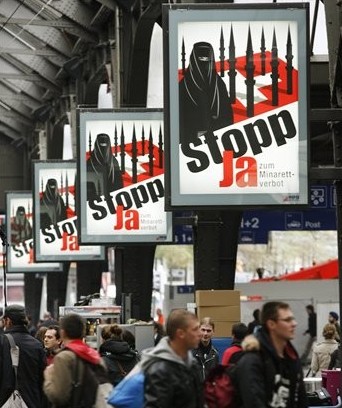
In the latest outbreak of European xenophobia, the minaret has become a missile in a campaign to ban their construction — that is, the construction of minarets, not missiles.

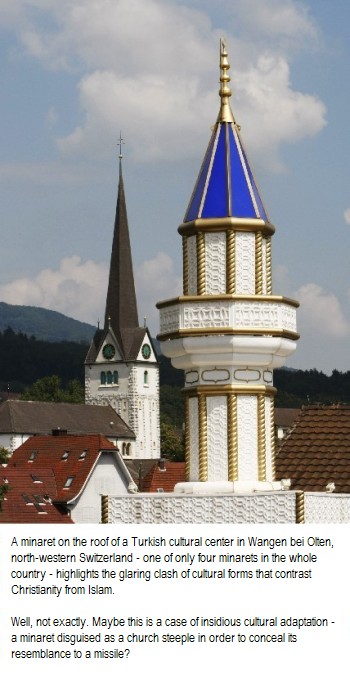
This is a curious iconic transformation. Is the Swiss People’s Party suggesting that Switzerland, in which currently there are only four minarets, is at risk of becoming a missile-minaret launching pad threatening the rest of Europe with Islamization? (After all, their posters depict missile-minarets ready for launch — not incoming missile-minarets about to explode.)

By Sunday it became apparent that Swiss voters had little interest in dissecting the visual absurdity of the campaign poster — a majority seemed to have bought the implicit message: Islam = violence, death and destruction.

The campaign’s final week of fear-mongering managed to raise support for the ban from 37% up to 57.5%, with passage in the majority of cantons meaning that a constitutional amendment will follow.

As The Guardian reported:

The controversial referendum on Sunday, accompanied by a prohibition campaign denounced as racist and in violation of human rights, is the latest tussle in Europe over the limits of multiculturalism and immigrant lifestyles.

Pushed by anti-immigrant rightwing populists, it has triggered months of debate in a country that uses direct democracy for single-issue politics. The referendum has turned into much more than a vote on architecture and urban planning.

“The minaret has got nothing to do with religion. It’s a symbol of political power, a prelude to the introduction of sharia law,” argued Ulrich Schlüer, of the rightwing Swiss People’s party, an architect of the campaign.

Two years ago the SPP became the strongest party in Switzerland, with an anti-immigrant election campaign that featured posters of three white sheep kicking a black sheep off a red and white Swiss flag. UN experts and human rights activists condemned the campaign as overtly racist.

This time the SPP has plastered the country with posters showing the same flag as a base for several black minarets, portrayed as missiles, alongside a woman clad in a black burqa. Church leaders, the Jewish community and Muslim leaders have all opposed the campaign. The foreign minister, Micheline Calmy-Rey, warned that a vote in favour risked turning Switzerland into “a target for Islamic terrorism”. The city of Basel and other towns have proscribed the incendiary posters.

Amnesty International said: “Freedom of religious belief is a basic human right and changing the Swiss constitution to ban the construction of minarets would clearly breach the rights of the country’s Muslims.”

UN human rights experts have said the proposed ban violates freedom of religion and liberty. The Swiss justice minister, Eveline Widmer-Schlumpf, has agreed, declaring that it would breach anti-discrimination laws and rights to free religious observance, raising the question of why the campaign has been allowed.

Tariq Ramadan, Switzerland’s most famous Muslim, suggests that what his country’s Muslim population is being told is that the only good Swiss Muslim is an invisible Muslim.

Ramadan was recently interviewed by the Swiss magazine, L’illustré, where Arnaud Bédat asked him to comment on the fears of his fellow citizens. (Translation by Rashed Chowdhury.)

Tariq Ramadan: One must respect the fear of ordinary citizens, while one also must resist in civic fashion populist parties which are instrumentalising fear in order to win elections. The majority of our fellow Swiss citizens are not racists: they are afraid and they would like to understand. Swiss people of the Muslim faith have a real responsibility to communicate and explain…. At the same time, one must refuse to allow populism to install itself. The problem is that the UDC [the Democratic Union of the Centre, another name for the Swiss People’s Party] initiative is using the symbol of the minaret to target Islam as a religion. I have had debates with Mr. Freysinger. [Oskar Freysinger is a parliamentarian in the Swiss People’s Party and a driving force in the campaign.] What does he say? That “Islam is not integratable into Swiss society.” So he says to me, to me, and I am Swiss like him, that “You are not a good Swiss person, you cannot be one, since your quality of being a Muslim prevents you from being a good Swiss person.” That is the foundation of the debate: the problem is Islam, not minarets.

Arnaud Bédat: But the minaret, you write so yourself, is not a pillar of Muslim faith.

TR: Yes, but is that a reason to say “Since it is not an obligation, you don’t need it”?… Does it have to be that the only good Swiss Muslim is an invisible Muslim? Is this the future of our pluralism and of our living together?

AB: Numerous Islamic countries forbid other religions on their territory — there are no churches or synagogues in Saudi Arabia, for example. Is it not ultimately logical that part of the West reject Islam on its territory?

TR: This is the oft-repeated argument of reciprocity. It is untenable. Respect for the rights and dignity of people is not a question of trade. It falls to us, to us in Switzerland, to preserve our principles of respect, and to not allow ourselves to be colonised by the unacceptable practices of other societies. Let us say first of all that it is wrong to say that religious minorities are always discriminated against in Muslim-majority societies. There are synagogues, churches and temples [there]. However, one should not deny the fact that discrimination and the denial of rights do occur, as in Saudi Arabia. One cannot hold Swiss citizens and residents of Muslim faith responsible for the actions of certain dictatorial governments from which they have often, by the way, fled for political or economic reasons. What one can expect from them [Swiss Muslims], nevertheless, from a moral point of view, is a denunciation of discrimination and ill treatment. That is something I do not stop doing, which has closed the doors of several countries, such as Saudi Arabia, to me.

AB: Do you dream, as you detractors claim, of a world that is entirely Muslim?

TR: No. I was born, have lived and have studied in Switzerland; my whole philosophical education comes from that. I have always believed that those who do not share my beliefs allow me to be more myself. The absolute power or uniformisation of a religion on earth would mean corruption and death. The worst that could happen to Muslims is if the whole world became Muslim! That is not even what God’s project is. There has to be diversity and difference. Because difference teaches us humility and respect.

To which I would add: The cultural ecosystem, or the ethnosphere as Wade Davis has named it, thrives on diversity.

Monoculture is inherently unstable because it lacks the strength that comes from constant adaptation necessitated by complexity and constant change.

Think about it. What would Europe be had it never been open to the influence of foreign cultures?

Christianity wasn’t born in Zurich — it came from the Middle East!

Facebooktwittermail

Who’s in charge of the language here?

“… who is in charge of the language here?”

After Israeli officials flatly refused a US request to block the approval for the construction of 900 new housing units in occupied East Jerusalem, the Obama administration “lashed out” (CBS) with “anger” (New York Times) and “sharply criticized” (Wall Street Journal) Israel’s decision.

The White House unleashed a shocking display of… “dismay.”

We are dismayed at the Jerusalem Planning Committee’s decision to move forward on the approval process for the expansion of Gilo in Jerusalem.

Thankfully, AP’s Matt Lee wasn’t as obliging as some of his colleagues in their efforts to pump vigor into a pathetic statement.

Challenging State Department spokesman Ian Kelly, Lee asked:

You can’t come up with anything stronger than “dismaying”? I mean, this flies in the face of everything you’ve been talking about for months and months and months.

Kelly: It’s dismaying.

Lee: Yeah, you can’t offer a condemnation of it or anything like that? (Laughter.) I mean, who is in charge of the language here?

On the other side of the Atlantic, Britain’s Foreign Office was a tad more forthright if not quite fiery: “this decision is wrong and we oppose it.”

That kind of language is apparently too strong for this White House. In fact, having originally put out a statement referring to planned “Settlement Expansion in Jerusalem”, the mamby pamdys in charge of language in the most powerful executive office in the world decided to retract “settlement expansion” and simply titled it a statement “on Jerusalem”.

So, the Obama administration is “dismayed” by Israel’s behavior.

It may well be that the word was chosen with exquisite care. It’s etymology is all too appropriate:

Middle English dismaien, from Anglo-Norman *desmaiier : probably de-, intensive pref.; see de- + Old French esmaier, to frighten (from Vulgar Latin *exmagāre, to deprive of power : Latin ex-, ex- + Germanic *magan, to be able to).

The White House could have said:

Prime Minister Netanyahu. You have exposed our impotence. Alas, we have no power.

Should anyone be dismayed at the White House’s language?

Only if you’ve been ignoring the news for the last few months and still imagine that Obama’s speech in Cairo was genuinely a highlight of his presidency.

Bibi goes nuclear on Jerusalem settlements

The plan, if implemented, will allow the construction of 844 units, and these units won’t be inside the existing footprint of the settlement. Rather, they will be on the settlement’s southwestern flank, expanding Gilo in the direction of the Palestinian village of Wallajeh (a village in which a large number of the homes are fighting Israeli demolition orders). This new Gilo plan clearly dovetails with another plan to build a new settlement, called Givat Yael, which would straddle the Jerusalem border and significantly extend Israeli Jerusalem to the south, further sealing the city off from the Bethlehem area and the West Bank (and connecting it to the Etzion settlement bloc). That plan, it was reported yesterday, also appears to be suddenly gaining steam. (for a map showing both the Gilo plan and Givat Yael, click here.)

The Gilo plan is thus extremely provocative on several levels. It represents a clear and public statement from the Netanyahu government that it is neither “freezing” nor acting with “restraint” in East Jerusalem. It compels the Palestinians to respond, just as it compels other regional actors to respond. Finally, it has important strategic implications, since the plan, implemented, would impact on border options for Jerusalem under a future peace agreement.

Today’s crisis was by no means inevitable. Nobody (except for those of us who obsessively follow Jerusalem at its most minute level) had any idea this Gilo plan was on the agenda for today. This means that Bibi could easily have responded positively to US concerns and quietly quashed or delayed the project, without any political cost. Alternatively, he could have offered another (deceptively) constructive course, like allowing it to be deposited for public review but promising to find other ways to hold it up later. Or he could simply have refused to intervene, but kept quiet about it – letting today’s technical approval process run it course and only react publicly, after the fact.

Bibi had a number of conventional options; he chose to go nuclear.

If this feels familiar, it should. This is basically what happened earlier this year with the Shepherds Hotel settlement in Sheikh Jarrah. The plan was on the agenda, Washington weighed in firmly but quietly, hoping for firm but quiet action by Netanyahu – and instead they got a story leaked to the Israeli media (in fact, to the same journalist who broke today’s Gilo story), turning it into an opportunity for Netanyahu to burnish his Jerusalem credentials, at the expense of the prospects for peace. [continued…]

Facebooktwittermail

Imagine living in the West Bank…

Imagine living in the West Bank…

For most Israelis, the occupied West Bank — now mostly concealed behind a barrier far more imposing than the Berlin Wall — could be a million miles away. Even so, thousands really do know what it’s like. They have firsthand experience of the conditions imposed on ordinary Palestinians — they know because during their military service they had a direct role in imposing those conditions.

For the rest of us, beyond hearing testimony, seeing photographs and film, it is really only through an act of imagination that we can transport ourselves there and attempt to understand what it means to be living under military occupation.

The following film was created as a tool to help those of us who take freedom of movement for granted, to have a sense of what it means when that freedom is taken away.

Facebooktwittermail

From Bradford to Gaza

The brothers from Bradford are ready for Gaza

On March 9, I wrote: “In Sharm el-Sheikh a week ago, world leaders delivered empty promises. Today, Viva Palestina delivered the goods!”

The first Viva Palestina convoy had just completed its arduous drive through Europe and across North Africa, traveling 5,000 miles to deliver humanitarian aid to the people of Gaza.

Before world leaders had convened in Egypt to make what were indeed empty promises — virtually none of the $4.5 billion of aid pledged in early March has subsequently reached any of its intended recipients — a bunch of ordinary working folk had gathered donations from their local communities, bought ambulances, a firetruck, other vehicles, medical equipment and urgently needed supplies and were well on their way to reaching Gaza.

At the time it looked like a terrific display of human spirit, even if it amounted to only a small fraction of the relief just one government could provide. Nine months later, after a second convoy reached Gaza in July and as a third “mega convoy” gears up for departure on December 5 [PDF], Viva Palestina has not only been an inspiring mobilization of people power — it has been of real practical effect at at time that the Blairs, Mitchells, Clintons, Milibands and Obamas of this world have shown themselves to be pathetic examples of all-words-and-no-actions.

Among the participants in the new convoy are a contingent from Bradford for whom I have a special affection.

With their keffiyehs, beards and traditional Pakistani dress, to many Americans some of these guys will look like jihadists from Waziristan, but to me they’re fellow Yorkshiremen.

As they are getting ready to go, they’ve put together a short video — after the intro titles, fast-forward to minute three (unless you have a particular interest in what ambulances look like) to hear the Bradford brothers speak for themselves:

For information on making donations to Viva Palestina go here.

To make donations to Viva Palestina USA go here.

To make donations to the Bradford convoy contact Sid 0797-066-6656 or Shaf 0796-693-0587 (when dialing from outside the UK, dial your international access code then +44, then drop the “0”, eg from the US 011 +44 797-066-6656). Sid is the tire-fitter who appears in the video above wearing an olive-green keffiyeh. See the Bradford Group’s flyer [PDF]. The Bradford group has already raised $335,000 (200,000 pounds) in donations from the local community.

For information on Viva Palestina USA go here.

Al Jazeera English recently aired a short documentary on the conditions facing the residents of the Gaza Strip. Munzer al-Dayyeh is a 40-year-old mechanic living in Gaza. And while the effects of war and ongoing siege may be good for his business, he can’t manage to secure medical treatment for his disabled children. An insight into an ordinary Gazan man struggling to make a living and to find a solution for his family in the difficulties of the Gaza Strip.

Locked in: Life in Gaza – Part 1

Locked in: Life in Gaza – Part 2

Facebooktwittermail

Two-State Solution: The Broadway Musical

Two-State Solution: The Broadway Musical

Remember a mere five months ago when Hillary Clinton, with all the toughness she had displayed during her primary campaign, said bluntly: “[Obama] wants to see a stop to settlements — not some settlements, not outposts, not ‘natural growth’ exceptions”?

The whole administration — presumably with expert coaching by Rahm Emanuel — was sending a strong message to Israel: We know your games and we’re not going to take any crap.

Freezing settlements — this was the litmus test for Benjamin Netanyahu to demonstrate his ability to engage in the so-called peace process.

Within a few weeks the administration’s Iran policy was in disarray — in the aftermath of the disputed presidential election — and terrified of the charge that he was being tough on Israel while soft on Iran, Obama’s resolve withered. Netanyahu bounced back and he has been riding high ever since.

Back in June, Netanyahu was admonished for not doing his homework. Now he’s thrown it in the trash and gets praise for offering “restraint on the policy of settlements” — even as Israel demolishes Palestinian homes in East Jerusalem and Palestinian citizens of Israel protest against the ethnic cleansing of Jerusalem.

Meanwhile, as Netanyahu mocks the idea that Washington has the capacity or will to apply pressure on an Israeli government, J Street, “the political arm of the pro-Israel, pro-peace movement,” after launching itself onto the stage of mainstream American politics through its first national conference last week, must somehow strive to keep the two-state-solution dream alive.

The two-state solution is indeed the stuff of dreams — at least the dreams of Zionists who find the idea of equality between Jews and non-Jews abhorrent, or as J Street’s Jeremy Ben-Ami puts it, “a nightmare for the Jewish people.”

Perhaps Washington is not the best place for dream believers. Maybe it’s time for a glitzy Two-State Solution on Broadway.

Oh look!

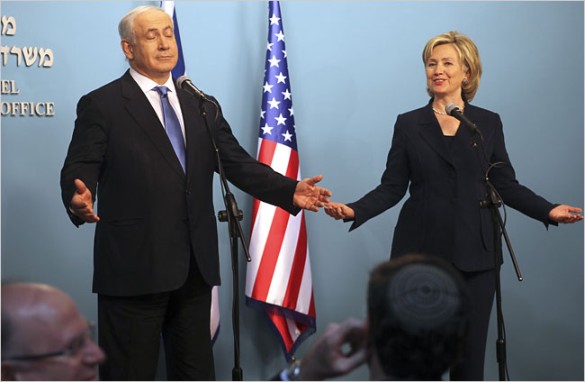
Bibi and Hillary are already auditioning.

J Street: Do we really need another Jewish-only road?

If you’re Palestinian, you know about checkpoints. There are over 600 checkpoints in the West Bank alone. They block, obstruct, frustrate and kill. Women die in childbirth at checkpoints, students are kept from attending school, parents from visiting their children, laborers from going to work. No one can swim in the sea. Israeli Jews are waved through checkpoints. They can swim in the sea. No problem. Jews travel freely on a complex system of Jewish-only roads and live on the Jewish side of the Separation Barriers along hundreds of miles of walls and fortified fences that keep Palestinians out. Palestinians live in an open air prison. Sometimes there is a moment of spring and the guards open the gates. But spring never lasts long. Blockades, nightly incursions, full-scale invasions, imprisonment, collective punishment, land theft, water theft, denial of education, health care, an economic future, frequent beatings and no freedom of movement is the daily bread of Palestinians. You can’t travel more than three miles without encountering a check point. Talk about stress.

J Street was a place where Jews talked to Jews about the Israeli-Palestinian conflict. Few Palestinians were present. Apparently they didn’t make it through the checkpoint. The narrative of J Street, like most Jewish narratives about the Israeli-Palestinian conflict, reflects the nature of the conflict as seen through a Jewish lens: Palestinians are physically absent. A Jew who seeks to express her activism in solidarity with Palestinians is in danger of loosing her ‘I love Israel’ card at a mainstream Jewish checkpoint. There were checkpoints at J Street. Some people were allowed in but not officially asked to participate, some were dis-invited, and some were not considered to be part of the conversation in the first place. [continued…]

Editor’s Comment — As Ahmed Moor eloquently puts it:

A purely Jewish focus on a more-than-Jewish problem causes many leftist Jews to take a paternalistic view of Palestinians. Rather than equals whose inalienable rights form the crux of the case against Zionism, the Palestinians are the clay of Jewish humanism, waiting to be fully actualized by thoughtful and reflective Jewish hands.

Facebooktwittermail

Israel: A fugitive state

Israel: A fugitive state

Do the innocent refuse to be questioned?

The Netanyahu government’s campaign to obstruct both the Goldstone inquiry and the report that it produced has been waged in the name of protecting Israel’s right of self-defense.

But Israel’s defenses are actually far weaker than the Goldstone critics care to admit: Israel is so vulnerable that it cannot withstand critical scrutiny or self-examination.

Gone are the days when an Israeli defense minister could be found by Israelis to “bear personal responsibility” for the massacre of hundreds of Palestinian civilians, as the Kahan Commission found Ariel Sharon after investigating his role in the Sabra and Shatila Massacre.

Now, Israel cannot even take the risk of conducting an independent investigation into alleged war crimes, let alone deal with the unpredictable outcome of such an investigation.

Instead, the defense of Israel now requires that all those who remain loyal to its interests and concerned about its preservation, maintain solidarity in a single mission: do everything possible to silence the Jewish state’s critics.

The underlying assumption seems to be that Israel will remain eternally an object of enmity; that the best it can hope for is that its enemies remain weak.

This is not merely the condition of a national identity; it percolates through to the outlook of individuals — an outlook that is inevitably misanthropic. It is to assume an existential orientation which regards the bulk of humanity as a harbor of ill-will.

For Israelis and many of their supporters, this situation ought to provoke a profound inquiry into the nature of antisemitism.

From where in the world does this ancient bigotry now draw most of its life?

In a pandemic of anti-Israel hostility?

Or might it find its most vital form of traction much closer to home, inside those very minds that perceive the rest of the world as other?

Are the Goldstone critics trying to defend Israel, or are they trying to sustain the image of an embattled state too fragile to survive the corrosive impact of investigation?

Mahmoud Ahmadinejad’s thesis is that Israel, like the Soviet Union, is destined to self-destruction. Michael Oren, Israel’s ambassador to the United States, seems susceptible to a similar fear.

Earlier this year, Oren wrote:

The breakdown of public morality, in my view, poses the greatest single existential threat to Israel. It is this threat that undermines Israel’s ability to cope with other threats; that saps the willingness of Israelis to fight, to govern themselves, and even to continue living within a sovereign Jewish state. It emboldens Israel’s enemies and sullies Israel’s international reputation. The fact that Israel is a world leader in drug and human trafficking, in money laundering, and in illicit weapons sales is not only unconscionable for a Jewish state, it also substantively reduces that state’s ability to survive.

Oren’s view has apparently subsequently shifted and he now seems to regard the results of the UN investigation as posing a greater threat to Israel than any other: “The Goldstone Report goes further than Ahmadinejad and the Holocaust deniers by stripping the Jews not only of the ability and the need but of the right to defend themselves.”

The ambassador might pause to consider this: A breakdown in public morality and an unwillingness to investigate alleged war crimes may in fact be intimately connected.

Facebooktwittermail

Barack Obama to follow in Shimon Peres’ footsteps

Barack Obama to follow in Shimon Peres’ footsteps

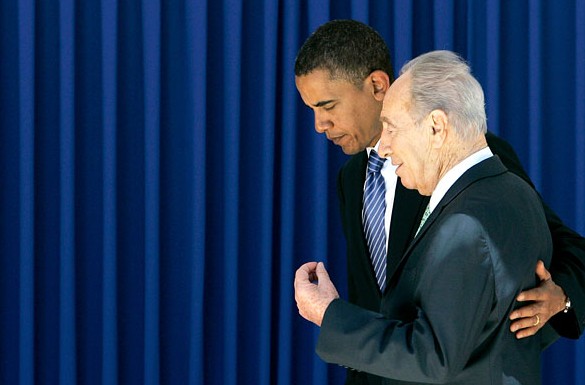
“Very few leaders if at all were able to change the mood of the entire world in such a short while with such profound impact. You provided the entire humanity with fresh hope, with intellectual determination, and a feeling that there is a lord in heaven and believers on earth.

“Under your leadership, peace became a real and original agenda. And from Jerusalem, I am sure all the bells of engagement and understanding will ring again. You gave us a license to dream and act in a noble direction.” Nobel Peace Prize laureate and President of Israel, Shimon Peres.

_____

It’s important not to rush to judgment on Obama — unless the judgment is glowing, then it’s full steam ahead.

If the so-called “reality-based community” still existed, then the very same people who have been suggesting that Obama critics hold their fire should now be insisting the Nobel committee jumped the gun.

Unfortunately that isn’t happening as much as it should. Why? Obama loyalists feel personally embattled. The impulse to grasp on to this fleeting object of relief is for some, irresistible. It’s a quick salve to those whose own unflinching loyalties portend humiliations that lurk down the road.

Realists can’t indefinitely remain true believers. True believers eventually abandon realism.

European Commission President Jose Manuel Barroso said: “The award of the prize to President Obama, leader of the most significant military power in the world, at the beginning of his mandate, is a reflection of the hopes he has raised globally with his vision of a world without nuclear weapons.”

There’s a note of realism there — this is about hopes raised, not accomplishments. The problem is, hope can only be raised so far and for so long. It’s power and durability depends on a strengthening conviction that hope is on a trajectory that leads to actuality. The longer that trajectory remains unclear, the more likely it will be that hope has instead provided the foundation for disappointment, cynicism and bitterness.

Obama traded on hope as a path to power but now he has the power he has to dispense with a large measure of hope. Governance is about deliverables.

It’s not surprising that the Nobel Peace Prize committee have chosen to endorse Obama’s nuclear disarmament initiative. But whether that goal has actually raised hopes globally is something I’m skeptical about. Disarmament is on Obama’s wish-list, but since — in the name of realism — he warned that this might not be accomplished in his lifetime, and since a goal is a dream with a deadline, thus far Obama has merely inspired hope in a dream. Ronald Reagan had that dream too.

Is there a sliver of a silver lining here? Maybe. It’s possible that the Nobel Peace-Prize winning president might feel inhibited from using the Pentagon’s newly-ordered 30,000lb Massive Ordnance Penetrator for destroying nuclear facilities in Iran. On the other hand, he might be persuaded that the destruction of Iran’s nuclear program is a necessary step on the path to nuclear disarmament.

* * *

A few other responses.

Mickey Kraus:

Turn it down! Politely decline. Say he’s honored but he hasn’t had the time yet to accomplish what he wants to accomplish. Result: He gets at least the same amount of glory–and helps solve his narcissism problem and his Fred Armisen (‘What’s he done?’) problem, demonstrating that he’s uncomfortable with his reputation as a man overcelebrated for his potential long before he’s started to realize it. … Plus he doesn’t have to waste time, during a fairly crucial period, working on yet another grand speech. … And the downside is … what? That the Nobel Committee feels dissed? … P.S.: It’s not as if Congress is going to think, well, he’s won the Nobel Peace Prize so let’s pass health care reform. But the possibility for a Nobel backlash seems non-farfetched.

The Taliban:

Taliban spokesman Zabihullah Mujahid said it was absurd to give a peace award to a man who had sent 21,000 extra troops to Afghanistan to escalate a war.

“The Nobel prize for peace? Obama should have won the ‘Nobel Prize for escalating violence and killing civilians’,” he told Reuters by telephone from an undisclosed location.

“When Obama replaced President Bush, the Afghan people thought that he would not follow in Bush’s footsteps. Unfortunately, Obama actually even went one step further.”

Gideon Rachman:

The prize is clearly an award of huge significance, awarded after only the deepest reflection, and won only by demi-Gods.

Maria Farrell:

President Obama has changed how the world feels about America. He’s lifted the planet’s mood. This guy is global Prozac.

Facebooktwittermail

Iran’s diplomatic dexterity

Iran’s diplomatic dexterity

The Geneva talks with Iran have been presented as a diplomatic victory and vindication of President Obama’s commitment to engagement. As Juan Cole wrote: “Barack Obama pwned Bush-Cheney in one day, and got more concessions from Iran in 7 1/2 hours than the former administration got in 8 years of saber-rattling.”

But as many commentators have been quick to describe this as a success for the administration, the role Iran played in making this happen has been largely overlooked.

The breakthrough came during talks on Thursday — or so the narrative runs.

Except, the terms of a key portion of the agreement — a deal for replenishing the fuel supply for a reactor in Tehran that produces medical isotopes — were announced the day before by President Mahmoud Ahmadinejad.

“As I said in New York, we need 19.75 percent-enriched uranium. We said that, and we propose to buy it from anybody who is ready to sell it to us. We are ready to give 3.5 percent-enriched uranium and then they can enrich it more and deliver to us 19.75 percent-enriched uranium,” Ahamdinejad was quoted by ISNA news agency as saying.

In an interview with Newsweek during his trip to New York to attend the UN General Assembly in late September, Ahmadinejad said:

“We simply don’t have the capacity to enrich at 20 percent for medicinal purposes, of the sort that we have in mind, at this stage. It’s only at 3.5 percent. We had been buying this material in the past, but not from the U.S. government. We can buy it from the United States. It doesn’t really matter who we buy it from, so we are open to it. But this does not affect the fuel cycle. But still, it seems to me a nice opening, a nice window to look through.”

A State Department background briefing given on the day of the Geneva talks confirmed:

“Iran came to the IAEA a few months ago with the request to replace this supply [for the Tehran reactor]. The IAEA consulted us and some others, some other members, and to make a long story short the United States and Russia joined together in a proposal to the IAEA which the IAEA subsequently conveyed as a response to the Iranians, to use Iran’s own LEU stockpile as the basis, as the feedstock for the reactor fuel that’s required.”

The crucial component in this deal was obviously that Iran would provide the feedstock, but as Ahmadinejad made clear on Wednesday, Iran’s decision to do that had already been made before discussions began in Geneva.

Still, the perception remains that the earlier revelations about the Fordo facility outside Qom meant that the Iranians had been diplomatically cornered.

Maybe so. But whether that’s the case may hinge on questions that remain unanswered: How and when did Iran discover that the existence of the facility was no longer secret? For that matter, is it realistic to think that the Iranians would ever have thought that this or any other construction project of such a type could progress without receiving careful and virtually constant scrutiny by America’s ever-watchful eyes in the sky? This after all is the kind of intelligence in which the US retains unparalleled prowess.

Facebooktwittermail

Thoughts on Iran, mountains and winning without war

On mountains and metaphors

A few random thoughts and observations on the latest developments with Iran:

How big’s a mountain? It’s a clandestine nuclear facility under construction “inside a mountain“.

The only adjective that got left out was “deep,” yet knowing that detail might be the key to knowing exactly what “very heavily protected” means.

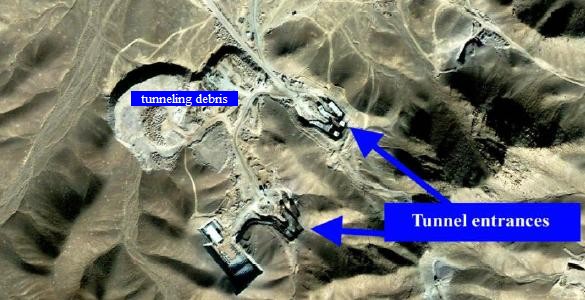
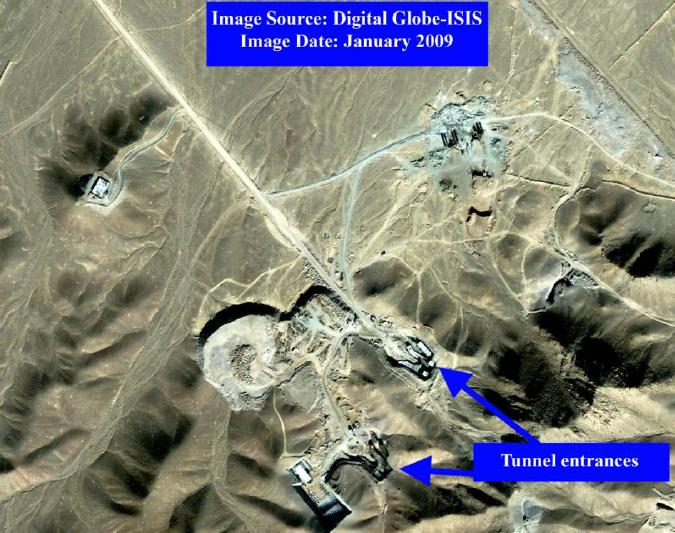
(This much we can already deduce about the extent of the tunneling: it has produced two very large adjoining flattened mounds of debris which are marked in the image above.)

Gary Sick seems to have been among the descriptively most precise in referring to “a small enrichment facility in an underground chamber on a Revolutionary Guards base.”

Inside an underground chamber it is; inside a mountain it is not — at least not unless one assumes a Lilliputian perspective and calls a 167ft tall hillock a mountain. That’s the difference in elevation between one of the tunnel entrances and the highest point along the ridge that the tunnel penetrates. (Use Google Earth to see specific elevations. For instance, the northern tunnel entrance is at 2,975ft. The adjacent ridge to the east is at 3,142ft.)


View Larger Map

Not so fast with the sanctions. When the president of a country sharing a 1,458km border with Iran says sanctions against Iran won’t work, there’s reason to think that he isn’t simply making a prediction; he might be making a promise.

Iraq’s President Jalal Talabani gave this warning on Saturday and no doubt it was warmly received in Tehran. China and Russia might be crucial when it comes to imposing sanctions. Iraq might turn out to be key when it comes to enforcing or being unable to enforce them.

Pity the IAEA. There it is — the world’s indispensable nuclear monitoring agency — but does anyone care to share their intelligence so that IAEA inspectors can do their work? Only when the powers that be deem it useful.

Bombs away. Maybe this isn’t the smoking gun Israel was waiting for. Evidence of a clandestine program may confirm some of Israel’s dire warnings, but how many other similarly well-concealed and hard-to-destroy facilities might there be? All that an Israeli attack might actually accomplish would be to legitimize Iran’s withdrawal from the NPT and a rush towards weaponization.

The meaning of a mountain. If “inside a mountain” might be a topographical stretch, it’s an image that serves multiple purposes:
1. It’s too good an image for any journalist to risk undermining with a skeptical question. (“And just how big is that mountain?”)
2. It tells the world that the Iranians are dastardly, sneaky fellows whose evil plans can only be hidden by something as big as a mountain.
3. It says the Americans are so smart that they can find anything, however well hidden.
4. It highlights the possibly insurmountable challenge Israel would face in launching an air strike against a target much harder to destroy than a reactor under construction in Syria, or a weapons convoy on the move in Sudan.
5. It says that Obama isn’t a daydream believer sending his representatives into a negotiating trap; he’s back in his superhero mode out to save the world.

What’s it all about? Once you get past the theatrics it comes down to the pursuit of national interests — it’s not (or at least should not be) about putting Iran in a box.

Every party has distinct national interests, but fruitful negotiations will hinge on identifying where these interests overlap — not simply the overlapping interests of the US and its allies, but also those that are shared by Iran.

Stepping off the war path requires that everyone, including the Iranians, can see a way of winning.

Facebooktwittermail

Locating Iran’s secret nuclear facility (updated, update II)

Update — Turns out ISIS already published a report [PDF] on this and suggest an alternative location NW of Qum in addition to the one described below. They also add dates to the imagery, the Google Earth images appearing below having been taken on March 25, 2005.

Locating Iran’s secret nuclear facility

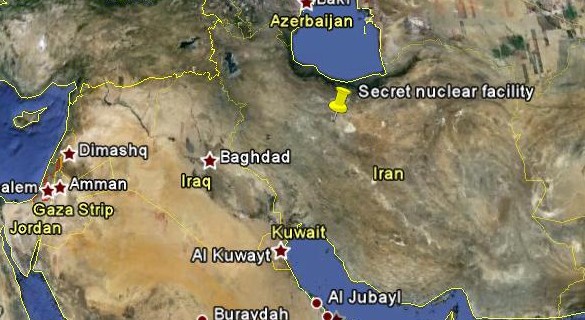
In numerous dispatches, Iran’s newly-reported and until a few days ago undeclared nuclear facility, is described as being built “inside a mountain“. In an Obama adminstration background briefing it was described as being located in “a very heavily protected, very heavily disguised facility”. Reports have also said that it is located north east of the city of Qum.

Understanding what “inside a mountain” and “very heavily protected” actually mean is important. It could mean that the facility is effectively invulnerable to any form of military strike.

Facilities buried more than 1000ft away from the earth’s surface are “essentially invulnerable to nuclear attack” says the Union of Concerned Scientists.

If it turns out the the Qum facility (and perhaps others) are in fact so heavily protected that they cannot be destroyed through a conventional or even an unconventional military strike, then the military threat that supposedly remains placed on that proverbial table would not really be a strike that could cripple of destroy Iran’s purported nuclear weapons program. It would simply mean that the threat of war remains on the table.

If that’s the case, then during the past couple of years (and remember, this facility has apparently been under observation since 2006), all the veiled and unveiled threats of an Israeli attack on Iran’s nuclear facilities have probably been made for purely political purposes.

So where is this newly announced facility and how heavily protected is it?

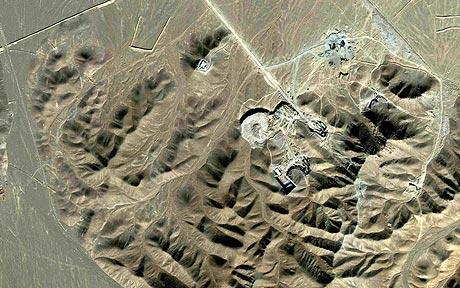
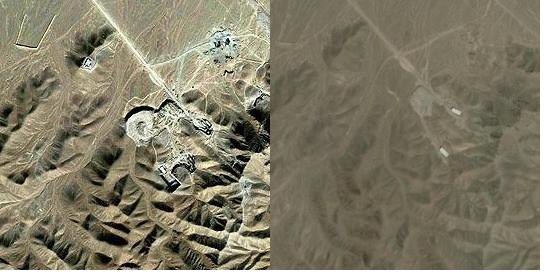
The Daily Telegraph has published this image from Reuters with the caption: “Satellite photo of what is believed to be a uranium-enrichment facility near Qom.”

I’m a novice at using Google Earth but I’ve got a good topographic eye, so with “inside a mountain, north east of Qum (alt spelling Qom)” as my starting point, I thought I’d take a look.

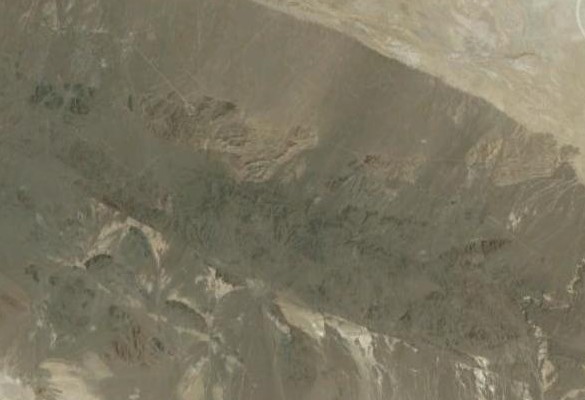
Here are some mountains north east of Qum:

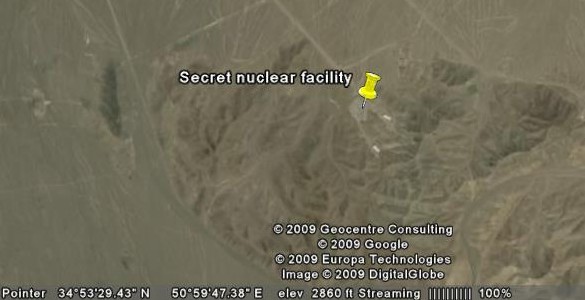
And what d’ya know? Here’s the location that appears in the Telegraph:

Of course, we don’t know for sure whether the Reuters-distributed image is actually a photograph of the facility in question, but let’s assume it is.

The Google Earth image is older and a comparison of the two reveals extensive earthworks that doubled in area during the (to me) unknown lapse between the two images. It looks like open-cast mining, suggesting that wherever in proximity to that these earthworks the facility might be buried, it probably isn’t under a 1000ft of granite.

The question remains (and it’s obviously one I can’t answer): is this facility invulnerable to a military attack?

(Update: The photos from ISIS identify two tunnel entrances to the east of the excavated area.

It seems quite possible that the tunnels do indeed extend deep enough into the mountains to provide strike invulnerability.)

If you want to examine the location more carefully, you can find it here on Google maps. And these are the coordinates: 34°53’8.74″N — 50°59’45.90″E

Second update: Upon further examination of the Google Earth information, I’m having second thoughts about the “buried in a mountain” description.

While the satellite image is suggestive of mountains, the range in elevation between the tunnel entrances and the highest surrounding ridges is little more than a hundred feet! These aren’t mountains: they are hillocks. Situated in a few undulations that protrude slightly from a vast salt basin area that is mostly at about 3,000ft in elevation, this “very heavily protected” facility might not in fact be quite as invulnerable as I suggested above.

Facebooktwittermail

Israel’s never-ending war

Israel’s never-ending war

As Israel’s Prime Minister, Benjamin Netanyahu, and Palestinian Authority President Mahmoud Abbas, meet at the United Nations today, “both sides have made clear that they’ll essentially be humoring Obama, showing up because the President of the United States expects it of them and not to relaunch long-stalled ‘final status’ peace negotiations, as the administration had hoped,” writes Tony Karon at Time magazine.

The conventional wisdom among most seasoned observers of the conflict is that the status quo is untenable — that at some point both sides will have to arrive at a mutually acceptable way of implementing a two-state solution.

The process that might lead to that point is as murky as ever.

The possibility that receives less consideration is that Israelis, living in a country forged through war — a country that has never really known peace — having become resigned to the apparent necessity of remaining on a perpetual war footing, have now reached a point where war is more than tolerable: it is acceptable.

War is what created Israel, has allowed it to exist and will guarantee its perpetuation. Many Israelis may pay lip-service to the notion that peace is desirable, yet it is their willingness to engage in war that makes them feel safe.

For Ariel Siegelman, an Israeli soldier who fought in Gaza in a special forces unit of the IDF, the key lesson from the 2006 war in Lebanon was this: “We learned that we had been living in an imaginary world and that the most dangerous type of war is the one that you call peace. We learned that we are not in fact in a ‘peace process’ at all. We are at war.”

In the Washington Post just this week, Jackson Diehl pointed out that even as the UN’s damning report on the war on Gaza brought renewed critical attention to the most recent conflict, “Operation Cast Lead, as the three-week operation is known in Israel, is generally regarded by the country’s military and political elite as a success.” (Diehl, with apparent satisfaction, predicted: “As for the Goldstone report [PDF], the heat it briefly produced last week will quickly dissipate”.)

Claiming that the wars in Lebanon and Gaza had for Israel both been qualified successes, Diehl suggested that Israel is far less fearful than are most of its allies about picking a fight with Iran.

… as with Gaza, even a partial and short-term reversal of the Iranian nuclear program may look to Israelis like a reasonable benefit — and the potential blowback overblown.

Americans who do not share Diehl’s neoconservative perspective, don’t need to ask themselves whether they share Israel’s view of itself; they simply need to decide whether the United States has a responsibility (or any legitimate excuse) for sustaining Israel’s war machine.

Without American arms, the Jewish state will not be starved of materiel — there are plenty of non-US arms manufacturers who would happily pick up the new demand.

The only issue is whether we should regard Israel’s wars as ours.

* * *

Israel’s military might and its fighting forces have been celebrated by Israelis and Israel’s supporters through numerous songs and videos. Here are a few:

Facebooktwittermail

September 9: The shot that was not heard round the world

September 9: The shot that was not heard round the world

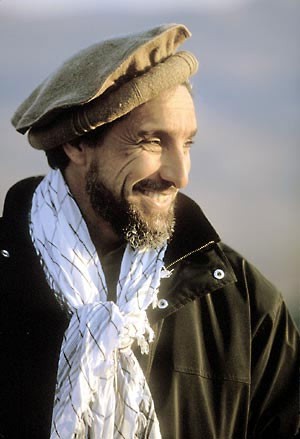
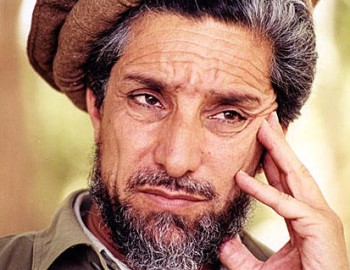
As the war in Afghanistan enters its ninth year, in the minds of most Americans the attacks of September 11, 2001 remain the signal event that shaped everything that has followed. Yet had we been paying more attention, we would have known that September 9, 2001, the day that Ahmed Shah Massoud was assassinated, was no less significant.

On that day, Afghanistan lost a leader of global stature — a man who truly was irreplaceable. Now, as much as ever, as the Taliban is resurgent and American and its allies attempt to prop up a deeply corrupt government in Kabul, the memory of Massoud is a symbol of the Afghan people’s so many shattered hopes.

A year after Massoud’s death, John Burns wrote in the New York Times:

As Americans prepare to mark the Sept. 11 anniversary, with many still struggling to come to terms with the cataclysm of that day, Afghans are passing through their own harrowing remembrance, of an attack that was overshadowed for the rest of the world by what happened two days later in the United States. Only four men died on Sept. 9 — the 49-year-old Mr. Massoud, an aide and the assassins — but there has been little healing of the wounds the killers inflicted on the hearts and the hopes of millions of his countrymen.

Ask Afghans who knew Mr. Massoud what it was about him that inspires such grief, and they struggle. Like [Fahim] Dashti [who was with Massoud at the time of his assassination], they talk of his skills as the guerrilla commander who astonished Soviet generals he outfought during the occupation of the 1980’s, or of his years holding out against the Taliban, when almost all other guerrilla leaders had joined the Taliban or fled abroad.

They speak of Mr. Massoud’s directness, his lack of pretense or false piety, his modesty, the look of somber intensity that rarely left his face. But usually, they give up, as people do when they try to define charisma. Mr. Dashti, the editor, resorted, in the end, to the simplest words. “We loved him,” he said. “We loved him more than we loved our own mothers and fathers. He embodied everything we loved about Afghanistan.”

In 1998, in a letter to the American people, Massoud wrote:

Let me correct a few fallacies that are propagated by Taliban backers and their lobbies around the world. This situation over the short and long-run, even in case of total control by the Taliban, will not be to anyone’s interest. It will not result in stability, peace and prosperity in the region. The people of Afghanistan will not accept such a repressive regime. Regional countries will never feel secure and safe. Resistance will not end in Afghanistan, but will take on a new national dimension, encompassing all Afghan ethnic and social strata.

The goal is clear. Afghans want to regain their right to self-determination through a democratic or traditional mechanism acceptable to our people. No one group, faction or individual has the right to dictate or impose its will by force or proxy on others. But first, the obstacles have to be overcome, the war has to end, just peace established and a transitional administration set up to move us toward a representative government.

We are willing to move toward this noble goal. We consider this as part of our duty to defend humanity against the scourge of intolerance, violence and fanaticism. But the international community and the democracies of the world should not waste any valuable time, and instead play their critical role to assist in any way possible the valiant people of Afghanistan overcome the obstacles that exist on the path to freedom, peace, stability and prosperity.

Pepe Escobar recounts:

During the 1990s, and especially during the time of the Taliban rule, which began in 1996, Washington never knew exactly how to deal with Massoud. But after the attacks on the US embassies in Kenya and Tanzania in 1998, Central Intelligence Agency (CIA) agents sought a meeting with Massoud in Dushanbe. The CIA wanted information on how to get to bin Laden. Massoud carefully considered all the angles, but ultimately he could not but criticize American shortsightedness. For the Bill Clinton administration, the ultimate aim was to get bin Laden and destroy al-Qaeda. For Massoud, the main point was to destroy the Taliban. He repeatedly stressed at the time that “without the Taliban, Osama can’t do anything”.

Massoud, indeed, had agents and intelligence in the heart of Taliban country. The best example is how his Panjshiris planted a powerful truck bomb just outside Mullah Omar’s compound in central Kandahar, in 1999. The explosion left a huge crater and killed 10 people, including three of Mullah Omar’s bodyguards. Omar escaped, almost by a miracle, but if the Northern Alliance could get close to the Taliban, they could not penetrate al-Qaeda’s ultra-hardcore security to try to find and menace bin Laden. And as much as the Northern Alliance could penetrate the Taliban, security chief Arif – now head of intelligence of Hamid Karzai’s government – says that “Osama was actively trying to recruit spies inside the Panjshir Valley”. But once again, no one investigated the “Moroccans”.

In his interview with Asia Times Online, the second-to-last in his lifetime, Massoud repeatedly portrayed al-Qaeda, the Taliban and Pakistan as a sort of “triangle of evil”. He criticized the US for basically following a Pakistani plan: try to “reform” the Taliban and concentrate on seducing Taliban “moderates” (a contradiction in terms). There were never any moderates within the Taliban. Mullah Omar was totally under the spell of bin Laden. American diplomats with knowledge of Central Asia were warning about the “Arabization” of Afghanistan. But no one in Washington was listening. The US only got the message after September 11 – and after Massoud’s death.

In the first months of 2001, Massoud calculated that he had to involve himself in a complex gamble: change his image from warrior to statesman. He addressed the European parliament in Strasbourg, France, in April 2001. This was his first official trip to the West. He tried hard to attract Western support for the resistance against the Taliban. But still no one was listening. In Strasbourg, Massoud delivered a stunning message that nobody took seriously at the time: “If President Bush doesn’t help us, then these terrorists will damage the United States and Europe very soon – and it will be too late.”

Afghanistan Revealed a documentary broadcast by National Geographic in October 2001, presents a portrait of Massoud and his struggle to save Afghanistan.

Facebooktwittermail

Israel doth protest too much

Israel doth protest too much

Organ trafficking accounts for around 10 per cent of the nearly 70,000 kidney transplants performed worldwide annually, although as many as 15,000 kidneys could be trafficked each year…

Trafficked organs are either sold domestically, or exported to be transplanted into patients from the US, Europe, the United Arab Emirates, Saudi Arabia, and especially Israel.Jane’s Intelligence Weekly, March, 2008

The publication of an article, “Our Sons Plundered Their Organs,” written by Donald Boström and published in the Swedish newspaper Aftonbladet on August 17, has provoked on outcry in Israel. Allegations in the article that Israel soldiers stole organs from the bodies of dead Palestinians have been described by Israeli government officials as a “blood libel” and the Swedish government has been called on to condemn the publication.

The Swedish Prime Minister Fredrik Reinfeldt rejected these demands on Monday:

Reinfeldt said it was not for the government to comment on the content of every newspaper, stressing that a free press is an integral part of Swedish democracy.

“It’s important for me to say that you cannot turn to the Swedish government and ask it to violate the Swedish constitution,” he was quoted as saying by the TT news agency.

Reinfeldt also rejected the suggestion that the row could undermine his country’s work in the Middle East peace process as the current holders of the EU presidency.

The allegations about organ theft are old but what prompted them being raised anew was the recent and widely reported New Jersey corruption scandal in which organ trafficking played a central role.

The Associated Press reported on July 25:

Levy Izhak Rosenbaum of Brooklyn called himself a “matchmaker,” but his business wasn’t romance.

Instead, authorities say, he brokered the sale of black-market kidneys, buying organs from vulnerable people from Israel for $10,000 and selling them to desperate patients in the U.S. for as much as $160,000.

The alleged decade-long scheme, exposed this week by an FBI sting, rocked the nation’s transplant industry. If true, it would be the first documented case of organ trafficking in the U.S., transplant experts said Friday.

“There’s certainly cross-national activity, but it hasn’t touched the United States or we haven’t known about it until now,” said University of Pennsylvania medical ethicist Arthur Caplan, who is co-directing a U.N. task force on international organ trafficking.

The claim that this is the first documented case of organ trafficking in the United States does not appear to be true. Moreover, the attention now being drawn to Israel’s role in the global organ trafficking market may explain why there has been such an outcry in Israel about the Boström article. Whether or not the Swedish journalist’s allegations have any basis, the Israeli effort to focus international attention on Sweden may well to some extent be driven by the desire to turn attention away from a wider issue: Israel’s role in the trade in human organs.

To learn about this issue, it isn’t necessary to scour the Internet for English translations of Swedish newspaper articles. One of the most authoritative sources is a renowned American professor whose work recently featured in JWeekly.com, a Jewish publication in the San Francisco Bay Area. An article published on July 30 began:

Nancy Scheper-Hughes insists she is “no Dick Tracy.” But she played an important whistle-blowing role in the caper involving corrupt rabbis, money laundering and human organ traffic in Israel.

The U.C. Berkeley anthropology professor is a leading expert in the study of human organ trafficking. She has spoken to countless international government and health officials decrying the practice. Her research has led her around the world, from the slums of Brazil and peasant villages in Romania to the streets of Tel Aviv.

She also started the Organ Watch Project as a kind of watchdog organization tracking the brokers, surgeons and thugs who profit from the trade.

One of her more startling realizations: Officials in many countries knew all about illegal transplants, yet didn’t care. “It was a public secret,” she said from her Berkeley home. “It was normalized in Israel.”

Professor Scheper-Hughes’ findings featured in testimony she gave at Congressional hearings on human organ trafficking held on June 27, 2001. There she described not only the global issue but also Israel’s role. She also repeated allegations that there have been cases of organ theft committed by Israelis on dead Palestinians.

Here are extracts from Professor Scheper-Hughes’ Congressional testimony:

In July of 2000, Avraham Ronan, a retired lawyer in Jerusalem, explained why he went through considerable expense and considerable risk to travel to Eastern Europe to purchase a kidney from a displaced rural worker, rather than wait in line for a cadaver organ in Israel:

Why should I have to wait years for a kidney from someone who was in a car accident, pinned under the car for many hours, then in miserable condition in the I.C.U. [intensive care unit] for days and only then, after all that trauma, have that same organ put inside me? That organ is not going to be any good! Or, even worse, I could get the organ of an elderly person, or an alcoholic, or a person who died of a stroke. That kidney is all used up! It’s far better to get a kidney from a healthy man who can also benefit from the money I can afford to pay. Where I went the people were so poor they did not even have bread to eat. Do you have any idea of what one thousand, let alone five thousand dollars, means to a peasant? The money I paid was a gift equal to the gift that I received.

The magical transformation of a person into a “life” that must be prolonged, saved, at any cost, has made life into the ultimate fetish as recognized many years ago by Ivan Illich. The idea of “life” itself as an object of manipulation, a relatively new idea in the history of modernity. The fetishization of life — a life preserved, prolonged, enhanced at almost any cost — erases any possibility of a social ethic.

… in Israel today there is an amazing tolerance at official levels toward outlawed “transplant tourism,” which is organized through a local business corporation in conjunction with a leading transplant surgeon, operating out of a major medical center not far from Tel Aviv. Mr. D., the head of “the company” (as transplant patients call it), has developed links with transplant surgeons in Turkey, Russia, Moldavia, Estonia, Georgia, Romania, and (most recently) New York City. The cost of the “package” increased from $120,000 in 1998 to $200,000 in 2001 and, with the pressure from transplant candidates to develop links in more developed countries, the cost is still rising. The transplant “package” covers: the rental of a private plane (to accommodate a group of six patients, each accompanied by a family member, the Israeli doctors, and the business coordinator; the “double operation” (kidney “extraction” and kidney transplant); the kidney and the “donor” fee (the donor is usually paid no more than $5,000); the “fees” paid to bribe airport and customs officials; the rental of private operating and recovery rooms and OR staff; and hotel accommodations for accompanying family members. The covert operation (in both senses of the term) is accomplished in five days. Day 1: on site pre-operative rests and dialysis; days 2 and 3: the operations (two or three patients per night, depending on the size of the group); days 4 and 5: on site recovery and the flight home.

The specific country, city, and hospital sites of the illicit surgeries are kept secret from transplant patients until the day of travel. Meanwhile, the sites are continually rotated to maintain a low profile. The surgeries are performed between midnight and the early morning hours. In the most common scenario, Israeli patients and doctors (a surgeon and a nephrologist) fly to a small town in Turkey on the Iraqi border, where the kidney sellers are often young Iraqi soldiers or guest workers. In another scenario, the Israeli and Turkish doctors travel to a third site in Eastern Europe, where the organ sellers are unemployed locals or guest workers from elsewhere.

The passivity of the Ministry of Health in refusing to intervene and crack down on this multi-million dollar business, which is making Israel something of a pariah in the international transplant world, requires some explanation. First, in the absence of a strong culture of organ donation and under the pressure of angry transplant candidates, each person transplanted abroad is one less client with which to contend. A more troubling phenomenon is the support and direct involvement of the Israeli Ministry of Defense in the illicit national “program” of transplant tourism. Some patients who traveled with the outlaw Israeli transplant surgeon to other countries noted that in each of the organized transplant groups were members of the Ministry of Defense or those closely related to them.

We in the United States cannot claim any high moral ground given the number of transplant centers that court and cater to paying foreigners, thereby subverting the idea of donated organs as a national and community resource. Dr. Michael Friedlander, chief nephrologist at Hadassah Hospital in Jerusalem, counts among his recovering international transplant patients, several Israelis who have recently returned this year and last (2000–2001) from Europe and the United States with kidneys that were purchased from living donors. The doctors in charge of the identified kidney units where these transplants have taken place claim ignorance, on their part, saying they believed that the donors and recipients were either biologically or emotionally related. Among a great many kidney experts the understanding is that commerce in kidneys between strangers is everywhere protected by a policy of “Ask — but please don’t tell me anything I don’t want to hear.”

In March 2001 I spent the day with Abraham Sibony, a recent immigrant to Israel from Morocco, who had embarked on a career as a petty thief. Sibony was in and out of jail for several years when he was contacted in a prison workshop by a warden attached to a local organs broker. “Do you want to find a quick way out of your troubles,” Sibony was asked. Surprised to learn that he could make $30,000 by selling one of his kidneys, and even more surprised to be told by an outlaw transplant doctor that “people were healthier and lived longer with only one kidney”, Sibony was in and out of surgery in a few days during a brief furlough from prison. Though Sibony has not, unlike many other unlucky kidney sellers, suffered from any significant medical complications, he was ill-prepared for a long period of recovery in prison, and angry that he was paid only $6,000 and had no legal recourse against the lawyer-transplant recipient and his broker who had deceived him, a story that is very common among the world’s kidney sellers.
[…]
That there are no fixed political, ideological, or religious boundaries with respect to illicit transplant practices is clear in the case of the Middle East. Residents of the Gulf States (Kuwait, Saudi Arabia, Oman) have for many years traveled to India and to countries in Eastern Europe to purchase kidneys made scarce locally due to local fundamentalist Islamic teachings that allow organ transplantation (to save a life), but prohibit organ harvesting from brain-dead bodies. Meanwhile, hundreds of kidney patients from Israel, which has its own well-developed, but under-used transplantation centers (due to lingering orthodox Jewish reservations about brain death) travel in privately brokered “transplant tourist” junkets to Turkey, Moldova, Romania where desperate kidney sellers can be found, to Russia where an excess of lucrative cadaveric organs result from lax standards for designating brain death, and to South Africa where the amenities in transplantation clinics in private hospitals can resemble four star hotels.

The infamous Zaki Shapira, head of kidney transplant services at Bellinson Medical Center, near Tel Aviv (and, ironically, former member of the Bellagio Task Force on global transplant ethics) has been operating as a transplant outlaw since the early 1990s when he used local Arab brokers to locate willing kidney sellers among strapped Palestinian workers in the Gaza and the West Bank. When Shapira’s hand was slapped by an ethics review board (the Cotev Commission) in the mid 1990s, Shapira simply moved his illicit practice overseas — to Turkey and to countries in Eastern Europe where the considerable economic chaos of the past decade has created parallel markets in bodies for sex and for kidneys.

But affluent Palestinians from the West Bank also travel in search of transplants with purchased kidneys to Baghdad, Iraq, where several medical centers cater to transplant tourists from elsewhere in the Arab world. The kidney sellers, I was told by one Palestinian transplant patient whom I interviewed in March 2001, are mostly young men, foreign workers from Jordan, and poor Iraqis who are housed in a special wing of each hospital in dorms that could be called “kidney motels”, while they wait for the blood and cross-matching tests that will turn them into the day’s “winner” of the kidney lottery. In Iraq the transplant package, complete with pre- and post-operative care and with fully equipped modern apartments provided in the hospital complex for accompanying relatives, is only $20,000, up, we were told, from only $10,000 several years ago. In fact, it was the appearance of these successful transplanted Palestinians in the after care clinic of Hadassah hospital (See Friedlander 2000) that prompted Jewish patients to pursue alternative transplant options for themselves.

While in Israel for Organs Watch in the summer of 2000 and, again in March 20001, when I accompanied Mike Finical, of The New York Times (see Finical 2001), I interviewed more than 50 transplants professionals, transplant patients, and organs buyers and sellers involved in commercialized transplants. Most surgeons, while worried about the risk to their patients and the potential for exploitation of both organs sellers and buyers on the part of unscrupulous doctors and their commercial brokers and intermediaries, none were willing to condemn a practice which they saw as “saving lives”.

Since the summer of 2000 an undisclosed number of Israeli kidney patients have traveled to major medical centers in the United States, sometimes accompanied by their Israeli surgeon or nephrologist, for illegal transplants with paid living donors. In some cases the kidney seller travel from abroad with the transplant candidates, in other cases the sellers are located in the United States by local intermediaries and brokers. I interviewed two men, one a young student, the other a retired Israeli civil servant, both of whom had recently returned from the U.S. with a brand new, purchased kidney. Itay, the student, preferred not to think about his donor, and was told by his doctor to think of his trip to the United States as an extended vacation holiday. The older transplant patient also tried to cast his payment to the stranger who gave him her kidney as a bonus — “vacation money” for her to recuperate while she had a good time far away from home.
[…]
… transplant doctors in Sao Paulo and Rio de Janeiro told me that during the military period (1964–1984) they had being given “quotas” of organs to be delivered to military hospitals, organs got by any means possible, including (I was told by one guilt-ridden practitioner) chemically inducing the signs of brain death. The execution of street children in Brazil (seen as enemies of decent people) that reached a peak in the 1990s (well after democratization) involved not only death squad killings but mutilations in the public morgues, a secret dimension of what was essentially a form of class warfare and ethnic cleansing.

And in South Africa toward the end of apartheid when a super-abundance of Black bodies produced in the violence and chaos of the anti-apartheid struggle piled up in police mortuaries, the harvesting (and sometimes the selling) of desired body parts both for muti (magical medicine) and for transplant was a hidden feature of that struggle. In these sad contexts, traditional sangomas and surgeons could both be described as witch doctors. Meanwhile, human rights groups in the West Bank complained to me of tissue and organs stealing of slain Palestinains by Israeli pathologists at the national Israeli legal medical institute in Tel Aviv.

A March 8, 2008 report for Jane’s Intelligence Weekly said:

As global demand for live transplants keeps growing, the shadowy organ trading business is rapidly expanding, dominated by unscrupulous brokers and facilitated by inadequate national legislations, widespread corrupt practices and a general lack of public awareness on the extent of the trade.

The illegal trade in body parts is largely dominated by kidneys because they are in greatest demand and they are the only major organs that can be wholly transplanted with relatively few risks for the living donor.

Organ trafficking accounts for around 10 per cent of the nearly 70,000 kidney transplants performed worldwide annually, although as many as 15,000 kidneys could be trafficked each year.

China, India, Pakistan, Egypt, Brazil, the Philippines, Moldova, and Romania are among the world’s leading providers of trafficked organs. If China is known for harvesting and selling organs from executed prisoners, the other countries have been dealing essentially with living donors, becoming stakeholders in the fast-growing human trafficking web.

Trafficked organs are either sold domestically, or exported to be transplanted into patients from the US, Europe, the United Arab Emirates, Saudi Arabia, and especially Israel.

On December 18, 2007, Haaretz reported on the first conviction brought after Israel made human organ trafficking illegal:

In a precedent-setting ruling yesterday the Haifa District Court yesterday sentenced two Haifa men to jail for trafficking in humans for the purpose of harvesting their organs.

John Allan (formerly Mohammad Gheit), 59, was sentenced to four years in jail with a three-year suspended sentence. Allan was also ordered to pay each of his six victims NIS 15,000. Hassan Zakhalka, 32, was sentenced to 20 months in prison and 12 months suspended sentence for aiding and abetting human trafficking for the harvest of organs.

This is the first time an Israeli court has issued a conviction for this offense, based on a law passed at the end of last year.

The pair confessed to the charges against them in a plea bargain with the prosecution.

Allan and Zakhalka admitted that at the end of 2006, they persuaded Arabs from the Galilee and central Israel who were developmentally challenged or mentally ill to agree to have a kidney removed for payment. They located their victims by placing ads in the newspaper offering money for organ donation. According to the indictment, the pair gave false information to the donors, and also pressured and threatened them to give up their kidney. After the surgery, Allan and Zakhalka did not pay the donors as promised.

One of the victims was an illiterate 32-year-old single mother from an Arab village in central Israel. The pair told her she would undergo a simple operation, and she would be back on her feet in two days. At one point, the woman changed her mind, and in response Allan and Zakhalka threatened to report her to the police, telling her it was a crime to agree to donate a kidney. Like the other victims, the woman was flown to Ukraine where she underwent the surgery. When she returned home, the victims refused to pay her the $7,000 they had promised her.

Allan and Zakhalka were part of a criminal ring that included an Israeli surgeon, Dr. Michael Zis, who also worked at Assaf Harofeh Medical Center. According to the indictment, Zis sold the kidneys he harvested for between $125,000 and $135,000, of which Allan received $10,000 dollars. The State Prosecutor’s Office is preparing an extradition order against Zis, who is being held in prison in Ukraine.

The conviction of Allan and Zakhalka was made possible by an amendment to the criminal code that was passed in October 2006, which added a number of clauses prohibiting trafficking in humans for the purpose of harvesting organs. Judges Josef Elron, Ron Sokol and Menahem Raniel decided to accept the plea bargain because they said clear legal interpretation had not yet been formulated with regard to the crime of human trafficking for the purpose of harvesting organs, Lacking such clear interpretation of the clause, they said, “the parties might be dragged into presenting much complex evidence.”

Facebooktwittermail