Category Archives: Editorials

Respect — the currency of infinite value

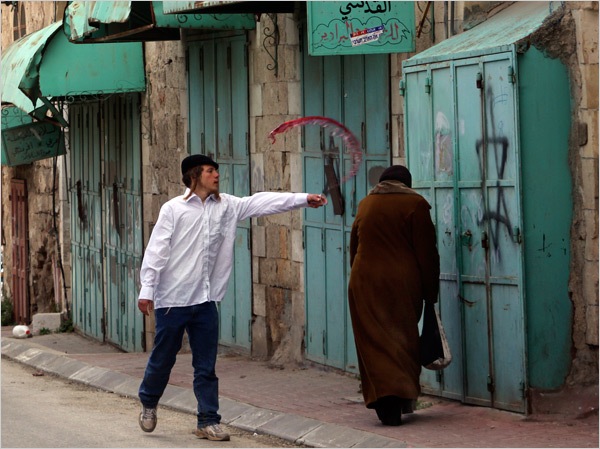
A Jewish settler tosses wine at a Palestinian woman on Shuhada Street in Hebron, the West Bank.

Four years ago, Rory Stewart wrote:

A great many of the failures in Afghanistan and Iraq arise from a single problem: the American-led coalitions’ lack of trust in local politicians. Repeatedly the Western powers, irritated by a lack of progress, have overruled local leaders, rejected compromises and tried to force through their own strategies. But the Westerners’ capacity is limited: they have little understanding of Afghan or Iraqi politics and rely too heavily on troops and money to solve what are fundamentally political and religious problems.

The coalitions cannot achieve political change in the absence of strong local support. And when they try to do so, they undermine their local allies. Iraqi and Afghan national and regional leaders have a far better understanding of the limits and possibilities of the local political scenes; they are more flexible and creative in finding compromises; and unlike the coalition officials, they are elected. They must be given real power and authority. This may seem an obvious prescription — but in fact the coalitions are not allowing it to happen.

Underneath the lack of trust that Stewart correctly identified, is a more fundamental issue: the hubris of power.

We have the guns, the cash, and represent the most powerful nation on Earth. You need to respect us but we really don’t need to respect you. Respect is something we expect but will also on occasions dish out if or when it seems expedient.

Americans, shaped by a culture that tends to place a higher value on power than anything else, are inclined to view respect as simply an element in a power equation. In one situation respect might seem essential, in another merely useful, and in yet another it can be dispensed with. Rarely is it held up as the most vital component in all human relationships.

After President Obama showed up in Kabul just over a week ago, President Karzai showed his uninvited guest and paymaster the courtesy of inviting him to dinner. Obama, the New York Times tells us, returned the courtesy with a thank-you note. “It was a respectful letter,” General James Jones, Obama’s national security adviser told reporters.

The significance of this incident, supposedly, is that it signals an overdue change in tone as the administration registers that its repeated admonitions of the Afghan president have proved counterproductive.

Ironically, an American president whose arrival in office was supposed to herald an historic shift in America’s approach to the world — one which would reinstate the value of soft power — has been a surprisingly clumsy diplomat.

So, if the White House now understands that it must not underestimate the value of respectfulness, that’s a good thing — but let’s not pretend a thank-you note is all it takes.

* * *

Respect is one of those words we use so often we rarely pause to consider its meaning. It describes an attitude, yet its latin root, specere, to look, indicates that this is really a form of attention.

To be respectful is to attentively incline oneself towards the other in recognition of their autonomy and integrity.

There is no one we can respect and simultaneously try to change. When we coerce or manipulate someone, we cannot respect them because our attention is focused not on them but on what we want.

If one views respect as a resource, nowhere is it generally more scarce than among the powerful.

The conceit of power is that power elicits respect, when in truth the tokens of respect bestowed on the powerful are rarely more than expressions of fear, envy or duty. (Hence an underlying paranoia haunts the powerful: they know they are the beneficiaries of a social investment that could, if things turn sour, be swiftly withdrawn.)

Respect is not the fruit of power, but on the contrary, it is a self-propagating virtue that becomes mirrored through its own expression.

Meanwhile, behind what might sound like an overly abstract reflection on respect, another topic floating in the background is Israel, since if one drills to the core of the Middle East conflict, it cannot be reduced to land or religion. It’s about respect.

Can Jews who claimed their “birthright” by dispossessing hundreds of thousands of Palestinians, somehow make peace with those people and their descendants without also acknowledging the Palestinians’ rights to dignity and respect? Yet can such respect be conferred without also calling into question the legitimacy of the Jewish state?

Where is the actual ground for mutual respect when the affirmation of one people’s rights has for six decades depended on the denial of another’s?


Facebooktwittermail

Is the US getting ready to push Israel to declare its nuclear status?

[Updated below] Whatever else can be said about the strained relationship between Barack Obama and Benjamin Netanyahu, one thing is clear: Obama seems intent on keeping Netanyahu off balance.

On Tuesday, Netanyahu announced he would be returning to Washington next week to attend Obama’s Nuclear Security Summit. Just days later, he had changed his mind, ostensibly because of “fears that a group of Muslim states, led by Egypt and Turkey, would demand that Israel sign up to the international Nuclear Non-Proliferation Treaty, or NPT,” Haaretz reported.

An earlier report in the Jerusalem Post, however, had raised that specific issue and said this would not deter the Israeli prime minister from attending the summit:

[O]ne main argument against participation was that Netanyahu’s presence at an international forum dealing with nuclear issues would inevitably draw attention to Israel’s own reported nuclear arsenal, as well as its policy of ambiguity on whether it has nuclear weapons.

Countries such as Egypt, Turkey and Saudi Arabia will certainly – as they do regularly at international nuclear forums – shine the spotlight on Israel and a perceived imbalance: Why is the world so keen on stopping Iran’s nuclear development program, but silent in the face of Israel’s reported nuclear arsenal?

One government official said Netanyahu’s decision to attend, despite this likely scenario, had been made because key issues affecting Israel would be discussed there, and it was important for the Jewish state’s voice to be heard – as well as the realization that Israel’s reported nuclear capacity would be an issue whether Netanyahu participated in the meeting or not.

Earlier, Ynet reported:

US Under Secretary of State for Arms Control and International Security Affairs Ellen Tauscher spoke with Deputy Foreign Minister Daniel Ayalon Tuesday and updated him on US President Barack Obama’s new nuclear proliferation policy.

Tauscher said that the US will strive to protect its allies and work against countries which violate the Non-Proliferation Treaty (NPT) such as North Korea, or countries that fail to meet their commitments to the international community such as Iran.

The under secretary of state stressed that Washington will adopt a “calculated ambiguity” policy towards countries which do not pose a threat to the US. Despite not explicitly pointing to Israel, it appears her statements were meant to reassure the Jewish state.

It’s unclear however, whether the administration’s “calculated ambiguity” was really meant to reassure Israel or do the opposite.

The United States is not on the brink of pushing Israel to sign the Nuclear Non-Proliferation Treaty but it could be signalling its willingness to see pressure applied by others as it provides a platform in Washington for such an effort. Moreover, in a little noted move, the Obama administration appears to be using a new diplomatic tool to signal that Israel’s days of “nuclear ambiguity” may be numbered: Israel’s nuclear scientists are now being shut out of the United States.

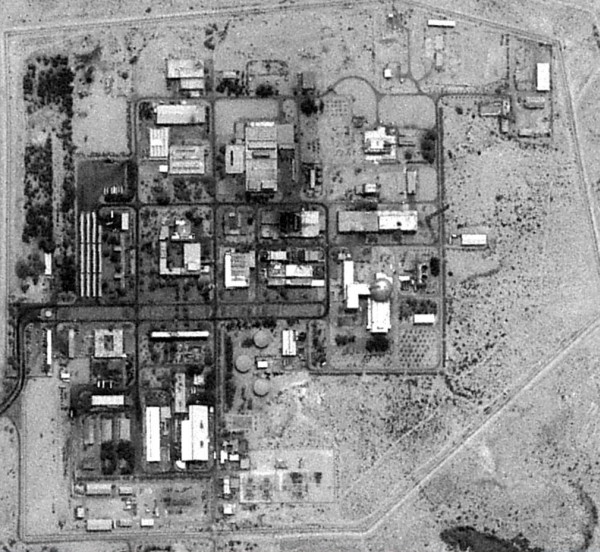
A report on the Hebrew NRG/Maariv website, under a headline, Dimona reactor workers not welcome in the US, says that workers at Israel’s Dimona nuclear research reactor who submitted visa requests to visit the United States for ongoing university education in physics, chemistry and nuclear engineering, have all been rejected, specifically because of their association with the Dimona reactor. According to the report, this is a new policy decision by the Obama administration, since reactor workers were until recently being issued visas to study in the US.

Update: Shortly after I posted this, Politico reported that the White House today denied that there has been any change in its visa policy.

Facebooktwittermail

A presidential death warrant

American soldiers have to be trained how to kill, but for American presidents killing comes naturally.

Anyone who aspires to become president must surely ask themselves: am I willing to end someone else’s life, be that an individual or perhaps tens or hundreds of thousands or even millions of people? After all, even though it’s not spelled out in the Constitution, it’s clear that a pacifist could never hold this office. Killing comes with the territory.

Even so, I can’t help wondering when it was the Barack Obama posed this question and decided, “yes I can.”

With candidate George W Bush we didn’t need to ask the question. He had a track record — as the Governor of Texas he presided over 152 executions. But with Obama, we may never know when he came to regard killing as a tolerable part of his job.

It’s hard to imagine that as a community organizer he ever entertained the idea that wiping people out could become a dimension of working towards the greater good, yet at some point he must have seen this coming and — from all the evidence we now see — not flinched.

But to contrast Obama and Bush as killers, here’s what’s scary and yet passes without comment: Obama’s approach is dispassionate, with no explicit moral calculation. Whereas Bush felt driven to assume an air of righteousness and moral superiority, casting his actions within a drama of good and evil, Obama presents the image of an administrative process through which, after careful analysis and legal and political deliberation, lives are terminated.

Under the morally insidious rubric of “procedures” — a notion that peels away personal responsibility by replacing it with impersonal rules-based behavior — the president, the CIA, the military, the administration, the media, and the American public are all being offered an excuse to look the other way. An unnamed official assured a Washington Post reporter: “[there are] careful procedures our government follows in these kinds of cases.”

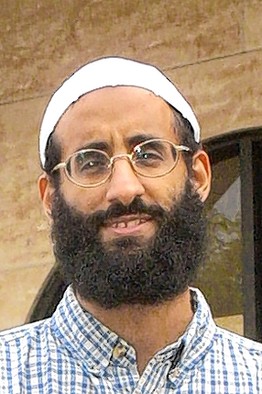
When Anwar al-Awlaki, an American born in New Mexico is shredded and incinerated — his likely fate at the receiving end of a Hellfire missile — there will be no account of the last moments of his life. No record of who happened to be in the vicinity. Most likely nothing more than a cursory wire report quoting unnamed American officials announcing that the United States no longer faces a threat from a so-called high value target.

Representative Jane Harman, Democrat of California and chairwoman of a House subcommittee on homeland security, was out prepping the media and the public on Tuesday when she called Awlaki “probably the person, the terrorist, who would be terrorist No 1 in terms of threat against us.”

Although it was only this week that a US official announced that Awlaki is now on the CIA’s assassination list, US special forces were already authorized and had made at least one attempt to kill the Muslim cleric who now resides in Yemen.

While both the military and the CIA make use of drones for the purpose of remotely controlled assassination, the fact that Awlaki is now considered a legitimate target for “lethal CIA operations” raises questions about the methods the agency might use.

Last summer CIA Director Leon Panetta shut down a secret CIA program which would have operated assassination teams for hunting down al Qaeda leaders. The news was presented as though the new administration was again distancing itself from the questionable practices of the Bush administration, yet at the time, Director of National Intelligence Dennis C Blair told Congress that the termination of that particular program did not rule out the future use of insertion teams that could kill or capture terrorist leaders.

One of the many ironies here is that the Obama administration appears to have abandoned one of the Bush era rationales for torture in favor of its own rationale for murder.

The most frequently used justification for torturing terrorist suspects has been the claim that in the scenario of a so-called ticking time bomb, vital information might be forced out of a suspect enabling an imminent act of terrorism to be thwarted.

Anwar al-Awlaki is supposedly just such a suspect. “He’s working actively to kill Americans,” an American official told the Washington Post. But whatever vital intelligence he might be able to provide, we’ll probably never know. Once dead he won’t hatch any new plots, but as for the ones already set in motion, well, we’ll just have to wait and see what sort of surprises may yet appear.

Needless to say, I am not suggesting that torturing terrorist suspects is any more acceptable than murdering them.

Ken Gude, a human rights expert from the Center for American Progress, argues that Awlaki is a legitimate target for assassination because of his claimed role in assisting the 9/11 attackers. On that basis, his killing would appear to be an act of extra-judicial punishment rather than the removal of a potential threat. But even if the administration sticks assiduously to its focus on future threats, it should not claim a God-like power to predict the future. Nor should it assume that the threat someone poses is necessarily diminished once they are dead.

In weighing the fate of Anwar al-Awlaki, this administration would do well to remember the case of Mohammed El Fazazi, a Moroccan cleric who from a Hamburg mosque preached to Mohammed Atta, Ramzi Binalshibh and Marwan al-Shehhi, three of the men who participated in the 9/11 attacks, that it was the duty of a devout Muslim to “slit the throats of non-believers.”

Eight years later, Fazazi had a new message as he appealed to Muslims to air their grievances through peaceful demonstrations. He is helping turn young men away from violent jihad. But what would stir the hearts of such men now if rather than hearing Fazazi’s moderated message, instead they held the memory of a day he became a martyr when struck by an American Hellfire missile?

Facebooktwittermail

Look in the mirror Avigdor

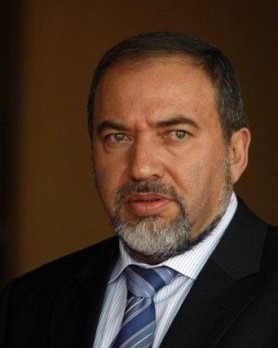
“The problem is not Turkey, the problem is Erdogan,” Israel’s foreign minister, Avigdor Lieberman, told Ynet on Monday.

Sorry Mr Lieberman: it’s you — not Turkey’s prime minister — who has a serious image problem. How many other countries in the world have a foreign minister who would best serve his county’s interests by staying at home and avoiding the media?

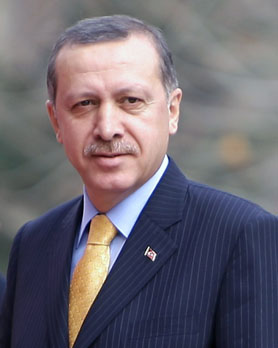
Today while visiting France, Recep Tayyip Erdogan, never one to spurn the diplomatic gifts that Israel so freely gives, was quick to use the opportunity to say plainly what every Western leader knows but lacks the guts to say in public: that Israel is the “principal threat to peace” in the Middle East.

Benjamin Netanyahu says: “We are interested in good relations with Turkey and regret that Erdogan chooses time after time to attack Israel,” but the Israeli prime minister and his foreign minister are indulging in an idle fantasy if they imagine they can drive a wedge between the nation of Turkey and its immensely popular leader.

Moreover, those who want to suggest or insinuate that the most populous Muslim nation that bridges Europe and Asia has somehow been led astray by its Islamist government should pay more attention to Turkey’s economy. Its growth rate is surpassed only by China’s. It survived the global economic crisis without bailing out a single bank and Erdogan has been the driving force behind an economic success story that neither Israel nor anyone else in the region can afford to ignore.

Bloomberg reports:

Erda Gercek spent 20 years outside Turkey, identifying stock market winners as a fund manager at Citigroup Inc. and Legg Mason Inc. Now he has moved back to his homeland, saying it’s a buy.

“In the time I was away, Turkey went from a highly volatile, boom-and-bust economy to one that’s relatively stable as inflation and interest rates came down,” Gercek, 44, said in an interview from Izmir, south of Istanbul. He said he’s “nurturing future talent,” teaching courses in fund management at Istanbul’s Bilgi University and Izmir Economy University.

The paradigm shift, as market strategist John Lomax of HSBC Holdings Plc calls it, was engineered by a government that the military and prosecutors say is trying to turn Turkey into an Islamic state. As Prime Minister Recep Tayyip Erdogan fought off pressure from secularist generals who ousted four governments since 1960 and also a lawsuit to shut his party, he reined in government spending, sold state-owned companies and crisscrossed the region to open trade doors for Turkish business.

The payoff has been average economic growth of 4.4 percent since he was first elected in 2002. Gross domestic product increased at an annual rate of 6 percent in the fourth quarter of 2009, lagging behind only China among the Group of 20 nations, the government said last week. Deputy Prime Minister Ali Babacan said April 2 the economy may have expanded by more than 10 percent in the first quarter.

Turkey’s $620-billion economy could move ahead of Germany’s to become the third-biggest in Europe by 2050, behind Russia and the U.K., Goldman Sachs Group Inc. economist Ahmet Akarli wrote in a report published in 2008.

Facebooktwittermail

Hillary Clinton channeling the neocons

In an interview on Canada’s CTV on Monday, US Secretary of State Hillary Clinton was asked about her reaction to a suicide bombing in the Moscow subway that day:

Question: We’ve had a terrorist attack in Moscow, dozens of people dead. Is this localized, in your view, or is there a wider implication?

Clinton: Well, it’s hard to tell, but I think there is a connection among most of the terrorist activities that we’re seeing around the world. They get encouragement from each other, they exchange training, explosives, information. I don’t know the details of this particular one other than, apparently, they were women who were the suicide bombers. And we know that Moscow has had problems for a number of years now with Chechnya and other places within the Russian Federation. So there are connections. I don’t think we want to go so far as to say they’re all part of the same operation, but certainly, there is a common theme to many of them.

Clinton’s language might not be charged with metaphor but this is a reprise of the neocons’ “unity of terror” meme, an idea that was best expressed in an editorial in the Jerusalem Post in 2003.

After a bombing in Gaza had claimed three American lives the Israeli newspaper declared:

Whether it was Hamas, Islamic Jihad, or perhaps even al-Qaida itself matters little and in fact tends to distract from what the West knows but often does not like to admit: The tentacles all belong to the same enemy.

By the time Clinton had reached the end of her second interview on Canadian television she was backing away from here earlier statement: “I’m not saying there’s a connection between all of these groups, but there certainly is a familiarity, a similarity in how they conduct themselves.”

I see. We’re talking about the conduct of terrorists. Terrorists being identifiable as terrorists because they engage in acts of terrorism. And there we have it: terrorism, a word that permeates everything and means nothing.

After a decade of a global war against terrorism, this is how far America’s understanding of terrorism has advanced: a desperate need to deconstruct meaningless and misleading language has barely been touched upon.

Yet, if the truth be told and extraordinary as the claim might sound, since 9/11 it is the word terrorism — not the phenomena that it attempts to homogenize — that has actually wreaked more havoc around the world than anything al Qaeda could ever have accomplished.

This it turns out was a secret weapon which shed no blood yet crippled thought as it exploded inside the brains of countless millions, rendering otherwise reasonably intelligent people incapable of recognizing that the actions and ambitions of a tiny number of individuals with extremely limited resources could never constitute a global threat unless globalized by the very people who felt threatened.

Facebooktwittermail

Being there

After a recent piece by Tom Engelhardt was republished in the military newspaper Stars and Stripes — his op-ed was on opposition to the scheduled US withdrawal from Iraq — a reader from the military sent Tom an email posing this pointed question: “When was the last time you visited Iraq?” The obvious implication being: if you ain’t been there, you don’t know what you’re talking about.

It’s a reasonable charge and one that can be thrown at most of those of us who are presumptuous enough to write about what’s happening on the other side of the world. For instance, I live in North Carolina and I’m not Jewish, yet I spend a great deal of time writing about Israel, a country I’ve never visited. Shouldn’t I be keeping my nose out of their business?

Up until 9/11 I certainly was minding my own business — but then everything changed. On that day a neoconservative cabal grasped the opportunity to set in motion a process that has shaped the last decade: the Israelification of the world.

In a shockwave that ripped across the planet this was as evident in California (where I lived at that time) as anywhere else. An ideological framework that had been used to deny the legitimacy of Palestinian rights and to justify forms of warfare and collective punishment that contravened international law, was suddenly and seamlessly transposed from the local theater of the Israeli-Palestinian conflict to the global theater of a war on terrorism.

On September 11, we all became Israelis whether we liked it or not. Among those of us who saw what we were being co-opted into as a twisted view of the world, George Bush’s bullhorn had the opposite of its intended effect: it was a call of resistance.

Still, the question, when was the last time you visited Iraq? is a legitimate question.

To have ventured outside one’s neighborhood but only along trails of text, tracing electronic rivulets to their source and soaking in pixelated landscapes, does without question provide a narrowly filtered view of the world.

I am lucky enough to have lived on three continents; to have seen the Buddhas of Bamyan before Osama bin Laden ever dreamed their destruction could light a fuse igniting a clash of civilizations; to have slept in caves and under the stars and to have drunk warm buffalo milk and rancid butter tea. I might not have been to Iraq but I do at least have the privilege of having seen the world from many vantage points.

There is though a sense in which wherever we go, we take our own world with us. Our experience is mediated through our own history. Nevertheless, when we get there — wherever that might be — the extent to which we bridge the gap between going there and being there can have as much to do with how we are seen as it has with what we see. Thus the self-limiting view of the world afforded to so many of America’s soldiers, journalists, missionaries, tourists, and business people who do not meet the world as much as they experience the world meeting America.

It is, as Tom Engelhardt notes, all to easy to go to Iraq (or Afghanistan or anywhere else on the globe) without really being there. Here’s part of Tom’s thoughtful response to his Stars and Stripes reader:

Sometimes being far away, not just from Iraq, but from Washington and all the cloistered thinking that goes with it, from the visibly claustrophobic world of American global policymaking, has its advantages. Sometimes, being out of it, experientially speaking, allows you to open your eyes and take in the larger shape of things, which is often only the obvious (even if little noted).

I can’t help thinking about a friend of mine whose up-close and personal comment on U.S. military commanders in Afghanistan was that they were trapped in an American-made box, incapable of seeing beyond its boundaries — of, that is, seeing Afghanistan. Let me be clear: I have no doubt that being there is generally something to be desired. But if you take your personal blinders with you, it often hardly matters where you are. Thinking about my Stars and Stripes reader’s question, the conclusion I’ve provisionally come to is this: It’s not just where you go, it’s also how you see what’s there, and no less important who you see, that matters — which means that sometimes you can actually see more by going nowhere at all.

When American officials, civilian or military, open their eyes and check out the local landscape, no matter where they’ve landed, all evidence indicates that the first thing they tend to see is themselves; that is, they see the world as an American stage and those native actors in countries we’ve invaded and occupied or where (as in Pakistan, Somalia, and Yemen) we conduct what might be called semi-war as so many bit players in an American drama.

Facebooktwittermail

The status quo is unsustainable. Really?

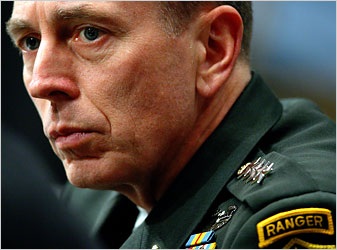
A week ago, Gen David Petraeus referred to “a perception of U.S. favoritism for Israel” that fuels anti-American sentiment across the Middle East.

He knows — as does anyone else who is even marginally aware of the issues — that this is not simply a matter of perception.

The United States does not merely exhibit favoritism towards Israel. Its political leaders express a level of loyalty towards the Jewish state that should be regarded as unseemly by any patriotic American.

Last week, right on the heels of receiving what was widely regarded as a monumental insult, Joe Biden said: “Throughout my career, Israel has not only remained close to my heart but it has been the center of my work as a United States Senator and now as Vice President of the United States.”

On Friday, Hillary Clinton spoke of US relations with Israel as “deep and broad, strong and enduring,” and today at the AIPAC conference in Washington said that America’s future is “bound up with the future of Israel.”

This is the status quo that should be changed but shows every sign of being thoroughly sustainable. It is one in which American politicians shamelessly pander to Israel’s wealthy supporters and cast aside any semblance of dignity in their efforts to display their unfailing devotion to the Jewish state.

The obsequious nature of these flourishes of unvarnished affection is further reinforced by the fact that neither on a political level nor a popular level are such feelings reciprocated from the other side.

As Chris McGreal wrote yesterday:

In a country permeated by fear and insecurity, Israelis define the rest of the world not by loyalties but by varying degrees of distrust. You can hear it among residents of Jewish settlements deep in the occupied territories and in the cafes of liberal Tel Aviv: angst over the perception of a new wave of antisemitism gripping Europe, the incomprehension over foreign condemnation of Israel’s crimes in Gaza, the common agreement that the United Nations is a conspiracy against the Jewish state.

In all of this, the US emerges as the least distrusted country by far… . Israelis recognise that they have long counted on Washington to pay a good chunk of their military budget and provide diplomatic cover for the illegalities of occupation.

Israel depends on defense and political aid from Washington and Washington dances to the tune of the Israel lobby.

Those who now hold on to the notion that this administration is intent on shifting the political dynamic simply because it proclaims that the Israeli-Palestinian status quo is unsustainable are paying attention to the wrong status quo.

Facebooktwittermail

Where’s Joe Biden?

Has the vice president gone missing? Or is he hiding in a secure undisclosed location?
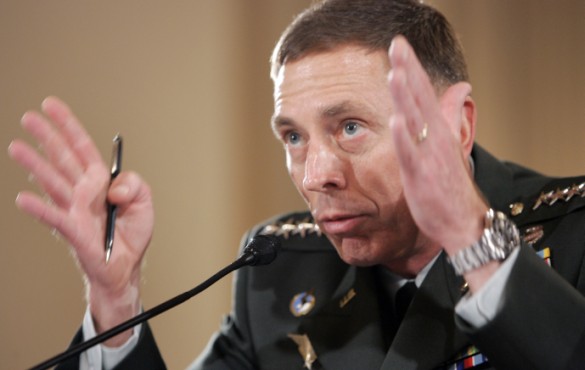
Strong words delivered by Joe Biden during his visit to Israel were widely reported last week.

“This is starting to get dangerous for us,” Biden warned his Israeli hosts. “What you’re doing here undermines the security of our troops who are fighting in Iraq, Afghanistan and Pakistan. That endangers us and it endangers regional peace.”

Many in Washington were apparently so shocked that Biden could have said something like this, they were, for several days, dumb-struck and rendered immobile.

One of the first to regain his senses was Jeffrey Goldberg. It can’t be true, Goldberg thought, and then set about getting to the bottom or at the very least the periphery of the story.

Where would one turn if one wanted to find out what the vice president said? Maybe the Office of the Vice President? Not if you’re Goldberg. He asked some fellow at the White House.

Meanwhile, Eric Re-Cantor had a chat with Rahm Emanuel, and the White House Chief of Staff confirmed that he too had heard from some guy (could have been Biden himself — we don’t know) that Biden was misquoted.

I guess I’m a bit of a stickler because when it comes to establishing what Biden did or did not say, I’d prefer to hear it from the vice president himself — or at least in a written statement from his office. He has a reputation for being blunt. I dearly hope he hasn’t lost it.

Facebooktwittermail

Israel is empowering al Qaeda, Petraeus warns

As erupting violence in Jerusalem suggests a third intifada may soon take hold, the CENTCOM commander Gen David Petraeus, testifying before the US Senate Armed Services Committee today, gave a grave warning about the wider impact of a conflict that has been the epicenter of Middle East hostilities ever since the creation of Israel.

In issuing his warning, Petraeus — arguably the most influential even if not the highest ranking member of the US military — was reiterating a statement he made almost a year ago. The only difference between what he said in April 2009 and what he said today, was that he now acknowledges al Qaeda is being strengthened by the conflict.

He now says:

The enduring hostilities between Israel and some of its neighbors present distinct challenges to our ability to advance our interests in the AOR [CENTCOM’s area of responsibility]. Israeli-Palestinian tensions often flare into violence and large-scale armed confrontations. The conflict foments anti-American sentiment, due to a perception of U.S. favoritism for Israel. Arab anger over the Palestinian question limits the strength and depth of U.S. partnerships with governments and peoples in the AOR and weakens the legitimacy of moderate regimes in the Arab world. Meanwhile, al-Qaeda and other militant groups exploit that anger to mobilize support. The conflict also gives Iran influence in the Arab world through its clients, Lebanese Hizballah and Hamas.

If such a statement was being made outside the American political arena, it could be regarded as a rather bland expression of what has long been utterly obvious. Yet from the lips of a celebrated general, regarded by many as a potential future president, these words come as a bombshell.

Neoconservatives and the Israel lobby have worked hard and long to obscure the deeply corrosive regional impact of a conflict that successive Israeli leaders have either been unwilling or seemingly incapable of resolving. Others, who earlier said what Petraeus now says, have either been dismissed as poorly informed or worse, branded as anti-Israeli or by insinuation, anti-Semitic.

No such charge will stick to Petraeus. Indeed, if the Israel lobby was so foolhardy as to try and go after an American general who sometimes gets treated like a latterday Eisenhower, the lobby will be at dire risk of being visited by its own greatest fear: being branded as anti-American.

Facebooktwittermail

Israel is putting American lives at risk

In Foreign Policy, Mark Perry describes an extraordinary Pentagon briefing on Israel’s impact on conflicts across the Middle East. Here is an excerpt and following some comments of my own, the author has provided me with additional background on his reporting.
[Important update: A senior military officer told Foreign Policy by email that one rather minor detail in Perry’s report was incorrect. A request from Gen Petraeus for the Palestinian occupied territories to be brought within CENTCOM’s region of operations was sent to the Chairman of the Joint Chiefs of Staff, Admiral Mullen, and not directly to the White House (who may or may not have subsequently been consulted). It is significant that the Pentagon made this correction, not because it was an important detail but on the contrary, because it was inconsequential to the overall narrative. In effect, the Pentagon clearly but discreetly said that there was virtually nothing in this report that could be denied.]

On January 16, two days after a killer earthquake hit Haiti, a team of senior military officers from the U.S. Central Command (responsible for overseeing American security interests in the Middle East), arrived at the Pentagon to brief JCS Chairman Michael Mullen on the Israeli-Palestinian conflict. The team had been dispatched by CENTCOM commander David Petraeus to underline his growing worries at the lack of progress in resolving the issue. The 33-slide 45-minute PowerPoint briefing stunned Mullen. The briefers reported that there was a growing perception among Arab leaders that the U.S. was incapable of standing up to Israel, that CENTCOM’s mostly Arab constituency was losing faith in American promises, that Israeli intransigence on the Israeli-Palestinian conflict was jeopardizing U.S. standing in the region, and that Mitchell himself was (as a senior Pentagon officer later bluntly described it) “too old, too slow…and too late.”

The January Mullen briefing was unprecedented. No previous CENTCOM commander had ever expressed himself on what is essentially a political issue; which is why the briefers were careful to tell Mullen that their conclusions followed from a December 2009 tour of the region where, on Petraeus’s instructions, they spoke to senior Arab leaders. “Everywhere they went, the message was pretty humbling,” a Pentagon officer familiar with the briefing says. “America was not only viewed as weak, but its military posture in the region was eroding.” But Petraeus wasn’t finished: two days after the Mullen briefing, Petraeus sent a paper to the White House requesting that the West Bank and Gaza (which, with Israel, is a part of the European Command – or EUCOM), be made a part of his area of operations. Petraeus’s reason was straightforward: with U.S. troops deployed in Iraq and Afghanistan, the U.S. military had to be perceived by Arab leaders as engaged in the region’s most troublesome conflict.

The Mullen briefing and Petraeus’s request hit the White House like a bombshell. While Petraeus’s request that CENTCOM be expanded to include the Palestinians was denied (“it was dead on arrival,” a Pentagon officer confirms), the Obama Administration decided it would redouble its efforts – pressing Israel once again on the settlements issue, sending Mitchell on a visit to a number of Arab capitals and dispatching Mullen for a carefully arranged meeting with Chief of the Israeli General Staff, Lt. General Gabi Ashkenazi. While the American press speculated that Mullen’s trip focused on Iran, the JCS Chairman actually carried a blunt, and tough, message on the Israeli-Palestinian conflict: that Israel had to see its conflict with the Palestinians “in a larger, regional, context” – as having a direct impact on America’s status in the region. Certainly, it was thought, Israel would get the message. [Read the rest of the report here.]

In December 2006, the Iraq Study Group Report was explicit in making this linkage: “The United States cannot achieve its goals in the Middle East unless it deals directly with the Arab-Israeli conflict and regional instability.”

What Mark Perry’s report indicates is that for the Obama administration a tipping point has been crossed in its perception of Israel’s effect on the conflicts that span the region.

Until now, the necessity for a resolution of the Arab-Israeli conflict has been framed in quasi-positive terms — such as that it would help defuse some of the hostility that the US now faces, or, that it would strengthen an alliance of nations attempting to curtail Iran’s nuclear program.

The shift, as expressed by Joe Biden last week and by the Petraeus briefing in January is that Israel is now being seen as a liability: the Jewish state is putting American lives at risk. “This is starting to get dangerous for us,” Biden reportedly told Netanyahu.

Such a shift marks a watershed in US-Israeli relations and so Perry’s report naturally raises questions. Indeed, the first line of defense from Israel and its supporters will be to claim that, on the contrary, recent events are nothing more than a bump in the road; that we can expect a quick resumption of business as usual between such close allies.

For this reason, I asked Mark — who I have had the privilege of working with in recent years — to provide some background to his report. This is what he said:

My piece on the briefing of Admiral Mullen by CENTCOM senior officers has occasioned a great deal of comment, as well as some skepticism: how accurate is the account? Was it told to me by direct participants in the briefing? Is there any basis for imagining that Petraeus has any kind of hidden agenda, whether that is a desire to expand CENTCOM – or even hostility towards Israel.

I won’t name my sources, even though it’s clear to people in the Pentagon – and certainly to General Petraeus – who they are. Was I told of the briefing by the briefers themselves? I will only say that there were four people in the briefing – the two briefers, Admiral Mullen, and Admiral Mullen’s primary adviser on the Israeli-Palestinian conflict. I know two of the people involved in the briefing. Whether or not they are my sources is something for the reader to determine. The account is not only accurate, it’s a precis of what actually happened. There is a lot more to it. The White House, State Department and Pentagon have not denied the account, and for good reason: it’s true.

Is there any basis for imagining that Petraeus has any kind of hidden agenda in ordering the briefing?

I have been reporting on the American military for thirty years. My work on the Joint Chiefs of Staff, Four Stars, is the authoritative account on the subject. I have deeply rooted contacts in the military that go back thirty years. I have never met a senior military officer whom I do not admire. There is no greater insult than to believe that General Petraeus or any other senior American military officer would use the lives of American soldiers as a lever to enhance their own political future. My sense is that General Petraeus neither likes nor dislikes Israel: but he loves his country and he wants to protect our soldiers. The current crisis in American relations with Israel is not a litmus test of General Petraeus’s loyalty to Israel, but of his, and our, concern for those Americans in uniform in the Middle East.

It is, perhaps, a sign of the depth of “the Biden crisis” that every controversy of this type seems to get translated into whether or not America and its leaders are committed to Israel’s security. This isn’t about Israel’s security, it’s about our security.

Facebooktwittermail

Obama gets kind of tough with Netanyahu

The Los Angeles Times says: “a dispute this week between the Obama administration and Israel has ballooned into the biggest U.S.-Israeli clash in 20 years.”

Tom Friedman says: “what the Israelis did played right into a question a lot of people are asking about the Obama team: how tough are these guys? The last thing the president needs, at a time when he is facing down Iran and China — not to mention Congress — is to look like America’s most dependent ally can push him around.”

But then Washington hit back — bam!

This is how Aluf Benn describes Obama’s get-tough approach:

Washington delivered its rebuke to Netanyahu through a number of channels. There was the extended censure by telephone from Secretary of State Hillary Clinton, a phone call from Biden, the summoning of Israel’s ambassador to Washington to the office of Deputy Secretary of State James Steinberg, the condemnation from the Quartet and, perhaps most important, a media briefing Clinton delivered during a CNN interview which escalated private rebukes into a full-blown public reprimand.

The reproofs were reminiscent of the “low chair diplomacy” the Turkish ambassador to Jerusalem was subjected to by the Israeli Foreign Ministry at the beginning of the year. The media was informed that the conversation between Clinton and Netanyahu lasted 43 minutes, “rather than 10 minutes as usual,” and that the prime minister barely uttered a word.

Obama himself reportedly worded the message to be delivered to Netanyahu during his weekly Thursday meeting with Clinton, lest the argument be made that it was merely the secretary of state scolding the Israeli leader, and not the U.S. president himself.

A State Department spokesman described the conversation using phrases which bring to mind a teacher castigating a student, not a working discussion with the leader of a friendly country and ally.

The substance was no less damning than the form – Clinton spoke of an “insult” to the United States and of “harming bilateral ties.” She could not understand, she said, how such a thing could have been done in light of America’s strong obligation to Israel’s security. U.S. media interpreted these remarks as suggesting that Washington’s military support for Israel is hardly unconditional.

Clinton dismissed Netanyahu’s explanation that the decision to approve the housing plan was made without his knowledge, reminding him that as prime minister he is responsible for his government’s actions.

The statements from the United States were publicized Friday evening – Shabbat – while Israel was officially unable to respond, therefore affording the White House a media exclusive. The instinctive reaction from Netanyahu and his associates was to accuse Washington of a diplomatic ambush, to simply rely on the support of his backers in the United States. Indeed, Abraham Foxman, national director of the Anti-Defamation League, was the first to charge the White House with “humiliating” the Israeli prime minister.

This week presents Netanyahu with a difficult decision. He may choose to visit Washington as planned to speak at the AIPAC conference, which would embarrass the preeminent pro-Israel lobby and put it on a collision course with the Obama administration. Senior U.S. officials will likely decline meetings with him, unless he agrees to at least some of Washington’s conditions. Canceling his flight, however, will be interpreted as acknowledgment of the crisis in U.S.-Israel ties.

High drama! But will it be of any lasting consequence? I really doubt it.

To put this in perspective we should not forget that the initiative the Obama administration is in a desperate effort to salvage — so-called proximity talks — is one that virtually no one had any confidence would accomplish anything in the first place. A successful resolution to the current dispute means getting this initiative back on a track that leads nowhere.

The Jerusalem District Planning and Building committee has canceled two meetings planned for this week. Big deal. It can reschedule them in a few weeks once America and the media are suitably distracted by current events. Indeed, the closer mid-term elections come, the greater this administration’s interests will be in restoring cordial relations with Israel.

Daniel Levy, a former adviser to then-Israeli prime minister Ehud Barak, says the administration is trying to “lay down a marker with [Netanyahu] that they will not allow him to make them look weak,” and no doubt that is true, but this is a marker on a movable line.

Nothing Netanyahu does or refrains from doing will reverse the perception of weakness that was Obama’s own doing when he caved on the issue of imposing a settlement freeze. To insist that this Israeli prime minister avoid doing anything to embarrass the US president merely underlines the extent to which this president is already highly susceptible to appearing weak.

As for whether the Israeli government has any interest in making meaningful gestures of reconciliation with the Palestinians, Ma’an reports on the latest indication: an order from Israeli authorities for the demolition of a mosque in Nablus, right in the heart of the West Bank.

Facebooktwittermail

Time for George Mitchell and the US to step aside

Among commentators unable to see beyond the bankrupt perspective that the United States has the indispensable role of mediating a Middle East peace agreement (if such an agreement is ever to be reached), much is being made about Joe Biden’s tough words “behind closed doors”. Laura Rozen quotes from a Yedioth Ahronoth report:

People who heard what Biden said were stunned. “This is starting to get dangerous for us,” Biden castigated his interlocutors. “What you’re doing here undermines the security of our troops who are fighting in Iraq, Afghanistan and Pakistan. That endangers us and it endangers regional peace.”

The vice president told his Israeli hosts that since many people in the Muslim world perceived a connection between Israel’s actions and US policy, any decision about construction that undermines Palestinian rights in East Jerusalem could have an impact on the personal safety of American troops fighting against Islamic terrorism.

Help us fight the war on terrorism, Biden admonishes his Israeli friends. But we are, they think but in this instance are too polite to say. That’s why we’re taking over East Jerusalem. We’re fortifying the front-line.

It seems to me that the crux of the issue is not the latest upset; it is that the so-called peace process has always rested on an unbalanced foundation. Which is to say, Israel will only accept the direct involvement of third parties that have a clear bias in their favor.

If President Obama wanted to do something truly radical, it might not have to take the form of applying pressure — pressure that would be fiercely and effectively resisted by the Israel lobby. On the contrary, it could be to acknowledge that American efforts have failed — not only his own but those of all his predecessors — and that there comes a point when failure has been so persistent and become so predictable, that it is time to step aside.

There is someone else waiting in the wings, eager to step in — a man who regards dialogue as the essence of politics and who can make a stronger claim to be even-handed than anyone in the United States or Europe: Brazil’s President Lula da Silva. He also happens to be the most popular political leader in the world.

Ahead of his visit to the Middle East next week, where his first stop will be in Israel, Lula was interviewed by Haaretz:

Lula was one of the first leaders to host President Mahmoud Ahmadinejad after Iran’s blood-stained election of June 2009. Brazil was also one of only five countries to abstain from an International Atomic Energy Agency vote last November on a condemnation of Iran.

He is set to visit the Islamic Republic in May, where his hosts will repay him in kind for the red carpet he laid out for them in Brasilia last November. When asked how he’ll be able to win over the Israelis, whose vantage point is related to the trauma of the Holocaust, Lula replies: “I spoke with the president of Iran and made it clear to him that he cannot go on saying that he wants Israel’s liquidation, just as it is untenable for him to deny the Holocaust, which is a legacy of all humanity. I added that the fact that he has differences with Israel does not allow him to deny or ignore history.”

In a way that will undoubtedly disturb those who will host him in Israel next week, Lula draws a direct association between the failure to advance Israeli-Palestinian peace and his planned visit to Tehran; between the need to ensure that Iran will not manufacture nuclear weapons and the need to resolve the Middle East conflict; and between the failed attempts at mediation led by international players, first and foremost the United States, and the need to bring in fresh new players – Brazilians, in all likelihood.

“I talked about Iran with many leaders, and particularly with those whose countries have a seat on the Security Council,” he explains. “The Americans, the French, the British, the Russians and the Chinese all want to advance the Middle East peace process. But I also feel that the parties to the conflict and the people involved in the process have long since grown tired of it. So, the time has come to bring into the arena players who will be able to put forward new ideas. Those players must have access to all levels of the conflict: in Israel, in Palestine, in Iran, in Syria, in Jordan and in many other countries that are associated with this conflict. This is the only way we will be able to advance Israeli-Palestinian peace, and at the same time be able to say clearly to Iran that we are against the manufacture of nuclear weapons.”

Lula does not overlook any of the elements in this comprehensive linkage when asked about the fact that Israeli patience regarding Iran seems to have worn thin. “The leaders I spoke to believe that we must act quickly, otherwise Israel will attack Iran. I do not want Israel to attack Iran, just as I do not want Iran to attack Israel. In an orderly world, people have to learn to talk to one another.” Here he seems to be alluding critically to the “proximity talks” about to get underway between Israel and the Palestinian Authority.

“The appropriate partners from each country have to be found, and more serious talks conducted,” he continues. “The importance of talks between third- and fourth-rank officials [does not hold] even 1 percent of the importance of tete-a-tete talks between leaders. Politics is mainly contact. People have to look at each other, sense each other. A leader has to look into the eyes of his interlocutor instead of communicating with him through lower-level individuals.”

The Brazilian president says he is disappointed that all that remains of the Oslo Accords is “Nobel Prizes and photographs of people hugging each other,” as well as the fact that the Annapolis conference of November 2007, in which Brazil participated, did not have any follow-up. “This gives me serious doubts: Who really wants peace in the Middle East? Who has an interest in achieving a solution and who would like the conflict to continue? The impression is that someone is constantly working here as though he has hidden enemies, people who simply do not want an agreement to be reached.”

Lula describes himself as a negotiator, not an ideologue, a person who manages to get along with both Hugo Chavez and George W. Bush, with Shimon Peres and Mahmoud Ahmadinejad. He says he has never read a book in his life, even though everyone admires his “supreme wisdom” and “creative mind.” As a chairman of the workers union during the years of military rule in Brazil, he encountered and resolved many difficult conflicts.

“I was born into the politics of dialogue, I became president of this country through dialogue and I have conducted my entire presidency by means of dialogue. I believe that through dialogue we will succeed in solving all the conflicts which today appear to be unsolvable,” he says.

He is well aware that he will be regarded as “naive” by his Israeli interlocutors. He is also familiar with the counter-rhetoric of Prime Minister Benjamin Netanyahu – who likens Ahmadinejad to Hitler, Iran to the Nazi regime and the world of 2010 to that of 1938. Lula’s assertive response is likely to surprise even those familiar with his arguments: “Anyone who compares Ahmadinejad and modern-day Iran to Hitler and the Nazis is having the same kind of radicalism of which Iran is being accused. Anyone who takes that line is not contributing in the least to the peace process which we want to create for the sake of the future. You cannot do politics with hate and resentment. Anyone who wants to do politics with hate and resentment should get out of politics. Nobody can rule a country through the liver. You have to rule a country with your head and your heart. Other than that, it’s best to stay somewhere else other than in politics

No doubt many veterans of the peace process would scoff at the notion that the Brazilian leader might succeed where those who have made this undertaking their professions have consistently failed. But if there is one place failure should succeed it is in the cultivation of humility.

As for the Israelis, there seems little prospect that they have the stomach for a genuinely even-handed approach and if they were to decline such an offer then that is undoubtedly their prerogative. They should be given these options: fair mediation or splendid isolation.

Claudio Lottenberg, the president of Sao Paulo’s Albert Einstein Hospital and a leader of Brazil’s Jewish community notes: “Lula is an important rising player in the international arena, and Israel should take account of this. It is important for Israel to have partners and allies besides the United States.”

But not only is Lula an important figure; Brazil itself clearly has much to teach a world which must become a multicultural success if it is to have any future at all.

Lula’s ambition to make a deep imprint in the Middle East goes beyond his country’s international status, to what he describes proudly as “a long Brazilian history of peace and a life of brotherhood in a region of diverse cultures. More than 120,000 Jews live here in full harmony with 10 million Arabs. It would seem that people can learn from us.” Brazil terms itself “the world’s largest Lebanese country” (some six million of Brazil’s Arabs are of Lebanese origin), “the second-largest African country in the world” (after Nigeria), and also the second-largest Italian and Japanese countries. It is a huge blend of peoples and cultures that do not know the meaning of friction.

You’d be hard-pressed to find someone in Rio de Janeiro who hasn’t heard of Saara Street, where Jews and Arabs sell clothing, toys and other items side by side. Whenever tension in the Middle East rises, local television crews show up to film the Brazilian version of coexistence. “All Brazilians are brothers,” they say – hence their ability, in their view, to bring brotherhood to all other nations.

Facebooktwittermail

East Jerusalem in a Jewish stranglehold

Isn’t it time that the “two-state solution” be regarded as an object of the imagination no more real than the Tibetan kingdom of Shambala?

At the heart of this Middle Eastern fable is another Shangri-La: Jerusalem, capital of the Jewish state and a Palestinian state.

In reality, Jews in an unremitting march of expansion are taking over the whole city, making sure that East Jerusalem will never become a Palestinian capital.

As this report reveals:

Some 50,000 new housing units in Jerusalem neighborhoods beyond the Green Line are in various stages of planning and approval, planning officials told Haaretz. They said Jerusalem’s construction plans for the next few years, even decades, are expected to focus on East Jerusalem.

Most of the housing units will be built in predominantly Jewish neighborhoods beyond the Green Line, while a smaller number of them will be built in Arab neighborhoods. The plans for some 20,000 of the apartments are already in advanced stages of approval and implementation, while plans for the remainder have yet to be submitted to the planning committees.

When the Netanyahu government resisted pressure from the Obama administration to impose a settlement freeze, it also made it clear that it regards Jerusalem as indivisible and outside the scope of any agreement on settlements.

As for the “unprecedented” concessions that Secretary Clinton applauded in late October, this is the outcome:

Three and a half months in, the settlement freeze is turning out to be more of a slowing down. With all the exceptions being made, its effect is limited and it appears to be mainly a demonstration of Israel’s willingness to offer concessions to expedite the renewal of negotiations. The total disappearance of the settlers’ protests against the freeze, which they originally described as a disaster, testifies to the actual state of things.

Meanwhile, Jewish extremists occupying Palestinian homes in Sheikh Jarrah in East Jerusalem have gained attention most recently as they sing the praise of the settler and mass murderer Baruch Goldstein:

.

Andrew Sullivan sees “massive Israeli demonstrations” as a sign that the Goldstein supporters are a small minority. Their behavior certainly makes them an easy target for criticism but in a way they seem to serve more as a distraction than to highlight the problem.

The plans to expand the Jewish population in East Jerusalem are unlikely to mean that the putative Palestinian capital will be populated with Goldstein supporters. On the contrary, most of these Israelis are likely to move into East Jerusalem for economic rather than ideological reasons, confident that the neighborhoods in which they live will remain under the authority of the Israeli government.

Even if the majority of Israelis actually thought that the creation of a Palestinian state would be a positive development, all the evidence suggests that most Israelis simply don’t believe that such a state is ever going to exist. Israel has invested too deeply in its claim to Palestinian territory to ever let go. Indeed, the perpetuation of the two-state myth has actually served to make a two-state solution impossible.

The impasse in the peace process is not a failure to implement a two-state solution; it is a failure to confront the realities which must be grappled with once such a proposition is abandoned.

Facebooktwittermail

The price tag for Israeli intransigence

The day before Vice President Joe Biden arrived in Israel — supposedly on a mission to help kick-start peace talks between Israelis and Palestinians — the Netanyahu government made its contempt for the Obama administration clear by approving new settlement construction.

They were quick to take offense — they being the Israelis!

“While we welcome Vice President Biden, a longtime friend and supporter of Israel,” Danny Danon, the deputy speaker of the Knesset, told the Washington Post, “we see it as nothing short of an insult that President Obama himself is not coming.”

Washington on the other hand had no interest in creating a fuss about settlement growth — its impotence on that particular issue has already been amply demonstrated. Pushing for a real settlement freeze is passé. The new game is proximity talks and shuttle diplomacy.

After 17 years of direct talks it’s now time to talk from a distance and have George Mitchell like an Energizer bunny going back and forth between Jerusalem and Ramallah. Irrespective of how much life there might be in his batteries, the Arab League has thankfully imposed a four-month deadline on this charade.

If the latest “initiative” seems like an exercise in atmospherics, an Israeli official was straightforward enough to confirm the fact when he told Ynet that resuming talks with the Palestinians “would create an atmosphere in the Arab world and the international community that would allow the world to focus on the real threat – Iran.”

George Mitchell is going to allow the Israelis to talk to the Palestinians so that the world can focus on Iran.

It’s not a novel idea. It came up three-and-a-half years ago in Washington when Philip Zelikow, Special Counselor to then-Secretary of State Condoleezza Rice, caused a stir by making a similar linkage between the threat from Iran and the Israeli-Palestinian conflict.

The controversy in Zelikow’s suggestion was that it hinted that the Bush administration might defy Tel Aviv and remove the peace process from its preservative, but Zelikow’s concern was the same as that of the Israelis now: how to mount pressure on Iran. This depended, he said, on strengthening an anti-Iran coalition.

What would bind that coalition and help keep them together is a sense that the Arab-Israeli issues are being addressed, that they see a common determination to sustain an active policy that tries to deal with the problems of Israel and the Palestinians. We don’t want this issue … [to] have the real corrosive effects that it has, or the symbolic corrosive effects that it causes in undermining some of the friends we need [as] friends to confront some of the serious dangers we must face together.

Note that Zelikow was not pushing for anything so grand as a resolution to the conflict, merely that an effort be made to create “a sense” that the issues were being addressed.

Initiatives, summits, and dark-suited earnestness with a liberal sprinkling of handshakes — we all know the routine. “What will they ask Israel to do? Meet with Abu Mazen? – so you’ll meet with Abu Mazen,” one Washington hand told Haaretz at the time.

That was 2006. Now in 2010 the Israelis don’t even need to inconvenience themselves by sitting in the same room as the Palestinians, even though Netanyahu would be happy to be granted the photo-op of face-to-face talks — talks that he can be confident will be fruitless.

The anti-Iran coalition might still be rather shaky but there is another coalition that has proved to be durable and near universal: the coalition of states who remain content to pay lip-service to the Palestinian issue; the political leaders who gladly shake hands with Mahmoud Abbas as though having Ramallah’s jaded political leaders received in global capitals was all the Palestinians could ever have aspired for.

But when it comes to dealing with the Israelis no one has a better understanding than the Israelis themselves. Jewish settlers in the West Bank insist that if they are uprooted, others will be forced to pay the “price tag.”

President Obama on the other hand insists that for Israel “the status quo is unsustainable” but neither he nor any of the other political leaders who profess some level of concern for the Palestinians have been willing to exact a price for Israeli intransigence. Until a price tag is applied effectively, Israel can remain confident in the durability of the status quo.

Facebooktwittermail

Obama wants to expand America’s military reach

As President Obama prepares to present his first Nuclear Posture Review, the news is that he’s about to announce plans to eliminate thousands of nuclear weapons from the United States arsenal. So good so far — but it gets worse from here on in.

If a smaller arsenal might look like a step towards the elimination of nuclear weapons, the fact that this president wants to retain a first strike option is not a step in the right direction. Worst of all are the designs for a non-nuclear future in the shape of what is called “Prompt Global Strike” — the ultimate form of remote warfare through which the US could strike any target on the planet in less than an hour.

This is how the New York Times describes the new class of non-nuclear weapons:

The idea, officials say, would be to give the president a non-nuclear option for, say, a large strike on the leadership of Al Qaeda in the mountains of Pakistan, or a pre-emptive attack on an impending missile launch from North Korea. But under Mr. Obama’s strategy, the missiles would be based at new sites around the United States that might even be open to inspection, so that Russia and China would know that a missile launched from those sites was not nuclear — to avoid having them place their own nuclear forces on high alert.

Better than firing nuclear weapons, isn’t it? Of course. But the one virtue of strategic nuclear weapons is that their use has seemed unthinkable to a point where we’ve gone 65 years without their use — apart from in testing.

To call Prompt Global Strike a “non-nuclear option” is to imply that it is some kind of relatively benign alternative to nuclear force. On the contrary, what we’re looking at here are two classes of weapons of mass destruction: one whose primary function is that they be held in reserve as a diabolical threat; the other system is very much designed for use. Indeed, one can imagine that at some point in his or her term of office, every American president will make a point of showcasing American power with a prompt global strike.

Noah Shachtman describes how this would work:

A tip sets the plan in motion — a whispered warning of a North Korean nuclear launch, or of a shipment of biotoxins bound for a Hezbollah stronghold in Lebanon. Word races through the American intelligence network until it reaches U.S. Strategic Command headquarters, the Pentagon and, eventually, the White House. In the Pacific, a nuclear-powered Ohio class submarine surfaces, ready for the president’s command to launch.
When the order comes, the sub shoots a 65-ton Trident II ballistic missile into the sky. Within 2 minutes, the missile is traveling at more than 20,000 ft. per second. Up and over the oceans and out of the atmosphere it soars for thousands of miles. At the top of its parabola, hanging in space, the Trident’s four warheads separate and begin their screaming descent down toward the planet. Traveling as fast as 13,000 mph, the warheads are filled with scored tungsten rods with twice the strength of steel. Just above the target, the warheads detonate, showering the area with thousands of rods-each one up to 12 times as destructive as a .50-caliber bullet. Anything within 3000 sq. ft. of this whirling, metallic storm is obliterated.

If Pentagon strategists get their way, there will be no place on the planet to hide from such an assault.

What Prompt Global Strike is really about is turning inter-continental ballistic missiles (minus nuclear warheads) into usable weapons.

Facebooktwittermail

At what point will the West dump Israel?

For those of us who view the Israeli-Palestinian conflict as being an issue of injustice, there’s plenty of reason to believe no resolution is in sight simply because justice is one of the weakest among the principles governing world affairs. To this extent, Israeli leaders can feel confident in their sense of impunity.

But there is another line Israel crosses at its peril: where its actions conflict with the commercial interests of its allies. Israel can be a moral liability but it cannot be a financial liability.

US taxpayers have every reason to feel that Israel, as the largest single recipient of US foreign aid, is already a massive financial liability. Even so, since most of those tax dollars get plowed straight back into the US defense industry, Washington is unlikely to become more attentive to the concerns of ordinary American citizens than it is to the interests of its corporate sponsors.

Nevertheless, there is now reason to think that with the murder of Mahmoud al Mabhouh in Dubai, Israel crossed a line that strains the limits of Western tolerance. Western governments would have paid scant attention to this event were it not for one egregious error by Mossad: its flagrant disregard for the integrity of foreign passports.

For many international travelers from Western countries, a passport might seem like nothing more than an obligatory document of no extraordinary value, yet in many ways these carefully bound and embossed permits are the lubricants of globalization. Swift passage through immigration control is one of the things that keeps the wheels of business turning smoothly.

But anyone traveling to the Middle East on an EU or Australian passport will now face a new level of scrutiny from immigration officers intent on blocking the passage of Israeli assassins.

Dubai’s police chief Lt Gen Dahi Khalfan Tamim announced on Monday that any travelers suspected of being Israeli, even if they hold passports from another country, will now be barred from entry into the UAE.

Asharq Al-Awsat reports that any foreign traveler visiting Lebanon who has a Jewish name will now be placed under surveillance.

Major General Wafiq Jizzini, director general of the Lebanese Public Security, said: “When someone comes to Lebanon on a foreign passport and the name of his family indicates that he is of Jewish origin, the border center sends the information to the central information office at the General Directorate of the Public Security. Afterward, the directorate observes this person who would have already registered his address in Lebanon. Both the visiting person and the one who receives him at the airport are observed.”

Israeli leaders such as Israel’s minister of industry, trade and labor, Binyamin Ben-Eliezer, who still regard the Dubai murder as a victory for Israel, have further reason to question that conclusion as fallout from the operation has now reached the United Nations General Assembly.

On Friday, the only countries willing to side with Israel in opposing a resolution that makes a renewed call for the investigation of war crimes committed during Israel’s war on Gaza, were the United States, Canada, Micronesia, Nauru, Panama, and Macedonia.

Australian government sources informed the Sydney Morning Herald that there was a direct connection between the UN vote and the Dubai affair:

Britain, France and Germany have all recently expressed anger at Israel after their passports were caught up in the Dubai plot.

One Department of Foreign Affairs source told the Herald there was no doubt the decision to abstain was intended as a sign to Israel not to take Australian support for granted.

“A number of things made it easier for us to switch our vote,” the source said.

“Firstly, the Americans helped the Palestinians to soften the wording of this resolution compared to the last one. Secondly, a number of other countries had indicated that they were toughening their own positions on Goldstone. But there is no question that the debacle surrounding our passports being used in Dubai helped to make up the government’s mind to abstain. The final decision was taken late on Friday, Australian time, just a few hours before the vote.

“Our pattern in the past has been to vote with the US when it comes to Israel, to show as much support for Israel as possible.

“We were also aware that the UK’s decision to vote in favour of the resolution was influenced by the fact that so many of their citizens had been caught up in the Dubai assassination.”

Israelis would do well to remember that even among their most effusive supporters, an allegiance to business invariably trumps all others.

Facebooktwittermail

Can the US afford not to help in the Dubai murder investigation?

On Thursday, the US State Department spokesmen P J Crowley was called on to break the US silence regarding the murder of Mahmoud al-Mabhouh:

QUESTION: …has there been any comment on the apparent assassination in Dubai? Is that something the U.S. has weighed in on?

MR. CROWLEY: I don’t think we’ve weighed in on it. It is being investigated by Dubai authorities.

QUESTION: Are you concerned about what appears to have been the use of foreign passports, forged passports by foreign operatives?

MR. CROWLEY: Well, I think, as a – you probably – the best place to – well – I mean, we have taken steps in recent years to strengthen the security surrounding U.S. passports. Obviously, this has been an area where the United States has talked to other countries. We are very alert to attempts to use forged or stolen passports, and as a major effort to limit the travel of terrorists around the world. So it is something that we have spent a lot of time focused on.

As to – I mean, that obviously is an area that will be investigated and is being investigated by Dubai authorities.

QUESTION: Would you be – would you condemn the use by an intelligence agency of forging passports?

MR. CROWLEY: Well, there’s an assumption behind your question that I can’t address.

QUESTION: Have the Dubai authorities, or the European partners, allies, asked the United States for help in the investigation into —

MR. CROWLEY: Not to my knowledge.

QUESTION: And would you cooperate with Interpol on any of this?

MR. CROWLEY: Well, we – I mean, we have specific responsibilities to – law enforcement would be cooperative if there’s anything that we can do or if we come across any information that we think is useful to the investigation.

Maybe Dubai can set up an 800 number — a number US officials can call if they happen to stumble across any useful information. Crowley’s response did not suggest the US intends to stonewall the Dubai investigation, but the tone was one of calculated disinterest.

But wait. The Wall Street Journal now reports:

American and United Arab Emirates authorities are exchanging information on a handful of credit-card accounts, issued through two U.S. firms, that Dubai police say were used by suspects in the killing of a top Hamas official in Dubai, according to a person familiar with the situation.

For years, U.S. government officials have flown into the U.A.E. and other Persian Gulf states, asking for assistance in terror-financing probes. The investigation of Mahmoud al-Mabhouh’s death appears to be the highest-profile case in which the roles are reversed: The U.A.E. is turning to Washington in its efforts to track down suspected criminal financing through the U.S. banking system.

What the WSJ neglects to mention is that Dubai’s call for US assistance comes at particularly awkward moment.

As the US pushes for sanctions against Iran, the emirate of Dubai is in a pivotal position to tighten or ease the economic pressure — it functions as Iran’s most important commercial and financial connection with the rest of the world.

If Washington drags its feet in assisting Dubai now, why should the US expect help from Dubai on the larger issue of pressuring Iran — an issue that concerns Israel more than any other country?

At the same time, if the Associated Press is to be believed, Dubai is not getting much help from European governments in the investigation:

The spotlight is falling on those countries where police say the alleged assassins’ trails begin and end: Switzerland, Italy, France, Germany and the Netherlands.

Authorities there have either declined to say whether they are investigating, or told The Associated Press they have no reason to hunt down the 26 suspects implicated in the Jan. 19 killing of Mahmoud al-Mabhouh.

European countries’ reluctance to investigate may have something to do with the widely held belief that the killing of al-Mabhouh was carried out by a friendly country’s intelligence agency – Israel’s Mossad. The Jewish state has previously identified him as the point man for smuggling weapons to the Gaza Strip’s Hamas rulers.

Experts say arresting Israeli agents – or even digging up further evidence that Israel was involved – could be politically costly.

And what exactly would that political cost be? Israel might refuse to participate in the Eurovision Song Contest? Israel leaders might decline to visit European countries where they already face the risk of being arrested for war crimes?

Certainly, the arrest of Mossad agents by a European country might sour relations with the US, but what’s the US going to do? Kick NATO troops out of Afghanistan?

As far as I can see, we’re looking at a political balance sheet where all the loses are on Israel’s side.

But we scored a major victory against Hamas, Israelis say.

Let’s be honest. The future of the Palestinian national movement, of which Hamas is a part, did not depend on Mahmoud al-Mabhouh. The Islamist organization and his family no doubt mourn his loss, but he is replaceable.

Meanwhile, the Dubai police chief Dahi Khalfan Tamim made a move that will not sit well with dual national Israelis and non-Israeli Jews who conduct business in the region. He urged Arab countries to thoroughly check any Jew who carries a non-Israeli passport in order to “prevent Mossad’s infiltrations”.

You might call it profiling payback.

Facebooktwittermail

The attrition of bravery

In Shakespeare’s Henry V, as the Battle of Agincourt is about to commence, the king addresses his men — “We few, we happy few, we band of brothers” — heavily outnumbered by the French and facing the risk of imminent slaughter.

Henry — a king who fights with his men and doesn’t simply issue commands — declares:

… he which hath no stomach to this fight,
Let him depart; his passport shall be made,
And crowns for convoy put into his purse;
We would not die in that man’s company
That fears his fellowship to die with us.

To the extent that there is a noble dimension to warfare it is this: that those willing to kill are also willing to die. Those taking the lives of others do so knowing that just as easily they could lose their own.

The technological advance of war has broken this equation and broken it so thoroughly that not only do a new class of killers face no risk of being killed; they may not even lose any sleep.

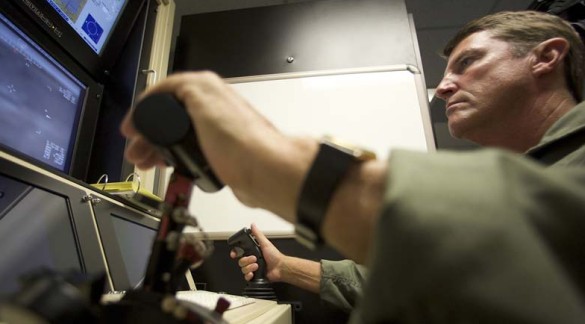
A drone pilot can fire on an insurgent dug into the Afghan hills and be home in time for a backyard barbecue. In just an hour or two, the pilot can go from a heated argument with a spouse to a tense radio conversation with an amped-up soldier pinned down by weapons fire.

“On the drive out here, you get yourself ready to enter the compartment of your life that is flying combat,” said retired Col. Chris Chambliss, who until last summer commanded drone operations at Creech Air Force Base, the command center for seven Air Force bases in the continental U.S. where crews fly drones over Iraq and Afghanistan. “And on the drive home, you get ready for that part of your life that’s going to be the soccer game.”

Drone crews don’t put their lives at risk. Instead, they juggle vast streams of video and data. With briefings both before and after their missions, their workdays typically stretch to 10 or 11 hours. Many of the pilots are experienced military fliers, but the camera operators tend to be much younger — often only 19 or 20, and new to the stresses of combat.

Mirroring the remote warfare of the drone operator is an unspoken compact between civilians and soldiers: The threshold at which this nation offers its tacit consent to war now corresponds not with the degree to which we embrace its gravity but the degree to which it can be ignored.

Ours have become wars of indifference whose advance is commensurate with the attrition of bravery.

Facebooktwittermail