James Bamford writes: In a rare break from the NSA’s tradition of listening but not speaking, NSA chief General Keith Alexander was grilled Tuesday on the topic of eavesdropping on Americans in front of a House subcommittee.
The questioning from Rep. Hank Johnson (D-Georgia) was prompted by Wired’s cover story this month on the NSA’s growing reach and capabilities, but leaves Americans with as many questions about the reach of spy agency’s powers as they had before Alexander spoke.
Alexander denied, in carefully parsed words, that the NSA has the power to monitor Americans’ communications without getting a court warrant.
But Alexander’s comments fly in the face of people who actually helped create the agency’s eavesdropping and data mining infrastructure. Few people know that system as well as William Binney, who served as the technical director for the agency’s M Group, which stood for World Geopolitical Military Analysis and Reporting, the giant 6,000-person organization responsible for eavesdropping on most of the world.
He was also the founder and co-director of the agency’s Signals Intelligence Automation Research Center, which helped automate that eavesdropping network. Binney decided to leave after a long career rather than be involved in the agency warrantless eavesdropping program, a program he said involves secret monitoring facilities in ten to twenty large telecom switches around the country, such as the one discovered in San Francisco’s AT&T installation a few years ago.
Historically, the NSA’s initial response has always been to either deny or evade when confronted with issues involving eavesdropping on Americans. For decades the agency secretly hid from Congress the fact that it was copying, without a warrant, virtually every telegram traveling through the United States, a program known as Project Shamrock. Then it hid from Congress the fact that it was illegally targeting the phone calls of anti-war protesters during the Vietnam War, known as Project Minaret.
More recently, President Bush said falsely that no American had been wiretapped without a warrant at the same time the agency was eavesdropping on thousands of Americans without a warrant as part of the later revealed Operation Stellar Wind. The Congress then passed a bill granting immunity from prosecution and law suits to the telecom companies involved in the illegal program.
Also, in the same way that General Alexander carefully parsed his words, the agency has always maintained its own secret definition of words in a document known as United States Signals Intelligence Directive 18, a document classified above top secret.
For example, NSA can intercept millions of domestic communications and store them in a data center like Bluffdale and still be able to say it has not “intercepted” any domestic communications. This is because of its definition of the word. “Intercept,” in NSA’s lexicon, only takes place when the communications are “processed” “into an intelligible form intended for human inspection,” not as they pass through NSA listening posts and transferred to data warehouses. [Continue reading…]
Category Archives: NSA
The NSA is building the country’s biggest spy center targeting all communication everywhere
James Bamford writes: Under construction by contractors with top-secret clearances, the blandly named Utah Data Center is being built for the National Security Agency. A project of immense secrecy, it is the final piece in a complex puzzle assembled over the past decade. Its purpose: to intercept, decipher, analyze, and store vast swaths of the world’s communications as they zap down from satellites and zip through the underground and undersea cables of international, foreign, and domestic networks. The heavily fortified $2 billion center should be up and running in September 2013. Flowing through its servers and routers and stored in near-bottomless databases will be all forms of communication, including the complete contents of private emails, cell phone calls, and Google searches, as well as all sorts of personal data trails—parking receipts, travel itineraries, bookstore purchases, and other digital “pocket litter.” It is, in some measure, the realization of the “total information awareness” program created during the first term of the Bush administration—an effort that was killed by Congress in 2003 after it caused an outcry over its potential for invading Americans’ privacy.
But “this is more than just a data center,” says one senior intelligence official who until recently was involved with the program. The mammoth Bluffdale center will have another important and far more secret role that until now has gone unrevealed. It is also critical, he says, for breaking codes. And code-breaking is crucial, because much of the data that the center will handle—financial information, stock transactions, business deals, foreign military and diplomatic secrets, legal documents, confidential personal communications—will be heavily encrypted. According to another top official also involved with the program, the NSA made an enormous breakthrough several years ago in its ability to cryptanalyze, or break, unfathomably complex encryption systems employed by not only governments around the world but also many average computer users in the US. The upshot, according to this official: “Everybody’s a target; everybody with communication is a target.”
For the NSA, overflowing with tens of billions of dollars in post-9/11 budget awards, the cryptanalysis breakthrough came at a time of explosive growth, in size as well as in power. Established as an arm of the Department of Defense following Pearl Harbor, with the primary purpose of preventing another surprise assault, the NSA suffered a series of humiliations in the post-Cold War years. Caught offguard by an escalating series of terrorist attacks—the first World Trade Center bombing, the blowing up of US embassies in East Africa, the attack on the USS Cole in Yemen, and finally the devastation of 9/11—some began questioning the agency’s very reason for being. In response, the NSA has quietly been reborn. And while there is little indication that its actual effectiveness has improved—after all, despite numerous pieces of evidence and intelligence-gathering opportunities, it missed the near-disastrous attempted attacks by the underwear bomber on a flight to Detroit in 2009 and by the car bomber in Times Square in 2010—there is no doubt that it has transformed itself into the largest, most covert, and potentially most intrusive intelligence agency ever created.
In the process—and for the first time since Watergate and the other scandals of the Nixon administration—the NSA has turned its surveillance apparatus on the US and its citizens. It has established listening posts throughout the nation to collect and sift through billions of email messages and phone calls, whether they originate within the country or overseas. It has created a supercomputer of almost unimaginable speed to look for patterns and unscramble codes. Finally, the agency has begun building a place to store all the trillions of words and thoughts and whispers captured in its electronic net. And, of course, it’s all being done in secret. To those on the inside, the old adage that NSA stands for Never Say Anything applies more than ever. [Continue reading…]
9/11: the tapping point
David Rose writes: One morning in June 2001, three months before the 9/11 attacks on the United States, I happened to be interviewing a senior official from the British Secret Intelligence Service, M.I.6. His current focus was the war on drugs, not international terrorism, but he shared a piece of information that united the two subjects.
A short time earlier, the official told me, the U.S. National Security Agency had intercepted a call between two satellite-telephone users in Afghanistan—the al-Qaeda leader Osama bin Laden and the Taliban leader Mullah Mohammed Omar. They had been discussing the Taliban’s ban on growing opium poppies, imposed the previous summer—a remarkably effective edict that had shrunk production in areas they controlled almost to zero.
According to the M.I.6 official, bin Laden sounded unhappy. “Why stop growing opium?” he asked. “Heroin only weakens our enemies.” There was no need to worry, Mullah Omar replied. The ban was merely a tactic. “There has been a glut, and the price is too low. Once the world price has risen, the farmers can start growing it again.”
The real lesson of this overheard conversation was not its specific content but the fact that it could be heard at all. Electronic eavesdropping clearly had potential in Taliban-controlled Afghanistan. But in the years before 9/11, when bin Laden’s terror plot was first being discussed, that potential remained limited. The reason was simple: Afghanistan had no cell phones, no Internet, and only a rudimentary landline network, which did not work at all outside the country’s largest cities. This could be remedied, however. Indeed, by the end of 1999, the Taliban government had embraced a full-fledged American scheme to install a modern cell-phone-and-Internet system in Afghanistan. It could have been up and running within months. The Taliban had already granted an exclusive license to a U.S.-owned firm, the Afghan Wireless Communications Company.
More to the point, electronic modifications concealed within the circuitry would have allowed every call and every e-mail emanating from Afghanistan to be relayed without interference to N.S.A. headquarters in Fort Meade, Maryland. “This project was a dream,” says one former senior F.B.I. counterterrorism specialist who knew about the scheme at the time. “To be able to wire up a country from ground level up—you don’t get too many opportunities like that.” No, you don’t. But at the critical moment, the Clinton administration put the project on hold, while rival U.S. agencies—the F.B.I., the N.S.A., and the C.I.A.—bickered over who should control it.
In the decade since 9/11, investigations by journalists and government commissions have explored the many missed opportunities to prevent bin Laden’s attacks. Overall, it is the story of a catastrophic failure to connect the dots. One can argue—and many have—that the connections emerge more visibly in retrospect than they ever did as events themselves unfolded. But the affair of the Afghan cell-phone network—put on hold until time ran out—falls into a category by itself. It was a course of action whose value and urgency were acknowledged by everyone, but it was impeded nonetheless. The cell-phone plan “was one tool we could have put in Afghanistan that could have made a difference,” a former C.I.A. official says. “Why didn’t we put it in? Because we couldn’t fucking agree.”
Top secret America
Israel’s ability to kill Americans with impunity
Roger Cohen writes:
Here’s what the United Nations report on Israel’s raid last year on the Turkish-flagged Mavi Marmara had to say about the killing of a 19-year-old U.S. citizen on board:
“At least one of those killed, Furkan Dogan, was shot at extremely close range. Mr. Dogan sustained wounds to the face, back of the skull, back and left leg. That suggests he may already have been lying wounded when the fatal shot was delivered, as suggested by witness accounts to that effect.”
The four-member panel, led by Sir Geoffrey Palmer, a former prime minister of New Zealand, appears with these words to raise the possibility of an execution or something close.
Dogan, born in upstate New York, was an aspiring doctor. Little interested in politics, he’d won a lottery to travel on the Gaza-bound vessel. The report says of him and the other eight people killed that, “No evidence has been provided to establish that any of the deceased were armed with lethal weapons.”
I met Dogan’s father, Ahmet, a professor at Erciyes University in Kayseri, last year in Ankara: His grief was as deep as his dismay at U.S. evasiveness. It’s hard to imagine any other circumstances in which the slaying in international waters, at point-blank range, of a U.S. citizen by forces of a foreign power would prompt such a singular American silence.
Unless, that is, one considers the case of the USS Liberty, the American ship that was attacked by Israeli forces in international waters in 1967 during the Six-Day War, resulting in the deaths of 34 crew members and the injury of 170.
Two squadrons of US Navy fighter-bombers were sent to repel the unprovoked Israeli attack and could have reached the Liberty in time to prevent a torpedo attack that killed 26 Americans, but the operation was aborted. As far as the White House was concerned, it was more important to avoid embarrassing Israel than it was to protect American lives.
After newly declassified government documents were released in 2007, the Chicago Tribune reported:
J.Q. “Tony” Hart, then a chief petty officer assigned to a U.S. Navy relay station in Morocco that handled communications between Washington and the 6th Fleet, remembered listening as Defense Secretary Robert McNamara, in Washington, ordered Rear Adm. Lawrence Geis, commander of the America’s carrier battle group, to bring the jets home.
When Geis protested that the Liberty was under attack and needed help, Hart said, McNamara retorted that “President [Lyndon] Johnson is not going to go to war or embarrass an American ally over a few sailors.”
McNamara, who is now 91, told the Tribune he has “absolutely no recollection of what I did that day,” except that “I have a memory that I didn’t know at the time what was going on.”
The Johnson administration did not publicly dispute Israel’s claim that the attack had been nothing more than a disastrous mistake. But internal White House documents obtained from the Lyndon B. Johnson Presidential Library show that the Israelis’ explanation of how the mistake had occurred was not believed.
Except for McNamara, most senior administration officials from Secretary of State Dean Rusk on down privately agreed with Johnson’s intelligence adviser, Clark Clifford, who was quoted in minutes of a National Security Council staff meeting as saying it was “inconceivable” that the attack had been a case of mistaken identity.
The attack “couldn’t be anything else but deliberate,” the NSA’s director, Lt. Gen. Marshall Carter, later told Congress.
[…]
For all its apparent complexity, the attack on the Liberty can be reduced to a single question: Was the ship flying the American flag at the time of the attack, and was that flag visible from the air?The survivors interviewed by the Tribune uniformly agree that the Liberty was flying the Stars and Stripes before, during and after the attack, except for a brief period in which one flag that had been shot down was replaced with another, larger flag — the ship’s “holiday colors” — that measured 13 feet long.
Concludes one of the declassified NSA documents: “Every official interview of numerous Liberty crewmen gave consistent evidence that indeed the Liberty was flying an American flag — and, further, the weather conditions were ideal to ensure its easy observance and identification.”
Enter the cyber-dragon
In the September issue of Vanity Fair, Michael Joseph Gross writes:
Lying there in the junk-mail folder, in the spammy mess of mortgage offers and erectile-dysfunction drug ads, an e-mail from an associate with a subject line that looked legitimate caught the man’s eye. The subject line said “2011 Recruitment Plan.” It was late winter of 2011. The man clicked on the message, downloaded the attached Excel spreadsheet file, and unwittingly set in motion a chain of events allowing hackers to raid the computer networks of his employer, RSA. RSA is the security division of the high-tech company EMC. Its products protect computer networks at the White House, the Central Intelligence Agency, the National Security Agency, the Pentagon, the Department of Homeland Security, most top defense contractors, and a majority of Fortune 500 corporations.
The parent company disclosed the breach on March 17 in a filing with the Securities and Exchange Commission. The hack gravely undermined the reputation of RSA’s popular SecurID security service. As spring gave way to summer, bloggers and computer-security experts found evidence that the attack on RSA had come from China. They also linked the RSA attack to the penetration of computer networks at some of RSA’s most powerful defense-contractor clients—among them, Lockheed Martin, Northrop Grumman, and L-3 Communications. Few details of these episodes have been made public.
The RSA and defense-contractor hacks are among the latest battles in a decade-long spy war. Hackers from many countries have been exfiltrating—that is, stealing—intellectual property from American corporations and the U.S. government on a massive scale, and Chinese hackers are among the main culprits. Because virtual attacks can be routed through computer servers anywhere in the world, it is almost impossible to attribute any hack with total certainty. Dozens of nations have highly developed industrial cyber-espionage programs, including American allies such as France and Israel. And because the People’s Republic of China is such a massive entity, it is impossible to know how much Chinese hacking is done on explicit orders from the government. In some cases, the evidence suggests that government and military groups are executing the attacks themselves. In others, Chinese authorities are merely turning a blind eye to illegal activities that are good for China’s economy and bad for America’s. Last year Google became the first major company to blow the whistle on Chinese hacking when it admitted to a penetration known as Operation Aurora, which also hit Intel, Morgan Stanley, and several dozen other corporations. (The attack was given that name because the word “aurora” appears in the malware that victims downloaded.) Earlier this year, details concerning the most sweeping intrusion since Operation Aurora were discovered by the cyber-security firm McAfee. Dubbed “Operation Shady rat,” the attacks (of which more later) are being reported here for the first time. Most companies have preferred not to talk about or even acknowledge violations of their computer systems, for fear of panicking shareholders and exposing themselves to lawsuits—or for fear of offending the Chinese and jeopardizing their share of that country’s exploding markets. The U.S. government, for its part, has been fecklessly circumspect in calling out the Chinese.
U.S. mass surveillance and data mining against the Arab world
Barrett Brown writes:
For at least two years, the U.S. has been conducting a secretive and immensely sophisticated campaign of mass surveillance and data mining against the Arab world, allowing the intelligence community to monitor the habits, conversations, and activity of millions of individuals at once. And with an upgrade scheduled for later this year, the top contender to win the federal contract and thus take over the program is a team of about a dozen companies which were brought together in large part by Aaron Barr – the same disgraced CEO who resigned from his own firm earlier this year after he was discovered to have planned a full-scale information war against political activists at the behest of corporate clients. The new revelation provides for a disturbing picture, particularly when viewed in a wider context. Unprecedented surveillance capabilities are being produced by an industry that works in secret on applications that are nonetheless funded by the American public – and which in some cases are used against that very same public. Their products are developed on demand for an intelligence community that is not subject to Congressional oversight and which has been repeatedly shown to have misused its existing powers in ways that violate U.S. law as well as American ideals. And with expanded intelligence capabilities by which to monitor Arab populations in ways that would have previously been impossible, those same intelligence agencies now have improved means by which to provide information on dissidents to those regional dictators viewed by the U.S. as strategic allies.
The nature and extent of the operation, which was known as Romas/COIN and which is scheduled for replacement sometime this year by a similar program known as Odyssey, may be determined in part by a close reading of hundreds of e-mails among the 70,000 that were stolen in February from the contracting firm HBGary Federal and its parent company HBGary. Other details may be gleaned by an examination of the various other firms and individuals that are discussed as being potential partners.
Of course, there are many in the U.S. that would prefer that such details not be revealed at all; such people tend to cite the amorphous and much-abused concept of “national security” as sufficient reason for the citizenry to stand idly by as an ever-expanding coalition of government agencies and semi-private corporations gain greater influence over U.S. foreign policy. That the last decade of foreign policy as practiced by such individuals has been an absolute disaster even by the admission of many of those who put it into place will not phase those who nonetheless believe that the citizenry should be prevented from knowing what is being done in its name and with its tax dollars.
To the extent that the actions of a government are divorced from the informed consent of those who pay for such actions, such a government is illegitimate. To the extent that power is concentrated in the hands of small groups of men who wield such power behind the scenes, there is no assurance that such power will be used in a manner that is compatible with the actual interests of that citizenry, or populations elsewhere. The known history of the U.S. intelligence community is comprised in large part of murder, assassinations, disinformation, the topping of democratic governments, the abuse of the rights of U.S. citizens, and a great number of other things that cannot even be defended on “national security” grounds insomuch as that many such actions have quite correctly turned entire populations against the U.S. government. This is not only my opinion, but also the opinion of countless individuals who once served in the intelligence community and have since come to criticize it and even unveil many of its secrets in an effort to alert the citizenry to what has been unleashed against the world in the name of “security.”
Likewise, I will here provide as much information as I can on Romas/COIN and its upcoming replacement.
Although the relatively well-known military contractor Northrop Grumman had long held the contract for Romas/COIN, such contracts are subject to regular recompetes by which other companies, or several working in tandem, can apply to take over. In early February, HBGary Federal CEO Aaron Barr wrote the following e-mail to Al Pisani, an executive at the much larger federal contractor TASC, a company which until recently had been owned by Northrop and which was now looking to compete with it for lucrative contracts:
“I met with [[[Mantech]] CEO] Bob Frisbie the other day to catch up. He is looking to expand a capability in IO related to the COIN re-compete but more for DoD. He told me he has a few acquisitions in the works that will increase his capability in this area. So just a thought that it might be worth a phone call to see if there is any synergy and strength between TASC and ManTech in this area. I think forming a team and response to compete against SAIC will be tough but doable.” IO in this context stands for “information operations,” while COIN itself, as noted in an NDA attached to one of the e-mails, stands for “counter intelligence.” SAIC is a larger intelligence contractor that was expected to pursue the recompete as well.
Pisani agreed to the idea, and in conjunction with Barr and fellow TASC exec John Lovegrove, the growing party spent much of the next year working to create a partnership of firms capable of providing the “client” – a U.S. agency that is never specified in the hundreds of e-mails that follow – with capabilities that would outmatch those being provided by Northrop, SAIC, or other competitors.
Several e-mails in particular provide a great deal of material by which to determine the scope and intent of Romas/COIN. One that Barr wrote to his own e-mail account, likely for the purpose of adding to other documents later, is entitled “Notes on COIN.” It begins with a list of entries for various facets of the program, all of which are blank and were presumably filled out later: “ISP, Operations, Language/Culture, Media Development, Marketing and Advertising, Security, MOE.” Afterwards, another list consists of the following: “Capabilities, Mobile Development, Challenges, MOE, Infrastructure, Security.” Finally, a list of the following websites is composed, many of which represent various small companies that provide niche marketing services pursuant to mobile phones.
More helpful is a later e-mail from Lovegrove to Barr and some of his colleagues at TASC in which he announces the following:
Our team consists of:
– TASC (PMO, creative services)
– HB Gary (Strategy, planning, PMO)
– Akamai (infrastructure)
– Archimedes Global (Specialized linguistics, strategy, planning)
– Acclaim Technical Services (specialized linguistics)
– Mission Essential Personnel (linguistic services)
– Cipher (strategy, planning operations)
– PointAbout (rapid mobile application development, list of strategic
partners)– Google (strategy, mobile application and platform development – long
list of strategic partners)– Apple (mobile and desktop platform, application assistance -long list of strategic partners)
We are trying to schedule an interview with ATT plus some other small app developers.
From these and dozens of other clues and references, the following may be determined about the nature of Romas/COIN:
1. Mobile phone software and applications constitute a major component of the program.
2. There’s discussion of bringing in a “gaming developer,” apparently at the behest of Barr, who mentions that the team could make good use of “a social gaming company maybe like zynga, gameloft, etc.” Lovegrove elsewhere notes: “I know a couple of small gaming companies at MIT that might fit the bill.”
3. Apple and Google were active team partners, and AT&T may have been as well. The latter is known to have provided the NSA free reign over customer communications (and was in turn protected by a bill granting them retroactive immunity from lawsuits). Google itself is the only company to have received a “Hostile to Privacy” rating from Privacy International. Apple is currently being investigated by Congress after the iPhone was revealed to compile user location data in a way that differs from other mobile phones; the company has claimed this to have been a “bug.”
4. The program makes use of several providers of “linguistic services.” At one point, the team discusses hiring a military-trained Arabic linguist. Elsewhere, Barr writes: “I feel confident I can get you a ringer for Farsi if they are still interested in Farsi (we need to find that out). These linguists are not only going to be developing new content but also meeting with folks, so they have to have native or near native proficiency and have to have the cultural relevance as well.”
5. Alterion and SocialEyez are listed as “businesses to contact.” The former specializes in “social media monitoring tools.” The latter uses “sophisticated natural language processing methodology” in order to “process tens of millions of multi-lingual conversations daily” while also employing “researchers and media analysts on the ground;” its website also notes that “Millions of people around the globe are now networked as never before – exchanging information and ideas, forming opinions, and speaking their minds about everything from politics to products.”
6. At one point, TASC exec Chris Clair asks Aaron and others, “Can we name COIN Saif? Saif is the sword an Arab executioner uses when they decapitate criminals. I can think of a few cool brands for this.”
7. A diagram attached to one of Barr’s e-mails to the group (http://imageshack.us/photo/my-images/7/pmo.png/) depicts Magpii as interacting in some unspecified manner with “Foreign Mobile” and “Foreign Web.” Magpii is a project of Barr’s own creation which stands for “Magnify Personal Identifying Information,” involves social networking, and is designed for the purpose of storing personal information on users. Although details are difficult to determine from references in Barr’s e-mails, he discusses the project almost exclusively with members of military intelligence to which he was pitching the idea.
8. There are sporadic references such things as “semantic analysis,” “Latent Semantic Indexing,” “specialized linguistics,” and OPS, a programming language designed for solving problems using expert systems.
9. Barr asks the team’s partner at Apple, Andy Kemp (whose signature lists him as being from the company’s Homeland Defense/National Programs division), to provide him “a contact at Pixar/Disney.”
Altogether, then, a successful bid for the relevant contract was seen to require the combined capabilities of perhaps a dozen firms – capabilities whereby millions of conversations can be monitored and automatically analyzed, whereby a wide range of personal data can be obtained and stored in secret, and whereby some unknown degree of information can be released to a given population through a variety of means and without any hint that the actual source is U.S. military intelligence. All this is merely in addition to whichever additional capabilities are not evident from the limited description available, with the program as a whole presumably being operated in conjunction with other surveillance and propaganda assets controlled by the U.S. and its partners.
Whatever the exact nature and scope of COIN, the firms that had been assembled for the purpose by Barr and TASC never got a chance to bid on the program’s recompete. In late September, Lovegrove noted to Barr and others that he’d spoken to the “CO [contracting officer] for COIN.” “The current procurement approach is cancelled [sic], she cited changed requirements,” he reported. “They will be coming out with some documents in a month or two, most likely an updated RFI [request for information]. There will be a procurement following soon after. We are on the list to receive all information.” On January 18th of next year, Lovegrove provided an update: “I just spoke to the group chief on the contracts side (Doug K). COIN has been replaced by a procurement called Odyssey. He says that it is in the formative stages and that something should be released this year. The contracting officer is Kim R. He believes that Jason is the COTR [contracting officer’s technical representative].” Another clue is provided in the ensuing discussion when a TASC executive asks, “Does Odyssey combine the Technology and Content pieces of the work?”
The unexpected change-up didn’t seem to phase the corporate partnership, which was still a top contender to compete for the upcoming Odyssey procurement. Later e-mails indicate a meeting between key members of the group and the contracting officer for Odyssey at a location noted as “HQ,” apparently for a briefing on requirements for the new program, on February 3rd of 2011. But two days after that meeting, the servers of HBGary and HBGary Federal were hacked by a small team of Anonymous operatives in retaliation for Barr’s boasts to Financial Times that he had identified the movement’s “leadership;” 70,000 e-mails were thereafter released onto the internet. Barr resigned a few weeks later.
Along with clues as to the nature of COIN and its scheduled replacement, a close study of the HBGary e-mails also provide reasons to be concerned with the fact that such things are being developed and deployed in the way that they are. In addition to being the driving force behind the COIN recompete, Barr was also at the center of a series of conspiracies by which his own company and two others hired out their collective capabilities for use by corporations that sought to destroy their political enemies by clandestine and dishonest means, some of which appear to be illegal. None of the companies involved have been investigated; a proposed Congressional inquiry was denied by the committee chair, noting that it was the Justice Department’s decision as to whether to investigate, even though it was the Justice Department itself that made the initial introductions. Those in the intelligence contracting industry who believe themselves above the law are entirely correct.
That such firms will continue to target the public with advanced information warfare capabilities on behalf of major corporations is by itself an extraordinary danger to mankind as a whole, particularly insomuch as that such capabilities are becoming more effective while remaining largely unknown outside of the intelligence industry. But a far greater danger is posed by the practice of arming small and unaccountable groups of state and military personnel with a set of tools by which to achieve better and better “situational awareness” on entire populations while also being able to manipulate the information flow in such a way as to deceive those same populations. The idea that such power can be wielded without being misused is contradicted by even a brief review of history.
History also demonstrates that the state will claim such powers as a necessity in fighting some considerable threat; the U.S. has defended its recent expansion of powers by claiming they will only be deployed to fight terrorism and will never be used against American civilians. This is cold comfort for those in the Arab world who are aware of the long history of U.S. material support for regimes they find convenient, including those of Saddam Hussein, Hosni Mubarak, and the House of Saud. Nor should Americans be comforted by such promises from a government that has no way of ensuring that they will be kept; it was just a few months ago that a U.S. general in Afghanistan ordered a military intelligence unit to use pysops on visiting senators in an effort to secure increased funding for the war, an illegal act; only a few days prior, CENTCOM spokesmen were confidently telling the public that such other psychological capabilities as persona management would never be used on Americans as that would be illegal. The fact is that such laws have been routinely broken by the military and intelligence community, who are now been joined in this practice by segments of the federal contracting industry.
It is inevitable, then, that such capabilities as form the backbone of Romas/COIN and its replacement Odyssey will be deployed against a growing segment of the world’s population. The powerful institutions that wield them will grow all the more powerful as they are provided better and better methods by which to monitor, deceive, and manipulate. The informed electorate upon which liberty depends will be increasingly misinformed. No tactical advantage conferred by the use of these programs can outweigh the damage that will be done to mankind in the process of creating them.
Barrett Brown
Project PM

Barrett Brown is a contributor to Vanity Fair, the Huffington Post and Skeptical Inquirer, and is author of Flock of Dodos: Behind Modern Creationism, Intelligent Design and the Easter Bunny, as well as an upcoming book on the deficits of the America media. He is the founder of the distributed thinktank Project PM. Barrett can be contacted at barriticus at gmail.
For more on Aaron Barr, read “How one man tracked down Anonymous—and paid a heavy price.”
NSA case unlikely to deter Obama’s take on leakers
The Associated Press reports:
Criminal defendants of all stripes in national security cases, including Marine Lt. Col. Oliver North in the Iran-Contra affair and al-Qaida terrorist Zacarias Moussaoui, have long sought to work government secrets into their defense.
The hope is the prosecutors will skip a trial rather than expose sensitive information in court.
This strategy worked perfectly in the just concluded leak case against a former National Security Agency official, Thomas Drake. But civil libertarians doubt the setback for prosecutors will halt the Obama administration’s vigorous legal attack on leakers, and the government shows no signs of backing off other cases.
After all, the strategy of threatening to expose secrets at trial to ward off charges has a decidedly mixed history for national security defendants. The practice is known as graymailing the government.
Drake pleaded guilty Friday in federal court in Baltimore to a single misdemeanor charge in a deal with prosecutors that avoided a trial in the case accusing Drake of passing classified material to a Baltimore Sun reporter.
Drake had faced up to 35 years in prison had he gone to trial and been convicted. The lesser charge carries a penalty of up to a year in prison and a $100,000 fine.
Drake’s defense was that he was a whistleblower exposing waste in an NSA program called TrailBlazer. That ill-fated effort was to have overhauled the agency’s vast computer systems to capture and screen information flooding into the agency from the Internet and cell phones. Begun in 2002, the project eventually cost $1.2 billion, but never worked as intended and was scrapped in 2006.
For more on the case, read Jane Mayer’s New Yorker article, “The Secret Sharer.”
Ex-NSA aide gains plea deal in leak case; setback to U.S.
The New York Times reports:
A former spy agency employee agreed late Thursday to plead guilty to a minor charge in a highly publicized leak prosecution, undercutting the Obama administration’s unusual campaign to prosecute government officials who disclose classified information to the press.
The National Security Agency official, Thomas A. Drake, had faced a possible 35 years in prison if convicted on felony charges under the Espionage Act. Instead, he agreed to admit to a misdemeanor of misusing the agency’s computer system by providing “official N.S.A. information” to an unauthorized person, a reporter for The Baltimore Sun. Prosecutors said in the written plea agreement that they would not oppose a sentence under which Mr. Drake would serve no time.
A formal plea hearing was set for Friday morning in Baltimore. The presiding judge, Richard D. Bennett of the district court, could impose a sentence of up to a year in prison. But legal experts said it would be highly unusual to impose a prison term when the Justice Department was not seeking incarceration.
The deal represented the almost complete collapse of the government’s effort to make an example of Mr. Drake, who was charged last year in a 10-count indictment that accused him of obstructing justice and lying to investigators. It is uncertain whether the outcome will influence the handling of three pending leak cases or others still under investigation.
The case against Mr. Drake is among five such prosecutions for disclosures to the news media brought since President Obama took office in 2009: one each against defendants from the National Security Agency, the C.I.A., the F.B.I., the military and the State Department. In the past, such prosecutions have been extremely rare — three or four in history, depending on how they are counted, and never more than one under any other president.
Obama’s war against whistle-blowers
Jane Mayer writes:
On June 13th, a fifty-four-year-old former government employee named Thomas Drake is scheduled to appear in a courtroom in Baltimore, where he will face some of the gravest charges that can be brought against an American citizen. A former senior executive at the National Security Agency, the government’s electronic-espionage service, he is accused, in essence, of being an enemy of the state. According to a ten-count indictment delivered against him in April, 2010, Drake violated the Espionage Act—the 1917 statute that was used to convict Aldrich Ames, the C.I.A. officer who, in the eighties and nineties, sold U.S. intelligence to the K.G.B., enabling the Kremlin to assassinate informants. In 2007, the indictment says, Drake willfully retained top-secret defense documents that he had sworn an oath to protect, sneaking them out of the intelligence agency’s headquarters, at Fort Meade, Maryland, and taking them home, for the purpose of “unauthorized disclosure.” The aim of this scheme, the indictment says, was to leak government secrets to an unnamed newspaper reporter, who is identifiable as Siobhan Gorman, of the Baltimore Sun. Gorman wrote a prize-winning series of articles for the Sun about financial waste, bureaucratic dysfunction, and dubious legal practices in N.S.A. counterterrorism programs. Drake is also charged with obstructing justice and lying to federal law-enforcement agents. If he is convicted on all counts, he could receive a prison term of thirty-five years.
The government argues that Drake recklessly endangered the lives of American servicemen. “This is not an issue of benign documents,” William M. Welch II, the senior litigation counsel who is prosecuting the case, argued at a hearing in March, 2010. The N.S.A., he went on, collects “intelligence for the soldier in the field. So when individuals go out and they harm that ability, our intelligence goes dark and our soldier in the field gets harmed.”
Top officials at the Justice Department describe such leak prosecutions as almost obligatory. Lanny Breuer, the Assistant Attorney General who supervises the department’s criminal division, told me, “You don’t get to break the law and disclose classified information just because you want to.” He added, “Politics should play no role in it whatsoever.”
When President Barack Obama took office, in 2009, he championed the cause of government transparency, and spoke admiringly of whistle-blowers, whom he described as “often the best source of information about waste, fraud, and abuse in government.” But the Obama Administration has pursued leak prosecutions with a surprising relentlessness. Including the Drake case, it has been using the Espionage Act to press criminal charges in five alleged instances of national-security leaks—more such prosecutions than have occurred in all previous Administrations combined. The Drake case is one of two that Obama’s Justice Department has carried over from the Bush years.
Gabriel Schoenfeld, a conservative political scientist at the Hudson Institute, who, in his book “Necessary Secrets” (2010), argues for more stringent protection of classified information, says, “Ironically, Obama has presided over the most draconian crackdown on leaks in our history—even more so than Nixon.”
Describing Drake’s concerns that the NSA was showing a flagrant disregard for the constitutional rights of US citizens, Mayer writes:
Drake says that in the Air Force, where he learned to capture electronic signals, the FISA law “was drilled into us.” He recalls, “If you accidentally intercepted U.S. persons, there were special procedures to expunge it.” The procedures had been devised to prevent the recurrence of past abuses, such as Nixon’s use of the N.S.A. to spy on his political enemies.
Drake didn’t know the precise details, but he sensed that domestic spying “was now being done on a vast level.” He was dismayed to hear from N.S.A. colleagues that “arrangements” were being made with telecom and credit-card companies. He added, “The mantra was ‘Get the data!’ ” The transformation of the N.S.A., he says, was so radical that “it wasn’t just that the brakes came off after 9/11—we were in a whole different vehicle.”
Few people have a precise knowledge of the size or scope of the N.S.A.’s domestic-surveillance powers. An agency spokesman declined to comment on how the agency “performs its mission,” but said that its activities are constitutional and subject to “comprehensive and rigorous” oversight. But Susan Landau, a former engineer at Sun Microsystems, and the author of a new book, “Surveillance or Security?,” notes that, in 2003, the government placed equipment capable of copying electronic communications at locations across America. These installations were made, she says, at “switching offices” that not only connect foreign and domestic communications but also handle purely domestic traffic. As a result, she surmises, the U.S. now has the capability to monitor domestic traffic on a huge scale. “Why was it done this way?” she asks. “One can come up with all sorts of nefarious reasons, but one doesn’t want to think that way about our government.”
[Bill] Binney [former head of the NSA’s Signals Intelligence Automation Research Center, or SARC], for his part, believes that the agency now stores copies of all e-mails transmitted in America, in case the government wants to retrieve the details later. In the past few years, the N.S.A. has built enormous electronic-storage facilities in Texas and Utah. Binney says that an N.S.A. e-mail database can be searched with “dictionary selection,” in the manner of Google. After 9/11, he says, “General Hayden reassured everyone that the N.S.A. didn’t put out dragnets, and that was true. It had no need—it was getting every fish in the sea.”
House Democrats call for release of one of the most notorious spies in Israel’s history

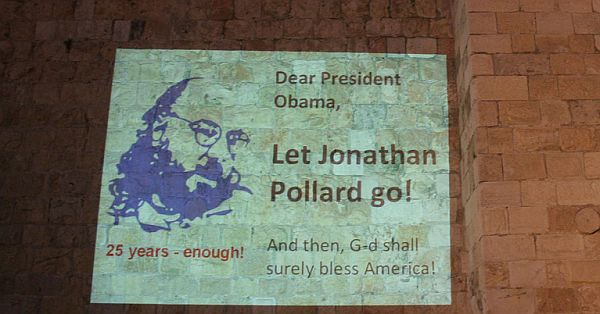
A “relentless” campaign by David Nyer, a Jewish Orthodox activist from Monsey, New York, has succeeded in winning significant support from House Democrats who are now calling on President Obama to release Jonathan Pollard.
Pollard is a former civilian intelligence analyst who was convicted of spying for Israel and through a plea bargain received a life sentence in 1987. He is believed to have caused incalculable damage to US national security.
Nyer’s campaign “struck gold” when he succeeded in winning the support of Rep. Barney Frank. The JTA reported:
Getting Frank was a coup, one congressional insider said, not only because he has a leadership position, but because his pronounced liberalism in other arenas adds credibility to an effort that has been identified in recent years with the Israeli and pro-Israel right.
Frank took up the cause because he long has believed that Pollard’s life sentence was disproportionate to the crime, his spokesman said.
“It is something he feels strongly about,” Harry Gural told JTA.
Launching the initiative at a Capitol Hill news conference Nov. 18, Frank listed two factors that made the matter timely: Pollard’s 25 years in prison as of Sundayand the parlous state of the Israeli-Palestinian peace process.
“The justification of this is the humanitarian one and the notion that the American justice system should be a fair one,” Frank said. “We believe that clemency after 25 years for the offenses of Jonathan Pollard would do that.
“My own hope is that if the president would do this, it would contribute to the political climate within the democracy of Israel and would enhance the peace process.”
Frank alluded to Obama’s low popularity in Israel where, fairly or not, the president has been saddled with a reputation as cool to Israeli interests.
The Jerusalem Post reports that Benjamin Netanyahu has asked the US to add Pollard’s release to the many other generous incentives the Obama administration have offered Israel in the hope of a 90 day, once only, extension to the settlement slowdown.
In “Why Pollard Should Never Be Released (The Traitor),” published in the New Yorker in January 1999, Seymour Hersh wrote:
A full accounting of the materials provided by Pollard to the Israelis has been impossible to obtain: Pollard himself has estimated that the documents would create a stack six feet wide, six feet long, and ten feet high. Rafi Eitan, the Israeli who controlled the operation, and two colleagues of his attached to the Israeli diplomatic delegation — Irit Erb and Joseph Yagur — were named as unindicted co-conspirators by the Justice Department. In the summer of 1984, Eitan brought in Colonel Aviem Sella, an Air Force hero, who led Israel’s dramatic and successful 1981 bombing raid on the Iraqi nuclear reactor at Osirak. (Sella was eventually indicted, in absentia, on three counts of espionage.) Eitan’s decision to order Sella into the case is considered by many Americans to have been a brilliant stroke: the Israeli war hero was met with starry eyes by Pollard, a chronic wannabe.
Yagur, Erb, and Sella were in Washington when Pollard was first seized by the F.B.I., in November, 1985, but they quickly left the country, never to return. During one period, Pollard had been handing over documents to them almost weekly, and they had been forced to rent an apartment in northwest Washington, where they installed a high-speed photocopying machine. “Safe houses and special Xeroxes?” an American career intelligence officer said, despairingly, concerning the Pollard operation. “This was not the first guy they’d recruited.” In the years following Pollard’s arrest and confession, the Israeli government chose not to cooperate fully with the F.B.I. and Justice Department investigation, and only a token number of the Pollard documents have been returned. It was not until last May [1998] that the Israeli government even acknowledged that Pollard had been its operative.
In fact, it is widely believed that Pollard was not the only one in the American government spying for Israel. During his year and a half of spying, his Israeli handlers requested specific documents, which were identified only by top-secret control numbers. After much internal assessment, the government’s intelligence experts concluded that it was “highly unlikely,” in the words of a Justice Department official, that any of the other American spies of the era would have had access to the specific control numbers. “There is only one conclusion,” the expert told me. The Israelis “got the numbers from somebody else in the U.S. government.”
Richard Perle? He was Assistant Secretary of Defense in the Reagan administration at that time and early in his career had been caught by the FBI passing classified information to the Israeli embassy in Washington.
Pollard’s American interrogators eventually concluded that in his year and a half of spying he had provided the Israelis with more than a year’s worth of the daily FOSIF reports from Rota [in Spain, the location of the Navy’s Sixth Fleet Ocean Surveillance Information Facility (FOSIF)]. Pollard himself told the Americans that at one point in 1985 the Israelis had nagged him when he missed several days of work because of illness and had failed to deliver the FOSIF reports for those days. One of his handlers, Joseph Yagur, had complained twice about the missed messages and had asked him to find a way to retrieve them. Pollard told his American interrogators that he had never missed again.
The career intelligence officer who helped to assess the Pollard damage has come to view Pollard as a serial spy, the Ted Bundy of the intelligence world. “Pollard gave them every message for a whole year,” the officer told me recently, referring to the Israelis. “They could analyze it” — the intelligence — “message by message, and correlate it. They could not only piece together our sources and methods but also learn how we think, and how we approach a problem. All of a sudden, there is no mystery. These are the things we can’t change. You got this, and you got us by the balls.” In other words, the Rota reports, when carefully studied, gave the Israelis “a road map on how to circumvent” the various American collection methods and shield an ongoing military operation. The reports provide guidance on “how to keep us asleep, thinking all is working well,” he added. “They tell the Israelis how to raid Tunisia without tipping off American intelligence in advance. That is damage that is persistent and severe.”
The Israeli threat to global security
A USB memory stick carrying the Stuxnet malware is believed to have provided intruders with access to Iran’s nuclear program. The same technique was used in November 2008 to break into CENTCOM, providing a foreign government with unfiltered access to the Pentagon’s command of the wars in Iraq and Afghanistan. Did both attacks come from the same source?
Earlier this week, Reuters reported:
Cyber warfare has quietly grown into a central pillar of Israel’s strategic planning, with a new military intelligence unit set up to incorporate high-tech hacking tactics, Israeli security sources said on Tuesday.
Israel’s pursuit of options for sabotaging the core computers of foes like Iran, along with mechanisms to protect its own sensitive systems, were unveiled last year by the military intelligence chief, Major-General Amos Yadlin.
The government of Prime Minister Benjamin Netanyahu has since set cyber warfare as a national priority, “up there with missile shields and preparing the homefront to withstand a future missile war”, a senior source said on condition of anonymity.
Back in 1997, when the US did not overtly support political assassinations, President Clinton intervened to save the life of Khalid Meshaal. The Hamas political bureau chief had been poisoned by Mossad operatives (carrying stolen Canadian passports) on the streets of Jordan’s capital, Amman.
Clinton wasn’t trying to help Hamas but knew that a peace treaty he had helped broker between Israel and Jordan would be in jeopardy if Prime Minister Netanyahu thought he could disregard the sovereignty of Jordan and carry out assassinations with impunity. Likewise, neither King Hussein nor the Canadian government believed that Israeli actions showing a flagrant disregard for the authority of their respective governments could go unanswered.
Netanyahu would probably have found Clinton’s pressure unpersuasive were it not for the fact that the Israeli operatives had already been arrested. In exchange for their release, the Israelis supplied the antidote that saved Meshaal’s life while also releasing the Hamas spiritual leader Sheikh Ahmed Yassin.
Then came 9/11.
Before long, Yassin had been assassinated, the US was using Israeli methods of torture in its campaign against an amorphous Islamic threat, Israel’s own war crimes were sanctioned by the US in the name of the war on terrorism, and the use of stolen foreign passports by Mossad agents committing murder on foreign soil provoked nothing more than a diplomatic slap on the wrists.
When suspected Israeli agents were reported this week to be conducting surveillance on the NSA in Utah, the national security breach did not provoke a murmur in the national media — even though a string of similar incidents prior to 9/11 raised questions about whether Israel could have had foreknowledge of the attacks.
The willingness of this and the previous administration to allow Israel to disregard international law shows that even if the Israel lobby can no longer flourish like a night flower, its power is barely diminished. Even so, the appearance of the Stuxnet malware should be a wake-up call to every government around the world that refuses to place Israel’s national interests above its own.
In its conception, Stuxnet can be viewed very much like a targeted killing — but one designed to attack silently and leave no trace of its origin.
It’s creators understood that they had designed an exceedingly dangerous weapon and so they made sure its damage could be contained. But it seems not to have worked according to plan and so caution got tossed out of the window. Apparently, Israel did what it has done so many times before: pursued what it regarded as its own interests with an utter disregard for the international consequences.
Computerworld reports:
The original infection method, which relied on infected USB drives, included a counter that limited the spread to just three PCs, said [Liam] O Murchu [operations manager with Symantec’s security response]. “It’s clear that the attackers did not want Stuxnet to spread very far,” he said. “They wanted it to remain close to the original infection point.”
O Murchu’s research also found a 21-day propagation window; in other words, the worm would migrate to other machines in a network only for three weeks before calling it quits.
Those anti-propagation measures notwithstanding, Stuxnet has spread widely. Why?
Kaspersky’s [Roel] Schouwenberg [a senior antivirus researcher] believes it’s because the initial attack, which relied on infected USB drives, failed to do what Stuxnet’s makers wanted.
“My guess is that the first variant didn’t achieve its target,” said Schouwenberg, referring to the worm’s 2009 version that lacked the more aggressive propagation mechanisms, including multiple Windows zero-day vulnerabilities. “So they went on to create a more sophisticated version to reach their target.”
That more complex edition, which O Murchu said was developed in March of this year, was the one that “got all the attention,” according to Schouwenberg. But the earlier edition had already been at work for months by then — and even longer before a little-known antivirus vendor from Belarus first found it in June. “The first version didn’t spread enough, and so Stuxnet’s creators took a gamble, and abandoned the idea of making it stealthy,” said Schouwenberg.
In Schouwenberg’s theory, Stuxnet’s developers realized their first attempt had failed to penetrate the intended target or targets, and rather than simply repeat the attack, decided to raise the ante.
“They spent a lot of time and money on Stuxnet,” Schouwenberg said. “They could try again [with the USB-only vector] and maybe fail again, or they could take the risk of it spreading by adding more functionality to the worm.”
O Murchu agreed that it was possible the worm’s creators had failed to infect, and thus gain control, of the industrial systems running at their objective(s), but said the code itself didn’t provide clear clues.
What is clear, O Murchu said in a news conference Friday morning, is that Stuxnet evolved over time, adding new ways to spread on networks in the hope of finding specific PLCs (programming logic control) hardware to hijack. “It’s possible that [the attackers] didn’t manage to get to all of their targets [with the earlier version],” O Murchu said. “The increased sophistication of Stuxnet in 2010 may indicate that they had not reached their target.”
With the proliferation of Stuxnet, Schouwenberg said that the country or countries that created the worm may have themselves been impacted by its spread. But that was likely a calculated risk the worm’s developers gladly took.
And that risk may have been quite small. “Perhaps they knew that their own critical infrastructure wouldn’t be affected by Stuxnet because it’s not using Siemens PLCs,” Schouwenberg said.
The danger now posed by Stuxnet is not simply through its direct proliferation but by virtue of the fact that it provides a blueprint that can be adapted by other parties who would otherwise lack the resources to create malware this sophisticated from scratch.
What might have been conceived as a tool to prevent the creation of a weapon of mass destruction could itself be turned into a WMD.
The Washington Post reports:
“Stuxnet opened Pandora’s box,” said Ralph Langner, a German researcher whose early analysis of the worm’s ability to target control systems raised public awareness of the threat. “We don’t need to be concerned about Stuxnet, but about the next-generation malware we will see after Stuxnet.”
Sean McGurk, director of the U.S. National Cybersecurity and Communications Integration Center at the Department of Homeland Security, said that the department posted its first report to industry recommending steps to mitigate the effects of Stuxnet on July 15. But “not even two days later,” he said, a hacker Web site posted the code so that others could use it to exploit the vulnerabilities in Microsoft.
“So we know that once the information is out in the wild, people are taking it and they’re modifying it,” he said.
In other words, what started as an Israeli cyber attack on nuclear installations in Iran could end up crashing the US powergrid or causing havoc anywhere else on the globe.
Even before Stuxnet loomed over the horizon, serious warnings were being issued about the United States’ vulnerability to a crippling cyber attack, yet thus far none of those raising the alarm have pointed to the ways in which Israel’s cyber warfare capabilities may now indirectly or directly threaten the United States and its interests.
– – –
Late last year, 60 Minutes reported on America’s vulnerability to a major cyber attack.
The New York Times reveals a few open secrets

The Fort
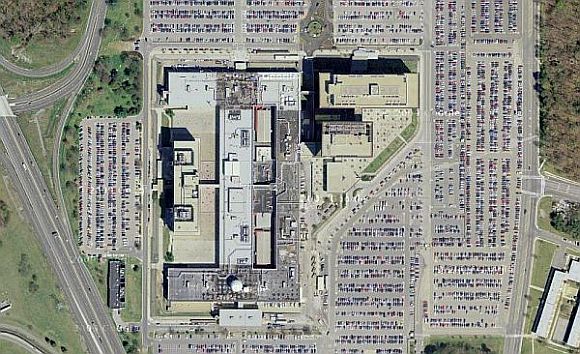
At the New York Times, Scott Shane divulges a national security secret: the National Security Agency (shown in the Google Earth image above) is known by the nickname the Fort. I guess you’d call that the definition of hiding in plain sight since the NSA is located in Fort Meade.
Apparently anyone in the locality could tell you the NSA headquarters is known as the Fort and Shane would not know that that’s supposed to be a secret had he not obtained a copy of a banned book available on eBay.
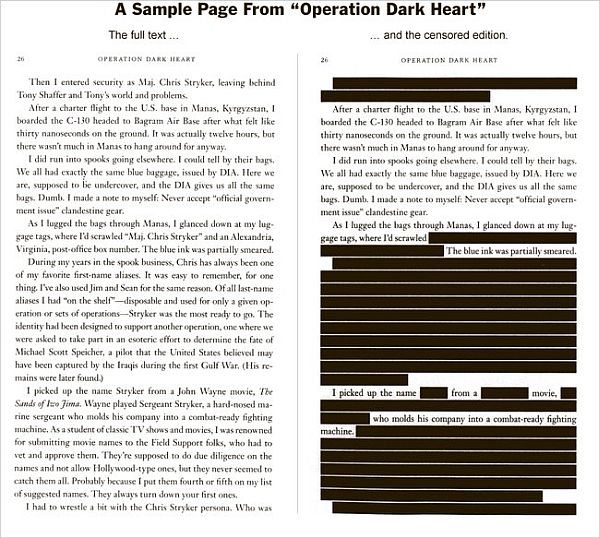
[T]hat nickname is one of hundreds of supposed secrets Pentagon reviewers blacked out in the new, censored edition of an intelligence officer’s Afghan war memoir. The Defense Department is buying and destroying the entire uncensored first printing of “Operation Dark Heart,” by Anthony Shaffer, a lieutenant colonel in the Army Reserve and former Defense Intelligence Agency officer, in the name of protecting national security.
Another supposed secret removed from the second printing: the location of the Central Intelligence Agency’s training facility — Camp Peary, Va., a fact discoverable from Wikipedia. And the name and abbreviation of the Iranian Revolutionary Guard Corps, routinely mentioned in news articles. And the fact that Sigint means “signals intelligence.”
Not only did the Pentagon black out Colonel Shaffer’s cover name in Afghanistan, Chris Stryker, it deleted the source of his pseudonym: the name of John Wayne’s character in the 1949 movie “The Sands of Iwo Jima.”
The redactions offer a rare glimpse behind the bureaucratic veil that cloaks information the government considers too important for public airing.
The New York Times is generous enough to provide a kind of Wikileaks teaser — a single page of the redacted and unredacted book.

Was it out of deference to St Martin’s Press or the Pentagon that the Times refrained from divulging more of the redactions?
And was the NSA so “liberal” in its use of redaction because they want to keep secret the criteria they use for defining secrecy, or because when it comes to secrecy, government officials in the post 9/11 era know that no one ever gets fired for over-classification?
Top secret America?

Too secret for the Washington Post to reveal what it is?
It’s out there — but you won’t find out much about it at the Washington Post!
Memos being leaked from government agencies imploring lips to remain sealed; several days of media buzz in anticipation of a blockbuster investigative series…
One of Hollywood’s hottest publicists must surely have been contracted to push the Washington Post‘s sensational Top Secret America.
And what did we get when the bombshell exploded? Investigative reporting fit for the pages of Cosmopolitan. God help American journalism.
It’s big. It’s really, really big.
This is the big story about the uncontrolled growth of America’s post-9/11 national security industry — indeed an important story, but couldn’t two years of investigation have yielded more substance?
Consider this nugget from Wednesday’s feature on “The secrets next door“:
“In the Washington area, there are 4,000 corporate offices that handle classified information, 25 percent more than last year…”
Twenty-five percent growth in the first year of the Obama administration — that’s a big deal! It must tell us a lot about this administration’s national security philosophy. Or maybe not — maybe all the growth was all in the pipeline and the administration hasn’t figured out how to rein it in.
This is just one of the many statistics that Priest and Arkin toss out and then do nothing to explore. And in this instance it appears to be a purely anecdotal “statistic.” It comes from the supervisor of an industrial security specialist. Justin Walsh spends most of his time up a ladder and this is what Justin’s boss said.
But if the feature articles in the series are a bit lacking in substance, maybe the hard facts are stuffed into the databases the Post has compiled. That’s where we’ll get revelations on a company like Autonomy where the infamous neoconservative warmonger Richard Perle has served as a non-executive director since 2000.
The Post reveals the company has just one government client. Strange?
As far back as 2002, Autonomy was reporting it had “demonstrated its dominance of the Intelligence market by achieving the key infrastructure wins in the arenas of Homeland security and Intelligence systems for over 30 intelligence related and classified organizations in the U.S.” (That comes from the company’s 2002 fourth quarter financial report.) Subsequent company reports indicate that business with the intelligence community has continued to expand for the global leader in creating software for processing unstructured information — one of the core needs in most intelligence analysis. But Top Secret America has nothing to report on this.
OK. The private sector is a labyrinth. How about US government operations? This is where one might hope to learn more about the super secret electronic eavesdropping facility at Sugar Grove.

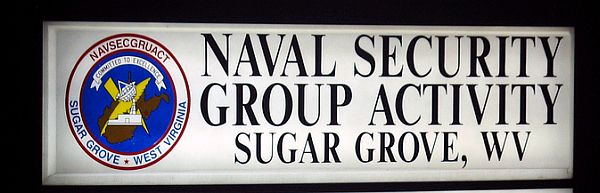
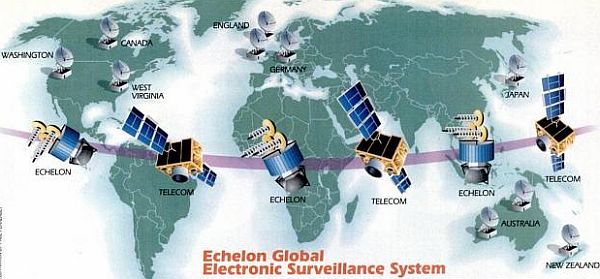
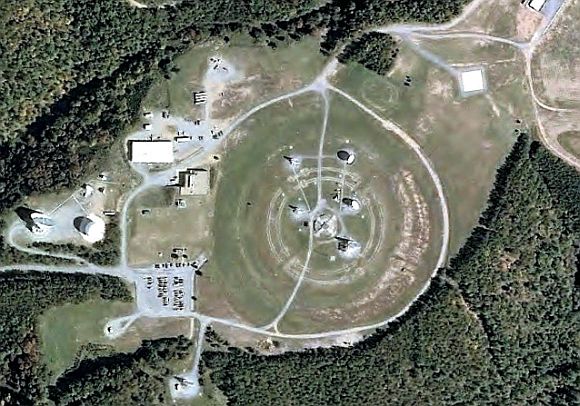
Sugar Grove, nestled in the mountains of West Virginia, is the location of an NSA facility which forms part of ECHELON, a global system of communications surveillance. More information can be found at the Navy Information Operations Command for the base — that is, if you have no qualms about agreeing to a Department of Defense consent agreement that says the US Government will thereafter have the right to seize your computer at any time! I’m not kidding.

And what do we learn about Sugar Grove in Top Secret America? Virtually nothing. It’s a red dot on the map (see the image at the top of this article).
But here’s the worst thing about Top Secret America: it is journalism that instead of providing in-depth exposure to a major political story will more likely have the effect of inoculating the issue.
While this country needs a wake-up call to the fact that its government is still locked in a Bush era fixation on national security, instead we are being cautioned that the crux of the issue primarily one of size. The national security industry in the US has grown out of control — oh yeah, I saw that report in the Washington Post. Big government. What’s new?

Sugar Grove, West Virginia - part of top secret America too secret for Top Secret America
The Post covers spy town
At the Atlantic, the independent investigative reporter, Tim Shorrock, slams the Washington Post‘s Top Secret America series:
Priest and Arkin offer an incredibly simplistic explanation for how the contracting bandwagon took off under President Bush, who they say manipulated “the federal budget process” to make it easier for agencies to hire contractors. Is that why Blackwater suddenly appeared on the scene in Afghanistan days after 9/11, signed up by counterterrorism official named Cofer Black who later joined the company? Is that how CACI International, a favorite of Donald Rumsfeld’s Pentagon, got the interrogation work at Abu Ghraib prison through an “IT” contract outsourced to the Interior Department? The Post also completely ignored the huge growth of contracting during the Clinton administration, which “reinvented” government by downsizing and outsourcing the federal workforce — including spies and surveillance teams in places like Bosnia. Many of the companies that are big wheels today got some of their first contracts during the late 1990s.
Worse, there is virtually nothing in the series about the deeper political questions raised by privatization, including the obvious issue of the revolving door. Unbelievably, Priest and Arkin don’t even mention that President Bush’s DNI, Mike McConnell, and President Obama’s counter-terrorism adviser, John Brennan, were both prominent contractors before taking their jobs. Why is that relevant? Well, McConnell came directly from Booz Allen Hamilton, one of the IC’s top contractors and an adviser to the NSA (and he’s back at Booz now). Brennan was an executive at The Analysis Corporation, which built a key terrorist database for the National Counterterrorism Center (which Brennan used to run).
There was not even a hint that Lt. Gen. James Clapper (ret.), who appeared before the Senate for his DNI confirmation hearing on the second day of the series, once had close ties to major contractors. Clapper once directed the National Geospatial-Intelligence Agency, which has extensive contracts with a satellite firm contracted by the government. Nor was there mention of the Intelligence and National Security Alliance, the largest association for NSA and CIA contractors, for which McConnell, Brennan, and Clapper have all served as chairman. That’s not part of the story? Could Clapper’s experience have influenced his strong defense of contractors during his testimony? Or would mentioning such ties hurt the Post’s access to the ODNI and the White House?
Despite Arkin’s much-vaunted reputation in collecting data, not even the charts are very good. The Post’s enormous database of contractors will be a useful tool for researchers and journalists, and certainly reveals the incredible scope of the industry (nothing new there though). But it does little to inform the public about what private corporations such as Lockheed Martin, SAIC, and Northrop Grumman actually do for the CIA and the dozens of intelligence units within the Pentagon. That’s partly because — as the authors admit in a note to readers — they removed certain “data points” at the suggestion of intelligence officials.
Therefore, you can look up a company like Booz Allen and see which agencies it holds contracts with and what kind of counter-terrorism, intelligence, or homeland security work it does; but you can’t learn what special tasks it carries out for specific agencies. Now some may applaud the Post for the omission, but I just see a failure to disclose.
NEWS ROUNDUP: January 27
Bush order expands network monitoring
President Bush signed a directive this month that expands the intelligence community’s role in monitoring Internet traffic to protect against a rising number of attacks on federal agencies’ computer systems.
Bush urged to renounce torture, restore ‘moral authority’
Delivering what they called a “prebuttal” to President Bush’s final State of the Union speech, congressional Democratic leaders called on Bush to chart a new direction for the U.S. economy and restore America’s “moral authority” abroad, notably by publicly renouncing torture and closing the Guantanamo Bay detention facility.
Israel to restore supply of industrial-use fuel to Gaza Strip
The state told the High Court of Justice on Sunday that Israel would restore the supply of industrial-use diesel to the Gaza Strip to target levels set prior to the blockade imposed on Gaza earlier this month.
American aid worker seized in Afghanistan
Gunmen kidnapped an American aid worker and her driver in southern Afghanistan’s largest city early Saturday, seizing the woman from a residential neighborhood as she was on her way to work.
Maliki sending troops to Mosul
Iraqi Prime Minister Nouri al-Maliki said Friday that Iraqi reinforcements have begun moving toward the northern city of Mosul for a “decisive” battle with the Sunni insurgent group al-Qaeda in Iraq.
FBI agent: Hussein didn’t expect invasion
Before the Iraq war, Saddam Hussein misjudged the U.S. military strategy and thought the United States would launch only several days of airstrikes and not a full-scale ground invasion, according to a television interview with the FBI agent who interrogated the former Iraqi leader for seven months.
NEWS: Big Brother
Wider spying fuels aid plan for telecom industry
For months, the Bush administration has waged a high-profile campaign, including personal lobbying by President Bush and closed-door briefings by top officials, to persuade Congress to pass legislation protecting companies from lawsuits for aiding the National Security Agency’s warrantless eavesdropping program.
But the battle is really about something much bigger. At stake is the federal government’s extensive but uneasy partnership with industry to conduct a wide range of secret surveillance operations in fighting terrorism and crime.
The N.S.A.’s reliance on telecommunications companies is broader and deeper than ever before, according to government and industry officials, yet that alliance is strained by legal worries and the fear of public exposure. [complete article]
NEWS & OPINION: Telecoms, buy victory in lawsuits
Senate and Bush agree on terms of spying bill
Senate Democrats and Republicans reached agreement with the Bush administration yesterday on the terms of new legislation to control the federal government’s domestic surveillance program, which includes a highly controversial grant of legal immunity to telecommunications companies that have assisted the program, according to congressional sources.
Disclosure of the deal followed a decision by House Democratic leaders to pull a competing version of the measure from the floor because they lacked the votes to prevail over Republican opponents and GOP parliamentary maneuvers.
The collapse marked the first time since Democrats took control of the chamber that a major bill was withdrawn from consideration before a scheduled vote. It was a victory for President Bush, whose aides lobbied heavily against the Democrats’ bill, and an embarrassment for House Speaker Nancy Pelosi (D-Calif.), who had pushed for the measure’s passage. [complete article]
AT&T, other telecoms, buy victory in lawsuits
Let’s just describe very factually and dispassionately what has happened here. Congress — led by Senators, such as Jay Rockefeller, who have received huge payments from the telecom industry, and by privatized intelligence pioneer Mike McConnell, former Chairman of the secretive intelligence industry association that has been demanding telecom amnesty — is going to intervene directly in the pending lawsuits against AT&T and other telecoms and declare them the winners on the ground that they did nothing wrong. Because of their vast ties to the telecoms, neither Rockefeller nor McConnell could ever appropriately serve as an actual judge in those lawsuits.
Yet here they are, meeting and reviewing secret documents and deciding amongst themselves to end all pending lawsuits in favor of their benefactors — AT&T, Verizon and others. [complete article]