Category Archives: Obama administration

Fighters abandoning al Qaeda affiliates to join #ISIS, U.S. officials say

The Washington Post reports: Even before its assault on Kurdish territories in northern Iraq this month, analysts said the Islamic State had shown an almost impulsive character in its pursuit of territory and recruits, with little patience for the elaborate and often time-consuming terror plots favored by al-Qaeda.

Counterterrorism analysts at the CIA and other agencies have so far seen no indication that an entire al-Qaeda node or any of its senior leaders are prepared to switch sides. But officials said they have begun watching for signs of such a development.

The launching of U.S. airstrikes has raised new questions, including whether the bombings will hurt the Islamic State’s ability to draw recruits or elevate its status among jihadists. “Does that increase the spigot or close it?” said a senior U.S. counterterrorism official, who, like others, spoke on the condition of anonymity and noted that U.S. military operations in Afghanistan and elsewhere have crippled al-Qaeda but also served as rallying cries against the United States.

Longer-term, U.S. officials expressed concern that the Islamic State, which so far has been focused predominantly on its goal of reestablishing an Islamic caliphate, may now place greater emphasis on carrying out attacks against the United States and its allies. [Continue reading…]

Hillary Clinton:

“One of the reasons why I worry about what’s happening in the Middle East right now is because of the breakout capacity of jihadist groups that can affect Europe, can affect the United States,” she said. “Jihadist groups are governing territory. They will never stay there, though. They are driven to expand. Their raison d’etre is to be against the West, against the Crusaders, against the fill-in-the-blank—and we all fit into one of these categories. How do we try to contain that? I’m thinking a lot about containment, deterrence, and defeat.”

The breakout capacity of jihadist groups? I strongly suspect that phrase was a gift from GOP strategist Frank Luntz. It offers a subliminal connection between terrorism and Iran’s nuclear program without having to make any substantive assertion to that effect. Instead, it conjures up jihadist groups as metaphorical weapons of mass destruction. Is this how a President Clinton would frame her iteration of the War on Terrorism?

More importantly, Clinton is echoing the U.S.-centric narcissistic view of terrorism that still prevails in this country: that extremists of every description have no greater desire than to find ways of killing Americans.

No doubt, ISIS has issued blood-curdling warnings, saying that the U.S. will be severely punished if it tries to obstruct the growth of the Islamic State, but the very fact that it has made these warnings is an indication that the group has vastly more interest in its caliphate project than it has in waging war with the U.S..

ISIS is not at war with America — it’s enemy is the Shia.

That’s not to imply that the rest of the world has any justification for being complacent about the level of mayhem ISIS can and already has created. It’s simply a suggestion that “American lives are at stake” should not be the only rationale guiding U.S. foreign affairs.


Facebooktwittermail

The chaos in Baghdad explains why #Obama isn’t trying to destroy #ISIS

Tweet from U.S. Deputy Assistant Secretary of State for Near Eastern Affairs (Iraq and Iran):

Vox: Iraqi Prime Minister Nouri al-Maliki threw the country’s political system into crisis on Sunday, when he announced that he would be staying on as Prime Minister after a deadline to form a new government expired without an agreement at 12 am Baghdad time. Maliki announced a plan to sue Iraq’s President, Fuad Masum, for violating the country’s constitution, and it’s now totally unclear when, if ever, Iraq will return to normal democratic procedures.

All of this underscores why, on his Saturday press conference about the US intervention on Iraq, President Obama emphasized the need for Iraqi political reform to solve the ISIS crisis. “Ultimately, there’s not going to be an American military solution to this problem,” President Obama told reporters. “There’s going to have to be an Iraqi solution.” This is the key line to understand if you want to grasp the administration’s approach to Iraq — and why the goals of the US military campaign are more narrow than you might think.

The American objectives for Obama’s airstrikes in Iraq are very clear, and very limited. American airpower will protect Iraqi Kurdistan from the advance of militants from Islamic State (ISIS), and will attempt to break the ISIS siege that’s starving up to 40,000 members of the Yazidi minority on an isolated mountain.

So why is the US stopping there? ISIS controls a huge swath of land about the size of Belgium in Iraq and Syria. The group poses a serious threat to the Iraqi government and possibly even the stability of the entire region. If the United States can beat ISIS back in Kurdistan, why not elsewhere?

That line about an Iraqi solution is the administration’s answer. In fact, the Obama administration has been consistent on this question since June, when ISIS first took control of big chunks of Iraq. They see ISIS as, at its heart, a political problem — one that can’t be solved solely with force. But the march on Kurdistan and the siege on Sinjar are narrow military problems, and thus merit military solutions. This distinction between military and political problems is at the heart of the Obama administration’s thinking on Iraq. [Continue reading…]

Facebooktwittermail

Exodus from the mountain: Yazidis flood back into Iraq following U.S. airstrikes

The Washington Post reports: Burned by the sun, blistered with thirst and weak from exhaustion, thousands of Yazidis fled the mountain on which they had been trapped for a week on Sunday, streaming into Iraq’s northern Kurdistan region after a harrowing escape from extremist fighters that some said was aided by U.S. airstrikes.

Hungry, thirsty and tired, they limped across a narrow bridge spanning the Tigris on the Iraqi-Syrian border hauling their few belongings, some of them barefoot, others in sleeping clothes because they ran for their lives at night.

It was the last leg of a nightmarish journey that some have not survived — and many more may not.

Thousands are still stranded on the mountain, either because they are surrounded in their villages by militants with the Islamic State or are simply too weak to walk, according to those arriving in the remote Iraqi border post of Fishkhabour. Others have died trying to reach safety, falling by the wayside on the barren, rocky mountain for lack of food and water. [Continue reading…]

Facebooktwittermail

A piecemeal parochial approach won’t solve the Middle East crisis

Chris Doyle writes: “The lamps are going out all over the Middle East”, to update Sir Edward Grey’s doom-laden warning to Europe a hundred years ago. The areas of calm and stability seem like small oases in a multitude of firestorms. Many areas are literally without lights. Gaza has around two hours electricity a day. The power cuts in Yemen are worse and worse, leading to major protests. But, more worryingly, the lights of the democratic, liberal, pluralistic forces that for many months in 2011 lit up the region are also dimming, overshadowed by the twin forces of brutal dictatorship and brutal religious sectarian extremism.

Syria and Iraq are divided and near ungovernable, in the waiting room for failed-state status. The so-called Islamic caliphate or Isis, which in reality bears no resemblance to any caliphates of the past, covers an ever-expanding area, larger than the United Kingdom, including 35 per cent of Syria. Libya is being terrorised by rival militias. Palestinians in Gaza, for the fourth time since 2006, are at the wrong end of an Israeli military aggression that pits one of the world’s most sophisticated militaries against a captive population inside the world’s largest prison. The collective pile of rubble from these conflicts would grace a mountain range.

Those states and areas that enjoy calm become refugee camps. Lebanon and Jordan host almost two million Syrian refugees between them, as well as 2.5 million Palestinians. Tunisia is confronted with a mass Libyan exodus; while Iraqi Kurdistan is home to more than 300,000 Iraqis displaced only since June, as well as 220,000 Syrian refugees. In each case, the numbers are rocketing up – with the number of Syrian refugees alone expected to reach four million by the end of the year. Each humanitarian appeal is underfunded.

Will it get worse? The signs are worrying. The fighting in Lebanon last week, in Arsal in the north Bekaa valley, is yet another example of why the Syrian crisis threatens to move from spilling over, to swamping, its smaller neighbour. The instability could spread to Jordan. Saudi Arabia and the Gulf states will not be immune to the regional changes.

Given the epidemic of crises in an area of the world vital to our trade, energy and security interests, the minimal expectation would be an energetic and engaged response. Yet, when asked about Western policy towards the region, my instinctive response is, “There is one?”

The failure is first and foremost one of leadership, at an international and regional level. Who are great international statesmen in the West or in the Middle East? Who do young Arabs, who make up most of the population, look to for inspiration? President Obama has been blasted for his indecisiveness but he is not alone. George W Bush and Tony Blair were decisive over Iraq and destroyed the country. There is no strategy, and often the debate is reduced to a question of to bomb or not to bomb. [Continue reading…]

Facebooktwittermail

Would half Israelis like to see Obama dead?

In a press conference last Saturday, Israeli Prime Minister Benjamin Netanyahu expressed his gratitude for the Obama administration’s resolute support throughout the latest war on Gaza: “I think the United States has been terrific.” He also thanked President Obama for his “unequivocal stand with Israel on our right to defend ourselves.”

While atrocities committed by Israel have been condemned by UN Secretary General Ban Ki-moon, people around the world have marched in solidarity with the Palestinians and there are repeated calls for Israel to be charged with war crimes and be taken to the International Criminal Court, the Obama administration has replenished Israel’s munition supplies and increased funding for Israel’s Iron Dome missile defense system.

With so few friends in the world, one might imagine that most Israelis would be glad they have a friend in the White House.

In an online poll conducted on August 3 by Israel’s most popular TV channel, Channel 2, respondents were asked what they thought the best birthday gift for Barack Obama would be?

The most popular response, coming from 48%, was to give him the Ebola virus.

Facebooktwittermail

Nothing says ‘sorry our drones hit your wedding party’ like $800,000 and some guns

Gregory D. Johnsen writes: Muhammad al-Tuhayf was relaxing at his house late in the afternoon on Dec. 12, 2013, when his iPhone rang. A boxy, tired-looking Yemeni shaykh with large hands and a slow voice, Tuhayf heard the news: A few miles from where he was sitting, along a rutted-out dirt track that snaked through the mountains and wadis of central Yemen, U.S. drones had fired four missiles at a convoy of vehicles. Drone strikes were nothing new in Yemen — there had been one four days earlier, another one a couple weeks before that, and a burst of eight strikes in 12 days in late July and August that had set the country on edge. But this one was different: This time the Americans had hit a wedding party. And now the government needed Tuhayf’s help.

The corpses had already started to arrive in the provincial capital of Radaa, and by the next morning angry tribesmen were lining the dead up in the street. Laid out side by side on bright blue tarps and wrapped in cheap blankets, what was left of the men looked distorted by death. Heads were thrown back at awkward angles, splattered with blood that had caked and dried in the hours since the strike. Faces that had been whole were now in pieces, missing chunks of skin and bone, and off to one side, as if he didn’t quite belong, lay a bearded man with no visible wounds.

Clustered around them in a sweaty, jostling circle, dozens of men bumped up against one another as they struggled for position and a peek at the remains. Above the crowd, swaying out over the row of bodies as he hung onto what appeared to be the back of a truck with one hand, a leathery old Yemeni screamed into the crowd. “This is a massacre,” he shouted, his arm slicing through the air. “They were a wedding party.” Dressed in a gray jacket and a dusty beige robe with prayer beads draped over his dagger, the man was shaking with fury as his voice faltered under the strain. “An American drone killed them,” he croaked with another wild gesture from his one free hand. “Look at them.”

A few miles outside of town, Tuhayf already knew what he had to do. This had happened in his backyard; he was one of the shaykhs on the ground. Only three hours south of the capital, the central government held little sway in Radaa. Like a rural sheriff in a disaster zone, he was a local authority, someone who was known and respected. And on Dec. 12, that meant acting as a first responder. Tuhayf needed to assess the situation and deal with the fallout. Every few minutes his phone went off again, the marimba ringtone sounding with yet another update. Already he was hearing reports that angry tribesmen had cut the road north. Frightened municipal employees, worried that they might be targeted, kept calling, begging for his help. So did the governor, who was three hours away at his compound in Sanaa.

It didn’t take Tuhayf long to reach a conclusion. The Americans had made a mess, and to clean it up he was going to need money and guns.

This is the other side of America’s drone program: the part that comes after the missiles fly and the cars explode, when the smoke clears and the bodies are sorted. Because it is here, at desert strike sites across the Middle East, where unsettling questions emerge about culpability and responsibility — about the value of a human life and assessing the true costs of a surgical war.

For much of the past century, the United States has gone to war with lawyers, men and women who follow the fighting, adjudicating claims of civilian casualties and dispensing cash for errors. They write reports and interview survivors. But what happens when there are no boots on the ground? When the lawyers are thousands of miles away and dependent on aerial footage that is as ambiguous as it is inconclusive? How do you determine innocence or guilt from a pre-strike video? When everyone has beards and guns, like they do in rural Yemen, can you tell the good guys from the bad? Is it even possible? And when the U.S. gets it wrong, when it kills the wrong man: What happens then? Who is accountable when a drone does the killing? [Continue reading…]

Facebooktwittermail

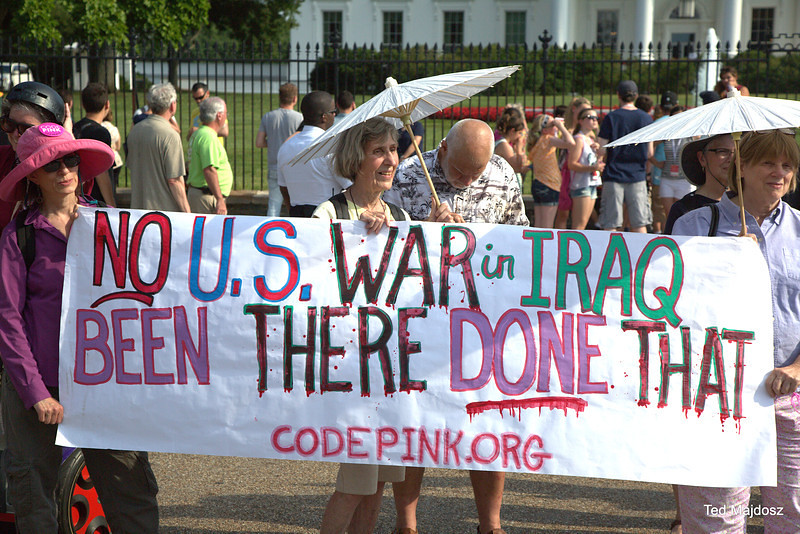
Send them parasols?

CODEPINK asks: “Why does our President want to take sides and get involved in a civil war? The US is not the target of ISIS, but if we become involved, we will be.”

A lot of Americans these days, some of whom regard themselves as impeccable humanitarians, have formed the conviction that when it comes to the Middle East (or pretty much anywhere else in the world), intervention by the United States — especially military intervention — can do nothing but harm.

President Obama’s concerns about the Iraqi humanitarian crisis and the safety of US personnel can be solved without dropping bombs. Helping the besieged civilians in Iraq should be an orchestrated international effort, not carried out just by the US — the country that unleashed the sectarian turmoil in the first place. (CODEPINK)

Tens of thousands of Iraqis fled from ISIS, taking refuge on a mountain top where they have no food, water, or shelter. How long could anyone survive in these conditions when daytime temperatures often exceed 100F?

By the time CODEPINK’s wished for international effort could be orchestrated, thousands of those in need of help would be dead.


Channel 4 News
spoke to a Yazidi refugee, Barakat al-Issa, who is trapped in the Sinjar mountains: “the situation is very tragic, more than 100 thousand people are trapped in the mountains here, in need of water and food.”

The Americans and Turkish have carried out air drops of aid, but the effort was not sufficient said Mr al-Issa: “They are saying that planes are dropping aid, but this aid is only getting to some 5 per cent of the people who are trapped here, because of the mountainous terrain.”

“People are waiting here for international forces to intervene, in the hope that this will become a safe haven for aid to be delivered.”

“Most of the people here are civilians and they hope a peacekeeping force will come from Iraq or Nato.”

He accused the Islamic State militants of kidnapping at least 500 Yazidi women, whose fate remains unknown, and said that dozens of families had been murdered in the south of the Sinjar mountains as they tried to flee. He also repeated allegations that militants had been seen executing women and children.

To advocate neutrality in this conflict seems indicative of either being willfully deluded about the nature of ISIS or the result of simply not paying attention to what has been happening in Syria and Iraq over the last two years.

ISIS, or the Islamic State as it now prefers to be known, is utterly uncompromising. These men have chosen to fight a war that they will either win or lose — don’t expect them to ever send a delegation of negotiators to Geneva or start talking about how they want to live peacefully side by side with anyone. Coexistence is not part of their vocabulary.

Anyone in CODEPINK who is averse to taking sides should watch the video below — or at least as much of it as they can stomach — to witness how these jihadists whose passion for killing has no limit choose to portray themselves.

Some of the latest military action in Iraq appears to already by paying off but the situation remains dire, as Rudaw reports:

Local officials said today that 10,000 Yezidis who were stranded on Mount Shingal for one week were rescued and settled in the town of Zakho.

Medical teams and aid organizations in Zakho have rushed in to assist the rescued families, said Rudaw reporter.

Ashti Kocher, Zakho’s security chief said that Kurdish armed forces have opened a safe corridor for the Yezidis at Mount Shingal.

“We have also cleared about 30 kilometers of the ISIL forces in order to open a road for those families,” said Kocher, who currently leads a Peshmerga unit at Sinune village near Shingal.

Kocher said that the rescued civilians were transported to the Kurdistan Region through Rojava (Syrian Kurdistan) which is under the control of Kurdish forces known as the Peoples Protection Units (YPG).

Barakat Issa, Rudaw reporter on Mount Shingal said that the number of Yezidis stranded on the mountain is higher than initially reported. He said that nearly 100,000 people are hiding on the mountain.

Issa said that in the past few days 60 children and elderly have [died] … of hunger and thirst while there is fear that Islamic militants controlling the town of Shingal and other villages have massacred hundreds of others.

Stephen Walt proposes a course of inaction for the U.S. in the Middle East on the grounds that U.S. intervention never has its desired effects, but he adds this caveat:

[T]his argument would not preclude limited U.S. action for purely humanitarian purposes — such as humanitarian airdrops for the beleaguered religious minorities now threatened with starvation in Iraq. That’s not “deep engagement”; that’s merely trying to help people threatened with imminent death. But I would not send U.S. forces — including drones or aircraft — out to win a battle that the Iraqi government or the Kurds cannot win for themselves.

So the anti-interventionist “humanitarian” perspective is this — if I understand it correctly: we should try to make sure the Yazidi do not starve to death on the mountaintop. If, however, they manage to come back down only later to be slaughtered by ISIS, that’s their problem.

Facebooktwittermail

U.S. warplanes strike #ISIS artillery to protect Kurds

Reuters reports: U.S. warplanes struck Iraq on Friday for the first time since American troops pulled out in 2011, attacking Islamist fighters advancing towards the Kurdish region after President Barack Obama said Washington must act to prevent “genocide.”

The fighters had advanced to within a half hour’s drive of Arbil, capital of Iraq’s Kurdish region and a hub for U.S. oil companies. A Pentagon spokesman said two F/A-18 aircraft dropped laser-guided bombs on a mobile artillery piece used by Islamic State fighters to shell Kurdish forces defending Arbil. [Continue reading…]

Facebooktwittermail

Kurdish commander: ‘If [the Americans] plan to help they had better do it now’

McClatchy reports: Jet aircraft attacked Islamic State positions outside the town of Kalak, 25 miles northwest of Irbil, the capital of Iraq’s autonomous Kurdish region, a resident of Kalak told McClatchy early Friday.

The resident, reached by phone from Irbil, said she had seen the aircraft and had heard the explosions coming from behind Islamic State lines, which are slightly more than a mile away. The resident said because it was dark she could not see any markings on the aircraft.

Kurdish television reported that the bombers were American. There was no confirmation from U.S. officials in Washington.

The reported bombing came after a day of panic in the Kurdish capital following Islamic State militants’ seizure of four strategic towns on a key highway and their advance to positions just minutes from Irbil.

Hundreds of Kurdish peshmerga militiamen built earthen berms near Kalak on the highway that links Irbil with Mosul, the Iraqi city whose fall to Islamic State militants in early June touched off a sweep across northern and western Iraq that until Thursday had spared Kurdish areas.

But that quiet appeared to be over, with the Islamic State boldly saying in an Internet posting Thursday that it intended to capture Irbil, a city previously thought so secure that the United States two months ago chose it as one of two Iraqi cities safe enough to receive scores of staffers evacuated from the U.S. Embassy in Baghdad.

“The Americans keep saying they will help us,” said Rosg Nuri Shawess, a top Kurdish military commander who was overseeing the defensive preparations. “Well, if they plan to help they had better do it now.” [Continue reading…]

Facebooktwittermail

Nick Turse: Christmas in July and the collapse of America’s great African experiment

On return from his recent reporting trip to Africa, Nick Turse told me the following tale, which catches something of the nature of our battered world.  At a hotel bar in Juba, the capital of South Sudan, he attended an informal briefing with a representative of a major nongovernmental organization (NGO).  At one point, the briefer commented that just one more crisis might sink the whole aid operation.  He thought she was referring to South Sudan, whose bottomless set of problems include unending civil war, no good prospects for peace, impending famine, poor governance, and a lack of the sort of infrastructure that could make a dent in such a famine.  Nick responded accordingly, only to be corrected.  She didn’t just mean South Sudan, she said, but the entire global NGO system.  Given the chaos of the present moment across the Greater Middle East and elsewhere, global aid operations were, she insisted, on the brink. They were all, she told him, just one catastrophe away from the entire system collapsing.

I have to admit that as I watch the civilian carnage in Gaza; catastrophically devolving Iraq; the nightmare of Syria; the chaotic situation in Libya where, thanks to militia fighting, the capital’s international airport is now in ruins; the grim events surrounding Ukraine, which seem to be leading to an eerie, almost inconceivable revival of the Cold War ethos; not to speak of the situation in Afghanistan, where bad only becomes worse in the midst of an election from hell and the revival of the Taliban, I have a similar eerie feeling: just one more thing might tip this planet into… well, what?

And then, of course, I read Nick Turse’s second report from Africa, up-close-and-personal from South Sudan.  It’s another place the U.S. chose as one of its special (un-)nation building projects and has seen it go to hell in a hand basket on a continent parts of which seem to be destabilizing as we watch.  Now, I find myself wondering whether just one more disaster, one political or military catastrophe, might push us all over the edge of… well, who knows what?  Tom Engelhardt

As a man-made famine looms, Christmas comes early to South Sudan
The limits of America’s African experiment in nation building
By Nick Turse

[This story was reported in partnership with the Investigative Fund at The Nation Institute. Additional funding was provided through the generosity of Adelaide Gomer.]

Juba, South Sudan — The soft glow of the dancing white lights is a dead giveaway.  It’s Christmas in July at the U.S. Embassy compound.  Behind high walls topped with fierce-looking metal impediments meant to discourage climbers, there’s a party under way.

Close your eyes and you could be at a stateside summer barbeque or an office holiday party.  Even with them open, the local realities of dirt roads and dirty water, civil war, mass graves, and nightly shoot-to-kill curfews seem foreign. These walls, it turns out, are even higher than they look.

Continue reading

Facebooktwittermail

#Obama reaffirms his loyalty to #Israel

The Huffington Post reports: President Barack Obama continued his forceful defense of Israel on Wednesday, blaming Hamas for the conflict in Gaza that has left nearly 1,900 Palestinians and 67 Israelis dead.

“I have no sympathy for Hamas. I have great sympathy for ordinary people who are struggling within Gaza,” Obama said at a press conference, when asked if he agreed with Israeli Prime Minister Benjamin Netanyahu’s assertion that Israel’s bombardment of Gaza was both “justified” and “proportionate.”

Obama, who has publicly stood by Israel throughout the crisis, reiterated many of the talking points he and his administration have employed since the war began on July 8.

Facebooktwittermail

The false dichotomy between military action and successful diplomacy

Shadi Hamid writes: The Middle East, as a region, is more unstable, divided, and rife with extremism today than it has been at any other point in recent decades. It would make little sense to blame these developments on American military intervention. The past six years have been characterized not by the use of force, but by a very concerted desire on the part of the Obama administration to reduce our regional engagement, in general, and our military footprint in particular.

The presumption was that with the withdrawal from Iraq, a key Arab grievance would be addressed. The Obama administration could, then, re-establish a relationship with the Arab world based on “mutual respect,” leading to a “new beginning.” It wasn’t unreasonable to think this. After all, it was precisely our over-engagement, and the waging of two costly, tragic wars, that appeared to provoke such anger toward the United States. Yet disengagement and detachment haven’t helped matters. Anti-Americanism persists at strikingly high levels and, in a number of countries, attitudes toward the U.S. are more negative under Obama than they were during Bush’s final years.

The Bush administration’s fatal mistake wasn’t military intervention per se, but rather the misapplication of military force under false pretenses. In other words, not all military adventures are created equal: Bad interventions are bad, but good interventions are good.

The two most destructive conflicts in the Middle East today are in Syria and Iraq, two countries that have imploded not because of too much intervention, but because of too little. In Syria, our failure to intervene with air support to help rebels hold territory and targeted military strikes to diminish the regime’s ability to kill not only exacerbated the humanitarian toll, but also undermined “moderates” — who have begged endlessly for the most basic weaponry — and strengthened extremist groups like ISIS. The claim, oft-repeated by opponents of intervention, that “there is no military solution” is a straw man, setting up a false dichotomy between military action and successful diplomacy, when the two, in fact, go hand in hand. Assad has no real incentive to negotiate in good faith in the absence of a credible threat of military force.

Consider ISIS’s recent capture of territory in the strategic Syrian city of Deir Ezzour. The group’s military success had very little to do with hatreds of any kind, ancient or otherwise, and more to do with the failure of the international community to support the rebels of the Free Syrian Army, who warned American officials, including Samantha Power, that ISIS was closing in. For weeks, they pleaded for assistance but were ignored. “The FSA numbers are big, but we don’t have weapons, we don’t have ammunition, we don’t have anything,” complained one FSA commander.

In Iraq, the original sin was the Bush administration’s decision to invade in 2003 (or was it the elder Bush’s failure to back the Iraqi uprising of 1991, effectively allowing Saddam to stay in power?). But, again, there was nothing inevitable about the fall of Mosul to ISIS in June and the eruption of civil war in Iraq. To emphasize, as Obama has, that this is a conflict between Iraqis and must be resolved by Iraqis, is banal and self-evident, but it also implies — in the context of Obama’s broader approach to the region — a certain studied detachment. This is not our civil war, but theirs. Except that the U.S., through a staggering combination of incompetence, neglect, and myopia, is directly implicated in the country’s political deterioration. As Ali Khedery, the longest continuing serving U.S. official in Iraq, writes: “The crisis now gripping Iraq and the Middle East was not only predictable but predicted — and preventable. By looking the other way and unconditionally supporting and arming Maliki, President Obama has only lengthened and expanded the conflict that President Bush unwisely initiated.”

If anything, the lesson of Bosnia, Kosovo, and, for that matter, Rwanda, is that supposedly “primordial” conflicts over religion, sect, and ethnicity are the very ones, due to their intractability and viciousness, that are more likely to require outside military intervention. Ultimately, the end of the Bosnian war did not mean that Bosniaks, Serbs, and Croats hated each other any less; it meant that, despite their hate, they would agree to abide by a peace agreement. This return to “politics” would not have been possible without, first, the resort to force by NATO and the international community. [Continue reading…]

Facebooktwittermail

How the U.S. got mixed up in a fight over Kurdish oil — with a unified Iraq at stake

The Washington Post reports: Sixty miles off the coast of Texas sits a crude-oil tanker fully loaded with years of antagonism between the Kurdish region of Iraq and the central government in Baghdad.

The United Kalavrvta, a tanker the length of three football fields, is carrying about 1 million barrels of crude oil from the Kurdish region of Iraq. It set sail for Galveston, but it never got there.

The central government of Iraq, despite recent military setbacks, dispatched its American lawyers to do battle in the federal court in southern Texas, where a judge ruled that the tanker’s cargo, worth about $100 million, should be seized if it came within Texas state waters.

The core of the dispute: The Iraqi government says that the crude cargo belongs to the Baghdad Ministry of Oil and that it was never the property of the Kurdistan Regional Government. But the Kurds argue that the Texas court doesn’t have jurisdiction, and they filed a motion Monday in the court to lift the restrictions on the oil. Michael Howard, an adviser to the Kurdish minister of natural resources, said in an interview that “it’s a constitutional issue that should be determined in Iraq and shouldn’t be exported to U.S. courts.” [Continue reading…]

Facebooktwittermail

Obama’s secret terrorist-tracking system, by the numbers

The Intercept reports: Nearly half of the people on the U.S. government’s widely shared database of terrorist suspects are not connected to any known terrorist group, according to classified government documents obtained by The Intercept.

Of the 680,000 people caught up in the government’s Terrorist Screening Database — a watchlist of “known or suspected terrorists” that is shared with local law enforcement agencies, private contractors, and foreign governments — more than 40 percent are described by the government as having “no recognized terrorist group affiliation.” That category — 280,000 people — dwarfs the number of watchlisted people suspected of ties to al Qaeda, Hamas, and Hezbollah combined.

The documents, obtained from a source in the intelligence community, also reveal that the Obama Administration has presided over an unprecedented expansion of the terrorist screening system. Since taking office, Obama has boosted the number of people on the no fly list more than ten-fold, to an all-time high of 47,000 — surpassing the number of people barred from flying under George W. Bush. [Continue reading…]

Facebooktwittermail

#Obama won’t end #Israel’s war on #Gaza

After an Israeli airstrike near a UN shelter which killed at least 10 people on Sunday, the State Department issued a statement saying: “The suspicion that militants are operating nearby [a UN shelter] does not justify strikes that put at risk the lives of so many innocent civilians.”

From day one in the current war, Israel has attempted to absolve itself for responsibility for civilian casualties by arguing that they are “human shields.” What the State Department finally made clear is that describing civilians as human shields does not make their lives expendable.

The State Department has understood this legal fact from day one but it waited almost a month before asserting this with any force. And even while the Obama administration caught the media’s attention in the last few days for voicing “harsh” criticism of the Israelis, it did so at the very same time as replenishing Israel’s supply of munitions.

The New York Times reports:

For all its outrage over civilian casualties, the United States steadfastly backs Israel’s right to defend itself and shares Israel’s view that Hamas is a terrorist organization. In a world of bitter enmities, the Israeli-American dispute is more akin to a family quarrel.

The White House seems determined to tamp down the latest eruption in tensions. “The nature of our relationship is strong and unchanged,” the press secretary, Josh Earnest, told reporters on Monday, pointing to comments by Mr. Netanyahu over the weekend, in which he said, “I think the United States has been terrific.”

The two statements are part of a recurring pattern for this administration: an angry outburst, followed by calmer words and the grudging recognition that little is going to change in the fundamental relationship between the United States and its closest ally in the Middle East.

Disputes between the United States and Israel are hardly new. President Ronald Reagan sold Awacs surveillance planes to Saudi Arabia over Israel’s fierce objections. George H.W. Bush held up loan guarantees because of Israeli settlement construction. Bill Clinton fumed after his first Oval Office encounter with a newly elected Israeli prime minister, Mr. Netanyahu.

But the chronic nature of this tension is unusual — and, according to current and former officials, rooted in ill will at the very top. “You have a backdrop of a very acrimonious relationship between the president and the prime minister of Israel,” said Robert M. Danin, a Middle East expert at the Council on Foreign Relations.

While tensions between Mr. Obama and Mr. Netanyahu only occasionally spill into the open, Mr. Kerry became the subject of very public and vitriolic — albeit anonymous — criticism from Israeli officials for his efforts two weeks ago to negotiate a cease-fire between Israel and Hamas. His proposal, the officials said, was tilted in favor of Hamas and did not do enough to protect Israel’s security.

Mr. Kerry, American officials responded, based his efforts on an Egyptian cease-fire proposal that had already been accepted by the Israelis. He submitted his ideas to the Israelis, anticipating that they would have concerns. Whatever the precise circumstances, Mr. Kerry found himself excoriated across the political spectrum in Israel.

At the White House, officials were incensed by what they saw as shabby treatment of Mr. Kerry, a loyal friend of Israel. In addition to the cease-fire and the peace talks, they noted, Mr. Kerry went to bat for Israel with the Federal Aviation Administration after it imposed a ban on commercial flights to Tel Aviv following a rocket attack near Ben-Gurion International Airport.

What does batting for Israel against the FAA mean? That at a moment when Israel seemed particularly vulnerable, the Secretary of State for the United States thought that it was his job to place the interests of Israel’s economy above those of his own citizens.

Now that a ceasefire has tentatively taken hold, the U.S. role in negotiations in Cairo, nominally promoting mediation yet predictably operating as Israel’s most loyal supporter, is to make sure that Israel’s interests take precedence above all others.

It is in Israel’s interests that it now contrive an expression of its humanitarian concerns — that after having flattened many parts of Gaza it will pay lip service to the need to consider the welfare of the population.

Yet there seems little doubt that even if the siege is “eased” is various ways, Israel’s war against Gaza will continue.

Facebooktwittermail

Top 5 ways the U.S. is #Israel’s accomplice in war crimes in #Gaza

Juan Cole writes: Here are the ways that the US is actively helping Israel in its war on Gaza:

1. The US shares its raw signals intelligence directly with Israeli intelligence, enhancing Israeli eavesdropping and surveillance capabilities, as Glenn Greenwald shows in a new article for Firstlook. Israel somewhat ungratefully repaid the favor by collaborating with Russia to spy on John Kerry during his failed peace negotiations.

2. The US continually replenishes Israel’s ammunition. If Washington were actually so distressed about the UNRWA school shelling, it could just stop sending the shells for a while. It did this to Egypt after the massacre at Rabi`a al-Adawiya last summer.

3. The US State Department actively helps Israel to economically blockade the civilians of Gaza. It even pressures Egypt to uphold the blockade (which is why it is silly to say that Egypt is also responsible for the siege of Gaza; Egypt doesn’t have a choice in this policy that is made from Tel Aviv and promulgated from Washington). [Continue reading…]

Facebooktwittermail

#Hamas denies taking missing #Israeli soldier

Al Jazeera reports: The al-Qasaam Brigades, the military wing of Hamas, has denied capturing a missing Israeli soldier after Barack Obama, the US president, called for his release as a precondition for further ceasefire talks after the latest Gaza truce fell apart after just a few hours.

The Israeli army said Hadar Goldin, 23, went missing when its soldiers, two of whom were killed, were attacked while trying to destroy a Hamas tunnel in southern Gaza.

Obama’s comment at a White House news conference on Friday suggested the limited impact that diplomacy is having as the violence continues in the besieged strip.

“If they are serious about trying to resolve this situation, that soldier needs to be unconditionally released as soon as possible,” he said.

The al-Qasaam Brigades said: “We have no idea about where the Israeli soldier is or what is the situation.

“We lost contact with the group who made the suicide mission near Rafah after it was done.

“And we believe everyone in this group was killed by an Israeli airstrike including the Israeli soldier who the Israelis are talking about having disappeared.” [Continue reading…]

Facebooktwittermail

On #Gaza, #Israel is losing the #Obama coalition

Peter Beinart writes: In Chicago, Barack Obama lived across the street from a very unusual synagogue, KAM Isaiah Israel, and its very unusual rabbi, Arnold Jacob Wolf. Wolf had been the founding chairman of Breira, the first American Jewish group to advocate a Palestinian state, and throughout his career, he passionately challenged Israeli settlement policies and the American Jewish organizations that justified them. In 1970, in words that could have been written this morning, Wolf denounced American Jewish leaders who, on the issue of Israel, “do not demand support, but rather submission…Any congregation whose allegiance is the least bit critical, any rabbi who holds independent views of the Middle Eastern situation, is eyed with suspicion, if not with downright hatred.”

Wolf liked Obama, but considered him timid. One month before Obama’s election, and three months before Wolf’s death, the octogenarian rabbi predicted that although Obama “knows more than most people do about the [Middle East] situation…he’s going to go very cautiously and not do anything that shakes up the Jewish community. I’m not sure I agree with that, but that’s what’s going to happen.”

Wolf was right. Obama has been cautious. He’s put far less pressure on Benjamin Netanyahu to stop settlement growth than George H.W. Bush put on Yitzhak Shamir. He’s been far more indulgent of Netanyahu’s war in Gaza than Ronald Reagan was of Shamir and Menachem Begin’s war in Lebanon.

But although Obama has not changed the American debate over Israel, the Obama coalition has. Look at the polls taken during this war. A majority of Americans defend Israel’s actions and blame Hamas for the violence. But among the demographic groups that backed Obama most strongly, it’s the reverse. First, young people. According to Gallup, while Americans over the age of 65 support Israel’s actions by a margin of 24 points, Americans under 30 oppose them by a margin of 26 points. Second, racial and ethnic minorities. White Americans back the war by 16 points. Non-whites oppose it by 24 points. Third, liberals. According to the Pew Research Center, conservatives are 54 points more likely to blame Hamas for the fighting than Israel. Among liberals, it’s tied. Continue reading

Facebooktwittermail