Category Archives: democracy

Secrecy and power

True believers in secrecy know that its most staunch defenders are secrecy’s worst enemies. They know that the inevitable consequence of the rampant proliferation of a secrecy culture, will be to feed doubt that secrecy itself has any legitimacy. The assumption will take hold that secrecy’s one and only function is the protection of power.

Secrecy is maintained by constructing barriers between those who can know and those who can’t. The powers of a Security State have less to do with protecting secrets than with controlling the barriers of secrecy and determining who can be allowed in and who must be kept out. In other words, secrecy ends up having more to do with maintaining inequities in the distribution of power than in protecting the public interest.

In the multitude of ways that the Obama administration has mishandled the WikiLeaks drama, none is worse than the signal it has just sent out to a generation of young Americans: if you have an inquiring mind, don’t bother applying for a job with the US government. If however you are happy to blindly follow orders and have a slavish admiration for institutional authority — who knows, maybe one day you could become president.

Yesterday, TPMMuckraker reported:

The Office of Management and Budget today directed all federal agencies to bar unauthorized employees from accessing the Wikileaks web site and its leaked diplomatic cables.

In an email to federal agencies obtained by TPM, the OMB’s general counsel directed the agencies to immediately tell their employees to “safeguard classified information” by not accessing Wikileaks over the Internet.

Classified information, the OMB notes, “remains classified … until it is declassified by an appropriate U.S. Government authority.” Employees may not view classified info over a non-classified system (i.e., the Internet), the OMB says, “as doing so risks that material still classified will be placed onto non-classified systems.”

Reading a classified document appearing in the New York Times presents the risk that the designation of its secrecy will lose effect in the minds of those who are required to maintain a reverential respect for rubber stamps.

Meanwhile, the State Department, apparently hoping it might be able to lobotomize a few young minds in preparation for government service, sent out some friendly advice:

Students of Columbia University’s School of International and Public Affairs were warned this week not to spread the Wikileak cables online if they ever wanted a job at the State Department.

The warning came through the office of career services, from an unnamed alumnus who now works at State and wanted to pass along the message.

“The documents released during the past few months through Wikileaks are still considered classified documents. He recommends that you DO NOT post links to these documents nor make comments on social media sites such as Facebook or through Twitter,” reads the email, sent by the office of career services. Engaging in these activities would call into question your ability to deal with confidential information, which is part of most positions with the federal government.”

Oh the irony, that any of us could have been so naive as to imagine that the Bush era might be followed by a more enlightened administration. Instead, a cast of colorful characters who were easy to demonize has been replaced by something worse: technocratic zombies who have normalized and solidified the power grabs initiated by their Machiavellian predecessors.

And this is what it has come to under Obama’s leadership: that the surest way of predicting how this administration will act, is simply to ask: what would be the most cowardly course of action? For that is the direction in which we can be sure it will proceed.

If this failing was merely that of a particular president or political party, America might not be in such bad shape, but the test came on 9/11 and America has been failing ever since.

Danger always poses a challenge. Will fear scream so loudly that nothing else can be heard?

“Courage is the ability to follow your principles even when you’re scared to death,” said Lt Cmdr Charles Swift after successfully challenging the Bush administration before the Supreme Court in Hamdan v. Rumsfeld.

Swift appears in Secrecy — a documentary no less relevant now than when it came out in 2008. (If you’re a Netflix subscriber you can “watch instantly.”)

Last year (before WikiLeaks had acquired such prominence), the film’s directors Peter Galison and Robb Moss joined professors Jack Goldsmith (author of The Terror Presidency and former Assistant Attorney General in the Bush administration) and Martha Minow from Harvard Law School, for a discussion on the documentary, moderated by Jonathan Zittrain from Harvard’s Berkman Center for Internet & Society.

Ever since 9/11, protecting America has been the name of the political game, yet there has been no consensus about what constitutes that which is under threat and in need of protection. Global hegemony? Rampant consumerism?

What has gradually become clear is that it is American democracy itself which faces the greatest challenge and if the issue of secrecy is to be addressed in a way that supports rather than undermines democracy, it will be approached using the same principles that shape the whole operation of government, with checks and balances, for these are the principles which if not applied will fall into disrepair, leaving an America armed to protect everything while no longer standing for anything.


Facebooktwittermail

John F Kennedy’s opposition to secrecy

The President and the Press: Address before the American Newspaper Publishers Association
President John F. Kennedy, Waldorf-Astoria Hotel, New York City, April 27, 1961

Ladies and gentlemen, the very word secrecy is repugnant, in a free and open society, and we are as a people, inherently and historically, opposed to secret societies, to secret oaths and secret proceedings.

We decided long ago that the dangers of excessive and unwarranted concealment of pertinent facts far outweigh the dangers which are cited to justify it.

Even today there is little value in opposing the threat of a closed society by imitating it’s arbitrary restrictions.

Even today there is little value in ensuring the survival of our nation, if our traditions do not survive with it.

And there is very grave danger that an announced need for increased security will be seized upon by those anxious who wish to expand it’s meaning to the very limits of official censorship and concealment.

That I do not intend to permit, to the extent that it is in my control.

And no official of my administration whether his rank is high or low, civilian or military, should interpret my words here tonight, as an excuse to censor the news, to stifle dissent, to cover up our mistakes, or to withhold from the press and the public the facts they deserve to know.

For we are opposed, around the world, by a monolithic and ruthless conspiracy, that relies primarily on covet means for expanding it’s fear of influence, on infiltration instead of invasion, on subversion instead of elections, on intimidation, instead of free choice, on guerrillas by night, instead of armies by day.

It is a system which has conscripted, vast human and material resources into the building of a tightly knit, highly efficient machine that combines military, diplomatic, intelligence, economic, scientific, and political operations.

Its preparations are concealed, not published. It’s mistakes are buried, not headlined. Its dissenters are silenced, not praised. No expenditure is questioned. No rumor is printed. No secret is revealed.

No president should fear public scrutiny of his program. For from that scrutiny comes understanding. And from that understanding comes support or opposition, and both are necessary.

I am not asking your newspaper to support an administration. But I am asking your help in the tremendous task of informing and alerting the American people. For I have complete confidence in the response and the dedication of our citizens whenever they are fully informed.

I not only could not stifle controversy from your readers — I welcome it. This administration intends to be candid about its errors. For as a wise man once said, “an error doesn’t become a mistake until you refuse to correct it”.

We intend to accept full responsibility for our errors and we expect you to point them out when we miss them. Without debate, without criticism, no administration and no country can succeed. And no republic can survive.

That is why the Athenian lawmaker Solon decreed it a crime for any citizen to shrink from controversy. And that is why our press was protected by the first amendment, the only business in America specifically protected by the constitution, not primarily to amuse or entertain, not to emphasize the trivial and sentimental, not to simply give the public what it wants, but to inform, to arouse, and to reflect, to state our dangers and our opportunities, to indicate our crises and our choices, to lead, mould, and educate and sometimes even anger public opinion.

This means greater coverage and analysis of international news, for it is no longer far away and foreign, but close at hand and local. It means greater attention to improved attention to greater understanding of the news, as well as improved transmission, and it means finally, that government at all levels, must meet its obligation, to provide you with it’s possible information, outside the narrowest limits of national security.

And so it is to the printing press, to the recorder of man’s deeds, the keeper of his conscience, the courier of his news, that we look for strength, and his assistance, confident that with your help, Man will be what he was born to be: free and independent.

Facebooktwittermail

Anarchism without anarchism: searching for progressive politics

Richard Falk, professor emeritus of international law at Princeton University and now 80, demonstrates it’s never too late in life to start a blog. In his latest post, he says “I wanted to introduce a perspective about progressive politics, and citizen engagement, at a time of fallen hopes.”

Recent explorations of the anarchist heritage are to be welcomed, bringing to a contemporary intellectual audience the politically and morally inspiring thought of such major thinkers as Bakunin, Kropotkin, Proudhon, and more recently, Harold Laski and Paul Goodman. This rich tradition reminds us strongly of the relevance of anti-state traditions of reflection and advocacy, as well as the indispensable role of cooperation, non-violence, community, small-scale social organization, and local solutions for human material needs if the aspiration for a just and sustainable society is ever to be rescued from its utopian greenhouse. There is every reason to celebrate this anarchist perspective for its own sake, although in a critical and discriminating manner. Non-violent philosophical anarchism has a surprising resonance in relation to the ongoing difficult search for a coherent and mobilizing progressive politics in the aftermath of the virtual demise of Marxist/Gramsci theorizing, as well as even socialist thought and practice.

At the same time, it should be acknowledged that this anarchist tradition has accumulated a heavy public burden of discrediting baggage, which adds to the difficulty of relying upon it to engender a new progressive mobilization within the current global setting. An immediate barrier to the wider acceptance of philosophical anarchism as a tradition of thought is its strong identification with exclusively Western societal experience, despite the existence of some affinities with strains of late Maoist praxis, especially the distrust of bureaucracies and political parties. In contrast, Gandhi’s inspiration and influence is often explicitly or implicitly evident in some recent attempts to espouse nonviolent anarchist perspectives as, for instance, in the Green Revolution that has been ongoing in Iran since their contested presidential elections of June 2009. Even within the Western framework of political thought and action there are two formidable obstacles to reliance on anarchism as political posture resulting from widespread public confusion and media manipulation.

First, is the widely endorsed stereotype of the anarchist as a sociopathetic bomb thrower, an understanding given credible cultural currency by way of Dostoyevski’s great anti-terrorist novel, The Devils. In our post-9/11 world it is unrealistic for public opinion to separate this dominant image of the anarchist from its preoccupation with terrorists and terrorism. To refer to someone as an anarchist invokes a discrediting term that is generally accepted as such without any qualifications. At best, ‘anarchists’ are popularly depicted as those seeking to turn peaceful demonstrations into violent carnivals of anti-state behavior, radical activists with no serious policy agenda. The mainstream media blamed anarchist elements for the violent disruptions that took place during the infamous ‘battle of Seattle’ at the end of 1999, which was the first massive populist expression of radical resistance to neoliberal globalization. In certain respects, by playing the anarchist card, the media and pro-globalizing forces were able to divert attention from the expanding populist resistance to non-accountable, non-transparent, anti-democratic, and hegemonic institutional actors (World Bank, IMF, and WTO). Most of those participating in Seattle neither regarded themselves as anarchists nor wanted to be portrayed as marching in step behind the black banners of anarchist militancy. The self-proclaimed anarchists at Seattle were also sharply criticized as ignorant about and indifferent toward the substantive anti-globalization concerns that motivated most of the demonstrators.

Secondly, our ideas about international relations often associated with Hobbes to the effect that relations among states are characterized by the absence of government, and in realist thinking that emanates from this source, the irrelevance of law and ethics to the pursuit of order and security on a global level.

Continue reading.

Facebooktwittermail

The Jewish Republic of Israel

Haaretz reports:

Israeli Arab MK Ahmed Tibi was quick Sunday to condemn the Cabinet’s approval of a controversial proposal requiring non-Jews seeking citizenship to pledge allegiance to Israel as a Jewish and democratic state.

“The government of Israel has become subservient to Yisrael Beiteinu and its fascist doctrine,” said Tibi. “No other state in the world would force its citizens or those seeking citizenship to pledge allegiance to an ideology.”

“Israel has proven that it is not equal and is a democracy for Jews and not for Arabs,” he added.

The amendment is one of the promises Prime Minister Benjamin Netanyahu made to Yisrael Beitenu in the coalition agreements. Since coming into government Yisrael Beitenu has advanced a long list of “loyalty” laws, which many consider to be discriminatory against Israel’s Arab citizens.

Gideon Levy writes:

Remember this day. It’s the day Israel changes its character. As a result, it can also change its name to the Jewish Republic of Israel, like the Islamic Republic of Iran. Granted, the loyalty oath bill that Prime Minister Benjamin Netanyahu is seeking to have passed purportedly only deals with new citizens who are not Jewish, but it affects the fate of all of us.

From now on, we will be living in a new, officially approved, ethnocratic, theocratic, nationalistic and racist country. Anyone who thinks it doesn’t affect him is mistaken. There is a silent majority that is accepting this with worrying apathy, as if to say: “I don’t care what country I live in.” Also anyone who thinks the world will continue to relate to Israel as a democracy after this law doesn’t understand what it is about. It’s another step that seriously harms Israel’s image.

Facebooktwittermail

When misanthropy and philanthropy go hand in hand

In a society that trumpets its faith in equal opportunity, freedom and the power of the people — government of the people, by the people and for the people, and all that — it’s ironic that again and again, we discover that some of the most powerful people in America are men (invariably men) who we’ve never heard of — men such as Charles and David Koch. It isn’t modesty that makes them keep out of sight.

Their father built his wealth by helping create an oil industry for Joseph Stalin. Later, Jane Mayer tells us in her New Yorker feature:

In 1958, Fred Koch became one of the original members of the John Birch Society, the arch-conservative group known, in part, for a highly skeptical view of governance and for spreading fears of a Communist takeover. Members considered President Dwight D. Eisenhower to be a Communist agent. In a self-published broadside, Koch claimed that “the Communists have infiltrated both the Democrat and Republican Parties.” He wrote admiringly of Benito Mussolini’s suppression of Communists in Italy, and disparagingly of the American civil-rights movement. “The colored man looms large in the Communist plan to take over America,” he warned. Welfare was a secret plot to attract rural blacks to cities, where they would foment “a vicious race war.” In a 1963 speech that prefigures the Tea Party’s talk of a secret socialist plot, Koch predicted that Communists would “infiltrate the highest offices of government in the U.S. until the President is a Communist, unknown to the rest of us.”

The principal heirs of the Koch fortune who now run Koch Industries (“the largest company that you’ve never heard of”), Charles and David Koch, have been described as “the billionaires behind the hate,” for helping spawn the Tea Party movement and “the Standard Oil of our times,” for their efforts to thwart government regulation.

With his brother Charles, who is seventy-four, David Koch owns virtually all of Koch Industries, a conglomerate, headquartered in Wichita, Kansas, whose annual revenues are estimated to be a hundred billion dollars. The company has grown spectacularly since their father, Fred, died, in 1967, and the brothers took charge. The Kochs operate oil refineries in Alaska, Texas, and Minnesota, and control some four thousand miles of pipeline. Koch Industries owns Brawny paper towels, Dixie cups, Georgia-Pacific lumber, Stainmaster carpet, and Lycra, among other products. Forbes ranks it as the second-largest private company in the country, after Cargill, and its consistent profitability has made David and Charles Koch — who, years ago, bought out two other brothers — among the richest men in America. Their combined fortune of thirty-five billion dollars is exceeded only by those of Bill Gates and Warren Buffett.

The Kochs are longtime libertarians who believe in drastically lower personal and corporate taxes, minimal social services for the needy, and much less oversight of industry — especially environmental regulation. These views dovetail with the brothers’ corporate interests. In a study released this spring, the University of Massachusetts at Amherst’s Political Economy Research Institute named Koch Industries one of the top ten air polluters in the United States. And Greenpeace issued a report identifying the company as a “kingpin of climate science denial.” The report showed that, from 2005 to 2008, the Kochs vastly outdid ExxonMobil in giving money to organizations fighting legislation related to climate change, underwriting a huge network of foundations, think tanks, and political front groups. Indeed, the brothers have funded opposition campaigns against so many Obama Administration policies — from health-care reform to the economic-stimulus program — that, in political circles, their ideological network is known as the Kochtopus.

In a statement, Koch Industries said that the Greenpeace report “distorts the environmental record of our companies.” And David Koch, in a recent, admiring article about him in New York, protested that the “radical press” had turned his family into “whipping boys,” and had exaggerated its influence on American politics. But Charles Lewis, the founder of the Center for Public Integrity, a nonpartisan watchdog group, said, “The Kochs are on a whole different level. There’s no one else who has spent this much money. The sheer dimension of it is what sets them apart. They have a pattern of lawbreaking, political manipulation, and obfuscation. I’ve been in Washington since Watergate, and I’ve never seen anything like it. They are the Standard Oil of our times.”

Facebooktwittermail

Remembering Tony Judt: 1948-2010

“The problem with Israel, in short, is not — as is sometimes suggested — that it is a European ‘enclave’ in the Arab world; but rather that it arrived too late. It has imported a characteristically late-nineteenth-century separatist project into a world that has moved on, a world of individual rights, open frontiers, and international law. The very idea of a ‘Jewish state’ — a state in which Jews and the Jewish religion have exclusive privileges from which non-Jewish citizens are forever excluded — is rooted in another time and place. Israel, in short, is an anachronism.”
Israel: The Alternative by Tony Judt, New York Review of Books, September, 2003

A tribute on Democracy Now!

Still Life: A short film about Tony Judt

Clips from “The Israel Lobby” (Marije Meerman, VPRO Backlight 2007)

Facebooktwittermail

America’s wars of indifference

David Bromwich writes:

Something is rotten in our democracy. Like a family where everything goes wrong and nobody says a word, we suffer a load of unasked questions that have under them still more questions. Do Americans always need a war? That is a first question. It did not seem so before 2001. And the attacks that America endured then, attacks whose misery we have returned a hundredfold against actual and imagined enemies — did those events and the interpretation put on them by Cheney and Bush (and ratified, with an agreeable change of tone, by Barack Obama ) trigger a mutation in the American character? In relation to the Constitution and our place in the world of nations, 2001 in that case must have assumed the status of the Big Bang in the universe of politics. Useless even to think of anything that came before.

To say we now act as if we need a war may underrate the syndrome. We seem to require three wars at a given time: a war to be getting out of, a war we’re in the middle of, and a war we aim to step into. The three at present are Iraq, Afghanistan, and Iran. And the three to follow? Pakistan, Sudan, and Yemen, perhaps: we are already well along in all three — well along in missile strikes, black ops, alienated people whom we say we support.

The commitment to war as a general need was not less wrong but it seemed more comprehensible when the president was George W. Bush. “All wars are boyish, and are fought by boys,” wrote Melville; and it was evident to anyone with nerve-endings that Bush was an unsatisfied boy. The pursuit of multiple wars seems more exposed under Barack Obama because he fits a common idea of a grown-up. So we look more dryly now for the principle backing wars that once seemed driven by crude passions and a cruel simplicity of heart.

America’s wars are sustained less by public support than by the absence of public opposition. These are wars of indifference that endure because tolerably few Americans get killed.

A society which likes to declare: we support our troops, is comfortable with the idea that a few thousand won’t come home. Tens of thousands Americans maimed is also tolerable — not because the number is tolerable but because it’s a number rarely mentioned. And hundreds of thousands of non-Americans killed or disfigured, with millions losing their homes while seeing their countries ripped apart — these are the tears in a global fabric, whose weave, texture, design are of little concern to a nation that perpetually sees the world as other.

When and how did this indifference emerge? I don’t believe that 9/11 was a turning point as much as a clarifying moment: it revealed that as far as most Americans are concerned, the US government is free to do as it pleases overseas so long as its military adventures do not intrude too much within the insulated American way of life.

And what is the nature of that way of life? It was anticipated 150 years ago by Alexis de Tocqueville when he described how democracy would fall apart:

I seek to trace the novel features under which despotism may appear in the world. The first thing that strikes the observation is an innumerable multitude of men, all equal and alike, incessantly endeavoring to procure the petty and paltry pleasures with which they glut their lives. Each of them, living apart, is as a stranger to the fate of all the rest; his children and his private friends constitute to him the whole of mankind. As for the rest of his fellow citizens, he is close to them, but he does not see them; he touches them, but he does not feel them; he exists only in himself and for himself alone; and if his kindred still remain to him, he may be said at any rate to have lost his country.

Facebooktwittermail

A free republic and its limits

David Bromwich writes:

“Things are in the saddle,/ And ride mankind.” The words were written by Emerson in a poem about the Mexican war — the first crisis that took America out of itself. The second such crisis was the Spanish-American war, and we are now in the middle of the third. The extent of our empire would have shocked the signers of the Declaration of Independence. On July 4, 1776 they sought to establish their right to stay within themselves; to declare the integrity of a republic as something separate from an aggrandizing power that aimed at subjugation.

Things are in the saddle in Afghanistan, in Iraq, in Guantanamo.

Montesquieu observed of the elite of Augustan Rome that

virtue seemed to forget itself in order to surpass itself, and it made men admire as divine an action that at first could not be approved because it was atrocious.

Washington had in mind a similar warning against vainglory when he spoke the words of his Farewell Address on the infinite mischief of foreign entanglements. There may, he saw, be a wrong as well as a right love of one’s country. The wrong overpowers by a loyalty that takes us out of ourselves. The right leads back to constitutional integrity and self-sufficiency.

Facebooktwittermail

After denied entry to West Bank, Chomsky likens Israel to ‘Stalinist regime’

Haaretz reports:

The Interior Ministry refused to let linguist Noam Chomsky into Israel and the West Bank on Sunday. Chomsky, who aligns himself with the radical left, had been scheduled to lecture at Bir Zeit University near Ramallah, and visit Bil’in and Hebron, as well as meet with Palestinian Prime Minister Salam Fayyad and various Palestinian activists.

In a telephone conversation last night from Amman, Chomsky told Haaretz that he concluded from the questions of the Israeli official that the fact that he came to lecture at a Palestinian and not an Israeli university led to the decision to deny him entry.

“I find it hard to think of a similar case, in which entry to a person is denied because he is not lecturing in Tel Aviv. Perhaps only in Stalinist regimes,” Chomsky told Haaretz.

Sabine Haddad, a spokesperson for the Interior Ministry, confirmed to Haaretz that the officials at the border were from the ministry.

“Because he entered the Palestinian Authority territory only, his entry is the responsibility of the Office of the Coordinator of Government Activities in the Territories at the Defense Ministry. There was a misunderstanding on our side, and the matter was not brought to the attention of the COGAT.”

Haddad told Haaretz that “the minute the COGAT says that they do not object, Chomsky’s entry would have been permitted.”

Chomsky, a Jewish professor of linguistics and philosophy at the Massachusetts Institute of Technology, had spent several months at Kibbutz Hazore’a during the 1950s and had considered a longer stay in Israel. He had been invited by the Department of Philosophy at Bir Zeit.

He planned to spend four days in the West Bank and give two lectures.

On Sunday, at about 1:30 P.M. he came to the Israeli side of the border with Jordan. After three hours of questioning, during which the border officer repeatedly called the Interior Ministry for instructions, Chomsky’s passport was stamped with “Denied Entry.”

With Chomsky, 81, were his daughter Aviva, and a couple of old friends of his and his late wife.

Entry was also denied to his daughter.

Their friends, one of whom is a Palestinian who grew up in Beirut, were allowed in, but they opted to return with Chomsky to Amman.

Chomsky told Haaretz that it was clear that his arrival had been known to the authorities, because the minute he entered the passport control room the official told him that he was honored to see him and that he had read his works.

The professor concluded that the officer was a student, and said he looked embarrassed at the task at hand, especially when he began reading from text the questions that had been dictated to him, and which were also told to him later by telephone.

Chomsky told Haaretz about the questions.

“The official asked me why I was lecturing only at Bir Zeit and not an Israeli university,” Chomsky recalled. “I told him that I have lectured a great deal in Israel. The official read the following statement: ‘Israel does not like what you say.'”

Chomsky replied: “Find one government in the world which does.”

“The young man asked me whether I had ever been denied entry into other countries. I told him that once, to Czechoslovakia, after the Soviet invasion in 1968,” he said, adding that he had gone to visit ousted Czechoslovak leader Alexander Dubcek, whose reforms the Soviets crushed.

In Ynet, Boaz Okon expresses his fear that Israel is moving in the direction of becoming a fascist state.

[I]n Israel our government has already started to threaten the freedom, or at least the freedom of those perceived as “others.” We are no longer interested in what “others” have to say, let alone in their right to live here normally. We want them to get out of here. We persecute “others” based on generalizations, suspicions, bias, or just because they annoy us.

The police detain protestors in east Jerusalem’s Sheikh Jarrah neighborhood on false pretenses. The custody court expels a pregnant foreign worker so she won’t give birth to a foreign child in Israel. The family court prevents babies in India from being brought into Israel based on unfounded excuses, which may serve as a veneer for the disapproval of the sexual orientation of their father.

Meanwhile, our courts issue gag orders routinely and without much thought, possibly in order to cover the shame. We even expelled clowns who wished to arrive at a festival in Ramallah because we are scared.

What we have here is a worrisome common denominator. When freedom disappears, it comes first and foremost at the expense of the weak, marginal groups, or minorities. Yet this does not end there. Now it’s also being directed towards globally recognized intellectuals.

For that reason, it would not be exaggerated to say that the decision to silence Professor Noam Chomsky is an attempt to put an end to freedom in the State of Israel. I am not referring to the foolishness inherent in providing ammunition for those who argue that Israel is fascist, but rather, to the fear that we may indeed be in the process of becoming that way.

Facebooktwittermail

The end of an era?

A few hours before Gordon Brown resigned as Britain’s prime minister, Alastair Campbell, Tony Blair’s former communications director said: “I think the reason why I’ve got involved in the election campaign is because I really think it would be terrible for Britain if David Cameron was prime minister and there was a Tory government, but if that is what happens we’ll just have to accept that. I hope that can be prevented.”

Anyone who lived in Britain through the Thatcher era has good reason to view the return of a Tory government as potentially terrible, but there is one prospect that would be even worse: the continued influence of people like Alastair Campbell.

The final effort of the master of spin to thwart the return to power of the Conservatives was to conjure the prospect of a “progressive alliance” — even when the numbers didn’t quite add up — but as soon as it became clear that that wasn’t going to happen, Campbell rushed to announce the imminent publication of his tell-all diaries. His loss of political influence does no doubt open up fertile new commercial opportunities.

But as for the arrival of a much-dreaded Tory government, the fact that it will instead be a “Liberal Democrat-Conservative coalition” — it was the new Conservative prime minister David Cameron who put his partners first — should not, as Jonathan Freedland points out, be seen as a construction of mere political expedience.

Since taking over in 2005, the Tory leader has tried to recast his party as one with which liberal Britons could feel comfortable – modern, tolerant, environmentally aware. That has been an uphill struggle, as the failure to “seal the deal” in last week’s election confirms. Yet at a stroke, Cameron has rammed his point home. How, runs the logic, could anyone dispute the liberal credentials of the new prime minister now? His government is packed full of Liberals. Cameron had always tried to rebrand himself as a liberal Conservative. Today he could speak of his “liberal Conservative government” – and the phrase was no longer empty.

Indeed, Britain’s first coalition government since the Second World War opens up a possibility that should be watched with keen attention by observers who might otherwise have no particular interest in British politics. The era where image-makers such as Campbell turned policymaking into an utterly unprincipled message-shaping process, may finally be drawing to a close as the communications apparatus of a single party will no longer hold sway. David Cameron will not have the luxury of merely needing to sell his message to a friendly media but will have to persuade Liberal-Democrat partners much less willing to swallow the Conservative spin.

The political mechanics of consensus and compromise will be hard enough to manage without the additional strain of attempting to balance the competing demands of two communications teams. For that reason, there is a chance that the spin doctors will be sidelined or their influence at least diminished if they further complicate an already complex process.

Beyond Britain’s slavish allegiance to Washington during the Blair years, nothing represented the Labour government’s abandonment of principle more clearly over the last decade than the relentless erosion of civil liberties in the name of security. There is now the prospect that this trend will be reversed.

Yesterday, Andy Worthington wrote:

Those of us who are concerned about the erosion of civil liberties under the Labour government, and the assault on human rights as part of the “War on Terror,” will be watching the government closely. On ID cards, both parties pledged to scrap Labour’s much-criticized scheme, and wasted no time in announcing today that the scheme would indeed be scrapped. To follow, apparently, are plans to scrap the next generation of biometric passports, to review the libel laws in England and Wales “to protect freedom of speech,” and to regulate the use of CCTV cameras, in particular as used by local authorities. As Channel 4 News’ Home correspondent Andy Davies explained today, “There will almost certainly be a reduction in the capacity for the DNA database to store samples taken from people arrested but not convicted. The national child database in England (‘Contactpoint’) is likely to be abandoned.”

As Andy Davies also explained, civil liberties is “one area where the coalition parties have a struck a similar tone in recent years … In their manifestos, the Lib Dems complain[ed] that the UK has become a ‘surveillance state,’ the Tories bemoan[ed] a ‘database state.’ Both have made significant pledges to roll back what they describe as intrusive, authoritarian executive powers introduced under Labour.”

How this seemingly happy cooperation will translate to questions of terrorism and human rights remains to be seen. Andy Davies noted that “the controversial control order regime could be one of the first Labour counter-terror initiatives to disappear under the new National Security Council.” He added that “the Tories call the orders ‘inherently objectionable’ and want a review” and “the Lib Dems have said they’ll cancel the whole project.”

And if anyone is in any doubt about just how badly eroded civil liberties in Britain have become, watch David Hoffman, a photojournalist who lives in east London, describe how he got handcuffed by police officers who forced their way into his own home on election day after he displayed a mildly offensive political poster in his living room window.

Facebooktwittermail

Israelis have an un-American view of democracy

Imagine reading this report in an American newspaper:

More than half of white Americans think human rights organizations that expose immoral behavior by the United States should not be allowed to operate freely, and think there is too much freedom of expression here, a recent survey found.

The pollsters surveyed 500 white Americans who can be considered a representative sample of the adult white population.

They found that 57.6 percent of the respondents agreed that human rights organizations that expose immoral conduct by the United States should not be allowed to operate freely.

Slightly more than half agreed that “there is too much freedom of expression” in the US.

The poll also found that most of the respondents favor punishing journalists who report news that reflects badly on the actions of the US military.

Another 82 percent of respondents said they back stiff penalties for people who leak illegally obtained information exposing immoral conduct by the military.

In reality, the views related in the fictitious article above are not those of white Americans but come from Jewish Israelis and pertain to their own state, military, and press. The results of the poll commissioned by the Tami Steinmetz Center for Peace Research at Tel Aviv University, are reported by Haaretz.

During his recent visit to Israel, Vice President Joe Biden spoke about the “unbreakable bond borne of common values” shared by America and the Jewish state.

What the Israeli poll makes clear is that Jewish Israelis and Americans, far from having an unbreakable bond of common values, actually have significantly different views about how democracy works. As Daniel Bar-Tal, a professor at Tel Aviv university said: “The public recognizes the importance of democratic values, but when they need to be applied, it turns out most people are almost anti-democratic.”

Of course, even my attempt to contrive some kind of ethnic symmetry by juxtaposing the dominant ethnic group in the United States with that in Israel, is itself a tenuous parallel. We now have a non-white president but for as long as Israel remains a Jewish state it will surely never have a non-Jewish prime minister.

Most Americans understand that the separation of Church and State protects both democracy and religious freedom. In this era, we know that if any single ethnic or religious group were to assert a “right” to control this country, the United States would cease to be a democracy. The principle of equal rights does not come in different ethnic flavors.

Facebooktwittermail

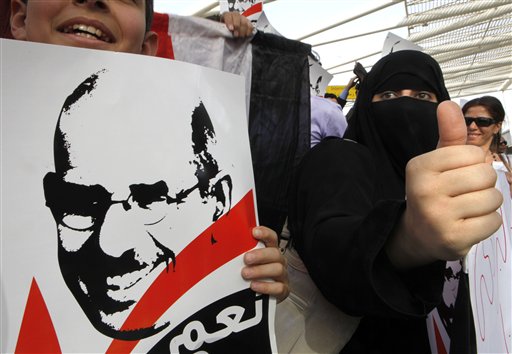
The looming risk of Egyptian democracy

As the end of rule looms for Egypt’s autocratic leader, Christopher Dickey looks at the prospects for Hosni Mubarak’s replacement being a champion of democracy: the former IAEA director, Mohamed ElBaradei.

In the event that ElBaradei declares his candidacy for president, the Obama administration will face a dilemma: whether to support the rise of democracy on Israel’s borders if such a democracy would in all likelihood not be particularly Israel-friendly.

Mubarak’s regime has been propped up for decades by hundreds of millions of dollars a year in development assistance and well over $1 billion a year in military aid from Washington. That was a reward for its 1979 deal with Israel, which relies on Egypt to keep the peace. But Egypt’s stability and its commitments can no longer be taken for granted, as they have been for most of the last two decades, and the way Egypt navigates the potential chaos of the next few years could well set the course for the rest of the region.

So accustomed have we become to Egypt’s torpor that it’s easy to forget just how much weight it really carries in Arab culture and politics. Its population of more than 80 million is greater than Iraq, Syria, and Saudi Arabia combined. It could continue to try to muddle along on the same stagnant track with someone from the Mubarak establishment; it could slide toward chaos or Islamization, or have order imposed by a military regime like the one that ran Pakistan for most of the last decade. Or Egypt could actually start to lead the way toward a more democratic and progressive future for the whole Arab world. That’s where ElBaradei hopes to take it, and where his supporters pray they are heading.

These are nervous times, certainly, for anyone afraid of change. At the elegant bar of the Four Seasons Nile Plaza hotel in Cairo, the fin de règne mood hangs as heavy in the air as the smoke from Cuban cigars. For those with money, the country has never been so luxurious or so efficient; foreign investors continue to come, and the stock market continues to rise. But not much of that money trickles down, and the gap between rich and poor grows more striking every day. Twenty years ago, wealthy Cairenes lived among the people downtown or in nearby suburbs. Today they are secluded in gated communities—what ElBaradei calls “ghettos for the rich”—around golf courses built in the desert. Even among a group of businessmen with close ties to the government I heard grim speculation, over glasses of Spanish wine and plates of risotto, about some unseen, bloody revolution brewing among “the 60 million”: that three fourths of the population living in misery or on the edge of it.

There have been real revolutionary movements in the past. Radical Islamists murdered President Anwar Sadat in 1981, and Ayman al-Zawahiri, a member of that conspiracy, led a group known as Jamaa al-Islamiya in a terrorist campaign against the regime that lasted into the mid-1990s. After the government repressed, infiltrated, and obliterated his organization, Zawahiri fled the country to become, eventually, Osama bin Laden’s deputy and the man who actually runs Al Qaeda.

But most opposition groups are far less threatening. Indeed, the great paradox of the Egyptian police state lies in its long record cultivating a certain level of tame extremism—which it finds useful to justify its police tactics—while it crushes passionate moderation. It’s a cliché of Egyptian political commentary that if Mubarak did not have the Muslim Brotherhood to oppose him, he’d have to invent it. And ElBaradei has walked right into the middle of this political twilight zone.

The Mubarak government allows about 90 members of the “outlawed” Brotherhood to serve as “independents” in Parliament, where, with 20 percent of the votes, they make up the single largest opposition group. The Brotherhood, for its part, plays any angle it can, and has glommed onto the strongly secular ElBaradei. “I didn’t know a single Muslim Brother until I came [back] here. But the head of the Brothers’ parliamentary faction, Mohamed Saad el-Katatni, has come to my house a couple of times,” says ElBaradei, who adds that he was reassured when el-Katatni declared, “We are for a civil state, we are for democracy.”

Facebooktwittermail

The most racist “democracy” in the world

As the process of ethnic cleansing continues in Jerusalem — Benjamin Netanyahu confirmed today that there will be no interruption — those outside Israel who are calling most loudly for the swift implementation of a two-state solution, frequently do so on the basis that this is what is urgently needed in order to ensure the survival of Israel as a “Jewish democracy.”

Stephen Walt writes:

In her scheduled address to the conference, Secretary of State Hillary Rodham Clinton should reaffirm the U.S. commitment to Israel’s existence but make it crystal clear that Washington will no longer tolerate Israel’s self-defeating policy on settlements. She should explain unambiguously that Israel faces a choice: It can end the occupation, embrace a genuine two-state solution, preserve its democratic and Jewish character and remain a cherished U.S. ally. Or it can continue the occupation of the West Bank and the siege of Gaza — a course that will eventually force it to abandon either its Jewish character or its democratic principles, and jeopardize its standing with its most important partner.

Member of the Knesset, Zevulun Orlev, has another proposal: any Israeli who denies that Israel is a democracy should be thrown in jail. He has said that those who “talk about a country belonging to all its citizens belong in prison.”

Today Ynet reports:

The current Knesset is the most racist Knesset since the establishment of the State, according to the Mossawa Center’s annual report on racism published Sunday. The report, published in honor of International Day for the Elimination of Racial Discrimination being marked Sunday, reveals a 75% increase in discriminatory and racist bills submitted to the Knesset in the past year.

According to the report, 11 bills deemed “discriminatory and racist” were placed on the legislature’s table in 2007, while 12 such bills were initiated in 2008. However, in 2009 a full 21 problematic bills were discussed in the Knesset.

The Mossawa Center asserted that this is a worrisome trend and estimate that such bills will only increase if the Ministerial Committee for Legislative Affairs does not take immediate action against the phenomenon.

“A Knesset so active in discriminatory and racist bills against Arab citizens of the State has never been witnessed,” said the report’s authors, Lizi Sagi and Attorney Nidal Ottman.

Another report also published today, further underlines the intrinsically anti-democratic character of the Jewish state.

While a government decision was made that by 2012, non-Jews — who make up 25% of Israel’s population — should fill at least 10% of government positions, the facts on the ground in the Negev demonstrate the gulf between Israel’s democratic pretensions and the undemocratic reality. From a population of 200,000 Bedouin, 16 hold government positions!

As for Israel’s “democratic” future, the signs are clear. Nearly half of Jewish high schoolers recently polled said that they oppose Israel’s Arab citizens being allowed to vote. Among religious Jewish students — representative of what has become the most politically influential minority in Israel — 82% oppose equal rights for Arabs and Jews.

Facebooktwittermail

The United States, Israel and the retreat of freedom

The United States, Israel and the retreat of freedom

Freedom House’s approach to Israel provides the starkest example of the abyss into which liberal thinking has fallen on the relationship between colonialism and freedom. Israel, we are told, “remains the only country in the [Middle East] region to hold a Freedom in the World designation of Free.” We are informed euphemistically that “The beginning of the year [2009] was marred by fierce fighting between the Israeli military and the Hamas movement in the Gaza Strip.”

There is no mention of the deliberate targeting by Israel of Gaza’s civilian infrastructure and the resulting massive destruction, and death and injury to thousands of Palestinian civilians. Nothing is said of the denial of fundamental political, civil and human rights, or freedom of movement, association and education to four million Palestinians living under Israeli military occupation and siege in the West Bank and Gaza Strip. There is no mention of the systematic discrimination, and social and political exclusion faced by 1.5 million Palestinian citizens of Israel, nor of the denial of the right of return of millions of Palestinian refugees.

There is an acknowledgment that “Hundreds of people were arrested during demonstrations against the Gaza conflict, and the parliamentary elections committee passed a measure banning two political parties from national elections, though the ban was quickly overturned by the Supreme Court.”

Despite this, on the tables accompanying the report, “Israel” receives the highest score of “1” for political rights, and a very respectable “2” for civil liberties — on a par with Italy and Japan. The overall impression is of minor glitches that could occur in any exemplary “Western” democracy. [continued…]

Palestine under the shadow of the wall

Sabah Haider visited the West Bank for ten days over Christmas and New Year 2010 to teach filmmaking to more than a hundred children at the SOS Village orphanage in Bethlehem. Here are some of the photographs that she took in Bethlehem, Jerusalem, Hebron and Nablus. [continued…]

Facebooktwittermail

Israel is becoming a diplomatically crippled nation

Disengaging from Israel

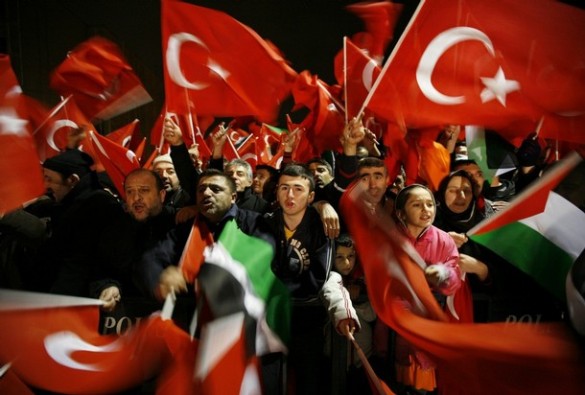
The historic reconciliation agreement signed Saturday between Turkey and Armenia constitutes further testament to the positive changes undergone by Turkey in recent year. A government with an Islamic orientation was able to impressively promote two highly sensitive issues for Turkish public opinion: Recognizing the cultural rights of the Kurdish minority and normalizing ties with Armenia.

The strong sense of Turkish nationalism previously prevented any compromise with the Kurds, for fear this will open the door for boosting their national demands and in turn for a renewed territorial disintegration by Turkey.

Tayyip Erdogan’s administration realized that it is precisely openness towards the Kurdish minority that will prompt a greater sense of belonging among them and weaken their aspiration to join other Kurdish areas, mostly in Iraq.

Erdogan faced a similar choice vis-à-vis Armenia: Perpetuating the frozen status-quo in the ties with Turkey’s neighbor would have boosted the global Armenian campaign for recognition of the massacre committed by the Turks as an organized and methodical genocide. Turkey would have been faced with all the possible implications of such recognition, especially if it would have also been backed by the US Congress.

Erdogan decided to preempt this blow, and while taking advantage of the weak Armenian economy (which suffered gravely as result of the closure of its borders with Turkey and Azerbaijan) managed to secure (with Swiss mediation) a reconciliation agreement that is difficult for both for the Turks and for the Armenians – yet postpones to an unknown future date the question of addressing the Armenian holocaust and entrusts future research on its scope in the hands of historians. [continued…]

Editor’s Comment — The writer notes “the fact that precisely at a time when Turkey reaches out to its past enemies, the Turkish administration is adopting an increasingly hostile policy vis-à-vis its former great ally – Israel” and he cites this as a justification for Turkey’s entry into the European Union being blocked.

It’s interesting that an Israeli should be advising the EU who it should or should not be willing to consider as a future member. Of course Israelis who are concerned about keeping Turkey out of the EU merely need to do their bit in helping foment anti-Muslim bigotry across Europe to ensure that the Turks won’t get a fair hearing.

While Eldad Beck clearly admires Erdogan’s diplomatic successes, he falls back on an old cliche in assuming that the Turkish leader is merely taking advantage of popular hostility towards Israel in order to advance his political goals. The assumption, as always, is that such hostility would either not exist or be of minor proportions were it not being fomented. Israel remains the perpetual victim of a bad press.

The real lesson that Israelis should be drawing from observing Turkey is to note how stark the difference is between a diplomatically and democratically empowered nation as it pursues a policy of regional engagement, versus the inevitable isolation that Israel now faces as a diplomatically crippled nation.

It turns out that having just one friend isn’t enough.

Israel’s growing isolation

… we have to recognize the fact that should the trend of isolation continue, we shall have to pay a heavy price – first and foremost on the economic front.

More than ever before, Israel’s growth and employment situation hinge on exporting goods to the global market. In case of isolation, we will find it difficult to engage in international trade, attract foreign investments, and acquire the credit we need.

The isolation will also undermine us strategically, as it would encourage Hezbollah, Hamas, Syria and Iran to provoke us. This is based on the assumption that the Israeli government will shy away from ordering the IDF to operate against them in full force, for fear of another Goldstone Report and possibly even UN Security Council sanctions.

Moreover, the isolation also serves to increase Israel’s depends on the American Administration to a dangerous degree; this dependence is too heavy as it is. [continued…]

(Part One and Part Two)

Facebooktwittermail

Cheney’s plans for a military coup

Cheney’s plans for a military coup

On Saturday, Mark Mazetti and David Johnston of the New York Times, quoting sources close to former President Bush, revealed that former Vice President Dick Cheney had advocated deploying the military for domestic policing purposes. Bush apparently declined to take Cheney’s advice. The discussions occurred against the backdrop of the so-called “Lackawanna Six” case, involving a group of six Yemeni-Americans from the Buffalo area who later pleaded guilty to charges of providing material support to Al Qaeda and received prison sentences.

The disclosures shed considerable light on two memoranda prepared in the Justice Department’s Office of Legal Counsel by John Yoo (with the help of Robert J. Delahunty on the second memo) at the request of then-White House counsel Alberto Gonzales. The principal memo was part of a group published by the Obama Administration on May 16, provoking widespread public concern. In the memo, Yoo argued that the Fourth Amendment could be viewed as suspended in the event of domestic operations by the military in war time. The second memo, not yet released but discussed here by Prof. Kim Scheppele on the basis of references to it in other documents, apparently attempted to read the Posse Comitatus Act of 1878, which forbids the domestic deployment of the military for police functions, into oblivion. In “George W. Bush’s Disposable Constitution,” I argued that Yoo’s memo was the formula for a dictatorship. Yoo responded to this objection in the Wall Street Journal, arguing that the memo had been authored with a very narrow set of facts in mind, namely an invasion like the sort of attack that was launched on Mumbai on November 26, 2008. But the latest disclosures make clear, once more, that Yoo’s claims are dishonest. [continued…]

Facebooktwittermail

DEMOCRACY AT WORK — ISRAELI STYLE

Democracy at work — Israeli style:
Israel bans Arab parties from coming election

Israel on Monday banned Arab political parties from running in next month’s parliamentary elections, drawing accusations of racism by an Arab lawmaker who said he would challenge the decision in the country’s Supreme Court.

The ruling by parliament’s Central Election Committee reflected the heightened tensions between Israel’s Jewish majority and Arab minority caused by Israel’s offensive in the Gaza Strip. Arabs have held a series of demonstrations against the offensive.

Parliament spokesman Giora Pordes said the election committee voted overwhelmingly in favor of the motion, accusing the country’s Arab parties of incitement, supporting terrorist groups and refusing to recognize Israel’s right to exist. Arab lawmakers have traveled to some of Israel’s staunchest enemies, including Lebanon and Syria.

The 37-member committee is composed of representatives from Israel’s major political parties. The measure was proposed by two ultranationalist parties but received widespread support. [continued…]

Facebooktwittermail