Category Archives: Israel-Palestinian conflict

Ethnic cleansing of Jerusalem while Israel implements a fake settlement freeze

Ethnic cleansing of Jerusalem while Israel implements a fake settlement freeze

Ever since Hillary Clinton officially declared the peace process dead and buried — well, her precise words were that Israel was making “unprecedented” concessions on the issue of settlements — the settlement freeze-hoax has hardly seemed worth tracking. Still, a couple of items from the last few days are noteworthy.

First, Benjamin Netanyahu’s reassurance offered to leaders of Jewish communities in “Judea and Samaria” (the Israeli occupied West Bank): “This order [to freeze new housing construction] is one-time only and it limits the duration of the suspension. There are nine months and three weeks left. Once the suspension has expired, we will continue to build.”

Then, the Jerusalem Post reported:

Strategic Affairs Minister Moshe Ya’alon, who voted in favor of the freeze last week as a member of the security cabinet, warned Thursday that if it continued beyond the 10-month period, ministers would begin to resign.

Ya’alon’s comments reflected earlier claims by Minister-without-Portfolio Bennie Begin, in which Begin promised that at the end of the 10-month period, building would begin “at a faster pace than before the freeze.”

Meanwhile, Haaretz reported on the massive increase in the pace of the ethnic cleansing of Jerusalem — part of the effort to solidify Israel’s claim to the city as an “undivided” Jewish capital.

Last year set an all-time record for the number of Arab residents of East Jerusalem who were stripped of residency rights by the Interior Ministry. Altogether, the ministry revoked the residency of 4,577 East Jerusalemites in 2008 – 21 times the average of the previous 40 years.

In the first 40 years of Israeli rule over East Jerusalem combined, from 1967 to 2007, the ministry deprived only 8,558 Arabs of their residency rights – less than double the number who lost their permits last year alone. Thus of all the East Jerusalem Arabs who have lost their residency rights since 1967, about 35 percent did so in 2008.

According to the ministry, last year’s sharp increase stemmed from its decision to investigate the legal status of thousands of East Jerusalem residents in March and April, 2008. The probe was the brainchild of former interior minister Meir Sheetrit (Kadima) and Yaakov Ganot, who headed the ministry’s Population Administration.

The ministry said the probe uncovered thousands of people listed as East Jerusalem residents but were no longer living in Israel, and were therefore stripped of their residency. Most of those who lost their residency for this reason did not just move from Jerusalem to the West Bank, but were actually living in other countries, the ministry’s data shows.

Those deprived of their residency included 99 minors under the age of 18.

Attorney Yotam Ben-Hillel of Hamoked: Center for the Defense of the Individual said the 250,000 Arab residents of East Jerusalem have the same legal status as people who immigrated to Israel legally but are not entitled to citizenship under the Law of Return.

“They are treated as if they were immigrants to Israel, despite the fact that it is Israel that came to them in 1967,” he said.

A resident, unlike a citizen, can be stripped of his status relatively easily. All he has to do is leave the country for seven years or obtain citizenship, permanent residency or some other form of legal status in another country, and he loses his Israeli residency automatically.

Once a Palestinian has lost his residency, even returning to Jerusalem for a family visit can be impossible, Ben-Hillel said. Moreover, he said, some of those whose residency Israel revoked may not have legal status in any other country, meaning they have been made stateless.

“The list may include students who went for a few years to study in another country, and can now no longer return to their homes,” he said.

Officials at Hamoked, which obtained the ministry data via the Freedom of Information Act, said they were concerned that some of those who lost their residency rights may not even know it.

“The phenomenon of revoking people’s residency has reached frightening dimensions,” said Dalia Kerstein, Hamoked’s executive director. “The Interior Ministry operation in 2008 is just part of a general policy whose goal is to restrict the size of the Palestinian population and maintain a Jewish majority in Jerusalem. The Palestinians are natives of this city, not Johnny-come-latelys.”

Sheetrit, however, insisted that the operation was necessary. “What we discovered is just the tip of the iceberg,” he said. “The State of Israel pays billions of shekels a year in stipends to people who don’t even live here. We sent notices to every one of them about the intention to revoke their residency; we gave them time to appeal. Those who appealed weren’t touched.”

The ministry data shows that 89 Palestinians got their residency back after appealing. Sheetrit said the probe revealed very serious offenses – such as 32 people listed as living at a single address that did not even exist.


Facebooktwittermail

There is a tremendous struggle to be waged, to force Israeli introspection, and change

There is a tremendous struggle to be waged, to force Israeli introspection, and change

I want to talk about a little bit of history, not too much, and then I want to talk about where I think BDS fits in to where we’re going in the struggle for justice, and why I think it’s going to work.

If you look at the history of Palestine over the past 62 years, ever since the destruction of much of Palestine and the establishment of the state of Israel on its ashes, I think it can be divided roughly into three phases of roughly 20 years. The first phase was from 1948 to 1967, that was the establishment of Israel, the ethnic cleansing of 90 percent of the population from inside the boundaries of what became Israel, the systematic destrucitoin of 500 towns and villages, and the exile of the indigenous population of the country. And of course the remaining Palestinians inside Israel subjected to military rule and to continued ethnic cleansing and removal from their land.

The second phase, beginning in 1967 with Israel’s 3-fold expansion, its conquest of Egypts’ Sinai peninsula, of southwest Syria, of the West Bank and Gaza Strip, was really the heyday, the era of maximum Israeli confidence, and the moment in which Zionism as we know it today became rooted in the American Jewish community. Before 1967 American Jews had for the most part not been captured by this ideology of Zionism and the virulent and racist nationalism that accompanies it. For Palestinians in the West Bank and Gaza Strip, it was the beginning of long occupation and colonization that continues to this day. It was also, from Israel’s perspective, a period of what I call a luxury occupation. The Palestinians in the West Bank and Gaza Strip were relatively quiescent, they were a source of cheap labor, Israelis allowed themselves to travel freely throughout the occupied territories, and it was bliss, it was a situation where Israelis said well, this is fine, we can stay like this as we build settlements, there’s no pressure on us to do anything, we don’t have to formally annex the West Bank and Gaza Strip, which would require us to give civil rights and voting rights to the Palestinians living there, so we just keep things as they are. [continued…]

Facebooktwittermail

Palestinian deemed ‘terrorist’ in ‘Bruno’ sues NBC, Baron Cohen

Palestinian deemed ‘terrorist’ in ‘Bruno’ sues NBC, Baron Cohen

We’ll have to admit that before the movie “Brüno” premiered earlier this year, we watched and chuckled as its star, British comedian Sacha Baron Cohen, promoted the film on David Letterman’s late-night show. In what quickly became a viral clip on the Web, Baron Cohen, who played a fictional gay, Austrian TV show host, described a scene in the film in which he interviews an “actual” Palestinian terrorist in a “secret location” in the Israeli-occupied West Bank.

In the scene, a caption identifies the man, Ayman Abu Aita, as a “terrorist group leader, al-aqsa martyrs brigade,” and Baron Cohen unsuccessfully tries to convince Abu Aita to kidnap him in a bid to get famous. Palestinian terrorists, Brüno said, are the “best in the business” and that “al-Qaeda is so 2001.”

Since the film was released, Abu Aita has fought back. He went on a media blitz to counter Baron Cohen’s claims in the film that he works for the al-Aqsa Martyrs’ Brigade, which was once an offshoot of a Palestinian political party to which Abu Aita currently belongs.

Today Abu Aita is in the U.S. with his lawyer, Joseph Peter Drennan, to announce the filing of a libel and slander lawsuit against Baron Cohen and NBC Universal, which released “Bruno.” (Click here for the complaint.) In the suit, filed in federal court in the District of Columbia, Abu Aita, who is Christian and owns a grocery store near Bethlehem, says Baron Cohen led him to believe he was a German filmmaker doing a film about the Palestinian cause. He then met him for an interview at a hotel near Bethlehem that is next door to an Israeli military facility. [continued…]

Facebooktwittermail

Omar Barghouti and George Fletcher debate BDS

Omar Barghouti and George Fletcher debate BDS

At the beginning of November Omar Barghouti and George Fletcher debated BDS at Columbia University. The event was moderated by Laura Flanders from GRITtv, who posted this great video of the event. Check it out. [continued…]

The battle for Israel’s soul

Unreported World travels to Israel to reveal how the rapid growth of Jewish ‘fundamentalists’ is creating tension within Israeli society and endangering any negotiations on a peace deal with the Palestinians.

Reporter Evan Williams and director Alex Nott begin their journey in the Mea Sharim district of Jerusalem. It’s the heartland of ultra-Orthodox Jews known as the Haredi, or ‘those who fear God’. They find a poor, overcrowded part of the city where everyone is wearing clothes in the style of 18th-century Europe, from where most of their ancestors came. ‘We are the real Jews,’ says one community leader, ‘everyone else in Israel just happens to be born Jewish.’

Many of the Haredi sects were almost wiped out in the Holocaust. But their numbers are growing fast. Haredi are the fastest growing segment of Israeli society, with many families having as many as eight children. ‘Every 20 years we have a community that is growing at eight or nine times,’ says one of the Haredi men to Williams. ‘It means we are growing in size and influence.’

Many Haredi men in Israel don’t work as they receive government subsidies to spend their entire lives studying the Torah and religious texts. One Rabbi from the Reform wing of Judaism tells Williams that, because Haredis are exempt from military service and heavily subsidised, they are creating huge tensions within the country. [continued…]

Facebooktwittermail

Israel is lying to itself about ‘united Jerusalem’

Israel is lying to itself about ‘united Jerusalem’

Those types have always been seen on big-city streets, talking to themselves, asking and answering, shouting, speaking in a low voice, deliberating and pontificating. As children, we were afraid of them. They were “crazy.” That’s exactly what Israeli public discourse is like. We are talking to ourselves, inventing bogus axioms and sticking with them as if they were decreed from on high, convinced that the whole world accepts them. But we are only talking to ourselves. No one else accepts them. The Israeli collective is not only talking to itself, it’s deceiving itself completely.

Jerusalem is a perfect example of this. It’s a neglected city, filthy and in parts frightfully ugly, stricken by poverty and ignorance. Nationalist, religious and social tensions are tearing it asunder, and part of the city is under the burden of occupation with all its most violent characteristics. The purported education, culture, openness and prosperity – far from the actual situation – are the locus of our national aspirations.

It’s a capital city which not a single country in the world recognizes, but it’s “our eternal capital,” in the words of the prime minister. It’s a relatively marginal city, certainly when compared to Tel Aviv. From many standpoints it’s a city on the margins which secular Israelis don’t exactly flock to for a good time. It’s a city even the prime minister preaches about. But he doesn’t practice what he preaces when he flees the city for the weekend, whenever he can. It’s the “heart of the nation,” but a city that has gradually become the city of the ultra-Orthodox and the Arabs, society’s two poorest minorities. Continue reading

Facebooktwittermail

Barghouti: Shalit abduction achieved what no dialogue could

Barghouti: Shalit abduction achieved what no dialogue could

Fatah strongman Marwan Barghouti said in an interview on Wednesday that he intends to run in the next Palestinian presidential election, and remarked that the abduction of Israel Defense Forces soldier Gilad Shalit by Gaza militants achieved what no negotiations could ever achieve.

Shalit was kidnapped in a cross border raid in 2006, and has been held prisoner by Hamas for over three years. Recent reports suggest that Israel and Hamas are closer than ever to reaching an agreement on a deal that would see hundreds of Palestinian prisoners released in exchange for Shalit’s freedom. It is unclear whether Barghouti will be among those prisoners, as he is currently serving five consecutive life sentences in an Israeli prison for his role in murderous terror attacks. Continue reading

Facebooktwittermail

Why can we talk to Hamas about Shalit, but not peace?

Why can we talk to Hamas about Shalit, but not peace?

hy is it permissible to talk to Hamas about the fate of one captive soldier and another several hundred prisoners, but forbidden to talk to them about the fate of two nations? Never has Israeli logic been so distorted. Now, when our hearts look forward to the deal’s implementation, when every human heart should look forward to Gilad Shalit’s release – and yes, to the release of hundreds of Palestinian prisoners, some of them political prisoners for all intents and purposes, not just “terrorists with blood on their hands” – now is the time to finally rid ourselves of some of the foolish prohibitions we have imposed on ourselves and the entire international community.

It is now clear that there is someone to talk to. In Gaza and Damascus sit tough but reasonable statesmen. They are also concerned, in their own way, about the fate of their people, they too aspire to bring them freedom and justice. When the deal is implemented we will also discover that they can be taken at their word. Were it not for the fact that Israel is holding tens of thousands of prisoners – some who used base means to achieve a just objective – who are judged differently from Jewish murderers and criminals, perhaps Hamas would not have had to use the weapon of kidnapping. Continue reading

Facebooktwittermail

West Bank settlers carry on building as new freeze is proposed

West Bank settlers carry on building as new freeze is proposed

At the small Jewish community of Revava in the northern West Bank, it was difficult to see yesterday what difference Israel’s freeze on settlement building would make. Construction continued on 20 housing units and the locals were apparently unperturbed by politicking between Jerusalem and Washington.

Under the proposal announced by Binyamin Netanyahu on Wednesday, no new residential permits will be issued and no new residential construction can start for ten months in the West Bank, excluding east Jerusalem. This was not stopping an American-Israeli homeowner and his family, who were working on the shell of their new house — one of 3,000 that have already been started and which will, therefore, continue.

The settlers of Revava admitted that existing curbs on building were beginning to bite. “It is a big problem,” said David, an armed private security guard. “There’s a great demand for housing here. There are lots of people applying for housing. My family lived in a three-room apartment but the family grew and now it is too small.”

The settlers, who call the West Bank area Judea and Samaria, said that they would do their best to continue building, despite the Government’s plans. “This is the heartland of our national claim, and the essence of Zionism is the return to the heartland where we once lived,” said David Ha-Ivry, a spokesman for the Jewish community in the northern West Bank. “There are things that can be done [by the Government] to make it difficult for us to proceed, but we find solutions. It’s part of the game. We’re doing pretty well.” [continued…]

Editor’s Comment — Anywhere else in the world, what the Israeli government calls a “freeze” would be called a development plan.

Even if this ten-month pause is actually enforced (and that, as the article above suggests, seems unlikely), to stop housing construction while continuing infrastructure and services expansion is transparently a plan to further entrench the policy of colonization.

Haaretz reports: “Defense Minister Ehud Barak on Thursday ordered the IDF to issue a temporary freeze order, but at the same time allowed the construction of 28 new public buildings in settlements.”

Perhaps the Israeli government should adopt a new expression for their practice of animated suspension: a fluid freeze.

Can Obama stand up to Israel?

President Obama urgently needs to distance Washington from the provocative – and illegal – actions the Israeli government has been undertaking in Jerusalem.

He needs to do this to save the two-state solution that he supports between Israelis and Palestinians. He needs to do it, too, because it will help protect US troops around the world. Jerusalem is a core concern for many of the world’s 1.5 billion Muslims, and with US forces now facing tense situations in several majority-Muslim countries, Washington has a stronger need than ever to keep the goodwill of the peoples of those lands. [continued…]

Facebooktwittermail

The Boycott, Divestment and Sanctions movement is working

Mohammad Othman’s administrative detention is a sign BDS is working

Mohammad Othman, the BDS campaigner who was detained by Israel upon returning from a speaking tour in Norway, was given three months administrative detention yesterday in an Israeli military court. Othman had been held 63 days without charge before the court agreed to the prosecution’s request for administrative dentention. Othman has been under nearly constant interrogation during this time. [continued…]

Editor’s Comment — The ongoing debate about the BDS movement seems like it could be a waste of energy. If BDS gathers enough momentum then it will become a politically self-justifying exercise simply by virtue of the attention it receives. If it doesn’t acquire critical mass, then its merits or flaws will be moot.

And momentum itself is to a significant degree a self-fulfilling expectation. As an Indian master once said: “faith is the willingness to try.” That willingness is increasingly evident.

The fact that J Street is alarmed by a movement that is “spreading like wild fire” across American college campuses is a strong sign that what might have once looked like a form of fringe activism is already heading on a trajectory towards the mainstream — a domain that the “pro-Israel pro-peace” lobby can probably only dream of dominating.

Is Israel threatened by the BDS movement?

For nearly six weeks now Mohammed Othman, a prominent Palestinian activist and an outspoken advocate of the nonviolent boycott, divestment and sanctions (BDS) movement, has been held in an Israeli military prison without charges.

On 22 September 2009 Othman, 34, was detained at the Allenby Crossing as he attempted to return home to the occupied West Bank from Jordan. He was returning from a trip to Norway, where he met with that country’s Finance Minister Kristin Halvorsen, amongst other officials.

At the beginning of September, Finance Minister Halvorsen announced Norway’s divestment from the Israeli company Elbit due to “ethical concerns.” Elbit provides security systems for Israel’s separation wall in the West Bank, for illegal settlements as well as unmanned aerial vehicles (commonly known as drones) and other technology for the Israeli military. According to many Middle East analysts and human rights groups, Othman played a pivotal role in Norway’s decision to disassociate from Elbit. [continued…]

Facebooktwittermail

Gideon Levy on Israel’s addiction

Gideon Levy on Israel’s addiction

Gaza militant groups agree to stop firing rockets into Israel

Hamas has won an agreement from other militant groups in Gaza to halt rocket fire into Israel for the first time in almost a year, asboth sides indicated progress on a deal to release a captured Israeli soldier.

The agreement, announced , appears to be an attempt by the Palestinian Islamist movement to prevent another descent into fighting at a time when reconstruction has barely begun almost 12 months after the devastating conflict with Israel.

It also reflected more progress in secretly mediated talks to release Gilad Shalit, the soldier captured more than three years ago, in exchange for the return of hundreds of Palestinian prisoners. [continued…]

Gaza water unfit for human consumption: Palestinians

Water in the Gaza Strip is so salty that it is unfit for human consumption, a Palestinian official in charge of water supplies inside the besieged coastal territory said on Saturday.

“The water is no longer fit for human consumption, with analysis and international studies showing that just 10 percent of water in the Gaza Strip is usable… threatening the lives of Palestinians,” Munzir Shiblak warned.

He called in a statement for “the necessary measures to be taken to end the problem of salinity in Gaza water supplies, a problem that is getting worse.” [continued…]

Obama must deal with important questions of the Mideast conflict

For 41 years, Washington turned a blind eye. It protested a bit, scolded a bit, and mostly made do with periodically stating that its policy has not changed – it still opposes settlements in the territories and does not recognize the annexation of East Jerusalem or the Golan Heights. Suddenly, it gave us a resounding slap, but one of the frustrating kind that misses the cheek and flies through empty air. Because the American demand that we freeze construction in the settlements, that “strong message” containing a threat, has become a personal duel between Prime Minister Benjamin Netanyahu and U.S. President Barack Obama, in place of a clear policy presented by the latter.

Obama will win, of course. He can set a meeting with Netanyahu late at night, not answer the prime minister’s phone calls, warn him from the Great Wall of China and even order his officials to give Israel’s requests the cold shoulder. Obama already has managed to garner international support for his demand that Israel freeze settlement construction, even in Jerusalem, and American public opinion is on his side. If Obama wants to undermine Israel’s trust in the United States, or to prove to Netanyahu who is stronger, he does not have to work hard.

The American demand is proper, even if it is very late and unusually aggressive. However, its lack of context is infuriating. Freezing settlements is not a policy. Its entire purpose is to give Mahmoud Abbas, the resigning Palestinian Authority president, a reason to get back to negotiations. But negotiations cannot be a final goal, just as freezing settlements cannot be considered the ultimate achievement. What then? Is Abbas doomed to be a constant negotiator in endless negotiations? Does Washington have a plan for continuing negotiations? Continue reading

Facebooktwittermail

Mourning uprooted olive trees in West Bank villages

Mourning uprooted olive trees in West Bank villages

The old tractor sputtered up the hill, its engine seemingly about to expire, but its big wheels bumping across the rocky terrain. We stood in the back, swaying wildly, holding on for dear life. On the hilltop loomed the big antenna of the settlement of Yitzhar, whose houses lay on the other side of the hill. The very knowledge of their presence inspired dread. It was a glorious sunny day, the spectacular valley sprawling below. The houses of the Palestinian village of Burin lie in this valley, which lies between two hills: on one stands Yitzhar; on the other, Har Bracha, outside Nablus.

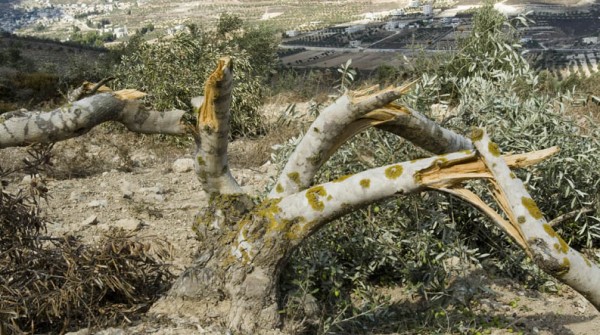
Burin is caught between a rock and hard place, between Har Bracha and Yitzhar. We have visited Burin often, most recently after settlers burned down some of its homes. Settlers once stole a horse from a villager, torched fields, demolished a home in the village and uprooted olive trees. We have frequently documented the uprooting of olive trees: Less than a month ago, in this space, we told the story of the beautiful vineyard belonging to the agriculture teacher Mohammed Abu Awad from the village of Mureir, whose 300 trees were felled by intruders – probably from the illegal outpost of Adei Ad – using buzz saws. Continue reading

Facebooktwittermail

J Street seeks to undermine BDS

J Street seeks to undermine BDS

We’ve been following J Street’s attempts to counteract the growing BDS movement. First there was its aborted release of a public letter criticizing the Toronto Declaration. Then there was the workshop at its student conference called “Reckoning with the Radical Left on Campus: Alternatives to Boycotts and Divestments.” The workshop didn’t go quite as planned either as many students who attended actually offered their support for divestment campaigns targeting the Israeli occupation. You would think these two initial missteps would lead J Street to reconsider which way the wind is blowing. Nope.

J Street is now working to undermine the National Campus Boycott, Divestment, Sanctions Conference that will be held this weekend at Hampshire College. The conference is being called to build “a coordinated national BDS campaign,” and J Street seems to feel threatened by this. Yesterday the organization sent the following email out to its student wing: [continued…]

Editor’s Comment — Strip a J Street statement of all its marketing filler and its use of slogans as a substitute for argumentation and you end up with nothing much at all.

In this case though, there is one important piece of news: “[The] Boycott, Divestment, and Sanctions (BDS) movement against Israel movement… is spreading like wild fire on campuses across the country…”

This is a major grassroots movement but J Street has the hubris and naivety to imagine it can co-opt and steer in the “right” direction. In the process J Street is increasingly coming to look like nothing more than the liberal wing of the Israel lobby.

Facebooktwittermail

For the Palestinians, all roads now lead to the UN

For the Palestinians, all roads now lead to the UN

It is hard to take seriously the threat by the Palestinian president Mahmoud Abbas to declare a Palestinian state in the West Bank and Gaza and demand recognition by the UN Security Council.

The cool response from the US and the European Union made clear that no such recognition would be forthcoming; and, as Hamas asked, what is the point of unilaterally declaring a state while those territories remain ultimately under Israeli control? Yasser Arafat already did that, in 1988.

Mr Abbas, of course, is a desperate man, because the strategy on which he has staked his political career – negotiating a two-state solution to the conflict with Israel under US auspices – is dead. The Obama administration was the last, best hope of the Palestinians for a change of course by America to deliver a credible peace. Mr Obama has been a massive disappointment, lacking either the will or the ability to compel Israel to do anything it doesn’t want to. [continued…]

‘Fatah officials warn of third Palestinian intifada’

atah had made a strategic decision to declare a third intifada against Israel, movement officials told Nazereth-based newspaper Hadith Anas, citing the failed peace talks as the reason for their resolution.

The newspaper report quoted Fatah Central Committee members as saying that the movement wished to implement a decision made during its sixth convention, which assembled last August in the West Bank city of Bethlehem.

One of the movement’s top officials interviewed by Hadith Anas said the third intifada will have a widespread popular base, adding, however, that unlike the previous popular struggle against Israel, which was sparked in September 2000, the movement will not endorse an armed struggle or the use of firearms. Continue reading

Facebooktwittermail

Israel: Apartheid and beyond

Beyond compare

While South Africa was explicit about the goal of apartheid policies, Israel engages in discursive subterfuge so that the intent and effects of their policies must be seen on the ground to be fully comprehended. Shulamit Aloni, the former Israeli minister of education, relates an episode at a bypass road built for settlers in the West Bank:

On one occasion I witnessed such an encounter between a driver and a soldier who was taking down the details before confiscating the vehicle and sending its owner away. ‘Why?’ I asked the soldier. ‘It’s an order—this is a Jews-only road,’ he replied. I inquired as to where was the sign indicating this fact and instructing [other] drivers not to use it. His answer was nothing short of amazing. ‘It is his responsibility to know it, and besides, what do you want us to do, put up a sign here and let some anti-Semitic reporter or journalist take a photo so that can show the world apartheid exists here?’

Part of the appeal of the apartheid comparison is that apartheid is a recognized name for an ideology and practice of separation. There is no similar name for what Israel has done. Neither the pre-state Zionist movement nor the state of Israel has ever spelled out an official policy of discrimination against the Palestinians, and Israel did not institute discriminatory practices in one fell swoop. Instead, it has worked in a piecemeal fashion to constrain Palestinian rights and access to resources. In other words, separation in the Occupied Territories has been a process whose legal contours are harder to discern and whose name has yet to circulate abroad.

A corollary assumption underlying the comparison is that Israeli practices cannot be condemned as discriminatory in and of themselves. They cannot stand on their own, partly because they are difficult to understand unless they are seen up close. Most people understand that Zionism, as an ideology and a project, calls for Jewish communal security, and due to centuries of pogroms and the Holocaust, this project commands considerable sympathy. But many people do not understand that Zionism, as put into practice, calls for an exclusivist state that leads to policies characteristic of apartheid, as defined by the UN.

Zionism retains a significant body of supporters in the West, particularly among Jews and evangelical Christians, but also the public at large. For numerous historical, cultural and political reasons, the American public in particular “stands with Israel,” a fact demonstrated by poll after poll and not lost on successive US administrations. Israel and its backers work constantly to cement this support, in part by equating criticism of Israel, the “Jewish state,” with anti-Semitism. Thus, drawing attention to the parallels between Israel’s occupation and apartheid has been one way to turn the tables, framing the occupation (and not criticism of Israel) as inherently racist. But the introduction of race into the conversation heats it up to the boiling point: As the Jews of Europe suffered from persecution and genocidal racism, and Jews comprised a large percentage of the white Americans who put their bodies on the line for civil rights, equating the practices of Zionism with racism is, for many, inconceivable. Rational debate shuts down.

It may be time to develop a new language. “Apartheid” cannot thoroughly explain Zionist ideology or Israeli practices. It can simply offer broad points of comparison, a framing in an already powerful concept. Yet the Afrikaans term does have a Hebrew counterpart in the term hafrada, meaning separation from and putting distance between oneself and others, in this case, the Palestinians. In Hebrew, the wall is often referred to as the “hafrada barrier.” [continued…]

Editor’s Comment — I seriously doubt whether any effort to develop new language can ever work. We don’t need new terms — we need to bring about a shift in the way existing terms are used.

Apartheid was a system that Africaners believed in and legally institutionalized. The campaign against apartheid was an effort to delegitimize an idea that held legitimacy in the minds of its proponents. And that seems to be the key: people give names to the things they believe in. Efforts in “discursive subterfuge” are efforts to avoid naming that which needs to be denied.

The concept of hafrada has arisen (from what I understand) in an effort to legitimize a policy of separation, yet that policy carries with it the notion that this separation comes out of a security imperative rather than an ideological conviction. It amounts to saying: We don’t want separation but the Palestinians made us do it.

The implication is that Israelis are good Western pluralists who are not racists and who would happily co-exist with their neighbors if only their neighbors could forsake their violent tendencies.

Julie Peteet says: “Perhaps the Hebrew hafrada can one day become a rallying cry as powerful as “apartheid” was in its day.”

To my mind the much more likely candidate is Zionism.

Although this is a word that is a long way from completely losing mainstream legitimacy, it has over the decades acquired increasingly negative connotations. It is a word that seems to have entered a netherworld. Self-described Zionists tend to be right-wing. Liberal Zionists either refrain from unabashedly calling themselves Zionists or they strongly emphasize the “liberal” qualification. Yet Zionism, of whatever political stripe, has at its core the notion of Jewish sovereignty in a Jewish homeland.

What does that mean? The clearest expression that I have recently heard comes from Rabi Toba Spitzer, an American Jew who in a promotional video for J Street underlined this as one of Israel’s core attributes: “[Israel is] the one place in the world where Jews are in charge.”

Whatever Israel’s future — whether its international boundaries can be agreed upon and whether a Palestinian state can be created — the continuation of Israel’s existence as a Jewish state depends on this: that it remains a state where Jews are in charge.

This, it seems to me, reveals the unvarnished nature of Zionism and exposes Israel’s hollow claim to be democratic.

Democracy is government by the demos — the people — and it allows no distinction between the multitude of groups whose amalgamation constitutes “the people”.

Jewish democracy, built on the fantasy of “a land with no people for a people with no land”, has in its practice used “democracy” as a salve to its liberal conscience, yet in the conflict between its Jewish identity and its democratic identity, democracy has consistently lost.

Israel’s enemy within: A rising militancy from the Jewish settlements

The terrorist walked up the quiet alleyway, police say, and went down nine steps and found himself hidden from view in the stone vestibule outside the famous Holocaust survivor’s apartment.

More than a half century ago the Nazis hadn’t been able to kill Ze’ev Sternhell, who would live to become Israel’s foremost expert on fascism and a long-time peace activist. But the terrorist who was now on his door step, whom police allege was a fellow Israeli from the militant settlement movement, was determined to succeed in just that. He attached the bomb, hidden inside a plant, to the doorknob and left.

Sternhell was inside the apartment in West Jerusalem. It was Sept. 25, 2008 and he and his wife had returned from a vacation in Paris the previous day. The hallway leading to the front door was still clogged up with their bags. It was late, a few minutes after midnight, and just like he does every night, Sternhell went to close the metal gate at the entrance of the vestibule that is meant to keep unwelcome guests from breaking and entering. The obstruction in his hallway forced Sternhell to turn sideways, the right side of his body facing outside, as he opened the door to the apartment.

There was a huge noise and something pushed him back. He saw the flash of an explosive. His right leg and thigh stung with pain and began to bleed. He was rushed to hospital in an ambulance. Doctors told him later that if he had not been sideways to the blast, his abdomen would likely have been pierced by the bomb’s shrapnel. He could have died.

Police who came to the scene found leaflets scattered nearby. The fliers offered a reward of $300,000 to anyone who killed a member of Peace Now, Israel’s best known peace movement. “The State of Israel has become our enemy,” the fliers said. Police officers immediately went to guard the home of Peace Now’s most-prominent figure, general secretary Yariv Oppenheimer.

I interviewed Sternhell in his home this January. The police had made no arrests back then, but Sternhell was convinced that fellow Jews had tried to kill him. “This,” said the 73-year-old, whose mother and sister were killed by the Nazis when he was 7 years old, “was an act of pure Jewish terror.” [continued…]

Rights groups: Israeli ambulance rules discriminate

Human rights groups are calling on the Israeli government to cancel instructions preventing ambulances from entering Palestinian neighborhoods in East Jerusalem without a police escort.

According Adalah, The Legal Center for Arab Minority Rights in Israel, Magen David Adom (MDA) ambulances “must wait in a Jewish neighborhood adjacent to the Palestinian neighborhood and may not enter it to transfer the injured or the sick person to the hospital until a police escort arrives, even in life threatening situations.”

In many cases, patients face long delays in receiving treatment, and must be transferred by their own family’s cars, risking complications or increased severity of illness, the rights advocates say.

In a news release on Thursday, Adalah said the procedures “violate the first rule in the work of emergency crews, which is to provide medical aid as soon as possible, and the state’s obligation to ensure the life and physical well-being of each person under its authority.” [continued…]

Facebooktwittermail

Obama’s word — a fire that has turned to ashes

Little behind Obama’s tough Mideast talk: analysts

The Obama administration is hardening its tone against Israel, but analysts warned Wednesday the tough talk was mere bluster hiding the lack of a viable plan to revive the Middle East peace process.

“You’ve had three ‘no’s’ to an American president in his first year,” Aaron David Miller, who has served as advisor on Middle East peacemaking to previous US administrations, told AFP.

President Barack Obama is now “faced with the default position, which is words,” said Miller from the Woodrow Wilson International Center for Scholars.

“And the louder they shout, the more there is a paradox. The tougher the words are, the weaker we look.” [continued…]

Editor’s Comment — In an interview with Barbara Walters on Tuesday, Sarah Palin said: “I don’t think that the Obama administration has any right to tell Israel that the Jewish settlements cannot expand.”

Americans for Peace Now quickly shot back: “Gov. Palin may not be aware of it, but every American president in the past 40 years — Republican and Democrat alike — has opposed West Bank settlements. They have done so because settlement expansion is bad for American national security interests and because they have cared about Israel’s well-being.”

It’s curious at this juncture that anyone would think the best way to press the argument against settlements is by citing the consistency of Washington’s opposition — opposition that for 40 years has proved to be utterly ineffectual.

To consistently oppose settlement growth while settlements relentlessly expand suggests that Washington is either convinced that it possesses no leverage, or, that its opposition is disingenuous.

Early on, the Obama administration signaled to Israel that it would distinguish itself from its predecessor by saying what it meant: there would be no contradiction between its public and private declarations.

What Obama now needs to grasp is that the greatest asset he held when he came into office — the power of his word — is a fire that has largely turned to ashes.

There may be a few embers in there, but the only way to rebuild the fire is for the president to show the world what he can do. We no longer have any interest in what he has to say.

Israel building Jewish homes with one hand, destroying Arab homes with the other

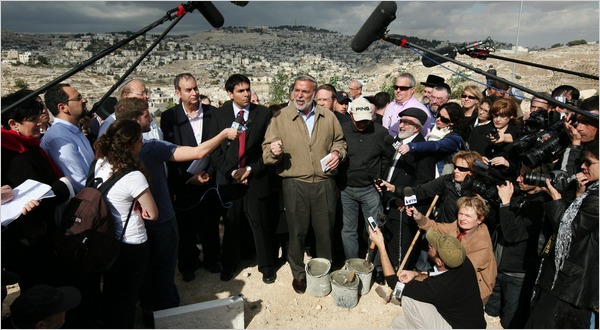
The World Likud movement held a cornerstone-laying ceremony yesterday for the expansion of the neighborhood of Nof Zion, despite – or possibly because of – American pressure against building in East Jerusalem. The Jewish settlement is in the middle of the Arab village of Jabal Mukkaber. Meanwhile, the Jerusalem municipality razed two Palestinian homes in East Jerusalem yesterday.

The plan is to add to Nof Zion 105 new apartments to the 90 ones that are already there, most of which are already occupied. The neighborhood is considered “prestigious,” but the developers ran into trouble a few years ago after they failed to sell the apartments to Jews from overseas. About a year ago the developers changed their marketing strategy to target the local national-religious market – and the apartments began selling quickly. The developers expect the same for the new part of the neighborhood.

The World Likud’s announcement of the ceremony said the neighborhood was near Jabal Mukkaber, “bounded by terraces and with olive trees and grapevines.”

In fact, however, Nof Zion is in the middle of the village, near Palestinian homes. In September Haaretz reported that the family of the late actor-comedian Shaike Ophir criticized the municipality’s decision to name a street in Nof Zion after him.

A group of American Jews interested in buying apartments in Nof Zion attended yesterday’s ceremony. New York State Assemblyman Dov Hikind, who is considered a staunch supporter of the settlers, headed the group. Continue reading

Facebooktwittermail

Why has the left in Israel vanished?

Why has the left in Israel vanished?

he threats uttered against a possible Palestinian declaration of independence by our leaders Benjamin Netanyahu, Avigdor Lieberman and Ehud Barak let the Israeli sanctimony (usually tedious and belabored) drop to the floor for a moment, like a woman’s slip. It exposed the ugly skeleton of force that gives only us freedom of speech – we’re permitted, you’re forbidden. We are allowed to reiterate Israel’s Declaration of Independence over and over. You are not allowed to do so with yours.

The simplest explanation for our privileges, and one that is becoming increasingly significant, is the religious one – the land is ours, from God, not theirs, so we’re allowed to declare independence or harm civilians. The simplest explanation offered by secular people of those privileges is force – we’re strong. These two explanations are the axis of consensus. In the name of this consensus, the military rabbis and officers in the Israel Defense Forces, equipped with equal amounts of hysteria, set out to incite the units on their way to kill in Gaza. Continue reading

Facebooktwittermail