Category Archives: Issues

How the #Israeli discourse on terrorism seeks to justify blatant #WarCrimes

Rémi Brulin writes: Appearing on CNN a few days into the current offensive in Gaza, Israeli Prime Minister Benjamin Netanyahu described Hamas as “the worst terrorists, genocidal terrorists.” He said they want to “pile up as many civilian dead as they can,” and, he added, to “use telegenically dead Palestinians for their cause.”

By contrast, Israeli strikes are said to be aimed at the “terrorists,” who are by definition legitimate targets. Any civilian casualties that may result from such uses of force are unintentional, and in fact should be blamed squarely on Hamas. Indeed, Netanyahu explained, not only do they target civilians but they also “hide behind civilians,” thus committing “a double war crime.”

According to this narrative, often embraced in toto by elected officials and political commentators in the United States, “terrorism” is a very clear, non-controversial concept. “Terrorism” is the use of violence against civilians for political purposes.

This discourse on “terrorism” is a deeply moral discourse, one that makes important normative claims about a given conflict and the parties to it.

It draws its power from a simple claim: what separates “us” from “them” is a fundamental conception of the value of innocent life. “We” respect innocent lives, demonstrated by our refusal to target civilians. In stark contrast, not only are “the terrorists” more than willing to hurt our civilians, but they also hope that we will kill theirs too.

The discourse on “terrorism” is thus an essentialist discourse: it claims to say something about the very essence of “the enemy” (cue recurring references to “barbarism”) and, consequently, about us (and our “civilized” values.)

On closer inspection however, this discourse fails precisely where it claims to be strongest. Israel’s actual practices, informed by its combat doctrine, are fundamentally at odds with how international law defines the concept of “civilian.” In actual fact, the discourse on “terrorism” and the practices it informs and justifies drastically erode the distinction between civilian and combatants as commonly understood in International Humanitarian Law. [Continue reading…]

Facebooktwittermail

Palestinians in #Gaza don’t want #Hamas to give up the fight

David Kenner writes: Why can’t the two sides reach a compromise? Why wouldn’t Hamas agree to an extension of the cease-fire, when its civilians and infrastructure are bearing the lion’s share of the damage?

And then you come to Gaza. The horror stories seek you out: The man living in a crowded United Nations Relief and Works Agency (UNRWA) refugee camp who hasn’t had the money to repair his house since it was damaged in the 2012 war; the 7-year-old girl who interrupts an interview to interject that her father has been killed; the exhausted general manager of Shifa Hospital, who spoke mournfully about how his staff was performing surgeries in waiting rooms because all of the operating rooms were full.

These people all said that this war was easily the worst of the three conflicts with Israel since Hamas took over the Gaza Strip in 2007. And all of them maintained that Hamas should continue striking Israel until its demands are met.

For these Gazans, the roots of their support for Hamas lie in the fact that they simply have so little left to lose. Sitting in his office in Gaza City, Raji Sourani, the director of the Palestinian Center for Human Rights, ticks off the statistics showing how impoverished this tiny territory was even before the war: 50 percent unemployment, 80 percent of households below the poverty line, and 90 percent dependence on international organizations that provide food and aid.

“We have become a nation of beggars. That’s not us — we are a people with dignity and with pride,” he said. “If you want to have isolation from the outside world, bombing, [and] destruction … that means you want to create extremism. Chapeau [respect] for Hamas that we don’t have either [the Islamic State] or al Qaeda. It’s a miracle.” [Continue reading…]

Facebooktwittermail

Guardian agrees to publish anti-Hamas ad

Roy Greenslade writes: The Times is under attack for refusing to run an advert about the conflict in Gaza. The paper is accused of being part of a British media “infamously skewed against Israel.”

The ad is a statement, written jointly by Elie Wiesel, the Nobel prize-winning author, and Shmuley Boteach, an outspoken American-born Orthodox rabbi.

It calls on President Obama and other political leaders across the world “to condemn Hamas’s use of children as human shields”, which amounts to “child sacrifice”.

The advert has been carried in five US newspapers, including the New York Times, Washington Post and the Wall Street Journal, which is published by News Corporation, the owner of The Times. The Guardian has agreed to run the advert on Monday.

The New York Observer reports that the fee The Guardian will receive for the ad is roughly $20,000. A source at the paper is quoted saying: “The Guardian may be left wing but they obviously believe in free speech and allowing their readers to hear the voice of a Nobel Laureate about a very important issue.”

If The Guardian is only printing this ad because it believes in free speech and it does not endorse the ad’s content, it could make its position clear by donating the $20,000 fee to a Gaza relief fund.

Facebooktwittermail

Hollywood studios blacklist Penelope Cruz over #Gaza letter accusing #Israel of ‘genocide’

International Business Times: Actress Penelope Cruz and her husband Javier Bardem have roused the fury of Hollywood producers, with pledges made to snub the Spanish couple.

Oscar-winner Bardem and Cruz signed an open letter speaking against “the genocide perpetrated by the Israeli occupation army”.

The letter accused Israel of “advancing on Palestinian territories instead of withdrawing to the 1967 borders.

“Gaza is living through horror… while the international community does nothing.”

The Spanish letter was signed by 100 leading figures in the film industry, including director Pedro Almodovar.

One top producer who has worked with Cruz says he privately has vowed not to hire her again, according to the Hollywood Reporter.

Another top Hollywood executive also privately expressed his disapproval, saying he’s “furious at Javier and Penelope” and wasn’t sure about working with the Spanish couple again.

Facebooktwittermail

Global protests in solidarity with Palestinians — #GazaDayofRage

Facebooktwittermail

Nothing says ‘sorry our drones hit your wedding party’ like $800,000 and some guns

Gregory D. Johnsen writes: Muhammad al-Tuhayf was relaxing at his house late in the afternoon on Dec. 12, 2013, when his iPhone rang. A boxy, tired-looking Yemeni shaykh with large hands and a slow voice, Tuhayf heard the news: A few miles from where he was sitting, along a rutted-out dirt track that snaked through the mountains and wadis of central Yemen, U.S. drones had fired four missiles at a convoy of vehicles. Drone strikes were nothing new in Yemen — there had been one four days earlier, another one a couple weeks before that, and a burst of eight strikes in 12 days in late July and August that had set the country on edge. But this one was different: This time the Americans had hit a wedding party. And now the government needed Tuhayf’s help.

The corpses had already started to arrive in the provincial capital of Radaa, and by the next morning angry tribesmen were lining the dead up in the street. Laid out side by side on bright blue tarps and wrapped in cheap blankets, what was left of the men looked distorted by death. Heads were thrown back at awkward angles, splattered with blood that had caked and dried in the hours since the strike. Faces that had been whole were now in pieces, missing chunks of skin and bone, and off to one side, as if he didn’t quite belong, lay a bearded man with no visible wounds.

Clustered around them in a sweaty, jostling circle, dozens of men bumped up against one another as they struggled for position and a peek at the remains. Above the crowd, swaying out over the row of bodies as he hung onto what appeared to be the back of a truck with one hand, a leathery old Yemeni screamed into the crowd. “This is a massacre,” he shouted, his arm slicing through the air. “They were a wedding party.” Dressed in a gray jacket and a dusty beige robe with prayer beads draped over his dagger, the man was shaking with fury as his voice faltered under the strain. “An American drone killed them,” he croaked with another wild gesture from his one free hand. “Look at them.”

A few miles outside of town, Tuhayf already knew what he had to do. This had happened in his backyard; he was one of the shaykhs on the ground. Only three hours south of the capital, the central government held little sway in Radaa. Like a rural sheriff in a disaster zone, he was a local authority, someone who was known and respected. And on Dec. 12, that meant acting as a first responder. Tuhayf needed to assess the situation and deal with the fallout. Every few minutes his phone went off again, the marimba ringtone sounding with yet another update. Already he was hearing reports that angry tribesmen had cut the road north. Frightened municipal employees, worried that they might be targeted, kept calling, begging for his help. So did the governor, who was three hours away at his compound in Sanaa.

It didn’t take Tuhayf long to reach a conclusion. The Americans had made a mess, and to clean it up he was going to need money and guns.

This is the other side of America’s drone program: the part that comes after the missiles fly and the cars explode, when the smoke clears and the bodies are sorted. Because it is here, at desert strike sites across the Middle East, where unsettling questions emerge about culpability and responsibility — about the value of a human life and assessing the true costs of a surgical war.

For much of the past century, the United States has gone to war with lawyers, men and women who follow the fighting, adjudicating claims of civilian casualties and dispensing cash for errors. They write reports and interview survivors. But what happens when there are no boots on the ground? When the lawyers are thousands of miles away and dependent on aerial footage that is as ambiguous as it is inconclusive? How do you determine innocence or guilt from a pre-strike video? When everyone has beards and guns, like they do in rural Yemen, can you tell the good guys from the bad? Is it even possible? And when the U.S. gets it wrong, when it kills the wrong man: What happens then? Who is accountable when a drone does the killing? [Continue reading…]

Facebooktwittermail

Return of the blacklist? Cowardice and censorship at the University of Illinois

David Palumbo-Liu writes: A few weeks ago Steven Salaita had reason to be pleased. After a full review by the University of Illinois at Urbana-Champaign, he had received a generous offer of a tenured, associate professor position there — the normal contract was offered, signed by the school, he had received confirmation of his salary, a teaching schedule, everything except the final approval of the UIUC chancellor.

In academia this is not at all unusual; departments and schools are told to go ahead with the offer, so as to be competitive with both the candidate’s current school and others that might be bidding for their talent. Salaita is a world-renowned scholar of indigenous studies (and also a frequent Salon contributor). At that point, as required by academic protocols, upon accepting the position he resigned the one he held at Virginia Tech.

But final approval never came. The Chronicle of Higher Education reports today that “Phyllis M. Wise, the campus’s chancellor, and Christophe Pierre, the University of Illinois system’s vice president for academic affairs, informed the job candidate, Steven G. Salaita, on Friday that they were effectively revoking a written offer of a tenured professorship made to him last year by refusing to submit it to the system’s Board of Trustees next month for confirmation.”

According to Inside Higher Education: “Sources familiar with the university’s decision say that concern grew over the tone of his comments on Twitter about Israel’s policies in Gaza. While many academics at Illinois and elsewhere are deeply critical of Israel, Salaita’s tweets have struck some as crossing a line into uncivil behavior.” Nevertheless, IHE goes on to report: “But as recently as July 22 (before the job offer was revoked), a university spokeswoman defended Salaita’s comments on Twitter and elsewhere. A spokeswoman told the News-Gazette for an article about Salaita that “faculty have a wide range of scholarly and political views, and we recognize the freedom-of-speech rights of all of our employees.”

With both the university and Salaita keeping quiet on the details of the firing at the moment, it’s hard to tell what exactly changed the university’s mind. But it would seem that Salaita would be doubly protected from summary firing. First of all, no matter how “uncivil,” “disagreeable” or even repugnant some of his tweets might appear to some people, they are nonetheless protected under the First Amendment. This holds true for all individuals. But Salaita is also protected by academic freedom, a concept enshrined in American institutions of higher education.

Not only that, Salaita would be protected as a tenured professor, had it not been for his being caught between resigning from Virginia Tech and being formally hired by UIUC. The concepts of academic freedom and tenure go hand in hand — both are aimed at guaranteeing professors the freedom to found new knowledge, which is often only possible by critically examining old knowledge and continually retesting norms and assumptions, without fear of reprisals from entrenched interests, or from those who might be threatened or offended. Besides the lofty ideals of the pursuit of knowledge, academic freedom and tenure have practical goals as well — they assure that no professor will lose their livelihood for taking unpopular stances. In sum, then, Salaita was on firm ground according to all the norms and protocols for both free speech and academic freedom.

But his tweets had indeed offended not a few, including the Simon Wiesenthal Center, which wrote to UI president Robert Easter accusing Salaita of being anti-Semitic and declaring that “such outrageous statements present a real danger to the entire campus community, especially to its Jewish students.” Here is where things start to blur, and to blur in ways that make this issue much more than simply a matter for the ivory tower. We see a deliberate confusion of a private individual’s thoughts and beliefs and their professional life. Despite the fears of the Wiesenthal Center, there has been no proof whatsoever that Salaita’s tweets would be required reading in the classroom. Or that his political views would be force-fed to the students. Furthermore, the “danger” mentioned here is extremely vague. What is deeply troubling in this case is the influence of outside agencies and organizations on a university decision, and the absolute lack of transparency on the part of the university. [Continue reading…]

Facebooktwittermail

Send them parasols?

CODEPINK asks: “Why does our President want to take sides and get involved in a civil war? The US is not the target of ISIS, but if we become involved, we will be.”
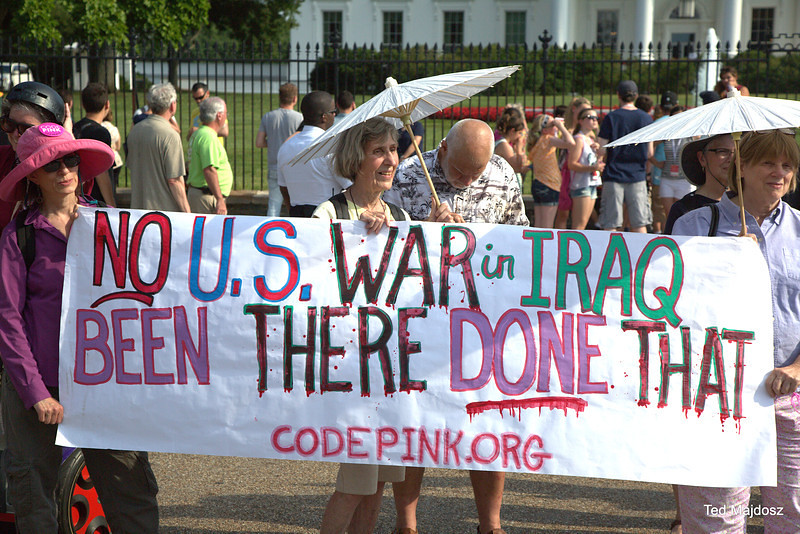
A lot of Americans these days, some of whom regard themselves as impeccable humanitarians, have formed the conviction that when it comes to the Middle East (or pretty much anywhere else in the world), intervention by the United States — especially military intervention — can do nothing but harm.

President Obama’s concerns about the Iraqi humanitarian crisis and the safety of US personnel can be solved without dropping bombs. Helping the besieged civilians in Iraq should be an orchestrated international effort, not carried out just by the US — the country that unleashed the sectarian turmoil in the first place. (CODEPINK)

Tens of thousands of Iraqis fled from ISIS, taking refuge on a mountain top where they have no food, water, or shelter. How long could anyone survive in these conditions when daytime temperatures often exceed 100F?

By the time CODEPINK’s wished for international effort could be orchestrated, thousands of those in need of help would be dead.


Channel 4 News
spoke to a Yazidi refugee, Barakat al-Issa, who is trapped in the Sinjar mountains: “the situation is very tragic, more than 100 thousand people are trapped in the mountains here, in need of water and food.”

The Americans and Turkish have carried out air drops of aid, but the effort was not sufficient said Mr al-Issa: “They are saying that planes are dropping aid, but this aid is only getting to some 5 per cent of the people who are trapped here, because of the mountainous terrain.”

“People are waiting here for international forces to intervene, in the hope that this will become a safe haven for aid to be delivered.”

“Most of the people here are civilians and they hope a peacekeeping force will come from Iraq or Nato.”

He accused the Islamic State militants of kidnapping at least 500 Yazidi women, whose fate remains unknown, and said that dozens of families had been murdered in the south of the Sinjar mountains as they tried to flee. He also repeated allegations that militants had been seen executing women and children.

To advocate neutrality in this conflict seems indicative of either being willfully deluded about the nature of ISIS or the result of simply not paying attention to what has been happening in Syria and Iraq over the last two years.

ISIS, or the Islamic State as it now prefers to be known, is utterly uncompromising. These men have chosen to fight a war that they will either win or lose — don’t expect them to ever send a delegation of negotiators to Geneva or start talking about how they want to live peacefully side by side with anyone. Coexistence is not part of their vocabulary.

Anyone in CODEPINK who is averse to taking sides should watch the video below — or at least as much of it as they can stomach — to witness how these jihadists whose passion for killing has no limit choose to portray themselves.

Some of the latest military action in Iraq appears to already by paying off but the situation remains dire, as Rudaw reports:

Local officials said today that 10,000 Yezidis who were stranded on Mount Shingal for one week were rescued and settled in the town of Zakho.

Medical teams and aid organizations in Zakho have rushed in to assist the rescued families, said Rudaw reporter.

Ashti Kocher, Zakho’s security chief said that Kurdish armed forces have opened a safe corridor for the Yezidis at Mount Shingal.

“We have also cleared about 30 kilometers of the ISIL forces in order to open a road for those families,” said Kocher, who currently leads a Peshmerga unit at Sinune village near Shingal.

Kocher said that the rescued civilians were transported to the Kurdistan Region through Rojava (Syrian Kurdistan) which is under the control of Kurdish forces known as the Peoples Protection Units (YPG).

Barakat Issa, Rudaw reporter on Mount Shingal said that the number of Yezidis stranded on the mountain is higher than initially reported. He said that nearly 100,000 people are hiding on the mountain.

Issa said that in the past few days 60 children and elderly have [died] … of hunger and thirst while there is fear that Islamic militants controlling the town of Shingal and other villages have massacred hundreds of others.

Stephen Walt proposes a course of inaction for the U.S. in the Middle East on the grounds that U.S. intervention never has its desired effects, but he adds this caveat:

[T]his argument would not preclude limited U.S. action for purely humanitarian purposes — such as humanitarian airdrops for the beleaguered religious minorities now threatened with starvation in Iraq. That’s not “deep engagement”; that’s merely trying to help people threatened with imminent death. But I would not send U.S. forces — including drones or aircraft — out to win a battle that the Iraqi government or the Kurds cannot win for themselves.

So the anti-interventionist “humanitarian” perspective is this — if I understand it correctly: we should try to make sure the Yazidi do not starve to death on the mountaintop. If, however, they manage to come back down only later to be slaughtered by ISIS, that’s their problem.

Facebooktwittermail

Palestinian Authority tries to prevent uprising in West Bank

Ahmad Azem reports: It should be noted that young Palestinians have started to develop a new type of confrontation in the villages near the settlements, or at checkpoints. They are starting to cut off roads and prevent Israeli vehicles from passing while the Israeli army watches from afar. Al-Monitor has witnessed such events in the village of Al-Eizariya, near the settlement of Ma’ale Adumim and Jerusalem. Yet at times, the army would directly intervene as it did in Beit Hanina and Shuafat. This raises the question: To what extent will this situation develop?

The lack of traditional confrontations with the occupation forces led to the idea of holding mass rallies outside the areas under the PA’s influence, such as the protests that took place near Ofer prison, west of Ramallah, or the Laylat al-Qadr march on July 24 at an Israeli checkpoint in Qalandiya. The protest that was known under the name of the “48,000 march” reflected the will to gather 48,000 demonstrators — which is an unprecedented number of protesters — in reference to the Palestinian Nakba of 1948.

Those who called for the march are young people affiliated with the Fatah movement, but they took action on their own without any official endorsement. This was made clear by one of the organizers in his speech at al-Manara, the main square of the city, where Al-Monitor was present a few days before the march was held. “This march has nothing to do with the leaderships,” he said. [Continue reading…]

Facebooktwittermail

#BDS: Boycott #Israeli products app gets 350,000 supporters

International Business Times: An app that allows users to search for a product linked to targeted companies or countries in order to boycott them has seen a significant surge in users signing up to anti-Israel campaigns.

Buycott catalogues brands and their affiliations and lets users set up campaigns to either help or avoid funding certain causes. By scanning a product’s barcode with their smartphone camera, consumers are able to determine which brands are associated with which campaigns.

The two most popular campaigns currently on Buycott are Long Live Palestine Boycott Israel and Avoid Israeli Settlement Products. Between them they have close to 350,000 supporters, over a quarter of which have joined in the last 12 hours (at time of publication).

Included on the list of companies implicated by the Long Live Palestine Boycott Israel campaign are McDonald’s, Intel, Nestle and Marks & Spencer. [Continue reading…]

Facebooktwittermail

The CIA must tell the truth about my rendition at 12 years old

Khadija al-Saadi writes: Two very different flights landed at Mitiga military airport in Libya just over a decade ago. The first was organized by the CIA and MI6. On board were a family of six surrounded by guards, the frightened children separated from their parents, the father chained to a seat in a rear compartment with a needle stuck in his arm. The second flight, only a couple of days later, carried Tony Blair in comfort, on his way to shake hands and do business with Colonel Gaddafi.

I know about the first flight, because I was one of the children. I know about the chains and the needle because Sami al-Saadi — a long-time political opponent of Colonel Gaddafi — is my father and I saw him in that state. I was 12 years old, and was trying to keep my younger brothers and my six year-old sister calm. The guards took us to see our mother once on the 16-hour flight. She was crying, and told us that we were being taken to Gaddafi’s Libya. Shortly before the plane landed, a guard told me to say goodbye to my father, at the front of the plane. I forced myself ahead and saw him with a needle in his arm. I remember guards laughing at me. Then I fainted.

We were taken off the plane and bundled into cars. Hoods were pulled over my parents’ heads. Libyans forced my mother, sister and I into one car, my brothers and father another. The convoy drove to a secret prison outside Tripoli, where I was certain we were all going to be executed. All I knew about Libya at that time was that Colonel Gaddafi wanted to hurt my father, and that our family had always been moving from country to country to avoid being taken to him. Now we had been kidnapped, flown to Libya, and his people had us at their mercy. [Continue reading…]

Facebooktwittermail

Kurdish commander: ‘If [the Americans] plan to help they had better do it now’

McClatchy reports: Jet aircraft attacked Islamic State positions outside the town of Kalak, 25 miles northwest of Irbil, the capital of Iraq’s autonomous Kurdish region, a resident of Kalak told McClatchy early Friday.

The resident, reached by phone from Irbil, said she had seen the aircraft and had heard the explosions coming from behind Islamic State lines, which are slightly more than a mile away. The resident said because it was dark she could not see any markings on the aircraft.

Kurdish television reported that the bombers were American. There was no confirmation from U.S. officials in Washington.

The reported bombing came after a day of panic in the Kurdish capital following Islamic State militants’ seizure of four strategic towns on a key highway and their advance to positions just minutes from Irbil.

Hundreds of Kurdish peshmerga militiamen built earthen berms near Kalak on the highway that links Irbil with Mosul, the Iraqi city whose fall to Islamic State militants in early June touched off a sweep across northern and western Iraq that until Thursday had spared Kurdish areas.

But that quiet appeared to be over, with the Islamic State boldly saying in an Internet posting Thursday that it intended to capture Irbil, a city previously thought so secure that the United States two months ago chose it as one of two Iraqi cities safe enough to receive scores of staffers evacuated from the U.S. Embassy in Baghdad.

“The Americans keep saying they will help us,” said Rosg Nuri Shawess, a top Kurdish military commander who was overseeing the defensive preparations. “Well, if they plan to help they had better do it now.” [Continue reading…]

Facebooktwittermail

Fascism in #Israel: The militarization of Jewish supremacism

Assaf Sharon writes: Addressing Israel’s offensive in Gaza, John Kerry said: “Israel is under siege by a terrorist organization.” Living in Israel, I found the secretary’s comment baffling. In my city, Jerusalem, the sirens have sounded only three times. Tel Aviv and its vicinity has had it worse, with three dozen sirens or so over the last month. Yet daily routine has not been greatly affected. In the south, near the Gaza strip, things are different. With numerous rockets daily, life in some Israeli towns and villages has become what happens between one rush to the shelter to the next. This is certainly not acceptable, but it is not a siege either. In Jewish history, the archetypical siege is the Roman siege of Jerusalem, described by the first-century historian, Josephus, thus: “Throughout the city people were dying of hunger in large numbers, and enduring unspeakable sufferings. In every house the merest hint of food sparked violence, and close relatives fell to blows, snatching from one another the pitiful supports of life.” In Zionist history, the paradigm comes from 1948, when Jerusalem was once again stricken with hunger and want of basic supplies. Here is how one mother described it in a letter to her son who was fighting in the north: “Whoever doesn’t have food simply goes hungry. There’s no gas for cooking, people gather wood and cook in the street. Other than bread, (and this too only 200 grams per person daily) there’s almost nothing to buy…. Water is delivered in a carriage with an allowance of 1.5 cans per person for a week (can=eighteen liters), which is precious little. And as there is no fuel for cars, the water must be brought (from great distance) from wells.” Today, this description is more suitable to Gaza than to Israel.

But there is another siege haunting Israel today. This siege is internal rather than external, moral rather than physical. The murder of sixteen-year-old Muhhamad Abu-H’deir, burned alive by Jewish extremists on July 2, made headlines worldwide. But the context in which this crime was hatched receives less attention. The day before, as the three Israeli youths kidnapped and murdered three weeks earlier were being buried, hundreds of extremists gathered in Jerusalem under the banner “We want Revenge!” And their slogans clarified: “Death to Arabs” and “Death to Leftists.” As the mob marched to the city center, they pounded on store fronts, demanding Arab blood. A large group gathered outside McDonald’s shouting for its Arab employees to be brought out. Smaller groups roamed the streets looking for Arabs to abuse. A wave of racist violence has been washing the streets since then. Organized mobs of extremists have been marching through the streets of Jerusalem shouting racist slogans, calling, “Death to Arabs!” Like scenes taken from revolutionary films, they block cars and busses mid-street, checking whether there are Arabs inside. If found, they are assaulted verbally as well as physically. Many Palestinians refrain from traveling on the city’s light rail because it has become a regular venue for racist attacks. [Continue reading…]

Facebooktwittermail

Palestinians returning home find #Israeli troops left faeces and venomous graffiti

The Guardian reports: When Ahmed Owedat returned to his home 18 days after Israeli soldiers took it over in the middle of the night, he was greeted with an overpowering stench.

He picked through the wreckage of his possessions thrown from upstairs windows to find that the departing troops had left a number of messages. One came from piles of faeces on his tiled floors and in wastepaper baskets, and a plastic water bottle filled with urine.

If that was not clear enough, the words “Fuck Hamas” had been carved into a concrete wall in the staircase. “Burn Gaza down” and “Good Arab = dead Arab” were engraved on a coffee table. The star of David was drawn in blue in a bedroom.

“I have scrubbed the floors three times today and three times yesterday,” said Owedat, 52, as he surveyed the damage, which included four televisions, a fridge, a clock and several computers tossed out of windows, shredded curtains and slashed soft furnishings. [Continue reading…]

Facebooktwittermail

#Israel’s campaign to destroy #Gaza’s economy

The New York Times reports: For nearly four decades, Al Awda Co. has stocked Gaza’s shelves with sweets and snacks, starting as a humble refugee-camp bakery and growing into a 180,000-square-foot factory with 600 workers.

On Wednesday, all that was left was a faint whiff of chocolate amid the sour smell of a fire that burned for three days.

A barrage of Israeli artillery turned Al Awda into a charred graveyard of machinery and material. The $1.3 million German control panel that powered the place became a metal cabinet of fried wires. Some 300 tons each of sugar, flour and margarine — gone. Metal roofs collapsed, cinder-block walls had gaping holes, floors were carpeted in rubble.

“I didn’t even go to the third floor; I don’t want to see what’s there,” said Mohammed Al Telbani, 61, who founded the business in 1977. “I’m used to building. I’m not used to destruction.”
Continue reading the main story

During Israel’s monthlong air-and-ground assault on the Gaza Strip, the world’s attention has focused on the more than 1,800 Palestinians killed and the more than 30,000 homes destroyed or damaged. But as a temporary truce held and talks toward a longer-term cease-fire began Wednesday, business leaders said that 175 of Gaza’s most successful industrial plants had also taken devastating hits, plunging an already despairing economy into a deeper abyss. [Continue reading…]

Facebooktwittermail
