Category Archives: Issues

Matthew Harwood: One nation under SWAT

Think of it as a different kind of blowback.  Even when you fight wars in countries thousands of miles distant, they still have an eerie way of making the long trip home.

Take the latest news from Bergen County, New Jersey, one of the richest counties in the country.  Its sheriff’s department is getting two mine-resistant ambush-protected vehicles, or MRAPs — 15 tons of protective equipment — for a song from the Pentagon.  And there’s nothing special in that.  The Pentagon has handed out 600 of them for nothing since 2013, with plenty more to come.  They’re surplus equipment, mostly from our recent wars, and perhaps they will indeed prove handy for a sheriff fretting about insurgent IEDs (roadside bombs) in New Jersey or elsewhere in the country.  When it comes to the up-armoring and militarization of America’s police forces, this is completely run-of-the-mill stuff.

The only thing newsworthy in the Bergen story is that someone complained.  To be exact, Bergen County Executive Kathleen Donovan spoke up in opposition to the transfer of the equipment.  “I think,” she said, “we have lost our way if you start talking about military vehicles on the streets of Bergen County.”  And she bluntly criticized the decision to accept the MRAPs as the “absolute wrong thing to do in Bergen County to try to militarize our county.”  Her chief of staff offered a similar comment: “They are combat vehicles. Why do we need a combat vehicle on the streets of Bergen County?”

Sheriff Michael Saudino, on the other hand, insists that the MRAPs aren’t “combat vehicles” at all.  Forget the fact that they were developed for and used in combat situations.  He suggests instead that one good reason for having them — other than the fact that they are free (except for postage, gas, and upkeep) — is essentially to keep up with the Joneses.  As he pointed out, the Bergen County police already have two MRAPs, and his department has none and, hey, self-respect matters!  (“Should our SWAT guys be any less protected than the county guys?” he asked in a debate with Donovan.)

striking recent report from the American Civil Liberties Union indicates that, as in Bergen County, policing is being militarized nationwide in all sorts of unsettling ways.  It is, more precisely, being SWATified (a word that doesn’t yet exist, but certainly should).  Matthew Harwood, senior writer and editor for the ACLU, as well as TomDispatch regular, offers a graphic look at just where policing in America is heading. Welcome to Kabul, USA. Tom Engelhardt

To terrify and occupy
How the excessive militarization of the police is turning cops into counterinsurgents
By Matthew Harwood

Jason Westcott was afraid.

One night last fall, he discovered via Facebook that a friend of a friend was planning with some co-conspirators to break in to his home. They were intent on stealing Wescott’s handgun and a couple of TV sets. According to the Facebook message, the suspect was planning on “burning” Westcott, who promptly called the Tampa Bay police and reported the plot.

According to the Tampa Bay Times, the investigating officers responding to Westcott’s call had a simple message for him: “If anyone breaks into this house, grab your gun and shoot to kill.”

Around 7:30 pm on May 27th, the intruders arrived. Westcott followed the officers’ advice, grabbed his gun to defend his home, and died pointing it at the intruders.  They used a semiautomatic shotgun and handgun to shoot down the 29-year-old motorcycle mechanic.  He was hit three times, once in the arm and twice in his side, and pronounced dead upon arrival at the hospital.


Continue reading

Facebooktwittermail

Fascism in Israel: ‘The intellectual bankruptcy of the mass media in this war is total’

Haaretz talked to Israel Prize laureate and renowned scholar Zeev Sternhell about his fears for the collapse of Israeli democracy.

Of all the phenomena you’ve encountered here, which do you find ugliest?

“What we’ve seen here in the past few weeks is absolute conformism on the part of most of Israel’s intellectuals. They’ve just followed the herd. By intellectuals I mean professors and journalists. The intellectual bankruptcy of the mass media in this war is total. It’s not easy to go against the herd, you can easily be trampled. But the role of the intellectual and the journalist is not to applaud the government. Democracy crumbles when the intellectuals, the educated classes, toe the line of the thugs or look at them with a smile. People here say, ‘It’s not so terrible, it’s nothing like fascism – we have free elections and parties and a parliament.’ Yet, we reached a crisis in this war, in which, without anyone asking them to do so, all kinds of university bodies are suddenly demanding that the entire academic community roll back its criticism.”

Do you think it’s due to fear?

“Fear of the authorities, fear of possible budgetary sanctions and fear of pressure from the street. The personification of shame and disgrace occurred when the dean of the law faculty of Bar-Ilan University threatened sanctions against one of his colleagues because the latter added a couple of sentences to an announcement about exam dates in which he expressed sorrow at the killing and loss of life on both sides. To grieve for the loss of life on both sides is already a subversive act, treason. We are arriving at a situation of purely formal democracy, which keeps sinking to ever lower levels.”

When will we cross the line in which democracy implodes?

“Democracy rarely falls in a revolution. Not in Italy, not in Germany and not in France with the Vichy regime – which is a crucial thing, because France was a democratic country that fell into the hands of the right wing with the support of the vast majority of the population. It was not the fall of France that generated this ideology. It was the result of a gradual process in which an extreme nationalist ideology took shape, a radical approach that perceives the nation as an organic body. Like a tree on which human individuals are the leaves and the branches – in other words, people exist only thanks to the tree. The nation is a living body.

“In Israel, the religious factor strengthens the national singularity. It’s not a matter of belief, but of identity; religion bolsters your distinctive identity. It’s essential to understand that without this radical nationalism there is no fascism. I also distinguish between fascism and Nazism, because fascism does not necessarily carry a race doctrine. Let me put it in no uncertain terms: Fascism is a war against enlightenment and against universal values; Nazism was a war against the human race.”

Do you see a negation of universal values in Israel and a war against enlightenment in recent years?

“It cries out to heaven. Israel is an extraordinary laboratory in which one sees the gradual erosion of enlightenment values, namely the universal values I mentioned. You see the negation, which always existed on the fringes, slowly impinging, until one day it dominates the center.”

Facebooktwittermail

MonsterMind: Automated cyberwarfare

In “The most wanted man in the world,” his feature article for Wired on Edward Snowden, James Bamford writes: The massive surveillance effort was bad enough, but Snowden was even more disturbed to discover a new, Strangelovian cyberwarfare program in the works, codenamed MonsterMind. The program, disclosed here for the first time, would automate the process of hunting for the beginnings of a foreign cyberattack. Software would constantly be on the lookout for traffic patterns indicating known or suspected attacks. When it detected an attack, MonsterMind would automatically block it from entering the country — a “kill” in cyber terminology.

Programs like this had existed for decades, but MonsterMind software would add a unique new capability: Instead of simply detecting and killing the malware at the point of entry, MonsterMind would automatically fire back, with no human involvement. That’s a problem, Snowden says, because the initial attacks are often routed through computers in innocent third countries. “These attacks can be spoofed,” he says. “You could have someone sitting in China, for example, making it appear that one of these attacks is originating in Russia. And then we end up shooting back at a Russian hospital. What happens next?”

In addition to the possibility of accidentally starting a war, Snowden views MonsterMind as the ultimate threat to privacy because, in order for the system to work, the NSA first would have to secretly get access to virtually all private communications coming in from overseas to people in the US. “The argument is that the only way we can identify these malicious traffic flows and respond to them is if we’re analyzing all traffic flows,” he says. “And if we’re analyzing all traffic flows, that means we have to be intercepting all traffic flows. That means violating the Fourth Amendment, seizing private communications without a warrant, without probable cause or even a suspicion of wrongdoing. For everyone, all the time.”

Facebooktwittermail

How the NSA shut down the internet in Syria — by accident

As I have written here before, as much as we should fear the immense power of intelligence agencies such as the NSA, it’s important to recognize that secrecy does not merely function as an instrument of power — just as importantly it functions to conceal incompetence.

The agencies want to sustain their mystique as the valiant and stealthy defenders of national security. What they dread is being seen as over-funded bunglers.

On November 29, 2012, the internet went down in Syria. The following day, the Washington Post reported:

Though the rebels and the Syrian government blamed each other for the prolonged outage, most technology experts believe Syrian authorities caused the blackout to try to impede the rebels’ interactions and online broadcasts of the fighting.

More honest reporting might have said, it’s anyone’s guess what happened, but for what it’s worth here’s some speculation from some so-called experts.

It turns out, apparently, that the experts were wrong and the cause of the outage was a bungled NSA operation.

James Bamford has just done an extended interview with Edward Snowden which includes this:

By the time he went to work for Booz Allen in the spring of 2013, Snowden was thoroughly disillusioned, yet he had not lost his capacity for shock. One day an intelligence officer told him that TAO — a division of NSA hackers — had attempted in 2012 to remotely install an exploit in one of the core routers at a major Internet service provider in Syria, which was in the midst of a prolonged civil war. This would have given the NSA access to email and other Internet traffic from much of the country. But something went wrong, and the router was bricked instead—rendered totally inoperable. The failure of this router caused Syria to suddenly lose all connection to the Internet—although the public didn’t know that the US government was responsible. (This is the first time the claim has been revealed.)

Inside the TAO operations center, the panicked government hackers had what Snowden calls an “oh shit” moment. They raced to remotely repair the router, desperate to cover their tracks and prevent the Syrians from discovering the sophisticated infiltration software used to access the network. But because the router was bricked, they were powerless to fix the problem.

Fortunately for the NSA, the Syrians were apparently more focused on restoring the nation’s Internet than on tracking down the cause of the outage. Back at TAO’s operations center, the tension was broken with a joke that contained more than a little truth: “If we get caught, we can always point the finger at Israel.”

Facebooktwittermail

‘My wife thinks I will come home in a box’ – and three days later Gaza bomb disposal expert was dead

The Guardian reports: Rahed Taysir al’Hom was buried in the sandy soil of the cemetery of Jabaliya, the rough Gaza neighbourhood where he had grown up, at 1pm on the third day of the ceasefire.

His funeral was quick, attended by a hundred or so mourners, and accompanied by a quick sermon from a white-turbaned cleric, a sobbing father and some shots fired from a Kalashnikov by a skinny teenager.

Two breezeblocks and a ripped piece of cardboard with his name scrawled on it now mark the grave of a personable man with an easy smile, hollow eyes and a quiet intensity that was entirely understandable given his job.

The 43-year-old father of seven lies next to his brother – a Hamas fighter killed in an Israeli air strike two weeks ago. But the al’Hom who died on Wednesday was not a warrior. He was head of the sole bomb disposal unit of Gaza’s northern governorate and his job was to protect several hundred thousand people from the unexploded ordnance that now litters the streets, fields and the rubble of many homes.

Al’Hom, who died when a 500kg bomb he was trying to defuse exploded at 10.30am on Wednesday, was an incidental casualty of a month-long war that no one seems able to stop.

Three of his colleagues and two journalists were killed with him. He was well aware of the risks he was taking but believed in his work. One day last week, while the last tenuous ceasefire held in Gaza, al-Hom received 70 calls. In this conflict alone, he had dealt with 400 “objects”. [Continue reading…]

Facebooktwittermail

U.S. airstrikes helped, but Kurds from Syria turned tide against #ISIS

McClatchy reports: Victory, they say, has many fathers, and as Kurdish peshmerga militia pushed Islamic State forces from a string of towns near Irbil Sunday and Monday, it was easy to cite two: accurate airstrikes by U.S. aircraft that eliminated artillery positions and convoys and timely deliveries of light arms and ammunition from the CIA.

But a third may have been just as important, though less publicized: the addition of hundreds of fighters from a Turkish group designated by the U.S. government as a terrorist organization.

Visits to front-line positions Monday made it clear that an influx of fighters with links to the Kurdish Workers Party, known by its Kurdish initials PKK, had played a major role in driving the Islamic State from key areas within a 30-minute drive of Irbil, the capital of Iraq’s Kurdistan Regional Government. It was Irbil’s possible fall last week that ended weeks of Obama administration inaction on Iraq.

“The PKK took Mahmour,” a peshmerga fighter at a checkpoint outside Mahmour acknowledged, shaking his head in admiration. Then, using the Arabic acronym for the Islamic State, he offered an explanation: “They’re very experienced from fighting Daash in Syria and are true guerrilla fighters from their time in Turkey. They have more experience and training than we do.”

There was plenty of gratitude for the U.S. intervention, which since Friday has included at least seven announced airstrikes on Islamic State targets near Irbil.

“The strikes came at the last second but, thank God, they came,” said one Kurdish defense official at Kalak, where the peshmerga has set up a defense line that, compared with last week’s ragged look, had developed a formidable array of machine guns mounted on pickup trucks with ample supplies of light ammunition. [Continue reading…]

Facebooktwittermail

Anti-Israel boycotts are spreading across Britain and they’re here to stay

BuzzFeed reports: “We’re not planning on stopping our actions, because the siege of Gaza still goes on,” Clare Essex, a spokeswoman for London Palestine Action (LPA), said. “People can’t have medicine. The one power plant in the city has been destroyed. More than ever, we need to keep pushing that into people’s consciousness.”

In the last few weeks, hundreds of thousands of people have been protesting in the streets of London, Manchester, and Edinburgh against the government’s stance on the conflict in Gaza. Alongside larger actions, there have been protests inside supermarkets such as Sainsbury’s, and shopkeepers have claimed to have faced intimidation on the high streets of Manchester.

But despite a short-term end to hostilities in Gaza, the campaign shows no signs of winding down. The Palestine Solidarity Campaign’s (PSC) chair, Hugh Lanning, said the organisation plans to build on the momentum it has gained. There will be another national day of action next Saturday, when activists will target high street stores that sell the products of SodaStream, a manufacturer of DIY carbonated-drink machines that has its headquarters in an Israeli settlement. [Continue reading…]

Facebooktwittermail

How #Israelis make money from killing #Palestinians

Haaretz reports: “Battle-tested” is the best marketing slogan for defense industries the world over, so for Israeli military manufactures Operation Protective Edge has yielded a major competitive edge.

“For the defense industries this campaign is like drinking a very strong energy drink — it simply gives them tremendous forward momentum,” says Barbara Opall-Rome, Israel bureau chief for the U.S. magazine Defense News. “Combat is like the highest seal of approval when it comes to the international markets. What has proven itself in battle is much easier to sell. Immediately after the operation, and perhaps even during, all kinds of delegations arrive here from countries that appreciate Israel’s technological capabilities and are interested in testing the new products.”

That was also the opinion of veteran military correspondent Amir Rapaport, editor of Israel Defense, which covers the local defense industry. “From a business point of view, the operation was an outstanding thing for the defense industries,” he says. “There are two main reasons for that. First, the cloud of budget cuts and project cancellations has been lifted. I believe that after the operation, Israel’s defense budget will be increased and projects that were frozen will be revived. Second, during the weeks of the war, new products were introduced for the army’s use. The war is an opportunity to cut red tape. Weapons systems that have long been under development suddenly became operational during the course of the fighting. [Continue reading…]

Facebooktwittermail

Antisemitism on rise across Europe ‘in worst times since the Nazis’

The Guardian reports: In the space of just one week last month, according to Crif, the umbrella group for France’s Jewish organisations, eight synagogues were attacked. One, in the Paris suburb of Sarcelles, was firebombed by a 400-strong mob. A kosher supermarket and pharmacy were smashed and looted; the crowd’s chants and banners included “Death to Jews” and “Slit Jews’ throats”. That same weekend, in the Barbes neighbourhood of the capital, stone-throwing protesters burned Israeli flags: “Israhell”, read one banner.

In Germany last month, molotov cocktails were lobbed into the Bergische synagogue in Wuppertal – previously destroyed on Kristallnacht – and a Berlin imam, Abu Bilal Ismail, called on Allah to “destroy the Zionist Jews … Count them and kill them, to the very last one.” Bottles were thrown through the window of an antisemitism campaigner in Frankfurt; an elderly Jewish man was beaten up at a pro-Israel rally in Hamburg; an Orthodox Jewish teenager punched in the face in Berlin. In several cities, chants at pro-Palestinian protests compared Israel’s actions to the Holocaust; other notable slogans included: “Jew, coward pig, come out and fight alone,” and “Hamas, Hamas, Jews to the gas.”

Across Europe, the conflict in Gaza is breathing new life into some very old, and very ugly, demons. This is not unusual; police and Jewish civil rights organisations have long observed a noticeable spike in antisemitic incidents each time the Israeli-Palestinian conflict flares. During the three weeks of Israel’s Operation Cast Lead in late 2008 and early 2009, France recorded 66 antisemitic incidents, including attacks on Jewish-owned restaurants and synagogues and a sharp increase in anti-Jewish graffiti.But according to academics and Jewish leaders, this time it is different. More than simply a reaction to the conflict, they say, the threats, hate speech and violent attacks feel like the expression of a much deeper and more widespread antisemitism, fuelled by a wide range of factors, that has been growing now for more than a decade. [Continue reading…]

Facebooktwittermail

Billionaire’s sketchy Middle East gamble: Meet the man betting on war with Iran

Eli Clifton reports: On the same evening last November that world powers announced an interim deal with Iran, halting its nuclear progress in exchange for a modest easing of sanctions, United Against Nuclear Iran (UANI) put out a statement complaining that the agreement was a “disappointment” and “provides disproportionate sanctions relief to Iran.” The group’s executive director, former U.S. diplomat Mark Wallace, suggested that no sanctions relief was appropriate as part of an interim deal: “By rolling back sanctions now, the international community is significantly lessening the pressure on Iran’s economy.”

That same group, at the end of July, turned up in a bit of intrigue: the New York Times revealed that the Justice Department had stepped in to a defamation suit against UANI to prevent the disclosure of documents revealing the group’s donors, among other information. UANI serves as a key pressure group for the enforcement of sanctions, frequently issuing reports and press releases about companies doing illicit business with Iran.

The Times reported that lawyers representing Greek shipping magnate Victor Restis, the plaintiff in the suit, accused UANI of receiving foreign funding and shaking down companies for donations. UANI had earlier accused Restis and his company of being “front men for the illicit activities of the Iranian regime.”

But it remains unclear what potential revelations the Justice Department is concerned about.

Among the pieces of heretofore undisclosed information the Justice Department’s shield might prevent from coming to light is the connection between UANI and one of the biggest investors in precious metals, Thomas S. Kaplan. Kaplan has emerged as one of the business world’s most outspoken proponents of investing in gold and other precious metals, investments he says will retain or appreciate in value during periods of political and economic unrest. [Continue reading…]

Facebooktwittermail

‘I just want people to pay’

Even though I spend too many of my waking hours on the internet, like a hamster on an endlessly spinning wheel, I have some sympathy for John R. MacArthur’s disdain for online publishing. Indeed, it’s probably because of this sense that the internet has an unlimited capacity to eat time that I see some appeal in the idea that we might return to a pre-digital age of print.

But the passionate defense of print media that the publisher of Harper’s magazine makes, falls apart when we learn this:

On several occasions during a recent interview, he could not quite remember a fact that supported a point. His version of searching for it on Google was yelling to a staff member, who hurried to deliver the information.

Who needs Google when they have staff?

But perhaps the more relevent question would be: who needs to use Google when they have staff who can use Google?

MacArthur’s argument against online publishing is that the web isn’t “much more than a gigantic Xerox machine” that prevents publishers and writers getting paid.

Even so, when he somewhat dismissively refers to the internet as a place where people go to blow off steam, I wonder whether he is oblivious of the degree to which he indirectly relies on it — like a man who says he doesn’t need to know how to cook because all his meals get delivered by caterers.

MacArthur might believe his argument is against those who promote online media and thereby undermine the economic viability of publishing, but maybe he should imagine how he would make his case with Gutenburg.

Whereas Gutenburg came up with the means of making the written word accessible to the masses and thereby democratized human expression, the revivalists of print seem more interested in restricting access of their publications to their well-heeled subscribers.

MacArthur might believe that everyone who is cultivated enough to appreciate a quality literary magazine will also be able to afford paying for it, but in making that assumption he represents the American liberal elite with its over-sized sense of being liberal and its downplayed status as an elite.

Facebooktwittermail

#Hamas pushes Abbas to join #ICC

David Hearst reports: Hamas has decided to demand that President Mahmoud Abbas sign the Rome Statute which will allow Palestine to join the International Criminal Court as a full member, even though the militant movement itself could be subject to prosecution, sources told the Middle East Eye.

Hamas’s deputy chairman and chief negotiator in Cairo, Moussa Abu Marzouk has been instructed to sign the document supporting the State of Palestine as a member of the ICC in The Hague, the MEE has learned. The decision comes after a top level meeting between the Palestinian chief negotiator Saeb Erekat and Khaled Meshaal, the leader of Hamas.

The document already contains the signatures of the PLO executive committee, Fatah Central Committee and other PLO organisations such as the Popular Front and the Democratic Front. But Abbas himself is resisting, as a result of the forceful opposition of the United States and the European Union.

A tape in which Erekat criticised Abbas’s refusal to join the ICC was leaked recently. In it, Erekat is alleged to have criticised Abbas for stalling on the question of the ICC. Since then, Erekat has been at the forefront of a campaign to force Abbas’ hand. The PLO held a meeting recently in which all Palestinian factions put their name to joining the ICC. [Continue reading…]

Facebooktwittermail

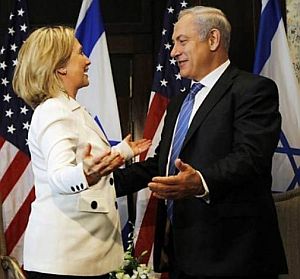
Hillary Clinton sympathizes with #Israel’s ‘PR problem’

hillary-bibiIn case anyone has the slightest doubt whether Hillary Clinton is running for president in 2016, read her interview with Jeffrey Goldberg in the Atlantic.

She dutifully supports every position the Israel lobby demands and even deftly conjures up a rhetorical connection between jihadists and the nuclear threat from Iran, introducing a piece of non-proliferation jargon into counterterrorism when she refers to the breakout capacity “of jihadist groups that can affect Europe, can affect the United States.”

For a few neocons in Washington who are indulging in fantasies about their political rehabilitation, much of what Clinton says, must be music to their ears. She shares the view frequently expressed by Israel apologists during its assault on Gaza, that Israel is getting more criticism than it deserves.

When it comes to killing Palestinian civilians, Israel still suffers from its “old PR problem.” Indeed, hundreds of dead children always cause a PR problem.

Hillary Clinton: [W]e do see this enormous international reaction against Israel, and Israel’s right to defend itself, and the way Israel has to defend itself. This reaction is uncalled for and unfair.

Jeffrey Goldberg: What do you think causes this reaction?

HRC: There are a number of factors going into it. You can’t ever discount anti-Semitism, especially with what’s going on in Europe today. There are more demonstrations against Israel by an exponential amount than there are against Russia seizing part of Ukraine and shooting down a civilian airliner. So there’s something else at work here than what you see on TV.

And what you see on TV is so effectively stage-managed by Hamas, and always has been. What you see is largely what Hamas invites and permits Western journalists to report on from Gaza. It’s the old PR problem that Israel has. Yes, there are substantive, deep levels of antagonism or anti-Semitism towards Israel, because it’s a powerful state, a really effective military. And Hamas paints itself as the defender of the rights of the Palestinians to have their own state. So the PR battle is one that is historically tilted against Israel.

JG: Nevertheless there are hundreds of children —

HRC: Absolutely, and it’s dreadful.

JG: Who do you hold responsible for those deaths? How do you parcel out blame?

HRC: I’m not sure it’s possible to parcel out blame because it’s impossible to know what happens in the fog of war. Some reports say, maybe it wasn’t the exact UN school that was bombed, but it was the annex to the school next door where they were firing the rockets. And I do think oftentimes that the anguish you are privy to because of the coverage, and the women and the children and all the rest of that, makes it very difficult to sort through to get to the truth.

There’s no doubt in my mind that Hamas initiated this conflict and wanted to do so in order to leverage its position, having been shut out by the Egyptians post-Morsi, having been shunned by the Gulf, having been pulled into a technocratic government with Fatah and the Palestinian Authority that might have caused better governance and a greater willingness on the part of the people of Gaza to move away from tolerating Hamas in their midst. So the ultimate responsibility has to rest on Hamas and the decisions it made.

That doesn’t mean that, just as we try to do in the United States and be as careful as possible in going after targets to avoid civilians, that there aren’t mistakes that are made. We’ve made them. I don’t know a nation, no matter what its values are– and I think that democratic nations have demonstrably better values in a conflict position — that hasn’t made errors, but ultimately the responsibility rests with Hamas.

Facebooktwittermail

U.S. air support helps Kurdish forces expel #ISIS fighters from two Iraqi towns

The Washington Post reports: Aided by U.S. airstrikes, embattled Kurdish forces began to reverse a string of losses on Sunday, expelling Islamic State extremists from two northern Iraqi towns.

Makhmour and Gweir, the first areas targeted in the U.S. air campaign that began Friday night, were cleared of the al-Qaeda-inspired militants on Sunday, Kurdish officials said.

“It’s thanks to the strikes that we have been able to move forward,” said Mahmood Haji, an official in the Kurdish Interior Ministry. The Kurdish television channel Rudaw showed live footage of security forces advancing in Makhmour, and later crowding around a government building in the town, where the Kurdish flag had been raised once more.

President Obama said Saturday that the American air campaign would not expand beyond the limited objectives he has outlined. He tied more extensive assistance to the formation of an inclusive Iraqi government in Baghdad. [Continue reading…]

BasNews reports: Most Arab tribes that border the Kurdistan Region geographically are helping Islamic State (IS) insurgents as well as helping them to get close or enter Kurdish villages and cities in northern Iraq.

Facebooktwittermail

A piecemeal parochial approach won’t solve the Middle East crisis

Chris Doyle writes: “The lamps are going out all over the Middle East”, to update Sir Edward Grey’s doom-laden warning to Europe a hundred years ago. The areas of calm and stability seem like small oases in a multitude of firestorms. Many areas are literally without lights. Gaza has around two hours electricity a day. The power cuts in Yemen are worse and worse, leading to major protests. But, more worryingly, the lights of the democratic, liberal, pluralistic forces that for many months in 2011 lit up the region are also dimming, overshadowed by the twin forces of brutal dictatorship and brutal religious sectarian extremism.

Syria and Iraq are divided and near ungovernable, in the waiting room for failed-state status. The so-called Islamic caliphate or Isis, which in reality bears no resemblance to any caliphates of the past, covers an ever-expanding area, larger than the United Kingdom, including 35 per cent of Syria. Libya is being terrorised by rival militias. Palestinians in Gaza, for the fourth time since 2006, are at the wrong end of an Israeli military aggression that pits one of the world’s most sophisticated militaries against a captive population inside the world’s largest prison. The collective pile of rubble from these conflicts would grace a mountain range.

Those states and areas that enjoy calm become refugee camps. Lebanon and Jordan host almost two million Syrian refugees between them, as well as 2.5 million Palestinians. Tunisia is confronted with a mass Libyan exodus; while Iraqi Kurdistan is home to more than 300,000 Iraqis displaced only since June, as well as 220,000 Syrian refugees. In each case, the numbers are rocketing up – with the number of Syrian refugees alone expected to reach four million by the end of the year. Each humanitarian appeal is underfunded.

Will it get worse? The signs are worrying. The fighting in Lebanon last week, in Arsal in the north Bekaa valley, is yet another example of why the Syrian crisis threatens to move from spilling over, to swamping, its smaller neighbour. The instability could spread to Jordan. Saudi Arabia and the Gulf states will not be immune to the regional changes.

Given the epidemic of crises in an area of the world vital to our trade, energy and security interests, the minimal expectation would be an energetic and engaged response. Yet, when asked about Western policy towards the region, my instinctive response is, “There is one?”

The failure is first and foremost one of leadership, at an international and regional level. Who are great international statesmen in the West or in the Middle East? Who do young Arabs, who make up most of the population, look to for inspiration? President Obama has been blasted for his indecisiveness but he is not alone. George W Bush and Tony Blair were decisive over Iraq and destroyed the country. There is no strategy, and often the debate is reduced to a question of to bomb or not to bomb. [Continue reading…]

Facebooktwittermail