Pandora’s Lunchbox: How Processed Food Took Over the American Meal: Of the roughly five thousand additives allowed into food, over half are flavorings. These thousands of taste molecules serve not only as window-dressing designed to make food hyperappealing, but often as the very foundation of the house itself. Consider KFC’s gravy, a product with at least seven flavoring ingredients, or nearly a third of the total:
Food Starch-Modified, Maltodextrin, Enriched Wheat Flour (Niacin, Reduced Iron, Thiamine Mononitrate, Riboflavin, Folic Acid), Chicken Fat, Wheat Flour, Salt, Partially Hydrogenated Soybean Oil, Monosodium Glutamate, Dextrose, Palm and Canola Oils, Mono- and Diglycerides, Hydrolyzed Soy Protein, Natural and Artificial Flavor (with Hydrolyzed Corn Protein, Milk), Caramel Color (Treated with Sulfiting Agents), Onion Powder, Disodium Inosinate, Disodium Guanylate, Spice, Spice Extractives, with Not More Than 2% Silicon Dioxide Added as an Anticaking Agent.
This is an unusual example in the sense that you can identify most of the flavorings. More often than not, you can’t. They are tucked into the opaque designations natural flavors and artificial flavors, which include things you can taste — fruits; spicy notes; savory, salty and tangy flavors like lemon or vinegar — and substances you can’t, because they’re being used to cover up unwanted flavor. Many ingredients that go into processed food don’t actually taste very good and need to be masked. In addition to soy protein, there’s the bitter taste of most artificial sweeteners and preservatives like sodium benzoate and potassium sorbate, which impart what’s known as “preservation burn.” The German company Wild has a product to modify the taste of stevia. “It has this horrible liquorice flavor that lingers,” noted Marie Wright, chief flavorist at the company. Added vitamins taste, unsurprisingly, vitamin-y. B1, in particular, can have a rotten-egg aroma.
A chef would make a gravy using poultry fat and stock, along with butter, onions, flour, cream, salt, pepper and maybe white wine, but industrial processors, for the most part, don’t have this luxury. Using real ingredients is not only more expensive, it’s often ineffective, since Mother Nature’s volatile and fragile flavors often don’t fare well during journeys through the assembly line. The potions produced by Wild; International Flavors and Fragrances (IFF); Gividuan, the world’s largest flavor company; the Swiss company Firmenich; the German outfit Symrise; Sensient, which is based in Cincinnati; and a handful of others are much more sturdy.
“If you take a fresh strawberry after processing, it’s nothing. It tastes like nothing,” said Wright, as a way of explaining why the food industry is so reliant on the $12 billion global flavoring industry. [Continue reading…]
Category Archives: Issues
The U.S. shouldn’t squander an opportunity to strike a deal with Iran
Vali Nasr writes: For the first time since 2009, there may be signs of a break in the deadlock over Iran’s nuclear program. Iran entered the latest talks with a slightly softened position. That is good news, but the United States will have to change its negotiating strategy to take advantage of it.
Economic sanctions are biting hard in Iran. Meanwhile, its strategic position is crumbling because of the turmoil in its ally Syria and the rise of militant Sunni Islamism throughout the Arab Middle East. Together, these forces seem to have forced Iran to reconsider its own bargaining position.
So rather than strengthen sanctions another notch, America should give Iran a little tit for tat: begin negotiating directly, and put on the table the prospect of lifting sanctions, one by one, as bargaining chips.
The United States should shift from trying to further intimidate Iran to trying to clinch an agreement. The sanctions have given America leverage, and we should use it to seek a deal that would finally restrict Iran’s ability to make bomb fuel, rather than ratchet up the pressure in the hopes of getting either a broader deal now or a total surrender later.
The problem with just standing tough is that it is likely to backfire; Iran is understandably nervous, and if it thinks America is intransigent, it might double down on its nuclear program, speeding it up past a point of no return. [Continue reading…]
Never forget: Our invasion of Iraq was a breach of trust
Richard Clarke writes: On Tuesday, at this 10th anniversary of the American Invasion of Iraq, we would do well to remind ourselves about some painful facts.
Keeping those facts in our collective memory may make it easier for us as a nation to prevent future mistakes. So, let us recall five unfortunate facts about the U.S. invasion of Iraq.
First, the leaders of the Bush administration were intent on invading from the beginning of their time in the White House. When the 9-11 attacks occurred, Bush Cabinet members immediately discussed how that tragedy could be used to justify an invasion.
Bush himself asked me to try to pin the blame for 9-11 on Iraq. Vice President Dick Cheney propagated a myth that a hijacker had met with Iraqi intelligence officials in Prague, even though we knew at the time Cheney said it that the report was false and that the hijacker was in Virginia at the time of the alleged meeting.
Second, the Bush-Cheney team settled on the excuse for invading that Iraq was making weapons of mass destruction. They trotted out to Congress, the American people and the United Nations a series of fabricated intelligence reports.
Iraq was allegedly buying “yellow cake” uranium from Niger. The documentary proof used turns out to have been a forgery. Iraq had mobile biological-weapons labs. The eyewitness has been shown to be a liar. Iraq was allegedly training al-Qaida. The only evidence of that were the ravings of a terrorist under extreme torture.
The proof that these and other fabricated intelligence reports were erroneous was available well before we invaded.
Third, the mismanagement of the war cost thousands of American lives and more than 100,000 Iraqi lives and disfigured, dismembered or traumatized tens of thousands of Americans. The financial and human cost of those casualties will be felt for decades. [Continue reading…]
Is this where the Third Intifada will start?

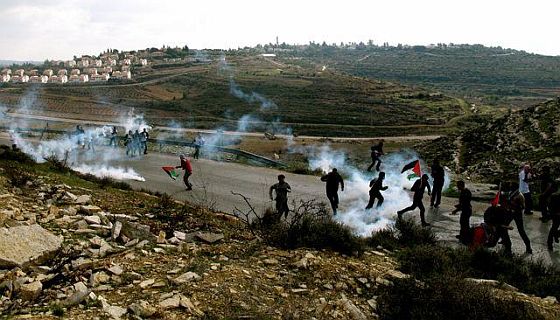
Ben Ehrenreich writes: On the evening of Feb. 10, the living room of Bassem Tamimi’s house in the West Bank village of Nabi Saleh was filled with friends and relatives smoking and sipping coffee, waiting for Bassem to return from prison. His oldest son, Waed, 16, was curled on the couch with his 6-year-old brother, Salam, playing video games on the iPhone that the prime minister of Turkey had given their sister, Ahed. She had been flown to Istanbul to receive an award after photos of her shaking her fist at an armed Israeli soldier won her, at 11, a brief but startling international celebrity. Their brother Abu Yazan, who is 9, was on a tear in the yard, wrestling with an Israeli activist friend of Bassem’s. Nariman, the children’s mother, crouched in a side room, making the final preparations for her husband’s homecoming meal, laughing at the two photographers competing for shots from the narrow doorway as she spread onions onto oiled flatbreads.
On the living-room wall was a “Free Bassem Tamimi” poster, left over from his last imprisonment for helping to organize the village’s weekly protests against the Israeli occupation, which he has done since 2009. He was gone for 13 months that time, then home for 5 before he was arrested again in October. A lot happened during this latest stint: another brief war in Gaza, a vote in the United Nations granting observer statehood to Palestine, the announcement of plans to build 3,400 homes for settlers, an election in Israel. Protests were spreading around the West Bank.
That night, the call came at about 7:30. Twenty people squeezed into three small cars and headed to the village square. More neighbors and cousins arrived on foot. (All of Nabi Saleh’s 550 residents are related by blood or marriage, and nearly all share the surname Tamimi.) Then a dark Ford pulled slowly into the square, and everyone fell silent.
Bassem, who is 45, stepped out of the car, straight-spined, his blue eyes glowing in the lamplight. He seemed a little thinner and grayer than the last time I saw him, in July. He hugged and kissed his eldest son. Ahed was next, then one by one, in silence, Bassem embraced family and friends, Palestinian activists from Ramallah and Jerusalem, Israeli leftists from Tel Aviv. When he had greeted everyone, he walked to the cemetery and stopped in front of the still-unmarked grave of his brother-in-law Rushdie, who was shot by Israeli soldiers in November while Bassem was in prison. He closed his eyes and said a quick prayer before moving on to the tomb of Mustafa Tamimi, who died after being hit in the face by a tear-gas canister in December 2011.
Back at home, Bassem looked dazed. Nariman broke down in his arms and rushed outside to hide her tears. The village was still mourning Rushdie’s death, but the young men couldn’t keep up the solemnity for long. They started with little Hamoudi, the son of Bassem’s cousin, tossing him higher and higher in the air above the yard. They set him down and took turns tossing one another up into the night sky, laughing and shouting as if they never had anything to grieve. [Continue reading…]
The lost tribes of the Amazon

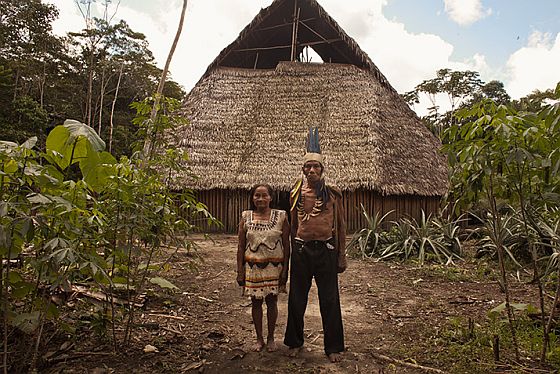
Jitoma Safiama, 70 -- seen here with his wife Rosita Garcia, a Muynane, in front of their maloca -- is a shaman and chief of a small subtribe of Uitotos, descendants of those who were chased by the rubber barons from their original lands around 1925.
Joshua Hammer writes: On a cloudless afternoon in the foothills of the Andes, Eliana Martínez took off for the Amazon jungle in a single-engine Cessna 172K from an airstrip near Colombia’s capital, Bogotá. Squeezed with her in the tiny four-seat compartment were Roberto Franco, a Colombian expert on Amazon Indians; Cristóbal von Rothkirch, a Colombian photographer; and a veteran pilot. Martínez and Franco carried a large topographical map of Río Puré National Park, 2.47 million acres of dense jungle intersected by muddy rivers and creeks and inhabited by jaguars and wild peccaries — and, they believed, several isolated groups of Indians. “We didn’t have a lot of expectation that we’d find anything,” Martínez, 44, told me, as thunder rumbled from the jungle. A deluge began to pound the tin roof of the headquarters of Amacayacu National Park, beside the Amazon River, where she now serves as administrator. “It was like searching for the needle in the haystack.”
Martínez and Franco had embarked that day on a rescue mission. For decades, adventurers and hunters had provided tantalizing reports that an “uncontacted tribe” was hidden in the rainforest between the Caquetá and Putumayo rivers in the heart of Colombia’s Amazon. Colombia had set up Río Puré National Park in 2002 partly as a means of safeguarding these Indians, but because their exact whereabouts were unknown, the protection that the government could offer was strictly theoretical. Gold miners, loggers, settlers, narcotics traffickers and Marxist guerrillas had been invading the territory with impunity, putting anyone dwelling in the jungle at risk. Now, after two years’ preparation, Martínez and Franco were venturing into the skies to confirm the tribe’s existence — and pinpoint its exact location. “You can’t protect their territory if you don’t know where they are,” said Martínez, an intense woman with fine lines around her eyes and long black hair pulled into a ponytail.
Descending from the Andes, the team reached the park’s western perimeter after four hours and flew low over primary rainforest. They ticked off a series of GPS points marking likely Indian habitation zones. Most of them were located at the headwaters for tributaries of the Caquetá and the Putumayo, flowing to the north and south, respectively, of the park. “It was just green, green, green. You didn’t see any clearing,” she recalled. They had covered 13 points without success, when, near a creek called the Río Bernardo, Franco shouted a single word: “Maloca!”
Martínez leaned over Franco.
“Donde? Donde?” — Where? Where? she yelled excitedly.
Directly below, Franco pointed out a traditional longhouse, constructed of palm leaves and open at one end, standing in a clearing deep in the jungle. Surrounding the house were plots of plantains and peach palms, a thin-trunked tree that produces a nutritious fruit. The vast wilderness seemed to press in on this island of human habitation, emphasizing its solitude. The pilot dipped the Cessna to just several hundred feet above the maloca in the hope of spotting its occupants. But nobody was visible. “We made two circles around, and then took off so as not to disturb them,” says Martínez. “We came back to earth very content.”
Back in Bogotá, the team employed advanced digital technology to enhance photos of the maloca. It was then that they got incontrovertible evidence of what they had been looking for. Standing near the maloca, looking up at the plane, was an Indian woman wearing a breechcloth, her face and upper body smeared with paint.
Franco and Martínez believe that the maloca they spotted, along with four more they discovered the next day, belong to two indigenous groups, the Yuri and the Passé — perhaps the last isolated tribes in the Colombian Amazon. Often described, misleadingly, as “uncontacted Indians,” these groups, in fact, retreated from major rivers and ventured deeper into the jungle at the height of the South American rubber boom a century ago. They were on the run from massacres, enslavement and infections against which their bodies had no defenses. For the past century, they have lived with an awareness — and fear — of the outside world, anthropologists say, and have made the choice to avoid contact. Vestiges of the Stone Age in the 21st century, these people serve as a living reminder of the resilience — and fragility — of ancient cultures in the face of a developmental onslaught. [Continue reading…]
Obama’s plan to expand the war on terrorism
Rosa Brooks writes: When a government is accused of activities that stretch or violate the law, it has three choices: 1) change the activities to conform with the law; 2) change the law to conform with the activities; or 3) lie (about the nature of the activities, the meaning of the law, or both).
Option 3 isn’t a comfortable one for the Obama administration, which is, thank heaven, not prone to outright lying. Some senior officials tolerate a moderate amount of fudging and obfuscation, but when the fudge factor gets too high, it induces visible queasiness. Over the last couple of weeks, we’ve seen more than a little such discomfort on the faces of those stuck with justifying U.S. drone policy to Congress and the public.
That’s not surprising: As the targets of U.S. drone strikes have expanded from senior Taliban and al Qaeda operatives to a far broader range of individuals with only the most tenuous links to al Qaeda, the administration’s legal arguments for targeted killings have grown ever more tortured and complex. In particular, it’s gotten progressively more difficult for officials to avoid blushing while claiming that U.S. drone policy is fully consistent with Congress’s 2001 Authorization for Use of Military Force (AUMF), which authorizes force only against those who bear some responsibility for the 9/11 attacks.
With Option 3 — lie, lie, lie — off the table, and fudging and obfuscation growing harder to comfortably sustain, the thoughts of administration officials turn naturally to Option 2: change the law. Thus, as the Washington Post reported last weekend, some administration officials are apparently considering asking Congress for a new, improved “AUMF 2.0,” one that would place U.S. drone policy on firmer legal footing.
Just who is behind this notion is unclear, but the idea of a revised AUMF has been gaining considerable bipartisan traction outside the administration. In a recent Hoover Institution publication, for instance, Bobby Chesney, who served in the Obama Justice Department, teams up with Brookings’s Ben Wittes and Bush administration veterans Jack Goldsmith and Matt Waxman to argue for a revised AUMF — one that can provide “a new legal foundation for next-generation terrorist threats.”
I’m as fond of the rule of law as the next gal, so in a general sense, I applaud the desire to ensure that future executive branch counterterrorist activities are consistent with the laws passed by Congress. But “laws” and “the rule of law” are two different animals, and an expanded new AUMF is a bad idea.
Sure, legislative authorization for the use of force against “next generation” terrorist threats would give an additional veneer of legality to U.S. drone policy, and make congressional testimony less uncomfortable for John Brennan and Eric Holder. But an expanded AUMF would also likely lead to thoughtless further expansion of targeted killings. This would be strategically foolish, and would further undermine the rule of law.
An expanded AUMF is also unnecessary. Even if Congress simply repealed the 2001 AUMF (as the New York Times editorial board urges) instead of revising it, the president already has all the legal authority he needs to keep the nation safe.
If U.S. drone policy is currently on shaky legal ground, it’s not for lack of inherent executive authority (or international law authority) to use force against any terrorist organization that poses an imminent and grave threat to the United States. U.S. drone policy is on shaky legal ground because the administration has lost sight of the difference between threats that are imminent and grave and threats better characterized as speculative and minor. [Continue reading…]
Prisoner protest at Guantánamo Bay stains Obama’s human rights record
Amy Goodman writes: Reports are emerging from the US military prison at Guantánamo Bay that a majority of the prisoners are on a hunger strike. Of the detainees, 166 remain locked up, although more than half have been cleared by the Obama administration for release. Yet, there they languish – in some cases, now in their second decade – in a hellish legal limbo, uncharged yet imprisoned.
President Barack Obama’s failure to close Guantánamo, as he boldly promised to do with an executive order signed on 22 January 2009, and the deterioration of conditions at the prison under his watch will remain a lasting stain on his legacy. From Guantánamo, Yemeni prisoner Bashir al-Marwalah wrote to his lawyer:
“We are in danger. One of the soldiers fired on one of the brothers a month ago. Before that, they send the emergency forces with M-16 weapons into one of the brothers’ cell blocks … Now they want to return us to the darkest days under Bush. They said this to us. Please do something.”
Al-Marwalah was referring to the first recorded use of rubber bullets being fired at a Guantanamo prisoner by the US military guards there. [Continue reading…]
A high-security ghetto for London’s new global super-rich

Nicholas Shaxson writes: Up until the 18th century, Knightsbridge, which borders genteel Kensington, was a lawless zone roamed by predatory monks and assorted cutthroats. It didn’t come of age until the Victorian building boom, which left a charming legacy of mostly large and beautiful Victorian houses, with their trademark white or cream paint, black iron railings, high ceilings, and short, elegant stone steps up to the front door.
This will not be the impression a visitor now gets as he emerges from the Knightsbridge subway station’s south exit. He will be met by four hulking joined-up towers of glass, metal, and concrete, sandwiched between the Victorian splendors of the Mandarin Oriental Hotel, to the east, and a pretty five-story residential block, to the west. This is One Hyde Park, which its developers insist is the world’s most exclusive address and the most expensive residential development ever built anywhere on earth. With apartments selling for up to $214 million, the building began to smash world per-square-foot price records when sales opened, in 2007. After quickly shrugging off the global financial crisis the complex has come to embody the central-London real-estate market, where, as high-end property consultant Charles McDowell put it, “prices have gone bonkers.”
From the Hyde Park side, One Hyde Park protrudes aggressively into the skyline like a visiting spaceship, a head above its red-brick and gray-stone Victorian surroundings. Inside, on the ground floor, a large, glassy lobby offers what you’d expect from any luxury intercontinental hotel: gleaming steel statues, thick gray carpets, gray marble, and extravagant chandeliers with radiant sprays of glass. Not that the building’s inhabitants need venture into any of these public spaces: they can drive their Maybachs into a glass-and-steel elevator that takes them down to the basement garage, from which they can zip up to their apartments.
The largest of the original 86 apartments (following some mergers, there are now around 80) are pierced by 213-foot-long mirrored corridors of glass, anodized aluminum, and padded silk. The living spaces feature dark European-oak floors, Wenge furniture, bronze and steel statues, ebony, and plenty more marble. For added privacy, slanted vertical slats on the windows prevent outsiders from peering into the apartments.
In fact, the emphasis everywhere is on secrecy and security, provided by advanced-technology panic rooms, bulletproof glass, and bowler-hatted guards trained by British Special Forces. Inhabitants’ mail is X-rayed before being delivered. [Continue reading…]
Secularism, the Arab way
Issandr El Amrani writes: Free Arabs, a new Web site run by a group of Arabs — some in the Middle East, others in the West — is causing a stir. Gathered under the slogan “Democracy, Secularism, Fun,” it laments the fact that “millions of Arabs have internalized the notion that secularism is tantamount to faithlessness, and is all about demonizing Islam and promoting a dissolute way of life.
Not only can secularism coexist with religion, Free Arabs argues, but it protects the free exercise of religion and can help promote other civil liberties, like gay rights.
The group is defending a no-compromise version of secularism — one that may be too much to ask of many Arab politicians, particularly those in the fledging new liberal parties that have emerged since the Arab uprisings.
Some don’t want to be dragged into culture wars, a favorite ground for Islamists who bank on the fact that many Arab societies are still socially conservative. Others are just plain conservative themselves, even on issues far more basic than gay rights — like whether gender equality should be applied to inheritance and other questions traditionally governed by Islamic law.
Still, the controversy triggered by Free Arabs is just the kind of debate Islamists and secularists in the Arab world should be having, if only because they couldn’t have had it under the old regimes. Also, there’s plenty of room for debate: In this part of the world, the term “secular” means very different things to different people. [Continue reading…]
Iraq’s pain has only intensified since 2003
Sami Ramadani writes: It has always been painful for me to write about Iraq and Baghdad, the land of my birth and the city of my childhood. They say that time is a great healer, but, along with most Iraqis, I feel the pain even more deeply today. But this time the tears for what has already happened are mixed with a crippling fear that worse is yet to come: an all-out civil war. Ten years on from the shock and awe of the 2003 Bush and Blair war – which followed 13 years of murderous sanctions, and 35 years of Saddamist dictatorship – my tormented land, once a cradle of civilisation, is staring into the abyss.
Wanton imperialist intervention and dictatorial rule have together been responsible for the deaths of more than a million people since 1991. And yet, according to both Tony Blair and the former US secretary of state Madeleine Albright, the “price is worth it“. Blair, whom most Iraqis regard as a war criminal, is given VIP treatment by a culpable media. Iraqis listen in disbelief when he says: “I feel responsibility but no regret for removing Saddam Hussein.” (As if Saddam and his henchmen were simply whisked away, leaving the people to build a democratic state). It enrages us to see Blair build a business empire, capitalising on his role in piling up more Iraqi skulls than even Saddam managed.
As an exile, I was painfully aware of Saddam’s crimes, which for me started with the disappearance from Baghdad’s medical college of my dearest school friend, Hazim. The Iraqi people are fully aware, too, that Saddam committed all his major crimes while an ally of western powers. On the eve of the 2003 invasion I wrote this for the Guardian: “In Iraq, the US record speaks for itself: it backed Saddam’s party, the Ba’ath, to capture power in 1963, murdering thousands of socialists, communists and democrats; it backed the Ba’ath party in 1968 when Saddam was installed as vice-president; it helped him and the Shah of Iran in 1975 to crush the Kurdish nationalist movement; it increased its support for Saddam in 1979…helping him launch his war of aggression against Iran in 1980; it backed him throughout the horrific eight years of war (1980 to 1988), in which a million Iranians and Iraqis were slaughtered, in the full knowledge that he was using chemical weapons and gassing Kurds and Marsh Arabs; it encouraged him in 1990 to invade Kuwait…; it backed him in 1991 when Bush [senior] suddenly stopped the war, exactly 24 hours after the start of the great March uprising that engulfed the south and Iraqi Kurdistan…; and it backed him as the ‘lesser evil’ from March 1991 to September 11 2001 under the umbrella of murderous sanctions and the policy of “containment”.” [Continue reading…]
Video: Kurdish group releases captive Turks
Is any hope left for Mideast peace?
Rashid Khalidi writes: What should Barack Obama, who is to visit Israel next Wednesday for the first time in his presidency, do about the Israeli-Palestinian conflict?
First, he must abandon the stale conventional wisdom offered by the New York-Washington foreign-policy establishment, which clings to the crumbling remnants of a so-called peace process that, in the 34 years since the Camp David accords, has actually helped make peace less attainable than ever.
When the most recent iteration of this process began with high hopes at the Madrid peace conference in 1991, which led to the Oslo accords two years later, there were 200,000 Israelis illegally settled in the occupied Palestinian territories: today, there are more than twice as many.
During this time, under four successive presidents, the United States, purportedly acting as an honest broker, did nothing to prevent Israel from gradually gobbling up the very land the two-state solution was to be based on.
Until 1991 most Palestinians, although under Israeli military occupation, could nonetheless travel freely. Today, an entire generation of Palestinians has never been allowed to visit Jerusalem, enter Israel or cross between the West Bank and Gaza. This ghettoization of the Palestinians, along with the unrest of the second intifada of 2000-5 and the construction of seemingly permanent settlements and of an apartheid-style wall, are the tragic fruits of the so-called peace process the United States has led.
The “peace process” has consisted of indulging Israeli intransigence over Palestine in exchange for foreign-policy goals unrelated to the advancement of peace and Palestinian freedom. [Continue reading…]
American Jews investing their tax dollars in Israel want more in return
Rabbi Jill Jacobs writes that a group of North American rabbis, cantors, rabbinical and cantorial students from all denominations of Judaism, who in January were petitioning Israeli Prime Minister Benjamin Netanyahu to cease plans for construction of a new settlement, did not get the hearing they deserved. She writes:
There are some who say that Diaspora Jews have no say in what goes on in Israel, since we don’t put our lives on the line to live there. I don’t buy this argument for a second. We have a stake in Israel because it is the Jewish homeland. We have a stake in Israel because we invest millions of dollars there, and lobby for the U.S. government to invest billions more of our tax dollars. We worry about family and friends in the Israeli army, who risk and sometimes lose their lives defending the misguided settlement project. And we are the ones who must explain to members of other communities, members of our own communities, and even our children why a state built on Jewish values perpetuates a military occupation of another people.
Since long before the creation of the state, the relationship between Israel and Diaspora Jews has been an unequal one. For too long, we have accepted the assumption that Diaspora Jews will send money and keep our mouths shut. We have perpetuated a myth that real Judaism lives in Israel, while our own Diaspora lives offer only a pale shadow of Jewish life. So we send our children to Israel for their Jewish inspiration and engagement, we fund hospitals and schools in Israel, and we devote our own political capital to defending Israel from criticism.
Jacobs writes: “We have a stake in Israel because we invest millions of dollars there, and lobby for the U.S. government to invest billions more of our tax dollars.” I have a problem with that. “We” refers to Diaspora Zionists but the tax dollars referred to as “our tax dollars” come from a much wider source, including vast numbers of Americans who do not have the slightest interest or desire to bankroll Israel’s defense forces — 20% of Israel’s defense budget is paid for by American taxpayers. So when Jacobs talks about lobbying the U.S. government to invest billions of tax dollars in Israel, she should be clear about who provides those tax dollars.
Settlers tell EU MPs: ‘Israel is the dam protecting Europe from fundamentalist Islam’
The pro-settler Israel National News reports: In yet another success for Samaria’s advocacy initiatives, a group of European parliamentarians agreed to take a 36-hour trip to the area this week. The European Union generally views Samaria (Shomron) [the Israeli occupied West Bank] as Arab land and condemns Israeli construction in the area.
The parliamentarians came as guests of Samaria Regional Council head Gershon Mesika.
They began their tour with a trip to the Barkan industrial zone. Many were surprised to see that Israeli Jews and Palestinian Authority Arabs were employed side-by-side in the factories.
Regional Council staff noted that boycotts of Israeli businesses in Judea and Samaria, including a threatened EU boycott, would primarily hurt industrial zones such as Barkan which provide a major source of employment for PA residents.
The tour then continued to a nearby lookout point from which the visitors could see the Tel Aviv region and Israel’s coastline. “We are in the heart of the land of the Bible and the center of Jewish heritage,” said Yossi Dagan. “From here we can see the ‘narrow waist’ of the State of Israel. Tel Aviv, the coastline and the Ben Gurion Airport are below us.”
“The State of Israel is the dam protecting Europe from fundamentalist Islam,” he added. “As you see with your own eyes, without Samaria the State of Israel is unlikely to survive.”
New report on impact of NYPD surveillance on American Muslims
American Muslim civil liberties groups released a new report today, Mapping Muslims: NYPD Spying and Its Impact on American Muslims, documenting the devastating impacts of the New York Police Department’s (NYPD) extensive surveillance program that targeted American Muslims throughout the Northeast and spread outrage throughout the nation.
Since 2002, the NYPD embarked on a covert domestic surveillance program that monitored American Muslims throughout the Northeast, from spying on neighborhood cafes and places of worship to infiltrating student whitewater-rafting trips — a program that continued despite the NYPD’s own acknowledgment that, over the course of six years, these efforts had not generated a single lead. The report is an unprecedented collection of voices from affected community members reflecting how the NYPD spying and infiltration creates a pervasive climate of fear and suspicion that encroaches upon every aspect of their religious, political, and community lives.
The global drone swarm
P.W. Singer writes: “One plan was to use an unmanned aerial vehicle to carry 20kg of TNT to bomb the area, but the plan was rejected because we were ordered to catch him alive.” This is what Liu Yuejin, director of China’s public security ministry’s anti-drug bureau, described of the manhunt for Naw Kham, the ringleader of a large drug trafficking outfit based in the Golden Triangle, who was suspected of killing 13 Chinese sailors. Ultimately, they got him via a cross-border nighttime ambush, the Chinese version of the Abbottabad raid.
This case, however, is useful to think about when talking about the global market for unmanned aerial systems (aka “drones”) and where it is headed, a topic that got new energy last week with a New York Times report on the confusion as to whether it was American or Pakistani drones that carried out a controversial airstrike.
Too often in policy and media circles, we discuss a supposed American monopoly on drones that is potentially ending. Or, as Time magazine entitled a story, “Drone Monopoly: Hope You Enjoyed It While It Lasted.” The article goes on to say,”It is going to happen; the only question is when.”
The answer is: several years ago.
Today, the United States is ahead in the field of military robotics, and, given that we spend the most money and make the most operational use of unmanned systems, we certainly should be. All told, there are over 8,000 unmanned aircraft in the U.S. military inventory and another 12,000 plus unmanned ground vehicles. A growing number are large and armed, including the MQ-1 Predator and MQ-9 Reapers that get so much attention in the press.
Depending on which source you want to cite, there are currently between 75 and 87 countries that have used unmanned aircraft in their militaries. Of these, at least 26 have larger systems, including Predator equivalents that are already armed or of a model that has been armed in the past, such as the Heron, made by IAI and used by the Israeli Defense Forces, as well as several countries via export. Only the United States, the United Kingdom, and Israel are known to have used armed drones operationally, but as the case of Naw Kham illustrates, the limit on why others have not is frequently political, not technological. They are either not at war or have chosen not to go that route yet. However, these political limits are changing. Witness China’s open discussion of its plans in the People’s Daily, or Germany’s recent decision to acquire armed drones for deployments abroad, which follows Italy’s, France’s, etc.
In short, when we often talk about a supposed future of drone proliferation, we usually ignore the reality of the present. We already have a market that is global in both its customers, from Australia to Turkey, and in its manufacturers, from American firms like General Atomics and Lockheed to ASN Technology, one of the major makers in China, and ADE of India. [Continue reading…]
Five ways privatization is poisoning America
Paul Buchheit writes: It gets more maddening every day. Essential human needs are being packaged into products to be bought and sold. The right to food and water, education, health care, public spaces, and unrestricted speech shouldn’t be based on who can pay the most, or on who can generate profits with the slickest marketing pitch.
The free-market capitalism that drives our economy is a doctrine of individuals pursuing profit. Nothing else matters. An executive for Roche, a healthcare company, said “We are not in the business to save lives, but to make money.”
With privatization of the common good we risk losing both our heritage and our humanness.
1. The Taking of Public Land
Attempts to privatize federal land were made by the Reagan administration in the 1980s and the Republican-controlled Congress in the 1990s. In 2006, President Bush proposed auctioning off 300,000 acres of national forest in 41 states.
The assault on our common areas continues with even greater ferocity today, as the euphemistic Path to Prosperity has proposed to sell millions of acres of “unneeded federal land,” and libertarian groups like the Cato Institute demand that our property be “allocated to the highest-value use.” Mitt Romney admitted that he didn’t know “what the purpose is” of public lands.
Examples of the takeaway are shocking. Peabody Coal is strip-mining public lands in Wyoming and Montana and making a 10,000% profit on the meager amounts they pay for the privilege. Sealaska is snatching up timberland in Alaska. The Central Rockies Land Exchange would allow Bill Koch to pick up choice Colorado properties from the Bureau of Land Management, while neighboring Utah Governor Gary Herbert sees land privatization as a way to reduce the deficit. Representative Cliff Stearns recommended that we “sell off some of our national parks.” One gold mining company even invoked an 1872 law to grab mineral-rich Nevada land for which it stands to make a million-percent profit.
The National Resources Defense Council just reported that oil and gas companies hold drilling and fracking rights on U.S. land equivalent to the size of California and Florida combined. Much of this land is“split estate,” which means the company can drill under an American citizen’s property without consent. Unrestrained by government regulations, TransCanada was able to use eminent domain in Texas to lay its pipeline on private property and then have the owner arrested for trespassing on her own land, and Chesapeake Energy Corporation overturned a 93-year-old law to frack a Texas residence without paying a penny to the homeowners. Most recently, the oil frenzy in North Dakota has cheated Native Americans out of a billion dollars worth of revenue from drilling leases.
Away from the mountains and the plains, back in the cities of Chicago and Indianapolis and L.A. and San Diego, our streets and parking spaces have been surrendered to corporations until the time of our great-grandchildren, with some of the highest profit margins in the corporate world. [Continue reading…]
Chomsky: Can civilization survive capitalism?
Noam Chomsky writes: There is “capitalism” and then there is “really existing capitalism.”
The term “capitalism” is commonly used to refer to the U.S. economic system, with substantial state intervention ranging from subsidies for creative innovation to the “too-big-to-fail” government insurance policy for banks.
The system is highly monopolized, further limiting reliance on the market, and increasingly so: In the past 20 years the share of profits of the 200 largest enterprises has risen sharply, reports scholar Robert W. McChesney in his new book “Digital Disconnect.”
“Capitalism” is a term now commonly used to describe systems in which there are no capitalists: for example, the worker-owned Mondragon conglomerate in the Basque region of Spain, or the worker-owned enterprises expanding in northern Ohio, often with conservative support – both are discussed in important work by the scholar Gar Alperovitz.
Some might even use the term “capitalism” to refer to the industrial democracy advocated by John Dewey, America’s leading social philosopher, in the late 19th century and early 20th century.
Dewey called for workers to be “masters of their own industrial fate” and for all institutions to be brought under public control, including the means of production, exchange, publicity, transportation and communication. Short of this, Dewey argued, politics will remain “the shadow cast on society by big business.”
The truncated democracy that Dewey condemned has been left in tatters in recent years. Now control of government is narrowly concentrated at the peak of the income scale, while the large majority “down below” has been virtually disenfranchised. The current political-economic system is a form of plutocracy, diverging sharply from democracy, if by that concept we mean political arrangements in which policy is significantly influenced by the public will. [Continue reading…]