Category Archives: Issues

The Return of Ghosts: Debating the rise of Geert Wilders and the far-right at the Nexus Symposium

Max Blumenthal writes:

I spent last week in Amsterdam, where I participated in the “Return of Ghosts” symposium of the Nexus Institute, a discussion/debate about the resurgence of neo-fascism in Europe and anti-democratic trends in the West. Besides providing a forum for debating European politics, the symposium was the occasion for the first public appearance in Europe by Peruvian writer Mario Vargas Llosa since he was awarded the Nobel Prize for Literature last month. The arrival of Vargas Llosa, one of the world’s foremost intellectuals, resulted in an overflow crowd filled with members of the Dutch media, the country’s political class, and the royal family.

Even with Vargas Llosa in the spotlight, the participants’ attention was focused on Geert Wilders, the leader of the far-right Dutch People’s Party for Freedom and Democracy, which is now the third leading party in the Netherlands. With his gathering influence, Wilders has essentially placed the Dutch coalition government in a stranglehold; the government meets with him every Wednesday to gauge his opinions and ask for his instructions. While Wilders dictates at will to the government, he remains independent of it, comfortably avoiding the consequences of policies he has helped to shape. It is the perfect position for a politician whose agenda is comprised exclusively of xenophobic populism, and typical strategy of the far-right in countries across the continent.

Wilders’ base lies in the mostly Catholic south, where ironically few people have ever encountered a Muslim. He has also generated support in the city of Groeningen, once a citadel of the communists. Seeking to expand his base, Wilders promised to hire scores of “animal cops” to investigate and prosecute the abuse of animals, a clever wedge strategy in the only country I know of that has a party dedicated exclusively to animal rights. Of course, Wilders could care less about our furry friends. His stated goal is to end immigration not just to Holland but to all of Europe; ban the Quran (free speech is only for the “Judeo-Christian” community), and severely limit the rights of Muslim citizens of Europe by, for instance, instituting what he called a “head rag tax” on Muslim women. Wilders’ international allies include the goosestepping neo-Nazis of the English Defense League, the far-right pogromist Pam Geller, the Belgian neo-fascist party Vlaams Belang, and a substantial portion of the US neocon elite. Over the course of just a few years, he has become perhaps the most influential Islamophobe in the world.


Facebooktwittermail

Will Miral be this generation’s Exodus?

Adam Horowitz writes:

Today, I saw Julian Schnabel’s new film Miral. It won’t be arriving in theaters in the US until next March, so it will be awhile until we see what effect it has, but my initial impression was amazement at what I was watching. Here was a film following many of the conventions of a traditional Hollywood film, but this time it was telling the Palestinian liberation story (which might explain why it was not produced in Hollywood and instead was a French/Israeli/Italian/Indian co-production).

The film, based on Rula Jebreal’s semi-autobiographical novel of the same name, takes us from the Nakba, and children orphaned during the Deir Yassin massacre, through the first Intifada to the signing of the Oslo Accords. I know there will be criticisms, and I have a few that I’ll share later, but right now I am struck by the emotional impact of the film. You follow the lead character through checkpoints, refugee camps, home demolitions, interrogations, humiliations and protests. After that it is impossible to not understand, and feel, the Palestinian call for justice.

This film was due for release on December 3 but this has been pushed back until March 25 when it will get a limited launch. Even if it doesn’t get shown widely, one way strong interest can be registered is if Netflix users add Miral to their DVD queue.

Facebooktwittermail

Do neoconservatives really care about the Iranian opposition?

Ali Gharib writes:

The rumblings of the largely underground Iranian Green Movement encourage neoconservative pundit Reuel Marc Gerecht. “I think it’s the most amazing intellectual second revolution…that we’ve seen in the Middle East,” he told a packed briefing room at Bloomberg’s D.C. headquarters last month. But even as he called on President Barack Obama to do more to vocally support the embattled rights movement — thinly veiled U.S. encouragement for regime change, in other words — Gerecht pushed for bombing Iran.

Yet Green activists who work on the ground in Iran roundly oppose a military attack precisely because it will undermine opposition efforts. Confronted with their warnings against strikes by his debate opponent, Gerecht was dismissive. He derided dissident journalist Akbar Ganji as “delusional” and spoke in dangerous innuendo about Shirin Ebadi, a human rights lawyer and Nobel laureate.”There is a huge difference between what some dissidents will say privately and what they’ll say publicly,” said Gerecht of Ebadi, “and I’ll leave it at that.”

In a phone interview, Ebadi couldn’t remember Gerecht by name (noting that she speaks to four or five journalists a day), but emphatically denied the charge that she talks out of both sides of her mouth. “Me, no! Everything I say, is exactly what I say,” she told me in Farsi. “Whoever said this, that I say different things in public and private, is wrong.” “I’m the same person in public and private,” she went on. “And I’m against war.”

Ebadi hasn’t been in Iran since the crackdown on demonstrators in the wake of the June 2009 elections, but she’s nonetheless a tireless advocate for reform and human rights in the Islamic Republic of Iran.”The military option will not benefit the U.S. interest or the Iranian interest,” she said recently in an interview with Think Progress, a Center for American Progress blog. “It is the worst option. You should not think about it. The Iranian people — including myself — will resist any military action.”

The soon-to-be-released “documentary,” Iranium, produced by the Clarion Fund, makes it plain that when it comes to Iran, the neoconservatives have only one objective: war.

Facebooktwittermail

Obama’s dubious Mideast bet

Tony Karon writes:

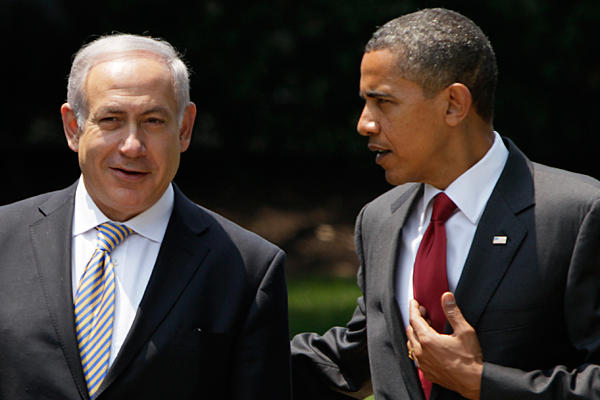
In the grand poker game of Middle East peacemaking, everyone around the table is wondering just what cards President Barack Obama is holding. That’s because the President has placed a potentially ruinous bet on what can be achieved over the 90 days of the partial settlement freeze he appears to have persuaded Israeli Prime Minister Benjamin Netanyahu to accept — in exchange for an extra $3 billion worth of advanced F-35 fighter aircraft. That is over and above the annual $2.75 billion military subsidy Israel receives from Washington. In addition, the Obama Administration has promised to run interference for Israel against any attempt to bring international law into play to settle the Israeli-Palestinian conflict via the U.N. But Obama is gambling with a lot more than $3 billion that the two sides can agree on borders between Israel and a Palestinian state within three months.

Netanyahu still has to convince his entire Cabinet to embrace the deal, and he’ll get some pushback from within his own party and among settlers furious about a new building slowdown (although the Israeli group Peace Now, which strongly opposes settlements, noted last week that over the six weeks since the last moratorium expired, settlers have started to work on pretty much the same number of housing units as they would have built over the 10 months it covered). The Palestinians, for their part, insist that they won’t return to negotiations until Israel completely halts building on occupied land, including in East Jerusalem. Netanyahu, however, is adamant that his construction freeze won’t apply to settlements in East Jerusalem, which he doesn’t deem to be settlements — although the international community does, having never recognized Israel’s annexation of those parts of the Holy City captured in the 1967 war.

But even if the deal manages to get talks restarted, the real gamble Obama has taken is giving the two sides just 90 days to agree on where to draw the final borders between Israel and a Palestinian state.

Facebooktwittermail

Israeli Rabbi: ‘Jews should make the Arabs flee’

The Independent reports:

First they threatened to burn his house down. Then they pinned leaflets to his front door, denouncing him as a Jewish traitor. But Eli Tzavieli, an 89-year-old Holocaust survivor, is defiant. His only “crime” is to rent out his rooms to three Arab students attending the college in Safed, a religious city in northern Israel that was until recently more famous for Jewish mysticism and Madonna.

A campaign waged by Shmuel Eliyahu, the town’s radical head rabbi, culminating in a ruling barring residents from renting rooms to Israeli Arabs, means that Safed is fast emerging as a byword for racism.

“I’m not looking for trouble, but if there is a problem, I’ll confront it,” says Mr Tzavieli, a Jew who survived Nazi forced labour camps and whose parents perished in Auschwitz. “These [tenants] are great kids. And I’m doing my best to make them comfortable.”

Didi Remez provides a translation of an article from the Hebrew Maariv:

Rabbi Shmuel Eliyahu, Chief Rabbi, of Safed is staging a tenacious battle these days. In his sights: Arabs, “who are fighting a land war against us” and “who want to throw us into the sea,” according to the rabbi. In a recent Halachic ruling the rabbi forbid Safed residents from selling or renting their homes to Arabs. The ruling sparked a storm, but Eliyahu was unmoved. “Jews don’t have to run away from Arabs,” said the rabbi in his first comprehensive interview, to be published in full in the Ma’ariv weekend supplement. “Jews should make the Arabs flee.”

“One person in Safed rented his home to three Bedouins,” says Rabbi Eliyahu. “I went to visit him. The tenants asked me ‘why are you against us?’ I told them we don’t want to make Safed into an Arab city. Even if this were Tel Aviv I would object. How much more so when talking about the holy city of Safed. They told me ‘you’ve got to recognize the fact. This is life. This is reality. And I couldn’t believe my ears. The Arabs don’t even bother denying they’ve got a system. It’s so simple: One person moves into a Jewish neighborhood, pays a high price and all the Jews leave immediately. Naturally, they don’t want to live next door to them.

“Their behavior is unpleasant. They stuck an old Arab woman into a public housing neighborhood. In theory, it was harmless. But as soon as she arrived she started to harass us. Every Shabbat ten cars of Arabs would come. The whole village was at her house. They played music, made noise. They had the nerve to act in a Jewish neighborhood in a way they never would have dared act in their village.”

Was that an isolated incident? Not if you ask the holy rabbi. “It is a behavioral phenomenon. You can’t come to a quiet tourist town and feel like you’re in an Arab village. If you’re a guest, act like a guest. But if you want to feel like you own the place, then the Halacha says it is forbidden to rent a home to you.

As soon as there are more than three Arabs in a neighborhood, [in practical terms] it means the Jews will yield the center to them. Jews don’t need to run away from Arabs. Jews should make the Arabs flee.

Facebooktwittermail

The myth of American pressure

Osamah Khalil writes:

Recent reports that the administration of US President Barack Obama offered Israel a series of incentives to continue its limited ten-month moratorium on settlement building have sparked an outcry among Palestinians and their supporters. Although the concessions for halting the construction of new settlements for only ninety days are unprecedented, Washington’s inability to maintain consistent pressure on Israel fits into a much broader historical pattern. The conventional wisdom is that when Washington has exerted pressure on Israeli governments they have eventually succumbed to American demands. However, a closer reading of the historical record and declassified American archival documents reveals a more complex dynamic between the two allies.

In this essay I examine four major crises in the “special relationship” between the US and Israel: the 1949 Lausanne Conference; the 1956 Suez Crisis; the October 1973 War; and the 1991 Madrid Peace Conference. I demonstrate that while Israel has on occasion publicly acceded to American demands, privately it has received concessions and agreements that rewarded its intransigence and improved its negotiating position at the expense of Palestinian rights. I argue that American pressure was negligible when compared to the policy options available to the different presidential administrations. Finally, I offer recommendations for Palestinians and their supporters.

Facebooktwittermail

Guantánamo Bay detainees to be paid compensation by UK government

The Guardian reports:

The [British] government will announce today that it will pay millions of pounds in compensation to former Guantánamo Bay detainees following weeks of negotiations between lawyers for the government and the former prisoners.

Ministers appear to have decided on the advice of the security services that they could not afford to risk the exposure of thousands of documents in open court on how Britain co-operated with the US on the so-called extraordinary rendition of terrorist suspects.

Some of the suspects, who were taken for interrogation in secret locations around the world before ending up in Guantánamo, were alleged to have links with the Afghan Taliban.

According to ITN, the high court has been notified that a settlement had been reached between the lawyers. The exact amounts may never be known, but at least one detainee is understood to be in line for a payout of more than £1m.

Facebooktwittermail

“We had to destroy [the villages] to make them safe”

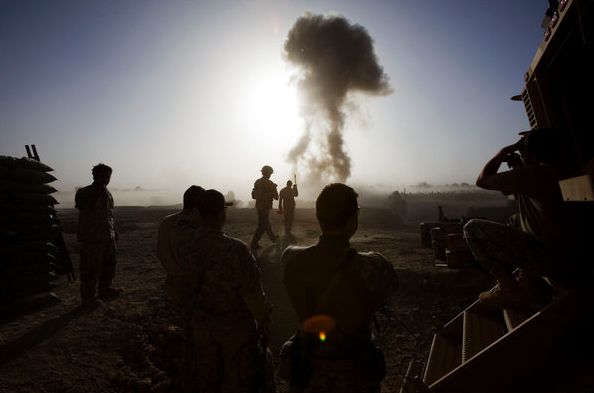
Hundreds and maybe thousands of Afghan homes are being bulldozed, blown up or hit by missile strikes in the effort to drive the Taliban out of the Kandahar region. As well as individual houses, whole villages have been destroyed. “We had to destroy them to make them safe,” the district governor, Shah Muhammed Ahmadi, is quoted telling the New York Times.

In the newly won districts around this southern city, American forces are encountering empty homes and farm buildings left so heavily booby-trapped by Taliban insurgents that the Americans have been systematically destroying hundreds of them, according to local Afghan authorities.

The campaign, a major departure from NATO practice in past military operations, is intended to reduce civilian and military casualties by removing the threat of booby traps and denying Taliban insurgents hiding places and fighting positions, American military officials said.

While it has widespread support among Afghan officials and even some residents, and has been accompanied by an equally determined effort to hand out cash compensation to homeowners, other local people have complained that the demolitions have gone far beyond what is necessary.

Facebooktwittermail

The new rules: globalization’s massive demographic bet

Thomas PM Barnett writes:

By calling the Chinese out explicitly on their currency manipulation in his concluding address to the G-20 summit last week, President Barack Obama may have torpedoed his relationship with Beijing for the remainder of what China’s bosses most certainly now hope is his first and only term. Burdened by a Republican-controlled, Tea Party-infused House, and bathed in hypocrisy thanks to the Fed’s own, just-announced currency manipulation (aka, QE2), Obama seems not to recognize either the gravity of his nation’s long-term economic situation or the degree to which his own political fate now hinges on his administration’s increasingly stormy ties with China.

Here’s the larger picture: Asia, anchored by China, is now the global economy’s center of gravity when it comes to deployable savings. As Europe heads into retirement and the U.S. refuses to come to grips with its unsustainable trajectory, China stands tall thanks to its capacity to spend and invest — even as that capacity seems woefully insufficient for the bevy of historical tasks at hand. Beijing must already see to the care and feeding of 22 percent of humanity, the bulk of whom remain impoverished by anybody’s reasonable standards. But in addition, China is now expected to cover the spendthrift West’s need to boost exports, while also serving as income-elevating engine for the rest of the world’s developing economies — largely through the Middle Kingdom’s ravenous resource demands.

And if all that wasn’t intimidating enough, China’s demographic clock is ticking like no other nation’s in human history. Already losing its cheap-labor advantage right now, China is set to stockpile elders from here on out at a pace never before witnessed. By 2050, it will have more non-working old people (400 million plus) than America’s total projected population (400 million). At that point, the U.S. median age will still be just below 40, while China’s will be closer to 50. It took Europe a century for its elder population to gradually rise from 10 percent of total population to the 20-percent level. America’s still-unfolding journey along the same path will run about six decades. But China will have 20 years, if it’s lucky.

Facebooktwittermail

How long will it take the Washington press corps to discover the big story in Washington?

The story so far:

November 8: the American Israel Public Affairs Committee (AIPAC) files a 260-page motion [large pdf — don’t attempt to download without broadband] in the District of Columbia Superior Court, in which AIPAC is attempting to fend off a $20 million defamation suit from former employee Steven J Rosen who claims he was wrongfully dismissed. AIPAC ditched him and his colleague Keith Weissman in 2005 when the pro-Israel lobby feared investigation by the FBI.

November 15: Grant Smith highlights much of the politically damaging content of the motion in an Antiwar article, AIPAC Bares All to Quash Lawsuit.

November 16: the story is picked up by MJ Rosenberg, The Forward and others.

November 17: the story is gathering steam in the Jewish press, with items in the JTA and Haaretz.

As for the Washington Post, the New York Times and the rest of the US mainstream media, well as of noon Wednesday, it’s apparently still nap time — or, a figurative bloodbath at that obscure and uninfluential lobbying organization really isn’t news — or, there’s no such thing as the Israel lobby and so why should the press pay any attention — or, a bunch of spineless editors, worried about embarrassing their friends at AIPAC, are looking over their shoulders waiting to see which of their competitors is going to break loose first and force them to report on this unseemly turn of events.

And as for why AIPAC and Rosen are both willing to engage in what looks like a self-destructive fight, I suspect that their interests are not actually as far apart as they seem.

Rosen says: “Any embarrassment I suffered as a result of what they filed will be insignificant compared to the embarrassment they’ll suffer after we file our motion.” This seems to be key: that both sides are engaged in campaigns to embarrass the other and both sides are ultimately served if the conflict can be contained to one of embarrassment.

AIPAC can survive embarrassment. What it cannot survive would be investigation by the FBI. It can get away with looking like a sleazy operation. It can’t get away with being exposed as being the instrument of a foreign government.

At the same time, this is also a fight over money. Rosen’s devotion to Zionism turns out to have come with an enormous price tag at a time that AIPAC is not as flush with funds as it used to be.

Hard times for the Israel lobby.

Facebooktwittermail

AIPAC is on the brink

The Forward reports:

The espionage case against two senior officials of the pro-Israel lobby in Washington was dropped last year. But it has not been forgotten, and is now threatening to draw the lobby into new depths of mudslinging.

Papers filed in the civil lawsuit of former lobbyist Steve Rosen against his previous employers at the American Israel Public Affairs Committee include mutual accusations of using pornographic material at the lobby headquarters, among other allegations. The papers, based on depositions taken from Rosen and from AIPAC principles, dig into the private lives of the involved parties. They also reveal in detail the close ties AIPAC officials held with Israeli diplomats based in Washington.

“After reading this stuff you feel like you need to wash your hands,” said one pro-Israel activist after skimming through the 260-page document, which is laced with graphic descriptions and invasive personal details. He declined to be named, out of a desire to avoid involvement in the case.

At issue is Rosen’s $20 million defamation lawsuit against his previous employers at AIPAC, who fired him and his colleague Keith Weissman in 2005 — several months after both had been indicted under a rarely used espionage statute because they allegedly received and passed on classified information. AIPAC, in a move that could be seen as meant to embarrass Rosen, revealed in its court filings extensive parts of the depositions, many of them dealing directly with Rosen’s personal life.

In an interview with the Forward after the court documents had been made public, Rosen said he was not deterred and promised that when he files his own motion next month, the information in it will put AIPAC on the hot seat. “Any embarrassment I suffered as a result of what they filed will be insignificant compared to the embarrassment they’ll suffer after we file our motion,” Rosen said.

“When this is all over we will do right by Steve,” AIPAC’s general counsel Philip Friedman is alleged to have told Rosen’s attorney Abbe Lowell. Indeed, as flag bearers for the pro-Israel lobby one might have expected the two parties to have reached an out-of-court settlement in order to minimize the damage caused by an ugly legal fight. Instead, AIPAC and Rosen appear to have opted to go on a path heading towards mutually assured destruction. The one thing that counts in their favor right now is that the mainstream media has thus far chosen to ignore the story. But the media’s silence can only last so long.

MJ Rosenberg writes:

Beyond the smut, the most shocking revelation in the court documents is when Rosen reveals that immediately upon being told by the FBI that he was in serious trouble, and being warned by AIPAC’s counsel to come immediately to his office and talk to no one in advance, he immediately ran to meet with the #2 at the Israeli embassy!

Now it’s war. AIPAC is putting out everything it has on Rosen and Rosen is about to put out everything he has on AIPAC. If he does — he won’t, it appears, if AIPAC pays him off — it is probably the end of the organization. Why? Because Rosen’s claim, which he will back up with documents in his possession, is that his operations — which AIPAC claims was more like those of “a secret agent than a lobbyist” — were standard operating procedure for the lobbying powerhouse. And that would mean that AIPAC is not a domestic lobbying organization at all, but something very, very different.

AIPAC is on the brink.

Facebooktwittermail

The overestimation of our power and the underestimation of resistance

Patrick Porter writes:

The road to strategic hell is paved with good intentions. Consider the words of General Sir David Richards, the chief of defence staff. We can’t defeat al-Qaida and its ilk, he believes, but we can contain it. In other words, we might never destroy it physically or ideologically but we can limit its potency and lethality “to the point that our lives and our children’s lives” are “led securely”. Amen to that.

But what does “containment” look like? It is a moveable idea. During the cold war, containment meant different things to George Kennan, its intellectual architect, and the later US presidents who expanded and militarised it.

At its best, it is a practical idea. It holds that, without exhausting or overextending ourselves, we can bound a threat and curtail its ability to operate, then wait patiently for it to wither into an irrelevance or nuisance. It works well with a self-defeating enemy, be it the Soviet Union with its doomed Marxist-Leninist system and imperial overstretch, or al-Qaida, a movement that habitually alienates the very Muslims it claims to represent. Containment is not only about outlasting the enemy, but about keeping costs down and avoiding self-defeating behaviour.

But General Richards’s containment is more ambitious. It involves “upstream prevention”, “education and democracy” and – judging by his other recent remarks – maybe a future military intervention in Yemen. He doesn’t favour more military interventions now, but it would be “barmy to say that one day we wouldn’t be back in that position”.

This means using our (depleted) wealth, our (reduced) military and our (dubious) confidence that we know what is good for others.

Facebooktwittermail

From the top there’s only one way forward: down

Mature cosmological systems recognize the cyclical nature of change: that growth is followed by decay and that power gathered is later dispersed. These are not ideas readily embraced by an imperial power and thus America has driven itself into a trap which it cannot back out of without undermining its own image of preeminence.

The trap that a great power falls into as soon as it makes the mistake of using blunt force against an asymmetrical threat is that its opponent has the exclusive ability to make tactical retreats with its pride in tact.

For a decade now, America has been fighting adversaries who operate unwaveringly according to the Maoist principles of guerrilla warfare: “The enemy advances, we retreat; the enemy camps, we harass; the enemy tires, we attack; the enemy retreats, we pursue.”

The war on terrorism, whose sole purpose was to put on display the preeminence of American power, has instead in every possible way demonstrated the limits of American power and yet even now the prospect of defeat cannot be entertained.

The Obama administration, desperate to find a way out of Afghanistan, refuses to admit that it is developing an exit strategy. The plan to end combat missions by 2014 is not an exit strategy; it is a “transition strategy” US envoy Richard Holbrooke claims.

And as if to guard against the risk that Obama might end a second term (if he gets one) with the United States no longer at war, he seems intent on starting a war of his very own — a war whose beginning echoes America’s entry into Vietnam.

The Wall Street Journal reports:

The U.S. is preparing for an expanded campaign against al Qaeda in Yemen, mobilizing military and intelligence resources to enable Yemeni and American strikes and drawing up a longer-term proposal to establish Yemeni bases in remote areas where militants operate.

The developments are part of a U.S. scramble to step up the hunt for members of al Qaeda in the Arabian Peninsula, the terrorist organization behind a recent failed attempt to blow up two planes over the U.S. using bombs hidden in cargo.

Limited U.S. intelligence experience in Yemen has created “a window of vulnerability” that the U.S. government is “working fast to address,” a senior Obama administration official said.

For now, the U.S. gets much of its on-the-ground intelligence from a growing partnership with Saudi Arabia, which shares a border with Yemen and has a fruitful informant network in Yemen’s tribal areas.

In the rush to build up capabilities, the Central Intelligence Agency and other agencies are moving in equipment and personnel from other areas, and over the past year have expanded the size of teams in the U.S. analyzing intelligence on AQAP. The emphasis now is on expanding the number of intelligence operatives and analysts in the field.

There is a debate within the Obama administration and Pentagon about how best to ramp up the fight against AQAP, the Yemen-based terrorist group. Supporters of establishing forward operating bases for Yemeni forces say they would help the weak Yemeni government expand its control and create an opportunity to get a small number of American Special Operations trainers and advisers out of the capital region and into the field.

Facebooktwittermail

AIPAC bares all to quash Rosen lawsuit

Maybe the days of the Israel lobby are numbered — not because it’s about to fall apart but because the terms of discourse will change. That is, we will no longer be speaking about a “lobby” as such but more explicitly about the evidence that the state of Israel has effectively pulled off a soft coup and through its informal representatives in Washington assumed a controlling influence over significant parts of the US government.

To put the notion of America under Israeli control in perspective, imagine this: if at the height of the Cold War, hundreds of USG officials and political operatives inside Washington were discovered to have sympathies and close ties with the Soviet Union. No greater shock to the American political system would have been seen since the Civil War. The fact that Israel is characterized as a friendly state really does little to diminish the significance of the influence it wields in domestic American politics. No other foreign government enjoys a fraction of Israel’s power in the US.

Grant Smith writes:

On Nov. 8, 2010, the American Israel Public Affairs Committee (AIPAC) filed a massive 260-page motion [.pdf] in the District of Columbia Superior Court. It asks Judge Erik Christian to dismiss former AIPAC employee Steven J. Rosen’s $20 million defamation suit. In October the court dismissed all counts of the March 2009 lawsuit except for Rosen’s claim of harm over AIPAC statements to the press that he did not uphold its standards of conduct. Rosen and AIPAC have – until now – abstained from filing damaging information about the internal workings of AIPAC in court. AIPAC’s willingness to publicly air some extremely sordid and revealing content to get the remaining count thrown out before an alternative dispute resolution hearing begins in December is a sign that AIPAC is now fighting for its life, or – as one former AIPAC attorney put it – “reason for being.” If Rosen proves in court that AIPAC has long handled classified information while lobbying for Israel, the worn public pretense that AIPAC is anything but a stealth extension of the Israeli Ministry of Foreign Affairs – from which it emerged in 1951 – will end forever.

Rosen filed his civil suit after adverse judicial rulings made his (and coworker Keith Weissman’s) prosecution under the Espionage Act unlikely. Col. Lawrence Franklin pled guilty to passing classified national defense information to persons not entitled to receive it while Rosen and Weissman were indicted in 2005 for their role in the espionage affair. Although prosecutors reluctantly dropped [.pdf] their indictment in May 2009 – as AIPAC carefully notes in its filing – Rosen was never acquitted. Outstanding questions in the defamation suit about classified-information trafficking have now placed AIPAC in a bind. If AIPAC financially settles with Rosen, it will signal to the American people and attentive law enforcement officials that it is honoring a previous compensation deal to pay Rosen off after the spy flap subsided. On May 11, 2010, Rosen revealed an e-mail to Washington Post reporter Jeff Stein asserting that AIPAC promised “when this is over we will do right by Steve.” But it’s now far from clear whether AIPAC has the financial wherewithal or donors willing to honor such a – possibly illegal – commitment.

Facebooktwittermail

Washington’s shameless and slavish devotion to Israel

Mark Perry writes:

A legendary story from our early history has it that Thomas Jefferson so hated John Jay that he ordered Pierre L’Enfant — the civil engineer who designed our capital city — to excise any reference to Jay (including “J Street”) from his plans. The story is apocryphal, but the history behind it isn’t. For Jefferson, Jay was an arch appeaser: his 1795 treaty with Britain provided concessions to a nation we had defeated in our revolution. Jefferson wasn’t the only one who hated the treaty. While Jay’s agreement was ratified by the Congress, he was burned in effigy by New York and Philadelphia mobs and the treaty so stained his reputation that he was never considered for the presidency. Jefferson didn’t make the same mistake. When the Pasha of Barbary demanded ransom for U.S. ships he had seized, Jefferson sent a U.S. naval squadron to punish him. The resulting victory is now celebrated with a half-verse in the Marine Corps hymn (which celebrates the triumph on “the shores of Tripoli”) and a knock-out political slogan that energized a nation: “Millions for defense, but not one cent for tribute.”

If only Jefferson could see us now. This weekend, the Obama administration promised to turn over $3 billion in stealth fighters to Israel (supplementing the 20 F-35s it will buy with the $2.75 billion in “grants” it gets from Washington) and veto any U.N. resolution that questions Israel’s legitimacy — all in exchange for Israel’s pledge to extend a ten-month partial settlement moratorium for another 90 days. This is a bad idea. And it’s dangerous. There are differences, of course, between the events of the last 24 hours and the crisis that Jefferson faced in 1804. Then, we protested that we were “paying tribute,” now we are “providing incentives.” Then too, Israel is not making any “demands,” they are simply (in Israeli Prime Minister Netanyahu’s words) “insisting.” Oh — and let’s not forget — the pirates of Barbary were America’s “enemy.” That’s a lot different than now; Israel is our “friend.”

This administration’s decision would be shocking were it not so predictable. Back on October 20, State Department spokesman Andrew Shapiro reassured the press that a $60 billion U.S. arms transfer to Saudi Arabia would go forward because “Israel does not object…” Shapiro’s statement passed with nary an eye blink in L’Enfant’s city, where Israel’s approval is apparently required for America to do anything in the Middle East. But Shapiro’s tone-deafness is hardly limited to dime-a-dozen spokespersons. In the wake of General Petreaus’ controversial March testimony that the Israeli-Palestinian conflict “foments anti-American sentiment” (stop the presses), Hillary Clinton went out of her way to reassure Israelis that “we are committed to Israel’s security,” a soothing word-for-word mantra repeated by Barack Obama (July 6), Joe Biden (November 7) and any old American official behind a microphone (P.J. Crowley, August 4). The administration doesn’t get it: the question is not whether we are committed to Israel’s security, but whether they’re committed to ours.

The tone-deafness evidenced by Andrew Shapiro is now an all-consuming part of public policy, extending to every part of the American government — and beyond. When Elena Kagan testified during her confirmation hearings for the Supreme Court, she cited Israel jurist Aharon Barak as her model, because he was the “John Marshall of the State of Israel.” Kagan might well be a brilliant justice, but I would have thought she would cite Marshall as her model. Reminded that Barak was a judicial activist (and therefore not necessarily acceptable for some committee members), Kagan gave a ready explanation: “Israel means a lot to me,” she explained. Enough said. When David Petreaus was criticized by Israel advocates for his March testimony, he backtracked, asking neo-conservative Max Boot (in an email he carelessly sent to a blogger) whether it would help “if folks know that I hosted Elie Wiesel and his wife at our quarters last Sun night?” Petreaus is our nation’s most influential military officer since Eisenhower. Guess what? He’s afraid of Israel’s lobby. And when Angela Merkel addressed the U.S. Congress in November of 2009, she didn’t talk about American security, but Israeli security. “Security for the state of Israel is, for me, non-negotiable,” she said. “Whoever threatens Israel also threatens us.” Even senior aides to the otherwise pro-Israel Congress were puzzled. “Maybe she thought she was talking to the Knesset,” one of them said. Finally, Republican Eric Cantor recently told Israeli Prime Minister Benjamin Netanyahu that the new Republican majority would serve as “a check on the administration” in any dispute with Israel — a statement so astonishing that one pro-Israel journalist viewed it as not only unprecedented, but “extraordinary.”

Facebooktwittermail

Why America will come to regret the craven deal Obama is offering Netanyahu

Christopher Hitchens writes:

Those of us who keep an eye on the parties of God are avid students of the weekly Sabbath sermons of Rabbi Ovadia Yosef. In these and other venues, usually broadcast, this elderly Sephardic ayatollah provides an action-packed diet that seldom disappoints. A few months ago, he favored his devout audience with a classic rant in which he called down curses on the Palestinian Arabs and their leaders, wishing that a plague would come and sweep them all away. Last month, he announced that the sole reason for the existence of gentiles was to perform menial services for Jews: After that, he opined, their usefulness was at an end. A huge hubbub led to his withdrawal of the first of these diatribes. (I would be interested to know if this was on partly theological grounds. After all, the local Palestinians may still have some labor to perform before the divine plan is through with them.) The second sermon, so far as I know, still stands without apology. Why on earth should anybody care about the ravings of this scrofulous medieval figure, who peppers his talk of non-Jews in Palestine with comparisons to snakes, monkeys, and other lesser creations, rather as Hamas and Hezbollah refer to the Jews? Well, one reason is that he is the spiritual leader of the Shas Party, an important member of Prime Minister Benjamin Netanyahu’s coalition. Indeed, two key portfolios, of the Interior and of Construction and Housing, are held by Shas members named Eli Yishai and Ariel Atias.

Yishai recently delighted the Diaspora by saying that only those Jews who converted via the Orthodox route could carry “the Jewish gene.” Atias has expressed alarm about the tendency of Israeli Arab citizens to try to live where they please—or “spread,” as he phrases it—and has advocated a policy of segregation in housing within Israel proper. He also advocates the segregation by neighborhood of secular from Orthodox Jews, adding that he does not wish his own children to mix with their nonreligious peers. It is Yishai’s ministry that is famous for making announcements about new “housing” developments outside Israel itself and in legally disputed territory. Very often, Netanyahu himself has claimed to be taken by surprise at these announcements, which usually involve tense areas of Jerusalem. Thus the huge embarrassment inflicted on Vice President Joe Biden earlier this year, when fresh settlement construction was proclaimed in the middle of his high-level visit. And thus the undisguised irritation of President Obama and Secretary of State Hillary Clinton last week, when yet another round of such housing was scheduled while Obama was in Asia and Netanyahu was in the United States. Apparently, the latest high-level round of the peace process has included the modest and tentative suggestion to Israel that such disclosures be timed with greater tact and coordination in the future.

Facebooktwittermail

Cantor recants

MJ Rosenberg writes:

[Soon-to-be House Majority Leader Eric Cantor] has been an AIPAC cutout since he first was elected to office. He’s been to more AIPAC meetings than he can probably count. And he should have figured out by now that the lobby is extremely careful, obsessively careful, to always emphasize loyalty to the United States while simultaneously endorsing Israeli policies that undermine our foreign policy objectives.

AIPAC officials never, ever, say that when push comes to shove their loyalty is with Israel not the United States. In fact, the accusation that this is the case is the charge AIPAC hates most.

But the soon-to-be Majority Leader came right out and said it: Israel, right or wrong.

It took a few days for Cantor to understand how utterly offensive his statement was. (He might have heard from a few Tea Party types who, say what you will about them, tend to take their patriotism seriously.)

So today Cantor explained he was misunderstood. His inconvenient truth, his gaffe, was replaced by a laughable untruth.

This is how the Washington Post‘s Dana Milbank reports it:

Brad Dayspring, Cantor’s press guy, tells me Cantor’s promise that the Republican majority would “serve as a check on the administration” was “not in relation to U.S./Israel relations.”

Mmmm. So Cantor’s pledge to stand with Netanyahu against Obama was “not in relation to US/Israel relations” despite the context of Cantor’s statement — just before Netanyahu’s meeting with Clinton — and the fact that the person he was talking to was the Prime Minister of Israel.

So, what was Cantor’s pledge “in relation to”?

Was it in relation to either repealing “Don’t Ask, Don’t Tell” or the Bush tax cuts for millionaires? Maybe it was about farm subsidies.

Facebooktwittermail

Is America bribing Bibi or blackmailing him?

The Economist‘s Lexington blog says:

Until this weekend, most people assumed that Israel enjoyed an unconditional American promise to maintain its military edge, and a nearly unconditional promise to support it in the United Nations. Now it seems that President Obama is making the continuation of some of these things conditional on Israel’s acceptance of a three-month settlement freeze, during which Israel will be pressed to agree final borders with a putative Palestinian state in the West Bank. That could be construed as a less confrontational, and more subtle, but no less effective version of the way George Bush senior forced a reluctant Yitzhak Shamir to the 1991 Madrid peace conference by withholding loan guarantees. Maybe, just maybe, the Obama peace push in Palestine has stronger legs than jaded onlookers have realised.

Facebooktwittermail