Category Archives: Palestinians

Most Palestinian prisoners held by Israel are denied access to an attorney

Amira Hass reports:

As many as 90 percent of Palestinian prisoners being interrogated by the Shin Bet security service are prevented from consulting with an attorney, even though civilian and military legislation state clearly that such prohibition should be rarely applied, according to a report published by the Public Committee Against Torture in Israel and the Palestinian Prisoners’ Society.

The Shin Bet says it has legal clearance to keep certain detainees from lawyers.

According to Dr. Maya Rosenfeld, the author of the study, during prolonged periods when prisoners are kept from meeting with lawyers, the Shin Bet utilizes interrogation methods that run contrary to international law, Israeli laws and Israeli commitments to avoid such methods.

Among these interrogation methods are tying prisoners for a long time to a chair with their hands behind the back, sleep deprivation, threats (usually of harming family members ), humiliation and being kept for long periods in unsanitary cells.

Facebooktwittermail

Israel jails peaceful protester for riding a bike

Joseph Dana writes:

Of all the criminals involved with the 2008 Gaza war, an Israeli leftist will be going to jail for riding his bike against the war in Tel Aviv. Tel Aviv Magistrates court judge Yitzhak Yitzhak convicted Israeli leftist Jonathan Pollak of illegal assembly for his participation in a January 2008 Critical Mass ride against the siege on Gaza and then sentenced him to three months imprisonment that will begin on January 11th, 2011. Pollak was the only one detained at the said protest, and was accused of doing nothing other than riding his bicycle in the same manner as the rest of the protesters. The conviction activates an older three-month suspended sentence imposed on Pollak in a previous trial for protesting the construction of the Separation Barrier. An additional three month prison term was also imposed for the current conviction, which will be served concurrently. His imprisonment is part of a clear strategy of silencing dissent in the Israeli left.

Jonathan Pollak is one of the founders of the Israeli leftist group “Anarchists Against the Wall“, which join weekly unarmed Palestinian protests throughout the West Bank against the Separation Wall and the Occupation. Since 2008, he has served the media coordinator of the Popular Struggle Coordination Committee, an Palestinian umbrella organization designed to garner media attention for the unarmed struggle in the West Bank.

Pollak gave the following statement in court today:

Your Honor, once found guilty, it is then customary for the accused to ask the court for leniency, and express remorse for having committed the offence. However, I find myself unable to do so. From its very beginning, this trial contained practically no disagreements over the facts. As the indictment states, I indeed rode my bicycle, alongside others, through the streets of Tel Aviv, to protest the siege on Gaza. And indeed, while riding our bicycles, which are legally vehicles belonging on the road, we may have slightly slowed down traffic. The sole and trivial disagreement in this entire case revolves around testimonies heard from police detectives, who claimed I played a leading role throughout the protest bicycle ride, something I, as well as the rest of the Defense witnesses, deny.

As said earlier, it is customary at this point of the proceedings to sound remorseful, and I would indeed like to voice my regrets regarding one particular aspect of that day’s events: if there is remorse in my heart, it is that, just as I argued during the trial, I did not play a prominent role in the protest that day, and thus did not fulfill my duty to do everything within my power to change the unbearable situation of Gaza’s inhabitants, and bring to an end Israel’s control over the Palestinians.

His Honor has stated during the court case, and will most likely state again in the future, that a trial is not a matter of politics, but of law. To this I reply that there is hardly anything to this trial except political disagreement. This Court may have impeded the mounting of an appropriate defense when it refused to hear arguments regarding political selectiveness in the Police’s conduct, but even from the testimonies which were admitted, it became clear such a selectiveness exists.

The subject of my alleged offense, as well as the motivation behind it were political. This is something that cannot be sidestepped. The State of Israel maintains an illegitimate, inhuman and illegal siege on the Gaza Strip, which still is occupied territory according to international law. This siege, carried out in my name and in yours as well, sir, in fact in all of our names, is a cruel collective punishment inflicted on ordinary citizens, residents of the Gaza strip, subjects-without-rights under Israeli occupation.

In the face of this reality, and as a stance against it, we chose on January 31st, 2008, to exercise the freedom of speech afforded to Jewish citizens of Israel. However, it appears that here in our one-of-many-faux-democracies in the Middle East, even this freedom is no longer freely granted, even to society’s privileged sons.

I am not surprised by the Court’s decision to convict me despite having no doubt in my mind that our actions on that day correspond to the most basic, elementary definitions of a person’s right to protest.

Indeed, as the Prosecution pointed out, a suspended prison sentence hung over my head at the time of the bicycle protest, having been convicted before under an identical article of law. And, although I still maintain I did not commit any offense whatsoever, I was aware of the possibility that under Israeli justice, my suspended sentence would be imposed.

I must add that, if His Honor decides to go ahead and impose my suspended prison sentence, I will go to prison wholeheartedly and with my head held high. It will be the justice system itself, I believe, that ought to lower its eyes in the face of the suffering inflicted on Gaza’s inhabitants, just like it lowers its eyes and averts its vision each and every day when faced with the realities of the occupation.

In a profile for The Independent, Donald Macintyre wrote:

[Pollak] attended the first of very many demonstrations as a months-old babe-in-arms at the huge mass rally in Tel Aviv calling for an end to the first Lebanon war in 1982. What makes him and his Israeli comrades unusual, however, is the decision to go beyond mere demonstrations to, as he himself puts it, “crossing sides, moving from protest to joining resistance”.

A high school dropout at 15, he was a teenage animal right activist, a cause with few Israeli adherents – and most of those Israelis who were part of it were anarchists. Very much part of Tel Aviv’s young counterculture in the politically relatively relaxed Nineties, Mr Pollak became one too. He remains an anarchist and a vegan, still a strong believer in animal rights, which he sees as consistent with his wider politics. For him, “racism, chauvinism, sexism, speciesism all come from the same place of belittling the other”, he said.

A few minor brushes with the law appear to have been enough to convince the army that he was not suitable material for compulsory military service. “I don’t think they wanted me any more than I wanted them,” he said. He spent two years in the Netherlands, living in a squat, before being deported back to Israel.

By this time, the second intifada was at its peak, and Mr Pollak found himself drawn, despite the dangers for a young Israeli of visiting the West Bank at the time, to the unarmed dimension of the Palestinian cause – including, most significantly, the very first anti-barrier protests in the West Bank village of Jayyous.

According to [Ayed] Morrar [the director of Budrus], a long-term opponent of armed uprising, “Jonathan… is a man trying to prove that those who believe in occupation cannot claim to be humanitarian or civilised. He also wants to prove that resisting oppression and occupation does not mean being a terrorist or killing”.

Facebooktwittermail

An open letter from Gaza: two years after the massacre, a demand for justice

An open letter published by The Palestine Telegraph:

We the Palestinians of the Besieged Gaza Strip, on this day, two years on from Israel’s genocidal attack on our families, our houses, our roads, our factories and our schools, are saying enough inaction, enough discussion, enough waiting – the time is now to hold Israel to account for its ongoing crimes against us. On the 27th of December 2008, Israel began an indiscriminate bombardment of the Gaza Strip.

The assault lasted 22 days, killing 1,417 Palestinians, 352 of them children, according to main-stream Human Rights Organizations. For a staggering 528 hours, Israeli Occupation Forces let loose their US-supplied F15s, F16s, Merkava Tanks, internationally prohibited White Phosphorous, and bombed and invaded the small Palestinian coastal enclave that is home to 1.5 million, of whom 800,000 are children and over 80 percent UN registered refugees. Around 5,300 remain permanently wounded.

This devastation exceeded in savagery all previous massacres suffered in Gaza, such as the 21children killed in Jabalia in March 2008 or the 19 civilians killed sheltering in their house in the Beit Hanoun Massacre of 2006. The carnage even exceeded the attacks in November 1956 in which Israeli troops indiscriminately rounded up and killed 275 Palestinians in the Southern town of Khan Younis and 111 more in Rafah.

Since the Gaza massacre of 2009, world citizens have undertaken the responsibility to pressure Israel to comply with international law, through a proven strategy of boycott, divestment and sanctions. As in the global BDS movement that was so effective in ending the apartheid South African regime, we urge people of conscience to join the BDS call made by over 170 Palestinian organizations in 2005. As in South Africa the imbalance of power and representation in this struggle can be counterbalanced by a powerful international solidarity movement with BDS at the forefront, holding Israeli policy makers to account, something the international governing community has repeatedly failed to do. Similarly, creative civilian efforts such as the Free Gaza boats that broke the siege five times, the Gaza Freedom March, the Gaza Freedom Flotilla, and the many land convoys must never stop their siege-breaking, highlighting the inhumanity of keeping 1.5 million Gazans in an open-air prison.

Facebooktwittermail

The redemptive xenophobia sweeping across Israel

Daniel Blatman writes:

Sebastian Haffner was a young lawyer in Germany in 1932. As a non-Jew, Haffner could have continued to further his career in the civil service. In describing the atmosphere in his country before the takeover by the Nazi dictatorship, he wrote that “the game dragged on tedious and gloomy, without high spots, without drama, without obvious decisive moments … what was no longer to be found was pleasure in life, amiability, fun, understanding goodwill, generosity and a sense of humor …. The air in Germany had rapidly become suffocating.”

Haffner chose to leave Germany. If he were to visit the neighborhoods of south Tel Aviv, Bnei Brak, Safed, Jerusalem or Bat Yam in late 2010, he would certainly recall those hard days in his homeland. He would find rabbis who sign racist manifestos against an ethnic minority and call for a policy of apartheid, fiery demonstrations against refugees from Africa, gangs of teens attacking Arabs, legislation promoting separatism and discrimination in racist and ethnic contexts, an oppressive public atmosphere, as well as violence and a lack of compassion toward people who are different and foreign.

Haffner would mainly warn against the anemic response of political institutions whose weakness and fears in 1933 led to a political reversal that could have been avoided. Of course, most Israelis do not see themselves as racist. The fact that half of Israel’s Jewish population would not want to live next to Arabs is given various excuses, as is the popular and sweeping support of initiatives designed to keep Arabs or Africans from living alongside Jews. But only a few people who give those excuses would be willing to openly state that they support ethnic and racial separation.

The wild propagandists of the right like MK Michael Ben Ari (National Union ) do not hesitate to use imagery and explanations taken from the anti-Semitic lexicon of Europe: Foreigners spread disease and take Jewish women; black refugees are violent criminals who endanger public safety.

This horrific propaganda is terrifying poor population groups who are already living with an infinite number of problems of survival. And the people who espouse this propaganda are persuading themselves that keeping foreigners out and racial separation produce hope for a solution to their problems. The historian Saul Friedlander defined this mood in Germany of the 1930s as “redemptive anti-Semitism.” A society in existential confusion lacking a political direction that gave it hope was swept up by an apocalyptic idea at whose heart was the need to keep Jews out; if not, the nation’s existence would come to an end.

Millions of people in Germany who would not have defined themselves as anti-Semites and certainly not as Nazis were swept up in the messianic and pseudo-religious public atmosphere. Israel today is becoming slowly and increasingly swept up in “redemptive xenophobia.” [Continue reading.]

Facebooktwittermail

What if the Palestinians turn to the U.N.?

Tony Karon writes:

Israel is worried, according to press reports in the country, that the United States will not “rush to veto” a planned U.N. Security Council resolution condemning ongoing Israeli settlement construction. The resolution is being drafted by Arab countries exasperated by the failure of the U.S. to pressure the Israelis to halt construction in the West Bank and East Jerusalem, which the U.N. deems illegal. The draft may be introduced as early as this week, according to Israeli media, and the Israeli foreign ministry is reportedly mustering a diplomatic full court press to counter the move. While the U.S. has a longstanding tradition of running interference for Israel at the U.N., the Obama Administration may find itself hard-pressed to veto a resolution condemning the same Israeli behavior that Washington itself has publicly deemed illegitimate — and which the Administration has spent months trying in vain to cajole the Israelis into halting.

The Palestinians have insisted, along with the Obama Administration, that Israel refrain from building settlements in occupied territory as a precondition for peace talks. Though the U.S. dropped that effort two weeks ago, the Palestinians continue to press the matter. Prime Minister Benjamin Netanyahu had late last year instituted a 10-month partial moratorium on construction, and talks between the two sides finally got under way in August. But the Palestinians called a halt a month later as Israel’s moratorium expired and construction resumed. And the best efforts of the Obama Administration to secure even a temporary reinstatement of the moratorium proved fruitless.

While Washington hopes to make progress by conducting parallel negotiations on substantive issues with both sides, the Palestinians and their Arab allies no longer seem willing to stay on that path and leave the matter in U.S. hands.

Facebooktwittermail

If President Obama is sincere …

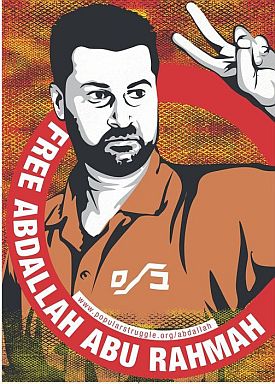
The Popular Struggle Coordination Committee comments on the Obama administration’s silence on the continued imprisonment of a Palestinian champion of non-violence.

Amid a flurry of European diplomatic attention over the imprisonment of Bil’in’s Abdallah Abu Rahmah, the United States has stayed strangely silent on the issue. Abu Rahmah, a non-violent leader from the West Bank village of Bil’in, has been in an Israeli military jail for over one year stemming from a charge of incitement and illegal protest levied against him after he was arrested in a night raid on his house on December 10th, 2009. After serving his sentence in full, the Israeli military prosecution demanded that he stay in jail while they file an appeal asking for a harsher sentence in order to ‘make an example’ of him.

On Friday, 10 December, AP reporter Matt Lee directly addressed Abdallah Abu Rahmah’s case during a US State Department briefing. US State department spokesman PJ Crowley responded that he was unable to provide a comment on the trial. When Matt Lee pushed, arguing that the EU and other foreign dignitaries had labeled Abu Rahmah a human rights defender, Crowley responded that he will “[find] out what we know.”
At his appeal hearing at the Ofer military court of appeals on 6 December 2010, a dozen European diplomats from France, Spain, the United Kingdom, Germany, Denmark, and Malta were on hand to observe the trial. Sir Vincent Fean gave a short statement to the press, noting his support of EU Foreign Policy Chief Catherine Ashton’s statement labeling Abu Rahmah as a human rights defender. He also pointed out that last month Abu Rahmah had already finished serving his sentence. Last month, British Foreign Minister, William Hague, met with leading Palestinian grassroots organizers in an unprecedented show of support in the face of ongoing Israeli repression.

The current US administration has made repeated statements on the need to support civil society activists, such as the one made by Secretary of State Clinton in July, 2010 the Krakow Community of Democracies meeting, in which she saluted “civil society activists around the world who have recently been harassed, censored, cut off from funding, arrested, prosecuted, even killed.” Clinton explained that when we defend civil society activists “we are defending an idea that has been and will remain essential to the success of every democracy.” She called for action to “protect civil society,” “to do more to defend the freedom of association,” and to “coordinate our diplomatic pressure” “to address situations where freedom of association comes under attack.”

Despite such statements, absent from the diplomatic core were representatives of the United States. In fact, the United States has not yet made any public statements on Abdallah’s imprisonment.

Yesterday, 15 December 2010, the issue of Abu Rahmah was followed up by the AP. Crowley answered that the case is ‘watched closely’ by US representatives in Israel. Far from releasing a statement on Abdallah Abu Rahmah, Crownly confirmed the silent position on Palestinian non-violence that the United States has maintained in recent months.

Facebooktwittermail

A message from Israeli military prison on International Human Rights Day

Majida Abu Rahmah writes:

A year ago tonight, on International Human Rights Day, our apartment in Ramallah was broken into by the Israeli military in the middle of the night and I was torn away from my wife Majida, my daughters Luma and Layan, and my son Laith, who at the time was only nine months old.

As the coordinator of the Bil’in Popular Committee against the Wall and Settlements I was convicted of “organizing illegal demonstrations” and “incitement.” The “illegal demonstrations” refer to the nonviolent resistance campaign that my village has been waging for the last six years against Israel’s Apartheid Wall that is being built on our land.

I find it strange that the military judges could call our demonstrations illegal and charge me for participating in and organizing them after the world’s highest legal body, the International Court of Justice in The Hague, has ruled that Israel’s wall within the occupied territories is illegal and must be dismantled. Even the Israeli supreme court ruled that the Wall’s route in Bil’in is illegal.

I have been accused of inciting violence: this charge is also puzzling. If the check points, closures, ongoing land theft, wall and settlements, night raids into our homes and violent oppression of our protests does not incite violence, what does?

Despite the occupations constant and intense incitement to violence in Bil’in, we have chosen another way. We have chosen to protest nonviolently together with Israeli and International supporters. We have chosen to carry a message of hope and real partnership between Palestinians and Israelis in the face of oppression and injustice. It is this message that the Occupation is attempting to crush through its various institutions including the military courts. An official from the Israeli Military Prosecution shamelessly told my Attorney, Gaby Lasky, that the objective of the military in my prosecution is to “put an end” to these demonstrations.

Facebooktwittermail

Gaza Mom: Palestine, Politics, Parenting, and Everything In Between

Newly released by Just World Books:

With Gaza Mom: Palestine, Politics, Parenting, and Everything In Between, El-Haddad takes us into the life and world of a busy Palestinian journalist who is both covering the story of Gaza and living it—very intensely. This book is El-Haddad’s self-curated choice of the best of her writings from December 2004 through July 2010. She was in Gaza City in 2005, watching hopefully as the Israelis prepared their withdrawal from the Gaza Strip. She covered the January 2006 Palestinian elections—judged ‘free and fair’ by all international monitors; but then, she watched aghast as the Israeli government, backed by the Bush administration, moved in to punish Gaza’s 1.5 million people for the way they had voted by throwing a tough siege around the Strip. Tensions then escalated between Israel’s very lethal (and U.S.-backed) military and the forces loyal to Gaza’s elected Hamas leadership. As the casualties and privations they suffered soared, Gaza’s people found that Israel’s much-bally-hooed withdrawal of 2005 had led to something very different from what they had hoped for…

El-Haddad was not only covering Gaza’s situation as a journalist and correspondent. She was also living them, including by trying to explain the ongoing events to her own young children. Her husband, U.S.-trained physician Yassine Daoud, is also a Palestinian but one without the (Israeli-administered) right to reside in or even enter Gaza. In 2006, El-Haddad left Gaza to be with Daoud in the U.S., but her beloved parents stayed behind. In the book she recounts the angst of a person stranded outside her homeland when it was came under intense Israeli assault at the turn of the year 2008-2009– though she was also able to publish and amplify the experiences of her parents as they cowered in central Gaza City under Israel’s harsh, 22-day bombardment.

In Gaza Mom El-Haddad shares many intimate details of her life as a parent. We watch her young children growing up throughout the text. She also tells us about her life as a journalist and a media activist, including her involvement in the many new Palestinian-rights initiatives that emerged after Israel’s late-2008 attack on Gaza.

Facebooktwittermail

Will Miral be this generation’s Exodus?

Adam Horowitz writes:

Today, I saw Julian Schnabel’s new film Miral. It won’t be arriving in theaters in the US until next March, so it will be awhile until we see what effect it has, but my initial impression was amazement at what I was watching. Here was a film following many of the conventions of a traditional Hollywood film, but this time it was telling the Palestinian liberation story (which might explain why it was not produced in Hollywood and instead was a French/Israeli/Italian/Indian co-production).

The film, based on Rula Jebreal’s semi-autobiographical novel of the same name, takes us from the Nakba, and children orphaned during the Deir Yassin massacre, through the first Intifada to the signing of the Oslo Accords. I know there will be criticisms, and I have a few that I’ll share later, but right now I am struck by the emotional impact of the film. You follow the lead character through checkpoints, refugee camps, home demolitions, interrogations, humiliations and protests. After that it is impossible to not understand, and feel, the Palestinian call for justice.

This film was due for release on December 3 but this has been pushed back until March 25 when it will get a limited launch. Even if it doesn’t get shown widely, one way strong interest can be registered is if Netflix users add Miral to their DVD queue.

Facebooktwittermail

Facebook prohibits the word “Palestinian”

The folks at Palestinian Refugee ResearchNet thought they’d create a Facebook page only to discover: Facebook blocks the term “Palestinian”! (H/t Jillian C York.)

Are Palestinians the only group so blocked from making pages? Well, not really… after a little fiddling around, I discovered that al-Qaida Refugee ResearchNet and Nazi Refugee ResearchNet are filtered too.

It does seem a bit odd, however, that a population of up to 12 million people, receiving more than a billion dollars in international aid, recognized by the UN, and enjoying a degree of formal diplomatic recognition from the United States — is placed in the same filtered category as Nazis and al-Qaida.

I’ve sent an email to Facebook customer service—we’ll see what they say.

Just to be sure, I tried myself to create a “Palestinian sports” page — not allowed.

Facebooktwittermail

Where kindness is a crime

Max Blumenthal reports:

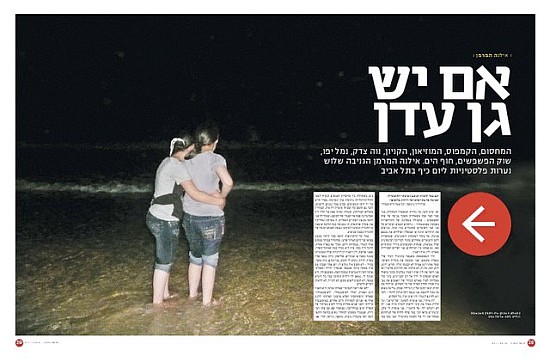
In a May 7 article, Haaretz reporter Ilana Hammerman described in dramatic detail a crime she had methodically planned and committed. In defiance of laws supposedly related to Israel’s security, Hammerman picked up three teenage Palestinian girls in their village in the West Bank, took them through the Betar checkpoint, and drove them into Tel Aviv. There they ate ice cream, visited the mall and museum, and played in the sea. Even though the girls lived just a few kilometers from the beach, Israel’s military occupation had prevented them from ever visiting it before their illegal “day of fun.”

Hammerman wrote in her account of the experience, “If There Is A Heaven:”

“The end was wonderful. The last photos show them about two hours after the trip to the flea market, running in the darkness on Tel Aviv’s Banana Beach. They didn’t want to stop for even a minute at the restaurant there to have a bite to eat or something to drink, or even to just relax a bit. Instead they immediately removed their sandals again, rolled up their pants and ran into the water. And ran and ran, back and forth, in zig-zags, along the huge beach, ponytails flying in the wind. From time to time, they knelt down in the sand or crowded together in the shallow water to have their picture taken. The final photo shows two of them standing in the water, arms around each others’ waists, their backs to the camera. Only the bright color of their shirts contrasting with the dark water and the sky reveals that the two are Yasmin and Aya, because Lin was wearing a black shirt.”

But the fun ended as soon as a group called The Legal Forum for the Land of Israel filed a request with Israeli Attorney General Yehuda Weinstein demanding that Hammerman be prosecuted for breaking the country’s “Law of Entry to Israel” forbidding Israelis from assisting Palestinians in entering Israel. If Weinstein agrees to the request, Hammerman could face as much as two years in prison.

Facebooktwittermail

Reclaiming self-determination

In a policy brief for Al-Shabaka, Ali Abunimah reviews the evolution of the concept of self-determination, its applicability to the Palestinian people, and its gradual erosion since 1991. He argues not only that self-determination must return to the center of the Palestinian struggle; he also shows how the Palestinian exercise of this right can be compatible with eventual coexistence with Israeli Jews.

In his 1974 speech to the United Nations General Assembly, Palestine Liberation Organization Chairman Yasir Arafat addressed “the roots of the Palestine question,” declaring, “Its causes do not stem from any conflict between two religions or two nationalisms. Neither is it a border conflict between neighboring States. It is the cause of a people deprived of its homeland, dispersed and uprooted, and living mostly in exile and in refugee camps.”

How ironic then that the “peace process” has reconceived the Palestine question precisely as little more than a border dispute between Israel and a putative Palestinian state. The “roots” were first reduced to a laconic list of “final status issues”: borders, settlements, Jerusalem and refugees and then gradually buried. Lost has been any commitment to self-determination in principle or in practice.

Although they have rarely been formally discussed, it has long been conventional wisdom in peace process circles that the “final status” issues have already effectively been settled, largely according to Israel’s requirements (we have heard ad nauseam the refrain “everyone knows what a final settlement will look like”). The United States and its hand-picked Palestinian leaders have accepted that large Israeli “settlement blocs” housing most of the settlers, will remain where they are in the West Bank.

The same formula has been adopted for Jerusalem, as per the so-called Clinton parameters: Israel would get “Jewish neighborhoods” and the Palestinian state would get “Arab neighborhoods.” What this means in practice is that Israel would keep everything it illegally annexed and colonized since 1967, and Palestinians might get some form of self-rule in whatever is left – which is shrinking daily as Israel aggressively escalates its Judaization of eastern Jerusalem. While everything east of the 1967 line is divisible and “disputed,” the same does not apply to the west. Palestinians would not be entitled, for example, to seek the return of their West Jerusalem neighborhoods ethnically cleansed and colonized by Israel in 1948. The “peace process” has actually created an incentive for Israel to accelerate its colonization of eastern Jerusalem because Israel knows that whatever is left uncolonized would become the new maximum ceiling of what the United States and other peace process sponsors would support as Palestinian demands.

Similarly, the refugee question has been virtually “settled” as well. Palestinian Authority-appointed chief negotiator Saeb Erekat revealed in a paper he circulated last December that Fatah leader and acting Palestinian Authority President Mahmoud Abbas had proposed to Israel that no more than 15,000 Palestinian refugees per year for ten years return to their original lands in what is now Israel.1 According to Erekat, then Israeli Prime Minister Ehud Olmert had countered with an offer of 1,000 refugees per year for a period of five years. In other words, the parties had already agreed to abrogate the fundamental rights of millions of Palestinian refugees, and were haggling only over the difference between 5,000 and 150,000, or less than three percent of the Palestinian refugees registered to receive services from UNRWA (the United Nations Works and Relief Agency for Palestine Refugees in the Near East).

So what is left to negotiate? Camille Mansour’s policy brief accurately summarizes the outstanding issues – as seen from within the peace process – the final borders and attributes of sovereignty of the Palestinian state. Mansour doubts that negotiations in present circumstances would lead to a peace treaty in which “Palestinian sovereignty requirements could be attained.”

Let us assume for the sake of argument that Israel were to agree to a Palestinian state in the West Bank including East Jerusalem, and the Gaza Strip that satisfies official Palestinian positions and provides for a state no more or less sovereign than any other. The question that then arises is: Does this sovereign state provide for the self-determination of the Palestinian people? Does it restore and guarantee their fundamental rights? As argued, below, the answer is a clear no. And this underscores the need to distinguish the limited goal of sovereignty from that of self-determination.

Facebooktwittermail

Interview with Ken O’Keefe

Ken O’Keefe, an activist who was on board the Mavi Marmara, is interviewed by Mark Dankof on his podcast, The Ugly Truth.

(During the first ten minutes of the broadcast, Phil Tourney, a survivor from the USS Liberty, describes the circumstances in which Israel attacked that American intelligence vessel in 1967.)

In a statement O’Keefe released soon after his expulsion from Israel, he said:

I said this straight to Israeli agents, probably of Mossad or Shin Bet, and I say it again now, on the morning of the attack I was directly involved in the disarming of two Israeli Commandos. This was a forcible, non-negotiable, separation of weapons from commandos who had already murdered two brothers that I had seen that day. One brother with a bullet entering dead center in his forehead, in what appeared to be an execution. I knew the commandos were murdering when I removed a 9mm pistol from one of them. I had that gun in my hands and as an ex-US Marine with training in the use of guns it was completely within my power to use that gun on the commando who may have been the murderer of one of my brothers. But that is not what I, nor any other defender of the ship did. I took that weapon away, removed the bullets, proper lead bullets, separated them from the weapon and hid the gun. I did this in the hopes that we would repel the attack and submit this weapon as evidence in a criminal trial against Israeli authorities for mass murder.

I also helped to physically separate one commando from his assault rifle, which another brother apparently threw into the sea. I and hundreds of others know the truth that makes a mockery of the brave and moral Israeli military. We had in our full possession, three completely disarmed and helpless commandos. These boys were at our mercy, they were out of reach of their fellow murderers, inside the ship and surrounded by 100 or more men. I looked into the eyes of all three of these boys and I can tell you they had the fear of God in them. They looked at us as if we were them, and I have no doubt they did not believe there was any way they would survive that day. They looked like frightened children in the face of an abusive father.

But they did not face an enemy as ruthless as they. Instead the woman provided basic first aid, and ultimately they were released, battered and bruised for sure, but alive. Able to live another day. Able to feel the sun over head and the embrace of loved ones. Unlike those they murdered. Despite mourning the loss of our brothers, feeling rage towards these boys, we let them go. The Israeli prostitutes of propaganda can spew all of their disgusting bile all they wish, the commandos are the murders, we are the defenders, and yet we fought. We fought not just for our lives, not just for our cargo, not just for the people of Palestine, we fought in the name of justice and humanity. We were right to do so, in every way.

Facebooktwittermail

In a different voice: a letter from Israel

Ronen Shamir, a professor of sociology and law who chairs the Department of Sociology and Anthropology at Tel Aviv University, writes in Today’s Zaman:

The truth must be said: The present-day Israeli regime is not interested in peace. The Israeli establishment has become prisoner to an ever growing public of Jewish fanatics — informed by messianic visions of Greater Israel — who over the years not only irreversibly settled in the occupied West Bank, with state funding, but have also penetrated the ranks of army officers, the civil service and the government. The outcome is that the current Israeli regime is firmly grounded in a religiously guided, ultranationalist and xenophobic worldview, one which is bound to bring calamity to the whole region, including Israel.

Deteriorating relations with Turkey are, sadly, an inevitable outcome of a siege mentality common among Israelis. For many, criticism of Israel’s policies from abroad is not heeded as yet more proof that “the world is against us” in general and that “the world is anti-Semitic” in particular. The Israeli regime, for its part, fosters this view, one that deliberately obscures the crucial difference between criticism of Israeli policies and a principled stand against Israel’s right to exist. The two become one in the Israeli media, the Israeli political propaganda machine, and ultimately, in the Israeli mind. Things became worse when criticism came from Turkey. Over the course of less than two years, following a string of events that reached its tragic climax last month, Turkey has been systematically demonized by the Israeli government. Relying on and further fostering well-embedded stereotypes of Muslims among Israeli Jews, Turkey — abstracted and depicted as a homogenous social-political entity — is now portrayed as the natural ally of militant and radical Islamists around the world.

It is in the context of such a cynical trope, at this dangerous juncture, that I wish to express my personal apology to the Turkish people for the deadly attack on the flotilla. It is also at this point in time that I believe it important to remember that there are many Israelis who are shocked and dismayed by the way Israel is governed, by the continuous blockade of Gaza and by Israel’s unwillingness to put an end to its occupation and repression of the Palestinian people. There are also many Israelis who understand and lament the folly involved in losing a long-time ally like Turkey, another step along a suicidal road that is leading us into an abyss.

Facebooktwittermail

What happens when a country has no borders?

In the hours leading up to the Mavi Marmara massacre, Israel extended like a cloud whose shadow spread deep into the Mediterranean. The Turkish ship’s captain took evasive action but it’s hard to escape the reach of a nation whose borders are so elastic.

Anyone who reads the Israeli press will sooner or later notice one of the curious features about Israel’s geographic identity. Politicians talk about threats from the north and the south in such a way that Israel sounds like a legendary kingdom on whose periphery are regions of darkness. It doesn’t have borders as such but instead margins of indeterminate depth where it is dangerous to venture.

This might explain in part the mythopoetic imagination through which Israelis see themselves heroically standing up against the forces of evil. It also suggests why it is that a very modern state has a medieval view of the world.

Benjamin Netanyahu warned his cabinet this weekend: “Dark forces from the Middle Ages are raging against us. I have received calls from concerned officials in the Balkans and Eastern Europe who are very worried about these developments.”

The mission of the Mavi Marmara, Netanyahu seems to hint, signaled the beginning of an attempt to re-establish an Ottoman Caliphate that once again threatens to take control of the Holy Land. Nevertheless, at such a historic juncture, it’s perhaps surprising that the commander of Israel’s military forces was apparently asleep.

Was this an expression of the unshakable confidence IDF’s commander in chief has in his soldiers, or (more likely) the blasé attitude with which Israel operates in the international arena?

Israel Defense Forces chief of staff Gabi Ashkenazi was not present in the IDF’s Tel Aviv command center during the first part of the maritime takeover of the Gaza-bound Turkish ship Mavi Marmara on May 31, Haaretz learned Sunday.

Instead, the most senior officer supervising the raid was Major General Tal Russo, IDF Chief of Operations, with Ashkenazi arriving only after the takeover had taken a turn for the worse.

The absence of both Ashkenazi and his second in command, Major General Benny Ganz, will be one of the issues to be reviewed by the specialist panel named by the IDF chief to probe the raid, headed by retired major general Giora Eiland.

No wonder Israel has been dragging its feet in responding to calls for an international investigation. But now, thanks to the Obama administration, it looks like Israel may once again avoid being held accountable for its actions.

Israel last night flouted pressure for an independent international inquiry into the lethal assault two weeks ago on a flotilla of ships attempting to break the blockade on Gaza, announcing an internal investigation with two foreign observers.

The White House gave its approval for the Israeli formula, which will be confirmed by the Israeli cabinet today.

The inquiry into the raid, in which nine Turkish activists aboard the Mavi Marmara were killed, will be headed by a former Israeli supreme court judge, Yaakov Tirkel. The foreign observers are the former Northern Ireland first minister David Trimble and a Canadian judge, Ken Watkin. They will have no voting rights.

The inquiry falls short of a UN proposal for an international investigation, but was agreed after consultation with the US. The White House said last night that the Israeli inquiry meets the standard of “prompt, impartial, credible and transparent investigation”.

The US Ambassador to the UN, Susan Rice, told Fox News on Sunday:

“We think that an international component would strengthen the investigation and certainly buttress its credibility in the eyes of the international community, and we’ve had discussions with Israel as to how and whether they might go about doing that,” Rice said.

But she added it’s “obviously ultimately the Israelis’ choice” whether to participate in such a group evaluation.

“Our view is that Israel, as a democracy, as a country with a tradition of strong military justice, can conduct an investigation of this sort however it chooses to constitute it,” she said, adding, “We are not pressuring Israel to participate in anything that it chooses not to participate in.”

In effect, what the United States is saying is that unlike any other country on the planet, Israel has the right construct its own definition of the term “international.” Israel when operating outside even its own self-determined boundaries of sovereignty, when conducting an assault on a ship operating under a Turkish flag and killing Turkish citizens, nevertheless has the “right” to say, “this is our business” — and Washington agrees.

Sefi Rachlevsky describes what happens when a nation refuses to set its own limits.

Israel gave itself a nice present to celebrate the 43rd anniversary of losing its borders. The raid on the Gaza flotilla in international waters is like the first Lebanon War – as if in a nightmarish experiment, we seem to be examining the question: What happens when a country has no borders?

Israel’s maritime attack did not happen by chance. A border is one of the fundamental factors that defines a country. Decades without one have distorted Israel’s thinking.

It is self-evident that, just as a person cannot build in an area that he does not own, a country cannot build settlements outside of its borders. And yet Israel has settled hundreds of thousands of its citizens in areas that, according to its laws, are not part of the State of Israel.

It is self-evident that any couple can marry “without regard to religion, race or gender.” And yet in Israel a Jewish man and a non-Jewish woman cannot legally marry. It’s self-evident that there is no arbitrary discrimination, and yet it’s enough to use the magic words “I’m a religious woman” or “I’m an ultra-Orthodox man” and the obligation to serve in the military evaporates.

It’s self-evident that the education provided to children be based on democracy and equality. And yet in Israel, 52 percent of first-graders defined as Jews study in various religious school systems that teach students things like “You are considered a human being and the other nations of the world are not considered human beings.”

They are taught that a non-Jew is not a human being, and that anyone who kills a non-Jew is not supposed to be killed by human hands; that women are inferior, and it is an obligation that males and females be separated; and that secular people, or anyone with secular family members, cannot enter these schools.

It is self-evident that racist education cannot be funded by the government and is illegal. And yet most of the country’s first-graders receive such “compulsory education” from their government.

The results of this nightmarish experiment are self-evident. In the most recent elections, 35 percent of voters defined as Jews cast their ballots for avowedly racist parties – Yisrael Beitenu, Shas, National Union and their friends.

Critics in the Israeli media wake up only when mistakes are made. That is why – after initially cheering the declaration that “the flotilla will not pass” – they changed their tune following the imbroglio, turning into advocates of the twisted logic “be smart, not right.” But what justice is there in an attack on civilians by soldiers on the open seas?

Like the territories, international waters are not Israel; they are outside its borders. A Turkish ship on the open sea is, in effect, a floating Turkish island. An Israeli attack on such an island is not all that different from sending the Israel Defense Forces to take on demonstrators at the Luxembourg Gardens in Paris. There, too, unpleasant people who are not friends of Israel can sometimes be found.

Turkey, which is a member of NATO, was not in a state of war with Israel before the attack. Attacking its citizens on territory that is by definition Turkish is another expression of the Israeli lunacy that lacks any kind of boundaries.

An attack beyond the border must be reserved for extreme cases involving a military target that represents an entity fighting against the country and when citizens are in danger. But civilian ships, that are not carrying weapons, but are bringing civilian aid to a population that is denied chocolate, toys and notebooks, are not nuclear reactors in Iraq, Syria or Iran.

A person who grows up without external borders tends to create distorted internal borders. That is the reason for the attack on Arab MK Hanin Zuabi and her colleagues. While there were certain Arab public figures who went too far in their statements, joining a civilian aid flotilla is one of those legitimate acts which are supposed to be self-evident.

And yet, what was self-evident became betrayal. And citizenship, one of the unconditional foundations of existence, has turned into something that can be revoked – in this case on the basis of ethnicity, a tactic used in fascist regimes. The street has returned to the atmosphere that prevailed under “responsible” opposition leader Benjamin Netanyahu and led to the assassination of prime minister Yitzhak Rabin – and the next murder is in the air.

The Israeli deed at sea is liable to reach The Hague. The problem is that Israel has genuine enemies who want to destroy it. A country that does not do everything in its power to accumulate legitimacy, along with turning Iran into an entity that is losing legitimacy and can therefore become a target of activities to undermine it, is a country losing its basic survival instinct. Without borders, it turns out, you lose even that.

Young Israelis who have grown up without borders are now dancing and singing “In blood and fire we will expel Turkey” and “Mohammed is dead.” If this keeps up, Israel will not make it to The Hague. The entity gradually replacing the State of Israel is liable not to exist long enough to get there.

Facebooktwittermail

Farewell Helen Thomas

It’s good that Helen Thomas will no longer be in White House press briefings. Not because she sullied the reputation of the Washington press corps with a few undiplomatic remarks, but because those who lack her boldness and bluntness will no longer be able to use her presence to foster the illusion that American journalism still values courage.

When Thomas was asked during a White House Jewish Heritage Celebration on May 27 (before the Mavi Marmara massacre) whether she had any comments on Israel, she said without a pause: “Tell them to get the hell out of Palestine.”

“It’s their land,” Thomas asserted, referring to the Palestinians and baldly challenging the notion that Israel was founded on land that belongs to the Jews. When asked where the Jews should go, she said they should “go home” — to Germany, Poland, America or from wherever else they had emigrated to Israel.

As soon as the video (see below) of Thomas’ remarks was made public, Washington’s mechanisms of tribal discipline swiftly kicked into gear.

Her words were “unconscionably callous and vile,” said Andrew Sullivan. “Thomas deserved what she got,” said Dana Millbank. Both saw her departure as a loss, yet just as President Obama deemed her words “out of line,” no one in Washington was willing to go to the heart of what she said.

In 1948 three-quarters of a million Palestinians were driven out of their homes by Zionists in order to make room for the creation of a Jewish state. For that reason, Helen Thomas, an American of Lebanese descent, apparently believes — as do most people in the Middle East — that the Jewish claim to “own” the land on which Israel was created is a claim based on religious dogma rather than historical fact.

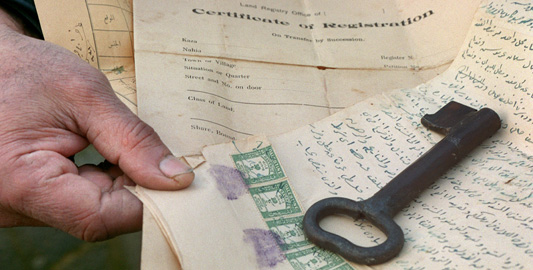
Those families who still possess the keys to homes they lost and the legal titles to land on which they were built, see the issue not as one of “disputed territories” but as one in which colonizers — like America’s settlers — grabbed land and then tried to disguise their acts of dispossession by invoking divine authority.

As Thomas has been dumped by her agent, forced to retire and is now ostracized by colleagues who disingenuously profess their admiration for her journalistic courage, Washington once again displays itself as a unique and rather pathetic satellite of Israel.

As the world condemns Israel’s latest act of unconscionable brutality, America’s media willingly turns its attention to the “unconscionable” words of an 89 year-old woman who had the audacity to say a few blunt words about the Jewish state. Oy veh!

Facebooktwittermail