Category Archives: Palestinians

War and truth in Libya and Palestine

Tarak Barkawi writes:

We are told that war is the pursuit of politics by other means. Attributed to Clausewitz, the thought is actually rather comforting. War may be violent but at least it’s rational. It is a sometimes necessary strategy to achieve objectives.

A world is imagined in which armed force is an instrument that can be calibrated, here a scalpel, there a hammer. Violence – the destruction of bodies and things – becomes a means to be assessed for its efficacy in attaining ends.

How much ‘punishment’ will the people of Gaza take before they get rid of Hamas? How much ‘pressure’ needs to be applied before the Gaddafi regime collapses?

Experts offer authoritative analyses. PowerPoint slides are produced, briefings given. Leaders make informed decisions. The balloon goes up. Operation Cast Lead or Unified Protector or some other begins.

Speeches follow; political, legal and moral justifications are made. Politicians and their advisors claim truth in the face of war. They speak of their rational command of force, of the effects it will have among the target populations.

Clausewitz also likened war to a wrestling match. Players in a game know it can take on a life of its own. Each move is countered, and then countered again. They are caught in a system neither side controls, each seeking a dominance that often turns out fleeting.

Like many veteran soldiers, Clausewitz well understood that the enemy always has a vote, that plans are cast aside on first contact, and that outcomes are ultimately unpredictable. Amidst the fog of war, calculations must be made with variable quantities. It was precisely for these reasons that he enjoined politicians and generals to think so carefully about their objectives in going to war.

What Clausewitz actually teaches us is that war is far more likely to make us its servants than we are to make war our instrument. War subjects us to its dynamics, it draws in ever greater resources, and it changes everything, especially but not only for those caught in the direct grip of its violence.

Facebooktwittermail

When Montgomery comes to Nabi Saleh

By Mark Perry

On March 24, the Israeli government arrested Bassem Tamimi, a 44-year-old resident of the small Palestinian village of Nabi Saleh, which is just west of Ramallah. Tamimi was arrested for leading a group of his neighbors in protest marches on a settlement that had “expropriated” the village’s spring — the symbolic center of Nabi Saleh’s life.

Tamimi was brought before the Ofer military court and charged with “incitement, organizing unpermitted marches, disobeying the duty to report to questioning” and “obstruction of justice” — for giving young Palestinians advice on how to act under Israeli police interrogation. He was remanded to an Israeli military prison to await a hearing and a trial. The detention of Tamimi is not a formality: under Israeli military decree 101 he is being charged with attempting “verbally or otherwise, to influence public opinion in the Area in a way that may disturb the public peace or public order.” As in Syria, this is an “emergency decree” disguised as protecting public security. It carries a sentence of 10 years.

The arrest of Tamimi marked only the most recent escalation in Israel’s campaign to suffocate the Nabi Saleh movemen: in the two months prior to his arrest, Israeli officials detained more than 18 Nabi Saleh youths; over the last two years, nearly 15 percent of Nabi Saleh’s population has spent time in Israeli jails; half of those arrested have been under the age of 18 and the youngest of them was 11. But what is extraordinary about the Nabi Saleh campaign is its effectiveness. The protestors are trained in non-violent tactics. “Our strategic choice of a popular struggle — as a means to fight the occupation taking over our lands, lives, and future — is a declaration that we do not harm human lives,” Tamimi has said. “The very essence of our activity opposes killing.”

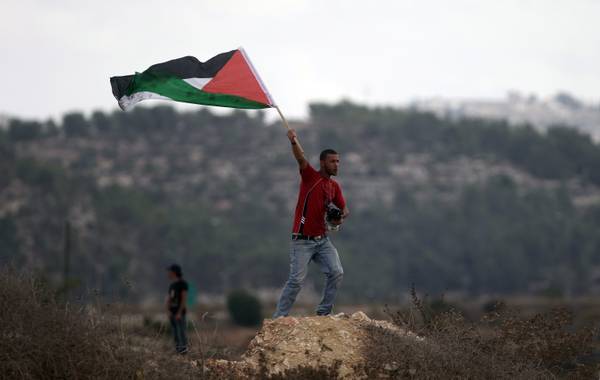
Tamimi’s arrest has not stopped the movement. On the morning of April 8, about 80 villagers marched from Nabi Saleh’s main street towards the settlement. As they crossed into some nearby fields, they were attacked by IDF soldiers with teargas, rubber bullets, and stun grenades. The villagers fled, but then reorganized themselves, defiantly linking arms in front of the soldiers. Again, the IDF responded harshly and, by that evening, had arrested six villagers. But these are small incidents in a continuing battle. The protests go on day after day, week after week — and have over the course of the last four years.

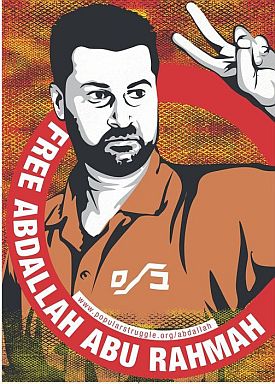
Nabi Saleh does not stand alone. The non-violent protests actually began eight years ago in small communities near Israel’s security wall, then took root in the villages of Mas’ha and Budrus; the protests have now spread to towns and villages across the West Bank, encompassing mass rural movements from Hebron in the south to Nablus in the north. The protests have involved dozens to hundreds, and on rare occasions, thousands of villagers. But pride of place for this widespread non-violent resistance movement belongs to Bil’in, a village that (like Nabi Saleh) has seen much of its land taken over by a settlement. The leader of the Bil’in protests is Abdallah Abu Rahmah, the head of Bil’in’s Popular Committee Against the Wall. Like Tamimi, Abu Rahmah has trained his young activists in the principles of non-violence, sparking movable protests that the IDF has found impossible to suppress.

Abu Rahmah, a high school teacher at the Latin Patriarch School in Ramallah, began organizing Bil’in’s protests in 2004, even as the violence of the Second Intifada was beginning to wane. Every Friday after prayers, Abu Rahmah would lead a group of Bil’in residents on a protest march towards a local settlement — and every Friday his march would be intercepted by the IDF.

In one demonstration, an IDF sniper used a .22 caliber rifle to disburse the protesters, killing a Palestinian boy. Twenty-one unarmed demonstrators, among them five children, have been killed in non-violent West Bank demonstrations since the beginnings of the movement. In the village of Nil’in in 2008, American activist Tristan Anderson was paralyzed after an IDF soldier fired a high velocity tear gas canister at his head from a distance of 15 meters. In December of 2009, IDF soldiers raided Abu Rahmah’s home, arrested him for incitement, and sentenced him to 12 months in prison. At the end of his sentence, the IDF asked his sentence to be extended for another four months, describing Abu Rahmah as “dangerous.” The court agreed.

Abu Rahmah has become a symbol of the protests. While in prison, he smuggled letters to his supporters, including one — written this last February — that has become a kind of “Letter from Birmingham Jail” of the movement. “Ofer is an Israeli military base inside the occupied territories that serves as a prison and military court,” he wrote. “The prison is a collection of tents enclosed by razor wire and an electrical fence, each unit containing four tents, 22 prisoners per tent. Now, in winter, wind and rain comes through the cracks in the tent and we don’t have sufficient blankets, clothes, and other basic necessities. Food is a critical issue here in Ofer, there’s not enough. We survive by buying ingredients from the prison canteen that we prepare for our tent. We have one small hot plate, and this is also our only source of warmth.”

One month after penning this letter, Abu Rahmah was released, but it’s only a matter of time before he’s arrested again — and shut inside one of the half-dozen Israeli military prisons and administrative facilities that dot the West Bank. Israeli tactics, the mass arrests, and the use of live fire have been condemned by a long list of human rights organization. But not by the United States.

Just how much do the Bil’in-Nabi Saleh protests worry Israel? One widely circulated article from the popular Israeli political daily Yediot Ahronot described Naji Tamimi, who helped his cousin Bassem organize the Nabi Saleh movement, as “a pied piper” who “fans the flames of violence.” (Despite the fact that not one Israeli has died as a result of the protests.) The article went further: “Even though it hasn’t been proven, it seems that sources connected to the Palestinian Authority are directing the activities and that the funds paid out to the youths is coming from donations from organizations registered abroad.” Not proven — because it’s not true. In fact, while Fateh and Hamas officials monitor the protests (PA officials have come to Nabi Saleh — before scuttling back to their offices in Ramallah), they have been careful not to interfere in them. They view the protests as a credible and powerful movement that is better left alone. Hamas leaders agree. “We wish them well. We hope they succeed. We support them. We are staying away,” a senior Hamas official says.

A group of international activists have been helping the Nabi Saleh protests. Jonathan Pollak, a 29-year-old native of Tel Aviv, has found himself at the center of the protests — and has written about them extensively. “I grew up in a progressive home,” he says, “but I don’t think that anyone in my family could be described as a radical. I came to Nabi Saleh and realized I had to help. What’s happening here is just wrong.” Joseph Dana, a New York native and journalist, works alongside Pollak. He came to Israel to find his Jewish identity. “I haven’t found it,” he says. “What I found instead was an army that arrests children.”

Pollak, Dana, and other international activists are working to bring attention to the Nabi Saleh movement and have escorted diplomats from Europe through the village. A few low-level American diplomats from Jerusalem have come to Nabi Saleh, but no senior American officials have visited. “The international community has been asking for years where the Palestinian nonviolent movement is,” Joseph Dana says from his home in Jerusalem. “Well, here it is. And the Americans are nowhere to be found.”

Pollak and Dana are being modest. While the events at Nabi Saleh and Bil’in have been largely ignored in the United States, they have sparked a simmering conflict between Palestinian villagers and Israeli settlers. The IDF has taken the side of the settlers, arresting hundreds of young Palestinians (many of them minors) and using (in one case) the testimony of a 14-year-old boy to condemn the movement’s leadership. “They kept him up all night, shouting at him,” Dana says. “He was frightened, alone. Finally, he did what they wanted. If you can imagine, Israeli soldiers subjecting a child to mental torture.” While the world’s attention has been diverted by the events in Tahrir Square, Israeli officials have struck back against what may well be the greatest threat to their settlement project — condemning non-violent protesters as “terrorists” and standing aside while settlers have taken more and more land from unarmed and defenseless people. Israel has poured increased funds into countering the protests, deployed more and more soldiers to stop them, and escalated the arrest of its leaders — breaking down the doors of their homes in pre-dawn raids designed to frighten and intimidate them. Nothing has worked.

Unfunded and unnoticed, Bassem Tamimi, his cousin Naji, Abdallah Abu Rahmah, and a handful of others have organized and trained battalions of young men and women in the art of non-violent resistance. Bassem Tamimi’s arrest has not stopped the protests. They are growing, and spreading. The movement is now in the hands of Bassem’s wife, Nariman, who vows to fight on. She has already spent time in an Israeli jail, but remains undeterred. “There is no knowing what the future holds,” she says from her home in Nabi Saleh, “but our path is clear and so is our goal. We know well that it is possible to achieve it, and we will continue to fight for it. To a great extent, the question of our victory is also one that should be directed to the American people and their government — are you on the side of justice and victory, or on the side of continued oppression?”

The Arab Spring has seen revolutions come to Tunisia, Egypt, Libya, Yemen, Bahrain, and Syria. In each revolution, U.S. President Barack Obama has praised the crowds seeking democracy and freedom. Again and again he has talked of the need to fight extremist violence. He has paid homage to the young men and women who have brought freedom to Egypt and Tunisia. He has supported those defending themselves in the streets of Benghazi, Sanaa, and Damascus. His talisman has been non-violence, his pole star the American civil rights movement. In Cairo, in June of 2009, President Obama linked the Palestinian quest for freedom to the American civil rights movement. “Palestinians must abandon violence,” he said. “Resistance through violence and killing is wrong and it does not succeed.” He was right. So why is it that now — when finally, Montgomery has come to Nabi Saleh — he chooses to remain silent?

Mark Perry is a military and political analyst and author of eight books, including Partners In Command, George Marshall and Dwight Eisenhower in War and Peace, and most recently Talking To Terrorists.

Facebooktwittermail

The single demand that can unite the Palestinian people

Karma Nabulsi writes:

After another week of breathtaking demonstrations from Jordan to Yemen heralding dramatic revolutionary change, in occupied Palestine things appear much the same. The repetitions of bombing, air attacks on civilians, muted international protests, and dubious gestures towards a bankrupted peace process: all lend an air of futility and hopelessness to the trajectory of Palestinian freedom. Palestinians urgently need their voice to be represented at this historical moment in which unrepresentative rulers are being toppled by popular movements, and citizens are reclaiming their public squares and political institutions on the age-old principle of popular sovereignty.

Since January Palestinians in the refugee camps and under military occupation have all been asking the same question: is this not our moment too? Yet how are we to overcome the entrenched system of external colonial control and co-optation, the repression, the internal divisions and the geographical fragmentation that have until now kept us divided and unable to unify? The situation appears a thousand times more complex than Bahrain, or Egypt, or Libya, or Syria.

The solution to this fierce dilemma lies in a single claim now uniting all Palestinians: the quest for national unity. Although the main parties might remain irreconciled, the Palestinian people most certainly are not. Their division is not political but geographic: the majority are refugees outside Palestine, while the rest inside it are forcibly separated into three distinct locations. The demand is the same universal claim to democratic representation that citizens across the Arab world are calling for with such force and beauty: each Palestinian voice counts.

Facebooktwittermail

Who is afraid of Julian Schnabel?

Jordan Elgrably writes:

Miral, currently in theatres, portrays the Israeli-Palestinian conflict from an entirely Palestinian perspective. It is nothing earth-shattering (a brief filmography at the end of this article offers other films that do this far more effectively) except that it was made by a Jewish filmmaker.

Several Jewish organisations and the Israeli government have seen fit to protest against the film. They say it does not tell both sides of the story. But that is precisely the point. When director Julian Schnabel – previously lauded for his lavish features Basquiat, Before Night Falls and The Diving Bell and the Butterfly – decided to make this film, based on the book by Palestinian journalist Rula Jebreal, his intention was to tell the story Rula tells in Miral.

Schnabel is an Academy-Award nominated director, and his film has brought “the conflict” into the mainstream. The fact that he happens to be Jewish while representing the Palestinian perspective inflames some in the Jewish community, who consider his film an act of betrayal.

I saw the film earlier this week in a special screening hosted by Javier Bardem, who starred in Before Night Falls and wanted to support Schnabel’s “brave film”. The director was there with his daughter Stella, who appears in the film, and with his new wife – Rula Jebreal. I could not help but wonder what the Jewish community thinks when a Jew marries a Palestinian.

More to the point, why are some Jews afraid of Jews who embrace narratives other than those officially sanctioned in the Jewish and Israeli community? Why do such narratives when told by Jews – including books by Norman Finkelstein and Noam Chomsky, and Israeli revisionist historians such as Avi Shlaim, Ilan Pappé and Tom Segev – cause such ire?

I am one of these contrarian Jews. Why do I strive to see things not only from the Jewish perspective but the Arab one? Because my father’s family lived for centuries in an Arab country, Morocco, and because long ago I recognised that the Israeli-Palestinian conflict is about nothing else if not conflicting narratives.

Facebooktwittermail

Why Palestinians will protest on March 15

Rawan Abu-Shahla writes:

We are a group of Palestinian youths who have come together for the sole purpose of leaving behind our political identities and affiliations, and deciding to put our best interests above all else, united under our Palestinian flag. We have called for peaceful demonstrations on Tuesday, 15 March across the Palestinian nation — in the Gaza Strip and West Bank, the territories of 1948 and the Palestinian diaspora, calling out together one slogan: “The people want to end the division!”

We call for peaceful actions in support of unity in the Palestinian political scene under one banner, the Palestine Liberation Organization (PLO).

Division in the Palestinian body politic has affected every aspect of our lives: socially, economically, educationally and intellectually. It is ordinary Palestinians who have paid the price of the four-year long division that serves no one but the Israeli occupier.

Our campaign to end the division started out as a thought which stirred discussion, and some youths decided to give it a try and did everything possible to make this initiative happen. Day after day, the idea grew and became a plan and then a public decision to not be silenced anymore, not to be terrorized or oppressed and most importantly, not to be ignored and forgotten anymore. That is how we came to our decision to demonstrate on 15 March, state the public’s refusal of the status quo and the practices of the political “leadership.”

Facebooktwittermail

Europeans are losing their illusions about Israel

Daud Abdullah writes:

In Europe, Israel has historically enjoyed a high level of support, not least because it was perceived as a progressive democracy in a sea of Arab backwardness. At the same time, most Europeans knew very little about the Israel-Palestine conflict: as recently as 2004, the Glasgow University Media Group found that only 9% of British students knew that the Israelis were the illegal occupiers of Palestinian land. Astonishingly, there were actually more people (11%) who believed that the Palestinians were occupying the territories.

However, according to a new poll by ICM for the Middle East Monitor, Europeans’ perception of Israel has changed decisively, and their understanding of the Israel-Palestine conflict, while still giving some cause for concern, has improved significantly. The survey of 7,000 people in Germany, France, Spain, Italy, the Netherlands and Britain reveals only a small minority (10%) now believe their countries should support Israel rather than the Palestinians, while many more, 39%, think they should not.

Facebooktwittermail

The new Israeli Left

Joseph Dana and Noam Sheizaf write:

As the controversial 443 highway, which connects Tel Aviv with Jerusalem by passing through the West Bank, begins to curve toward Israel’s capital, the eye is inevitably drawn to an imposing gray structure with massive concrete walls, part of the Ofer Military Prison. Commuters are barely aware of what takes place behind those walls, and that’s no accident—the Ofer compound, comprising a military court, detention center and prison, is just one of many black holes that enable Israelis to go on with their daily lives, unaware of the everyday realities of the occupation.

Inside, a man in shackles enters the courtroom. He is wearing a brown prison suit, and his exhausted eyes exchange glances with his wife. The two haven’t met outside the courtroom in more than a year, and for some reason the prison guards are frantically moving the wife so she doesn’t sit too close to her husband, who is officially a “security risk.” Soon the military judge, outfitted in a light green Israel Defense Forces (IDF) uniform and an army beret, enters the room and begins the proceedings.

This trial could be any one of the thousands that have taken place at Ofer. Israeli military justice is swift and unflinching: according to the Israeli human rights organization Yesh Din, the conviction rate at Ofer is an astounding 99.7 percent. Hearings are short, and apart from relatives who use the opportunity to see their loved ones, nobody bothers to attend or report on the proceedings. But today is different. The small courtroom is full, with twenty European diplomats—including the British general consul, Sir Vincent Fean—as well as a handful of Israelis who have become close to the prisoner through years of joint action.

The prisoner, Abdallah Abu Rahmah, a 39-year-old schoolteacher and father of three, has already been convicted and has served a sentence for incitement and organizing illegal protests in the West Bank village of Bil’in. But after a prosecutor’s appeal, the judge ordered that he be kept in prison. Abu Rahmah would later receive an additional six months of prison time.

It wasn’t only friendship that brought the Israelis to Ofer. They see the case against Abu Rahmah as part of a new effort to crush unarmed resistance in the West Bank. For them, Abu Rahmah is not just another Palestinian activist. By leading the mostly nonviolent weekly protests in his village against Israel’s separation wall, he has become the face of a new uprising against the occupation and a key player in a kind of activism that has united Jews, Palestinians and people from around the world—one that carries a message of hope, something as unusual and unexpected in this part of the world as the recent uprisings that have toppled Arab tyrannies. It is a hope that can even penetrate the forbidding walls of the Ofer military compound.

Facebooktwittermail

Permanent temporariness

Alastair Crooke writes:

It was in 2003 that I realised something fundamental had changed. The door to the room in which I was sitting flew open. In stalked a figure still dressed in a dark overcoat and scarf. He evidently could contain himself no longer. I was in Downing Street with the prime minister’s foreign affairs adviser, David Manning; the overcoated figure bursting into our meeting was Jack Straw. He wanted to tell Manning that he had persuaded Joschka Fischer, the German foreign minister, to add Hamas to the EU list of terrorist movements. His tale of his conversion of Fischer was wrapped in expressions of outrage at Hamas. It wasn’t so much the proscription that shocked me. A ceasefire, which I had helped facilitate, had broken down. What was new was the elation with which Straw greeted the banning. I don’t know what Manning thought, but he will have been aware that the terrorist ‘list’ is one of those things from which it’s almost impossible to get a name removed. The consequences for diplomacy, for the politics of peace-making, would be profound, possibly irreversible; but Straw wasn’t worried. Manning, I knew, believed strongly that there could be no solution to the Israel-Palestine issue without Hamas involvement and had firmly supported EU efforts at inclusive peace-building. Officially, the EU remained committed to a political solution, but it now seemed that two key member states were heading in the opposite direction – towards a militarised resolution. The wind had changed.

There had already been hints that a political solution was no longer at the forefront of Whitehall thinking. Not long before, a senior British official had told me bluntly that my methods of building popular consent – holding ‘town hall’ meetings with all factions, working with Hamas, shuttling between Palestinians on the ground and President Arafat to ensure broad participation and continued momentum – were passé. We were in a new era, and it required new thinking: ‘The road to Jerusalem now passes through Baghdad,’ the official insisted. He was speaking just before the 2003 invasion. The message was clear: the Islamic resistance in Palestine was to be neutralised, and psychologically defeated, by the massive display of Western force in Iraq, rather than brought into the political process. Britain and the US expected that the chastened Palestinians would then make the necessary concessions to Israel. What was striking was the official’s conviction that such an outcome was inevitable.

These were heady days for American and British officials and enthusiasm for the ‘war on terror’ was soaring. At our first meeting, Manning’s Downing Street successor, Nigel Sheinwald, told me angrily that security in Palestine could be achieved by eradicating the ‘virus’ of Hamas from Gaza, and eliminating its ‘disease’ from the region. He had no interest in helping to create legitimate Palestinian security services, representative of a cross-section of the community. The language was Washington’s. The Palestinian conflict was seen not as a problem in its own right, but as a subset of a war against ‘extremism’ – another domino to be pushed over in order to strengthen the ‘moderates’. A senior Israeli intelligence official later told me, privately, that he believed the change had begun in earnest in September 2003, after Arafat forced Mahmoud Abbas – a favoured figure in Washington – to resign as prime minister. Angry and frustrated, Bush called Blair. He complained that the Europeans ‘were dancing around Arafat’, while the US was left to do the ‘heavy lifting’ with Israel. Bush also complained that he did not see peace-building as compatible with his ‘war on terror’. Al-Jazeera’s recent release of the Palestine Papers has cast some light on all this: the documents include copies of British covert plans from 2003 and 2004 to ‘degrade’ the capabilities of opponents to the Palestinian Authority, to disrupt their communications, intern their members, close their civil and charitable organisations, remove them from public bodies, and seize their assets. Blair had set aside the lessons of peace-building, so recently learned in Northern Ireland, and embraced the doctrine of counter-insurgency.

The shift in the British position, under American pressure, sabotaged European policy. It undermined the EU’s commitment to promoting Palestinian unity by suppressing, at the covert, security level, opposition to the PA, removing from Palestinian institutions not only all members of Hamas and Islamic Jihad but even those elements in Fatah who had been involved in the second intifada. From now on, the EU would ‘talk the talk’ of encouraging Palestinian unity, while several of its most prominent member states were ‘walking the walk’ of a security-led repression of the very movements the EU was trying to encourage into the political arena. The result was that when Hamas – rather than being demoralised or psychologically defeated by shock and awe in Baghdad – comfortably won the 2006 Palestinian parliamentary elections, the EU was forced into a militarised security response. The new commitment to counter-insurgency meant that there was no prospect of exploring the political possibilities of Hamas’s win. After the election the UN envoy to the Middle East, Alvaro de Soto, wrote a memo to the UN secretary general complaining that the conditions for entering into a dialogue with Hamas had been deliberately set so that Hamas would be unable to meet them – thus engineering its exclusion. De Soto resigned from the UN soon afterwards.

Facebooktwittermail

Palestine and the Arab democratic revolution

Mustafa Barghouthi writes:

The rush and tumult of events makes it hard, sometimes, to draw the most important general conclusions from their significance. This said, the revolutionary tidal wave, which began in Tunisia and Algeria, reached its crest in Egypt and is currently sweeping other countries such as Libya and Bahrain, offers a unique opportunity to watch how people can reshape history as they reconstruct their fates and futures. It also offers a rare scientific window to observe the birth of the new from the old and to study a moment of qualitative transformation that culminated from a long process of quantitative accumulation and that manifests the dialectical laws of social dynamics with utmost clarity.

What happened in Tunisia and then in Egypt, and what will certainly follow in other places, cannot be produced or fabricated by a political party, movement or force, domestic or otherwise. The uprisings are the product of a long cumulative evolution, lasting years, decades or perhaps even centuries in some areas, that eventually erupted into millions-strong grassroots protest movements of a magnitude unprecedented in the modern history of the Arab world, and perhaps in its entire history. Perhaps the only moment of similar size, scope and breadth is the first popular Palestinian Intifada, in its first year (1987-88). Sadly, the Oslo Accords undermined the magnificent initial results of this uprising and destroyed a historic opportunity to end the Israeli occupation. We should add that this Palestinian revolutionary moment was never sufficiently documented, first due to the differences in size and strategic importance compared to the Egyptian case, and second due to the lack of media coverage and unprecedented sophistication in communications technology that was available to Egypt today.

The events in Egypt today — as was the case in Tunisia and in all great revolutions, such as the French and Russian revolutions — epitomise what sociologists call a “revolutionary moment”. Such a moment occurs when the governed refuse to be ruled as they had been and when the rulers can no longer govern in the same manner. It is a momentous event. It is one that political parties, movements and forces, and intellectuals and spontaneous popular action can prepare for. But it is far bigger than anyone could have expected, planned for or attempted to produce. Great revolutions cannot be made. They erupt, like volcanoes, atop of the mounting force of huge and long-suppressed social and political contradictions.

It is precisely because these contradictions have been pent- up for so long, prevented from expressing themselves and unable to vent their anger, that the moment of explosion is too powerful to cap or control. Therefore, political parties and forces should be careful not overrate their own size, role and or abilities with respect to this condition. They might be akin to a midwife who is there to help with a safe delivery, but they did not produce the embryo or induce the birth, and they are not the mother (the people), or even the surrogate mother.

Rather than blaming themselves for their actions in the past, political forces should focus on their role at present, which is to ensure the safety of the birth and the health of the infant, and to safeguard it against any attempts on the part of the old order to abort, kill or stunt it. The revolution, or the eruption, may produce a newborn, but it cannot guarantee its survival and wellbeing. This is one of the tasks of an organised and aware intellectual vanguard.

The phenomenon that is unfolding before our eyes today is not restricted to Egypt; it has its roots in the state of the Arab world as a whole. That Tunisia was the first country to react is due to the fact that it was the weakest link in the chain of an interconnected order, whose profound internal contradictions, some of which are old and others of which are relatively new, have long needed to be resolved.

Facebooktwittermail

The Egyptian revolution began in Palestine

Hossam el-Hamalawy writes:

In the 1990s, one could only whisper Hosni Mubarak’s name. Political talk or jokes were avoided in phone calls. This year, millions of Egyptians fought for 18 days against their ageing tyrant, braving the police troops firing teargas, rubber bullets and live ammunition. People in Egypt have lost their fear, but it did not happen overnight. The Egyptian revolution, rather than coming out of the blue on 25 January 2011, is a result of a process that has been brewing over the previous decade – a chain reaction to the autumn 2000 protests in solidarity with the Palestinian intifada.

Mubarak’s iron-fist rule and the outbreak of the dirty war between the regime and Islamist militants in the 1990s meant the death of street dissent. Public gatherings and street protests were banned and if they did take place, confronted by force. Live ammunition was used on strikers. Trade unions were put under government control.

Only after the Palestinian intifada broke out in September 2000 did tens of thousands of Egyptians take to the streets in protest – probably for the first time since 1977. Although those demonstrations were in solidarity with the Palestinians, they soon gained an anti-regime dimension, and police showed up to quell the peaceful protests. The president, however, remained a taboo subject, and I rarely heard anti-Mubarak chants.

I recall the first time I heard protesters en masse chanting against the president in April 2002, during the pro-Palestinian riots around Cairo University. Battling the notorious central security forces, protesters were chanting in Arabic: “Hosni Mubarak is just like [Ariel] Sharon.” [Continue reading…]

Facebooktwittermail

Israelis fear a peaceful intifada too large to crush

Officially, the main cause of concern the Egyptian revolution poses for Israel is that it might result in the end of the Israel-Egypt peace treaty. A much larger concern however, is that the Arab democratic revolution sweeping the region might inspire Palestinians in larger numbers than ever, to demand their political rights.

Israel’s military forces have had decades of practice containing and crushing uprisings on a smaller scale, but numbers matter. The rising spirit of people power is contagious and as we have witnessed in Tunisia, Egypt, Bahrain and now Libya, the brutality of an authoritarian state’s security apparatus is not enough to crush the desire for freedom in a population that has become fearless.

The Jerusalem Post reports:

Concerned by the prospect of the Palestinians replicating Egypt-style mass demonstrations with dozens of simultaneous marches and protests in the West Bank, the IDF is beginning to build rapid-response forces and to identify vantage points throughout the territories that could be used to contain such protests.

The IDF’s Central Command assesses that the Palestinians could resort to so-called nonviolent resistance, on a scale previously unknown to Israel, in the absence of peace negotiations.

While there is deemed to be some possibility that such demonstrations will take place in the near future in the spirit of Egypt, Tunisia and Iran, a senior officer said it was more likely that the Palestinian Authority would prevent this from happening until after elections in September.

One senior officer said commanders were discussing ways to counter and contain large demonstrations launched simultaneously in different parts of the West Bank.

“We are preparing different responses for different scenarios to think about what we will do if there are, for example, 30 marches of several thousand people each,” the officer said. “This is something we have yet to encounter.”

One step the IDF is taking is to set up rapid-response teams that can quickly maneuver throughout the West Bank and arrive at the scene of a demonstration in its early stages in an attempt to contain it. During the summer, the Border Police are expected to establish a new command in the West Bank after the Arava District is dismantled.

In addition, the IDF is locating strategic hilltops that can be used as vantage points from which the military could deploy reconnaissance and surveillance teams to track developments inside Palestinian towns and cities.

The concern is that in the event of multiple large-scale demonstrations, the IDF will not know how to effectively respond and contain the protests, which could lead to a high number of casualties. As a result, commanders have been instructed to prepare their soldiers mentally for how to respond in such scenarios.

Israel has been keeping a close eye on Palestinian cities in recent weeks since the revolution in Egypt, to ensure that the violence does not spread to the West Bank.

According to intelligence assessments, the Palestinians are currently interested in continuing with their plans to build up and reform the institutions they would require for statehood if they decided to make a unilateral declaration following elections in September.

Even after September, the IDF believes the PA will maintain its high-level and almost daily security coordination with the IDF. But, it is thought, the PA could, at the same time, allow and even possibly encourage civilians to launch so-called nonviolent resistance to delegitimize Israel.

Facebooktwittermail

Jewish youth screaming “death to Arabs” murder Palestinian in Jerusalem

Joseph Dana reports:

Amid the revolutionary cheer that was emanating from Egypt last week, a group of Israeli Jews attacked and killed a Palestinian in the heart of West Jerusalem. 24-year-old Palestinian Hussam Rwidy was killed by a group of nationalist Jewish youth screaming “death to Arabs” as he was walking home from work. The Israeli government quickly put a media blackout on the case fearing a violent reactions from Palestinians in Jerusalem, Israel and the West Bank. Once the media blackout was lifted, select Israeli media outlets covered the story as a “drunken brawl turned bad” and the story was largely ignored.

Facebooktwittermail

Israel is America’s obnoxious drunk friend

Adbusters asks:

What do you do when your friend is blind drunk, slurring, staggering and boisterous as they fumble for their car keys? Do you cheer them on, slap them on their back and hand them another shot of whiskey? Of course not, no matter how much they may protest. And when it comes to America’s friendship with Israel, what is true for the ethics of bars holds true for international politics as well.

Israel is America’s obnoxious drunk friend. And for over half a century, America has been Israel’s bartender and enabler: each year dumping billions of dollars in military aid that is used to oppress Palestinians, handing out bribe money to Arab tyrants in exchange for the suppression of their people’s outrage and, most importantly, protecting Israel from the UN Security Council despite repeated, flagrant violations of international law. On Friday, America did it again by vetoing a Security Council resolution that would have declared Israel’s settlements illegal… all other members of the council, longstanding friends of Israel included, had voted in favor of the reprimand.

In the last thirty days, the power dynamics of the Middle East have changed irrevocably. Israel’s biggest ally in the region has been toppled, popular movements are sweeping neighboring countries and a new mood of self-governance has captured the imagination of the world’s citizens. It is time for Israel to sober up and face the reality that their aggressive militarism won’t work any more. Only America has the power to grab Israel’s car keys.

The Guardian reports:

Palestinians are planning a “day of rage” on Friday in response to the US wielding its veto against a UN security council resolution condemning Israeli settlements.

The US decision to use its veto has sparked a furious reaction in the West Bank and Gaza.

Anti-US rallies took place in the West Bank towns of Bethlehem, Tulkarem and Jenin this weekend after the 14-1 vote on the resolution, in which the US stood alone against the rest of the security council, including Britain, Germany and France. It voted in contradiction of its own policy.

In Gaza, Hamas described the US position as outrageous and said Washington was “completely biased” towards Israel.

Ibrahim Sarsour, an Israeli-Arab member of the Israeli parliament, the Knesset, said it was time to tell the US president, Barack Obama, to “go to hell”.

“Obama cannot be trusted,” he wrote in an open letter to the Palestinian president, Mahmoud Abbas. “We knew his promises were lies. The time has come to spit in the face of the Americans.”

Facebooktwittermail

Those living under occupation must look to Egypt’s uprising in order to find their own path to freedom

Amjad Atallah writes:

If you live in Washington, DC, the question of what does the Egyptian Revolution mean for Palestine might seem like a strange question. The question du jour here is what does the Egyptian Revolution mean for Israel? The subtext to that second question is what does the Egyptian Revolution mean for Israel’s continued occupation and its denial of equality to non-Jewish citizens and residents. Of course, both questions show an Israel/Palestine-centric view of the world.

Yes, the denial of Palestinian freedom has been an iconic issue of concern not only for Arabs and the larger Muslim world, but also for the Global South and persons of conscience around the world. And once upon a time, the Palestinian struggle for their rights did symbolise the heroism of a people demanding justice for themselves.

But today that mantle lies with the Egyptian and Tunisian peoples. Today, they are the teachers and the rest of us are the pupils. Today, the Arab people of Egypt and Tunisia, and those demonstrating for the same goals throughout the Arab world are providing all of us, including Americans, with hard fought lessons that decades of useless peace-processing and support for authoritarian leaders have let us forget. Here are at least four lessons that have been thrown in our face:

First, the state and the government exist as a consequence of the will of the people, and not vice-versa. It was clear in Hosni Mubarak’s speech yesterday that he has conflated the state of Egypt with himself. His well being is that of Egypt. Attacks on his rule, in his mind, are attacks on Egypt. But Mubarak is not alone in this delusion.

Saddam Hussein saw Iraq in the same way. Listening to the Palestinian rulers in Gaza and Ramallah who administer some of the Palestinian cities under Israeli occupation, you would think that Palestine has become those administrations.

Millions of people marching throughout Egypt today and for the last two weeks have shown us what Egypt actually is – it is the self-determination exercised and demanded by those millions of individuals. Egypt is not an abstract concept tied in to a corrupt rule, it exists because the people today have resurrected themselves and in so doing have resurrected their state.

Palestinians in the first Intifada had tried something very similar but the exercise was ultimately hijacked and ended up in an agreement that actually restricted even further Palestinian space (anyone who lived in the West Bank or Gaza before the Oslo Agreement can tell you it was easier to travel throughout all of historic Palestine before “peace” than after).

Facebooktwittermail

The democratic threat to the Jewish state

Ilan Pappe writes on why Israelis fear the prospect of becoming surrounded democratic Arab states.

Nonviolent, democratic (be they religious or not) Arabs are bad for Israel. But maybe these Arabs were there all along, not only in Egypt, but also in Palestine. The insistence of Israeli commentators that the most important issue at stake — the Israeli peace treaty with Egypt — is a diversion, and has very little relevance to the powerful impulse that is shaking the Arab world as a whole.

The peace treaties with Israel are the symptoms of moral corruption not the disease itself — this is why Syrian President Bashar Asad, undoubtedly an anti-Israeli leader, is not immune from this wave of change. No, what is at stake here is the pretense that Israel is a stable, civilized, western island in a rough sea of Islamic barbarism and Arab fanaticism. The “danger” for Israel is that the cartography would be the same but the geography would change. It would still be an island but of barbarism and fanaticism in a sea of newly formed egalitarian and democratic states.

In the eyes of large sections of Western civil society the democratic image of Israel has long ago vanished; but it may now be dimmed and tarnished in the eyes of others who are in power and politics. How important is the old, positive image of Israel for maintaining its special relationship with the United States? Only time will tell.

But one way or another the cry rising from Cairo’s Tahrir Square is a warning that fake mythologies of the “only democracy in the Middle East,” hardcore Christian fundamentalism (far more sinister and corrupt than that of the Muslim Brotherhood), cynical military-industrial corporate profiteering, neo-conservatism and brutal lobbying will not guarantee the sustainability of the special relationship between Israel and the United States forever.

Facebooktwittermail

Most of South America now recognizes Palestine

The latest announcement of diplomatic recognition of Palestine means that governments representing 304 million out of South America’s 386 million people have joined the international movement pressing for the creation of a fully sovereign Palestinian state.

The Guardian reports:

Peru last night announced it recognises Palestine as a state, becoming the seventh South American country to do so in a rapid diplomatic domino effect which has alarmed Israel.

The declaration came on the eve of a Latin American-Arab summit to be hosted in the Peruvian capital, Lima, reflecting growing political and economic ties between the two regions.

“Palestine is recognised as a free and sovereign state,” Peru’s foreign minister, José Antonio García Belaúnde, told RPP radio. “There was no pressure from any side. We have acted with freedom and independence.” He expressed Peru’s continued support for peace talks.

The announcement followed similar decisions by Argentina, Bolivia, Brazil, Chile, Ecuador and Guyana in recent weeks, bolstering Palestinian hopes of momentum towards global recognition.

It came as a chink of good news for Palestinians amid controversy and despair over leaked peace talks documents showing negotiators’ apparent weakness in dealings with Israel and the US.

Facebooktwittermail

Does Israel wish it might become invisible?

Humiliating journalists might not be a good way of generating positive coverage for ones country, but perhaps the treatment of foreign reporters covering a speech by Prime Minister Benjamin Netanyahu had a different purpose: to try and persuade the world’s media to ignore Israel altogether.

Either that, or this and two other stories below represent the small but unsightly rips in a nation that has set itself on a path of self-destruction.

Dimi Reider posts a statement released by the Foreign Press Association in Israel:

The Foreign Press Association is outraged over the treatment members received at the hands of Israeli security personnel during Tuesday night’s invitation-only gathering with the prime minister. While we appreciate the need for security, it is not remotely acceptable to invite people for cocktails at a five-star hotel and then make them undress at the door.

Several members were forced to remove their underwear, waiting for as long as 20 minutes in this humiliating situation while security checked their documents. Others, including the bureau chief of The Wall Street Journal, were strip-searched and forced to take off their pants. A number of members walked out of the event in disgust following this despicable treatment.

It is incomprehensible that anyone would think such humiliating treatment is necessary at such an event. All GPO card holders are known to authorities and have already undergone extensive background checks. All participants emptied their pockets, submitted their equipment to inspection and went through metal detectors to enter.

The Shin Bet has its responsibilities but it must also operate within reasonable parameters. In a democratic country security services are not permitted to do as they please. For a government trying to usher in a new era of relations with the foreign media, it is a peculiar way to start. We are confident the prime minister would not accept such abusive security checks for his friends or family.

We ask for assurances that this will not happen again or we will respectfully decline further invitations.

Meanwhile, in the latest expression of rabbinical contempt for non-Jews, sterile Jewish couples are being discouraged from taking the risk of producing “barbaric offspring” which would result the use of Gentile sperm.

Rabbi Dov Lior, a senior authority on Jewish law in the Religious Zionism movement, asserted recently that a Jewish woman should never get pregnant using sperm donated by a non-Jewish man – even if it is the last option available.

According to Lior, a baby born through such an insemination will have the “negative genetic traits that characterize non-Jews.” Instead, he advised sterile couples to adopt.

Lior addressed the issue during a women’s health conference held recently at the Puah Institute, a fertility clinic. His conservative stance negated a ruling widely accepted by rabbis, which states that sperm donated by a non-Jew is preferable to that of an anonymous Jew, who might pose a genealogical risk.

“Sefer HaChinuch (a book of Jewish law) states that the character traits of the father pass on to the son,” he said in the lecture. “If the father in not Jewish, what character traits could he have? Traits of cruelty, of barbarism! These are not traits that characterize the people of Israel.”

And if that wasn’t enough, Richard Silverstein writes about a rabbinical appeal for the extermination of Palestinians.

Back in the days of the Shoah, one of the slogans of the Jew haters was: “Jews to the Ovens.” Now, it causes me anguish to say, we have Israeli Orthodox rabbis saying the same about the Palestinians.

Thanks to Cicero for pointing me to a shocking passage in an Israeli Orthodox “family magazine,” Fountains of Salvation, which suggests that Israel will create death camps for Palestinians in order to wipe them out like Amalek.

Facebooktwittermail