Category Archives: Israel

Israel braces for war crimes inquiries on Gaza

The New York Times reports: The fighting is barely over in the latest Gaza war, with a five-day cease-fire taking hold on Thursday, but attention has already shifted to the legal battlefield as Israel gears up to defend itself against international allegations of possible war crimes in the monthlong conflict.

Israel has excoriated the United Nations Human Rights Council over the appointment of Prof. William Schabas, a Canadian expert in international law, to head the council’s commission of inquiry for Israel’s military operations in the Gaza Strip.

The broader struggle will be over what some experts describe as Israel’s “creative” interpretation of international law for dealing with asymmetric warfare in an urban environment. More than 1,900 Palestinians were killed in the recent fighting, a majority of them believed to be civilians, while on the Israeli side 64 soldiers and three civilians were killed.

Israeli leaders view the Human Rights Council as hopelessly biased against Israel and say statements made in the past by Professor Schabas rule him out as a fair adjudicator. In one prime example, Professor Schabas was filmed in New York almost two years ago saying Prime Minister Benjamin Netanyahu was his “favorite” to be in the dock at the International Criminal Court.

“The report of this committee has already been written,” Mr. Netanyahu said this week. “They have nothing to look for here. They should visit Damascus, Baghdad and Tripoli.”

Mr. Netanyahu has repeatedly accused Hamas of a “double war crime” for targeting Israeli civilians with its rockets and, he says, using Gaza’s civilians as a human shield for its activities.

Yuval Steinitz, Israel’s minister for strategic affairs, said that paradoxically, the only way Professor Schabas could prove he was worthy of the job would be by resigning from it.

Responding to the charges by telephone from London, Professor Schabas said Thursday: “Everybody in the world has opinions about Israel and Palestine. I certainly do.”

He added: “I was recruited for my expertise. I leave my own personal views at the door, as a judge does.”

Rejecting assertions that he is “anti-Israeli,” he said he had lectured in Israel often and was on the board of the Israel Law Review. “I don’t think everyone in Israel agrees,” he said. “I would fit in well there.” [Continue reading…]

Facebooktwittermail

U.S. halts transfer of Hellfire missiles to Israel

The Wall Street Journal reports: White House and State Department officials who were leading U.S. efforts to rein in Israel’s military campaign in the Gaza Strip were caught off guard last month when they learned that the Israeli military had been quietly securing supplies of ammunition from the Pentagon without their approval.

Since then the Obama administration has tightened its control on arms transfers to Israel. But Israeli and U.S. officials say that the adroit bureaucratic maneuvering made it plain how little influence the White House and State Department have with the government of Israeli Prime Minister Benjamin Netanyahu —and that both sides know it.

The munitions surprise and previously unreported U.S. response added to a string of slights and arguments that have bubbled behind the scenes during the Gaza conflict, according to events related by senior American, Palestinian and Israeli officials involved.

In addition, current and former American officials say, U.S.-Israel ties have been hurt by leaks that they believe were meant to undercut the administration’s standing by mischaracterizing its position and delay a cease-fire. The battles have driven U.S.-Israeli relations to the lowest point since President Barack Obama took office.

Now, as Egyptian officials shuttle between representatives of Israel and Hamas seeking a long-term deal to end the fighting, U.S. officials are bystanders instead of in their historic role as mediators. The White House finds itself largely on the outside looking in.

U.S. officials said Mr. Obama had a particularly combative phone call on Wednesday with Mr. Netanyahu, who they say has pushed the administration aside but wants it to provide Israel with security assurances in exchange for signing onto a long-term deal.

As a 72-hour pause in the fighting expired at midnight Wednesday, a senior Hamas official said negotiators agreed to another cease-fire, this one of five days. The cease-fire was holding on Thursday.

The frayed relations raise questions about whether Mr. Obama and Mr. Netanyahu can effectively work together. Relations between them have long been strained over other issues, including Mr. Obama’s outreach to Iran and U.S.-backed peace talks with the Palestinians.

Today, many administration officials say the Gaza conflict—the third between Israel and Hamas in under six years—has persuaded them that Mr. Netanyahu and his national security team are both reckless and untrustworthy.

The watershed moment came in the early morning in Gaza July 30. An Israeli shell struck a United Nations school in Jabaliya that sheltered about 3,000 people. Later that day, it was reported in the U.S. that the 120-mm and 40-mm rounds had been released to the Israeli military.

“We were blindsided,” one U.S. diplomat said.

White House and State Department officials had already become increasingly disturbed by what they saw as heavy-handed battlefield tactics that they believed risked a humanitarian catastrophe capable of harming regional stability and Israel’s interests.

They were especially concerned that Israel was using artillery, instead of more precision-guided munitions, in densely populated areas. The realization that munitions transfers had been made without their knowledge came as a shock.

“There was no intent to blindside anyone. The process for this transfer was followed precisely along the lines that it should have,” another U.S. defense official said.

Then the officials learned that, in addition to asking for tank shells and other munitions, Israel had submitted a request through military-to-military channels for a large number of Hellfire missiles, according to Israeli and American officials.

The Pentagon’s Defense Security Cooperation Agency, or DSCA, was about to release an initial batch of the Hellfires, according to Israeli and congressional officials. It was immediately put on hold by the Pentagon, and top officials at the White House instructed the DSCA, the U.S. military’s European Command and other agencies to consult with policy makers at the White House and the State Department before approving any additional requests.

A senior Obama administration official said the weapons transfers shouldn’t have been a routine “check-the-box approval” process, given the context. The official said the decision to scrutinize future transfers at the highest levels amounted to “the United States saying ‘The buck stops here. Wait a second…It’s not OK anymore.’ “

Facebooktwittermail

Worse the Israel? Why these comparisons are odious

The huge loss of life and massive destruction in Gaza over the last month has triggered an outpouring of humanitarian concern from many of Israel’s most loyal defenders — concern directed towards anywhere but Gaza.

It’s a bit like responding to the situation in Ferguson, Missouri, by saying that it’s nowhere near as bad as Aleppo — which it isn’t, but so what?

Following the release of a Human Rights Watch report which says Egypt’s leaders should be investigated for committing possible crimes against humanity, the editorial board of the Washington Post says:

the massacre staged by Egyptian security forces on Aug. 14, 2013, in Cairo’s Rabaa Square far exceeds, in its wanton use of force and calculated slaughter of women and children, any action by Israel during the recent fighting in Gaza.

That’s debatable, but the Post’s concern is that this illustrates the unfairness with which Israel has been singled out as a target of international criticism.

The editorial’s headline says “Egypt should be a pariah state for its bloody crackdown on dissent” — the implication being that it is Egypt, not Israel, which is more deserving of being branded as a pariah state. And while the piece rebukes the Obama administration for cynically maintaining its ties to the Sisi regime, it makes no mention of Israel’s close ties to Egypt.

No doubt Egypt is deserving of pariah status — but so is Israel.

Facebooktwittermail

Hamas talks of ‘real chance’ for Gaza agreement with Israel

The Guardian reports: Hamas believes there is a “real opportunity” to reach an agreement with Israel in Cairo negotiations to end the conflict in Gaza, saying it is “not interested in more bloodshed”.

The positive signals from the Islamist organisation, which has fought a 30-day war with Israel, came after mediators brokered a five-day extension to the current ceasefire shortly before a midnight deadline on Wednesday.

Despite there being some rocket fire from Gaza and air strikes by Israel as efforts to extend the truce went to the wire, the ceasefire held throughout Thursday. It expires at midnight on Monday.

Both the Palestinian and Israeli delegations left Cairo for a break in the talks, which are expected to resume on Sunday.

The Hamas negotiator Khalil al-Hayya, who returned to Gaza to brief the local leadership, told reporters: “There is still a real chance to clinch an agreement, but Israel must stop playing with words.”

He added: “We are not interested in more destruction for our people. We are not interested in more bloodshed.”

But, he said, Hamas would not sign an agreement that did not “meet our people’s demands”, and he warned that the organisation could “renew the battle” with greater strength. [Continue reading…]

Facebooktwittermail

Fascism in Israel: ‘The intellectual bankruptcy of the mass media in this war is total’

Haaretz talked to Israel Prize laureate and renowned scholar Zeev Sternhell about his fears for the collapse of Israeli democracy.

Of all the phenomena you’ve encountered here, which do you find ugliest?

“What we’ve seen here in the past few weeks is absolute conformism on the part of most of Israel’s intellectuals. They’ve just followed the herd. By intellectuals I mean professors and journalists. The intellectual bankruptcy of the mass media in this war is total. It’s not easy to go against the herd, you can easily be trampled. But the role of the intellectual and the journalist is not to applaud the government. Democracy crumbles when the intellectuals, the educated classes, toe the line of the thugs or look at them with a smile. People here say, ‘It’s not so terrible, it’s nothing like fascism – we have free elections and parties and a parliament.’ Yet, we reached a crisis in this war, in which, without anyone asking them to do so, all kinds of university bodies are suddenly demanding that the entire academic community roll back its criticism.”

Do you think it’s due to fear?

“Fear of the authorities, fear of possible budgetary sanctions and fear of pressure from the street. The personification of shame and disgrace occurred when the dean of the law faculty of Bar-Ilan University threatened sanctions against one of his colleagues because the latter added a couple of sentences to an announcement about exam dates in which he expressed sorrow at the killing and loss of life on both sides. To grieve for the loss of life on both sides is already a subversive act, treason. We are arriving at a situation of purely formal democracy, which keeps sinking to ever lower levels.”

When will we cross the line in which democracy implodes?

“Democracy rarely falls in a revolution. Not in Italy, not in Germany and not in France with the Vichy regime – which is a crucial thing, because France was a democratic country that fell into the hands of the right wing with the support of the vast majority of the population. It was not the fall of France that generated this ideology. It was the result of a gradual process in which an extreme nationalist ideology took shape, a radical approach that perceives the nation as an organic body. Like a tree on which human individuals are the leaves and the branches – in other words, people exist only thanks to the tree. The nation is a living body.

“In Israel, the religious factor strengthens the national singularity. It’s not a matter of belief, but of identity; religion bolsters your distinctive identity. It’s essential to understand that without this radical nationalism there is no fascism. I also distinguish between fascism and Nazism, because fascism does not necessarily carry a race doctrine. Let me put it in no uncertain terms: Fascism is a war against enlightenment and against universal values; Nazism was a war against the human race.”

Do you see a negation of universal values in Israel and a war against enlightenment in recent years?

“It cries out to heaven. Israel is an extraordinary laboratory in which one sees the gradual erosion of enlightenment values, namely the universal values I mentioned. You see the negation, which always existed on the fringes, slowly impinging, until one day it dominates the center.”

Facebooktwittermail

What the world builds, Israel bombs

Hugh Naylor reports: International donors are wary of funding another rebuilding effort in Gaza, with the European Union divided over increasing pressure on Israel for a lasting solution to the Palestinian issue.

“There’s huge concern that whatever we help rebuild will be destroyed again,” said a European diplomat in charge of his country’s development aid in Israel and the Palestinian territories.

“We need fundamental changes to the situation on the ground so that we don’t repeat what keeps on getting repeated.”

Palestinian officials said last week the Israeli offensive that began on July 8 caused US$6 billion (Dh22bn) worth of damage. Nearly 1,900 Palestinians, mostly civilian, have been killed so far.

The onslaught destroyed important infrastructure, homes, and even entire neighbourhoods, including Shujaieh, Beit Hanoun and Khuzaa.

Palestinian officials said the destruction from the latest offensive surpassed that from Israel’s eight-day war in 2012 and even its three-week onslaught that began in December 2008 and killed at least 1,400 Palestinians.

But the United Nations and countries that fund development and reconstruction projects in the aid-dependent Palestinian territories fear that any new investment in Gaza, which has been under a blockade imposed by Israel since Hamas took over in 2007, could be futile if the underlying causes of the conflict are not addressed. [Continue reading…]

Facebooktwittermail

‘My wife thinks I will come home in a box’ – and three days later Gaza bomb disposal expert was dead

The Guardian reports: Rahed Taysir al’Hom was buried in the sandy soil of the cemetery of Jabaliya, the rough Gaza neighbourhood where he had grown up, at 1pm on the third day of the ceasefire.

His funeral was quick, attended by a hundred or so mourners, and accompanied by a quick sermon from a white-turbaned cleric, a sobbing father and some shots fired from a Kalashnikov by a skinny teenager.

Two breezeblocks and a ripped piece of cardboard with his name scrawled on it now mark the grave of a personable man with an easy smile, hollow eyes and a quiet intensity that was entirely understandable given his job.

The 43-year-old father of seven lies next to his brother – a Hamas fighter killed in an Israeli air strike two weeks ago. But the al’Hom who died on Wednesday was not a warrior. He was head of the sole bomb disposal unit of Gaza’s northern governorate and his job was to protect several hundred thousand people from the unexploded ordnance that now litters the streets, fields and the rubble of many homes.

Al’Hom, who died when a 500kg bomb he was trying to defuse exploded at 10.30am on Wednesday, was an incidental casualty of a month-long war that no one seems able to stop.

Three of his colleagues and two journalists were killed with him. He was well aware of the risks he was taking but believed in his work. One day last week, while the last tenuous ceasefire held in Gaza, al-Hom received 70 calls. In this conflict alone, he had dealt with 400 “objects”. [Continue reading…]

Facebooktwittermail

The world is letting Israel get away with it again

Larry Derfner writes: If I may mangle Ben-Gurion’s famous dictum, it doesn’t matter what the goyim say, it matters what the goyim do, and the goyim are doing nothing. Even now, after this month-long horror show in Gaza, which isn’t over.

And since the goyim – along with the liberal Jews who are appalled by Israel’s actions – are doing nothing, meaning they’re not punishing or penalizing Israel in any manner, not holding it in any way accountable for what it has done to Gaza and its people, then Israel indeed has no reason to care what the goyim or liberal Jews say.

The world is shocked by the death and devastation in Gaza, it understands that the “root cause” is Israel’s half-century denial of freedom to the Palestinians, and it knows that the Netanyahu government has no interest whatsoever in setting the Palestinians free – yet the world, even now, is letting Israel get away with it.

Just compare: Russia takes back Crimea, which made most Crimeans very happy, and which got no one killed, and the world immediately imposed economic sanctions on Russia. But after Operation Protective Edge – nothing.

It goes without saying that the United States isn’t going to do a thing to Israel, but neither is “left-wing, pro-Palestinian” Europe. The title of Amira Hass’ column in Monday’s Haaretz, “A European green light to kill, destroy and pulverize Gaza” pretty much tells the story. [Continue reading…]

Facebooktwittermail

Sandy Tolan: Going wild in the Gaza war

The carnage in the Gaza Strip has been horrendous: more than 1,900 dead, mainly civilians; its sole power plant destroyed (and so electricity and water denied and a sewage disaster looming); 30,000 to 40,000 homes and buildings damaged or destroyed; hundreds of thousands of residents put to flight with nowhere to go; and numerous U.N. schools or facilities housing some of those refugees hit by Israeli firepower. And then there was the evident targeting by the Israelis of the Gazan economy itself: 175 major factories taken out, according to the New York Times, in a place that already had an estimated unemployment rate of 47%.

The last weeks represent the latest episode in a grim, unbalanced tale of the destructive urges of both the Israeli government and Hamas, in a situation in which the most fundamental thing has been the desire to punish civilians.  Worse yet, indiscriminate assaults on civilian populations create the basis for more of the same — fiercer support in Israel for governments committed to ever worse actions and ever more recruits for Hamas or successor organizations potentially far worse and more fundamentalist), and of course more children traumatized and primed for future acts of terror and revenge.

Think of it as the Middle Eastern equivalent of a self-fulfilling prophecy, which means it hardly even qualifies as a prediction to say that Israel’s violent and punishing acts against the civilian population of Gaza will settle nothing whatsoever. In fact, for the Israelis, as Sandy Tolan suggests today, the Gazan War of 2014 may prove a defeat, both in the arena of global opinion (U.S. polls show that young Americans are ever more sympathetic to the Palestinians and disapproving of Israeli actions) and in relation to Hamas itself. History indicates that air strikes and other attacks meant to break the “will” of a populace, and so of a movement’s hold on it, generally only create more support.

These have been the days of the whirlwind in Gaza and in Israel, but don’t stop there. If you want a hair-raising experience, put these events in a larger regional context.

Following 9/11, the Bush administration and its neocon supporters dubbed the area that stretched from North Africa to Central Asia “the Greater Middle East” and referred to that vast expanse as “the arc of instability.” At the time, despite their largely Muslim populations, the nations of that sprawling region had relatively little in common; nor, on the whole, was it particularly unstable, even if the roiling Israeli-Palestinian situation already sat at its heart.

Ruled largely by strongmen and autocrats, those nations remained in a grim post-Cold War state of stasis. Three American interventions — in Afghanistan (2001), Iraq (2003), and Libya (2011) — blew holes through the region, sparking bitter inter-ethnic and religious conflict, as well as an Arab Spring (largely suppressed by now), while transforming most of the Greater Middle East into a genuine arc of instability. Today, what’s happening there qualifies as the perfect maelstrom, as yet more states and groups, insurgent, extremist, or otherwise, are drawn into its maw of destruction.

To start on the eastern reaches of the Greater Middle East, Pakistan is now a destabilized democracy with a fierce set of fundamentalist insurgencies operating within and from its territory; Afghanistan is an almost 13-year nation-building disaster where the Taliban is resurgent and, in the latest “insider attack” at its top military academy, an Afghan soldier considered an American “ally” managed to kill a U.S. major general sent to the country to help “stand up” its security forces. Iraq is a tripartite disaster area in which another American-trained and -equipped army stood down rather than up and in which an extreme al-Qaeda offshoot, the Islamic State (IS) is at the moment ascendant. It has routed Iraqi and Syrian forces, and most recently, the supposedly fierce Kurdish pesh merga militia in northern Iraq, while endangering the Kurdish capital and possibly seizing the country’s largest dam. Turkish and Syrian Kurdish insurgents are being drawn into the fight in Iraq, as once again is the U.S.

Syria itself is no longer a country at all, but a warring set of extremist outfits facing what’s left of the patrimony (and military) of the al-Assad family.  In Lebanon last week, regular army units found themselves battling IS extremists and their captured American tanks for the control of a border town. In Egypt, the military is back in power atop a disintegrating economy.  In Libya, the chaos following the U.S./NATO intervention that led to the fall of autocrat Muammar Gaddafi never ended.  Recently, factional militias fighting in Tripoli, the capital, managed to destroy its international airport, while diplomatic missions, including the U.S. one, were withdrawn in haste, and now the Egyptians are threatening an intervention of their own.  Meanwhile, reverberations from the chaos in Libya have been spreading across North Africa and heading south.  Only Iran (eternally under threat from the U.S. and Israel), Saudi Arabia (which helped bankroll the rise of the IS), and the Gulf States seem to have remained — thus far — relatively aloof from the chaos.

In sum, the vast region the Bush people so blithely called the arc of instability seems to be heading for utter chaos or a mega-conflict, while the predicted “cakewalk” of American forces into Iraq managed, in barely a moment in historical time, to essentially obliterate the regional borders set up by the European colonial powers after World War I. In other words, a world is being unified in turmoil and extremism, as thousands die and millions are uprooted from their homes, and all of this now surrounds the volatile, still destabilizing center that is the Palestinian/Israeli nightmare. There, as Sandy Tolan, a TomDispatch regular and the author of The Lemon Tree: An Arab, a Jew, and the Heart of the Middle East, points out, both Tel Aviv and Washington have, in recent years, ignored every chance to take a less violent path and so encouraged the arrival of the maelstrom. Tom Engelhardt

Blown chances in Gaza
Israel and the U.S. miss many chances to avoid war
By Sandy Tolan

Alongside the toll of death and broken lives, perhaps the saddest reality of the latest Gaza war, like the Gaza wars before it, is how easy it would have been to avoid. For the last eight years, Israel and the U.S. had repeated opportunities to opt for a diplomatic solution in Gaza. Each time, they have chosen war, with devastating consequences for the families of Gaza.

Continue reading

Facebooktwittermail

Anti-Israel boycotts are spreading across Britain and they’re here to stay

BuzzFeed reports: “We’re not planning on stopping our actions, because the siege of Gaza still goes on,” Clare Essex, a spokeswoman for London Palestine Action (LPA), said. “People can’t have medicine. The one power plant in the city has been destroyed. More than ever, we need to keep pushing that into people’s consciousness.”

In the last few weeks, hundreds of thousands of people have been protesting in the streets of London, Manchester, and Edinburgh against the government’s stance on the conflict in Gaza. Alongside larger actions, there have been protests inside supermarkets such as Sainsbury’s, and shopkeepers have claimed to have faced intimidation on the high streets of Manchester.

But despite a short-term end to hostilities in Gaza, the campaign shows no signs of winding down. The Palestine Solidarity Campaign’s (PSC) chair, Hugh Lanning, said the organisation plans to build on the momentum it has gained. There will be another national day of action next Saturday, when activists will target high street stores that sell the products of SodaStream, a manufacturer of DIY carbonated-drink machines that has its headquarters in an Israeli settlement. [Continue reading…]

Facebooktwittermail

How #Israelis make money from killing #Palestinians

Haaretz reports: “Battle-tested” is the best marketing slogan for defense industries the world over, so for Israeli military manufactures Operation Protective Edge has yielded a major competitive edge.

“For the defense industries this campaign is like drinking a very strong energy drink — it simply gives them tremendous forward momentum,” says Barbara Opall-Rome, Israel bureau chief for the U.S. magazine Defense News. “Combat is like the highest seal of approval when it comes to the international markets. What has proven itself in battle is much easier to sell. Immediately after the operation, and perhaps even during, all kinds of delegations arrive here from countries that appreciate Israel’s technological capabilities and are interested in testing the new products.”

That was also the opinion of veteran military correspondent Amir Rapaport, editor of Israel Defense, which covers the local defense industry. “From a business point of view, the operation was an outstanding thing for the defense industries,” he says. “There are two main reasons for that. First, the cloud of budget cuts and project cancellations has been lifted. I believe that after the operation, Israel’s defense budget will be increased and projects that were frozen will be revived. Second, during the weeks of the war, new products were introduced for the army’s use. The war is an opportunity to cut red tape. Weapons systems that have long been under development suddenly became operational during the course of the fighting. [Continue reading…]

Facebooktwittermail

How #Hamas beat #Israel in #Gaza

Ronen Bergman writes: Israel’s leaders are determined to represent Defensive Edge as a victory, and it is therefore unlikely that public inquiry panels will be set up as they were after the Lebanon war in 2006 or that heads will roll.

However, the I.D.F. will have to reinvent the way it counters guerrilla warfare. It will once again have to try to recruit agents in Gaza, now that it has become clear that electronic spying is insufficient because Hamas has become more careful.

Israel’s foreign intelligence agency, the Mossad, will now have to pay more attention to Hamas operatives in Qatar and Turkey and intercept Hamas’s communications from weapons suppliers, like North Korea.

Israel may also decide to focus on striking Hamas personnel outside Gaza, without taking responsibility. When the Mossad assassinated a top Hamas official in 2010 in Dubai, the large amount of negative publicity led to a cessation of such acts, but they may now be judged more effective than massive military action. Likewise, special operations will get more attention. Hamas surprised Israel, but Israel has carried out almost no imaginative or daring targeted operations in this latest war. Ehud Barak, the most prominent commando fighter in Israel’s history, proposed some such schemes when he was defense minister in 2010, but they were not adopted.

Finally, the defense ministry will be given unlimited funding to devise an underground electronic “fence” based on oil and gas prospecting technology, that will be laid all along the border between Israel and Gaza to detect tunnels as they are built.

For Israel, this round of fighting will probably end politically more or less at the point where it began but with significant damage to Israel’s deterrence.

And the feeble efforts at negotiation efforts between Mahmoud Abbas’s Palestinian Authority and Israel now seem completely irrelevant, as military commanders on both sides go back to their drawing boards to plan the inevitable next round.

Facebooktwittermail

#Hamas pushes Abbas to join #ICC

David Hearst reports: Hamas has decided to demand that President Mahmoud Abbas sign the Rome Statute which will allow Palestine to join the International Criminal Court as a full member, even though the militant movement itself could be subject to prosecution, sources told the Middle East Eye.

Hamas’s deputy chairman and chief negotiator in Cairo, Moussa Abu Marzouk has been instructed to sign the document supporting the State of Palestine as a member of the ICC in The Hague, the MEE has learned. The decision comes after a top level meeting between the Palestinian chief negotiator Saeb Erekat and Khaled Meshaal, the leader of Hamas.

The document already contains the signatures of the PLO executive committee, Fatah Central Committee and other PLO organisations such as the Popular Front and the Democratic Front. But Abbas himself is resisting, as a result of the forceful opposition of the United States and the European Union.

A tape in which Erekat criticised Abbas’s refusal to join the ICC was leaked recently. In it, Erekat is alleged to have criticised Abbas for stalling on the question of the ICC. Since then, Erekat has been at the forefront of a campaign to force Abbas’ hand. The PLO held a meeting recently in which all Palestinian factions put their name to joining the ICC. [Continue reading…]

Facebooktwittermail

Hillary Clinton sympathizes with #Israel’s ‘PR problem’

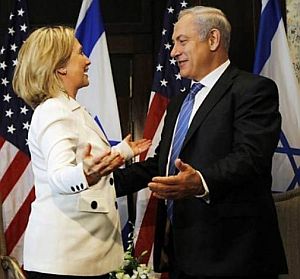
hillary-bibiIn case anyone has the slightest doubt whether Hillary Clinton is running for president in 2016, read her interview with Jeffrey Goldberg in the Atlantic.

She dutifully supports every position the Israel lobby demands and even deftly conjures up a rhetorical connection between jihadists and the nuclear threat from Iran, introducing a piece of non-proliferation jargon into counterterrorism when she refers to the breakout capacity “of jihadist groups that can affect Europe, can affect the United States.”

For a few neocons in Washington who are indulging in fantasies about their political rehabilitation, much of what Clinton says, must be music to their ears. She shares the view frequently expressed by Israel apologists during its assault on Gaza, that Israel is getting more criticism than it deserves.

When it comes to killing Palestinian civilians, Israel still suffers from its “old PR problem.” Indeed, hundreds of dead children always cause a PR problem.

Hillary Clinton: [W]e do see this enormous international reaction against Israel, and Israel’s right to defend itself, and the way Israel has to defend itself. This reaction is uncalled for and unfair.

Jeffrey Goldberg: What do you think causes this reaction?

HRC: There are a number of factors going into it. You can’t ever discount anti-Semitism, especially with what’s going on in Europe today. There are more demonstrations against Israel by an exponential amount than there are against Russia seizing part of Ukraine and shooting down a civilian airliner. So there’s something else at work here than what you see on TV.

And what you see on TV is so effectively stage-managed by Hamas, and always has been. What you see is largely what Hamas invites and permits Western journalists to report on from Gaza. It’s the old PR problem that Israel has. Yes, there are substantive, deep levels of antagonism or anti-Semitism towards Israel, because it’s a powerful state, a really effective military. And Hamas paints itself as the defender of the rights of the Palestinians to have their own state. So the PR battle is one that is historically tilted against Israel.

JG: Nevertheless there are hundreds of children —

HRC: Absolutely, and it’s dreadful.

JG: Who do you hold responsible for those deaths? How do you parcel out blame?

HRC: I’m not sure it’s possible to parcel out blame because it’s impossible to know what happens in the fog of war. Some reports say, maybe it wasn’t the exact UN school that was bombed, but it was the annex to the school next door where they were firing the rockets. And I do think oftentimes that the anguish you are privy to because of the coverage, and the women and the children and all the rest of that, makes it very difficult to sort through to get to the truth.

There’s no doubt in my mind that Hamas initiated this conflict and wanted to do so in order to leverage its position, having been shut out by the Egyptians post-Morsi, having been shunned by the Gulf, having been pulled into a technocratic government with Fatah and the Palestinian Authority that might have caused better governance and a greater willingness on the part of the people of Gaza to move away from tolerating Hamas in their midst. So the ultimate responsibility has to rest on Hamas and the decisions it made.

That doesn’t mean that, just as we try to do in the United States and be as careful as possible in going after targets to avoid civilians, that there aren’t mistakes that are made. We’ve made them. I don’t know a nation, no matter what its values are– and I think that democratic nations have demonstrably better values in a conflict position — that hasn’t made errors, but ultimately the responsibility rests with Hamas.

Facebooktwittermail

A piecemeal parochial approach won’t solve the Middle East crisis

Chris Doyle writes: “The lamps are going out all over the Middle East”, to update Sir Edward Grey’s doom-laden warning to Europe a hundred years ago. The areas of calm and stability seem like small oases in a multitude of firestorms. Many areas are literally without lights. Gaza has around two hours electricity a day. The power cuts in Yemen are worse and worse, leading to major protests. But, more worryingly, the lights of the democratic, liberal, pluralistic forces that for many months in 2011 lit up the region are also dimming, overshadowed by the twin forces of brutal dictatorship and brutal religious sectarian extremism.

Syria and Iraq are divided and near ungovernable, in the waiting room for failed-state status. The so-called Islamic caliphate or Isis, which in reality bears no resemblance to any caliphates of the past, covers an ever-expanding area, larger than the United Kingdom, including 35 per cent of Syria. Libya is being terrorised by rival militias. Palestinians in Gaza, for the fourth time since 2006, are at the wrong end of an Israeli military aggression that pits one of the world’s most sophisticated militaries against a captive population inside the world’s largest prison. The collective pile of rubble from these conflicts would grace a mountain range.

Those states and areas that enjoy calm become refugee camps. Lebanon and Jordan host almost two million Syrian refugees between them, as well as 2.5 million Palestinians. Tunisia is confronted with a mass Libyan exodus; while Iraqi Kurdistan is home to more than 300,000 Iraqis displaced only since June, as well as 220,000 Syrian refugees. In each case, the numbers are rocketing up – with the number of Syrian refugees alone expected to reach four million by the end of the year. Each humanitarian appeal is underfunded.

Will it get worse? The signs are worrying. The fighting in Lebanon last week, in Arsal in the north Bekaa valley, is yet another example of why the Syrian crisis threatens to move from spilling over, to swamping, its smaller neighbour. The instability could spread to Jordan. Saudi Arabia and the Gulf states will not be immune to the regional changes.

Given the epidemic of crises in an area of the world vital to our trade, energy and security interests, the minimal expectation would be an energetic and engaged response. Yet, when asked about Western policy towards the region, my instinctive response is, “There is one?”

The failure is first and foremost one of leadership, at an international and regional level. Who are great international statesmen in the West or in the Middle East? Who do young Arabs, who make up most of the population, look to for inspiration? President Obama has been blasted for his indecisiveness but he is not alone. George W Bush and Tony Blair were decisive over Iraq and destroyed the country. There is no strategy, and often the debate is reduced to a question of to bomb or not to bomb. [Continue reading…]

Facebooktwittermail

How the #Israeli discourse on terrorism seeks to justify blatant #WarCrimes

Rémi Brulin writes: Appearing on CNN a few days into the current offensive in Gaza, Israeli Prime Minister Benjamin Netanyahu described Hamas as “the worst terrorists, genocidal terrorists.” He said they want to “pile up as many civilian dead as they can,” and, he added, to “use telegenically dead Palestinians for their cause.”

By contrast, Israeli strikes are said to be aimed at the “terrorists,” who are by definition legitimate targets. Any civilian casualties that may result from such uses of force are unintentional, and in fact should be blamed squarely on Hamas. Indeed, Netanyahu explained, not only do they target civilians but they also “hide behind civilians,” thus committing “a double war crime.”

According to this narrative, often embraced in toto by elected officials and political commentators in the United States, “terrorism” is a very clear, non-controversial concept. “Terrorism” is the use of violence against civilians for political purposes.

This discourse on “terrorism” is a deeply moral discourse, one that makes important normative claims about a given conflict and the parties to it.

It draws its power from a simple claim: what separates “us” from “them” is a fundamental conception of the value of innocent life. “We” respect innocent lives, demonstrated by our refusal to target civilians. In stark contrast, not only are “the terrorists” more than willing to hurt our civilians, but they also hope that we will kill theirs too.

The discourse on “terrorism” is thus an essentialist discourse: it claims to say something about the very essence of “the enemy” (cue recurring references to “barbarism”) and, consequently, about us (and our “civilized” values.)

On closer inspection however, this discourse fails precisely where it claims to be strongest. Israel’s actual practices, informed by its combat doctrine, are fundamentally at odds with how international law defines the concept of “civilian.” In actual fact, the discourse on “terrorism” and the practices it informs and justifies drastically erode the distinction between civilian and combatants as commonly understood in International Humanitarian Law. [Continue reading…]

Facebooktwittermail