Christoph Reuter reports: The St. Lucie cherry trees were in bloom when the calamity began. It was not unexpected. Indeed, the men of Korin and surrounding villages had done their part to bring it about. Since winter, after two years of an almost static front line, they quickly overran several of the Syrian army’s last outposts in the Idlib Province. And soon after regime troops fled the eponymously named provincial capital at the end of March, the bombs arrived. It is a pattern that has often been seen in Syria: Soon after rebels take an army base, an airport or a city, the air force arrives to pound them from above.
For weeks, regime helicopters circled at an altitude beyond the range of rebel weapons and repeatedly dropped half-ton barrel bombs on Korin. On at least one occasion, a cylinder full of chlorine gas outfitted with detonators was dropped on the village, which is located some 40 kilometers (25 miles) south of the Turkish border. Sukhoi jets appeared between the clouds and fired rockets at those buildings that were still intact. Thirty-one people died — a number smaller than it might have been because the residents of Korin, accustomed as they are to fleeing violence, had retreated to the olive groves that surround the village when the first bombs started to fall. For a while, they lived in tiny shacks among the trees — shelters that had been built in more peaceful times.
The air strikes began to wane around the time when the olive trees bloomed. The jets were needed elsewhere; additional villages were in need of punishment. And in Korin, the villagers returned from the olive groves. Soon, around three-quarters of the erstwhile population of 11,000 were again living in the town, collecting stones and organizing cement and tarps to repair their homes. If the war weren’t still going on, one could almost have called it a peaceful summer.
It was the calm between the storms — a fragile calm, not unlike that of a tiny boat on the high seas. After all, Korin and the entire region surrounding it, with hundreds of towns and villages, have been living for almost four years in a state of anarchy.
It is almost as though someone had devised a wicked experiment to see what happens when everything that serves public order is suddenly removed. When police, courts and indeed the entire state simply disappears without a new one replacing it. And when the old state reappears periodically to spread death and destruction. It is a situation reminiscent of End Times science fiction tales in which marauding hordes find themselves in a constant battle for fuel, water and women. But what is it really like? [Continue reading…]
Category Archives: Lands
Iran sanctions: Middle East stock crash wipes £27bn off markets as Tehran enters oil war

The Telegraph reports: Stock markets across the Middle East saw more than £27bn wiped off their value as the lifting of economic sanctions against Iran threatened to unleash a fresh wave of oil onto global markets that are already drowning in excess supply.
All seven stock markets in the Gulf states tumbled as panic gripped traders. London shares are now braced for a second wave of crisis to hit when they open on Monday morning after contagion from China sent the FTSE 100 to its worst start in history last week.
Dubai’s DFM General Index closed down 4.65pc to 2,684.9, while Saudi Arabia’s Tadawul All Share Index, the largest Arab market, collapsed by 7pc intraday, before recovering to end down 5.44pc at 5,520.41, its lowest level in almost five years. [Continue reading…]
Prisoner swap: Obama’s secret second channel to Iran
Robin Wright writes: urteen months ago, President Obama authorized a top-secret, second diplomatic channel with Tehran to negotiate freedom for Americans who had disappeared or been imprisoned in Iran. It was a high-risk diplomatic gamble. The initiative grew out of nuclear negotiations, launched in the fall of 2013, between Iran and the world’s six major powers. On the margins of every session, Wendy Sherman, the top American negotiator, pressed her Iranian counterparts about the American cases. The Iranians countered with demands for the release of their citizens imprisoned in the United States for sanctions-busting crimes. More than a year of informal discussions between Sherman and her counterpart, Majid Takht Ravanchi, the Iranian Foreign Ministry official in charge of American and European affairs, led to an agreement, in late 2014, that the issue should be handled separately — but officially — through a second channel. After debate within the Administration, Obama approved the initiative. But it was so tightly held that most of the American team engaged in tortuous negotiations on Iran’s nuclear program were not told about it.
What heightened the risk was the fact that the new Iranian team was headed by a senior intelligence official, a sharp departure from the traditional but still tentative diplomatic channels with the Iranian Foreign Ministry developed in the nuclear talks. The involvement of Iranian intelligence made prospects far more unpredictable — and potentially controversial. Brett McGurk, a senior State Department official, headed the small American team, which also included officials from the Department of Justice, the F.B.I., and the intelligence community. The meetings — facilitated by the Swiss government and often held in Geneva — repeatedly hit snags, complications, legal hurdles, and last-minute demands. The swap — officially referred to as a “humanitarian gesture” — came close to fruition three times over more than a year of secret meetings, only to collapse again and again, an Iranian official said. [Continue reading…]
Old myths perpetuate poor analysis of Saudi Arabia
Hassan Hassan writes: Economic sanctions on Iran have been lifted. The removal of sanctions, which will release billions of dollars worth of frozen assets and bring Iran in from the cold, comes exactly two weeks after a diplomatic spat with Saudi Arabia brought the region to boiling point.
Both of these events could have profound international implications for Saudi Arabia. After the diplomatic row, the kingdom came under fierce media attack and was generally portrayed as an irresponsible regional player that deliberately provoked Iran by executing the Saudi religious cleric Nimr Al Nimr. Such depictions do not bode well for the kingdom as it prepares for the entry of a regional rival into the international arena.
Broadly speaking, much of the punditry about Saudi Arabia and the Gulf states at large tends to rely on old facts and myths – mostly dating back to the 1990s.
Perpetuating old stereotypes about Saudi Arabia’s foreign policy ignores the progress –and indeed the drastic changes – that have taken place over the past decade. More importantly, they also reduce Iran’s role in the neighbourhood to a geopolitical rivalry with its neighbours, rather than casting this role in its true light, as an aggressive sectarian agenda that claimed the lives of thousands of people and perpetuated conflict and civil strife.
To better understand Iran’s behaviour, consider the policies of the two countries since the eruption of the Arab uprisings five years ago. [Continue reading…]
American victim of Cologne sex attacks recounts how she was rescued by Syrian refugees
At the core of Christianity is the commandment to “love your neighbor as you love yourself,” so you’d think that in a country with so many loudly professing Christians, there really wouldn’t be any debate about whether America should welcome refugees.
Indeed, when it came to clarifying who should be described as a neighbor, Jesus chose to illustrate this teaching through a parable that cast a Samaritan — considered by most Jews at that time as an enemy — as the exemplar of the principle of universal love.
The teaching doesn’t go: love your neighbors after they’ve been vetted by the FBI, so long as you’re sure they’re Christian, and so long as you own a gun to protect yourself.
After the mass sex attacks in Cologne helped fuel a new round of anti-refugee hysteria, a Good Samaritan story has emerged in which a 27-year-old American woman recounts how she was saved that night by the intervention of strangers — a group of men who turned out to be Syrian refugees.
The New York Times reports: Caught up in a melee of drunken revelers outside the Cologne train station on New Year’s Eve, Caitlin Duncan, a neuroscience student from Seattle, was terrified. She had somehow gotten separated from her German boyfriend, who had both their cellphones and her wallet. Ms. Duncan, 27, said that she was quickly surrounded and groped by several young men: One snatched her hat from her head, another tried to kiss her face and neck.
Like many of the hundreds of women who later said they had been assaulted in the crowd, Ms. Duncan sought help from the police, but said the officers were too busy trying to clear the square. But unlike other victims, whose complaints of attacks by foreigners of North African and Arab descent have ignited new debate about Germany’s ability to absorb migrants, Ms. Duncan said she was rescued by a group of Syrian asylum seekers.
Amid the swirl of criminal chaos, it seems, there were also acts of chivalry.
As the crowd swelled and grew more unruly, Ms. Duncan said, a stranger came up and asked if she needed help. Both of them spoke broken German, so the stranger summoned a friend who spoke English. He was Hesham Ahmad Mohammad, from Aleppo, Syria, who had met up in Cologne for the holiday with six or seven other Syrian refugees scattered around Germany.
The men offered Ms. Duncan money for a taxi to her boyfriend’s parents’ home: “the only address I knew,” she said. They would happily have called her boyfriend, Sebastian Samer, but Ms. Duncan had relied on speed-dial and could not remember the number. “I know there’s a lot of 7s,” she thought, “but that’s not helping me right now.”
She persuaded the men to form a kind of cordon around her so they could move through the crowd. She described her boyfriend to them, and they eventually found him inside the station. She cried. “I was just so relieved,” she recalled later.
Mr. Ahmad Mohammad, a former primary-school teacher, said he had left Aleppo, a scene of tremendous fighting in the Syrian civil war, in 2014 for Turkey, and had arrived in Germany via the Balkans and Austria in September. He said he had left his wife and two sons in a village near the Syrian-Turkish border and was living in a small town near Cologne with two other Syrians, studying German as he awaited asylum.
He said in a telephone interview on Friday that he and his friends had also felt unsafe on New Year’s, and blamed “bad boys” who were “drinking, and I think taking marijuana or something. They lost their minds.” Now, they worry that Germans and other Europeans are drawing conclusions that will make it harder for new arrivals. [Continue reading…]
‘Death to Christians, enemies of Israel’ — Hebrew graffiti defacing Jerusalem monastery

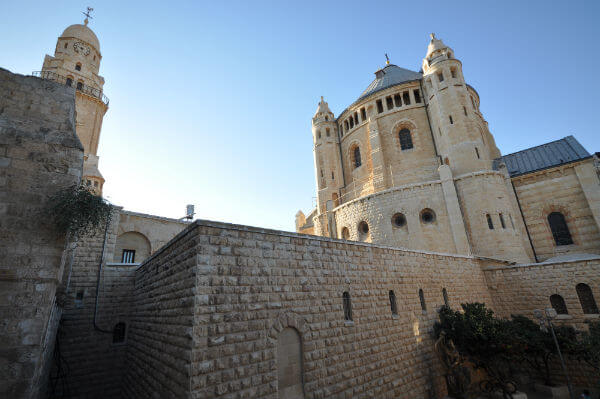
Reuters reports: Israel ordered a high-priority police investigation on Sunday into anti-Christian messages scrawled in Hebrew on the walls and doors of a Jerusalem monastery, saying they marked an assault on religious harmony.
“Idols will be extirpated” – a line lifted from the Jewish prayer service – and “Christians Go to Hell” were among graffiti left outside the Dormition Abbey with felt-tip pens. The varying handwriting suggested several vandals had been involved.
The Benedictine monastery, on Mount Zion in the Old City, is near a site where many Christians believe Jesus held the Last Supper as well as a tomb revered as the last resting place of the biblical King David and which draws many Jewish worshippers.
“We will not let anyone undermine religious coexistence in Israel,” Internal Security Minister Gilad Erdan said in a statement, adding that police would put a high priority on “nabbing those who carried out this despicable act”.
Israel has been struggling with a spate of hate crimes by suspected Jewish ultra-nationalists targeting Christian sites as well as Palestinians and Israeli human rights activists. [Continue reading…]
The Times of Israel: “Despite promises by the government, these incidents continue to happen,” Wadia Abu Nasser, the executive director of the Assembly of Catholic Bishops in the Holy Land, railed Sunday morning. “If we were to actually count all of these incidents, they’d be in the hundreds.
“We have limited resources at our disposal. It’s the state’s responsibility to not only apprehend these perpetrators, but to make the necessary changes in the education system to educate against this sort of thing,” he told Army Radio. [Continue reading…]
Ynet adds: “The inscriptions are not only against Jesus the Messiah, but also call to slaughter the Christians and send them to hell! How long will these acts of vandalism continue?” the church said.
“This is the area of our convent, which until today is not monitored by police cameras, although this has been promised to us in the summer of 2013 by the Israeli security authorities after the cars of the monastery were badly damaged and several hate graffiti were discovered.”
The Domition Abbey further complained of “aggressive gathering with loud music and chanting by Jewish right-wing radicals in our immediate neighborhood in the area of the Tomb of David” almost every weekend for the past three years. [Continue reading…]
In 2011, I posted a collection of articles under the headline, “Being spat at remains part of life for Christians in Jerusalem.” This included reports from Haaretz, the Jerusalem Post, and The Forward. Attacks on Christians were described by Eric J Greenberg in 2004 as what has been “Jerusalem’s dirty little secret for decades.”
Last month I received a message from a reader claiming that these incidents are being used “as a stick to beat all Jews,” to which I responded:
In none of the reports cited — all reports made by Jewish journalists — is the behavior of “young Jewish bigots” in Jerusalem portrayed as representative of Jews as a whole. At the same time, this phenomenon doesn’t sound like something that deserves being ignored — especially if the Jerusalem Post reports that the attacks on Christians are not rare but are in fact “habitual.”
Israel’s Minister of Public Security, Gilad Erdan, says:
“We will show zero tolerance to whomever harms the democratic foundations of Israel and its freedom of religion and we will apprehend those who carried out this heinous act.”
How can anyone take seriously this claim that the Israeli government has “zero tolerance” for these types of attacks on religious freedom when it has been clearly documented that they have been going on for decades?
This isn’t just a domestic political issue for Israel, or reason for Israeli leaders and business owners to be concerned about the impact on tourism.
If a blind eye has been turned towards these hate crimes, it most likely also includes that of American Christian Zionists who are more closely aligned with right-wing Israelis than they are with fellow Christians in the Holy Land.
Prime Minister Benjamin Netanyahu considers Christians United for Israel “to be a vital part of Israel’s national security.”
I guess for CUFI and Netanyahu, the latest anti-Christian incident in Jerusalem will be a cause for little more than mild and fleeting embarrassment.
Yes, Saddam laid the groundwork for the emergence of ISIS
Kyle Orton writes: About three weeks ago I wrote a piece for The New York Times explaining the evolution of Saddam Hussein’s regime away from the hard-secularism of its Ba’athist origins, and how this had prepared the ground for the Islamic State (IS). I received much positive feedback, but the social media reaction was inevitable: little thought and much anger, particularly from people who view Iraqi history through a political prism and felt I was trying to exculpate George W. Bush. With rare exceptions, the critique could hardly be called thoughtful. So it is nice to finally have such a critique to deal with, from Samuel Helfont and Michael Brill in today’s Foreign Affairs.
To dive right in: the authors contend that their “rigorous study” of the Saddam regime records “has found no evidence that Saddam or his Baathist regime in Iraq displayed any sympathy for Islamism, Salafism, or Wahhabism.” As the authors note, even those who see Saddam’s regime having Islamized note the anti-Wahhabi component to the Faith Campaign. But the authors are unconvinced by the distinction between Salafism and Wahhabism. Saddam was “equally antagonistic toward them,” Helfont and Brill write. Later in the piece, however, the authors note: “Domestically, Saddam also opposed Islamism and those promoting any other version of Islam than his own.” Exactly.
In what I wrote in The Times, I said: “In the Sunni areas … the [Faith] campaign was effective, creating a religious movement I call Baathi-Salafism, under Mr. Hussein’s leadership.” I have previously written of this aspect of the Faith Campaign, dealing with the claim that it was really anti-religious because it involved the infiltration and even assassination of leaders of the religious trend that (I think the evidence shows) Saddam had aligned with. This is about Saddam’s approach to power, not his ideology:
Of course Saddam’s regime infiltrated the Salafi Trend and tried to bring it under control … Saddam still believed that only his movement was the true one, even if others were complementary. In a regime where the intelligence agencies spied on one-another, Saddam’s approach to the Salafi Trend is hardly a surprise. The Salafi Trend largely made its peace with the Islamized Saddam regime but it remained independent of the regime, and therefore a possible threat.
Or, as Amatzia Baram put it, “For Saddam the defining question was whose religious activities were to be targeted. … He was not at all suspicious [of religious activities], provided those activities were his.”
The authors contend,
Saddam had expressed the desire to instrumentalize these Baathist views on Islam as far back as the 1970s, but it was not until the 1990s that his regime developed the institutional capacity to teach its Arab nationalist version of Islam and the security architecture to ensure that doing so did not unintentionally aid hostile religious movements. The maturation of these capabilities rather than ideological shifts was the basis of the Faith Campaign.
This is exactly the wrong way around. When the Ba’ath regime was powerful enough in the early 1970s — after it was stabilized from the 1968 coup — that was when it showed its stern secularism and even what Baram calls “implied atheism”. The construction of a giant statue of the Abbasid poet Abu Nuwas, whose verse consists primarily of homoeroticism and wine, in 1972 cannot have been other than to provoke the traditionalists (see especially the bucket-sized wine glass in the statue’s hand). The Ba’ath was at this time also competing with the Communists for the urban intelligentsia and its high-brow produce, namely the magazine, “The Arab Intellectual,” produced in Baghdad between 1970 and 1975, laid the implied atheism on thickly, with its references to “science” and “progress” and a cosmological design that conspicuously didn’t mention god. It was during the war with Iran, when the Grand Ayatollah Ruhollah Khomeini’s propaganda calling Saddam an “infidel” was finding an audience inside Iraq, not least because Iran was winning on the battlefield, identifying Islam with power as well as right, that Saddam turned to Islam for legitimation. This intensified after the crushing defeat in Kuwait. The Islamization of Saddam’s regime was, among many other things, a profound admission of failure. [Continue reading…]
Ramadi — another city destroyed in an effort to save it from ISIS
The Associated Press reports: So complete was the destruction of Ramadi that a local reporter who had visited the city many times hardly recognized it.
“Honestly, this is the main street,” Amaj Hamid, a member of Iraq’s elite counterterrorism forces, told the TV crew as they entered from the southwest.
He swerved to avoid the aftermath of months of fighting: rubble, overturned cars and piles of twisted metal. Airstrikes and homemade bombs laid by the Islamic State group had shredded the poured-concrete walls and ceilings of the houses and shops along the road.
Ramadi, once home to about 500,000 people, now largely lies in ruins. A U.N. report released Saturday used satellite imagery to assess the devastation, concluding that more than 3,000 buildings had been damaged and nearly 1,500 destroyed in the city 70 miles (115 kilometers) west of Baghdad.
All told, more than 60 percent of Anbar’s provincial capital has been destroyed by constant air bombardment and the scorched-earth practices of IS fighters in retreat, according to local estimates. [Continue reading…]
Burkina Faso attack demonstrates al Qaeda revival in Africa
CNN reports: Al Qaeda in the Islamic Maghreb, often seen as a fractured and undisciplined group, apparently has carried out its second major terror attack in two months — claiming more than 20 lives in the assault on a luxury hotel and two other targets in Ouagadougou, the capital of Burkina Faso.
The gun attack on the Splendid Hotel bears many similarities to that on the Radisson Blu hotel in Bamako, Mali, on November 20 in which 22 people were killed.
Both targets were popular with Westerners and international (especially U.N). officials; they were “soft,” rather than military installations or police stations. The attackers (two in Bamako, possibly four in Ouagadougou) were armed with automatic weapons, their aim to kill and then take as many hostages as possible.
And both operations apparently were carried out by an AQIM group called Al Mourabitoun.
The group’s statement after the latest attack claimed the Splendid Hotel was “frequented by staff of the nations of global disbelief;” the attack was “to punish the cross-worshippers for their crimes against our people in Central Africa, Mali, and other lands of the Muslims.” [Continue reading…]
Mokhtar Belmokhtar, ‘The Uncatchable’ desert jihadist
AFP reports: Wily one-eyed Mokhtar Belmokhtar, whose jihadists have claimed the attack on a hotel in Burkina Faso, shot to global notoriety with a spectacular assault on an Algerian gas field in 2013, but had long been known as “The Uncatchable”.
Washington has offered a $5 million (4.7 million euros) bounty for the 43-year-old, born and bred in the Algerian desert, and of all the jihadist leaders in the Sahel region straddling the southern Sahara, it is Belmokhtar who is most wanted.
He was behind the 2013 attack on the In Amenas natural gas complex in the remote south of his homeland, in which 39 hostages and 29 Islamists were killed.
And his Al-Murabitoun group, an Al-Qaeda affiliate, also claimed responsibility for the jihadist siege at the Radisson Blu hotel in Mali’s capital Bamako that left 20 dead in November, including 14 foreigners. [Continue reading…]
U.S. accepted 2,500 Syrian refugees over four years while Canada took in more in just two months

The New York Times reports: Among the Obamas’ guests at the State of the Union address on Tuesday was Refaai Hamo, a middle-aged widower with sunken eyes, a side-swept mop of silver hair and a harrowing account of losing his wife and his daughter in an air raid over his home in Syria.
His presence in the gallery was meant to send a signal to the world that the United States — or at least this administration, in its last year in the White House — believes that people like Mr. Hamo deserve a chance to restart their lives in this country.
“The world respects us not just for our arsenal,” President Obama said in his address. “It respects us for our diversity and our openness.”
The gesture raised an obvious question: Has the United States lived up to its idea of itself as a haven for those fleeing war and persecution?
The numbers offer a partial answer, and they reflect the acute dilemmas that confront countries worldwide amid a historic global crisis.
The United Nations says that an estimated 20 million people around the world, half of them children, have fled their home countries because of conflict or persecution. The war in Syria is now the single largest source of new refugees, casting about 4.4 million Syrians out of their country since the conflict began nearly five years ago.
But unlike in 1951 — when the international refugee convention was forged in the aftermath of World War II, requiring countries to offer protection to those scattered by war and persecution — the political calculus for world leaders has sharply shifted. The costs of taking in refugees have grown and the payoffs, many feel, have diminished.
First, the numbers.
The United States has taken in around 2,500 Syrian refugees since 2012, shortly after the war began.
Canada took in more than that in the last two months of 2015 alone.
Brazil has offered what it calls “humanitarian visas” to three times as many Syrian refugees as the United States has accepted — 7,380 at last count by the United Nations refugee agency.
Switzerland has issued 4,700 special-category visas for Syrians who have family in the country. And Australia, which has come under international criticism for turning away boats of potential refugees from South and Southeast Asia, has said it will take 12,000 from Syria and Iraq.
Germany is in a category of its own, with Syrians making up the largest single group (428,500) of the 1.1 million people who were registered as refugees and asylum seekers there in 2015. [Continue reading…]
Fearmongering around Muslim immigrants echoes anti-Asian hysteria of past
Murtaza Hussain writes: On May 6, 1882, U.S. President Chester Arthur signed into law the Chinese Exclusion Act, the first in a series of discriminatory legal measures aimed at curbing immigration from Asia. Speaking at the time of its passage, California Sen. John F. Miller, a leading proponent of the law, declared that the Chinese were “an inferior sort of men” and that “Chinese civilization in its pure essence appears as a rival to American civilization. It is a product of a people alien in every characteristic to our people, and it has never yet produced and can never evolve any form of government other than an imperial despotism. Free government is incompatible with it, and both cannot exist together.”
There are echoes of Miller’s demagoguery, and of contemporaneous warnings about the supposed “Yellow Peril” posed by East Asians, in the warnings politicians and prominent media figures issue today about allegedly unassimilable immigrants and refugees from Muslim countries.
“The type of rhetoric we’re seeing today about Muslims is both very similar and also slightly different from that which was used to describe Asian immigrants in the past,” said University of Minnesota professor Erika Lee. A specialist in immigration studies, Lee is also author of the 2015 book The Making of Asian America, which chronicles in part the anti-Asian sentiment that new arrivals often had to contend with. “Like Muslims, Asian immigrants were characterized as a slowly creeping civilizational threat to the security and integrity of the United States, but today, with Muslims, there is also the additional allegation that they have a violent intent to overthrow the existing order.” [Continue reading…]
It’s official: Sunnis joining Iraq’s Popular Mobilization Units
Mustafa Saadoun reports: Sunnis are saying “sign me up” now that Iraqi Prime Minister Haider al-Abadi has approved the appointment of 40,000 Sunni fighters to the Popular Mobilization Units, a force that was once almost exclusively Shiite.
Samer al-Hamdani, who in 2014 fled from Baiji in northern Iraq to Baghdad, says he is ready to return to his liberated city and join up. He told Al-Monitor, “It is essential for the Popular Mobilization Units to include Iraqis of all spectra for it to become a national institution able to earn everybody’s approval and respect, away from sectarian labels.”
He added, “The presence of 40,000 Sunni fighters creates an important and necessary balance within the Popular Mobilization Units. But we hope the politicians’ positions and statements avoid sectarian incitement, so as not to offend the [group], which must be excluded from interventions and conflicts between the political blocs.” [Continue reading…]
Russia accused of deliberately targeting civilians in Syria
The Guardian reports: Russia is breaching all the norms of war by deliberately targeting rescue workers, schools and hospitals in Syria, the UK foreign secretary has claimed, accusing the Russians of running return raids on targets inside Syria solely to hit civilian rescue workers.
Philip Hammond levelled his charges after meeting Syrian civil defence workers in Adana, southern Turkey. The rescue workers are being trained by the Turks to extract the injured and dying from the rubble of buildings struck by Syrian regime bombs or Russian raids.
In probably his toughest condemnation of Russian tactics since Vladimir Putin surprised the west by intervening militarily in Syria at the end of September, Hammond said: “The Russians are deliberately attacking civilians, and the evidence points to them deliberately attacking schools and hospitals and deliberately targeting rescue workers.
“If you go back for a second strike you know what you are doing.”
The west has long argued Russia is not targeting Islamic State but instead opponents of the Assad regime, but this is the furthest Hammond has gone in condemning the tactics of Russian pilots. [Continue reading…]
What it’s like to live in the capital of the ISIS ‘caliphate’
Marwan Hisham (the pseudonym of a Syrian resident of Raqqa) writes: The Islamic State has worked hard to isolate Raqqa from the rest of the world. A few months ago, residents were deprived of Wi-Fi signals inside their homes, as the group had the signal extenders placed on rooftops removed. On Nov. 18, satellite Internet was banned, and Internet cafes were ordered to close. If the cafe wishes to reopen, it needs to gather two recommendations from Islamic State security forces, with their emirs’ signatures. You’ll need a license from the Islamic State’s intelligence office as well.
The Islamic State always describes any hardship or new restriction as resulting from the sins of those afflicted, and the Friday sermon that followed this decision was no exception. “People disobey God, and as such God inflicts upon them suffering,” a fighter preached.
However, it’s not only the Islamic State’s god who is dissatisfied. Raqqa’s citizens not only suffer from the group’s orders, but also the international war effort against it. Air raids have become practically a daily routine. On Nov. 3, the Russians joined the party. And then the French. Airstrikes damaged the main bridge on the Euphrates used by residents to enter the city and destroyed the other minor ones. It took an hour’s drive to get to the opposite bank. The West speaks of the necessity of cutting off Islamic State “supply routes,” but these are not Islamic State bridges — they are bridges used by everyone in Raqqa.
And yet, somehow life still goes on. Muhammad, who is 31 years old and displaced from Aleppo, and his fiancee are preparing for their wedding, as if in private defiance of the incredible challenges the world has thrown at them. A cousin’s little daughter reads a 9th-grade French book, trying to understand a single word.
Yet, when the jet fighters interrupt, all eyes turn to the sky. Everything here is a target, because the Islamic State is everywhere. But once the bombs are dropped, people go back to what they were doing. It’s no longer a moment of reflection about life and death, nor a moment of curiosity about what happened: It’s something that has no ending. [Continue reading…]
In the New York Times, Hisham writes: The Islamic State gives people one choice: Escape your poverty by fighting for us. The world has to offer people living under the Islamic State better choices. Stop the Assad government from bombing markets and bridges, and its Russian allies from bombing civilian infrastructure, as happened recently when a Russian airstrike reportedly hit a water main, cutting off water for the entire city.
Most of all, don’t dismiss as terrorists the citizens of occupied cities just because they were too poor to leave when the Islamic State took over. The people under this occupation present the best hope for destroying the jihadists. Without their support, the Islamic State can hardly be defeated. [Continue reading…]
Istanbul suicide bomber went from dental school to ISIS
BuzzFeed reports: The man who blew himself up in Istanbul on Tuesday, killing 10 people, was a former dental student and member of ISIS who may have initially planned to carry out the attack on New Year’s Eve, sources told BuzzFeed News.
Nabil Fadli went from student at Aleppo University to anti-government rebel before casting his lot with ISIS radicals, people who knew him said.
“We fought for our revolution, but they wanted to build their Islamic state,” said one former rebel who fought alongside Fadli against the brutal government of Syrian President Bashar al-Assad, requesting anonymity because he feared retaliation from ISIS for speaking to the press. “We thought he was a good guy, but he’s a son of a bitch.”
Turkish authorities are still working to piece together a profile of Fadli, who entered the country as a refugee before attacking the heart of Istanbul, ratcheting up Turkey’s conflict with ISIS. But interviews with those who knew him in Syria provide new details about his path to terror — one that has become all too common over the course of the war.
They were still trying to come to grips with Fadli’s attack, which they saw as not only an act of terror, but also a bid to demonize 2 million of his countrymen who have been forced to take refuge in Turkey. “I was shocked when I heard what he did in Istanbul,” said Mohammed Bakir Hussein, who recalled studying with Fadli at Aleppo University, describing him as a well-liked student, quiet and conscientious. “It’s a very terrible thing.”
“He did it to make problems for the refugees,” the former rebel said. “He killed 10 people, but he put the 2 million Syrians in Turkey at risk.” [Continue reading…]
Turkish prosecutors to investigate academics over Erdoğan petition

The Guardian reports: Turkey has launched an investigation into academics who signed a petition criticising the military’s crackdown on Kurdish rebels in the south-east that angered President Recep Tayyip Erdoğan.
More than 1,200 academics from 90 Turkish universities calling themselves “Academicians for Peace”, as well as foreign scholars, signed the petition last week calling for an end to the months-long violence.
Entitled “We won’t be a party to this crime”, the petition urged Ankara to “abandon its deliberate massacre and deportation of Kurdish and other peoples in the region”.
It was signed by dozens of foreign luminaries and intellectuals, among them the US academic Noam Chomsky and the Slovenian philosopher Slavoj Žižek. [Continue reading…]
Five years on, Tunisia’s Jasmine Revolution continues from the ground up
By Adnan Saif, University of Birmingham
Tunisians are marking five years since the culmination of their “Jasmine Revolution”. Since its longtime authoritarian leader Zine El Abidine Ben Ali was forced out of office in January 2011, Tunisia has been embarking on a long transition to constitutional democracy – a transation that, although very bumpy at times, has nevertheless led to two successful multi-party elections and a new constitution.
The award of the 2015 Nobel Peace Prize to the Tunisia National Dialogue Quartet, representing Tunisian civil society, was but one of many recognitions by the international community for the progress the country has made on its path to a stable and democratic new order.
During my many visits to Tunisia over the last four years, I witnessed the transition process through its highs and lows. My most recent visit was in August 2015, just after the terrorist attack in the coastal city of Sousse that left 38 people dead, mostly British tourists.
In spite of the tragic loss of life and the damage done to the national economy, Tunisians have developed a remarkable resilience and are able to pick themselves up and move on. That capacity is inspired in no small part by the country’s leaders, especially the two “sheikhs”, as some have now began to call them: president Beji Caid Essebsi and Rashid Al-Ghannoushi, respective leaders of the two largest political parties, Nidaa Tounes and Ennahdah.