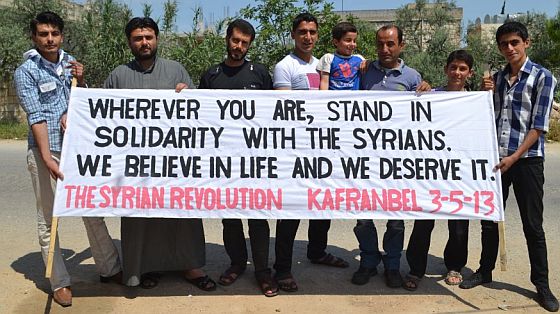
Mike Giglio reports: On March 30, 2011, around 3 p.m. in Damascus, Lawand Kiki took a seat in front of the TV in a friend’s living room and waited for Syria’s president to appear on the screen.
Bashar al-Assad had been silent for more than a week.
Dictatorships had just been toppled in Egypt and Tunisia, and NATO jets were pounding Libya. Now unrest had reared its head in Syria. Earlier that month, protests erupted the small city of Daraa, south of Damascus, after police arrested and tortured some kids who’d been caught spray-painting anti-Assad graffiti. Crackdowns on the protests there inspired more around the country. Security forces had reportedly killed dozens of protesters by the time Assad decided to speak.
Syrians across the country tuned in. Many of them saw Assad as their savior. Kiki thought the speech would be historic: Assad would show himself as the reformer he’d long claimed to be, apologizing for the bloodshed and calming the anxious nation’s nerves. This is a crisis, and he’s gonna fix it, he thought. Don’t worry. Everything’s gonna be fine.
Kiki was far from the hardened sectarian stereotype that defines Assad’s supporters today. He spent half his life in the United States, moving there at 14 when his father, a Kurdish dissident, won asylum. For the next 15 years he lived with his family in Fairview, N.J., developing a thick Jersey accent and a deep love for the U.S. But he overstayed his visa and was deported back to Syria in 2007.
The return was a shock for a guy who did a mean DeNiro impression and recited lines from Analyze This. He was arrested upon landing at the airport, by authorities suspicious of his time in the U.S. They whipped him with electric cables and beat him until his teeth cracked. Then they set him free, and he settled in Damascus, where he was jarred by the poverty and isolation — the overcrowded homes, the fact that most people couldn’t afford to own a car or even to buy meat. He quickly learned not to talk politics in a country blanketed by Soviet-style secret police. “The walls have ears,” said his family and friends.
Over time, he fell in love with the ancient city, finding peace in things like the jasmine flowers that grew from its old stone walls. He sometimes thought he felt the city breathing. In Assad — the young, Western-educated president who dined with John Kerry and mingled with people in the street — Kiki saw hope, believing the president would roll back the repressive regime handed down by his father, Hafez. Things like corruption and police abuse were the mistakes of individual people, not reflections on Assad. It has nothing to do with the president himself, Kiki would think.
Kiki also feared the demons that a push to oust Assad might unearth, as the bloody histories of Syria’s neighbors in Lebanon and Iraq cast a long shadow over its own sectarian balancing act. I don’t want this mess in my country, he thought as Assad prepared to take the stage.
In the U.S., Hillary Clinton, then secretary of state, had told reporters three days earlier that members of Congress from both sides of the aisle saw Assad as “a reformer.” His biographer, the author and historian David W. Lesch, said the jury was still out: “[I]t’s not yet clear what sort of leader Mr. Assad is going to be,” Lesch wrote in an op-ed titled “The Syrian President I Know” published in the New York Times the day before the speech. “Mr. Assad’s background suggests he could go either way.”
Frederic C. Hof, then a senior U.S. official tasked with negotiating peace between Syria and Israel, didn’t buy into Assad’s reformist image, but thought: “This is Bashar’s opportunity. He’s been talking about reform and a new Syria for nearly 11 years.”
CNN and the BBC broadcast the speech live.
As Assad approached the podium, the regime-sanctioned parliament broke into thundering applause.
“I speak to you at this exceptional moment when events and developments pose a great test to our unity,” he said. “It is a test which is repeated every now and then because of the continued conspiracy against this country.”
Assad said he was responsible for all Syrians but didn’t apologize for the violence. He spoke vaguely of reform but mentioned nothing specific. And he warned of conspiracy, again and again. “I am sure you all know that Syria is facing a great conspiracy whose tentacles extend to some nearby countries and faraway countries, with some inside the country,” he said. [Continue reading…]
Category Archives: Lands
Al-Qaeda slaughters on Syria’s killing fields
Al Jazeera reports: Al-Qaeda fighters have struck a bloody blow in scenes of medieval violence in Syria’s northern border-town of Jarabulus. Fighting came to a head on January 17, between rebel groups Liwa al-Tawhid Brigade and the al-Qaeda-linked Islamic State of Iraq and the Levant (ISIL) in the town, when reinforcements arrived from Raqqa and reclaimed the city in a brutal four-hour battle.
By nightfall, at least 10 men had been beheaded, their heads mounted on spikes, and more than 1,000 refugees fled the 3kms across the border to Turkey.
It’s a shocking turn of events for residents and Free Syrian Army (FSA) fighters alike, who just a week ago believed they were hours away from expelling the al-Qaeda group from their city altogether after surrounding the last 40 fighters in the city’s cultural centre.
But when an ISIL car bomb killed 33 people – all women and children – the FSA brigade called for backup. Instead, what arrived was a 70-car ISIL convoy from Raqqa, an ISIL stronghold 160kms to the south-east. Fighters say half of the militants wore their usual black uniform and half wore camouflage like the FSA, and were uncharacteristically clean-shaven. The disguised fighters tied white bands around their arms to distinguish themselves from the real FSA. [Continue reading…]
Where is Al Qaeda holding its Western hostages in Syria?
The Daily Beast reports: Fears for the safety of dozens of Western captives—among them journalists and aid workers—kidnapped in northern Syria by al Qaeda factions are mounting amid signs they are being moved deeper into territory firmly under jihadist sway. Private security experts and Western intelligence sources say the captives are in the process of being transported closer to the Iraqi border in an operation directed by a Chechen commander.
The movement of the captives appears to be a precaution against them being freed as a consequence of furious rebel infighting that has plunged insurgent-held areas in northern Syria into chaos in the past two weeks.
Speaking on the condition they would not be identified, private security experts working on several abduction cases say a commander called Abu Omar al Chechen, a former Georgian soldier who has sworn allegiance to the emir of the Islamic State of Iraq and Sham (ISIS), Abu Bakr al-Baghdadi, is overseeing the movement of the captives amid heavy security.
“The Westerners are being moved in groups and individually in armored vehicles,” one of the security advisers told the Daily Beast. Foreign fighters, including Saudis, are guarding them, he says. [Continue reading…]
Iran wants full nuclear deal and investment, Rouhani tells Davos
Reuters reports: Iran is determined to negotiate a comprehensive deal on its nuclear programme with major powers so it can develop its battered economy, President Hassan Rouhani said on Thursday, inviting Western companies to seize opportunities now.
Addressing the World Economic Forum in Davos, the pragmatic president said Tehran was negotiating with the United States as part of a “constructive engagement” with the world and wanted Washington to back up its words with actions.
However, a day after a chaotic Syria peace conference from which Iran was excluded, he was unbending in his support for Syrian President Bashar al-Assad. Ending “terrorism” backed by some of Syria’s neighbours was a precondition for any settlement of the country’s civil war, he said. [Continue reading…]
The kidnapping of journalists in Syria
James Traub writes: In the ancient southeastern Turkish city of Antakya,1 20 miles from the border with Syria, a plump Syrian merchant who calls himself Abu Nabil can be found most evenings drinking tea in the Bellur, a pleasant open-air cafe. Abu Nabil is the kind of mysterious middleman who germinates spontaneously in war zones. His specialty, or so he says, is arranging the release of journalists and activists kidnapped by the regime of President Bashar al-Assad in Damascus.
When I met Abu Nabil, in the first days of October 2013, he told me that he was at that very moment negotiating for the freedom of James Foley, an American freelance journalist who had disappeared the year before. I said that I had heard that Foley was held by rebels, not by the regime. Abu Nabil shot me a masterful look.
“The company” — Kroll Risk and Compliance Solutions, the private security firm working the case — “doesn’t know anything; the government doesn’t know anything; nobody knows anything,” he said, through an interpreter. “James Foley will come to his family in 15 days.”
Foley did not come to his family in 15 days; whatever hole he has been deposited in, he is there still. Abu Nabil’s tale, like so many of the narratives emerging from a vicious civil war now well into its third year, was a compound of outright lies, exaggerations, and, quite possibly, truth. The kidnapping and ransom specialists at Kroll had been sufficiently persuaded of Abu Nabil’s veracity that they dispatched two agents to Antakya, where they had spent weeks trying fruitlessly to press this Arabian Sydney Greenstreet for hard proof.
The fate of journalists kidnapped in Syria is a terrifying mystery. As of press time, at least 30 journalists, as well as a number of humanitarian actors, are languishing in captivity. In only a few cases do their colleagues or employers know where they are or who is determining their fate. In almost no cases have their captors made any effort to communicate. It is as if these unlucky men and women have simply disappeared.
The early days of the war saw a number of tragic deaths of journalists, including the Sunday Times of London’s Marie Colvin and freelance photographer Remi Ochlik, killed by regime shelling during the bombardment of Homs. And then things took an even nastier turn. On August 13, 2012, Austin Tice, an American former Marine, law student, and sometime journalist, was nabbed, apparently by the regime. Nothing has been heard from him since October 2012. Two months later, the NBC reporter Richard Engel and his team were kidnapped by what Engel described as the pro-regime militia known as shabiha. They escaped after five days when their captors drove into a rebel checkpoint. Those were just early mile markers on the road to anarchy. Today, rampant kidnapping has become the norm.
Covering wars is, of course, a dangerous job; that’s one of the things many war correspondents like about it. But Syria is dangerous in a way that is less thrilling than sickening. Stephanie Freid, who covers the war for the Chinese CCTV network, says, “I’ve never been in a bleaker, darker setting; it’s a godless place. Whenever I go in I feel like, ‘Just let me get out alive.'” While some major news organizations continue to work inside Syria, many of the world’s most experienced war correspondents — including C.J. Chivers of the New York Times, Paul Wood of the BBC, and Janine di Giovanni of Newsweek — stopped crossing into Syria in September 2013. They’re not afraid of being killed, at least no more than any sentient being would be in such a dangerous place. “I can take anything but kidnapping,” says di Giovanni.
Thus at a moment when Syria’s destiny hangs in the balance, and states opposed to Assad’s regime debate how, if at all, to support the rebels, it has become almost impossible to know what is actually happening inside the country. Though YouTube videos and citizen journalism of various bias and veracity litter the Internet, the average engaged person knows less and less about the real balance of forces, both between the regime and its opponents, and among the rebels themselves. Of course, given the actual state of chaos and internecine warfare on the ground, more coverage might not result in more support for the rebel cause.
The Assad regime has arrested journalists and probably targeted others like Colvin for death. That is what pitiless regimes do in the midst of wars. What makes Syria unique is the growing role of foreign jihadi forces among the rebels. Since the summer, the al Qaeda affiliate known as the Islamic State of Iraq and al-Sham (ISIS) has spread like a contagion across the “liberated” region of northern Syria, from Idlib in the west to Raqqa in the east. Journalists who travel there are thus all too likely to come in direct contact with al Qaeda, which rarely happened even in the wars in Iraq and Afghanistan. And al Qaeda has made clear that it views Western journalists as infidels and worse — CIA agents. They seize them not in order to get something in exchange, as criminal gangs and even “moderate” rebels brigades do. They seize them as agents of the enemy. The only mystery is why ISIS doesn’t kill them. [Continue reading…]
Testy exchange sets tone as peace talks open on Syria
The New York Times reports: Friction and acrimony broke out almost immediately on Wednesday with the start of a long-delayed peace conference on Syria, punctuated by a testy exchange between the Syrian foreign minister and the leader of the United Nations, casting doubt on the prospects for easing hostilities or even opening up emergency aid corridors to help besieged civilians.
The conference of delegates representing some 30 countries in the lakeside Swiss city of Montreux, already troubled by last-minute diplomatic stumbles, was described by Secretary of State John Kerry as a test for the international community. But the meeting had barely begun when the atmosphere grew even more charged over divisions between the United States and Russia and especially among the Syrians themselves.
The Syrian foreign minister, Walid al-Moallem, who led his country’s delegation, was openly defiant, calling Syrian insurgents evil and ignoring appeals by Ban Ki-moon, the United Nations secretary-general, to avoid invective or even yield the floor as a bell rang signaling that he had exceeded the allotted time for his remarks.
“You live in New York, I live in Syria,” Mr. Moallem snapped after Mr. Ban asked that he conclude his speech, which lasted more than 30 minutes.
After Mr. Moallem finished Mr. Ban lamented that his injunction that participants take a constructive approach to the crisis “had been broken.” [Continue reading…]
Egypt charges renowned scholar with espionage
The New York Times reports: An internationally respected Egyptian political scientist said Wednesday that prosecutors had filed espionage charges against him, making him the second such scholar targeted this month in a widening crackdown on dissent against last summer’s military takeover.
Emad Shahin, a scholar of political Islam who has taught at Harvard, Notre Dame and the American University in Cairo and edited the Oxford Encyclopedia of Islam and Politics, was charged along with several senior leaders of the Muslim Brotherhood with conspiring with foreign organizations to undermine Egypt’s national security. He is listed as defendant 33 in a lengthy criminal complaint that also names former President Mohamed Morsi, who was deposed in the takeover.
The charges against Mr. Shahin were filed more than two weeks ago, but they have come to light just as prosecutors have also charged Amr Hamzawy, a liberal political scientist and former lawmaker, with the crime of “insulting the judiciary” because he questioned a ruling against a group of Western nonprofit organizations.
Both men were among the few public critics of the bloody crackdown on Mr. Morsi’s Islamist supporters after the military takeover. Both were also fiercely critical of Mr. Morsi and the Brotherhood while they were in power, although previously Mr. Shahin had been relatively more sympathetic to the idea that the Brotherhood might play a constructive role in building a new democracy. [Continue reading…]
What killed Egyptian democracy?
Mohammad Fadel writes: On February 11, 2011, after eighteen days of protests, Hosni Mubarak resigned as President of Egypt. Now, three years later, the Egyptian security state appears to have re-established political control of the country.
Why did the democratic transition fail? Answers range widely. Some blame the poorly designed transition process, which made trust among different political groups unachievable. Others point to a lack of leadership within Egypt’s political organizations, particularly the Muslim Brotherhood. Still others focus on a devastating economic crisis that post-Mubarak governments could never address given the political divisions within the country.
These explanations are plausible and not mutually exclusive. But they all miss something important. The January 25 Revolution was also a striking failure of political theory. More precisely, it was a failure of the theories embraced by the most idealistic revolutionaries. Their demands were too pure; they refused to accord any legitimacy to a flawed transition—and what transition is not flawed?—that could only yield a flawed democracy. They made strategic mistakes because they did not pay enough attention to Egypt’s institutional, economic, political, and social circumstances. These idealists generally were politically liberal. But the problem does not lie in liberalism itself. The problem lies in a faulty understanding of the implications of political liberalism in the Egyptian context—an insufficient appreciation of factors that limited what could reasonably be achieved in the short term. A more sophisticated liberalism would have accounted for these realities. [Continue reading…]
Should the fate of Syria concern you?
The Guardian reports: The cache of evidence smuggled out of Syria showing the “systematic killing” of 11,000 detainees in Syrian jails may only be the tip of the iceberg, international aid agencies have said.
The International Committee of the Red Cross, various United Nations bodies and Human Rights Watch have repeatedly complained of having next to no access to detainees and being stone-walled by Syrian authorities despite repeated requests to visit infamous detention sites, such as Sayednaya prison in Damascus.
They said Monday’s report by three eminent international lawyers that at least 11,000 victims have been killed while in detention represents numbers in only one part of the country.
“All I know after years of trying to get access is that this is likely to eventually shock the world,” one senior official from an international body told the Guardian, on condition of anonymity. “What we have seen in the [war crimes lawyers’] report broadly reflects what we have pieced together over the past few years.”
Syrian activists say an estimated 50,000 detainees remain unaccounted for. Tens of thousands of Syrians have been held in the country’s infamous detention centres and released, often after months of deprivation and torture.
In reaction to this report, here is a sampling of the comments from readers at The Guardian. While there are a few expressions of outrage, the comments I’ve picked out are fairly representative of the prevailing sentiment.
— “Assad, while not being the best of leaders, is arguably what many Arab countries need in the face of aggressive militant fanatics.”
— “Propaganda alert somebody wants to bomb them back to the stone age”
— “we should keep out of it. We can do no good here. Any attempt to intervene will inevitably result in uncoordinated disaster.”
— “All these allegations just before the peace conference smack of propaganda and manipulation. Obama was so sure that Assad had used sarin until it was shown to be a lie. But, of course, no one in the land of the free would report it (nor the Guardian). Cry wolf too many times and many will be skeptical. The timing of this report and the fact it was sponsored by Qatar is very suspicious.”
— “I supposed they need some Anti-Assad material before the scheduled talks. One last try by Qatar and the Saudi’s to propaganda us into their view. Won’t work.”
— “the west should be backing assad in his fight against the islamists/ as bad as assad might be, he is far better than the islamists/ al qaeda would butcher far more people if they took power”
— “This is nothing to do with us. We have nothing to gain from involving ourselves in this war and we’re in no position to make things better. We need to just leave them to it.”
— “Look, I’m sorry that I’m so cynical, but it’s really not my fault. They lied us into Iraq, twice! Once using the ‘babies being thrown out of incubators’ lie and once using Curveball’s lies. They have already tried to lie us into Syria once, with what looked very much like a false flag sarin attack (in that nobody could provide any real evidence of culpability). Now they are trying a new tack.”
— “I don’t think we can trust any mainstream report on issues in the middle east and elsewhere. There are to many untrustworthy players, Saudis Israel, the US can’t be trusted on Syria. You can’t trust report coming from the other side as they are not much better. Best we stop interfering in other countries affairs and most of these problems will resolve themselves.”
— “Whilst I have no doubt that the Syrian government is responsible for atrocities in Syria, I have misgivings about this report. It seems to have come out at a very convenient time, just before the peace talks, and is sponsored by the Qatar government (who back the rebels), so is hardly subjective. Seems to be another attempt to persuade Western governments to start yet another war.”
— “Haven’t we seen regimes we backed torture their population and kill thousands without a murmur of objection from our political masters? It’s time we kept out of this type of conflict. We only make things worse for the innocents.”
Never has a war been fought in which so many lives were lost, so many families displaced, and so much destruction wrought, while an antiwar “movement” was seized by one concern alone: that the West not intervene.
Of course this isn’t really an antiwar movement since with no Western government on the brink or even considering military intervention, there is nothing to protest against.
Neither is it really antiwar, since there is much less interest in ending this war than there is in making sure it not become our war.
Look at the level of public interest in Syria as measured through Google searches since the uprising began in March 2011. The only major spike came after the Ghouta chemical attack when briefly there was the prospect of very limited Western military intervention. For about three weeks, Syria — or to be more precise, the fear of war — overshadowed America’s fascination with Justin Bieber.
I used to think that being opposed to war had something to do with wanting to make the world a better place, yet in recent years the deeply conservative underpinnings of this orientation have become increasingly evident.
When Western opponents of war look at Syria or pretty much anywhere else in the Middle East, the answer to the question — am I my brother’s keeper? — appears to be a resounding, no.
Granted, whether it’s in the geopolitical realm or within the narrow sphere of ones own life, it is always necessary to balance ones aspirations with a realistic assessment of ones capabilities. And the principal of do no harm applies just as well to international affairs as it does to medicine.
But to be able to casually dismiss a report on “industrial-scale killing” seems to have less to do with expressing humility in the face of what looks like an intractable conflict and more to do with a very mundane mentality: I’ve got enough problems of my own; I don’t need to hear about yours.
Yet it’s not as though anyone reading about the latest accounts of Syria’s horrors in The Guardian has been asked to do anything. It’s not as though we have to decide whether we might be willing to make some personal sacrifice and, for instance, accommodate some refugees.
We do indeed live in a world where for vast numbers of people the demands of everyday life make it next to impossible to pay attention to the plight of people living far away.
There are however significant numbers of people who profess a concern about social justice and in the name of some kind of global conscience, champion causes such as supporting the rights of Palestinians, yet for many, their internationalism inexplicably halts at the Syrian border.
In the name of not “starting another war” (no one bothers to explain how it’s possible to start a war half way through), the antiwar camp is content to absolve itself of all concern on the basis that in Syria there are supposedly no “good guys”; that to oppose Assad is to support al Qaeda; and because it’s not our job to solve the world’s problems.
OK. But if you think Syria looks so difficult, forget about climate change, forget about inequality, and forget about opposing war. You might as well just go fishing and forget about the world.

Assad goes into Geneva with the upper hand
Rajan Menon writes: It would certainly be wonderful if Wednesday’s peace conference in Geneva were to result in some kind of blueprint, however fragile, for winding down a Syrian civil war that is now approaching the three-year mark. The carnage has consumed some 130,000 lives — at least half of them civilians — turned 2.4 million Syrians into refugees in neighboring countries and displaced another 6.5 million within Syria itself.
Add to this devastation the children who have lost one or both of their parents, the destruction of essential infrastructure, the outbreak, actual or potential, of multiple diseases and the scarcity of basic necessities, and what’s evident is that Syria is being consumed by catastrophe. Syrians will feel its malign effects for years to come, as will people in adjacent countries, particularly Lebanon and Iraq, where Syria’s sectarian war has aggravated Sunni-Shi’a tensions.
With all of these factors in play, it appears unlikely that a substantive and sustainable resolution will be reached in this week’s “Geneva II” peace talks.
First, there’s a deep divide between the Syrian groups in exile — which claim to be the authentic voice of Syrians and have been recognized as such by many governments — and the most effective fighting forces within Syria. The former are organized as the National Coalition of Syrian Revolutionary and Opposition Forces (aka the Syrian National Coalition, SNC) and have established a provisional government — based in Turkey — as well as a Supreme Military Council. But no matter the rhetoric of the SNC and its backers in Washington and elsewhere, other opposition groups that do not answer to the SNC bear the brunt of the fighting and are therefore more consequential to Syria’s political future.
The pressure the United States has applied on the SNC to join Geneva II has further divided what was already a creaky coalition. When the SNC voted Saturday on whether to participate in the talks, about half of its members refused to vote, voted no or abstained. The dissenters worried, with good reason, that sitting down with Assad’s representatives would further erode their standing within Syria and diminish the likelihood of removing the dictator from power. [Continue reading…]
Egypt’s drift back into authoritarianism
Marc Lynch writes: Citizens of an Arab country recently went to the polls to vote in a highly-touted referendum designed to turn the page on a violent and authoritarian past. The relatively progressive new constitution — which promised multiparty democracy, expanded freedoms, and even provided for unprecedented term limits on the president — was approved overwhelmingly, with 89 percent of people voting in favor and turnout hitting 57 percent. The architects of the initiative hoped that it would restore some legitimacy to a regime that had badly lost internal and foreign approval.
Of course, the Syrian constitutional referendum of February 2012 did no such thing. And who thought that it would? In the context of a bloody civil war and the enduring oppression of a brutal authoritarian single party regime, everyone — even, probably, the most vocal pro-Assad loyalists — understood that the words on paper meant nothing.
It’s unlikely that many people thought of Syria’s farcical vote as they followed the news of Egyptians heading to the polls this week to vote on a new military-backed constitution. The official results showed that a whopping 98.1 percent of voters backed Egypt’s new charter — considerably more than in Syria’s referendum. Gen. Abdel Fattah al-Sisi’s Egypt is not Bashar al-Assad’s Syria, but the lessons from Damascus should not be lost on those seeking to parse the meaning of this referendum.
Syria’s swiftly forgotten bit of political theater helps to highlight what really matters about any constitutional referendum: Does the new document actually establish consensual and legitimate rules of the political game? That’s why Egypt’s political prisoners suffering for their political affiliation, peaceful protests, or journalism are a more crucial window into the real significance of the referendum than turnout or approval percentages. [Continue reading…]
Evidence of ‘industrial-scale killing’ by Syria spurs call for war crimes charges
The Guardian reports: Syrian government officials could face war crimes charges in the light of a huge cache of evidence smuggled out of the country showing the “systematic killing” of about 11,000 detainees, according to three eminent international lawyers.
The three, former prosecutors at the criminal tribunals for the former Yugoslavia and Sierra Leone, examined thousands of Syrian government photographs and files recording deaths in the custody of regime security forces from March 2011 to last August.
Most of the victims were young men and many corpses were emaciated, bloodstained and bore signs of torture. Some had no eyes; others showed signs of strangulation or electrocution.
The UN and independent human rights groups have documented abuses by both Bashar al-Assad’s government and rebels, but experts say this evidence is more detailed and on a far larger scale than anything else that has yet emerged from the 34-month crisis.
The three lawyers interviewed the source, a military policeman who worked secretly with a Syrian opposition group and later defected and fled the country. In three sessions in the last 10 days they found him credible and truthful and his account “most compelling”.
They put all evidence under rigorous scrutiny, says their report, which has been obtained by the Guardian and CNN.
The authors are Sir Desmond de Silva QC, former chief prosecutor of the special court for Sierra Leone, Sir Geoffrey Nice QC, the former lead prosecutor of former Yugoslavian president Slobodan Milosevic, and Professor David Crane, who indicted President Charles Taylor of Liberia at the Sierra Leone court.
The defector, who for security reasons is identified only as Caesar, was a photographer with the Syrian military police. He smuggled the images out of the country on memory sticks to a contact in the Syrian National Movement, which is supported by the Gulf state of Qatar. Qatar, which has financed and armed rebel groups, has called for the overthrow of Assad and demanded his prosecution.
The 31-page report, which was commissioned by a leading firm of London solicitors acting for Qatar, is being made available to the UN, governments and human rights groups. Its publication appears deliberately timed to coincide with this week’s UN-organised Geneva II peace conference, which is designed to negotiate a way out of the Syrian crisis by creating a transitional government. [Continue reading…]
Syria’s polio epidemic: the suppressed truth
Annie Sparrow reports: One way to measure the horrific suffering of Syria’s increasingly violent war is through the experience of Syrian children. More than one million children are now refugees. At least 11,500 have been killed because of the armed conflict,1 well over half of these because of the direct bombing of schools, homes, and health centers, and roughly 1,500 have been executed, shot by snipers or tortured to death. At least 128 were killed in the chemical massacre in August.
In the midst of all this violence, it is easy to miss the health catastrophe that has also struck Syrian children, who must cope with war trauma, malnutrition, and stunted growth alongside collapsing sanitation and living conditions. Syria has become a cauldron of once-rare infectious diseases, with hundreds of cases of measles each month and outbreaks of typhoid, hepatitis, and dysentery. Tuberculosis, diphtheria, and whooping cough are all on the rise. Upward of 100,000 children are stigmatized by leishmaniasis, a hideous parasitic skin disease that flourishes in war. Many of these diseases have already traveled beyond Syria’s borders, carried by millions of refugees. Five million more children have been forced out of their homes but are still living within Syria, increasingly vulnerable to early marriage, trafficking, and recruitment as child soldiers.
And now polio is back. Since May, Syrian doctors and international public health agencies have documented more than ninety cases of polio in seven of Syria’s fourteen administrative districts, or governorates: Deir Ezzor, Aleppo, Idlib, Hamas, Damascus, al-Hasakeh, and Ar-Raqqa. At an average age of just under two, most victims are—or used to be—literally toddlers. Few were fully vaccinated. None has had treatment to prevent paralysis from becoming permanent. All are from areas long opposed to the Assad regime, which reflects the political dimension of the outbreak. Not a single case has occurred in territory controlled by the government.
Once the most feared disease of the twentieth century, polio in most countries had long ago passed into the history books. Syria was no exception. Polio was eliminated there in 1995 following mandatory (and free) immunization introduced in 1964 after the Baath party took power.2 Yet wildtype 1 polio—the most vicious form of the disease—has been confirmed across much of Syria.
Ninety or so afflicted children may sound like a small number, but they are only a tiny manifestation of an enormous problem, since for each crippled child up to one thousand more are silently infected. Polio is so contagious that a single case is considered a public health emergency. Ninety cases could mean some 90,000 people infected, each a carrier invisibly spreading the disease to others for weeks on end. [Continue reading…]
U.S. says invitation to Iran to attend Syria talks should be withdrawn
Reuters reports: The United States insisted on Monday that a U.N. invitation to Iran to attend a January 22 peace conference on ending Syria’s war should be withdrawn unless Tehran fully supports a 2012 plan to establish a transitional government in Syria.
A senior State Department official, speaking on condition of anonymity, said chances of the conference going ahead were still “fluid” given that Iran has not fully endorsed the Geneva 1 agreement from 2012 to end the conflict.
The 2012 Geneva 1 plan agreed to establish “by mutual consent” a transitional body to govern Syria.
Syrian opposition groups, which voted on Saturday to attend the conference, have threatened to withdraw from the talks unless the invitation to Iran is withdrawn.
The official said Iran was providing substantial military and economic support for President Bashar al-Assad and Tehran’s participation in peace talks was not helpful.
“They are doing nothing to de-escalate tensions … and their actions have actually aggravated them, and so the idea that they would come to the conference refusing to acknowledge support for Geneva 1, we do not see how it could be helpful,” the official said.
No wonder this State Department official was speaking on condition of anonymity. He or she would hopefully be embarrassed to have their name attached to such nonsensical statements.
If this so-called peace conference was to require that all participants be committed to de-escalating tensions, then either there would be no participants who are qualified or no conference would be necessary.
The purpose of a peace conference is not to bring together peace lovers; it is to bring together adversaries in order to explore alternatives to the continuation of fighting. For any alternative to gain any traction it will need to offer each side the prospect of a better outcome than does the continuation of war.
The Syrian revolution’s Kuwaiti supporters
Through the lens of a new Orientalism with which many on the Left now view the Middle East, the war in Syria is an old fashioned proxy war in which the forces of Western imperialism, using their local autocratic allies are engaged in the latest phase of a struggle against the “axis of resistance” which unites Hezbollah, the Assad regime, and Iran.
Even if there is an element of truth in that perspective, it contains a fundamental distortion in the degree to which it discounts the roles of individuals. Syrian civilians along with Syrian and non-Syrian fighters, are all viewed as pawns whose fates will be determined in the real centers of power: Washington, Jerusalem, Paris, London, Riyadh, Qatar, Ankara, Amman, Beirut, Tehran, and Moscow.
In a report on Kuwaiti private support for the opposition, Elizabeth Dickinson provides a much more granular view of who has been funding the war, why this support arose and is now waning. Her account shows why the view of Syria at the center of a geopolitical chessboard is so limited.
Jamaan Herbash used to smile when he talked about Syria. When I met the former Kuwaiti parliamentarian, a year ago, just outside Kuwait City, he scrolled through snapshots of Syria on his iPhone as if they were vacation pictures. One showed him with Free Syrian Army fighters in Aleppo, another was of an F.S.A. hospital that he had helped to fund. He told me that he was even conducting human-rights training for moderate rebel brigades. He was evidently proud of his work, and his face softened as he talked about his most recent visit to Syria. He said that other countries should be doing more to help the rebels, like supplying anti-aircraft weapons to the F.S.A. In the meantime, he explained, private donors were trying to make up the difference: “People pay for their own travel and make sure they convey their donations hand to hand, so the money is disbursed in a very clean manner, untainted by any corruption.”
When I saw Herbash again, nine months later, in October, he looked weary. His beard, scraggly and untrimmed, in the style of strict Islamists, framed exasperated eyes, and his feet fidgeted as we talked about the deteriorating state of the rebellion against Bashar al-Assad. “It’s clear that there is a war of exhaustion in Syria now,” he said, reversing his earlier prediction that the rebels were only months away from victory. More extreme fighters had taken control, and the rebels were so disorganized that many of them were primarily fighting among themselves. Herbash was still raising money—a poster outside his home urged people to contribute: “THEIR CHILDREN ARE BEING KILLED WHILE OUR CHILDREN ARE ENJOYING THE BOUNTIES OF LIFE”—but his optimism had faded.
On Wednesday, Kuwait hosted an international donors’ conference, chaired by Ban Ki-moon, the U.N. Secretary-General, which aimed to raise some of the $6.5 billion that the U.N. estimates will be needed for humanitarian relief in Syria in 2014. The Emir of Kuwait, Sheikh Sabah al-Sabah, made the largest pledge, five hundred million dollars; the United States added three hundred and eighty million. In all, the conference generated $2.4 billion, well short of its goal. But, even before the event began, Herbash was convinced that it would make little difference. Last year, the Kuwaiti government’s donation was channelled through the U.N., which under international law must work with the Syrian government—the al-Assad regime—to coördinate relief efforts. That aid hadn’t helped the refugees, not even a little, Herbash wrote on Twitter on Wednesday morning. So, he asked, why not give the money to private Kuwaiti charities to disperse?
Since the Syrian revolution began, in 2011, private Kuwaiti donors like Herbash have been among its most generous patrons, providing what likely amounts to hundreds of millions of dollars to the armed opponents of Assad. The majority of Kuwaitis—like most of the rebels—are Sunni; the Syrian regime and its Army are predominantly Alawites, a small Shiite sect that counts Assad among its members. With its open political atmosphere and its weak terror-financing laws, Kuwait also serves as a hub for private donors across the Gulf.
At the beginning of 2013, Herbash still thought that the moderate rebels of the F.S.A. could win the war. At that point, the Syrian conflict had produced fewer than five hundred thousand refugees, and, he believed, the opposition controlled seventy per cent of Syrian land. Today, there are at least 2.4 million Syrian refugees, with another 6.5 million Syrians displaced inside the country itself. The regime has reclaimed territory, and bitter fighting has erupted between mainstream-opposition fighters and the Al Qaeda affiliate called the Islamic State of Iraq and al-Sham (ISIS), whose reputation for ruthlessness has shocked even the strictest of the Islamist rebels. Earlier this month, ISIS ceded territory that had come under assault from other rebel groups—including Jabhat al-Nusra, another brigade linked to Al Qaeda—but regained some of it in fierce fighting in the past week, which has claimed over a thousand lives.
As the war took a more sectarian and extremist turn, so, too, did its private funders. As the grandmothers, wives, brothers, and even children in Kuwait who had donated to the rebels watched as the conflict turned fratricidal, they wondered what they had given their money to. But the funding didn’t stop—instead, it simply flowed in more extreme directions. Moderates like Herbash have essentially been eclipsed by donors who have fewer qualms about the tactics of the most violent jihadist groups. When I spoke to Herbash in October, he lamented the emergence of hundreds of new rebel brigades, each one accountable only to its own funders. [Continue reading…]
Israeli mainstream media recognizes the significance of the boycott
Larry Derfner writes: On Saturday night the boycott of Israel gained an impressive new level of mainstream recognition in this country. Channel 2 News, easily the most watched, most influential news show here, ran a heavily-promoted, 16-minute piece on the boycott in its 8 p.m. prime-time program. The piece was remarkable not only for its length and prominence, but even more so because it did not demonize the boycott movement, it didn’t blame the boycott on anti-Semitism or Israel-bashing. Instead, top-drawer reporter Dana Weiss treated the boycott as an established, rapidly growing presence that sprang up because of Israel’s settlement policy and whose only remedy is that policy’s reversal.
In her narration, Weiss ridicules the settlers and the government’s head-in-the-sand reaction to the rising tide. The segment from the West Bank’s Barkan Industrial Park opens against a background of twangy guitar music like from a Western. “To the world it’s a black mark, a symbol of the occupation,” she reads. “But here they insist it’s actually a point of light in the area, an island of coexistence that continues to flourish despite efforts to erase it from the map.” A factory owner who moved his business to Barkan from the other side of the Green Line makes a fool of himself by saying, “If the state would only assist us by boycotting the Europeans and other countries causing us trouble …” The Barkan segment ends with the manager of Shamir Salads saying that between the European and Palestinian boycott, he’s losing about $115,000 to $143,000 a month in sales. “In my view,” he says, “it will spread from [the West Bank] to other places in Israel that have no connection to the territories.”
Weiss likewise ridicules Deputy Foreign Minister Ze’ev Elkin, who runs the government’s “hasbara war,” as he puts it. Weiss: “Yes, in the Foreign Ministry they are for the time being sticking to the old conception: it’s all a question of hasbara. This week the campaign’s new weapon, developed with the contributions of world Jewry: (Pause) Another hasbara agency, this time with the original name ‘Face To Israel.’” She quotes the co-owner of Psagot Winery saying the boycott is “nothing to get excited about,” that people have been boycotting Jews for 2,000 years, and concluding, “If you ask me, in the last 2,000 years, our situation today is the best it’s ever been.” That final phrase, along with what Weiss describes as Elkin’s “conceptzia,” are the same infamous words that Israelis associate with the fatal complacency that preceded the surprise Yom Kippur War. [Continue reading…]
Egyptians care more about the survival of society than who governs
Rami G Khouri writes: In the past three years since the overthrow of the Hosni Mubarak’s government, on my regular visits to Cairo I have watched with fascination, pride and hope the birth of Arab citizens and the sudden emergence of a public political sphere – an open, pluralistic space where people from different ideological and cultural perspectives could freely compete for political power and legitimate, democratic control of the government. I have witnessed very different things in Cairo this week, during and after the referendum on the new Egyptian constitution that was drawn up in recent months by the interim government that was installed by armed forces commander Gen. Abdel-Fattah al-Sisi, and that also has led a tough campaign to outlaw the Muslim Brotherhood.
The constitution was approved by an astounding, and totally expected, 98 percent of voters, for most of those who opposed it boycotted the process altogether, either from conviction or intimidation. The vast majority of international and local observers found almost nothing seriously wrong with the mechanics of the voting, so the 98 percent approval accurately reflects the sentiments of those who voted. Yet many observers criticized the wider political environment that did not permit a serious debate about the merits or the constitution or the unilateral political process that created it.
The frenzied mass support for Gen. Sisi and against the Muslim Brotherhood is genuine, and reflects a peculiar combination of Arab events and sentiments that are only found today in Egypt. This is why I suspect that what we witness these days in Egypt cannot be analyzed by using political criteria, but rather requires the tools of the anthropologist. There is no real political or ideology involved here. There is mainly biology driving events these days, primarily the anthropological need of tens of millions of Egyptians to get on with their lives and – as they see it – prevent the collapse of this society that has functioned without interruption for over 5,000 years. The citizen and public political sphere that were being born in the past three years have momentarily receded from modern history, for they have been overshadowed by the herd and its need for self-preservation, the biological cell’s need for water and protein, and Egyptian society’s need for order. [Continue reading…]
The Sunni-Shiite divide in the Greater Levant
Giandomenico Picco writes: The entire region from Pakistan to Lebanon — what I refer to as the Greater Levant — has been affected by profound, seismic changes during the course of the last three decades. These began in the late 1970s, in the Pakistan-Afghanistan-Iran triangle.
Pakistan received the political support of Saudi Arabia, both in its tense standoff with nuclear India and in its increasingly intense relationship with the Soviet Union, which had invaded neighboring Afghanistan in December 1979. The Khomeini revolution (February 1979) in Shiite Iran convinced the Sunni “world” of an epochal change in the making. This little-noticed affair was at the very root of a more open confrontation along sectarian lines. In the mess of the first Afghan War of the 1980s, which I witnessed up close and personal, the underlying Sunni and Shiite conflict was barely noticed by the rest of the world, though it was better perceived in the war between Iran and Iraq in the same decade.
In the 1990s, however, events in Afghanistan revealed the true face of the underlying confrontation between Sunni and Shiite throughout the region. By the mid 1990s, the Taliban, with Pakistani support, began to make their run for total victory in Kabul. Soon the Sunni Afghan tribes (i.e., the Pasthun) and the Shiite Afghan tribes (i.e. the Tajiks and Hazaras), were engaged in open sectarian civil war. The Shiite tribes were supported by Russia and Iran, while the Taliban received support from Pakistan, somewhat from Saudi Arabia and, for a while, from the West, though in a very undecided way.
The tragic events of September 11, which had been masterminded by Sunni men who had trained in Afghanistan, resulted in a new understanding between Iran and the United States. The interests of both countries had coalesced. The 2001 Bonn Agreements between Washington and Tehran revealed that both nations had a common enemy in the Sunni extremists. At the same time, Hamid Karzai, a Pashtun Sunni, became president of Afghanistan and the opposing Tajiiks came back to Kabul and entered into a coalition of sorts with Karzai. While this did not end the sectarian conflict, which continued during and after the U.S. military intervention, post-2001 Afghanistan is an example of a country rife with sectarian conflict, yet one in which compromise of a sort can be sought and even found.
But then came Iraq. Iran welcomed the U.S. war against Saddam Hussein in 2003, seeing it as payback for 1534, an important, sad date in the Shiite narrative. In that year, Suleiman the First (the Ottoman Sultan) conquered Mesopotamia (modern day Iraq) and “the land of the two rivers” came under the control of the Sunni minority. Iran felt that the West had inadvertently given them a chance to reclaim Baghdad for the Shiites. Again, the ancient Sunni-Shiite conflict structured events but was little noticed by the West.
Despite vigorous efforts, there has been little progress on the Israeli-Palestinian question. Indeed, there has been no progress at all since Prime Minister Rabin was assassinated by one of his own fellow citizens in mid 1995. The longest running conflict in the modern Middle East now seems to have little effect on the day-to-day events of the region. Indeed I would submit that the conflict is no longer pivotal in the region.
There are several reasons for this shift in the prominence and perception of the issue: for one thing, the Cold War came to an end and power struggles in the region were no longer proxy conflicts between the superpowers. Globalization, moreover, has weakened national and nationalistic boundaries and created unprecedented economic interdependence. Technology has made the individual more powerful than he or she has ever been before and the very concept of the nation-state is changing. The simple, two-dimensional worldview of decades past has yielded to recognition of a multiplicity of variables in the Greater Levant. Still, the principal, underlying and organizational dynamic of the entire region is no longer the Palestinian-Israeli conflict but the Sunni-Shiite conflict and its cold and hot wars in every country from the Hindu Kush to the Litani River.
The lead actors in this ongoing drama remain Shiite Iran and Sunni Saudi Arabia. If a new architecture for the entire region is going to be found, then these two countries must take on the responsibility. Yet the chess game between Riyadh and Tehran continues: in Iraq, the Shiites have won a victory of sorts in the West’s defeat of Saddam. Yet Saddam’s Sunni backers in the region do not accept this as the last word. This remains the core line of demarcation for both sides. [Continue reading…]