Category Archives: Lands

ISIS may be led by former Iraqi army officers

@wikibaghdady, a Twitter account that started on December 10, allegedly provides an insider’s account of the development of the Islamic State of Iraq and Syria (ISIS). A report in Al-Akbar based on the information provided in the tweets, begins by examining the identity of Abu Bakr al-Baghdadi, the ISIS “emir.”

The leaks maintain that he is Ibrahim Awwad Ibrahim Bou Badri bin Armoush, known as Abu Awwad or Abu Doaa. Abu Bakr is an alias.

According to the leaks, Baghdadi worked in Fallujah and served as an imam in a mosque in Diyala. Baghdadi is not from Baghdad, since he belongs to the Bou Badri clan, which is a part of the Bou Abbas clan from Samarra, which claims to be a descendant of Imam al-Hassan Bin Ali. This means Abu Bakr has roots in the Quraish tribe, which is a condition for becoming an emir in a jihadi group. However, the Alawi Heritage Validation Organization, which authenticates Hashemite heritage, published a statement in 2009 maintaining that the Bou Badri are neither descendants of Mohammed al-Jawad nor of Bin Idris, and thus do not belong to the Hassans as they claim.

The page indicates that the ISIS leadership council is 100 percent Iraqi, saying that Baghdadi would not accept any other nationality, since he does not trust anyone. The number of people in the council always changes, ranging between eight and 13 people. The leadership of the council is held by three former Iraqi army officers who served during the regime of Saddam Hussein.

They are commanded by a former Iraqi army colonel called Hajji Bakr, who joined ISIS when it was under the command of Abu Omar al-Baghdadi (killed in 2010). Hajji Bakr was appointed as a consultant to Abu Omar al-Baghdadi and Abu Hafs al-Muhajir, after providing them with military information about combat plans and communication methods with former Baath commanders.

The leaks mention that Abu Bakr al-Baghdadi was not a member of the former leadership council of the Islamic State of Iraq, headed by Abu Omar, although he was part of the organization and lived in Fallujah. However, after the killing of Abu Omar and his deputy, Hajji Bakr surprised everyone in the military council by supporting Abu Bakr al-Baghdadi as a new emir of the organization.

A new phase of the State began under two leaders, Abu Bakr al-Baghdadi in public and Hajji Bakr behind the scenes. The appearance of the colonel, “a beardless western imitator,” next to Abu Bakr, irritated members, so he grew a beard and changed his appearance and mannerisms. However, the members are not allowed to inquire about the leadership, “since inquiring is doubting, and doubting is a break in ranks, which calls for blood.” [Continue reading…]

Facebooktwittermail

A widow of Bayada and the death of Syria

Robin Yassin-Kassab writes: Our car turns through the crowded alleyways of single-storey breezeblock houses, foggy with coal smoke in the icy December morning. This is the poorest quarter of Reyhanli, a Turkish town just across the Syrian border, and it’s crammed with Syrian refugees.

The woman whose story I’ve come to hear puts on a niqab when the camera comes out. And she prefers to be nameless, because she fears for her two married daughters still living in regime-controlled territory.

She lives in an empty, unheated house. Her son sits with us, and her small daughter shivers under a blanket. The woman is in early middle age but looks older. Her face is long, worn, and haggard, her voice pain-strained and sharp.

Her husband, born in 1972, worked with the military security for seventeen years but retired early when he needed an operation on a vertebral disc. After that he opened a roast chicken place in his Homs neighbourhood, Bayada. The family lived what his wife describes as a working-class life “of an acceptable standard”. They had six children. Bayada comprised both Sunni and Alawi families, “and the relationship between us was very good, even if the state favoured Alawis. We drank maté together. There was no problem.”

The revolution broke out less than a year after her husband’s retirement, and the newly-pressured military security began asking him to return to work. He refused. “How could he work for them? At that time Bab Dreib was being shelled. In our area there were house searches and random arrests of young men. They even took women, those who attended demonstrations and those who shouted ‘God is Greater!’ from their windows at night.”

Her husband supported the revolution and was part of a local network which helped the revolutionaries, finding shelter for those on the run and collecting food, medical supplies and money. His wife believes an Alawi neighbour informed on him. On the other hand, it was an Alawi friend who warned him that his name was on the wanted list at regime checkpoints.

After that he stayed in his own neighbourhood. But one night at around nine the security arrived in five or six cars, and announced their arrival by drenching the street in tear gas. They broke down the family’s front door and directed a stream of insults at their ex-colleague, the kindest of which was ‘dog’. “Dog, why didn’t you return to work when you were told?” They beat him savagely in front of his children, then dragged him away.

Some days later they delivered his corpse. There was a bullet in the head, a bullet in the thigh, three bullets in the chest. Chunks of flesh had been carved out of the body, which was also covered with burns. It seems the latter injuries were inflicted while he was still alive. [Continue reading…]

Facebooktwittermail

Collective punishment: easier to condemn in Gaza than Yarmouk

The Palestinian refugee camp of Yarmouk in Damascus has been under siege by forces of the Assad regime since last July and 28 of the residents have already starved to death. Yet the pro-Palestinian movement which never fails to raise its voice in outrage about the effects of an Israeli siege on Gaza, is reluctant to takes sides when it comes to Syria.

Talal Alyan writes: While you were insisting on neutrality about Yarmouk, the Syrian regime dropped barrel bombs on it. Mohammad Al Far. Husam Abo Ahmad. Mohammad Tafori. Mohammad Suhaib Al Qides. Ala’a Fri’j. These men are all dead. Mohammad Taha would later die too when he, along with a larger demonstration, approached a regime checkpoint in frustration after the carnage rained on them from above.

The Pro-Palestinian movement was delayed in picking up on the tragic unraveling of Yarmouk. It took the work of a great deal of dedicated activists to force it into the forefront of the solidarity movement’s agenda. What couldn’t be predicted, however, was that, in the place of silence, an ugly neutrality would hover over the new-founded concern. And that said the neutrality was often an unconvincing veil for something much more vile. Perhaps, in our naivety, we believe that when Yarmouk became visible, it would be nearly impossible to omit the clear fact that the siege was being imposed by the Syrian regime. Instead, it was the oppositional fighters in the camp who fell under the spotlight. A chorus emerged, one familiar enough to evoke a surreal sense of Déjà vu.

Yarmouk had transformed into Gaza. But this time, it was our side that was rationalizing the blockage, entertaining and validating the motives offered for collective punishment, instead of flatly rejecting it as a cruel practice. [Continue reading…]

Facebooktwittermail

Egyptian editor backtracks after saying ‘Americans will be killed in streets’

The Guardian reports: A prominent Egyptian editor who threatened that Americans could be slaughtered in the streets has been forced to backtrack on his remarks after they were reported by western media.

In an extreme example of the growing xenophobic rhetoric by media outlets who back the country’s army chief, General Abdel Fatah al-Sisi, Mostafa Bakry made the threat on a major TV talkshow, also warning the US president, Barack Obama, and his “puppets” that “we will enter their houses, and we will kill them one by one”.

Bakry speculated that the US government planned to assassinate Sisi, who ousted Egypt’s first democratically elected leader, Mohamed Morsi, last July after mass protests against his one-year rule.

“There is a plot to kill General Sisi, and the security services know it well,” said Bakry – a pro-regime journalist known for his provocative behaviour. He then suggested that a similar US-backed plot had led to the assassination of Pakistani politician, Benazir Bhutto.

Such a scenario would lead the Egyptian people to rise up in a “revolution to kill the Americans in the streets”, he said.

Egypt’s foreign ministry later forwarded the following clarification from Bakry himself: “These comments were made regarding terrorism and the terrorist group that is waging a war against Egypt. I am opposed to any violence, including any violence against US citizens, and I would like to make it clear that we have no enmity with or hostility towards the American people at all.

“The intention of my comments was to highlight Egyptian independence, and our adamant refusal to allow any outside party, be that the US or any other party, to interfere in internal Egyptian affairs.”

Facebooktwittermail

In Egypt the old state has won, to great applause

Sarah Carr writes: A referendum on the constitution is rarely about the document itself, but more than any previous plebiscite this vote is about sticking two fingers up at the Brotherhood and expressing varying levels of confidence/adoration in the army and more specifically the person of Commander-in-Chief Abdel Fatah el Sisi.

Voters repeatedly linked a “yes” to the constitution with a “yes to Sisi” yesterday. His picture was everywhere, and in some quarters he is regarded as the second coming. One man actually said this, that Sisi was “sent” to protect Egypt. I remembered 2011, and the Islamists and their rhetoric, a “yes” vote is a vote for Islam. It’s still all about interchangeable deities in the end.

One interesting aspect of all this is that Mubarak was noticeably absent from the military effigies (Nasser, Sadat, Sisi) plastered everywhere, but his spirit permeated everything. He bequeathed the current situation to Egypt, after all, the us vs. them mindset, the suspicion of political or cultural otherness, that idea that Egypt, and Egyptian identity, must be a fortress against interlopers and the ease with which the threat of such interlopers, real or imagined, can steer the country’s course.

This referendum is part of that legacy. It is another brick in the wall of the security state and its relentless homogeneity. In January 2011, there was a small crack put in that wall and we were given a glimpse of a new possibility, of new faces, and new political forces. But through a tragic and increasingly inevitable combination of their own inexperience, blind trust and the public’s unwillingness to back an unknown entity, they were eventually shut out of the public space and we were reduced to the same old tired binary of Islamists and the old state — just like Mubarak promised us.

Now the old state has won, to great applause, and there is absolutely no room for difference, all in the name of stability and progress. [Continue reading…]

Facebooktwittermail

In Egypt journalists are held in detention for practicing journalism

Mada Masr: The public prosecution has accused three journalists working for the Qatar-based satellite channel Al Jazeera English of producing fabricated news with the intent of harming Egypt’s image abroad, reported on Thursday the state-owned Middle East News Agency (MENA).

The journalists were arrested last month after the National Security Apparatus accused them of using two hotel rooms to hold meetings with Muslim Brotherhood members and “broadcast news that harms national security as well as spread false information for Al Jazeera without the approval of relevant authorities,” according to a statement issued by the Ministry of Interior in late December.

The defendants include Mohamed Fahmy, Al Jazeera’s English-language bureau chief, correspondent Peter Greste and producer Baher Mohamed. Fahmy is of Egyptian origin but holds a Canadian passport, while Greste is Australian. Mohamed is an Egyptian.

The prosecution accused the defendants of fabricating news stories that Egypt was going through a civil war to serve the interests of the Muslim Brotherhood group, which was recently designated a banned, terrorist organization in Egypt; as well as inciting the international community against the nation.

The journalists have been charged with possession of wireless communication devices and broadcasting equipment without the required authorization, spreading false news to threaten public security and possession of fake footage they intended to use to harm Egypt’s image and reputation, according to the statement.

The prosecution dismissed allegations that the journalists’ arrest was a violation of freedom of the press, and asserted that the laws regulating media were carefully taken into consideration in the case.

The “prosecution is not concerned with conflicts among different political fractions,” the statement added. [Continue reading…]

Al Jazeera has denied that its journalists detained in Egypt since December 29, 2013, have confessed to the charges levelled against them.

Egypt’s prosecutor’s office said on Thursday that some of the journalists – producers Mohamed Fahmy, Baher Mohamed, and correspondent Peter Greste – confessed to being members of the Muslim Brotherhood, without specifying who.

Muslim Brotherhood was designated as a terrorist organisation by Egypt’s military-led interim government after its leader Mohamed Morsi was deposed on July 3 in a coup.

Facebooktwittermail

The truth about Israel’s secret nuclear arsenal

Julian Borger reports: Deep beneath desert sands, an embattled Middle Eastern state has built a covert nuclear bomb, using technology and materials provided by friendly powers or stolen by a clandestine network of agents. It is the stuff of pulp thrillers and the sort of narrative often used to characterise the worst fears about the Iranian nuclear programme. In reality, though, neither US nor British intelligence believe Tehran has decided to build a bomb, and Iran’s atomic projects are under constant international monitoring.

The exotic tale of the bomb hidden in the desert is a true story, though. It’s just one that applies to another country. In an extraordinary feat of subterfuge, Israel managed to assemble an entire underground nuclear arsenal – now estimated at 80 warheads, on a par with India and Pakistan – and even tested a bomb nearly half a century ago, with a minimum of international outcry or even much public awareness of what it was doing.

Despite the fact that the Israel’s nuclear programme has been an open secret since a disgruntled technician, Mordechai Vanunu, blew the whistle on it in 1986, the official Israeli position is still never to confirm or deny its existence.

When the former speaker of the Knesset, Avraham Burg, broke the taboo last month, declaring Israeli possession of both nuclear and chemical weapons and describing the official non-disclosure policy as “outdated and childish” a rightwing group formally called for a police investigation for treason.

Meanwhile, western governments have played along with the policy of “opacity” by avoiding all mention of the issue. In 2009, when a veteran Washington reporter, Helen Thomas, asked Barack Obama in the first month of his presidency if he knew of any country in the Middle East with nuclear weapons, he dodged the trapdoor by saying only that he did not wish to “speculate”. [Continue reading…]

Facebooktwittermail

Don’t trust Jonathan Pollard

M.E. Bowman writes: Jonathan Jay Pollard liked to imagine his life was greater than it was. He told fanciful tales to peers while at Stanford in the 1970s, including that he was a Mossad officer and that he had once been captured and tortured by Arabs.

After graduation, he lied to superiors and friends about his exploits and his qualifications. By the mid-1980s, he had used his position as a civilian naval intelligence analyst to become an enthusiastic and willing spy for profit by passing state secrets to Israel.

The Department of Justice was prepared to file a variety of charges against him, but in a plea agreement all except the most serious were dropped. Mr. Pollard pleaded guilty to espionage in 1987.

At the time of his arrest and trial, I was the liaison officer for the Department of Defense to the Department of Justice, and the coordinator of an investigation into the damage Mr. Pollard’s treachery had done to the American intelligence community.

Every few years, there is an orchestrated attempt to forge popular support for Mr. Pollard’s release. It is now happening again. In addition to calls for clemency coming from across the Israeli political spectrum, Lawrence J. Korb, the assistant secretary of defense at the Pentagon at the time of Mr. Polland’s arrest, has said that his punishment was disproportionate to his offense. R. James Woolsey, a former director of central intelligence echoed that sentiment at a security conference in November. Last month, when Secretary of State John Kerry traveled to Israel, there was a rash of hopeful reports in the Israeli press that he was considering releasing Mr. Pollard in exchange for Israeli concessions.

Mr. Pollard’s apologists portray him as a sort of dual patriot: loyal to the United States, but also motivated to help Israel. In fact, he was primarily a venal and selfish person who sought to get rich. [Continue reading…]

Facebooktwittermail

The United States’ disproportionate impact on global warming

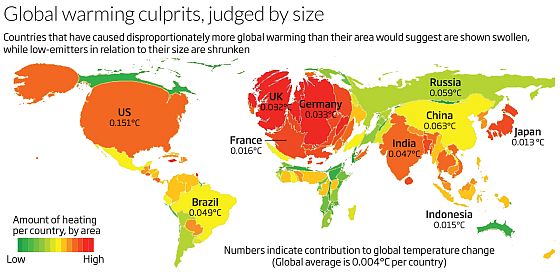
global-warming-culprits

New Scientist reports: It’s a chart that no one wants to top, but global warming’s worst offenders, in absolute terms, are the US, China, Russia, Brazil, India, Germany and the UK. New calculations suggest that these nations are responsible for more than 60 per cent of the global warming between 1906 and 2005.

Damon Matthews of Concordia University in Montreal, Canada, and his colleagues calculated national contributions to warming by weighting each type of emission according to the atmospheric lifetime of the temperature change it causes. Using historical data, they included carbon dioxide from burning fossil fuels and changes in land use – such as deforestation. They also accounted for methane, nitrous oxide and sulphate aerosols. These together account for 0.7 °C of the world’s 0.74 °C warming between 1906 and 2005.

The US is the clear leader, responsible for 0.15 °C, or 22 per cent of the 0.7 °C warming. China accounts for 9 per cent, Russia for 8 per cent, Brazil and India 7 per cent each, and Germany and the UK for 5 per cent each. [Continue reading…]

Facebooktwittermail

Al Qaeda’s real impotence and the threat from Iraq’s prime minister Maliki

A lot of ink has been spilled in recent weeks about the rising power of al Qaeda.

“Fallujah fall just the beginning — Al Qaeda virus is virulent and spreading,” an op-ed by the Heritage Foundation’s Peter Brookes, captures the spirit of this perception of a resurgence of what some people portray as the greatest source of evil ever to appear on Planet Earth.

The thing is, viral growth of any kind cannot be reliably measured by the ability to grab headlines. However widely dispersed groups branded as al Qaeda affiliates become, the feature that distinguishes each of them is that their predilection for violence makes them unpopular. They are like psychopathic gatecrashers. Everyone knows when they show up at a party and everyone wishes they’d go some place else.

Scaring everyone around you is a good way of getting noticed but it’s not a good way of making friends and at the end of the day, whatever else one might say about these men of violence, they have profound problems making and sustaining meaningful relationships. Their dysfunctionality makes it impossible for them to become the driving force behind any popular social movement; their direct impact on the wider world will never be more than marginal.

The real global impact of al Qaeda is not one that it has the capacity to generate itself; it is the impact created by governments which either cynically or paranoiacally react to a threat whose scope they been blown out of all proportion.

Anthony H. Cordesman writes: No one can deny that al Qaeda is a violent extremist threat wherever it operates. It poses a threat in terms of transnational terrorism in the United States and Europe, and a far more direct threat to the people who live in every area it operates. It has consistently been horribly repressive, violent, and often murderous in enforcing its political control and demands for a form of social behavior that reflect the worst in tribalism and offers almost nothing in terms of real Islamic values.

Like all extreme neo-Salafi movements, al Qaeda is also an economic and social dead end. It does not offer any practical way of operating and competing in a global economy, it is too dysfunctional to allow meaningful education and social interaction, and it finances itself largely through extortion in ways that cripple the existing local economy. Moreover, it does not tolerate competition even from other Islamist fighters. In Syria, it has provoked its own civil war with other hardline Islamist movements – a civil war it now seems to be decisively losing to other Sunni rebel factions.

It is precisely that type of behavior, however, which should lead U.S. officials, analysts, and media to do a far, far better job of reporting on exactly what has really happened in Anbar, and in cities like Fallujah and Ramadi. Bad as Al Qaeda in Iraq (AQI) is, far too much of the evidence points to Prime Minister Maliki as an equal threat to Iraq and to U.S. interests. Ever since the 2010 election, he has become steadily more repressive, manipulated Iraq’s security forces to serve his own interests, and created a growing Sunni resistance to his practice of using Shi’ite political support to gain his own advantage.

He has refused to honor the Erbil power-sharing agreement that was supposed to create a national government that could tie together Arab Sunni and Arab Shi’ite, and he has increased tensions with Iraq’s Kurds. As the U.S. State Department human rights reports for Iraq, Amnesty International, and the United Nations Assistance Mission for Iraq (UNAMI) make all too clear; Maliki’s search for power has steadily repressed and alienated Iraq’s Sunnis on a national level. It has led to show trials and death sentences against one of Iraq’s leading Sunni politicians including former Vice President Taqris al-Hashimi, who has been living in asylum in Turkey since being convicted and sentenced to death in absentia by an Iraqi court. It has shifted the promotion structure in the Iraqi Security Forces to both give the Prime Minister personal control and has turned them into an instrument he can use against Sunnis.

Al Qaeda in Iraq – nor its recent incarnation the Islamic State of Iraq and Syria (ISIS) or the Islamic State of Iraq and the Levant (ISIL) – has not risen up as a rebirth of the opposition the U.S. faced in 2005-2008. In spite of attempts by the Maliki government to label virtually any major Sunni opposition as terrorists, the steady increase in that opposition orginated primarily in the form of peaceful and legitimate political protests against Maliki’s purges of elected Iraqi Sunni leaders, and a regular exclusion of Sunnis from the government – including the Sons of Iraq in areas like Anbar. It came because Maliki used the Iraqi Security Forces against segments of his own population in the name of fighting terrorists and extremists. It came because of the failure to use Iraq’s oil wealth effectively and fairly – resulting with an economy that the CIA ranks Iraq 140th in the world in per capita income. The opposition to Maliki’s government also resulted from corruption so extreme that in December 2013 Transparency International ranked Iraq the seventh most corrupt country in the world, with only Libya, South Sudan, Sudan, Afghanistan, North Korea, and Somalia ranking worse than Iraq in terms of corruption.

Any analysis or news report that focuses only on al Qaeda’s very real abuses is little more than worthless – it encourages the tendency to demonize terrorism without dealing with the fact that terrorism almost always only succeeds when governments fail their people. Just as serious counterinsurgency can never be successful if it only addresses the military dimension, counterterrorism cannot succeed if it is not coupled with an effort to address the quality of the nation’s political leadership and governance, and the legitimate concerns of its people.

Any failure to analyze Maliki’s actions since the 2010 election – his disregard for the Erbil agreement that called for a true national government, his manipulation of the courts to create multiple trails and death sentences for political oppponents, including one of Iraq’s vice presidents – Tariq al-Hashemi; his use of temporary appointments to take control of key command positions in the Iraqi Security Forces; his efforts to bribe senior Iraqi Sunni politicians to support him with ministerial posts; and his steadily increasing suppression of Sunni popular opposition and protests – is dishonest, lazy, intellectual rubbish. [Continue reading…]

Facebooktwittermail

Egypt’s security state is triumphant once again

Jared Malsin reports from Cairo: Dozens of men lined the sidewalk outside a school in Cairo’s upper-class Mohandessin neighborhood on Tuesday morning, the first day of voting on Egypt’s new constitution. Soldiers in tan fatigues armed with AK-47s motioned for the men to enter, four or five at a time. Inside the gates, one group of mostly elderly men argued with the army officer in charge. “We can’t find our names on the list!” shouted one man. The officer dialed his cell phone, assuring the man he would find his polling station.

The proposed constitution, drafted under a military-backed government in the months since the ouster of President Mohamed Morsi in July, further insulates the police and armed forces from civilian control and could enshrine the military’s power within the Egyptian state for decades. Nearly three years after a popular uprising forced autocrat Hosni Mubarak from power, Egypt’s security state is triumphant once again. Since Morsi’s removal, more than a thousand people have been killed in a government crackdown on supporters of Morsi’s Muslim Brotherhood and its allies. Hundreds of others have been jailed, including journalists and leading activists who opposed Mubarak and Morsi. With most of the media backing the current regime, and much of the public either voicing support for the military or simply resigned to the reality of the current political arrangement, the forces of the 2011 revolution are struggling to be heard.

At three separate polling stations on Tuesday, every voter interviewed backed the constitution. “I believe that this constitution is a very good constitution, and this is just to give a message that we don’t want the Muslim Brotherhood. We want a new regime of freedom and democracy,” says Inas Mazen, a 60-year-old doctor, at a women’s polling station in Mohandessin. Egypt’s Elections Committee on Monday reported that 15% of voters had turned out so far, according to the leading news site Ahram Online. Nine people were killed in violence at polling stations as security forces clashed with protesters, and an explosion hit a courthouse in Cairo’s Imbaba district, causing no reported injuries.

In spite of criticism from rights groups and political dissidents about both the content of the constitution and the integrity of the voting process, the document is expected to be approved by a majority of voters. Recent history suggests voters will choose a concrete constitutional option and the prospect of political stability over the chaos of a no vote. Majorities also voted yes in constitutional referendums in Egypt in 2011 and 2012.

This week’s referendum is also taking place amid government harassment of those opposed to the document. One of the only groups actively urging a no vote, the Strong Egypt Party, suspended its campaign on Sunday after 11 activists were arrested in three separate incidents hanging posters and distributing campaign materials. “It’s a referendum with one choice only, and it’s yes. No is not allowed,” says Strong Egypt Party representative Fekry Nabil. “This process is not free and not fair, and we cannot join it.” [Continue reading…]

Facebooktwittermail

Egypt’s military rulers plot to provoke uprising in Gaza

Reuters reports: After crushing the Muslim Brotherhood at home, Egypt’s military rulers plan to undermine the Palestinian militant group Hamas, which runs the neighboring Gaza Strip, senior Egyptian security officials told Reuters.

The aim, which the officials say could take years to pull off, includes working with Hamas’s political rivals Fatah and supporting popular anti-Hamas activities in Gaza, four security and diplomatic officials said.

Since it seized power in Egypt last summer, Egypt’s military has squeezed Gaza’s economy by destroying most of the 1,200 tunnels used to smuggle food, cars and weapons to the coastal enclave, which is under an Israeli blockade.

Now Cairo is becoming even more ambitious in its drive to eradicate what it says are militant organizations that threaten its national security.

Intelligence operatives, with help from Hamas’s political rivals and activists, plan to undermine the credibility of Hamas, which seized control of Gaza in 2007 after a brief civil war against the Fatah movement led by Western-backed Palestinian President Mahmoud Abbas.

According to the Egyptian officials, Hamas will face growing resistance by activists who will launch protests similar to those in Egypt that have led to the downfall of two presidents since the Arab Spring in 2011. Cairo plans to support such protests in an effort to cripple Hamas.

“Gaza is next,” said one senior security official, who requested anonymity because of the sensitivity of the issue. “We cannot get liberated from the terrorism of the Brotherhood in Egypt without ending it in Gaza, which lies on our borders.” [Continue reading…]

Facebooktwittermail

Washington ready to send $1.5 billion aid to Egypt’s military rulers

The Daily Beast reports: Congress is preparing to allow the Obama administration to give more than $1 billion dollars to the Egyptian government and military, despite the fact the generals perpetrated a coup last summer and are suppressing opposition ahead of a nation-wide constitutional referendum.

The House and Senate are set to unveil a year-long spending bill that will loosen restrictions on U.S. aid to Egypt and negate the law that prevents the U.S. from funding a foreign military that has conducted a coup against a democratically elected government. The Obama administration has been lobbying Congress for permission to give the aid to the Egyptian government. Several senior senators had been working to make sure that aid was conditioned on the Egyptian government pursing a path toward democracy and respect for the rule of law.

But now, with the Egyptians speeding toward a Constitutional referendum that will cement the rule of the military-led regime and with the Egyptian government’s crackdown on the opposition ongoing, most of those conditions could be lifted by Congress or waived by the Obama administration.

For experts and congressional officials who have followed the Obama administration’s clumsy and often incoherent policy on Egypt, the potential easing of restrictions on aid represents only the latest unfortunate twist in a failed effort to preserve U.S. influence in the Arab world’s most populous country.

“When the omnibus bill is passed, there’s going to be legislation in it that in effect is going to give the administration a waiver from the coup provisions and allow them to restore aid to Egypt,” said Michele Dunne, senior associate at the Carnegie Endowment for International Peace.

Ever since the Egyptian military ousted and jailed ex-president Mohamed Morsi last July and began its campaign of arresting opposition leaders and protesters, the Obama administration and Congress have been withholding most of the $1.5 billion in annual aid the U.S. gives Egypt, most of which goes directly to the country’s army.

“I think there’s a sense of giving up on Egypt [inside of the Obama administration], on the Hill as well,” said Dunne. “There’s a sense that ‘Oh well they tried a democratic transition, it didn’t work, but we don’t want to cut ourselves off from Egypt as a security ally, so let’s just forget about the whole democracy and human rights thing except for giving it some lip service from time to time.’” [Continue reading…]

Facebooktwittermail

Russia expels American journalist without explanation

For the first time since the end of the Cold War, Russia has expelled an American journalist. David Satter, a former correspondent for the Financial Times, spoke to The Guardian:

He said the manner of his expulsion – without any explanation – suggested the security services regarded him as a risk. “This is a formula used for spies,” he said. “To apply it to a journalist is something I have not seen in nearly four decades of writing and reporting on Russia. It is indicative that they consider me, for whatever crazy reasons, to be a security threat.”

Satter first visited Moscow in 1969 as an Oxford graduate student. Between 1976-82 he was the FT’s correspondent in the city. In 1979, the authorities threatened to expel him for “hooliganism”, only to back down later. He returned to post-communist Russia in the early 1990s and went back to Moscow from the US for another stint last autumn.

Satter’s new role was an adviser to the broadcaster Radio Europe/Radio Free Liberty, which is funded by the US Congress. He was also working on a book on Russia’s post-communist history. Satter said he had been unable to collect his notes, clothes and other belongings, which remain in his flat in central Moscow.

Asked why Russia had kicked him out, Satter said he did not know the answer. But he speculated that the FSB’s decision may be linked to his writings on Russia’s 1999 apartment bombings – one of the murkiest episodes in the country’s post-Soviet history.

More than 300 people were killed in a series of unprovoked explosions in Moscow and two other cities. Putin blamed the bombings on Chechen terrorists. He immediately seized on the blasts to justify a second, punitive and devastating war in Chechnya.

Satter, and others, believe the bombings may have been an undercover FSB operation, designed to boost Putin’s popularity and to secure his election as president. In his 2003 book, Darkness at Dawn: The Rise of the Russian Criminal State, Satter concluded that the evidence of the FSB being behind the blasts was “overwhelming”.

Facebooktwittermail

Why Russia might be crazy enough to buy Iranian oil and undermine nuclear talks

Quartz: Moscow privately denies a report that it is conducting barter negotiations that would increase Iranian crude oil exports by up to 50%, a source privy to US State Department communications has told Quartz. But if Russian president Vladimir Putin has in fact sanctioned such discussions, it is because of the attractions of a sweet deal and a chance yet again to flaunt his foreign policy independence.

The report — a Jan. 10 exclusive by Reuters — is taken seriously enough in Washington that US secretary of state John Kerry raised it with Russian foreign minister Sergei Lavrov. The idea is that Iran would ship as many as 500,000 barrels of oil a day to Russia, which would pay in the form of goods. The volume is eye-popping since Iran currently exports just 1 million barrels a day, one-third of its 2011 shipments, because of sanctions.

The Russian side denied the Reuters report to US officials, the source told Quartz. But the reason Kerry reacted so sharply was that it coincided almost precisely with a Jan. 12 final agreement by Iran and US-led negotiators to scale back Tehran’s nuclear enrichment program in exchange for some sanctions relief. The two sides agreed to activate that deal Jan. 20. If Iran could hike its oil shipments significantly, with Russia’s help, it would weaken other countries’ leverage for getting it to agree to a planned final and much more stringent agreement in six months. [Continue reading…]

Facebooktwittermail

EU must open doors to avoid Syrian refugee catastrophe, says UN

The Guardian reports: The crisis posed by millions of refugees from Syria’s civil war flooding into neighbouring countries is becoming a humanitarian and political catastrophe that can only be eased if Europe opens its doors, the UN and European commission have warned.

More than 2.1 million refugees have been registered by the UN high commissioner for refugees (UNHCR) in Syria’s four neighbouring states; hundreds of thousands more are known to be living outside Syria’s borders without access to aid.

The scale of the crisis is perhaps the most acute since the end of the second world war. David Miliband, president of the International Rescue Committee (IRC), described the ever-deteriorating situation in Syria as “the defining humanitarian crisis of our time”.

The UNHCR, European commission and British Refugee Council have urged EU leaders to acknowledge the exceptional crisis posed by the Syrian civil war and accept the temporary settlement of Syrian refugees inside their borders – relaxing “fortress” policies designed to keep migrants out of Europe.

The UN has issued an urgent call to resettle 30,000 of the most vulnerable Syrians worldwide – a call that remains unmet as the exodus from Syria into Turkey, Lebanon, Jordan and Iraq fast outpaces the capacity to provide for them. The UK government has refused to take part in the resettlement scheme, calling the idea tokenistic and stressing the importance of the £500m of aid it has sent to the region. [Continue reading…]

Facebooktwittermail

Syria: Extremists restricting women’s rights

Human Rights Watch: Certain extremist armed opposition groups are imposing strict and discriminatory rules on women and girls that have no basis in Syrian law, Human Rights Watch said today. The harsh rules that some groups are administering in areas under their control in northern and northeastern Syria violate women’s and girls’ human rights and limit their ability to carry out essential daily activities.

Human Rights Watch interviewed 43 refugees from Syria in Iraqi Kurdistan and conducted telephone interviews with two refugees from Syria in Turkey in November and December 2013. The refugees interviewed said that the extremist armed groups Jabhat al-Nusra and the Islamic State of Iraq and Sham (ISIS) have enforced their interpretation of Sharia, or Islamic law, by requiring women and girls to wear headscarves (hijabs) and full-length robes (abayas), and threatening to punish those who do not comply. In some areas, the groups are imposing discriminatory measures prohibiting women and girls, particularly those who do not abide by the dress code, from moving freely in public, working, and attending school.

“Extremist groups like ISIS and Jabhat al-Nusra are undermining the freedoms that Syria’s women and girls enjoyed, which were a longtime strength of Syrian society,” said Liesl Gerntholtz, women’s rights director at Human Rights Watch. “What kind of victory do these groups promise for women and girls who are watching their rights slip away.”

Facebooktwittermail

Devastating dossier on ‘abuse’ by UK forces in Iraq goes to International Criminal Court

The Independent reports: A devastating 250-page dossier, detailing allegations of beatings, electrocution, mock executions and sexual assault, has been presented to the International Criminal Court, and could result in some of Britain’s leading defence figures facing prosecution for “systematic” war crimes.

General Sir Peter Wall, the head of the British Army; former defence secretary Geoff Hoon; and former defence minister Adam Ingram are among those named in the report, entitled “The Responsibility of UK Officials for War Crimes Involving Systematic Detainee Abuse in Iraq from 2003-2008”.

The damning dossier draws on cases of more than 400 Iraqis, representing “thousands of allegations of mistreatment amounting to war crimes of torture or cruel, inhuman or degrading treatment”.

They range from “hooding” prisoners to burning, electric shocks, threats to kill and “cultural and religious humiliation”. Other forms of alleged abuse include sexual assault, mock executions, threats of rape, death, and torture.

The formal complaint to the ICC, lodged yesterday, is the cumulation of several years’ work by Public Interest Lawyers (PIL) and the European Centre for Constitutional and Human Rights (ECCHR). It calls for an investigation into the alleged war crimes, under Article 15 of the Rome Statute.

The dossier, seen by The Independent on Sunday, is the most detailed ever submitted to the ICC’s Office of the Prosecutor on war crimes allegedly committed by British forces in Iraq. The court has already acknowledged that there was little doubt that war crimes were committed. [Continue reading…]

Facebooktwittermail