Category Archives: Lands

Three months in Rouhani’s Iran

Farideh Farhi writes: I have recently returned from a three-month trip to Iran. I arrived in Tehran in early September before the famous Rouhani/Obama phone call and departed last week as the mood was turning more skeptical regarding the potential for some sort of final nuclear deal, which, in the words of Foreign Minister Javad Zarif, would “normalize” the status of Iran’s nuclear program if it were to happen.

Frankly, sitting in Tehran, it was hard to listen to various Obama administration officials’ frenzied explanations to the US Congress and Israeli government regarding how, even with the first-step agreement, Iran will remain in dire straits. It was hard to listen without becoming skeptical about the US political environment allowing an agreement that would also be acceptable to Iran. From the receiving end of all the nuclear chatter, the whole American demeanor on Iran appears imperious, even outright uncivilized; like people speaking calmly about the taking of others’ lives and imposing further economic misery on them as options that are still very much on the table.

As I write this, news has broken that the Iranian experts engaged in talks in Vienna over the first phase of the “Joint Plan” were abruptly recalled to Tehran in reaction to the blacklisting of 19 Iranian companies by the US Treasury Department — a move that both Iran and Russia said violated the “spirit” of the Geneva accord. The spokesperson of Iran’s Foreign Ministry, Marzieh Afkham, in describing the “unconstructive moves” by the Obama Administration, regretted “serious confusion in the approach, decisions, and statements of US officials.”

When I was in Tehran, Iranian officials of various political persuasions were rather soft in their reaction to all the hard talk coming out of Washington. Several officials, including key members of the Parliament, expressed their understanding of the Obama administration’s predicament in trying to sell the Geneva agreement to the US Congress. Talk about continuing pressure on Iran did provide ammunition to folks like Hossein Shariatmadari, the hawkish chief editor of the well-known Iranian daily, Kayhan, but Washington’s verbal assaults were mostly tolerated, even if Foreign Minister Zarif acknowledged that they were making his efforts to maintain support for the agreement difficult. But it appears that the latest Treasury Department move, which followed a rather harsh op-ed in the Wall Street Journal by David Cohen, the Undersecretary for Terrorism and Financial Intelligence, made looking the other way difficult. Lest we forget: Iran also has domestic politics. Unlike its reception in Washington, the Iranian nuclear agreement was mostly greeted positively in Tehran given the general consensus that it’s time to resolve the nuclear imbroglio. But there are limits to what Tehran can ignore.

I am inclined to view this event as an “enough is enough” public statement directed at Congress and aimed at limiting further moves by the Treasury Department. Both the Obama and Rouhani administrations have raised the stakes in the talks high enough to prevent unraveling at this early stage. Nevertheless, the chances of this are quite high, particularly if the Iranian context for the decision to engage in talks in the current manner is misunderstood or willfully misconstrued. [Continue reading…]

Facebooktwittermail

A political deal in a deeply divided Tunisia as Islamists agree to yield power

The New York Times reports: Compromise has been in short supply since Tunisia sparked the Arab Spring nearly three years ago. But this small North African nation has once again broken new ground with a political deal between longtime enemies among the Islamists and the secular old guard.

The deal, announced over the weekend, aims to put in place an independent caretaker government until new elections next year, marking the first time Islamists have agreed in the face of rising public anger to step back from power gained at the ballot box.

Tunisia had been careening toward chaos and political paralysis after two assassinations this year and an inability to finalize a new constitution, and it remains fragile and divided. But months of laborious back-room haggling led by two political leaders helped, at least for now, to avoid the kind of zero-sum politics that have come to define the post-Arab Spring tumult in Egypt, Libya and the battlefield of Syria.

Beji Caid Essebsi, a former prime minister who leads a new secular-minded political party, Nidaa Tounes, and Rachid Ghannouchi, the leader of the Islamist party Ennahda, have starkly different visions of the country’s future. But since Tunisia’s political crisis flared this year, the two men have met one on one at least five times to try to find a political solution. [Continue reading…]

Facebooktwittermail

Roger Waters, the ‘crushingly obvious’ parallels to Israel and the parallels we prefer to ignore

Keith Kahn-Harris writes: It’s happening increasingly often: a prominent public figure makes a vituperative criticism of Israel, accusations of antisemitism follow and then come emphatic denials. This time it’s Roger Waters, the Pink Floyd vocalist, who has fanned the constantly glowing embers of controversy. Among other things, he has claimed that the “parallels [between Israel’s actions against the Palestinians] with what went on in the 1930s in Germany are so crushingly obvious”, that the Israeli rabbinate views Palestinians as “sub-humans”, and that the “Jewish lobby” is “extraordinarily powerful”. This comes on the back of Waters’ long history of pro-Palestinian activity, including supporting a cultural boycott of Israel.

In response, Waters has been accused of antisemitism by firebrands such as Rabbi Shmuley Boteach and more measured voices such as Karen Pollock of the Holocaust Educational Trust. Waters vociferously denies antisemitism, complaining that defenders of Israel “routinely drag the critic into a public arena and accuse them of being an antisemite”.

So who is right? Is Waters guilty of antisemitism?

The problem with viewing the Waters controversy through the lens of the antisemitism debate is that it becomes a zero-sum game: whether his words were antisemitic or not. If they were not, then the assumption is that they would be acceptable.

Yet there are other ways to analyse discourse on Israel. What would happen if one temporarily (and, yes, artificially) removes the question of antisemitism and looks at Waters’ remarks the way one might look at other forms of political discourse? This leads to other questions: was Waters’ intervention useful? Were his words proportionate and reasonable? Should we take what he says seriously?

Accusations that Israel is behaving in a Nazi-like manner are hardly novel. In fact they are something of a cliche not just in the controversy over Israel but in a wide range of other debates. Godwin’s Law draws attention to the wearisome regularity with which Nazi Germany is invoked; for some, its corollary is that in any debate the first one to mention the Nazis has lost.

Not only is comparing Israel to Nazi Germany predictable, even the harshest reading of Israel’s actions shows that the analogy is completely over the top. Israel can arguably be accused of subtle and not-so-subtle forms of discrimination and even ethnic cleansing of Palestinians over its history, but it has never committed systematic mass murder and the existence of Palestinian citizens of Israel (albeit often marginalised) is something that no genuinely neo-Nazi regime could tolerate. [Continue reading…]

I suspect that part of the reason Waters and others grab the Nazi analogy is that breaking this kind of taboo is a kind of act of defiance through which someone can feel they are demonstrating an unswerving commitment to truth. It’s a way of attempting to say: I will speak the truth, whatever the consequences.

As Kahn-Harris points out, however, this particular choice of analogy is cliched — it also has the appearance (intentionally or not) of serving as a form of baiting.

There are numerous other “crushingly obvious” parallels Waters could have pointed to, such as the treatment of Native Americans by European settlers who asserted a God-given right to claim this continent as their own.

Then there are parallels that most observers in the West would apparently rather ignore, namely, those in Syria where after the Palestinian occupied territories, Israel, and Jordan, the largest exiled Palestinian population resides.

By whatever metric one chooses to use, the scale of destruction wrought by the Assad regime over the last two years dwarfs the crimes of the Israelis over the last 65 years, yet so many of those who express outrage over massacres in Gaza, appear unmoved when the aggressors are not Zionists.

Israelis have been fittingly scorned for professing a humanitarian sensibility as they “shoot and cry” (Yorim u’Vochim), but among Israel’s critics who are willing to hold up a mirror there may be visible a similarly flimsy humanitarian impulse.

We often seem more concerned about who fired the gun and who manufactured the bullet than who got killed.

Facebooktwittermail

Far right in Eastern Europe makes gains as Syrians arrive

The New York Times reports: After spreading turmoil and desperate refugees across the Middle East, Syria’s brutal civil war has now leaked misery into Europe’s eastern fringe — and put a spring in the step of Angel Bozhinov, a nationalist activist in this Bulgarian border town next to Turkey.

The local leader of Ataka, a pugnacious, far-right party, Mr. Bozhinov lost his seat in the town council at the last municipal elections in 2011 but now sees his fortunes rising thanks to public alarm over an influx of Syrian refugees across the nearby frontier.

Membership of the local branch of Ataka, he said, had surged in recent weeks as “people come up to me in the street and tell me that our party was right.” Ataka, which means attack, champions “Bulgaria for Bulgarians” and has denounced Syrian refugees as terrorists whom Bulgaria, the European Union’s poorest nation, must expel. An Ataka member of Parliament has reviled them as “terrible, despicable primates.”

With populist, anti-immigrant parties gathering momentum across much of Europe, Ataka stands out as a particularly shrill and, its critics say, sinister political force — an example of how easily opportunistic groups can stoke public fears while improving their own fortunes.

The influx of Syrian refugees has sown divisions across the European Union as the refugees add burdens on governments still struggling to emerge from years of recession. But Bulgaria is perhaps the most fragile of all the European Union’s 28 members. Modest as the numbers of refugees are here, the entry of nearly 6,500 Syrians this year has overwhelmed the deeply unpopular coalition government and added a volatile element to the nation’s already unstable politics.

The arrival of the refugees and public fury over the stabbing of a young Bulgarian woman by an Algerian asylum seeker “has opened the floodgates” for far-right nationalists, said Daniel Smilov of the Center for Liberal Strategies, a policy research group in Sofia, the capital. “They see this as their big chance.” [Continue reading…]

Facebooktwittermail

Refugee stories from the Syrian exodus

Dania-Amroosh

The Washington Post reports: Dania Amroosh wears a Hello Kitty shirt, tiny heart-shaped earrings and her hair in cute little pigtails. She looks like any other 7-year-old, except for the jagged scars on the bridge of her nose and across her chin.

There is much worse beneath her blanket on the third floor of the Kilis State Hospital in southern Turkey. A huge seeping wound on her stomach is closed with an angry grid of stitches. The casts are finally off her broken right leg and right hand, but her fingers are still black and blue and she can barely walk. Her lower body is covered with shrapnel scars.

Five months ago, Dania and her family were sitting in their home in Aleppo, Syria, about 60 miles south of here, when a bomb dropped from the sky. Her grandmother, aunt, uncle and two cousins were killed instantly. Another cousin lost his legs. Dania was mangled.

Mohammad Amroosh, her father, says that after what Syrian President Bashar al-Assad’s military did to them, he can’t go back. When Dania is ready to leave the hospital, the family will stay in Turkey, joining nearly 700,000 other Syrians who have taken shelter in the country.

“This is our home now,” he says.

One of the world’s largest forced migrations since World War II is transforming the Middle East.

The United Nations and governments in the countries where the refugees have taken shelter estimate that between 2.3 million and 2.8 million Syrians have fled their homeland. The United Nations says that number is rising by nearly 3,000 people a day, with no end in sight for a conflict that has lasted nearly three years. [Continue reading…]

Facebooktwittermail

France broadens its surveillance power

The New York Times reports: For all their indignation last summer, when the scope of the United States’ mass data collection began to be made public, the French are hardly innocents in the realm of electronic surveillance. Within days of the reports about the National Security Agency’s activities, it was revealed that French intelligence services operated a similar system, with similarly minimal oversight.

And last week, with little public debate, the legislature approved a law that critics feared would markedly expand electronic surveillance of French residents and businesses.

The provision, quietly passed as part of a routine military spending bill, defines the conditions under which intelligence agencies may gain access to or record telephone conversations, emails, Internet activity, personal location data and other electronic communications.

The law provides for no judicial oversight and allows electronic surveillance for a broad range of purposes, including “national security,” the protection of France’s “scientific and economic potential” and prevention of “terrorism” or “criminality.”

In an unusual alliance, Internet and corporate groups, human rights organizations and a small number of lawmakers have opposed the law as a threat to business or an encroachment on individual rights. [Continue reading…]

Facebooktwittermail

Chas Freeman on Snowden and snooping

The former U.S. ambassador to Saudi Arabia, Chas W. Freeman, said at MIT on Thursday: We live in what the National Security Agency [NSA] has called “the golden age of SIGINT [signals intelligence].” We might have guessed this. We now know it for a fact because of a spectacular act of civil disobedience by Edward Snowden. His is perhaps the most consequential such act for both our domestic liberties and our foreign relations in the more than two century-long history of our republic.

This past spring, Mr. Snowden decided to place his oath to “preserve, protect and defend the Constitution of the United States” and his allegiance to the Bill of Rights above his contractual obligations to the intelligence community and the government for which it snoops. He blew the whistle on NSA’s ruthless drive for digital omniscience. When he did this, he knew that many of his fellow citizens would impugn his patriotism. He also knew he would be prosecuted for violating the growing maze of legislation that criminalizes revelations about the national security practices of America’s post-9/11 warfare state.

Mr. Snowden does not dispute that he is guilty of legally criminal acts. But he places himself in the long line of Americans convinced, as Martin Luther King put it, that “noncooperation with evil is as much a moral obligation as is cooperation with good.” As someone long in service to our country, I am upset by such defiance of authority. As an American, I am not.

Like Henry David Thoreau and many others in protest movements in our country over the past century and a half, Mr. Snowden deliberately broke the law to bring to public attention government behavior he considered at odds with the U.S. Constitution, American values, and the rule of law. One point he wanted to make was that we Americans now live under a government that precludes legal or political challenges to its own increasingly deviant behavior. Our government has criminalized the release of information exposing such behavior or revealing the policies that authorize it. The only way to challenge its policies and activities is to break the law by exposing them. [Continue reading…]

Facebooktwittermail

The pharmaceutical industry and the fight against gun control

The Washington Post reports: One year ago, 20 children and six staff members at Sandy Hook Elementary School in Newtown, Conn., were gunned down by Adam Lanza. In the aftermath, there was hope among gun-control advocates that the event would spark pro-control reform. They’ve set their eyes on on a few states, but over the past year, more of them have loosened gun restrictions than tightened them. While gun control may face an uphill battle, though, a related policy area has seen change in the wake of the tragedy.

“We think that Sandy Hook opened up the eyes of governors and state legislators and policymakers around the country that mental health has been cut enough,” Andrew Sperling, the director of legislative advocacy at the National Alliance on Mental Illness, told Post TV’s “In Play.”

Some 36 states increased their mental health-care budgets in 2013, according to NAMI. In Colorado, where James Holmes opened fire on a crowded movie theater a little over a year ago, the mental-health budget was increased by 13.5 percent.

State-level efforts have focused on five broad categories — the mental-health system, crisis and inpatient care, community mental health, criminal justice and mental health, and civil rights and stigma reduction — NAMI wrote in a fall report.

The Post fails to note that the innocuously named NAMI, receives most of its funding from the pharmaceutical industry.

It’s not that pharma has a natural alignment with the opponents of gun control, yet what the NRA and its supporters have succeeded in doing in the wake of Newtown is to shift the debate away from gun control onto mental health — a shift which clearly serves the interests of the drug industry.

27% of all mental health services in the United States come through Medicaid and Medicaid is a cash cow for the pharmaceutical industry.

In the 1980s and ’90s, the psychiatric system went through a major transformation as psychiatric medication replaced psychotherapy as the standard of care. This broadened the scope of psychiatry in two ways. With patient care being reduced to medication management, doctors could see more patients. And with a massive growth in the number of Americans receiving disability for mental illness, the market for psychiatric medication has been booming, thanks in part to Medicaid funding.

The pharmaceutical industry has only one interest: selling drugs. It can reasonably be described as the most successful form of organized crime in human history. When companies repeatedly pay billions of dollars in settlements, it is clear that they regard such settlements as simply a component in the operating costs.

That the drug manufacturers are really nothing more than sophisticated drug pushers can be illustrated in numerous ways — consider for instance the way in which attention deficit disorder has become such a profitable diagnosis.

After more than 50 years leading the fight to legitimize attention deficit hyperactivity disorder, Keith Conners could be celebrating.

Severely hyperactive and impulsive children, once shunned as bad seeds, are now recognized as having a real neurological problem. Doctors and parents have largely accepted drugs like Adderall and Concerta to temper the traits of classic A.D.H.D., helping youngsters succeed in school and beyond.

But Dr. Conners did not feel triumphant this fall as he addressed a group of fellow A.D.H.D. specialists in Washington. He noted that recent data from the Centers for Disease Control and Prevention show that the diagnosis had been made in 15 percent of high school-age children, and that the number of children on medication for the disorder had soared to 3.5 million from 600,000 in 1990. He questioned the rising rates of diagnosis and called them “a national disaster of dangerous proportions.”

“The numbers make it look like an epidemic. Well, it’s not. It’s preposterous,” Dr. Conners, a psychologist and professor emeritus at Duke University, said in a subsequent interview. “This is a concoction to justify the giving out of medication at unprecedented and unjustifiable levels.”

The rise of A.D.H.D. diagnoses and prescriptions for stimulants over the years coincided with a remarkably successful two-decade campaign by pharmaceutical companies to publicize the syndrome and promote the pills to doctors, educators and parents. With the children’s market booming, the industry is now employing similar marketing techniques as it focuses on adult A.D.H.D., which could become even more profitable.

None of the above considerations should be taken to imply that mental health services are not indeed neglected in this country — simply that drugging and forced treatment are not the answer.

As for the issue of the epidemic of school shootings, ironically this has mostly served as a distraction from the much larger issue of gun violence.

Following the Gabrielle Giffords shooting in 2011, Emily Badger wrote:

Today, gun laws that target the mentally ill — alongside convicted felons — are founded on a series of assumptions: that people with mental illness are particularly dangerous, that legislation restricting their gun ownership will lead to decreased violence, and that this strategy will make a difference in the overall safety of society.

Such laws also assume that the background-check system is an effective means in the first place of keeping guns out of the hands of any type of dangerous person.

“In a society like ours where firearms are so prevalent — there are more handguns than there are people in the U.S. today — that seems like a highly dubious proposition,” [the director of the Division of Law, Ethics, and Psychiatry at Columbia University, Paul] Appelbaum said. “People who really want guns are arguably likely to be able to get them whether they are covered by this statute or not. It’s an empirical question as to whether this actually works in keeping guns out of anybody’s hands, or at least very many people’s hands.”

The best data Appelbaum has found, which dates to the late 1980s and early ’90s, also suggests that, at most, 3-5 percent of violent acts in the U.S. are attributable to serious mental illnesses as a risk factor — and most of those acts don’t involve guns. More recent studies in England and Sweden suggest that number for violent acts may be as low as 1-2 percent.

“To say that another way, if no one with a mental illness committed a violent act, we would still have 95-97 percent of the baseline level of violence,” Appelbaum said. “However you cut it, it looks as though we’re just talking about the tip of the iceberg in terms of problems of violence in our society, which raises the quite reasonable question as to why we’re so focused on the mentally ill?”

Not only is that focus a distraction, he adds, but it comes with the significant downside of further stigmatizing people with mental illness and confusing the public as to the notion that mental illness is a significant cause of violence in this country.

Facebooktwittermail

Mandela’s unfinished revolution

T.O. Molefe writes: For all his remarkable achievements, Nelson Mandela died with his dream for South Africa incomplete. Democracy and peace were attained, yet real racial harmony, social justice and equality seem, in some ways, further away than ever.

South Africa’s economy still stifles the aspirations of most of its black citizens — a situation that threatens the sustainability of the project of national reconciliation that is a central part of the Mandela legacy.

When I am able to detach myself from the anger I feel over this injustice, I see the South Africa that Mr. Mandela described in his 1994 inaugural address — “a rainbow nation at peace with itself and the world” — as but the opening move of a master tactician. It represented the brief suspension of reality for the sake of an endgame Mr. Mandela knew he would not be around to play.

Mr. Mandela’s rainbow ideal of a multiracial country that had avoided civil war, where blacks had forgiven whites for apartheid and everyone had learned to live together, was great and necessary for its time. But it is an ideal that should be laid to rest with him. Today, an economic revolution is what is needed most if South Africa is to continue on the path to reconciliation.

Like many of the transitional steps on the road to democracy, the rainbow-nation ideal was needed to hold together a country that was on the verge of fracturing. It did this by assuaging white guilt and putting off the black majority’s demand for immediate social justice.

In the 1990s, together with Archbishop Desmond Tutu, the chairman of South Africa’s Truth and Reconciliation Commission, Mr. Mandela popularized a new national self-image that made it possible to focus mainly on racial reconciliation, strengthening democratic institutions and creating a free press — all prerequisites for turning a tentative peace into a more lasting one.

In pursuit of this rainbow ideal, Mr. Mandela and the African National Congress had to silence, mollify or sideline certain allies within the liberation movement who not only demanded a democratic revolution but an economic one, too. But the price of deferring the dream of true equality was to leave the country lurching dangerously toward an explosion.

For the poorer black majority of South Africans, the unheralded heroes who have sacrificed so much in the transition to democracy that Mr. Mandela led, social justice has been held in abeyance, ostensibly for the sake of peace, as though the maxim “justice delayed is justice denied” did not apply to them. [Continue reading…]

Facebooktwittermail

For Syrian refugees in Lebanon, winter storm brings snow, rain and new misery

The Washington Post reports: The United Nations said Wednesday that it is “extremely concerned” for Syria’s refugees as snow and freezing temperatures descended on the region.

Syria and the countries that border it have been bracing for what is expected to be the worst winter storm in years. Snow hit some areas of Lebanon, Turkey and northern Syria overnight Tuesday as sharp winds and cold, heavy rains battered others, causing misery for hundreds of thousands in camps and shanties.

In Lebanon, despite the wintry conditions, the flow of Syrians fleeing the war is unrelenting. Local officials in the border town of Arsal, where some of the heaviest snow fell overnight, on Wednesday reported the arrival of 200 men, women and children who had risked the treacherous journey across the mountains on foot. Many were from the town of Yabroud in the Qalamoun region, where a Syrian army offensive is underway.

Aid agencies, the Office of the U.N. High Commissioner for Refugees (UNHCR) and the Lebanese army rushed to distribute kits containing plastic sheeting and blankets to the newcomers, but poorly funded humanitarian groups are struggling to meet the overwhelming needs. Authorities remain reluctant to establish permanent refu­gee camps in Lebanon and have opened only one official, 100-tent “transit camp.” [Continue reading…]

Facebooktwittermail

The collapse of the Free Syrian Army brand

Mike Giglio reports: On the afternoon of Nov. 26, near the border in southern Turkey, Mohamed al-Kadi got behind the wheel of a white Isuzu delivery truck and drove into Syria. In the back of the truck sat a shipment of advanced communications equipment, provided by the United States. Kadi’s mission was to bring it to the Free Syrian Army, or FSA, the U.S.-backed rebel coalition whose main base sat just a few miles into Syria.

Kadi, a deeply religious man partial to Muslim prayer beads and oddball humor, was a tech whiz with a degree in computer engineering. He’d been a young lieutenant in Damascus at the war’s outset but defected early to the rebel side, where his computer skills saw him pulled from the front lines. He worked as a senior technician for the FSA’s high command, based mainly inside Syria. But shortly after he crossed into Syria that afternoon, Kadi and the delivery truck disappeared. Days later, his body was found in a farm field, shot at point-blank range in the back of the head, hands tied behind his back.

The FSA blamed Kadi’s death on the Islamic State of Iraq and Syria, or ISIS, which claims to be Al-Qaeda’s Syrian arm, saying the group had captured Kadi’s truck along a critical supply route and stolen the equipment inside.

The incident alarmed the U.S., which had long worried about the possibility of the supplies it sends the FSA falling into the hands of extremists. Some U.S. allies inside the rebellion shared those concerns. “We warned the U.S. government for over a year about ISIS gathering strength and spreading in the North,” said one opposition official involved in channeling U.S. assistance to the FSA.

Now many are questioning how much longer the FSA can survive, following news that fighters from a new, hardline coalition called the Islamic Front, which boasts an estimated 45,000 fighters in Syria, overtook its main bases and warehouses in Atimeh, a town near the Turkish border late last week. The powerful Islamist faction now stands poised to overtake the FSA as the country’s dominant rebel force. [Continue reading…]

Facebooktwittermail

Former CIA chief Hayden hopes Assad will remain in power

AFP reports: The sectarian bloodbath in Syria is such a threat to regional security that a victory for Bashar al-Assad’s regime could be the best outcome to hope for, a former CIA chief said.

Washington condemned Assad’s conduct of the conflict, threatened air strikes after he was accused of targeting civilians with chemical weapons and has demanded he step down.

The United States is also supplying millions of dollars in “non-lethal” aid to some of the rebel groups fighting Assad’s rule.

But Michael Hayden, the retired US Air Force general who until 2009 was head of the Central Intelligence Agency, said a rebel win was not one of the three possible outcomes he foresees for the conflict.

“Option three is Assad wins,” Hayden told the annual Jamestown Foundation conference of terror experts.

“And I must tell you at the moment, as ugly as it sounds, I’m kind of trending toward option three as the best out of three very, very ugly possible outcomes,” he said.

Facebooktwittermail

Iran nuclear talks hit snag after U.S. expands commercial ‘blacklists’

Reuters reports: A breakthrough agreement to end a standoff over Iran’s nuclear program appeared to face its first major difficulty on Friday with Russia warning that a U.S. sanctions move could “seriously” complicate its implementation.

Russia, which along with the United States is among the six world powers which negotiated the November 24 interim accord with Tehran, echoed Iran’s criticism by saying Washington’s sanctions decision violated the spirit of the deal.

Moscow’s statement came after diplomats said Iran had interrupted technical talks with the six nations in Vienna over how to implement the agreement, under which Tehran is to cap its nuclear program in return for limited sanctions easing.

The developments highlighted potential obstacles negotiators face in pressing ahead with efforts to resolve a decade-old dispute between the Islamic Republic and the West that has stirred fears of a new Middle East war.

Several Western diplomats insisted the inconclusive outcome of the December 9-12 expert-level discussions in Vienna should not be seen as a sign that the political deal hammered out nearly three weeks ago was in serious trouble.

But Russia made its concerns clear a day after the United States blacklisted additional companies and people under existing sanctions intended to prevent Iran from obtaining the capability to make nuclear weapons. Iran denies any such aims.

“The U.S. administration’s decision goes against the spirit of this document,” said Foreign Ministry spokeswoman Maria Zakharova, referring to the Geneva agreement between Iran and the United States, Russia, China, France, Britain and Germany.

“Widening American ‘blacklists’ could seriously complicate the fulfillment of the Geneva agreement, which proposes easing sanctions pressure.” [Continue reading…]

Facebooktwittermail

The disappearance of CIA contractor Robert Levinson: A rogue operation or a rogue intelligence agency? Updated

An Associated Press investigation has revealed that Robert Levinson, a former FBI agent who went missing in Iran in 2007 and who was at that time described by the State Department as “a private citizen involved in private business in Iran,” was in fact working for the CIA. He had been hired by a team of analysts who were running a rogue intelligence operation.

A 28-year veteran of the Drug Enforcement Administration and the FBI, Robert Levinson had a natural ability to cultivate informants. Former colleagues say he was an easy conversationalist who had the patience to draw out people and win their confidence. He’d talk to anyone.

“Bob, in that sense, was fearless,” said retired FBI Assistant Director Mark Mershon, who worked with Levinson in Miami in the 1980s. “He wasn’t concerned about being turned down or turned away.”

As the Soviet Union collapsed, Levinson turned his attention away from Mafia bosses and cocaine cartels and began watching the Russian gangsters who made their homes in Florida. Russian organized crime was a niche then and Levinson made a name as one of the few investigators who understood it.

At a Justice Department organized crime conference in Santa Fe, N.M., in the early 1990s, Levinson listened to a presentation by a CIA analyst named Anne Jablonski and spotted a kindred spirit.

Jablonski was perhaps the government’s foremost expert on Russian organized crime. Former colleagues say she had an encyclopedic memory and could, at the mere mention of a crime figure, quickly explain his place in the hierarchy and his method of moving money. When White House officials had questions about Russian organized crime, they often called Jablonski directly.

In the relatively staid world of CIA analysts, Jablonski was also a quirky character, a yoga devotee who made her own cat food, a woman who skipped off to Las Vegas to renew her vows in an Elvis-themed chapel.

After the Santa Fe conference, Levinson left a note for Jablonski at her hotel and the two began exchanging thoughts on organized crime. Jablonski invited Levinson to CIA headquarters in Langley, Va., to speak to her colleagues in the Office of Russian and European Analysis.

By the time Levinson retired from the FBI in 1998, he and Jablonski were close friends. She attended his going-away party in Florida, met his family and harvested his knowledge of organized crime.

In retirement, Levinson worked as a private investigator, traveling the world and gathering information for corporate clients. Jablonski, meanwhile, thrived at the CIA. After the Sept. 11 attacks, former colleagues say, she was assigned to brief Attorney General John Ashcroft and FBI Director Robert Mueller about terrorist threats every morning.

In 2005, Jablonski moved to the Office of Transnational Issues, the CIA team that tracks threats across borders. Right away, she arranged for Levinson to speak to the money-laundering experts in the office’s Illicit Finance Group.

In a sixth-floor CIA conference room, Levinson explained how to track dirty money. Unlike the analysts in the audience, Levinson came from the field. He generated his own information.

In June 2006, the head of Illicit Finance, Tim Sampson, hired Levinson on a contract with the CIA, former officials said. Like most CIA contracts, it was not a matter of public record. But it also wasn’t classified. [Continue reading…]

Following an internal investigation into the events leading up to Levinson’s disappearance, Jablonski and Sampson were forced to resign. [The New York Times reports that Jablonski says she refused to resign and was fired. See update below.]

Jablonski later became chief data officer for Regulatory DataCorp, Inc. (RDC), a private intelligence company serving major banks. Yesterday evening the company’s website leadership page included this description of her:
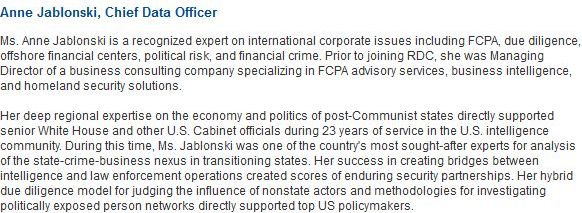
jablonski

Today a company representative I spoke to said that she no longer works there but couldn’t tell me when she left. Presumably it was within hours of the publication of the Associated Press report.

USA Today reports that the White House strongly urged AP not to run the story:

“Without commenting on any purported affiliation between Mr. Levinson and the U.S. government, the White House and others in the U.S. Government strongly urged the AP not to run this story out of concern for Mr. Levinson’s life,” said a statement from Caitlin Hayden, a spokesperson for the National Security Council.

NBC News, however, reports that Levinson’s family believe the disclosure may be helpful:

Friends and relatives of Robert Levinson, a retired FBI agent who disappeared in Iran more than six years ago, say they hope new disclosures that he was working for the CIA will lead to more action to get him home.

“Bob is a courageous man who has dedicated himself, including risking his own life, in service to the U.S. government,” Levinson’s family said in a statement provided to NBC News. “But the U.S. government has failed to make saving this good man’s life the priority it should be.”

While the account told by the AP places emphasis on the role of Anne Jablonski, characterizing her as “quirky” (like 20 million other Americans she practices yoga) and implies that as “kindred spirits” she and Levinson perhaps carry equal responsibility for conducting a rogue operation, the story says nothing about the prevailing culture in the CIA after Vice President Dick Cheney had said that it would need to operate on “the dark side.”

The idea of a group of analysts contracting an American to conduct a clandestine mission inside Iran might sound reckless, but the fact is, they were working inside an agency that was engaged in targeted killing, torture, kidnapping, and the operation of secret prisons.

Governments, their agencies, and companies, all expect unswerving loyalty from their employees, but the obligations of loyalty invariably seem to flow in only one direction.

Update: Following the publication of the AP report, the New York Times has also released a report which it has published after receiving the Levinson family’s permission. The report contains a great deal of additional information about the fruitless efforts to find Levinson. It also contains details that raise questions about whether Jablonski was turned into a scapegoat by the CIA. It should be noted that the agency’s own investigation was triggered by the intervention of Levinson’s senator, who had himself be informed about the case by the Levinson family’s lawyer.

In March 2008, a year after Mr. Levinson’s disappearance, his wife was called to a meeting at F.B.I. headquarters. There C.I.A. officials acknowledged for the first time that he had worked for them. Had it been left up to the C.I.A., it is unlikely that meeting would have occurred.

Mr. McGee [the family lawyer] and Mr. Silverman [a retired NBC investigative producer who had arranged Levinson’s meeting in Iran] had given records from Mr. Levinson’s files that documented his C.I.A. work to the Senate Select Committee on Intelligence. Senator Bill Nelson, Democrat of Florida, called in top agency officials and demanded an explanation. Those officials said they had never been alerted that an agency contractor was missing and promised to investigate.

Not long afterward, two C.I.A. officials met with Ms. Levinson and Mr. McGee at his office in Pensacola, Fla. They started by delivering a message. “They wanted to officially apologize on behalf of the C.I.A. to the Levinson family,” Mr. McGee recalled.

According to Mr. McGee, the C.I.A. officials said that while an inquiry had not found a “smoking gun” proving that the agency knew in advance about Mr. Levinson’s trip, it did conclude that Ms. Jablonski and her boss, Mr. Sampson, had misled officials about his work.

The agency gave Ms. Jablonski, Mr. Sampson and another top C.I.A. analytical official a choice: They could resign from the agency or be fired, according to several people familiar with the matter. Mr. Sampson and the other official resigned. Ms. Jablonski said she had refused and had been fired. In 2008, when Mr. McGee made it clear he was prepared to sue the C.I.A., the agency agreed to pay $2.25 million to Christine Levinson, whether or not her husband returned.

Ms. Jablonski later said in an interview that the C.I.A.’s suggestion she had abandoned a friend to protect her career was a lie. She said she had never imagined Mr. Levinson would go to Kish and insisted that she would have stopped him had she known.

She described herself as a convenient scapegoat for the C.I.A. She said that during the agency’s internal inquiry she had been repeatedly interrogated inside a windowless room by two former operatives. The men belittled Mr. Levinson’s intelligence reports as useless and suggested she might have been complicit in his disappearance.

“For all we know, you were angry with your friend and sent him to Iran to be killed,” she said one of them told her.

Facebooktwittermail

Top Western-backed rebel in Syria is forced to flee

The Wall Street Journal reports: Islamist fighters ran the top Western-backed rebel commander in Syria out of his headquarters, and he fled the country, U.S. officials said Wednesday.

The Islamists also took over key warehouses holding U.S. military gear for moderate fighters in northern Syria over the weekend. The takeover and flight of Gen. Salim Idris of the Free Syrian Army shocked the U.S., which along with Britain immediately froze delivery of nonlethal military aid to rebels in northern Syria.

The turn of events was the strongest sign yet that the U.S.-allied FSA is collapsing under the pressure of Islamist domination of the rebel side of the war. It also weakened the Obama administration’s hand as it struggles to organize a peace conference next month bringing together rebels and the regime.

The Islamic Front is a recently formed alliance of the largest Islamist rebel groups that excludes the two main al Qaeda-linked rebel groups—the Nusra Front and the Islamic State of Iraq and al Sham—and is considered the more moderate faction among Islamist rebel groups.

Gen. Idris flew to the Qatari capital of Doha on Sunday after fleeing to Turkey, U.S. officials said Wednesday. “He fled as a result of the Islamic Front taking over his headquarters,” a senior U.S. official said.

An Islamic Front spokesman also said Gen. Idris had fled to Turkey.

The Front took over the warehouses and offices controlled by the Supreme Military Council, the moderate opposition umbrella group that includes the FSA and coordinates U.S. aid distribution, officials said. They also seized the Bab al-Hawa border crossing with Turkey, near the warehouses in the town of Atmeh.

The growing strength of the Islamic Front prompted the U.S. and its allies to recently hold direct talks with Islamic Front representatives. The goal, according to Western officials, was to persuade some Islamists to support a Syria peace conference set for Geneva on Jan. 22 for fear that a lasting accord won’t be possible without their backing. The SMC already agreed to participate in the peace talks. [Continue reading…]

Facebooktwittermail

How easy is it to make sarin?

“It’s not hard to make sarin. You could mix it in the backyard. Two chemicals melded together.”Seymour Hersh interviewed on CNN, December 9, 2013.

The idea that the chemical warfare agent, sarin, is easy to make is central to Seymour Hersh’s claim that the August 21 attacks killing hundreds of Syrians could have been carried out by the rebel group, the Al Nusra Front. (With unquestioning confidence in the reliability of his source(s), Hersh rests this claim on classified intelligence reports none of which he claims to have seen.)

Hersh’s backyard sarin production appears to be concocted from fiction. The only non-state actor known to have engaged in large-scale sarin production was the Japanese cult, Aum Shinrikyo. They invested $30 million in this endeavor which included the creation of a production facility.

The plant was a free-standing three-story building, staffed by workers with chemistry and chemical-engineering expertise who designed and built proper process controls. It was a complex, expensive operation, and its production capacity was approximately 2 gallons of sarin per batch.

Dan Kaszeta, a former officer in the U.S. Army Chemical Corps and former member of the U.S. Secret Service, estimates that the August attack would have required one ton of sarin — far more than Aum Shinrikyo was able to produce even with their dedicated facility.

Hersh says “there’s two inert substances” used for producing sarin. But Kaszeta points out that the precursors are neither easy to obtain nor inert. Methylphosphonyl difluoride is both reactive and corrosive and as a Schedule 1 substance under the Chemical Weapons Convention, is tightly controlled.

Even if the precursors are obtainable, anyone trying to make sarin in an at-home lab would face a challenge because, in many ways, the ingredients are more dangerous than the final product. An intermediate step in the production, for example, requires the use of hydrogen fluoride gas at a high temperature. Hydrogen fluoride is nasty stuff, and a lot of it is needed to make sarin. Even in its more stable liquid form, the smallest leak would destroy all the chemistry equipment and almost everything else in a modern kitchen. Anyone trying to combine these ingredients may kill or seriously harm himself and anyone nearby.

Amy E. Smithson, a researcher on chemical and biological weapons at the Henry L. Stimson Center in Washington, who investigated the Aum Shinrikyo attacks in Japan emphasized that in assessing the capacity of non-state actors to use chemical weapons there is a huge gulf between the “theoretical possibility” and the “operational reality.” And keep in mind that Aum Shinrikyo was operating in the tranquility of peacetime Japan — it’s obstacles were all technical with none from the battlefield.

“By almost any standard, Aum was a terrorist nightmare – a cult flush with money and technical skills led by a con-man guru with an apocalyptic vision, an obsession with chemical and biological weaponry, and no qualms about killing,” Smithson writes.

But by almost any standard, Aum Shinrikyo’s chemical weapons program, and an earlier attempt to develop biological agents, failed to produce anything close to the killing power the group desired.

The cult started off by trying to simply acquire chemical weapons from a rogue U.S. operation peddling nerve gas on the black market – but found itself dealing with a front for the U.S. Customs Service.

For terrorists, the lesson here is plain: Worldwide law enforcement and intelligence agencies represent no small obstacle.

When Aum Shinrikyo then turned to producing its own stockpiles of chemicals in 1993, it soon ran into complex problems involved in dispersing nerve gas in ways that kill lots of people.

“Weaponizing” chemical agents requires munitions that disperse the substances in droplets, which can kill on skin contact, or vapor, which can be lethal if inhaled. But most explosive devices within the technological reach of terrorists would either destroy most of the chemical agents upon detonation or fail to effectively disperse them.

Spraying also can effectively disperse chemical agents. But most experts believe that 90 percent of any agent sprayed outdoors will not reach its intended targets in lethal form, given the vagaries of temperature, sunlight, wind and rain. Pumping chemical or biological agents into a building’s indoor ventilation system is no easy task either, requiring detailed knowledge of how air is distributed from floor to floor.

In Aum Shinrikyo’s first attempt to attack a rival group by spraying sarin gas from a moving van, Smithson notes, “the sprayer completely malfunctioned and sprayed backwards.” The second attempt ended up exposing the group’s security chief to the toxic nerve agent.

When the cult finally executed its climactic subway attack, its dispersal method of choice was poking holes in plastic bags with sharpened umbrella points. Noxious fumes then seeped from the bags into the subway cars.

The resulting chaos and death shocked the world. “Rescue crews found pandemonium, with scores of commuters stumbling about, vision-impaired and struggling to breathe,” Smithson writes. “Casualties littered the sidewalks and subway station exits. Some foaming at the mouth, some vomiting and others prone and convulsing.”

But in the final analysis, she notes, 85 percent of the 5,510 people treated at Tokyo hospitals and clinics were simply worried, not harmed. Twelve ultimately died from sarin exposure, about 40 others were seriously injured, and slightly less than 1,000 were “moderately ill.”

I recently launched my new website, Attention to the Unseen.

If you find it interesting, please sign up for email updates (via Feedburner).

Facebooktwittermail

Investigating chemical weapons in Syria

Brian Whitaker writes: In the blue corner, Seymour Hersh, one of America’s most famous and highly paid investigative reporters. In the red corner, Eliot Higgins, who sits at home in an English provincial town trawling the internet and tweets and blogs about his findings under the screen name Brown Moses.

On Sunday, in a 5,000-word article for the London Review of Books, Hersh suggested Syrian rebels, rather than the regime, could have been responsible for the chemical weapons attacks near Damascus on August 21.

On Monday, Higgins responded on the Foreign Policy website, demolishing the core of Hersh’s argument in a mere 1,700 words.

While seeking to re-ignite the “whodunnit” debate about chemical weapons, Hersh’s article unwittingly revealed a lot about the changing nature of investigative journalism. Hersh is old-school. He operates in a world of hush-hush contacts – often-anonymous well-placed sources passing snippets of information around which he constructs an article that challenges received wisdom.

The Hersh style of journalism certainly has a place, but in the age of the internet it’s a diminishing one – as the web-based work of Higgins and others continually shows.

The main problem with Hersh’s article is that he seems to have spent so much time listening to his secretive sources, and perhaps became so enthralled with them, that he never got round to looking at a wealth of information about the chemical attacks which is freely available on the internet. The result was that his article posed a number of once-important questions which others had already answered. [Continue reading…]

Facebooktwittermail

Syria’s foreign fighters

Thomas Hegghammer writes: Sometime in the spring or summer of 2013, history was made in Syria. That was when the number of foreign fighters exceeded that of any previous conflict in the modern history of the Muslim world. There are now over 5,000 Sunni foreign fighters in the war-torn country, including more than a thousand from the West. The previous record-holder — the 1980s Afghanistan war — also attracted large numbers overall, but there seems never to have been more than 3,000 to 4,000 foreign fighters at any one time in Afghanistan. This influx of war volunteers will have a number of undesirable consequences, from strengthening the most uncompromising elements of the Syrian insurgency to reinvigorating radical communities in the foreign fighters’ home countries. Not all of these fighters can be considered jihadists, of course, but many can, and more will be radicalized as they spend time in the trenches with al Qaeda-linked groups. At this rate, the foreign fighter flow into Syria looks set to extend the life of the jihadi movement by a generation.

But why is Syria attracting so many war volunteers? How could this happen only two years after the Arab spring and the death of Osama bin Laden prompted many to predict the decline of jihadism? The short answer is that it’s easy to get there. Not since the early days of the Bosnia war has it been less complicated for Islamists to make it to a war zone. This was stated in a recent Washington Post interview with a Syrian facilitator:

“‘It’s so easy,’ said a Syrian living in Kilis who smuggles travelers into Syria through the nearby olive groves and asked to be identified by only his first name, Mohammed. He claims he has escorted dozens of foreigners across the border in the past 18 months, including Chechens, Sudanese, Tunisians and a Canadian. ‘For example, someone comes from Tunisia. He flies to the international airport wearing jihadi clothes and a jihadi beard and he has jihadi songs on his mobile,’ Mohammed said. ‘If the Turkish government wants to prevent them coming into the country, it would do so, but they don’t.'”

The obstacles facing Syria volunteers today are smaller than those faced by most other foreign fighters in the past two decades. A Saudi showing up at Islamabad airport in 2002 humming jihadi anashid would be on the next plane to Guantanamo, and woe to the Arab caught in combat gear on the Chechen border. It is not just the border crossing which is less complicated; the risk of legal sanctions at home also seems lower, thus far at least, for Syria-farers than for their predecessors. A European Islamist with al Qaeda in Yemen would face almost certain prosecution on his return. The United States has been even less forgiving, sending several Somali-Americans to prison for merely trying to join al-Shabab. Thus far, few if any European countries seem to be systematically prosecuting foreign fighters returning from Syria, although some E.U. officials have called for stricter legislation. [Continue reading…]

Facebooktwittermail