Peter Beinart writes: Now that he’s dead, and can cause no more trouble, Nelson Mandela is being mourned across the ideological spectrum as a saint. But not long ago, in Washington’s highest circles, he was considered an enemy of the United States. Unless we remember why, we won’t truly honor his legacy.
In the 1980s, Ronald Reagan placed Mandela’s African National Congress on America’s official list of “terrorist” groups. In 1985, then-Congressman Dick Cheney voted against a resolution urging that he be released from jail. In 2004, after Mandela criticized the Iraq War, an article in National Review said his “vicious anti-Americanism and support for Saddam Hussein should come as no surprise, given his longstanding dedication to communism and praise for terrorists.” As late as 2008, the ANC remained on America’s terrorism watch list, thus requiring the 89-year-old Mandela to receive a special waiver from the secretary of State to visit the U.S.
From their perspective, Mandela’s critics were right to distrust him. They called him a “terrorist” because he had waged armed resistance to apartheid. They called him a “communist” because the Soviet Union was the ANC’s chief external benefactor and the South African Communist Party was among its closest domestic allies. More fundamentally, what Mandela’s American detractors understood is that he considered himself an opponent, not an ally, of American power. And that’s exactly what Mandela’s American admirers must remember now. [Continue reading…]
Category Archives: Lands
Mandela was never a revolutionary, always a radical
Gary Younge writes: A fitting way to commemorate Nelson Mandela is to describe his arrival in the townships during the first democratic elections in 1994. The crowds travelled up to 100 miles in cattle trucks or minibuses to get to places that apartheid had deliberately made remote and barren. Then they waited for hours, in a ramshackle stadium with little shade. Despite being punctual in his personal life, Mandela on the campaign trail was always late: a victim of overambitious scheduling and inefficient minders.
Finally, the crowds saw his cavalcade throw up dust in the distance, and they began to sing the campaign song Sekunjalo Ke Nako (Now is the Time). Everyone started to dance, ululations and cheers growing in intensity. Many of those present had not seen Mandela even on TV, and knew his face only from posters and newspaper pictures. Flags and placards hoisted above heads created a ripple at first, then a wave of excitement on a sea of black, gold and green.
The rush of energy did not subside until Mandela had taken the stage half an hour later. By then the crowd had got what it came for – proximity, a sighting, to be present in history. For hours after the rally, people walking home from the stadium punched the air and shouted “amandla” (“power”) at passing cars.
The problem with personifying a national, political aspiration, as Mandela did, is that it becomes difficult to see where the man starts and the movement ends. [Continue reading…]
Desmond Tutu on Nelson Mandela: ‘Prison became a crucible’
Desmond Tutu writes: For 27 years, I knew Nelson Mandela by reputation only. I had seen him once, in the early 1950s, when he came to my teacher-training college to judge a debating contest. The next time I saw him was in 1990.
When he came out of prison, many people feared he would turn out to have feet of clay. The idea that he might live up to his reputation seemed too good to be true. A whisper went around that some in the ANC said he was a lot more useful in jail than outside.
When he did come out, the most extraordinary thing happened. Even though many in the white community in South Africa were still dismissing him as a terrorist, he tried to understand their position. His gestures communicated more eloquently than words. For example, he invited his white jailer as a VIP guest to his inauguration as president, and he invited the prosecutor in the Rivonia trial to lunch.
What incredible acts of magnanimity these were. His prosecutor had been quite zealous in pushing for the death penalty. Mandela also invited the widows of the Afrikaner political leaders to come to the president’s residence. Betsie Verwoerd, whose husband, HF Verwoerd, was assassinated in 1966, was unable to come because she was unwell. She lived in Oranje, where Afrikaners congregated to live, exclusively. And Mandela dropped everything and went to have tea with her, there, in that place.
He had an incredible empathy. During the negotiations that led up to the first free elections, the concessions he was willing to make were amazing. Chief Buthelezi wanted this, that and the other, and at every single point Madiba would say: yes, that’s OK. He was upset that many in the ANC said Inkatha was not a genuine liberation movement. He even said that he was ready to promise Buthelezi a senior cabinet position, which was not something he had discussed with his colleagues. He did this to ensure that the country did not descend into a bloodbath. [Continue reading…]
Nelson Mandela: a leader above all others
In an editorial, The Guardian says: When Helen Suzman went to see Nelson Mandela on Robben Island in 1967, the first prisoner she encountered was a man called Eddie Daniels, who told her: “Yes, we know who you are. Don’t waste time talking to us. Go and talk to Mandela at the end of the row. He’s our leader.” Daniels’s absolute certainty struck Suzman very forcibly. Although Daniels did not spell it out, she learned later that the prison administration had tried to arrange her tour so that she would not reach Mandela’s cell before her limited time on Robben ran out.
She took the advice, made her way to Mandela’s cell, and found there a quietly eloquent and direct man of imposing physique and great natural authority. Eddie Daniels was of course right: Mandela was indeed the leader, not only of the detainees in the island prison, but of the South African liberation movement as a whole. He had mentors and partners, some in detention with him, some in exile, and some enduring a harassed and persecuted life in South Africa itself, and he had rivals inside and outside the African National Congress.
But he was indubitably the man who came, above all others, to symbolise the struggle of the ANC, from the time when it seemed to have collapsed under the assaults of the apartheid state, to the time of its final successes, when that same state found itself pleading with the ANC to enter a new era in which the structures of oppression would be liquidated.
Yet this leadership, even if we define it as moral rather than practical, remains ultimately something of a mystery. Mandela was not able, during 27 years in prison, to exercise sustained operational control or to take a regular part in ANC decision-making, except toward the very end, when he negotiated with FW de Klerk.
Before he went to jail, his record was of brave failure rather than of significant victory. His attempts, during his early years, to wage, along with others, a legal and non-violent campaign for black rights were stymied by a government which was not only unresponsive but positively preferred to push the ANC into clandestine activity so that it could fragment and criminalise the movement. His reluctant conversion to the military path ended abruptly when he was arrested within days of returning to South Africa to pursue the armed struggle. As a civil rights leader, he was ineffective. As a short-lived guerrilla leader, he was an amateur. And when, released from prison, he became the first president of the new South Africa, he was often inattentive, he discarded his once radical views on the economy, and, arguably, he endorsed the wrong man as his successor. To set against that, he insisted on respect for the judgments of the South African Constitutional Court even when they upset the ANC’s plans, and he refused to support the death penalty.
Mandela was far from alone among 20th-century liberation leaders in achieving stature in prison. [Continue reading…]
Nelson Mandela: we are blessed to have shared our lifetime with a colossus
Justice Malala writes: Nelson Mandela, global hero, died on Thursday night. We had steeled ourselves for it in the months of his hospitalisation over the past year and half. Yet, we are in shock.
We mourn him. We mourn him because in his 95 years, Nelson Rolihlahla Mandela has taught us how to live.
He taught us to strive for what is good and right, even as we ourselves stumble; to strain for perfection, even as we are caught up in our own flawed lives; to put the poor and downtrodden at the centre of our endeavours, even as we reach for the good life.
As he lay in hospital for months this year, Mandela taught us yet another lesson: just as we have been blessed with the gift of his presence, so too must we accept his inevitable departure. It is the most terrible of Biblical injunctions to perceive, but today it is stark: there is a time to live, and a time to die. Today we face the heartbreaking reality of the latter.
Over the past six months the news coming out of Pretoria had been the gravest it had ever been: the presidency had used the word “critical”; the family was sombre and mournful even as it was divided. The man whose walk to freedom was so long, so painful, so inspirational, was well on in his last journey.
Outside the hospital, passersby stopped and stared at the massed international and local media. “He is old. He must go,” said one to me as, like so many other journalists, we waited outside the hospital for word. It is a refrain that was heard often, at the hospital and elsewhere, even as far away as his home in Qunu. We could not bear to think of Mandela, a man who endured so much in pursuit of all our freedom, being in pain.
The heartbreaking reality, as one of our great poets, Chris van Wyk, once put it, is that it was time to go home, now. It is time to go home. [Continue reading…]
Nelson Mandela: Freedom fighter — 1918-2013
In June, Gary Younge wrote: Shortly before Nelson Mandela stepped down as president of South Africa in 1999, racial anxiety was a lucrative business. At the public library in the affluent area of Sandton, I attended a session at which an emigration consultant, John Gambarana, warned a hundred-strong, mostly white audience of the chaos and mayhem to come. Holding up a book by broadcaster Lester Venter called When Mandela Goes, he told them, “People, this book is a wake-up call. The bad news is [when Mandela leaves] the pawpaw’s really going to hit the fan. The good news is the fan probably won’t be working.”
And so it was that, even in the eyes of those who made a living peddling fear, less than a decade after his release from prison, Mandela had been transformed from terrorist boogeyman to national savior.
White South Africa has come to embrace him in much the same way that most white Americans came to accept Martin Luther King Jr.: grudgingly and gratefully, retrospectively, selectively, without grace but with considerable guile. By the time they realized that their dislike of him was spent and futile, he had created a world in which admiring him was in their own self-interest. Because, in short, they had no choice.
As the last apartheid leader, F.W. de Klerk—who had lost the election to Mandela—told me that same year, “The same mistakes that we made were still being made in the United States and the ex-colonies. Then we carried them on for around twenty years longer.” There are myriad differences between apartheid South Africa and America under segregation. But on that point, if little else, de Klerk was absolutely right. Neither the benefits of integration nor the urgency with which it was demanded were obvious to most Americans during King’s time. A month before the March on Washington in 1963, 54 percent of whites thought the Kennedy administration was “pushing racial integration too fast.” [Continue reading…]
Why Syria’s Islamic Front is bad news for radical groups
Hassan Hassan writes: One of the mistakes analysts of the Syrian conflict often make is to assess rebel groups exclusively based on the slogans these organisations use. Many observers already recognise that hard-line Islamist rhetoric is more often than not used to attract funding. But in recent weeks, this rhetoric has become even more essential to prevent a deeply worrying trend: more Syrians have been drifting towards the orbit of radical groups such as Jabhat Al Nusra as a consequence of their efficiency and tireless focus on the battlefield.
This trend can be best examined by looking into the newly-formed Islamic Front, a Salafi-leaning alliance of at least seven of the most powerful rebel groups in Syria.
The nexus of this alliance was Jaish Al Islam, a merger of initially 51 groups led by Zahran Alloush from Damascus. Alloush’s alliance was seen by extremists as a Saudi scheme in lieu of the US-backed Military Councils. When Jaish Al Islam was formed in September, it started to face hostile criticism by supporters of radical groups, especially as the group lost ground in several areas around Damascus to the regime’s Iranian-backed militias. Alloush, according to sources, met senior members of Jabhat Al Nusra to contain the situation. He also recorded a video in which he praised Jabhat Al Nusra and its ideological proximity to Jaish Al Islam.
Maintaining ties with Jabhat Al Nusra has been practically unavoidable for rebel groups. Jabhat Al Nusra has successfully won hearts and minds of local communities through its efficiency not only on the battlefield but also in the delivery of aid to people. Fighters from other groups recognise its popularity and avoid confrontation with it.
The Islamic Front succeeded where Zahran Alloush failed: it convinced Jabhat Al Nusra that the alliance would work closely with it, but only quietly. The attacks against Salafi groups died down noticeably after the formation of the Front.
The closer relationship between the Islamic Front and Jabhat Al Nusra is a marriage of convenience, as the two groups increasingly view the Al Qaeda-affiliated Islamic State of Iraq and Syria (Isis) as a menace. [Continue reading…]
The Wall Street Journal reports: The U.S. and its allies have held direct talks with key Islamist militias in Syria, Western officials say, aiming to undercut al Qaeda while acknowledging that religious fighters long shunned by Washington have gained on the battlefield.
At the same time, Saudi Arabia is taking its own outreach further, moving to directly arm and fund one of the Islamist groups, the Army of Islam, despite U.S. qualms.
Both the Western and Saudi shifts aim to weaken al Qaeda-linked groups, which Western officials now concede are as great a danger in Syria as President Bashar al-Assad’s regime.
Some officials in Western capitals remain wary about courting these groups, whose ultimate goal is to establish a state ruled by Islamic law, or Shariah, in Syria. Throughout the conflict, the U.S. and its allies have balked at sending powerful arms to any Islamists, fearing such shipments could end up in the hands of al Qaeda-backed forces.
The Saudis and the West are pivoting toward a newly created coalition of religious militias called the Islamic Front, which excludes the main al Qaeda-linked groups fighting in Syria — the Nusra Front and the Islamic State of Iraq and the Sham, known as ISIS. [Continue reading…]
A Syrian regime governed by fear and distrust
Robin Yassin-Kassab writes: Syrian poet Rasha Omran once told me that Bashar al-Assad was “not a dictator, just a gangster boss”. But he’s not even that. What he is, a (dysfunctional) functionary. Syria is a dictatorship which lacks an efficient dictator.
Hafez al-Assad – the father – was an entirely different matter. Born in a dirt-floor shack, he clawed his way to the top by brute cunning, deft flexibility, and strategic intelligence. The careful manipulation of sectarian tensions in order to divide and rule was one of his key strategies, yet he was also attentive to building alliances with rural Sunnis and the urban bourgeoisie – both constituencies now alienated by his son.
Bashar’s great innovation was supposedly economic reform. In practice this meant an unpleasant marriage of neoliberalism with crony capitalism. It succeeded in making his cousin Rami Makhlouf the richest man in the country. The poor, meanwhile, became much poorer, the social infrastructure crumbled, and unemployment continued to climb.
The thesis of former German diplomat Bente Scheller’s book, The Wisdom of the Waiting Game, is that the Syrian regime’s approach to its current existential crisis follows a “narrow path consistent with previous experience”, and she focuses on foreign policy to make this point. When the regime found itself isolated on Iraq after the 2003 invasion, for instance, or on Lebanon in 2005, after the assassination of Rafiq Hariri and the Syrian army’s precipitous withdrawal, it waited, refusing to change its policy, until conditions changed, its opponents were humbled, and it was brought in from the cold.
In his book The Fall of the House of Assad, David Lesch points out that Bashar felt personally vindicated by these perceived policy victories, and grew in arrogance as a result. Today, with the West handing the Syria file over to Russia, and seemingly coming around to Bashar’s argument that Islamism poses a greater threat than his genocidal dictatorship, it looks (for now at least) as if the refusal to budge is again paying off. [Continue reading…]
Syria’s chemical weapons to be shipped in delicate U.S.-Danish operation
The Guardian reports: A Danish cargo vessel is due to load Syria’s chemical arms stockpile and transfer it to a specially adapted US ship in a delicate and unprecedented operation early in the new year, according to the world’s chemical weapons watchdog’s current plans.
The plans being drawn up by the Organisation for the Prohibition of Chemical Weapons (OPCW) have not been finalised. It is not yet clear, for example, whether the transfer between the two ships of about 500 tonnes of lethal chemicals, including nerve agents, will be done on sea or when both vessels are docked.
Both options have serious challenges. A sea transfer from one ship to another with such a hazardous cargo would be fraught with danger. But so far, no Mediterranean port has agreed to host the transfer on land, say weapons experts briefed on the plan by the OPCW yesterday in The Hague.
The US ship, the Maritime Administration MV Cape Ray, is being fitted in Norfolk, Virginia, with two field deployable hydrolysis systems (FDHS) that will neutralise the chemical weapons agents with the addition of fresh water and other reagents, such as sodium hydroxide and sodium hypochlorite. The Danish ship has so far not been identified but is believed to be a roll-on, roll-off (“ro-ro”) vessel like the Cape Ray.
The direct docking of the Cape Ray at the Syrian port of Latakia is not seen as an option given the hostile relations between Washington and Damascus.
If all goes according to plan, the chemical weapons should leave Latakia by the year’s end and the Cape Ray should be ready to sail by 4 January. It will begin processing the chemicals in international waters, but can only do so in calm seas. [Continue reading…]
Academics should boycott Israel: Growing movement takes next step
Steven Salaita, an associate professor of English at Virginia Tech, writes: In recent years, we have seen greater recognition in the United States that religious acrimony and ancient blood feuds are not the source of the Israel-Palestine conflict, whose progenitor in fact is Jewish colonization. As this recognition grows, along with corresponding support for Palestinian human rights, unprecedented pressure bears on Israel’s defenders to maintain the once-dominant narratives of Israeli victimhood and Palestinian terror.
These days, Israel is an extremely difficult state to defend.
It should be so. Israel continues to make a mockery of the “peace process” by constructing new settlements and insulting American leaders. It tolerates politicians who routinely make racist statements. And it continues to be in violation of at least 77 United Nations Resolutions and numerous provisions of the Fourth Geneva Convention.
The latest challenge to these violations comes from the Boycott/Divestment/Sanctions movement, which has attracted the attention of pro-Israel advocacy groups and the Israeli government itself, thus validating the efficacy of the tactic. A specific element of BDS, academic boycott, was recently ratified by the Association of Asian American Studies and enjoys overwhelming support among the membership of the American Studies Association, whose National Council today voted to affirm a resolution honoring the Palestinian call to boycott Israeli universities.
Although at first glance academic boycott seems vengeful and arbitrary, its mission is rigorous and ethical, perfectly concordant to comparable boycotts that earned widespread support in the United States (against apartheid South Africa, for instance, or Arizona when it refused to recognize Martin Luther King Jr. Day). [Continue reading…]
Israel not striving for peace, says former central bank chief
Haaretz reports: Former Bank of Israel Governor Stanley Fischer says that Israel is not looking for peace “to the extent that it should” and that it is “divided between those who want to settle the West Bank and those who seek peace.”
The rare public criticism of Israeli policy from the soft-spoken former governor, widely credited with navigating the successful Israeli economy of the past decade, came during a discussion of “Israel: the View from the Inside Out,” which convened on Tuesday evening at the Center on Law and Security of New York University’s School of Law. Participating in the panel alongside Fischer were former Supreme Court President Dorit Beinisch, Hebrew University Professor Moshe Halbertal and New Republic Literary Editor Leon Wieseltier, who moderated.
“The approach that we have to be strong because if we’re not strong we will be defeated is absolutely correct but it is not the only the part of national strategy,” Fischer said. “The other part is the need to look for peace, and that part is not happening to the extent that it should.”
“The country seems to me to be divided between those who want to settle the West Bank and those who seek peace. It is a huge challenge for the future for a country whose achievements are so extraordinary,” he added. [Continue reading…]
Hezbollah accuses Israel of assassinating senior commander in Beirut
Haaretz reports: The death of Hassan al-Laqis, a senior Hezbollah commander who was killed on Tuesday in what looks like a clean and especially professional assassination in Dahieh, the Shi’ite quarter of Beirut, is the biggest operational blow to the Lebanese organization since the death of Imad Mughniyeh. Mughniyeh, who was described as the Hezbollah chief-of-staff, was assassinated in Damascus in February 2008. At the time Hezbollah blamed Israel, which refrained from responding. On Wednesday morning the organization blamed Israel for the assassination of Laqis as well.
Laqis, one of Hezbollah’s veteran military leaders, has been familiar to Western intelligence services since the 1980s. Intelligence officials have described him in the past as a “brilliant mind” who played a combined role in the Shi’ite organization, which could be compared to the head of Israel Defense Forces’ research and development as well as technology and logistics branch.
Laqis was knowledgeable of and involved in all the organization’s operational secrets – from the acquisition and development of advanced weapons to the establishment of classified communication systems to Hezbollah’s operative plans. His death strips Hezbollah of a “intelligence source” – a person whose experience and widespread connections to Syrian and Iranian intelligence organizations served Hezbollah well for almost three decades. [Continue reading…]
Democractic, as long as you’re Jewish
Aeyal Gross writes: When discussing democracy in Israel, some people seek to distinguish between what happens within the Green Line and what happens beyond it – an undemocratic regime of occupation. They believe the occupation doesn’t weigh on Israel’s democratic character, both because it’s a temporary situation and because it has the distinction of taking place outside the state’s borders.
But the claim of temporariness has steadily eroded as the occupation nears its jubilee, and the claim that the situation is different and distinct from what happens inside the state has been eroding as well, given the similarity of many practices on both sides of the Green Line. This is exemplified by the cases of Susya and Umm al-Hiran.
The government’s decision to settle Jews on the lands of the Bedouin community of Umm al-Hiran entails evacuating and demolishing one of the state’s “unrecognized” villages – communities that, despite being inhabited by citizens of the state, have no master plan, and whose residents don’t receive basic services like water and sewage. Some of these unrecognized villages have existed since before the state was established, and some are the result of the expulsion of Bedouin citizens from their lands. Israel’s military government expelled Umm al-Hiran’s residents from their original village in 1956 and relocated them to the Nahal Yatir region. [Continue reading…]
The best and the brightest: More members with PhDs from U.S. universities in Rouhani’s cabinet than in Obama’s
Moisés Naím writes: Hassan Rouhani, Iran’s president, has more cabinet members with Ph.D. degrees from U.S. universities than Barack Obama does. In fact, Iran has more holders of American Ph.D.s in its presidential cabinet than France, Germany, Italy, Japan, Russia, or Spain — combined.
Take, for example, Rouhani’s chief of staff, Mohammad Nahavandian. He spent many years in the United States and has a Ph.D. in economics from George Washington University. Or Javad Zarif, the foreign affairs minister and chief negotiator in the recent nuclear deal between Iran and six global powers. He studied at the University of San Francisco and completed his doctorate at the University of Denver. For five years, he lived in New York and was Iran’s ambassador to the United Nations. Ali Akbar Salehi, head of Iran’s Atomic Energy Organization, has a Ph.D. in nuclear engineering from MIT. Mahmoud Vaezi, the communication minister, studied electrical engineering at Sacramento and San Jose State Universities and was enrolled in the Ph.D. program at Louisiana State University (he ultimately earned a doctorate in international relations at Warsaw University). Other cabinet members have advanced degrees from universities in Europe and Iran. Abbas Ahmad Akhoundi, the transportation minister, has a Ph.D. from the University of London, while President Rouhani got his from Glasgow Caledonian University in Scotland. The new government in Tehran, in other words, might well be one of the most technocratic in the world.
Does this matter? On the surface, perhaps not much. We all know how often the governments of the “best and the brightest” disappoint. And it’s important to keep in mind that many of these highly credentialed cabinet members were also active participants in former Iranian administrations and backed policies that earned Iran’s theocracy its bad name. [Continue reading…]
Video: Landmark case goes to trial over massive U.S. terrorism ‘no-fly’ database
Iran nuclear deal respects Netanyahu’s red line

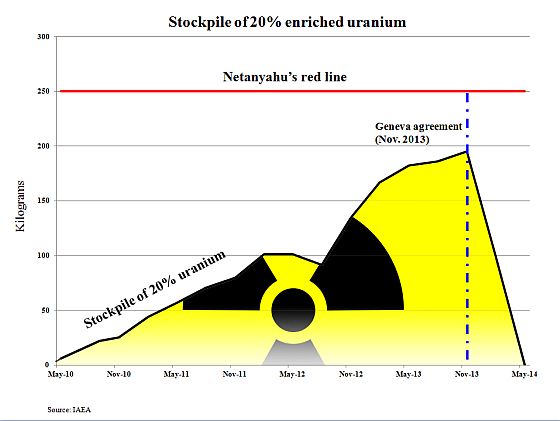
Graham Allison writes: Amidst the weeping and gnashing of teeth from the Prime Minister’s office after the interim agreement on Iran reached in Geneva, it is appropriate to pause to ask how President Obama’s interim agreement actually measures up on Israeli Prime Minister Netanyahu’s chosen yardstick.
Who can forget Netanyahu’s UN presentation last year where he made his best case to the world about the threat Iran’s nuclear program poses to international security. To vivify this danger, Bibi unveiled a graphic sketch of a bomb on which he demonstrably drew a red line.
As he explained in his UN speech then: “In the case of Iran’s nuclear plans to build a bomb, this bomb has to be filled with enough enriched uranium. And Iran has to go through three stages. The first stage: they have to enrich enough of low enriched uranium. The second stage: they have to enrich enough medium enriched uranium. And the third stage and final stage: They have to enrich enough high enriched uranium for the first bomb.”
Having set the stage, he then asked, “Where’s Iran?” As he answered: “Iran’s completed the first stage. It took them many years, but they completed it and they’re 70% of the way there. Now they are well into the second stage.” He then vowed that Iran would never be allowed to cross his red line to the third stage. “The red line must be drawn on Iran’s nuclear enrichment program,” he argued, “because these enrichment facilities are the only nuclear installations that we can definitely see and credibly target. I believe that faced with a clear red line, Iran will back down.” [Continue reading…]
Zarif asks Saudi Arabia to work with Iran
Al Jazeera reports: Mohammad Javad Zarif, Iran’s foreign minister who is currently on a tour of the Gulf states, has appealed to Saudi Arabia to work with Iran towards achieving regional stability.
He said on Monday in Doha, Qatar, after visits to Kuwait and Oman for meetings on its recent nuclear deal with world powers that his goal was to assure Gulf Arab states that the deal was in their best interests.
“We believe that Iran and Saudi Arabia should work together in order to promote peace and stability in the region,” Zarif told AFP news agency.
Zarif suggested the deal should not be seen as a threat.
“This agreement cannot be at the expense of any country in the region,” he said on Sunday. [Continue reading…]
UN falls short of feeding Syria’s hungry as winter bites
Reuters reports: The United Nations said on Tuesday it had delivered food to 3.4 million people in Syria in November, falling short again of its monthly target of 4 million as heavy fighting kept it from reaching hungry people in contested areas.
As winter bites, the number of children in Syria deemed vulnerable and in need of assistance has nearly quadrupled from a year ago to 4.3 million, the U.N. Children’s Fund (UNICEF) said.
“The scale of the humanitarian response needed for the looming winter is unprecedented,” it said in a statement.
U.N. aid chief Valerie Amos was to brief the Security Council on the humanitarian situation in Syria later on Tuesday amid deep concerns about lack of access to besieged civilians.
A U.N. document obtained by Reuters last week said around 250,000 people were beyond the reach of its aid convoys, in areas besieged by Syrian government forces or rebels. [Continue reading…]