Category Archives: Lands

What democracies can learn from Greece’s failed populist experiment

Stathis Kalyvas writes: The abysmal incompetence of populists leads to the mistaken belief that their rule will end quickly. Although SYRIZA’s deafening failure looked certain to spell its political death, Tsipras engineered a snap election in September 2015, which he won easily. It was just too early for the stunned electorate to admit its mistake and turn back to the discredited mainstream parties. Through its complacency towards populist parties, the opposition placed itself at a marked disadvantage. By assuming that the populists’ inability to deliver on their promises would doom them, it ultimately helped them remain in power.

The lesson here is that voters often resist a return to mainstream parties once they have abandoned them. They also don’t like to be reminded that they were wrong to jump on the populist bandwagon in the first place. Rather, it is up to the non-populist parties, the fetid mainstream, to convince the electorate that they themselves have changed and are ready to offer credible solutions. In Greece, SYRIZA managed to reclaim power in September 2015, even after its policies failed, partly because it faced a tired, unreformed opposition. Only when the underdog Kyriakos Mitsotakis, a younger reformist, won New Democracy’s leadership, did this old, tired party gain political traction.

Paradoxically, this suggests that there’s nothing like a populist experiment to re-legitimize the mainstream. With their promises in tatters and their incompetence on full display, populist parties are eventually exposed. At this point, they face the choice to either go mainstream or disappear. Populism may well be a necessary, perhaps effective treatment for the belief that there are easy solutions to hard problems—for belief that one can escape reality. [Continue reading…]


Facebooktwittermail

Why Trump’s budding bromance with Xi is doomed

The New York Times reports: President Xi Jinping of China and President Trump, despite vastly different personal styles, have several things in common.

They were both born to privilege. They both possess boundless self-confidence. Each seeks advice from a select inner circle, ignoring the big bureaucracies of his government.

Mr. Trump, not known for his effusive praise of world leaders, has talked up their relationship, saying in an interview on CBS’s “Face the Nation” last weekend that his relationship with China was “already acclaimed as being something very special, something very different than we’ve ever had.” He called Mr. Xi “a man that I’ve gotten to like and respect.”

But beneath the bonhomie, Chinese analysts say, fundamental differences of strategic interest are likely to undermine any personal ties Mr. Trump says he has forged with the Chinese leader. The romance, they say, may be more a short marriage of convenience.

Mr. Trump’s public effusiveness is barely reciprocated in China. The state-run media accords Mr. Trump polite coverage, much more so than it did President Barack Obama — a signal that the government, for the time being, would like the Chinese people to view the American president in a positive light.

Among foreign policy experts, however, there is skepticism that Mr. Trump’s flattery of Mr. Xi, and his reliance on the Chinese leader to bear down on North Korea over its nuclear program, will bring the results he wants. [Continue reading…]

Facebooktwittermail

Reformist candidate in Iranian election overshadows Rouhani

Belkis Wille writes: A candidate who entered the Iranian election race to help his boss, President Hassan Rouhani, is emerging as a favourite of reformists for his bold and outspoken campaign, even though he is ultimately expected to step aside.

Eshaq Jahangiri, the first vice-president, made clear when he registered as a candidate for the top job that he was “supplementing” and not challenging the incumbent – indicating his campaign was a tactical move aimed at defending Rouhani’s achievements.

The presidential election on 19 May is the first since the 2015 nuclear deal with the west, when Tehran rolled back its nuclear programme in exchange for the removal of sanctions.

None of the candidates have spoken of scrapping that accord but two conservatives – Tehran’s mayor, Mohammad-Bagher Ghalibaf, and the hardliner Ebrahim Raisi – have questioned whether Rouhani has achieved tangible economic benefits.

Jahangiri’s strong appearance in the first of three televised debates boosted the reformists but Ghalibaf said it was a “strange phenomenon” that he was running alongside Rouhani.

Referring to the marginalisation of reformists after the 2009 disputed presidential vote, which gave hardliner Mahmoud Ahmadinejad a second term in office, Jahangiri responded: “There’s a movement called the reformist movement and you’ve deprived them of all rights and now you are saying that they shouldn’t even have a candidate?

“I’ve put myself up as a representative of the reformist movement to speak out … They confined everyone to their houses. They [Ahmadinejad’s government] earned $700bn, they took it, they spent it and they left nothing, just unemployment.” [Continue reading…]

Facebooktwittermail

To freeze Syria war, Russia proposes setting up ‘de-escalation zones’

The New York Times reports: Russia is circulating a draft proposal to Syrian rebel groups and diplomats that envisions pausing the war in Syria through the creation of safe “de-escalation zones,” with outside troops possibly acting as buffers between the antagonists.

The draft proposal, shared with The New York Times on Wednesday by participants at Syria talks held in Astana, Kazakhstan, is one of the most detailed suggestions to emerge in recent months in the rocky negotiations to halt the war, now in its seventh year.

The proposal would apply to Syrian government and rebel forces in the four main areas of the country where insurgents unaffiliated with the Islamic State still hold significant territory.

But it faces a number of challenges, most notably acceptance by the Syrian government and the insurgent groups attending the talks.

The insurgent groups suspended participation in the talks on Wednesday to protest what they described as heavy bombing by the Syrian government’s Russian-backed forces the day before that killed dozens, including civilians.

The Russian proposal does not specify measures to prevent government warplanes from carrying out such bombings. Rebels said they remained suspicious of Russian guarantees, regardless, because Russia has been unable or unwilling to curb government attacks on civilians.

President Vladimir V. Putin of Russia said on Wednesday that the proposal had the backing not only of Russia but also of Iran, another ally of President Bashar al-Assad of Syria, and Turkey, which backs some anti-Assad groups.

“We as guarantors — Turkey, Iran, Russia — will do everything for this to work,” Mr. Putin said in remarks carried on Russian television, speaking in Sochi, Russia, after meeting with President Recep Tayyip Erdogan of Turkey.

The proposal was made as the United States, another supporter of some anti-Assad groups, appeared to be re-engaging in the negotiations after a prolonged absence.

Stuart E. Jones, the acting assistant secretary of state, was in Astana, the most senior American official to participate in Syria talks since President Trump took office. [Continue reading…]

Facebooktwittermail

North Korea issues direct criticism of China amid nuke dispute

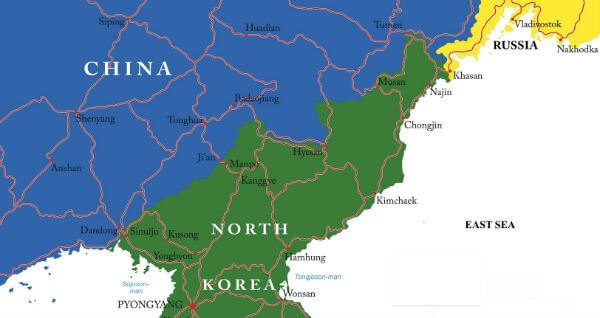
The Associated Press reports: North Korea has issued a rare direct criticism of China through a commentary saying its “reckless remarks” on the North’s nuclear program are testing its patience and could trigger unspecified “grave” consequences.

China, North Korea’s largest trading partner and main benefactor, suspended imports of North Korean coal in line with U.N. sanctions earlier this year and has recently been urging its traditional ally to stop nuclear and missile activities amid U.S. pressure to use its leverage to resolve the nuclear standoff. Chinese state media have also unleashed regular and harsh criticisms on North Korea.

The commentary released Wednesday by the state-run Korean Central News Agency said that “a string of absurd and reckless remarks are now heard from China every day only to render the present bad situation tenser.”

Asked about the KCNA commentary during a regular briefing Thursday, Chinese Foreign Ministry spokesman Geng Shuang said Beijing’s position on “developing good neighborly and friendly cooperation with North Korea is also consistent and clear.” [Continue reading…]

Facebooktwittermail

Russia, feeling slighted by Trump, seeks a reset

The New York Times reports: Given the spotlight focused on Russia during the American presidential campaign and Donald J. Trump’s warm words as candidate for President Vladimir V. Putin, the Kremlin anticipated a starring role as foreign policy partner No. 1 under the Trump administration.

Instead, while President Trump has been feting every Theresa, Justin and Abdel Fattah at the White House or at his Mar-a-Lago estate in Florida, including a high-profile dinner with President Xi Jinping of China, Mr. Putin has had to content himself with three measly telephone calls since the inauguration.

“They feel slighted,” Vladimir Frolov, a prominent foreign policy analyst and columnist, said of the Russian leadership. [Continue reading…]

Facebooktwittermail

Palestinians for Trump: ‘He might be the one’

Politico reports: The Qalandia checkpoint, the main border crossing separating this Palestinian city from East Jerusalem, is not a great place for anyone in a hurry.

On a recent hot afternoon, all passage was halted without explanation as hundreds of Palestinians with permits to work, study or seek medical treatment in Israel—or who actually live there—were packed into a maze of thick iron cages surrounded by barbed wire and monitored by guard towers waiting to be searched, interrogated and, for many, once again humiliated.

After a lengthy delay, small groups were permitted through the turnstiles into the screening areas—some only after being among the unlucky temporarily locked between the heavy revolving bars by an unseen Israeli soldier in an armored guard station with tiny blast-resistant windows.

Though as an accredited American journalist I could have used a speedier route for my return to Jerusalem, I opted to pass through the checkpoint to experience it for myself. Countless Palestinians use the border crossing each day—a procedure Israeli officials say is necessary, like the physical barrier that cuts off much of the West Bank, to prevent terrorism. (The next day, a Palestinian woman stabbed an Israeli soldier at the same checkpoint, one in a recent spate of lone-wolf attacks.)

The daily routine at Qalandia is also a metaphor for the fits and starts of the long struggle to settle the Israeli-Palestinian conflict—which, measured by Israel’s control of the West Bank and Gaza, will reach the milestone next month of half a century on the anniversary of the 1967 Six-Day War.

But there is new glimmer of hope here that things can get moving: Donald Trump.

Trump will welcome Palestinian leader Mahmoud Abbas to the White House on Wednesday ahead of his own planned official visit to the region later this month. In my conversations here with Palestinian officials, I found them surprisingly upbeat about an American president who came to office vowing to crack down on Muslim immigration and who has backed away from longtime U.S. support for a two-state solution.

“The hints are very positive,” General Jibril Rajoub, a member of the central committee of Fatah, the moderate wing of the Palestinian leadership, told me over lunch in late April in a trendy restaurant, Caspar and Gambini’s, on Ramallah’s Al Jihad Street.

A senior Palestinian official, in one of a series of interviews with Politico Magazine, put it this way: “He might be the one to bring the political settlement.”

It is a sense of optimism that virtually no one here anticipated—and one that feels genuine, if also calculated to get into the good graces of the new American leader. Trump’s personal chemistry with hawkish Israeli Prime Minister Benjamin Netanyahu and the pro-settler views of his new ambassador to Israel, David Friedman, were both seen as early omens that the new American president would have little, if any, interest in the Palestinian issue and might even encourage more Israeli settlement construction in the West Bank.

But Rajoub, an urbane diplomat who runs the Palestinian Football Federation and was a longtime adviser to the late Palestinian leader Yasser Arafat, said the quiet but seemingly earnest visits to Ramallah in recent months of CIA Director Mike Pompeo and Jason Greenblatt, the New York lawyer serving as a Trump envoy, were surprisingly positive. [Continue reading…]

Facebooktwittermail

How Sweden became ‘the most alt-right’ country in Europe

BuzzFeed reports: The white nationalist Richard Spencer is partnering with two Swedish outfits to create a company they hope will become a media giant and keep race at the center of the new right wing.

It is envisioned, one co-creator said, as a “more ideological Breitbart.” Called the AltRight Corporation, it links Spencer with Arktos Media, a publishing house begun in Sweden to print English-language editions of esoteric nationalist books from many countries. The other Swedish partner is Red Ice, a video and podcast platform featuring white nationalists from around the globe.

It was natural for Spencer to turn to Swedes as partners in the new enterprise, given the country’s history as an exporter of white nationalist ideas. But forging formal bonds between nationalists across the Atlantic makes even more sense today, when the politics of Northern Europe is heavily driving the politics of immigration and Islam in the United States.

Sweden has been a key center of white nationalism for decades. In the 1990s, it was a world capital of “white power” heavy metal bands; today, it teems with websites and podcasts promoting a new language of white identity. Nationalists have built this network in a country that immigration opponents worldwide have been closely watching with the belief that it will be the first Western nation to collapse beneath the weight of Muslim immigration. [Continue reading…]

Facebooktwittermail

Kremlin critic Aleksei Navalny says attack left him mostly blind in an eye

The New York Times reports: Aleksei A. Navalny, the Russian opposition leader, said on Tuesday that a doctor told him he had lost 80 percent of the sight in one eye after suffering a chemical burn when an assailant threw a green liquid in his face last week.

The eye’s vision may improve, but the outlook is unclear, Mr. Navalny wrote on his website, citing his doctor.

Initially, the attack had appeared less serious; dousing opposition figures with green dye is a common occurrence and often attributed to pro-Kremlin activists. Typically, a type of topical medical disinfectant has been used. It is difficult to wash out but harmless.

Mr. Navalny, who has declared his intention to run in Russia’s presidential election next year, had already been splashed in the face with green dye once this spring, without any adverse affects.

But after the attack on Thursday, in which a man threw the green liquid in the opposition leader’s face and then ran away, Mr. Navalny was taken to a hospital to treat burning in his right eye.

In a post on his website on Tuesday, Mr. Navalny said his ophthalmologist had told him that he had a “chemical burn on the right eye” caused by something other than the green-colored disinfectant. “There was clearly a mix of disinfectant and another, caustic chemical,” Mr. Navalny wrote. [Continue reading…]

Facebooktwittermail

Two-thirds of Canada’s electricity now comes from renewable energy

The Canadian Press reports: Two-thirds of Canada’s electricity supply now comes from renewable sources such as hydro and wind power, the National Energy Board said in a report released Tuesday.

Renewable energy production jumped 17 per cent between 2005 and 2015. The portion of all electricity in Canada generated by renewables is now 66 per cent, up from 60 per cent a decade earlier.

“I think people don’t understand just how much of our generation is the renewables,” said NEB chief economist Shelley Milutinovic. “Probably very few people would know Canada produces the second most hydro in the world.” [Continue reading…]

Facebooktwittermail

South Korea’s likely next president asks the U.S. to respect its democracy

The Washington Post reports: South Korea is on the brink of electing a liberal president with distinctly different ideas than the Trump administration on how to deal with North Korea — potentially complicating efforts to punish Kim Jong Un’s regime.

He is also a candidate who fears that the U.S. government has been acting to box him in on a controversial American missile defense system and circumvent South Korea’s democratic process.

“I don’t believe the U.S. has the intention [to influence our election], but I do have some reservations,” Moon Jae-in told The Washington Post in an interview.

Barring a major upset, Moon will become South Korea’s president Tuesday, replacing Park ­Geun-hye, who was impeached in March and is on trial on bribery charges. Because Park was dismissed from office, Moon will immediately become president if elected, without the usual transition period.

With Moon pledging to review the Park government’s decision to deploy the Terminal High Altitude Area Defense (THAAD) antimissile system, the U.S. military has acted swiftly to get it up and running. This has sparked widespread criticism here that the United States is trying to make it difficult, if not impossible, for Moon to reverse it. [Continue reading…]

The Associated Press reports: The anger is palpable on a narrow road that cuts through a South Korean village where about 170 people live between green hills dotted with cottages and melon fields. It’s an unlikely trouble spot in the world’s last Cold War standoff.

Aging farmers in this corner of Seongju county, more than 200 kilometers (125 miles) south of the capital Seoul, spend the day sitting by the asphalt in tents or on plastic stools, watching vehicles coming and going from a former golf course where military workers are setting up an advanced U.S. missile-defense system.

“Just suddenly one day, Seongju has become the frontline,” said a tearful Park Soo-gyu, a 54-year-old strawberry farmer. “Wars today aren’t just fought with guns. Missiles will be flying and where would they aim first? Right here, where the THAAD radar is.” [Continue reading…]

Facebooktwittermail

As U.S. and China find common ground on North Korea, is Russia the wild card?

Reuters reports: When North Korean leader Kim Jong Un sent Lunar New Year greetings this year, the first card went to Russian President Vladimir Putin, ahead of leaders from China and other allies of the isolated country, according to its official news agency.

Some academics who study North Korea argue Kim could be looking for Russia to ease any pain if China, which accounts for about 90 percent of North Korea’s trade, steps up sanctions against the isolated country as part of moves to deter its nuclear and missile programmes.

U.S. President Donald Trump lavished praise on Chinese President Xi Jinping last week for Beijing’s assistance in trying to rein in Pyongyang. A day later, U.S. Secretary of State Rex Tillerson pressed the United Nations Security Council to impose more sanctions to further isolate Pyongyang.

There is no sign of any sustainable increase in trade between Russia and North Korea, but business and transport links between the two are getting busier.

A new ferry service starting next week will move up to 200 passengers and 1,000 tonnes of cargo six times a month between North Korea and the Russian port of Vladivostok. [Continue reading…]

Facebooktwittermail

Russian election hacking ‘wildly successful’ in creating discord, says former U.S. lawmaker

Reuters reports: Russia succeeded in its goals of sowing discord in U.S. politics by meddling in the 2016 presidential election, which will likely inspire similar future efforts, two top former U.S. voices on intelligence said on Tuesday.

Former Director of National Intelligence James Clapper and former House Intelligence Committee Chairman Mike Rogers agreed at a panel at Harvard University that Russia likely believed it had achieved its goals and could attempt to repeat its performance in elections in other countries.

“Their purpose was to sew discontent and mistrust in our elections they wanted us to be at each others’ throat when it was over,” Rogers said at the panel at Harvard’s Kennedy School of Government. “It’s influencing, I would say, legislative process today. That’s wildly successful.” [Continue reading…]

Facebooktwittermail

New evidence shows pattern of nerve-agent use by Assad regime

Human Rights Watch reports: New evidence supports the conclusion that Syrian government forces have used nerve agents on at least four occasions in recent months: on April 4, 2017, in a chemical attack on Khan Sheikhoun that killed at least 92 people, and on three other occasions in December 2016 and March 2017, Human Rights Watch said in a report released today.

These attacks are part of a broader pattern of Syrian government forces’ use of chemical weapons. The attacks are widespread and systematic and in some cases have been directed against the civilian population. These two features mean the attacks could meet the legal standard required to characterize them as crimes against humanity. As part of the evidence showing these attacks have become widespread and systematic, the 48-page report, “Death by Chemicals: The Syrian Government’s Widespread and Systematic Use of Chemical Weapons,” identifies three different systems being used to deliver chemical weapons: [Continue reading…]

Facebooktwittermail

Someone is blinding Russian opposition activists with chemicals

Moscow Times reports: Two Russian opposition activists have partially lost their sight after unidentified assailants hurled liquid chemicals in their eyes. In both cases, the activists and their doctors are concerned that the damage may be irreparable.

On April 27, an attacker hurled a caustic green antiseptic known as zelyonka in opposition leader Alexei Navalny’s face as he was leaving the office of his Anti-Corruption Foundation.

Doctors subsequently diagnosed Navalny with a “chemical burn in his right eye.” Navalny later stated that there was a risk his vision would not recover.

The next day, Natalya Fyodorova, a Moscow-based activist from the Yabloko opposition party, was hospitalized after an attacker hurled a “chemical solution” in her eyes. Several days later, she can still only see out of one eye and “feels poorly,” says Sergei Mitrokhin, head of the Moscow branch of Yabloko.

Zelyonka attacks have become part and parcel of Russian politics in recent months. Since February, at least eight opposition activists and journalists have been targeted. However, the most recent incidents suggest the attackers are moving on to harsher chemicals.

In Fyodorova’s case, the liquid appears not to have been zelyonka. And, according to Navalny, his doctors believe the zelyonka that damaged his eye was “mixed with something else” because “simple zelyonka would not burn the eyes seriously.”

In both cases, activists allege that police investigations have been languid or deceitful.

After the attack on Navalny, police declined to confiscate security camera footage that could have identified the assailant. Security guards in the Anti-Corruption Foundation’s office building also told one of Navalny’s colleagues that none of the security cameras were working that day, the NewsRu.com site reported.

Later, however, an employee of the Anti-Corruption Foundation released a photo of the attacker taken from security camera footage. [Continue reading…]

Facebooktwittermail

Guns and religion: How American conservatives grew closer to Putin’s Russia

The Washington Post reports: Growing up in the 1980s, Brian Brown was taught to think of the communist Soviet Union as a dark and evil place.

But Brown, a leading opponent of same-sex marriage, said that in the past few years he has started meeting Russians at conferences on family issues and finding many kindred spirits.

Brown, president of the National Organization for Marriage, has visited Moscow four times in four years, including a 2013 trip during which he testified before the Duma as Russia adopted a series of anti-gay laws.

“What I realized was that there was a great change happening in the former Soviet Union,” he said. “There was a real push to re-instill Christian values in the public square.”

A significant shift has been underway in recent years across the Republican right.

On issues including gun rights, terrorism and same-sex marriage, many leading advocates on the right who grew frustrated with their country’s leftward tilt under President Barack Obama have forged ties with well-connected Russians and come to see that country’s authoritarian leader, Vladimir Putin, as a potential ally.

The attitude adjustment among many conservative activists helps explain one of the most curious aspects of the 2016 presidential race: a softening among many conservatives of their historically hard-line views of Russia. To the alarm of some in the GOP’s national security establishment, support in the party base for then-candidate Donald Trump did not wane even after he rejected the tough tone of 2012 nominee Mitt Romney, who called Russia America’s No. 1 foe, and repeatedly praised Putin. [Continue reading…]

Facebooktwittermail

Trump says he’d meet with Kim Jong Un under right circumstances

Bloomberg reports: U.S. President Donald Trump said he would meet with Kim Jong Un amid heightened tensions over North Korea’s nuclear weapons program if the circumstances were right.

“If it would be appropriate for me to meet with him, I would absolutely, I would be honored to do it,” Trump said Monday in an Oval Office interview with Bloomberg News. “If it’s under the, again, under the right circumstances. But I would do that.” [Continue reading…]

Facebooktwittermail