Category Archives: Turkey

Look in the mirror Avigdor

“The problem is not Turkey, the problem is Erdogan,” Israel’s foreign minister, Avigdor Lieberman, told Ynet on Monday.

Sorry Mr Lieberman: it’s you — not Turkey’s prime minister — who has a serious image problem. How many other countries in the world have a foreign minister who would best serve his county’s interests by staying at home and avoiding the media?

Today while visiting France, Recep Tayyip Erdogan, never one to spurn the diplomatic gifts that Israel so freely gives, was quick to use the opportunity to say plainly what every Western leader knows but lacks the guts to say in public: that Israel is the “principal threat to peace” in the Middle East.

Benjamin Netanyahu says: “We are interested in good relations with Turkey and regret that Erdogan chooses time after time to attack Israel,” but the Israeli prime minister and his foreign minister are indulging in an idle fantasy if they imagine they can drive a wedge between the nation of Turkey and its immensely popular leader.

Moreover, those who want to suggest or insinuate that the most populous Muslim nation that bridges Europe and Asia has somehow been led astray by its Islamist government should pay more attention to Turkey’s economy. Its growth rate is surpassed only by China’s. It survived the global economic crisis without bailing out a single bank and Erdogan has been the driving force behind an economic success story that neither Israel nor anyone else in the region can afford to ignore.

Bloomberg reports:

Erda Gercek spent 20 years outside Turkey, identifying stock market winners as a fund manager at Citigroup Inc. and Legg Mason Inc. Now he has moved back to his homeland, saying it’s a buy.

“In the time I was away, Turkey went from a highly volatile, boom-and-bust economy to one that’s relatively stable as inflation and interest rates came down,” Gercek, 44, said in an interview from Izmir, south of Istanbul. He said he’s “nurturing future talent,” teaching courses in fund management at Istanbul’s Bilgi University and Izmir Economy University.

The paradigm shift, as market strategist John Lomax of HSBC Holdings Plc calls it, was engineered by a government that the military and prosecutors say is trying to turn Turkey into an Islamic state. As Prime Minister Recep Tayyip Erdogan fought off pressure from secularist generals who ousted four governments since 1960 and also a lawsuit to shut his party, he reined in government spending, sold state-owned companies and crisscrossed the region to open trade doors for Turkish business.

The payoff has been average economic growth of 4.4 percent since he was first elected in 2002. Gross domestic product increased at an annual rate of 6 percent in the fourth quarter of 2009, lagging behind only China among the Group of 20 nations, the government said last week. Deputy Prime Minister Ali Babacan said April 2 the economy may have expanded by more than 10 percent in the first quarter.

Turkey’s $620-billion economy could move ahead of Germany’s to become the third-biggest in Europe by 2050, behind Russia and the U.K., Goldman Sachs Group Inc. economist Ahmet Akarli wrote in a report published in 2008.


Facebooktwittermail

Genocide vote harms US-Turkey ties

Stephen Kinzer writes:

For the US house of representatives foreign affairs committee to decide that the killing of Armenians by Ottoman Turks in 1915 constituted genocide, as it did Thursday by a one-vote margin, would be acceptable and even praiseworthy if it were part of a serious historical effort to review all the great atrocities of modern history. But the singling out of Turks for censure, among all the killers of the 20th century, is something quite different. This vote was a triumph of emotion, a victory for ethnic lobbying, and another example of the age-old American impulse to play moral arbiter for the world.

Turkey recalled its ambassador in Washington immediately after the vote, which was broadcast live on Turkish television. The resolution now goes to the full House of Representatives. Given the pull of moneyed politics, and President Obama’s unwillingness or inability to bring Congress to heel on this issue, as Presidents Bush and Clinton did, it could pass. That would provoke much anger in Turkey, and might weaken the US-Turkish relationship at the precise moment when the US needs to strengthen it.

In the past few years, Turkey has taken on a new and assertive role in the Middle East and beyond. Turkey can go places, talk to factions, and make deals that the US cannot. Yet it remains fundamentally aligned with western values and strategic goals. No other country is better equipped to help the US navigate through the region’s treacherous deserts, steppes and mountains.

Before the resolution was passed, Philip Giraldi wrote:

Every year the resolution lives or dies based on a key but never openly verbalized question: what does Israel want? This year, Israel is somewhat chagrined by Turkish refusal to see last year’s Gaza carnage as a measured response, but remarks by Israeli Defense Minister Ehud Barak would seem to indicate that Tel Aviv still values the relationship, unleashing AIPAC to make sure that each and every congressman votes the right way. Having received its instructions, the US Congress will likely genuflect and do as it is told, allowing the resolution to languish in committee just as it did last year.

Giraldi turns out to have been wrong about the outcome of the vote, but his assumption that Israel would make its preference known to members of Congress — especially under the leadership of Israel-loyalist Howard L. Berman — is surely well-founded. Might that suggest that Israel, convinced that the administration’s efforts to place sanctions on Iran are destined to go nowhere, is now intent on short-circuiting the process? Souring US-Turkish relations would be useful in serving that agenda.

Hmmm… On second thoughts, maybe in this instance these were not the dynamics at play. After all, if word had come down from AIPAC on which way the Congress members should vote, I can’t imagine it would have split so evenly – 23 to 22.

MJ Rosenberg, however, sees a clear Israeli hand at play here:

The Israelis are trying to teach the Turks a lesson. If the Armenian resolution passes both houses and goes into effect, it will not be out of some newfound compassion for the victims of the Armenian genocide and their descendants, but to send a message to Turkey: if you mess with Israel, its lobby will make Turkey pay a price in Washington.

And, just maybe, the United States will pay it too.

Facebooktwittermail

Turkey recalls ambassador over US vote

The Financial Times reports:

Washington suffered a setback in its attempt to strengthen relations with Turkey when Ankara recalled its US ambassador on Thursday night.

The move came after a congressional panel backed a resolution describing the Ottoman-era massacres of 1.5m Armenians as “genocide”. Ankara has long warned that such a vote could harm US-Turkish relations and efforts to establish diplomatic ties between Turkey and Armenia.

Washington is currently seeking to persuade Ankara to back sanctions against Iran.

“We condemn this draft resolution, accusing the Turkish nation with a crime that it has not committed,” said the Turkish government. “This decision, which could adversely affect our co-operation on a wide common agenda with the US, also regrettably attests to a lack of strategic vision.”

Facebooktwittermail

Turkey arrests the alleged ringleaders of the Sledgehammer coup plot

Today’s Zaman reports:

The latest wave of detentions of nearly 50 retired and active duty military personnel as part of an investigation into the Sledgehammer coup plot, allegedly devised by the military to overthrow the government, has put those who strongly denied the authenticity of the plot when it was first made public in a difficult situation.

The Balyoz (Sledgehammer) Security Operation Plan, which was first revealed by the Taraf daily in January, included shady plans such as bombing the most-frequented mosques in İstanbul to trigger chaos in the country with the ultimate goal of a military takeover. While the plan led to nationwide outcry, with many calling on the authorities to punish those behind it, some had suspicions that the plan was “fabricated to defame the military.”

“Although all these claims were so serious that they were referred to judicial bodies, some circles tried to play down the plot or said it was revenge by the government. Instead of saying such plans should have no place in democracies, they denied them, defended them or downplayed them,” Mehmet Altan, a columnist for the Star daily, told Today’s Zaman.

Eleven retired generals and several retired colonels were detained early on Monday as part of an investigation into alleged coup plots named the Sledgehammer and Cage plans, reportedly devised by the military members of Ergenekon, a clandestine gang charged with plotting to overthrow the government.

Police said the operation on Monday was launched when the National Police Department’s criminal investigations unit examined and verified the authenticity of documents regarding the Sledgehammer and Cage plans. The original documents were handed to the Ergenekon prosecutors by Taraf, which exposed both plans.

In Hurriyet, Mustafa Akyol writes:

For decades and decades, Turkey’s powerful generals, even if they often remained behind the scenes, ruled the country. And every Turk knew that. They also knew that if the elected politicians make the generals angry, the latter would come down and teach them a damn good lesson.

I got my own share of this national wisdom when I was 8 years old. That was the time when the military coup of 1980 was launched, and all active politicians, including my father, were arrested by the military. Almost all of them were tried for “high treason,” and similar nonsense, and the military prosecutors had asked for their execution.

As a kid, then, I really wasn’t getting what all this meant. I just knew that my father stopped coming home, and started to stay “at a hotel-like place” as my mom told me after his arrest. For weeks, I insisted to join her during her weekly visits to this “hotel.” And, one day, she took me with her.

The place was the military prison in Mamak, a destitute neighborhood in Ankara, and it really did not look like a hotel. It rather resembled, to be honest, Auschwitz. There was barbed wire everywhere, besides watchtowers with machine guns, and lots of soldiers with rifles. We waited behind a corridor of barbed wire, at 7 a.m. on a snowy day, and then my father, along with a dozen other men, showed up in the distance. Their heads were shaven, and they were made to walk in a straight line while singing some military march. Then they lined on the other side of the corridor. I just remember that my father looked warmly at my scared eyes and said, “Don’t worry, I will come home soon.”

He could come home only after spending 14 months in prison, a long-term arrest for no reasonable reason. Thousands of other politicians or activists were also jailed for months, and sometimes years, and often suffered terrible treatment. Unlike Auschwitz, to be fair, Mamak had no gas chambers. But, along with other military prisons in Istanbul and Diyarbakır, it had torture chambers. Some people died under the unbelievable agony they went through, which included notorious “techniques” that I don’t have the stomach to talk about.

The Turks who have gone through all this don’t know what to say when some presumptuous foreigners, such as Israeli president Shimon Peres, utter incredible words like this:

“Turkey is the only country in the world where a non-democratic institution, the Army, was in charge of preserving democracy. And they did it.”

The Army, of course, was not “preserving democracy.” It was rather preempting it. It was also preventing us from finding non-military solutions to our acute problems such as the Kurdish question or the stalemate in Cyprus. Besides the military coups and interventions — in 1960, 1971, 1980 and 1997 — it was perpetually limiting the scope of democratic politics with the “red lines” it drew on all these big issues.

Facebooktwittermail

Peres shown bowing to Erdogan

In an interview with the Spanish newspaper El Pais, published on Monday, Turkey’s Prime Minister Recep Tayyip Erdogan said that the Davos incident in which he clashed with Israel’s President Shimon Peres a year ago soon after Israel’s war on Gaza, led to a new Turkish approach to foreign policy.

“That opened a new approach to foreign relations,” he said. “We have a philosophy of strength. It is a foreign policy with a backbone.”

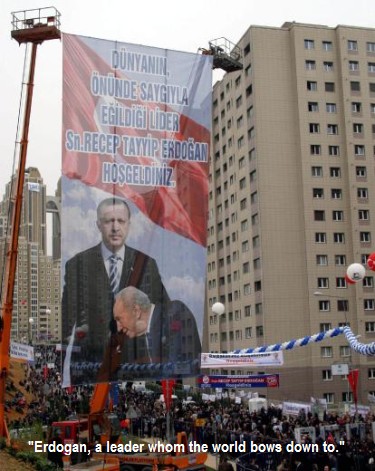
In a graphic response to the insult to Turkey’s ambassador to Israel shown by Israel’s Deputy Foreign Minister Danny Ayalon last month, a poster depicting Peres bowing before Erdogan was briefly unfurled in Istanbul this week.

Agence France Presse reports:

A huge poster showing Israel’s president bowing to the Turkish prime minister was hung from an Istanbul crane Sunday in the latest round of sniping between the two nations.

The picture, unfurled from a crane in a city suburb, combined an image of Turkish Prime Minister Recep Tayyip Erdoğan standing upright with one of Shimon Peres leaning forward; making it look like the Israeli president was bowing.

Erdoğan was due to visit the area to inaugurate a new road network, and officials from his office had the poster removed before he arrived, the Akşam newspaper said on its Web site.

It was not clear who was behind the stunt, the newspaper said, though it appeared to be retaliation for the public dressing down given to the Turkish ambassador to Israel last month.

Facebooktwittermail

Turkey reins in its renegade generals

The most determined challenge to military political power in Turkey in decades is being reported in much of the Western media as a struggle between an Islamist government and the forces of secularism. Bulent Kenes, a columnist for Turkey’s Today’s Zaman, frames the issue much more starkly: this is a struggle between civilian and military power.

Turkey has kicked off a new week with another great shock. This time, the powerful sledgehammer of justice landed on the generals of the Sledgehammer (Balyoz) coup plan, a treacherous plot to devastate the whole country.

Accused of preparing thousands of pages of plans and preparations to blow up mosques, to trigger conflict between Turkey and Greece by arranging the crash-landing of Turkish warplanes in the Aegean Sea and give the army a central role in the country’s administration, to close Parliament, to ideologically profile hundreds of thousands of people just to arrest and collect them in stadiums during a future military coup, to introduce Soviet-style centralization to the country’s economic management, to shut the door to foreign investment, to arrest leading media professionals and to close down or take control of newspapers and TV channels, some former force commanders, retired generals and admirals were taken to custody one by one on Monday morning.

These detentions — including 17 retired generals, four active duty admirals and 28 military officers — carried out as part of the probe into Ergenekon, a shadowy network nested within the state aiming to lay the groundwork for an eventual military takeover, is not only regarded as the first of its kind in terms of its scope, but has also shown to the world that there will not be an “untouchable” judiciary class in this country. With that said, can we be justified in asserting that the abnormalities in civilian-military relations — a main source of almost all major problems in Turkey — have come to an abrupt end? Of course not.

Certainly, the fact that those who regard themselves as “untouchable,” superior to the rule of law and free from legal accountability, can now be touched will have important effects in the normalization of civilian-military relations and in the dispersal of the military tutelage that has been haunting us since the establishment of the republic. Still, I personally do not think that the exposure to daylight of military junta members who made plans to betray the nation, seeking to overthrow the democratically elected government, the sweeping detentions or the ongoing judicial processes will be sufficient to solve Turkey’s gravest problem, the “army issue,” and eliminate the army’s overwhelming pressure on politics, the judiciary, the legislature and civil life. This is because I am of the opinion that developments seen during the Ergenekon investigation process are not concerned with the essence of the matter but are related to the grave consequences of this problematic structure.

Bloomberg reports:

Turkey’s military said the detention of retired officers over an alleged coup plot was a “serious situation,” in the sharpest escalation of tensions with the government since a 2007 showdown that led to early elections.

The top commanders gathered at military headquarters in Ankara late yesterday to discuss the detention of more than 40 former officers, the armed forces said on its Web site. Police held the ex-officers, including previous heads of the air force and navy, in a series of raids on Feb. 22.

The arrests deepened strains between Prime Minister Recep Tayyip Erdogan and the military leadership. Erdogan, whose Justice and Development Party has its roots in political Islam, has curtailed the secularist generals’ influence over decision- making as Turkey chases membership in the European Union.

Facebooktwittermail

Turkey’s Prime Minister Erdogan interviewed on Euronews

Euronews, Ali Ishan Aydin: How do you see the future of Turkey-Israel relations? After all that has happened, do you still think Turkey can mediate between Israel and Syria, and other Arab states?

Prime Minister, Recep Tayyip Erdoğan: Israel should give some thought to what it would be like to lose a friend like Turkey in the future. The way they recently treated our ambassador has no place in international politics. We have done our best for Israel-Syria relations. But now we see Benjamin Netanyahu saying ‘I do not trust Erdoğan, but I trust Sarkozy’. Do you have to give a name? This is diplomatic inexperience, too. Because when you say this… How can I trust you if you say you don’t trust me? We have important ongoing agreements between us. How can these agreements be kept going in this climate of mistrust? I think Israel had better take another look at its relations with its neighbours if it believes it is a world power.

Euronews Nial O’Reilly: In recent days the Israeli foreign ministry has accused you of being a cause of the rising tension between your two countries. In fact, it has accused you of anti-semitism. When you review how you handled this incident, do you feel YOU could have handled it more diplomatically?

Prime Minister, Recep Tayyip Erdoğan: I am telling the truth…And I will keep telling the truth. Turkey has an age-old history as a state. When you talk to such a state you must be careful. When innocent civilians are ruthlessly killed, struck by phosphorus bombs, infrastructure is demolished in bombing and people are forced to live in an open-air prison… we can not see this as compatible with the Universal Declaration of Human Rights, simply human rights, and we can not close our eyes to all this happening. 1-30-10

Facebooktwittermail

Turkey: Newly exposed military coup planned to turn the clock back to 1923

Turkey: Newly exposed military coup planned to turn the clock back to 1923

The Turkish Armed Forces (TSK) hoped to take Turkey back to 1923, the time when the republic was proclaimed, after the staging of a coup d’état against the Justice and Development Party (AK Party) government, the Taraf daily reported on Thursday.

According to the coup plan — titled the Balyoz (Sledgehammer) Security Operation Plan — all the key posts in the country, public and private, would be occupied by active and retired members of the military to “get rid of every single threat to the secular order of the state.”

“The plan will be based on an objective to clean up all state and public posts [of individuals suspected of posing a threat to the secular order of Turkey] and return Turkey to its dynamism of 1923. All the assets and financial resources of individuals and groups suspected of involvement in acts of reactionaryism will be confiscated, and necessary steps will be taken to freeze their financial resources abroad,” stated the document.

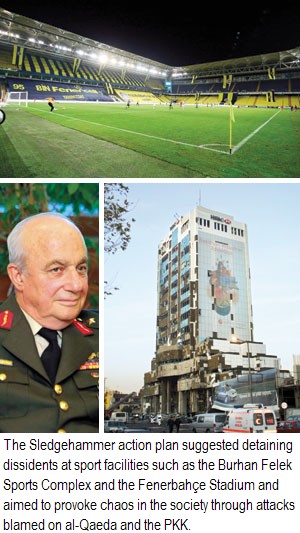
The armed forces also planned to take into custody and then arrest at least 200,000 individuals accused of reactionary activities in İstanbul after the coup. The total number of detainees around Turkey was estimated to reach 16 million, the plan stated. According to the document, individuals who stood against the coup would be taken into custody and brought to large sports facilities for interrogation. Among those facilities were the Burhan Felek sports complex and Fenerbahçe Stadium. The suspects would be questioned by security forces there and then would be sent to prisons. If the prisons were unable to accommodate all the arrestees, then military barracks would temporarily be turned into jails. [continued…]

120 al-Qaida suspects detained in Turkey

Turkish police launched a nationwide crackdown on suspected militants linked to the al-Qaida terror network on Friday, rounding up 120 people in simultaneous pre-dawn raids, the state-run Anatolia news agency reported.

It was not clear if Friday’s raids in 16 provinces in this NATO member and western ally country would amount to a major blow to homegrown Islamic militants.

Yeni Safak newspaper this week reported that Turkish police had recently seized video recordings of alleged Turkish al-Qaida militants in Taliban camps in Afghanistan, as well as alleged plans for attacks on Turkish soldiers in Kabul and on police in Turkey. It did not cite a source for the report. [continued…]

Facebooktwittermail

Turkey and Russia move closer to building strategic partnership

Turkey and Russia move closer to building strategic partnership

Turkey and Russia have come closer to building a strategic partnership by agreeing to deepen cooperation in the area of energy and work on a plan to lift visa requirements for their citizens.

The two countries also have ambitious plans to boost their trade volume to $100 billion in the coming years. “Our relations are developing and becoming more diversified in the political, military, economic and cultural spheres. What is exciting for me is that both sides have a positive will,” to further boost ties, Prime Minister Recep Tayyip Erdoğan said at a joint press conference with his Russian counterpart, Vladimir Putin, late on Wednesday.

Erdoğan, who had talks with Putin and Russian President Dmitry Medvedev during his one-day visit to Moscow, announced that the two countries will start work on abolishing visa requirements for their nationals. [continued…]

Facebooktwittermail

Turkish human rights group: Arrest Barak when he arrives here

Turkish human rights group: Arrest Barak when he arrives here

espite the intensifying crisis between Israel and Turkey, Defense Minister Ehud Barak is insisting to follow through with his scheduled plans to visit Turkey next week. However, on Thursday it became clear that an arrest warrant may await him there.

One of the major human rights organizations in Turkey, Mazlumder, requested from the Turkish state prosecution to order that Barak be arrested upon landing in the country for what they call “his responsibility for war crimes during Operation Cast Lead.”

A statement published Wednesday night by the Istanbul branch of Mazlumder claimed that the request is rooted in the right of universal jurisdiction and Article CMK98 of Turkish law. [continued…]

U.S. to store $800 million in emergency gear in Israel

The U.S. Army will double the value of emergency military equipment it stockpiles on Israeli soil, and Israel will be allowed to use the U.S. ordnance in the event of a military emergency, according to a report in Monday’s issue of the U.S. weekly Defense News.

The report, written by Barbara Opall-Rome, the magazine’s Israel correspondent, said that an agreement reached between Washington and Jerusalem last month will bring the value of the military gear to $800 million.

This is the final phase of a process that began over a year ago to determine the type and amount of U.S. weapons and ammunition to be stored in Israel, part of an overarching American effort to stockpile weapons in areas in which its army may need to operate while allowing American allies to make use of the ordnance in emergencies. [continued…]

Bomb in Jordan misses convoy of Israeli diplomats

A roadside bomb exploded near a convoy of vehicles carrying Israeli diplomats in Jordan on Thursday, but no one was injured, according to Israeli and Jordanian officials.

“All I can say at this moment is there was an attack that targeted an Israeli embassy vehicle,” foreign-ministry spokesman Yigal Palmor said. “The Israeli embassy staff in the vehicle were not injured. The vehicle proceeded.”

A senior Israeli official said Israel’s ambassador to Jordan, Danny Nevo, wasn’t in the convoy, but refused to specify who was. [continued…]

Facebooktwittermail

Report: Turkey warns Lebanon that Israel may be planning attack

Report: Turkey warns Lebanon that Israel may be planning attack

Turkish Prime Minister Recep Tayyip Erdogan this week warned Lebanese leaders that Israel may be planning an attack on its northern neighbor, Lebanese sources told the London-based Arabic language daily A-Sharq al-Awsat on Thursday.

At a meeting in Ankara with Lebanese Prime Minister Saad Hariri and President Michel Suleiman on Monday, Erdogan declared that Israel was endangering world peace by using exaggerated force against the Palestinians, breaching Lebanon’s air space and waters and for not revealing the details of its nuclear program.

Erdogan called on the five permanent members of the United Nations Security Council to pressure Israel over its nuclear program in the same way that the international community has been dealing with Iran. “Israel never denied that it has nuclear weapons,” said Erdogan. “In fact, it has admitted to such.” [continued…]

Turkish-Israeli tension on the axis of the ‘Damascus Province’

As Turkish-Israeli relations turn sour, Turkey has lifted the visas to all Arab countries neighboring Israel and a political-economic integration is being pursued.

This means being a “center of power” in the region.

But if you pay attention to Erdoğan’s remark on Israel the other day in the press conference with Hariri, you realize that Turkish Prime Minister said: “Israel says ‘I am the power of the region’ because there is an imbalance of opportunities. We never approve of this picture. We will continue to be with the aggrieved.”

Against a state that declares itself to be the power of the region just because of having more opportunities than the others, Turkey gathers the “aggrieved” around it, lifts visas, engages in serious economic ties and does all these by applying “soft power” only.

We should expect more reactions to come because Turkey and its prime minister have made serious moves against Israel and have caused debates both at in the region and outside it. [continued…]

Danny Ayalon should resign for provoking shameful crisis vis-à-vis Turkey

Diplomatic crises are a dime a dozen these days, but the most recent one, orchestrated by Deputy Foreign Minister Danny Ayalon, has delivered a gut-wrenching blow to Israel’s dignity.

The Turkish television show that enraged the Foreign Ministry is indeed insulting, and somewhat reminiscent of an earlier crisis involving Swedish tabloid Aftonbladet. In that case too, the Foreign Ministry came out with guns blazing. A silly and wholly unsubstantiated tabloid article that could have gone totally unnoticed was turned into a battle with the Swedish government.

Like the Swedish tabloid article, the Turkish television show was given more credibility by Israel’s vehement response to it. However, the crisis with Turkey had far more devastating results, as it ended with an official apology to a state now widely viewed as biased against Israel – a state which Prime Minister Benjamin Netanyahu believes is inching closer to Iran every day. [continued…]

Ayalon apologizes following Turkish deadline

Ayalon’s office said later Wednesday that “now, following President Peres’ appeal and with respect to his request, a letter has been sent from the deputy foreign minister to the Turkish ambassador to Israel.”

The deputy foreign minister addressed the Knesset on Wednesday evening and said that “Israel will eventually benefit, and I believe that the relations between Israel and Turkey will also benefit” from the diplomatic incident.

The deputy minister was asked by Knesset Member Carmel Shama (Likud), “Was everything that happened preplanned?” Ayalon responded, “I think we should leave an element of surprise for our rivals and enemies… Let’s leave it, let them decide.” [continued…]

Facebooktwittermail

Israel’s hopeless quest for respect

Israel’s hopeless quest for respect

As Israeli-Turkish relations hit a new low with the threat that Turkey might withdraw its ambassador, Israel’s foreign minister Avigdor Lieberman said he expects Israel to be treated with “dignity and respect” by Turkey.

The sign of respect Lieberman is looking for would be for the Turkish government to censor Turkish media by banning a TV show that depicts Israeli soldiers as war criminals. Israel’s war on free speech continues on many fronts without much success — other than in America.

The slide in relations between the two major regional powers began with Israel’s war on Gaza. In Davos, Turkish prime minister Recep Tayyip Erdogan stood up for Turkish dignity by refusing to be silenced after Israeli president Shimon Peres launched a bombastic tirade in defense of Israel’s right to wage war.

Though in the eyes of the Western media the Davos incident was seen as a “spat”, much more importantly in Turkey and across the Middle East, Erdogan was seen as a national leader unwilling to countenance disrespect from an Israeli leader — however much the latter might act out, used as he is to being coddled by the West.

Now we have Lieberman, whose diplomatic talent has been shaped by his experience working as a nightclub bouncer, endorsing a plan that was designed to teach Turkey a lesson. Deputy Foreign Minister Danny Ayalon seemed to think that if the Turkish ambassador was forced to look up to him — literally — humiliation would deliver in its wake, respect.

This is how the meeting unfolded where the Israeli minister conveyed to Turkey’s ambassador Oguz Celikkol how offensive Israel finds “Valley of the Wolves”.

During the photo-op at the start of the meeting, Ayalon reportedly told the photographers in Hebrew: “Pay attention that he is sitting in a lower chair and we are in the higher ones, that there is only an Israeli flag on the table and that we are not smiling.” Celikkol’s associates told Israeli Army Radio on Tuesday that the meeting with Ayalon was the most humiliating event he had experienced in 35 years as a diplomat.

Those in Israel who understand something about the way diplomacy works know that Ayalon made a huge blunder. He now faces criticism even from inside his own party, Israel Beiteinu.

“He is finished politically,” an Israel Beiteinu official told The Jerusalem Post. “This ruins his reputation as a diplomat. It is a stain that cannot be erased. He damaged Lieberman and first and foremost himself.”

Minister of Industry, Trade and Labor Binyamin Ben-Eliezer said: “The respect for Israel is not judged by how you humiliate an ambassador; humiliation doesn’t help, it only harms.”

While Ben-Eliezer and others indicate that political realism still exists in Israel, Ayalon’s mistake was less that of pure error of judgment than that of representing an Israeli mentality too faithfully.

Alon Liel, a former Israeli ambassador to Turkey, facetiously told Israeli Army Radio that “a new sort of diplomacy” had been invented, and that Lieberman had “made up a new way of reprimanding.”

“This time, they made him sit on a low chair, next time maybe they’ll make him crawl, and who knows, maybe the time after that they’ll beat him up at the entrance,” Liel said.

The former Israeli ambassador’s intention might have been to mock Lieberman, but the idea that contempt generates respect serves as a foundation stone for Zionism. Israel’s struggle to pacify its opponents has since 1948 been a relentless effort to demonstrate who stands above and who must crouch below.

Israel has placed all its bets on the effectiveness of coercion — an investment from which it is difficult to move away. There is no easy road that leads from contempt to mutual respect. Indeed, in those whose nature it is to treat others with contempt there is an underlying assumption that respect is something which will never be freely conferred.

What Danny Ayalon and those Israelis who are cast in the same mold repeatedly and unwittingly display is their own lack of dignity. They have no idea how profound a difference there is between demanding respect and being worthy of respect.

Facebooktwittermail

Turkey’s generals sound the retreat

Turkey’s generals sound the retreat

Confronted with a wave of accusations that range from coup plots to assassination plans directed against high-profile critics, the Turkish military has ended its long-standing policy of stonewalling any attempt to investigate members of the armed forces from outside.

When Gen Ilker Basbug, Turkey’s chief of general staff, ordered his subordinates to open a secret archive to an investigating judge last month, that decision marked a key moment in the transition towards more civilian control over the military, observers say. The balance of power in Ankara is tipping towards the civilians.

“We are not hiding anything, open the door,” said the general’s order, according to media reports that are understood to have had the blessing of the armed forces. Kadir Kayan, a judge in Ankara, has been going through documents in the “cosmic chamber” of the military, an archive containing secret files, for more than two weeks. Mr Kayan is investigating accusations that two military officers planned an assassination attempt on Bulent Arinc, a deputy prime minister and outspoken critic of the military. As a country that has seen four governments pushed from power by the military since 1960, Turkey developed “a structure we call military guardianship” over the years, Ali Bayramoglu, a prominent columnist, told yesterday’s Vatan newspaper. In that structure, the military never fully recognised the leadership of civilian governments, he added. But recent events signalled that those days are over. “We see that this is changing step by step,” Bayramoglu said. [continued…]

Facebooktwittermail

Keeping Turkey out of Europe

Keeping Turkey out of Europe

[Nicolas Sarkozy and Angela Merkel’s] opposition to Turkey’s bid for EU membership is explained by what a columnist in the Turkish newspaper Hürriyet accurately described as “basic facts not pronounced openly” on Monday. “Turkey is a Muslim country,” Mehmet Ali Birand wrote. “And Europe is not ready yet to accept a Muslim country in the EU.”

This anti-Turkish bias is tantamount to racism. Even though the EU institutions officially claim to cherish diversity, there is a tacit agreement among some of their most powerful leaders that the union must remain predominantly Christian. Herman Van Rompuy, the EU’s new president, is one of the few to have voiced this desire in a public forum (and that was long before his recent elevation in status). “The universal values which are in force in Europe, and which are also fundamental values of Christianity, will lose vigour with the entry of a large Islamic country such as Turkey,” he told a meeting at the Belgian parliament in 2004. [continued…]

Facebooktwittermail

Viva Palestina convoy heading to Rafah

Viva Palestina convoy heading to Rafah

After a battle between Egyptian riot police and convoy members in Al-Arish last night, the convoy finally started out on the last leg of its journey a couple of hours ago:

“Vehicles very slowly exiting port gates now, heading to Rafah, insyaAllah.” – juanajaafar

An Egyptian border guard was shot dead Wednesday and about 55 people were injured late Tuesday in clashes between Egyptian police and pro-Palestinian activists trying to get a relief convoy into the Gaza Strip, militants, medics and officials said.

Some 520 activists belonging to the convoy – led by charismatic and outspoken British MP George Galloway – broke down the gate at El-Arish to protest an Egyptian decision to ship some of the goods through Israel.

They blocked the two entrances to the Sinai port with vehicles, and clashed with police. Forty militants were injured, a source close to them said, while medical sources said 15 policemen were also hurt.

An Egyptian official said Wednesday that the border guard was shot dead by a Palestinian sniper while Gazan youths hurled stones across the border at the Egyptian security forces.

The protests were sparked by an Egyptian decision to allow 139 vehicles to enter Gaza through the Rafah bordering crossing, about 45 kilometers from El-Arish, but requiring a remaining 59 vehicles to pass via Israel. Talks in which Galloway and a delegation of Turkish MPs sought to change the Egyptian’s minds proved unsuccessful. — Hurriyet Daily News

At the beginning, it was a peaceful protest, singing and making noise. The Egyptians were there to be provoked, no doubt, but they needed a reason. This went on for about 1 hour 30 mins, and then all hell broke loose. I don’t know who threw the first stone but the Egyptians seemed to have prepared stones to be thrown. A running battle went on for about 30 minutes, mainly the Egyptians hurtling stones at us. Some people fought back with stones and sticks against the riot police with batons. Five seasoned Derry men stood at the back. Ole hands at these riots.

The end result was up to 20 people injured, head injuries and even worse it appears. There was news that the Turks had captured 3 Egyptians police as hostages but they were later released. There was a deadly atmosphere amongst the compound. This wasn’t the way it was suppose to work out, we should of been heading for Gaza. At this point, it’s too early to see where the blame lies.

Galloway made his way onto the stage, looking very shaken and holding prayer beads, he recalled the progression of events that I have just told, and once again, encouraged people to protest throughout the world against the Egyptians. He said we wouldn’t be going anywhere soon’. We went to bed after that.

So another massive change of events, and I think the whole thing has had a negative rather than positive effect on proceedings. A lot of people think this way and I could see a lot of people going home. — Derry to Gaza

“Galloway challenged in open convoy mtg to resign leadership!” — zhat

Jordan’s Islamic Action Front (IAF) on Wednesday condemned Egypt’s alleged assault on members of the Viva Palestina humanitarian convoy in the Egyptian port of El Arish.

“The attack by the Egyptian authorities on the Viva Palestina convoy late Tuesday is heinous and cruel. We condemn the assault on the convoy members who seek to break the siege imposed on Gaza and such behaviors do not reflect the history of Egypt,” the IAF, the political arm of Jordan’s Muslim Brotherhood, said in a statement posted on its website. — Xinhua

In Istanbul, thousands of protesters staged a demonstration to condemn the Egyptian police crackdown on the Gaza-bound aid convoy. The protestors marched towards the Egyptian Consulate in the Turkish capital and held a picture of assassinated Hezbollah commander Imad Mugniyah and a picture titled “the picture of betrayal”, showing Egyptian President Hosni Muabark shaking hands with former Israeli Foreign Minister Tzipi Livni.

Tuesday’s demonstration joined a wave of protests against Mubarak across the Arab world. The Hamas organization in Gaza called on Palestinians on Wednesday morning to stage protests calling on the Egyptian authorities to allow the entry of the foreign activists. — Ynet

An Egyptian soldier was killed and four Palestinians were wounded in a gunbattle on Wednesday during a protest against an anti-smuggling wall Cairo is building on the Gaza border. — Reuters

Facebooktwittermail

Turkey helps Viva Palestina deliver aid to Gaza

Turkish MPs to enter Gaza with Viva Palestina convoy in Egypt

Five Turkish MPs will on Monday join an international aid convoy that has reached Egyptian port one-week later after the date that they initially hoped to reach Gaza Strip on the first anniversary of Israel’s 22-day offensive.

Viva Palestina Convoy is now at the Egyptian port of El-Arish with Turkish ship ULUSOY-6, which carried the convoy from the Syrian port of Lattakia to Egypt.

The aid volunteers who stay at Lattakia will fly in the day in 3 separate flights to Al-Arish to join the convoy. After everyone arrives at the Al- Arish port, the convoy will make an hour-drive to the Rafah border.

It is expected that the convoy will enter Gaza on Tuesday evening. It will be able to stay in Gaza for 24 hours only. During this time, all aid, drugs and medical tools will be delivered to the Gazan authorities. After 24 hours, all volunteers who travel with the convoy will go to Egypt and then fly back to their own countries. [continued…]

Facebooktwittermail

Relations with Turkey kindle hopes in Syria

Relations with Turkey kindle hopes in Syria

Ever since Syria and Turkey lifted their visa restrictions in September, Turkish visitors have poured into this picturesque northern city. Hawkers in Aleppo’s ancient souk now call out to shoppers in Turkish, and cross-border commerce has soared. The two countries have embarked on a very public honeymoon, with their leaders talking about each other like long-lost friends.

But this reconciliation is about far more than trade, or the collapse of old Turkish-Arab enmities. At a time of economic and political uncertainty here, the new warmth with Turkey has stirred hopes about Syria’s future direction, in areas that include religion, oil and gas, and peace with Israel.

For some here, the new closeness with secular, moderate Turkey represents a move away from Syria’s controversial alliance with Iran. For others, it suggests an embrace of Turkey’s more open, cosmopolitan society. And for many — including Syria’s president, Bashar al-Assad — it conjures different dreams of a revitalized regional economy, less vulnerable to Western sanctions or pressure.

“It’s much more than an economic relationship,” said Samir al-Taqi, director of the Orient Center for International Studies in Damascus. “It’s about regathering the region, and a feeling that the West is much weaker, less liable to do anything here. I think Syria has lots of ambitions to redefine its geopolitical position.” [continued…]

Facebooktwittermail

Is Turkey the only real country in the Middle East?

Is Turkey the only real country in the Middle East?

Every time I visit Turkey I ask myself what is it that makes me marvel at the many political and economic developments that make it stand out as the most impressive country in the greater Middle East. Watching Turkey’s significant foreign policy initiatives these days to cement good relations with its neighbors, I think I understand why: This is the only country in the Middle East region that acts like a normal, mature country.

Turkey’s mix of lively domestic politics, dynamic social and cultural life, and strong and internationally expanding economy all come together through the agency of a government that actually leads by taking initiatives, but is also held accountable to the citizens through regular elections. Turkey is the only country in the Middle East region that has both a democratic domestic system and an activist foreign policy. It is refreshing to witness this phenomenon in contrast with the largely passive and often dysfunctional countries across the Middle East.

The critical elements in Turkey’s success that others might learn from strike me as three in particular: freedom of speech and association that allow domestic politics to proceed in the direction defined by a majority of the citizenry; civilian authority over the armed forces and security agencies; and, pragmatic, humble realism in coming to terms with the realities of a pluralistic society where minorities demand rights that the majority should acknowledge. [continued…]

Facebooktwittermail