Category Archives: Turkey

What happens when a country has no borders?

In the hours leading up to the Mavi Marmara massacre, Israel extended like a cloud whose shadow spread deep into the Mediterranean. The Turkish ship’s captain took evasive action but it’s hard to escape the reach of a nation whose borders are so elastic.

Anyone who reads the Israeli press will sooner or later notice one of the curious features about Israel’s geographic identity. Politicians talk about threats from the north and the south in such a way that Israel sounds like a legendary kingdom on whose periphery are regions of darkness. It doesn’t have borders as such but instead margins of indeterminate depth where it is dangerous to venture.

This might explain in part the mythopoetic imagination through which Israelis see themselves heroically standing up against the forces of evil. It also suggests why it is that a very modern state has a medieval view of the world.

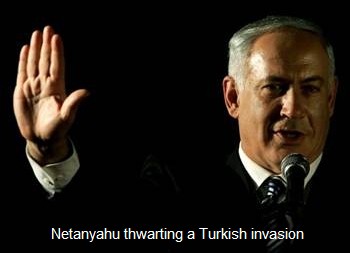
Benjamin Netanyahu warned his cabinet this weekend: “Dark forces from the Middle Ages are raging against us. I have received calls from concerned officials in the Balkans and Eastern Europe who are very worried about these developments.”

The mission of the Mavi Marmara, Netanyahu seems to hint, signaled the beginning of an attempt to re-establish an Ottoman Caliphate that once again threatens to take control of the Holy Land. Nevertheless, at such a historic juncture, it’s perhaps surprising that the commander of Israel’s military forces was apparently asleep.

Was this an expression of the unshakable confidence IDF’s commander in chief has in his soldiers, or (more likely) the blasé attitude with which Israel operates in the international arena?

Israel Defense Forces chief of staff Gabi Ashkenazi was not present in the IDF’s Tel Aviv command center during the first part of the maritime takeover of the Gaza-bound Turkish ship Mavi Marmara on May 31, Haaretz learned Sunday.

Instead, the most senior officer supervising the raid was Major General Tal Russo, IDF Chief of Operations, with Ashkenazi arriving only after the takeover had taken a turn for the worse.

The absence of both Ashkenazi and his second in command, Major General Benny Ganz, will be one of the issues to be reviewed by the specialist panel named by the IDF chief to probe the raid, headed by retired major general Giora Eiland.

No wonder Israel has been dragging its feet in responding to calls for an international investigation. But now, thanks to the Obama administration, it looks like Israel may once again avoid being held accountable for its actions.

Israel last night flouted pressure for an independent international inquiry into the lethal assault two weeks ago on a flotilla of ships attempting to break the blockade on Gaza, announcing an internal investigation with two foreign observers.

The White House gave its approval for the Israeli formula, which will be confirmed by the Israeli cabinet today.

The inquiry into the raid, in which nine Turkish activists aboard the Mavi Marmara were killed, will be headed by a former Israeli supreme court judge, Yaakov Tirkel. The foreign observers are the former Northern Ireland first minister David Trimble and a Canadian judge, Ken Watkin. They will have no voting rights.

The inquiry falls short of a UN proposal for an international investigation, but was agreed after consultation with the US. The White House said last night that the Israeli inquiry meets the standard of “prompt, impartial, credible and transparent investigation”.

The US Ambassador to the UN, Susan Rice, told Fox News on Sunday:

“We think that an international component would strengthen the investigation and certainly buttress its credibility in the eyes of the international community, and we’ve had discussions with Israel as to how and whether they might go about doing that,” Rice said.

But she added it’s “obviously ultimately the Israelis’ choice” whether to participate in such a group evaluation.

“Our view is that Israel, as a democracy, as a country with a tradition of strong military justice, can conduct an investigation of this sort however it chooses to constitute it,” she said, adding, “We are not pressuring Israel to participate in anything that it chooses not to participate in.”

In effect, what the United States is saying is that unlike any other country on the planet, Israel has the right construct its own definition of the term “international.” Israel when operating outside even its own self-determined boundaries of sovereignty, when conducting an assault on a ship operating under a Turkish flag and killing Turkish citizens, nevertheless has the “right” to say, “this is our business” — and Washington agrees.

Sefi Rachlevsky describes what happens when a nation refuses to set its own limits.

Israel gave itself a nice present to celebrate the 43rd anniversary of losing its borders. The raid on the Gaza flotilla in international waters is like the first Lebanon War – as if in a nightmarish experiment, we seem to be examining the question: What happens when a country has no borders?

Israel’s maritime attack did not happen by chance. A border is one of the fundamental factors that defines a country. Decades without one have distorted Israel’s thinking.

It is self-evident that, just as a person cannot build in an area that he does not own, a country cannot build settlements outside of its borders. And yet Israel has settled hundreds of thousands of its citizens in areas that, according to its laws, are not part of the State of Israel.

It is self-evident that any couple can marry “without regard to religion, race or gender.” And yet in Israel a Jewish man and a non-Jewish woman cannot legally marry. It’s self-evident that there is no arbitrary discrimination, and yet it’s enough to use the magic words “I’m a religious woman” or “I’m an ultra-Orthodox man” and the obligation to serve in the military evaporates.

It’s self-evident that the education provided to children be based on democracy and equality. And yet in Israel, 52 percent of first-graders defined as Jews study in various religious school systems that teach students things like “You are considered a human being and the other nations of the world are not considered human beings.”

They are taught that a non-Jew is not a human being, and that anyone who kills a non-Jew is not supposed to be killed by human hands; that women are inferior, and it is an obligation that males and females be separated; and that secular people, or anyone with secular family members, cannot enter these schools.

It is self-evident that racist education cannot be funded by the government and is illegal. And yet most of the country’s first-graders receive such “compulsory education” from their government.

The results of this nightmarish experiment are self-evident. In the most recent elections, 35 percent of voters defined as Jews cast their ballots for avowedly racist parties – Yisrael Beitenu, Shas, National Union and their friends.

Critics in the Israeli media wake up only when mistakes are made. That is why – after initially cheering the declaration that “the flotilla will not pass” – they changed their tune following the imbroglio, turning into advocates of the twisted logic “be smart, not right.” But what justice is there in an attack on civilians by soldiers on the open seas?

Like the territories, international waters are not Israel; they are outside its borders. A Turkish ship on the open sea is, in effect, a floating Turkish island. An Israeli attack on such an island is not all that different from sending the Israel Defense Forces to take on demonstrators at the Luxembourg Gardens in Paris. There, too, unpleasant people who are not friends of Israel can sometimes be found.

Turkey, which is a member of NATO, was not in a state of war with Israel before the attack. Attacking its citizens on territory that is by definition Turkish is another expression of the Israeli lunacy that lacks any kind of boundaries.

An attack beyond the border must be reserved for extreme cases involving a military target that represents an entity fighting against the country and when citizens are in danger. But civilian ships, that are not carrying weapons, but are bringing civilian aid to a population that is denied chocolate, toys and notebooks, are not nuclear reactors in Iraq, Syria or Iran.

A person who grows up without external borders tends to create distorted internal borders. That is the reason for the attack on Arab MK Hanin Zuabi and her colleagues. While there were certain Arab public figures who went too far in their statements, joining a civilian aid flotilla is one of those legitimate acts which are supposed to be self-evident.

And yet, what was self-evident became betrayal. And citizenship, one of the unconditional foundations of existence, has turned into something that can be revoked – in this case on the basis of ethnicity, a tactic used in fascist regimes. The street has returned to the atmosphere that prevailed under “responsible” opposition leader Benjamin Netanyahu and led to the assassination of prime minister Yitzhak Rabin – and the next murder is in the air.

The Israeli deed at sea is liable to reach The Hague. The problem is that Israel has genuine enemies who want to destroy it. A country that does not do everything in its power to accumulate legitimacy, along with turning Iran into an entity that is losing legitimacy and can therefore become a target of activities to undermine it, is a country losing its basic survival instinct. Without borders, it turns out, you lose even that.

Young Israelis who have grown up without borders are now dancing and singing “In blood and fire we will expel Turkey” and “Mohammed is dead.” If this keeps up, Israel will not make it to The Hague. The entity gradually replacing the State of Israel is liable not to exist long enough to get there.


Facebooktwittermail

Turkey is the new Palestinian champion

Noting a historic shift in the regional balance of power, Alastair Crooke says:

The cause of the Palestinians is gradually passing out of the hands of Mubarak and King Abdullah bin Aziz Al Saud of Saudi Arabia. It is the leaders of Iran and Turkey, together with President Bashar al-Assad of Syria, who recognize the winds of change. Mubarak appears increasingly isolated and is cast as Israel’s most assiduous collaborator. Here in the region, it is often as not the Egyptian embassies that are the butt of popular demonstrations.

Mubarak’s motives for his dogged support for Israel are well known in the region: He is convinced that the gateway to obtaining Washington’s green light for his son Gamal to succeed him lies in Tel Aviv rather than Washington. Mubarak enjoys a bare modicum of support in the United States, and if Washington is to ignore its democratic principles in order to support a Gamal shoo-in, it will be because Israel says that this American “blind eye” is essential for its security.

To this end, Mubarak has worked to weaken and hollow out Hamas’s standing in Gaza, and to strengthen that of Palestinian Authority President Mahmoud Abbas. Indeed, he has pursued this policy at the expense of Palestinian unity – his regular “unity” initiatives notwithstanding. Egyptian one-sided peace “brokering” is viewed here as part of the problem rather than as part of any Palestinian solution. Paradoxically, it is precisely this posture that has opened the door to Turkey and Iran’s seizing of the sponsorship of the Palestinian cause.

Meanwhile, Associated Press reports:

The Arab world’s top diplomat declared support Sunday for the people of blockaded Gaza in his first visit to the Palestinian territory since Hamas violently seized control of it three years ago.

The visit was latest sign that Israel’s deadly raid on a flotilla trying to break the blockade of Gaza has eased the diplomatic isolation of the Islamic militant group.

Israel, meanwhile, appeared to grow more isolated in the fallout over the May 31 raid as Israeli Defense Minister Ehud Barak abruptly canceled plans Sunday to visit Paris.

Barak’s office said he canceled his trip while Israel forms a committee to investigate the raid. The statement denied that the decision was connected to attempts by pro-Palestinian groups to seek his arrest.

George Mitchell, having been President Obama’s so-called Middle East peace envoy for a year and a half and during that time having engaged in tireless and fruitless shuttle diplomacy, has yet to visit Gaza.

Facebooktwittermail

European Jewish solidarity with Gazans

Richard Hall reports:

A Jewish European peace group is to launch a boat to break the blockade of Gaza in the coming months, organizers said, almost a week after nine activists were killed making the same trip.

European Jews for a Just Peace (EJJP) – an umbrella organization of Jewish groups from 10 European countries against the occupation of Palestine – aim to deliver humanitarian aid such as school books and medicines to the Gaza Strip, and to draw attention to the blockade which they call “immoral.”

“We want to show that not all Jews support Israel,” said Edith Lutz, a German member of the EJJP. “We are calling for a just solution and for an end to the blockade.”

On board the ships will be activists from across Europe including Germany and the UK, as well as an 85-year-old Holocaust survivor from Israel. The voyage was originally meant to carry only a small number of activists together with journalists from Europe and Israel, but organizers say that a huge response from the Jewish community has meant that a second boat has been arranged, and the possibility of a third is being discussed.

Meanwhile, in Today’s Zaman, columnist Ali Bulac notes:

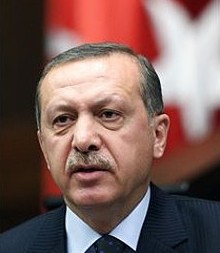
Mario Levi, a member of the Turkish Jewish community, who spoke on June 2 about the bloody Israeli attack on a humanitarian aid flotilla, said they, “as the Jews of İstanbul, are in solidarity with Gazans,” adding that “[Recep Tayyip] Erdoğan gave an excellent statement. It must be acknowledged that his party has done better things compared to the social democrats and nationalists. I do not see anti-Semitic sentiments in Turkey. I am sympathetic to Israel, but I still regard Israeli Prime Minister [Benjamin] Netanyahu as a chauvinist, the country’s foreign minister as fascist and its defense minister as stupid.”
Facebooktwittermail

Israel’s “self-defense” narrative falls apart — Updated

(See this post to read an important update on the video that appears below.)

On May 31, Israel’s Prime Minister Benjamin Netanyahu described the actions of IDF soldiers who had conducted the raid on the Mavi Marmara, killing at least nine of its passengers, as “a clear case of self-defense because as our soldiers were inspecting these ships, they were attacked – they were almost lynched. They were attacked with clubs, with knives, perhaps with live gunfire, and they had to defend themselves – they were going to be killed.”

That was before video emerged appearing to show two Israeli soldiers first pummeling with their boots and then shooting one of the victims as he lay at their feet. To stand above an injured man and then finish him off with rounds from an assault rifle can by no ones estimation be described as an act of self-defense.

I have asked the IDF Spokesman’s office for comment on the video and been told that they will get back to me in due course.

An explanation from the IDF is unlikely to be swift because a decision on how to handle this matter is now likely to rise above the military ranks to the highest political level.

The Netanyahu government’s political strategy for grappling with the latest international crisis it has triggered has been rooted from its inception in the outlook that molds the Israeli psyche: whatever happens, Israel is always the victim.

Out of a national unwillingness to rise above this unremitting sense of victimization, Israel’s leaders and its population have rendered themselves incapable of accepting responsibility for their own actions.

Right now, there are at least two Israeli soldiers who could step forward, break their silence and act in the greater interest of the country they have pledged to defend.

But I don’t see that happening. Firstly, this would require an unusual amount of personal courage, but anyone who shoots an injured man who is lying helplessly at his feet seems lacking in courage. And secondly, most individuals who follow military commands do so on the assumption that it’s not for them to determine the national interest. Indeed, the orders these particular soldiers have been instructed to follow almost certainly include that they now maintain their silence.

As soon as it became apparent that some kind of investigation of the massacre would be inevitable, Israel’s minister of defense, Ehud Barak, was quick to say that in any investigation of the massacre, no individual commandos would face questioning. In other words, no one who pulled a trigger would be placed in legal jeopardy by being compelled to explain their own actions. The Israeli government has in effect promised legal immunity for its defense forces, in the hope presumably that the government itself will thereby ensure its own legal and political protection.

Turkey’s Prime Minister Recep Tayyip Erdogan, however, has said: “Israel must pay the price of the blood it shed and the lives of the martyrs. It will do so. We will pursue this within the framework of law.”

So far, the United States, under President Obama’s morally drifting leadership, has maintained its traditional role in acting like Israel’s lawyer. But even the best defense lawyer realizes when the evidence against their client makes a “not guilty” plea untenable. Moreover, every lawyer knows that they can only go so far in loyally defending their client. Past a certain point, a loyal attorney becomes a criminal accomplice.

It’s time for Washington to tell Tel Aviv that it needs to get ready to tell the truth, the whole truth, and nothing but the truth about the Mavi Marmara massacre. Israel cannot escape facing legal scrutiny from an international investigation.

Facebooktwittermail

A Turkish revival

“Israel must pay the price of the blood it shed,” said Turkey’s Prime Minister Recep Tayyip Erdogan this week as he honored the lives of those who were “martyred” defending the Mavi Marmara.
The clash between Turkey and Israel comes at a moment when the state which was once the seat of the Ottoman Empire is reclaiming some of its historic regional significance.

But this Turkish revival is not being welcomed by the United States. The New York Times says:

Turkey is seen increasingly in Washington as “running around the region doing things that are at cross-purposes to what the big powers in the region want,” said Steven A. Cook, a scholar with the Council on Foreign Relations. The question being asked, he said, is “How do we keep the Turks in their lane?”

From Turkey’s perspective, however, it is simply finding its footing in its own backyard, a troubled region that has been in turmoil for years, in part as a result of American policy making.

While many Israeli’s might currently be nurturing the belief that the Jewish nation just struck back against some kind of Turkish assault, hardly anyone one else harbors such delusions about who has been wronged. Erdogan emphatically asserts that Israel will pay a price.

This is a moment, Michael Vlahos suggests, in which a Turkish Renovatio is taking place.

“This is language that we have not heard since the time of Gamal Abdul Nasser.” Thus wrote the influential chief editor of Al-Quds al-Arabi newspaper, referring to Turkish Prime Minister Recep Tayyip Erdogan’s fiery response to the Israeli assault on the Gaza flotilla — adding that such “manly” positions and rhetoric had “disappeared from the dictionaries of our Arab leaders (since the demise of Egyptian President Gamal Abdul Nasser).” He lamented, “Arab regimes now represent the only friends left to Israel.” (From the CSM here.)

What is Renovatio? Simply, it is a national revival that takes the form of a restoration: Where things once right and true triumphantly return. Renovatio represents identity reborn.
[…]
A contemporary Turkey that is robustly part Western and also part Islamist in fact represents the most valuable model for the future Ummah — and especially for its Arab-Urdu core.

Enough time has passed now that old Arab-Turkish scores should have receded, just as they have recently among Turks and Greeks. The Mavi Marmara incident — if followed up strongly and unrelentingly — can assert a neo-Ottoman claim to symbolic leadership of an emerging Muslim Renovatio.

Such a restoration would unfold in ritual terms. But is that not the point — the point that the US and Israel stubbornly refuse to see? The whole design of the fabled Khilafat was in reality always that of a Muslim Commonwealth, not of a unitary state (save for Al Qaeda fantasists). Renovatio means a restoration of collective identity and purpose. But it also requires a leader: A Champion who will right wrongs and bring Islam back to the glory of the “Rightly Guided.” Not as political order but as renewed collective consciousness.

Facebooktwittermail

Israel’s separate reality

One of the lessons of state communism is that there is no better environment in which to control the way people think than one in which they believe they are free.
Stalin never had it so easy as Benjamin Netanyahu when it comes to getting a whole population to effortlessly swallow a pack of lies.

“Everything is against Jews. We have the right to defend ourselves. If Turkey sends a ship full of Muslim terrorists, it means that we have to stop them,” a resident of Tel Aviv tells Max Blumenthal during celebrations in support of the Mavi Marmara massacre. “It reminds us of the Holocaust.”

Another says, “It’s the first time we don’t need to kiss anyone’s ass. Not the United States, not the United Nations. We are on our own. We can do it. We did it — I don’t know — sixty years ago. We can do it again…”

Probably the most bewildering aspect of the Gaza flotilla affair has been the righteous indignation expressed by the Israeli government and people, writes Ilan Pappe, in Scotland’s Sunday Herald.

The nature of this response is not being fully reported in the UK press, but it includes official parades celebrating the heroism of the commandos who stormed the ship and demonstrations by schoolchildren giving their unequivocal support for the government against the new wave of anti-Semitism.

As someone who was born in Israel and went enthusiastically through the socialisation and indoctrination process until my mid-20s, this reaction is all too familiar. Understanding the root of this furious defensiveness is key to comprehending the principal obstacle for peace in Israel and Palestine. One can best define this barrier as the official and popular Jewish Israeli perception of the political and cultural reality around them.

A number of factors explain this phenomenon, but three are outstanding and they are interconnected. They form the mental infrastructure on which life in Israel as a Jewish Zionist individual is based, and one from which it is almost impossible to depart – as I know too well from personal experience.

The first and most important assumption is that what used to be historical Palestine is by sacred and irrefutable right the political, cultural and religious possession of the Jewish people represented by the Zionist movement and later the state of Israel.

Most of the Israelis, politicians and citizens alike, understand that this right can’t be fully realised. But although successive governments were pragmatic enough to accept the need to enter peace negotiations and strive for some sort of territorial compromise, the dream has not been forsaken. Far more important is the conception and representation of any pragmatic policy as an act of ultimate and unprecedented international generosity.

Any Palestinian, or for that matter international, dissatisfaction with every deal offered by Israel since 1948, has therefore been seen as insulting ingratitude in the face of an accommodating and enlightened policy of the “only democracy in the Middle East”. Now, imagine that the dissatisfaction is translated into an actual, and sometimes violent, struggle and you begin to understand the righteous fury. As schoolchildren, during military service and later as adult Israeli citizens, the only explanation we received for Arab or Palestinian responses was that our civilised behaviour was being met by barbarism and antagonism of the worst kind.

According to the hegemonic narrative in Israel there are two malicious forces at work. The first is the old familiar anti-Semitic impulse of the world at large, an infectious bug that supposedly affects everyone who comes into contact with Jews. According to this narrative, the modern and civilised Jews were rejected by the Palestinians simply because they were Jews; not for instance because they stole land and water up to 1948, expelled half of Palestine’s population in 1948 and imposed a brutal occupation on the West Bank, and lately an inhuman siege on the Gaza Strip. This also explains why military action seems the only resort: since the Palestinians are seen as bent on destroying Israel through some atavistic impulse, the only conceivable way of confronting them is through military might.

The second force is also an old-new phenomenon: an Islamic civilisation bent on destroying the Jews as a faith and a nation. Mainstream Israeli orientalists, supported by new conservative academics in the United States, helped to articulate this phobia as a scholarly truth. These fears, of course, cannot be sustained unless they are constantly nourished and manipulated.

From this stems the second feature relevant to a better understanding of the Israeli Jewish society. Israel is in a state of denial. Even in 2010, with all the alternative and international means of communication and information, most of the Israeli Jews are still fed daily by media that hides from them the realities of occupation, stagnation or discrimination. This is true about the ethnic cleansing that Israel committed in 1948, which made half of Palestine’s population refugees, destroyed half the Palestinian villages and towns, and left 80% of their homeland in Israeli hands. And it’s painfully clear that even before the apartheid walls and fences were built around the occupied territories, the average Israeli did not know, and could not care, about the 40 years of systematic abuses of civil and human rights of millions of people under the direct and indirect rule of their state.

Nor have they had access to honest reports about the suffering in the Gaza Strip over the past four years. In the same way, the information they received on the flotilla fits the image of a state attacked by the combined forces of the old anti-Semitism and the new Islamic Judacidal fanatics coming to destroy the state of Israel. (After all, why would they have sent the best commando elite in the world to face defenceless human rights activists?)

As a young historian in Israel during the 1980s, it was this denial that first attracted my attention. As an aspiring professional scholar I decided to study the 1948 events and what I found in the archives sent me on a journey away from Zionism. Unconvinced by the government’s official explanation for its assault on Lebanon in 1982 and its conduct in the first Intifada in 1987, I began to realise the magnitude of the fabrication and manipulation. I could no longer subscribe to an ideology which dehumanised the native Palestinians and which propelled policies of dispossession and destruction.

The price for my intellectual dissidence was foretold: condemnation and excommunication. In 2007 I left Israel and my job at Haifa University for a teaching position in the United Kingdom, where views that in Israel would be considered at best insane, and at worst as sheer treason, are shared by almost every decent person in the country, whether or not they have any direct connection to Israel and Palestine.

That chapter in my life – too complicated to describe here – forms the basis of my forthcoming book, Out Of The Frame, to be published this autumn. But in brief, it involved the transformation of someone who had been a regular and unremarkable Israeli Zionist, and it came about because of exposure to alternative information, close relationships with several Palestinians and post-graduate studies abroad in Britain.

My quest for an authentic history of events in the Middle East required a personal de-militarisation of the mind. Even now, in 2010, Israel is in many ways a settler Prussian state: a combination of colonialist policies with a high level of militarisation in all aspects of life. This is the third feature of the Jewish state that has to be understood if one wants to comprehend the Israeli response. It is manifested in the dominance of the army over political, cultural and economic life within Israel. Defence minister Ehud Barak was the commanding officer of Benjamin Netanyahu, the prime minister, in a military unit similar to the one that assaulted the flotilla. That background was profoundly significant in terms of the state’s Zionist response to what they and all the commando officers perceived as the most formidable and dangerous enemy.

You probably have to be born in Israel, as I was, and go through the whole process of socialisation and education – including serving in the army – to grasp the power of this militarist mentality and its dire consequences. And you need such a background to understand why the whole premise on which the international community’s approach to the Middle East is based, is utterly and disastrously wrong.

The international response is based on the assumption that more forthcoming Palestinian concessions and a continued dialogue with the Israeli political elite will produce a new reality on the ground. The official discourse in the West is that a very reasonable and attainable solution – the two states solution – is just around the corner if all sides would make one final effort. Such optimism is hopelessly misguided.

The only version of this solution that is acceptable to Israel is the one that both the tamed Palestine Authority in Ramallah and the more assertive Hamas in Gaza could never accept. It is an offer to imprison the Palestinians in stateless enclaves in return for ending their struggle. And thus even before one discusses either an alternative solution – one democratic state for all, which I myself support – or explores a more plausible two-states settlement, one has to transform fundamentally the Israeli official and public mindset. It is this mentality which is the principal barrier to a peaceful reconciliation within the fractured terrain of Israel and Palestine.

How can one change it? That is the biggest challenge for activists within Palestine and Israel, for Palestinians and their supporters abroad and for anyone in the world who cares about peace in the Middle East. What is needed is, firstly, recognition that the analysis put forward here is valid and acceptable. Only then can one discuss the prognosis.

It is difficult to expect people to revisit a history of more than 60 years in order to comprehend better why the present international agenda on Israel and Palestine is misguided and harmful. But one can surely expect politicians, political strategists and journalists to reappraise what has been euphemistically called the “peace process” ever since 1948. They need also to be reminded that what actually happened.

Since 1948, Palestinians have been struggling against the ethnic cleansing of Palestine. During that year, they lost 80% of their homeland and half of them were expelled. In 1967, they lost the remaining 20%. They were fragmented geographically and traumatised like no other people during the second half of the 20th century. And had it not been for the steadfastness of their national movement, the fragmentation would have enabled Israel to take over historical Palestine as a whole and push the Palestinians into oblivion.

Transforming a mindset is a long process of education and enlightenment. Against all the odds, some alternative groups within Israel have begun this long and winding road to salvation. But in the meantime Israeli policies, such as the blockade on Gaza, have to be stopped. They will not cease in response to feeble condemnations of the kind we heard last week, nor is the movement inside Israel strong enough to produce a change in the foreseeable future. The danger is not only the continued destruction of the Palestinians but a constant Israeli brinkmanship that could lead to a regional war, with dire consequences for the stability of the world as a whole.

In the past, the free world faced dangerous situations like that by taking firm actions such as the sanctions against South Africa and Serbia. Only sustained and serious pressure by Western governments on Israel will drive the message home that the strategy of force and the policy of oppression are not accepted morally or politically by the world to which Israel wants to belong.

The continued diplomacy of negotiations and “peace talks” enables the Israelis to pursue uninterruptedly the same strategies, and the longer this continues, the more difficult it will be to undo them. Now is the time to unite with the Arab and Muslim worlds in offering Israel a ticket to normality and acceptance in return for an unconditional departure from past ideologies and practices.

Removing the army from the lives of the oppressed Palestinians in the West Bank, lifting the blockade in Gaza and stopping the racist and discriminatory legislation against the Palestinians inside Israel, could be welcome steps towards peace.

It is also vital to discuss seriously and without ethnic prejudices the return of the Palestinian refugees in a way that would respect their basic right of repatriation and the chances for reconciliation in Israel and Palestine. Any political outfit that could promise these achievements should be endorsed, welcomed and implemented by the international community and the people who live between the river Jordan and the Mediterranean Sea.

And then the only flotillas making their way to Gaza would be those of tourists and pilgrims.

Facebooktwittermail

Remembering the dead and the Rachel Corrie‘s mission

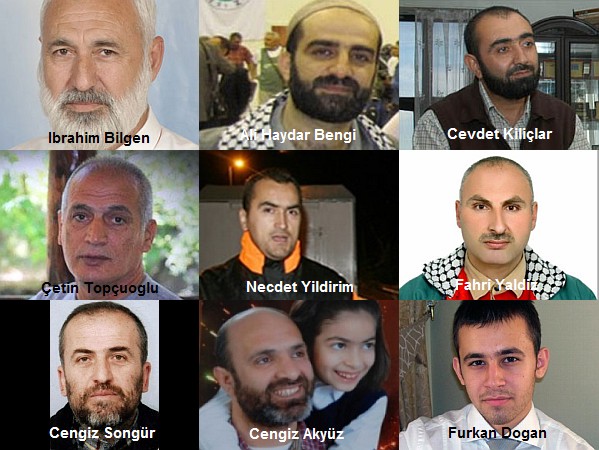
Humanitarian aid workers, a firefighter, a politician, a taekwondo champion, a photojournalist, a student who hoped to become a doctornine Turkish men, mostly fathers who leave behind children and wives.

Even while their deaths are at the center of an international crisis that is rocking the state of Israel, these individual lives lost have scarcely gained attention — firstly because the Israeli government resisted revealing any information about who died and in what circumstances, and then, while maintaining a stranglehold on the facts, Israel’s propaganda machine has worked furiously to portray the victims as villains.

The world has largely viewed Israel’s efforts to conceal its brutality with a mixture of skepticism, contempt and outrage. Yet in one regard the hasbara has worked: it has effectively sold the idea that the organizers and participants in the Freedom Flotilla were intent on picking a fight. This was an act of provocation and where opinions differ is on whether the provocation was justified or not.

As MJ Rosenberg wrote:

The first thing you need to know about the Gaza flotilla disaster is that the intention of the activists on board the ships was to break the Israeli blockade. Delivering the embargoed goods was incidental.

In other words, the activists were like the civil rights demonstrators who sat down at segregated lunch counters throughout the South and refused to leave until they were served. Their goal was not really to get breakfast. It was to end segregation.

Yes and no.

The Freedom Flotilla is part of a movement that aims to end the siege of Gaza, but delivering humanitarian aid is not incidental.

Israeli officials and the Israeli public who see themselves as victims of a campaign designed to make Israel look bad, fail to recognize that what cements Muslim solidarity and what has turned Gaza into a global issue, is not a global conspiracy against Israel or against Jews; it is a heartfelt response to human suffering.

The Freedom Flotilla carried thousands of tons of aid, not to poke Israel in the eye, but to help those in need. The many thousands of people who engaged in fundraising, made donations, gathered together supplies and readied the ships — a grass roots effort spread mostly across Europe and the Middle East — believed, naively or not, that the fruits of their efforts would be of real and practical assistance to the population in Gaza.

But, the cynics will ask, how could a few hundred people in a small flotilla of boats hope to successfully defy Israel’s military might? Firstly, simply on the basis that other vessels had completed the same mission. But more importantly, because courageous acts are invariably undertaken in defiance of the odds. The heroic imagination is enticed by what seems impossible.

The Freedom Flotilla as David, is not challenging the Goliath of Israel in order to give the mighty Jewish state some bad headlines. This is about defeating an agent of oppression. It is not about destroying Israel, but about challenging and overcoming the injustices which Israel sustains.

As the MV Rachel Corrie now approaches Gaza, Israel’s Foreign Ministry Director-General Yossi Gal says: “We have no desire for a confrontation. We have no desire to board the ship. If the ship decides to sail the port of Ashdod, then we will ensure its safe arrival and will not board it.”

A conciliatory gesture should receive a similar response, should it not?

Don’t be fooled. Israel and the United States are now working hand in glove to try and “moderate” the oppression of the population in Gaza. While the world calls for the siege to be ended, the Obama administration is calling for it to be “new approach.” Benjamin Netanyahu is reported to be “softening” his position.

This is about moving pressure from the heel to the toe, but it still means the Palestinians remain under an Israeli foot. It’s about taking Gaza out of the spotlight in the hope that global outrage can be replaced by global indifference.

For the Rachel Corrie to sail into the Israeli port of Ashdod under its own steam would be to capitulate to the power that claims it withdrew from Gaza even while it persists in maintaining absolute control over its population, its borders, its airspace and its economy.

The Rachel Corrie must reach Gaza, but if it is thwarted, more ships will come. Israel cannot win.

(Note of thanks to Lawrence of Cyberia for compiling information on those who died in the Flotilla Massacre and creating a page where new information is being added.)

Facebooktwittermail

Turkish president: Israel will never be forgiven

Al Jazeera‘s Jamal Elshayyal describes the attack on the Mavi Marmara, witnessing activists being shot, how the injured were left to die, and how he was abused under Israeli detention.

Al Jazeera reports:

The Turkish president has said that Israel’s military raid on civilian aid ships bound for the Gaza Strip has caused “irreparable” damage to his country’s relations with Israel, and will “never” be forgiven.

“From now on, Turkish-Israeli ties will never be the same. This incident has left an irreparable and deep scar,” Abdullah Gul said in a televised speech on Thursday, as thousands gathered in the streets of Istanbul to pay their respects to the humanitarian activists killed during the raid.

The raid “is not an issue that can be forgotten… or be covered up… Turkey will never forgive this attack,” he said.

Hassan Ghani, a journalist for PressTV describes his experience on board the Mavi Marmara as it came under Israeli attack.


Parts two and three of the interview with Hassan Ghani.

Today’s Zaman adds:

Activists say some people who were initially on the flotilla are missing. They are also telling stories of horror, carnage and pure barbarism at the hands of Israeli officials. In a shocking account, Humanitarian Aid Foundation (İHH) President Bülent Yıldırım, who returned on Thursday, said a photographer, whose first name was Cevdet, was shot in the forehead by a soldier one meter away from him. “Our Cevdet [Kılıçlar], he is a press member. He has become a martyr. All he was doing was taking pictures. They smashed his skull into pieces. We soon made out that these were real bullets they were firing. Rubber bullets also kill because you shoot at very close range, between one-and-a-half and two meters.”

Kevin Ovenden of Britain, an activist on the ship that arrived in İstanbul on Thursday, also said a man who had pointed a camera at the soldiers was shot directly through the forehead with live ammunition, with the exit wound blowing away back of his skull.

There were also claims that Israeli official reports on the number of people killed are untruthful. Yıldırım said, “Until now they have returned nine dead bodies, but our list is bigger. There are people missing.” Speaking to journalists at Atatürk International Airport shortly after his return, Yıldırım said: “We saw 38 injured who were brought back to us by doctors after the attack. Now they are saying there are 21 people who have been injured.” Yıldırım was on the main passenger ship, the Mavi Marmara, which the Israeli navy attacked at the start of its raid.

Another witness, Yücel Köse, who was on the ship Gazze repeated Yıldırım’s allegations of missing people. “The Mavi Marmara was bombed right in front of our eyes. They threw the wounded into the water,” he said. Köse said the soldiers were upset when some of their men were held by activists aboard the Mavi Marmara.

Facebooktwittermail

It’s up to Obama whether the siege of Gaza continues

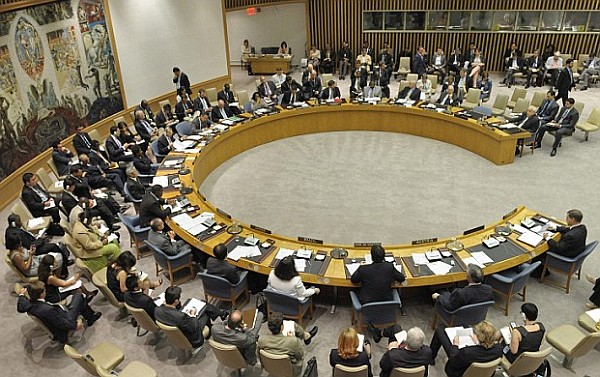
After the flotilla massacre committed by Israeli forces, Turkey’s call for an emergency meeting of the UN Security Council yesterday was to be expected. Turks are assumed to be among the dead — whose names and nationalities have still not been released. There are now hundreds of Turks being held in detention in Israel and Turkish ships were captured illegally in international waters in an action Turkey’s foreign minister described as “tantamount to banditry and piracy.”

What was equally predictable was that the Obama administration would only offer its support if action from the UN was so weak as to be worthless.

Had events of the last two days not disrupted their agendas, President Obama and Prime Minister Netanyahu would today have been servicing their individual political needs with smiles and handshakes on the steps of the White House. Absent that much-anticipated saccharine event, Obama was not about to turn around and support a stern rebuke to Israel.

The key Turkish demand presented to the Security Council was that the “blockade of Gaza must be ended immediately and all humanitarian assistance must be allowed in.”

Turkey was not alone. Britain’s new foreign secretary, William Hague, was equally unequivocal:

There can be no better response from the international community to this tragedy than to achieve urgently a durable resolution to the Gaza crisis.

I call on the Government of Israel to open the crossings to allow unfettered access for aid to Gaza, and address the serious concerns about the deterioration in the humanitarian and economic situation and about the effect on a generation of young Palestinians.

Universally there were calls for an inquiry. But the key to whether such an inquiry would be of any real value would be, minimally, its independence, and ideally that it would be international.

The statement finally issued by the Security Council is riddled with language surely crafted in the White House. It “calls for a prompt, impartial, credible and transparent investigation conforming to international standards.” Impartial, but not independent. International standards, but not international.

It does not call for an end to the siege but says “the situation in Gaza is not sustainable.” And there’s Obama’s lie.

Whether the siege of Gaza is lifted or sustained is up to Washington. If, when Netanyahu finally meets Obama, the US president was to say the embargo must end, Israel would have no choice. The siege of Gaza can only continue with US support and thus far, Obama refuses to withdraw that support. He says the situation is not sustainable, but through his actions Obama has a direct hand in perpetuating the suffering in Gaza.

“Unsustainable” is the signature of Obama’s self-declared impotence. It’s change over which he would like everyone else to believe he has no control. It’s the deceit through which he tells Americans and the world, I would if I could but I can’t.

Before the Security Council issued its statement and before it became clear that Obama was yet again going to throw away an opportunity to demonstrate his commitment to upholding international law, Stephen Walt wrote:

President Obama likes to talk a lot about our wonderful American values, and his shiny new National Security Strategy says “we must always seek to uphold these values not just when it is easy, but when it is hard.” The same document also talks about a “rule-based international order,” and says “America’s commitment to the rule of law is fundamental to our efforts to build an international order that is capable of confronting the emerging challenges of the 21st century.”

Well if that is true, here is an excellent opportunity for Obama to prove that he means what he says. Attacking a humanitarian aid mission certainly isn’t consistent with American values — even when that aid mission is engaged in the provocative act of challenging a blockade — and doing so in international waters is a direct violation of international law. Of course, it would be politically difficult for the administration to take a principled stand with midterm elections looming, but our values and commitment to the rule of law aren’t worth much if a president will sacrifice them just to win votes.

More importantly, this latest act of misguided belligerence poses a broader threat to U.S. national interests. Because the United States provides Israel with so much material aid and diplomatic protection, and because American politicians from the president on down repeatedly refer to the “unbreakable bonds” between the United States and Israel, people all over the world naturally associate us with most, if not all, of Israel’s actions. Thus, Israel doesn’t just tarnish its own image when it does something outlandish like this; it makes the United States look bad, too. This incident will harm our relations with other Middle Eastern countries, lend additional credence to jihadi narratives about the “Zionist-Crusader alliance,” and complicate efforts to deal with Iran. It will also cost us some moral standing with other friends around the world, especially if we downplay it. This is just more evidence, as if we needed any, that the special relationship with Israel has become a net liability.

In short, unless the Obama administration demonstrates just how angry and appalled it is by this foolish act, and unless the U.S. reaction has some real teeth in it, other states will rightly see Washington as irretrievably weak and hypocritical. And Obama’s Cairo speech — which was entitled “A New Beginning” — will be guaranteed a prominent place in the Hall of Fame of Empty Rhetoric.

Irretrievably weak and hypocritical — unfortunately the evidence was there even before Obama took office. His character, commitments, calculations and cynicism were all on open display as he watched in silence Israel’s war on Gaza.

Facebooktwittermail

Protesters try to storm Israeli consulate in Turkey

Haaretz reports:

Turkish police blocked dozens of stone-throwing protesters who tried to storm the Israeli Consulate in Istanbul over reports of an Israeli attack on at least one aid ship in international waters on Monday, news channels reported.

CNN-Turk and NTV showed dozens of angry protesters scuffling with Turkish police guarding the consulate in downtown Istanbul.

“Damn Israel,” the protesters shouted.

Two TV networks reported earlier that Israeli warships attacked the six ships carrying pro-Palestinian activists and aid for blockaded Gaza, killing at least 10 and wounding an unknown number of people on board.

“We were not expecting such an operation in international waters,” Omer Faruk Korkmaz, an official of the pro-Islamic aid group, IHH, that led the aid shipment said in Turkey. “Israel has been caught redhanded and the international community will not forgive it.”

Korkmaz said the ship was being escorted to Haifa.

Turkey’s foreign ministry called the reported attack “unacceptable” and summoned the Israeli ambassador to to discuss the incident – bringing already tense relations between Turkey and Israel to new levels.

“I was expecting an intervention,” said Murat Mercan, a lawmaker from Prime Minister Recep Tayyip Erdogan’s ruling party. “I was not expecting bloodshed, the use of arms and bullets.”

“Israel is engaged in activity that will extremely hurt its image,” he said.

Facebooktwittermail

Is Obama’s word worth anything?

President Obama is either a liar or he has lost control of his own administration.

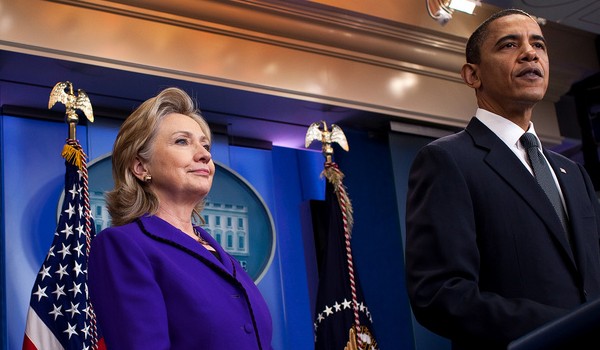
In a letter he sent to the president of Brazil in late April, Obama spelled out the terms on which the US would support a diplomatic initiative by Brazil and Turkey who hoped to revive a nuclear swap agreement that Iran had rejected last fall. Obama expressed his skepticism that Iran would make the necessary concessions. He was proved wrong, but then instead of welcoming Lula and Erdogan’s diplomatic accomplishment, Secretary Clinton dismissed it out of hand. If she did so with Obama’s consent, he has shown his word is worthless. If she did so on her own initiative, this president has lost his authority as chief executive.

This is what Obama wrote to Lula on April 20, 2010 (emphasis added):

His Excellency
Luiz Inácio Lula da Silva
President of the Federative Republic of Brazil
Brasilia
Dear Mr. President:

I want to thank you for our meeting with Turkish PrinIe Miuister Erdogan during the Nuclear Security Summit. We spent some time focused on Iran, the issue of the provision of nuclear fuel for the Tehran Research Reactor (TRR), and the intent of Brazil and Turkey to work toward finding an acceptable solution. I promised to respond in detail to your ideas. I have carefully considered our discussion, and I would like to offer a detailed explanation of my perspective and suggest a way ahead.

I agree with you that the TRR is an opportunity to pave the way for a broader dialogue in dealing with the more fundamental concerns of the intemational community regarding Iran’s overall nuclear program. From the beginning, I have viewed Iran’ s request as a clear and tangible opportunity to begin to build mutual trust and confidence, and thereby create time and space for a constructive diplomatic process. That is why the United States so strongly supported the proposal put forth by former International Atomic Energy Agency (IAEA) Director General EIBaradei.

The IAEA’s proposal was crafted to be fair and balanced, and for both sides to gain trust and confidence. For us, Iran’s agreement to transfer 1,200 kg of Iran’s low enriched uranium (LEU) out of the country would build confidence and reduce regional tensions by substantially reducing Iran’s LEU stockpile. I want to underscore that this element is of fundamental importance for the United States. For Iran, it would receive the nuclear fuel requested to ensure continued operation of the TRR to produce needed medical isotopes and, by using its own material, Iran would begin to demonstrate peaceful nuclear intent. Notwithstanding Iran’s continuing defiance of five United Nations Security Council resolutions mandating that it cease its enrichment of uranium, we were prepared to support and facilitate action on a proposal that would provide Iran nuclear fuel using uranium enriched by Iran — a demonstration of our willingness to be creative in pursuing a way to build mutual confidence.

During the course of the consultations, we also recognized Iran’s desire for assurances. As a result, my team focused on ensuring that the lAEA’s proposal contained several built-in measures, including a U.S. national declaration of support, to send a clear signal from my government of our willingness to become a direct signatory and potentially even play a more direct role in the fuel production process, a central role for Russia, and the IAEA’s assumption of full custody of the nuclear material throughout the fuel production process. In effect, the IAEA’s proposal offered Iran significant and substantial assurances and commitments from the IAEA, the United States, and Russia. Dr. EI Baradei stated publicly last year that the United States would be assuming the vast majority of the risk in the IAEA’s proposal.

As we discussed, Iran appears to be pursuing a strategy that is designed to create the impression of flexibility without agreeing to actions that can begin to build mutual trust and confidence. We have observed Iran convey hints of flexibility to you and others, but formally reiterate an unacceptable position through official channels to the IAEA. Iran has continued to reject the IAEA’s proposal and insist that Iran retain its low-enriched uranium on its territory until delivery of nuclear fuel. This is the position that Iran formally conveyed to the IABA in January 2010 and again in February.

We understand from you, Turkey and others that Iran continues to propose that Iran would retain its LEU on its territory until there is a simultaneous exchange of its LEU for nuclear fuel. As General Jones noted during our meeting, it will require one year for any amount of nuclear fuel to be produced. Thus, the confidence-building strength of the IAEA’s proposal would be completely eliminated for the United States and several risks would emerge. First, Iran would be able to continue to stockpile LEU throughout this time, which would enable them to acquire an LEU stockpile equivalent to the amount needed for two or three nuclear weapons in a year’ s time. Second, there would be no guarantee that Iran would ultimately agree to the final exchange. Third, IAEA “custody” of lran’s LEU inside of Iran would provide us no measurable improvement over the current situation, and the IAEA cannot prevent Iran from re-assuming control of its uranium at any time.

There is a potentially important compromise that has already been offered. Last November, the IAEA conveyed to Iran our offer to allow Iran to ship its 1,200 kg of LEU to a third country — specifically Turkey — at the outset of the process to be held “in escrow” as a guarantee during the fuel production process that Iran would get back its uranium if we failed to deliver the fuel. Iran has never pursued the “escrow” compromise and has provided no credible explanation for its rejection. I believe that this raises real questions about Iran’s nuclear intentions, if Iran is unwilling to accept an offer to demonstrate that its LEU is for peaceful, civilian purposes. I would urge Brazil to impress upon Iran the opportunity presented by this offer to “escrow” its uranium in Turkey while the nuclear fuel is being produced.

Throughout this process, instead of building confidence Iran has undermined confidence in the way it has approached this opportunity. That is why I question whether Iran is prepared to engage Brazil in good faith, and why I cautioned you during our meeting. To begin a constructive diplomatic process, Iran has to convey to the IAEA a constructive commitment to engagement through official channels — something it has failed to do. Meanwhile, we will pursue sanctions on the timeline that I have outlined. I have also made clear that I will leave the door open to engagement with Iran. As you know, Iran has thus far failed to accept my offer of comprehensive and unconditional dialogue.

I look forward to the next opportunity to see you and discuss these issues as we consider the challenge of Iran’s nuclear program to the security of the international community, including in the U.N. Security Council.

Sincerely,
Barack Obama

So what did Brazil and Turkey accomplish? An agreement by Iran to do exactly what Obama claimed he was seeking: that Iran would transfer 1200kg of LEU to be held in escrow by Turkey and in return for which, one year later, Iran would receive fuel rods for the TRR.

The US response? Secretary Clinton claimed there were “discrepancies” in the offer. These included that:

There is a recognition on the part of the international community that the agreement that was reached in Tehran a week ago between Iran and Brazil and Turkey only occurred because the Security Council was on the brink of publicly releasing the text of the resolution that we have been negotiating for many weeks. It was a transparent ploy to avoid Security Council action.

That is a truly Kafkaesque statement!

The US and its allies have been mounting diplomatic and economic pressure on Iran to force it to make concessions on the nuclear issue. As soon as Iran makes concessions, the US turns around and says the concessions are a “ploy” to avoid sanctions.

Facebooktwittermail

Turkey’s “zero problems” foreign policy

In a presentation of Turkey’s “zero-problems” foreign policy, Turkey’s foreign minister, Ahmet Davutoglu, lays out five operational principles guide Turkey’s foreign policy-making process:

The first principle is the balance between security and democracy. The legitimacy of any political regime comes from its ability to provide security and freedom together to its citizens; this security should not be at the expense of freedoms and human rights in the country. Since 2002, Turkey has attempted to promote civil liberties without undermining security. This is an ambitious yet worthy aim — particularly in the post-Sept. 11 environment, under the threat of terrorism, in which the general tendency has been to restrict liberties for the sake of security.

Turkey has made great strides in protecting civil liberties despite serious domestic political challenges to such freedoms over the past seven years. This required vigorously carrying out the struggle against terrorism without narrowing the sphere of civil liberties — a challenge Turkey successfully overcame. In the process, we’ve found that Turkish soft power has only increased as our democracy has matured.

Second, the principle of zero problems towards neighbors has been successfully implemented for the past seven years. Turkey’s relations with its neighbors now follow a more cooperative track. There is a developing economic interdependence between Turkey and its neighboring countries. In 2009, for example, we achieved considerable diplomatic progress with Armenia, which nevertheless remains the most problematic relationship in Turkey’s neighborhood policy.

Turkey’s considerable achievements in its regional relationships have led policymakers to take this principle a step further and aim for maximum cooperation with our neighbors. Since the second half of 2009, Turkey established high-level strategic council meetings with Iraq, Syria, Greece and Russia. These are joint cabinet meetings where bilateral political, economic, and security issues are discussed in detail. There are also preparations to establish similar mechanisms with Bulgaria, Azerbaijan and Ukraine as well as other neighboring countries. Turkey abolished visa requirements with, among others, Syria, Tajikistan, Albania, Lebanon, Jordan, Libya and Russia. Turkey’s trade with its neighbors and nearby regions has substantially increased in recent years.

The third operative principle is proactive and pre-emptive peace diplomacy, which aims to take measures before crises emerge and escalate to a critical level. Turkey’s regional policy is based on security for all, high-level political dialogue, economic integration and interdependence, and multicultural coexistence. Consider Turkey’s mediation between Israel and Syria, a role that was not assigned to Turkey by any outside actor. Other examples of pre-emptive diplomacy include Turkey’s efforts to achieve Sunni-Shiite reconciliation in Iraq, reconciliation efforts in Lebanon and Palestine, the Serbia-Bosnia reconciliation in the Balkans, dialogue between Afghanistan and Pakistan, and the reconstruction of Darfur and Somalia.

The fourth principle is adherence to a multi-dimensional foreign policy. Turkey’s relations with other global actors aim to be complementary, not in competition. Such a policy views Turkey’s strategic relationship with the United States through the two countries’ bilateral strategic ties and through NATO. It considers its EU membership process, its good neighborhood policy with Russia, and its synchronization policy in Eurasia as integral parts of a consistent policy that serves to complement each other. This means that good relations with Russia are not an alternative to relations with the EU. Nor is the model partnership with the United States a rival partnership against Russia.

The fifth principle in this framework is rhythmic diplomacy, which aspires to provide Turkey with a more active role in international relations. This principle implies active involvement in all international organizations and on all issues of global and international importance. Turkey became a non-permanent member of the U.N. Security Council and is chairing three critical commissions concerning Afghanistan, North Korea, and the fight against terror. Turkey undertook the chairmanship-in-office of the South-East European Cooperation Process, a forum for dialogue among Balkan states and their immediate neighbors, for 2009 and 2010. Turkey is also a member of G-20, maintains observer status in the African Union, has a strategic dialogue mechanism with the Gulf Cooperation Council, and actively participates in the Arab League. Turkey has also launched new diplomatic initiatives by opening 15 new embassies in Africa and two in Latin America, and is a signatory to the Kyoto Protocol. These developments show a new perspective of Turkey, one that is based on vision, soft power, a universal language, and implementation of consistent foreign policies in different parts of the world.

Facebooktwittermail

Obama and Clinton’s choice: humility or humiliation?

This week the Obama administration made what may come to be seen as a blunder of historic proportions. At a moment when tactical agility was a must, it stayed on course because it lacked the diplomatic finesse to show or perhaps even recognize the difference between being resolute and being inflexible.

The sanctions juggernaut plowed into the Iran diplomatic initiative masterminded by Brazil and Turkey and on the basis that these are “lesser” powers, Washington imagined its own agenda must be unstoppable. Or at least the administration felt compelled to bow in obedience to a fear that shackles every Democratic leader: the fear that flexibility will be seen as a sign of weakness.

Common sense and prudence made it clear that the smart way of responding to the new opening from Iran would have been with a cautious opening in return. Instead, Iran, Turkey and Brazil got the door slammed in their face. The calculation in Washington, no doubt, was that Iran, in its usual tempestuous style would swiftly reject the swap deal in the face of the continued threat of sanctions, and the diplomatic upstarts, Lula and Erdogan, would defer to the old world order.

Instead, it seems that Iran remains intent on seizing the initiative, will stick to the deal it signed and thereby demonstrate to the world that in the long-running nuclear dispute it is the United States that is now the intransigent party.

The Jerusalem Post reports:

Turkey’s prime minister is seeking international support for a deal under which Iran would ship much of its low-enriched uranium to Turkey.

Recep Tayyip Erdogan’s office said Saturday he had written to the leaders of 26 countries saying the deal would resolve the nuclear standoff with Iran by way of diplomacy and negotiation. The countries included all permanent and non-permanent members of the UN Security Council.

Iran will submit an official letter to the IAEA on Monday morning conveying its acceptance of the uranium enrichment deal brokered by Turkey and Iran, state-run news agency IRNA reported on Friday, citing a statement by the country’s National Security Council.

“Following the joint declaration by Iran, Turkey and Brazil, permanent representative of the Islamic Republic of Iran at the IAEA officially announced its readiness to submit our country’s letter to the IAEA Chief per paragraph six of the Teheran Declaration,” the statement reportedly read.

Also on Friday, IRNA quoted a top Iranian cleric as saying that the deal was a “powerful response” that “put the ball in the West’s court.” He reportedly stated that far from being a ploy meant to facilitate enrichment for military use, the deal should be seen as a confidence-building measure.

Meanwhile in Turkey, UN Secretary-General Ban Ki-moon expressed hope that the deal reached last week would “open the door to a negotiated settlement” between Iran and Western nations, according to a Reuters report.

Ban reportedly called the enrichment agreement “an important initiative in resolving international tensions over Iran’s nuclear program by peaceful means.” He went on to praise Turkey’s role and cooperation with Brazil in negotiating the deal, stressing that the International Atomic Energy Agency (IAEA) would have to make its own assessment concerning the issue at hand.

At this point, it looks like Hillary Clinton has driven the United States into a diplomatic ditch.

The American mindset now as always fixes its attention on power and while the US remains the pre-eminent global power it assumes that it must have its way. But this fixation on power blinds Washington to a more important issue — one that provides the foundation for effective diplomacy, namely, trust.

The Turkish commentator, Mustafa Akyol, says:

This issue of trust, I believe, is the key to not just the Iranian nuclear crisis, but also other conflicts in the region, including the Arab-Israeli one. On all these issues, America has all the eye-catching instruments that give her full confidence: The world’s most powerful military, the largest diplomatic corps, and the most sophisticated brain power with plentitude of universities, institutes and think-tanks.

Yet, I am sorry to say, she terribly lacks the trust of the peoples of the Middle East. So, it would be only wise for her to rely more on the regional actors that do have that trust – such as the new Turkey of the 21st century.

Rami G Khouri adds:

The agreement on Iran’s nuclear fuel announced on Monday after mediation by the Turkish and Brazilian governments should be good news for those who seek to use the rule of law to prevent nuclear weapons proliferation. From both the American and Iranian perspectives the political dimension of the current dynamics is more important than the technical one. The accord should remind us that the style and tone in diplomatic processes is as important as substance.

Iran and its international negotiating partners have not reached agreement on Iran’s nuclear programs in the past half-decade, to a large extent because American- and Israeli-led concerns have been translated into an aggressive, accusatory, sanctions-and-threats-based style of diplomacy that Iran in turn has responded to with defiance.

Iran’s crime, in the eyes of its main critics in Washington and Tel Aviv (they are the two that matter most, as other Western powers play only supporting roles), is not primarily that it enriches uranium, but that it defies American-Israeli orders to stop doing so. (The Iranian response, rather reasonable in my view, is that it suspended uranium enrichment half a decade ago and did not receive the promises it expected from the United States and its allies on continuing with its plans for the peaceful use of nuclear technology. So why suspend enrichment again?)

The Iranians are saying, in effect, that this issue is about two things for them, one technical and one political: The technical issue is about the rule of law on nuclear nonproliferation and the right of all countries to use nuclear technology peacefully. The political issue is about treating Iran with respect, and negotiating with it on the basis of two critical phenomena: First, addressing issues of importance to Iran as well as those that matter for the American-Israeli-led states; and, second, actually negotiating with Iran rather than condescendingly and consistently threatening it, accusing it of all sorts of unproven aims, and assuming its guilt before it is given a fair hearing.

The age in which the non-Western world could be expected to show deference to the dictates of the dominant global powers is over. Western leaders must either humbly adapt to a world that has changed or suffer the humiliations that arrogance now invite.

Facebooktwittermail

“For the world has changed, and we must change with it.”

Back in the days when Barack Obama scored political points for setting the right tone and hitting the right notes, this was one of his best lines, it’s significance underlined by the fact that it came in his inauguration speech.

… the world has changed, and we must change with it.

From America the hyperpower to America the adaptive power. From a president who liked to wield a chainsaw to a president who loved basketball — the blundering giant was going to give way to deft leadership, agile and attuned to the moment.

As cynical as I might sound, I still think Obama gets this. I think he understands what the possibility looks like, yet he also seems convinced that seemingly inviolable political realities dictate that he sticks to a script that could have been written for George Bush. Indeed, had it been possible for there to have been a third Bush term, the trajectory set from 2006 onward appeared to have been heading in the direction we have now landed.

So maybe it’s time Obama asked himself this question: does he want to be remembered as a continuation of the past or as a man who actually helped American embrace the future?

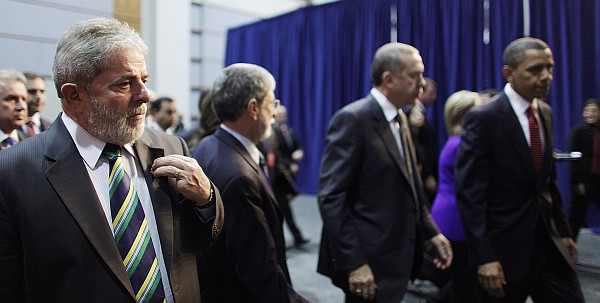
Luiz Inácio Lula da Silva and Recep Tayyip Erdoğan are men who represent the kind of future Obama really should believe in, yet having made himself a slavish tool of Washington’s institutional power, he operates with the calculations and lack of authenticity that have become synonymous with modern Western political leadership. Paradoxically, the art of securing political power now dictates that the power thereby acquired will be insufficient to bring about any significant change.

In spite of this, officials in Washington still harbor the conceit that they hold and are able to move all the major levers of global power — Washington still sees itself as the engine room of global change. No wonder the up-swell of indignation when two “lesser powers” have the audacity to become agents of change in an arena where this administration has thus far been manifestly impotent.

As Flynt and Hillary Mann Leverett note:

For months, Administration officials–and most U.S.-based Iran analysts–have asserted that the Islamic Republic is too internally conflicted to have a coherent international strategy or make important decisions. Senior Brazilian, Chinese, and Turkish officials who have invested significant amounts of time in substantive discussions with Iranian counterparts argued to Washington for months that a nuclear deal was possible. But Secretary Clinton and others in the Obama Administration thought they knew better–and said so publicly.

In fact, Iran has worked purposefully–dare we say strategically–to cultivate relations with important rising powers, like Brazil and Turkey, as well as China. And, this week, Tehran showed that it can take major decisions. Can the same things be said of the Obama Administration?

President Obama, who came to office professing a new U.S. approach to international engagement, allowed himself to be upstaged by new powers because he has been unwilling to match his rhetoric with truly innovative diplomacy that takes real notice of other countries’ interests.

The world was eager to forgive American arrogance when it appeared it could be more narrowly circumscribed as George Bush’s arrogance, but the heavy-handed approach now being applied by the current administration suggests that as the world changes, America is incapable of changing with it.

Simon Tisdall observes that the emerging realignment of global power does not simply involve America’s diminishing power but also a shift away from the American way of wielding power.

Brazil and Turkey, two leading members of a new premier league of emerging global powers, have a quite different approach. They stress persuasion and compromise. In the case of Iran, instead of ultimatums, deadlines and sanctions, they prefer dialogue. It helps that neither country feels threatened by Tehran.

Lula da Silva, Brazil’s popular president, typifies this outlook. He gave Clinton fair warning earlier this year that it was “not prudent to push Iran against a wall”. More broadly, Lula has championed the cause of emerging countries, challenged the rich world’s assumptions at the Copenhagen climate summit, and bearded the US over Cuba and Hugo Chávez.

Lula speaks for a world that was formed in the west’s image but is increasingly rejecting its tutelage and its ideas. China and India are the foremost members of this pack. But their leaders’ overriding priority is to build up their countries’ economic strengths. For most part, Beijing avoids open fights with the Americans and their west-European allies. The time will come when that will change – but not yet.

Reacting angrily to Clinton’s implied suggestion that somehow they had been suckered into the uranium deal by the crafty Iranians, Maria Luiza Ribeiro Viotti, Brazil’s ambassador to the UN, said Brazil would not co-operate with US-initiated security council discussions on a new resolution. Without unanimity in the council, new sanctions are even less likely to be honoured or effectively implemented than is already the case now.

Brazil’s foreign minister, Celso Amorim, also warned Washington to think again. “We have a chance to achieve a peaceful, negotiated solution [with Iran]. Those who turn down that possibility, or who think that sanctions or other measures would get us closer, they’ll have to take responsibility for that.” Such robust language is an eloquent expression of the changing power dynamic between the old superpower and its new rivals.

Recep Tayyip Erdogan, Turkey’s prime minister and, like Lula, the leader of an emerging regional power, has a more direct interest in what happens in Iran. The two countries have a common border and a common belief that the Middle East has seen too much interference by foreign powers. Ankara does not want a nuclear-armed Iran any more than it wants a nuclear-armed Israel. In fact, it seeks to empty the region of all weapons of mass destruction.

But Erdogan is increasingly resistant to the US way of doing things, whether it is turning a blind eye to Israel’s Gaza depredations, lecturing Turkey on Armenian history, or maintaining double standards on nuclear weapons. Like most Turks, Erdogan opposed the invasion of Iraq. He has led a rapprochement with Syria, another American bete noire. And he suggested this week that Washington was behaving arrogantly in dismissing the Iran deal.

“This is the time to discuss whether we believe in the supremacy of law or the law of the supremes and superiors,” he said. “While they [the US] still have nuclear weapons, where do they get the credibility to ask other countries not to have them?” Yet despite his obvious anger, Erdogan still answered Clinton’s criticism that the timeline for the uranium swap was “amorphous”. Iran was expected to fulfil its part of the deal within one month, otherwise it would “be on its own”, he said.

Ahmet Davutoglu, Turkey’s foreign minister, made clear Ankara’s opposition to further sanctions – and that he was not worried about upsetting the Americans. “We don’t want any new sanctions in our region because it affects our economy, it affects our energy policies, it affects our relations in our neighbourhood,” he said. Without Turkish co-operation, any new measures will struggle to have an impact.

That may prove to be the case anyway. Overlooked in the furore is the consideration that, thanks to stiff Chinese and Russian opposition, the proposed new sanctions, even if agreed as drafted, are fairly weak. This is nothing like the “crippling” package promised by Clinton, is largely voluntary or non-binding in nature, and will have no effect on Iran’s oil and gas sales – its main source of income.

Supplementary, tougher measures are expected from the EU at a later date while individual countries, such as the US and Britain, may take additional, unilateral steps. So what the US would like to portray as the international community’s united front against Iran is likely to boil down, in reality, to a narrowly-based coalition of the willing involving Washington and a handful of west-European states.

This week’s symbolically significant attempt by Brazil and Turkey to do things differently, and the divisions the subsequent row exposed, suggests this already rickety traditional international security architecture, maintained and policed by a few self-appointed countries, cannot hold much longer. Power is shifting away from the west. You can almost feel it go.

Facebooktwittermail

Lula’s new world order

In a world long dominated by Western powers, the global order has been one shaped by coercion. Although the twentieth century saw the end of formal colonialism — the most overt coercive system — the perpetuation of economic colonialism has meant that the United States and its allies still expect to have the final word on most issues of global importance.

It seems natural then as a new global order emerges, Western domination will not get replaced by another form of domination — the Western coercive paradigm itself will be rejected. This indeed, is the new approach to diplomacy that is being pioneered by Brazil and Turkey.

If Barack Obama really embodied a new way of thinking, we’d have reason to hope that he’d be nimble enough to adapt to the momentous period of change that is now unfolding, yet so far all the indications are that whatever his personal abilities might be, he remains firmly tethered to an arthritic diplomatic and political establishment.

The nuclear swap deal just struck by Brazil, Turkey and Iran could be grasped as an unexpected but welcome opportunity. Instead, Washington’s guarded response barely conceals the fact that it sees it own power as being usurped.

In the Financial Times, Jonathan Wheatley notes that the deal may vindicate Brazilian diplomacy and prove the skeptics wrong.

The idea that Iran would abandon its alleged nuclear weapons programme in favour of a peaceful nuclear energy programme in response to amicable talks rather than under the threat of UN-backed sanctions seemed unrealistic, even naïve. But it may well have paid off. Even a US official conceded today that the latest news was “potentially a good development.”

If so, Celso Amorim, Brazil’s foreign minister, can be forgiven some self-satisfaction. “We are holding conversations in a respectful manner and with conviction . . . Our language is not that of pressure. Our language is that of persuasion, friendship and cooperation,” he told reporters in Tehran on Monday.

Al Jazeera notes:

The recent visit by Luiz Inacio Lula da Silva, Brazil’s president, to Iran is part of a broad multilateral foreign policy that he believes is commensurate with his nation’s ever-growing importance in a changing world axis.

Brazil under Lula’s eight year reign has promoted trade between Israel and Latin America, while supporting talks with Hamas and Palestinian statehood. It has balked at US urges for sanctions on Iran over their nuclear programme, which Washington believes has nefarious intentions, while on Sunday it brokered an agreement in which Tehran exchanges low-enriched uranium for nuclear fuel.

Diplomatic ties have been created with more than 40 nations, including North Korea, and Brasilia maintains good relations across divides, for instance with foes Venezuela and Colombia.

Like India, Brazil is advocating for a permanent seat at the UN Security Council and wants reform of the International Monetary Fund (IMF) to better represent developing nations.

For as Lula said in an interview with Al Jazeera this week, international geopolitics is shifting and global governance needs to change with it.

The impact of the agreement on Israel — where coercion is generally regarded as the only effective tool of persuasion — was summed up by Yossi Melman:

The agreement on the transfer of Iran’s enriched uranium, achieved via Turkish-Brazilian mediation, is an important victory for Iranian diplomacy and a debacle for Israeli policy. The deal reduces the chances, which were slim to begin with, of new sanctions being imposed on Iran, and makes a military strike against Iran even less feasible.

Zvi Bar’el notes:

Turkey is the deal’s big winner. Trade between Iran and Turkey already stands at $10 billion annually, so if sanctions were imposed on Tehran, Turkey would suffer a massive blow to its economy – and Prime Minister Recep Tayyip Erdogan’s party would suffer a major political setback. Alternatively, should Turkey decide not to uphold the sanctions, it might find itself in a crisis with the United States and Europe. Hence the tremendous effort Turkey made to achieve the deal, despite American warnings that Iran might be using Turkey in order to buy time.

Why did Iran choose to see Turkey as an “honest broker” and make the deal with it instead of with the permanent Security Council members? The two countries’ good relations are not free of suspicion, but both Iran and Turkey have adopted a policy of expanding their influence in the Middle East, influence of the sort that relies on cooperation rather than competition.

The closer ties between Turkey and Syria, Iran’s ally; the similar attitude that Turkey and Iran have toward Hamas; their shared interests in Iraq; and a similar view of radical Islamic terrorism all combined with Turkey’s disappointment over European views of its candidacy to join the European Union to create a confluence of interests that, for the time being, trumps their disagreements. Moreover, from an ideological standpoint, Iran prefers Turkey to the U.S.: Any concession to Washington or its Security Council partners would be perceived as a surrender.

The Wall Street Journal adds:

China welcomed Iran’s new nuclear fuel-swap agreement, saying the deal supports Beijing’s long-held position that the international dispute over Iran’s nuclear ambitions can be resolved through diplomacy rather than sanctions or force.

“We hope this will help promote a peaceful settlement of the Iranian nuclear issue through dialogue and negotiation,” foreign ministry spokesman Ma Zhaoxu said Tuesday at a regular press briefing. “We believe dialogue and negotiation is the best approach to settle the Iranian nuclear issue.”

Under the deal arranged by Brazil and Turkey, Iran will ship out some of its uranium to Turkey, have it enriched and then shipped back to Iran for use in a medical research reactor. Western powers want to keep Iran from enriching uranium on its own soil, because it fears that fuel will end up being used for nuclear weapons, which Tehran denies. The latest deal is a weakened version of one that was negotiated last October but fell through after Iran’s government didn’t approve it.

For China, a deal brokered by Brazil and Turkey is in line with its broader vision of a more multipolar world order not dominated by Washington.

Julian Borger thinks that Iran might have overplayed its hand.

The initial western response to the new Turkish-Brazilian-Iranian uranium swap deal was akin to a chess player realising loss is inevitable. There was an awkward silence and quietly spreading panic as western capitals looked a few moves ahead and could not think of a way of escaping the trap they had fallen into. The deal would have to be accepted, even though it did little to slow down Iran’s nuclear drive, and the push for sanctions in New York would deflate.

And then, the Iranian foreign ministry decided to speak. The spokesman, Ramin Mehmanparast, declared: “Of course, enrichment of uranium to 20% will continue inside Iran.”

The announcement was stunning. Iran’s justification for beginning 20% enrichment in February, was that it needed the material to make medical isotopes for the Tehran research reactor, although it was unclear how the Iranians were going to fabricate the necessary rods. Under this new deal, the rods will be provided free of charge. What then would be the civilian use of Iran’s home-enriched uranium?

For those already convinced Iran is working its way to breakout nuclear weapons capacity, the point of enriching to 20% is clear. In engineering terms it is a lot more than half way to 90% weapons-grade material, and an important test of the reliability of Iran’s centrifuges in reaching that goal.

Within minutes, the western capitals, tongue-tied over their response for the first few hours, began to rally.

But if Washington hoped that there might at least be unity in the expression of Western reservations about the deal, that hope was swiftly undermined as the French President Nicholas Sarkozy said he sees this development as a “positive step.”

Facebooktwittermail

Lula and Erdogan demonstrate their diplomatic clout

If President Obama had accomplished what Brazil and Turkey are about to pull off — a deal through which Iran will exchange its stockpile of enriched uranium in return for fuel rods for a medical research reactor — then the US media would be hailing this as a diplomatic breakthrough. Instead, this is being described as a possible obstacle to sanctions. The New York Times reports:

Brazilian and Turkish government officials said Sunday that their leaders had brokered a tentative compromise with Iran in the international standoff over Iran’s nuclear program, a development that could undermine efforts in the United Nations to impose new sanctions on the Iranians.

A spokesman for the Turkish Foreign Ministry said that after 17 hours of talks in Tehran, ministers from Brazil, Iran and Turkey had reached an agreement on the “principles” to revive a stalled nuclear fuel-swap deal backed by the United Nations.

The spokesman, speaking on condition of anonymity, said the deal would be presented to the leaders of the countries for “final touches,” with a statement on the agreement expected as early as Monday. The exact terms, notably the amount of nuclear fuel to be swapped, were not revealed.

The Turkish prime minister, Recep Tayyip Erdogan, canceled an official visit to Azerbaijan late Sunday and instead joined officials in Tehran in what was seen as a sign of progress in the talks.

Laura Rozen adds:

[A] Washington Iran expert said the fact that the alleged nuclear deal was connected to Lula’s meeting with the Iranian Supreme Leader, as opposed to with the Iranian president, may be significant.

That signals that Khamenei “is endorsing the deal,” the National Iranian American Council’s Trita Parsi said, adding it may reduce the bouts of Iranian domestic political infighting that have plagued earlier rounds of negotiations that failed to hold up. “That means this is no longer Ahmadinejad’s nuclear deal, this is Khamenei’s nuclear deal.”

The Financial Times said:

Iran’s supreme leader on Sunday praised Luiz Inácio Lula da Silva for defying US calls to close ranks against the Islamic regime as the Brazilian leader arrived in Tehran seeking to mediate in the crisis over Iran’s nuclear ambitions.

“Brazil in recent years [under Mr Lula] has differed from previous years,” Ayatollah Ali Khamenei told his visitor. He called on “independent” countries to assert their roles in global affairsnd help to change the UN so it does not favour powerful states.

Facebooktwittermail

Russia’s Middle East moves

While Israel, Iraq and Afghanistan are like lead weights that limit the flexibility of the United States in the Middle East, other powers are now taking advantage of Washington’s inability to function as an agent of change.

After Russian President Dmitry Medvedev visited Turkey this week, commentator Semih Idiz wrote:

[I]f U.S. President Barack Obama’s visit to Turkey was the highlight of 2009, Medvedev’s visit to Turkey is the highlight of 2010. In fact, one can even go further and suggest that the latter visit has produced much more in terms of concrete results than the former.

There is no doubt, for example, that Washington is looking on with a certain chagrin as Turkey awards a $20 billion nuclear power plant contract to Russia and signs documents that propose a $100 billion volume of trade as well as billions of dollars worth of investments, all suggesting a rapidly growing strategic partnership.

Meanwhile, Al Jazeera reports that Russia has rejected criticism from Israel after Medvedev met the leader of Hamas in Damascus.

Israel’s foreign ministry said it was “deeply disappointed” that Medvedev had met Khaled Meshaal, the group’s exiled leader, during a visit to Syria this week.

“Hamas is not an artificial structure,” Andrei Nesterenko, the Russian foreign ministry spokesman, said in a statement on Thursday.

“It is a movement that draws on the trust and sympathy of a large number of Palestinians. We have regular contacts with this movement.

“It is known that all other participants of the Middle East quartet are also in some sort of contact with Hamas leadership, although for some unknown reason they are shy to publicly admit it,” Nesterenko said.

Joshua Landis says:

Russia will fish in the troubled waters of the Middle East. American isolation can only redound to its advantage. The Arabs and Iran will look to Russia for arms. Russia can also be gratified by the deterioration of Turkey’s relations with both Israel and the United Stats. It will continue to look for ways to frustrate U.S. efforts to add teeth to its sanctions regime against Iran.

So long as America’s No. 1 foreign-policy goal in the region is to hurt Iran and help Israel, Russia will be drawn back into the region and a new Cold War will take shape. Washington’s failure to realign relations with Iran and Syria dooms it to repeat its past. But this time Israel will be more of a millstone around its neck as it thumbs it’s nose at international law and human rights.

Facebooktwittermail

The Israeli exception

At Foreign Policy in Focus, John Feffer draws attention to the contradiction between Israel’s behavior as a rogue state and the fact that it is about to be granted the privileged status of membership in the Organization for Economic Cooperation and Development — unless, that is, a country such as Turkey steps up and exercises its right to cast a veto.

North Korea and Israel have a lot in common.

Neither is a signatory to the Nuclear Non-Proliferation Treaty (NPT), and both employ their nuclear weapons in elaborate games of peek-a-boo with the international community. Israel and North Korea are equally paranoid about outsiders conspiring to destroy their states, and this paranoia isn’t without some justification. Partly as a result of these suspicions, both countries engage in reckless and destabilizing foreign policies. In recent years, Israel has launched preemptive strikes and invaded other countries, while North Korea has abducted foreign citizens and blown up South Korean targets (including, possibly, a South Korean ship in late March in the Yellow Sea).

And they’re both exceptions in their regions: Israel is a Jewish state in an Arab region; North Korea is an old-style feudal dictatorship in an Asian region marked by relative prosperity and political openness. But the two countries often behave as if they are exceptions to all other rules as well. For instance, they both share an antipathy toward human rights organizations that attempt to hold them to international standards. Witness the recent attacks by Israel (and its hard-right supporters) of Human Rights Watch because of reports critical of Israel’s human rights record. North Korea also routinely rejects human rights inquiries as a challenge to its sovereignty. (For a proposal on a better strategy to engage North Korea on human rights issues, check out my latest piece Starting Where North Korea Is.)

Despite these similarities, these two roguish powers haven’t had a great deal of interaction. Between 1992 and 1994, Israel secretly negotiated a billion dollar buy-out of North Korea’s missile export program to the Middle East, and the United States intervened to nix the deal (only to explore a similar option with North Korea at the end of the Clinton administration). In 2007, Israel bombed a suspected nuclear facility in Syria that may or may not have been built with North Korean assistance. Otherwise, the two countries maintain their innocence and distance.

And yet one country is an official rogue and the other country only plays one on Arab TV. The difference in designation owes much to U.S. policy. One of the perks of world domination is the chance to make like Adam in Genesis and name all the animals. North Korea, according to Washington, is beyond the pale. Israel, however, is “one of us”: firmly ensconced in the Judeo-Christian tradition, accorded honorary European status, and even considered worthy of membership in the Organization for Economic Cooperation and Development (OECD).

Meanwhile, The Guardian reports:

Britain has refused to allow Israel’s Mossad secret service to send a representative back to the country’s London embassy following the row over the killing of a Hamas operative by agents using forged UK passports.

Israel’s Yediot Aharonot newspaper reported yesterday that the Foreign Office is digging in its heels because Israel is refusing to commit itself not to misuse British passports in future clandestine operations.

Facebooktwittermail