Category Archives: United Kingdom

While Murdoch’s papers targeted former PM Gordon Brown, Tony Blair tried to protect Murdoch

The Guardian reports:

Journalists from across News International repeatedly targeted the former prime minister Gordon Brown, attempting to access his voicemail and obtaining information from his bank account, his legal file as well as his family’s medical records.

There is also evidence that a private investigator used a serving police officer to trawl the police national computer for information about him.

That investigator also targeted another Labour MP who was the subject of hostile inquiries by the News of the World, but it has not confirmed whether News International was specifically involved in trawling police computers for information on Brown.

Separately, Brown’s tax paperwork was taken from his accountant’s office apparently by hacking into the firm’s computer. This was passed to another newspaper.

Brown was targeted during a period of more than 10 years, both as chancellor of the exchequer and as prime minister. Some of the activity clearly was illegal.

The Mail on Sunday reported:

Tony Blair urged Gordon Brown to persuade the Labour MP who led the campaign to expose News of the World phone-hacking to back off, friends of Mr Brown said last night.

Well-placed sources said Mr Blair, who has close links with the paper’s owner Rupert Murdoch, wanted Mr Brown to get his ally Tom Watson to lay off the News International (NI) title, but Mr Brown refused.

Mr Watson’s two-year crusade played a major part in Mr Murdoch’s shock decision to close the paper after today’s edition.

Facebooktwittermail

UK govt. official: Murdoch made Cameron eat a ‘shit sandwich’ which turned into a three-course dinner

The Independent reports:

For more than 30 years now there have been two truths about Rupert Murdoch’s increasingly infrequent visitations to the British outpost of his media empire.

The first: anyone who is anyone in the world of politics and business angles for (and is delighted by) any kind of audience with the great man.

The second is the chill his visit engenders amongst his senior editors and executives in Wapping [News International’s London headquarters].

Yesterday as Mr Murdoch’s corporate Boeing 737 jet, complete with a boardroom and double bed, touched down at Luton Airport, it was clear how much has changed in the last week. The chill in Wapping is still there – worse than ever – but the audiences for Mr Murdoch have dried up.

He and his company – feted by David Cameron and Ed Miliband just two weeks ago at the News International Summer Party – have become a political liability. To paraphrase the famous quote: “It was News of the World wot lost it”. Yesterday Downing Street made it very clear that Mr Cameron would be neither meeting nor speaking to Mr Murdoch on this visit.

Privately Government sources are blunter. They are incandescent at the political damage done by the phone-hacking scandal and angry that News Corp has not voluntarily suspended its attempted takeover of BSkyB in the wake of the allegations.

They feel they are getting unfairly blamed for not stopping the takeover and the impression is growing that they are still in the pocket of the company. “We always knew we were going to have to eat a shit sandwich over the BSkyB deal,” said one. “We didn’t know it would turn into a three course dinner.”

David Carr writes:

[H]ow did we find out that a British tabloid was hacking thousands of voice mails of private citizens? Not from the British government, with its wan, inconclusive investigations, but from other newspapers.

Think of it. There was Mr. Murdoch, tying on a napkin and ready to dine on the other 60 percent of BSkyB that he did not already have. But just as he was about to swallow yet another tasty morsel, the hands at his throat belonged to, yes, newspaper journalists.

Newspapers, it turns out, are still powerful things, and not just in the way that Mr. Murdoch has historically deployed them.

The Guardian stayed on the phone-hacking story like a dog on a meat bone, acting very much in the British tradition of a crusading press, and goosing the story back to life after years of dormancy. Other papers, including The New York Times, reported executive and police complicity that gave the lie to the company’s “few bad apples” explanation. As recently as last week, Vanity Fair broke stories about police complicity.

Mr. Murdoch, ever the populist, prefers his crusades to be built on chronic ridicule and bombast. But as The Guardian has shown, the steady accretion of fact — an exercise Mr. Murdoch has historically regarded as bland and elitist — can have a profound effect.

His corporation may be able to pick governments, but holding them accountable is also in the realm of newspaper journalism, an earnest concept of public service that has rarely been of much interest to him.

The coverage last week, on a suddenly fast-moving story that had been moving only in increments, destabilized the ledge that the News Corporation had been standing on. James Murdoch regretted everything and took responsibility for almost nothing. What looked like an opportunity for him to prove his mettle as a manager of crisis might yet engulf him.

Andy Coulson, the former editor of News of the World who became the chief spokesman for Mr. Cameron, has been arrested. And Rebekah Brooks, chief executive of News International and previous editor of The News of the World, responded by saying that it was “inconceivable” that she knew of the hacking.

I’d suggest it was inconceivable she did not know, given the number of hacking targets. What editor doesn’t know where her stories come from, especially stories chock full of highly private, delicious conversations. Did Ms. Brooks think they were borne in through the window by magic fairies?

Facebooktwittermail

Murdoch’s Watergate

Carl Bernstein writes:

The hacking scandal currently shaking Rupert Murdoch’s empire will surprise only those who have willfully blinded themselves to that empire’s pernicious influence on journalism in the English-speaking world. Too many of us have winked in amusement at the salaciousness without considering the larger corruption of journalism and politics promulgated by Murdoch Culture on both sides of the Atlantic.

The facts of the case are astonishing in their scope. Thousands of private phone messages hacked, presumably by people affiliated with the Murdoch-owned News of the World newspaper, with the violated parties ranging from Prince William and actor Hugh Grant to murder victims and families of soldiers killed in Iraq and Afghanistan. The arrest of Andy Coulson, former press chief to Prime Minister David Cameron, for his role in the scandal during his tenure as the paper’s editor. The arrest (for the second time) of Clive Goodman, the paper’s former royals editor. The shocking July 7 announcement that the paper would cease publication three days later, putting hundreds of employees out of work. Murdoch’s bid to acquire full control of cable-news company BSkyB placed in jeopardy. Allegations of bribery, wiretapping, and other forms of lawbreaking—not to mention the charge that emails were deleted by the millions in order to thwart Scotland Yard’s investigation.

All of this surrounding a man and a media empire with no serious rivals for political influence in Britain—especially, but not exclusively, among the conservative Tories who currently run the country. Almost every prime minister since the Harold Wilson era of the 1960s and ’70s has paid obeisance to Murdoch and his unmatched power. When Murdoch threw his annual London summer party for the United Kingdom’s political, journalistic, and social elite at the Orangery in Kensington Gardens on June 16, Prime Minister Cameron and his wife, Sam, were there, as were Labour leader Ed Miliband and assorted other cabinet ministers.

Murdoch associates, present and former—and his biographers—have said that one of his greatest long-term ambitions has been to replicate that political and cultural power in the United States.

Alan Rusbridger, editor of The Guardian, on the phone-hacking scandal

Marina Hyde writes:

Say what you like, this does finally give meaning to David Cameron’s “we’re all in this together” catchphrase. Whether the members of Britain’s necrotic establishment are wading in it, or are up to their necks in it, will be a matter for you to call. But what an irony that Murdoch tabloids, infrequently righteous in their crusades, have finally been shown what major corruption looks like. It’s not a couple of swingers daring to live an unconventional lifestyle in a Wilmslow terrace – it was in the mirror all along.

Yet the solemn announcement that the News of the World is dead (long live the Sun on Sunday!) does not indicate the Murdoch-controlled culture that has debased this septic isle for decades has been dismantled. This week, people have beheld MPs saying what they actually think about Britain’s most obscenely powerful unelected foreign tax exile, and marvelled as if they had seen unicorns. That gives you some idea of the scale of the clean-up, and unless all manner of establishment drones get brave and stay brave, revulsion over the corruption of public life by Murdoch and his soldiers will go the same way as that pertaining to bankers or MPs’ expenses.

People are right to be revolted. It is revolting. Indeed, there are so many threads that we should don rubber gloves and follow merely one of them for a flavour of the whole. So, do open your textbooks at “war”.

Rupert Murdoch was the only figure powerful enough to be able to state explicitly, without consequence, that he was backing war on Iraq to bring down the price of oil. So his “free press” all cheer-led for said war, and began commodifying their version of it, even confecting their own military award ceremonies as though the medal system were inadequate.

The whitewashing report into the death of a scientist who questioned the basis for that war was mysteriously leaked to Murdoch’s papers – another WORLD EXCLUSIVE – while others in his pay hacked the phones and emails of those casualties of war being repatriated in bodybags, to be monetised as stories all over again. Any complaint about this must be taken before an industry court presided over not by the kangaroo of Rupert’s native Australia, but an even less engaged selection of backscratching editors, including his own.

Polly Toynbee writes:

David Cameron’s press conference was nearly a masterclass in damage limitation. How firm he sounded with his three-point actions, announcing two inquiries and the demise of the “failed” Press Complaints Commission. Yes, he would have accepted Rebekah Brooks’s resignation. How shocked he was. It was “simply disgusting”. Here was a wake-up call on the “culture, practice and ethics of the press” and, for now, the crucial BSkyB deal would be delayed. He strove with every sinew to show he gets it, he really does get the public outrage at the hacked phones of a murdered child and dead soldiers. But as the questions rained down, you could see the crisis slipping from his control. This was too little, too late, not quite grasping the changed rules of the old politico-media game.

He said “frankly” once too often, a word that rings alarm bells from politicians on the ropes. “We’ve all been in this together,” he confessed. All the parties, “yes, including me”, had cosied up to Murdoch, turning a blind eye to court political support. But paddling hard to stay afloat, he could not say the Murdoch bid should be stopped. He could not apologise for hiring a man who had already resigned over phone hacking. Every time he said he gave Andy Coulson “a second chance”, that soundbite sounded weaker. What may some day do for him was his denial that he ever received private warnings, one from the Guardian, not to take Coulson into Downing Street, as further revelations were imminent. “I wasn’t given any specific information … I don’t recall being given any information.” Denials about who knew what often turn embarrassments into serious political danger.

Facebooktwittermail

Shares in Rupert Murdoch’s companies tumble as investors take fright

(See Hugh Grant’s article in the New Statesman and for more background on the hacking scandal see this post.)

The Guardian reports:

Investors in companies controlled by Rupert Murdoch have been dumping the shares amid fears on both sides of the Atlantic over the fallout from the phone-hacking scandal at the News of the World.

Shares in broadcaster BSkyB are down 5% in the last week, wiping some £666m off the value of the business, while News Corp had lost 2.6% – slicing some $400m off the value of the News of the World’s ultimate parent company. Many hedge funds which had bought into BSkyB in the hope of making a quick profit from the bid have been selling the shares on fears that the deal now faces substantial delay.

The British prime minister’s former communications director and former editor of News of the World, Andy Coulson, is now under arrest.

To get a sense of the political impact these events are having on David Cameron’s leadership, a scathing commentary in the Tory-friendly Daily Telegraph by Peter Oborne sums up the situation:

In the careers of all prime ministers there comes a turning point. He or she makes a fatal mistake from which there is no ultimate recovery. With Tony Blair it was the Iraq war and the failure to find weapons of mass destruction. With John Major it was Black Wednesday and sterling’s eviction from the Exchange Rate Mechanism. With Harold Wilson, the pound’s devaluation in 1967 wrecked his reputation.

Each time the pattern is strikingly similar. Before, there is a new leader with dynamism, integrity and carrying the faith of the nation. Afterwards, the prime minister can stagger on for years, but as increasingly damaged goods: never is it glad, confident morning again.

David Cameron, who has returned from Afghanistan as a profoundly damaged figure, now faces exactly such a crisis. The series of disgusting revelations concerning his friends and associates from Rupert Murdoch’s News International has permanently and irrevocably damaged his reputation.

Until now it has been easy to argue that Mr Cameron was properly grounded with a decent set of values. Unfortunately, it is impossible to make that assertion any longer. He has made not one, but a long succession of chronic personal misjudgments.

He should never have employed Andy Coulson, the News of the World editor, as his director of communications. He should never have cultivated Rupert Murdoch. And – the worst mistake of all – he should never have allowed himself to become a close friend of Rebekah Brooks, the chief executive of the media giant News International, whose departure from that company in shame and disgrace can only be a matter of time.

We are talking about a pattern of behaviour here. Indeed, it might be better described as a course of action. Mr Cameron allowed himself to be drawn into a social coterie in which no respectable person, let alone a British prime minister, should be seen dead.

It was called the Chipping Norton set, an incestuous collection of louche, affluent, power-hungry and amoral Londoners, located in and around the Prime Minister’s Oxfordshire constituency. Brooks and her husband, the former racing trainer Charlie Brooks, live in a house scarcely a mile from David and Samantha Cameron’s constituency home. The two couples meet frequently, and have continued to do so long after the phone hacking scandal became well known.

PR fixer Matthew Freud, married to Mr Murdoch’s daughter Elisabeth, is another member of this Chipping Norton set. When Mr Cameron bumped into Freud at Rebekah Brooks’s wedding two years ago, he and Mr Freud greeted each other with exuberant high-fives to signal their exclusive friendship.

The Prime Minister cannot claim in defence that he was naively drawn in to this lethal circle. He was warned – many times. Shortly before the last election he was explicitly told about the company he was keeping. Alan Rusbridger – editor of The Guardian newspaper, which has performed such a wonderful service to public decency by bringing to light the shattering depravity of Mr Murdoch’s newspaper empire – went to meet one of Mr Cameron’s closest advisers shortly before the last election. He briefed this adviser very carefully about Mr Coulson, telling him many troubling pieces of information that could not then be put into the public domain.

Mr Rusbridger then went to see Nick Clegg, now the deputy prime minister. So Mr Cameron and Mr Clegg – the Prime Minister and the Deputy Prime Minister – knew all about Mr Coulson before last May’s coalition negotiations. And yet they both paid no attention and went on to make him the Downing Street director of communications, an indiscretion that beggars belief.

So the Prime Minister is in a mess. To put the matter rather more graphically, he is in a sewer. The question is this: how does he crawl out and salvage at least some of his reputation for decency and good judgment?

Rupert Murdoch’s effort to save his own skin has been bold (even if predictably cynical). To get a sense of what shutting down News of the World means, keep in mind that its circulation of 2.7 million is more than twice the size of America’s largest circulation Sunday newspaper, the New York Times (1.3 million).

Stephen Glover writes:

Rupert Murdoch’s decision to close the 168-year-old News of the World certainly takes one’s breath away. For a moment one is tempted to marvel at the media tycoon’s decisiveness. Despite inexorably losing sales over the past couple of decades, the title is still Britain’s highest selling newspaper, and profitable. To shut such an operation seems a very big deal indeed.

But it actually isn’t – except for those who will lose their jobs. The paper’s closure after next Sunday is a piece of corporate window dressing designed to persuade us that News International is at long last taking the phone hacking scandal seriously, and that Murdoch should be allowed to proceed with the acquisition of the whole of BSkyB. We would do better to ask ourselves: what exactly has changed?

It is a fair bet that in a matter of weeks, News International will launch a paper called The Sun on Sunday, appealing to readers of the News of the World. The internet domain name for such a title was registered by persons unknown only two days ago.

What looks like an act of commercial self-sacrifice may turn out to be no more than an inconvenience to the company. News International’s decision to give all the revenues of next Sunday’s final issue to “good causes” is piece of calculated piety intended to make it appear caring.

My scepticism goes deeper. In his announcement to staff yesterday, the company’s British head, James Murdoch, spoke as though the News of the World were a separate entity from News International. He rightly said the paper had behaved abominably, and had “made statements to Parliament without it being in the full possession of the facts” – ie it lied.

But the News of the World is part of News International, and all its rampant illegal practices, and the subsequent cover-up, are ultimately the responsibility of Rupert and James Murdoch, and Rebekah Brooks, its chief executive.

Facebooktwittermail

Hacking scandal rocks Murdoch empire

If there was any doubt that Rupert Murdoch realizes his media empire is under threat, his latest move at damage control is unprecedented: the News of the World is about to be shut down.

The News of the World, a British tabloid with which most Americans will be unfamiliar, is not as powerful as Fox News, but it is just as representative of Murdoch’s ruthless approach to media sensationalism and journalism as cut-throat commerce.

The latest phone hacking story that The Guardian broke on Monday revealed that there seem to be no ethical boundaries that News Corp is unwilling to cross.

After schoolgirl Milly Dowler went missing in March 2002, “News of the World journalists reacted by engaging in what was standard practice in their newsroom: they hired private investigators to get them a story.”

Scotland Yard is now investigating evidence that the paper hacked directly into the voicemail of the missing girl’s own phone. As her friends and parents called and left messages imploring Milly to get in touch with them, the News of the World was listening and recording their every private word.

But the journalists at the News of the World then encountered a problem. Milly’s voicemail box filled up and would accept no more messages. Apparently thirsty for more information from more voicemails, the paper intervened – and deleted the messages that had been left in the first few days after her disappearance. According to one source, this had a devastating effect: when her friends and family called again and discovered that her voicemail had been cleared, they concluded that this must have been done by Milly herself and, therefore, that she must still be alive. But she was not. The interference created false hope and extra agony for those who were misled by it.

The Dowler family then granted an exclusive interview to the News of the World in which they talked about their hope, quite unaware that it had been falsely kindled by the newspaper’s own intervention. Sally Dowler told the paper: “If Milly walked through the door, I don’t think we’d be able to speak. We’d just weep tears of joy and give her a great big hug.”

The deletion of the messages also caused difficulties for the police by confusing the picture when they had few leads to pursue. It also potentially destroyed valuable evidence.

Today, The Guardian reports:

The senior detective leading the phone hacking inquiry said on Thursday that there were 4,000 possible victims of phone hacking listed in the pages of private eye Glenn Muclaire’s notebooks and they were being contacted “as quickly as possible”.

Deputy assistant commissioner Sue Akers, who is running Operation Weeting, broke her silence to give more details on her operation as the number of victims being publicly identified continued to grow.

Her words are the first official confirmation of what the Guardian reported two years ago – that thousands of people were listed as possible victims in the notebooks of Mulcaire, who was hired by the News of the World. These individuals were not contacted by detectives investigating phone hacking in the first inquiry, known as the Goodman inquiry. The Guardian’s original story in 2009 suggested that between 2,000 and 3,000 individuals might have been the victims of phone hacking.

The fallout from the hacking scandal also extends to London’s police force:

Investigators inside Scotland Yard are trying to identify up to five officers who were paid between them a total of at least £100,000 in cash from the News of the World, the Guardian understands.

Documents sent to the police by News International did not name those involved but contained pseudonyms which investigators within the Yard are trying to match with individual officers.

The revelation comes a day after Sir Paul Stephenson, commissioner of the Metropolitan police, said that the amounts involved had been paid to a small number of officers.

News that officers were allegedly paid so much in bribes has caused shock and concern within Scotland Yard, where the directorate of professional standards is now investigating the matter. There have been calls for an external force to be brought in to investigate the scandal – Boris Johnson, the mayor of London, has said someone else should wash the Met’s dirty linen in public.

Facebooktwittermail

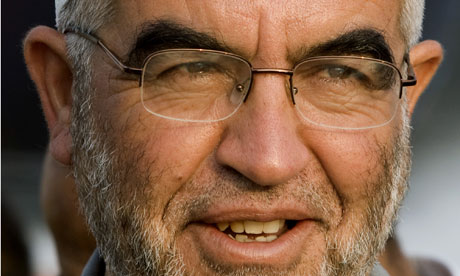
Britain accused of collaborating with Israel over Salah arrest

The Guardian reports:

Arab Israelis and Palestinians have accused the British government of collaborating with Israel in detaining Sheikh Raed Salah, the leader of the Islamic Movement in Israel.

Ibrahim Sarsur, a United Arab List member of the Knesset, the Israeli parliament, described the arrest of Salah as “strange”. He said: “Sheikh Salah is one of the leading figures in the Arab Israeli community. He travelled to the UK legitimately, and he had no knowledge of any ban on his entering the UK, so we are surprised and disappointed by this illegitimate procedure.”

Sarsur called on Britain to release Salah immediately. “We know that Israel is not happy with anyone that opposes its policies, but we see Britain as the most democratic place in the world and the birthplace of democracy. Britain should deal with delicate matters of the Middle East with delicacy and not act as a collaborator with the Israeli government.”

Ben White, a writer and activist who was due to speak at an event with Salah on Wednesday, said there was a stark contrast between how Britain treated Palestinian and Israeli leaders. “The same government that sent police to arrest a Palestinian civil society leader from his hotel bedroom is changing UK legislation explicitly to facilitate the entry of accused Israeli war criminals,” he said.

Facebooktwittermail

WikiLeaks: UK government ‘spying’ on Julian Assange during house arrest

In a video, titled “House Arrest”, and released by WikiLeaks, they claim that three cameras have been erected to watch who enters and leaves his temporary home.

The video, published today on Telegraph.co.uk, marks his six months on bail. It shows one of the cameras outside the entrance to Ellingham Hall, Norfolk.

Mr Assange has lived there for six months while he fights extradition to Sweden over allegations of sexual crimes, which he denies.

All of the cameras have been installed since Mr Assange moved there in mid-December.

On the video, Sarah Harrison, one of the WikiLeaks’ team, says: “This is one of the three cameras that is outside each entrance of the property.

“We suddenly noticed them appearing since we have been here. We believe they are monitoring everything that goes in and out of the property.”

Facebooktwittermail

UK training Saudi forces used to crush Arab spring

The Guardian reports:

Britain is training Saudi Arabia’s national guard – the elite security force deployed during the recent protests in Bahrain – in public order enforcement measures and the use of sniper rifles. The revelation has outraged human rights groups, which point out that the Foreign Office recognises that the kingdom’s human rights record is “a major concern”.

In response to questions made under the Freedom of Information Act, the Ministry of Defence has confirmed that British personnel regularly run courses for the national guard in “weapons, fieldcraft and general military skills training, as well as incident handling, bomb disposal, search, public order and sniper training”. The courses are organised through the British Military Mission to the Saudi Arabian National Guard, an obscure unit that consists of 11 British army personnel under the command of a brigadier.

The MoD response, obtained yesterday by the Observer, reveals that Britain sends up to 20 training teams to the kingdom a year. Saudi Arabia pays for “all BMM personnel, as well as support costs such as accommodation and transport”.

Bahrain’s royal family used 1,200 Saudi troops to help put down demonstrations in March. At the time the British government said it was “deeply concerned” about reports of human rights abuses being perpetrated by the troops.

Facebooktwittermail

War in Libya — mission under construction

Associated Press reports:

U.S. Defense Secretary Robert Gates said Sunday that the U.S. expects to turn control of the Libya military mission over to a coalition — probably headed either by the French and British or by NATO — “in a matter of days.”

In his first public remarks since the start of the bombings, Gates said President Barack Obama felt very strongly about limiting America’s role in the operation, adding that the president is “more aware than almost anybody of the stress on the military.”

“We agreed to use our unique capabilities and the breadth of those capabilities at the front of this process, and then we expected in a matter of days to be able to turn over the primary responsibility to others,” Gates told reporters traveling with him to Russia. “We will continue to support the coalition, we will be a member of the coalition, we will have a military role in the coalition, but we will not have the preeminent role.”

The two key possibilities, he said, are a combined British-French command or the use of a NATO command. He acknowledged there is “some sensitivity on the part of the Arab League to being seen to be operating under a NATO umbrella.”

The Guardian reports:

America, France and Britain – the leaders of the coalition’s air attacks on Libya – were struggling to maintain international support for their actions, as they faced stinging criticism about mission creep from the leader of the Arab League, as well as from China and Russia.

Critics claimed that the coalition of the willing may have been acting disproportionately and had come perilously close to making Gaddafi’s departure an explicit goal of UN policy.

Russia, which abstained on the UN vote last week, called for “an end to indiscriminate force”.

Despite denials from coalition forces, Alexander Lukashevich, Russia’s foreign ministry spokesman, said that the coalition had hit non-military targets.

He suggested that 48 civilians had been killed. “We believe a mandate given by the UN security council resolution – a controversial move in itself – should not be used to achieve goals outside its provisions, which only see measures necessary to protect civilian population,” he said.

The Arab League secretary general, Amr Moussa, also startled western governments when he denounced the air attacks only a week after the league had called for creation of a no-fly zone.

Moussa, who is a candidate for the Egyptian presidency, said: “What has happened in Libya differs from the goal of imposing a no-fly zone and what we want is the protection of civilians and not bombing other civilians.”

The Foreign Office later said Moussa claimed he had been misquoted, or had put his criticism more strongly in Arabic than in English. “We will continue to work with our Arab partners to enforce the resolution for the good of the Libyan people,” the FO said.

The Arab League had, though, been called to an emergency session to discuss the scale of the attacks.

The British defence secretary, Liam Fox, said the scale was in line with UN resolutions that had been “essential in terms of the Gaddafi regime’s ability to prosecute attacks on their own people”. He also said it was possible that Gaddafi himself could become a target of air attacks if the safety of civilians could be guaranteed.

Ahead of a Commons debate and vote tomorrow, leading figures in David Cameron’s cabinet were under pressure to clarify whether the explicit purpose of the attacks was to render Gaddafi’s regime so powerless that it collapses.

Speaking on the Politics Show, Fox said: “Mission accomplished would mean the Libyan people free to control their own destiny. This is very clear – the international community wants his regime to end and wants the Libyan people to control for themselves their own country.”

He then added: “Regime change is not an objective, but it may come about as a result of what is happening amongst the people of Libya.”

He said: “When the dynamic shifts and the equilibrium shifts, we will get a better idea just how much support the Gaddafi regime has and how much the people of Libya genuinely long to be able to control their own country.

“If Colonel Gaddafi went, not every eye would be wet.”

Fox said it was possible that allied forces might treat Gaddafi himself as a legitimate target for air strikes.

The New York Times reported:

Around 10 p.m. Sunday, a column of white smoke rose near Colonel Qaddafi’s compound in Tripoli, accompanied by a loud explosion, suggesting that either his residence or the barracks of his personal guard had become a target for the allied barrage. The compound already contains a damaged building known as the “House of Resistance” that was preserved along with a statue as a monument to a failed American bombing attack on the compound more than 20 years ago. The sounds of sirens and sporadic gunfire followed.

Asked about the explosion, Vice Adm. William Gortney told a news conference in Washington that the United States was not on a mission to kill the Libyan leader. “At this particular point, I can guarantee that he’s not on a targeting list,” he said. But he added: “If he happens to be in a place, if he’s inspecting a surface-to-air missile site, and we don’t have any idea if he’s there or not, then —” He was interrupted by another question, and then said, “No, we’re not targeting his residence.”

The key phrase being: “at this particular point…”

Meanwhile, Chris McGreal describes the fate of some of the first victims of allied attacks on Gaddafi’s forces near Benghazi:

The dozen or so men clustered behind the last smouldering tank looked as if they had died while they slept.

Their blankets bore no burn marks so perhaps it was the force of blasts – powerful enough to rip the turrets off the Russian-made tanks and toss them 20 metres or more across the open field near Benghazi – that killed Muammar Gaddafi’s soldiers.

The air attack came at 4am , after the tanks pulled back from a day-long assault on the rebel stronghold of Benghazi. The crews chose to rest in a field about 10 miles from the de facto capital of the anti-Gaddafi revolutionaries.

It must have seemed safe to the soldiers. The rebels were far away and the tank crews would have seen any threat approaching by road. They gathered to eat and sleep behind the tank furthest into the field.

But it was no protection from the threat in the sky. The tanks and their operators were sitting ducks in the open and probably never heard the planes. The French pilots did not even have to be concerned about the risk of harming civilians.

Within moments, three of the four tanks in the field were shells.

What was not immediately incinerated was mangled, thrown into the sky and dumped in bits on the earth. Machine guns twisted into grotesque shapes, broken engine parts and flattened shells lay among the wreckage.

Four hours later, two of the tanks were still smouldering. A flatbed lorry used to haul them to the edge of Benghazi was on fire. A handful of pickup trucks, one carrying tins of food for the troops, had been burned out. Scavengers were picking over the corpses of Gaddafi’s dead soldiers.

Wreckage was strewn in similar scenes along nearly 15 miles of road beyond Benghazi, the result of air strikes on targets across the country that turned the struggle between Gaddafi and Libya’s revolutionaries on its head in a moment.

The barrage of attacks led by France, Britain and the US on Libya’s army, air bases and other military targets drew threats of a prolonged war from Gaddafi himself. But on the ground many of his forces were in disarray and fleeing in fear of further attacks from a new and unseen enemy.

The air assault halted and then reversed the advances by Gaddafi’s army on Benghazi and other rebel-held towns. But the revolutionary leadership wanted more. On Sunday it appealed for an intensification of the air assault to destroy the Libyan ruler’s forces and open the way for the rebels to drive him from power.

Issandr El Amrani has a shot at looking further down the road and poses five questions few are asking about Libya:

Not to rain on anyone’s parade, but while I’m glad that the multinational intervention is giving cover to Libyan insurgents, I’m rather shocked at the desultory coverage of what might come out of the military intervention. A tragedy has been taking place in Libya, whose people deserve help, but that doesn’t mean not thinking through consequences. Here’s a shot at it:

1. UNSC Resolution 1973 isn’t really about getting a ceasefire, is it?

Not really. Even if Qadhafi were to produce a real ceasefire, which is unlikely, the rebels would not observe it: they would keep trying to topple the regime. This resolution, under the guise of obtaining a ceasefire, seeks to carry out regime change. It would get even more complicated as the Libyan government headed by Qadhafi remains legitimate under international law, and thus can be argued to have law enforcement duties to implement against armed insurgents. This resolution is not just about preventing a massacre of civilians, it’s about taking sides. The Qadhafi regime is over as far as the international community is concerned, and mission creep will ensure that things will swiftly move from imposing a no-fly zone to more direct efforts, including ground missions. This might be good for the insurgents, might split them, and might not be so good for the countries leading the intervention. Time will tell.

2. But what if Qadhafi hangs in there, and there’s a stalemate?

Well, prolonged civil war happens. But it’s not clear whether this is a likely outcome, particularly if there are such stringent sanctions and travel restrictions on regime officials. There could a “liberated zone” and a Qadhafi-controlled zone for a while, with ongoing skirmishes. Western and Arab supplies of weapons to the insurgents would likely increase (Egypt is already supplying them). Although the insurgents have insisted on a united Libya, the fact is that historically there is strong regionalism in the country. A split could perdure, backed by both the regime’s control through force and genuine tribal support in its favor. The international community could be moved to escalate the mission to make it officially regime change, or push other actors (some would like that to be Egypt) to intervene directly. Some openly advocate for Egypt to invade Libya. I liked the idea of regional powers acting as regional policemen, but no one has asked Egypt whether it wants that role. It also has to think about thousands of Egyptians the regime might hold hostage there.

Facebooktwittermail

Leaving Gaddafi a way out

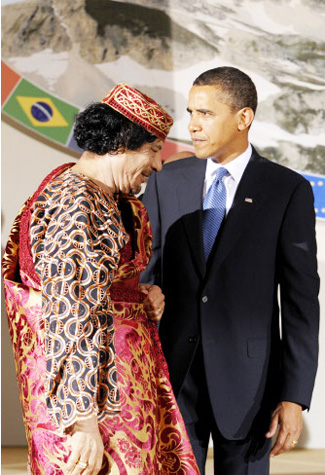
If Sarkozy, Cameron and Obama believe that Gaddafi’s demonization makes the war legitimate in the eyes of domestic audiences which might otherwise lack interest in the fate of Libya, the West will have needlessly restricted the range of acceptable outcomes to this war.
Even at this point, there should be some effort to open up as many exit methods possible both for the Libyan leader and those around him. If Gaddafi’s only options are to cling to power or be killed, he will without doubt fight to the finish. If he can be convinced he won’t win he also needs to be enticed by the credible possibility that there remains a way out — one that’s more appealing than facing trial in The Hague.

Gaddafi is too vain to be serious about martyrdom. I don’t believe he is ready to die, and if that is indeed the case then his desire to live should be seen as an advantage that his adversaries should exploit.

Simon Tisdall focuses on the implications of the expressions of personal animosity that the war’s Western leaders are directing at Muammar Gaddafi.

Now the missiles and B52s have begun their dreadful work, Gaddafi knows, if he didn’t already, that he’s in a fight to the finish – and for him, there may be no escape. His course of action in the coming days will be influenced by this realisation, and may be consequently more extreme and more aggressive than otherwise.

His defiant overnight statement, when he condemned the “crusader colonialism” afflicting his country, was clearly aimed at Arab and Muslim world opinion in particular, and the non-western world in general (major countries such as China, India, Brazil and Germany have not supported the intervention). Regime claims about mounting civilian deaths will play big there, Iraq-style. Gaddafi will press his propaganda advantage for all its worth.

The demonisation of Gaddafi has made it impossible for western leaders to countenance his continuation in power. But without the ground invasion they have pledged not to undertake, he could well survive as the overlord of western and southern Libya following a de facto partition, hostile, vengeful and highly dangerous.

This seems to be his plan. Far from giving up or drawing back, Gaddafi escalated the fighting around Benghazi at the weekend. Rather than abandon cities such as Zawiya, as Obama demanded, he is reportedly moving his troops into urban areas where they can less easily be targeted from the air. Meanwhile, his apparent willingness to use “human shields”, his threats of retaliation across the Mediterranean area, and his designation of the whole of north Africa as a “war zone” raises the spectre of possible terrorist attacks and an alarming regression to his old ways.

Gaddafi has personalised this war, too. And he is not going to go quietly. Military superiority in the air will count for nothing if pro-regime army and air force units, militia and security forces, and civilian and tribal supporters who have remained loyal refuse to turn on him or kick him out of Tripoli. By its determination to “get Gaddafi”, the west has made this a fight to the death – and death may be a long time in coming.

Chris McGreal reports:

Benghazi woke on Saturday morning to discover that its wild celebrations over the UN security council’s declaration and Gaddafi’s calling of a ceasefire on Friday were premature. Residents had imagined the city was saved by the west’s threat of air strikes unless Gaddafi halted his attacks on Libya’s rebellious towns.

But at dawn the dictator’s army was fighting its way into the country’s second-largest city of about 700,000 people using rockets and tanks.

As the shells fell, rattling nerves and buildings, a single question emerged time and again. On occasions it was delivered as a baffled plea by middle-aged men gathered on Benghazi’s seafront as they anxiously awaited the latest word on the fighting. At other times, the question was shouted in anger by young men manning the barricades and facing the threatened onslaught with Kalashnikovs and petrol bombs.

“Where are the air strikes? Why is the west waiting until it is too late?” asked Khalid el-Samad, a 27-year-old chemical engineer, who shook his finger in fury. “Sarkozy said it. Obama said it. Gaddafi must stop. So why do they do nothing? Is it just talk while we die?”

Benghazi reeled in shock as the rebels initially fell back and then fought hard to contain the assault while artillery fire rocked parts of the city for much of the day.

Dozens of people were killed, among them the civilians the UN resolution was pledged to protect, and hospitals treated an even larger number wounded. As the fighting intensified, thousands fled east towards the Egyptian border in cars, pick-up trucks and buses crammed with people and what was most precious or essential – bedding and cooking pots.

Alongside the angry questions over the lack of air strikes was bafflement that the western powers had apparently been duped into believing Gaddafi’s false promise of a ceasefire that bought him time to launch the assault on Benghazi by delaying military action French officials had suggested was imminent.

“In 42 years we learned never to trust Gaddafi,” said Hassan Khalafa, an accountant carrying a Kalashnikov at a checkpoint near the former court that serves as the revolutionary government’s headquarters. “He always lies. The only time he told the truth is when he said he will kill all of us in Benghazi. France and America and the UN have been fooled by him.”

As dusk settled, Gaddafi’s gamble appeared to have failed. In the face of rebel resistance, his army pulled back only to be hit a few hours later by the air strikes. But by then, it was clear that the people of Benghazi will not feel safe until the man who has controlled their country for 42 years is overthrown.

Gaddafi’s prophetic declaration? “All tryants fall under the feet of the people.”

Facebooktwittermail

Arabs say Gaddafi must go, wary of Western action

Reuters reports:

Muammar Gaddafi’s appeal for Arab solidarity in the face of foreign air strikes fell on deaf ears across the Middle East on Sunday, but support for his opponents was mixed with deep suspicion of Western motives.

Western forces have unleashed their biggest military attack in the Arab world since the 2003 U.S. invasion of Iraq, targeting Gaddafi’s air defences and armoured vehicles near the rebel stronghold of Benghazi in the east of the country.

A few hours after the first missiles struck, Gaddafi called on “citizens of the Arab and Islamic nations” and other developing countries to “stand by the heroic Libyan people to confront this aggression”.

But Arabs from North Africa to the Gulf, many demanding political rights for the first time, dismissed the appeal from a leader whose four decades of authoritarian and capricious rule have exhausted any reserves of sympathy.

“It is now clear and understandable that Arab people want to get rid of their leaders, so leaders should simply leave and not fight their people and force foreign nations to interfere,” said Mohamed Abdel Motaleb, a bank employee in Cairo, where mass protests toppled veteran president Hosni Mubarak last month.

“I am very much against foreign troops fighting in Libya, but Arab leaders should not let that happen through their stubbornness and refusal to quit power”.

A Libyan government official said 64 people died in the Western air strikes and the head of the Arab League, which supported Libyan no-fly zone, said the organisation had not endorsed attacks on ordinary Libyans.

“What is happening in Libya differs from the aim of imposing a no-fly zone, and what we want is the protection of civilians and not the bombardment of more civilians,” Amr Moussa said, announcing an emergency Arab League meeting to discuss Libya.

The overthrow of Mubarak in Egypt and Tunisia’s Zine al Abidine bin Ali — as well as mass protests against leaders in Yemen and Bahrain — have restored a dormant Arab pride which was crushed by decades of autocracy and foreign intervention.

But many people in the Arab world, while anxious to see the end of Gaddafi’s rule, felt that the resort to Western military action has tarnished Libya’s revolution.

“Who will accept that foreign countries attack an Arab country? This is something shameful,” said Yemeni rights activist Bashir Othman.

OIL OR DEMOCRACY?

Support for military action was also muted by deep-seated suspicions that the West is more concerned with securing access to Arab oil supplies than supporting Arab aspirations.

“They are hitting Libya because of the oil, not to protect the Libyans,” said Ali al-Jassem, 53, in the village of Sitra in Bahrain, where protests by the Shi’ite Muslim majority against the Sunni ruling Al-Khalifa family have triggered military reinforcement by neighbouring Gulf Arab forces.

A spokesman for Bahrain’s largest Shi’ite opposition party Wefaq questioned why the West was intervening against Gaddafi while it allowed oil-producing allies to support a crackdown on protesters in Bahrain in which 11 people have been killed.

“We think what is happening in Bahrain is no different to what was happening in Libya,” Ibrahim Mattar said. “Bahrain is very small so the deaths are significant for a country where Bahrainis are only 600,000.”

In Iraq, where U.S.-led forces invaded eight years ago to topple Saddam Hussein, opposition to Gaddafi was tempered by the years of violence which Iraq endured after Saddam’s downfall, as well as anger at perceived double standards.

“Bombing Gaddafi’s forces is a step in the right direction but turning blind eyes to the slaughter of innocent protesters in Bahrain is a step in the wrong direction,” said Amir Ahmed, owner of a home appliance shop in Baghdad’s Karrada district.

The leader of Lebanon’s Shi’ite group Hezbollah, Sayyed Hassan Nasrallah, said many people had spelt out their support for the protests in Egypt and Libya, “but when Bahrain is involved… their ink dries up”.

“What is the difference between the Al-Khalifa regime and the regimes of (Hosni) Mubarak and Gaddafi?” he said in a televised speech on Saturday night.

But criticism of the West has not translated into support for Gaddafi, who has bemused or infuriated leaders across the Arab world during his four decades in power.

Facebooktwittermail

The fight for Libya

The Los Angeles Times reports:

With his popularity at a record low and facing an election next year, French President Nicolas Sarkozy was in desperate need of a boost to his political stature.

And on Saturday, he got it.

The French leader, once dubbed Super Sarko by the local press for his eagerness to take the reins in global crises, summoned leaders from four continents to an emergency war council at the Elysee presidential palace in Paris to agree on military action against strongman Moammar Kadafi in Libya.

His 20 guests had barely reached an agreement when Sarkozy announced that French planes were already in the air preparing to strike.

With almost theatrical gravitas, Sarkozy said France had “decided to assume its role, its role before history” in stopping Kadafi’s “killing spree” against people whose only crime was to seek to “liberate themselves from servitude.”

Barely more than three years ago, Sarkozy gave Kadafi the red carpet treatment in Paris, welcoming him with open arms and allowing the Libyan leader to pitch a Bedouin tent near the Elysee. Now the French president was announcing that he was sending warplanes in to bomb him.

Beside Sarkozy was British Prime Minister David Cameron, France’s partner in the military offensive, talking tough but overshadowed by his Gallic counterpart.

The Guardian reports:

In Britain, the question Cameron was asked in the Commons after his statement on Friday was an understandable one: is the UK capable of such a military endeavour? The prime minister – speaking coincidentally eight years to the day since Tony Blair asked parliament for its backing for the invasion of Iraq – was in no doubt that the country was in good shape for the campaign, and he reminded MPs that the UK was still the world’s fourth-biggest spender on defence.

Indeed, it is arguable that one of the figures vindicated by events over the past 48 hours was Liam Fox. The defence secretary has overseen a sometimes brutal, relatively successful, campaign to lessen the size of the cuts to trim the Ministry of Defence’s £36bn of debt, arguing that Britain needs to retain its capability to strike quickly and decisively in an increasingly unpredictable world.

Libya, in more ways that one, has bolstered his cause. Only on Thursday – hours before the no-fly zone was approved by the UN – a confident-sounding Fox was promising defence unions that he would still find ways to reduce the fallout of last year’s strategic defence and security review, by promising to save thousands of threatened civilian jobs. Yet, just a fortnight earlier, he had kicked off the month by confirming that more than a 1,000 jobs would be axed from the RAF by September, with almost 1,700 to follow. Speculation clouded the future of the Tornado GR4 strike aircraft with reports that the squadron at RAF Lossiemouth would be axed.

Libya, Fox might believe, would put a stop to such reports, reaffirming the need for a varied and sizeable air force. The Tornado, after all, has excelled in battle and is likely to be the first British assets used against Gaddafi.

Foreign Policy reports:

As the U.N. Security Council voted the evening of March 17 to impose a no-fly zone over Libya, the international media broadcast the joyous reaction from the streets of Benghazi, the de facto capital of the Libyan opposition. Thousands of Libyans celebrated in the streets, waving the old Libyan flag that has become the revolution’s standard and firing guns happily into the air. A spokeswoman for the Libyan opposition said that the revolutionaries were “embracing each other” over the U.N. decision.

But until recently, Benghazi’s attitude toward outside intervention was different. The rebels’ attitude toward the role of the international community evolved as Col. Muammar al-Qaddafi’s forces advanced aggressively over the past week, threatening to use their superior firepower to quash the poorly armed rebellion.

Only two weeks ago, professionally designed posters were plastered on billboards around Benghazi’s elegant palm tree-lined streets reading: “No foreign intervention. Libyan people can do it alone.” Men and women in the city reacted defiantly to suggestions they needed outside support. Qaddafi had already tried to pin the uprising on al Qaeda — they wanted change to come exclusively from a homegrown movement free from allegations of outside influence.

Views quickly changed as Qaddafi’s military continued to advance across the country’s east. Even as the Security Council met to announce its decision, Qaddafi’s forces were shelling Ajdabiya, the last town on their march toward Benghazi. In a radio address, Qaddafi — perhaps in a show of propaganda — vowed that his forces would reach Benghazi that night, and that they would “show no mercy and no pity” to the rebels.

The New York Times reports:

In a Paris hotel room on Monday night, Secretary of State Hillary Rodham Clinton found herself juggling the inconsistencies of American foreign policy in a turbulent Middle East. She criticized the foreign minister of the United Arab Emirates for sending troops to quash protests in Bahrain even as she pressed him to send planes to intervene in Libya.

Only the day before, Mrs. Clinton — along with her boss, President Obama — was a skeptic on whether the United States should take military action in Libya. But that night, with Col. Muammar el-Qaddafi’s forces turning back the rebellion that threatened his rule, Mrs. Clinton changed course, forming an unlikely alliance with a handful of top administration aides who had been arguing for intervention.

Within hours, Mrs. Clinton and the aides had convinced Mr. Obama that the United States had to act, and the president ordered up military plans, which Adm. Mike Mullen, chairman of the Joint Chiefs of Staff, hand-delivered to the White House the next day. On Thursday, during an hour-and-a -half meeting, Mr. Obama signed off on allowing American pilots to join Europeans and Arabs in military strikes against the Libyan government.

The president had a caveat, though. The American involvement in military action in Libya should be limited — no ground troops — and finite. “Days, not weeks,” a senior White House official recalled him saying.

Facebooktwittermail

This is war, not revolution

The #Libyan people are no longer protesting, we’re simply trying to survive. This is war, not revolution. #Gaddafi changed the game. @Libyan4life

CNN reports:

At least 15 people have been killed and 200 more wounded in the Libyan city of Zawiya, an eyewitness told CNN.

Wounded people started arriving at the hospital Friday morning. Most of the injuries resulted from gunshots, and many of the injuries were to the head and chest.

The eyewitness said the hospital is running out of medical supplies.

“There is a river of blood here in the hospital. The situation is very bad,” he said.

The Washington Post reports:

Forces loyal to Libyan leader Moammar Gaddafi unleashed their fiercest counterattack yet against the opposition on Friday, assaulting rebel-held positions by ground and air and firing on demonstrators in the government stronghold of Tripoli.

The lethal force of the government offensive – including what rebels described as a “bloodbath” in the strategic western port city of Zawiyah – raised the stakes for Washington and its western allies. They have threatened military intervention should the Gaddafi government cross red lines including the systematic endangerment of defenseless civilians or if the battle for Libya evolved into a long-term, bloody stalemate.

Yet if anything, the events Friday underscored Gaddafi’s ability to press defiantly ahead with a brutal campaign to reclaim land already lost to the rebels and squelch dissent within bastions of government control. The government appeared to be attempting to secure a buffer zone around Tripoli and target areas vital to the country’s oil industry, taking aim at cities and ports that have given the rebels a foothold close to the capital.

The White House expressed renewed alarm, saying that President Obama is “appalled by the use of force against unarmed, peaceful civilians.” Obama is being briefed on Libya three times a day, and “we’re not taking any options off the table,” said Jay Carney, the White House press secretary.

With thousands of refugees stuck on the Tunisian border with Libya, the U.S. Air Force flew in humanitarian supplies for them Friday aboard two C-130 cargo planes and planned to return Saturday to pick up Egyptian refugees and fly them home.

The fiercest attack on Friday fell on the opposition-held city of Zawiyah, home to one of Libya’s largest oil refineries and situated just 27 miles west of Tripoli. Official Libyan media claimed the government had retaken the city, though the rebels there denied it. As of late Friday, however, the city remained under siege.

“We are still in the square,” said Mohamed Magid, an opposition spokesman. “Zawiyah has not fallen.”

Gaddafi loyalists armed with tanks and heavy machine guns and reportedly led by his son, Khamis Gaddafi, launched an offensive around midday, rebels said. Forces loyal to Gaddafi entered the city from several directions, using tanks, SUVs and trucks armed with heavy machine guns, witnesses said. They also laid siege to the city with mortar fire.

Though details were impossible to verify, witnesses in Zawiyah said at least 15 people were killed and 200 wounded, with a senior rebel leader reported to be among the dead. Some reports put the death toll as high as 50.

The Cable reports:

Libyan Ambassador to the United States Ali Aujali, who joined the opposition in the early days of the crisis, issued an urgent plea for the United States to take more aggressive actions against the Libyan government in an interview with Foreign Policy today.

Aujali strongly supported the implementation of a no-fly zone over Libya, calling it “a historic responsibility for the United States.” He also criticized the arguments about the risks of no-fly zone, which have been made by U.S. Defense Secretary Robert Gates and other military officials. “When we say, for example, that the no-fly zone will take a long time, that it is complicated — please don’t give this regime any time to crush the Libyan people,” he said.

The ambassador, who began his diplomatic career four decades ago, raised the flag of the Libyan opposition over the ambassador’s residence in Washington after resigning last week. He told Foreign Policy that he decided to resign following Saif al-Qaddafi’s speech on Feb. 21, in which Qaddafi’s favored son warned protesters of “rivers of blood” if they did not cease their demonstrations.

Aujali warned that further delay in organizing an international response raised the risk that Qaddafi would be able to reconstitute his strength. “Time means losing lives, time means that Qaddafi will regain control,” he said. “He has weapons, he has rockets with about 450 kilometers’ distance, and we have to protect the people. These mercenaries now are everywhere.”

The Guardian reports:

Britain is to send a team of experts capable of giving military advice into eastern Libya to make contact with opposition leaders as the struggle for control of the country escalates.

The move is a clear intervention on the ground to bolster the anti-Gaddafi uprising, learn more about its leadership, and see what logistical support it needs. Whitehall sources said the diplomatic taskforce would not be providing arms to the rebels, as there is an international arms embargo.

It came as Libya’s deputy foreign minister, Khaled Kaim, said that Tripoli had accepted a peace initiative put forward by Venezuela’s president Hugo Chávez, which was heavily criticised by the White House. Kaim said it stated that a committee would be formed by African, Asian and Latin American countries “to help the international dialogue and to help the restoration of peace and stability”.

Interpol issued a global alert against Muammar Gaddafi and 15 other Libyans, including his daughter and seven sons, in an effort to enforce sanctions.

Facebooktwittermail

Britain’s role in arming Gaddafi

Associated Press reports:

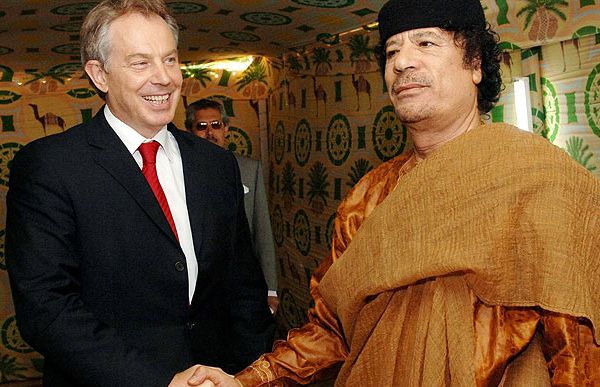
When Moammar Gadhafi told the world he was a changed man, some leaders were skeptical. Others, like Britain’s Tony Blair, were quicker to see the benefits of rapprochement with the oil-rich nation.

Now, as Gadhafi’s regime crumbles, questions are being raised about whether Britain, the United States, and others were too quick to embrace a volatile despot linked to terrorism and oppression as they sought lucrative business deals.

Those deals worth billions are now in jeopardy as Libya hurtles toward civil war. The strategic decision to build ties with the likes of Gadhafi, Egypt’s Hosni Mubarak, and Tunisia’s Ben Ali also threatens to further inflame anti-Western anger in the Arab world.

Blair’s role was particularly vital in Gadhafi’s international rehabilitation.

The former British prime minister flew to Libya in 2004, holding talks with Gadhafi inside a Bedouin tent. He praised the leader for ending Libya’s nuclear and chemical weapons program and stressed the need for new security alliances in the wake of the Sept. 11 terror attacks. British commercial deals soon followed.

Britain sold Libya about 40 million pounds ($55 million) worth of military and paramilitary equipment in the year ending Sept. 30, 2010, according to Foreign Office statistics. Among the items: sniper rifles, bulletproof vehicles, crowd control ammunition, and tear gas.

“What did the Foreign Office think Colonel Gadhafi meant to do with sniper rifles and tear gas grenades — go mole hunting?” asked Britain’s Guardian newspaper.

Although Britain’s current government led by David Cameron has revoked dozens of export licenses to Libya in the wake of the Libyan violence, many say the very weapons and equipment Britain has sold to Libya are being used against the country’s people.

Britain’s elite Special Air Service, or SAS, also participated in recent training for Libyan soldiers in counterterrorism and surveillance. Robin Horsfall, a former SAS soldier, said at the time that the training was a mistake: “People will die as a result of this decision,” he warned.

In September 2009, the Daily Telegraph reported:

Members of Britain’s elite regiment are angry at having to help train soldiers from a country that for years armed terrorists they fought against.

An SAS source said: “A small SAS training team have been doing it for the last six months as part of this cosy deal with the Libyans.

“From our perspective we cannot see it as part of anything else other than the Megrahi deal.” Another SAS soldier said: “The IRA was our greatest adversary now we are training their backers. There was a weary rolling of the eyes when we were told about this.”

The Ministry of Defence refuses to comment on special forces activities, but sources have admitted that SAS reserves have bolstered the team that has been training “Libyan infantry in basic skills”.

A senior defence source admitted: “This is a huge political embarrassment.’’

The first moves towards setting up the training agreement are believed to have begun after Tony Blair visited
Libya as Prime Minister in 2004. However, the deal was only finalised and “signed off” by Mr Brown earlier this year.

Robin Horsfall, a former SAS soldier who took part in the Iranian Embassy siege in 1980 and fought the IRA in Northern Ireland, said:

“There is a long list of British soldiers who have died because of Gaddafi funding terrorists.

“The SAS is being ordered to do something it knows is morally wrong.”

Facebooktwittermail

Julian Assange loses extradition battle

The Guardian reports:

The WikiLeaks founder Julian Assange is to be extradited to Sweden to face allegations of rape and sexual assault. Assange will appeal, his legal team has confirmed. If they lose he will be sent to Sweden in 10 days.

Speaking outside Belmarsh magistrates court in south-east London after the judgment, Assange attacked the European arrest warrant system.

He dismissed the decision to extradite him as a “rubber-stamping process”. He said: “It comes as no surprise but is nevertheless wrong. It comes as the result of a European arrest warrant system amok.”

There had been no consideration of the allegations against him, Assange said. His extradition would thrust him into a legal system he did not understand using a language he did not speak.

Assange said the US government by its own admission had been waiting to see the British court verdict before determining what action it could take against him.

Glenn Greenwald on the Assange extradition ruling, the jailing of Bradley Manning, and the campaign to target WikiLeaks supporters

Facebooktwittermail

Arming democracy’s opponents

The Daily Telegraph reports:

Facing budget cuts at home, western arms firms are desperate for a share of the lucrative Middle East market. “The post-financial crisis reality,” said Herve Guillou, president of Cassidian Systems, a subsidiary of European aviation defence group EADS, “is that today it is clearly the Middle East that is seeing the biggest growth.” Iran’s growing military power has pushed Gulf states into their largest-ever military build up, making purchases worth £76 billion from the US alone in 2010. The largest acquisitions were made by Saudi Arabia, which is spending £41 billion on F-15 fighter jets and upgrades for its naval fleet.

The six Gulf Cooperation Council countries – Saudi Arabia, Bahrain, UAE, Oman, Qatar, Kuwait – along with Jordan will spend another £41 billion on defence in 2011, according to Frost and Sullivan, a research firm.

Libya and Egypt are among the states which have representatives at IDEX [the International Defence Exhibition and Conference in Abu Dhabi]. Global Industrial and Defence Solutions, a Pakistani exhibitor, lists Libya as being among the “key customers of our products.” Renault also issued a press release before the exhibition, saying it had contracted to supply military trucks to Egypt. Libya’s al-Musallah magazine, which covers arms-trade related issues in the country, is also among the exhibitors.

Simon Jenkins writes:

I must be missing something. The present British government, like its predecessor, claims to pursue a policy of “liberal interventionism”, seeking the downfall of undemocratic regimes round the globe, notably in the Muslim world. The same British government, again like its predecessor, sends these undemocratic regimes copious weapons to suppress the only plausible means of the said downfall, popular insurrection. The contradiction is glaring.

Downing Street is clearly embarrassed by Egypt, Bahrain and Libya having had the impertinence to rebel just as David Cameron was embarking on an important arms-sales trip to the Gulf, not an area much addicted to democracy. Fifty British arms makers were present at last year’s sickening Libyan arms fair, while the resulting weapons are reportedly prominent in gunning down this week’s rioters. Cameron reads from the Foreign Office script, claiming that all guns, tanks, armoured vehicles, stun grenades, tear gas and riot-control equipment are “covered by assurances that they would not be used in human rights repression”. He must know this is absurd.

What did the FO think Colonel Gaddafi meant to do with sniper rifles and tear-gas grenades – go mole hunting? Britain has tried to cover its publicity flank by “revoking 52 export licences” to Bahrain and Libya for weapons used against demonstrators, in effect admitting its guilt. This merely locks the moral stable after the horse has fled, while also being a poor advertisement for British after-sales service. What is the point of selling someone a gun and telling him not to use it?

Gaddafi turns US and British guns on his own people

Facebooktwittermail

Britain’s role in Bahrain’s torture regime

Colonel Ian Henderson, who from 1966 until 1998 was Bahrain’s security chief, is alleged to have instituted and overseen a brutal torture regime in the Gulf state, as a result of which he came to be known as the “Butcher of Bahrain.” Numerous human rights organizations have investigated and confirmed the allegations against him, yet an investigation by British police was suspended in 2008 due to a lack of co-operation from the Bahrain government.

“Ian Henderson has played a very dirty role,” said Saeed Shehabi, Bahrain Freedom Movement, in 2002. “Ever since he came to Bahrain in 1966, he embarked upon an era of terror and thousands of people were arrested — arbitrarily arrested — and tortured under his command. Until he retired, two or three years ago, he was the strong man behind the whole repressive regime in Bahrain.”

Blind Eye to the Butcher (2002)

In a report on Bahrain’s reliance on foreign nationals in its security services, Ian Black adds:

Bahrainis often complain that the riot police and special forces do not speak the local dialect, or in the case of Baluchis from Pakistan, do not speak Arabic at all and are reviled as mercenaries. Officers are typically Bahrainis, Syrians or Jordanians. Iraqi Ba’athists who served in Saddam Hussein’s security forces were recruited after the US-led invasion in 2003. Only the police employs Bahraini Shias.

The secret police – the Bahrain national security agency, known in Arabic as the Mukhabarat – has undergone a process of “Bahrainisation” in recent years after being dominated by the British until long after independence in 1971. Ian Henderson, who retired as its director in 1998, is still remembered as the “Butcher of Bahrain” because of his alleged use of torture. A Jordanian official is currently described as the organisation’s “master torturer”.

Channel 4 report on human rights abuses in Bahrain (1999)

Facebooktwittermail