George Monbiot writes: ‘When I give food to the poor, they call me a saint. When I ask why they are poor, they call me a communist.” So said the Brazilian archbishop Dom Hélder Câmara. His adage exposes one of the great fissures in the Catholic church, and the emptiness of the new pope’s claim to be on the side of the poor.
The bravest people I have met are all Catholic priests. Working in West Papua and then in Brazil, I met men who were prepared repeatedly to risk death for the sake of others. When I first knocked on the door of the friary in Bacabal, in the Brazilian state of Maranhão, the priest who opened it thought I had been sent to kill him. That morning he had received the latest in a series of death threats from the local ranchers’ union. Yet still he opened the door.
Inside the friary was a group of peasants – some crying and trembling – whose bodies were covered in bruises made by rifle butts, and whose wrists bore the marks of rope burns. They were among thousands of people the priests were trying to protect, as expansionist landlords – supported by police, local politicians and a corrupt judiciary – burned their houses, drove them off their land, and tortured or killed those who resisted.
I learned something of the fear in which the priests lived when I was beaten and nearly shot by the military police. But unlike them, I could move on. They stayed to defend people whose struggles to keep their land were often a matter of life or death: expulsion meant malnutrition, disease and murder in the slums or the goldmines.
The priests belonged to a movement that had swept across Latin America, after the publication of A Theology of Liberation by Gustavo Gutiérrez in 1971. Liberation theologists not only put themselves between the poor and the killers, they also mobilised their flocks to resist dispossession, learn their rights and see their struggle as part of a long history of resistance, beginning with the flight of the Israelites from Egypt.
By the time I joined them, in 1989, seven Brazilian priests had been murdered; many others across the continent had been arrested, tortured and killed; Óscar Romero, the archbishop of San Salvador, had been shot dead. But dictators, landlords, police and gunmen were not their only enemies. Seven years after I first worked in Bacabal, I returned and met the priest who had opened the door. He couldn’t talk to me. He had been silenced, as part of the church’s great purge of dissenting voices. The lions of God were led by donkeys. The peasants had lost their protection. [Continue reading…]
Beer, mushrooms, and civilization

Lascaux Paleolithic cave paintings, estimated to be 17,300 years old.
The psychiatrist, Jeffrey P. Kahn, suggests that the flowering of civilization may have been fueled by the creation of beer, a practice that could have evolved as early as 10,000 years ago providing occasional relief from the constraints of social conformity.
Once the effects of these early brews were discovered, the value of beer (as well as wine and other fermented potions) must have become immediately apparent. With the help of the new psychopharmacological brew, humans could quell the angst of defying those herd instincts. Conversations around the campfire, no doubt, took on a new dimension: the painfully shy, their angst suddenly quelled, could now speak their minds.
But the alcohol would have had more far-ranging effects, too, reducing the strong herd instincts to maintain a rigid social structure. In time, humans became more expansive in their thinking, as well as more collaborative and creative. A night of modest tippling may have ushered in these feelings of freedom — though, the morning after, instincts to conform and submit would have kicked back in to restore the social order.
I don’t find this a particularly persuasive line of speculation. It seems much more likely that beer served a role in sustaining the social order rather than freeing the imagination.
Records from 5,000 years ago show that enslaved farm laborers were being provided by their masters with a staple diet of barley gruel and weak beer — provisions barely sufficient to prevent starvation. The beer — not unlike the most popular watery brews of today — seems like it might have served more as a tool of pacification than a liberator of creativity. Indeed, if the advent of civilization opened up new avenues for exploring the human spirit for a newly emerging creative class, it simultaneously created the need for a new class of workers who would obediently follow directions without plotting insurrections.
Knowledge about botanical tools for expanding consciousness most likely long preceded civilization. On several continents evidence of the use of hallucinogenic mushrooms can be found in rock art and rock art itself appears to go back as far as 40,000 years. Whatever social, ritual, or religious function such art may have performed it appears to express the kind of creative exuberance suggesting that for these primeval artists the creative act was an end in itself. And whether that creativity was unleashed by hallucinogens is perhaps besides the point. Clearly, human beings required neither civilization nor beer in order to become creative.
Civilization is celebrated because among other things it led to the creation of writing, yet in terms of creativity the transition from rock art to writing was regressive. The former served in enabling a magical transmutation: the ephemeral, intangible stuff of imagination was turned into physical form. Writing, on the other hand, initially served as a tool for exploitation. It allowed claims of ownership and laws to be set in stone. Its function at the beginning of civilization was to shackle the imagination and codify authority.
If beer was essential for pacifying slaves, it may also have functioned in defining a boundary that legitimized alcohol while prohibiting hallucinogens. Just as the U.S. army demonstrated when experimenting with the use of LSD in chemical warfare, the potential such drugs have for undermining conventions of social order suggest they would commonly be perceived as a threat to civilization.
If beer was civilizing this might say less about the socially liberating effect of alcohol than it says about the need for social elites to limit the ambitions of those upon whose labor they depend. A central nervous system depressant could be employed as a way to release slaves from their leg irons by shackling their brains.
This site needs your support
![]()
“If you are seriously interested in international politics, especially the Middle East, War in Context is one of the best sites on the web. Not only does it say smart things about war on a daily basis, but it also deals extensively with the broader political context in which war takes place. In that sense, Paul Woodward is a Clausewitzian at heart. He is also tough-minded, smart, and goes where the evidence takes him. The end result is first-rate analysis on the key issues of the day, something that is increasingly difficult to find in the mainstream media. It is for good reason that I make sure to read War in Context every day.”
— John Mearsheimer, Professor of Political Science, University of Chicago, co-author of The Israel Lobby and U.S. Foreign Policy.
![]()
As an independent news editor and commentator, I use my own judgment. I don’t bow to anyone — not to governments, or political parties, or corporations, or the mainstream media, or advertisers, or think tanks, or academia, or popular opinion, or ideology, or the blogosphere, or social media, or even my own readership.
If you value this kind of liberated journalism, please support this site and make a donation. Thank you — Paul Woodward
Click the button above to make a secure donation via PayPal.
If you would prefer to make a donation by check, please contact me using the contact form or directly by email to: editor[at]warincontext.org and I will send you my mailing address.
![]()
Jaron Lanier asks whether we have given up too much power to the big digital corporations
The Guardian: Jaron Lanier, groundbreaking computer scientist and infectious optimist, is concerned that we are not making the most of ourselves. In Who Owns the Future? he tellingly questions the trajectory of economic value in the information age, and argues that there has been a fundamental misstep in how capitalism has gone digital. For Lanier, late capitalism is not so much exhausted as humiliating: in an automated world, information is more important to the economy than manual labour, and yet we are expected to surrender information generated by or about ourselves – a valuable resource – for free.
Information here is a broad term for any conscious intellectual, artistic, or pragmatic contribution to the production of goods, services and cultural output, but it also includes the data that we unconsciously radiate simply by exhibiting certain behavioural and consumer traits. Lanier’s project is to foresee how livelihoods might be better sustained in a world in which information is king.
In his view, disproportionate economic power now accumulates around companies who “own the fastest computers with the most access to everyone’s information”. We donate extremely lucrative information – our interests, demographic predilections, buying habits, cyber-movements – in exchange for “free” admission into social media networks. (Digitisation has also allowed banks to repackage the “information” of a mortgage debt and sell it on as increasingly complex financial products, while excluding the indebted home-owner from a percentage of the profits.) Lanier argues that the early internet years have fetishised open access and knowledge-sharing in a way that has distracted people from demanding fairness and job security in an economy predicated on data flow. [Continue reading…]
Music: Ali Farka Toure & Toumani Diabate — ‘Ai Ga Bani!’
Subscribe by email
![]()
Stay up to date with War in Context: subscribe by email.
Once a day you will receive an email summary including links to all the posts from the previous 24 hours. I will never share or sell your email address. Give it a try!
After signing up, look out for a confirmation email with the subject line: “War in Context – please activate your email subscription” — it could show up in your spam folder. Your subscription will not start until you have responded to this confirmation.
![]()
The Free Syrian Army does exist and is growing stronger by the day
Koert Debeuf writes: When I read the piece of Aron Lund, ‘the FSA doesn’t exist’, I was utterly surprised. Of course the FSA does exist. And it is changing rapidly.Over the last few months, the FSA has transformed itself from a loose structure into a functioning organization. In fact, what Lund describes is an era of the FSA that no longer exists. It ignores the developments of the last several months and the present reality on the ground.
Last month, I visited Northern Syria three times with the Free Syrian Army (FSA). I spoke to many generals who had defected from the Syrian Army, to commanders on the ground,to people in the headquarters of the FSA and to military-civilian organizers of humanitarian aid of all parts of Syria. I also spent many hours with Dr. Brigadier General Salim Idriss, Chief of Staff of the FSA; I was in the middle of a battle at Quweris airport, then one of the main front lines.
Many points Lund is making, were correct three months ago. But not now. Col. Riaad Assad for example is completely out of the picture, whatever he himself might say. Another example is Qasem Saadeddin. He did indeed try to create some unity in Homs and had difficulties in doing so. But that too is history. Today he is a Commander of one of the five fronts under the umbrella of the FSA and he is working very closely with Chief of Staff Salim Idriss. It is also not true that Idriss would not use the ‘brand’ FSA. One example is the fact that he recently started his own twitter and Facebook account as well as one for the headquarters, using @FSAHQ. [Continue reading…]
Beneath Debeuf’s post is a response by Lund.
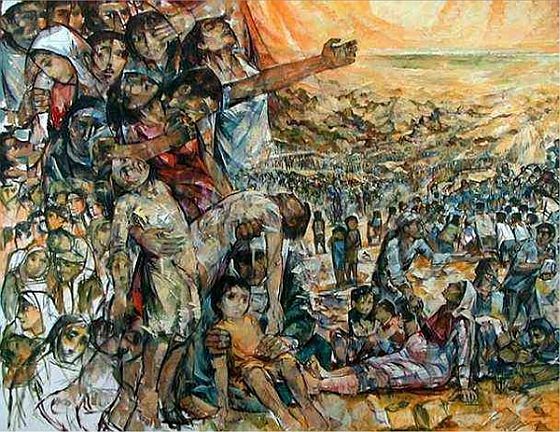
Mr. President, don’t forget the Nakba

The Road to Nowhere by Ismail Shammout
Yousef Munayyer writes: Tomorrow, Air Force One will land in my hometown. Lydda, a historic Palestinian city, is where the airport is (not Tel Aviv). Just like the Palestinians, the airport was there before the state of Israel. It was only named after Israel’s first Prime Minister, David Ben Gurion, in 1973.
Unbeknownst to most observers, President Barack Obama is actually traveling to the region on the anniversary of a pivotal day in the history of Palestine. Sixty-five years ago, in a township called Lake Success, NY, a chain of events would be set into motion that would lead to disaster for Palestinians.
Lake Success, a township on Long Island, was home to the United Nations long before it moved to its iconic eastside headquarters. There, on March 19, 1948, ambassadors and delegates were gathered to discuss the implementation of the 1947 Partition plan for Palestine. The British mandate was drawing to a close within weeks. Many people know that the U.N. passed a general assembly resolution in favor of partitioning Palestine in November 1947. Few people know, however, that on this day, the United States — which had originally voted for partition — withdrew its support for the plan and favored instead something closer to a one-state outcome.
For the Zionists, this was a blow to their political scheme. They had worked on their colonial project for decades, and now after a partition plan had been announced and just as the British Mandatory forces were beginning to withdraw, the United States, the most important player on the international scene after WWII, was backing out. The Zionists were so close to establishing their goal only to see it stymied by diplomats in New York.
There was another plan, of course. It was called Plan Dalet. The military plan for the conquest of Palestine was adopted by the Zionists days earlier. Ben Gurion, in response to America’s withdrawal of support for partition, was defiant. He declared that “the tactical establishment of the Jewish state depends on Jewish strength. It is by our power, mobilized to the utmost, that the state will arise.”
If the international community wasn’t going to give the Zionists a state of their own in Palestine at the expense of the natives, the Zionists were determined to take it by force. [Continue reading…]
The shame of America’s gulag
Chris Hedges writes: If, as Fyodor Dostoevsky wrote, “the degree of civilization in a society can be judged by entering its prisons” then we are a nation of barbarians. Our vast network of federal and state prisons, with some 2.3 million inmates, rivals the gulags of totalitarian states. Once you disappear behind prison walls you become prey. Rape. Torture. Beatings. Prolonged isolation. Sensory deprivation. Racial profiling. Chain gangs. Forced labor. Rancid food. Children imprisoned as adults. Prisoners forced to take medications to induce lethargy. Inadequate heating and ventilation. Poor health care. Draconian sentences for nonviolent crimes. Endemic violence.
Bonnie Kerness and Ojore Lutalo, both of whom I met in Newark, N.J., a few days ago at the office of American Friends Service Committee Prison Watch, have fought longer and harder than perhaps any others in the country against the expanding abuse of prisoners, especially the use of solitary confinement. Lutalo, once a member of the Black Liberation Army, an offshoot of the Black Panthers, first wrote Kerness in 1986 while he was a prisoner at Trenton State Prison, now called New Jersey State Prison. He described to her the bleak and degrading world of solitary confinement, the world of the prisoners like him held in the so-called management control unit, which he called “a prison within a prison.” Before being released in 2009, Lutalo was in the management control unit for 22 of the 28 years he served for the second of two convictions—the first for a bank robbery and the second for a gun battle with a drug dealer. He kept his sanity, he told me, by following a strict regime of exercising in his tiny cell, writing, meditating and tearing up newspapers to make collages that portrayed his prison conditions.
“The guards in riot gear would suddenly wake you up at 1 a.m., force you to strip and make you grab all your things and move you to another cell just to harass you,” he said when we spoke in Newark. “They had attack dogs with them that were trained to go for your genitals. You spent 24 hours alone one day in your cell and 22 the next. If you do not have a strong sense of purpose you don’t survive psychologically. Isolation is designed to defeat prisoners mentally, and I saw a lot of prisoners defeated.” [Continue reading…]
America is asking all the wrong questions about drones
Jack L. Amoureux writes: Whether or not drones should be employed in the United States is the wrong question. Americans should be asking, “Is it ethical to use drones anywhere?”
Recently, concerns about how the U.S. government manages and deploys its fleet of around 7,000 drones have become especially prominent. Just last year President Obama, under mounting pressure, acknowledged the systematic use of drones in Iraq, Afghanistan, and elsewhere after a U.S. citizen was killed by a drone strike in Yemen.
Senate hearings on whether to confirm a key architect of the drone program, John Brennan, as director of the CIA underscore the increasingly urgent questions being asked of the administration. As part of the confirmation process, several senators insisted that the president share secret memoranda about drones, and Senator Rand Paul, R-Ky., mounted a 13-hour filibuster on the Senate floor over the administration’s refusal to rule out the possibility of a drone strike against a U.S. citizen on domestic soil.
But drones have become a hot button issue for a surprisingly diverse set of political actors only as armed drones flying over our heads have become more of a reality. Opposition has coalesced around the constitutional rights of U.S. citizens and a call for greater transparency and regulation of domestic drones. There is, however, a worrisome void in this debate about U.S. drone policy and practice — the lack of focus on the ethics of drones, whether used domestically or abroad. This neglect puts the United States out of step with the debates that are happening in the areas of the world most affected by drones. [Continue reading…]
Video: Greece could be the spark for defeating austerity across Europe
Alexis Tsipras, the radical left party Syriza which is leading in the Greek polls, interviewed by Seumas Milne:
Video: The rise of the global South
Why the ‘color revolutions’ failed
Melinda Haring and Michael Cecire write: The fate of the “color revolutions” — the symbolically-named series of peaceful uprisings in the former Soviet Union — have been terribly disappointing. In Georgia (“Rose,” 2003), Ukraine (“Orange,” 2004), and Kyrgyzstan (“Tulip,” 2005), popular uprisings against entrenched leaders brought to power reform-minded politicians who pledged to transform post-Soviet dens of corruption into modern states. But in all three places, those promises of far-reaching change never really materialized. Yet scholars and democracy promotion organizations continue to mine them for lessons that might apply to the Arab Spring transitions. Here’s why that’s a mistake.
In Georgia, where the endlessly energetic Mikheil Saakashvili embraced the West and free-market reforms with apparent gusto, elite corruption still continued apace. In Ukraine, Viktor Yushchenko’s public spats with one-time ally Yulia Tymoshenko were so vicious that Viktor Yanukovych — the villain of the Orange Revolution — managed to return to office as prime minister in 2006, and won election as president four short years later. In Kyrgyzstan, Tulip Revolution leader Kurmanbek Bakiyev quickly established himself as a political strongman and informally put his son Maksim in charge of all business transactions. After bloodshed erupted in 2010, when citizens refused to sit idly by, after a winter of power shortages and intense price shocks while the first family enriched itself, President Bakiyev fled to Minsk.
So much for the vaunted color revolutions, not one of which has produced a consolidated democracy.
Why did they fail? Quite simply, the rule of law never took root. Too often, the color revolution governments acted above or with little regard to the democratic legal standard to which they held their predecessors. For example, Georgia’s record of protecting property rights was abysmal, Ukraine was inescapably seized by vendetta politics, and Bakiyev presided over Kyrgyzstan as though it were his personal fiefdom. Though the governments all professed a commitment to democracy and the rule of law, the maladies that typified the preceding regimes quickly came to describe the new governments. Supporters made a key mistake: They took the revolutions themselves as the apogee of democracy rather than focusing on the hard, grinding work of institution-building. [Continue reading…]
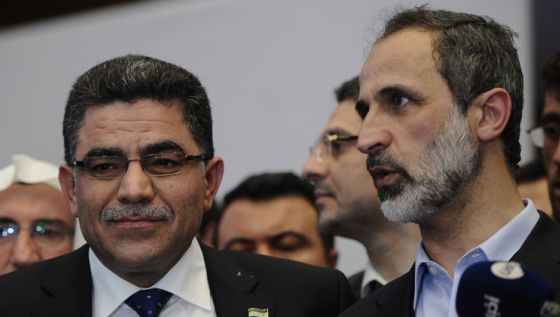
Syrian exile opposition pick U.S. citizen to lead interim government

Ghassan Hitto (left) alongside Moaz al-Khatib, president of the Syrian National Coalition.
The Associated Press reports: Syria’s rebel coalition has elected as its prime minister Ghassan Hitto, a little-known American-educated IT manager and Islamic activist who will head an interim government to administer the areas seized by opposition forces from the regime troops of President Bashar Assad.
Hitto received 35 votes out of 48 ballots cast by the opposition Syrian National Coalition’s 63 active members during a meeting in Istanbul. The results were read aloud by coalition member Hisham Marwa to applause from a few dozen of his colleagues who had waited until after 1am to hear the results.
“I miss my wife and children and I look forward to seeing them soon,” said Hitto, who has lived in the United States for decades and recently moved from Texas to Turkey to help co-ordinate aid to rebel-held areas.
When asked what his interim government’s first priority would be, Hitto said he planned to give a speech later on Tuesday outlining his plans.
Hitto did not receive a resounding mandate from the coalition, of which he is not a member. Of the group’s 63 active members only 48 voted. Four cast blank ballots and Hitto received 35 of the remaining votes.
Hitto was born in Damascus, the Syrian capital, in 1963, according to his official resumé provided by the coalition. Little known in Syria, Hitto has lived in the United States for more than two decades, most recently in Texas. He has academic degrees from Purdue University in Indiana and Indiana Wesleyan University.
He worked for a number of different technology companies and helped run a Muslim private school called the Brighter Horizons Academy. He is also a founding member of the Muslim Legal Fund of America, which was founded to give legal aid to Muslims following the 9/11 terrorist attacks. He is married with four children.
Coalition members hope the new government will unite the rebels fighting Assad’s forces on the ground and provide services to Syrians living in rebel-held areas, many of which have been battered by the country’s civil war and suffer acute shortages of food, electricity and medical services.
But the new government faces huge challenges, starting with its ability to gain recognition from rebel factions on the ground.
Please help support this site
![]()
“Paul Woodward’s War in Context is well named except it is not just war Woodward puts in context but foreign policy in general. For me, War in Context serves as a corrective I apply to my own thinking and writing. If I am on the same page as Paul Woodward, I know I have got it right. If I’m not, I go back and re-think. It’s not that I will change my own thinking if it is not compatible with Paul’s but rather that I respect his powers of analysis so much that he makes me think twice. Additionally, War in Context provides me with a guide to articles and columns from sources I would probably have missed otherwise. Having it close at hand is an insurance policy. If I read it, I know I am on top of events even if perchance I don’t get to read much else. It is indispensable.”
— M.J. Rosenberg, blogger and author of The Israel Lobby & Me to be published by Just World Books later this year.
![]()
As an independent news editor and commentator, I use my own judgment. I don’t bow to anyone — not to governments, or political parties, or corporations, or the mainstream media, or advertisers, or think tanks, or academia, or popular opinion, or ideology, or the blogosphere, or social media, or even my own readership.
If you value this kind of liberated journalism, please support this site and make a donation. Thank you — Paul Woodward
Click the button above to make a secure donation via PayPal.
If you would prefer to make a donation by check, please contact me using the contact form or directly by email to: editor[at]warincontext.org and I will send you my mailing address.
![]()
The rise of the global south

Richard Rodriguez writes: We Americans have long told ourselves that we are a God-favored people, a churchgoing, moral people. But last week when the old cardinals of Roman Catholicism looked for the future of their church, they looked south. And what we Americans heard, as if for the first time, is that the spiritual center of Christianity is in the Southern Hemisphere, not with us in the north.
How could that be?
Despite the drug addiction of Americans — an addiction second to none that has destabilized Latin America from Bolivia to Colombia to Mexico — we assume the moral high ground in the Americas. We long have regarded Latin Americans as a morally lazy race, corrupt in their civic life, tolerant of Marxism one day, fascism the next. Now we learn that the beating heart of Christianity is in the south. World Catholicism is centered there. And Protestantism, too, surges throughout Latin America.
We Americans built a wall to separate ourselves from Latin Americans and their disrespect regarding our laws. A number of us tell pollsters or listeners of talk radio that we would deport the millions of Latin Americans who are illegally here, and their children bleating about their “dreams.” Many Americans declare they do not want illegality rewarded in any way.
In the long political debate over illegal immigration, religion and morality have rarely been mentioned by those in power, except by disgraced Cardinal Roger Mahony in Los Angeles. In immigrant rights parades, it’s true, one did see nuns and people carrying crosses, as in a religious procession. But right-wing commentator Pat Buchanan, famously a Catholic, described illegal immigrants from Latin America as a greater threat to our union than Al Qaeda. There was something evil coming from the south.
What went unsaid on talk radio and on the floor of Congress was that were it not for Latin American immigrants, here legally and illegally, many churches in the U.S. would be as empty as Notre Dame cathedral in Paris. And not just Catholic churches.
Increasingly, as young, white Americans abandon organized religion, Latin Americans in the United States have been flocking to evangelical Protestantism. Already, in Central America and Brazil, the rate of conversion to evangelical Protestantism is such that by century’s end, Latin America may be in its majority, evangelical Protestant. Already, Protestant churches are sending missionaries from Latin America north to attend to our barren souls. [Continue reading…]
As Rodriguez goes on to note, the American left is largely uninterested in religion — and I expect that lack of interest is reflected among visitors to this site.
Even so, the strength of religion should interest everyone, irrespective of their religious or political orientation. And those of us with no faith should hesitate to assume that our lack of faith makes us better off.
One of the reasons secularists look down on the religious is out of the conviction that scientific realism will inevitably triumph over religious superstition. But as Rodriguez points out, the decline of religion is not resulting in a demographic rise of secularism. Why? Because as religious belief declines, so does the drive to reproduce.
This probably says less about mere differences in orientation towards life and an afterlife than it does about differences between the irreligious rich and the religious poor.
As people become more immersed in their pursuit of careers, a tension develops between the demands of raising a family and the pursuit of personal achievement outside the family. Simultaneously, the more economic independence the individual acquires, the less reliant he or she becomes on the mutual support provided by family, community, and church. Put simply, the less we need others, the less we procreate.
As we maximize our individual autonomy, we collectively wither. The price for liberating ourselves from religion is that we end up with weaker, atomized societies. The better we can take care of ourselves, the less we care about others.
Having left religion behind, one can’t easily turn back.
Some people want to create churches for the faithless — a goal I can support in spirit. Yet what will provide the glue that holds together such communities? In our resolute individualism, where do we find common ground when there is no ready substitute for shared faith?
We secularists imagine we have an ideological advantage because we believe in this life rather than any other and because we rely on science rather than scripture, but we fall down by over-investing in the material world.
“Lay not up for yourselves treasures upon earth, where moth and rust doth corrupt, and where thieves break through and steal.”
That can be read as an injunction to the faithful to fix their attention on rewards in heaven, but it also says something to those of us with no faith: that there are false promises attached to most of the material things we can acquire.
Pope Francis has said he wants a poor church, for the poor. As an archbishop he condemned the gross inequalities in his native Argentina and from the perspective of secularists concerned with social justice, these may sound like a call for the redistribution of wealth. The poor must be raised out of poverty.
But remember: this comes from a priest who took a vow of poverty. Granted, there’s a huge difference between poverty that is chosen and poverty from which one hungers to escape, but for those who take such a vow, this is not an exercise in self-abnegation; it’s about the liberating effect of recognizing that ones needs are few.
Ironically, in societies with material abundance, the terms ‘poor’ and ‘needy’ are interchangeable. Yet the more easily we can meet our material needs, the more difficult it becomes to differentiate between needs and desires. Indeed needs met, rather than resulting in contentment, often fuel larger desires.
The top of the ladder of acquisition, rather than being occupied by people who are serenely fulfilled is instead the abode of those who acquire perverse desires — like wanting to live in $200 million apartments.
If one looks at the world not in terms of the distribution of wealth, but the distribution of contentment, it turns out that Latin America ranks highest.
There’s no disputing that in a world where there are clearly enough resources to meet everyone’s basic needs, no one should be dying of hunger, lacking care for treatable diseases, or living in miserable squalor. But another poverty goes unnamed — one that afflicts the rich and causes desire to metastasize, producing concentrations of wealth that serve little good even for those in their possession.
What those protected by military-trained guards, bulletproof glass, and panic rooms, fail to see, is that rather having been supremely successful in acquiring so much, they have instead become the prisoners of their own wealth.
But worse than that, the affliction of excessive wealth is also a curse on others. Not only does the wasteful aggregation of resources necessitate deprivation for others, but the status attached to wealth undermines the dignity of those who possess little.
The reconfiguration of wealth the world needs, cannot be confined to the distribution of material resources, but requires a redefinition of the meaning of wealth.
Only when those who believe they have so much, start to see how much loss acquisition incurs, can a deeper reordering of human values begin.

Amazon Indians unite against Canadian oil giant

Survival International: Amazon Indians from Peru and Brazil have joined together to stop a Canadian oil company destroying their land and threatening the lives of uncontacted tribes.
Hundreds of Matsés Indians gathered on the border of Peru and Brazil last Saturday and called on their governments to stop the exploration, warning that the work will devastate their forest home.
The oil giant Pacific Rubiales is headquartered in Canada and has already started oil exploration in ‘Block 135’ in Peru, which lies directly over an area proposed as an uncontacted tribes reserve.
In a rare interview with Survival, a Matsés woman said, ‘Oil will destroy the place where our rivers are born. What will happen to the fish? What will the animals drink?’
The Matsés number around 2,200 and live along the Peru-Brazil border. Together with the closely-related Matis tribe, they were known as the ‘Jaguar people’ for their facial decorations and tattoos, which resembled the jaguar’s whiskers and teeth.
The Matsés were first contacted in the 1960s, and have since suffered from diseases introduced by outsiders. Uncontacted tribes are also at extreme risk from contact with outsiders through the introduction of diseases to which they have little or no immunity. [Continue reading…]
Pope Francis’s actions will say more than his words
Christopher Dickey writes: The biggest test for Francis as an inspiring leader for change and renewal – at least in the minds of many Catholics in the United States, Ireland, Belgium and other countries with horrific histories – will be the way he addresses the issue of child abuse by predatory priests and the insidious cover-ups that have protected them even when it meant endangering many more children.
There is no question of dogma here. Official church policy is flatly opposed to child abuse, or course. The problem is that when priests have been the abusers, and there are thousands of cases, Church practice often has been hard to reconcile with its policy.
Symbolically, Francis is off to a bad start. The morning after his election he went to pray at the Church of Santa Maria Maggiore, which is the papal basilica in the city of Rome. That would not be controversial, except that the infamous former cardinal of Boston, Bernard Law, is resident there. Law resigned his post in the United States more than ten years ago after the courts reviewed devastating evidence that he knowingly protected criminally abusive priests. His former archdiocese has paid out more than $100 million to settle hundreds of civil suits by the victims.
What Francis said to Law when the two of them met and briefly embraced at the Rome basilica is not known. Some reports in the Italian press said the pope told Law he must retire to a monastery. But Vatican spokesmen flatly denied that.
David Clohessy, executive director of the Survivors’ Network for those Abused by Priests, said Saturday that the encounter between the pope and this known protector of pedophiles was “extraordinarily hurtful.” “If you ignore wrongdoing,” said Clohessy, “you condone wrongdoing.” And if that is the case under Francis, then millions of children will remain at risk from predators in clerical collars. But Anne Barrett Doyle, co-director of BishopAccountability.org, an exhaustive database of abuse, was, while very cautious, also a little optimistic. She would give Francis “the benefit of the doubt,” she said.
Americans can hardly avoid viewing a pope as a religious counterpart to a president, but as much as each represents the concentration of great power in the hands of an individual, the differences are more noteworthy than the similarities.
A candidate for the presidency spends two years or more trying to convince the nation that they, more than anyone else, deserve to occupy the Oval Office. As an exercise in self-aggrandizement and unadulterated egotism, there is no parallel.
If the institution of the pope exceeds that of the president in its pomposity — at least presidents don’t generally claim to represent God — then at the same time, one has to concede that a pope enters office with a certain measure of innocence. It’s not that cardinals necessarily have less inflated egos than would-be presidents, but since no one can predict when a new pope will be selected, even someone who craves the position can’t do much to secure it (bar conspiring to bump off his predecessor).
So, whatever questions linger about Francis’s past or doubts about his intentions for reform, I’d say he’s entitled to a honeymoon. He doesn’t have to prove himself to the press and he doesn’t have something to accomplish within an arbitrarily assigned amount of time — such as his first one hundred days. Big changes should be clearly conceived and well-crafted. Speed is not of the essence.