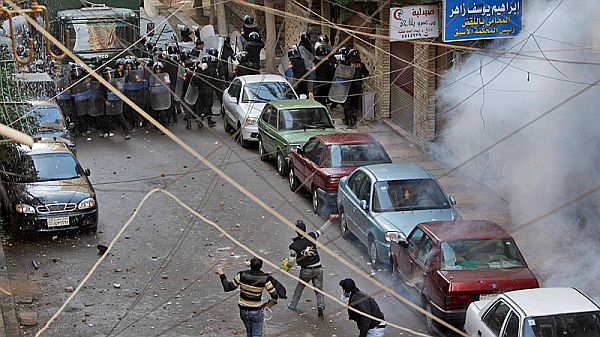
On Wednesday in Alexandria, a huge Egyptian flag was flown connecting the Coptic al-Qiddissin (Saints) Church to the adjacent mosque in a powerful display of religious and national unity.
On New Year’s Day, the church was the target of a bombing that killed 23 people. The attack was internationally condemned. The Interior Ministry blamed “foreign elements,” and the Alexandria governor accused al Qaida of being responsible, yet in a foretaste of the nationwide protests that were to erupt three weeks later Christians unleashed their rage at the authorities.
Former Interior Minister Habib el-Adly is now facing trial for his alleged role in organizing the bombing.
The U.S. Army illegally ordered a team of soldiers specializing in “psychological operations” to manipulate visiting American senators into providing more troops and funding for the war, Rolling Stone has learned – and when an officer tried to stop the operation, he was railroaded by military investigators.
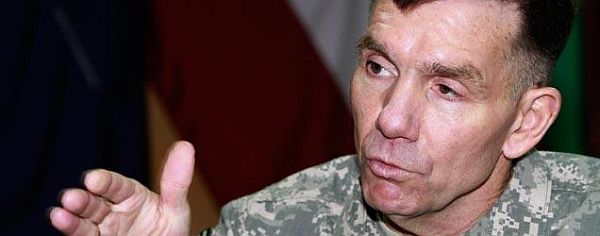
The orders came from the command of Lt. Gen. William Caldwell, a three-star general in charge of training Afghan troops – the linchpin of U.S. strategy in the war. Over a four-month period last year, a military cell devoted to what is known as “information operations” at Camp Eggers in Kabul was repeatedly pressured to target visiting senators and other VIPs who met with Caldwell. When the unit resisted the order, arguing that it violated U.S. laws prohibiting the use of propaganda against American citizens, it was subjected to a campaign of retaliation.
“My job in psy-ops is to play with people’s heads, to get the enemy to behave the way we want them to behave,” says Lt. Colonel Michael Holmes, the leader of the IO unit, who received an official reprimand after bucking orders. “I’m prohibited from doing that to our own people. When you ask me to try to use these skills on senators and congressman, you’re crossing a line.”
The list of targeted visitors was long, according to interviews with members of the IO team and internal documents obtained by Rolling Stone. Those singled out in the campaign included senators John McCain, Joe Lieberman, Jack Reed, Al Franken and Carl Levin; Rep. Steve Israel of the House Appropriations Committee; Adm. Mike Mullen of the Joint Chiefs of Staff; the Czech ambassador to Afghanistan; the German interior minister, and a host of influential think-tank analysts.
The incident offers an indication of just how desperate the U.S. command in Afghanistan is to spin American civilian leaders into supporting an increasingly unpopular war. According to the Defense Department’s own definition, psy-ops – the use of propaganda and psychological tactics to influence emotions and behaviors – are supposed to be used exclusively on “hostile foreign groups.” Federal law forbids the military from practicing psy-ops on Americans, and each defense authorization bill comes with a “propaganda rider” that also prohibits such manipulation. “Everyone in the psy-ops, intel, and IO community knows you’re not supposed to target Americans,” says a veteran member of another psy-ops team who has run operations in Iraq and Afghanistan. “It’s what you learn on day one.”
When Moammar Gadhafi told the world he was a changed man, some leaders were skeptical. Others, like Britain’s Tony Blair, were quicker to see the benefits of rapprochement with the oil-rich nation.
Now, as Gadhafi’s regime crumbles, questions are being raised about whether Britain, the United States, and others were too quick to embrace a volatile despot linked to terrorism and oppression as they sought lucrative business deals.
Those deals worth billions are now in jeopardy as Libya hurtles toward civil war. The strategic decision to build ties with the likes of Gadhafi, Egypt’s Hosni Mubarak, and Tunisia’s Ben Ali also threatens to further inflame anti-Western anger in the Arab world.
Blair’s role was particularly vital in Gadhafi’s international rehabilitation.
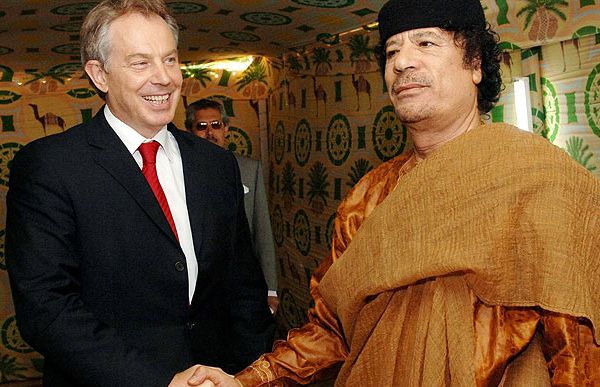
The former British prime minister flew to Libya in 2004, holding talks with Gadhafi inside a Bedouin tent. He praised the leader for ending Libya’s nuclear and chemical weapons program and stressed the need for new security alliances in the wake of the Sept. 11 terror attacks. British commercial deals soon followed.
Britain sold Libya about 40 million pounds ($55 million) worth of military and paramilitary equipment in the year ending Sept. 30, 2010, according to Foreign Office statistics. Among the items: sniper rifles, bulletproof vehicles, crowd control ammunition, and tear gas.
“What did the Foreign Office think Colonel Gadhafi meant to do with sniper rifles and tear gas grenades — go mole hunting?” asked Britain’s Guardian newspaper.
Although Britain’s current government led by David Cameron has revoked dozens of export licenses to Libya in the wake of the Libyan violence, many say the very weapons and equipment Britain has sold to Libya are being used against the country’s people.
Britain’s elite Special Air Service, or SAS, also participated in recent training for Libyan soldiers in counterterrorism and surveillance. Robin Horsfall, a former SAS soldier, said at the time that the training was a mistake: “People will die as a result of this decision,” he warned.
Members of Britain’s elite regiment are angry at having to help train soldiers from a country that for years armed terrorists they fought against.
An SAS source said: “A small SAS training team have been doing it for the last six months as part of this cosy deal with the Libyans.
“From our perspective we cannot see it as part of anything else other than the Megrahi deal.” Another SAS soldier said: “The IRA was our greatest adversary now we are training their backers. There was a weary rolling of the eyes when we were told about this.”
The Ministry of Defence refuses to comment on special forces activities, but sources have admitted that SAS reserves have bolstered the team that has been training “Libyan infantry in basic skills”.
A senior defence source admitted: “This is a huge political embarrassment.’’
The first moves towards setting up the training agreement are believed to have begun after Tony Blair visited
Libya as Prime Minister in 2004. However, the deal was only finalised and “signed off” by Mr Brown earlier this year.
Robin Horsfall, a former SAS soldier who took part in the Iranian Embassy siege in 1980 and fought the IRA in Northern Ireland, said:
“There is a long list of British soldiers who have died because of Gaddafi funding terrorists.
“The SAS is being ordered to do something it knows is morally wrong.”
The WikiLeaks founder Julian Assange is to be extradited to Sweden to face allegations of rape and sexual assault. Assange will appeal, his legal team has confirmed. If they lose he will be sent to Sweden in 10 days.
Speaking outside Belmarsh magistrates court in south-east London after the judgment, Assange attacked the European arrest warrant system.
He dismissed the decision to extradite him as a “rubber-stamping process”. He said: “It comes as no surprise but is nevertheless wrong. It comes as the result of a European arrest warrant system amok.”
There had been no consideration of the allegations against him, Assange said. His extradition would thrust him into a legal system he did not understand using a language he did not speak.
Assange said the US government by its own admission had been waiting to see the British court verdict before determining what action it could take against him.
Glenn Greenwald on the Assange extradition ruling, the jailing of Bradley Manning, and the campaign to target WikiLeaks supporters
Iraqi police allowed dozens of assailants to beat and stab peaceful protesters in Baghdad on February 21, 2011, Human Rights Watch said today. Security forces have an obligation to protect the right to assemble peacefully and to use only the minimum necessary force to protect lives if violence erupts, Human Rights Watch said.
In the early hours of February 21 dozens of men, some wielding knives and clubs, attacked about 50 protesters who had set up two tents in Baghdad’s Tahrir Square. The assailants stabbed and beat at least 20 of the protesters who were intending to camp in the square until February 25, when groups have called for national protests similar to the “Day of Anger” in Egypt. The attack came directly after the police had withdrawn from the square, and witnesses suggested the assailants were in discussion with the police before they attacked.
“Promises by Prime Minister Nuri al-Maliki to allow protests are meaningless when we see vicious attacks like the one on February 21,” said Joe Stork, deputy Middle East director at Human Rights Watch. “Iraqi authorities should hold police who allowed this attack to happen accountable.”
Teenagers high on drugs, incited by Osama bin Laden — this is Muammar Gaddafi’s explanation gives for the current challenge to his rule.
What is happening now in Libya is not people’s power, it’s international terrorism led by al-Qaeda … All they want is to kill your kids, that’s what Bin Laden wants, he should be happy now, that’s what he wants.
Rebels are increasing their hold on Muammar Gaddafi’s ailing regime, by shutting down oil exports and mobilising rebel groups in the west of the country as the revolution rapidly spreads. Gaddafi’s hold on power appears confined to parts of Tripoli and perhaps several regions in the centre of the country. Towns to the west of the capital have fallen or are being fought over. Gun battles are taking place between forces loyal to Gaddafi and his opponents in the town of Az-Zawiyah, 30 miles west of Tripoli, according to witnesses. Order is returning to the sacked second city of Benghazi after days of fierce fighting that saw the military defect en masse and virtually all government buildings razed and looted. Gaddafi was expected to make a statement at some point soon…
Nato says it will not intervene in Libya. Its secretary-general, Anders Fogh Rasmussen, says the alliance has received no such requests and that in any case any intervention must be based on a UN mandate. Rasmussen says the turmoil in Libya does not threaten any Nato members, but the conflict could spark a mass refugee crisis.
The claim comes in an interview with former justice minister Mustafa Mohamed Abud Al Jeleil in the Swedish newspaper Expressen:
“Gaddafi’s days are numbered. He will do what Hitler did – he will take his own life.”
Al Jeleil earlier claimed that Gaddafi had ordered the Lockerbie bombing.
When Gaddafi said bin Laden must be happy now, he spoke with an air of resignation — much of his tone of defiance from yesterday having dissipated.
Denial, bargaining, anger, depression — most of the stages of dying are already evident. Al Jeleil may well be right and what we are witnessing now is a tyrant in dialogue with his own death. Acceptance comes as he pulls the trigger.
The refusal of the people to kiss or ignore the rod that has chastised them for so many decades has opened a new chapter in the history of the Arab nation. The absurd, if much vaunted, neocon notion that Arabs or Muslims were hostile to democracy has disappeared like parchment in fire.
Those who promoted such ideas appear to the most unhappy: Israel and its lobbyists in Euro-America; the arms industry, hurriedly trying to sell as much while it can (the British prime minister acting as a merchant of death at the Abu Dhabi arms fair); and the beleaguered rulers of Saudi Arabia, wondering whether the disease will spread to their tyrannical kingdom. Until now they have provided refuge to many a despot, but when the time comes where will the royal family seek refuge? They must be aware that their patrons will dump them without ceremony and claim they always favoured democracy.
If there is a comparison to be made with Europe it is 1848, when the revolutionary upheavals left only Britain and Spain untouched – even though Queen Victoria, thinking of the Chartists, feared otherwise. Writing to her besieged nephew on the Belgian throne, she expressing sympathy but wondered whether “we will all be slain in our beds”. Uneasy lies the head that wears a crown or bejewelled headgear, and has billions stored in foreign banks.
Like Europeans in 1848 the Arab people are fighting against foreign domination (82% of Egyptians, a recent opinion poll revealed, have a “negative view of the US”); against the violation of their democratic rights; against an elite blinded by its own illegitimate wealth – and in favour of economic justice. This is different from the first wave of Arab nationalism, which was concerned principally with driving the remnants of the British empire out of the region.
Facing budget cuts at home, western arms firms are desperate for a share of the lucrative Middle East market. “The post-financial crisis reality,” said Herve Guillou, president of Cassidian Systems, a subsidiary of European aviation defence group EADS, “is that today it is clearly the Middle East that is seeing the biggest growth.” Iran’s growing military power has pushed Gulf states into their largest-ever military build up, making purchases worth £76 billion from the US alone in 2010. The largest acquisitions were made by Saudi Arabia, which is spending £41 billion on F-15 fighter jets and upgrades for its naval fleet.
The six Gulf Cooperation Council countries – Saudi Arabia, Bahrain, UAE, Oman, Qatar, Kuwait – along with Jordan will spend another £41 billion on defence in 2011, according to Frost and Sullivan, a research firm.
Libya and Egypt are among the states which have representatives at IDEX [the International Defence Exhibition and Conference in Abu Dhabi]. Global Industrial and Defence Solutions, a Pakistani exhibitor, lists Libya as being among the “key customers of our products.” Renault also issued a press release before the exhibition, saying it had contracted to supply military trucks to Egypt. Libya’s al-Musallah magazine, which covers arms-trade related issues in the country, is also among the exhibitors.
I must be missing something. The present British government, like its predecessor, claims to pursue a policy of “liberal interventionism”, seeking the downfall of undemocratic regimes round the globe, notably in the Muslim world. The same British government, again like its predecessor, sends these undemocratic regimes copious weapons to suppress the only plausible means of the said downfall, popular insurrection. The contradiction is glaring.
Downing Street is clearly embarrassed by Egypt, Bahrain and Libya having had the impertinence to rebel just as David Cameron was embarking on an important arms-sales trip to the Gulf, not an area much addicted to democracy. Fifty British arms makers were present at last year’s sickening Libyan arms fair, while the resulting weapons are reportedly prominent in gunning down this week’s rioters. Cameron reads from the Foreign Office script, claiming that all guns, tanks, armoured vehicles, stun grenades, tear gas and riot-control equipment are “covered by assurances that they would not be used in human rights repression”. He must know this is absurd.
What did the FO think Colonel Gaddafi meant to do with sniper rifles and tear-gas grenades – go mole hunting? Britain has tried to cover its publicity flank by “revoking 52 export licences” to Bahrain and Libya for weapons used against demonstrators, in effect admitting its guilt. This merely locks the moral stable after the horse has fled, while also being a poor advertisement for British after-sales service. What is the point of selling someone a gun and telling him not to use it?
Gaddafi turns US and British guns on his own people
As the GCC foreign ministers huddled in a Bahraini capital seemingly under siege, it is clear that the predicted stability of the oil states is being put to the test. Most analysts believed the Gulf would be spared the wave of rebellion spreading across the Arab World due to their relative wealth and welfare provisions for their populace. Yet Bahrain’s pre-emptive promises of increased social spending and direct subsidies of $2,700 per family did not prevent robust protests this week. Analysts also suggested that monarchies are less prone to revolutionary fervor than the Arab faux republics; legitimacy is based on religion and paternalistic care of citizenry, not on the false promise of public sovereignty in the republics. Yet it is exactly that paternalistic authority that is being called into question by political activists across the Gulf.
In fact, the demands of Gulf activists, and increasingly Gulf publics, are broadly similar to those coming from Tunisia and Egypt: We want accountable governance, free of corruption. We want popular participation and to have our say on the issues that affect us. And we want to be free to speak our minds — to assemble online and off without fear of intimidation or arrest. In short, Gulf publics, and particularly Gulf youths, want to be full citizens.
An uncertain calm has settled over the small island kingdom of Bahrain. The wave of peaceful pro-democracy protests from February 14-17 culminated in bloodshed, including the brutal murder of seven activists, some of whom were asleep in tents, by the armed forces. On orders from above, the army withdrew from the roundabout on the outskirts of the capital of Manama where the protests have been centered, and since shortly after the seven deaths it has observed calls for restraint. Thousands of jubilant protesters seized the moment to reoccupy the roundabout, the now infamous Pearl Circle. In commemoration of the dead, the demonstrators have renamed it Martyrs’ Circle.
The mood in the circle is buoyant, even carnivalesque. It is also dead serious, for the thousands of encamped demonstrators demand nothing short of fundamental change to the kingdom’s autocratic political order. The crown prince, Salman bin Hamad Al Khalifa, has issued a bland call for healing and national dialogue. The country’s formal opposition may be tempted by the prospect of realizing at least some of its long-established demands for reform. But the wounds from the direct assault at dawn on February 17 are deep. Several prominent banners in Martyrs’ Circle display the pledge, “No dialogue with those who killed us in cold blood.” Chants echo: “We will sit here until the fall of the regime!” The fault lines that have long divided rulers and subjects in Bahrain have widened due to the carnage.
The United States military undermined efforts to improve relations with Bahrain’s Shiite majority and understated abuses by the Sunni royal family, according to one present and one former American government adviser and a Bahraini human rights advocate.
As Bahrain’s leaders struggle to hold back a rising popular revolt against their absolute rule, Washington’s posture toward the Shiite majority, which is spearheading the opposition, could prove crucial to future relations with this strategically valuable Persian Gulf nation. The United States Navy’s Fifth Fleet is based here, helping ensure the flow of oil through the Strait of Hormuz and the gulf, and safeguarding American interests in this volatile region.
Over the years, the military, according to the advisers and the human rights advocate, believed that King Hamad bin Isa al-Khalifa and his court were reform-minded leaders who could advance democracy and preserve stability. That narrative contrasts sharply with the experience of the Shiites, as documented by human rights groups and some of the military’s own advisers.
“The problem has been that we have been doing everything we can to cuddle up to the Khalifas and have been consciously ignoring at best the situation of Bahraini Shiites,” said Gwenyth Todd, a former political adviser to the Navy in Bahrain from 2004 to 2007 who was also an adviser on Middle Eastern and North African affairs at the Pentagon and the White House. “We could find ourselves in a very bad situation if the regime has to make major concessions to the Shia, unless we change our tone.”
I spent four and a half years negotiating resolutions on the Middle East at the UN Security Council. When it wishes, the council can make decisions in hours. We agreed a resolution condemning the 9/11 attacks in less than an hour, the morning after the attacks took place. Time is of the essence. The only message that Gadaffi will understand is one of real substance and force. Such a resolution should state, at a minimum:
• The demand that all violence cease immediately, and that if lethal force continues to be used, the government will face consequences. At this point, such consequences do not need to be spelled out (and would unlikely be agreed) but imply sanctions, and, in extremis, force.
• Immediate freezing of all assets and an explicit travel ban on members of the regime, until all violence is halted and has been fully investigated.
• Since Libya is not a party to the International Criminal Court, the Council can and should refer Libya to the ICC for an immediate investigation into possible war crimes.
• Demand that there be an immediate transition to a representative government, involving consulting civil society and all relevant political actors.
• The decision should be taken under chapter VII of the UN Charter, recognising that events in Libya are an international threat to international peace and security (there are already refugees flowing out of Libya), and requiring all UN members to comply (this reference also implies the threat of military enforcement action).
I would love to see the council agree a no-fly zone or exclusion zone, to prevent air attacks on civilians. However, unless someone is prepared to enforce such a ban, it is meaningless. Realistically, only the US has this capability and such a call would risk playing into Gaddafi’s hands in his specious claim that foreign forces are behind the unrest.
The first test of any would-be interventionist is this: do no harm. And there is very little evidence that direct intervention in the Libyan case could meet this test. For instance, calls for a no-fly zone by Libya’s Deputy Ambassador to the U.N. (drawing on the Iraqi precedent of the 1990s) and an air campaign by others (drawing on the Kosovo precedent from 1999) would surely fail this test. Neither option would shield the Libyan civilian population from the regime’s coercive apparatus (which is not principally aerial) and both options may entail serious costs to civilians by freezing or exacerbating the situation on the ground. Beyond raising questions of enforcement (would international forces fire on Libyan aircraft?), a no-fly zone might well block one method of escape for Libyan civilians or close an avenue for defections by members of the air force, such as the four pilots that are known to have flown out and defected in disobedience of direct orders to bomb civilians. Alternatively, air strikes run the risk of serious damage to both the civilian population and infrastructure. In short, any intervention must be crafted to offer real support to the civilian population of Libya, which direct forms of coercive intervention like no-fly zones or air strikes would not. But are there other forms of intervention that would be better suited to the task? Given limited knowledge of Libya’s internal dynamics at present and the heavy-handed interventionist toolkit developed to date by the international community any such option must be approached with caution.
Coercive options should be taken off the table. Absent the political will to commit ground forces to serve as a meaningful buffer between the regime and the population, any coercive intervention will do more damage (particularly to civilians) than good. Further, even if the political will existed for forceful intervention to offer direct protection to Libyan civilians, history suggests that the ultimate outcome of such intervention would still be harmful. Aside from the obvious potential threats to the civilian populations from the presence of foreign troops on their soil, including risks from a ground conflict and risks associated with the possibility of a prolonged presence, there are additional considerations that weigh against such intervention. At a time when the regime appears to be crumbling from within, as a result of the courageous mobilization of its own people, to engage in an eleventh hour intervention runs the very serious risk of depriving the Libyan people of their control over the hard-won transition they have initiated. To rebrand the Libyan uprising with the last minute trappings of international liberation (read: “Made in the West”) would do a serious disservice to the achievements of the protesters. Of course, none of this is to absolve the international community of its obligation to support Libyan civilians. Rather, we seek to identify a principled course of action that speaks to the dire situation, our responsibilities towards it, and the power relations that frame it.
In the immediate context, the most appropriate role for the international community is in providing humanitarian assistance and desisting from any further support to the regime. In addition to condemning the regime’s resort to violence, there are at least five modalities for the provision of such assistance, all of which should be employed immediately, with the support of the Security Council. First, all borders should be opened and appropriate facilities created to allow Libyan civilians to flee regime violence. If various governments are going to create exit routes through charter flights and land crossings for their own citizens, they also need to create a mechanism for Libyans to get out. Second, all available means for providing direct humanitarian assistance on the ground to the Libyan population should be utilized, including aid convoys to eastern Libya through Egypt and to western Libya through Tunisia. Third, al-Qaddafi’s assets and those of remaining elements of the regime should be frozen and kept in safe keeping to be given to whatever post-Qaddafi system emerges. Fourth, governments with ties to Libya should immediately sever all military ties, withholding delivery of materiel and cancelling all outstanding contracts. Finally, an arms embargo should be imposed preventing the sale or delivery of military equipment or personnel (including foreign mercenaries) to the Libyan state security forces. Sanctions that target military materiel, services and the movement of reinforcements from among foreign mercenaries are essential. Sanctions that go beyond these aims would run the risk of causing more harm to civilians than to the regime.
Up to 15,000 men, women and children besieged Tripoli’s international airport last night, shouting and screaming for seats on the few airliners still prepared to fly to Muammar Gaddafi’s rump state, paying Libyan police bribe after bribe to reach the ticket desks in a rain-soaked mob of hungry, desperate families. Many were trampled as Libyan security men savagely beat those who pushed their way to the front.
Among them were Gaddafi’s fellow Arabs, thousands of them Egyptians, some of whom had been living at the airport for two days without food or sanitation. The place stank of faeces and urine and fear. Yet a 45-minute visit into the city for a new airline ticket to another destination is the only chance to see Gaddafi’s capital if you are a “dog” of the international press.
There was little sign of opposition to the Great Leader. Squads of young men with Kalashnikov rifles stood on the side roads next to barricades of upturned chairs and wooden doors. But these were pro-Gaddafi vigilantes – a faint echo of the armed Egyptian “neighbourhood guard” I saw in Cairo a month ago – and had pinned photographs of their leader’s infamous Green Book to their checkpoint signs.
There is little food in Tripoli, and over the city there fell a blanket of drab, sullen rain. It guttered onto an empty Green Square and down the Italianate streets of the old capital of Tripolitania. But there were no tanks, no armoured personnel carriers, no soldiers, not a fighter plane in the air; just a few police and elderly men and women walking the pavements – a numbed populous. Sadly for the West and for the people of the free city of Benghazi, Libya’s capital appeared as quiet as any dictator would wish.
But this is an illusion. Petrol and food prices have trebled; entire towns outside Tripoli have been torn apart by fighting between pro- and anti-Gaddafi forces. In the suburbs of the city, especially in the Noufreen district, militias fought for 24 hours on Sunday with machine guns and pistols, a battle the Gadaffi forces won. In the end, the exodus of expatriates will do far more than street warfare to bring down the regime.
Muammar Gaddafi was looking increasingly isolated after damaging defections by senior regime figures and key military commanders and units as the uprising spread closer to Tripoli.
Malta denied a report that Gaddafi’s daughter, Aisha, was on board a Libyan plane refused permission to land on the island on Wednesday. But Menas, a respected London Middle East consultancy, said the leader’s wife, daughter, daughters-in-law and grandchildren had left Libya for an unknown destination.
Mass protests erupted in Misurata, a Mediterranean port and the country’s third-largest city, and violence was reported in Sebrata and Zawiya, which are also in western Libya and closer to Tripoli.
Benghazi and much of the east of the country have now been lost to the government. Misurata is near Sirte, the leader’s home town, where a key tribe has reportedly come out in support of what is being called the 17 February revolution.
Al-Jazeera TV reported that tribes in the Azzintan and Nalut areas, also in the west, had come out against Gaddafi. Oil facilities were now under their protection.
Libyan and Arab sources said the biggest blow to Gaddafi so far had been the defection of his interior minister and veteran loyalist, Abdel-Fatah Younes al-Obeidi, who called on the army on Tuesday to “serve the people and support the revolution and its legitimate demands”.
But the whereabouts of other senior comrades remains unclear. Mustafa al-Kharroubi, a leading figure in the regime’s old guard, is rumoured to have left Tripoli. There are question marks too about another loyalist, Khweildi al-Hmeidi, whose daughter is married to the leader’s wayward son Sa’adi.
In another blow to the Libyan leader, his former justice minister, Mustafa Abdel-Jalil, who stepped down this week, was quoted as saying today that Gaddafi personally ordered the Lockerbie bombing, in which 270 people were killed.
Another departure was of Youssef Sawan, who quit as director of the Gaddafi International Charitable Foundation run by the leader’s son, the supposedly reformist-minded Saif al-Islam.
Libyan exile sources also confirmed the defection of a senior figure in the revolutionary committees, Ali al-Sahouli, who warned that Gaddafi would sabotage the country’s infrastructure including oil installations, power stations and banks.
The International Criminal Court has issued a statement that it cannot investigate war crimes occurring in Libya unless the issue is referred to the court by the UN Security Council. It seems unlikely that the UNSC will take this step unless it is also willing to take actions (not simply issue condemnations) in an effort to prevent more war crimes taking place.
Tom Malinowski from Human Rights Watch challenges the claim that the US and its allies lack the leverage required to halt Gaddafi.
There are numerous steps the United States and its allies can take today to affect the immediate calculations of the Qaddafi regime. Europe buys 85 percent of Libya’s oil, after all. And the West largely controls the international financial system through which the Libyan leadership moves its money — and could block transactions with one word from the Treasury Department or other finance ministries. And there’s more: Western governments could say today that they will seek international investigations and prosecutions of Libyan officials who murder their people. And they could offer to provide humanitarian assistance to parts of Libya that have fallen to the opposition.
Qaddafi may rail endlessly about foreign meddling, but the reaction of Western governments clearly matters to his regime. Why else would it have gone to such lengths to hide what it is doing by shutting down the Internet and communications with the outside world?
We should be under no illusion that Qaddafi himself will give in to international pressure at this point. As his brutal tactics show, he is fighting for his life. But Libya’s fate is not in Qaddafi’s hands; it is in the hands of those who must decide, today and tomorrow, whether to follow his orders. Every psychological blow to Qaddafi’s government — whether it is a Libyan official who defects to the opposition or a forceful repudiation of his government by the international community — gives them another reason to refuse to commit further outrages on their leader’s behalf, for which they may be held accountable when the crisis is over.
“Our leverage is limited” is a phrase diplomats use to absolve themselves from responsibility. It is both true — after all, U.S. influence is never unlimited — and utterly irrelevant. The only question the United States and other countries should be asking now is how to use the leverage they have to bring the calamity unfolding in Libya to an end.
Ranj Alaaldin argues in favor of the creation of a no-zone across Libya.
A no-fly zone will ensure Libyan helicopter gunships are not used to dreadful effect against indiscriminate targets like they were during the 1991 uprising in Iraq. It will deprive the regime of the ability to enforce extraordinarily brutal countermeasures from the air, like the bombardment of heavily populated residential areas and the destroying of homes.
As the regime becomes more and more desperate, so too will its response become more brutal. Can the international community depend and pin their hopes on further defections and pilots refusing to carry out such orders, like the two that yesterday sought asylum in Malta? Maybe. But the prudent person would argue that is a risk too grave to take and one that effectively gambles with the lives of thousands. The city of Benghazi, reportedly under the control of the regime’s opponents, has a population of 600,000. It will be the first to be hit and the international community will be unable to do anything but disgracefully watch.
Failure to prevent genocides and massacres around the world has put the international community on the wrong side of history. Yet, this is a chance to prevent another mass atrocity from taking place, a chance for us to take a responsible measure rather than a reactionary one that comes too late. The international community has the capacity to limit Gaddafi’s capacity for mass murder by keeping his bombers grounded.
Frank Gardner describes the “murky network of paramilitary brigades, ‘revolutionary committees’ of trusted followers, tribal leaders and imported foreign mercenaries, who are allowing Gaddafi to retain his grip on power.
Martin Chulov is the first foreign journalist to have reached Benghazi.
Libya’s second city, Benghazi, appears to have fallen beyond the control of Muammar Gaddafi, with the local military defying his regime and monarchy-era flags flying from government buildings.
As the first foreign news organisation to report from so-called Free Benghazi, the Guardian witnessed defecting troops pouring into the courtyard of a ransacked police station carrying tonnes of weaponry and ammunition looted from a military armoury to stop it being seized by forces loyal to the Libyan dictator.
Soldiers brought rockets and heavy weapons which had been used in an assault on citizens in central Benghazi on Saturday as Gaddafi tried to keep control of the city. Doctors in Benghazi said that at least 230 people were killed, with a further 30 critically injured.
There was also the clearest confirmation yet that Gaddafi’s regime used outside mercenaries to try to suppress the rebellion. Adjoining the police station a large crowd gathered in another courtyard. Upstairs, the Guardian saw a number of mercenaries, allegedly flown in the previous week, being interrogated by lawyers and army officials.
An air force officer, Major Rajib Faytouni, said he personally witnessed up to 4,000 mercenaries arrive on Libyan transport planes over a period of three days starting from 14 February. He said: “That’s why we turned against the government. That and the fact there was an order to use planes to attack the people.”
Officially, the main cause of concern the Egyptian revolution poses for Israel is that it might result in the end of the Israel-Egypt peace treaty. A much larger concern however, is that the Arab democratic revolution sweeping the region might inspire Palestinians in larger numbers than ever, to demand their political rights.
Israel’s military forces have had decades of practice containing and crushing uprisings on a smaller scale, but numbers matter. The rising spirit of people power is contagious and as we have witnessed in Tunisia, Egypt, Bahrain and now Libya, the brutality of an authoritarian state’s security apparatus is not enough to crush the desire for freedom in a population that has become fearless.
Concerned by the prospect of the Palestinians replicating Egypt-style mass demonstrations with dozens of simultaneous marches and protests in the West Bank, the IDF is beginning to build rapid-response forces and to identify vantage points throughout the territories that could be used to contain such protests.
The IDF’s Central Command assesses that the Palestinians could resort to so-called nonviolent resistance, on a scale previously unknown to Israel, in the absence of peace negotiations.
While there is deemed to be some possibility that such demonstrations will take place in the near future in the spirit of Egypt, Tunisia and Iran, a senior officer said it was more likely that the Palestinian Authority would prevent this from happening until after elections in September.
One senior officer said commanders were discussing ways to counter and contain large demonstrations launched simultaneously in different parts of the West Bank.
“We are preparing different responses for different scenarios to think about what we will do if there are, for example, 30 marches of several thousand people each,” the officer said. “This is something we have yet to encounter.”
One step the IDF is taking is to set up rapid-response teams that can quickly maneuver throughout the West Bank and arrive at the scene of a demonstration in its early stages in an attempt to contain it. During the summer, the Border Police are expected to establish a new command in the West Bank after the Arava District is dismantled.
In addition, the IDF is locating strategic hilltops that can be used as vantage points from which the military could deploy reconnaissance and surveillance teams to track developments inside Palestinian towns and cities.
The concern is that in the event of multiple large-scale demonstrations, the IDF will not know how to effectively respond and contain the protests, which could lead to a high number of casualties. As a result, commanders have been instructed to prepare their soldiers mentally for how to respond in such scenarios.
Israel has been keeping a close eye on Palestinian cities in recent weeks since the revolution in Egypt, to ensure that the violence does not spread to the West Bank.
According to intelligence assessments, the Palestinians are currently interested in continuing with their plans to build up and reform the institutions they would require for statehood if they decided to make a unilateral declaration following elections in September.
Even after September, the IDF believes the PA will maintain its high-level and almost daily security coordination with the IDF. But, it is thought, the PA could, at the same time, allow and even possibly encourage civilians to launch so-called nonviolent resistance to delegitimize Israel.
Amid the revolutionary cheer that was emanating from Egypt last week, a group of Israeli Jews attacked and killed a Palestinian in the heart of West Jerusalem. 24-year-old Palestinian Hussam Rwidy was killed by a group of nationalist Jewish youth screaming “death to Arabs” as he was walking home from work. The Israeli government quickly put a media blackout on the case fearing a violent reactions from Palestinians in Jerusalem, Israel and the West Bank. Once the media blackout was lifted, select Israeli media outlets covered the story as a “drunken brawl turned bad” and the story was largely ignored.
Tobruk is several hundred miles away from Benghazi, the first large epicenter of the revolt, and even farther from Tripoli, the Libyan capital. But local activists felt wired into the revolutions going on far beyond the borders of their nation, even though foreign newspapers were never for sale in Gaddafi’s Libya and websites were often blocked, says Gamal Shallouf, a marine biologist who has joined the newly fledged opposition. While the Internet has been down here since the revolution started, the regime’s inability to shut down new-media innovations entirely has been key to spreading Libya’s revolt.
“Generally, in Libya before this, there was no media,” explains Shallouf. “So if Tobruk made a revolution, [the government] would spend three to five days killing us and finish the revolution. Nobody in [larger nearby communities and cities] al-Baida or Darna or Benghazi would have heard about it. But now with al-Jazeera and Facebook and the media, all of Libya hears about the revolution and is with the revolution. They know about it. They think, ‘I am Libyan, this is my family, so I will go to the street to fight for them.’ ”
He and fellow Libyans had followed the Tunisian and Egyptian uprisings on al-Jazeera and satellite Arabic-language news channels. He did his best, along with other Libyan activists, to internally circulate the videos he saw so that other Libyans could get a glimpse of what was happening on either side of their closed-off country. “After I got videos from the Internet, we sent them from Bluetooth to Bluetooth. Mostly videos of fighting in Egypt. I felt two things when I saw these videos: I felt sad. And then I wanted to make a revolution!”