Goldstone to Haaretz: U.S. does not have to protect Israel blindly

Goldstone to Haaretz: U.S. does not have to protect Israel blindly

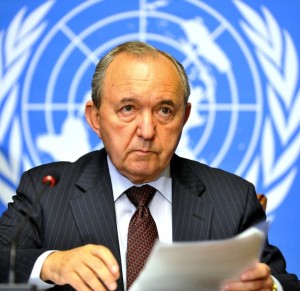
The Goldstone report is expected to be raised for discussion in the United Nations Security Council in the near future, and Goldstone Thursday discussed the possibility that the United States would veto any resolution that would hurt Israel when it comes to the implementation of the report’s findings. “I do not believe that any nation should protect another nation blindly. I would prefer to see the United States furnish reasons for criticizing the report. The United States has supported our call for credible investigations by Israel and by the Gaza authorities, whether the PA or Hamas,” he said.

Goldstone reiterated statements he has made, as well as those made by a number of Israeli human rights groups, inviting an open, public investigation and categorically rejecting a probe by the Israel Defense Forces of the Gaza campaign. “It does not suffice for the military to investigate itself. That will satisfy very few people and certainly not the victims.”

However Goldstone stressed that “in any public inquiry, it would be open to the Israeli government and the IDF to have sensitive security information protected from public disclosure.”

When asked how far up the chain of command he felt such a criminal investigation should go, and whether decision-makers in government be its subject, he replied: “A criminal investigation should go as high up the chain of command, both military and civilian, as the evidence justifies.” [continued…]

Facebooktwittermail

U.S. adviser to Kurds stands to reap oil profits

U.S. adviser to Kurds stands to reap oil profits

Peter W. Galbraith, an influential former American ambassador, is a powerful voice on Iraq who helped shape the views of policy makers like Joseph R. Biden Jr. and John Kerry. In the summer of 2005, he was also an adviser to the Kurdish regional government as Iraq wrote its Constitution — tough and sensitive talks not least because of issues like how Iraq would divide its vast oil wealth.

Now Mr. Galbraith, 58, son of the renowned economist John Kenneth Galbraith, stands to earn perhaps a hundred million or more dollars as a result of his closeness to the Kurds, his relations with a Norwegian oil company and constitutional provisions he helped the Kurds extract.

In the constitutional negotiations, he helped the Kurds ram through provisions that gave their region — rather than the central Baghdad government — sole authority over many of their internal affairs, including clauses that he maintains will give the Kurds virtually complete control over all new oil finds on their territory.

Mr. Galbraith, widely viewed in Washington as a smart and bold foreign policy expert, has always described himself as an unpaid adviser to the Kurds, although he has spoken in general terms about having business interests in Kurdistan, as the north of Iraq is known.

So it came as a shock to many last month when a group of Norwegian investigative journalists at the newspaper Dagens Naeringsliv began publishing documents linking Mr. Galbraith to a specific Norwegian oil company with major contracts in Iraq.

Interviews by The New York Times with more than a dozen current and former government and business officials in Norway, France, Iraq, the United States and elsewhere, along with legal records and other documents, reveal in considerable detail that he received rights to an enormous stake in at least one of Kurdistan’s oil fields in the spring of 2004. [continued…]

Facebooktwittermail

How America’s wars are systematically destroying our liberties

How America’s wars are systematically destroying our liberties

In his approach to National Security Agency surveillance, as well as CIA renditions, drone assassinations, and military detention, President Obama has to a surprising extent embraced the expanded executive powers championed by his conservative predecessor, George W. Bush. This bipartisan affirmation of the imperial executive could “reverberate for generations,” warns Jack Balkin, a specialist on First Amendment freedoms at Yale Law School. And consider these but some of the early fruits from the hybrid seeds that the Global War on Terror has planted on American soil. Yet surprisingly few Americans seem aware of the toll that this already endless war has taken on our civil liberties.

Don’t be too surprised, then, when, in the midst of some future crisis, advanced surveillance methods and other techniques developed in our recent counterinsurgency wars migrate from Baghdad, Falluja, and Kandahar to your hometown or urban neighborhood. And don’t ever claim that nobody told you this could happen — at least not if you care to read on.

Think of our counterinsurgency wars abroad as so many living laboratories for the undermining of a democratic society at home, a process historians of such American wars can tell you has been going on for a long, long time. Counterintelligence innovations like centralized data, covert penetration, and disinformation developed during the Army’s first protracted pacification campaign in a foreign land — the Philippines from 1898 to 1913 — were repatriated to the United States during World War I, becoming the blueprint for an invasive internal security apparatus that persisted for the next half century. [continued…]

Facebooktwittermail

U.S. envoy resists increase in troops

U.S. envoy resists increase in troops

The U.S. ambassador in Kabul sent two classified cables to Washington in the past week expressing deep concerns about sending more U.S. troops to Afghanistan until President Hamid Karzai’s government demonstrates that it is willing to tackle the corruption and mismanagement that has fueled the Taliban’s rise, senior U.S. officials said.

Karl W. Eikenberry’s memos, sent as President Obama enters the final stages of his deliberations over a new Afghanistan strategy, illustrated both the difficulty of the decision and the deepening divisions within the administration’s national security team. After a top-level meeting on the issue Wednesday afternoon — Obama’s eighth since early last month — the White House issued a statement that appeared to reflect Eikenberry’s concerns.

“The President believes that we need to make clear to the Afghan government that our commitment is not open-ended,” the statement said. “After years of substantial investments by the American people, governance in Afghanistan must improve in a reasonable period of time.”

On the eve of his nine-day trip to Asia, Obama was given a series of options laid out laid out by military planners with differing numbers of new U.S. deployments, ranging from 10,000 to 40,000 troops. None of the scenarios calls for scaling back the U.S. presence in Afghanistan or delaying the dispatch of additional troops.

But Eikenberry’s last-minute interventions have highlighted the nagging undercurrent of the policy discussion: the U.S. dependence on a partnership with a Karzai government whose incompetence and corruption is a universal concern within the administration. After months of political upheaval, in the wake of widespread fraud during the August presidential election, Karzai was installed last week for a second five-year term. [continued…]

Editor’s Comment — Many years ago I had a conversation — seemingly trivial at the time — yet it contained an observation as true now as it was then.

I was in Bamyan Valley in central Afghanistan (this was when the Buddha statues were still intact) talking to one of the English-speaking residents. A policeman sat on a curb nearby, well within earshot but neither I nor my interlocutor had any reason to imagine the man in his dusty uniform could understand a word we were saying.

“He’s a bit stupid,” the Afghan volunteered bluntly. “He works for the government. They don’t pay well and they don’t pay often. This is the only type of man who would take such a job.”

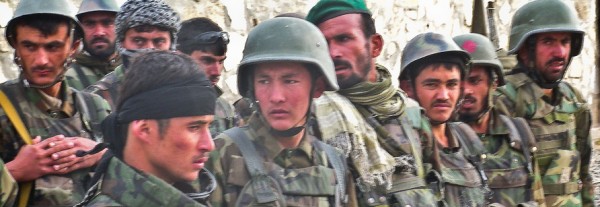
I’m reminded of that sorry-looking policeman when I look at this ragtag collection of Afghan National Army soldiers. It certainly doesn’t help that even when uniformed they are so visibly lacking in uniformity, but their collective look of bewilderment conveys better than any Congressional testimony that they are part of an ill-conceived enterprise.
President seeks clarity on turnover to Afghan government, official says

President Barack Obama does not plan to accept any of the Afghanistan war options presented by his national security team, pushing instead for revisions to clarify how and when U.S. troops would turn over responsibility to the Afghan government, a senior administration official said Wednesday.

Obama still is close to announcing his revamped war strategy, most likely shortly after he returns from a trip to Asia that ends on Nov. 19.

The president raised questions at a war council meeting on Wednesday, however, that could alter the dynamic of both how many additional troops are sent to Afghanistan and what the timeline would be for their presence in the war zone, according to the official, who spoke on condition of anonymity to discuss Obama’s thinking. [continued…]
In Afghanistan, Taliban surpasses al-Qaeda

This year, Omar’s military committee published a rule book for followers, calling on them to protect the population and avoid civilian casualties — much like U.S. counterinsurgency principles. He has railed against the corruption of President Hamid Karzai’s government, an issue that resonates with Afghans. He has also solicited support from other Muslim countries. But al-Qaeda’s agenda of global holy war and taste for mass-casualty attacks, no matter how many Muslim civilians are killed, complicate that goal.

In a February interview with al-Samoud magazine, Taliban political committee leader Agha Jan Mutassim praised the Saudi Arabian government, called for Muslim unity and said the Taliban “respects all different Islamic schools and branches without any discrimination” in Afghanistan.

Such positions may put Omar’s Taliban at odds with al-Qaeda’s extremist Sunni agenda of overthrowing what it sees as corrupt Muslim governments and targeting Shiites. Analysts said that Omar, who leads a council of Taliban commanders based in or around the Pakistani city of Quetta, wants such countries as Saudi Arabia, the United Arab Emirates and Pakistan to recognize the Taliban as a legitimate government if it regains power and that he has little interest in fomenting war elsewhere.

“We assure all countries that the Islamic Emirate of Afghanistan, as a responsible force, will not extend its hand to cause jeopardy to others,” Omar said in a written statement in September.

The messages from the Taliban leadership since the spring amount to something of a “revolution,” said Wahid Mujda, a political analyst who was a Foreign Ministry official under the Taliban government. “Al-Qaeda’s path is now different from the Taliban’s path, and they are growing more separated.” [continued…]

How the US funds the Taliban

Welcome to the wartime contracting bazaar in Afghanistan. It is a virtual carnival of improbable characters and shady connections, with former CIA officials and ex-military officers joining hands with former Taliban and mujahedeen to collect US government funds in the name of the war effort.

In this grotesque carnival, the US military’s contractors are forced to pay suspected insurgents to protect American supply routes. It is an accepted fact of the military logistics operation in Afghanistan that the US government funds the very forces American troops are fighting. And it is a deadly irony, because these funds add up to a huge amount of money for the Taliban. “It’s a big part of their income,” one of the top Afghan government security officials told The Nation in an interview. In fact, US military officials in Kabul estimate that a minimum of 10 percent of the Pentagon’s logistics contracts–hundreds of millions of dollars–consists of payments to insurgents. [continued…]

Afghanistan is neither Vietnam nor Iraq

As President Obama contemplates a new strategy in Afghanistan, Washington is obsessed with whether the best analogy to the conflict lies in Vietnam or Iraq, with attendant and obvious implications for policy. Of course, Afghanistan has little in common with either Vietnam or Iraq in terms of history, geography, culture, or politics. There is, however, a more apt analogy, and it involves the very area in dispute.

Driven by radical Islam, Pashtun nationalism, and armed opportunism, some of the clans in Waziristan — a pair of currently militant-ridden tribal regions in Pakistan and the site of the recent anti-Taliban Pakistani military offensive — rose against British rule in 1936. The rebels improvised roadside bombs, ambushed convoys, and launched hit and run attacks on isolated outposts to drive out alien forces. They kidnapped and beheaded British soldiers and civilians. In unprotected villages, they massacred civilians who did not support them. When troops chased the rebels, they crossed the border with Afghanistan to seek refuge. (Much of this is happening today on either side of Waziristan’s border with Afghanistan.)

Chasing down rebels, patrolling roads, and keeping supply lines open was — and remains — hazardous duty. Soldiers in Waziristan learned to vary their activities or paid with their lives. D. S. Richards in The Savage Frontier quotes a British soldier on “the cardinal Frontier principle of never doing the same thing in the same way twice running,” because “[s]omeone was always watching — someone with an inborn tactical sense, someone who missed nothing.” [continued…]

Facebooktwittermail

Israeli Jews and the one-state solution

Israeli Jews and the one-state solution

Ultimately, as we now know, the combination of internal resistance and international isolation did force whites to abandon political apartheid and accept majority rule. However, it is important to note that the combined strength of the anti-apartheid movement never seriously threatened the physical integrity of the white regime.

Even after the massive township uprisings of 1985-86, the South African regime was secure. “So far there is no real physical threat to white power,” The Economist noted, “so far there is little threat to white lives. … The white state is mighty, and well-equipped. It has the capacity to repress the township revolts far more bloodily. The blacks have virtually no urban or rural guerrilla capacity, practically no guns, few safe havens within South Africa or without.”

This balance never changed, and a similar equation could be written today about the relative power of a massively-armed — and much more ruthless — Israeli state, and lightly armed Palestinian resistance factions.

What did change for South Africa, and what all the weapons in the world were not able to prevent, was the complete loss of legitimacy of the apartheid regime and its practices. Once this legitimacy was gone, whites lost the will to maintain a system that relied on repression and violence and rendered them international pariahs; they negotiated a way out and lived to tell the tale. It all happened much more quickly and with considerably less violence than even the most optimistic predictions of the time. But this outcome could not have been predicted based on what whites said they were willing to accept, and it would not have occurred had the ANC been guided by opinion polls rather than the democratic principles of the Freedom Charter.

Zionism — as many Israelis openly worry — is suffering a similar, terminal loss of legitimacy as Israel is ever more isolated as a result of its actions. Israel’s self-image as a liberal “Jewish and democratic state” is proving impossible to maintain against the reality of a militarized, ultra-nationalist Jewish sectarian settler-colony that must carry out frequent and escalating massacres of “enemy” civilians (Lebanon and Gaza 2006, Gaza 2009) in a losing effort to check the resistance of the region’s indigenous people. Zionism cannot bomb, kidnap, assassinate, expel, demolish, settle and lie its way to legitimacy and acceptance. [continued…]

Facebooktwittermail

What Goldstone says about the US

What Goldstone says about the US

… if Israel is guilty of committing systematic war crimes across Gaza and the West Bank, then the US, which supported, funded and armed Israel during the war, is an accessory to those crimes.

Goldstone explains in no uncertain terms that Gaza was not an aberration in terms of Israel’s treatment of Palestinians.

Rather, it marked not only a continuation of Israel’s behaviour during the 2006 invasion of Lebanon, but “highlights a common thread of the interaction between Israeli soldiers and Palestinian civilians which emerged clearly also in many cases discussed in other parts of the report.

It referenced continuous and systematic abuse, outrages on personal dignity, humiliating and degrading treatment contrary to fundamental principles of international humanitarian law and human rights law”.

“The Mission concludes that the treatment of these civilians constitutes the infliction of a collective penalty on those persons and amounts to measures of intimidation and terror. Such acts are grave breaches of the Geneva Conventions and constitute a war crime,” the report says.

Put simply, if there is blood on Israel’s hands, than it is has dripped all over America’s shirt.

Israel could not and would not have engaged in the level of wholesale destruction of Gaza painstakingly catalogued in the report without the support of the outgoing Bush administration, and acquiescence of the incoming Obama administration. [continued…]

Facebooktwittermail

Why the US will not cut aid to Israel

Department of meaningless gestures

Two eminent mainstream journalists — Tom Friedman and Joe Klein — recently called for United States to disengage from the Israeli-Palestinian peace process, on the grounds that Palestinians were too divided to make a deal and the Israelis were not interested in one. Friedman couldn’t bring himself to draw the logical conclusion — if the United States [is] truly going to “disengage,” that also means cutting off its economic and military assistance — but Klein did.

I have a certain sympathy for this position (and even wrote similar things myself before I wised up), but there are two problems with this specific idea. The first is that it is a meaningless prescription: There’s no way to cut the aid package (or even put a hold on it, which is what Klein recommends) so long as Congress is in hock to AIPAC and the other groups in the status quo lobby. And unless I’ve missed something, I doubt groups like J Street would support it either.

Friedman and Klein’s statements do convey how discourse in the United States is changing, but the specific recommendation they offer here is a non-starter. Remember: we are dealing with a Congress that just voted to condemn the Goldstone Report by a vote of 344-24. The aid package may be indirectly subsidizing the settlements and threatening Israel’s future as a Jewish majority state, but a supine House and Senate will still sign the annual check. [continued…]

Editor’s Comment — The perennial debate on whether the US will ever find the will to cut off aid to Israel invariably misses what is ultimately probably the most important sticking point: a lion’s share of the money that Congress allocates as foreign military aid ends up going back into the US economy. Members of Congress face pressure not only from the Israel lobby but also the defense industry lobby and in many cases their own constituents to keep on doling out the cash.

The Israeli government is currently in the process of negotiating its largest military purchase ever: 25 F-35 fighters at a cost of $3.25 billion, paid to Lockheed-Martin who will start delivery in 2014. Interestingly, Israel has the ability to allocate funds coming from US taxpayers that will appear in US budgets that have yet to be passed or even drafted by Congress!

So, if the White House is not about to call on Congress to cut back on aid to Israel, the one lever over which it retains absolute control is the way the US casts votes in the UN Security Council. I’m not holding my breath waiting for any surprises there.

Perhaps more significant than anything happening (or not happening) in Washington, is the process unfolding around the globe through which Israel is inexorably losing its legitimacy.

When Michael Oren, the Israeli ambassador to the US, warns about the delegitimization of Israel he is giving voice to a real fear among Israelis. That fear is given form when people such as the French Foreign Minister Bernard Kouchner says Israel does not want peace:

“What really hurts me, and this shocks us, is that before there used to be a great peace movement in Israel. There was a left that made itself heard and a real desire for peace,” Kouchner said on France Inter radio.

“It seems to me, and I hope that I am completely wrong, that this desire has completely vanished, as though people no longer believe in it,” he added.

Israel clings to a tenuous claim to being a peace-loving nation. Once the world completely loses faith in that notion, the path to pariah status will be hard to avoid.

Facebooktwittermail

90,000 casualties, but who’s counting?

90,000 casualties, but who’s counting?

Veterans Day arrives tomorrow, and with it, the anticipated harvest of heartbreaking anecdotes driving the press coverage and our ever wandering attention back to less desirable realities: the disfigured but persevering hero, the homeless warrior, the unemployable sergeant, the father or son or daughter who came home a stranger and cannot be reached.

Usually, there is nothing more powerful than a personal story to pound home the cost of eight years of war overseas, but I think today there is something even more disturbing to bear.

It’s the number 89,457.

As of Nov. 9, that’s how many American casualties there were in Iraq and Afghanistan since Oct. 7, 2001, when the Afghan war officially began. That includes a tire-screeching 75,134 dead, wounded-in-action, and medically evacuated due to illness, disease, or injury in Operation Iraqi Freedom (OIF), and 14,323 and counting in Afghanistan, or Operation Enduring Freedom (OEF). [continued…]

Facebooktwittermail

The Taliban solution

The Taliban solution

A powerful grassroots movement has blossomed in Afghanistan, giving its people new hope, self-esteem and a sense of belonging. The problem is that this movement is the Taliban.

As President Obama and his advisers ponder a new Afghan strategy, the conventional wisdom is that this bottom-up insurgency must be attacked with top-down solutions: a stronger central government, a decline in regional warlordism, a more loyal national army.

But research we recently completed for the World Bank shows that what Afghanistan needs is not solutions from the top down but from the bottom up. It needs a good Taliban — a dispersed people’s movement, spanning thousands of villages, through which the Afghan people can regain a sense of control over their government.

Is this utopian fantasy, or is it possible in a country bloodied by its own past?

It may seem utopian under the myths that have become commonplace in the American understanding of Afghanistan. But our findings suggest that those myths need revision. [continued…]

Facebooktwittermail

Gulf Al-Qaida chief: Shi’ites, like Iran, more dangerous than Jews

Gulf Al-Qaida chief: Shi’ites, like Iran, more dangerous than Jews

The leader of Al-Qaida in the Arabian Penninsula warned Tuesday that Shi’ite Muslims, particularly Iran, posed more danger to the world than either Jews or Christians.

“They [Shiites] are being driven by a greed to take over Muslim countries and they are full of a wish to annihilate Sunnis,” Mohammed bin Abdul Rahman al-Rashid said in an audio recording carried by the U.S. monitoring group SITE Intelligence.

“Their threat to Islam and its people is much bigger than that from Jews and Christians,” he added. The majority of the world’s Muslims are Sunni, but Iran and the Lebanon-based group Hezbollah are both Shi’ite. [continued…]

Facebooktwittermail

Key oil figures were distorted by US pressure, says whistleblower

Key oil figures were distorted by US pressure, says whistleblower

The world is much closer to running out of oil than official estimates admit, according to a whistleblower at the International Energy Agency who claims it has been deliberately underplaying a looming shortage for fear of triggering panic buying.

The senior official claims the US has played an influential role in encouraging the watchdog to underplay the rate of decline from existing oil fields while overplaying the chances of finding new reserves.

The allegations raise serious questions about the accuracy of the organisation’s latest World Energy Outlook on oil demand and supply to be published tomorrow – which is used by the British and many other governments to help guide their wider energy and climate change policies. [continued…]

Facebooktwittermail

Blackwater said to approve Iraqi payoffs after shootings

Blackwater said to approve Iraqi payoffs after shootings

Top executives at Blackwater Worldwide authorized secret payments of about $1 million to Iraqi officials that were intended to silence their criticism and buy their support after a September 2007 episode in which Blackwater security guards fatally shot 17 Iraqi civilians in Baghdad, according to former company officials.

Blackwater approved the cash payments in December 2007, the officials said, as protests over the deadly shootings in Nisour Square stoked long-simmering anger inside Iraq about reckless practices by the security company’s employees. American and Iraqi investigators had already concluded that the shootings were unjustified, top Iraqi officials were calling for Blackwater’s ouster from the country, and company officials feared that Blackwater might be refused an operating license it would need to retain its contracts with the State Department and private clients, worth hundreds of millions of dollars annually.

Four former executives said in interviews that Gary Jackson, who was then Blackwater’s president, had approved the bribes and that the money was sent from Amman, Jordan, where the company maintains an operations hub, to a top manager in Iraq. The executives, though, said they did not know whether the cash was delivered to Iraqi officials or the identities of the potential recipients.

Blackwater’s strategy of buying off the government officials, which would have been illegal under American law, created a deep rift inside the company, according to the former executives. They said that Cofer Black, who was then the company’s vice chairman and a former top C.I.A. and State Department official, learned of the plan from another Blackwater manager while he was in Baghdad discussing compensation for families of the shooting victims with United States Embassy officials. [continued…]

Facebooktwittermail

Israeli rabbi approves murder of non-Jews

Israeli rabbi approves murder of non-Jews

A book published this week by a radical Jewish rabbi from the Israeli-occupied West Bank and endorsed by prominent religious right-wing figures suggests killing any non-Jew, including children and babies, who pose a threat to Israel.

The book’s publication, just days after the arrest of Jewish settler Jack Teitel, who is charged with a string of killings, including two Palestinians, reflects a growing antipathy towards Palestinians among Jews living in the occupied territory.

Michael Warschawski, the founder of the Jerusalem-based Alternative Information Centre, said the book went public with a concept that was already being promoted in a quieter way by dozens of settler rabbis in internal community newspapers and speeches. [continued…]

Facebooktwittermail

Ft. Hood and the Clash of Civilizations: Security vs political correctness revisited

Ft. Hood and the Clash of Civilizations: Security vs political correctness revisited

Since the Ft Hood atrocity, I’ve seen a meme going around that it somehow exposed a contradiction between “political correctness” and “security.” The avoidance of Nidal Hassan’s religion out of fear of offending anyone, goes the argument, created the conditions which allowed him to go undetected and unsanctioned in the months and years leading up to his rampage. American security, therefore, demands dropping the “political correctness” of avoiding a confrontation with Islamist ideas and asking the “tough questions” about Islam as a religion and the loyalty of Muslim-Americans.

This framing of the issue is almost 100% wrong. There is a connection between what these critics are calling “political correctness” and national security, but it runs in the opposite direction. The real linkage is that there is a strong security imperative to prevent the consolidation of a narrative in which America is engaged in a clash of civilizations with Islam, and instead to nurture a narrative in which al-Qaeda and its affiliates represent a marginal fringe to be jointly combatted. Fortunately, American leaders — from the Obama administration through General George Casey and top counter-terrorism officials — understand this and have been acting appropriately. [continued…]

Facebooktwittermail

Muslim US Army psychiatrist displayed suspicious interest in how Muslim soldiers might think and feel

Fort Hood suspect warned of threats within the ranks

The Army psychiatrist believed to have killed 13 people at Fort Hood warned a roomful of senior Army physicians a year and a half ago that to avoid “adverse events,” the military should allow Muslim soldiers to be released as conscientious objectors instead of fighting in wars against other Muslims.

As a senior-year psychiatric resident at Walter Reed Army Medical Center, Maj. Nidal M. Hasan was supposed to make a presentation on a medical topic of his choosing as a culminating exercise of the residency program.

Instead, in late June 2007, he stood before his supervisors and about 25 other mental health staff members and lectured on Islam, suicide bombers and threats the military could encounter from Muslims conflicted about fighting in the Muslim countries of Iraq and Afghanistan, according to a copy of the presentation obtained by The Washington Post.

“It’s getting harder and harder for Muslims in the service to morally justify being in a military that seems constantly engaged against fellow Muslims,” he said in the presentation.

“It was really strange,” said one staff member who attended the presentation and spoke on the condition of anonymity because of the investigation of Hasan. “The senior doctors looked really upset” at the end. These medical presentations occurred each Wednesday afternoon, and other students had lectured on new medications and treatment of specific mental illnesses. [continued…]

Editor’s Comment — Repeat after me: “the struggle against Islam is the central feature of American foreign policy,” said David Brooks as he swung a pendulum before Dana Priest’s sleepy eyes, mesmerizing and helping her settle into the appropriate mindset before she sat down to write this report.

I jest, but truly this is a despicable piece of “reporting”.

Hasan was supposed to make a presentation on a medical topic of his choosing but instead he lectured on Islam, suicide bombers and threats the military could encounter from Muslims conflicted about fighting in the Muslim countries of Iraq and Afghanistan.

What kind of audacity and burgeoning violent extremism would lead an American Muslim training as a military psychiatrist to talk about the moral and spiritual anguish that other American Muslim soldiers might face in wars where they would likely end up killing fellow Muslims or destroying their homes?

Surely the only concern of such a doctor must be that he be well-versed in the diagnostic criteria laid out in the DSM-IV — the bible of modern psychiatry — and that he knows how to prescribe drugs appropriately.

A young confused Muslim American soldier comes in for counseling, troubled about the prospect or reality of killing fellow Muslims.

What’s a well-trained psychiatrist going to say?

“Look son, you’re in an all-volunteer army. Next please.”

Facebooktwittermail

Mofaz seeks meeting with senior Hamas officials

Mofaz seeks meeting with senior Hamas officials

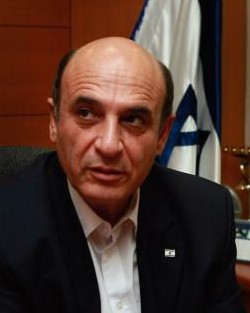
Opposition MK Shaul Mofaz is planning to meet with senior Hamas officials, the Channel 10 website reported late Monday.

On Sunday, Mofaz presented his peace plan, which calls for the establishment within a year of a Palestinian state with provisional boundaries on 60 percent of the West Bank. He urged dialogue with Hamas as a means of achieving peace with the Palestinians.

Mofaz portrayed his proposal as a challenge not only to Prime Minister Benjamin Netanyahu but also to his own party’s leader, Tzipi Livni.

The plan sparked severe criticism, both from the Palestinians as well as within Israel. In response, Mofaz said Monday that “I will talk to the devil himself if that’s what will bring peace,” Israel Radio reported.

In recent years, Mofaz has vehemently rejected any contact with the Islamist Hamas, who violently seized control over the Gaza Strip in a bloody coup in 2007. In a complete turnaround, Mofaz told Israel Radio Monday that if Hamas is voted to power in the upcoming elections – scheduled for January – he is willing to negotiate with them. [continued…]

Hamas adopting more moderate stance?

Something is stirring within the Hamas body politic, a moderating trend that, if nourished and engaged, could transform Palestinian politics and the Arab-Israeli peace process. There are unmistakable signs that the religiously based radical movement has subtly changed its uncompromising posture on Israel.

For example, in the last few months top Hamas officials have publicly stressed that they want to be part of the solution of the Palestinian-Israeli conflict, not part of the problem. What is happening inside Hamas’ mosques and social base shows a concerted effort on the part of its leadership to re-educate its rank and file about co-existence with the Jewish state and in so doing mentally prepare them for a permanent settlement in the future.

In Gazan mosques, pro-Hamas clerics have begun to cite the example of Salah al-Din al-Ayubi, a famed Muslim military commander and statesman, who, after liberating Jerusalem from the Western Crusaders, allowed them to retain a coastal state of their own. The moral lesson of the story is that if the famed leader could tolerate the warring, bloodthirsty Crusaders, then today’s Palestinians should be willing to live peacefully with a Jewish state in their midst. [continued…]

Collapse feared for Palestinian Authority if Abbas resigns

The possible collapse of the Palestinian Authority, Israel’s negotiating partner, loomed Monday, as several aides to its president, Mahmoud Abbas, said that he intended to resign and forecast that others would follow.

“I think he is realizing that he came all this way with the peace process in order to create a Palestinian state, but he sees no state coming,” Saeb Erekat, the chief Palestinian peace negotiator, said in an interview. “So he really doesn’t think there is a need to be president or to have an Authority. This is not about who is going to replace him. This is about our leaving our posts. You think anybody will stay after he leaves?”

Mr. Abbas warned last week that he would not participate in Palestinian elections he called for, to take place in January. But he has threatened several times before to resign, and many viewed this latest step as a ploy by a Hamlet-like leader upset over Israeli and American policy. Many also noted that the vote might not actually be held, given the Palestinian political fracture and the unwillingness of Hamas, which controls Gaza, to participate.

In the days since, however, his colleagues have come to believe that he is not bluffing. If that is the case, they say, the Palestinian Authority could be endangered. [continued…]

Vast majority of Gaza children suffer PTSD symptoms

More than 40 years of Israeli military occupation have had a devastating impact on Palestinians in Gaza. Air strikes, artillery shelling, ground invasions, jet flybys and other acts of violence have all led to an epidemic of suffering among Gaza’s most vulnerable inhabitants. The most recent studies indicate that the vast majority of Gaza’s children exhibit symptoms of post-traumatic stress disorder (PTSD).

Soon after the Israeli winter assault, a group of scholars at the University of Washington discussed different aspects of the situation in Gaza and the Occupied Palestinian Territories (OPT). Dr. Evan Kanter, a UW School of Medicine professor and the current president of Physicians for Social Responsibility, delivered a somber talk describing the mental health situation among Gaza’s population. The numbers he cited described a staggering level of psychological trauma.

Dr. Kanter described studies that revealed 62 percent of Gaza’s inhabitants reported having a family member injured or killed, 67 percent saw injured or dead strangers and 83 percent had witnessed shootings. [continued…]

Mr Netanyahu, tear down this wall

In the 20th anniversary of the fall of the Berlin Wall, Western leaders are full of self-congratulation. But their paeans to universal freedom ring hollow, when they bear large responsibility for another wall constricting human freedom: the apartheid wall dividing the Palestinian West Bank.

Israeli authorities refer to it as a “separation barrier,” but that’s misleading. The wall doesn’t separate pre-1967 Israel from the West Bank. If that’s all it did, it would be an entirely different political object. Instead, the wall cuts deep into the Palestinian West Bank, separating Palestinians from each other and from their land, and signaling to the Palestinians that Israel intends to annex territory that Palestinians want for an independent Palestinian state. The fact that Western countries that support the Israeli government – above all the United States – say nothing about the West Bank wall signals to Palestinians that Western support for Palestinian statehood is merely rhetorical.

Today, AFP reports, Palestinians tore down a chunk of the wall near Ramallah. [continued…]

Facebooktwittermail

West Bank rabbi: Jews can kill Gentiles who threaten Israel

West Bank rabbi: Jews can kill Gentiles who threaten Israel

Just weeks after the arrest of alleged Jewish terrorist, Yaakov Teitel, a West Bank rabbi on Monday released a book giving Jews permission to kill Gentiles who threaten Israel.

Rabbi Yitzhak Shapiro, who heads the Od Yosef Chai Yeshiva in the Yitzhar settlement, wrote in his book “The King’s Torah” that even babies and children can be killed if they pose a threat to the nation.

Shapiro based the majority of his teachings on passages quoted from the Bible, to which he adds his opinions and beliefs. “It is permissable to kill the Righteous among Nations even if they are not responsible for the threatening situation,” he wrote, adding: “If we kill a Gentile who has sinned or has violated one of the seven commandments – because we care about the commandments – there is nothing wrong with the murder.” [continued…]

Israel spy agency tried to recruit alleged killer

A Jewish settler who was arrested for allegedly having murdered two Palestinians was approached by Israel’s internal security agency to be an informer after the attacks, the agency said Friday.

Jack Teitel, a 37-year-old immigrant from the United States, was arrested in October on suspicions of murdering the men in 1997 while visiting Israel as a tourist, the police announced on Sunday. He is also suspected of being behind a string of bomb attacks since 2006.

When Teitel returned to Israel in 2000, three years after the murders, he was questioned by the Shin Bet internal security service and the police over the killings, but no charges were filed. [continued…]

In the garden of bigotry and extremism

Another right-wing Orthodox Jewish killer has come out of the woodwork, which means, again, that the right-wing Orthodox Jewish camp’s stock is going up while that of its opposite number, the secular left, is going down.

This is the way it works now: An “ideological” settler goes on a bombing, shooting and stabbing spree against Palestinians, gays, a left-wing professor, a Christian missionary, maybe a couple of policemen and who knows who else. Immediately, the Orthodox Jewish right professes shock and starts praising itself to the skies, condemning the media and the country’s half-dozen or so leftists for incitement, while intimidating everybody else into nodding their heads.

The people in Shvut Rahel, home of confessed murderer Ya’acov Teitel, suspected accomplice Yosef Shpinoza, former Kach activist Avraham Richland and the late Asher Weisgan (who killed four Palestinian laborers in 2005) are absolutely stunned.

How could it happen – here, of all places? Ya’acov was such a nice, unassuming, quiet guy. He was always helping people. Of course we condemn the murders, what a question! And all these “attempts by the Left to take advantage of the situation for incitement against all of the settlers are ugly and pathetic.” [continued…]

Facebooktwittermail