Nate Silver writes: Hillary Clinton would probably be president if FBI Director James Comey had not sent a letter to Congress on Oct. 28. The letter, which said the FBI had “learned of the existence of emails that appear to be pertinent to the investigation” into the private email server that Clinton used as secretary of state, upended the news cycle and soon halved Clinton’s lead in the polls, imperiling her position in the Electoral College.
The letter isn’t the only reason that Clinton lost. It does not excuse every decision the Clinton campaign made. Other factors may have played a larger role in her defeat, and it’s up to Democrats to examine those as they choose their strategy for 2018 and 2020.
But the effect of those factors — say, Clinton’s decision to give paid speeches to investment banks, or her messaging on pocket-book issues, or the role that her gender played in the campaign — is hard to measure. The impact of Comey’s letter is comparatively easy to quantify, by contrast. At a maximum, it might have shifted the race by 3 or 4 percentage points toward Donald Trump, swinging Michigan, Pennsylvania, Wisconsin and Florida to him, perhaps along with North Carolina and Arizona. At a minimum, its impact might have been only a percentage point or so. Still, because Clinton lost Michigan, Pennsylvania and Wisconsin by less than 1 point, the letter was probably enough to change the outcome of the Electoral College.
And yet, from almost the moment that Trump won the White House, many mainstream journalists have been in denial about the impact of Comey’s letter. The article that led The New York Times’s website the morning after the election did not mention Comey or “FBI” even once — a bizarre development considering the dramatic headlines that the Times had given to the letter while the campaign was underway. Books on the campaign have treated Comey’s letter as an incidental factor, meanwhile. And even though Clinton herself has repeatedly brought up the letter — including in comments she made at an event in New York on Tuesday — many pundits have preferred to change the conversation when the letter comes up, waving it away instead of debating the merits of the case.
The motivation for this seems fairly clear: If Comey’s letter altered the outcome of the election, the media may have some responsibility for the result. [Continue reading…]
North Korea issues direct criticism of China amid nuke dispute
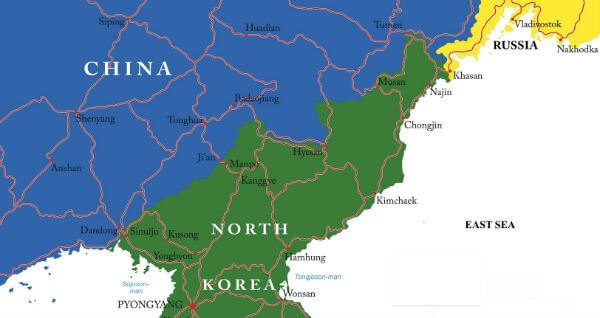
The Associated Press reports: North Korea has issued a rare direct criticism of China through a commentary saying its “reckless remarks” on the North’s nuclear program are testing its patience and could trigger unspecified “grave” consequences.
China, North Korea’s largest trading partner and main benefactor, suspended imports of North Korean coal in line with U.N. sanctions earlier this year and has recently been urging its traditional ally to stop nuclear and missile activities amid U.S. pressure to use its leverage to resolve the nuclear standoff. Chinese state media have also unleashed regular and harsh criticisms on North Korea.
The commentary released Wednesday by the state-run Korean Central News Agency said that “a string of absurd and reckless remarks are now heard from China every day only to render the present bad situation tenser.”
Asked about the KCNA commentary during a regular briefing Thursday, Chinese Foreign Ministry spokesman Geng Shuang said Beijing’s position on “developing good neighborly and friendly cooperation with North Korea is also consistent and clear.” [Continue reading…]
Russia, feeling slighted by Trump, seeks a reset
The New York Times reports: Given the spotlight focused on Russia during the American presidential campaign and Donald J. Trump’s warm words as candidate for President Vladimir V. Putin, the Kremlin anticipated a starring role as foreign policy partner No. 1 under the Trump administration.
Instead, while President Trump has been feting every Theresa, Justin and Abdel Fattah at the White House or at his Mar-a-Lago estate in Florida, including a high-profile dinner with President Xi Jinping of China, Mr. Putin has had to content himself with three measly telephone calls since the inauguration.
“They feel slighted,” Vladimir Frolov, a prominent foreign policy analyst and columnist, said of the Russian leadership. [Continue reading…]
Anand Gopal: The sheer brutality of the Assad regime has led people to join ISIS
Palestinians for Trump: ‘He might be the one’
Politico reports: The Qalandia checkpoint, the main border crossing separating this Palestinian city from East Jerusalem, is not a great place for anyone in a hurry.
On a recent hot afternoon, all passage was halted without explanation as hundreds of Palestinians with permits to work, study or seek medical treatment in Israel—or who actually live there—were packed into a maze of thick iron cages surrounded by barbed wire and monitored by guard towers waiting to be searched, interrogated and, for many, once again humiliated.
After a lengthy delay, small groups were permitted through the turnstiles into the screening areas—some only after being among the unlucky temporarily locked between the heavy revolving bars by an unseen Israeli soldier in an armored guard station with tiny blast-resistant windows.
Though as an accredited American journalist I could have used a speedier route for my return to Jerusalem, I opted to pass through the checkpoint to experience it for myself. Countless Palestinians use the border crossing each day—a procedure Israeli officials say is necessary, like the physical barrier that cuts off much of the West Bank, to prevent terrorism. (The next day, a Palestinian woman stabbed an Israeli soldier at the same checkpoint, one in a recent spate of lone-wolf attacks.)
The daily routine at Qalandia is also a metaphor for the fits and starts of the long struggle to settle the Israeli-Palestinian conflict—which, measured by Israel’s control of the West Bank and Gaza, will reach the milestone next month of half a century on the anniversary of the 1967 Six-Day War.
But there is new glimmer of hope here that things can get moving: Donald Trump.
Trump will welcome Palestinian leader Mahmoud Abbas to the White House on Wednesday ahead of his own planned official visit to the region later this month. In my conversations here with Palestinian officials, I found them surprisingly upbeat about an American president who came to office vowing to crack down on Muslim immigration and who has backed away from longtime U.S. support for a two-state solution.
“The hints are very positive,” General Jibril Rajoub, a member of the central committee of Fatah, the moderate wing of the Palestinian leadership, told me over lunch in late April in a trendy restaurant, Caspar and Gambini’s, on Ramallah’s Al Jihad Street.
A senior Palestinian official, in one of a series of interviews with Politico Magazine, put it this way: “He might be the one to bring the political settlement.”
It is a sense of optimism that virtually no one here anticipated—and one that feels genuine, if also calculated to get into the good graces of the new American leader. Trump’s personal chemistry with hawkish Israeli Prime Minister Benjamin Netanyahu and the pro-settler views of his new ambassador to Israel, David Friedman, were both seen as early omens that the new American president would have little, if any, interest in the Palestinian issue and might even encourage more Israeli settlement construction in the West Bank.
But Rajoub, an urbane diplomat who runs the Palestinian Football Federation and was a longtime adviser to the late Palestinian leader Yasser Arafat, said the quiet but seemingly earnest visits to Ramallah in recent months of CIA Director Mike Pompeo and Jason Greenblatt, the New York lawyer serving as a Trump envoy, were surprisingly positive. [Continue reading…]
Hamas leader plays final hand
The New York Times reports: In the violent flux of the Middle East, Khaled Meshal is one of the great survivors. Down the years other senior figures in Hamas, the Islamist militant group that resists Israel, have died in hotel rooms at the hands of Israeli assassins or been crushed by laser-guided missiles during the wars in Gaza.
Mr. Meshal, who spent his career shifting from one Arab capital to another, had his own close scrape: In 1997, a year after he became the leader of Hamas, Israeli spies sprayed poison into his ear on a street in Jordan, sending Mr. Meshal into a coma and setting off an angry diplomatic showdown between Jordan and Israel that ended with the delivery of a lifesaving antidote.
Now Mr. Meshal is stepping down as the senior leader, ending a 21-year reign during which Hamas grew into a formidable military force and also joined politics to rule Gaza for the past decade. Yet it has become an international pariah for its attacks on civilians.
Mr. Meshal’s parting shot is a new political document, released at a luxury hotel in Doha on Monday, that he is pitching as an attempt to pull Hamas from its isolation by presenting a friendlier face to the world.
A big part of that is its watering down of the anti-Semitic language of the original Hamas charter in 1988, with its talk of war between Arabs and Jews. “We are making it clear that ours is a liberation project — not about religion or the Jews,” Mr. Meshal said in an interview on Tuesday in Doha, his latest home.
His offer found few takers. Prime Minister Benjamin Netanyahu of Israel immediately rejected the overture as an exercise in insincerity. “Hamas is attempting to fool the world, but it will not succeed,” his spokesman said Monday. Hamas is loathed in Israel for bombings and rockets launched indiscriminately into civilian areas, and critics say the group spends too much money preparing for war and not enough on Gaza’s besieged residents.
The document was also greeted with silence by Western countries, a reflection of the fact that Hamas failed to bend on any of the factors that have caused it to be branded a terrorist organization — and has not even formally repudiated the 1988 charter, with its talk of “obliterating” Israel and creating an Islamic State on “every inch” of historic Palestine.
The failure to achieve even that cosmetic gesture offers a telling indication of how Hamas is hamstrung by its own deep-seated ambivalence toward reform, said Nathan Thrall, an analyst with the International Crisis Group who is based in Jerusalem, who noted that the original charter has long been a source of quiet embarrassment among more reform-minded Hamas leaders.
“On one hand, they are attempting to appeal to hard-liners by not giving up their core principles,’’ said Mr. Thrall, the author of a forthcoming book on the Israeli-Palestinian conflict, “The Only Language They Understand.’’
“On the other, people like Meshal were hoping the document could lead to openings with Sunni Arab states and the West. It attempts to please everyone, and in so doing pleases no one.” [Continue reading…]
James Comey ‘mildly nauseous’ over idea he swayed the election
The New York Times reports: James B. Comey, the F.B.I. director, sharply defended his rationale for notifying Congress about new emails related to the Hillary Clinton investigation less than two weeks before Election Day, saying Wednesday that any suggestion he affected the vote’s outcome made him “mildly nauseous.”
Mr. Comey’s comments at a Senate Judiciary Committee oversight hearing were his first public explanation for his actions, which roiled the presidential campaign in its final days and cast a harsh spotlight on the F.B.I. director.
Mr. Comey said he went public on Oct. 28 because he believed that the emails found by his agents might provide insight into Mrs. Clinton’s reasons for using a private server as secretary of state and might change the outcome of the investigation. Failing to inform Congress, Mr. Comey said, would have a required an “act of concealment.”
“Concealment, in my view, would have been catastrophic,” he said, adding later that he knew the decision would be “disastrous for me personally.”
What Mr. Comey viewed as concealing, Justice Department officials viewed simply as following the rules. The F.B.I. does not normally confirm ongoing investigations. Senior Justice Department officials urged him not to send a letter to Congress informing them that the bureau was examining the new emails. [Continue reading…]
How Sweden became ‘the most alt-right’ country in Europe
BuzzFeed reports: The white nationalist Richard Spencer is partnering with two Swedish outfits to create a company they hope will become a media giant and keep race at the center of the new right wing.
It is envisioned, one co-creator said, as a “more ideological Breitbart.” Called the AltRight Corporation, it links Spencer with Arktos Media, a publishing house begun in Sweden to print English-language editions of esoteric nationalist books from many countries. The other Swedish partner is Red Ice, a video and podcast platform featuring white nationalists from around the globe.
It was natural for Spencer to turn to Swedes as partners in the new enterprise, given the country’s history as an exporter of white nationalist ideas. But forging formal bonds between nationalists across the Atlantic makes even more sense today, when the politics of Northern Europe is heavily driving the politics of immigration and Islam in the United States.
Sweden has been a key center of white nationalism for decades. In the 1990s, it was a world capital of “white power” heavy metal bands; today, it teems with websites and podcasts promoting a new language of white identity. Nationalists have built this network in a country that immigration opponents worldwide have been closely watching with the belief that it will be the first Western nation to collapse beneath the weight of Muslim immigration. [Continue reading…]
Kremlin critic Aleksei Navalny says attack left him mostly blind in an eye
The New York Times reports: Aleksei A. Navalny, the Russian opposition leader, said on Tuesday that a doctor told him he had lost 80 percent of the sight in one eye after suffering a chemical burn when an assailant threw a green liquid in his face last week.
The eye’s vision may improve, but the outlook is unclear, Mr. Navalny wrote on his website, citing his doctor.
Initially, the attack had appeared less serious; dousing opposition figures with green dye is a common occurrence and often attributed to pro-Kremlin activists. Typically, a type of topical medical disinfectant has been used. It is difficult to wash out but harmless.
Mr. Navalny, who has declared his intention to run in Russia’s presidential election next year, had already been splashed in the face with green dye once this spring, without any adverse affects.
But after the attack on Thursday, in which a man threw the green liquid in the opposition leader’s face and then ran away, Mr. Navalny was taken to a hospital to treat burning in his right eye.
In a post on his website on Tuesday, Mr. Navalny said his ophthalmologist had told him that he had a “chemical burn on the right eye” caused by something other than the green-colored disinfectant. “There was clearly a mix of disinfectant and another, caustic chemical,” Mr. Navalny wrote. [Continue reading…]
Two-thirds of Canada’s electricity now comes from renewable energy
The Canadian Press reports: Two-thirds of Canada’s electricity supply now comes from renewable sources such as hydro and wind power, the National Energy Board said in a report released Tuesday.
Renewable energy production jumped 17 per cent between 2005 and 2015. The portion of all electricity in Canada generated by renewables is now 66 per cent, up from 60 per cent a decade earlier.
“I think people don’t understand just how much of our generation is the renewables,” said NEB chief economist Shelley Milutinovic. “Probably very few people would know Canada produces the second most hydro in the world.” [Continue reading…]
Technology doesn’t make us better people
Nicholas Carr writes: Welcome to the global village. It’s a nasty place.
On Easter Sunday, a man in Cleveland filmed himself murdering a random 74-year-old and posted the video on Facebook. The social network took the grisly clip down within two or three hours, but not before users shared it on other websites — where people around the world can still view it.
Surely incidents like this aren’t what Mark Zuckerberg had in mind. In 2012, as his company was preparing to go public, the Facebook founder wrote an earnest letter to would-be shareholders explaining that his company was more than just a business. It was pursuing a “social mission” to make the world a better place by encouraging self-expression and conversation. “People sharing more,” the young entrepreneur wrote, “creates a more open culture and leads to a better understanding of the lives and perspectives of others.”
Earlier this year, Zuckerberg penned another public letter, expressing even grander ambitions. Facebook, he announced, is expanding its mission from “connecting friends and family” to building “a global community that works for everyone.” The ultimate goal is to turn the already vast social network into a sort of supranational state “spanning cultures, nations and regions.”
But the murder in Cleveland, and any similar incidents that inevitably follow, reveal the hollowness of Silicon Valley’s promise that digital networks would bring us together in a more harmonious world.
Whether he knows it or not, Zuckerberg is part of a long tradition in Western thought. Ever since the building of the telegraph system in the 19th century, people have believed that advances in communication technology would promote social harmony. The more we learned about each other, the more we would recognize that we’re all one. In an 1899 article celebrating the laying of transatlantic Western Union cables, a New York Times columnist expressed the popular assumption well: “Nothing so fosters and promotes a mutual understanding and a community of sentiment and interests as cheap, speedy, and convenient communication.”
The great networks of the 20th century — radio, telephone, TV — reinforced this sunny notion. Spanning borders and erasing distances, they shrank the planet. Guglielmo Marconi declared in 1912 that his invention of radio would “make war impossible, because it will make war ridiculous.” AT&T’s top engineer, J.J. Carty, predicted in a 1923 interview that the telephone system would “join all the peoples of the earth in one brotherhood.” In his 1962 book “The Gutenberg Galaxy,” the media theorist Marshall McLuhan gave us the memorable term “global village” to describe the world’s “new electronic interdependence.” Most people took the phrase optimistically, as a prophecy of inevitable social progress. What, after all, could be nicer than a village?
If our assumption that communication brings people together were true, we should today be seeing a planetary outbreak of peace, love, and understanding. Thanks to the Internet and cellular networks, humanity is more connected than ever. Of the world’s 7 billion people, 6 billion have access to a mobile phone — a billion and a half more, the United Nations reports, than have access to a working toilet. Nearly 2 billion are on Facebook, more than a billion upload and download YouTube videos, and billions more converse through messaging apps like WhatsApp and WeChat. With smartphone in hand, everyone becomes a media hub, transmitting and receiving ceaselessly.
Yet we live in a fractious time, defined not by concord but by conflict. Xenophobia is on the rise. Political and social fissures are widening. From the White House down, public discourse is characterized by vitriol and insult. We probably shouldn’t be surprised. [Continue reading…]
Music: Söndörgő — ‘Drago Kolo’
South Korea’s likely next president asks the U.S. to respect its democracy
The Washington Post reports: South Korea is on the brink of electing a liberal president with distinctly different ideas than the Trump administration on how to deal with North Korea — potentially complicating efforts to punish Kim Jong Un’s regime.
He is also a candidate who fears that the U.S. government has been acting to box him in on a controversial American missile defense system and circumvent South Korea’s democratic process.
“I don’t believe the U.S. has the intention [to influence our election], but I do have some reservations,” Moon Jae-in told The Washington Post in an interview.
Barring a major upset, Moon will become South Korea’s president Tuesday, replacing Park Geun-hye, who was impeached in March and is on trial on bribery charges. Because Park was dismissed from office, Moon will immediately become president if elected, without the usual transition period.
With Moon pledging to review the Park government’s decision to deploy the Terminal High Altitude Area Defense (THAAD) antimissile system, the U.S. military has acted swiftly to get it up and running. This has sparked widespread criticism here that the United States is trying to make it difficult, if not impossible, for Moon to reverse it. [Continue reading…]
The Associated Press reports: The anger is palpable on a narrow road that cuts through a South Korean village where about 170 people live between green hills dotted with cottages and melon fields. It’s an unlikely trouble spot in the world’s last Cold War standoff.
Aging farmers in this corner of Seongju county, more than 200 kilometers (125 miles) south of the capital Seoul, spend the day sitting by the asphalt in tents or on plastic stools, watching vehicles coming and going from a former golf course where military workers are setting up an advanced U.S. missile-defense system.
“Just suddenly one day, Seongju has become the frontline,” said a tearful Park Soo-gyu, a 54-year-old strawberry farmer. “Wars today aren’t just fought with guns. Missiles will be flying and where would they aim first? Right here, where the THAAD radar is.” [Continue reading…]
As U.S. and China find common ground on North Korea, is Russia the wild card?

Reuters reports: When North Korean leader Kim Jong Un sent Lunar New Year greetings this year, the first card went to Russian President Vladimir Putin, ahead of leaders from China and other allies of the isolated country, according to its official news agency.
Some academics who study North Korea argue Kim could be looking for Russia to ease any pain if China, which accounts for about 90 percent of North Korea’s trade, steps up sanctions against the isolated country as part of moves to deter its nuclear and missile programmes.
U.S. President Donald Trump lavished praise on Chinese President Xi Jinping last week for Beijing’s assistance in trying to rein in Pyongyang. A day later, U.S. Secretary of State Rex Tillerson pressed the United Nations Security Council to impose more sanctions to further isolate Pyongyang.
There is no sign of any sustainable increase in trade between Russia and North Korea, but business and transport links between the two are getting busier.
A new ferry service starting next week will move up to 200 passengers and 1,000 tonnes of cargo six times a month between North Korea and the Russian port of Vladivostok. [Continue reading…]
In the Trump White House, the momentum has turned against the Paris climate agreement
The Washington Post reports: Foes of the Paris climate agreement have gained the upper hand in the ongoing White House debate over whether the U.S. should pull out of the historic pact, according to participants in the discussions and those briefed on the deliberations, although President Trump has yet to make a final decision.
Senior administration officials have met twice since Thursday to discuss whether the United States should abandon the U.N. accord struck in December 2015, under which the United States pledged to cut its greenhouse gas emissions 26 percent to 28 percent below 2005 levels by 2025.
The president’s aides remain divided over the international and domestic legal implications of remaining party to the agreement, which has provided a critical political opening for those pushing for an exit.
On Thursday several Cabinet members — including Environmental Protection Agency Administrator Scott Pruitt, who’s called for exiting the accord, Energy Secretary Rick Perry, who wants it renegotiated, and Secretary of State Rex Tillerson, who advocates remaining a party to it — met with top White House advisers, including Trump’s daughter Ivanka Trump and her husband, Jared Kushner, and Chief of Staff Reince Priebus. Both Ivanka Trump and Kushner advocate remaining part of the U.N. Framework Convention on Climate Change, even though the president has repeatedly criticized the global warming deal. [Continue reading…]
Trump’s conviction in ‘deals’ betrays his lack of conviction in anything else
Jamelle Bouie writes: From Missouri to Nullification to the fierce battles over the Mexican War and the strife of the 1850s and last-ditch efforts to avoid conflict, slavery was the defining domestic concern of the antebellum United States, the dilemma that consumed the energy of the nation’s most able lawmakers and statesman, up until tensions exploded in open warfare. Donald Trump is apparently ignorant of all of this, but his alt-history musings aren’t necessarily unreasonable. Given what we know, what would Andrew Jackson have done in 1860 and 1861? Could it all have been “worked out,” to borrow the president’s words?
If you believe that slavery constituted an irrepressible moral and political conflict in the United States, then a war of some sort was likely inevitable. But that doesn’t mean it couldn’t have been postponed. There’s a case to make that a President Jackson in 1861 could have done just that, by bolstering the planter class and its search for new territories and new markets. This, in fact, was a live option in the timeline as it exists; unionist Democrats like Stephen Douglas, Lincoln’s chief opponent in the 1860 election, sought to preserve the United States through alliance with slaveholders and maintenance of a pro-slavery status quo. As chairman of the Senate committee on territories, Douglas helped craft the 1854 Kansas-Nebraska Act, which effectively undid a key provision of the Missouri Compromise (banning slavery in territories north of that state’s southern border) and organized two new territories—Kansas and Nebraska—that could choose to be slave or free. An almost unambiguous win for Southern slaveholders, Kansas-Nebraska would help push the sectional crisis to its breaking point. Likewise, as a presidential candidate, Douglas stood against Lincoln’s talk of a “house divided.” To talk about the end of slavery, he argued, was “revolutionary and destructive to the existence of this Government.” As Douglas declared in one debate, “I would not endanger the perpetuity of this Union. I would not blot out the great inalienable rights of the white men for all the negroes that ever existed.”
It is easy to imagine a President Jackson in 1860 who followed Douglas’ path. Who, in keeping with his sympathies and beliefs about Americans democracy, forestalled war by advancing the interests of slaveholders and Southern elites even further than Douglas proposed, opening new territories to the expansion of slavery, and organizing the nation’s foreign policy around new markets and opportunities for slave-produced commodities. Jackson may well have prevented the war, at the cost of 4 million black Americans, held in bondage.
That gets to the rub of it all. Trump isn’t wrong to think there was a deal that could have prevented the Civil War. There was. But the price of that deal was the maintenance of slavery; in fact, the strengthening of a monstrous system of violence and exploitation.
That this wasn’t obvious to President Trump—that, judging from his continued tweets on the issue, it still isn’t—is as revealing as it is troubling. It suggests a worldview in which everything can be resolved by deals, where there are no moral stakes or irreconcilable differences, where there aren’t battles that have to be fought for the sake of the nation and its soul. Slavery had to be eradicated, and war was the only option. Any deal that was achievable would have been an immoral maintenance of an abominable status quo.
Likewise, Trump seems to see presidential leadership as a game of dealmaking, where the best and most effective presidents are those that make the most “deals.” But this just isn’t true. Dealmaking and negotiation are part of the job of the presidency, but they have to happen with a purpose in mind; with an idea of the good within reach. [Continue reading…]
Trump enables despotism
Roger Cohen writes: So the threats were no more than bluster, and all is well. That is one view of President Trump’s foreign policy at the 100-day-or-so mark.
Wrong.
Yes, there’s no sign of the Wall, and NATO is no longer “obsolete,” and the “One China” policy has not been scrapped, and the Iran nuclear agreement endures despite Trump’s dismissal of it as “the worst deal ever,” and the United States embassy is still in Tel Aviv, and neither the Paris climate deal nor the North American Free Trade Agreement has been abandoned.
Defense Secretary Jim Mattis and H.R. McMaster, the national security adviser, have ring-fenced Trump’s recklessness and bellicosity. They have neutralized his ignorance even if nobody can help the president grasp its extent. Some of the loonier members of the president’s entourage have been fired or marginalized. Adults have taken charge. There is still a lot of noise, but “America First” has not upended the world.
Except that it has. A disaster is unfolding whose consequences for humanity and decency will be devastating.
The United States under Trump has embarked on a valueless foreign policy. The president has not met a strongman whose machismo does not beguile him. He prefers guns to diplomats. Militarism and mercantilism constitute a new policy, unconstrained by any consideration of what the United States stands for in the world or the values its alliances have defended since 1945.
This is a radical departure. America is also an idea. That idea is inextricable — whatever the country’s conspicuous failings — from the defense of liberty, democracy, human rights, open societies and the rule of law. Realist, neoconservative and liberal internationalist schools have different interpretations of how this may be achieved, and what limits exist on America’s capacity to extend the reach of freedom. But the unblushing, public embrace of the torturer for mutual gain does not appear in any pre-Trump foreign policy manual I know.
A “very friendly” conversation with President Rodrigo Duterte of the Philippines leads to a White House invitation for a man accused of waging a brutal extrajudicial drug war. President Recep Tayyip Erdogan of Turkey cements his repressive and increasingly imperious rule in a dubious referendum and gets a congratulatory call from Trump. The red carpet rolls out for Egypt’s autocratic president, Abdel Fattah el-Sisi, who becomes Trump’s “great friend.” President Xi Jinping of China goes from currency manipulator to “terrific person” and seems to inspire in Trump an embarrassing awe. President Vladimir Putin of Russia, having been lumped early on with Chancellor Angela Merkel of Germany as somebody Trump may or may not be able to trust, basks still in Trump’s agnosticism on brutality.
The message is clear: The United States has granted carte blanche for despots. [Continue reading…]
Russian election hacking ‘wildly successful’ in creating discord, says former U.S. lawmaker
Reuters reports: Russia succeeded in its goals of sowing discord in U.S. politics by meddling in the 2016 presidential election, which will likely inspire similar future efforts, two top former U.S. voices on intelligence said on Tuesday.
Former Director of National Intelligence James Clapper and former House Intelligence Committee Chairman Mike Rogers agreed at a panel at Harvard University that Russia likely believed it had achieved its goals and could attempt to repeat its performance in elections in other countries.
“Their purpose was to sew discontent and mistrust in our elections they wanted us to be at each others’ throat when it was over,” Rogers said at the panel at Harvard’s Kennedy School of Government. “It’s influencing, I would say, legislative process today. That’s wildly successful.” [Continue reading…]