The New York Times reports: Behind the Trump administration’s sudden urgency in dealing with the North Korean nuclear crisis lies a stark calculus: a growing body of expert studies and classified intelligence reports that conclude the country is capable of producing a nuclear bomb every six or seven weeks.
That acceleration in pace — impossible to verify until experts get beyond the limited access to North Korean facilities that ended years ago — explains why President Trump and his aides fear they are running out of time. For years, American presidents decided that each incremental improvement in the North’s program — another nuclear test, a new variant of a missile — was worrisome, but not worth a confrontation that could spill into open conflict.
Now those step-by-step advances have resulted in North Korean warheads that in a few years could reach Seattle. “They’ve learned a lot,” said Siegfried S. Hecker, a Stanford professor who directed the Los Alamos weapons laboratory in New Mexico, the birthplace of the atomic bomb, from 1986 to 1997, and whom the North Koreans have let into their facilities seven times.
North Korea is now threatening another nuclear test, which would be its sixth in 11 years. The last three tests — the most recent was in September — generated Hiroshima-size explosions. It is unclear how Mr. Trump would react to a test, but he told representatives of the United Nations Security Council at the White House on Monday that they should be prepared to pass far more restrictive sanctions, which American officials say should include cutting off energy supplies. [Continue reading…]
Nuclear Threat Initiative reports: Since 2014, North Korea has dramatically altered its missile testing patterns, launching missiles much more frequently and from a variety of new locations. Recognizing the importance of understanding the proliferation implications of these patterns, the James Martin Center for Nonproliferation Studies (CNS) has created a database of every known North Korean missile launch.
The CNS database reveals more subtle changes than simply an increase in the number of missiles that North Korea has launched. The data reveals:
- North Korea has created sites specifically dedicated to developmental testing of missiles
- North Korea has largely abandoned its original missile test site dedicated to development and design verification tests, the Tonghae Satellite Launching Ground. The regime has shifted space launches to the Sohae Satellite Launch Center, and developmental missile tests to Wonsan
- Many recent launches of extended range Scud and Nodong missiles, rather than being developmental in nature, have been undertaken as operational tests at relevant military units’ training grounds
Taken together, these trends make the clear and disturbing point that North Korea has been conducting launch exercises, consistent with the regime’s probable intent to deploy nuclear weapons to missile units throughout the country.
North Korea’s totalitarian regime releases propaganda rather than facts about its missile capabilities. Analysts at CNS estimate the evolution of the regime’s true capabilities by locating every test site and examining open source evidence about the tests, from regime propaganda to satellite imagery. This information helps to determine the purpose of each launch, and how well developed each missile system is. For example, if North Korea only tests a missile at a site from which it conducts developmental tests, it is highly likely the missile remains purely under development. Tests elsewhere suggest North Korea is trying to achieve some other goal than seeing whether the missile works.
North Korea established the Tonghae Satellite Launching Ground, near Musudan-ri, as its first missile testing site in 1984. Tonghae was North Korea’s primary developmental test site for its first generation of ballistic missiles. Because North Korea doesn’t disclose the names and types of its missiles, outside analysts named them after nearby locations – the villages of No-dong, Taepo-dong, and Musudan. Of the fifteen known missile launches carried out under Kim Il Sung, all but one was conducted at Tonghae. At least one-third of these developmental tests, in which North Korea experimented with different designs and attempted to perfect its reverse-engineered missile technology, ended in catastrophic failure.
Developmental testing of new missiles paused for four years after Kim Jong Il succeeded his father in 1994. Kim Jong Il restarted missile testing with an attempted Taepodong launch in 1998. The missile made it off the ground and over Japan before exploding spectacularly and splashing down into the Pacific. The immediate international outcry prompted talks between the United States and North Korea, which resulted in a ballistic missile testing moratorium.
After abandoning the moratorium in 2006, North Korea resumed missile testing. By then, it had converted the Tonghae facility entirely into a space launch facility, which the regime used for two more space launch attempts in 2006 and 2009 (both of which failed). North Korea moved developmental testing of new missiles to a new site near the city of Wonsan, usually called Kittaeryong. Of the 16 rockets that North Korea launched during Kim Jong Il’s rule, only 3 were launched from Tonghae and all of these were space launches – in 1998, 2006 and 2009. All other launches during this period occurred from the Wonsan area. This shift in behavior can clearly be seen in this interactive, which displays the test locations used by Kim Il Sung, Kim Jong Il, and Kim Jong Un. [Continue reading…]


On March 9, Jeffrey Lewis wrote: On Monday morning, North Korea launched four missiles from the northwest corner of the country that traveled 620 miles before landing in the Sea of Japan.
While none of the launches were the long-awaited test of an intercontinental-range ballistic missile — the sort of weapon that could reach the United States — the salvo was a big deal in its own way. Pyongyang very vividly demonstrated the warnings from Thae Yong-ho, a high-ranking North Korean diplomat who defected last year and described how the country was taking the final steps to arm its missile units with nuclear weapons. North Korea is developing an offensive doctrine for the large-scale use of nuclear weapons in the early stages of a conflict. When combined with what we know about U.S. and South Korean war plans, this fact raises troubling questions about whether a crisis on the Korean peninsula might erupt into nuclear war before President Donald Trump has time to tweet about it.
In the past, North Korea tested all its No-dong missiles out of a single military test site near a village of the same name. (Why, yes, the U.S. analysts did name the missiles after the town. The emasculating quality was a pure coincidence, I am sure.) These tests were designed to demonstrate that the Scud and No-dong missiles worked. They were tests in the literal sense of the word.
In recent years, however, North Korea has started launching Scuds and No-dongs from different locations all over the damn country. These aren’t missile tests, they are military exercises. North Korea knows the missiles work. What the military units are doing now is practicing — practicing for a nuclear war.
The North Koreans haven’t exactly been coy about this. Last year, North Korea tested a No-dong missile. Afterward, North Korea published a map showing that the missile was fired to a point at sea that was the exact range as South Korea’s port city of Busan, with an arc running from the target into the ocean, down to Busan. In case you missed the map, the North Koreans spelled it out: “The drill was conducted by limiting the firing range under the simulated conditions of making preemptive strikes at ports and airfields in the operational theater in South Korea where the U.S. imperialists’ nuclear war hardware is to be hurled.”
This time, North Korea launched four “extended-range” Scud missiles that are capable of flying up to 620 miles. The map showed all four missiles landing on an arc that stretched down to the Marine Corps Air Station near Iwakuni, Japan. Once again, the North Korean statement doesn’t leave much to the imagination: “Involved in the drill were Hwasong artillery units of the KPA (Korean People’s Army) Strategic Force tasked to strike the bases of the U.S. imperialist aggressor forces in Japan in contingency.”
So why is North Korea practicing nuking U.S. forces in Japan?
The United States and South Korea are conducting their largest annual joint military exercise, known as Foal Eagle. The exercise, which is really a series of exercises, lasts two months and involves tens of thousands of U.S. and South Korean military personnel, as well as an aircraft carrier, bombers, and — guess what? — F-35 aircraft based out of Iwakuni. Foal Eagle is a rehearsal for the U.S.-Republic of Korea war plan, known as OPLAN 5015, which has been described as a pre-emptive strike against North Korea, including its leadership, as a retaliation for some provocation. Whether that’s a fair description or not, the North Koreans certainly think the annual exercise is a dress rehearsal for an invasion. This year’s menu of fun and games reportedly includes a U.S.-ROK special operations unit practicing an airborne assault on North Korea’s nuclear and missile facilities.
What North Korea is doing is simply counterprogramming the Foal Eagle with its own exercise. If we are practicing an invasion, they are practicing nuking us to repel that invasion. [Continue reading…]
Politico reports: The Turkish man who gave Mike Flynn a $600,000 lobbying deal just before President Donald Trump picked him to be national security adviser has business ties to Russia, including a 2009 aviation financing deal negotiated with Vladimir Putin, according to court records.
The man, Ekim Alptekin, has in recent years helped to coordinate Turkish lobbying in Washington with Dmitri “David” Zaikin, a Soviet-born former executive in Russian energy and mining companies who also has had dealings with Putin’s government, according to three people with direct knowledge of the activities.
This unusual arrangement, in which Alptekin and Zaikin have helped steer Turkish lobbying through various groups since at least 2015, raises questions about both the agenda of the two men and the source of the funds used to pay the lobbyists.
Although Turkey is a NATO ally, its president, Recep Tayyip Erdogan, has grown increasingly authoritarian and friendly with Putin. And the hiring of Flynn by Alptekin came at a time when Flynn was working for Trump’s campaign and Putin’s government was under investigation for interfering with the U.S. election. [Continue reading…]
Politico reports: President Donald Trump isn’t the only one promoting his private Mar-a-Lago club as the “winter White House.” His foreign policy team has gotten in on it too.
The State Department and at least two U.S. embassies — the United Kingdom and Albania — earlier this month circulated a 400-word blog post detailing the long history of the president’s South Florida club, which has been open to dues-paying members since the mid-1990s and is now used by Trump for frequent weekend getaways. He has hosted foreign leaders there twice.
The blog post — written by the State Department-managed site Share America — described the “dream deferred” when Mar-a-Lago’s original builder, Marjorie Merriweather Post, willed the property to the federal government upon her death in 1973, with the stipulation it be used as a winter retreat for the president.
“Her plan didn’t work, however,” the post’s author, Leigh Hartman, wrote, explaining how the government returned the property to Post’s trust because it cost too much money to maintain. Trump bought the property and its furniture in 1985, and he opened it a decade later as a private club.
“Post’s dream of a winter White House came true with Trump’s election in 2016,” Hartman wrote.
Share America removed the post on Monday after the State Department’s efforts to share the article — originally published just before Trump hosted Chinese President Xi Jinping at Mar-a-Lago — drew criticism. “The intention of the article was to inform the public about where the President has been hosting world leaders. We regret any misperception and have removed the post,” read a statement on the site in place of the post. [Continue reading…]
The Wall Street Journal reports: Hackers matching the profile of a pro-Kremlin group have tried in recent weeks to access campaign email accounts of French presidential candidate Emmanuel Macron, a cybersecurity firm said Monday, raising fears of election interference in the final two weeks of the France’s presidential campaign.
In a report set to be published Tuesday, security-research firm Trend Micro identified a pro-Kremlin hacking group it calls Pawn Storm as the likely source of a multipronged phishing attack that started in mid-March against Mr. Macron’s campaign.
As part of the attack, hackers set up multiple internet addresses that mimicked those of the campaign’s own servers in an attempt to lure Mr. Macron’s staffers into turning over their network passwords, said Feike Hacquebord, a senior threat researcher for Tokyo-based Trend Micro and the author of the report, a copy of which was reviewed by The Wall Street Journal.
Mounir Mahjoubi, digital director of Mr. Macron’s campaign, confirmed the attempted hacking, saying that several staffers had received emails leading to the fake websites. The phishing emails were quickly identified and blocked, and it was unlikely others went undetected, Mr. Mahjoubi said.
“We can’t be 100% sure,” he said, “but as soon as we saw the intrusion attempts, we took measures to block access.”
The hacking group Pawn Storm, which is known to other cybersecurity firms as Fancy Bear or APT28, was identified by U.S. officials and cybersecurity experts last year as a Russian state-backed organization. They said the group had carried out hacks to obtain and subsequently leak emails from the Democratic National Committee and Hillary Clinton’s campaign chairman during last year’s U.S. presidential election, allegations that Russia denied. [Continue reading…]
The Washington Post reports: The general in charge of U.S. forces in Afghanistan appeared to confirm Monday that Russia is sending weapons to the Taliban, an intervention that will likely further complicate the 15-year-old war here and the Kremlin’s relations with the United States.
When asked by reporters, Gen. John Nicholson did not dispute claims that the Taliban is receiving weapons and other supplies from the Russians.
“We continue to get reports of this assistance,” Nicholson said, speaking to reporters alongside Defense Secretary Jim Mattis. “We support anyone who wants to help us advance the reconciliation process, but anyone who arms belligerents who perpetuate attacks like the one we saw two days ago in Mazar-e Sharif is not the best way forward to a peaceful reconciliation.” [Continue reading…]
Aric Toler and Melinda Haring report: Hacked emails show that the Kremlin directs and funds the ostensibly independent republics in eastern Ukraine and runs military operations there. In late 2016, Ukrainian hacker groups released emails purportedly taken from the office of Kremlin official Vladislav Surkov, who oversees Ukraine policy for Russian President Vladimir Putin. The Surkov leaks confirm what many have long suspected: the Kremlin has orchestrated and funded the supposedly independent governments in the Donbas, and seeks to disrupt internal Ukrainian politics, making the task of rebuilding modern Ukraine impossible. Russia has consistently denied accusations from Kyiv and the West that it is providing the separatists with troops, weapons, and other material support or meddling in Ukrainian affairs. The emails from Surkov’s office betray the official Kremlin line, revealing the extent of Russian involvement in the seizure of Ukrainian territory, the creation of puppet “people’s republics,” and the funding to ensure their survival.
There have been three tranches of information from Surkov’s account: a PDF document detailing plans to destabilize Ukraine, a dump of 2,337 emails, and a final dump of 1,000 emails. While the plot to destabilize Ukraine with its detailed plan to use energy tariffs to foment revolution has garnered attention, its veracity is disputed. The trove of 2,337 emails, released by the hacker group Cyber Hunta, covers the period from September 2013 to November 2014, when Russia illegally annexed Crimea and deployed separatist proxies in eastern Ukraine to start a war. The final dump dates from September 2014 to September 2016. We have analyzed the overlooked second and third troves. Here’s what we found. [Continue reading…]
Michael Weiss writes: There is no one more zealous than a convert.
CIA Director Mike Pompeo previously welcomed WikiLeaks’ disclosures about Hillary Clinton and the Democratic National Committee when these proved helpful to the Republican nominee. Now he has experienced a road-to-Damascus moment.
“WikiLeaks,” Pompeo said at a think tank event last week, “walks like a hostile intelligence service and talks like a hostile intelligence service.” Pompeo also regards Julian Assange, the publisher of WikiLeaks and the lonely maintainer of its hyper-active Twitter account, as a “fraud.”
In a rather folksy fly-over metaphor, the former Kansas representative likened the albinoid antipodean anarchist to the Wizard of Oz, perhaps forgetting that the man behind the curtain turned out to be an all-right guy in the end rather than a helpmeet of European dictatorship and a purveyor of conspiracy theories about the Rothschilds.
Pompeo isn’t the only one who’s changed his mind about the man holed up for five long years at the Ecuador embassy in London. The U.S. Justice Department, headed by Jeff Sessions—a man who conveniently forgot while testifying before Congress that he twice met with the Russian ambassador to the United States—now considers arresting Assange a “priority.” [Continue reading…]
Arresting Assange is a “priority” of an undisclosed magnitude — I’m doubtful that it can be particularly high.
No doubt at a time when this administration is going out of its way to create the appearance that it has no ties to Russia, a tough-on-Wikileaks stance might seem desirable.
But let’s not forget that Assange himself has repeatedly claimed that he is willing to accept extradition to the United States.
So is it just a matter of time before the cable news networks will be able to feast on 24/7 coverage of the trial of the century?
Probably not.
Ignoring the question of whether the Justice Department can actually construct a legal case against Assange, I seriously doubt that the White House would welcome seeing him testifying in court. Indeed he might not even make it to his own trial if he sought and received immunity as an FBI witness.
The message that the U.S. wants to get its hands on Assange may have had less to do with challenging his ability to remain in refuge than it has with making sure he remains where he is. Likewise, he will probably remain a problem Moscow doesn’t need to solve so long as he stays put.
The irony is that if Assange had complied with Sweden’s request to question him in 2010, whatever the outcome of that interrogation, it is quite likely that by now he would be a free man. Instead he endures a self-imposed prison sentence for which there is no end in sight.
The New York Times reports: The chairman of a United Nations commission investigating possible war crimes in Syria has met that country’s ambassador only once, he said. It happened during a chance encounter in a hallway after he had given a briefing to the General Assembly in New York.
“Then for 15 minutes, he gave me a lecture,” the commission chairman, Paulo Sérgio Pinheiro, said of his exchange with the Syrian envoy, Bashar al-Jaafari. “We don’t have any hope that the Syrians will cooperate with us.”
Members of the commission, created by the United Nations Human Rights Council in August 2011, have never been permitted to visit Syria by the government of President Bashar al-Assad, which appears to view them as accomplices of Mr. Assad’s enemies.
The commission, with a support staff of about 25 people, has collected an enormous volume of material, which could be used in courts, about the atrocities committed in the six-year-old civil war by both Mr. Assad’s side and the groups arrayed against him. [Continue reading…]
Tom Rollins reports: It might not look like much now – patches of turf and half-finished dust roads bulldozed through orchards and farmhouses – but a three-square-kilometre plot of land in the neighbourhood of Basateen al-Razi is fast becoming ground zero for the reconstruction of Syria. Critics say it is also the urban planning blueprint President Bashar al-Assad intends to use to consolidate his post-war power.
Back in September 2012, al-Assad signed legislative decree (66/2012) to “redevelop areas of unauthorised housing and informal settlements [slums]”. Decree 66 has since provided the legal and financial foundation for reconstruction in several areas returned to Syrian government control, including Basateen al-Razi.
Al-Assad inaugurated the multi-million-dollar urban redevelopment project in March 2016, promising grand designs and a scintillating future for the capital. Armed with planning documents full of futuristic tower blocks, park boulevards, and row upon row of modern-fronted housing, the Damascus Governorate says the 2.15-million-square-metre development will provide 12,000 housing units for an estimated 60,000 residents. There will be schools and restaurants, places of worship, even a multi-storey car park and a shopping mall.
Not everyone shares the government’s vision for the future. Opposition activists and independent analysts, as well as former residents, argue that Decree 66 is not only being used to forcibly dispossess Basateen al-Razi civilians but also to engineer demographic change. [Continue reading…]
Reuters reports: Top Trump administration officials will hold a rare briefing on Wednesday at the White House for the entire U.S. Senate on the situation in North Korea, senior Senate aides said on Monday.
All 100 senators have been asked to the White House for the briefing by Secretary of State Rex Tillerson, Secretary of Defense Jim Mattis, Director of National Intelligence Dan Coats and General Joseph Dunford, chairman of the Joint Chiefs of Staff, the aides said.
While top administration officials routinely travel to Capitol Hill to address members of Congress on foreign policy and national security matters, it is unusual for the entire 100-member Senate to go to such an event at the White House, and for those four top officials to be involved. [Continue reading…]
In an editorial, The Guardian says: The news that Egypt’s army shot dead up to eight unarmed detainees, including a minor, in the Sinai peninsula and tried to cover up the extrajudicial killings by claiming they had happened in combat should alarm all those interested in the cause of democracy in the Arab world. Back in December the Egyptian army posted on its Facebook page that the military had raided a militant outpost, killing eight and arresting four others. But a three-minute video that emerged this weekend raises serious questions over the army’s version of events. It shows no firefight but does record the cold-blooded murder of prisoners. In one instance a soldier casually shoots a man in the head. In another, soldiers escort a blindfolded man into a field, place him on his knees and shoot him repeatedly. Predictably, Cairo’s military dictatorship calls this propaganda by its opponents. Just as predictable is that there’s to be no investigation into alleged war crimes.
The video was leaked on the day the US defence secretary, Jim Mattis, sat down with Egypt’s ruler, Abdel Fatah al-Sisi, who seized power in a bloody coup in 2013. Possibly the most authoritarian leader in the Middle East, a title for which there is some competition, Mr Sisi bears responsibility for the deaths of hundreds of Egyptians, jailing thousands of others and running his country’s economy into the ground.
Instead of treating the Egyptian leader as a pariah, this month Donald Trump welcomed him to the White House after he had been cold-shouldered by Barack Obama for years. Cairo’s pro-Sisi press proclaimed human rights in Egypt were no longer an issue. This may be true. While Egypt remains a human rights “priority country” for Britain, the foreign secretary, Boris Johnson, did not focus on them when he visited the country in February. Perhaps Britain cannot afford such moral positions. British companies have extensive offshore gas interests in Egypt. The hypocrisy is not just ours. Following the coup, an EU arms embargo was brought in but it is honoured more in the breach. About £120m in British arms have been sold since the coup. [Continue reading…]
Michael Harris writes: On April 14, 1934, Richard Byrd went out for his daily walk. The air was the usual temperature: minus 57 degrees Fahrenheit. He stepped steadily through the drifts of snow, making his rounds. And then he paused to listen. Nothing.
He attended, a little startled, to the cloud-high and over-powering silence he had stepped into. For miles around the only other life belonged to a few stubborn microbes that clung to sheltering shelves of ice. It was only 4 p.m., but the land quavered in a perpetual twilight. There was—was there?—some play on the chilled horizon, some crack in the bruised Antarctic sky. And then, unaccountably, Richard Byrd’s universe began to expand.
Later, back in his hut, huddled by a makeshift furnace, Byrd wrote in his diary:
Here were imponderable processes and forces of the cosmos, harmonious and soundless. Harmony, that was it! That was what came out of the silence—a gentle rhythm, the strain of a perfect chord, the music of the spheres, perhaps.
It was enough to catch that rhythm, momentarily to be myself a part of it. In that instant I could feel no doubt of man’s oneness with the universe.
Admiral Byrd had volunteered to staff a weather base near the South Pole for five winter months. But the reason he was there alone was far less concrete. Struggling to explain his reasons, Byrd admitted that he wanted “to know that kind of experience to the full . . . to taste peace and quiet and solitude long enough to find out how good they really are.” He was also after a kind of personal liberty, for he believed that “no man can hope to be completely free who lingers within reach of familiar habits.” [Continue reading…]
Zack Beauchamp writes: To understand what France’s election means, and what it tells us about the rise of far-right movements around Europe, you need to understand two fundamental truths about the results.
The first is that it’s a historic victory for the far-right Marine Le Pen and her Front National party. Le Pen was one of two candidates who qualified for the second round, soundly beating the standard-bearers both of France’s traditional establishment parties — the center-right Republicans and center-left Socialists. The once-reviled Front has clearly entered the mainstream of French politics.
At the same time, the election seemed to demonstrate the very clear limits of Le Pen’s popularity — and, potentially, European far-right politics more broadly.
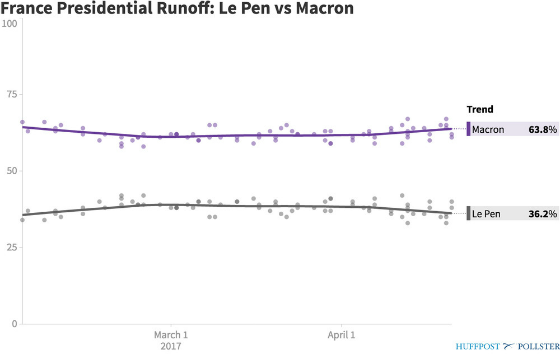
Le Pen came in second in Sunday’s election, with 21.7 percent of the vote. The plurality winner, upstart centrist Emmanuel Macron, won with 23.9 percent. He’s her polar opposite in virtually every respect. She wants to restrict immigration to France and pull France out of the EU; he supports keeping the borders open and proudly waved the EU flag at his final campaign rally. And when these two face each other one-on-one in a runoff in two weeks, he’s very likely to win — every poll that’s been taken so far has him up by massive margins:
The tolerant center, in France, appears likely to hold.What we’re seeing in France mirrors what’s happening in much of Europe. After the twin shocks of Brexit and Trump, the far-right has seen a series of setbacks. From elections in Austria and the Netherlands to polls in all-important Germany, the far-right is performing far less well than many have expected.
What these numbers suggest is that the far-right has a political ceiling: That while its supporters may be hard-core, the majority of Europeans still recoil from its vision — at least for now. [Continue reading…]

The Daily Beast reports: The Senate Intelligence Committee’s probe into Russia’s election interference is supposedly the best hope for getting the public credible answers about whether there was any coordination between the Kremlin and Trump Tower.
But there are serious reasons to doubt that it can accomplish this task, as currently configured.
More than three months after the committee announced that it had agreed on the scope of the investigation, the panel has not begun substantially investigating possible ties between the Trump campaign and Russia, three individuals with ties to the committee told The Daily Beast.
The investigation does not have a single staffer dedicated to it full-time, and those staff members working on it part-time do not have significant investigative experience. The probe currently appears to be moving at a pace slower than prior Senate Intelligence Committee investigations, such as the CIA torture inquiry, which took years to accomplish.
No interviews have been conducted with key individuals suspected of being in the Trump-Russia orbit: not Michael Flynn, not Roger Stone, not Carter Page, not Paul Manafort, and not Jared Kushner, according to two sources familiar with the committee’s procedures. [Continue reading…]