White House considers four options for modifying NSA mass phone surveillance

The Wall Street Journal reports that administration lawyers have presented the White House with four options for reforming the NSA’s mass phone-surveillance program the first of which would require phone companies to store such data and deliver specific search requests.

A second option presented to the White House would have a government agency other than the NSA hold the data, according to a U.S. official. Candidates for this option could include the Federal Bureau of Investigation, which some current and former intelligence officials have recommended.

Another possibility floated in policy circles was turning the program over to the custody of the Foreign Intelligence Surveillance Court, which oversees the phone-data and other NSA surveillance programs, but judges have balked at an expanded role for the court.

A third option would be for an entity outside the phone companies or the government to hold the data, officials said. This approach has been criticized by privacy groups who say such a third party would just become an extension of the NSA and would provide no additional privacy benefit.

A final alternative would be to scrap the phone-data program and instead bolster investigative efforts under current authorities to obtain the information about possible terrorist connections some other way, an official said. Mr. Obama acknowledged this approach in his January speech, but said “more work needs to be done to determine exactly how this system might work.”

Facebooktwittermail

Leaked tapes prompt calls for Turkish PM to resign

n13-iconThe Guardian reports: Turkish opposition parties called on the prime minister to resign on Tuesday as a result of an explosive corruption scandal in which he was allegedly caught on tape ordering his son to get rid of millions of dollars in incriminating cash.

Recep Tayyip Erdogan responded in characteristically robust form, dismissing the allegations against him as a plot to bring down his government – the latest in a wave of accusations fuelling widespread popular protest against his 11-year rule.

Recordings of phone-tapped conversations leaked on the internet appear to capture Erdogan instructing his 33-year-old son, Bilal, to dispose of large amounts of hidden funds from their private home in the midst of a corruption investigation.

Erdogan has rejected the allegations as “complete lies”, insisting the recordings were fabricated to discredit his government. “Yesterday they published a play that they have assembled and dubbed themselves,” he told a meeting of his ruling Justice and Development party (AKP). “What has been done is a vile attack against the Republic of Turkey and her prime minister. If we bow to this, we will be doing injustice to all coming prime ministers and ministers.” [Continue reading…]

Facebooktwittermail

FBI had human source in contact with bin Laden as far back as 1993

n13-iconThe Washington Times reports: In a revelation missing from the official investigations of the Sept. 11, 2001, terrorist attacks, the FBI placed a human source in direct contact with Osama bin Laden in 1993 and ascertained that the al Qaeda leader was looking to finance terrorist attacks in the United States, according to court testimony in a little-noticed employment dispute case.

The information the FBI gleaned back then was so specific that it helped thwart a terrorist plot against a Masonic lodge in Los Angeles, the court records reviewed by The Washington Times show.

“It was the only source I know in the bureau where we had a source right in al Qaeda, directly involved,” Edward J. Curran, a former top official in the FBI’s Los Angeles office, told the court in support of a discrimination lawsuit filed against the bureau by his former agent Bassem Youssef.

Mr. Curran gave the testimony in 2010 to an essentially empty courtroom, and thus it escaped notice from the media or terrorism specialists. The Times was recently alerted to the existence of the testimony while working on a broader report about al Qaeda’s origins.

Members of the Sept. 11 commission, congressional intelligence committees and terrorism analysts told The Times they are floored that the information is just now emerging publicly and that it raises questions about what else Americans might not have been told about the origins of al Qaeda and its early interest in attacking the United States.

“I think it raises a lot of questions about why that information didn’t become public and why the 9/11 Commission or the congressional intelligence committees weren’t told about it,” said former Rep. Peter Hoekstra, Michigan Republican, who chaired the House Permanent Select Committee on Intelligence from 2004 through 2007 when lawmakers dealt with the fallout from the 9/11 Commission’s official report.

“This is just one more of these examples that will go into the conspiracy theorists’ notebooks, who say the authorities are not telling us everything,” Mr. Hoekstra told The Times in an interview last week. “That’s bad for the intelligence community. It’s bad for law enforcement and it’s bad for government.”

Former Rep. Lee Hamilton, an Indiana Democrat who co-chaired the 9/11 Commission with former New Jersey Gov. Thomas Kean, said that as far as he can remember, the FBI never told the commission that it had been working a source so close to bin Laden that many years before 9/11.

“I do not recall the FBI advising us of a direct contact with Osama bin Laden,” Mr. Hamilton told The Times in a recent interview. [Continue reading…]

Facebooktwittermail

Syria: Leader of the Nusra Front challenges ISIS

n13-iconThe Associated Press reports: The leader of a powerful al-Qaida-linked group in Syria gave a rival breakaway group a five-day ultimatum to accept mediation by leading clerics to end infighting or be “expelled” from the region.

The ultimatum announced in an audio recording by the leader of the Nusra Front aims to end months of deadly violence between the Islamic State of Iraq and the Levant and other Islamic factions. The fighting has killed hundreds of people since the beginning of the year and is undermining their wider struggle against President Bashar Assad.

It comes two days after the killing of Abu Khaled al-Suri, who had acted as al-Qaida chief Ayman al-Zawahri’s representative in Syria. Rebels and activists believe he was assassinated by two suicide attackers from the Islamic State of Iraq and the Levant.

Both the Nusra Front and the Islamic State of Iraq and the Levant are considered terrorist organizations by the United States.

Al-Zawahri has named the Nusra Front al-Qaida’s branch in Syria and broken ties with the Islamic State, which has increasingly clashed with rebel brigades in opposition-held areas of Syria. The Islamic State has angered other factions with its brutal tactics and campaign to Islamize areas under its control in the northeast.

More than 2,000 people have been killed in the fighting between the Islamic State and rebel groups, including the Nusra Front.

Abu Mohammed al-Golani, the Nusra Front leader, suggested in the audio recording arbitration by clerics to stop the infighting. He warned the Islamic State that it would be driven from Syria and “even from Iraq” if it rejected the results of arbitration. He did not elaborate on how his group might do that. [Continue reading…]

Facebooktwittermail

Guantanamo activist’s arrest sparks debate on foreign support for Syria

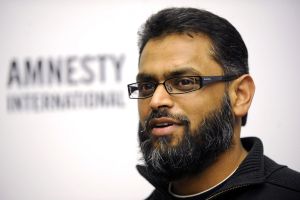
Moazzam-BeggThe Toronto Star reports: The arrest in Birmingham of Moazzam Begg, a former Guantanamo Bay detainee and outspoken critic of Britain’s counterterrorism policies, has sparked a debate about foreign support for Syria’s conflict and accusations that the activist’s detention was politically motivated.

Begg, a 45-year-old British citizen who spent more than three years in Guantanamo before being released in 2005 without charge, was one of four people arrested in a terrorism sweep by West Midlands police Tuesday on suspicion of facilitating terrorism overseas.

Although it is rare to identify detained suspects who are not charged, West Midlands police confirmed Begg’s arrest to local media due to “high public interest.”

“All four arrests are connected,” Detective Superintendent Shaun Edwards told The Guardian, referring to Begg and a 36-year-old man, a 44-year-old woman and her son, aged 20, who were also taken into custody. “They were all preplanned and intelligence-led. There was no immediate risk to public safety.”

He added: “We continue to urge anyone planning to travel to Syria to read the advice issued by the Foreign Office.”

Begg, who was reportedly also questioned on suspicion of attending a terrorist training camp, is the high-profile director of the London-based organization CAGE.

Through his advocacy work, he has met with foreign ministers, deputy prime ministers and Britain’s Lord Chancellor. According to a cable released through WikiLeaks, the U.S. ambassador to Luxembourg once commended Begg as an ally in the sensitive task of settling Guantanamo detainees whom the Pentagon has cleared for release.

Begg has found himself targeted by Western security services in the past and recently had his passport confiscated. In 2011, he was barred from boarding a direct flight from London to Toronto, where he was scheduled to give a speech. He was told he was being turned back in case the flight was rerouted to the U.S. [Continue reading…]

Facebooktwittermail

U.N.: Syrians soon to become world’s biggest refugee population, surpassing Afghans

n13-iconThe Associated Press reports: Syrians could soon overtake Afghans as the world’s biggest refugee population, with their numbers expected to pass 4 million by year’s end, a top U.N. official said Tuesday.

High Commissioner for Refugees Antonio Guterres spoke as the international community sharply urged Syria to comply with a new Security Council resolution demanding that President Bashar Assad and the opposition provide immediate access for humanitarian aid.

Opposition activists say more than 140,000 people have died in the conflict, which enters its fourth year next month. The U.N. says 9.3 million Syrians are in need of humanitarian assistance.

The number of Afghan refugees was 2.6 million at the end of 2012, UNHCR says. Syrians, with nearly 2.5 million registered as refugees, should overtake that long before the end of the year. About one-half of the refugees are children.

Facebooktwittermail

Inside ‘Unit 61398’: Portrait of accused Chinese cyberspying group emerges

n13-iconThe Associated Press reports: Unit 61398 of the People’s Liberation Army has been recruiting computer experts for at least a decade. It has made no secret of details of community life such as badminton matches and kindergarten, but its apparent purpose became clear only when a U.S. Internet security firm accused it of conducting a massive hacking campaign against North American targets.

Hackers with the Chinese unit have been active for years, using online handles such as “UglyGorilla,” Virginia-based firm Mandiant said in a report released Tuesday as the U.S. prepared to crack down on countries responsible for cyber espionage. The Mandiant report plus details collected by The Associated Press depict a highly specialized community of Internet warriors working from a blocky white building in Shanghai:

—RECRUITING THE SPIES: Unit 61398, alleged to be one of several hacking operations run by China’s military, recruits directly from universities. It favors high computer expertise and English language skills. A notice dated 2003 on the Chinese Internet said the unit was seeking master’s degree students from Zhejiang University’s College of Computer Science and Technology. It offered a scholarship, conditional on the student reporting for work at Unit 61398 after graduation.

—CYBERSPY WORKPLACE: Mandiant says it traced scores of cyberattacks on U.S. defense and infrastructure companies to a neighborhood in Shanghai’s Pudong district that includes the 12-story building where Unit 61398 is known to be housed. The building has office space for up to 2,000 people. Mandiant estimates the number of personnel in the unit to be anywhere from hundreds to several thousand. [Continue reading…]

Facebooktwittermail

The roots of America’s narcissism epidemic

f13-iconWill Storr writes: For much of human history, our beliefs have been based on the assumption that people are fundamentally bad. Strip away a person’s smile and you’ll find a grotesque, writhing animal-thing. Human instincts have to be controlled, and religions have often been guides for containing the demons. Sigmund Freud held a similar view: Psychotherapy was his method of making the unconscious conscious, helping people restrain their bestial desires and accord with the moral laws of civilization.

In the middle of the 20th century, an alternative school of thought appeared. It was popularized by Carl Rogers, an influential psychotherapist at the University of Chicago, and it reversed the presumption of original sin. Rogers argued that people are innately decent. Children, he believed, should be raised in an environment of “unconditional positive regard”. They should be liberated from the inhibitions and restraints that prevented them from attaining their full potential.

It was a characteristically American idea — perhaps even the American idea. Underneath it all, people are good, and to get the best out of themselves, they just need to be free.

Economic change gave Rogers’s theory traction. It was the 1950s, and a nation of workmen was turning into a nation of salesmen. To make good in life, interpersonal sunniness was becoming essential. Meanwhile, rising divorce rates and the surge of women into the workplace were triggering anxieties about the lives of children born into the baby boom. Parents wanted to counteract the stresses of modern family life, and boosting their children’s self-esteem seemed like the solution.

By the early 1960s, wild thinkers in California were pushing Rogers’s idea even further. The “human potential movement” argued that most people were using just 10 percent of their intellectual capacity. It leaned on the work of Abraham Maslow, who studied exceptional people such as Albert Einstein and Eleanor Roosevelt and said there were five human needs, the most important of which was self-actualization—the realization of one’s maximum potential. Number two on the list was esteem.

At the close of the decade, the idea that self-esteem was the key to psychological riches finally exploded. The trigger was Nathaniel Branden, a handsome Canadian psychotherapist who had moved to Los Angeles as a disciple of the philosopher Ayn Rand. One of Rand’s big ideas was that that moral good would arise when humans ruthlessly pursued their own self-interest. She and Branden began a tortuous love affair, and her theories had an intense impact on the young psychotherapist. In The Psychology of Self-Esteem, published in 1969, Branden argued that self-esteem “has profound effects on a man’s thinking processes, emotions, desires, values and goals. It is the single most significant key to his behavior.” It was an international bestseller, and it propelled the self-esteem movement out of the counterculture and into the mainstream.

The year that Branden published his book, a sixteen-year-old in Euclid, Ohio named Roy Baumeister was grappling with his own self-esteem problem: his Dad. [Continue reading…]

Facebooktwittermail

Why Israelis are content to live in a bubble of denial

o13-iconJonathan Cook writes: The 24-hour visit by German chancellor Angela Merkel to Israel this week came as relations between the two countries hit rock bottom. According to a report in Der Spiegel magazine last week, Ms Merkel and Israeli prime minister Benjamin Netan­yahu have been drawn into shouting matches when discussing by phone the faltering peace process.

Despite their smiles to the cameras during the visit, tension behind the scenes has been heightened by a diplomatic bust-up earlier this month when Martin Schulz, the president of the European parliament and himself German, gave a speech to the Israeli parliament.

In unprecedented scenes, a group of Israeli legislators heckled Mr Schulz, calling him a “liar”, and then staged a walkout, led by the economics minister Naftali Bennett. Rather than apologising, Mr Netanyahu intervened to lambast Mr Schulz for being misinformed.

Mr Schulz, who, like Ms Merkel, is considered a close friend of Israel, used his speech vehemently to oppose growing calls in Europe for a boycott of Israel. So how did he trigger such opprobrium?

Mr Schulz’s main offence was posing a question: was it true, as he had heard in meetings in the West Bank, that Israelis have access to four times more water than Palestinians? He further upset legislators by gently suggesting that Israel’s blockade of Gaza was preventing economic growth there.

Neither statement should have been in the least controversial. Figures from independent bodies such as the World Bank show Israel, which dominates the local water supplies, allocates per capita about 4.4 times more water to its population than to Palestinians.

Equally, it would be hard to imagine that years of denying goods and materials to Gaza, and blocking exports, have not ravaged its economy. The unemployment rate, for example, has increased 6 per cent, to 38.5 per cent, following Israel’s recent decision to prevent the transfer of construction materials to Gaza’s private sector.

But Israelis rarely hear such facts from their politicians or the media. And few are willing to listen when a rare voice like Mr Schulz’s intervenes. Israelis have grown content to live in a large bubble of denial. [Continue reading…]

Facebooktwittermail

Syria aid still stalled after U.N. resolution

syria-starvation

Reuters reports: World powers have passed a landmark Security Council resolution demanding an end to restrictions on humanitarian operations in Syria, but aid workers doubt it has the punch to make Damascus grant access and let stuck convoys deliver vital supplies.

President Bashar al-Assad’s administration and to a lesser extent rebels fighting to overthrow him have been accused of preventing food and medical care from reaching a quarter of a million people in besieged areas.

Russia, Assad’s ally on the Security Council, and China have vetoed three resolutions that would have condemned him or threatened sanctions since Syrian forces cracked down on a pro-democracy uprising in 2011 that has since turned into a civil war. More than 140,000 have been killed in the fighting, which has forced half the population to flee from their homes.

Saturday’s resolution threatened unspecified “further steps” if Damascus does not comply. [Continue reading…]

Facebooktwittermail

If native advertising is so harmless, why does it rely on misleading readers?

o13-iconBob Garfield writes: The devil walks into a bar and sits at a table with eight newspaper and magazine publishers plus one strange little fellow in shabby, dated robes. The devil says, “How’d you all like to get some advertising revenue at higher rates than what you’ve been fetching for the past five or six years?”

The publishers crowd in to hear to his offer. All they need do in exchange is make the advertising look similar to the surrounding editorial matter. “Can we label it as advertising?” one publisher asks.
“You can label it ‘sponsored content,'” the devil replies.
“And it will be worthy?” chimes in another publisher.
“Oh yes,” says the devil. “My clients don’t benefit if people don’t read the stuff.”
“But won’t this confuse our readers,” ventures another publisher, “and even deceive them into reading brand propaganda when they’re expecting arms-length journalism?”

The devil has an answer for that, too. “I repeat: the rates are higher than for the regular display ads that nobody ever looks at. What say we put this to a vote?”

One by one the publishers raise their hands. The Economist. Forbes. The Atlantic. The Huffington Post. The Washington Post. Time Inc. The New York Times. And, most recently, Yahoo. Nine people sit at the table, and eight hands eventually are raised. Only one, the strange fellow with the odd garments and a thick German accent, fails to accept the devil’s offer.

“And you, sir,” says the prince of darkness. “I didn’t catch your name.”
“Faust,” answers the holdout.
“And may I ask why you did not accept my bargain, Mr Faust?”
The odd fellow nods. “Sure,” he says to the devil. “To tell you the truth, I don’t see much of an upside.” [Continue reading…]

Facebooktwittermail

Ira Chernus: What ever happened to plain old apocalypse?

For those of us of a certain age, it seems as if the world has always been ending.  It’s easy now to forget just how deep fears and fantasies about a nuclear apocalypse went in the “golden” 1950s.  And I’m not just thinking about kids like me “ducking and covering” at the advice of Bert the Turtle, while sirens screamed in the big city and the emergency warning system Conelrad blared from a radio on our teacher’s desk.  Here, from Spencer Weart’s book Nuclear Fear, is a typical enough description of everyday life in that nuclearized America.  “Operation Alert” was a set of exercises that started in 1954 and were meant to prepare the populace for imminent attack.  As Russian nuclear-armed bombers “supposedly approached,” writes Weart, “citizens in scores of cities obeyed the howl of sirens and sought shelter, leaving the streets deserted.  Afterward, photographs of the empty streets offered an eerie vision of a world without people.  The press reported with ghoulish precision how many millions of Americans ‘died’ in each mock attack.”

No one was immune from such experiences and fears.  In June 1953, for instance, President Dwight Eisenhower screened Operation IVY, a top-secret film about the first successful full-scale test of an H-bomb at Eniwetok Atoll in the Marshall Islands.  That bomb was not just a city-killer, but also a potential civilization destroyer.  The screening took place at the White House with the full cabinet and the Joint Chiefs in attendance.  The president was evidently deeply disturbed by the image of an “entire atoll” vanishing “into a crater” and, adds Weart, by “the fireball with a dwarfed New York City skyline printed across it in black silhouette.”  In 1956, Democratic presidential candidate Estes Kefauver announced that H-bombs could “right now blow the earth off its axis by 16 degrees.”  Talk about waking nightmares.

In the same years, if you happened to be young and at the movies, nuclearized America was taking vivid shape.  In the Arctic, the first radioactivated monster, Ray Bradbury’s Rhedosaurus, awakened in The Beast from 20,000 Fathoms to begin its long slouch toward New York City; in the Southwestern desert, near the Trinity testing grounds for the first atomic bomb, a giant mutated queen ant in Them! prepared for her long flight to the sewers of Los Angeles to spawn; in space, the planet Metaluna displayed “the consequences of a weak defense system” by being incinerated in This Island Earth.  And don’t forget the return of the irrepressible, the A-bombings of Hiroshima and Nagasaki. In 1954, Godzilla, that reptilian nightmare “awakened” by atomic tests, stomped out of Japan’s Toho studios to barnstorm through American theaters.

No wonder that, of all my thousands of dreams from those years, no matter how vivid or fantastic, the only ones I remember are those in which I seemed to experience “the Bomb” going off, saw the mushroom cloud rising, or found myself crawling through the rubble of atomically obliterated cities.  In this, I suspect, I’m not alone in my generation.  In fact, I’ve always had the desire to conduct a little informal survey, collecting the atomic dreamscapes of my peers from that era.  If I had another life, I undoubtedly would.

From the actual nuclear destruction of 1945 to the prospective nuclear destruction that, in the Cuban Missile Crisis of 1962, seemed briefly to reach the edge of a world-ending boil, to the possibility today of a global “nuclear winter” set off by a regional war between India and Pakistan, who knows just how the fear of a nuclear apocalypse has embedded itself in consciousness.  All we can know is that it has, and that a climate-change version of the same, perhaps even harder to grasp and absorb, has been creeping into our imaginations and dreamscapes in recent years.  Today, religious scholar, historian, and TomDispatch regular Ira Chernus takes the deep plunge into the modern version of the apocalyptic imagination, wondering whether the crater the first H-bomb left in Eniwetok Atoll is where hope lies buried. Tom Engelhardt

Apocalypses everywhere
Is there any hope in an era filled with gloom and doom?
By Ira Chernus

Wherever we Americans look, the threat of apocalypse stares back at us.

Two clouds of genuine doom still darken our world: nuclear extermination and environmental extinction. If they got the urgent action they deserve, they would be at the top of our political priority list.

But they have a hard time holding our attention, crowded out as they are by a host of new perils also labeled “apocalyptic”: mounting federal debt, the government’s plan to take away our guns, corporate control of the Internet, the Comcast-Time Warner mergerocalypse, Beijing’s pollution airpocalypse, the American snowpocalypse, not to speak of earthquakes and plagues. The list of topics, thrown at us with abandon from the political right, left, and center, just keeps growing.

Continue reading

Facebooktwittermail

‘Parallel state’ phone-tapped thousands in Turkey – officials

n13-iconReuters reports: The network of a U.S.-based cleric illegally tapped thousands of telephones in Turkey to blackmail and concoct criminal cases as part of a campaign of covert influence over government, a top adviser to Prime Minister Tayyip Erdogan said on Monday.

A lawyer for preacher Fethullah Gulen, accused by Erdogan of building a parallel command structure in police and judiciary, described the accusations as unjust and contributing to an atmosphere of “hatred and enmity” in Turkish society.

The government accuses Gulen’s Hizmet (Service) network of engineering corruption charges against figures including businessmen close to Erdogan that came to light with a series of raids on December 17. The scandal has posed the biggest challenge yet to Erdogan’s 11-year-rule.

The government responded by reassigning thousands of police and hundreds of prosecutors and judges in a bid to purge the influence of Gulen, once an ally of Erdogan believed to have helped the prime minister rein in the power of the military.

Hizmet runs a large network of schools, businesses and media groups in Turkey and across the world. Tension with Erdogan came to light when the prime minister moved to close the schools, a primary source of Hizmet’s income and influence. [Continue reading…]

Facebooktwittermail

How covert agents infiltrate the internet to manipulate, deceive, and destroy reputations

f13-iconGlenn Greenwald writes: No matter your views on Anonymous, “hacktivists” or garden-variety criminals, it is not difficult to see how dangerous it is to have secret government agencies being able to target any individuals they want – who have never been charged with, let alone convicted of, any crimes – with these sorts of online, deception-based tactics of reputation destruction and disruption. There is a strong argument to make, as Jay Leiderman demonstrated in the Guardian in the context of the Paypal 14 hacktivist persecution, that the “denial of service” tactics used by hacktivists result in (at most) trivial damage (far less than the cyber-warfare tactics favored by the US and UK) and are far more akin to the type of political protest protected by the First Amendment.

The broader point is that, far beyond hacktivists, these surveillance agencies have vested themselves with the power to deliberately ruin people’s reputations and disrupt their online political activity even though they’ve been charged with no crimes, and even though their actions have no conceivable connection to terrorism or even national security threats. As Anonymous expert Gabriella Coleman of McGill University told me, “targeting Anonymous and hacktivists amounts to targeting citizens for expressing their political beliefs, resulting in the stifling of legitimate dissent.” Pointing to this study she published, Professor Coleman vehemently contested the assertion that “there is anything terrorist/violent in their actions.” [Continue reading…]

Facebooktwittermail

A jihadist’s account of how ‘Al Qa’eda mediator’ Abu Khaled Al-Suri was assassinated

Abu Khaled al-Suri, a senior figure in the insurgent faction Ahrar al-Sham and a representative of Al Qa’eda leader Ayman al-Zawahiri, was killed on Sunday by a suicide attack in Aleppo. EA Worldview has posted a translation of a jihadist’s account of al-Suri’s death:

al-suriMay Allah damn these suicides and may those who sent them be damned.

(Al-Suri) was a remarkable man. He was a colleague and friend of Osama Bin Laden, a fellow campaigner and representative of Ayman al-Zawahiri in Syria. He was given the task of making peace between the Mujahideen in Syria.

We met him more than once when our brigade was in Hama. He gave us great, extensive help when we were there. I did not meet a more pleasant man. Joyful, pleasant, his face shone with goodwill and wisdom.

In conversation he was very gracious and attentive to the person to whom he was talking. He was very simple and direct with people. When any questions arose that demanded his participation he said, “I am a slave of Allah and your servant. Speak, ask, and I will do everything in my power for you.”

He waged jihad for over 20 years. The infidels were trying to kill him for many years already. The USA’s CIA put a price on his head.

Now he is no more. This is not just a loss for his brigade and for Syria but it is no exaggeration to say for the Ummah as well.

That gang of arrogant villains who planned this evil act will be sorry for it.

Of course everyone is asking, who did it?

Right now it’s hard to say. It’s only possible to describe those who did it. Their arrogance is good for cowardice and stupidity. Dumb and brainless agents carrying out the orders of the arrogant.

Facebooktwittermail

How people are becoming the property of technology companies

o13-iconFollowing Facebook’s $19 billion dollar acquisition of WhatsApp, Reuven Cohen writes: In November 2013, a survey of smartphone owners found that WhatsApp was the leading social messaging app in countries including Spain, Switzerland, Germany and Japan. Yet at 450 million users and growing, there is a strong likelihood that both Facebook and WhatsApp share the majority of the same user base. So what’s driving the massive valuation? One answer might be users attention. Unlike many other mobile apps, WhatsApp users actually use this service on an ongoing daily or even hourly basis.

“Attention,” write Thomas Mandel and Gerard Van der Leun in their 1996 book Rules of the Net, ”is the hard currency of cyberspace.” This has never been truer.

WhatsApp’s value may not have much to do with the disruption of the telecom world as much as a looming battle for Internet users rapidly decreasing attention spans. A study back in 2011 uncovered the reality for most mobile apps. Most people never use an app more than once. According to the study, 26% of the time customers never give the app a second try. With an ever-increasing number of apps competing for users attention, the only real metric that matters is whether or not they actual use it. Your attention may very well be the fundamental value behind Facebook’s purchase.

In a 1997 Wired article, author Michael H. Goldhaber describes the shift towards the so called Attention Economy; “Attention has its own behavior, its own dynamics, its own consequences. An economy built on it will be different than the familiar material-based one.” writes Goldhaber.

His thesis is that as the Internet becomes an increasingly strong presence in the overall economy and our daily lives, the flow of attention will not only anticipate the flow of money, but also eventually replace it altogether. Fast-forward 17 years and his thesis has never been more true.

As we become ever more bombarded with information, the value of this information decreases. Just look at the improvements made to Facebook’s news feed over the years. In an attempt to make its news feed more useful, the company has implement-advanced algorithms that attempt to tailor the flow of information to your specific interests. The better Facebook gets at keeping your attention, the more valuable you become. Yes, you are the product. [Continue reading…]

To the extent that corporations are in the business of corralling, controlling, and effectively claiming ownership of people’s attention, the only way of finding freedom in such a world will derive from each individual’s effort to cultivate their own powers of autonomous attention.

Facebooktwittermail