The new Great Game: Why Ukraine matters to so many other nations

a13-iconBloomberg Businessweek reports: Ukraine doesn’t seem like the kind of place that world powers would want to tussle over. It’s as poor as Paraguay and as corrupt as Iran. During the 20th century it was home to a deadly famine under Stalin (the Holomodor, 1933), a historic massacre of Jews (Babi Yar, 1941), and one of the world’s worst nuclear disasters (Chernobyl, 1986). Now, with former President Viktor Yanukovych in hiding, it’s struggling to form a government, its credit rating is down to CCC, a recession looms, and foreign reserves are running low. Arseniy Yatsenyuk, head of the opposition party affiliated with former Prime Minister Yulia Tymoshenko, said on Feb. 24 in Parliament, “Ukraine has never faced such a terrible financial catastrophe in all its years of independence.”

But Ukraine is also a breadbasket, a natural gas chokepoint, and a nation of 45 million people in a pivotal spot north of the Black Sea. Ukraine matters—to Russia, Europe, the U.S., and even China. President Obama denied on Feb. 19 that it’s a piece on “some Cold War chessboard.” But the best hope for Ukraine is that it will get special treatment precisely because it is a valued pawn in a new version of the Great Game, the 19th century struggle for influence between Russia and Britain.

Russia, which straddles Europe and Asia, has sought a role in the rest of Europe since the reign of Peter the Great in the early 18th century. An alliance with Ukraine preserves that. “Without Ukraine, Russia ceases to be a Eurasian empire,” the American political scientist Zbigniew Brzezinski wrote in 1998. Russian President Vladimir Putin wants Ukraine to join his Eurasian Union trade bloc, not the European Union. Russia’s Black Sea naval fleet is headquartered in Sevastopol, a formerly Russian city that now belongs to Ukraine. [Continue reading…]


Facebooktwittermail

The murders before the Boston Marathon

f13-iconSusan Zalkind writes: It’s nearly midnight in a nondescript condo complex a few blocks from Universal Studios in Orlando, and Tatiana Gruzdeva has been crying all day. Though neither of us knows it yet, as she sits on the corner of her bed and sobs in tiny convulsions, the fact that she’s talking to me will lead to her being arrested by federal agents, placed in solitary confinement, and deported back to Russia.

Next to us on the bed are nine teddy bears. Eight of them came with her from Tiraspol, Moldova. The ninth was a gift from her boyfriend, Ibragim Todashev. Today would have been Ibragim’s 28th birthday, but he is not here to see it, because in the early hours of May 22, 2013, a Boston FBI agent shot and killed him in this very apartment, under circumstances so strange that a Florida state prosecutor has opened an independent investigation. According to the FBI, just before Ibragim was shot—seven times, in two bursts, including once in the top of the head—he was about to write a confession implicating himself and alleged Boston Marathon bomber Tamerlan Tsarnaev in a brutal triple homicide that took place in Waltham, Massachusetts, in September 2011.

I’m sitting awkwardly at one end of the twin bed. She’s crying quietly, cross-legged at the other end, wearing shorts and a white shirt with sequins. Most of her outfits have sequins or rhinestones. She’s 19. I’m 26. We both have long blond hair. We’ve both been close to men who were in trouble with the law, and lost them violently. We’ve been talking for about an hour, mostly about men, and parties, and moving forward after a tragedy. Ibragim was a good man, she says. He could never have committed a murder.

“I’m here alone,” she cries. “I hope it never can be worse than this.”

I try to comfort her, but it’s complicated. We both want to know why Ibragim Todashev was killed. She wants to clear his name. For me, and for the families of the Waltham murder victims, Ibragim’s shooting may have snuffed out the last chance at finding out what really happened that night. In the back of my mind is this question: Did her dead boyfriend kill my friend Erik? [Continue reading…]

Facebooktwittermail

ISIS withdraws from parts of northern Syria

n13-iconThe Associated Press reports: Members of an al-Qaida-breakaway group withdrew Friday from parts of the northern province of Aleppo, ahead of a Saturday deadline issued by another rebel group that could spark more infighting, opposition activists said.

Fighters from the Islamic State of Iraq and the Levant evacuated from several towns north of Aleppo, including Azaz near the Turkish border, Aleppo-based activists who go by the names of Ibrahim Saeed and Abu Raed said. Rival fighters moved in shortly after, the activists and the Britain-based Syrian Observatory for Human Rights said.

The pullout came three days after the leader of a powerful al-Qaida-linked group in Syria gave the Islamic State a five-day ultimatum to accept mediation by leading clerics to end infighting or be “expelled” from the region.

The ultimatum, announced in an audio recording by the leader of the Nusra Front, aims to end two months of deadly violence between the Islamic State and other Islamic factions that activists say has killed more than 3,000 people. The infighting is undermining the opposition fighters’ wider struggle against President Bashar Assad’s government.

There has been no official reaction from the Islamic State so far but they most likely will reject the ultimatum, possibly leading to more deadly battles in the coming days.

Saeed said Islamic State fighters appear to be withdrawing toward their stronghold in the northeastern city of Raqqa, the first provincial capital in Syria to fall to the rebels. The Islamic State’s shadowy leader, known as Abu Bakr al-Baghdadi, once called it the group’s capital. [Continue reading…]

Facebooktwittermail

Mole who met Bin Laden killed by Al Qaeda in Bosnia

n13-iconNBC News reports: An FBI mole who provided valuable intelligence on al Qaeda and met with Osama bin Laden was lured away from the FBI to work for the CIA, but was killed by al Qaeda operatives in Bosnia who suspected he was an informant, NBC News has learned exclusively.

The informant, a Sudan-born driver and confidante to “Blind Sheikh” Omar Abdel-Rahman, the radical Muslim cleric who allegedly masterminded the first attempt to take down the World Trade Center, had been the sole human asset providing first-person information about al Qaeda in the mid-1990s as the terror group gained strength around the globe.

According to sources familiar with the management of the mole, the FBI recruited him in 1993 because he was a known associate of the Blind Sheikh. [Continue reading…]

Facebooktwittermail

NSA chief suggests outsourcing mass surveillance to phone companies?

The Wall Street Journal reports: The departing National Security Agency chief offered senators an unexpected option Thursday for restructuring the agency’s U.S. phone-data collection program: narrow it to obtain only terrorism-related data.

The remarks by NSA Director Gen. Keith Alexander were striking because the government’s justification for the data-collection program has been that the NSA needs the full database of Americans’ call records to uncover otherwise unknown terrorist connections.

But Gen. Alexander instead signaled that the information the NSA needs about terrorist connections might be obtainable without first collecting what officials have termed “the whole haystack” of U.S. phone data.

Explaining the option, he told the Senate Armed Services Committee that intelligence agencies could “look at what data you actually need and get only that data.”

This is the argument many privacy advocates have made since the details of the phone-data-collection program were disclosed in June by former NSA contractor Edward Snowden. They say it is unnecessary to obtain records from millions of ordinary Americans to seek out terrorists.

Gen. Alexander suggested that teasing out the relevant data would involve a mechanism under which the NSA would make classified requests to phone companies asking for data only for phone numbers associated with terrorist suspects. [Continue reading…]

I didn’t hear the actual testimony, but the way it is reported here makes it sound like Alexander is suggesting that mass collection of U.S. phone data might no longer be necessary.

But the only thing that he seems to be saying may be unnecessary is for the NSA to do the collection.

For the NSA to make classified requests to the phone companies, it is those companies that would need to be doing the mass data collection.

And maybe that now looks like an appealing option not only because it would provide the NSA with extra constitutional protection; it might also create opportunities for even more extensive data collection with even less oversight.

Facebooktwittermail

Eavesdropping by algorithm is still eavesdropping

Bruce Schneier writes: Increasingly, we are watched not by people but by algorithms. Amazon and Netflix track the books we buy and the movies we stream, and suggest other books and movies based on our habits. Google and Facebook watch what we do and what we say, and show us advertisements based on our behavior. Google even modifies our web search results based on our previous behavior. Smartphone navigation apps watch us as we drive, and update suggested route information based on traffic congestion. And the National Security Agency, of course, monitors our phone calls, emails and locations, then uses that information to try to identify terrorists.

Documents provided by Edwards Snowden and revealed by the Guardian today show that the UK spy agency GHCQ, with help from the NSA, has been collecting millions of webcam images from innocent Yahoo users. And that speaks to a key distinction in the age of algorithmic surveillance: is it really okay for a computer to monitor you online, and for that data collection and analysis only to count as a potential privacy invasion when a person sees it? I say it’s not, and the latest Snowden leaks only make more clear how important this distinction is.

The robots-vs-spies divide is especially important as we decide what to do about NSA and GCHQ surveillance. The spy community and the Justice Department have reported back early on President Obama’s request for changing how the NSA “collects” your data, but the potential reforms – FBI monitoring, holding on to your phone records and more – still largely depend on what the meaning of “collects” is. [Continue reading…]

Those who claim a special privilege to define words in their own way, defying the dictates of everyday usage, are also claiming a right to employ their own definitions of truthfulness and lying. This might have some legal utility, but the price for going this route is that language, thus constrained, becomes worthless.

As Schneier notes, Google has also fallen back on the dumb-machine defense when claiming that it does not read our email.

Back when Gmail was introduced, this was Google’s defense, too, about its context-sensitive advertising. Googles computers examine each individual email and insert an advertisement nearby, related to the contents of your email. But no person at Google reads any Gmail messages; only a computer does. In the words of one Google executive: “Worrying about a computer reading your email is like worrying about your dog seeing you naked”.

The absence of human eyes does not add a layer of privacy. On the contrary it constitutes a glaring lack of oversight by promoting a fiction: that what people don’t see, must be harmless.

Google is not a dumb companion, eager to please and dependably obedient; its only loyalty is to its own commercial interests and it currently sees those interests best served by pursuing an ambition to dominate the field of machine learning.

The data analysis being performed by computers enables surveillance more sweeping than could ever be carried out by people.

Although most Americans seem more afraid of government than commerce, the powers being exercised by the NSA are dwarfed by those that have been acquired by companies like Google, Amazon, and Facebook. Indeed the intelligence community has been doing little more than opportunistically taking a piggyback ride on the shoulders of Silicon Valley.

Facebooktwittermail

GCHQ intercepted webcam images of millions of Yahoo users worldwide

n13-iconThe Guardian reports: Britain’s surveillance agency GCHQ, with aid from the US National Security Agency, intercepted and stored the webcam images of millions of internet users not suspected of wrongdoing, secret documents reveal.

GCHQ files dating between 2008 and 2010 explicitly state that a surveillance program codenamed Optic Nerve collected still images of Yahoo webcam chats in bulk and saved them to agency databases, regardless of whether individual users were an intelligence target or not.

In one six-month period in 2008 alone, the agency collected webcam imagery – including substantial quantities of sexually explicit communications – from more than 1.8 million Yahoo user accounts globally.

Yahoo reacted furiously to the webcam interception when approached by the Guardian. The company denied any prior knowledge of the program, accusing the agencies of “a whole new level of violation of our users’ privacy”. [Continue reading…]

Facebooktwittermail

Karen Greenberg: Obama’s commandments

Think of us as having two presidents.  One, a fellow named Barack Obama, cuts a distinctly Clark Kent-ish figure.  In presiding over domestic policy, he is regularly thwarted in his desires by the Republicans in Congress and couldn’t until recently get his most basic choices for government positions or the judiciary through the Senate.  For the most minimal look of effectiveness, he has to rely on relatively small gestures by executive order.  In the recent history of the American presidency, he is a remarkably powerless figure presiding over what everyone who is a media anyone claims is a riven, paralyzed, even broken government structure, one in which the Republicans are intent on ensuring that a Democratic president can do nothing until they take the White House (which is almost guaranteed to be never).  What this president wants, almost by definition, he can’t have.  He is, as Guardian columnist Gary Younge wrote recently, a man who’s lost the plot line to his own story and has been relegated to the position of onlooker-in-chief.

But keep in mind that that’s only one of our two presidents.  The other, a fellow named Barack Obama, flies (by drone) like Superman, rules more or less by fiat, sends U.S. missiles to strike and kill just about anyone, including American citizens, anywhere in the distant backlands of the planet, and dispatches the country’s secret warriors (whether from the CIA or the special operations forces) wherever he pleases.  He can, with rare exceptions, intervene violently wherever he chooses.  He can (by proxy) listen in on whomever he’s curious about (including, it seems, 320 German business and political leaders).  He rules over what former Congressional insider Mike Lofgren calls the “deep state” in Washington, a national security apparatus that is neither riven, nor broken, nor paralyzed, with only the rarest intercessions from Congress.  In this world, Obama’s powers have only grown, along with the “kill list” he reviews every week.

Admittedly, in his actions abroad from Afghanistan to Libya, his moves on the global stage haven’t exactly proven to be brilliant coups de théâtre.  Many have, in fact, been remarkably boneheaded.  But no one ever claimed that Superman’s superpowers included super-brain-power.

Think of this White House, then, as the schizophrenic presidency, one half remarkably impotent, the other ever more potent.  The conundrum is that they both inhabit the same man.  And if they add up to anything, as Karen Greenberg, director of the Center on National Security at Fordham Law and TomDispatch regular, makes clear today, it’s long-term bad news for the country and the planet. Tom Engelhardt

The Five Commandments of Barack Obama
How “thou shalt not” became “thou shalt”
By Karen J. Greenberg

In January 2009, Barack Obama entered the Oval Office projecting idealism and proud to be the constitutional law professor devoted to turning democratic principles into action.  In his first weeks in office, in a series of executive orders and public statements, the new president broadcast for all to hear the five commandments by which life in his new world of national security would be lived. 

Thou shalt not torture.

Thou shalt not keep Guantanamo open.

Thou shalt not keep secrets unnecessarily.

Thou shalt not wage war without limits.

Thou shalt not live above the law.

Five years later, the question is: How have he and his administration lived up to these self-proclaimed commandments?

Continue reading

Facebooktwittermail

Qatar’s foreign domestic workers subjected to slave-like conditions

n13-iconThe Guardian reports: Foreign maids, cleaners and other domestic workers are being subjected to slave-like labour conditions in Qatar, with many complaining they have been deprived of passports, wages, days off, holidays and freedom to move jobs, a Guardian investigation can reveal.

Hundreds of Filipino maids have fled to their embassy in recent months because conditions are so harsh. Many complain of physical and sexual abuse, harassment, long periods without pay and the confiscation of mobile phones.

The exploitation raises further concerns about labour practices in Qatar in advance of the World Cup, after Guardian reports about the treatment of construction workers. The maids are not directly connected to Qatar’s preparations for the football tournament, but domestic workers will play a big role in staffing the hotels, stadiums and other infrastructure that will underpin the 2022 tournament. [Continue reading…]

Facebooktwittermail

Egypt’s ‘AIDS curing device’ may be a fake bomb detector

a13-iconMashable: On Saturday, the Egyptian army unveiled a “miraculous” device it claims will detect and cure AIDS and Hepatitis. But the device, named C-Fast, looks eerily similar to a fake bomb detector sold by a British company to Iraq in the late 2000s.

That device, codenamed ADE 651, was later found to be a scam. One that reportedly cost the Iraqi government as much as $85 million dollars, and perhaps hundreds of lives. Its creator, James McCormick, was indicted and later sentenced to 10 years in prison.

The possible link between the C-Fast and the fake bomb detector, named ADE 651, was first spotted by the Libyan Youth Movement, a citizen organization born after the Egyptian revolution of 2011. The group posted a picture of the two devices on Twitter.

Facebooktwittermail

Paco de Lucía — 1947-2014

m13-iconThe fame and influence of the guitarist Paco de Lucía, who has died aged 66 from a suspected heart attack, reached far beyond the intense and sometimes enclosed world of Spanish flamenco. His musical role in Carlos Saura’s Carmen (1983) was as arresting in its way as the first glimpse of Laura del Sol, the film’s luminous lead. The director-choreographer Saura cleverly reinvented the opera as a contemporary fable while retaining the original’s elements of passion, possession, jealousy and obsession. De Lucía’s interpretation respectfully returned Bizet’s score – a French fantasy of Spain – to its Moorish antecedents. He also gave Carmen’s timeless melodies a fresh, international appeal that chimed with the movie’s arthouse success. [Continue reading…]

Facebooktwittermail

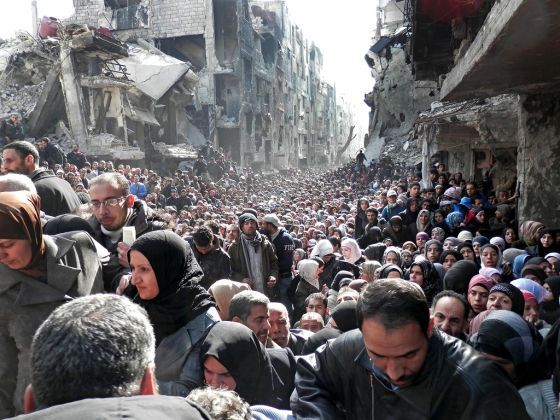
Palestinians besieged in Yarmouk

Yarmouk

The Guardian reports: It is a vision of unimaginable desolation: a crowd of men, women and children stretching as far as the eye can see into the war-devastated landscape of Yarmouk refugee camp in Damascus.

A photograph released on Wednesday by the UN agency for Palestinian refugees, UNRWA, shows the scene when thousands of desperate Palestinians trapped inside the camp on the edge of the Syrian capital emerged to besiege aid workers attempting to distribute food parcels.

More than 18,000 people are existing under blockade inside Yarmouk, enduring acute shortages of food, medicines and other essentials. Much of the camp has been destroyed by shelling, and attempts to deliver aid to those inside have been hampered by continued fighting in Syria’s three-year-old civil war.

United Nations workers have delivered about 7,000 food parcels over recent weeks, following negotiations between the Syrian government, rebel forces and Palestinian factions within the camp. The most recent delivery, of 450 parcels, was on Wednesday. The UN acknowledges that the level of aid is a “drop in the ocean”. [Continue reading…]

Facebooktwittermail

Forget the NSA, the LAPD spies on millions of innocent folks

f13-iconLA Weekly reports: Edward Snowden ripped the blinds off the surveillance state last summer with his leak of top-secret National Security Agency documents, forcing a national conversation about spying in the post-9/11 era. However, there’s still no concrete proof that America’s elite intelligence units are analyzing most Americans’ computer and telephone activity — even though they can.

Los Angeles and Southern California police, by contrast, are expanding their use of surveillance technology such as intelligent video analytics, digital biometric identification and military-pedigree software for analyzing and predicting crime. Information on the identity and movements of millions of Southern California residents is being collected and tracked.

In fact, Los Angeles is emerging as a major laboratory for testing and scaling up new police surveillance technologies. The use of military-grade surveillance tools is migrating from places like Fallujah to neighborhoods including Watts and even low-crime areas of the San Fernando Valley, where surveillance cameras are proliferating like California poppies in spring.

The use of militarized surveillance technology appears to be spreading beyond its initial applications during the mid-2000s in high-crime areas to now target narrow, specific crimes such as auto theft. Now, LAPD and the Los Angeles County Sheriff are monitoring the whereabouts of residents whether they have committed a crime or not. The biggest surveillance net is license plate reading technology that records your car’s plate number as you pass police cruisers equipped with a rooftop camera, or as you drive past street locations where such cameras are mounted. [Continue reading…]

Facebooktwittermail

Is solitary confinement an impossible idea?

f13-iconBenjamin Wallace-Wells writes: On July 8 of last year, a 50-year-old man named Todd Ashker, an inmate at California’s Pelican Bay State Prison, began a hunger strike. He had compiled a list of demands, but the essential one was that the policy that dictated the terms of his imprisonment be abolished. Ashker was housed in Pelican Bay’s Security Housing Unit, the most restrictive prison unit in California and a place of extreme isolation. Convicts stay in their cells 23 hours a day and leave only to exercise in a concrete room, alone; their meals are fed into their cell through a slot. Other than an awareness that they are staring at the same blank wall as seven other men kept in their “pod,” they are completely alone. Ashker has been there since 1990; in his view, he has been subject to nearly a quarter-­century of continuous torture. “I have not had a normal face-to-face conversation with another human being in 23 years,” he told me recently, speaking from the other side of a thick plate of glass.

The sheer length of time inmates spend here has made Pelican Bay a novel experiment in social control. The California prison system allows any confirmed gang member to be kept in the SHU indefinitely, with a review of his status only every six years. (Prisoners who kill a guard or another inmate, by contrast, are given a five-year term in the SHU.) This policy has filled Pelican Bay with men considered the most influential and dangerous gang leaders in California. Ashker, allegedly a senior member of the Aryan Brotherhood, had for years shared a pod with Sitawa Jamaa, allegedly the minister of education of the Black Guerrilla Family, and Arturo Castellanos, allegedly an important leader of the Mexican Mafia. In the next pod over was Antonio Guillen, allegedly one of three “generals” of Nuestra Familia. According to the state, these men have spent much of their lives running rival, racially aligned criminal organizations dedicated, often, to killing one another. But over a period of years, through an elaborate and extremely patient series of conversations yelled across the pod and through the concrete walls of the exercise room, the four men had formed a political alliance. They had a shared interest in protesting the conditions of their confinement and, eventually, a shared strategy. They became collaborators.

The men planned for the hunger strike meticulously. They had staged two more modest strikes in 2011, and afterward some had staged private fasts in their cells to try to learn how long they might be able to go without food. The four men had spent the spring putting on weight. Ashker had calculated how much water he needed to drink to keep his electrolytes ­balanced, his heart pumping: 240 ounces a day. In June, the men sent letters to an activist group detailing their grievances, explaining when the strike would begin, and asking other prisoners to join them. In letters to families and friends, they spread the word. Corrections officers throughout the state heard the news; on July 2, a few senior officials visited from Sacramento to meet with the prisoners and measure their intent. They left ­convinced the men were serious. Then, a few days later, the prisoners stopped eating.

The severity of his isolation meant that as the strike began, Ashker had little idea of what effect it was having or how many other prisoners had decided to join him. It turned out to be the largest coordinated hunger strike in American history. [Continue reading…]

Facebooktwittermail

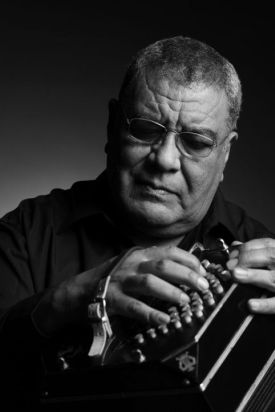
Music: Dino Saluzzi — ‘Winter’

dino-saluzziTimoteo “Dino” Saluzzi was born in 1935 in Campo Santo, a small village in the north of Argentina noted primarily for its sugar cane refining factory, around which local life revolved. Despite the absence of records, radio and indeed electricity in the Saluzzi household there was always music. His father played guitar, mandolin and bandoneon and taught Dino the rudiments of the latter instrument at seven. On this popular German import, the diatonic variety of the accordion developed by Heinrich Band, the young Dino at first played folk music. An uncle who had traveled in Europe added some of his acquired musical knowledge and, by the time he was 14, Dino knew enough to play in the Trio Carnaval, his first band. He began to play professionally while studying in Buenos Aires and was soon a member of the symphonic Orquesta Estable at Radio El Mundo, Argentinia’s first radio station. It was in Buenos Aires, too, that he met Astor Piazolla, as the term “tango nuevo” began to be aired. Though Piazolla and Saluzzi always respected each other’s work, Dino has never cared to put a label on his own music. In numerous interviews, however, he has stressed that it is neither an “art music” nor an “intellectual music” but rather a music of the emotions and one that attempts to express the widest range of feelings.

Quitting his radio orchestra job in 1956, Saluzzi returned to the district of Salta to develop his compositions, now consciously incorporating folk music elements. From this point onward, however, he was concerned that his music would not “fall into the common eclecticism” that had already diluted several variants of Latin American music. He sought a flexible form that was “vital and real beyond the conventions”: this has proved to be a life’s work. In the early 70s Dino was briefly associated with Gato Barbieri, helping the saxophonist towards a rediscovery of his own roots on, for example, the album Chapter One: Latin America. With Mariano Mores he undertook numerous South American tours, playing concerts in Bolivia, Peru, Columbia and Venezuela. He also worked as arranger and soloist for Enrique Mario Francini’s Sinfonica de Tango which brought him to Japan in 1977. In 1979 he launched the first Cuarteto Dino Saluzzi, whose early European appearances made headlines, and also co-founded the experimental chamber ensemble Música Creativa.

Saluzzi’s ECM discography was launched with the solo album Kultrum, spontaneously created in the studio and an enduring example of the bandoneonist’s art as “storyteller.” Dino described the music as “an imaginary return” to the little towns and villages of his childhood. The vividness of his musical sketches was not lost on reviewers: “Reworking elements of tango, South American Indian music, backwater folk tunes, and other root sounds, his breadth of feeling makes for remarkable listening” – Down Beat. A second solo album Andina, prompted America’s Fanfare to write that “Dino Saluzzi is probably the greatest living master of the bandoneon”, concluding that the recording was “a stunning portrait of an amazing musical talent.” [Continue reading…]

Facebooktwittermail

Maidan, Ukraine … Tahrir, Egypt … the square symbolises failure, not hope

o13-iconSimon Jenkins writes: The experience was eerie. I was watching a documentary, The Square, on Netflix about the 2011 Tahrir Square occupation when the lead character, Ahmed, let out a cry of delight, “The revolution has been won.” At that very moment my radio blurted out a voice live from a different square, Kiev’s Maidan. “The revolution has been won,” it repeated.

Squares are famously potent political theatres. This year is a second showing for Ukraine’s revolution, and a third for Egypt’s. Western TV viewers have cheered them all on. We thrill to see young people hurling rocks at power. Fire, smoke, bloodstained flags, broken heads, water, gas and sinister paramilitaries are Les Misérables for slow learners. We can sit with a front seat in the auditorium of history. It beats polling booths any day.

Tahrir and Maidan squares thus join Istanbul’s Taksim, Tehran’s Azadi, Beijing’s Tiananmen, Prague’s Wenceslaus, Athens’s Syntagma, London’s Trafalgar and a dozen other urban spaces the world over as icons of modern revolutionary politics. Their furniture is the barricade, their tipple the Molotov cocktail, their tonic the tear gas canister. They gather people in their thousands to sacred forums and invite the world to witness the latest trial of strength with a supposedly oppressive regime. Sometimes they even win.

If I were a dictator I would build shopping malls over these places right away, as Turkey’s Recep Erdoğan tried to do last year in Taksim’s Gezi Park. At the very least, I would learn the message of Tiananmen: that a crowd once formed in a square is fiendishly hard to remove, and creates worse publicity worldwide than a dozen provincial massacres.

Vladimir Putin reportedly damned Ukraine’s Viktor Yanukovych for failing immediately to remove crowds from Maidan, at whatever cost in brutality. It is hard to imagine Putin allowing an occupation of Red Square. [Continue reading…]

Facebooktwittermail

Watch: Zeynep Tufekci on social media-fueled protest style from Arab Spring to Gezi protests in Turkey

a13-iconWhat can we learn from the protest wave of the last years? How does social media impact the capacity for collective action? Does social media contribute to blunting movement impacts by facilitating horizontal, non-institutional and “leaderless” movements? How do these movements compare with their predecessors like the civil-rights or anti-colonial movements? In this talk Zeynep Tufekci — assistant professor at the University of North Carolina, a faculty associate at Berkman Center for Internet & Society, and a fellow at the Center for Information Technology Policy at Princeton University — discusses these questions by drawing from research on a variety of social movements including the “Arab Spring”, European indignados movements, Occupy and Turkey’s Gezi protests. (October 15, 2013, Berkman Center for Internet & Society, Harvard University.)

Facebooktwittermail

NSA inspector general speaks on Snowden for first time, says he was ‘manic in his thievery’

n13-iconKevin Gosztola reports: During a day-long conference at the Georgetown University Law Center, Dr. George Ellard, the inspector general for the National Security Agency, spoke for the first time about the disclosures made by former NSA contractor Edward Snowden.

In addressing the alleged damage caused by Snowden’s disclosures he compared Snowden to Robert Hanssen, a former FBI agent and convicted spy who sold secrets to the Russians.

Ellard has been the NSA’s inspector general since 2007. In this capacity he has not spoken in a public forum before so that made what he said additionally significant. Had Snowden made the decision to report his concerns through approved NSA channels it would have been through Ellard’s office.

Ellard was part of a panel discussion on whether there was a “new paradigm of leaking.” The panel included Alex Abdo, staff attorney of the ACLU National Security Project, Georgetown Law professor David Cole and Kenneth Wainstein, former Homeland Security Advisor and former Assistant Attorney General for National Security.

When Ellard began his prepared statements, he acknowledged that he had approached this event with some level of trepidation. [Continue reading…]

Facebooktwittermail