Author Archives: Paul Woodward

Did Isreaelis intercept a ship loaded with missiles?

Did Isreaelis intercept a ship loaded with missiles?

“You can easily hide an alley of cruise missiles under a lumber stockpile,” Kouts told an Estonian newspaper two weeks ago, and the Russian maritime expert who broke the story on Aug. 8 of the ship’s disappearance agrees with him.

“I can’t think of any other reason,” Mikhail Voitenko told ABC News. “I just can’t explain it by any other way. Not by piracy, it’s foolish. What piracy?” he asks, pointing to the low value of the ship’s official cargo.

Voitenko has been a loud voice about the lack of detail surrounding the saga of the Arctic Sea and his reporting in his online maritime bulletin Sovfracht apparently touched a nerve. A few days ago he got a call telling him he had hours to “get the hell out of Russia” or he would be arrested.

“There is something on board they don’t want anyone to see,” says Voitenko by phone from a hotel in Istanbul. He says that by reporting the missing ship he “spoiled the whole business for somebody” and now “they just want revenge, to smash me.”

Voitenko says his primary concern is the ship’s crew. When the navy took over the ship they immediately flew 11 of the 15 crew back to Moscow along with the hijackers for questioning.

The crew members were confined to a hotel for two weeks, only allowed to call their families to tell them they were alive and well. They were released over the weekend and haven’t revealed anything about their ordeal or the questioning that followed. [continued…]

Facebooktwittermail

Shaker Aamer’s long wait for justice

Shaker Aamer’s long wait for justice

Imagine, gathered under one roof, over a dozen men who were once regarded as the most dangerous people on the planet – and a man who once guarded them, breaking their Ramadan fast together with lords and baronesses, poets and writers, activists and lawyers and students and children on a summer’s eve in London’s Kensington area – in its town hall to be exact. This is precisely what happened at the “Beyond Guantánamo” fundraising event hosted by Cageprisoners last Sunday.

Among the five hundred or more attendees were the wife and children of Shaker Aamer, a man held captive without charge in Guantánamo for eight years. Shaker’s wife gave me a copy of the latest letter she received from her husband – over a year ago – part of which I read to the audience:

Yes I lost a lot of weight, yes I have a lot of sicknesses, yes I’ve got short sight, yes my bones are aching, yes I got white hair, yes I got old, but my heart is still young, my mind still strong – a lot stronger than ever. My soul’s got the biggest wings to fly and help others to fly. I am a lot wiser, a lot [more] patient, a lot [more] knowledgeable, a lot [more] merciful, a lot [more] loving and caring, a lot [more] helpful. I feel I can change the world to be a better place. I feel I can restore justice so we can have peace and love amongst each other.

And what crime has Shaker committed for which both he and his family are paying such an astronomical price? [continued…]

Facebooktwittermail

GOP support may be vital to Obama on Afghan war

GOP support may be vital to Obama on Afghan war

As President Obama prepares to decide whether to send additional troops to Afghanistan, the political climate appears increasingly challenging for him, leaving him in the awkward position of relying on the Republican Party, and not his own, for support.

The simple political narrative of the Afghanistan war — that this was the good war, in which the United States would hunt down the perpetrators of the Sept. 11 attacks — has faded over time, with popular support ebbing, American casualties rising and confidence in the Afghan government declining. In addition, Afghanistan’s disputed election, and the attendant fraud charges that have been lodged against President Hamid Karzai, are contributing further to the erosion of public support.

A CBS News poll released on Tuesday reports that 41 percent of those polled wanted troop levels in Afghanistan decreased, compared with 33 percent in April. Far fewer people — 25 percent — wanted troop levels increased, compared with 39 percent in April. And Mr. Obama’s approval rating for his handling of Afghanistan has dropped eight points since April, to 48 percent. [continued…]

Afghan vote results likely to be delayed

Afghanistan’s volatile presidential election process moved closer to violent confrontation Wednesday, even as officials said releasing the final results from the Aug. 20 polls would be further delayed because of slow vote counting and an even slower effort to investigate hundreds of fraud complaints.

The tension was exacerbated by a suicide bombing outside a mosque in the capital of northeastern Laghman province Wednesday morning. A senior official of the national intelligence service and 23 others were killed; scores were wounded.

Election officials announced Wednesday that President Hamid Karzai, who is seeking reelection, had widened his lead over the main challenger, Abdullah Abdullah, an ophthalmologist and former foreign minister. With about 3.7 million valid votes from 60 percent of polling stations tallied, they said, Karzai leads Abdullah 47.2 to 32.5 percent. [continued…]

Karzai’s election victory seen as inevitable, despite claims of fraud

Richard Holbrooke, the US special envoy to the Afghanistan-Pakistan region, dismissed as fantasy the reports that Washington was seeking a run-off against Dr Abdullah. “We have no candidates and no preference as to a first-round victory or a run-off,” Mr Holbrooke said. It was up to the Electoral Complaints Commission to rule on the fraud claims before the final result was proclaimed this month. “The post-election phase, the phase of determining who won, is going to be critical in determining the future of Afghanistan,” he said.

Mr Holbrooke and others among the 27 international envoys played down the likely scope of the irregularities. Many of the 2,500 complaints referred to the same incidents, they said.

“During the process, there will be many claims of irregularities,” Mr Holbrooke said. “That happens in democracies, even when they are not in the middle of a war.”

Bernard Kouchner, the French Foreign Minister, acknowledged concern but said that the election had been a triumph “at a time of serious danger for each of the men and women who dipped their fingers in ink to vote”. [continued…]

Facebooktwittermail

CIA doctors face human experimentation claims

CIA doctors face human experimentation claims

Doctors and psychologists the CIA employed to monitor its “enhanced interrogation” of terror suspects came close to, and may even have committed, unlawful human experimentation, a medical ethics watchdog has alleged.

Physicians for Human Rights (PHR), a not-for-profit group that has investigated the role of medical personnel in alleged incidents of torture at Guantánamo, Abu Ghraib, Bagram and other US detention sites, accuses doctors of being far more involved than hitherto understood.

PHR says health professionals participated at every stage in the development, implementation and legal justification of what it calls the CIA’s secret “torture programme”. [continued…]

Calling Hannah Arendt

The mind-numbing bureaucratic details displayed in the documents released last week on the Bush Administration’s abusive detention program sent wise commentators, such as The Atlantic’s Hanna Rosin, to Hannah Arendt, the mother of all war-crime writers. Her observations, first published in this magazine, on what she eventually dubbed the “banality of evil,” exhibited by the Nazis’ tidy, carefully monitored control of the Final Solution, are, sadly, timeless.

This is not to suggest that there is any moral equivalence between the Nazis and the Bush Administration. That would be absurd. Nevertheless, as C.I.A. bureaucrats debated the appropriate temperature of the water with which they planned to fill the lungs of captives or the number of times prisoners could be propelled head-first into a plywood wall (“twenty to thirty times consecutively”), it’s hard not to have renewed appreciation for Arendt.

There is also a less famous observation by Arendt, made in The New York Review of Books in the wake of the protests of 1968 and shared with me by Georgetown Law professor David Luban, that captures the problem faced by the Obama Administration in its attempt to hold the right officials accountable. She calls it the “rule by Nobody.” Attorney General Eric Holder is stuck trying to investigate an entire bureaucracy. Those on the top can claim to have clean hands, while those on the bottom can claim they were following ostensibly legal orders. What’s left, Arendt suggests, is an all-powerful government that is beyond accountability. [continued…]

Facebooktwittermail

A nuclear deadline looms for Iran — and for Obama

A nuclear deadline looms for Iran — and for Obama

President Barack Obama took office promising to pursue a diplomatic solution to the standoff over Iran’s nuclear program, but so far, he’s gotten little out of Tehran. So little, in fact, that the President has given Iran a Sept. 15 deadline to respond positively to his offer of negotiations, or face a heightening of sanctions. As U.S. officials huddled with European, Russian and Chinese counterparts in Germany on Wednesday to review the issue, Iran signaled that it will, indeed, respond — by offering its own package of proposals to achieve a diplomatic resolution to the standoff. Western leaders at the meeting in Germany urged Iran to agree to a meeting with Russia, China, the key European nations and the U.S. before Sept. 23. But nobody is expecting Iran’s proposals to come close to meeting current Western demands, and that could leave Obama facing the unenviable choice either of being painted as feckless, or else moving down a road of escalation that puts a diplomatic solution further beyond reach. [continued…]

Iran’s flip-flopper supreme

Will the real Ayatollah Ali Khamenei please stand up?

On June 19, a week after Iran’s disputed presidential election, the supreme leader shed the garb of the lofty arbiter to deliver a raging sermon in which he warned of “bloodshed and chaos” in Tehran if protests continued. They did, the next day, and I will never forget the blood that flowed at Khamenei’s behest.

Khamenei, abandoning the plausible deniability of the Prophet’s avatar, opting instead for perilous political partisanship, said then: “Please see the hungry wolves in ambush who are gradually removing their mask of diplomacy to show their true faces.” He identified the most evil of these foreign wolves as “the British government,” no less.

Now, 10 weeks later, with the Iranian revolutionary establishment still shaken by the brazenness of the June 12 electoral fraud and the rashness of the supreme leader’s gambit, Khamenei declares: “I don’t accuse the leaders of the recent incidents of being affiliated with foreign countries, including the United States and Britain, since the issue has not been proven to me.”

Well, sir, which is it? [continued…]

Facebooktwittermail

Norway fund expels Israel firm for barrier work

Norway fund expels Israel firm for barrier work

Norway’s $400 billion-plus wealth fund has excluded Israeli company Elbit Systems (ESLT.TA) for supplying surveillance equipment for the separation barrier in the West Bank, the government said on Thursday.

“We do not wish to fund companies that so directly contribute to violations of international humanitarian law,” Finance Minister Kristin Halvorsen said in a statement.

“The freedom of movement of the people living in the occupied territory has been unacceptably restricted,” she said.

Halvorsen said the International Court of Justice has said the barrier construction breaches the Fourth Geneva Convention and that “Norwegian authorities act in accordance with this.” [continued…]

Facebooktwittermail

How the Taliban are winning the war

Warlord’s defection shows Afghan risk

Ghulam Yahya, a former mayor of this ancient city along the Silk Road, battled the Taliban for years and worked hand in hand with Western officials to rebuild the country’s industrial hub.

Now, Mr. Yahya is firing rockets at the Herat airport and nearby coalition military headquarters. He has kidnapped soldiers and foreign contractors, claimed the downing of an Afghan army helicopter and planted bombs in central Herat — including one that killed a district police chief and more than a dozen bystanders last month.

Mr. Yahya’s stranglehold over the outskirts of Herat has destabilized a former oasis of calm and relative prosperity. “The security situation here is critical,” said Herat’s current mayor, Mohammed Salim Taraki.

The warlord’s odyssey from friend to foe shows how disillusionment with the Western-backed administration of President Hamid Karzai has pushed even some former enemies of the Taliban into the insurgency. Violence is rapidly spreading beyond the ethnic Pashtun heartland of southern and eastern Afghanistan, where much of the countryside already is in rebel hands, into parts of the country that were considered safe just a few months ago. [continued…]

U.S. to boost combat force in Afghanistan

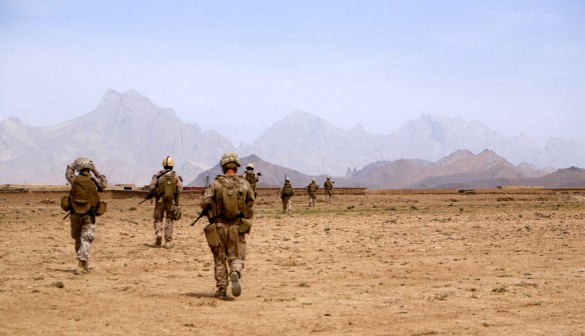
U.S. officials are planning to add as many as 14,000 combat troops to the American force in Afghanistan by sending home support units and replacing them with “trigger-pullers,” Defense officials say.

The move would beef up the combat force in the country without increasing the overall number of U.S. troops, a contentious issue as public support for the war slips. But many of the noncombat jobs are likely be filled by private contractors, who have proved to be a source of controversy in Iraq and a growing issue in Afghanistan.

The plan represents a key step in the Obama administration’s drive to counter Taliban gains and demonstrate progress in the war nearly eight years after it began. [continued…]

Taliban surprising U.S. forces with improved tactics

The Taliban has become a much more potent adversary in Afghanistan by improving its own tactics and finding gaps in the U.S. military playbook, according to senior American military officials who acknowledged that the enemy’s resurgence this year has taken them by surprise.

U.S. rules of engagement restricting the use of air power and aggressive action against civilians have also opened new space for the insurgents, officials said. Western development projects, such as new roads, schools and police stations, have provided fresh targets for Taliban roadside bombs and suicide attacks. The inability of rising numbers of American troops to protect Afghan citizens has increased resentment of the Western presence and the corrupt Afghan government that cooperates with it, the officials said.

As President Obama faces crucial decisions on his war strategy and declining public support at home, administration and defense officials are studying the reasons why the Taliban appears, for the moment at least, to be winning. [continued…]

Deputy intelligence chief is slain in Afghanistan

The second-ranking intelligence official in Afghanistan and a prominent ally of President Hamid Karzai was assassinated by a suicide bomber on Wednesday morning in a blast that also killed 15 others outside the main mosque in the official’s hometown, near Kabul, officials and witnesses said.

The official, Dr. Abdullah Laghmani, was the deputy director of the National Directorate for Security.

“As an intelligence expert, he knew a lot about Al Qaeda, and he was a person who was very actively fighting against the Taliban and against Al Qaeda in the 34 provinces of Afghanistan,” said the provincial governor, Mutfullah Mashal, in an interview at the scene of the attack here in the capital of the eastern province of Laghman. “His loss is really a major loss.” [continued…]

$600 for a Kalashnikov – a sign of bloodshed to come in Afghanistan

The price of Kalashnikovs has doubled in Afghanistan. For a country awash with arms, the fact that the weapons are now fetching $600 apiece is a cause of some surprise, but a surge of demand is to blame for the increase, with a steady stream of weapons said to be heading for the north.

This is the Tajik constituency of Abdullah Abdullah, the presidential candidate who claims the election is being stolen by the incumbent Western-backed President, Hamid Karzai. [continued…]

U.N. sees Afghan drug cartels emerging

Afghanistan’s production of opium, the raw material for heroin, declined by 10 percent this year, and the amount of land used to cultivate opium fell by 22 percent, according to a report from the United Nations Office on Drugs and Crime that is to be formally released Wednesday.

The smaller harvest, largely attributed to market forces and heightened interdiction efforts, is a rare bit of good news for the United States and the coalition of Western governments whose troops and taxpayers are supporting what even American commanders describe as a deteriorating situation as the war approaches its ninth year.

But while United Nations officials suggested that some opium-trafficking guerrillas were now less focused on Taliban ideology, they also reported that perhaps more than 10,000 tons of illegal opium — worth billions of dollars and enough to satisfy at least two years of world demand — is now secretly stockpiled. They said they were concerned that part of this stockpile could be a “ticking bomb” in the hands of people who could use it to pay for “sinister scenarios.”

Opium is easily smuggled and stored and “is an ideal form of terrorist financing,” Antonio Maria Costa, the executive director of the United Nations Office on Drugs and Crime, said in an interview. “It’s a huge amount of money to have in the wrong hands.” He called on intelligence agencies to investigate the stockpiles. [continued…]

Contractors outnumber U.S. troops in Afghanistan

Civilian contractors working for the Pentagon in Afghanistan not only outnumber the uniformed troops, according to a report by a Congressional research group, but also form the highest ratio of contractors to military personnel recorded in any war in the history of the United States.

On a superficial level, the shift means that most of those representing the United States in the war will be wearing the scruffy cargo pants, polo shirts, baseball caps and other casual accouterments favored by overseas contractors rather than the fatigues and flight suits of the military.

More fundamentally, the contractors who are a majority of the force in what has become the most important American enterprise abroad are subject to lines of authority that are less clear-cut than they are for their military colleagues. [continued…]

Report details misbehavior by Kabul embassy guards

Private security contractors who guard the U.S. Embassy in Kabul have engaged in lewd behavior and hazed subordinates, demoralizing the undermanned force and posing a “significant threat” to security at a time when the Taliban is intensifying attacks in the Afghan capital, according to an investigation released Tuesday by an independent watchdog group.

The Project on Government Oversight (POGO) launched the probe after more than a dozen security guards contacted the group to report misconduct and morale problems within the force of 450 guards who live at Camp Sullivan, a few miles from the embassy compound.

The report highlighted occasions when guards brought women believed to be prostitutes into Camp Sullivan and videotaped themselves drinking and partially undressed. It also outlined communications problems among the guards, many of whom don’t speak English and have trouble understanding orders from their U.S. supervisors. [continued…]

Facebooktwittermail

Afghan tribal leaders call for Karzai to quit after detailing election fraud

Afghan tribal leaders call for Karzai to quit after detailing election fraud

Hundreds of tribal elders and officials from southern Afghanistan gathered in Kabul yesterday to protest against alleged electoral fraud that robbed entire districts of their votes and allocated them to President Karzai.

In a string of searing testimonies, community leaders told of villages that had been too terrified to vote because of Taleban threats — yet had mysteriously produced full ballot boxes. They said that most of the phantom votes had been cast for Mr Karzai, often by his own men or tribal leaders loyal to him.

“How is it that in a district which a governor can only visit once every two years, where it’s too dangerous for the police to go, where even Nato can’t fly — how come there were 20,000 votes collected?” asked Hamidullah Tokhy, a tribal elder from Kandahar province. [continued…]

Tribal leaders say Karzai’s team forged 23,900 votes

Just a week before this country’s presidential election, the leaders of a southern Afghan tribe called Bariz gathered to make a bold decision: they would abandon the incumbent and local favorite, Hamid Karzai, and endorse his challenger, Abdullah Abdullah.

Mr. Abdullah flew to the southern city of Kandahar to receive the tribe’s endorsement. The leaders of the tribe, who live in a district called Shorabak, prepared to deliver a local landslide.

But it never happened, the tribal leaders said.

Instead, aides to Mr. Karzai’s brother Ahmed Wali — the leader of the Kandahar provincial council and the most powerful man in southern Afghanistan — detained the governor of Shorabak, Delaga Bariz, and shut down all of the district’s 45 polling sites on election day. The ballot boxes were taken to Shorabak’s district headquarters, where, Mr. Bariz and other tribal leaders said, local police officers stuffed them with thousands of ballots.

At the end of the day, 23,900 ballots were shipped to Kabul, Mr. Bariz said, with every one marked for President Karzai. [continued…]

First the votes, now the complaints pile up in Afghanistan

In a low-slung building tucked behind concrete blast barriers on the edge of the Afghan capital, the plain brown envelopes are opened one by one, and the complaint forms inside smoothed out and scrutinized by weary-eyed workers.

One handwritten account tells of a gunman turning up at a polling place. Another describes a candidate brazenly handing out cash bribes. Yet another reports a ballot box filled with votes only moments after the start of polling.

Nearly two weeks after Afghanistan’s troubled presidential election, the task of sorting out allegations of fraud and intimidation has swelled. More than 2,000 complaints have poured into the Electoral Complaints Commission, a U.N.-backed body given the responsibility of determining the validity of claims of election misconduct. As the vote tally slowly advances, that task becomes more and more crucial. [continued…]

Facebooktwittermail

Liberation, not a fictitious Palestinian “state”

Liberation, not a fictitious Palestinian “state”

Late last month, Salam Fayyad, the appointed Palestinian Authority (PA) prime minister in Ramallah, made a surprise announcement: he declared his intention to establish a Palestinian state in the West Bank and Gaza Strip before the end of 2011 regardless of the outcome of negotiations with Israel.

Fayyad told the London Times that he would work to build “facts on the ground, consistent with having our state emerge as a fact that cannot be denied.” His plan was further elaborated in a lengthy document grandly titled “Program of the Thirteenth Government of the Palestinian National Authority.”

The plan contains all sorts of ambitious ideas: an international airport in the Jordan Valley, new rail links to neighboring states, generous tax incentives to attract foreign investment, and of course strengthening the “security forces.” It also speaks boldly of liberating the Palestinian economy from its dependence on Israel, and reducing dependence on foreign aid.

This may sound attractive to some, but Fayyad has neither the political clout nor the financial means to propose such far-reaching plans without a green light from Washington or Tel Aviv. [continued…]

Jewish settlers plan massive construction

The accelerating pace of Jewish settlement expansion in East Jerusalem this year may spur violence between Israelis and Palestinians in the city and cripple new efforts by the Obama administration to kick-start peace talks, an Israeli anti-settlement group warned yesterday.

The “massive” construction being planned by Jewish settlers within Palestinian neighbourhoods in East Jerusalem is likely to prompt clashes, said Yudith Oppenheimer, the executive director of Ir Amim, a Jerusalem-based advocacy group.

“There is a combination of factors, including settlers invading Palestinian neighbourhoods, already annoying with their presence and control of houses and land and their mass construction plans when, next door, Palestinian neighbours cannot even build a balcony because they do not get a permit. This creates the conditions for violence,” she said. [continued…]

Facebooktwittermail

How the US Congress plans on supporting the Iranian Revolutionary Guard

Buying American in Tehran

American sanctions against this country are not only obviously ineffective, … they often have unintended consequences that hurt American interests.

President George W. Bush’s 2005 sanctions on financial assets, meant to crack down on rogue banks facilitating Iran’s nuclear program, had two unforeseen side effects. Freezing the financial assets of these banks increased the price of credit, making it more costly for honest financial firms like ours to operate. It also increased the value of Western goods like TV satellite dishes, cigarettes and alcohol, which the Revolutionary Guards sell on the black market, netting an estimated $12 billion a year.

Today, five members of the United Nations Security Council and Germany are to meet to consider cutting off Iran’s supply of imported gasoline and diesel — which accounts for 40 percent of the country’s total consumption — if the regime does not agree to restart negotiations over its nuclear weapons program by the end of this month. Sadly, though, the only people such sanctions would hurt would be the poor, who would face higher prices for food and bus fare.

Sanctions against foreign investment firms hurt ordinary Iranians, too, because those businesses pour money into companies that make medicine and build roads and housing, providing jobs for the millions of young Iranians who graduate each year with limited job prospects.

Further isolating Iran economically may in fact play right into the hands of Revolutionary Guard hard-liners. Tougher sanctions would rally this fratricidal conservative bloc against an old common enemy and help the Guards’ many businesses, which include smuggling goods through secret landing spots on the coast. [continued…]

Iran says it’s ready to reopen nuclear talks

Iran’s top nuclear negotiator said Tuesday that the country was prepared to resume talks with world powers over its contentious nuclear technology program and that it had prepared a package of proposals for discussions.

Saeed Jalili, secretary of Iran’s Supreme National Security Council and its point person on the nuclear issue, did not disclose details of the package but said that it would be an updated version of one submitted last year. That package was criticized by Western countries for failing to address key points of disagreement.

Still, Jalili’s comments were the most substantive official remarks on the nuclear issue since the contentious June 12 election and could give the Obama administration, which has offered to have direct talks with Iran on its nuclear program, an opportunity to try to engage Tehran before resorting to a fresh round of sanctions. [continued…]

Purge of Iranian universities is feared

As Iran’s universities prepare to start classes this month, there is growing concern within the academic community that the government will purge political and social science departments of professors and curriculums deemed “un-Islamic,” according to academics and political analysts inside and outside Iran.

The fears have been stoked by speeches by the supreme leader, Ayatollah Ali Khamenei, and by President Mahmoud Ahmadinejad, as well as by confessions of political prisoners, that suggest that the study of secular topics and ideas has made universities incubators for the political unrest unleashed after the disputed presidential election in June.

Ayatollah Khamenei said this week that the study of social sciences “promotes doubts and uncertainty.” He urged “ardent defenders of Islam” to review the human sciences that are taught in Iran’s universities and that he said “promote secularism,” according to Iranian news services. [continued…]

Facebooktwittermail

Is the war in Afghanistan in the interests of the United States and its allies?

Is the war in Afghanistan in the interests of the United States and its allies?

Operation Enduring Freedom [OEF], through the lens of vital national interests, was largely won but for some inexplicable reason we have not realized it. What is worse, we allowed our strategy to change before the initial, imperative mission was fully accomplished. Having to a great extent captured, killed, and seriously disrupted the al-Qaeda leadership and training infrastructure in Afghanistan, the necessity, and therefore strategy for this war, has gotten away from us. This is true for one reason and one reason alone: we have transferred the consequence of the very real threat of al Qaeda to the Taliban, to fields of Afghan poppies, and to the political and economic shambles that was and is Afghanistan. These things are not existential threats to our nation. With public debate and approval, they might be worthy of continued political and economic transformation and support through other aspects of national power, but not wholesale military intervention.

It is not a threat to the United States if the Islamic Republic of Afghanistan decides to live as if it were in the 15th century and create laws to mandate it. It is not a threat to the U.S. if they decide to ban women from attending school or stone them for adultery or not wearing a headscarf correctly. Nor is it a threat if poppies are their main cash crop. These are all variously horrible, unfortunate, and things we would like to see change, but do not constitute a direct, existential threat to the United States requiring a military response. Therefore, if the direct threats are not the Taliban (who was in power minding their own business since 1996), Sharia law (which has been used in various countries at various levels of fundamentalism for over 1400 years without being a threat to us), drugs, or necessarily even the failed or ungoverned state itself (of which examples have always been present on the global stage, also without being a threat to us), what are they? The direct threat was and is the loosely tied organization of al Qaeda and its affiliates. They are best destroyed just as we successfully prosecuted the early stages of OEF- through a combination of limited relationship building with local populations, deployments of Special Operations Forces [SOF], thorough intelligence, and targeted airstrikes. When we need to, our nation can call upon these assets to attack and defeat these threats. Then those assets can come home. Any continued presence should only be conducted by the occasional SOF, Foreign Service Officers, and/or USAID representatives (in permissive environments) to maintain networks of relationships when and where necessary and promote US interests. If al Qaeda were to again coalesce in Afghanistan, we would find, fix, and kill/capture them. This is the same strategy we follow when we find them anywhere else, be it Sudan, Yemen, Pakistan, or Newark, NJ. Why, then, does only Afghanistan warrant a total military-led effort to redesign their culture, system of government, and market-base based on US biases?

As Sun Tzu said, “Tactics without strategy is the noise before defeat.” What is facing us now is a series of tactics and operations with no overlying match of policy and strategy. Even if there is a higher strategy that is in line with national policy, this policy does not pass the “Family Factor” test that Kent Johnson defines in his article “Political-Military Engagement Policy: Casualty Avoidance and the American Public.” (Aerospace Power Journal, Spring 2001) Our limited war in early OEF quickly and silently evolved into something different with the intent of removing the Taliban in their entirety and ‘enabling’ a centralized democracy to exist where none has before. After the war for our vital national interests, we allowed our nation’s military to be the tool used to secure interests of a far less critical nature; to forcibly promote our beliefs of human rights, economic freedoms, and individual liberties. In our best Wilsonian imitation, we are determined to bestow the Peace of Westphalia upon Afghanistan, create a sovereign state in the best Western sense of the word, and allow them to move through the “majestic portal” to bring them into the family of evolved nations. Somehow, this will be better for America than whatever locally legitimate ruling authority rises to power in Kabul or the rest of Afghanistan’s provinces. In a utopian world, this might be fine, but in reality, where the native Pashtun, Tajik, Hazara, and Uzbek people get a vote, it yields the quagmire we face today. Not only is this outside of our initial (and again, largely complete) mission in Afghanistan, it is outside of both the pragmatism and necessity of realpolitik and realism on one side and any cost-benefit analysis of political idealism on the other. To think that to secure the US homeland from attack we must install an amenable democratic government in Kabul awakens definite parallels in Afghani history.

Field Marshall Frederick Roberts who, during the Second Anglo-Afghan War, led a successful attack against Kabul and the later 300-miles-in-3-weeks march from Kandahar to Kabul (to rescue an embattled British force) eventually said: “The less they see of us, the less they’ll dislike us.” In the end, he, and the British parliament, realized that after three consecutive wars in the same region for the same strategic purpose, Afghanistan wasn’t as strategically important to the British as they had supposed all along. In their effort to maintain varying levels of control or influence in Afghan affairs to counter supposed Russian aims on British India, the British fought three politically debilitating wars with the Afghans resulting in less regional influence, less control, and more loss of life each time. They would eventually conclude that if the Russians wanted to attack British India through Afghanistan, they, the British, should let them. The impossible task and effort of maintaining influence over the Afghans was inordinate compared to the cost of defending India at the gates of India, not at the Hindu Kush. Invading Afghanistan was easy; the follow-on governing was impossible. It would be far easier to let Russia try and stretch their LOCs [lines of communication] and expend their blood and treasure through unconquerable Afghan territory to get to India, not the reverse.

Something about Afghanistan must breed strategic overstretch. As British ‘Forward Policy’ of the 19th century delivered three strategically unwinnable wars, we similarly seem to think defense of the homeland begins at the Hindu Kush; that we must fight them there so we don’t have to fight them here. The British realized in their successive efforts that punitive strikes and raids when necessary into Afghanistan were far more effective in the long run than trying to maintain even a semi-permanent presence and installing British-friendly (malleable) governments.

Beyond the supposed and indefensible argument that the Taliban provides us with an existential threat, we have allowed something far more insidious to occur; we have enabled al Qaeda of the 21st century to replace Russia of the 19th century in the way we, and the Victorian British before us, looked at and dealt with the territory and peoples of Afghanistan. Academically, the parallel is illuminating; in reality, it is tragic. Al Qaeda, far from requiring a massive, conventional military deployment (nor a global war on terrorism), should in actuality warrant only local police actions. If that is not possible or within the capacity of local forces, a “low-intensity,” small footprint, or otherwise limited US response to negate that threat where present would suffice. This should be the modus operandi in Afghanistan, Yemen, central or northern Africa, Indonesia, or anywhere else. Large-scale deployments or nation building are not the answer. If for no other reason than to point out the fact that we do not see the need to try and “fix” every other un- or under-governed space across the world or forcibly promote our national interests everywhere else they might differ from our own. “Fixing” Afghanistan is not a vital national interest. [continued…]

Editor’s Comment — “Operation Enduring Freedom, through the lens of vital national interests, was largely won but for some inexplicable reason we have not realized it.”

An inexplicable reason? If George Bush had not been surrounded by neoconservative handlers, I dare say that rather than come up with an overblown “war on terror” he would have kept it simple. The task in hand was to “get bin Laden.” And that’s why the war has never ended: it has failed to accomplish its primary goal.

Of course, as any fool knows, a real man hunt requires stealth.

Facebooktwittermail

Fifteen minutes of hate in Silwan

Fifteen minutes of hate in Silwan

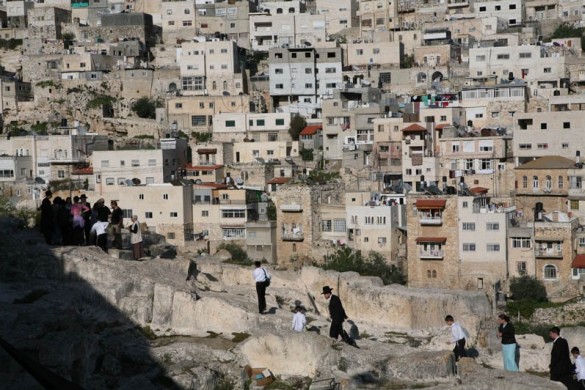
It’s searing hot, but there’s some pleasantness about the stone-flagged path rising from the centre of Silwan, Jerusalem. Maybe it’s the breeze, or the stone houses oozing coolness into the air, or maybe it’s the wide-open mountain landscape. There are three of us – Ilan, the director, Michael, the cameraman and me, the interviewee. We’re making a film on the blatant institutional discrimination against the residents of this Palestinian east-Jerusalem neighbourhood; authorities favour the Jewish settlers who are not hiding their desire to Judaise the neighbourhood, to void it of its Palestinian character.

Even before we position the camera, a group of orthodox Jewish girls, aged about eight to 10, come walking up the path in their ankle-long skirts, pretty, chattering, carefree. One of them slows down beside us, and pleasantly asks us if we want to film her. What would you like to tell us, we ask. I want to say that Jerusalem belongs to us Jews, she says as she walks on, only it’s a pity there are Arabs here. The messiah will only come when there isn’t a single Arab left here. She walks on, and her girlfriends giggle and rejoin her.

Two minutes later a young, well-built young man comes up, carrying a weapon and a radio, without any uniform or tag upon his clothes. Even before he opens his mouth I’m already guessing he’s a security guard, an employee of the private security contractor operated by settlers but sponsored by the housing ministry at an annual budget of NIS 40m (£4.6m). This security company has long since become a private militia policing the entire neighbourhood and intimidating the Palestinian residents without any legal basis whatsoever. A committee set up by a housing minister determined that this arrangement was to cease, and the security of both Palestinian and Jewish residents must be handed over to the Israeli national police. The government endorsed the committee’s conclusions in 2006, but recanted six months later, under settler pressure. The private security contractor went on operating. [continued…]

From Shiloah to Silwan

Jerusalem began as a small village in a place known as the City of David where the Palestinian village of Silwan sits today. Buried under the village lands, 5000 years of history bind the stories of ancient nations and rulers with the present life of the local residents. Dozens of excavated archaeological strata tell the complex multi-cultural saga of Jerusalem.

We, a group of archaeologists and residents of Silwan, invite you to hear the story of ancient Jerusalem and of life in the village today. Our tour sheds light on the role of archaeology in the Israeli-Palestinian conflict and in the discourse of the future of Jerusalem. We will offer a different perspective: archaeology without an ownership, one that bridges between periods, cultures and nations; archaeology which involves the local residents and examines the past as a shared asset regardless of religion or nationality.

We believe that archaeology in Silwan/”City of David” has the power to change the dynamics of the conflict and promote tolerance and respect for other cultures, past and present, for a better future for both the local residents and the whole region. [continued…]

Facebooktwittermail

The real winner of Afghanistan’s election

The real winner of Afghanistan’s election

The real winner of Afghanistan’s presidential election will not be Hamid Karzai or his main rival, Abdullah Abdullah. It’s a man named Mohammad Qasim Fahim. He is Afghanistan’s senior-most military commander, with the lifetime rank of marshal, and was Karzai’s running mate during the campaign. Whether Karzai or one of his opponents wins, Fahim will hold and exercise extraordinary influence over the country’s military and security apparatus — more so than the elected president.
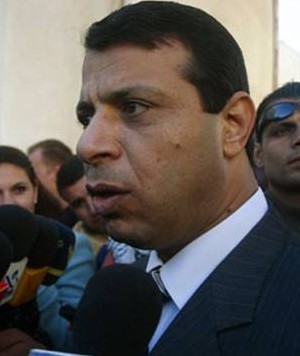
This means the real loser of Afghanistan’s presidential election — besides the Afghan people — will be the United States’ long-standing ambition to train and equip enough Afghan forces to allow for an eventual withdrawal of the U.S. military. Building up the Afghan military and police is at the heart of Gen. Stanley McChrystal’s latest assessment for Washington of what needs to be done in Afghanistan. But McChrystal’s forces will be training Afghan soldiers and police to work for Fahim: a human-rights-abusing, drug-trafficking warlord who might also have had a role in al Qaeda’s assassination of his political godfather, Tajik warlord Ahmad Shah Massoud, on Sept. 9, 2001 — an operation widely viewed in retrospect as a precursor to the terrorist attacks in the United States two days later. [continued…]

Time to get out of Afghanistan

“Yesterday,” reads the e-mail from Allen, a Marine in Afghanistan, “I gave blood because a Marine, while out on patrol, stepped on a [mine’s] pressure plate and lost both legs.” Then “another Marine with a bullet wound to the head was brought in. Both Marines died this morning.”

“I’m sorry about the drama,” writes Allen, an enthusiastic infantryman willing to die “so that each of you may grow old.” He says: “I put everything in God’s hands.” And: “Semper Fi!”

Allen and others of America’s finest are also in Washington’s hands. This city should keep faith with them by rapidly reversing the trajectory of America’s involvement in Afghanistan, where, says the Dutch commander of coalition forces in a southern province, walking through the region is “like walking through the Old Testament.” [continued…]

The Afghan 8os are back

It is deja vu on a huge and bloody scale. General Stanley McChrystal, the US commander in Afghanistan, is about to advise his president that “the Afghan people are undergoing a crisis of confidence because the war against the Taliban has not made their lives better”, according to leaked reports. Change the word “Taliban” to “mujahideen”, and you have an exact repetition of what the Russians found a quarter of a century ago.

Like Nato today, the Kremlin realised its forces had little control outside the main cities. The parallels don’t end there. The Russians called their Afghan enemies dukhy (ghosts), ever-present but invisible, as hidden in death as they were when alive – which echoes Sean Smith’s recent photographic account of the fighting in Helmand and the failure of the British units he was with to find a single Talib body.

The Soviet authorities never invited western reporters to be embedded, but you could track down Afghan war veterans in Moscow’s gloomier housing estates. They were conscripts, unlike British and US troops, so perhaps they had a heightened sense of anger. But how many British vets would share the sentiments that Igor expressed, as he hung out with his mates one evening in February 1989 and let me listen? “You remember that mother who lost her son. She kept repeating, ‘He fulfilled his duty. He fulfilled his duty to the end.’ That’s the most tragic thing. What duty? I suppose that’s what saves her, her notion of duty. She hasn’t yet realised it was all a ridiculous mistake. I’m putting it mildly. If she opened her eyes to our whole Afghan thing, she’d probably find it hard to hold out.” [continued…]

Facebooktwittermail

Once-legendary Fatah figure makes a comeback

Once-legendary Fatah figure makes a comeback

He ran the Gaza Strip like the Godfather, dispensing brutal punishment and benevolent largess. But that was before his summer of disgrace, two years ago, when Hamas militants drove out his armed followers and allowed looters to pick apart his seaside villa.

Mohammed Dahlan, the once-legendary chief of Fatah’s forces in the enclave, watched his own defeat helplessly from exile. Then he felt the sting of blame for “losing Gaza,” a debacle that split the Palestinians into hostile camps and crippled their drive for statehood.

Stripped of his authority in the late Yasser Arafat’s movement, he dropped from the limelight and plotted. But his target was not Hamas; it was the many detractors among his Fatah brethren who branded him a has-been.

After 18 months of quiet but tireless politicking, Dahlan is back in play. His recent election to Fatah’s Central Committee put him in an elite circle of advisors to Arafat’s 74-year-old successor, Palestinian Authority President Mahmoud Abbas, and positioned him as a contender to lead the movement someday. [continued…]

Facebooktwittermail

Iran news agency reports prisoner died of abuse

Iran news agency reports prisoner died of abuse

In what may be the first admission that a prisoner died from abuse by Iranian prison authorities in the wake of post-election unrest, a semiofficial news service reported Monday that the son of an adviser to a prominent conservative politician had died of “physical stress, conditions of imprisonment, repeated blows and harsh physical treatment.”

The report, by the Mehr News Agency, quoted “informed sources” as saying the medical examiner had determined that Mohsen Ruholamini, 25, died of abuse and neglect after being held in the Kahrizak detention center and then being transferred to Evin prison under “unsuitable conditions.” He was one of hundreds of people arrested as mass protests swept major Iranian cities after President Mahmoud Ahmadinejad claimed a landslide victory in June, and one of dozens who died.

“As a result of his poor physical condition, at the end of the journey, and after a delay of 70 minutes in transferring him to hospital, he unfortunately died,” said the report by Mehr, which has close ties to conservatives. [continued…]

Son to succeed father as Iraqi Shiite party leader

One of Iraq’s leading Shiite political parties moved quickly on Monday to fill the vacuum left by the death of its influential leader last week, nominating his son to take over a party now poised to challenge Prime Minister Nuri Kamal al-Maliki in national elections next year.

The nominee, Ammar al-Hakim, the scion of a respected political and religious family that fought Saddam Hussein’s government from exile and emerged as a political force after its fall, was widely expected to take over the party, the Supreme Islamic Iraqi Council.

His father, Abdul Aziz al-Hakim, who died of cancer in Tehran last week, provided for the succession in his will, heading off any potential leadership challenges. The party’s television network announced the nomination, and a spokesman said it would be ratified by the party’s leadership on Tuesday. [continued…]

Facebooktwittermail

Against the Israel boycott

Against the Israel boycott

One of the main battlefields in our fight for peace is Israeli public opinion. Most Israelis believe nowadays that peace is desirable but impossible (because of the Arabs, of course.) We must convince them not that peace would be good for Israel, but that it is realistically achievable.

When the archbishop [Tutu] asked what we, the Israeli peace activists, are hoping for, I told him: We hope for Barack Obama to publish a comprehensive and detailed peace plan and to use the full persuasive power of the United States to convince the parties to accept it. We hope that the entire world will rally behind this endeavor. And we hope that this will help to set the Israeli peace movement back on its feet and convince our public that it is both possible and worthwhile to follow the path of peace with Palestine.

No one who entertains this hope can support the call for boycotting Israel. Those who call for a boycott act out of despair. And that is the root of the matter. [continued…]

Netanyahu ‘doesn’t care what Britain thinks of Israel’

The editor of The Jewish Chronicle has accused Israel’s Prime Minister, Binyamin Netanyahu, of not caring about British public opinion after he refused to give any interviews during his visit to London last week.

In a comment piece in the newspaper, Stephen Pollard – though essentially supportive of Mr Netanyahu – concludes of his office: “The truth of it is that for all they moan about coverage of the Middle East, they don’t actually care. They don’t care if Brits end up thinking they are warmongers. They don’t care if they are losing the PR war. And they don’t care if those of us who do care are left fuming at their wilful refusal to do anything to help us counter Israel’s appalling image.” [continued…]

Editor’s Comment — Uri Avnery’s hope might be a testament to the tenacious spirit of this old peace activist, but is there any evidence that Israel’s political leadership or the majority of its population would be receptive to an Obama peace initiative? Fifty-one percent of Jewish Israelis view Obama as anti-Israel (pro-Palestinian) and a mere four percent see him as supportive of the Jewish state.

When The Jewish Chronicle‘s Stephen Pollard bemoans Benjamin Netanyahu’s indifference to international opinion, Pollard might be voicing a frustration commonplace within the Jewish diaspora, but the object of his frustration is what many (perhaps most) Israelis regard as one of the nation’s core strengths: it’s righteous isolation. Israel’s isolation — so the thinking goes — is not the product of its behavior but proof for the necessity of its existence.

Why should the Israeli prime minister be concerned about Israel’s appalling global image? He’s milking it for all it’s worth!

Facebooktwittermail

Israel ‘ups settlement activity in east Jerusalem’

Israel ‘ups settlement activity in east Jerusalem’

Israeli settlement activity in annexed east Jerusalem accelerated in the first half of 2009 despite US calls for a freeze, an anti-settlement activist group said on Sunday in a report.

“Recent months have seen the acceleration of the process of Israeli settlement in Palestinian communities in east Jerusalem,” the Israeli Ir Amim group said.

“These settlements… implant (a) Jewish population… precisely in the areas of the most intense dispute in the Palestinian-Israeli conflict,” it said. [continued…]

Facebooktwittermail

Pressuring Iran on nukes: would a gas embargo help?

Pressuring Iran on nukes: would a gas embargo help?

While the Obama Administration may think that a gasoline embargo, even a partial one, would pressure the Iranian regime to suspend its nuclear activities, Tehran may be hoping for just that sanction to help it with one of its longtime goals: reducing gasoline consumption. Indeed, the Iranian government, which has been subsidizing pump prices for years and keeping them well below the international market price (at a huge burden to the national budget), would love the U.S. to take the political hit for helping to end the subsidies.

Former President Mohammad Khatami stated that his greatest economic failure during his tenure was not reducing the massive subsidies the Iranian government spends to keep gas prices low. Every year, his government had to draw millions of dollars from Iran’s special “rainy day” oil revenue reserve fund in order to pay out the subsidies. By 2003, the leaders today associated with the ongoing Green Movement opposition — Khatami, Mehdi Karroubi and Ali Akbar Hashemi Rafsanjani — all supported rationing gasoline in order to reduce domestic consumption and government expenditure. [continued…]

Panel in Iran will oversee investigations into unrest

Conservative rivals of President Mahmoud Ahmadinejad of Iran have continued to challenge his drive to consolidate power, appointing a committee to supervise investigations into the unrest that swept the nation after he claimed a landslide victory in the disputed presidential election in June, political analysts said.

On Saturday, a day before Mr. Ahmadinejad stepped before a hostile Parliament to defend his 21 nominees for the cabinet — one of the many internal fights he is confronting — the chief of the judiciary, Sadeq Larijani, announced the appointment of a panel to oversee investigations by allies of the president into the postelection unrest.

Mr. Larijani, a rival of the president, said the committee was told “to ensure that the defendants’ rights are reserved and that they are treated properly,” according to the semi-official Fars news service, offering a not-too-subtle vote of no confidence in the president’s handling of events. [continued…]

Facebooktwittermail