
Author Archives: Paul Woodward

REVIEW: Leaderless Jihad, by Marc Sageman

A fresh look at terrorism’s roots

Among Sageman’s most useful points is his description of al-Qaeda both as a social movement and an ideology. The most important thing the United States can do, in countering global Islamic terrorism, is to avoid the mistakes of the early Cold War era when policymakers assumed that communism was one global monolithic movement. It wasn’t and neither is al-Qaeda. Even before September 11 it had evolved beyond the group that had first formed in the aftermath of fighting the Soviets in Afghanistan and it has evolved several times since, and will continue to do so. Increasingly, to paraphrase, the old cliche about politics, all terrorism is local.

Leaderless JihadSageman also does an excellent job of debunking the conventional wisdom as to how people become terrorists, ie, that they are brainwashed when they are immature children or teenagers, that they lack family obligations, act out of sexual frustration, that there is something intrinsically wrong with them (the “bad seed” school of thought).

Sageman finds that one of the greatest motivators for joining an Islamic terrorist social movement is the one that is most easily understood; relationships with friends and kin. In other words, there is no to-down recruitment into al-Qaeda. Rather, the movement forms through the spontaneous self-organization of informal, trusted friends. [complete article]

Facebooktwittermail

NEWS & OPINION: New torture tapes?

Lawyers for detainee refer in filing to more CIA tapes

Attorneys for a former detainee at a secret CIA prison said in a court filing this week that intelligence officials had falsely claimed in public statements that his interrogations were not videotaped, that all videotaped interrogations stopped in 2002 and that only a small number of CIA detainees were subjected to unusually harsh interrogation techniques.

The basis of the assertions was redacted from the filing by the Bush administration, under an unusually stringent security order that blocks the attorneys for Majid Khan from disclosing evidence of the alleged falsehoods or detailing how Khan was treated while in CIA custody.

Khan, one of 14 detainees whom the CIA secretly imprisoned before transferring them last year to the U.S. military prison at Guantanamo Bay, Cuba, has said he was systematically tortured. His attorneys at the New York-based Center for Constitutional Rights have been pressing for a court order to prevent the government from destroying evidence of his treatment. [complete article]

The official story unfolds

The destruction of the CIA torture tapes is still a fairly young scandal as Washington scandals go. It hasn’t even acquired a “gate” suffix. But the Administration is already busily choreographing it, with the dozens of shiny metal parts clicking away in synchronicity, like a finely designed mechanical watch. There is an admirable efficiency to the political process. If only these people were a fraction as good at the work of government as they are at political shenanigans, I keep thinking. The Bush Administration plan is simple: let’s think of this as a movie–Abu Ghraib, The Sequel. Instead of offering up a group of young grunts for the sacrifice, this time it will be a retired senior management figure at the CIA and some of his subordinates. And this sacrifice will, in the White House’s view, divert attention from the real source of both scandals, which is high in the upper reaches of the Executive Branch. Inside the White House, in fact. [complete article]

Facebooktwittermail

FEATURE: The war on diplomacy

Off target

Linda Gallini, one of the State Department’s leading experts on nuclear nonproliferation, stepped into an empty room at the International Atomic Energy Agency’s headquarters in Vienna, Austria, and placed a call to Washington. A senior delegate to the iaea, she’d spent the past week strategizing how to keep dangerous materials out of the hands of rogue states and terrorists. But as dusk settled over the Danube that evening in September 2005, Gallini was more worried about what was brewing back home.

When she got her boss, deputy assistant secretary for nuclear nonproliferation Andrew Semmel, on the phone, he confirmed her worst fears. Carrying out a plan announced two months earlier by Secretary of State Condoleezza Rice, neoconservative political appointees were about to replace some of State’s most knowledgeable wmd experts with Republican loyalists. Gallini’s heart sank. “If that’s what they’re going to do, pretty much everyone else is going to leave,” she said. “Yeah,” she recalls Semmel telling her. “That’s what they want.”

As she resigned a year later, Gallini gave a series of interviews to Mother Jones, providing an insider’s view of how the Bush administration has gutted the nation’s expertise on wmd. Presidents come and go, but State Department staff like Gallini have long been the backbone of U.S. foreign policy—the “ballast,” as she puts it—that keeps political appointees grounded in reality. “Our job is to be the informed, helpful, supportive folks who guide them when they arrive clueless to the issues,” she explains. [complete article]

See also, Burns’ departure muddles nuclear deal (AP).

Facebooktwittermail

NEWS: White House cover-up

White House missing CIA, Iraq e-mails

Apparent gaps in White House e-mail archives coincide with dates in late 2003 and early 2004 when the administration was struggling to deal with the CIA leak investigation and the possibility of a congressional probe into Iraq intelligence failures.

The gaps — 473 days over a period of 20 months — are cited in a chart prepared by White House computer technicians and shared in September with the House Reform and Government Oversight Committee, which has been looking into reports of missing e-mail.

Among the times for which e-mail may not have been archived from Vice President Dick Cheney’s office are four days in early October 2003, just as a federal probe was beginning into the leak of Valerie Plame’s CIA identity, an inquiry that eventually ensnared Cheney’s chief of staff.

Contents of the chart — which the White House now disputes — were disclosed Thursday by Rep. Henry Waxman, a California Democrat who chairs the House committee, as he announced plans for a Feb. 15 hearing. [complete article]

Facebooktwittermail

NEWS & OPINION: Iraq’s illusive political solution

Federalism, not partition

Overall, Shiites see their future based on two fundamental “rights”: Power must be exercised by the political majority through control of governmental institutions, and institutional sectarian discrimination must be eliminated. Kurds see their future bound to their “rights” of linguistic, cultural, financial and resource control within Kurdistan. Sunni Arabs are driven by resistance to their loss of power, as well as fear of revenge for past wrongs and the potential for reverse discrimination.

The current political framework is based on a pluralistic democratic vision that, while admirable, is entirely unsuited to resolving this three-way divide. It ignores underlying issues and expects that a consensus will emerge simply by enacting a liberal constitutional legal order.

Pluralistic democracy will not take root unless the national political compact recognizes and accommodates the fears and aspirations of Iraq’s communities. Resolution can be achieved only through a system that incorporates regional federalism, with clear, mutually acceptable distributions of power between the regions and the central government. Such a system is in the interest of all Iraqis and is necessary if Iraq is to avoid partition or further civil strife. [complete article]

Iraq faces ‘slide back to conflict’ without rapid reconstruction

Iraq’s government must rapidly raise its game to cement the country’s fragile new peace, the United States ambassador in Baghdad has declared.

Iraq was “immeasurably better” than a year ago, Ryan Crocker told The Times, but Nouri al-Maliki’s administration had to provide jobs and services to undercut the militias and prevent a slide back to conflict. “Failure to consolidate security gains with progress in other areas would be highly dangerous.”

In a wide-ranging interview Mr Crocker also urged Britain to maintain a force near Basra, saying it still had an important role advising Iraqi commanders, supporting reconstruction efforts, and guarding American supply routes. [complete article]

Iraq may need military help for years, officials say

Senior U.S. military officials projected yesterday that the Iraqi army and police will grow to an estimated 580,000 members by the end of the year but that shortages of key personnel, equipment, weaponry and logistical capabilities mean that Iraq’s security forces will probably require U.S. military support for as long as a decade.

“The truth is that they simply cannot fix, supply, arm or fuel themselves completely enough at this point,” said U.S. Army Lt. Gen. James Dubik, head of the Multi-National Security Transition Command in Iraq.

The Iraqi government has been increasing its forces “much more aggressively” in response to the high violence levels witnessed in 2006 and early 2007, Dubik said in testimony before the House Armed Services Committee. [complete article]

Facebooktwittermail

NEWS: Bush coddles tyrants

Bush lauds Egypt leader, avoiding record on dissent

President Bush lavished praise on President Hosni Mubarak of Egypt on Wednesday, emphasizing the country’s role in regional security and the Israeli-Palestinian peace process while publicly avoiding mention of the government’s actions in jailing or exiling opposition leaders and its severe restrictions on opposition political activities.

Ending an eight-day trip through the Middle East in which he highlighted democratic change as the foundation for peace and security throughout the region, Mr. Bush strikingly avoided direct criticism of Mr. Mubarak, an autocratic leader in power since late 1981. In the past, Mr. Bush criticized Egypt for arresting political dissidents.

“I appreciate very much the long and proud tradition that you’ve had for a vibrant civil society,” said Mr. Bush, whose appearance with Mr. Mubarak was unannounced and, according to the White House, had been uncertain until the last minute.

Mr. Bush’s remarks reflected some of the contradictions evident in the issues he addressed on his trip.

He spoke passionately at times about the birth of liberty and justice in countries that restrict them and the role of women in societies that still largely sequester them.

And yet he avoided public disputes with monarchical leaders widely accused of limiting freedoms as he sought Arab support for the peace talks between the Israelis and Palestinians, the war in Iraq, diplomatic efforts to isolate Iran and easing the strain on the American economy caused by high oil prices. [complete article]

Facebooktwittermail

GUEST CONTRIBUTOR – Roger Morris: Burials in the Sind

roger-morris.jpgPakistan has paid dearly for America’s most generous and tragic patronage
By Roger Morris, War in Context, January 17, 2008

Benazir Bhutto was a precocious 23-year-old in 1976 when she noticed Army Chief of Staff Mohammed Zia ul-Haq come and go at the office of her father, Pakistani prime minister Zulfikar Ali Bhutto. “A short, nervous, ineffectual-looking man,” she remembered the general, “whose pomaded hair was parted in the middle and lacquered to his head.” Along with the hair, Gen. Zia’s thick mustache and diffident manner seemed to Islamabad politicians a Punjabi version of English comedian Terry Thomas. “Bhutto’s butler” they called him.
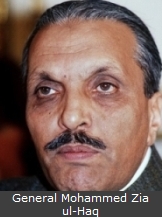
General Muhammad Zia-Ul-HaqThen, suddenly, in July 1977, Gen. Zia was no longer amusing when his junta arrested Mr. Bhutto and his cabinet, and imposed martial law. There followed more than a decade of military tyranny as Pakistan became, in Salman Rushdie’s phrase, “a nightmarish land.” That era and its sequels would be the setting of Benazir Bhutto’s political career, climaxing in her assassination Dec. 27. She was emblematic of her country’s nightmare, and of the tortuous role the United States played in it. It is a history – forgotten, denied – that haunts us all.

Benazir was a year old in 1954 as Washington adopted Pakistan as its Cold War client, lavishing the first of what would be billions of dollars on a military that by the end of the 1950s seized power amid the country’s chronic poverty and hostility with India. It was cozy, enduring patronage. Pentagon and CIA men shared with their Pakistani peers an occupational contempt for non-alignment and the hindrance of democratic politics.

By 1959, the CIA had stationed an agent in Karachi to advise Pakistani generals on public relations practices that would be enabling military dictatorships to claim legitimacy nearly a half-century later.
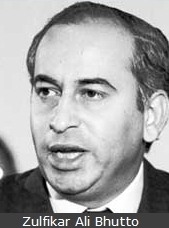
Zulfikar Ali BhuttoCanny, charismatic, irrepressibly ambitious, U.S.- and Oxford-educated Zulfikar Ali Bhutto was a young civilian minister for the junta in the 1960s, veering between complicity and enmity with the generals in the tangled pattern of Pakistan’s civilian-military politics. He then was an occasional nemesis of Washington, courting Communist China, fiercely bellicose on Kashmir and India. Breaking with the junta and founding his Pakistan Peoples Party in 1967, he inherited power in the 1971 breakaway of Bangladesh, when not even the U.S. could save the generals from the toll of secession, genocide, and another lost war with India.

While Benazir was driving her yellow MG at Radcliffe and Oxford, her father moved to restore his truncated nation and, in the process, seeded much of the 21st century predicament in South Asia – often in collusion with a heedless Washington. Grateful for Pakistan’s role as go-between in their 1971 opening to China, U.S. president Richard Nixon and secretary of state Henry Kissinger joined and financed Mr. Bhutto in his covert intervention against an Afghan regime he claimed was a pawn for Soviet expansion to the Arabian Sea and a menace to Pakistan’s ever-unruly northwest with its Afghan-kindred tribes. In 1973-75 they secretly mounted attacks in the Hindu Kush by radical Islamic Afghan exiles – whose anti-Western politics, terrorist tactics, and control by Pakistan prefigured the mujahedeen and Taliban years before the 1979 Russian invasion, the Afghan civil war, al-Qaeda and 9/11.

Meanwhile, in January 1972, under an awning on the broad lawn of an estate in Multan – an ancient city of Sufi shrines known as Pakistan’s “second heart” – Mr. Bhutto secretly gathered 70 of the country’s finest scientists and asked them to build a nuclear bomb. “They responded,” said one, “enthusiastically.” For years, Washington would look the other way. His foes sneered at Mr. Bhutto as the “Raja of Larkana,” after his estate in the Sind where he and his daughter would be buried. Both were seigniorial in their politics, the PPP family chattel, inherited now by Benazir’s son, Bilawal Bhutto Zardari. “Our feudals,” a CIA agent called them. But unlike Benazir, her father was a reformer as well as demagogue, nationalizing exploitative industries, insurance companies, and exclusive private schools, giving the poorest farmers tax relief and fixing ceilings on land ownership.

Despite periodic repression and no little corruption in his ranks, his constitution in 1973 recognized Islam as the national religion while establishing a parliamentary system to evolve into a secular democracy. He freed Pakistan from the fine-print fetters of the Commonwealth, negotiated the Simla Agreement with India accepting the line of control in Kashmir, recognized Bangladesh and, by 1977, was making peace with Afghanistan. It all won popular support – but challenged the oligarchy, religious right, and allies of both in the military, Pakistan’s ruling triad. Gen. Zia’s coup came with sanction from those forces – and, ultimately, Washington.

After a show trial, they hanged Mr. Bhutto at dawn at the old Rawalpindi prison, not far from where his daughter was murdered three decades later. The U.S. embassy referred to it delicately as “resolving the Bhutto problem,” and the American media made its peace with the winner; Newsweek taken with Gen. Zia’s “brooding eyes,” the Los Angeles Times finding him “low-key, direct, and polite,” an “incredibly canny man” who “talks with quiet sincerity about his country’s problems” – the latter the Times and others didn’t bother to explore. Gen. Zia was no stranger to the Pentagon and CIA, files plump with his 1950s study in the U.S. as a young officer, at the Command and General Staff School at Fort Leavenworth in 1964, and in highly secret Pentagon “command courses” not long before he seized power. Like most of his predecessors and successors, the pomaded general was, to some, Washington’s creature.

Two days after the April 1979 Bhutto hanging, U.S. president Jimmy Carter’s advisers formally approved a major covert intervention using the client Afghan religious radicals against the new Communist regime in Afghanistan – this, eight months before the Soviet invasion that the U.S.-armed and Pakistani-controlled insurgency was designed, in part, to provoke. The ensuing enormity came to seem familiar, though distorted to parody by versions like Charlie Wilson’s War and its Hollywood gloss. Hundreds of millions, ultimately billions, poured into the mujahedeen with their rampant drug trade and fulmination of al-Qaeda; Washington’s unstinting support of Gen. Zia, with more winking at his nuclear arsenal, and with as much as half the U.S. money siphoned off by Pakistan’s Inter-Services Intelligence, the notorious ISI already a state-within-a-state and now dominant in a black economy that eclipsed the open one. When he was assassinated in 1988 in the crash of Pak One, Gen. Zia was returning from a demonstration of a faulty tank the Pentagon was typically keen to sell him, and in tête-à-tête with a U.S. ambassador who knew him when he was still “Bhutto’s butler.”

Benazir BhuttoBenazir Bhutto now joined the story, though in ugly anticlimax. While the CIA-Zia combine conducted its Afghan war and associated trade over the 1980s, she worked tirelessly as her father’s chosen successor. This included building furtive ties to the Americans, the CIA covering its bets with subsidies to Ms. Bhutto, some no doubt recycled in paying for her Washington lobbyists.

With Gen. Zia’s murder, she was ready and, like her father, inherited power in a moment of the military’s division. But her tenures as prime minister in 1988-90 and again in 1993-96 were hobbled by the massive power of the ISI, old habits of repression, including the murder of her own dissident brother, and blatant looting by her circle, not least by her husband Asif Zardari. Failure and corruption went unrelieved by any reforms approaching her father’s. It stood to be repeated had Ms. Bhutto held power again – the ISI manacling along with her own corruption – and is in the wings now with Mr. Zardari’s regency over the PPP.

Like her father, like Gen. Zia her nemesis, she was partly America’s creature as well, inserted by the Bush administration, with the blessing of congressional Democrats, to shore up Pakistani President Pervez Musharraf with some coalition manqué appeasing enough of the crowd as well as the triad. As always, there was even an underside to Ms. Bhutto’s vaunted defiance of the Islamic radicals; her own regimes had been instrumental in the rise of the Afghan Taliban and given to quiet accommodation and sharing of spoils with the internal Pakistani zealots.

She was dead only days when it became clear that the tragedy of her last 30 years would continue. In a U.S. presidential campaign that, otherwise, blares change, no candidate dares to change this most disastrous, most bipartisan, most bigoted of foreign policies, in which America’s meddling was so malignant and its ultimate control so illusory. In Pakistan, the old politics go on, including the security of the nuclear arms. None of the ruling triad wants that horror unleashed. The losers, as always, will be the more than hundred million Pakistanis in abject want or on the edge – the historic disgrace of the world’s longest running military despotism, and of America’s most generous and tragic patronage.

If only they buried in the Sind, along with Zulfikar Ali Bhutto and his beloved daughter, that sordid past. For now, we can only follow the poet Faiz Ahmed Faiz: “We will inter hope with appropriate mourning … Every gate of prayer throughout heaven is slammed shut today.”

© Roger Morris

Roger Morris, who served on the National Security Council staff under Lyndon Johnson and Richard Nixon, is the author of Shadows of the Eagle, a history of U.S. covert intervention and policy in the Middle East and South Asia, to be published this year.
This article first appeared in the Globe and Mail and is reprinted here with the author’s permission.


Facebooktwittermail

OPINION & EDITOR’S COMMENT: Toward a nuclear-free world

Toward a nuclear-free world

The accelerating spread of nuclear weapons, nuclear know-how and nuclear material has brought us to a nuclear tipping point. We face a very real possibility that the deadliest weapons ever invented could fall into dangerous hands.

The steps we are taking now to address these threats are not adequate to the danger. With nuclear weapons more widely available, deterrence is decreasingly effective and increasingly hazardous.

One year ago, in an essay in this paper, we called for a global effort to reduce reliance on nuclear weapons, to prevent their spread into potentially dangerous hands, and ultimately to end them as a threat to the world. The interest, momentum and growing political space that has been created to address these issues over the past year has been extraordinary, with strong positive responses from people all over the world. [complete article]

Editor’s Comment — Strengthening the NPT requires that nuclear states who refuse to sign the treaty must as a consequence face penalties. The outlaw states are India, Pakistan, North Korea, and Israel. For as long as the United States — with a nod and a wink — allows Israel to maintain the pretense that it is not a nuclear-armed state, it will be impossible to credibly apply pressure on the others. If the United States wants to show the world that it is really serious about disarmament, Israel must be forced out of its nuclear closet.

Facebooktwittermail

ANALYSIS: Pentagon’s Whitman spins a good yarn

How the Pentagon planted a false story

Senior Pentagon officials, evidently reflecting a broader administration policy decision, used an off-the-record Pentagon briefing to turn the Jan. 6 U.S.-Iranian incident in the Strait of Hormuz into a sensational story demonstrating Iran’s military aggressiveness, a reconstruction of the events following the incident shows.

The initial press stories on the incident, all of which can be traced to a briefing by deputy assistant secretary of defense for public affairs in charge of media operations Bryan Whitman, contained similar information that has since been repudiated by the Navy itself.

Then the Navy disseminated a short video into which was spliced the audio of a phone call warning that U.S. warships would “explode” in “a few seconds.” Although it was ostensibly a Navy production, IPS has learned that the ultimate decision on its content was made by top officials of the Defense Department. [complete article]

Facebooktwittermail

NEWS: France’s expanding nuclear trade

France signs up to £2 billion deal to build nuclear plants in the Gulf

France has agreed a £2 billion deal to build nuclear power stations in the Gulf and in return has secured a military base there.

The French base in Abu Dhabi would accommodate up to 500 troops. It would probably serve as a maintenance station for France’s naval vessels in the Gulf and could also be used as a springboard to send troops into the troubled region.

“France responds to its friends,” President Sarkozy said, calling the deal “a sign to all that France is participating in the stability of this region”.

The French moves followed an American promise to sell £10 billion of weaponry to Gulf states to help them to counter the influence of Iran. [complete article]

Sarkozy: Arabs have nuclear right

Nicolas Sarkozy has said that Arab countries should have the right to develop nuclear energy.

However, the French president said that right should not be extended to Iran until the government in Tehran has proved definitively that it does not intend to acquire nuclear weapons.

Sarkozy told Al Jazeera in the Qatari capital Doha on Monday: “In 40 years from now there will be no oil left and in 100 years no more gas, nuclear power will replace those energy sources … It is the energy of the future. [complete article]

Facebooktwittermail

NEWS, ANALYSIS & EDITOR’S COMMENT: IDF-Hamas clash

Despite raid, Hamas, Israel don’t seek escalation

Tuesday’s fighting in the Gaza Strip and western Negev was the fiercest in a year, making it one of the worst days since the disengagement in August 2005. The Palestinians suffered 19 deaths and dozens of wounded. On the Israeli side, a foreign volunteer was killed at Kibbutz Ein Hashlosha, a few people were lightly wounded in Sderot, and dozens of Qassam rockets and mortar shells fell on communities near Gaza and a Katyusha rocket hit Ashkelon.

Despite this, Tuesday’s military operation in Gaza was basically routine. It was not part of a major operation to reoccupy the Strip; neither Israel nor Hamas is currently interested in a broader confrontation.

Nevertheless, a cautionary note must be added to this assessment: The large number of fatalities suffered by Hamas – more than 30 since the start of the month – could push the organization into escalation even if this is not in its interest.

Prime Minister Ehud Olmert told the Knesset Foreign Affairs and Defense Committee on Monday that fewer Israelis were killed by Palestinian terror in 2007 than in any year since 1999, and he “strongly recommends not becoming embroiled in operations and costs that bear no proportion to the constraints that we face” – a reference to a major operation in Gaza. Senior Israel Defense Forces officers say their impression is that neither Olmert nor Defense Minister Ehud Barak wants an escalation in the Strip.

However, this picture contains another element as well: the deal to free kidnapped soldier Gilad Shalit. Mahmoud Zahar, who lost a second son to IDF fire Tuesday, is the politician with the most influence on Hamas’s military wing, which holds Shalit. The death of his son might stall negotiations on the Shalit deal, which had recently seemed on the verge of a breakthrough. And since the deal, in which Israel would swap 450 Palestinian prisoners for Shalit, would likely have included a temporary cease-fire, the chances of escalation increase if it is put on ice. [complete article]

Exiled Hamas leader says Bush ‘incited the Zionists’ to raid Gaza

Khaled Meshal, in an interview with The Associated Press in Damascus where he lives, accused Bush of inciting Israeli leaders.

“This crime is the ugly fruit of Bush’s visit to the region. He has incited the Zionists and has exerted pressure on the Palestinian side to become more hardline against Palestinian dialogue,” he said during the interview in his office. [complete article]

See also, Hezbollah’s Nasrallah: Bush’s visit empowered Israel to ‘wreak havoc’ (AP).

Editor’s Comment — The death of Hussam Zahar who, as the New York Times reports, “died in an Israeli airstrike on the car in which he was traveling,” suggests that Israel may have reinstated its program of “targeted killings” — assassinations.

Facebooktwittermail

NEWS: Blackwater might evade justice; signs of Iraq’s economic progress turn out to be baseless

Blackwater case faces obstacles, Justice Dept. says

Justice Department officials have told Congress that they face serious legal difficulties in pursuing criminal prosecutions of Blackwater security guards involved in a September shooting that left at least 17 Iraqis dead.

In a private briefing in mid-December, officials from the Justice and State Departments met with aides to the House Judiciary Committee and other Congressional staff members and warned them that there were major legal obstacles that might prevent any prosecution. Justice officials were careful not to say whether any decision had been made in the matter, according to two of the Congressional staff members who received the briefing.

The staff members, who asked not to be identified, disclosed details of the meeting in interviews this week.

The December briefing took place after a federal grand jury had been convened in the case, suggesting that prosecutors had decided to begin hearing testimony with potential prosecution problems still unresolved. [complete article]

Iraqi spending to rebuild has slowed, report says

Highly promising figures that the administration cited to demonstrate economic progress in Iraq last fall, when Congress was considering whether to continue financing the war, cannot be substantiated by official Iraqi budget records, the Government Accountability Office reported Tuesday.

The Iraqi government had been severely criticized for failing to spend billions of dollars of its oil revenues in 2006 to finance its own reconstruction, but last September the administration said Iraq had greatly accelerated such spending. By July 2007, the administration said, Iraq had spent some 24 percent of $10 billion set aside for reconstruction that year.

As Gen. David H. Petraeus, the top American commander in Iraq, and Ryan C. Crocker, the American ambassador to Iraq, prepared in September to report to Congress on the state of the war, the economic figures were a rare sign of progress within Iraq’s often dysfunctional government.

But in its report on Tuesday, the accountability office said official Iraqi Finance Ministry records showed that Iraq had spent only 4.4 percent of the reconstruction budget by August 2007. It also said that the rate of spending had substantially slowed from the previous year. [complete article]

Facebooktwittermail

NEWS & EDITOR’S COMMENT: The torture cover-up

Station chief made appeal to destroy CIA tapes

Those known to have counseled against the tapes’ destruction include John B. Bellinger III, while serving as the National Security Council’s top legal adviser; Harriet E. Miers, while serving as the top White House counsel; George J. Tenet, while serving as CIA director; [Scott W.] Muller, while serving as the CIA’s general counsel; and John D. Negroponte, while serving as director of national intelligence.

Hayden, in an interview, said the advice expressed by administration lawyers was consistent. “To the degree this was discussed outside the agency, everyone counseled caution,” he said. But he said that, in 2005, it was “the agency’s view that there were no legal impediments” to the tapes’ destruction. There also was “genuine concern about agency people being identified,” were the tapes ever to be made public.

Hayden, who became CIA director last year, acknowledged that the questions raised about the tapes’ destruction, then and now, are legitimate. “One can ask if it was a good idea, or if there was a better way to do it,” he said. “We are very happy to let the facts take us where they will.” [complete article]

Editor’s Comment — The top officials here were either duplicitous or incompetant or both. The decision-making process carries the signature of the Bush-Cheney administration. It’s all about being able to act and evade responsibility. Under the leadership of a frat boy president, no one wants to carry the accountability that Bush himself refuses to bear.

Special counsel sought in CIA tapes case

The chairman of the House Judiciary Committee and 18 other House Democrats on Tuesday asked the attorney general to replace a government prosecutor with an outside lawyer to investigate the CIA’s destruction of interrogation videotapes. [complete article]

Facebooktwittermail

NEWS: Bagram – the other Gitmo

Bagram: The other Gitmo

As last week marked the sixth anniversary of the arrival of the first orange-jumpsuit-clad prisoners at the US naval base at Guantanamo Bay, Cuba, human-rights organizations are attempting to focus public and congressional scrutiny on what some are calling “the other Gitmo”.

This is a prison located on the US military base in the ancient city of Bagram near Charikar in Parvan, Afghanistan. The detention center was set up by the US military as a temporary screening site after the 2001 invasion of Afghanistan overthrew the Taliban. It currently houses about 630 prisoners – close to three times as many as are still held at Guantanamo.

In 2005, following well-documented accounts of detainee deaths, torture and “disappeared” prisoners, the US undertook efforts to turn the facility over to the Afghan government. But, thanks to a series of legal, bureaucratic and administrative missteps, the prison is still under American military control. And a recent confidential report from the International Committee of the Red Cross (ICRC) has reportedly complained about the continued mistreatment of prisoners.

The ICRC report is said to cite massive overcrowding, “harsh” conditions, lack of clarity about the legal basis for detention, prisoners held “incommunicado” in “a previously undisclosed warren of isolation cells”, and “sometimes subjected to cruel treatment in violation of the Geneva Conventions”. Some prisoners have been held without charges or lawyers for more than five years. The Red Cross said dozens of prisoners have been held incommunicado for weeks or even months, hidden from prison inspectors. [complete article]

Facebooktwittermail

EDITORIAL: Fake friendly-fire

Richard Cohen’s Farrakhan test

Anticipation of the “swiftboating” of Barak Obama is a partially misplaced fear in as much as it focuses on the likelihood of delightfully crude attacks of the kind Karl Rove could be expected to craft. Much more insidious is the form of attack — a kind of fake friendly-fire — that comes from commentators like Richard Cohen.

“It’s important to state right off that nothing in Obama’s record suggests he harbors anti-Semitic views,” says Cohen in the Washington Post. Though Cohen professes “admiration” for Obama, he says, “I wonder about his mettle.”

What Cohen is doing with his Obama and anti-Semitism association is playing with the same line of deceit that George Bush and Dick Cheney like to use in linking Saddam Hussein and 9/11. Bring the terms into close proximity and then bounce them back and forth between sentences. If someone asks, “Are you suggesting that Saddam was responsible for 9/11?” or, “Are you implying that Barak Obama does not object to anti-Semitism?”, then the swift response is, “I said no such thing.” But after the denial comes the repetition. It’s a coward’s line of attack.

It’s one thing to make a provocative argument and stir up debate, but Cohen’s commentary, far from being an appeal to reason is a blatant effort to poison a political process. He is doing what so many a political operative does which is to look at the audience he hopes to influence and then try and pick out all its weaknesses — its fear, suspicion, bigotry and ignorance. These he sees as a valuable pool of resources that can be exploited to further his political agenda. But do you really think, Mr. Cohen, that we need another presidency that rests on a foundation of fear and ignorance?

Facebooktwittermail

OPINION & EDITOR’S COMMENT: Faith talk on the campaign trail

Is religion a threat to democracy?

It’s a presidential campaign like no other. The candidates have been falling all over each other in their rush to declare the depth and sincerity of their religious faith. The pundits have been just as eager to raise questions that seem obvious and important: Should we let religious beliefs influence the making of law and public policy? If so, in what way and to what extent? Those questions, however, assume that candidates bring the subject of faith into the political arena largely to justify — or turn up the heat under — their policy positions. In fact, faith talk often has little to do with candidates’ stands on the issues. There’s something else going on here.

Look at the TV ad that brought Mike Huckabee out of obscurity in Iowa, the one that identified him as a “Christian Leader” who proclaims: “Faith doesn’t just influence me. It really defines me.” That ad did indeed mention a couple of actual political issues — the usual suspects, abortion and gay marriage — but only in passing. Then Huckabee followed up with a red sweater-themed Christmas ad that actively encouraged voters to ignore the issues. We’re all tired of politics, the kindly pastor indicated. Let’s just drop all the policy stuff and talk about Christmas — and Christ.

Ads like his aren’t meant to argue policy. They aim to create an image — in this case, of a good Christian with a steady moral compass who sticks to his principles. At a deeper level, faith-talk ads work hard to turn the candidate — whatever candidate — into a bulwark of solidity, a symbol of certainty; their goal is to offer assurance that the basic rules for living remain fixed, objective truths, as true as religion. [complete article]

Editor’s Comment — In his introduction to Ira Chernus’ piece, Tom Engelhardt writes:

… the “change” candidates of 2008, wielding the “C” word for an audience “fired up” for… well, you know what, so just shout it out… must themselves swear that they are “consistent” in their positions, that, in short, they do not change. The one thing these candidates of change can’t go out in public and say is something like: “Well, that was 2002, but in the intervening years, I’ve done a lot of thinking, had new experiences, grown, matured… changed, and so has my position on [you fill in the issue].”

This makes me think of a line from Gandhi: “My aim is not to be consistent with my previous statements on a given question, but to be consistent with truth as it may present itself to me at a given moment.”

To say otherwise is to say: My understanding of the world is impervious to the effect of experience. What I thought yesterday, I will think tomorrow. I am incapable of having a fresh thought. My brain has stopped working. I want to become the next president.

Facebooktwittermail

NEWS & OPINION: Bush’s effort to undermine the NIE

Artificial intelligence

President George W. Bush hasn’t accomplished much on his voyage to the Middle East, but he did take the time to inflict another wound on the entire U.S. intelligence community—and on the credibility of anything he might ever again say about the world.

In the latest Newsweek, Michael Hirsh reports that, during a private conversation with Israeli Prime Minister Ehud Olmert, Bush “all but disowned” the agencies’ Dec. 3 National Intelligence Estimate on Iran. A “senior administration official who accompanied Bush” on the trip confided to Hirsh that Bush “told the Israelis that he can’t control what the intelligence community says, but that [the NIE’s] conclusions don’t reflect his own views.” [complete article]

In Iran reversal, bureaucrats
triumphed over Cheney team

Senior officials at the Office of the Director of National Intelligence, the umbrella organization that coordinates the U.S.’s 16 spy agencies and that oversaw the report, say payback wasn’t a factor. They defend the report as a righting of the ship after the Iraq intelligence failures.

Hundreds of officials were involved and thousands of documents were drawn upon in this report, according to the DNI, making it impossible for any official to overly sway it. Intelligence sources were vetted and questioned in ways they weren’t ahead of the 2003 U.S. invasion of Iraq.

Thomas Fingar, 62 years old, is one of the lead architects of the Iran report. A veteran State Department official, Mr. Fingar helped lead the office that argued in 2002 that evidence of Iraq’s nuclear program was faulty. He is now a senior official at the DNI.

Of the backlash against the report, Mr. Fingar says, “A lot of it is just nonsense. The idea that this thing was written by a bunch of nonprofessional renegades or refugees is just silly.” [complete article]

Facebooktwittermail

OPINION: Less than human

Less than human

Friday marked the sixth anniversary of the arrival of the first detainees at the American GULAG constructed to house prisoners taken in the Bush Administration’s War on Terror in Guantánamo. Around the world, thousands gathered in public commemorations in London, Stockholm, Dublin, Brussels and Bahrain. More than twelve hundred parliamentarians signed a formal plea calling for the immediate closing of the base. The same plea had previously been issued by Pope Benedict, Chancellor Angela Merkel and more than two dozen other world leaders. Indeed, quite remarkably, on Sunday Admiral Mike Mullen, chairman of the Joint Chiefs of Staff essentially joined in with the protestors.

“More than anything else it’s been the image — how Gitmo has become around the world, in terms of representing the United States. … I believe that from the standpoint of how it reflects on us that it’s been pretty damaging.”

Mullen went on to say that he wanted the facility shut down. Sources inside the Pentagon say that has been the view of the Joint Chiefs of Staff for several years now. [complete article]

Facebooktwittermail
