Author Archives: Paul Woodward

NEWS ANALYSIS OPINION & EDITOR’S COMMENTS: Iran, war, prisoners, oil, nuclear advances

The Iranian challenge

Iran will be the top foreign policy challenge for the United States in the coming years. The Bush Administration’s policy (insistence on zero enrichment of uranium, regime change and isolation of Iran) and the policy of the radicals around President Mahmoud Ahmadinejad (unlimited civilian nuclear capability, selective inspections and replacing the United States as the region’s dominant power) have set the two countries on a collision course. Yet the mere retirement of George W. Bush’s neocons or Ahmadinejad’s radicals may not be sufficient to avoid the disaster of war.

The ill-informed foreign policy debate on Iran contributes to a paradigm of enmity between the United States and Iran, which limits the foreign policy options of future US administrations to various forms of confrontation while excluding more constructive approaches. These policies of collision are in no small part born of the erroneous assumptions we adopted about Iran back in the days when we could afford to ignore that country. But as America sinks deeper into the Iraqi quicksand, remaining in the dark about the realities of Iran and the actual policies of its decision-makers is no longer an option.

A successful policy on Iran must begin by reassessing some basic assumptions:

1. Iran is ripe for regime change.

Not true. Although the ruling clergy in Iran are very unpopular, they are not going anywhere anytime soon. [complete article]

Editor’s Comment — At a moment when numerous contrasts and comparisons are being drawn between Iran and Pakistan, this is one among many that deserves underlining: non-nuclear Iran is more politically stable than nuclear Pakistan.

Noun + verb + 9/11 + Iran = Democrats’ defeat?

… there is nonetheless a method to all the mad threats of war coming out of the White House. While the saber- rattling is reckless as foreign policy, it’s a proven winner as election-year Republican campaign strategy. The real point may be less to intimidate Iranians than to frighten Americans. Fear, the only remaining card this administration still knows how to play, may once more give a seemingly spent G.O.P. a crack at the White House in 2008.

Whatever happens in or to Iran, the American public will be carpet-bombed by apocalyptic propaganda for the 12 months to come. Mr. Bush has nothing to lose by once again using the specter of war to pillory the Democrats as soft on national security. The question for the Democrats is whether they’ll walk once more into this trap.

You’d think the same tired tactics wouldn’t work again after Iraq, a debacle now soundly rejected by a lopsided majority of voters. But even a lame-duck president can effectively wield the power of the bully pulpit. From Mr. Bush’s surge speech in January to Gen. David Petraeus’s Congressional testimony in September, the pivot toward Iran has been relentless. [complete article]

See also, Inexorable march toward war with Iran? (Joseph L. Galloway).

U.S. ‘to release’ Iranians in Iraq

The US military in Iraq says it intends to release nine Iranians being held there, including two detained on suspicion of helping Shia militias.

They were among five Iranians who Tehran insists are diplomats seized in the Kurdish city of Irbil in January.

The announcement came as Iran opened two consulates in northern Iraq to improve ties with the Kurdish region.

Iran’s ambassador said the detention of the five men was an “illegal act against Iraqi sovereignty”. [complete article]

Editor’s Comment — Hmmm…. I wonder whether Centcom commander Admiral Fallon came back from Pakistan with word that this would be a good time to slip this one under the radar while Bush and Cheney were distracted?

US faces dilemma in targeting Iran’s oil

With oil above $95 a barrel, there are limits to how much pressure the U.S. is willing to place on Iran’s petroleum sector to influence a persistent nuclear standoff, analysts say.

The dilemma is pretty clear for the world’s largest energy consuming nation, which last week announced sanctions against several Iranian oil-services firms. Taking more aggressive action risks hurting America’s economy, while enriching Iran’s.

Washington is also limited by the reality that, even if it wanted to take a more bellicose stance, it can do little — short of military action — to hinder Iran’s oil sales at a time when global demand is bulging. [complete article]

See also, Oil passes $98 on weaker dollar (BBC).

Poll finds Americans split on taking military action in Iran

Americans are concerned about Iran’s nuclear program but split on whether military action should be undertaken if diplomacy and economic sanctions fail to stop it, according to a new USA TODAY/Gallup Poll.

The findings underscore public concern about an Iranian threat and a partisan divide over how to respond. Iran has emerged as a key issue in the presidential race, especially among Democrats.

While 46% of those surveyed say military action should be taken either now or if diplomacy fails, 45% rule it out in any case. Republicans are twice as likely as Democrats to endorse taking military steps. [complete article]

Experts: No firm evidence of Iranian nuclear weapons

Despite President Bush’s claims that Iran is pursuing nuclear weapons that could trigger “World War III,” experts in and out of government say there’s no conclusive evidence that Tehran has an active nuclear-weapons program.

Even his own administration appears divided about the immediacy of the threat. While Bush and Vice President Dick Cheney speak of an Iranian weapons program as a fact, Bush’s point man on Iran, Undersecretary of State Nicholas Burns, has attempted to ratchet down the rhetoric.

“Iran is seeking a nuclear capability … that some people fear might lead to a nuclear-weapons capability,” Burns said in an interview Oct. 25 on PBS.

“I don’t think that anyone right today thinks they’re working on a bomb,” said another U.S. official, who requested anonymity because of the issue’s sensitivity. Outside experts say the operative words are “right today.” They say Iran may have been actively seeking to create a nuclear-weapons capacity in the past and still could break out of its current uranium-enrichment program and start a weapons program. They too lack definitive proof, but cite a great deal of circumstantial evidence. Bush’s rhetoric seems hyperbolic compared with the measured statements by his senior aides and outside experts. [complete article]

Defiant Iran reaches key nuclear target

Iran has reached a key target of 3,000 centrifuges for uranium enrichment, President Mahmoud Ahmadinejad said on Wednesday, vowing to ignore UN resolutions calling for a halt to Tehran’s sensitive nuclear work.

“We have now reached 3,000 machines,” a defiant Ahmadinejad told a rally in the northeastern city of Birjand.

It was not the first time that the president had boasted that Iran had 3,000 centrifuges up and running. [complete article]


Facebooktwittermail

NEWS: The Taliban continues to advance

Taliban stage a coup of their own

While the world’s attention focused on the troubles of President General Pervez Musharraf following his declaration of a state of emergency in Pakistan at the weekend, the Taliban have launched a coup of their own in Afghanistan and the Pashtun areas of Pakistan.

Pakistani troops had prevented the Taliban from launching their planned post-Ramadan (Muslim holy month) offensive into Afghanistan by invading the Pakistani North Waziristan and South Waziristan tribal areas on October 7.

The Taliban managed to set up a counter engagement by stirring their network in the Swat Valley in North-West Frontier Province, which took the pressure off the Waziristans. The November 4 declaration of an emergency and the preparations before it was enforced distracted the military. As a result, several villages and towns in the Swat Valley, only a drive of four hours from Islamabad, have fallen to the Taliban without a single bullet being fired – fearful Pakistani security forces simply surrendered their weapons. [complete article]

See also, Afghan suicide blast ‘kills 40’ (BBC).

Facebooktwittermail

OPINION: America and Britain’s failure in Iraq

The enemy within

The world’s finest military launches a highly coordinated shock-and-awe attack that shows enormous initial progress. There’s talk of the victorious troops being home for Christmas. But the war unexpectedly drags on. As fighting persists into a third, and then a fourth year, voices are heard calling for negotiations, even “peace without victory.” Dismissing such peaceniks and critics as defeatists, a conservative and expansionist regime — led by a figurehead who often resorts to simplistic slogans and his Machiavellian sidekick who is considered the brains behind the throne — calls for one last surge to victory. Unbeknownst to the people on the home front, however, this duo has already prepared a seductive and self-exculpatory myth in case the surge fails.

The United States in 2007? No, Wilhelmine Germany in 1917 and 1918, as its military dictators, Field Marshal Paul von Hindenburg and his loyal second, General Erich Ludendorff, pushed Germany toward defeat and revolution in a relentless pursuit of victory in World War I. Having failed with their surge strategy on the Western Front in 1918, they nevertheless succeeded in deploying a stab-in-the-back myth, or Dolchstoßlegende, that shifted blame for defeat from themselves and Rightist politicians to Social Democrats and others allegedly responsible for losing the war by their failure to support the troops at home.

The German Army knew it was militarily defeated in 1918. But this was an inconvenient truth for Hindenburg and the Right, so they crafted a new “truth”: that the troops were “unvanquished in the field.” So powerful did these words become that they would be engraved in stone on many a German war memorial. [complete article]

Britain’s failure in Iraq

Last month’s announcement of substantial withdrawals of British troops from southern Iraq is a useful vantage point from which to review Britain’s part in the occupation. The role of the United States has been the more important, and is far better documented and understood. But Britain’s role has not been insignificant, especially for the people of southern Iraq.

In 2003, Britain promised a post-Saddam Iraq that would be “a stable, united and law-abiding state providing effective representative government to its own people.” That those ambitions have not been realised is now widely acknowledged even within the political establishment. A recent report by Michael Knights and Ed Williams described Iraq’s deep south, the area for which Britain is responsible, as “a kleptocracy” where “well armed political-criminal mafiosi have locked both the central government and the people out of power”.

Britain’s official goals have now been significantly downgraded to keeping violence at a manageable level, and leaving local administrators and security services to deal with the situation. Even this is far from being achieved, and Britain faces these problems in near isolation from the international community. British policymakers and analysts will be asking themselves what went wrong for many years to come. [complete article]

Facebooktwittermail

EDITORIAL: The real world of torture

Jack Bauer vs. Abdallah Higazy — Fiction vs. Reality

jackbauer.jpgabdallah-higazy.jpg

According to a new CNN poll, 69 percent of Americans believe that waterboarding is a form of torture. Even so, a staggering 40 percent of Americans polled believe that the US government should be allowed to use this form of torture to get information from suspected terrorists.

Commentators on this issue have expressed moral outrage — “waterboarding is killing America’s soul,” proclaims the Philadelphia Daily News‘ “Attytood.” Some see this as an afront to American pride — Keith Olbermann challenges President Bush by saying, “[We don’t condone torture] because we’re Americans, sir, and we’re better than that. We’re better than you.” While there are those who express indifference — the Wall Street Journal regards this as “mostly a political sideshow.”

Yet for those 40 percent of Americans who favor the use of torture, their view has in all likelihood been clearly expressed by Democratic Senator, Charles Schumer, who in a 2004 Senate hearing said:

I think there are probably very few people in this room or in America who would say that torture should never ever be used, particularly if thousands of lives are at stake. . . . It is easy to sit back in the armchair and say that torture can never be used, but when you are in the foxhole it is a very different deal. And I respect, I think we all respect the fact that the President is in the foxhole every day.

This then is how the issue is being framed: on one side are those who see themselves adopting the moral high ground — though their critics perceive them as being holier-than-thou, starry-eyed idealists; and on the other side are those who believe in the necessity of making tough choices in extreme circumstances — though their opponents see them as having lost their moral bearings.

At the center of this debate is an argument of perceived necessity. And the narrative that animates this argument, borrowed from Israel and used there in an earlier debate on the legitimacy of torture, is the “ticking bomb” scenario.

The scenario itself is fanciful. We are all familiar with the suspense movie in which the reality of what is feared is confirmed by making the audience privilege to the whereabouts of a bomb and the time left before it will explode. In post-9/11 America the impact of such dramas has been heightened by the likes of Fox TV’s fictional counter-terrorism agent, Jack Bauer. Let’s face it, for a population that forms most of its understanding of the world through television, such imagery has a visceral impact. But in Israel itself, where the danger of terrorism is more tangible and ubiquitous, the ticking bomb scenario is itself no less a product of fiction and has served no less as a political tool. As Stephen Langfur wrote in 1996:

Israel wants to present itself as an enlightened democracy on the Western model, but it has locked itself into the role of Occupier, with the result that toward part of the population under its control it must behave like a police-state. The “ticking bomb scenario” offers an exceptional, border-line situation, in which everyone can understand that even an enlightened democracy might have to use torture. What Israel does, therefore, is to extend the fantasy of the bomb in the crowded building to include analogous situations—even remotely analogous. Israel can then allow its security apparatus to approach interrogations as if they were all “ticking bombs.” Thus it can keep wearing the mask of an enlightened democracy, while functioning like a police-state. The “ticking bomb scenario,” for which torture is useless, “koshers” other situations where torture can be useful.

Indeed, Langfur points out that Israeli General Security Service officials used the ticking bomb argument to intimidate judges. After all, who would be willing to curtail an interrogation and thereafter be accused of having failed to prevent carnage? Yet in practice, so-called ticking bombs turned out to be prisoners who had been held in detention for weeks — plenty of time for plots to be revised and for the seeming inevitability of any attack to evaporate.

If an interrogation method’s “necessity” was to be based on the magnitude of a risk averted, then any technique applied to bring about the desired result would surely be justifiable. On what basis could one say that it was acceptable to use waterboarding to make the prisoner fear that he was about to drown, yet bleach could not be poured in his eyes, if in both cases the justification for the brutality was the necessity of saving innocent Israeli or American lives? If brutality can be graded on a scale, then on what basis can we say that in one instance the end justify the means while in another it does not, when necessity is determined by the end and not the means?

The issue here cannot be addressed or resolved by considering fictional scenarios. Instead we need to focus on reality and fortunately there is already one case that provides the perfect litmus test: the case of Abdallah Higazy.

On December 17, 2001, Higazy was detained and questioned by the FBI and then held as a material witness, suspected of being an accomplice in the 9/11 attacks on the World Trade Center in New York. He had been staying in a nearby hotel and was thought to have been in possession of an air-band transceiver capable of air-to-air and air-to-ground communication that could have been used as a beacon to direct the hijacked aircraft into their targets, the Twin Towers. As a terrorist suspect Higazy was as hot as they get.

Under interrogation he kept on changing his story. He had to be lying. FBI agents said they gave Higazy a “polygraph” yet the United States Court of Appeals opinion [PDF] quotes the suspect as saying that the test produced “intense pain.” The court opinion states that “Higazy asked whether anybody else had ever suffered physical pain during the polygraph, to which [FBI Special Agent Michael] Templeton replied: “[i]t never happened to anyone who told the truth.” Was Higazy being given a polygraph or was he being electrocuted?

The court opinion continues:

Higazy alleges that during the polygraph, Templeton told him that he should cooperate, and explained that if Higazy did not cooperate, the FBI would make his brother “live in scrutiny” and would “make sure that Egyptian security gives [his] family hell.” Templeton later admitted that he knew how the Egyptian security forces operated: “that they had a security service, that their laws are different than ours, that they are probably allowed to do things in that country where they don’t advise people of their rights, they don’t – yeah, probably about torture, sure.”

If so-called harsh interrogation methods can be justified, Abdallah Higazy was surely the perfect candidate to be given the third degree. He was suspected of having played an instrumental role in the worst terrorist attack the world has ever seen. This must have been — as Vice President Cheney would say — a no-brainer. Or not?

Anyone familiar with the name, Abdallah Higazy, will of course know that he was completely innocent. The FBI quickly realized as much when a few weeks after Higazy’s detention an airline pilot showed up looking for the radio transceiver he had left behind when he had been evacuated from his hotel on September 11.

When FBI Special Agent Templeton was interrogating his suspect, were Cheney’s words from September 16, 2001, still fresh in his mind?

We also have to work, though, sort of the dark side, if you will. We’ve got to spend time in the shadows in the intelligence world. A lot of what needs to be done here will have to be done quietly, without any discussion, using sources and methods that are available to our intelligence agencies, if we’re going to be successful. That’s the world these folks operate in, and so it’s going to be vital for us to use any means at our disposal, basically, to achieve our objective.

Templeton certainly went to the dark side, but the terrorist he was after wasn’t there. The question that needs to be addressed now and that needs to be the concern of the next attorney general is not what methods of interrogation can be applied in a ticking bomb scenario; it is this: how should the law have protected Abdallah Higazy?

Interrogation is a means of inquiry, not a method of punishment. In the war on terrorism, the presumption of innocence should not be treated as a legal luxury — it is a recognition that suspects are not always (contrary to what the administration would have us believe) the worst of the worst, but on the contrary that with unfortunate frequency they have included the innocent.

Forget about ticking time bombs and remember Abdallah Higazy. After all, those who now want to justify torture do so in the name of protecting the innocent.

Facebooktwittermail

NEWS, ANALYSIS, OPINION & EDITOR’S COMMENT: Musharraf’s detour on the path to democracy

Pakistan shakes off U.S. shackles

…it turns out that the former prime minister Bhutto’s abrupt departure for Dubai in the United Arab Emirates last Thursday against the advice rendered by most of her party leaders happened just in time when it dawned on the US and Britain that despite their strong urgings, the generals were hell-bent on the imposition of emergency rule. The US and Britain counseled her to get out of harm’s way and quickly leave the country.

The initial statements of “regret” by the Western capitals, especially Washington, need to be taken with a pinch of salt. To be sure, the US policy toward Pakistan finds itself in a cul-de-sac. Musharraf’s move coincides almost to the hour with the thundering speech by President George W Bush at the Heritage Foundation, a Washington-based think-tank, on Thursday in which he blasted the US Congress for failing to take his “war on terror” not seriously enough, and he went on to compare Osama bin Laden to Adolf Hitler and Vladimir Lenin.

Addressing his neo-conservative acolytes, Bush came back to his favorite theme that via his “war on terror”, he was actually waging a global war for democracy and freedom. He compared Islamist “plans to build a totalitarian Islamist empire … stretching from Europe to North Africa, the Middle East and South East Asia” to the Third Reich. He claimed that US-led campaigns have “liberated 50 million people from the clutches of tyranny” in Iraq and Afghanistan. Bush said the people in the Middle East are “looking to the United States to stand up for them”.

Alas, we knew only a day later that just as Bush was speaking, one of his staunchest allies in his pet global war was squashing democracy and freedom. The US doublespeak becomes all too apparent in the mildly reproachful comment over Musharraf’s move, bordering on resignation, by the US spokesmen. It indicates that Washington’s dealings with the Musharraf regime will continue and normal business will resume once the dust has settled down. [complete article]

lawyersdefendingdemocracy.jpg

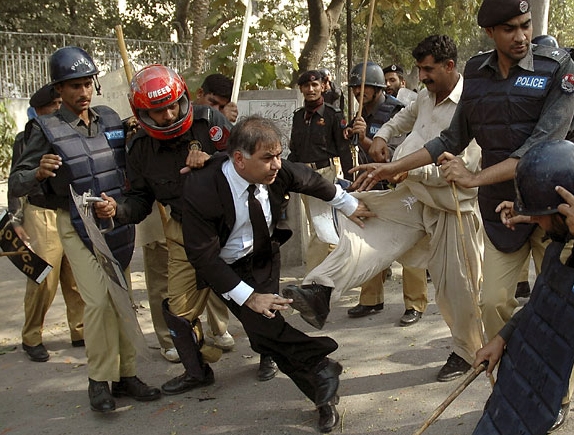
Editor’s Comment — These images of protesting lawyers in Pakistan deserve to become one of the lasting icons of the so-called war on terrorism. The Bush administration — however much handwringing it might engage in — once again has put itself on the wrong side of the law. Tariq Azim Khan, Pakistan’s minister of information, in what the New York Times describes as “unusually candid terms,” says that the United States would rather have a “stable” Pakistan than risk see democracy “fall into the hands of extremists.” In the same cynical spirit as talk-circuit motivational speakers, administration officials have now adopted a the journey is the goal philosophy as they express their hope that General Musharraf can keep Pakistan on the “path to democracy.”

(And here’s a note to America’s legal profession: How about demonstrating outside the White House in solidarity with your Pakistani counterparts? Their willingness to stand up to batton-wielding police is the kind of pro bono work that democracy defenders the world over, should be applauding.)

A second coup in Pakistan

The key question Musharraf faces is how long the army will continue to back him. Rank-and-file soldiers are keenly aware of the widening gulf between them and the public they are supposed to protect. The army, already demoralized, is unwilling to fight a never-ending war against its own people.

For now, the judges are gone, the media has been censored, the opposition and lawyers jailed and curtailed. But Musharraf’s emergency is not sustainable. Ruling by force without any political support will prove impossible. [complete article]

U.S. military aid to Pakistan misses its Al Qaeda target

Despite billions of dollars in U.S. military payments to Pakistan over the last six years, the paramilitary force leading the pursuit of Al Qaeda militants remains underfunded, poorly trained and overwhelmingly outgunned, U.S. military and intelligence officials said.

Pakistani President Pervez Musharraf cited the rising militant threat in declaring a state of emergency on Saturday and suspending the constitution.

But rather than use the more than $7 billion in U.S. military aid to bolster its counter-terrorism capabilities, Pakistan has spent the bulk of it on heavy arms, aircraft and equipment that U.S. officials say are far more suited for conventional warfare with India, its regional rival. [complete article]

Editor’s Comment — Hmmm… So we’re supposed to believe the administration isn’t happy to see military aid being spent on F-16s? On the contrary, it just sounds like that well-oiled revolving door that circulates American tax dollars, allocated as “foreign aid,” back into the pockets of American defense contractors. That’s how the military-industrial complex is designed to run isn’t it?

Fear and brutality inside the fiefdom of Islamist shock jock

The tourist brochures call it the Switzerland of south Asia – a mountain idyll of rushing turquoise rivers, snow-dusted peaks and Pakistan’s sole ski piste.

But now the Swat valley in northern Pakistan has a dark new reputation, as the frontline in the country’s faltering war on Islamist extremism.

On Saturday General Pervez Musharraf cited surging violence in Swat – including suicide bombings, beheadings and kidnappings – as a justification for the imposition of emergency rule. His security forces are battling an Islamist militia led by Maulana Fazlullah, a radical cleric with a flair for theatrics who wants to turn Swat into a mini Islamic fiefdom. The fight has been short but brutal, leaving hundreds dead. [complete article]

Facebooktwittermail

NEWS: Taliban make territorial advances

Taliban capture third western Afghan district

Taliban insurgents have captured a third district in western Afghanistan, local officials said on Monday, defying Western assertions the rebels are unable to mount large military offensives.

The hardline Islamist Taliban relaunched their insurgency two years ago to topple the pro-Western Afghan government and eject the 50,000 foreign troops, expanding their operations further from the mainly Pashtun south where they are strongest.

Western forces say the Taliban’s greater reliance this year on suicide and roadside bombs is a result of heavy battlefield casualties they and Afghan troops have inflicted on the rebels and the insurgents’ inability to hold ground.

But in the last week, the Taliban have captured three districts in the western province of Farah, bordering Iran, forcing lightly armed Afghan police to flee and defying Afghan and foreign forces to retake the lost ground. [complete article]

Facebooktwittermail

OPINION: Rethinking the war on terror

Rethinking the war on terror

In the last four years a great number of works have appeared which attempt to come to grips with the Bush Administration’s war on terror. Many of them are polemical, and few seem to me to be of lasting value. However, David Cole and Jules Lobel have crafted in Less Safe, Less Free one of the most important critiques to be put forward so far from the civil libertarians. They offer unsparing criticism, muster their arguments with skill and artistry, and most importantly they offer constructive criticism of the current Bush Administration model. On January 20, 2009, a new president will occupy the White House. The electoral process for Bush’s successor has already begun—the earliest such election contest in history—and polls show that Americans are uncharacteristically engaged and eager to see a turnover.

The key issue in this process will certainly be the war on terror and the paradigms that drive it. But it is distressing that this debate can only occur in the context of the election cycle. The most depressing fact about the Bush Administration is not the abject failure of its counter-terrorism policies; it is the Administration’s refusal to recognize the areas where those policies have fallen short and take some steps to correct them. Unlike any of its predecessors, this Administration has withdrawn from a public discussion of its own policies. [complete article]

Facebooktwittermail

ANALYSIS & EDITOR’S COMMENT: Deep in the (well-populated, well-connected, fertile) desert

Tourist trips to the Box-on-the-Euphrates

Is the Box-on-the-Euphrates in a remote place?

Details like that might seem insignificant, but they are not. Often, it seems to me, intelligence judgments are supported by informal bits of “color” or what you might call the gouge — circumstantial details that aren’t part of any official briefing, but appear in loose talk to bolster a judgment. Recall the “viewing stand” that North Korea never built, but nonetheless contributed to a false alarm about North Korean nuclear testing in Spring 2005.

One detail in the Box-on-the-Euphrates story that seems to lend credence to the “nuclear reactor” hypothesis is that the site is remote, and therefore suspicious. Here is how Martha Raddatz at ABC put it:

The official said the suspected nuclear facility was approximately 100 miles from the Iraqi border, deep in the desert along the Euphrates River. It was a place, the official said, “where no one would ever go unless you had a reason to go there.”

But the claim the the location is remote is, itself, an exaggeration. [complete article]

Editor’s Comment — As I pointed out a week ago, the fact that the Box on the Euphrates is not in a remote location is evident simply from studying Google Earth images. It’s very easy to zero in on the site’s location because the Euphrates river valley comprises two broad ribbons of rich agricultural land in the middle of which an arid interlude — no more than a few miles long — divides the river valley. This is the spot that, from a narrow-angle view, looks like the middle of nowhere.
middle of nowhere
Syria is not the American mid-West — in other words, agriculture is not highly mechanized and thus requires plenty of labor. Close to the “isolated” location that the media has only depicted in close aerial shots, there are lots of towns and villages. A surfaced road and a railway track run either side of the “nuclear” site. By no definition of the expression, can this be called “the middle of nowhere” — unless, that is, it’s an expression being used by those parochial observers who regard Syria itself as the middle of nowhere.

Facebooktwittermail

OPINION: Nuclear hypocrisy

No exceptions

How can a country, which according to endless foreign reports has kept secret for years several atomic weapons, manage to rally the international community in a struggle against a neighboring country that insists on acquiring nuclear energy? What do Israeli politicians answer to those asking why Iran should not be allowed to acquire the same armaments that are already in the arsenals of neighboring countries, like Pakistan and India? The common response is that “Iran is the sole country whose president, Mahmoud Ahmadinejad, declares openly that he intends to destroy the state of Israel.” This argument is a double-edged sword, par excellence, used by a country that sports a radiant nuclear glow (according to foreign press reports, of course), and who has a senior minister, one assigned to dealing with strategic threats, who has threatened to bomb the Aswan Dam.

What will Israel’s policy – or for that matter, America’s – be, if in Iran’s upcoming elections, Ahmadinejad were to give way to a more moderate leader, who were to announce that Iran recognizes Israel’s right to exist within the 1967, borders? Will Iran become one of the “moderate” Muslim states, like, say, Pakistan, which is allowed to develop nuclear weapons? There was a day when our friend the Shah ruled Iran, and then came the Ayatollahs, with whom we were happy to trade arms, until the whole affair became muddled. Regimes come and go, but nuclear weapons are forever. [complete article]

Facebooktwittermail

OPINION: Talking about talking

This is no basis for talks

David Trimble cannot be accused of lacking knowledge of what the Irish problem was about; he had been part of the problem as well as the solution. However, his lack of expertise on the Palestinian problem – which he admitted on the BBC’s Newsnight recently – surely renders him ill qualified to insist, as he did on these pages recently, that Hamas should be excluded from any talks until it first complies with the conditions of the Quartet (the US, Russia, EU and UN): recognition of Israel, repudiation of violence and recognition of past agreements between Israel and the PLO.

Trimble’s warning against learning the wrong lessons from the Northern Ireland peace process derives from the assertion that the process was based on clear preconditions. Others involved in the process, such as Michael Ancram, Stephen Byers, Lord Alderdice, Peter Hain and Alastair Crooke, have refuted this claim. In any conflict, what really matters is first to secure a cessation of violence and to persuade the parties to negotiate how to live in peace.

Had the IRA been asked to sign up to the same conditions imposed on Hamas today, no peace would ever have prevailed in Northern Ireland, and Britain might still have been subject to IRA attacks. Hamas is being asked to accept that it is legitimate for Israel to occupy the homes of Palestinians and to deny them the right to return to these homes. It is asked to renounce violence while the Israelis are under no obligation to reciprocate. It is asked to recognise agreements that have been humiliating and detrimental to Palestinians. What would remain to discuss were these conditions met? And what guarantees are there that the result would be peace? [complete article]

The day after Annapolis

No invitations have even been issued for the Bush administration’s planned Middle East peace conference later this fall and US Secretary of State Condoleezza Rice is already talking about “the day after.”

Rice is back in Jerusalem for her eighth visit of the year as she tries to keep the conference on track and temper expectations.

After her first round of talks with Israeli leaders, Rice told reporters that the meeting in Annapolis (now expected to be held in late November or early December) would be “the beginning of a process, not a single point in time.” [complete article]

Facebooktwittermail

ANALYSIS: Is Israel about to attack Hezbollah?

Is Israel about to attack Hizballah?

Is Israel laying the ground for pre-emptive air strikes against targets belonging to the militant Shi’ite group Hizballah in Lebanon?

Tensions have been building along the Lebanon-Israel border in recent days. The Israeli army was engaged last week in large-scale military exercises in northern Israel, close to the border with Lebanon, putting into practice the lessons learned from last year’s 34-day war against Hizballah. The exercises took place at the same time as Israeli jets conducted a growing number of mock air raids and overflights in Lebanese airspace. Israeli aircraft fly in Lebanese airspace on a near daily basis, but last week Lebanese army anti-aircraft units fired at the jets for the first time since the end of the war.

Hizballah, too, is reported to have carried out over the weekend its largest ever military manouevers in south Lebanon. According to a report Monday in Lebanon’s Al-Akhbar newspaper, Hizballah’s three-day exercise was a response to the Israeli army’s own maneuvers and was intended, according to quoted Hizballah sources, to “deter the enemy from undertaking any further Lebanese adventures.” [complete article]

Facebooktwittermail

NEWS: Equality before the law during a civil war?

Trial nearer for Shiite ex-officials in Sunni killings

An Iraqi judge has ruled that there is enough evidence to try two former Health Ministry officials, both Shiites, in the killing and kidnapping of hundreds of Sunnis, many of them snatched from hospitals by militias, according to American officials who are advising the Iraqi judicial system.

The case, which was referred last week to a three-man tribunal in Baghdad, is the first in which an Iraqi magistrate has recommended that such high-ranking Shiites be tried for sectarian violence. But any trial could still be derailed by the Health Ministry, making the case an important test of the government’s will to administer justice on a nonsectarian basis.

The Iraqi investigation has confirmed long-standing Sunni fears that hospitals had been opened up as a hunting ground for Shiite militias intent on spreading fear among Sunnis and driving them out of the capital. Even before the case, Baghdad residents told of death threats against doctors who would treat Sunnis, of intravenous lines ripped from patients’ arms as they were carried away, and of relatives of hospitalized Sunnis who were killed when they came to visit. [complete article]

Facebooktwittermail

NEWS: Africa doesn’t want AFRICOM

Skepticism, distrust greet America’s new military command in Africa

Just a few years ago, the U.S. military was all but absent from the oil-rich waters of West Africa’s Gulf of Guinea.

This year, it plans to be there every day.

Africa’s strategic importance is on the rise, as the U.S. acknowledged last month with the creation of a new unified U.S. military command for the continent called Africom. Monday brings the first military mission to Africa since Africom’s founding, a U.S. Navy cruiser on a half-year training exercise through the Gulf of Guinea that stops first in Senegal’s capital, Dakar.

For American commanders, Africom means consolidating responsibility for a continent previously split among three other regional commands, each of which saw Africa as a secondary interest.

However, Africom’s creation has provoked so much skepticism on the continent that one of the most basic questions — where it will be located — remains unresolved. [complete article]

Facebooktwittermail

ANALYSIS & EDITOR’S COMMENT: The blowback has yet to come

Crisis in Pakistan: Administration officials see few options for U.S.

For more than five months the United States has been trying to orchestrate a political transition in Pakistan that would manage to somehow keep Gen. Pervez Musharraf in power without making a mockery of President Bush’s promotion of democracy in the Muslim world.

On Saturday, those carefully laid plans fell apart spectacularly. Now the White House is stuck in wait-and-see mode, with limited options and a lack of clarity about the way forward.

General Musharraf’s move to seize emergency powers and abandon the Constitution left Bush administration officials close to their nightmare: an American-backed military dictator who is risking civil instability in a country with nuclear weapons and an increasingly alienated public. [complete article]

Editor’s Comment — While the neoconservatives are waging a hysterical campaign targeting unrealized nuclear risks in Iran, the fearmongers have had little to say about the nuclear actualities in Pakistan. Indeed, we now know that for decades American administrations and Congress looked the other way while Pakistan both developed its own weapons program and created the most extensive clandestine proliferation network ever known – a network that is believed to remain in tact and in operation even though in February 2004 its chief of operations, AQ Khan, was forced into what could best be described as early retirement. Paradoxically, while the drumbeat for bombing Iran grows increasingly loud, there is a stunning silence in response to the preeminent risk for nuclear terrorism. Washington’s Faustian pact with General Musharraf is now unraveling, yet we are blithely assured that Pakistan’s weapons and nuclear materials will remain safe, whoever rises to power. We have seemingly entered a Through-the-Looking-Glass world where nuclear weapons that do exist are less dangerous than those that can be imagined.

For more revelations on Washington and Islamabad’s twisted relations, read this:

‘Bush winked at Pakistan’s nuclear proliferation’
Chidanand Rajghatta, Times of India, September 5, 2007

Successive US administrations winked at Pakistan’s clandestine nuclearisation and its rampant proliferation activities, and Washington continues the charade of normalcy although proliferation activities continue to this day, an explosive new book on the subject has revealed.

The disclosures in the book Deception: Pakistan, the United States and the Secret Trade in Nuclear Weapons by Adrian Levy and Catherine Scott-Clark, which is to be released next week, are nothing short of stunning.

It charges US President Bush of perpetuating deceit in an elaborate American charade that forgave Pakistan for its nuclear transgressions as a price for keeping it from becoming an even more dangerous proposition – in other words, succumbing to Pakistani blackmail.

Describing the episode in which US officials confronted Pakistan’s military ruler Pervez Musharraf with evidence of its nuclear proliferation, the authors say “American officials knew that Musharraf had known about the nuclear trade all along. And Washington had itself not only turned a blind eye to Pakistan’s nuclear bomb project for decades but had covered it up for imperative geopolitical reasons, even when Islamabad began trading its secret technology.”

The authors credit then Deputy Secretary of State Richard Armitage of conceiving the drama in which Musharraf would promise to shut down Pakistan’s nuclear black market in return for winning continued US support for his unelected regime.

It was agreed that A Q Khan and his aides would be arrested and blamed for “privately” engaging in proliferation. “The country’s military elite – who had sponsored Khan’s work and encouraged sales of technology to reduce their reliance on American aid – were left in the clear,” the authors say, adding that “Bush subscribed to the deceit.”

However, in a worrying new claim for Washington’s non-proliferation pundits, who have spent the last two decades chasing WMD phantoms in all the wrong places, Pakistan’s proliferation has not stopped even now.

They say new intelligence reports show that Pakistan is procuring a range of materials and components that “clearly exceeds” what Islamabad needed for its domestic nuclear program.

KRL labs, A.Q.Khan’s old facility, had continued to coordinate the Pakistani sales programme and now runs a network of front companies in Europe, the Gulf and southeast Asia which deployed all the old tricks: disguising end-user certificates by shielding the ultimate destinations from sellers, and lying on customs manifests.

Most alarming, say the authors, was the finding that hundreds of thousands of components amassed by Khan, including canisters with radioactive material, had vanished since he had been put out of operation.

In other words, they write, Pakistan has continued to sell nuclear weapons technology (to clients known and unknown) even as Musharraf denies it – “which means either that the sales are being carried out with his secret blessing or that he is no more in control of Pakistan’s nuclear program than he is of the bands of jihadis in his country.”

The book then quotes Robert Gallucci, a former US diplomat who tracked Islamabad’s nuclear program from inception in 1972, as describing Pakistan as “the number one threat to the world at this moment.”

“If it all goes off, a nuclear bomb in a US or European city, I’m sure we will find ourselves looking in Pakistan’s direction,” says Gallucci.

Such observations, and other disclosures in the book, hasn’t made the slightest impression on Washington, which continues a decades-long wink-wink policy that has made Pakistan’s into what experts are increasingly
describing as the world’s most dangerous country.

The Bush administration continues to back Musharraf and is trying to engineer a coalition between the military ruler and former PM Benazir Bhutto. The latest experiment does not address the nuclear proliferation issue, where Washington is yet to even question A.Q.Khan even as Pakistan spirals out of control.

“The tragedy is that America’s gamble on Musharraf has not paid off…Musharraf presides over a country that is not only still a nuclear proliferator but the real source of the Islamist terrorism menacing the West,” say Levy and Clark-Scott.

http://timesofindia.indiatimes.com/articleshow/msid-2338421,prtpage-1.cms

Facebooktwittermail

NEWS & EDITOR’S COMMENT: Ho hum… first use of nukes since 1945?

Al-Jazeera: Strike on Syria was made by U.S. Air Force with tactical nukes

The September 6 raid over Syria was in fact carried out by the US Air Force, Al-Jazeera’s Web site reported in Arabic Friday, quoting unnamed Israeli and Arab sources as saying that two strategic US jets armed with tactical nuclear weapons executed the attack on a nuclear site under construction.

The sources were quoted as saying that Israeli F-15 and F-16 jets only provided cover for the US fighter-bombers, which carried one tactical nuclear weapon apiece. The site was hit by one bomb and totally destroyed. The use of nukes might account for the fact that the suspected plant was effectively erased from the earth, with few if any traces remaining, according to satellite photos. [complete article]

New satellite surveillance system was key Israeli tool in Syria raid

In addition to the military objective of destroying the target, the raid on Syria also had important international and domestic political overtones, notes one Israeli official. The goal was to send a strategic signal to the region about Israel’s willingness to act. Moreover, for the IAF, the mission was an important step. The armed forces are grappling with lessons learned from last year’s Lebanon war and a potential budget shift to the ground forces. As a result, the air arm wanted to signal its continued importance to national defense. [complete article]

Editor’s Comment — Former CIA officer Philip Giraldi, recently asserted that the Box-on-the-Euphrates story bears all the marks of a “classic disinformation” campaign. I beg to differ. I think the script here comes straight out of The Onion. How else can we account for such a wildly meandering narrative that spans every quarter from historic event — the first offensive use of nuclear weapons since “Fat Man” obliterated Nagasaki on August 9, 1945 — to the prosaic — a theatrical piece of budgetary infighting as the Israeli Air Force competes against the Israeli Army for a larger slice of the IDF sheqel pie — to the absurd — a Syrian super secret, so secret it couldn’t be revealed to Syria’s own military?

What next? It was Osama bin Laden’s hide out and he got killed in the attack?

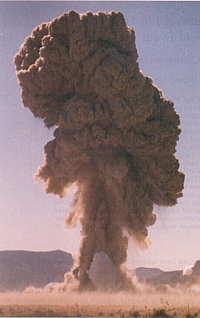
And just in case anyone wants to think seriously about the idea that a tactical nuclear weapon was used to destroy the Box on the Euphrates (or “tall building shaped like a square” to use the IAEA’s more technically precise nomenclature), this is what an explosion equivalent to a low-yield (5kt) nuclear explosion looks like:
misersgold.jpg
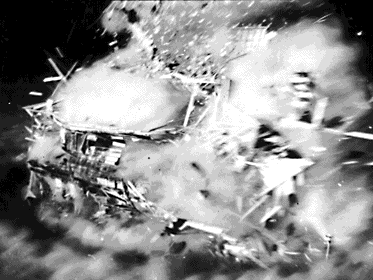
This is what happens to a house located 1,100 meters away a somewhat larger (16kt) explosion:
blast8.gif
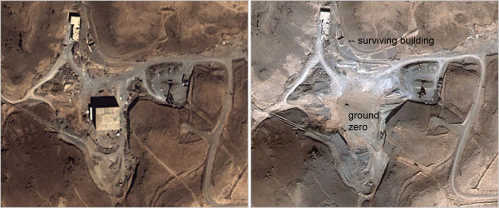
And this is a picture of the Syrian site after the attack:
noboxontheeuphrates.jpg
Note, a small building just 300 meters directly up from “ground zero” was still standing after the attack. That’s a clue — there was no nuclear shockwave that ripped through this gully.

Facebooktwittermail

OPINION: From Bandung to Davos — and back?

Global warming as white man’s burden

Readers of a certain age and inclination might remember a sometimes-incendiary, often-provocative, most-always-interesting television show on the UK’s Channel Four called Bandung File. Channel Four came to prominence in that brief hundred-flowers spring moment in the Britain of the 70s and early 80s, when Ken Livingstone, Mayor of London, was still ‘Red’ Ken, and the Greater London Council had money to spend on any number of beautiful community-driven efforts, from the Southall Black Sisters to water resources planning for the next century. Bandung File, produced by Tariq Ali and Darcus Howe, labelled itself an African-Asian news and current affairs programme. What made it quite unique was that its stated purpose was to canvas opinion from the public and policy-makers in those continents: Its topics were not just what was being done to people of color in the UK, nor even the history of colonial injustice. Instead, it focused on the current concerns of Africans and Asians — its issues ranged from apartheid to street crime in Jamaica and corruption in a Kenyan hospital. With a muckraking exuberance and flair, Bandung File drove the blade in to the hilt. And what made it such refreshing television was it was never dominated by experts from the North; instead it gave free rein to the eloquence of its Southern subjects, whether corrupt politicians or enraged citizens or passionate radicals.

It’s an odd place to begin talking about the 2007 Nobel Peace Prize, as Tony asked me to do for Rootless Cosmopolitan, but bear with me. Bandung File was named for a now rather obscure mountain town in Java: a favoured “hill station” to which British, and later brown, sahibs would retire to escape Indonesian summers. This little resort town once took centre stage in world history, in 1955, when it was the seat of an extraordinary conference, when representatives of one half of humanity met to proclaim an end to the colonial era. Some of the countries respresented were newly independent, others not yet quite so; but it was clear that the end of direct colonial rule was near, and this conference of African and Asian people met to ask, what sort of world would follow. We now call this, in an inaccurate Nothern-Hemisphere-centric worldview, the ‘Global South’… but here was born the ‘third world’ — “l’ensemble des peuples d’Asie et d’Afrique qui, n’appartenant ni à la « noblesse » européenne ni au « clergé » américain” (all the peoples of Africa and Asia who belong neither to the European aristocracy nor to the American clergy) — beautiful! The term was thus a direct extrapolation from the ‘Third Estate’ of the French Revolution, and had not acquired its current distorted meaning of distended bellies, child soldiers, and retired dictators living in splendid majesty in the homes of their former paymasters in Hawaii or on the Riviera. [complete article]

Facebooktwittermail

NEWS: The torture test

Bush administration blocked waterboarding critic

A senior Justice Department official, charged with reworking the administration’s legal position on torture in 2004 became so concerned about the controversial interrogation technique of waterboarding that he decided to experience it firsthand, sources told ABC News.

Daniel Levin, then acting assistant attorney general, went to a military base near Washington and underwent the procedure to inform his analysis of different interrogation techniques.

After the experience, Levin told White House officials that even though he knew he wouldn’t die, he found the experience terrifying and thought that it clearly simulated drowning. [complete article]

Editor’s Comment — Does Cheney have as much guts as an acting assistant attorney general? Or does he think waterboarding guidelines should include a clause that exempts anyone with a pacemaker?

Mukasey all but a shoo-in for approval

Michael B. Mukasey appeared on Friday to be all but assured of becoming the nation’s 81st attorney general when two Senate Democrats broke ranks and said they would support the retired federal judge to head the Justice Department.

While acknowledging serious concerns about his views on interrogation techniques, Sens. Dianne Feinstein of California and Charles E. Schumer of New York said they would vote to confirm Mukasey when the Senate Judiciary Committee takes up his nomination to succeed Alberto R. Gonzales on Tuesday. [complete article]

See also, John Dean on Mukasey (TPM) and The torture litmus test (Scott Horton).

Facebooktwittermail

NEWS: U.S. approves Gaza invasion; Abbas talks to Hamas

‘U.S. okays IDF wide-scale Gaza op’

The United States has given a “green light” to an IDF operation in the Gaza Strip, the Lebanese newspaper, Al-Akhbar reported Saturday morning.

The report cites “credible diplomatic sources” as saying that American approval came after Israeli intelligence impressed on US officials the importance of a wide-scale operation as an answer to the unprecedented arms smuggling within Gaza.

According to the newspaper report, the intelligence was shared during Defense Minister Ehud Barak’s last visit to Washington. Sources told Al-Akhbar that the intelligence depicted a worrying picture of an “arms race” between Hamas and the Islamic Jihad. In addition, Israel presented details of money transfers between the Islamic Jihad and the Al-Aksa’s Martyrs Brigades. [complete article]

Abbas meets West Bank Hamas leaders

The Palestinian president, Mahmoud Abbas, met Friday with a group of Hamas leaders in the West Bank, the first time he has done so since Hamas routed Fatah forces in Gaza in June.

Mr. Abbas, of the Fatah faction, said the meeting in his Ramallah office was not the beginning of a formal dialogue with Hamas. Instead, it seemed to be an effort to split more moderate Hamas officials in the West Bank from their more militant brethren in Gaza. [complete article]

Facebooktwittermail