Category Archives: Analysis

Tide of Syria civil war turns against Assad as rebels make sweeping gains

The Telegraph reports: The posters of President Bashar al-Assad once hung proud in Syria’s capital. Supporters of the regime would confidently predict the defeat of the “terrorists” – the accepted term for the rebel opposition.

In the last few weeks, however, the the insurgents have turned the tide of the civil war by winning a string of battlefield victories against Mr Assad’s forces.

In the north, a newly unified rebel coalition called the “Army of Conquest” managed to capture Idlib, a provincial capital, and much of the surrounding territory.

They pressed on to Jisr al-Shughour, seizing most of this strategically important city and besieging about 250 regime soldiers inside its hospital. That victory threatens a vital supply line to Latakia, the coastal heartland of Mr Assad’s Alawite sect.

In the south, another insurgent alliance known as the “Southern Front” made steady gains in Deraa province, joining up a patchwork of opposition-held villages into one expanse of rebel-controlled territory. If this advance continues, the rebels could press northwards along the main highway to Damascus itself. [Continue reading…]


Facebooktwittermail

Village of Bedouins faces eviction as Israel envisions a village of Jews

The New York Times reports: Salim al-Qian settled back on his white faux leather couch strewn with pink cushions and took a sip of tea, clearly comfortable in his tiny home in this ramshackle hamlet in the dusty hills of southern Israel. The sense of permanence suggested by his comfort, however, looks to be short-lived.

Mr. Qian and the other members of some 70 Bedouin families are likely to be evicted soon from their homes in the hamlet of Umm al-Hiran, where they have been living since the 1950s. In their place, the Israeli government plans to build a community with nearly the same name, Hiran — but its expected residents will be religious, Zionist Jews.

The government says Umm al-Hiran is on state-owned land that it would like to develop, and it has fought a long legal battle to have the Bedouin families, about 1,000 people, relocated. This month, the Supreme Court ruled in a 2-1 decision that the families would have to leave. The court gave no date for when evictions could begin, and residents intend to appeal the decision.

The Bedouins say they do not want to leave land on which they have been living for more than half a century after being resettled there by the Israeli military. The government has promised compensation in the form of cash and land elsewhere, but the Bedouins say the decision to move them reflects discriminatory policies.

“It is not possible to order one home demolished because it belongs to an Arab and build another for a Jew,” said Mr. Qian, 57, a trader and community leader. [Continue reading…]

Facebooktwittermail

New Putin invasion coming this summer

Michael Weiss James Miller write: The war in Ukraine may have faded largely from international headlines, but Vladimir Putin’s drip-drip invasion continues. In the last two weeks, forensic evidence, some of which has been reported by monitor organizations and senior Western diplomats, the rest corroborated by eyewitness photography and video, only confirms what the U.S. fears most: A summer offensive is inevitable.

On May 5, the Ukrainian government released new data which says that they have lost 28 towns to Russian-backed separatists since February 18. That was the day the strategic town of Debaltsevo, which guarded a key highway to separatist-controlled regions, slipped from Ukraine’s control. The map of separatist territory is as alarming as it is illustrative, especially when it is combined with the daily reports of ceasefire violations and fighting coming out of both the Organization for Security and Co-operation in Europe (OSCE) and Kiev.

On May 6, Ukrainian President Petro Poroshenko addressed the National Security and Defense Council and warned that Russia has 50,000 troops on the border and its proxies have more than 40,000 fighters inside the country. That’s not only a combined 50% increase in possible invaders over July of last year, the month which proceeded the “Russian invasion” on the Ukrainian mainland. It’s more than enough soldiers to invade and gobble up a significant amount of Ukrainian territory. [Continue reading…]

Facebooktwittermail

Outcast: Adrift with Burma’s Rohingya

Jason Motlagh writes: In June 2012, mobs of ethnic Rakhine Buddhists tore through Rohingya Muslim neighbourhoods in the coastal town of Sittwe, attacking anyone in their path. Mohammad Idriss, a member of the persecuted minority, took refuge with relatives indoors. In a moment of panic, his younger brother made the mistake of jumping from a window, only to be caught and beaten to death with sticks and iron rods.

Idriss says that a neighbour dealt the first blow to the head. “All victims deserve justice, but I don’t think it will be possible even in a decade,” he says, reflecting on the massacre that night. “Our situation is hopeless.”

The killings were part of a gathering wave of sectarian violence that has spread to other parts of the country, amid accusations that security forces have turned a blind eye to bloodshed. Two years on, Idriss and most of the 140,000 Rohingya uprooted from their ancestral homes live in what have been likened to concentration camps, trapped between armed guards and the sea. Burma’s government insists it is for their own protection, but aid groups have been kicked out, and food and medical supplies are limited, resulting in a surge of deaths from treatable illnesses. [Continue reading…]

Facebooktwittermail

CO2 trend is up, up, up

Climate Central: Any day now, carbon dioxide levels in the atmosphere will reach their annual peak in a cycle driven by the collective inhale and exhale of the world’s plant life. But because of the extra CO2 pumped into the air by human activities, this year’s peak will be higher than last year’s, which was higher than the year before that — a sign of the unabated emissions that are driving the Earth’s temperature ever upward.

The amount of heat-trapping carbon dioxide in the atmosphere has been measured at the observatory atop Hawaii’s Mauna Loa volcano since 1958, producing a record that shows not only the yearly maximum and minimum driven by the spring bloom and fall dieback of plants, but also the steady climb in CO2 levels every year.

The last few years have seen a spate of atmospheric CO2 milestones in the Mauna Loa record: The first measurement of CO2 above 400 parts per million (ppm) in May 2013, the first month entirely above 400 ppm in April of last year, and this year will likely see several months with an average above that level.

While 400 ppm is something of a symbolic threshold, as the amount of extra heat trapped by it versus 399 ppm is minimal, it serves to show how far carbon dioxide in the atmosphere has risen from preindustrial levels of 280 ppm. Studies have estimated that CO2 levels on Earth haven’t been this high in at least 800,000 years. [Continue reading…]

Facebooktwittermail

We are ignoring the new machine age at our peril

John Naughton writes: As a species, we don’t seem to be very good at dealing with nonlinearity. We cope moderately well with situations and environments that are changing gradually. But sudden, major discontinuities – what some people call “tipping points” – leave us spooked. That’s why we are so perversely relaxed about climate change, for example: things are changing slowly, imperceptibly almost, but so far there hasn’t been the kind of sharp, catastrophic change that would lead us seriously to recalibrate our behaviour and attitudes.

So it is with information technology. We know – indeed, it has become a cliche – that computing power has been doubling at least every two years since records of these things began. We know that the amount of data now generated by our digital existence is expanding annually at an astonishing rate. We know that our capacity to store digital information has been increasing exponentially. And so on. What we apparently have not sussed, however, is that these various strands of technological progress are not unconnected. Quite the contrary, and therein lies our problem.

The thinker who has done most to explain the consequences of connectedness is a Belfast man named W Brian Arthur, an economist who was the youngest person ever to occupy an endowed chair at Stanford University and who in later years has been associated with the Santa Fe Institute, one of the world’s leading interdisciplinary research institutes. In 2009, he published a remarkable book, The Nature of Technology, in which he formulated a coherent theory of what technology is, how it evolves and how it spurs innovation and industry. Technology, he argued, “builds itself organically from itself” in ways that resemble chemistry or even organic life. And implicit in Arthur’s conception of technology is the idea that innovation is not linear, but what mathematicians call “combinatorial”, ie one driven by a whole bunch of things. And the significant point about combinatorial innovation is that it brings about radical discontinuities that nobody could have anticipated. [Continue reading…]

Facebooktwittermail

Is Marine Le Pen in bed with Putin?

The Daily Beast reports: On May 11, delegates from Europe’s political fringes travelled to Donetsk, the occupied ‘capital’ of the self-proclaimed Donetsk People’s Republic (DNR), for a forum to mark the first anniversary of the proclamation of the Russian-backed separatist entities in Ukraine. This in itself is unsurprising since far-right politicians have been used on several occasions to lend a veneer of legitimacy to Russia’s puppet statelets and sham votes since the invasion of Crimea last year.

The attendance roster for this confab included some familiar pro-Putin faces such as French far-right Member of European Parliament Jean-Luc Schaffhauser, Italian nationalist Alessandro Musolino and German neo-Nazi journalist Manuel Ochsenreiter, who moonlights as Kremlin propaganda channel RT’s German “expert” on the Middle East. But this time there was one surprising name in the bunch: Emmanuel Leroy.

Leroy was billed as representing the French charity, Urgence d’Enfants Ukraine (UEU), led by Alain Fragny, a former member of the extreme-right Bloc Identitaire. UEU is a suspicious organization that promotes pro-Russian and pro-separatist propaganda on its websites and is rather opaque with regards to its structure and operations. Leroy was also named by the official site of the DNR leadership as one of the initiators of the forum back in March this year.

But this infamously reclusive figure on France’s far-right is a far more interesting and important figure than any of the other political outliers to have participated in pro-separatist events.

Leroy is a former member of GRECE (Groupement de recherche et d’études pour la civilisation européenne, or the Research and Study Group for European Civilization), an extreme, ethno-nationalist think tank, formed in 1968 and headed by Alain de Benoist, whose name appeared in a leaked list of potentially sympathetic contacts purportedly drafted by the Russian ultra-nationalist, Aleksandr Dugin. GRECE promotes ethnic nationalism as a bulwark against race-mixing, placing great emphasis on pre-Christian Nordic culture, which left the group at odds with the Catholic mainstream of the Front National, France’s increasingly popular far-right party, which last year won two seats in the French senate. [Continue reading…]

Facebooktwittermail

Interview with Iranian foreign minister: ‘We will have differences with U.S. no matter what’

Der Spiegel reports: Mohammad Javad Zarif, 55, is relaxed and cheerful during an interview that takes place in his office in Tehran, telling jokes in perfect English. He studied political science in the United States before becoming Tehran’s ambassador to the United Nations. Since 2013, he has served as foreign minister under President Hassan Rouhani. He recently negotiated the preliminary agreement in the country’s nuclear dispute with the international community. He is well-liked by his Western negotiating partners and a star in his home country, where his autobiography is a best-seller. Some see a future president in the making, but he smiles and shrugs off the suggestion. “Domestic policy is not for me,” he says.

SPIEGEL: Mr. Minister, you literally had people dancing in the streets when you announced on April 2 that a solution to the nuclear conflict was in sight. At the same time, neither side was able to agree on a joint fact sheet. Did people party prematurely?

Zarif: It is the right of the people to be happy and it is the responsibility of the government to make people happy. What happened in Lausanne was an important milestone, but it wasn’t a deal. I believe that a deal is not only possible, but probable. We reached a conceptual understanding on a number of parameters for the resolution. We need to put that in writing in terms of an agreement, and that’s exactly what my colleagues are doing now in Vienna.

SPIEGEL: The United States released its fact sheet of the key points of the negotiations in order to show that it didn’t make major concessions. We assume you weren’t thrilled about this, right?

Zarif: I do not believe that the practice of producing fact sheets is a very useful one. The world has gone through a significant change. You cannot pick and choose your audience anymore. In the past, you could present your version of reality, your narrative to your audience, and the other side could have presented their narrative to their audience. But today in the age of the Internet and social media, narratives become global — and that’s where the problem comes. So you need to be able to present the final, complete package. [Continue reading…]

Facebooktwittermail

The complexity of science

Leonard Mlodinow writes: The other week I was working in my garage office when my 14-year-old daughter, Olivia, came in to tell me about Charles Darwin. Did I know that he discovered the theory of evolution after studying finches on the Galápagos Islands? I was steeped in what felt like the 37th draft of my new book, which is on the development of scientific ideas, and she was proud to contribute this tidbit of history that she had just learned in class.

Sadly, like many stories of scientific discovery, that commonly recounted tale, repeated in her biology textbook, is not true.

The popular history of science is full of such falsehoods. In the case of evolution, Darwin was a much better geologist than ornithologist, at least in his early years. And while he did notice differences among the birds (and tortoises) on the different islands, he didn’t think them important enough to make a careful analysis. His ideas on evolution did not come from the mythical Galápagos epiphany, but evolved through many years of hard work, long after he had returned from the voyage. (To get an idea of the effort involved in developing his theory, consider this: One byproduct of his research was a 684-page monograph on barnacles.)

The myth of the finches obscures the qualities that were really responsible for Darwin’s success: the grit to formulate his theory and gather evidence for it; the creativity to seek signs of evolution in existing animals, rather than, as others did, in the fossil record; and the open-mindedness to drop his belief in creationism when the evidence against it piled up.

The mythical stories we tell about our heroes are always more romantic and often more palatable than the truth. But in science, at least, they are destructive, in that they promote false conceptions of the evolution of scientific thought. [Continue reading…]

Facebooktwittermail

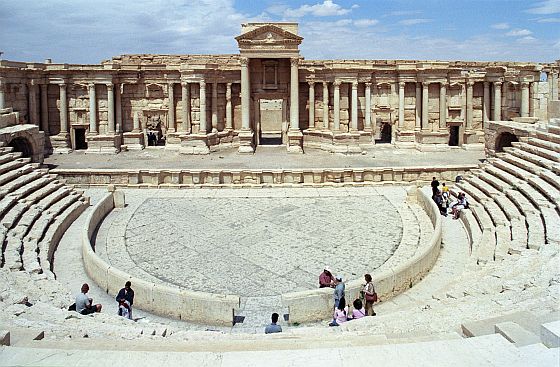
ISIS advance in Syria endangers ancient ruins at Palmyra

Palmyra

The New York Times reports: Islamic State militants advanced to the outskirts of the Syrian town of Palmyra on Thursday, putting the extremist group within striking distance of some of the world’s most magnificent antiquities.

That raised fears that the ancient city of Palmyra, with its complex of columns, tombs and ancient temples dating to the first century A.D., could be looted or destroyed. Militants from the Islamic State, also known as ISIS or ISIL, have already destroyed large parts of ancient sites at Nimrud, Hatra and Nineveh in Iraq. Islamic State leaders denounce pre-Islamic art and architecture as idolatrous even as they sell smaller, more portable artifacts to finance their violent rampage through the region.

The fighting on Thursday took place little more than a mile from the city’s grand 2,000-year-old ruins, which stand as the crossroad of Greek, Roman, Persian and Islamic cultures.

People in Palmyra described a state of anxiety and chaos, with residents trying to flee the northern neighborhoods. [Continue reading…]

Facebooktwittermail

The new coal frontier

The Guardian reports: Around 27bn tonnes of coal are thought to be locked under the ground of the Galilee Basin in the outback of Queensland. A huge proposed complex of coal mines is planned here, including the world’s largest thermal coal project.

So are railway lines and a massive expansion of the Abbot Point port on the Great Barrier Reef.

What will this mean for the Aboriginal community, the Great Barrier Reef and the world’s climate?

Adrian Burragubba is a strong man. His people, the Wangan and Jagalingou, have called this flat, arid outback in central Queensland home for tens of thousands of years, but now all that is under threat.

When the white man first came here in his great-grandfather’s time, Adrian, 54, a tribal elder and ‘law man’, says they were thought of as ghosts – strange, but welcome enough. But later generations were to bear the brunt of the interlopers’ greed. His grandfather and his father were both removed from the land and put on church-run properties to make way for a gold rush.

“Those places were like concentration camps,” he explains. “They wanted Aboriginal people out of the way, so you couldn’t leave them. The police would take you back if you did.”

Now the rapacious outsiders are back. Massive mining operations are looking to plunder a gigantic new coal frontier in the Galilee Basin. There are 247,000 sq km (95,400 sq miles) of coal: a land mass the size of Britain. [Continue reading…]

Facebooktwittermail

Israeli government to refugees: Go back to Africa or go to prison

The Washington Post reports: As Europe struggles to stem a spring flood of migrants from Africa and the Middle East trying to cross a deadly Mediterranean Sea, Israel has begun to toughen its stance toward refugees, telling unwanted Africans here they must leave now or face an indefinite stay in prison.

Israeli authorities are sending letters to the first of 45,000 Eritrean and Sudanese refugees, informing them they have 30 days to accept Israel’s offer of $3,500 in cash and a one-way ticket home or to an unnamed third country in Africa, or face incarceration at Saharonim prison.

Israeli leaders have proclaimed that their tough approach — building a fence along the country’s border, denying work permits for illegal migrants, forcing them into a detention center in the desert — may ultimately save lives by dissuading migrants from attempting a perilous journey. Critics of the Israeli policy counter that a country built by refugees should be more accepting of those fleeing war, poverty and oppression. [Continue reading…]

Facebooktwittermail

Iran these days is a greater focus of Arab ire and disquiet than Israel

From Dubai, Roger Cohen writes: When Amr Moussa, the former secretary general of the Arab League, spoke here of the Arab world’s humiliation by three non-Arab states — Iran, Israel and Turkey — and the way they had, through their “hegemony,” turned Arabs into a “laughingstock,” I asked him what exactly he meant.

His response focused on Iran. This in itself was interesting. Statements from Tehran about Iran calling the shots in several Arab capitals — including Damascus, Baghdad and Sana — had “enraged many of us,” he said, leaving Arabs humiliated that any power “would dare say that.”

As this remark suggests, Iran these days is a greater focus of Arab ire and disquiet than Israel, a country with which many Arab states have aligned but unsayable interests.

Cut to Camp David and President Obama’s attempt to reassure Persian Gulf leaders that the United States can, in Secretary of State John Kerry’s words, “do two things at the same time” — that is, conclude a nuclear deal with Shiite Iran and honor its alliances with the Sunni monarchies, whose oil is now of less strategic importance to an America in the midst of an oil boom.

The walk-and-chew-gum American argument is a tough sell because Arab honor and Arab humiliation are in play. That’s why King Salman of Saudi Arabia stayed away from Camp David. That’s why the Saudis started a bombing campaign in Yemen: to stop the Houthis, portrayed in Riyadh as pure Iranian proxies. That’s why much of what you hear these days in Dubai (where many Iranians live and trade) is talk of Obama’s betrayal of the Arabs through infatuation with Iran. [Continue reading…]

Facebooktwittermail

12 years later, a mystery of chemical exposure in Iraq clears slightly

C.J. Chivers reports: The toxic vapors acted quickly against the Second Platoon of the 811th Ordnance Company, whose soldiers were moving abandoned barrels out of an Iraqi Republican Guard warehouse in 2003. The building, one soldier said, was littered with dead birds.

As the soldiers pushed the barrels over and began rolling them, some of the contents leaked, they said, filling the air with a bitter, penetrating smell. Soon, many were dizzy and suffering from running noses and tearing eyes. A few were vomiting, disoriented, tingling or numb.

After the soldiers staggered outside for air, multiple detection tests indicated the presence of nerve agent. Others suggested blister agent, too. The results seemed to confirm the victims’ fear that they had stumbled upon unused stocks of Iraq’s chemical weapons.

From Camp Taji, where the barrels had been found, more than 20 exposed soldiers were evacuated in helicopters to a military hospital in Balad, where they were met by soldiers wearing gas masks and ordered to undress before being allowed inside for medical care.

“They drew a box in the sand and had armed guards and were like: ‘Do not get out of that box. Do not get out of that box,’ ” said Nathan Willie, a private first class at the time. “I was kind of freaked out.”

Since last fall, the United States military has acknowledged that American soldiers found thousands of abandoned chemical weapons in Iraq, and that hundreds of troops notified the military medical system that they believed they had been exposed to them. The military acknowledged the exposures after years of secrecy — and of denying medical tracking and official recognition to victims — only after an investigation by The New York Times.

Even then, the affliction of the 811th Ordnance Company had quietly remained one of the unsolved mysteries of the Iraq war, and a parable of what several of the victims describe as the corrosive effects of the government’s secrecy on troop welfare and public trust. [Continue reading…]

Facebooktwittermail

The cruel and unusual execution of Clayton Lockett

Jeffrey E. Stern reports: On the morning of his execution, Clayton Lockett hid under the covers.

Before a team of correctional officers came to get him at 5:06 a.m., he fashioned a noose out of his sheets. He pulled the blade out of a safety razor and made half-inch-long cuts on his arms. He swallowed a handful of pills that he’d been hoarding. And on April 29, 2014, when the team of officers knocked on the door of his cell in the Oklahoma State Penitentiary in McAlester, Oklahoma, Clayton Lockett — a 38-year-old convicted murderer — pulled a blanket over his head and refused to get up.

The officers left and asked for permission to tase him. While they were gone, Lockett tried to jam the door. They came back, forced their way in, tased him, and dragged him out.

Eleven hours later, at about 5:20 p.m., after a medical examination, X‑rays, eight hours in a holding cell, and a shower, Lockett was brought by a five-member strap-down team into the death chamber. It was a small, clinical-looking room with white walls and a polished floor that reflected the lights overhead. A gurney stood in the center of the room; above it hung a microphone for Lockett’s final words. [Continue reading…]

Facebooktwittermail

Turks are wondering if their president is insane

The Daily Beast reports: It’s less than four weeks to go before parliamentary elections in Turkey on June 7, and it looks like President Recep Tayyip Erdogan is panicking. Or worse.

A popular refrain among his political opponents, and on the street, is that Erdogan has lost his marbles and is driven by an insatiable appetite for power. Ever since he moved into a lavish 1,100-room palace in Ankara last year, Erdogan has been accused of succumbing to an out-of-control urge for grandeur. Kurdish politician Abdullah Zeydan says the president “thinks he is a sultan.” Meral Aksener, a nationalist politician and deputy speaker of parliament, claims Prime Minister Ahmet Davutoglu was telling people behind closed doors that Erdogan “is out of his mind.”

“Obviously, there is panic,” said Yavuz Baydar, a respected journalist.

At a minimum there is frustration for the president of this country with huge strategic importance, which has the second largest army in NATO and borders Iran, Iraq and Syria or, if you will, the Islamic State. Over the course of 12 years in power, first as prime minister and since last year as president, Erdogan has overseen unprecedented economic stability and growth in Turkey, trimmed the power of the military, with its long history of coups and its reputation as “the deep state,” and entered into an important dialogue with Kurdish politicians and even Kurdish rebels.

But polls say Erdogan, 61, will probably fail to get the majority he wants to push through sweeping constitutional changes to give himself unlimited but as yet unspecified power as president. The economy has grown sluggish of late, unemployment is on the rise, and the political opposition is resurgent, all of which spells trouble for Erdogan’s ruling Justice and Development Party (AKP). Some polls suggest the AKP could even lose its majority in parliament. [Continue reading…]

Facebooktwittermail

Obama is on a quest to rebalance American power in the Middle East

Reza Marashi writes: As President Obama hosts leaders from Saudi Arabia, Qatar, Oman, Bahrain, Kuwait, and the UAE on May 13 and 14, he will surely hear a push from them for a White House plan to contain Iran. However, recent candid remarks from Admiral Mike Mullen should cause America to think twice. Going against conventional wisdom in Washington, the former Chairman of the Joint Chiefs of Staff said: “[A nuclear deal] would also more fairly rebalance American influence. We need to re-examine all of the relationships we enjoy in the region, relationships primarily with Sunni-dominated nations. Détente with Iran might better balance our efforts across the sectarian divide.”

Let that sink in. The highest-ranking officer in the United States Armed Forces from 2007 to 2011 is essentially saying that America’s long-standing allies in the Middle East are trying to lock it into permanent confrontation with Iran–and into a permanent alliance with countries whose interests and values are increasingly opposed to its own. After the initial shock from Admiral Mullen’s intellectual honesty subsides, one quickly realizes that he is right: Why shouldn’t the U.S. have more options at its disposal to achieve its interests and reduce the threats it faces? For example, after 15 Saudi hijackers attacked the U.S. on September 11th, 2001, American decision-makers did not have the option of being firm with Saudi Arabia. Instead, they were trapped in an alliance precisely because there was no regional alternative that could be leveraged to hold the Saudis accountable. [Continue reading…]

Facebooktwittermail

Saudi Arabia vows to match Iran in nuclear capability

The New York Times reports: When President Obama began making the case for a deal with Iran that would delay its ability to assemble an atomic weapon, his first argument was that a nuclear-armed Iran would set off a “free-for-all” of proliferation in the Arab world. “It is almost certain that other players in the region would feel it necessary to get their own nuclear weapons,” he said in 2012.

Now, as he gathered Arab leaders over dinner at the White House on Wednesday and prepared to meet with them at Camp David on Thursday, he faced a perverse consequence: Saudi Arabia and many of the smaller Arab states are now vowing to match whatever nuclear enrichment capability Iran is permitted to retain.

“We can’t sit back and be nowhere as Iran is allowed to retain much of its capability and amass its research,” one of the Arab leaders preparing to meet Mr. Obama said on Monday, declining to be named until he made his case directly to the president. Prince Turki bin Faisal, the 70-year-old former Saudi intelligence chief, has been touring the world with the same message. [Continue reading…]

Facebooktwittermail