Category Archives: Editorials

Narrative on Israeli air strike on Syria starts to unravel

In the aftermath of an Israeli air strike on Syria on Wednesday, numerous reports claimed that the target of the strike was a convoy carrying SA-17 missiles approaching the Lebanese border. The Syrian government, however, claimed that the target was a research facility north west of Damascus.

Russian SA-17

The New York Times reported:

American officials said Israel hit a convoy before dawn on Wednesday that was ferrying sophisticated SA-17 antiaircraft missiles to Lebanon. The Syrians and their allies said the target was a research facility in the Damascus suburb of Jamraya.

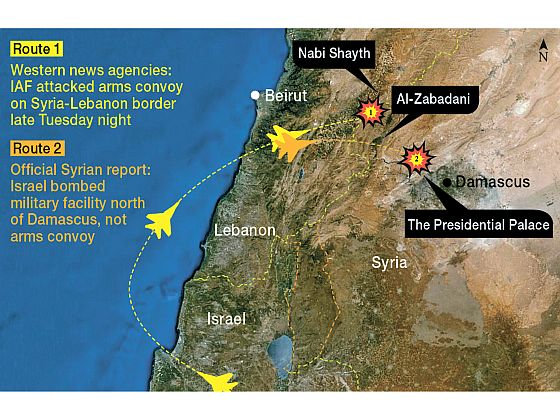
Haaretz even published a map showing the two locations:

As I noted at the time, whether Israel was trying to destroy a moving or a stationary target was significant because if the target turned out to be stationary, then the timing of the strike was most likely determined as much by the Israelis as by the circumstances.

The idea that highly sophisticated Russian-made missile systems were just about to slip across the Lebanese border and into the hands of Hezbollah, was clearly intended to convey Israel’s sense of urgency.

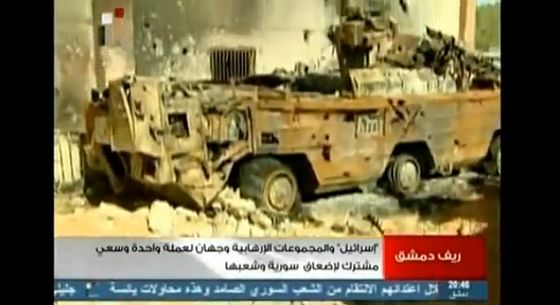
But now Syrian TV has broadcast footage of what is claimed to be the aftermath of the strike: damage to the research facility at Jamraya outside Damascus.

The Times of Israel reports:

The video also shows what appears to be a destroyed mobile carrier for an SA-17 anti-aircraft missile battery.

But on the contrary, what the video shows is the remains of an SA-8 missile battery, an air defense system that has been in service for over 40 years.

Syrian SA-8 missile launcher apparently destroyed in Israeli air strike.

SA-8 missile launcher.

The New York Times now reports:

A senior United States military official, asked about reports that the research center had been damaged, said, “My sense is that the buildings were destroyed due to the bombs which targeted the vehicles” carrying the antiaircraft weapons, and from “the secondary explosions from the missiles.”

The official, speaking on condition of anonymity in order to discuss intelligence reports, said that “the Israelis had a small strike package,” meaning that a relatively few fighter aircraft slipped past Syria’s air defenses and that targeting both the missiles and the research center “would risk doing just a little damage to either.”

“They clearly went after the air defense weapons on the transport trucks,” the official said.

Based on the evidence available at this time, the claim that SA-17s were targeted, appears to be baseless. Neither is there any evidence that the SA-8s that were destroyed were heading for Lebanon. Indeed, as the New York Times report suggests — perhaps unintentionally — the SA-8s may well have not been going anywhere. They may have been intended to defend the facility next to which they were positioned*:

By hitting the research center, part of a military complex that is supposed to be protected by Russian-made antiaircraft defenses, Israel made it clear it was willing to risk direct intervention to keep weapons and missiles out of Hezbollah’s hands.

The report goes on to say:

The strike also appeared to be a signal to the Iranians that Israel would be willing to conduct a similar attack on aboveground nuclear facilities if it seemed that Iran was near achieving nuclear weapons capability. But Iran would be a far harder target — much farther away from Israel, much better defended, and with facilities much more difficult to damage. The nuclear enrichment center that worries Israel and Western governments the most is nearly 300 feet under a mountain outside Qum, largely invulnerable to the weapons that Israel is seemed to have used in last week’s raid.

The decision of the Syrian government to reveal the results of the Israeli attack was no doubt intended to serve multiple purposes, but it’s hard to imagine that what looks like an ill-conceived operation will have provoked much fear in Iran.

Was Netanyahu sending a message to Tehran to demonstrate Israel’s strong will, or was he sending a message to Washington about Israel’s limited capabilities?

* In the final paragraph of today’s New York Times report, it does refer to the fact that the missile launchers in the video are SA-8s, but then quotes an Israeli journalist, Amir Rapaport, claiming that the SA-8s were planted at the scene. “Maybe it’s sort of a trick of the Syrians,” Rapaport said. Maybe. But frankly, neither the Americans nor Israelis have a lot of credibility at this point. The existence and destruction of SA-17s in this story is mere hearsay.

Facebooktwittermail

Is Israel baiting Iran?

Last week, Ali Akbar Velayati, an aide to Ayatollah Ali Khamenei, declared that an “attack on Syria is considered attack on Iran.”

Yesterday, in a dangerous act of brinkmanship, Israel called Iran’s bluff.

But Israel doesn’t want to be perceived as risking provoking a war and so it portrayed its air strike on Syria as an imperative act of self defense necessitated by Syria’s alleged attempt to transport Russian-made SA-17 missiles to Hezbollah in Lebanon.

Syria denies that a convoy carrying such missiles was struck and even though the word of the Syrian government carries little weight these days, there are several reasons to doubt the narrative that U.S. officials have been disseminating.

Soon after Operation Orchard, an Israeli strike on a nuclear facility in Syria on September 6, 2007, U.S. officials told the New York Times that “the most likely targets of the raid were weapons caches that Israel’s government believes Iran has been sending the Lebanese militant group Hezbollah through Syria.” It was weeks later before details of the carefully planned operation became clear.

And here’s the all-important point: the timing of a strike on a convoy is going to be determined by the commanders of the convoy. Israel gets word that missiles are on the move and thus is left with “no choice” but to intervene.

But if the attack is on a stationary facility, then the timing of an attack is much more in Israel’s control.

This week there were multiple indications that Israel was preparing for military action:

So what are we supposed to believe? That in spite of the warnings, Syrian officials decided to try their luck and send a missile-carrying convoy on its way with the slim hope that it might evade attack?

Or, that Israel knew that the target of its choice, a research facility in the area of Jamraya, northwest of Damascus, could be struck at a time of Israel’s choosing and by striking now, Iran’s earlier pledge to defend Syria would be shown as empty — or, if Iran does actually follow through, then a pretext may have been created for an attack on Iran’s nuclear facilities.

For Netanyahu, soon to lead a government that will probably be less inclined to support military muscle flexing, this week may have looked like the ideal time to place a wager that he thinks he cannot lose.

Facebooktwittermail

On culture and artifacts

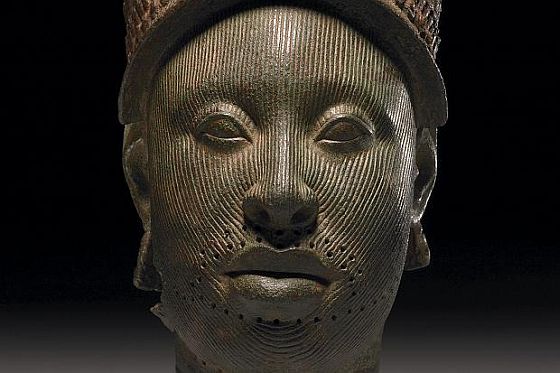
The Olokun Head discovered in Nigeria in 1910 and initially regarded by European scholars as too great a masterpiece to have originated from Africa.

One of the conceits of Western societies is that our museums and galleries and private collections represent our appreciation of culture. Indeed, our appreciation of culture is supposedly so refined that we have often asserted the right or even duty to become self-appointed custodians of artifacts whose protection demanded, we claimed, that they be removed from their place of origin.

It is reasonable to assume that in the coming months and years, artifacts from Timbuktu will find their way into the hands of art collectors who rationalize their actions with the idea that only individuals with the finest taste recognize the real value of such rare treasures.

What those who either buy such artifacts or merely view them while wandering around museums are inclined to believe is that culture and its material expressions are one and the same.

Even so, such objects only become artifacts as culture falls apart. Our museums serve less to preserve human genius and function more as cultural graveyards.

In cultures that no longer sustain oral tradition, we have forgotten that the written word was not intended to subordinate the value of the spoken word — it merely expands the voice’s reach. Language’s rhythmical structure serves first to allow thought to be housed in memory before being left to reside on the page.

Yes, it will be an immense loss if Timbuktu’s manuscript collections have been decimated, but there as elsewhere, the real cultural loss long preceded the effort to breath life into dead remains.

The culture most in jeopardy and most in need of protection lives in what Wade Davis calls the planet’s “ethnosphere”: the cultural web of life which is the “sum total of all thoughts and dreams, myths, ideas, inspirations, intuitions brought into being by the human imagination since the dawn of consciousness.”

This is culture which no museum can house and no collector can buy because it exists solely through its ability to animate human life.

Facebooktwittermail

What you are is what eats

That might sound like a mangled version of the aphorism: you are what you eat — something surely worth remembering when industrially-produced toxins are now so pervasive they can be found in unborn babies.

What I am alluding to, however, is actually a question of self-identity as illuminated not by the external sources of our food but by our advancing understanding of the human microbiome.

The human body is made up of 10 trillion cells, while our gut hosts 100 trillion bacteria — microscopic organisms performing a vast array of functions far beyond their widely understood role in digestion. They don’t just break down food but also regulate the immune system, produce vitamins and hormones and even appear to affect the way our brain works. When our gut flora thrive, we thrive.

For that reason, one of the most promising recent advances in medicine has been in the use of fecal transplants — the transfer of gut flora from a healthy donor to someone with intestinal disease.

If that’s something you’d rather not visualize, it gets even worse. The most effective way of performing such a transplant is via a nasogastric tube. That’s right: down the nose and through the stomach to the top end of the small intestine.

Treatment of Clostridium difficile, an intestinal disease that kills 14,000 Americans annually, has had over a 90% success rate for patients given a fecal transplant, a procedure whose use was first documented in 1958.

The use of this treatment would likely already be far more commonplace and diverse in its application were it not for two reasons: Firstly, as a treatment that involves no drugs and makes less effective drug treatments redundant, the use of fecal transplants does not serve the interests of the pharmaceutical industry. Secondly, and perhaps just as importantly, the very idea of such a treatment is something that many people will find repulsive. It represents a kind of invasion and defilement of who and what we take ourselves to be. It involves an exchange of bodily fluids that transgresses most people’s notion of what might be desirable, amounting to the filthiest kind of intimacy one could imagine.

If, however, we set aside the taboos that condition our perceptions of the human body and think about this in a more abstract way, gut flora — whether they be native or transplanted — invite us to think about not just what contributes to good health but also what shapes who or what we are.

In as much as we are inclined to view the world as a complex of systems, we tend to view most systems as hierarchies. At the top sits the executive — God, president, CEO, general, brain — and below reside a multitude of individually expendable subordinates — person, citizen, worker, soldier, cell.

Identity becomes glued to the executive yet dissolves in the amorphous mass over which he (it is almost invariably he) rules.

Picture, for instance, the way in which a company like Apple, with over 70,000 employees, became synonymous with Steve Jobs. Or, the way American power is supposedly embodied in the individual of the president — so-called leader of the free world.

In the hierarchical conception of such systems, power extends from the top, downwards and outwards. In reality, power flows the opposite way. It flows up from the bottom, most of the time without question yet always with the possibility of suspension. The workers could walk out; the citizens could rebel. At such moments, the real structure of power becomes manifest.

So, consider again ones body and think of it as New York. It sounds like a fanciful song we might sing in our head where we can be number one, yet the actual city is not its landmarks — standing or fallen — or its skyline, or its shows, or words sung by Frank Sinatra. It is millions of people — a pulsating mass of organisms, moving through vessels underground, walking, driving, riding, endlessly scattering and aggregating in a process that cannot be reduced to any of its parts — a process which constitutes the life of a city, or if you will, the percolation of the gut flora of New York. A few New Yorkers might harbor the conceit that they keep the city running, but however they might aggrandize themselves, none turns out to be indispensable.

Still, as we each tell ourselves who we are, we locate meaning in a larger sphere. For instance, in our noblest moments we rise above our fears and show we have guts — but that expression, it turns out, is much more telling than we could have imagined.

What we take to be our own courage (or lack of it) may actually say less about the narrative construct we call character and more about our physical gut and the activity of trillions of bacteria such as Lactobacillus rhamnosus.

Mice fed a broth rich in this particular microorganism become more adventurous and show fewer signs of stress. The bacteria don’t just give them a healthier gut but also a healthier brain, an indication that who we are is intimately shaped by what lives inside our body. Such findings also suggest that the enteric nervous system, our “second brain,” may have as much influence over our behavior as does the stuff up top.

Given that the human microbiome is at this point a vast yet mostly uncharted territory, the fact that this is territory in which medicine — through the use of antibiotics — has engaged in open warfare for much of the last century, is all the more reason to think about our nature. In a rampage to kill our enemies we have also been destroying our selves.

Facebooktwittermail

Collapse

At the New York Times, Robert F Worth writes: As the uprising closed in around him, the Libyan dictator Col. Muammar el-Qaddafi warned that if he fell, chaos and holy war would overtake North Africa. “Bin Laden’s people would come to impose ransoms by land and sea,” he told reporters. “We will go back to the time of Redbeard, of pirates, of Ottomans imposing ransoms on boats.”

In recent days, that unhinged prophecy has acquired a grim new currency. In Mali, French paratroopers arrived this month to battle an advancing force of jihadi fighters who already control an area twice the size of Germany. In Algeria, a one-eyed Islamist bandit organized the brazen takeover of an international gas facility, taking hostages that included more than 40 Americans and Europeans.

Coming just four months after an American ambassador was killed by jihadists in Libya, those assaults have contributed to a sense that North Africa — long a dormant backwater for Al Qaeda — is turning into another zone of dangerous instability, much like Syria, site of an increasingly bloody civil war. The mayhem in this vast desert region has many roots, but it is also a sobering reminder that the euphoric toppling of dictators in Libya, Tunisia and Egypt has come at a price.

“It’s one of the darker sides of the Arab uprisings,” said Robert Malley, the Middle East and North Africa director at the International Crisis Group. “Their peaceful nature may have damaged Al Qaeda and its allies ideologically, but logistically, in terms of the new porousness of borders, the expansion of ungoverned areas, the proliferation of weapons, the disorganization of police and security services in all these countries — it’s been a real boon to jihadists.”

Last year, Malley wrote: The US cooperated with Gulf Arab monarchies and sheikhdoms in deposing Qaddafi yesterday and in opposing Assad today. It says it must be on the right side of history. Yet those regimes do not respect at home the rights they piously pursue abroad. Their purpose is neither democracy nor open societies. They are engaged in a struggle for regional domination. What, other than treasure, can proponents of a self-styled democratic uprising find in countries whose own system of governance is anathema to the democratic project they allegedly promote?

The new system of alliances hinges on too many false assumptions and masks too many deep incongruities. It is not healthy because it cannot be real. Something is wrong. Something is unnatural. It cannot end well.

This may indeed not end well but I question the idea that either the Arab Spring or NATO intervention in Libya should be viewed as the starting point.

I would go back to the Vietnam War. That was when American power suffered its first major blow. Less than a decade later, the Soviet Union had stepped into its own quagmire in Afghanistan leading to an even greater defeat and soon the end of the Cold War.

Though the U.S. claimed victory, there was no knockout punch — its opponent had staggered out of the ring leaving the American world champion to indulge in unipolar global power and the short-lived “end of history.”

History rebegan on 9/11, an attack perceived in much of the world and especially the Middle East, less as being emblematic of a diabolical threat from Islamic extremism and more as the United States receiving a well-deserved punch in the nose.

That a nation so powerful could so easily be brought to its knees by so few people was instructive, for this was the power that propped up so many of the Middle East’s authoritarian regimes and was the guarantor of the status quo.

9/11 did not just signal that a small band of terrorists were willing to go to extreme lengths in pursuit of an impossible goal; more importantly, it showed that American power was brittle and that those who depended on that power were similarly vulnerable.

America’s efforts to reestablish its power through wars in Iraq and Afghanistan had the opposite effect and confirmed that the era of seemingly invincible American power was over. This is what opened the doors to the Arab Spring.

Viewed most broadly, the emerging trend is one in which there is an ever widening arc of dwindling state power.

The stability of the West seems to derive mostly from its control of resources — it’s hard to claim that we enjoy the benefits of representative government.

Libertarians and survivalists might welcome or think they are prepared for the collapse of state power, but to those of us who regard climate change as the most urgent issue we must tackle, the idea that this can happen without the instruments of government and law seems like sheer fantasy.

Our failed states might never resemble those in Africa; lawlessness is less likely to appear in the guise of militias than through the expansion of the power of the deep transnational state — corporate interests whose sole guiding principle is the pursuit of profit.

Facebooktwittermail

How we forgot the value of time

Fast food, instant messaging, plug and play, push-button publishing, drive-thru weddings, drive-thru funerals — have it all, and have it now.

We have made time our enemy.

Waiting, patience, endurance, persistence — anything that takes time, supposedly wastes time, if you believe that time must be grasped.

What this mentality expresses is a form of time deprivation — a sense that however much we do and however fast we do it, we will never have enough time. We are all time-poor and can afford to give very little of it away. Time given is time lost.

Learning how to experience time in a different way can sometimes mean having to live in a different world. For me, that opportunity came a few decades ago while living in India, where a trip to the bank could take a couple of hours, buying a train ticket most of a day, and making an international phone call might take more than a day. In such circumstances you either surrender or go insane.

There are however ways in which some people experience a much more expansive sense of time — time not even bound by one life but stretching back many generations.

Toumani Diabaté is a Malian kora player and a griot. A kora is a West African harp and a griot is a custodian of oral tradition — in Diabaté’s case by belonging to a lineage of musicians in which father taught son, one after another for 71 generations.

In the video below, Diabaté gives a solo performance demonstrating the kora’s exquisite delicacy and range, while interspersed in the music are clips from an interview in which he talks about Malian history and the role of music in the Manden Empire.

For those of us from cultures spellbound by the power of the written word, it’s difficult to appreciate the significance and value of oral traditions. The idea that knowledge could only be spoken and passed along from hand to hand — the idea that knowledge resides in the whole person and that it can only be passed on when people come in physical contact — might seem like a constraint and a deficit, restricted to people who lack more portable and reproducible mediums of communication. In contrast, we have come to believe that knowledge can be embedded in inanimate devices and that the acquisition of knowledge depends above all on access to those devices.

Most of us have not experienced apprenticeship or learned the ways in which knowledge often resides in the smallest details. This is the knowledge of craft which builds in increments through patient repetition. And as Diabaté demonstrates, knowledge acquired in this way goes far beyond the talent of an individual, becoming an aggregation of learning that spans centuries. One man becomes the vessel containing the wisdom of all his ancestors. His actions are not his alone as hands, long gone, animate those that live now.

Facebooktwittermail

Assad offers no room for negotiation

Reuters reports: A defiant President Bashar al-Assad called on Sunday for national mobilization in a “war to defend the nation”, describing rebels fighting him as terrorists and agents of foreign powers with whom it was impossible to negotiate.

Appearing in an opera house in central Damascus packed with cheering supporters, the Syrian leader delivered his first speech to an audience since June last year, and his first public comments since a television interview in November.

He unveiled what he described as a peace initiative to end the 21-month-old uprising. But the proposal, including a reconciliation conference that would exclude “those who have betrayed Syria”, was certain to be rejected by enemies who have already said they will not negotiate unless he leaves power.

He spoke confidently for about an hour before a crowd of cheering loyalists, who occasionally interrupted him to shout and applaud, at one point raising their fists and chanting: “With blood and soul we sacrifice for you, O Bashar!”

At the end of the speech, supporters rushed to the stage, mobbing him and shouting: “God, Syria and Bashar is enough!” as a smiling Assad waved and was escorted from the hall.

“We are now in a state of war in every sense of the word,” Assad said in the speech. “This war targets Syria using a handful of Syrians and many foreigners. Thus, this is a war to defend the nation.”

A few days ago, Charles Glass wrote: The rebels, with the concurrence of their outside backers in Riyadh, Doha, Ankara and Washington, have steadfastly rejected jaw-jaw in favour of war-war. The leader of the newly created Syrian National Coalition, Moaz Al Khatib, rejected the latest call by UN envoy Lakhdar Brahimi and Russian Foreign Sergei Lavrov to attend talks with the Syrian government. Mr Al Khatib insists that Bashar Al Assad step down as a precondition to talks, but surely Mr Al Assad’s future is one of the main points for discussion.

The rebels, over whom Mr Al Khatib has no control, have not been able to defeat Mr Al Assad in almost two years of battle. Stalemate on the battlefield argues for negotiation to break the impasse through acceptance of a transition to something new. Is it worth killing another 50,000 Syrians to keep Mr Al Assad out of a transition that will lead to his departure?

When the First World War ended with nearly 9 million soldiers killed and European civilisation poised for the barbarity of Nazism, the struggle did not justify the loss. The bloody aftermath was little better. [Stefan] Zweig wrote: “For we believed – and the whole world believed with us – that this had been the war to end all wars, that the beast which had been laying our world waste was tamed or even slaughtered. We believed in President Woodrow Wilson’s grand programme, which was ours too; we saw the faint light of dawn in the east in those days, when the Russian Revolution was still in its honeymoon period of humane ideals. We were foolish, I know.”

Are those who push the Syrians to fight and fight, rather than to face one another over the negotiating table, any less foolish?

At this point, to look at the war in Syria and say, it must stop, a negotiated end must be found, is nothing more than an ineffectual sentiment. It is a way of saying war is terrible and can bring no good.

Indeed — but that observation will do nothing to hasten the end of the fighting.

The adversaries must face each other over the negotiating table. OK. But when during the last two years has the Assad regime shown the slightest interest in negotiation?

Assad’s line has always been that he is up against an effort by foreign powers to take over Syria. He asserts that this is a war for the defense of the nation. He denies the existence of a revolution.

Assad’s offer of a peace initiative and a reconciliation conference is a vacuous gesture since he would exclude the very people he is fighting against. To portray his opponents and their backers as obstinate — as Glass does — is itself a willful denial of the regime’s own intransigence.

All that Assad promises now is what his armed forces have delivered relentlessly for the last two years: more bloodshed.

Facebooktwittermail

‘We were part of each other’s fabric’

Daniel Levitin writes: Tom was one of those people we all have in our lives — someone to go out to lunch with in a large group, but not someone I ever spent time with one-on-one. We had some classes together in college and even worked in the same cognitive psychology lab for a while. But I didn’t really know him. Even so, when I heard that he had brain cancer that would kill him in four months, it stopped me cold.

I was 19 when I first saw him — in a class taught by a famous neuropsychologist, Karl Pribram. I’d see Tom at the coffee house, the library, and around campus. He seemed perennially enthusiastic, and had an exaggerated way of moving that made him seem unusually focused. I found it uncomfortable to make eye contact with him, not because he seemed threatening, but because his gaze was so intense.

Once Tom and I were sitting next to each other when Pribram told the class about a colleague of his who had just died a few days earlier. Pribram paused to look out over the classroom and told us that his colleague had been one of the greatest neuropsychologists of all time. Pribram then lowered his head and stared at the floor for such a long time I thought he might have discovered something there. Without lifting his head, he told us that his colleague had been a close friend, and had telephoned a month earlier to say he had just been diagnosed with a brain tumor growing in his temporal lobe. The doctors said that he would gradually lose his memory — not his ability to form new memories, but his ability to retrieve old ones … in short, to understand who he was.

Tom’s hand shot up. To my amazement, he suggested that Pribram was overstating the connection between temporal-lobe memory and overall identity. Temporal lobe or not, you still like the same things, Tom argued — your sensory systems aren’t affected. If you’re patient and kind, or a jerk, he said, such personality traits aren’t governed by the temporal lobes.

Pribram was unruffled. Many of us don’t realize the connection between memory and self, he explained. Who you are is the sum total of all that you’ve experienced. Where you went to school, who your friends were, all the things you’ve done or — just as importantly — all the things you’ve always hoped to do. Whether you prefer chocolate ice cream or vanilla, action movies or comedies, is part of the story, but the ability to know those preferences through accumulated memory is what defines you as a person. This seemed right to me. I’m not just someone who likes chocolate ice cream, I’m someone who knows, who remembers that I like chocolate ice cream. And I remember my favorite places to eat it, and the people I’ve eaten it with.

Pribram walked up to the lectern and gripped it with both hands. When they had spoken last, his colleague seemed more sad than frightened. He was worried about the loss of self more than the loss of memory. He’d still have his intelligence, the doctors said, but no memories. “What good is one without the other?” his colleague had asked. That was the last time Pribram spoke to him.

From a friend, Pribram had learned that his colleague had decided to go to the Caribbean for a vacation with his wife. One day he just walked out into the ocean and never came back. He couldn’t swim; he must have gone out with the intention of not coming back — before the damage from the tumor could take hold, Pribram said. [Continue reading…]

I remember as a child of 11 or 12 — somewhere around that age — falling and getting concussion. While dazed and frightened about possible brain damage, I started running through multiplication tables. This was a strange choice of neurological self-examination since I was never particularly good at mathematics, but my performance was sufficiently good that I quickly assured myself that aside from the thumping pain on the side of my head there was no lasting damage. (Who knows whether that was true since that was in the days before MRIs — I didn’t even see a doctor.)

There are all sorts of ways when, in response to a novel situation, we conjure up some ad hoc method to go in search of ourselves. It’s a strange undertaking since if we were truly lost, who could embark on such a quest?

The self lost in the form of amnesia Levitin describes is less self and more story. It is the construct of our inner biographer — a storyteller who compulsively assesses the quality of our life on a scale of accomplishments and failings.

But what the story of Tom tells after his biographical memories have been stolen by a tumor, is that personal development is much richer than the accumulation of memories.

Levitin is embarrassed to tell Tom that they had never actually been friends, and yet Tom is acutely attuned to the predicament of his well-intending visitor. He says:

“It’s okay. There’s often this . . . gray area, I guess you’d call it, in human relationships, isn’t there? We meet people, we see them every day, we say hello, but we don’t really know them. We say they’re our friends, but really, you can’t be friends with the hundreds of people you meet, can you? It’s enough that we had a shared history together. We were in the same places for a time. We were part of each other’s fabric.”

If the details of Tom’s past are now for him shrouded in darkness, he clearly remembers and continues to experience in a very nuanced way, what it means to connect with other people.

The self present is intact.

And as he invites visitors to take away with them possessions for which he no longer has any use, he also appears to be at peace with his future.

We shall not cease from exploration
And the end of all our exploring
Will be to arrive where we started
And know the place for the first time. (T.S. Elliot)

Facebooktwittermail

The Sandy Hook suicide attack

In one particular but quite significant way, Adam Lanza’s death was a typical American suicide: he shot himself

Although only 5 percent of Americans who attempt suicide shoot themselves, 50 percent of suicides are caused by firearms. Guns are simply much more efficient than most other methods through which people try to end their own lives. And although many people imagine the greatest danger guns pose is by being used to murder others, more people die by firing a gun at themselves. Indeed, while gun owners typically say they need their weapons for self protection, 83 percent of gun-related deaths in American homes are the result of suicide.

Since 2001, suicide attack is a phrase that has shaped American perceptions of the Middle East and framed much of U.S. national security policy-making. This is unfortunate for several reasons, not least because there is little evidence that the perpetrators of so-called suicide attacks conduct their operations in order to commit suicide — there are after all much easier ways for someone to kill themselves. Moreover, from what is known about many of the attackers, it is clear that they see the violent ending of their own lives as a means to a greater purpose rather than an end in itself.

As Robert Pape writes:

In general, suicide attackers are rarely socially isolated, clinically insane, or economically destitute individuals, but are most often educated, socially integrated, and highly capable people who could be expected to have a good future. The profile of a suicide terrorist resembles that of a politically conscious individual who might join a grassroots movement more than it does the stereotypical murderer, religious cult member, or everyday suicide.

In contrast, real acts of suicide are focused resolutely on the termination of life — not what might follow.

When each new school massacre in America is reported, it almost always turns out that the killing finishes when the shooter ends his own life. While it might seem that suicide is in some sense a logical conclusion to the blood-letting — the gunman might reasonably conclude that if he doesn’t shoot himself he will end up getting shot by the police — because the massacre becomes the immediate focus of media attention, the suicide itself is turned into a footnote. A natural reluctance to comment much on the method of the gunman’s death lest such attention suggests he might be worthy of sympathy, also has the effect of making the suicide seem peripheral to the event.

This is a mistake, for it we want to understand what happened in Sandy Hook on Friday morning we should be in no doubt that this was the way Adam Lanza chose to make certain that his own death would not go unnoticed.

Individuals who, for whatever reason, experience extreme social isolation — loners who by their nature tend to go unnoticed — are often perceived as lacking the desire to be socially engaged, but more often their isolation serves to cloak a cauldron of agony and despair born from frustrated social needs.

The way Lanza ended his life suggests that he felt separated from the rest of the world by an unbridgeable chasm. Having concluded that he would never be able to cross that divide, he found company by taking away 27 innocents lives who, to his mind, would be forced join him in oblivion.

While in a typical suicide there is a dread of life and some kind of reconciliation with the fact that we are all destined to die alone, those who kill others before taking their own lives seem trapped in a tormented fight against their own isolation.

Shooting massacres, even when they occur as frequently as several times a year, are still viewed by most Americans as isolated events — anomalies in an otherwise relatively peaceful society. But — to borrow a metaphor from the war on terrorism — the swamp in which this carnage takes place is a pervasive feature of American life: the fragmentation of individual lives separated from social networks and the life-affirming experience of physical contact with others.

Facing the epidemic of isolation in America would require a collective willingness to embark on some profound cultural changes. In many ways, this is a society that strangles its own development by making human relationships subordinate to individual freedom.

Before such changes can begin to take place there will be more tormented souls who try to follow in Lanza’s footsteps. But whether the results are equally catastrophic depends more immediately on one thing: how easily they have access to guns.

Facebooktwittermail

The difference between Min Yingjun and Adam Lanza: a knife and a gun

Two deranged men go on rampages in two schools and in one case there are no deaths and few serious injuries and in the other, twenty-seven people die.

When Min Yingjun went on the rampage at an elementary school in the Henan province village of Chengping on Friday morning, his attack would surely have been just as deadly as Adam Lanza’s killing spree in Sandy Hook Elementary School in Newtown, Conn., had Yingjun been carrying similar weapons. But however murderous someone’s intent, a knife simply can’t inflict as much harm as a gun.

In the wake of America’s latest mass killing, the media’s interest is inevitably focusing on the identity of the killer, but what might be a more meaningful profile would be on the weapons he used — weapons that as has already been reported, were legally purchased.

It wasn’t Lanza’s troubled childhood that killed twenty children; it was precision engineering performing exactly in accordance with its designs. The bullets flew through the air precisely in the direction they were being aimed and were just as deadly as their manufacturers intend them to be. Who wants to take the credit?

“We’re going to have to come together and take meaningful action to prevent more tragedies like this, regardless of the politics,” says President Obama. But having had four years to witness how this president operates, it’s easy to tell when he’s making a vacuous statement. He’s advocating collective action — doesn’t take the lead — and says it should be ‘meaningful’, a phrase loaded with limitless possibilities and zero commitments. His words were greeted with skepticism:

Mayor Michael R. Bloomberg of New York spoke for many gun-control advocates, who have been frustrated and disappointed by Mr. Obama’s failure to embrace the issue, when he said he wanted to hear much more.

“Calling for ‘meaningful action’ is not enough. We need immediate action,” said Mr. Bloomberg, who is a leader of a group of mayors against illegal gun ownership.

“We have heard all the rhetoric before,” Mr. Bloomberg added. “What we have not seen is leadership — not from the White House and not from Congress. That must end today.”

The problem is, even the majority of the advocates of gun control are ducking the central issue: the idea that owning a gun deserves constitutional protection.

The right to bear arms sounds like a libertarian form of self expression. It’s like saying, I can’t exercise my birthright as an America unless I can own a gun; that an America which curtails this freedom will no longer be a land of the free.

But is this really why so many Americans own guns? On the contrary, American gun ownership is not an expression of freedom; it shows just how much fear permeates this society.

Americans own guns to protect themselves from other Americans and even at its circular extreme in order to protect their right to own guns.

But don’t children have an even more important right: to be able to go to school without getting shot?

Facebooktwittermail

Finding wealth in poverty

Landfill Harmonic is an upcoming feature-length documentary about a remarkable musical orchestra in Paraguay, where young musicians play instruments made from trash. For more information about the film, please visit facebook.com/landfillharmonicmovie.

I was sent this video by a reader and shortly after that, by coincidence, saw it posted on the website of my local curbside recycling service. It’s clearly going viral.

Looking at the filmmakers’ Facebook page, it’s also clear that lots of viewers feel this documentary has an inspiring message. I too feel the inspiration, but I’m not so clear about the message.

Across the planet, there are millions of people who survive by sifting through garbage in search of objects of value. In America, this scavenging operates at arguably the most primitive level — less often by scouring landfills than by plucking food from trash cans and household items from dumpsters as people with no homes do what they can to survive. But wherever this activity happens, the same equation is at play: in the objects that one group of people see as worthless, another group of people find value.

From a purely materialistic perspective a story about people making violins from trash looks like extraordinary resourcefulness in a world of extreme inequality, but consider where this resourcefulness comes from — it isn’t simply an expression of a hunger that drives some people to make something out of nothing.

The eyes and hands that turn tin cans and other found objects into a musical instrument are guided by minds that don’t see trash — they see discarded materials waiting to be turned to a new purpose. Or, to put it another way, while poverty can feed desperation, it can also fuel an inventive imagination. And such an imagination sees the possibilities in what is present as clearly as the limitations imposed by what is absent.

(If to my eye there is a somewhat depressing element in this story, it is that the creativity that gave birth to these instruments then gets channeled into a somewhat less creative endeavor: the imitation of the music bequeathed by European colonists rather than an exploration of indigenous idioms. Too often, those who struggle to rise out of poverty, do so by trying to model themselves on their own oppressors.)

I see on Facebook some well-meaning inquiries from individuals wanting to know how they might donate unwanted instruments — couldn’t a shortage of instruments in one country be resolved by diminishing the glut from elsewhere?

All across America there must be thousands of violins and trumpets stuffed in the back of closets, discarded and forgotten, waiting to be placed into appreciative hands. But why were they abandoned in the first place?

We live in a land of excesses — too much stuff and too many sources of instant gratification. Learning to play music is hard and painful and demands patience and discipline. Why struggle to play music when it is so much easier to listen to it?

We have reduced culture to a commodity. Its creators possess what most of us regard as a rare attribute, talent, and thanks to the mass production of devises like iPods we can passively consume the creativity of others.

Whether talent is less rare than we imagined we may never discover because we are content to rely on the talent of others rather than delve within and explore our own.

Maybe the message from the children in Cateura says less about how much they have made from so little and more about what we have lost through having so much.

Facebooktwittermail

A message to Tel Aviv

For several years, Israeli leaders and the public at large have nurtured the illusion that the state’s national security policies, the construction of the so-called “security fence” (better known as the Apartheid Wall) and other counter-terrorism mechanisms have made Israel safe. In reality, the Wall could not possibly have achieved that purpose — it has never been completed — moreover its actual purpose has always been somewhat transparently political as it carves into Palestinian territory.

The obvious fact is that the lull in violence since 2006 inside Israel has had as much to do would the choices of would-be attackers as it has had with the effectiveness of Israel’s efforts to thwart attacks. Indeed, the more extreme the Jewish state becomes, the more vulnerable it will be to violent reactions generated inside its own population. An ethnocracy in which 25% of the population are treated as second-class citizens inevitably ends up sacrificing freedom in the name of security.

As for today’s bus bombing, one of the most obvious conclusions to draw is that attacks on Gaza cannot continue without provoking a backlash from the West Bank. Israel’s leaders are foolish to imagine that they can politically profit by dragging out the process of reaching a ceasefire agreement.

Facebooktwittermail

Hamas, Gaza, and the Arab Spring — an interview with Mark Perry

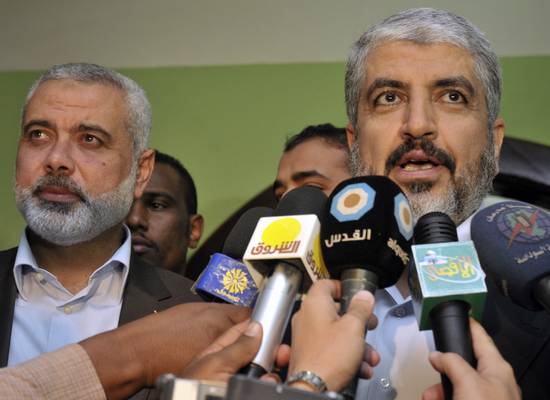
Ismail Haniyah and Khaled Meshaal

No one in Washington has a better understanding of Hamas than Mark Perry. He’s been in communication with the Palestinian resistance movement’s leadership for much of the last two decades.

As bombs rain down on Gaza we are again reminded of the ruthlessness with which Israel controls and takes away the lives of Palestinians, but at such a juncture there seems to be all the more reason to try and understand Israel’s nemesis in Gaza. This morning I posed a few questions to Mr Perry that, at least to my mind, seem to have been left out from much of the analysis of the current conflict.

Paul Woodward: As the latest Israeli assault on Gaza has unfolded, there has been a considerable amount of speculation about how this plays into Benjamin Netanyahu’s political calculations as he approaches elections in Israel due to take place in January. Much less has been said about the political contest currently taking place inside Hamas. Can you describe that contest and talk about how this might have affected the choices being made by the Hamas leadership inside Gaza?

Mark Perry

Mark Perry: The Hamas leadership has been embroiled in a difficult internal debate that is both ideological and personal. On the one side is Ismail Haniyah and his Gaza allies, who believe that the movement should align itself more closely with Iran and take a harder line on reconciliation with Fatah. On the other side is Khaled Meshaal, the head of the movement, and his political allies. Meshaal has a more internationalist vision — and one that takes account of the shifts inside the Arab polity, and inside the movement itself.

The disagreement surfaced in August of last year when Hamas signaled its disapproval of Bashar Assad’s handling of the Syrian uprising by refusing to mount demonstrations among Palestinians in Syrian on his behalf. The movement then moved its headquarters from Damascus. Mr Haniyeh took exception to this decision and criticized the politburo for their actions. Then, in February, Meshaal and Haniyah had a confrontation over Haniyah’s decision to travel to Tehran to show “solidarity” with the “Axis of Resistance.” Meshaal attempted to dissuade him from making the visit. Haniyah attended the conference, but his subsequent visit to other Arab capitals, was not a success. They signaled their disapproval of his views, allowing him to meet with only minor officials.

Haniyah also strongly disagreed with Meshaal’s handling of the reconciliation negotiations with Mahmoud Abbas. Meshaal took a more moderate line with Fatah than his Gaza colleagues, believing the continued divisions between the two movements could become permanent — and fatal to the Palestinian national cause. Haniyah accused him of making unilateral decisions without seeking consensus among his colleagues.

While it’s difficult to know exactly how this has played out on the ground in the recent crisis, Haniyah and his allies have worked to strengthen their claims of being the most credible leaders of Palestinian resistance — a claim that has been enhanced by Israel’s recent offensive. Ironically, or perhaps not (especially for those of us who follow this kind of thing), Israel singled out for assassination a Hamas leader in Gaza who was closer to Meshaal’s vision than Haniyeh’s. That is to say: Israel’s assassination strengthened Hamas’s radical wing. But then, perhaps, “they shall have wars, and pay for their presumption.”

Woodward: With the Muslim Brotherhood now in power in Egypt, why has the border with Gaza remained mostly closed?

Perry: I have a tentative and unsatisfactory answer. The Sinai is a security mess for Egypt’s new government, their economy is in crisis, the salafist current remains remarkably resilient, the Gaza leadership remains unpredictable and the last thing that President Morsi needs is a fight with Israel. Morsi is not Mubarak, he supports the Palestinian cause. But just now, he prefers quiet. He gets that by controlling the border, not throwing it open. And without stability, Egypt’s economy will be finished — and so will he.

Woodward: Qatar just promised to invest $400 million in Gaza. It looks like that probably won’t be enough to even cover the cost of the damage from Israel’s latest airstrikes. As much as the Qataris along with Hamas’s other nominal allies might voice their support for the Palestinian resistance, do you think the latest violence will make it more difficult for Hamas to secure financial support?

Perry: Hamas has made its choice. It had to choose between Assad and the Syrian people, and it chose the Syrian people. It had to choose Iran’s money or its own principles, and it chose its principles. It did this long before Qatar came to its aid. This is not the hallmark of a radical group bent on violence and terror. It is the sign of a mature political movement that represents the best interests of the Palestinian people.

We need to recognize what has happened in the Arab world — both within Arab governments as well as inside its most important political movements. The Arab Spring has taken hold, top to bottom, through all of these societies. Hamas’s leadership, to their credit, has responded to these changes by adopting policies in line with the views of the vast majority of their people: for accountability and transparency. This is not a perfect organization led by charm school graduates, but it is capable of making rational and politically mature decisions.

This pragmatism and maturity is not a secret to other regional leaders. Khaled Meshaal is welcome in Ankara, Cairo and Doha — where his views are solicited. Israelis read his speeches and talk to his followers: by arresting them in order to do so. I believe that he, and the people around him, hold the key to resolving the longest standing and most intransigent conflict in the region.

In Iraq, our senior military commanders determined that we could “not shoot our way to victory” and shaped a political opening to the insurgency. In so doing, we extracted ourselves from a divisive, bankrupting and spirit sapping war. Why not do that now? We can maintain our strong support of Israel, but we should not allow them to hold our interests in the region, and our friendship with badly needed Arab allies, hostage to their decisions.

My belief is that, when this crisis subsides, Arab governments will throw money at Hamas.

Woodward: Having severed its ties to Syria, how much support does Hamas still get from Iran?

Perry: The shift away from Iran has been significant. The last monetary support that Hamas received from Iran was in March. The movement then announced that they would not be a party to any future Iranian-Israeli conflict.

You hear all the time that Hamas is an Iranian proxy. It’s not true. And it’s not true when it comes to Hamas’s rocket arsenal. I am very skeptical of reports about Hamas’s capabilities. Let’s not kid ourselves, compared to Israel, their weapons are primitive. Hamas has reportedly received Fajr 3 and Fajr 5 rockets from Iran smuggled through the Sudan. I assume the reports are reliable, but even so Hamas has no more than 70 to 100 of them, and probably fewer now.

No one is denying that a rocket fired from Gaza is lethal. But the idea that Hamas is specifically targeting Israeli civilians with these rockets is preposterous. The rockets have no sophisticated guidance systems, but are cobbled together in Gaza workshops from parts received elsewhere, stuck into tubes and then “fired in the general direction” of Israel.

Woodward: Beyond the goal of survival, what do you think Hamas’s aims are right now?

Perry: To retain and strengthen its position as the premier Palestinian political movement. But its moderate leadership knows this can only be done by successfully forging a reconciliation agreement with Fatah, while recognizing the finality of the Arab Spring — which has swept aside governments that failed to reflect and meet the needs of their people. Khaled Meshaal and his allies inside of the Hamas political bureau know that without increased transparency, and a free, fair and open exchange of ideas among and between its younger and aspiring supporters, the vision of a free Palestine cannot be met.

Woodward: Do you think that the Hamas leadership in Gaza are currently acting in the interests of the local population?

Perry: No.

Woodward: Are missiles aimed at Tel Aviv and Jerusalem advancing Hamas’s cause or are its military and political wings currently undermining each other?

Perry: Supporters of Palestinian freedom should not allow their beliefs to blind them to the realities of Palestinian politics. A police state is a police state: whether it is enforced by Abu Mazen’s American trained NSF [National Security Force] in the West Bank, or Hamas gunmen in Gaza. I am not a Palestinian and have no say in how Palestinians choose to govern themselves. But that they have a right to govern themselves is not in question. Free, fair and open elections, the right to dissent, freedom of speech and the right to petition your leaders for a redress of grievances are not American ideas, but universal principles. Abu Mazen needs to open his jails. So too does Ismail Haniyah.

Critics of that position will respond that my views do not take into account the vicious and ongoing oppression of the Palestinians by Israel — or the continuing siege of Gaza imposed by a ruthless Israeli leadership that vowed, openly, to put the people of Gaza “on a diet.” They’re wrong. I have seen the suffering first hand. But the “freedom can wait until the revolution is won” crowd are the same people who support Bashar Assad. A right postponed is a right denied. It is not a contradiction to support the right of the Palestinian people to defend themselves while advocating that their leaders recognize and respond to their needs.

Are Hamas’s military and political wings undermining each other? Ironically, again, Israel’s latest operation has actually accomplished the impossible — it has stitched together a divided leadership and people around a common cause. Abu Mazen, Ismail Haniyah, Salam Fayaad and Khaled Meshaal have different strategies for gaining Palestinian freedom. But when it comes to defending their own people, those divisions and differences disappear. As they have now.

Mark Perry is a Washington-based author and reporter. His most recent book is Talking To Terrorists. His forthcoming book (Basic Books, 2013) is a study of the relationship between President Franklin Roosevelt and General Douglas MacArthur. Perry served as an unofficial advisor to PLO Chairman and Palestinian President Yasser Arafat from 1989 to 2004.


Facebooktwittermail

Obama backs Israel’s use of disproportionate force in Gaza

Reuters reports: U.S. President Barack Obama said on Sunday he fully supported Israel’s right to defend itself and called for an end to the firing of missiles into Israel by militants inside Gaza in order for a peace process to go ahead.

“There’s no country on earth that would tolerate missiles raining down on its citizens from outside its borders,” he said. “We are fully supportive of Israel’s right to defend itself.”

If the right of self-defense is not being exercised, it is recognized as a universal principle that applies to individuals and states, including Israel. But when President Obama expresses his support for Israel’s right to defend itself at this time, the principle cannot be divorced from the means through which it is being applied. Only those who choose to obscure the facts speak about Israel’s rights without questioning its methods of defense.

When ‘self-defense’ is used as a license for the use of disproportionate force, the transition has been crossed from defense to aggression and those who voice their support for Israel’s right to defend itself become accessories to Israel’s crimes.

The Institute for Middle East Understanding has put together a useful fact sheet on Israel’s use of disproportionate force which makes clear that this is a doctrine that guides Israel’s military operations — not merely the outcome of unpredictable escalation in the heat of conflict.

Since November 14, when Israel assassinated Hamas leader Ahmed Jabari, further escalating an already bloody week that began with the killing of a 12-year-old Palestinian boy during an Israeli raid on November 8, at least 52 Palestinians have been killed in Gaza, including at least 16 civilians, ten children among them. During the same period, three Israeli civilians have been killed in southern Israel.

This disparity in civilian casualties is representative of a historic pattern, with a disproportionate number of Palestinian and other Arab civilians killed and wounded in virtually every phase of the conflict since Israel’s creation in 1948.

Although Israeli officials stress that the Israeli military carries out “surgical strikes” and goes to great lengths to avoid civilian casualties, evidence documented by human rights organizations shows that Israel has repeatedly and deliberately used disproportionate force – a war crime – as a tactic to kill enemy fighters, minimize the risk of injury to Israeli soldiers during military operations, and to establish “deterrence.” In recent years, the Israeli military has formulated this as the “Dahiya Doctrine.”

To put the casualty figures of the current violence into context, the IMEU offers the following fact sheet on Israel’s use of disproportionate force and an overview of Palestinian and Israeli casualty figures since the First Intifada.

FACT SHEET: THE “DAHIYA DOCTRINE” & ISRAEL’S USE OF DISPROPORTIONATE FORCE

  • A central tenet of Israeli military policy is “deterrence.” This is embodied in the so-called “Dahiya Doctrine,” which dictates the use of overwhelming and disproportionate firepower and the targeting of government and civilian infrastructure during military operations. It received its name from the Dahiya neighborhood of Beirut, a stronghold of Hezbollah, which Israel destroyed almost completely during its assault on Lebanon in the summer of 2006.
  • In October 2008, Gabi Siboni, Director of the Military and Strategic Affairs Program at Tel Aviv University’s Institute for National Security Studies (INSS), a quasi-governmental think tank with close ties to the Israeli political and military establishments, published a policy paper entitled “Disproportionate Force: Israel’s Concept of Response in Light of the Second Lebanon War.” It stated:

    ‘With an outbreak of hostilities [with Hezbollah], the IDF will need to act immediately, decisively, and with force that is disproportionate to the enemy’s actions and the threat it poses. Such a response aims at inflicting damage and meting out punishment to an extent that will demand long and expensive reconstruction processes.

    ‘Israel’s test will be the intensity and quality of its response to incidents on the Lebanese border or terrorist attacks involving Hezbollah in the north or Hamas in the south. In such cases, Israel again will not be able to limit its response to actions whose severity is seemingly proportionate to an isolated incident. Rather, it will have to respond disproportionately in order to make it abundantly clear that the State of Israel will accept no attempt to disrupt the calm currently prevailing along its borders. Israel must be prepared for deterioration and escalation, as well as for a full-scale confrontation. Such preparedness is obligatory in order to prevent long term attrition.’

[Continue reading…]

Dahiya, Beirut, before and after Israel's 2006 carpet bombing.

Issandr El Amrani writes: The Obama administration is asking regional powers to help restrain Hamas but they won’t restrain Israel. It claims to be for de-escalation but will not urge it. De-escalation might work if on one side the Arabs and Turkey use their influence on Hamas to end the rocket fire, and on the other the Europeans and Americans use their influence in Israel to end its missile, bomb and aircraft attacks and urge them not to carry out ground operations that would make this even more deadly.

It’s not even a question of changing their position towards Hamas. It’s a question of making it clear that a ground invasion will lead to the same catastrophic results as during Cast Lead and will further sour the regional scene the interests of all concerned.

But this ever-more-disappointing president can’t even bring himself or his advisors to say they would oppose such a development or urge Israel to forego ground operations.

Pathetic — and a signal to the Egyptians, Turks and others that there is no business to be done with this administration.

Facebooktwittermail

America’s royal generals

An article in the Daily Telegraph which focuses on Jill Kelley’s role as a hostess and prominent Tampa socialite reports:

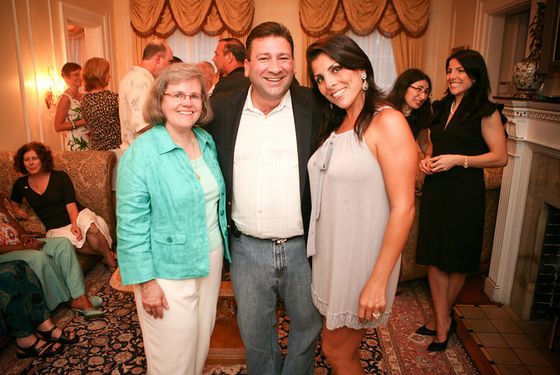
Mrs Kelley, a mother-of-three and unpaid “social liaison” for the US military in Tampa, is said to have spared no expense at such parties to honour top brass stationed at nearby US Central Command. She was pictured at one event at her $1.2 million mansion in 2010 with Gen Petraeus, who arrived in a 28-man police motorcycle escort.

No wonder Petraeus has been dubbed King David.

Spencer Ackerman and Noah Shachtman write:

If there’s a possible silver lining to this rather weird and icky cloud, it’s that these scandals might provoke a reevaluation of how the military treats its highest-ranking general officers. Today, many three and four stars are pampered like British royals – and we all know the kind of trouble those Windsors get themselves into.

“I worry about a creeping entitlement culture,” a former senior military officer tells Danger Room. “They’re so far removed from the daily realities – everything’s taken care of. There’s too many bells and whistles, too many perks,” says the former officer. “They’re ferried from place to place in black SUVs. Some of them have their own airplanes. Aides make their dinner reservations, get their clothes cleaned even cook their dinners. Many guys running big corporations aren’t living this large. And it all seems perfectly normal to them.”

Peeling away the entourages might bring some generals back down to the plane of mere mortals.

Americans have a very confused relationship with privilege. This country was founded as a republic because the idea anyone should be subject to rule under a monarch offended the conception that “all men are created equal.” But rather than completely rejecting the idea that some people can assume the right to rule over others, the preference has often seemed that “equality” can consist of common access to royal power. No one can be born a king but everyone can become a king. And thus presidents become invested with regal authority and the ability to start wars — not an actual legal right but a kind of cultural right that naturally belongs to whichever king currently rules from his white palace.

Facebooktwittermail

Neuroscience and architecture

The cloister of the basilica of Assisi.

Emily Badger writes: Architects have been talking for years about “biophilic” design, “evidence based” design, design informed by the work of psychologists. But last May, at the profession’s annual convention, John Zeisel and fellow panelists were trying to explain neuroscience to a packed ballroom.

The late-afternoon session pushed well past the end of the day; questions just kept coming. It was a scene, Zeisel marveled—all this interest in neuroscience—that would not have taken place just a few years earlier.

Zeisel is a sociologist and architect who has researched the design of facilities for Alzheimer’s patients. Architects, he explains, “understand about aesthetics; they know about psychology. The next depth to which they can go is understanding the brain and how it works and why do people feel more comfortable in one space than another?”

This is an admittedly abstract concept. To help explain, architects often tell this story: Early in his career, when he was still struggling to find a cure for polio, Jonas Salk retreated to Umbria, Italy, to the monastery at the Basilica of Assisi. The 13th-century Franciscan monastery rises out of the hillside in geometric white stone, with Romanesque arches framing its quiet courtyards. Salk would insist, for the rest of his life, that something about this place—the design and the environment in which he found himself—helped to clear his obstructed mind, inspiring the solution that led to his famous polio vaccine.

“He really thought there was something to this,” says the architect Alison Whitelaw, “that the quality of the built environment could affect the performance of the brain.” [Continue reading…]

Salk Institute

If the idea that changes in the environment could bring about changes in the brain is a revelation, it’s worth drilling into the suppositions that it upturns, for it can only challenge the idea that somehow we might be unaffected by what’s around us.

Is anyone actually so oblivious to the impact of their surroundings?

If architecture often seems poorly attuned to human needs, this probably has less to do with insufficient input from neuroscientists and much more to do with what is invariably the case: that the creators of public spaces rarely spend a significant portion of their own lives occupying their own creations.

However Jonas Salk was inspired by the monastery in Assisi, it’s frankly hard to compute how that translated into the desolate features of the Salk Institute.

No doubt we should try and reap the rewards of whatever understanding neuroscience can provide, but mindful that it can only provide information. The creativity that infuses life into artistic creations requires more than the aggregation of information.

Facebooktwittermail

Is it the Petraeus or the Kelley Affair?

What quickly became known as the Petraeus Affair has now escalated dramatically in its scope. The FBI investigation that was instigated by a cyber-stalking complaint made by Jill Kelley, a volunteer social liaison to MacDill Air Force Base in Tampa Bay, Florida, has now revealed that Kelley and the top U.S. commander in Afghanistan, General John Allen, exchanged between 20,000 and 30,000 messages from 2010 to 2012. That would be an average of something like 30 messages a day!

Reuters reports: Defense Secretary Leon Panetta told reporters flying with him to Australia that he had asked that Allen’s nomination to be Commander of U.S. European Command and Supreme Allied Commander Europe be delayed “and the president has agreed.”

President Barack Obama has put the nomination on hold, the White House said on Tuesday.

Allen, who is now in Washington, was due to face a Senate confirmation hearing on Thursday, as was his successor in Afghanistan, General Joseph Dunford.

The FBI referred the case to the Pentagon on Sunday and Panetta directed the Defense Department’s Inspector General to handle the investigation. Panetta informed the top Republican and Democrat on the Senate Armed Services Committee during the flight to Australia. The House Armed Services Committee was also notified.

The U.S. defense official said that Allen denied wrongdoing and that Panetta had opted to keep him in his job while the matter was under review – and until Dunford can be confirmed to replace him, a process that gains urgency given the cloud the scandal could cast over the mission in Afghanistan.

Jill and Dr. Scott Kelley alongside Holly Petraeus


A rightwing blog, The Conservative Tree House, provides a useful summary of the story so far. A new question likely to emerge in Congressional hearings on the Benghazi attack, is whether the CIA is now circumventing Executive Order 13491 — which prohibits the CIA from operating detention facilities — by outsourcing such operations to contractors.

So Jill Kelley, a Petraeus family friend, began receiving odd and harrassing e-mails about her relationship with CIA director General David Petraeus:

“More like, ‘Who do you think you are? … You parade around the base … You need to take it down a notch,’” according to the source, who was until recently at the highest levels of the intelligence community and prefers not to be identified by name.

Kelley then reaches out to a family friend who is by profession in the FBI. She asks if these unsourced e-mails reach the level of cyber-stalking.

The FBI “friend” takes her to a field office where he puts her in contact with the “cyber-crimes” division/agents. There they essentially come to the conclusion that the statute on cyber-stalking does actually seem to apply, so they open a preliminary case.

The first step in that aspect of the case is to back-check the IPs etc to find the origin of the e-mails to Kelley. That investigative part finds Paula Broadwell as the origin of the e-mails to Kelley. So the FBI gets a subpoena to dig further into the Broadwell electronic mail accounts. *Note the investigation at this point is into Paula Broadwell*

During the research of her communication it becomes apparent that she is in contact with CIA Director General David Petraeus on some personal level.

While this is occuring, the original FBI friend (unknown) of Kelley is asking the Cyber division people on the case for updates. They provide him some information based on professional courtesy. He in turn then relays this information to Jill Kelley herself, who then begins to inform her friend, General Petraeus, of the source. Essentially telling Petraeus “heads up” this woman you know has been identified as the origin of threatening e-mails to me. (*Note* whether Kelley knew of the affair aspect at this time is unknown).

Simultaneously, the FBI friend of Kelley sends a personal, perhaps flirtatious, picture to Kelley that the FBI becomes aware of (they are monitoring Kelley’s communication). The FBI, is not comfortable with the “non-professional” relationship between the FBI friend and Kelley, and they inform him he is ‘cut out’ of the story. (The FBI probably know that Kelley is also back-channelling information from this guy to her friend Gen Petraeus – any investigator would not like this loss of control). [Continue reading…]

Facebooktwittermail

Israel considers ‘reformatting’ Gaza

Once again, as Israel’s leaders contemplate the systematic slaughter of Palestinians they choose a cold and colorless metaphor: “Israel must perform a reformatting of Gaza, and rearrange it,” says Home Front Defense Minister Avi Dichter — as though the Gaza Strip were a computer disc whose contents could painlessly be erased.

What would “reformatting” look like according to Dichter?

Operation Defensive Shield — the IDF’s assault on the West Bank during the Second Intifada in 2002. That was when the slaughter in Jenin became too much even for George Bush to support, though his demands that Ariel Sharon must withdraw his forces “without delay” went unheeded.

The New York Times then reported:

Describing a visit to the Jenin camp, the United Nations envoy to the Middle East, Terje Roed-Larsen, said at a news conference here today: “We saw children looking for their parents. We saw fathers, brothers, sisters digging in the rubble in order to find the corpses of their dear ones.”

Surveying the wreckage at the camp on Thursday, Mr. Roed-Larsen called the scene “horrifying beyond belief.”

“Combating terrorism does not give a blank check to kill civilians,” he said…

The Times of Israel now reports:

The Israeli army is preparing for a ground incursion into Gaza and will launch it unless rocket fire from the Strip ends, Education Minister Gideon Sa’ar said during a visit to a school in Sderot on Monday.

“We have seen the escalations on the Gaza border increase in frequency over the past year and we need to put an end to them,” said Sa’ar a senior Likud official with close ties to the prime minister. “All the preparations for a wide-scale ground operation are being made. Unless the [missile] fire stops, such an operation will be launched.”

Sa’ar said that measures to gain international approval for an operation similar to 2008′s Cast Lead are already under way.

Defense Minister Ehud Barak addressed the possibility of such an incursion too, though more subtly. During an air defense drill Barak said actions against Hamas “may intensify and expand.”

On Monday, Barak made it clear that Israel would not hesitate to reenter Gaza. “If we are forced to go back into Gaza in order to deal Hamas a [serious] blow and restore security for all of Israel’s citizens, then we will not hesitate to do so,” he said.

The Ma’an News Agency reports: The Hamas government has filed a complaint to the UN against Israeli attacks on the Gaza Strip, a spokesman said.

Taher al-Nunu said government called on UN Secretary General Ban Ki-moon to pressure Israel to stop its attacks on civilians in Gaza.

Israeli tanks shelled Gaza City on Saturday killing four civilians and injuring at least 25. Israel’s army said it was responding to a missile attack on an Israeli military jeep which injured four soldiers.

Gaza factions fired dozens of rockets into Israel in response to the deaths, with Israel launching an airstrike early Sunday which killed two members of Islamic Jihad’s military wing.

Israel launched multiple airstrikes on the Gaza Strip overnight Sunday, with no injuries reported, and 11 rockets have been fired from Gaza since Monday morning. One rocket struck a home in the city of Netivot at around 7 a.m., causing material damage.

The Salafi organization, the Shura Council of the Mujahedeen, claimed that rocket and Israel promised a tough response.

“We have a full box of tools … that we have not yet used,” Israeli Vice Prime Minister Moshe Yaalon told Army Radio. “We will need to toughen our response until Hamas says ‘enough’ and ends the fire.”

Facebooktwittermail