When I say War in Context is handmade, that’s not a figure of speech. Typing and cutting-and-pasting involve all sorts of precise flexions, animated by action potentials rippling at high speed down the median nerve which extends from the cervical spine to the hand.
For the last two months the root of my own right median nerve has been held in a vice grip — a high grade central canal stenosis, to be precise.
With physical therapy and narcotics, I’ve tried to ward off the evil effects of curse-inducing pain coursing through my arm — even though the pain kept repeating the same message. If there’s one thing that with absolute consistency aggravates this condition, it’s stretching my hand over a keyboard. The message is: stop typing.
A friendly neurosurgeon who I talked to for all of fifteen minutes, glanced over my MRI results and told me he’d be happy to slit my neck open and go to work with sharp instruments and power tools operating in close proximity to every major vessel that keeps me alive.
Afterwards he wrote (in reference to me):
I talked to him about the nature of the procedure, as well as the risks of bleeding, infection, injury to the trachea, esophagus, or carotid requiring repair, laryngeal nerve injury with hoarseness, spinal cord injury with weakness, CSF leak, and failure of bony union. We talked about the need for reoperation if this occurs. All questions were answered and no guarantees were given as the the outcome of surgery.
It’s true — he did mention the risk of hoarseness.
I’ll be sure to exhaust all my other options before I get this intimate with a virtual stranger — but that means I have to take a break from intensive blogging.
There are all sorts of things worth giving up your right arm for — except your right arm.
Meanwhile, I strongly encourage regular readers who haven’t already done so, to subscribe to War in Context by email so that I can alert you when this site and its creator are back at full strength. Prior to that, I will continue to post videos and probably the occasional must-read.
Update 4/15/11: Many thanks for all the expressions of support in comments and messages I’ve received over the last week. With the help of a naturapathic physician and regular restorative yoga and a prednisone jumpstart, I’m fairly confident I’ll be able to escape the knife. But after having done over 23,000 posts on this site over the last nine years, I’ll also need to cut back on the repetitive stress for a while.
It looks like Jon Stewart has discovered his Islamophobe-within as he drums up laughs and fear among those Americans who’ve decided that Libya is the new Afghanistan and Libya’s rebels are destined to become foot soldiers for Osama bin Laden. For Stewart, the armed opponents of Gaddafi aren’t just rebels but something far more ominous: Muslim rebels.
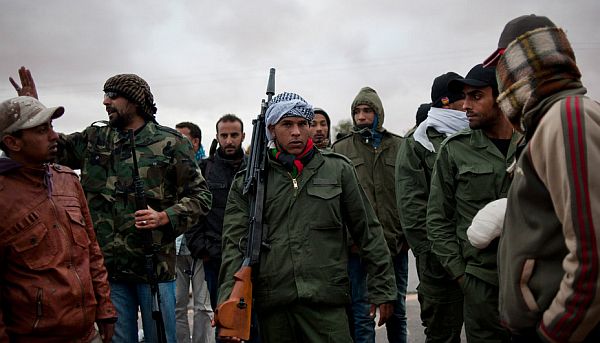
Having implied that Libya is now the training ground for terrorists who might some day attack America, Stewart then goes on to mock the young fighters as though any revolution worthy of the name instantly spawns battalions of skilled soldiers. No doubt in the early days of the American revolution, there were plenty of English satirists who scoffed at the idea that a rag-tag army of disgruntled colonists could possibly defeat the King’s vastly superior forces. And who’s to say whether America’s revolution would have succeeded without outside support through the supply of weapons, training and then French intervention?
A story reported by Wefaq Media, translated by ShababLibya and posted on LibyaFeb17.com, shows that rebels defending Misratah are using cunning to make up for some of the disadvantages they face against Gaddafi’s much larger and better armed forces.
Several days ago, the freedom fighters unloaded the fuel station located on a service road for heavy transport vehicles. The gasoline it contained was emptied and was replaced with water instead. The freedom fighters then retreated thus leaving the fueling station to be accessible to the nearby Gaddafi brigade.
Because it’s easy to trap a mouse in a trap, the rats of Gaddafi looted the fuel station and started filling their armored vehicles with ‘fuel’! When they attempt to leave, their vehicles stopped moving , and that is when our freedom fighters ambushed them! Gaddafi’s solders were forced to flee leaving their dead vehicles behind. I guess the next time they want to fill up, they’ll have to taste the fuel to be sure.
Meanwhile, Ryan Calder on his excellent new blog, Revolutionology, reports on the Orientalist bias among the major news outlets who have an appetite for images that reinforce Western assumptions and fears about those Libyans who have taken up arms.
In an area of desert where literally hundreds of fighters are gathered, freelance photographers go for the salable shots — such as images of men reading the Quaran. These are the pictures the news agencies will have most interest in buying. Why? Because fearmongers like Jon Stewart choose to reinforce the idea that even if liberal peace-loving Americans bear no animosity to Muslims in general, Americans still have reason to be afraid any time a Muslim picks up a gun.
The American left is Muslim-friendly — so long as we’re talking about Muslims who don’t fight and preferably don’t take their religion too seriously.
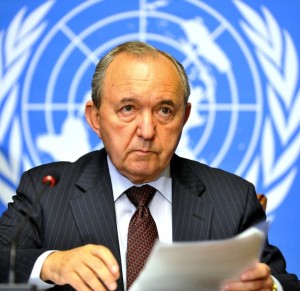
Here’s a circle that should never have been closed.
The Goldstone Report, once credited with having provided a hefty shove as Israel veered towards pariah status, is now being held up by Israelis as having unintentionally demonstrated why, when the need arises, Israel will be able to launch Cast Lead Two and once again chant: “we have no choice” — no choice but to slaughter hundreds more Palestinians.
Israel grappled on Sunday with whether a retraction by a United Nations investigator regarding its actions in the Gaza war two years ago could be used to rehabilitate its tarnished international image or as pre-emptive defense in future military actions against armed groups.
The disavowal, by Richard Goldstone, a South African judge who led a panel of experts for the United Nations, appeared in an opinion article in The Washington Post. He said that he no longer believed that Israel had intentionally killed Palestinian civilians during its invasion of Gaza.
Many here considered the article truly significant. Commentary came in a flood, ranging from gracious praise to vindictive indignation. Some cited the message of Proverbs 28:13 that whoever confesses and renounces his sins “finds mercy.”
Still, the question remained whether the harm the Goldstone report caused — the ammunition it gave to those who view Israel as a pariah state and question its right to exist; the campaigns that have stopped some Israeli officials from traveling abroad for fear of arrest for war crimes — could be undone.
Prime Minister Benjamin Netanyahu told his cabinet on Sunday that Israel would work “to formulate practical and public diplomacy measures in order to reverse and minimize the great damage that has been done by this campaign of denigration against the State of Israel.”
A number of officials said that while the blow to Israel’s name had been great, the renunciation of the harshest conclusion would help in the future.
“The one point of light regards future actions,” Gabriela Shalev, a law professor and most recently Israel’s ambassador to the United Nations, said on Israel Radio. “If we have to defend ourselves against terror organizations again, we will be able to say there is no way to deal with this terror other than the same way we did in Cast Lead.”
“If I had known then what I know now, the Goldstone Report would have been a different document,” Judge Goldstone wrote in the Washington Post. But it matters little what kinds of revisions Goldstone would now make; the most significant thing is that he is perceived as having disavowed some of his own conclusions.
The political impact of the report always had more to do with the identity of its author than the report’s contents. Thus the Report of the United Nations Fact Finding Mission on the Gaza Conflict quickly became known simply as the Goldstone Report. It’s supposed authority derived not from the fact that it had been produced by independent international fact-finding mission under the auspices of the United Nations Human Rights Council — what mattered more than anything else was that Goldstone was Jewish and a Zionist.
Israel — the theory went — would be forced to sit up and pay attention if a humanitarian rebuke came from such an impeccable source. But on the contrary, Goldstone ended up being elevated to the status of presenting an existential threat to the Jewish state, on a par with Iran.
He has now effectively disarmed himself.
Israel, long enamored with the notion that its soldiers have higher moral standards than any other military force, has been quick to declare that it has been vindicated. The Goldstone Report itself has ended up better serving those who want to sustain Israel’s sense of victimhood than in being the cause of any change in Israel’s behavior.
There’s a lesson here: don’t attach too much attention to a 500-page report that few people have read, or to the ethnicity or ideology of the messenger. The reason Gaza changed the world’s view of Israel was largely thanks to on-the-ground reporting — not a report — and it came from the voices and faces and presence of young journalists who were describing what they saw, as it happened.
Al Jazeera shone the brightest spotlight on Gaza — in his report, Goldstone did little more than reiterate what we already knew.
Reuters reports that the CIA is now on the ground in Libya and the Obama administration is considering arming Gaddafi’s opponents.
This is some of the reaction from Firedoglake‘s David Dayen:
I can just go back to the American track record of arming insurgencies and it’s not very good. Robert Gates knows well from his experience in the CIA that when he armed or helped to arm the Afghan rebels to try to get the Soviets out, that didn’t end well for us.
I just don’t think we know enough about this opposition which is, I think, substantly [sic] different than the opposition that was in peaceful protest throughout the Arab world, to make that assessment that we are going to provide armaments and then possibly trainers to deal with the situation.
Let’s unpack this statement because there’s an awful lot embedded in it that reveals widely held assumptions among those who view Libya as a special case and believe what is going on there can be viewed as intrinsically different from the wider Arab democratic revolution.
Dayen refers to Gaddafi’s opponents as “insurgents” — a term generally applied to armed opponents of a legitimate government. But anyone who doubts that the Gaddafi government has lost its legitimacy needs to explain why so many of Libya’s ambassadors have defected — now even Moussa Koussa, Libya’s foreign minister, has fled to the UK.
I doubt that Dayen’s purpose is to legitimize Gaddafi, but this kind of language certainly delegitimizes those who are fighting to free Libya from Gaddafi’s control. Moreover, to refer to the US’s track record in supporting insurgencies is another way of casting aspersions at the Libyans by invoking memories of the counter-revolutionary anti-Sandinista Contras in Nicaragua or the Mujahadeen out of whose ranks al Qaeda later emerged.
Dayen then makes the ambiguous assertion that on the one hand we don’t know enough about the Libyan opposition, yet apparently we do know enough about them to know that they are intrinsically different from the revolutionaries in Egypt and Tunisia.
Are we supposed to distrust any uprising in which Facebook doesn’t play a prominent role?
Or is the fundamental reason for mistrusting the Libyan rebels because they fairly swiftly armed themselves after hundreds of unarmed demonstrators had been killed?
What would have placated the fears of those in the West who now view with suspicion Libya’s rag-tag army of rebel fighters? That several thousand more would have been killed before the peaceful protest movement transitioned into an armed uprising?
The fact is that peaceful protest movements can be crushed. The partial successes in Tunisia and Egypt says less about the indomitable force of people power, than it says about the extent to which the autocratic leaders in each of those countries were constrained in how far they could go in violently suppressing their own people while still retaining Western support. The West’s support for tyrants is utterly cynical but it does have limits and thus the awkward maneuvering we have repeatedly witnessed as Washington sustains its ties to old autocratic allies while simultaneously coaxing them to institute enough reforms that they might guarantee their survival.
In spite of his relatively brief political rehabilitation, Gaddafi knew from the moment the uprising burst forth, that he wasn’t going to get any protection from the West and thus he did not fear condemnation for his brutality. That’s why he has shown no restraint in his fight for survival. It would be ironic if he now found he was being offered a lifeline by those who oppose Western intervention in Libya.
Before France, Britain, and the United States stumbled into its current attempt to dislodge Muammar al-Qaddafi from power in Libya — and let’s not kid ourselves, that’s what they are trying to do — did anyone bother to ask what recent social science tells us about the likely results of our intervention?
I doubt it, because recent research suggests that we are likely to be disappointed by the outcome. A 2006 study by Jeffrey Pickering and Mark Peceny found that military intervention by liberal states (i.e., states like Britain, France and the United States) “has only very rarely played a role in democratization since 1945.” Similarly, George Downs, and Bruce Bueno de Mesquita of New York University found that U.S. interventions since World War II led to stable democracies within ten years less than 3 percent of the time, and a separate study by their NYU colleague William Easterly and several associates found that both U.S and Soviet interventions during the Cold War generally led to “significant declines in democracy.” Finally, a 2010 article by Goran Piec and Daniel Reiter examines forty-two “foreign imposed regime changes” since 1920 and finds that when interventions “damage state infrastructural power” they also increase the risk of subsequent civil war.
The best and most relevant study I have yet read on this question is an as-yet unpublished working paper by Alexander Downes of Duke University, which you can find on his website here. Using a more sophisticated research design, Downes examined 100 cases of “foreign imposed regime change” going all the way back to 1816. In particular, his analysis takes into account “selection effects” (i.e., the fact that foreign powers are more likely to intervene in states that already have lots of problems, so you would expect these states to have more problems afterwards too). He finds that foreign intervention tends to promote stability when the intervening powers are seeking to restore a previously deposed ruler. But when foreign interveners oust an existing ruler and impose a wholly new government (which is what we are trying to do in Libya), the likelihood of civil war more than triples.
It’s not as though Susan Rice and Samantha Power lack grounding in the social sciences, but if President Obama, when being pressed to authorize an urgent intervention in Libya, had responded by calling for a report to see what useful lessons social scientists had drawn from previous interventions, his request might have been greeted with an exclamation: “give me a break!” or at least a polite admonition: “we don’t have the time.” But even if the situation was not quite as urgent, how much could social science reveal about the situation in Libya?
The problem is, social science isn’t science. In real science, you can test theories by running multiple experiments, changing the variables and comparing the different outcomes. You can’t prove that something is true if there are no means by which it could be proved false. In this case, all a social scientist can do is posit a number of what are deemed to be parallel cases, pointing to the outcomes there and then and predict a similar outcome in Libya.
But whatever generalizations you want to make, it’s hard to dispute the Colonel Gaddafi is one of a kind and however important the lessons from history might be, they do no more than suggest a number of possible outcomes. Indeed, we do well to remember that only a matter of weeks ago scholarly opinion was quite confident in asserting that Egypt was not ripe for revolution. History is not a process of endless repetition and there are periods of change when it becomes foolish to predict with much conviction what is going to happen.
In real life we make choices and the nature of most major decisions is that they foreclose the possibility of backtracking and finding out the consequences of each alternative.
The US and its allies chose to intervene in Libya and now those who doubt the wisdom of that choice can second guess it and make all sorts of claims about how things would have worked out better if that choice had not been made. These are to a significant degree idle forms of speculation because they involve making unprovable claims. There is no parallel reality in which we can observe what would have happened had UN Res. 1973 not passed and the intervention thus not occurred. The only incontrovertable statements are of the kind, we wouldn’t be spending $300 million a week on an intervention in Libya if we hadn’t intervened in Libya. You don’t say?
Walt concludes, “these various scholarly studies suggest that the probability that our intervention will yield a stable democracy is low, and that our decision to intervene has increased the likelihood of civil war.”
Who claimed this intervention was going to lead to a stable democracy? At this point there has yet to be a clear consensus on what the operation’s aims are. I haven’t heard any grand predictions about the dawn of a new democracy. This sounds like another instance of the echoes of Iraq emerging out of silence.
As for the risks of civil war, many of the skeptics claim that a civil war had already started. That, I would dispute.
By the point at which Gaddafi’s power briefly appeared not to reach far out of Tripoli, the uprising had all the marks of being a popular and contagious rejection of his rule. Had he not already anticipated the need to guard his power by relying on foreign mercenaries, he would most likely already be gone.
And as for the danger of instability in a post-Gaddafi Libya, the truth is that in a revolutionary society, stability is just another name for oppression. It might look appealing to those of us outside for whom it has tangible benefits, like lower oil prices, but for the Libyans who have risen up to overthrow a tyrant, the prize of freedom they seek is all that they can now accept — even if the price is turmoil.
Does that sound like Rumsfeld’s view of the collapse of civil order in Baghdad? Superficially, but the rupture Iraq went through was triggered by an American invasion. This time around the outsiders have inserted themselves (though not literally stepped in) at a point at which a society was already being ripped apart. We didn’t make this happen.
That should not be forgotten because after 112 cruise missiles slammed into Libya’s air defense sites that day and the phrase “shock and awe” started getting tossed around once again, the implication for many observers was that Western intervention in Libya marked the beginning of another American-made war in the Arab world. It didn’t.
If I am asked, do you support the war? Or, do you support the intervention? Or, are you an interventionist? My response is: none of the above. They are all misleading questions.
By the week beginning March 13, the collapse of the Libyan revolution and the beginning of a major and very bloody assault on Benghazi were imminent. For anyone to believe in the likelihood of a massacre leading to thousands of deaths, did not depend on the political impact of dubiously sourced newspaper reports or how effectively highly questionable intelligence could be presented. Nor did it depend on ascribing to Muammar Gaddafi the intent to invade other countries or supply terrorists with weapons of mass destruction. Indeed, pretty much the only way one could avoid coming to the conclusion that Benghazi and its population of close to a million was in a position of immense danger would have been by avoiding reading the news.
Towns and cities along the Libyan coast that only days before had been liberated by a rag-tag army of protesters-turned-freedom-fighters, were being reclaimed by Gaddafi’s forces one by one as the rebels were pushed back towards Benghazi. The uprising had not been fully crushed, but it was in the process of rapid collapse.
When the members of the UN Security Council discussed the issue last week, debate did not revolve around whether the situation was urgent but on whether any consensus could be reached on how the international community could effectively respond to this emergency and prevent an assault on Benghazi. Since by that point there seemed no plausible way to protect the city other than by military force, the core issue became whether there was any validity to the claim that the fate of Benghazi had become an international responsibility.
In the end, no member of the Security Council was willing to assume a position which would effectively had said: what happens inside Libya’s borders is not our concern. Those who doubted that their concerns could be met through some form of military action, abstained.
In the wider arena of political debate, opposition to intervention in Libya has come primarily from those who are ideologically opposed to military intervention. Implicitly, their argument runs from the general to the particular.
Military intervention is always entered into with unrealistic optimism, inevitably has unintended consequences and will necessarily do more harm than good. Intervention in Libya will simply reaffirm what has universally already been shown to be true.
What about Benghazi?
The less said the better. Who knows, perhaps their plucky fighters would have been able to keep Gaddafi’s forces at bay. Perhaps Egypt would eventually have intervened.
What about the repeated appeals from the rebels?
From who? Who are these people? Is Libya really part of the wider Arab uprising or is this just a civil war in which the losing side wants our help?
“[W]e know nothing about the opposition. It ain’t Egypt,” declares Michael Ratner. As a hard-headed attorney, he says the only circumstance in which intervention in Libya could be justified would be “in response to genocide.”
It’s questionable whether a massacre of any size would cross that legal threshold, so Ratner’s message to the people there essentially amounts to this: sorry guys, you’re on your own.
And what about the impact the crushing of the Libyan uprising might have on the wider Arab revolution?
This for me is one of the most important questions. It’s clear that in Tunisia, Egypt, Yemen, Bahrain and Libya, everyone is fighting their own fight. It is also clear that there is a sense of solidarity that spans the Arab uprising — that the examples of Tunisia and then Egypt demonstrated to the region as a whole that ordinary people rising up en masse can in just a few weeks topple ruthless dictatorial regimes.
If Gaddafi stays in power he will demonstrate that popular support, enthusiasm, the use of social media, desperation and even the willingness to take up arms, will not necessarily be enough to bring down a dictator who is ruthless enough to set no limit on how much violence he is willing to use to crush his opponents.
This is a message that will disempower everyone now on the streets across the region, protesting to win their political rights. At the same time it will encourage every threatened regime and the security apparatus upon which each depends, to maintain their faith that violence can continue to sustain the status quo.
How intervention in Libya will ultimately impact the Arab democratic revolution we don’t know, but Gaddafi’s position is more vulnerable than it was a week ago. Success for Libya’s revolutionaries is far from guaranteed but they now have what is perhaps the most they can or should hope to derive from outside support — a fighting chance.
A few hours ago I had it mind to note that one of the distinctions of the attack on Libya was that even after it had begun, it had yet to receive a name. The fact that French jets were screeching across the sky above Benghazi, yet TV commentators could not with gravitas preface the announcement of their presence with a suitably grandiose title, did actually underline the fact that warfare is and should be a last resort — not something that can be carefully premeditated and branded as though it was a product for sale.
I guess I should have realized that the naming ceremony was being reserved for the Pentagon, with its compulsion to announce the unleashing of any fusillade of cruise missiles with the title of a summertime Hollywood blockbuster.
Perhaps the strangest and yet most telling piece of messaging is that the US attack would be launched while the commander in chief is on an overseas jaunt.
The message being? That it underlines that the United States is playing a strictly supporting role in this operation? That this is business as usual for America and if the president can enjoy a trip to Brazil while the bombs drop then so should the rest of the country continue with its own distractions? Or, that Obama is so ambivalent about his role that he is much more comfortable simply delegating responsibility to the next man in the chain of command, Secretary of Defense Robert Gates — who happened to make his objections to this operation quite transparent? And if the latter is the case, perhaps this does in a somewhat regal fashion underline that ultimately Obama is the decision maker, not just the deliberator.
Meanwhile, to those who remain spellbound by memories of 2003 I would suggest imagining this:
It’s March 2003, a month after the beginning of the spectacular Iraqi uprising that had begun once again in Basra. Caught by surprise, Saddam loyalists had been pushed back all the way to Baghdad and for a brief period it looked like the regime might collapse. Iraqis across the country were eager to claim their democratic rights, deeply inspired by the fact that to their west, the Saudi royal family had unceremoniously be evicted and to their east, a peaceful democracy movement had led Ayatollah Khamenei to rescind the ideology of vilayat-e faqih and transfer full constitutional power to an elected assembly. Yet although the uprising had swept the length and breadth of Iraq, the enthusiasm of ordinary people could not withstand Saddam’s brutality and his willingness to use all necessary means to reassert control over the country. For a few weeks, irregular forces had fought bravely to defend their gains, but now the Iraqi army was in the process of reclaiming territory, city by city.
George Bush, at that time a president who had not actually launched a war, suggested that America could at least provide a supporting role as, much to everyone’s surprise, Europe formed a coalition including Arab nations intent on preventing Saddam from strangling Iraqi democracy at its birth. Would there have been strong objections in the Middle East or the West?
For much of the last year, I’ve been wondering whether it’s worth me devoting time to moderating and responding to reader comments. Initially, this issue arose because my coverage of Israel/Palestine was attracting the attention of increasing numbers of Zionist trolls.
In recent days it’s become clear that I’ve alienated a number of readers due to my support for an international military attack on the Gaddafi regime. I’m now getting enough questions and comments thrown at me — many of them perfectly legitimate challenges — that I could easily spend most of my time responding to comments. But if I did that the site would quickly grind to a halt.
One individual has manage to write over 7,000 words in comments in just the last three days! I would commend anyone with that much to say, to start their own blog rather than opt for the convenience of turning someone else’s site into a ready-made soap box.
It’s never been my purpose for War in Context to be some kind of ideological echo chamber where a certain political constituency would be served by the dubious form of satisfaction that comes from having their own opinions confirmed.
At least for now, I’m suspending commenting. I might reconsider my decision at some point in the future, but in the meantime anyone who wants to share with me what they think on any topic relevant to this site, is welcome to send me an email. I may well on occasions use such comments as the basis of a post, exercising my editorial privilege to the same extent as I do in the operation of this site as a whole.
The mere fact that Gaddafi has been served notice that continued military operations will bring reprisals has not been sufficient to persuade him to implement a unilateral ceasefire which he already promised. Benghazi is currently under attack.
Meanwhile, as missiles are coming down on the last refuge of the Libyan revolution, a strange message is going out to the people whose lives are still threatened by Gaddafi’s forces. Social activists and members of the anti-war movement want the revolutionaries to know that they feel betrayed and let down!
There are people in places like Montreal and Chicago who have dedicated their lives — or at least careers, or blogs, or speaking tours — to challenging the mighty forces of Western imperialism, and then the folks in Benghazi hand out an open invitation for NATO to come along and rescue them. Unforgivable!
Elements of the rebel leadership have stained their own name, and stained their revolution. That is inescapable now. But what is damaging to all of us is the narrow, self-centered, provincialism of what is clearly a neo-colonial elite of former regime insiders serving as self-appointed “representatives of the Libyan people,” elites who like the neo-colonized, depend on aid from abroad as part of their self-fulfillment. Cheering for what will be a NATO-led operation, is a validation and legitimation of that organization, and in a time when budgets for education, health, public works, and programs for the poor are all being slashed across the West, they help to validate the need for maintaining heavy military spending. Nobody is out in the streets cheering universities and hospitals, but apparently they are out in the street cheering the bomb. Their provincialism was displayed in their lack of solidarity, or even passing concern, with social justice and anti-war activists in the West, in cases berating those of us who felt we should have a voice — these are, after all, our planes, our bombs, and our political leaders — because all we needed to know was that “Libyans” asked for this intervention. If that is a reflection of the kind of political work and solidarity-building they did at home, then no wonder they had to turn to artificial, prosthetic solutions. Not just the anti-war movement, and the anti-secrecy movement, will be damaged here, as the clock is turned back to 2003 — it is the very meaning of “revolutionary,” which can now be made to include those who would be clients of imperial patrons.
So, the current predicament of the Libyan revolution is not the result of the brutality of the regime and its oppressive rule, but because of its second-rate revolutionary leaders, their lack of political skill and their deficiencies in solidarity-building?
I guess the “fall” of the Libyans actually took place the first day they started shooting back and revealed that they lacked Gandhi’s commitment to non-violence. If only they had possessed the moral strength of their Western supporters-now-turned-critics and realized that Gaddafi could be toppled with pure love.
OK, I’ll dispense with the sarcasm. The fact is, I find it extraordinary, that anyone aligned with any kind of movement whose basis is human solidarity would not have enough empathy to recognize that people whose lives are under immediate threat, do not have the luxury of picking and choosing between possible sources of protection just for the sake of maintaining the ideological purity of their cause.
If revolutionaries in Tunisia and Egypt had been able to join forces with their counterparts in Libya and collectively bring down Gaddafi, that would have been the dream combination. But it couldn’t happen — or at least, it couldn’t happen soon enough.
And the idea that the Arab democratic revolution is now over because of Western intervention in Libya, conveniently skirts over the implications that Gaddafi’s victory might have for the wider revolution.
The Western intervention of the most dangerous and insidious form would be Western non-intervention as autocratic regimes, emboldened by Gaddafi’s success in crushing the Libyan revolution, followed in his footsteps and crushed revolts across the region while the US quietly took comfort in the restoration of “stability.”
Now that the Obama administration has veered off its previously steady and passive response to the region’s uprisings, the remaining regimes have become more — not less — vulnerable. Hence the Arab League’s support for Res. 1973. The Gulf states are desperate to demonstrate how supposedly different they are from Gaddafi because their inequities and centralization of power are so similar. Gaddafi might not indulge in the same level of gross opulence as his royal Arab counterparts, but he shares their fear of political freedom.
Maybe Benghazi is not populated by failed revolutionaries but the failure comes from the outside through a projection of revolutionary aspirations by those who are disappointed by the lack of revolutionary tendencies in their own societies.
The driving force behind the Arab democratic revolution in Libya and elsewhere is not a lofty desire to change the world — it’s simply a hunger among ordinary people to be able to control their own lives.
The time at which this became a question whose answer could not be avoided was this beginning of this week. It was not in reference to a no-fly zone or any other form of international military action aimed at Libya. It was in reference to Muammar Gaddafi’s advance on Benghazi.
For those who want to draw parallels with Iraq, the equivalent question was: what happens if we don’t remove Saddam? The neocon answer, long before the war had been launched, was that Saddam possessed and was destined to use weapons of mass destruction. How does this end? If we don’t stop Saddam it could end with a mushroom cloud.
In the face of widespread skepticism, Colin Powell had to “prove” the case for WMD in front of the UN Security Council.
This time around, no one had to prove that an attack on Benghazi was imminent and very few were in doubt that if or when it happened there would be a massacre. One could debate how many lives would be lost, but it would have been hard politically or morally to say: here’s the threshold — this becomes a matter of international concern only if it’s reasonable to assume X number of casualties are likely.
As soon as it appeared highly probable that a massacre was a matter of days away, the international debate turned to the question of how this could be prevented.
The answer provided by UN Resolution 1973 is quite persuasive.
How does this end? By a massacre in Benghazi being prevented.
But now there are a flood of other questions — will this operation result in the removal of Gaddafi? What would a post-Gaddafi Libya look like? Which governments are contributing forces for enforcing the NFZ? How will the NFZ be implemented? How long will it take to put in place? What happens if Gaddafi respects a ceasefire but his opponents don’t?
When those who sought and secured the UN authorization to intervene in Libya were, just a few days ago, skeptical about intervention, it’s a bit unrealistic to believe that they now already have all the answers about how this is supposed to play out in theory, let alone predict what will actually happen.
This isn’t the culmination of a long campaign to reshape the Arab world hatched by a cabal of liberal interventionists. It is a chapter in a process that began on December 17 in Tunisia when Mohamed Bouazizi set himself on fire. Not a single person on the planet could have foreseen what that desperate act by a street vendor was going to trigger.
So to those who now vex about an intervention in Libya is going to play out, I would remind them that the drama we are now witnessing and have been following for the last three months has no script — but not only that — the fact that there’s no script is what’s good about it!
I have great respect for you and your site but find myself dumbfounded by your enlisting Leon Wieseltier in your campaign to impose (or as you would say “respond to the rebels’ pleas”) a NFZ [no-fly zone] in Libya. The right or wrong of such a move is highly debatable. I for one feel no honest observer of the last twenty years of US/NATO interventions can see much wisdom or efficacy in such action even with the possibility (by no means assured) of it bringing about the desired outcome of rebel (who exactly?) success and the tyrant’s fall. Wieseltier, a deluded apologist for extreme violence (Iraq, Bosnia and where else?) shows his true “humanitarian intervention” colors by solemnly citing the awful Samantha Powers. Her “sad” (for reasons other than those he cites) book “A Problem From Hell” the much lauded whitewash of U.S. slaughter (by simply ignoring it) is the Bible used by the Humanitarian Interventionists to justify violence they -liberals- wish to unleash. One of several major lies Powers propagates is the fiction that the US “stood idly by” in Rwanda when in fact it was very much involved with Kagame and his invasion of Rwanda (to this day supporting his murderous rampages in DRC). If you’re going to insist that US/NATO –responsible for some of the most grievous violations of international law resulting in the deaths of millions of innocent civilians– bomb (see Sec Def Gates) Libya I would respectfully suggest you don’t let neo-con hacks like Wieseltier make your case for you.
I can’t see why you think the US would magically change its spots after decades of murderous policies and merely float above Libya like some guardian angel, do its NFZ thing, make things safe for Libyan democracy and then turn around and fly off into the sunset. Even if the US were to morph into an egalitarian and neutral police force devoid of its mighty imperial baggage the proposed NFZ would be fraught with unnecessary risk of disaster for the Libyan people themselves. No such use of power has ever been so clinically used without serious consequences in the form of entanglements and debts owed not to mention the usual unforeseen tangential horrors of war all highly probable and predictable even if it didn’t involve the players and history in this instance. Powerful state actors are not designed to do work free of charge. The idea that the US can use military force in Libya without further destabilizing the region seems ludicrous to me.
My response:
You refer to my “campaign to impose (or as you would say ‘respond to the rebels’ pleas’) a NFZ in Libya”.
Whether a no-fly zone is imposed disregarding the preference of rebels, or is enforced in response to rebel pleas, is an all-important distinction. I don’t support foreign intervention that would amount to the US or any other outside power simply trying to impose its will on Libya. Neither do I see any evidence that such a move is on the cards. The idea that the US is itching to involve itself in another imperial adventure implies that the US has learned nothing from Iraq.
When Obama says we are slowly tightening the noose on Gaddafi, the operative word is not “noose” — it’s “slowly”. However much he and other Western leaders might profess an interest in seeing Gaddafi ousted, their primary interest is in seeing him restrain his brutality just enough that the outside powers don’t get drawn in.
Note that Obama said the US would stand up for “defenseless civilians” in Libya. In other words, they can’t expect any help from the US unless they stop fighting. That’s not much of an offer to those fighters now retreating from Ras Lanuf. In fact, it’s an invitation for Gaddafi to retake Brenghazi. If its residents try to defend their stronghold, they won’t be defenseless civilians. But if they lay down their weapons, Gaddafi can reassert control without a fight.
Those who are now vehemently opposing a no-fly zone might stop to consider whether they are actually aiding and abetting in what might end up as an opened-ended process to isolate Gaddafi that ultimately causes more harm to the Libyan people than anyone else. For governments which like to structure foreign policies around easy-to-demonize enemies, Gaddafi is more useful remaining in power than in being overthrown.
Although there have been numerous reports in which rebel leaders and individual fighters are directly quoted appealing for swift implementation of a no-fly-zone, I have not seen a single statement in which rebels say they do not want a no-fly zone. There are plenty of statements saying they don’t want foreign troops on Libyan soil — I share their assumption that a no-fly zone will not be a precursor to an invasion simply because the US and NATO are indeed overstretched in Afghanistan. The Pentagon doesn’t want to trumpet its lack of capacity — it prefers to council caution.
If I cite Wieseltier or anyone else, that doesn’t mean I’m endorsing everything that individual has ever written. I trust that the readers here have enough critical intelligence to evaluate statements based on their substance and not the hallowed or hollow authority of the source.
Wieseltier says the White House is “so haunted by past Arab anger at American action in the Middle East that it cannot recognize present Arab anger at American inaction in the Middle East.” The validity of that statement doesn’t hinge on who wrote it. The frustration on the ground in Libya which Wieseltier references from a New York Times report is also evident in this statement from Salem Abdel Wahad, a 30-year-old Libyan rebel soldier:
We find one thing strange: the position of the United states. It’s impossible that the U.S. would not have imposed a no-fly zone, impossible, unless they have some agreement with Gaddafi against the Libyan people.
You say “The idea that the US can use military force in Libya without further destabilizing the region seems ludicrous”. Maybe. But as the Arab democratic revolution develops, we either accept and even dare I say celebrate the fact that this is a hugely destabilizing process, or we say that in the interests of regional stability, it would be much better if these angry Arabs temper their desire for political freedom.
The Arab democratic revolution is bad for America — at least in the short term. It’s pushing up gas prices and it’s harming the economy — and most Americans don’t really give a shit about whether Libyans or pretty much anyone else have democratic freedoms or live under oppression. The same kind of myopic self-interest applies to the US government. So, trying to build up public pressure in support of foreign assistance to Libya’s rebels is not about appealing to idealistic instincts where they are unlikely to be found. It’s about trying to enlist support for a just cause even if that support comes tainted with a bundle of dubious interests.
The fact that I support calls for a NFZ does not mean that I believe this would necessarily decisively tip the balance in the rebels’ favor, but if implemented fast enough it could place an urgently needed obstacle on Gaddafi’s path to victory and give the rebels some breathing space. This is and will remain their fight.
If Libyans could secure their freedom through non-violent protests, Gaddafi would already have been toppled. But since he chose to use violence to maintain his rule, those who had already risen up against him were left with a choice: be rounded up and executed or imprisoned, or to fight for their lives. I think they made the right choice and that their fight is worthy of support by anyone who opposes oppression. Those who believe that stability should be our overriding concern can continue watching and hoping that things quieten down soon. But have no doubt, if Gaddafi holds on, autocratic rulers across the region will have taken note that the West remains, as it has long been, a willing partner in rule by force — even as we profess our love of democracy.
While the Libyan revolt is playing out in vastly different ways, and with far greater bloodshed, it is part and parcel of the democratic revolutionary process rising across the Arab world and beyond. And just as in Egypt, Tunisia, Yemen, Bahrain, and elsewhere, there is no evidence that the Libyan population supports foreign military involvement.
To the contrary, although at least part of the anti-Qaddafi leadership is indeed calling for some kind of military intervention, there appears to be widespread public opposition to such a call. Certainly there is fear that such foreign involvement will give credibility to Qaddafi’s currently false claims that foreigners are responsible for the uprising. But beyond that, there is a powerful appeal in the recognition that the democracy movements sweeping the Middle East and North Africa are indigenous, authentic, independent mobilizations against decades-long U.S.- and Western-backed dictatorship and oppression.
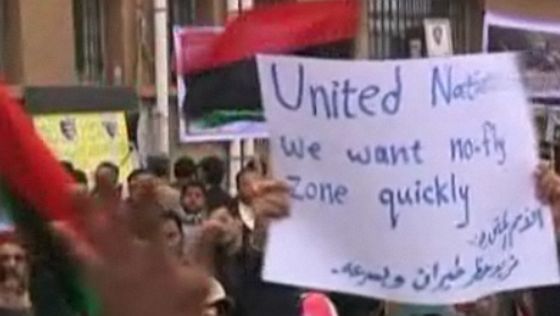
At a demonstration after a funeral for rebel fighters in Benghazi (shown in the video below) protesters can be seen holding up signs saying “Libyans Need No-Fly Zone” and “United Nations: we want no-fly zone quickly.”
Perhaps the signs were being held aloft by foreign agents, or maybe these particular Libyans have not been paying enough attention to Washington’s think tanks and don’t know how difficult a no-fly zone is to operate or what wider military involvement it might entail.
Or, maybe those outside Libya who refuse to make any distinction between a no-fly zone implemented in response to Libyan appeals and a no-fly zone imposed without consultation, simply don’t want to hear what Libyans are saying when it conflicts with the views to which so many non-interventionists seem so deeply attached.
Mustafa Abdul-Jalil, head of the Interim Transitional National Council based in Benghazi, in an interview with CNN reiterated his appeal for the international community to immediately impose a no-fly zone.
Is anyone listening?
There seems to be a highly questionable logic at work here among the opponents of a no-fly zone: if Gaddafi can effectively crush his opponents, then the uprising can’t have had enough popular support, but if there’s sufficient popular support, then no outside support is necessary.
In other words, the message to the revolution is this: if you’re going to win, you won’t need our help, but if you need our help, you probably won’t win. Good luck guys.
Does this have implications for the Palestinians?
Isn’t the Boycott, Divestment and Sanctions movement a form of foreign intervention?
If the Palestinians in the West Bank can’t muster the will or the force to kick out the Israeli occupiers, then maybe outsiders should not be making any effort to tip the balance of power.
Good revolutions, as the White House cynically says, grow organically. And believe me, contrary to all the anti-imperialist fear-mongering that’s going around right now, moderately tough-talk notwithstanding, Obama’s actually firmly on the side of the non-interventionists. The international community and especially the US and even more so the Pentagon, are loathe to get involved in this conflict.
So who do you want to align yourself with? US Defense Secretary No-No-Fly Zone Gates or Pro-No-Fly-Zone Mustafa Abdul-Jalil?
To those who argue that US involvement would undermine the credibility of the revolution, consider this observation by Salem Abdel Wahad, a 30-year-old Libyan rebel soldier:
We find one thing strange: the position of the United states. It’s impossible that the U.S. would not have imposed a no-fly zone, impossible, unless they have some agreement with Gaddafi against the Libyan people.
There is no neutrality in this war. If you don’t support the revolution, you are by default against it.
The debate for and against a no-fly zone is not closed, but it should at least be met on honest terms — without concealing the fact that Libyan appeals for a no-fly zone are only growing louder, and without claiming that a no-fly zone would inevitably lead to a full-blown Western intervention. Can a no-fly zone help or are there more effective alternatives?
Aviation Week spoke to two retired US Air Force generals who say that the difficulties in imposing a no-fly zone have been over-stated by the Pentagon.
Any attack, the two generals contend, would be far more limited in scope and greater in effect than critics have suggested.
“[Defense Secretary Robert] Gates has said that a no-fly zone can’t stop helicopters,” the first Gen. says “That’s wrong. There are only three places in Libya where helicopters can stage, fuel, rearm and re-equip – one in Tripoli, one in Benghazi and one in the eastern oil fields that are in the hands of the rebels. They are all near the coast. All the rest of Libya is barren.
“The U.S. Air Force has specialized in operations to take down integrated air defense, crater runways and destroy helicopter staging areas,” he says. “We know where they are. You can shoot down low-flying helicopter with Aim-9X Sidewinders. The suppression would take 24-48 hours with assets that aren’t being used for Iraq or Afghanistan.
Former US diplomat Peter Galbraith described the way a no-fly zone operates to Mark Colvin on Australia’s ABC News:
PETER GALBRAITH: Generally what happens is that once you’ve declared the no-fly zone, that the target air force is unwilling to fly its aircraft, of the pilots themselves individually are unwilling to fly and so by and large you don’t then need to have patrols to enforce it.
In the case of the no-fly zone that was over Iraq during the time that Saddam Hussein was in power, the Iraqis never actually challenged it, and so it was able to be enforced by a couple of planes patrolling every day.
MARK COLVIN: Do you first though have to take out their radar and other navigational aids?
PETER GALBRAITH: Not necessarily. Again if you declare it, there’s a good chance that the country will choose not to challenge it, or again that the pilots will stop to fly. But it’s also important to remember that in the case of Libya a significant purpose here is psychological. You have a country where a large segment of the population, including of the armed forces, has gone over to the rebellion.
The others may be sympathetic to the rebellion, or certainly are not necessarily committed to Gaddafi who are looking to say, to see how this is going to turn out. And once it’s clear, that Gaddafi is not going to remain in power, they are not going to defend him.
And so one of the purposes of declaring a no-fly zone is to send a signal that the international community is determined that he will not be able to put down the rebellion and this will perhaps hasten his departure or will make people, make it clear that he is not in fact going to succeed in putting down the rebellion.
There are those, such as Stephen Kinzer, who regard this as “a highly obscure conflict” — as though we really don’t know enough to judge what’s going on.
And for those of us simple-minded observers who see what is happening in Libya as just one current in the rising tide of the Arab democratic revolution and who see this trend as historic and inspiring, in spite of the fact that we do not know what it will lead to, it’s not hard to support the Libyan revolution — even though Libya after Gaddafi seems likely to involve a measure of chaos.
The alternative — that Gaddafi might succeed in crushing this popular uprising — would not only be bad for Libya, but bad for countless people across the Arab world who currently dream of the possibility of liberating themselves from the suffocating grip of autocratic power.
Anti-interventionists argue that Libyans can and must win this fight on their own. Self-appointed saviors from the West would indeed be unwelcome. But is that really what’s on the horizon? Is President Obama or anyone else currently recruiting support for a coalition of the willing, eager to liberate Libya and cast out the tyrant?
To intervene is “to interfere, usually through force or threat of force, in the affairs of another nation.”
Libya’s revolutionaries have made it clear that they don’t want a direct military intervention on Libyan soil. But that’s not a rejection of all outside support. Indeed, the Interim Transitional National Council in its founding statement said: “we request from the international community to fulfil its obligations to protect the Libyan people from any further genocide and crimes against humanity…”
How can that request be fulfilled? Would a no-fly zone help? If that is what is explicitly requested, then it does not constitute a form of interference. Assistance in response to an appeal for help is not an imposition.
Instead of pro- and anti-interventionists indulging in an ideological debate, what is called for right now is dialogue — not between these two camps but between representatives of the Libyan revolutionary movement and those national and international bodies which are ready to offer assistance.
Still, there are those who want to draw a sharp divide between military and non-military aid. Food for the hungry but no guns for the fighters. And what about medical assistance for those injured on the battlefield? Or intelligence information? Or jamming communications?
There are all sorts of ways of supporting the fight without dropping bombs, but first you have to take sides. If you’re not willing to take sides, the question about intervention is moot, but if you support the revolution, the only question is: how can Gaddafi be defeated?
The head of the interim government in eastern Libya pleaded Wednesday for the international community to move quickly to impose a no-fly zone over Libya, declaring that any delay would result in more casualties.
“It has to be immediate action,” Mustafa Abdul-Jalil told CNN in an exclusive interview in this eastern opposition stronghold. “The longer the situation carries on, the more blood is shed. That’s the message that we want to send to the international community. They have to live up to their responsibility with regards to this.”
Anti-interventionists might prefer to turn a deaf ear to this appeal, or perhaps question Abdul-Jalil’s authority to speak for the revolution, but I’d say it’s time to set aside this outworn debate. It’s time to support the Libyan revolution.
Colonel Ian Henderson, who from 1966 until 1998 was Bahrain’s security chief, is alleged to have instituted and overseen a brutal torture regime in the Gulf state, as a result of which he came to be known as the “Butcher of Bahrain.” Numerous human rights organizations have investigated and confirmed the allegations against him, yet an investigation by British police was suspended in 2008 due to a lack of co-operation from the Bahrain government.
“Ian Henderson has played a very dirty role,” said Saeed Shehabi, Bahrain Freedom Movement, in 2002. “Ever since he came to Bahrain in 1966, he embarked upon an era of terror and thousands of people were arrested — arbitrarily arrested — and tortured under his command. Until he retired, two or three years ago, he was the strong man behind the whole repressive regime in Bahrain.”
Blind Eye to the Butcher (2002)
In a report on Bahrain’s reliance on foreign nationals in its security services, Ian Black adds:
Bahrainis often complain that the riot police and special forces do not speak the local dialect, or in the case of Baluchis from Pakistan, do not speak Arabic at all and are reviled as mercenaries. Officers are typically Bahrainis, Syrians or Jordanians. Iraqi Ba’athists who served in Saddam Hussein’s security forces were recruited after the US-led invasion in 2003. Only the police employs Bahraini Shias.
The secret police – the Bahrain national security agency, known in Arabic as the Mukhabarat – has undergone a process of “Bahrainisation” in recent years after being dominated by the British until long after independence in 1971. Ian Henderson, who retired as its director in 1998, is still remembered as the “Butcher of Bahrain” because of his alleged use of torture. A Jordanian official is currently described as the organisation’s “master torturer”.
Channel 4 report on human rights abuses in Bahrain (1999)
As the train of democracy gathers steam in Egypt, there are those nearby who seem eager to throw themselves under its wheels.
No doubt an observer such as the Israeli historian, Benny Morris, is vain enough to imagine that he is not about to get run over but, on the contrary, hopes his grave warnings will encourage others to seize the train’s brakes and prevent an imminent catastrophe.
What is more likely to happen is that we will only need wait a matter of months before Morris and fellow fearmongers will be exposed as hysterical fools or intellectual rogues.
Morris believes that those of us in the West currently intoxicated by the glorious vision of democracy taking birth in Egypt, have only been able to indulge in such emotions because we don’t understand what Egyptians really want.
Alas, I fear, Westerners will see what most Egyptians actually think and want if and when the country holds free and fair general elections (perhaps in September-October). And I fear that they will be surprised—perhaps even shocked—by the results, and by what the Egyptian masses then say about what they actually think and want. I fear that at that point, “Death to Israel,” “Death to America,” and “Allahu Akbar” will drown out every democratizing and liberalizing chant.
But by then the genie will be well out of the bottle; by then, it will be too late.
Trapped inside a misanthropic Zionist mindset, Morris seems incapable of recognizing that at the core of the Egyptian and Tunisian revolutions, the driving force is not ideological. It is a universal and human demand for respect.
Sensing themselves newly visible on a world stage, ordinary Tunisians and Egyptians stood up, individually and collectively, and said: we refuse to be treated as less than human. We are reclaiming the dignity that is everyone’s birthright and will no longer tolerate the abuse of brutal rulers or the indifference of foreign powers. We demand to be heard and respected.
To the extent that the call from the dignity revolutions is being heard far beyond the Arab world, it resonates most with those who to differing degrees and for different reasons, share the same experience. That many of us live in democracies does little to diminish a sense that our governments do not represent our interests. And that so many of our fellow citizens respond to this reality with indifference only makes us envy the courage and imagination of people who do otherwise as they rise up, declare and discover: we have the power to change the world.
Egyptians triumphed over their police state without Western help or even moral support. During rigged parliamentary elections, the West barely raised an eyebrow. And when the protests began at Tahrir Square, Secretary of State Hillary Rodham Clinton said that the Mubarak government was “stable” and “looking for ways to respond to the legitimate needs and interests of the Egyptian people.”
Commentators have repeatedly referred to the Obama administration playing catch-up during the Egyptian revolution, yet its seeming inability to track fast-changing events was merely an expression of its unwillingness to embrace the direction those events were heading.
Immediately after Hosni Mubarak resigned, Jake Tapper from ABC News tweeted that he couldn’t find anyone in the administration who thought that whatever comes next would be better for U.S. interests than Mubarak had been.
The dictator’s departure is not being celebrated in Washington. The leaders of the free world have a singular lack of enthusiasm for freedom.
The administration has not merely repeatedly stumbled, but has functioned as a dead weight, attempting to slow the pace of what may become the most significant transformation in world order since the birth of Western colonial power.
America’s friends in Israel have been equally unenthusiastic about the turn of events. After Mubarak’s defiant speech on Thursday night when he insisted he would sit out his term as president, “Israel breathed a sigh of relief,” according to Israeli commentator, Alex Fishman. The respite must have felt dreadfully brief.
But if Americans want to grasp the significance of the Egyptian revolution, they need look no further than this country’s much bloodier assertion of people power: the American revolution.
For the first time in Egypt’s history, the Egyptian people have made a declaration of sovereignty and claimed their right of self-governance. Is that not something that every person on the planet who cherishes life and liberty can joyfully celebrate?
As Western leaders now line up, having no choice but to express their support for the revolution, while sagely offering guidance and assistance in managing an “orderly transition” to a democratic system, they do so with a palpable ambivalence.
People power is in jeopardy of sweeping the Middle East and undoing the carefully constructed “stability” through which for most of the last century the West has managed the control of its most vital resource: oil.
Worse for the United States, the Egyptian revolution now undermines the US government’s ability to sustain an unswerving loyalty to the preeminence of Israel’s security interests.
A democratic Egyptian government will not have the autocratic latitude that until now enabled Mubarak’s complicity in the siege of Gaza or his willingness to participate in the charade of a peace process going nowhere.
Stepping back from the most obvious regional implications of what is now unfolding, there is a more far-reaching dimension.
When in 1990 President George HW Bush used the phrase “new world order”, his words had an ominous ring both because they implied that this would be an American-defined order but also — on the brink of the first Gulf War — a militarily-imposed order. The new order was synonymous with the dubious claim that the collapse of the Soviet Union represented an American “victory” in the Cold War.
A new world order worthy of the name, however, should represent something much more significant than the strategic reapportioning of power on a geopolitical level. It should involve the reapportioning of power through which global affairs become the people’s affairs. It should mean that international relations can no longer be conducted within the confines of intrinsically undemocratic arenas where ordinary people have no voice.
The people-power unleashed in Egypt has the potential to serve as a democratizing force that not only threatens autocratic leaders in the Middle East but also technocratic and nominally democratic leaders in the West — those whose complacent style of governance has depended on the political passivity of the populations they nominally serve while providing ready access for corporate interests to exercise their undemocratic influence.
The West, far from representing a model of democracy ripe for export has instead long been mired in a post-democratic phase where the foundational concept of demos, the people, has withered.
Individual wealth has supplanted the need for social solidarity as citizenship has been substituted by consumerism. Our material self-sufficiency has robbed us of the experience of mutual reliance and worn thin the fabric of society.
In a new world order, a new democracy might spread not just further east but also further west.
There is also a bittersweet note in this moment.
The Western exporters of democracy delivered the war in Iraq and yet as we witness events unfold in Egypt, it’s hard not to wonder what might have been possible had the people of Iraq, without Western help or hindrance, been allowed the same opportunity to claim their own freedom.
“Never insult the Arabs,” advised Amos Gilead, former head of Israel’s Political-Military Bureau, speaking on Monday at the influential Herzliya national security conference.
But he wasn’t appealing for an improvement in Israeli-Arab relations since he only had a few Arabs in mind — Hosni Mubarak and other leaders “that are supporting stability and are coping with terror and have proven themselves along decades.”
As for Gilead’s views about the advance of democracy in the region, such a prospect presents nothing less than a path to hell.
“If we allow,” Gilead said, then edited himself realizing that democracy should not be presented as something Israel can allow (or forbid) and thus he continued in less instrumental terms, “or if there is democrative process in the Middle East, it will bring for sure — or, let’s say, quite sure — dictatorships which will make this area like hell.”
The Obama administration — which has yet to face any form of governmental pressure it was willing to resist — is now showing itself in much deeper sympathy with those voices who present democracy as a threat than those who claim democracy as their right.
As the Obama administration gropes for the right response to the uprising in Egypt, it has not lacked for advice from democracy advocates, academics, pundits, even members of the previous administration. But few voices have been as urgent, insistent or persuasive as those of Egypt’s neighbors.
Israel, Saudi Arabia, Jordan and the United Arab Emirates have each repeatedly pressed the United States not to cut loose Egypt’s president, Hosni Mubarak, too hastily, or to throw its weight behind the democracy movement in a way that could further destabilize the region, diplomats say. One Middle Eastern envoy said that on a single day, he spent 12 hours on the phone with American officials.
There is evidence that the pressure has paid off. On Saturday, just days after suggesting that it wanted immediate change, the administration said it would support an “orderly transition” managed by Vice President Omar Suleiman. Secretary of State Hillary Rodham Clinton said that Mr. Mubarak’s immediate resignation might complicate, rather than clear, Egypt’s path to democracy, given the requirements of Egypt’s Constitution.
“Everyone is taking a little breath,” said a diplomat from the region, who spoke on the condition of anonymity because he was discussing private conversations. “There’s a sense that we’re getting our message through.”
While each country has its own concerns, all worry that a sudden, chaotic change in Egypt would destabilize the region or, in the Arab nations, even jeopardize their own leaders, many of whom are also autocrats facing restive populations.
Like frogs that refuse to jump out of pot of hot water because its temperature is only rising slowly, those autocrats and their Western allies who now equate stability with their ability to act as a judicious brake on change, have a will to survive that is guiding them down a path of self-destruction.
Slow but sure are the watchwords of the proponents of an “orderly transition” to democracy in Egypt. Yet even as they profess a desire to see democratic change unfold and claim no interest in dictating the outcome of a democratic process, this posture of non-interference is contradicted by a clear intent to dictate the pace of change. The will of the Egyptian people will be respected — but not just yet.
What the West is telling the Arab world is this: be patient living under dictators we like because if you get rid of them you’ll end up being ruled by dictators we don’t like. Now, as ever, the West treats Arabs as being incapable of building their own democracies.
But beneath this veneer of contempt lies a much deeper fear: that a Middle East made up of truly self-governing independent nations fully in control of resources upon which the West depends will no longer bow to Western interests. That’s a prospect the West dreads to contemplate.
Venice Beach, California, might not be the best place to take the pulse of American opinion. Or is it?
Would Geena and Jenna be relieved or disappointed to learn that Egypt now consumes about as much oil as it produces and that most of the relatively small volume it exports goes to Italy?
Maybe Egypt just belongs to that long list of countries that most Americans know little about and care even less — at least so long as those countries that have it “keep giving us our oil.”
Meanwhile, our Goldilocks president (who thinks Egyptians need more democracy — as though they already have some — and who clearly doesn’t want the freedom spigot turned on too fast) will probably take comfort in the following numbers — a perfect marker of success in centrist politics: that public indifference and ignorance provide a reassuring level of support for a steady-as-she-goes approach on a course going who-knows-where.
Americans do not have a clear point of view about how the massive anti-government protests in Egypt will affect the United States. More than half (58%) say the protests will not have much of an effect (36%), or offer no response or are noncommittal (22%). Of the minority that thinks the protests will have an effect on the U.S., nearly twice as many say their impact will be negative rather than positive (28% vs. 15%).
This lack of agreement notwithstanding, a majority (57%) says the Obama administration is handling the situation in Egypt about right, while much smaller numbers say the administration has shown too much support (12%) or too little support (12%) for the protestors.
As for whether California comedian Kassem G was able to gather a representative sample of American opinion in Venice Beach, Pew’s findings would indicate he was only gathering the views of about half the country: 52% of Americans, during two weeks of media saturation coverage, said that they had heard little or nothing about what’s been happening in Egypt.
Perhaps the phrase, living under a rock, should be changed to, living in America.
This website or its third-party tools use cookies, which are necessary to its functioning. By closing this banner, you agree to the use of cookies.

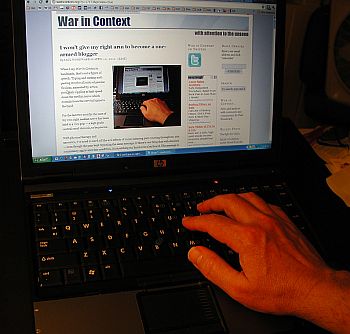 When I say War in Context is handmade, that’s not a figure of speech. Typing and cutting-and-pasting involve all sorts of precise flexions, animated by action potentials rippling at high speed down the median nerve which extends from the cervical spine to the hand.



 Here’s a circle that should never have been closed.



 Colonel