A burned Quran along with excrement-smeared pages from the holy book were found outside the Islamic Center of East Lansing, Michigan yesterday. The FBI have been called in to launch an investigation.
The same day, the Council on American-Islamic Relations (CAIR) called for federal hate crime charges to be brought against three men who allegedly painted the racist slur “sand n**gers” on a mosque in New York.
Earlier this week, CAIR called on the FBI to investigate recent vandalism at a mosque in Phoenix.
In recent months, mosques in California, Florida, Illinois, Kentucky, New York, Tennessee, Texas, and Wisconsin, have faced vocal opposition or have been targeted by hate incidents.
In an effort to sound the alarm during “one of those times that test our values,” Nicholas Kristof notes: “In America, bigoted comments about Islam often seem to come from people who have never visited a mosque and know few if any Muslims.”
He asks: “Is this America?”
Well, most Americans have never visited a mosque and know few if any Muslims.
If liberals such as Kristof and James Fallows are shocked about swelling Islamophobia in America, this may say less about the rise of bigotry than it says about the reluctance of members of America’s liberal elite to acknowledge that they do not represent mainstream America.
Why the reluctance? If one sees oneself as an influential figure — as belonging to that very select class of “opinion makers” (none more prestigious than a New York Times columnist) — yet it turns out that most people do not share your views, it also turns out that you have less influence than your status might suggest.
Kristof lays out some of the numbers that make it clear that Americans, in massive numbers, are delusional. He cites a Newsweek poll that indicates that 52% of Republicans believe President Obama wants to see Sharia law imposed in America and around the world. 24% of those polled believe Obama is a Muslim.
A Washington Post-ABC News poll indicates that 49% of Americans have generally unfavorable opinions about Islam and while these views have no doubt been shaped by the repetitive association made between Islam and terrorism, only 1% of Americans regard terrorism as the most important problem facing this country.
What this suggests is that undiluted Islamphobia has taken hold in the American consciousness over the last nine years. What initially might have simply been a fear of terrorism has gradually shifted into an a more pervasive aversion towards Muslims. Fear has metasticized, becoming a broadly tolerated anti-Muslim bigotry.
One in five Americans believe that most or many Muslims living in America support the goals of al Qaeda and Islamic fundamentalists.
Think about what that means if you’re a Muslim American flying inside this country. The chances are that one or two of the passengers in the same row think you’re a terrorist sympathizer (if not a terrorist).
Or think about it this way:
If you’re a non-Muslim American, the chance that you’ll run into a terrorist sympathizer as you go about your day is so small it can be discounted.
If you’re a Muslim American the chance you’ll run into a bigot every single day is so high it’s almost certain.
9/11 has become the emblem of all our fears not because it represents a national security failure or because it exposed poorly crafted foreign policy.
From our perspective the most terrifying dimension of the threat posed by al Qaeda is not its destructive capacity but its operatives’ casual disregard for life. Like moths drawn towards a flame, death offers for them some irresistible allure.
In contrast, we see our own fear of death as a healthy expression of our love of life. Indeed we see death as signifying more than anything else the termination of life.
There’s a contradiction here which reveals the fundamentally secular nature of contemporary American society — a secularism masked by the ostentatious religious identifications to which so many Americans cling.
Strip away their diverse forms of worship and their often conflicting systems of belief, and each religion has at its core the same function: it provides the individual and society a means to face mortality and render it meaningful.
If you want to determine the degree from which any society has moved away from its historical religious orientation, there is no easier way than to look at how it handles death.
A death-denying society is one that finds little comfort in the promise of an afterlife. It invests most of its faith in this world in the absence of any real confidence about what might follow.
Consider the example of America’s religious fanatic-of-the-week, Pastor Terry Jones. In the face of death threats he professed his willingness to die in defense of his beliefs, yet he did so with a 40-caliber pistol strapped to his waist.
We say “One Nation Under God” as though we are guided by a transcendent perspective, yet more often we seem to worship the nation itself.
The holy book in which so many Americans profess their faith says quite clearly:
Lay not up for yourselves treasures upon earth, where moth and rust doth corrupt, and where thieves break through and steal;
But lay up for yourselves treasures in heaven, where neither moth nor rust doth corrupt, and where thieves do not break through nor steal.
This, like so many others, is a throughly un-American Biblical teaching and where American values and Biblical values conflict, the outcome is predictable.
Our fears reign in this land — the place we have stored all our treasures — which is why, however much we spend on defense, we still struggle to feel safe.
Firebrand Pastor Jones now says he won’t be burning Qurans on Saturday because he claims he extracted a deal to get the Cordoba House project moved to a different site.
“Americans don’t want the mosque there and of course Muslims don’t want us to burn Qurans,” Jones said.
The problem is, Jones appears to have cut his deal with someone who has no say in the location of the mosque: Florida Imam Muhammad al-Masri.
In an interview on CNN on Wednesday, Imam Feisal Abdul Rauf reiterated his commitment to open the Islamic center in Lower Manhattan.
“I am glad that Pastor Jones has decided not to burn any Qurans,” Rauf told ABC News on Thursday. “However, I have not spoken with Pastor Jones or Imam Musri. I am surprised by their announcement.”
The likely political effect of Jones’ Quran burning stunt is that it will strengthen mainstream opposition to Cordoba House. In response to Jones’ antics, many opponents of the Islamic center have taken the opportunity to paint themselves as moderates in tune with popular opinion.
Most Americans say the planned Muslim community center and place of worship should not be built in Lower Manhattan, with the sensitive locale being their overwhelming objection, according to a new Washington Post-ABC News poll.
Two-thirds of those polled object to the prospective Cordoba House complex near the site of the former twin towers, including a slim majority who express strongly negative views. Eighty-two percent of those who oppose the construction say it’s because of the location, although 14 percent (9 percent of all Americans) say they would oppose such building anywhere in the country.
The new results come alongside increasingly critical public views of Islam: 49 percent of all Americans say they have generally unfavorable opinions of Islam, compared with 37 percent who say they have favorable ones. That’s the most negative split on the question in Post-ABC polls dating to October 2001.
Furthermore, the poll makes it clear that while America remains at war, economic recovery is nowhere near in sight, and tackling climate change has yet to be treated as a national and global imperative, the focus of the upcoming midterm elections is likely to be a minor construction project in New York.
Regardless of their rationale, most voters who firmly oppose the center’s construction in Lower Manhattan say they feel strongly enough about the issue that it would influence their congressional vote in November. These voters side by a wide margin with Republican over Democratic candidates.
Overall, 83 percent of Republicans oppose the Muslim center, as do 65 percent of independents and 53 percent of Democrats. Among Republicans, generally negative views have spiked higher: 67 percent of those who identify as Republican say they have unfavorable views of Islam, up from 42 percent in the months after the Sept. 11, 2001, attacks.
Big majorities of Protestants and Catholics are against it, with opposition peaking among white evangelical Protestants. By contrast, most people with no professed religion support the construction.
As the issue reveals, rarely is there a discernible difference between piety and pettiness — at least in America.
“Republicans are usually eager to trumpet their support for the troops and the war against terror. So why aren’t they condemning the Florida pastor who plans to lead his congregation in a Quran-burning bonfire on Sept. 11?,” wrote Fred Kaplan on Tuesday.
His call has been answered — by Sarah Palin: “Book burning is antithetical to American ideals. People have a constitutional right to burn a Koran if they want to, but doing so is insensitive and an unnecessary provocation — much like building a mosque at Ground Zero.”
Is Pastor Jones ready to obey Palin’s call to “stand down”? Maybe a generous donation to his church will do the trick.
However Palin and other Cordoba House opponents manage to persuade Jones to back down, this is how they must be hoping they can play his Quran burning stunt: turn an eleventh hour display of “sensitivity” by the Florida pastor into leverage against Feisal Abdul Rauf — as though the imam and the pastor are somehow equivalents. Once “Dr” Jones finds it in his heart to act as the “sensitive” Christian, the chorus will rise even louder demanding a reciprocal display from “sensitive” Muslims.
Before the term got hijacked by Islamophobes, it was widely understood that to be insensitive was to show a lack of awareness about the feelings of others. To call Quran burning “insensitive” is to imply that Jones and his followers don’t grasp the offensiveness of their action. But as ignorant as the members of this church might be, no one can be in any doubt that this action is consciously designed as an act of provocation. Islam is the target of this attack and it is absurd to claim — as Jones does — that Muslims collectively are not also the intended victims.
In tying together Jones’ Quran burning with the proposed Islamic center we witness a false equivalence that has become all too familiar. Islamophobes poke Muslims in the eye and then accuse them of being culturally insensitive because of the manner in which they practice their faith — by building mosques, by women wearing head coverings and so forth.
Sarah Palin and others are riding on the sensitivity bandwagon because they think it’s a safe bet. Who can refute that sensitivity is a good thing. Most importantly though, it appears to let them off a constitutional hook. After all, it’s hard to wrap yourself in the flag and also oppose freedom of religion.
In truth though, the most reliable defenders of freedom of religion are not particularly religious — least of all are they evangelical.
When someone comes to my door and tells me I’d have a better life it I gave it to Christ, they are certainly exercising freedom of religion but they are not defending it. On the contrary, they are engaged in a religiously sanctioned act of arrogance that I regard as an insult to my intelligence. Even as I suggest that in a reversal of the current situation, they might not take kindly to my arrival on their doorstep for the purpose of educating them about Darwinism, they busily search for a line of scripture that might point me in the right direction. Lucky for them, I believe in religious tolerance and have yet to slam the door in anyone’s face.
Living religions (as distinct from their doctrinal underpinnings) are by their very nature intolerant and the purpose of religious freedom is to temper this intolerance by promoting a live-and-let-live spirit. (To his credit, President Obama has acknowledged that the freedom of religion also protects each American’s right to practice no religion at all.)
Tolerance does not mean that I bow to anyone’s prejudice; it means that I recognize and respect the autonomy of each individual in forming and articulating his or her own understanding of life.
The evangelical conceit — and it matters to me not a whit whether the evangelist happens to be a Christian, a Muslim or a Darwinist — is that there is no intrinsic value in the utterly unique vantage point from which we each of us engages the world. On that basis, the evangelist treats the spirit of the unconverted as open territory, ready for colonization.
America is a vessel inside which evangelical colonists roam freely, but however loudly they may insist on making themselves heard we must ensure that no ones freedom confers privilege in ownership.
This can only be the land of the free if it belongs to everyone.
Arguments about the construction of an Islamic center and the destruction of Qurans may have less to do with Islam than they have with who gets to define America and why this nation is grappling with its own identity.
Prominent Christian, Jewish and Muslim leaders held an extraordinary “emergency summit” meeting in the capital on Tuesday to denounce what they called “the derision, misinformation and outright bigotry” aimed at American Muslims during the controversy over the proposed Islamic community center near ground zero.
“This is not America,” said Cardinal Theodore E. McCarrick, the emeritus Roman Catholic archbishop of Washington, flanked by three dozen clergy members and religious leaders at a packed news conference at the National Press Club. “America was not built on hate.”
They said they were alarmed that the “anti-Muslim frenzy” and attacks at several mosques had the potential not only to tear apart the country, but also to undermine the reputation of America as a model of religious freedom and diversity.
The imam behind the plan to build an Islamic center near ground zero, Feisal Abdul Rauf, finally spoke out about the controversy, saying in an opinion piece in The New York Times published Tuesday night that he would proceed with plans to build the center. He wrote that by backing down, “we cede the discourse and, essentially, our future to radicals on both sides.”
The meeting in Washington occurred amid growing concern by the White House, the State Department and the top American military commander in Afghanistan over plans by Terry Jones, the pastor of a small church in Florida, to burn copies of the Koran on the anniversary of the Sept. 11 attacks.
Gen. David H. Petraeus warned on Tuesday that any video of Americans burning the Koran “would undoubtedly be used by extremists in Afghanistan — and around the world — to inflame public opinion and incite violence,” endangering the lives of American soldiers.
A State Department spokesman called Mr. Jones’s plan “un-American.” Robert Gibbs, the White House spokesman, said any activity “that puts our troops in harm’s way would be a concern to this administration.”
Several clergy members in Washington and Florida said that there were efforts to dissuade Mr. Jones from proceeding with the event, but that he appeared unlikely to relent.
The religious leaders in Washington said in their statement, “We are appalled by such disrespect for a sacred text that for centuries has shaped many of the great cultures of our world.”
Interfaith events are not unusual, but this one was extraordinary for the urgency and passion expressed by the participants. Some of the same religious leaders later met with Attorney General Eric H. Holder Jr. to urge him to prosecute religious hate crimes aggressively.
Rabbi David Saperstein, director of the Religious Action Center of Reform Judaism, said: “We know what it is like when people have attacked us physically, have attacked us verbally, and others have remained silent. It cannot happen here in America in 2010.”
The problem with any argument that revolves around contesting views about the true identity of this country is that neither side is attempting to differentiate between the America of their convictions and America as actuality.
Cardinal McCarrick can say, “This is not America,” but in fact it is — it just happens to be uglier than he would like it to be.
As an ideological debate, this is ostensibly an argument between on the one hand those who fully include Muslims in the idea of America, and on the other hand those who demand that Muslims must shed or at least modify their identities if they wish to be accepted in this society.
The problem is that a Muslim voice is barely audible on either side of the debate — evidence that the proponents of inclusion are describing an ideal that is far from having been realized.
Feisal Abdul Rauf, whose Cordoba House project has been at the center of the argument and who has just returned from a two-month overseas trip sponsored by the State Department, said in an op-ed in today’s New York Times: “I felt that it would not be right to comment from abroad.”
Not right? Maybe closer the truth was that he knew that if he spoke from the Middle East, his words would more likely be perceived not as those of an American but as a representative of that region and thus they would reinforce the image of Muslims in America as outsiders.
In the context of rising Islamophobia, American Muslims are in retreat, yet the lower the profile they assume, the more empowered the anti-Muslim voice becomes.
Muslims sit in their living rooms, aghast as pundits assert over and over that Islam is not a religion at all but a political cult, that Muslims cannot be good Americans and that mosques are fronts for extremist jihadis. To address what it calls a “growing tide of fear and intolerance,” the Islamic Society of North America plans to convene a summit of Christian, Muslim and Jewish leaders in Washington on Tuesday.
Young American Muslims who are trying to figure out their place and their goals in life are particularly troubled, said Imam Abdullah T. Antepli, the Muslim chaplain at Duke University.
“People are discussing what is the alternative if we don’t belong here,” he said. “There are jokes: When are we moving to Canada, when are we moving to Sydney? Nobody will go anywhere, but there is hopelessness, there is helplessness, there is real grief.”
Mr. Antepli just returned from a trip last month with a rabbi and other American Muslim leaders to Poland and Germany, where they studied the Holocaust and the events that led up to it (the group issued a denunciation of Holocaust denial on its return).
“Some of what people are saying in this mosque controversy is very similar to what German media was saying about Jews in the 1920s and 1930s,” he said. “It’s really scary.”
The Anti-Defamation League has formed an Interfaith Coalition on Mosques (ICOM) which aims to “provide support and stand with Muslims when their rights are being violated,” but the credibility of this initiative is undermined by the ADL’s own opposition to the construction of the Cordoba Islamic center. They might have quickly realized that that was a political blunder but it remains to be seen whether ICOM is more than a PR exercise designed to repair the ADL’s tattered image.
Aside from the question about whether the ADL can be true to its core mission and fight “to secure justice and fair treatment to all,” the proponents of a more libertarian and inclusive vision of American society face a deeper problem. We belong to a minority and there are inherent limits on the extent to which any minority can exert its will. We should thus perhaps more explicitly focus on what we want America to become than profess to represent its current condition.
In an interview on CNN this morning, Dr Terry Jones, the Florida pastor who has organized “International Burn a Koran Day” for September 11, said:
We want to send a clear message to the peaceful Moslems. We have freedom of speech. We have freedom of religion. They are more than welcome to be here. More than welcome to worship. More than welcome to build mosque[s].
Say what? In July, Jones was asked whether he thought Muslims would turn to Christ as a result of his Quran-burning event:
This is our prayer and desire that they would seriously reexamine their religion. They will then come to the conclusion that Islam is of the devil and Christianity is the only true religion.
Jones now tells CNN that Muslims are welcome to worship in America but in a broadcast of his “Braveheart Show” in May he said:
We must demand that all Moslems that are here, they adapt to our values — they become Americans. If they want to stay Moslems, with their culture, with their Islamic law, then they can stay in Moslem dominated countries.
He now says Muslims are more than welcome to build mosques in America. In May he said:
We should stop immediately, stop right now, the building of all mosque[s] in America…
So, Jones says Muslims are welcome to build mosques in America and that no more mosques should be built. Muslims are welcome to worship here, but if they want to practice their religion they should live in a Muslim-dominated country.
If there’s just one lesson we can draw from the last decade it is this: utter the word “terrorism” and thought grinds to a halt, perceptions become blinkered and the power of human intelligence is suddenly put on hold.
Consider the attack near Hebron in the West Bank yesterday in which four Israelis were gunned down by Palestinian gunmen.
A report in the Jerusalem Post conveys a particularly harrowing moment in the attack’s aftermath as volunteers from Zaka, the Israeli community emergency response network, arrived at the scene of the shooting.
Zaka volunteer Momy Even-Haim was dispatched to the scene of the attack with his colleagues, when to his horror he discovered that his wife was among the dead.
“We saw a crying volunteer, and at first we did not understand what was happening — he has seen many disasters before,” Zaka volunteer Isaac Bernstein told The Jerusalem Post.
“Then he started shouting, ‘That’s my wife! That’s my wife!’ We took him away from the scene immediately,” Bernstein added. Even-Haim was taken to his home in Beit Hagai by his colleagues.
Tragedy takes infinite forms. Those in closest proximity can never be expected to respond rationally but from a distance, rationality is not only possible — it is essential.
Instead though, this attack — like so many before — has produced a series of highly predictable knee-jerk responses.
The White House issued a statement saying:
The United States condemns in the strongest possible terms the terrorist attack today perpetrated by Hamas in which four Israelis were killed in the southern West Bank. We express our condolences to the victims’ families and call for the terrorists behind this horrific act to be brought to justice. We note that the Palestinian Authority has condemned this attack. On the eve of the re-launch of direct negotiations between Israelis and Palestinians, this brutal attack underscores how far the enemies of peace will go to try to block progress. It is crucial that the parties persevere, keep moving forward even through difficult times, and continue working to achieve a just and lasting peace in the region that provides security for all peoples.
Is Washington already ahead of Israel in identifying the culprits?
That seems unlikely. Much more likely is that the White House is content to parrot press reports in which representatives of Hamas are quoted claiming responsibility for the attack. If Hamas claims responsibility, its claim will be accepted at face value; if it were to deny responsibility, it’s denial would be treated with skepticism. That’s the way the “analytical” process works.
Israeli press reports are less clear on the matter.
In Haaretz, Avi Issacharoff and Amos Harel report:
Even though no official claim of responsibility was made, the investigation by the security services of Israel and the Palestinian Authority suggest that the culprits were a cell which identifies itself, more or less, with Hamas. Fauzi Barhum, one of the spokesmen for the group in the Gaza Strip, did not openly claim responsibility for the attack, but hinted that his group was behind the shooting.
“The resistance continues everywhere,” he said.
In recent months the Hamas leadership in the Gaza Strip and Damascus has pressed West Bank-based teams of gunmen to resume the attacks in an effort to make it more difficult on the Palestinian Authority and stir up tension with Israel.
Two months ago a large Hamas network was uncovered in the southern Hebron Hills, a “sleeper cell” that was revived, whose members are suspected of murdering an Israeli policeman in a similar shooting incident, along the same route, several kilometers from the spot of last night’s terror attack.
A cell which identifies itself “more or less” with Hamas — that’s pretty vague. Moreover, a previously unknown group calling itself the Al-Haq (“Rights”) Brigades has claimed responsibility for Tuesday’s shooting, according to the Ma’an news agency.
As for Issacharoff and Harel’s claim that a Hamas cell was responsible for the June Hebron Hills shooting, that also is far from clear. When suspects were arrested by Israel’s internal security services, Shin Bet, Haaretz reported:
It is unclear… who is responsible for the establishment of this group, which is reportedly affiliated to Palestinian President Mahmoud Abbas’ Fatah movement. Israeli security sources have been examining the possibility that the gunmen behind the June 14 attack were from various Palestinian militant groups.
Whether or not Hamas had a role in yesterday’s attack it is too soon to tell. And even if some or all of the gunmen turn out to belong to the movement does not necessarily reveal a great deal about the level of command and control or political motives for the attack.
Whatever the motives, the outcome itself has opened political opportunities to each constituency that now portrays itself as a victim.
Given that the attack took place in an area controlled by the IDF, President Abbas could have taken the opportunity to point out that the attack underlines the fact that there can ultimately be no security solution to the political conflict. Instead, Palestinian security services have been quick to launch what is being described as one of the largest arrest waves of all time in the West Bank.
Hamas lawmaker Omar Abdel-Raziq said more than 150 members had been detained, and others had been summoned to police stations for questioning.
He accused Abbas of trying to please the Israelis.
“These are political arrests,” he said. “They are trying to tell the Israelis that they are capable of doing the job after the attack.”
At the funerals of the four Israelis killed, settler leaders took the opportunity to push for settlement expansion, call for vengeance (a call which has already been acted upon), deny the existence of the Palestinian people and make a thinly-veiled appeal for ethnic cleansing:
Rabbi Dov Lior of Kiryat Arba eulogized the victims saying that “this is a grave tragedy for the families, for the people of Israel and for the state. God, avenge the spilled blood of your servants.”
“There is an army, which must be used,” Rabbi Lior continued. “The mistake is to think that an agreement can be reached with these terrorists. Every Jew wants peace, but these evildoers want to destroy us. We need to give them the right of return and return them to the countries from which they came.”
When President Obama tries to press Benjamin Netanyahu to extend the so-called settlement freeze, the Israeli prime minister will no doubt tell him solemnly that in light of recent events, his hands are well and truly tied.
They shoot and we build has become the settlers’ slogan — one that is almost certainly to Netanyahu’s liking.
Update: In a conversation I just had with Hamas expert, Mark Perry, he made the point that when it comes to identifying armed militants in the West Bank, the Al Qassam Brigade (affiliated with Hamas) and the Al Aqsa Brigade (affiliated with Fatah) are virtually indistinguishable in most of the area, but particularly in Hebron. The clearest differentiation in armed groups is between those who are on the Palestinian Authority’s payroll and those who aren’t.
Mark also pointed out that if the Obama administration was not trapped inside its own terrorism rhetoric, they could point out that the attack underlines the unnecessary vulnerability that Israeli’s expose themselves to by grabbing Palestinian land and building settlements.
Israelis might argue about whether the settlements are going to destroy Zionism or help it survive; they differ much less when it comes to their views about Palestinians.
Gadi Taub is ringing the now familiar alarm bell that without a swift end to the occupation, Zionism itself will be in jeopardy. Salvation depends on partition.
The most pressing problem with the settlements is not that they are obstacles to a final peace accord, which is how settlement critics have often framed the issue. The danger is that they will doom Zionism itself.
If the road to partition is blocked, Israel will be forced to choose between two terrible options: Jewish-dominated apartheid or non-Jewish democracy. If Israel opts for apartheid, as the settlers wish, Israel will betray the beliefs it was founded on, become a pariah state and provoke the Arab population to an understandable rebellion. If a non-Jewish democracy is formally established, it is sure to be dysfunctional. Fatah and Hamas haven’t been able to reconcile their differences peacefully and rule the territories — throwing a large Jewish population into the mix is surely not going to produce a healthy liberal democracy. Think Lebanon, not Switzerland.
In truth, both options — and indeed all “one-state solutions” — lead to the same end: civil war. That is why the settlement problem should be at the top of everyone’s agenda, beginning with Israel’s. The religious settlement movement is not just secular Zionism’s ideological adversary, it is a danger to its very existence. Terrorism is a hazard, but it cannot destroy Herzl’s Zionist vision. More settlements and continued occupation can.
On the other side of the debate are Israelis such as Naftali Bennett, Benjamin Netanyahu’s former chief of staff and the recently named director-general of the settler advocacy group the Yesha Council.
When it comes to assessing the prospects for anything to be accomplished in the latest round of Israeli-Palestinian talks, Bennett succinctly describes the power equation and thus the reason the talks will go nowhere: “It’s in their interest more than ours. We’re doing just fine.”
Bennett challenges much of the conventional wisdom about settlements and settlers — not surprising perhaps because he lives inside Israel and was a high-tech millionaire before entering politics.
He says: “My vision is 1 million Jews living in Judea and Samaria [the West Bank], putting an end to the notion that we can have a Palestinian state in the heart of Israel.”
With over half a million Jews already planted inside the occupied territories, that vision is more than half way towards being realized. “Anyone considering the notion of expelling 80,000 or 150,000 Jews (from the West Bank) today should know that it’s simply impossible,” Bennett declares.
“We view Judea and Samaria as the bulwark of Israel, and Israel as the bulwark for the West against Islamic terrorism. We are the security shield of Israel. That’s fundamentally how people in Judea and Samaria see it. People see it as a mission to maintain and protect this area for the Jewish people.”
Since he rejects the idea of a Palestinian state, the Los Angeles Times asks Bennett what alternative he envisions:
The alternative is peaceful coexistence on the ground and simply strengthening the current, very positive trends with the economy and security. Removing the roadblocks. Giving Palestinians political rights to vote for themselves. If they want to reach an agreement with Jordan to give them citizenship, so be it. If we need to make adjustments to make life better, we can.
Many Palestinians say the status quo is unfair and not acceptable.
There wouldn’t be apartheid. They’d rule themselves and we’d rule ourselves. We’d drive on the same roads. Arabs have fairly good lives. The overwhelming majority of the Palestinian people want peaceful coexistence. It’s just their leaders who are not OK with it.
It’s not perfect. They want a full-blown state. But it’s a zero-sum game. If they have a state, we’ll cease to exist. That’s the best we can do.
What’s interesting in looking at these contrasting Israeli views of the settlements is that beneath the divergence in analysis, there is an Israeli consensus: they see no real basis for Palestinian self determination. Palestinians would undermine the effective functioning of any democracy other than a Jewish-controlled “democracy,” but they can rule themselves so long as they don’t imagine they can have their own fully sovereign state.
Whether viewed from the left or the right, the one thing most Jewish Israelis seem to agree on (even if they differ in how bluntly they will state this) is that they regard Palestinians as their inferiors.
Update: Following a shooting attack in which Palestinian gunmen killed four Israelis outside the Kiryat Arba settlement near Hebron on Tuesday, settlement leaders were quick to call for talks due to start in Washington on Wednesday, to be cancelled.
The head of the Mount Hebron Regional Council, Tzvika Bar-Hai, called on Netanyahu to cancel the Washington talks.
“There is no place for negotiations with those who respond with deadly fire to our hand outstretched for peace,” he said.
“It is time for the leaders of Israel to wake up from the illusion of false peace,” Bar-Hai added.
“We’re talking about one of the worst terrorist attacks in the past few years,” said Naftali Bennet, director-general of the Council of Jewish Communities of Judea, Samaria and Gaza.
“We’re asking that the prime minister immediately turn the plane around and come back to Israel. It’s not possible, while we’re holding funerals, that he can stay there. And we’re calling on him, tomorrow morning, to renew the building in Judea and Samaria,” he said.
The council announced Tuesday night that it would respond to the attack by unilaterally ending the construction freeze and starting to build on Wednesday.
A Yesha Council statement said: “The Zionist answer is to build and support. They shoot and we build. Each does as he believes.”
Although a spokesman for Izz al-Din al-Qassam, the military wing of Hamas, claimed responsibility for the attack, Ynet reported:
Earlier on Tuesday, Hamas Spokesman Fawzi Barhum addressed the attack but did not claim responsibility for it.
“The attack was not meant to impede direct negotiations which failed prior to even starting. This is a natural response by the Palestinian resistance to the enemy’s crimes, and is proof that despite the resistance’s persecution by the security services and despite Israel’s crimes, the Palestinians are capable of responding to these crimes,” he said.
Barhum stressed that the attack was the type of response “which the enemy and occupation should expect. The Palestinian resistance is alive, well and kicking.”
The opponents of Park51, the so-called “Ground Zero mosque,” have decided that the litmus test for identifying “good Muslims” is to ask them whether they regard Hamas as a terrorist organization.
Andy McCarthy, one of the lead knights in the crusade to stop “the Islamization of America,” strikes the latest blow — this time against a rather guileless Imam Dawoud Kringle. This is how McCarthy recounts the crucial part of his “debate” on the fair-and-balanced Fox News:
Then came the moment of truth: the very simple question, “Is Hamas a terrorist organization?” Have a look at the YouTube clip below. Like his friend Imam Feisal Rauf, Imam Kringle won’t answer the question. I pressed him, pointing out that it is a very simple question. And it is: Quite apart from the fact that Hamas is formally designated as a terrorist organization under U.S. law, Hamas’s own charter makes abundantly clear — indeed, wears like a badge of honor — that Hamas exists solely for the purpose of driving Israel out of Palestine by violent jihad. Yet the imam cannot bring himself to say Hamas is a terrorist organization.
Perhaps Kringle would have held surer footing if he had first addressed the reliability of the US government in identifying terrorists.
It was only two years ago that Nelson Mandela and the African National Congress were removed from the US terrorism watch list — that was 15 years after Mandela had been awarded the Nobel Peace Prize.
The terrorism watch list — like the Nobel Peace Prize — is not in and of itself a reliable indicator of someone’s current willingness to use violence in pursuit of a political cause.
Likewise, the fact that in the 1980s the Reagan administration regarded Afghanistan’s mujahideen as “freedom fighters” — not terrorists — had everything to do with who they were fighting (the Soviets) and nothing to do with the methods they employed or the causes those particular jihadists might subsequently espouse.
Terrorism and terrorist — as everyone knew until they suddenly forgot on 9/11 — are mutable designations that more clearly specify the relationship between the designator and the designee than they say much else.
Is Hamas a terrorist organization? As far as the US government is concerned, the answer it yes. It’s on the list. Yet not all organizations listed terrorist are the same — and like most objective foreign policy analysts, the US government like every other government knows this: these organizations are as diverse in their political aims as they are in their geographical distribution.
Hamas has been presented with a set of conditions which, if fulfilled, would allow it to participate in the peace process. In other words, even from the perspective of those governments who currently describe it as a terrorist organization there is an exit ramp for Hamas to shed its “terrorist” label. In contrast, there are no conditions under which any government will enter talks with al Qaeda.
Contrary to what McCarthy and others insinuate, Hamas and al Qaeda are not two peas in the same pod. They are in fact sworn enemies.
But given that so far no one has pointed to any direct connection between Park51 and Hamas, one has to wonder why those affiliated with the proposed Islamic center are being asked their views on the Palestinian movement?
The answer has much less to do with Park51 than it does with the myth that America’s interests are indistinguishable from those of Israel.
Whether McCarthy describes himself as a Zionist, he is certainly pushing a Zionist agenda when he claims: “Hamas exists solely for the purpose of driving Israel out of Palestine by violent jihad.”
In fact, Hamas’ leadership has explicitly supported the creation of a Palestinian state based on the 1967 borders if Israel ends the occupation. But this politically pragmatic position is one that McCarthy and his ilk refuse to acknowledge because it conflicts with a narrative that pits Israel and its allies against an ideologically unyielding and anti-Semitic foe. Characterize the conflict that way and there is no compromise a peace-loving Israel could make which would satisfy its enemies.
Indeed, elsewhere McCarthy has made it clear that he subscribes to the right-wing Zionist school of thought which sees a resolution to the Israeli-Palestinian conflict as contingent solely on the ability of Israel to crush its opponent.
As he wrote during the war on Gaza: “What Israel needs is to be allowed to win: to finish the grisly work of ‘breaking the will of the Palestinians, of Hamas, to continue to fire at Israel,’ as Israeli Interior Minister Meir Sheetrit so aptly put it.”
As for Palestinian national aspirations in general, McCarthy says: “On the political front, it is high time to acknowledge the failure of the fantasy that the Palestinians are legitimate actors worthy of statehood and its privileges.” He says: “we must halt the mindless ‘two state solution’ rhetoric.” Scorning those who he calls “democracy devotees,” McCarthy says: “Let’s be blunt: we are looking at a generation or more before the Palestinians might be prepared to assume the obligations of sovereignty. So we should stop talking about it.”
Daniel Luban in an article in which he describes Islamophobia as the “new anti-Semitism,” notes the central role that McCarthy has assumed as an ideologue now marshaling opposition to Islam in America.
The mosque furor is only the most recent and revealing demonstration of the anti-jihadists’ political influence; from the beginning of the controversy, McCarthy and his allies have dictated the terms of debate on the right. In his July 28 statement attacking the Islamic center, Newt Gingrich cited [McCarthy’s book] The Grand Jihad and framed the controversy in McCarthy’s terms of Western civilization under siege from creeping sharia. More recently, the American Family Association — a leading fundamentalist Christian group — cited the book to argue that no more mosques should be built anywhere in the United States because “each Islamic mosque is dedicated to the overthrow of the American government.” A campaign spearheaded by Pamela Geller, the right-wing blogger who was previously most notorious for publishing a lengthy piece alleging that Obama is the illegitimate child of Malcolm X, will place ads on New York City buses opposing the Islamic center. On September 11, she and Gingrich will lead a major rally against the center that will also feature [Geert] Wilders, the Islamophobic Dutch politician. What was once a lunatic fringe now appears to be running the show, aided and abetted by mainstream figures like Gingrich.
It is quite possible that the next Republican president will also be a party to what can justly be called the new McCarthyism; for that reason alone, McCarthy and his allies deserve our attention. But even more important is the impact of this steady stream of anti-Muslim vitriol on the popular consciousness. Cynical politicians like Gingrich may know that all the talk of the Islamic center as a “9/11 victory monument” and of ordinary Muslims as stealth sharia operatives is mere agitprop designed to win votes in an election year, but ordinary citizens may take them at their word and act accordingly.
Given that McCarthy and his cohorts want to associate Park51 with Hamas, it’s worth considering what Hamas has to say about the plans for the Islamic center.
In an interview on New York’s WABC radio (audio can be heard here), Mahmoud al-Zahar, a co-founder of Hamas who is in the Gaza political leadership, was asked by Aaron Klein to comment on the construction of the center.
Without addressing the question directly, Zahar chose to respond by pointing out that Muslims in America are like Muslims elsewhere, living in accordance with Islam, fasting (during Ramadan), praying and so forth. He then went on to say that Hamas is being misrepresented by those who would liken it to the Taliban and that it is recognized across the Islamic world as a moderate organization.
Klein, however, wanted to focus on the mosque controversy and returned to that question:
Klein: What do you think about the new initiative to build a mosque near the World Trade Center in New York, which is a major point of controversy on all sides?
Zahar: We have to build the mosque as you are allowed to build the church and the Israeli are building their holy places. We have to build everywhere — in every area we have muslims, we have to pray, and this mosque is the only site of prayer especially for the people when they are looking to be in the group — not individual.
Muslims should be allowed to worship in mosques, just like Christians going to church and Jews going to the synagogue.
Not much controversy there, right?
Well, the New York Post seemed eager to pour fuel on the fire by inserting a few words implying that Hamas (and Muslims in general) are engaged in territorial expansion.
A leader of the Hamas terror group yesterday jumped into the emotional debate on the plan to construct a mosque near Ground Zero — insisting Muslims “have to build” it there.
“We have to build everywhere,” said Mahmoud al-Zahar, a co-founder of Hamas and the organization’s chief on the Gaza Strip.
“In every area we have, [as] Muslim[s], we have to pray, and this mosque is the only site of prayer,” he said on “Aaron Klein Investigative Radio” on WABC.
Zahar actually said, “In every area we have Muslims, we have to pray,” which is to say, wherever Muslims live they have a religious obligation to gather for prayer and they do this in mosques.
The New York Post twisted this into: “In every area we have, [as] Muslims[s], we have to pray,” which conjures up a completely different picture. Lower Manhattan is now an area that Muslims claim as their own — at least the New York Post appears to want to promote this lie.
Those who now man the barricades in response to what they call the Islamization of America, reveal in the shadow of their fears the scope of their ambitions.
On 9/11, four groups of hijackers took control of four aircraft resulting in the horrific deaths of 3,000 people. The same day, another group of hijackers took control of the aftermath of the attacks and began a war in which hundreds of thousands have died and millions been displaced. The campaign of those hijackers continues and Park51 is merely its latest target.
That sounds like damning material. Plans to insert US-trained terrorists into Iran or Venezuela perhaps? Is Wikileaks exposing yet more dirty secrets from the CIA’s ugly history?
No.
Indeed, if we are to define a leak as the revelation of confidential information in which the public has a compelling interest — information that must be published as a matter of conscience — then the latest offering from Wikileaks hardly qualifies being described as a leak. Indeed, the US intelligence community may actually regard the release of such a report as something that overall enhances their public image.
This Red Cell report has a couple of interesting details — confirmation that there are those in the US government who understand that Jewish terrorism has played a significant role in triggering Palestinian terrorism, and (reading between the lines) that CIA officers engaged in kidnapping can be perceived as American terrorists — but the overarching topic here is not a secret acknowledgment that the US government has been involved in promoting and exporting terrorism.
If Wikileaks wants to provide the best public service it is capable of, it needs to focus attention on improving its image. It has made the medium more important than the message as though we should be more interested in Wikileaks than the leaks. Instead of the brand “Wikileaks” signalling the release of important information, it now signals a theatrical drama in which Julian Assange demands a spotlight while he is supposedly jousting with the dark forces of government. Is that what he and his cohorts want to be known as? A band of attention seekers?
Whistleblowing is a noble exercise in which individuals follow the dictates of their conscience and place public interest above personal interest. I assume that Wikileaks was created as a way of honoring such a spirit.
A missile strike on December 17 in Yemen last year that killed 41 people including 21 children and 14 women was most likely the result of a US cruise missile strike — an opening shot in a US military campaign that began without notice and has never been officially confirmed.
Amnesty International says it has obtained photographs apparently showing the remnants of missiles known to be held only by U.S. forces at the site of the air strike against al Qaeda suspects.
“The Yemeni authorities have a duty to ensure public safety and to bring to justice those engaged in attacks that deliberately target members of the public, but when doing so they must abide by international law,” said Malcolm Smart, Amnesty International’s Director for the Middle East and North Africa Programme. “Enforced disappearances, torture and other ill-treatment, and extrajudicial executions are never permissible, and the Yemeni authorities must immediately cease these violations.”
“It is particularly worrying that states such as Saudi Arabia and the USA are directly or indirectly aiding the Yemeni government in a downward spiral away from previously improving human rights record.”
The Washington Post now reports that the CIA is likely to have a larger role in President Obama’s expanding war in Yemen.
Proponents of expanding the CIA’s role argue that years of flying armed drones over Pakistan have given the agency expertise in identifying targets and delivering pinpoint strikes. The agency’s attacks also leave fewer telltale signs.
“You’re not going to find bomb parts with USA markings on them,” the senior U.S. official said.
When American and Pakistani agents captured Abdul Ghani Baradar, the Taliban’s operational commander, in the chaotic port city of Karachi last January, both countries hailed the arrest as a breakthrough in their often difficult partnership in fighting terrorism.
But the arrest of Mr. Baradar, the second-ranking Taliban leader after Mullah Muhammad Omar, came with a beguiling twist: both American and Pakistani officials claimed that Mr. Baradar’s capture had been a lucky break. It was only days later, the officials said, that they finally figured out who they had.
Now, seven months later, Pakistani officials are telling a very different story. They say they set out to capture Mr. Baradar, and used the C.I.A. to help them do it, because they wanted to shut down secret peace talks that Mr. Baradar had been conducting with the Afghan government that excluded Pakistan, the Taliban’s longtime backer.
In the weeks after Mr. Baradar’s capture, Pakistani security officials detained as many as 23 Taliban leaders, many of whom had been enjoying the protection of the Pakistani government for years. The talks came to an end.
The events surrounding Mr. Baradar’s arrest have been the subject of debate inside military and intelligence circles for months. Some details are still murky — and others vigorously denied by some American intelligence officials in Washington. But the account offered in Islamabad highlights Pakistan’s policy in Afghanistan: retaining decisive influence over the Taliban, thwarting archenemy India, and putting Pakistan in a position to shape Afghanistan’s postwar political order.
“We picked up Baradar and the others because they were trying to make a deal without us,” said a Pakistani security official, who, like numerous people interviewed about the operation, spoke anonymously because of the delicacy of relations between Pakistan, Afghanistan and the United States. “We protect the Taliban. They are dependent on us. We are not going to allow them to make a deal with Karzai and the Indians.”
My question: Did the New York Times really need six months to piece this story together?
The capture of the Taliban’s second in command, Mullah Abdul Ghani Baradar, has been hailed as a huge blow to the Taliban but it may turn out to deliver an even bigger blow to President Obama’s hopes for an early withdrawal of US troops from Afghanistan.
Hajji Agha Lalai, former head of the Afghan government-led reconciliation process in Kandahar, who has dealt with members of the Taliban leadership council for several years, said Mullah Baradar was “the only person intent on or willing for peace negotiations.”
Last month Baradar facilitated an inconclusive meeting in Dubai between midlevel Taliban commanders and Kai Eide, the departing top UN official in Kabul, according to McClatchy newspapers.
According to Vahid Mojdeh, a former Afghan official who worked under the Taliban, Baradar was instrumental in reining in insurgent violence, by banning sectarian killings and indiscriminate bombings.
“Baradar was an obstacle against al-Qaida, who wanted to make an operation in Afghanistan like they did in Iraq,” Mojdeh said. “But Baradar would not allow them to kill Shias” – the minority Muslim sect – “or set off explosions in crowded places.”
Pakistani analysts said Baradar’s capture suggested either that Islamabad had abandoned its attempt to promote peace talks or the Taliban number two had fallen afoul of the Pakistani authorities. Analysts said Baradar was the most likely point of contact for any future talks.
“This is inexplicable. Pakistan has destroyed its own credentials as a mediator between Taliban and Americans. And the trust that might have existed between Taliban and Pakistan is shattered completely,” said Rustam Shah Mohmand, a former Pakistani ambassador to Kabul after the overthrow of the Taliban.
The capture of Mullah Baradar has been widely reported as the result of a coordinated operation between the US and Pakistan, but so far the story seems very murky.
Pakistan has told the United States it wants a central role in resolving the Afghan war and has offered to mediate with Taliban factions who use its territory and have long served as its allies, American and Pakistani officials said.
The offer, aimed at preserving Pakistan’s influence in Afghanistan once the Americans leave, could both help and hurt American interests as Washington debates reconciling with the Taliban.
Pakistan’s army chief, Gen. Ashfaq Parvez Kayani, made clear Pakistan’s willingness to mediate at a meeting late last month at NATO headquarters with top American military officials, a senior American military official familiar with the meeting said.
The report said that General Kayani rebuffed US pressure to expand operations against the Taliban in North Waziristan because “the Pakistani Army still regarded India as its primary enemy and was stretched too thin to open a new front.”
Within days we learn of Mullah Baradar’s arrest in Karachi, Pakistan. His capture could cripple the Taliban’s military operations, at least in the short term, says Bruce Riedel, an adviser to the Obama administration. Others in Washington describe this as a huge blow to the Taliban.
The arrest followed weeks of signals by Pakistan’s military chief, Gen. Ashfaq Parvez Kayani — to NATO officials, Western journalists and military analysts — that Pakistan wanted to be included in any attempts to mediate with the Taliban.
Even before the arrest of the Taliban commander, Mullah Abdul Ghani Baradar, a senior Pakistani intelligence official expressed irritation that Pakistan had been excluded from what he described as American and Afghan approaches to the Taliban.
“On the one hand, the Americans don’t want us to negotiate directly with the Taliban, but then we hear that they are doing it themselves without telling us,” the official said in an interview. “You don’t treat your partners like this.”
Mullah Baradar had been a important contact for the Afghans for years, Afghan officials said. But Obama administration officials denied that they had made any contact with him.
Whatever the case, with the arrest of Mullah Baradar, Pakistan has effectively isolated a key link to the Taliban leadership, making itself the main channel instead.
While Washington denied prior negotiations with Baradar, a US intelligence official in Europe claimed otherwise:
“I know that our people had been in touch with people around him and were negotiating with him,” the official said, speaking on the condition of anonymity because he was not authorized to discuss the issue.
“So it doesn’t make sense why we bite the hand that is feeding us,” the official added. “And now the Taliban will have no reason to negotiate with us; they will not believe anything we will offer or say.”
Update (2/17/10): In an interview on NPR Ahmed Rashid speculated that now that Baradar is in custody he could be in a better position to negotiate. Why? Because he’s not going anywhere?
Much more plausible is that the Pakistanis pulled him in — Rashid acknowledges that Baradar’s whereabouts have never been unknown to the ISI — because they didn’t want to be cut out of the negotiating loop by Americans negotiating directly with the Taliban. In other words, Pakistan is not willing to see a deal agreed to end this war without being able to dictate some of the terms.
If that is the case, no wonder The White House asked its news outlet (the New York Times) to sit on the story for a few days while they decided how it should be told.
The lesson of the famous Millennium 2002 Challenge was that a cumbersome military machine that over-invests in high tech weaponry is vulnerable to swarming attacks. In the $250 million war game such an attack resulted in most of the US fleet being sunk within hours.
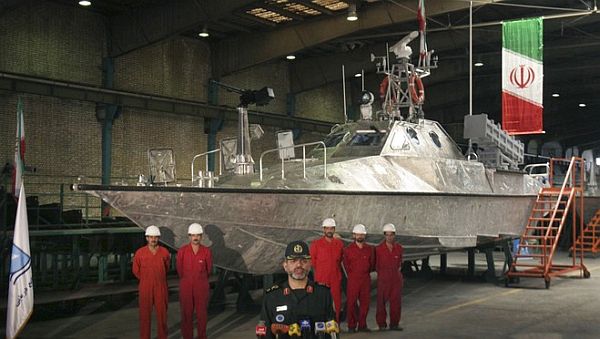
With the development of the F-35 Joint Strike Fighter — the most expensive defense program ever — going ahead, it looks like the Pentagon is still stuck in the past. Iran on the other hand — the country that grasps the jugular vein through which most of the world’s oil supply flows (the Strait of Hormuz) — today made clear that it knows exactly how to flex its muscles in that arena and it will do so with vessels designed for lethal swarming.
Iran began mass-producing two high-speed variants of missile-launching assault boats on Monday, warning its enemies not to “play with fire” as it boosts security along its coastline.
The inauguration of the production lines for the Seraj and Zolfaqar speedboats comes a day after President Mahmoud Ahmadinejad unveiled Iran’s home-built bomber drone, which he said would deliver “death” to Iran’s enemies.
The United States expressed concern about the Islamic republic’s growing military capabilities.
Iran’s state news agency IRNA reported that the Seraj (Lamp) and Zolfaqar (named after Shiite Imam Ali’s sword) boats would be manufactured at the marine industries complex of the defence ministry.
Defence Minister Ahmad Vahidi opened the assembly lines, saying the vessels would help to strengthen Iran’s defences, IRNA said.
“Today, the Islamic Republic of Iran is relying on a great defence industry and the powerful forces of Sepah (Revolutionary Guards) and the army, with their utmost strength, can provide security to the Persian Gulf, the Sea of Oman and Strait of Hormuz,” Vahidi said.
He issued a stern warning to Iran’s foes.
“The enemy must be careful of its adventurous behaviour and not play with fire because the Islamic Republic of Iran’s response would be unpredictable,” IRNA quoted him as saying.
“If enemies attack Iran, the Islamic Republic of Iran’s reaction will not be restricted to one area. The truth of our defence doctrine is that we will not attack any country and that we extend our hand to all legitimate countries.”
Meanwhile, in yet another response to Jeffrey Goldberg’s prediction of an Israeli attack on Iran, the former UN chief weapons inspector, David Kay, suggests that Israel is using the issue in order to press the Obama administration to ease its pressure on settlements and the need to make concessions to the Palestinians.
… Israel is engaged in psychological warfare with the Obama administration — and it only partly concerns Iran.
With regard Iran, Israel clearly understands that any unilateral military action it took against Iran without U.S. knowledge and support could have consequence of strategic importance for Israel and might even make an attack on Iran of limited benefit. Israel would much rather have the U.S. with it in an attack on Iran, or, even better, would be if the U.S. executed the attack entirely on its own.
But beyond Iran, of probably greater importance to the current Israeli government is avoiding the Obama administration pushing it into a choice between settlements and territorial arrangements with the Palestinians that it is unwilling to make and permanent damage to its relationship with the U.S. Hyping the Iranian nuclear program and the need for early military action is a nice bargaining counter. The U.S. certainly cannot join or lead an attack on Iran while pushing the Israeli government to the brink on settlements and concessions to the Palestinians. Or if the U.S. wants to avoid an imminent Israeli strike, it must make concessions to Israel on the Palestinian issues.
In the current climate of escalating rhetoric through which hostility towards Muslims is now being unleashed across America, there is a tendency to pay greater attention to the fact that this makes America look bad, than that it reveals real fractures and failings inside American society.
Responding to the Manhattan Islamic-center controversy, Evan Kohlmann, an independent terrorism consultant at Flashpoint Partners who monitors jihadist websites, told the Wall Street Journal: “We are handing al Qaeda a propaganda coup, an absolute propaganda coup.”
But what if we could be assured that hatred of Muslims did not increase the risk of terrorism? Should we be any less concerned?
A couple of years ago, ABC‘s Prime Time conducted a revealing experiment to see how ordinary Americans respond to expressions of hostility directed at American Muslims. Watch the video below:
As encouraging as it might be to see that twice as many individuals tried to correct an injustice rather than supported it, the silent majority did nothing. And keep in mind: this was in response to the mistreatment of an American Muslim. Muslims born elsewhere who may speak little or no English can only fare worse in similar circumstances.
The pernicious effect of political correctness is that it exaggerates the value of cosmetic changes. A socially acceptable code can prevail, yet barely beneath the surface, bigotry festers both in spite of and to some extent because it no longer finds free expression.
The current up-swell of hatred towards Muslims in America says, I would contend, less about changing sentiments than it does about people’s willingness to express what they previously thought they must conceal. We should be less concerned about what people are now saying than what this reveals about what they think.
Glenn Greenwald comments on the demonstration that took place in Manhattan yesterday, as shown in this video:
The animosity and hatred so visible here extends far beyond the location of mosques or even how we treat American Muslims. So many of our national abuses, crimes and other excesses of the last decade — torture, invasions, bombings, illegal surveillance, assassinations, renditions, disappearances, etc. etc. — are grounded in endless demonization of Muslims. A citizenry will submit to such policies only if they are vested with sufficient fear of an Enemy. There are, as always, a wide array of enemies capable of producing substantial fear (the Immigrants, the Gays, and, as that video reveals, the always-reliable racial minorities), but the leading Enemy over the last decade, in American political discourse, has been, and still is, the Muslim.
That’s why the population is willing to justify virtually anything that’s done to “them” without much resistance at all, and it’s why very few people demand evidence from the Government before believing accusations that someone is a Terrorist: after all, if they’re Muslim, that’s reason enough to believe it. Hence, the repeated, mindless mantra that those in Guantanamo — or those on the Government’s “hit list” — are Terrorists even in the absence of evidence and charges, and even in the presence of ample grounds for doubting the truth of those accusations.
And there’s no end in sight: the current hysteria over Iran at its core relies — just as the identical campaign against Iraq did — on the demonization of a whole new host of Muslim villains.
This may turn out to be one of the most important tests of Barack Obama’s presidential leadership. His inclination and that of his political advisers is likely to lean heavily in favor of weathering out the storm — especially since he appeared to walk back from his initial intervention. But the test of leadership is the willingness and ability to act in conformity with the dictates of the circumstance and not those of political prudence.
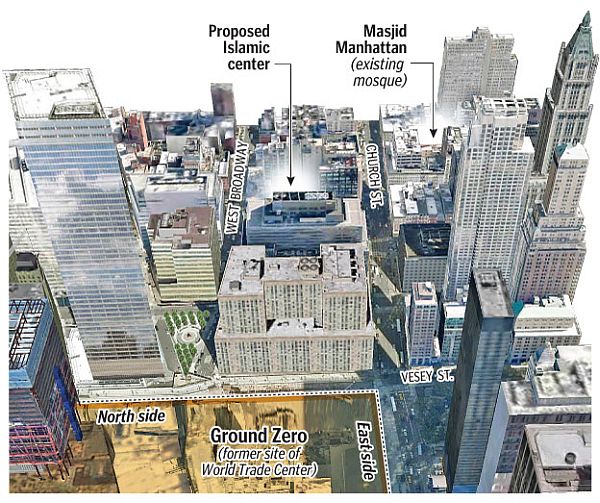
Masjid Manhattan wants to keep a low profile — which is understandable. At the top of their home page is a bold disclaimer:
Please be advised that we are by no means affiliated with any other organization trying to build anything new in the area of downtown Manhattan.
That blanket disclaimer is their way of distancing themselves from the controversial Park51 project (aka Cordoba House, aka the Ground Zero mosque).
It’s sad that Masjid Manhattan feels the need to do this when it could reasonably describe itself as the Ground Zero mosque that was there before Ground Zero.
If two blocks away from the site of the World Trade Center can be described as “at Ground Zero” then so can three blocks away.
Do those who now object to the construction of a new Islamic center also favor that the existing mosque be removed?
In all likelihood, most Americans who object to Park51 don’t even know that there is already a mosque nearby — one that opened the same year as the World Trade Center and now lacks sufficient space for all those Muslims living and working in the area who wish to gather for prayer. Neither would they know that one of the staunchest defenders of the project is the Jewish Congressman who represents the district, Jerry Nadler.
Unlike the rest of the Democrats in the New York congressional delegation, who have said as little as possible about the issue, Nadler has unabashedly supported the congregation’s right to build the mosque.
“It’s only a slap in the face if you think that the people in the congregation are responsible for al-Qaeda,” Nadler said as he sat in his office, where outdated posters, some featuring the Twin Towers, hung on the wall.
A staunch defender of Israel, Nadler said that it is logical that he is fighting for the rights of a Muslim congregation that he said he might very well vehemently disagree with. “Jews, of all people, should know that we have to support religious liberty,” he said. “Because if you can block a mosque, you can block a synagogue.”
And lest there be any doubt that the current controversy has been fomented by political opportunists, Frank Rich notes:
We owe thanks to Justin Elliott of Salon for the single most revealing account of this controversy’s evolution. He reports that there was zero reaction to the “ground zero mosque” from the front-line right or anyone else except marginal bloggers when The Times first reported on the Park51 plans in a lengthy front-page article on Dec. 9, 2009. The sole exception came some two weeks later at Fox News, where Laura Ingraham, filling in on “The O’Reilly Factor,” interviewed Daisy Khan, the wife of the project’s organizer, Imam Feisal Abdul Rauf. Ingraham gave the plans her blessing. “I can’t find many people who really have a problem with it,” she said. “I like what you’re trying to do.”
If there was a ministry of information it would release reports like this: “US Assures Israel That Iran Threat Is Not Imminent.” But why would Washington need to create such an agency when the New York Times so gladly provides the service?
In a report transparently written as a quasi-official response to Jeffrey Goldberg’s “The Point of No Return,” we learn that contrary to all the feverish speculation about an imminent strike on Iran, it turns out everything’s cool.
And maybe it is — though the Times’ Mazzetti and Sanger could do more credible reporting if they made an effort not to sound like a mouthpiece for the administration.
The one priceless quote in their article comes from Gary Samore, President Obama’s top adviser on nuclear issues, who when referring to an anticipated one year “dash time” that the Iranians would need to convert nuclear material into a working weapon, said: “A year is a very long period of time.”
Israeli officials said their assessments were coming into line with the American view, but they remain suspicious that Iran has a secret enrichment site yet to be discovered.
American officials said, in contrast to a year ago, that Iran’s nuclear program was not currently the central focus of discussions between top leaders in Washington and Jerusalem. During the last visit to Washington by Prime Minister Benjamin Netanyahu of Israel in early July, the Iranian program was relatively low on the agenda, according to one senior administration official.
The next time Netanyahu takes questions from the press, maybe someone can ask him whether he agrees with the White House’s assessment about the nature of time and that a year is indeed a very long period.
Another issue the article touches upon is the breakout capacity for the long-delayed National Intelligence Estimate. Since the White House seems eager to say what the NIE will say even before its been released, can we interpret this as an effort to shape the report that is itself supposed to shape the administration’s policy?
Finally, just to be sure that the Israel lobby does not become too despondent when they hear another war might not be just around the corner (despite their best efforts), the article closes by saying:
Even as American and Israeli officials agree that the date that Iran is likely to have a nuclear weapon has been pushed into the future, that does not mean that Israel has abandoned the idea of a possible military strike.
American officials said that Israel was particularly concerned that, over time, Iran’s supreme leader could order that nuclear materials be dispersed to secret locations around the country, making it less likely that an Israeli military strike would significantly cripple the program.
So have no fear — the option of a strike is still on the table, or to be precise, at some indeterminate point in the future there might be a strike and it could happen sooner rather than later because at some point (future or past) the Iranians could hide everything and maybe they already have secret facilities in which case the opportunity to destroy them has already past. Clear?
The monument at the hypocentre of the Nagasaki atomic bomb blast
Another way of saying “sacred” is to say “off-limits.”
Something can be sanctified by placing a barrier around it constructed from rigid taboos. The most extreme among those taboos dictates not only silence but also exclusion.
In such a way, for many Americans, 9/11 has been sanctified. The sacred idea occupies a sacred space and only those willing to display sufficient awe and reverence can be allowed to enter.
Yet there are limits on how high this sacred narrative can be raised. We do not, by and large, talk about the 9/11 holocaust — and rightfully so. To link a day on which 3,000 Americans died, to a period during which 6 million Jews were systematically slaughtered, would be absurd and obscene.
When on 9/11 Benjamin Netanyahu said it was “very good” — because it would generate sympathy for Israelis — his response would no doubt have been rather different had he been asked whether the attacks would help Americans now better understand the significance of the Holocaust.
So we don’t talk about a 9/11 holocaust. Instead, with little to no comment, the attacks have another but equally perverse association: with the nuclear devastation brought down on Hiroshima on August 6, 1945.
The more obvious World War Two association — with the December 7 attack on Pearl Harbor in 1941 — was initially referenced through headlines that reinvoked Roosevelt’s description of that day as “a date which will live in infamy,” but beyond the date — 9/11 — the name that stuck was “ground zero.”
The rubble and dust at the crushed feet of the World Trade Center might have conjured images of nuclear devastation yet little sense that a stolen word required a buried memory.
If Americans were polled today and asked which city they associate with “ground zero,” would any answer “Hiroshima” or “Nagasaki”? Most likely, very few — even though the anniversary of the nuclear bombings has only just passed.
On August 6, a ceremony marking the 65th anniversary of the bombing that killed 140,000 people in Hiroshima, was attended for the first time by a representative of the US government, the US ambassador to Japan, John Ross. This was not the first time an American official had been allowed to attend — it was the first time an invitation had been accepted. So far, no sitting American president has ever visited Hiroshima.
Within a decade of the nuclear attacks, the Catholic Memorial Cathedral for World Peace had been opened in Hiroshima. The Japanese raised few objections to the construction a church close to the original ground zero.
Meanwhile, Pearl Harbor is being invoked once again in a vain effort to conceal the Islamophobia that permeates objections to the New York mosque.
Dr Richard Land, president of the Southern Baptist Convention’s Ethics and Religious Liberty Commission, and a member of the federally created United States Commission on International Religious Freedom, “insists that his opposition to the Cordoba House project is principled — that he would and has opposed similar efforts when they upset local populations.”
“There is a Japanese Shinto shine, I am told, blocks from the USS Arizona,” Land said. “That isn’t appropriate even 60 years later. Three-thousand Americans died there and they died at the hands of people acting on behalf of the Japanese Empire.”
There isn’t, in fact, a Shinto shrine near Pearl Harbor [writes Brian Beutler], though many conservatives use this hypothetical as an example of a non-Muslim shrine they’d oppose for similar reasons.
Around the same time that Western dignitaries gathered in Japan in order to commemorate the ghastly effects of nuclear destruction, another group of public figures embarked on an equally historic pilgrimage.
Eight Muslim-American imams, along with President Obama’s envoy to combat anti-Semitism, Hannah Rosenthal, traveled to the sites of the former Dachau and Auschwitz concentration camps in Germany and Poland.
“These Muslim leaders were experiencing something they knew nothing about,” Rosenthal told Politico. She had many family members at Auschwitz, including her grandparents. “I can’t believe anyone walks into Auschwitz and leaves the same person. I watched them break down. I broke down in front of suitcases. … It is the cemetery of my whole family.”
The American imams later released a statement saying:
We bear witness to the absolute horror and tragedy of the Holocaust where over twelve million human souls perished, including six million Jews.
We condemn any attempts to deny this historical reality and declare such denials or any justification of this tragedy as against the Islamic code of ethics.
We condemn anti-Semitism in any form. No creation of Almighty God should face discrimination based on his or her faith or religious conviction.
We stand united as Muslim American faith and community leaders and recognize that we have a shared responsibility to continue to work together with leaders of all faiths and their communities to fight the dehumanization of all peoples based on their religion, race or ethnicity. With the disturbing rise of anti-Semitism, Islamophobia, and other forms of hatred, rhetoric and bigotry, now more than ever, people of faith must stand together for truth.
Strangely, the Anti-Defamation League’s Abe Foxman and the Investigative Project’s Steve Emerson, author of “American Jihad,” lobbied U.S. officials against participating in the trip.
Perhaps if those now concerned about the Cordoba House project gave more attention to what it means to enter a sacred space, rather than how to keep others out, they would understand that a real sense of the sacred springs from keeping ones eyes open — not sealing them closed.
Israel has until the weekend to launch a military strike on Iran’s first nuclear plant before the humanitarian risk of an attack becomes too great, former U.S. Ambassador to the United Nations John Bolton said Tuesday.
A Russian company is expected to help Iran start loading nuclear fuel into its plant starting on Saturday, after which an attack on the Bushehr reactor could trigger harmful radiation, which Israel wants to avoid, Bolton said. So unless the Israelis act immediately to shut down the facility, it will be too late.
“Once it’s close to the reactor … the risk is when the reactor is attacked, there will be a release of radiation into the air,” Bolton told FoxNews.com. “It’s most unlikely that they would act militarily after fuel rods are loaded.”
The attack Iran story gets increasingly bizarre. Now we have neocon commentators like Bolton watching the clock as though this was some kind of sporting event and at the same time, presenting Israel as a thoroughly responsible player. While Israel might be willing to destabilize the whole region, it wouldn’t want to risk spreading nuclear fallout into the Gulf. But as Marsha Cohen points out, the risks from fallout would not simply be humanitarian — they would be economic:
Besides the catastrophic human and environmental toll of such an attack, the sea lanes through which much of the world’s oil supplies pass would be endangered.
Iranians know this. In 1980, Iran bombed Iraq’s Osirak nuclear power plant before it contained any radioactive material. Osirak was quickly repaired by the French contractors who built it. Eight months later Osirak was partially destroyed by Israeli jets, aided by Iranian intelligence.
Meanwhile, at The Atlantic, Jeffrey Goldberg and Robin Wright are now placing bets on the likelihood of an attack — not in the next few days, but the coming months.
“By July next year, I’ll wager that neither Israel nor the United States will have bombed Iran,” says Wright.
Note the phrasing chosen by the man who just a few days ago expressed “profound, paralyzing ambivalence” about whether on attack on Iran would be a good idea. He doesn’t now simply reiterate his expectation that an attack is more likely but that it looks like a “better” than 50 percent chance.
Casually chosen words? Maybe, but if Goldberg was being asked how likely another 9/11 attack might be and he thought it more likely than not to happen, I doubt that he would say there is a better than 50 percent chance of such an attack, would he?
This website or its third-party tools use cookies, which are necessary to its functioning. By closing this banner, you agree to the use of cookies.

 A burned Quran along with excrement-smeared pages from the holy book were found outside the Islamic Center of East Lansing, Michigan yesterday. The FBI have been called in to launch an investigation.



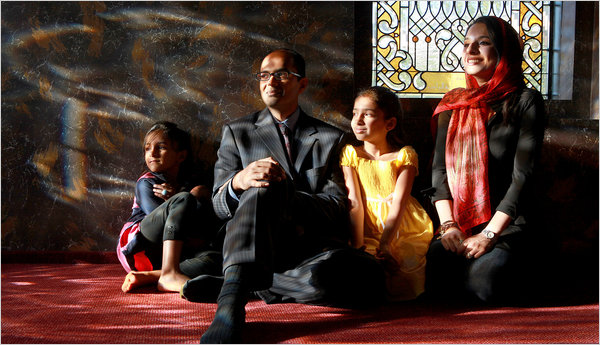

 The most pressing problem with the settlements is not that they are obstacles to a final peace accord, which is how settlement critics have often framed the issue. The danger is that they will doom Zionism itself.
 On the other side of the debate are Israelis such as Naftali Bennett, Benjamin Netanyahu’s former chief of staff and the recently named director-general of the settler advocacy group the Yesha Council.