Category Archives: Editorials

Do most Israeli Jews consider non-Jews to be sub-human?

The question I pose here is prompted by a post by the Israeli blogger, Yossi Gurvitz.

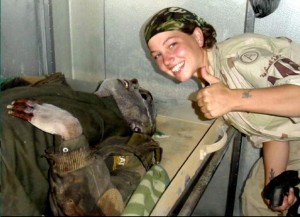
After the blogosphere lit up yesterday in reaction to photographs of a young Israeli soldier, Second Lieutenant Eden Aberjeel, posing alongside Palestinian prisoners, Gurvitz wrote:

There is nothing out of the ordinary about Aberjeel, who refused to speak with several bloggers because she “doesn’t speak with leftists”: she describes herself as holding rightwing political views and being religious (i.e., an observant Jewish Orthodox); she’s also a member of several religious groups, particularly of “born again” (hozrim bi’tshuva) Jews, quite a few “Bring Gilad Shalit home” groups — and the group “I, too, hate the Hamas”.

In short, she’s a good representative of a large portion of the IDF’s soldiers — and, more worryingly, officers. Like Lynndie England, she’s become a face for the banality of evil; unlike England, she doesn’t seem to understand she did something wrong, and didn’t think twice before posting those pictures.

And why would she? After all, like most Israeli Jews, she considers non-Jews — Arabs in particular — to be subhuman.

In order to refute an official statement which claimed that Aberjeel’s behavior was an exception, the Israeli human rights group, Breaking the Silence, has now released photographs showing other IDF soldiers sitting alongside handcuffed and blindfolded Palestinian detainees. Indeed, anyone who has watched the documentary To See If I Am Smiling (released in 2007) in which six young Israeli women recount their experiences of military service in the occupied Palestinian territories, knows that this is a familiar story.

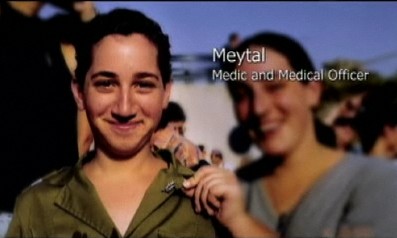
The title of the film comes from a story told by Meytal, a medic and medical officer. Having described how cleaning the corpses of Palestinians after they had been brutalized by Israeli soldiers had become a routine part of her job, she goes on to recount a particular moment that still haunts her: when she posed for a photograph next to a corpse.

I’m not sure when it was, but at some point I became very ashamed of that picture. And I didn’t tell anyone about it, that it existed. I forgot about it a little. But I would like to see it. To see if I look different. I want to see if I’m still smiling.

The photograph is not shown in the documentary, but in the mind’s eye of many Americans it must evoke memories of Abu Ghraib.

Such images are iconic because they capture the moment in which a soldier discovers that he or she has become the very thing they fear. The dehumanized other is a vortex from which there is no escape.

If a nation can have such a thing as a soul, To See If I Am Smiling, reveals how profoundly Israel’s soul has been scarred by 43 years of occupation. A fully militarized society has shackled itself to a conviction — we have no choice — whereby each individual can then bury their own awareness of complicity and moral responsibility under a collective weight of irresistible necessity.

But before anyone jumps to conclusions about what all of this says about Israelis, it’s worth remembering what Americans have shown themselves capable of when they come to regard their enemies as subhuman.

Abu Ghraib is still fresh in most people’s minds as an indication of the depravity soldiers can descend into once the enemy has been sufficiently dehumanized, but to the extent that the war in Iraq is now broadly considered a mistake, Abu Ghraib is likewise easily seen as some kind of aberration.

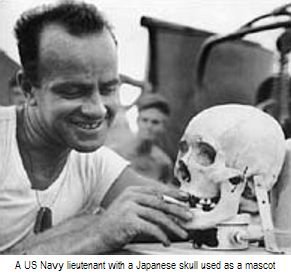
Better then to be reminded of some of the barbarity that members of “the greatest generation” engaged in while fighting the “good war” — World War Two.

In the fight against the Japanese, the practice of “trophy hunting” went far beyond posing for photographs next to captives of the dead. “[B]oiling the flesh off enemy [Japanese] skulls to make souvenirs was a not uncommon practice. Ears, bones and teeth were also collected,” writes the historian, Niall Ferguson.

And the context in which this occurred? One in which among Americans, the Japanese had come to be regarded as subhuman. “To the historian who has specialized in German history, this is one of the most troubling aspects of the Second World War: the fact that Allied troops often regarded the Japanese in the same way that Germans regarded Russians — as Untermenschen,” writes Ferguson.

In each of these scenarios we witness the shadow of exceptionalism: that when individuals, nations, tribes or ethnic groups see themselves as superior to others, they also unleash their own depravity.

Facebooktwittermail

You must do what we can’t, because if you don’t, we will

There are those who would have us believe that:

[O]ne day next spring, the Israeli national-security adviser, Uzi Arad, and the Israeli defense minister, Ehud Barak, will simultaneously telephone their counterparts at the White House and the Pentagon, to inform them that their prime minister, Benjamin Netanyahu, has just ordered roughly one hundred F-15Es, F-16Is, F-16Cs, and other aircraft of the Israeli air force to fly east toward Iran — possibly by crossing Saudi Arabia, possibly by threading the border between Syria and Turkey, and possibly by traveling directly through Iraq’s airspace, though it is crowded with American aircraft.

Worried about an Israeli attack on Iran? That’s the idea.

You must do what we can’t, because if you don’t, we will.

This is how some Israelis are trying to twist Washington’s arm to get the US to attack Iran.

A more honest way of making the argument would be to say this: If the US won’t attack Iran, then Israel will — even though it won’t accomplish its military objectives and it will open Pandora’s box. Desperate nations sometimes do desperate things. You have been warned.

Another name for this: blackmail.

It’s hard to counter an irrational argument when the irrationality is intentional. Such are the means by which someone like erstwhile Israeli army corporal and current Atlantic commentator, Jeffrey Goldberg, attempts to persuade his readers — not through cogent reasoning based on clear evidence, but by an insidious form of argument that has the clarity of slime.

Consider the way he tries to close his case for an attack on Iran — even while avoiding saying straight out that he supports such a course of action.

The United States must not take the risk of letting Israel attack Iran because if President Obama orders US forces to attack instead, this would be the most patriotic thing to do. Obama would not be serving Israel’s interests; he would be defending Western civilization.

Based on months of interviews, I have come to believe that the administration knows it is a near-certainty that Israel will act against Iran soon if nothing or no one else stops the nuclear program; and Obama knows — as his aides, and others in the State and Defense departments made clear to me — that a nuclear-armed Iran is a serious threat to the interests of the United States, which include his dream of a world without nuclear weapons. Earlier this year, I agreed with those, including many Israelis, Arabs — and Iranians — who believe there is no chance that Obama would ever resort to force to stop Iran; I still don’t believe there is a great chance he will take military action in the near future — for one thing, the Pentagon is notably unenthusiastic about the idea. But Obama is clearly seized by the issue. And understanding that perhaps the best way to obviate a military strike on Iran is to make the threat of a strike by the Americans seem real, the Obama administration seems to be purposefully raising the stakes. A few weeks ago, Denis McDonough, the chief of staff of the National Security Council, told me, “What you see in Iran is the intersection of a number of leading priorities of the president, who sees a serious threat to the global nonproliferation regime, a threat of cascading nuclear activities in a volatile region, and a threat to a close friend of the United States, Israel. I think you see the several streams coming together, which accounts for why it is so important to us.”

When I asked Peres what he thought of Netanyahu’s effort to make Israel’s case to the Obama administration, he responded, characteristically, with a parable, one that suggested his country should know its place, and that it was up to the American president, and only the American president, to decide in the end how best to safeguard the future of the West. The story was about his mentor, David Ben-Gurion.

“Shortly after John F. Kennedy was elected president, Ben-Gurion met him at the Waldorf-Astoria” in New York, Peres told me. “After the meeting, Kennedy accompanied Ben-Gurion to the elevator and said, ‘Mr. Prime Minister, I want to tell you, I was elected because of your people, so what can I do for you in return?’ Ben-Gurion was insulted by the question. He said, ‘What you can do is be a great president of the United States. You must understand that to have a great president of the United States is a great event.’”

Peres went on to explain what he saw as Israel’s true interest. “We don’t want to win over the president,” he said. “We want the president to win.”

Israel only wants what’s good for America — and we’re supposed to believe that, even while few if any Israelis could be persuaded that America only wants what’s good for Israel.

The truth is that everyone gets to define their own interests so let’s ignore the obsequious crap from Peres and consider Goldberg’s core claim: that Israel is gearing up to strike Iran.

Even if Goldberg is participating in a neocon game of bluff, the only kind of bluff worth engaging in is one that has credibility. To make a credible argument that Israel has the intention of going it alone, Goldberg would have to present the outline of a credible plan of attack. He doesn’t even try.

Israeli planes would fly low over Saudi Arabia, bomb their targets in Iran, and return to Israel by flying again over Saudi territory, possibly even landing in the Saudi desert for refueling—perhaps, if speculation rife in intelligence circles is to be believed, with secret Saudi cooperation.

And he prefaces this “plan” by saying Israel only gets one try. That’s not even a back-of-an-envelope war plan. It’s more like a Twitter war plan.

Five years ago Kenneth Pollack dismissed the idea that Israel could attack Iran on its own. I don’t see any reason to doubt that his analysis on the military logistics of an attack still remains sound. Indeed, there seem to be plenty of Israeli analysts who concede that Israel simply does not have the option of going it alone. Even Goldberg quotes an unnamed Israeli general who says: “This is too big for us.”

In The Persian Puzzle: The Conflict Between Iran and America, Pollack wrote:

[T]he United States … should not count on Israel to conduct a counterproliferation strike for us. It is almost certainly the case that Israel would be willing to absorb the diplomatic costs of a strike, would be prepared to deal with Iran’s retaliation in the form of either terrorist attacks or missile strikes on Israel, and probably is not overly concerned about Iranian behavior in Iraq. The problem for Israel is much simpler: Iran is too far away. Most of the known Iranian nuclear facilities are around 1,000 miles away from Israel. Its Jericho II ballistic missiles could reach these targets, but they lack the payload, accuracy, and numbers to be able to significantly damage (let alone destroy) more than one or two of the large Iranian nuclear facilities, which leaves the matter to the Israeli Air Force. Even assuming that Israeli aircraft were to fly directly to Iran, overflying Jordan and Iraq, the only aircraft in its inventory that could reach Iran’s known nuclear sites are its 25 F-151 strike fighters. (Israel would need to set up aerial refueling stations at three to five locations between Israel and the Iranian targets for its roughly 350 F-16s to be able to participate, which would be practically impossible.) Because the F-151s would have to carry a considerable amount of fuel, they could not carry a great deal of ordinance. Given the size of the various Iranian nuclear facilities, it would not be possible for Israel to destroy all of them in a single raid as it did Osiraq. Nor would it be politically, militarily, or logistically possible for Israel to sustain multiple such strikes over the many days, if not weeks, it would take for all its F-151s to accomplish the job. [My emphasis.]

The neocon game of bluff will only box in the Obama administration if the Israeli “threats” are treated seriously. A more appropriate response would seem to be to focus on the limits of Israeli military action — unless that is one imagines that Israel would launch a nuclear attack on Iran, which to my mind is wildly implausible. (If Israel wants to permanently seal its global pariah status, the first offensive use of nuclear weapons since Nagasaki is a sure way.)

Goldberg reports, but apparently didn’t take seriously, the observations of some Israelis who given their positions of military command seem to merit close attention:

Gabi Ashkenazi, the Israeli army chief of staff, is said by numerous sources to doubt the usefulness of an attack, and other generals I spoke with worry that talk of an “existential threat” is itself a kind of existential threat to the Zionist project, which was meant to preclude such threats against the Jewish people. “We don’t want politicians to put us in a bad position because of the word Shoah [Holocaust],” one general said. “We don’t want our neighbors to think that we are helpless against an Iran with a nuclear bomb, because Iran might have the bomb one day. There is no guarantee that Israel will do this, or that America will do this.”

The message Netanyahu, Goldberg and other panic-stricken Zionists are unintentionally sending out is that come the day Iran acquires a nuclear weapon, Israelis may as well back their bags and abandon the Jewish state.

That probably won’t happen because in such an event Israel will “discover” what many Israelis no doubt already think: that retired General John Abizaid was right when he said that the United States and its allies can “live with” a nuclear-armed Iran. “Let’s face it — we lived with a nuclear Soviet Union, we’ve lived with a nuclear China, and we’re living with nuclear powers as well,” Abizaid told an audience at the Center for Strategic and International Studies.

That was true in 2007 and it’s true now. It’s also true that spineless politicians remain the playthings of fear-mongers who are addicted to war.

Facebooktwittermail

What happened before we left Afghanistan

What Happens if We Leave Afghanistan” predicts the latest Time magazine cover, yet Time has not mastered a new art — taking photographs of the future. The image reflects what has happened under our watch and rather than representing the dreadful fate for Afghan women should the US and its allies prematurely relinquish control, it underlines the fact that we have never had anything more than a tenuous grip on Afghanistan.

The idea that we went there to make it a better country merely pandered to our world-saving vanity. A war billed as a necessity — the linchpin of American national security — was itself a face-saving exercise. It wasn’t about saving the faces of Afghan women, but saving the reputation of America’s military might after its weakness had been exposed by a small band of men armed with nothing more than box cutters.

The means through which the US will eventually extricate itself from this ill-conceived war will likewise be another face-saving exercise through which failure can be dressed up as success.

Meanwhile, as fewer Americans are acquiring college degrees, more are taking to the streets to protest against the construction of mosques — even while a recent study indicates mosques deter the spread of Islamic militancy.

9/11 might have caused a national wound, but the means through which we treated it turned out to be more harmful than the injury itself. Nine years later should mean nine years wiser. Instead, we find ourselves living in a nation that gets harder to parody, as reality itself becomes increasingly absurd.

Consider for instance the Pentagon’s ways of responding to Wikileaks — demanding leaked documents be “returned” (as though they had been spirited away to a secret location where a stash of Xerox sheets are now hidden) while telling DoD employees they mustn’t look at the documents (as though they’re now going to pretend they forgot how to use the internet).

As Noah Shachtman writes:

Any citizen, any foreign spy, any member of the Taliban, and any terrorist can go to the WikiLeaks website, and download detailed information about how the U.S. military waged war in Afghanistan from 2004 to 2009. Members of that same military, however, are now banned from looking at those internal military documents. “Doing so would introduce potentially classified information on unclassified networks,” according to one directive issued by the armed forces.

That cry you hear? It’s common sense, writhing in pain.

There was a time, just a few months ago, when the Pentagon appeared to be growing comfortable with the emerging digital media landscape. Troops were free to blog and tweet, as long as they used their heads and didn’t disclose secrets. Thumb drives and DVDs could be employed, as long as they didn’t carry viruses or classified information. But the WikiLeaks disclosures — tens of thousands of classified documents — seem to have reversed that trajectory.

And in a commentary on this country’s perversely misconceived national priorities, Glenn Greenwald writes:

As we enter our ninth year of the War in Afghanistan with an escalated force, and continue to occupy Iraq indefinitely, and feed an endlessly growing Surveillance State, reports are emerging of the Deficit Commission hard at work planning how to cut Social Security, Medicare, and now even to freeze military pay. But a new New York Times article today illustrates as vividly as anything else what a collapsing empire looks like, as it profiles just a few of the budget cuts which cities around the country are being forced to make. This is a sampling of what one finds:

Plenty of businesses and governments furloughed workers this year, but Hawaii went further — it furloughed its schoolchildren. Public schools across the state closed on 17 Fridays during the past school year to save money, giving students the shortest academic year in the nation.

Many transit systems have cut service to make ends meet, but Clayton County, Ga., a suburb of Atlanta, decided to cut all the way, and shut down its entire public bus system. Its last buses ran on March 31, stranding 8,400 daily riders.

Even public safety has not been immune to the budget ax. In Colorado Springs, the downturn will be remembered, quite literally, as a dark age: the city switched off a third of its 24,512 streetlights to save money on electricity, while trimming its police force and auctioning off its police helicopters.

There are some lovely photos accompanying the article, including one showing what a darkened street in Colorado looks like as a result of not being able to afford street lights. Read the article to revel in the details of this widespread misery. Meanwhile, the tiniest sliver of the wealthiest — the ones who caused these problems in the first place — continues to thrive.

And let’s be clear about what it means to thrive while others suffer. This isn’t simply callous indifference or unrestrained greed; it is parasitic behavior.

Facebooktwittermail

Iran targeted in cyber attack

Last September, Reuters reported: “Israel has been developing “cyber-war” capabilities that could disrupt Iranian industrial and military control systems. Few doubt that covert action, by Mossad agents on the ground, also features in tactics against Iran. An advantage of sabotage over an air strike may be deniability.”

Now it seems, such an attack may have occurred in recent months.

“Looks like this malware was made for espionage,” was the assessment of industry analyst Frank Boldewin when describing the recently discovered computer worm, known has Stuxnet. It targets Siemens SCADA (supervisory control and data acquisition) management systems that control energy utilities, transportation, and other vital systems. Elias Levy, senior technical director with Symantec Security Response, said: “The most we can say is whoever developed these particular threats was targeting companies in those geographic areas,” when explaining why this particular trojan has had its greatest impact in Iran.

It is just two months since the newly-created United States Cyber Command based at Fort Meade, Maryland, became operational. The creation of CYBERCOM is ostensibly a response to the United States’ vulnerability to cyber attacks. “Given our increasing dependency on cyberspace, this new command will bring together the resources of the department to address vulnerabilities and meet the ever-growing array of cyberthreats to our military systems,” Defense Secretary Robert Gates said in a statement.

But as Robert Fry, a former Deputy Commanding General of coalition forces in Iraq, notes, “the speed of cyber operations places a premium on first strike and so inverts the Clausewitzian principle of the inherent advantage of defense.” Thus, as Federal Computer Week points out: “CYBERCOM also oversees offensive cyber capabilities, and that involves developing weapons and the doctrine that governs when and how those weapons can be used.”

Did we just witness one of the opening shots in a cyber war against Iran? Stuxnet is, according to Andy Greenberg, “the first publicly-known threat, aside from occasional unattributed reports, to target the long-vulnerable infrastructure systems.” As such, the most likely instigator of such an attack would be a hostile government.

The question is: which government? Israel and/or the United States have to be the prime suspects.

Facebooktwittermail

Is Payoneer under US investigation for role in Dubai murder?

The Wall Street Journal reports:

American investigators, cooperating in a probe of the January assassination of a top Palestinian leader in Dubai, have identified a handful of U.S.-based companies believed to have been used to transfer money to suspects in the case, a finding that brings international authorities closer to identifying who funded the operation.

The findings show American authorities playing a bigger role in the investigation than previously revealed. The case is especially delicate for the U.S., because Dubai police have said their prime suspect in the case is Mossad, the intelligence service of Israel, a key U.S. ally.

International investigators see money transfers made through the U.S. companies as key clues in a globe-spanning manhunt aimed at identifying more than two dozen suspects in the case, according to officials familiar with the matter.

The U.S. companies identified by investigators include Internet-based businesses that match freelance job-seekers with employers and process payments between the two sides. Authorities have identified financial transfers from several of these intermediary businesses into prepaid, cash-card accounts used by suspects in the Dubai killing, according to international investigators.

U.S. authorities say they don’t believe the intermediary companies had any way of knowing the money would be used in the plot, according to a U.S. official familiar with the investigation.

Instead, U.S. investigators believe, suspects might have posed as freelancers in order to get money in a way that obscured their funding source, and used the money for operational expenses, such as buying plane tickets.

The next step in the investigation would be to determine who the employers were in the transactions.

Representatives of several companies identified in the probe said they hadn’t been contacted by U.S. authorities and weren’t aware of any investigation.

Note that the report says “several companies” — it does not say “all the companies” — which leaves open the possibility that Payoneer, the New York-based company run by the former IDF special ops commando, Yuval Tal, is indeed under investigation.

In March Al Jazeera reported: “The UAE central bank is investigating how 24 suspects obtained credit cards from US company, Payoneer. Although registered in the US, Payoneer’s employees are mostly in Israel, this creating a stir on the internet about possible Mossad connections.”

In March, Gulf News reported:

The Payoneer connection unveils a network of links to Israel, specifically its intelligence community.

Its CEO is Yuval Tal, an Israeli citizen who, according to media reports, described himself as a former Israeli special forces commando in a 2006 Fox News interview.

Clips of the interview on video sharing websites have been removed.

However, a person who said he met Tal a couple of times but did not want to be named told Gulf News that “there is no question in my mind that Yuval has contacts with [Israel’s spy agency] Mossad”.
He recalled a conversation Tal had with attendees of a Jewish charity event in New York, where he spoke of his connections with Mossad.

“Yuval was entertaining a small group of people with tales of his IDF [Israeli Defence Forces] exploits… Specifically, he was commending Israeli intelligence and how Mossad and [Israel’s internal security agency] Shin Bet always gave him great information on his commando raids. He said his ‘colleagues’ are tracking [Hamas leaders Khaled] Mesha’al and [Esmail] Haniyeh’s movements almost every day,” he said.

Payoneer is held by three venture capital firms: Greylock Partners, Carmel Ventures, and Crossbar Capital.
Greylock, which has offices in the US, India and Herzliya, Israel, was established by Moshe Mor, a former military intelligence captain in the Israeli army.

Carmel Ventures is an Israeli venture capital fund based in Herzliya. Crossbar Partners is run by Charlie Federman, who is also managing director of the BRM Group, a venture capital fund also in Herzliya that was founded by Nir and Eli Barkat, the former of whom is the mayor of occupied Jerusalem.

Facebooktwittermail

America’s sense of the sacred

Hiroshima: the original Ground Zero

The New York Times reports:

An influential Jewish organization on Friday announced its opposition to a proposed Islamic center and mosque two blocks north of ground zero in Lower Manhattan, intensifying a fierce national debate about the limits of religious freedom and the meaning of the Sept. 11 terrorist attacks.

The decision by the group, the Anti-Defamation League, touched off angry reactions from a range of religious groups, which argued that the country would show its tolerance and values by welcoming the center near the site where radical Muslims killed about 2,750 people.

But the unexpected move by the ADL, a mainstream group that has denounced what it saw as bigoted attacks on plans for the Muslim center, could well be a turning point in the battle over the project.

In New York, where ground zero has slowly blended back into the fabric of the city, government officials appear poised to approve plans for the sprawling complex, which would have as many as 15 stories and would house a prayer space, a performing arts center, a pool and a restaurant.

But around the country opposition is mounting, fueled in part by Republican leaders and conservative pundits. Sarah Palin, the 2008 Republican vice-presidential nominee, has urged “peace-seeking Muslims” to reject the center, branding it an “unnecessary provocation.” A Republican political action committee has produced a television commercial assailing the proposal. And former House Speaker Newt Gingrich has decried it in speeches.

The complex’s rapid evolution from a local zoning dispute into a national referendum highlights the intense and unsettled emotions that still surround the World Trade Center site nine years after the attacks.

To many New Yorkers, especially in Manhattan, it is a construction zone, passed during the daily commute or glimpsed through office windows. To some outside of the city, though, it stands as a hallowed battlefield that must be shielded and memorialized.

Those who are fighting the project argue that building a house of Muslim worship so close to ground zero is at best an affront to the families of those who died there and at worst an act of aggression that would, they say, mark the place where radical Islam achieved a blow against the United States.

“The World Trade Center is the largest loss of American life on our soil since the Civil War,” Mr. Gingrich said. “And we have not rebuilt it, which drives people crazy. And in that setting, we are told, why don’t we have a 13-story mosque and community center?”

He added: “The average American just thinks this is a political statement. It’s not about religion, and is clearly an aggressive act that is offensive.”

Several family members of victims at the World Trade Center have weighed in against the plan, saying it would desecrate what amounts to a graveyard. “When I look over there and see a mosque, it’s going to hurt,” C. Lee Hanson, whose son, Peter, was killed in the attacks, said at a recent public hearing. “Build it someplace else.”

Those who support it seem mystified and flustered by the heated opposition. They contend that the project, with an estimated cost of $100 million, is intended to span the divide between Muslim and non-Muslim, not widen it.

Oz Sultan, the programming director for the center, said the complex was based on Jewish community centers and Y.M.C.A.’s in Manhattan. It is to have a board composed of Muslim, Christian and Jewish leaders and is intended to create a national model of moderate Islam.

“We are looking to build bridges between faiths,” Mr. Sultan said in an interview.

City officials, particularly Mayor Michael R. Bloomberg, have forcefully defended the project on the grounds of religious freedom, saying that government has no place dictating where a house of worship is located. The local community board has given overwhelming backing to the project, and the city’s landmarks commission is expected to do the same on Tuesday.

“What is great about America, and particularly New York, is we welcome everybody, and if we are so afraid of something like this, what does that say about us?” Mr. Bloomberg asked recently.

“Democracy is stronger than this,” he added. “And for us to just say no is just, I think — not appropriate is a nice way to phrase it.”

Still, the arguments against the Muslim center appear to be resonating. Polling shows that a majority of Americans oppose building it near ground zero.

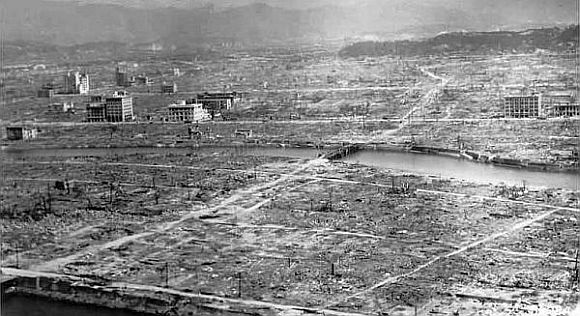
It’s not surprising that the destructive force of two massive collapsing buildings — sinking like atomic mushroom clouds in reverse — would at that time have evoked comparisons with nuclear destruction. Even so, the fact that the name “ground zero” stuck shows how little effort was ever made to view the horror of that day with a sense of proportion.

On August 6, 1945, beneath the original ground zero where at 8.15 that summer morning the “Little Boy” nuclear weapon exploded, two-thirds of Hiroshima was instantly destroyed and a third of the inhabitants perished.

If survivors of America’s nuclear attack on Japan, from which over 200,000 people died, feel that it is inappropriate to associate that level of destruction with the way America suffered on 9/11, I can understand why. It is as if to say, nothing more devastating the 9/11 could be imagined — when of course it can, and to do so we need not look far back in history or to the deeds of some horrific foreign foe.

That the sanctity of the World Trade Centers site is said to be threatened by the construction of a mosque a few blocks away says more about the way the site remains a potent vehicle of American nationalism than it does about anyone’s insensitivity towards the memory of those who died there.

Want to know what gross insensitivity looks like? Then look at another construction site 5,000 miles further east, to Jerusalem where the inaptly named Museum of Tolerance is being built on top of an historic Muslim cemetery. A round-the-clock excavation has proceeded with haste under high security as skeletons are stuffed in boxes and carted off the site — apart from those that get trampled under foot. A senior archaeologist told Haaretz: “They wanted to create a done deed, after which people could yell all they wanted to, but there wouldn’t be any graves left anymore.”

Facebooktwittermail

Secrets worth revealing

“Dr Ellsberg, do you have any concern about the possibility of going to prison for this?”

“Wouldn’t you go to prison to help end this war?” Ellsberg responded when asked by reporters about the repercussions he might face after leaking the Pentagon Papers.

The 40-year old former US military analyst who was then working for the RAND Corporation, knew exactly the risks he was taking. In 1971, his was a courageous act of conscience, clear-eyed and utterly responsible.

Almost 40 years later, Wikileaks founder Julian Assange sees himself in the same role — with a difference. Assange seems to have become caught up in the mystique of whistleblowing and allowed the actors and the mechanism through which they reveal secrets to assume as much importance as the secrets themselves.

Someone using the handle Bradass87 seems to have been the source of the leaked Afghan war logs, which he described like this: “its open diplomacy … its Climategate with a global scope and breathtaking depth … its beautiful and horrifying … It’s public data, it belongs in the public domain.”

It would appear that Bradass87 is a 22-year old intelligence analyst, Private Bradley Manning. He was arrested on May 26 and was transferred today from Kuwait to Quantico, Virginia where he is in military custody and has been placed on suicide watch.

Assuming that Manning was indeed the source, it’s hard to believe that he deeply weighed up the risks he was taking. The comparison with the so-called Climategate is perhaps telling — another leak where the act of revelation had more significance than the content.

It was Assange who held up the Pentagon Papers parallel, which again perhaps said less about the documents than about the Wikileaks founder’s desire to be seen as a modern Ellsberg — even though Assange’s role is actually much closer to that of a newspaper publisher than that of a whistleblower.

Through Wikileaks, Assange has created a new and immensely valuable infrastructure for whistleblowing, but as with everything else enabled by the internet, the medium should not be confused with the content. But since in this case that is to a significant degree what has happened, the story that has captivated the media for a week has been a story about Wikileaks as much as it has been about the war in Afghanistan.

In the short run, this might provide a boost to Wikileaks and draw wider attention to its work, but in the long run the value of whistleblowing itself will be undermined if it comes to be regarded as political theater where the actors claim more attention that the text.

When asked to comment on the war logs, Ellsberg said that they are significant more for what they lack than what they contain: they provide no plausible justification for the war. But when asked by the Washington Post whether there are indeed important documents, yet to be leaked, declassified or otherwise made public, that could fundamentally alter public understanding of key national security issues and foreign policy debates, he gladly drew up a wish list:

1. The official U.S. “order of battle” estimates of the Taliban in Afghanistan, detailing its size, organization and geographic breakdown — in short, the total of our opponents in this war. If possible, a comparison of the estimate in December 2009 (when President Obama decided on a troop increase and new strategy) and the estimate in June or July 2010 (after six or seven months of the new strategy). We would probably see that our increased presence and activities have strengthened the Taliban, as has happened over the past three years.

2. Memos from the administration’s decision-making process between July and December 2009 on the new strategy for Afghanistan, presenting internal critiques of the McChrystal-Petraeus strategy and troop requests — similar to the November 2009 cables from Ambassador Karl W. Eikenberry that were leaked in January. In particular, memos by Vice President Biden, national security adviser Jim Jones and others; responses to the critiques; and responses to the responses. This paperwork would probably show that, like Eikenberry, other high-level internal critics of escalation made a stronger and more realistic case than its advocates, warranting congressional reexamination of the president’s policy.

3. The draft revision, known as a “memo to holders,” of the National Intelligence Estimate on Iran from November 2007. This has been held up for the past several months, apparently because it is consistent with the judgment of that NIE that Iran has not made a decision to produce nuclear weapons. In particular, the contribution to that memo by the State Department’s Bureau of Intelligence and Research (INR), since the INR has had the best track record on such matters. Plus, estimates by the INR and others of the likelihood of an Israeli attack on Iran later this summer. Such disclosures could arrest momentum toward a foreseeably disastrous U.S.-supported attack, as the same finding did in 2007.

4. The 28 or more pages on the foreknowledge or involvement of foreign governments (particularly Saudi Arabia) that were redacted from the congressional investigation of 9/11, over the protest of then-Sen. Bob Graham (D-Fla.).

On each of these matters, congressional investigation is called for. The chance of this would be greatly strengthened by leaks from insiders. Subsequent hearings could elicit testimony from the insiders who provided the information (whose identities could be made known to congressional investigators) and others who, while not willing to take on the personal risks of leaking, would be ready to testify honestly under oath if requested or subpoenaed by Congress. Leaks are essential to this process.

Through the revelation of such documents, Wilileaks would demonstrate its value, but if such revelations are to occur it will most likely require a selfless act of courage from someone who occupies a higher perch in government than the one held by Private Bradley Manning.

Facebooktwittermail

Good guests don’t overstay their welcome

“Be a good guest. Treat the Afghan people and their property with respect,” Gen David Petreaus advises his forces in a new counterinsurgency manifesto.

Maybe during his tenure in Tampa, Florida, Petreaus used to shop regularly at Target and thus has a more elastic definition of the word “guest”, but the way I understand the term, good guests always defer to the wishes of their hosts. Good guests don’t invite themselves into anyone’s home and they don’t overstay their welcome.

Petreaus says: “Live with the people: Position joint bases and combat posts as close to those we’re seeking to secure as is feasible.”

Now when Hezbollah does this in Southern Lebanon where it is the indigenous military force, it gets accused of using the local population as human shields. US and NATO forces in Afghanistan who “live with the people” — they’re just getting cozy with their hosts.

Facebooktwittermail

War against Iran more likely — thanks to Wikileaks

If the release of the Pentagon Papers epitomized the value of government leaks as a means of speaking truth to power, Wikileaks at this point can claim no such distinction.

As if to underline the extent to which the Afghan war logs are making the fog of war more, not less, dense, Katrina vanden Heuvel says: “more than a few commentators — including Daniel Ellsberg himself — have called [the war logs] a 21st-century Pentagon Papers.”

She may understandably have been misled by a headline in The Guardian that read: “Daniel Ellsberg describes Afghan war logs as on a par with ‘Pentagon Papers’.” However, “These documents are not the Pentagon Papers — we still await their equivalent for Afghanistan,” is what Ellsberg unambiguously told the Financial Times.

While Wikileak’s founder, Julian Assange, is no doubt sincere in his hope that these intelligence revelations will expose the futility of war, the fact is, because intelligence is not intelligent it can very easily be used to serve a host of diverging political agendas.

If opponents of the war in Afghanistan now feel better armed, so do proponents of an expanding war in Pakistan. Likewise, those pushing for military action against Iran will welcome a new supply of ammunition served by Wikileaks.

Yesterday, the Wall Street Journal reported:

Cooperation among Iran, al Qaeda and other Sunni extremist groups is more extensive than previously known to the public, according to details buried in the tens of thousands of military intelligence documents released by an independent group Sunday.

U.S. officials and Middle East analysts said some of the most explosive information contained in the WikiLeaks documents detail Iran’s alleged ties to the Taliban and al Qaeda, and the facilitating role Tehran may have played in providing arms from sources as varied as North Korea and Algeria.

The officials have for years received reports of Iran smuggling arms to the Taliban. The WikiLeaks documents, however, appear to give new evidence of direct contacts between Iranian officials and the Taliban’s and al Qaeda’s senior leadership. It also outlines Iran’s alleged role in brokering arms deals between North Korea and Pakistan-based militants, particularly militant leader Gulbuddin Hekmatyar and al Qaeda.

Here we see one of the most bizarre twists in the story: US government sources now using the leaked documents to buttress the current anti-Iran narrative and in the process acting as though the intelligence reports are providing information that hadn’t been accessible inside government until they were leaked!

At the very same time, the State Department’s leading expert on Iran, John Limbert — a genuine source of intelligence and “the most qualified person on the Iran team at State in the three decades I have lived in the United States,” according to Haleh Esfandiari, head of the Middle East program at the Woodrow Wilson International Center for Scholars — is about to resign.

At Foreign Policy, Barbara Slavin writes:

[I]t’s hard not to view Limbert’s departure as a turning point and yet another missed opportunity in U.S.-Iran relations. A number of players with more skeptical views about the prospect of rapprochement with Tehran — such as White House aide Dennis Ross and nonproliferation experts like Robert Einhorn and Gary Samore — appear to be driving U.S. policy now, and the president himself blames the Iranian government for failing to respond to his outreach.

What could please the attack-Iran lobby more than to see the departure of the most skilled American proponent of engagement and at the same time to be served a prize piece of propaganda by an outfit aligned with the anti-war movement?!

Facebooktwittermail

Bush’s negligence doesn’t absolve Obama of his responsibilities

True to form, the administration’s response to the biggest intelligence leak ever has been tactical and clichéd.

“The United States strongly condemns the disclosure of classified information by individuals and organizations which could put the lives of Americans and our partners at risk, and threaten our national security,” National Security Adviser Gen. James Jones said in a statement released by the White House.

Senate Foreign Relations Committee Chairman John Kerry had a somewhat more serious response, The Hill reported:

“However illegally these documents came to light, they raise serious questions about the reality of America’s policy toward Pakistan and Afghanistan,” Kerry said. “Those policies are at a critical stage and these documents may very well underscore the stakes and make the calibrations needed to get the policy right more urgent.”

But how long can this critical stage last?

In The Guardian, Simon Tisdall observes:

That the Afghan campaign lacks a clear strategy, has been politically misdirected and militarily under-resourced, and is essentially unwinnable as presently conceived is something the British public, like its counterparts in the US and western Europe, has increasingly suspected. Opinion polls in most Nato countries show strengthening opposition to the western alliance’s longest ever war.

The war logs, an official accounting of murderous missions, tragic incompetence and abject failure from 2004-2009, put factual flesh on the bare bones of these negative perceptions. Their publication may further undermine public support just as the campaign supposedly reaches a “critical” juncture following June’s record casualties and the sacking of General Stanley McChrystal.

The White House’s defence — that this serial bungling occurred on George Bush’s watch — appears problematic. Since Barack Obama concluded a policy review last December and decided on a “surge” of 30,000 additional troops, overall levels of violence have risen further while confusion about counterinsurgency strategy and the exit timetable has deepened.

“Obama has had several opportunities to reassess US goals and interests and in each instance he has chosen to escalate,” said Richard Haass, a former senior Bush administration official and president of the council on foreign relations. “Today the counterinsurgency strategy that demanded all those troops is clearly not working.” Afghanistan was now Obama’s war, Haass said, and he was losing it. “It’s time to scale down our ambitions and reduce and redirect what we do.”

When it comes to understanding this war, subjective impressions sometimes tell us as much as any of the raw facts. It’s even possible that a poem — and one written hundreds of miles away from the battlefield in another country — might provide us with as much insight as do reams of intelligence reports.

Megan Stack covered the war in Afghanistan for the Los Angeles Times and in her new book, Every Man in This Village Is a Liar, chronicles her experiences as a war correspondent.

In an interview on NPR this morning, Stack described the way a government-backed anti-terrorism program in Yemen failed to resonate with the experience of ordinary Yemenis — people whose sentiment is no doubt shared by much of the population in Afghanistan.

On one of her last evenings in Yemen, Stack traveled to a remote village to meet a poet who was known for his anti-terrorism poems and had been hired by the government to travel around the countryside, reciting his poetry and encouraging people to write their own anti-terrorist verses.

But what Stack heard the villagers recite that night was quite a bit different:

The more we try to be Muslim, the more American they try to make us.
Our literary teaching and great heritage have been invaded by the West.
They drove us crazy talking about the freedom of women.
They want to drive her to evil.
They ask the woman to remove the hijab and replace it with trousers, to show their bodies.
Now people who do their village rituals are accused of being extremists.
Even the music is now brought in instead of listening to good, traditional music.
Now people are kissing each other on television.

Cultural imperialism results in no casualty reports, no visible scars, but the destructive effect of America’s wars should not simply be measured in the amount of blood shed.

Facebooktwittermail

Facebook prohibits the word “Palestinian”

The folks at Palestinian Refugee ResearchNet thought they’d create a Facebook page only to discover: Facebook blocks the term “Palestinian”! (H/t Jillian C York.)

Are Palestinians the only group so blocked from making pages? Well, not really… after a little fiddling around, I discovered that al-Qaida Refugee ResearchNet and Nazi Refugee ResearchNet are filtered too.

It does seem a bit odd, however, that a population of up to 12 million people, receiving more than a billion dollars in international aid, recognized by the UN, and enjoying a degree of formal diplomatic recognition from the United States — is placed in the same filtered category as Nazis and al-Qaida.

I’ve sent an email to Facebook customer service—we’ll see what they say.

Just to be sure, I tried myself to create a “Palestinian sports” page — not allowed.

Facebooktwittermail

Jacob Weisberg throws his weight behind the boycott

“Don’t boycott Israel,” says the headline in Newsweek.

Jacob Weisberg, editor-in-chief at Slate and author of the piece calls a boycott a “repellent idea” with consequences that are “intrinsically vile.” But pointing out the “sheeplike, liberal opinion” of celebrities like Meg Ryan is unlikely to break up the flock. Indeed, Weisberg must vastly overestimate his own degree of influence in Hollywood if he imagines that his protestations will have more effect than do celebrities influence each other.

His appeal is perhaps not an effort to shepherd celebrity opinion but a reflex expression of alarm as he witnesses the boycott movement rapidly acquiring critical mass. Support from politically uninformed but socially influential celebrities is important because it signals the point at which the Palestinian cause rises above its regional, ethnic, religious and historical boundaries, and is being adopted as a humanitarian cause.

Weisberg, in a chaotic effort to marshall his arguments claims:

The stronger case against a cultural boycott of Israel is based on consistency, proportionality, and history. That supporters of this boycott seldom focus on China or Syria or Zimbabwe — or other genuinely illegitimate regimes that systematically violate human rights — underscores their bad faith.

The bad faith that proponents of an Israel boycott are supposedly exhibiting is that they are singling Israel out; that Israel as a target of a boycott is a target of victimization. Any fair-minded person would see how much Israel, China, Syria and Zimbabwe have in common and treat them similarly… Oh, but maybe that isn’t exactly what Weisberg’s trying to say.

As a good liberal, Weisberg isn’t eager to play the anti-Semitic card and he doesn’t see an anti-Semitic trend in Hollywood, but he goes ahead and makes the accusation anyway by saying that the boycott movement “is hard to disassociate from anti-Semitism — even if Ryan and Costello intend nothing of the kind.”

There is an issue here that I suspect touches a raw nerve for Weisberg and many others and it’s not thinly disguised anti-Semiticism; it’s the power of social exclusion.

The boycott — at least a particularly ugly form of boycott — is the Israel lobby’s favorite weapon. Attacks on critics of Israel are invariably ad hominem attacks — the campaign against Judge Richard Goldstone being among the most vociferous of such denunciations. This isn’t about vigorous opposition to ideas; it’s about the effort to destroy people — their reputations, their careers, and their social standing.

Weisberg sees the same spirit in the boycott movement:

What they’re saying is, “We consider your country so intrinsically reprehensible that we are going to treat all of your citizens as pariahs.”

The subtext: It’s not about what we do; it’s about who we are.

This is how Israel washes away its sins — and it’s a way of refusing to face the charge upon which the boycott movement rests: that Israel continues to deny the Palestinians their fundamental rights for freedom, equality and self-determination. If this denial of human rights leads to Israel’s increasing isolation, this is a path that Israelis have chosen. Israel is not a victim of an unjust world or an ill-conceived boycott movement.

Facebooktwittermail

The democratic state solution

One-state solution? Two-state solution? Isn’t it time for a democratic state solution?

In response to an article in Haaretz on proposals for a one-state solution coming from the Israeli right, Uri Avnery warns that the “attractive leftist vision of the one-state solution may grow up into a rightist monster.”

Avnery writes:

The regime described here is not an apartheid state, but something much worse: a Jewish state in which the Jewish majority will decide if at all, and when, to confer citizenship on some of the Arabs. The words that come up again and again – “perhaps within a generation” – are by nature very imprecise, and not by accident.

But most important: there is a thunderous silence about the mother of all questions: what will happen when the Palestinians become the majority in the One State? That is not a question of “if”, but of “when”: there is not the slightest doubt that this will happen, not “within a generation”, but long before.

This thunderous silence speaks for itself. People who do not know Israel may believe that the rightists are ready to accept such a situation. Only a very naive person can expect a repetition of what happened in South Africa, when the whites (a small minority) handed power over to the blacks (the large majority) without bloodshed.

We said above that it is impossible to “turn the triangle into a circle”. But the truth is that there is one way: ethnic cleansing. The Jewish state can fill all the space between the sea and the Jordan and still be democratic – if there are no Palestinians there.

Ethnic cleansing can be carried out dramatically (as in this country in 1948 and in Kosovo in 1998) or in a quiet and systematic way, by dozens of sophisticated methods, as is happening now in East Jerusalem. But there cannot be the slightest doubt that this is the final stage of the one-state vision of the rightists.

Let’s grant Avnery all his assumptions about the real intentions of these one-state rightists, and let’s on that basis say that their disingenuous vision underlines the necessity for a swiftly implemented two-state solution.

And let’s go one step further and anticipate that a contiguous, viable, sovereign Palestinian state is created and operates peacefully alongside the neighboring Jewish state of Israel.

Israel still has a problem. It has a sizable and growing Palestinian minority. Unless Avnery and other two-state proponents imagine that the vast majority of Palestinian Israelis would decide to move to a newly-created Palestinian state, Israel will still have to address the problem of reconciling its Jewish and democratic identities.

If Israel fails to address that issue, then neither one state nor two states presents a solution. The issue in either context remains: is a Jewish population willing to place a higher value on democracy than it does on Jewish rule?

Facebooktwittermail

Top secret America?

Too secret for the Washington Post to reveal what it is?

It’s out there — but you won’t find out much about it at the Washington Post!

Memos being leaked from government agencies imploring lips to remain sealed; several days of media buzz in anticipation of a blockbuster investigative series…

One of Hollywood’s hottest publicists must surely have been contracted to push the Washington Post‘s sensational Top Secret America.

And what did we get when the bombshell exploded? Investigative reporting fit for the pages of Cosmopolitan. God help American journalism.

It’s big. It’s really, really big.

This is the big story about the uncontrolled growth of America’s post-9/11 national security industry — indeed an important story, but couldn’t two years of investigation have yielded more substance?

Consider this nugget from Wednesday’s feature on “The secrets next door“:

“In the Washington area, there are 4,000 corporate offices that handle classified information, 25 percent more than last year…”

Twenty-five percent growth in the first year of the Obama administration — that’s a big deal! It must tell us a lot about this administration’s national security philosophy. Or maybe not — maybe all the growth was all in the pipeline and the administration hasn’t figured out how to rein it in.

This is just one of the many statistics that Priest and Arkin toss out and then do nothing to explore. And in this instance it appears to be a purely anecdotal “statistic.” It comes from the supervisor of an industrial security specialist. Justin Walsh spends most of his time up a ladder and this is what Justin’s boss said.

But if the feature articles in the series are a bit lacking in substance, maybe the hard facts are stuffed into the databases the Post has compiled. That’s where we’ll get revelations on a company like Autonomy where the infamous neoconservative warmonger Richard Perle has served as a non-executive director since 2000.

The Post reveals the company has just one government client. Strange?

As far back as 2002, Autonomy was reporting it had “demonstrated its dominance of the Intelligence market by achieving the key infrastructure wins in the arenas of Homeland security and Intelligence systems for over 30 intelligence related and classified organizations in the U.S.” (That comes from the company’s 2002 fourth quarter financial report.) Subsequent company reports indicate that business with the intelligence community has continued to expand for the global leader in creating software for processing unstructured information — one of the core needs in most intelligence analysis. But Top Secret America has nothing to report on this.

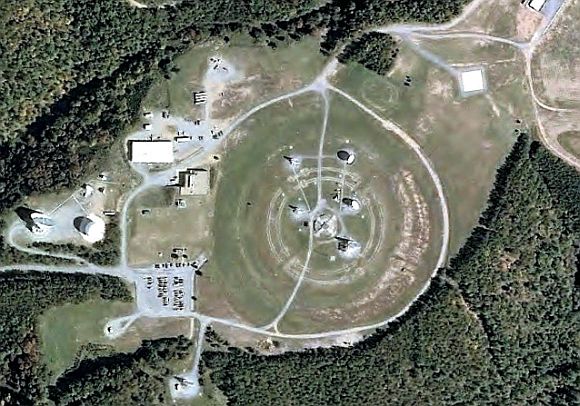
OK. The private sector is a labyrinth. How about US government operations? This is where one might hope to learn more about the super secret electronic eavesdropping facility at Sugar Grove.

Sugar Grove, nestled in the mountains of West Virginia, is the location of an NSA facility which forms part of ECHELON, a global system of communications surveillance. More information can be found at the Navy Information Operations Command for the base — that is, if you have no qualms about agreeing to a Department of Defense consent agreement that says the US Government will thereafter have the right to seize your computer at any time! I’m not kidding.

And what do we learn about Sugar Grove in Top Secret America? Virtually nothing. It’s a red dot on the map (see the image at the top of this article).

But here’s the worst thing about Top Secret America: it is journalism that instead of providing in-depth exposure to a major political story will more likely have the effect of inoculating the issue.

While this country needs a wake-up call to the fact that its government is still locked in a Bush era fixation on national security, instead we are being cautioned that the crux of the issue primarily one of size. The national security industry in the US has grown out of control — oh yeah, I saw that report in the Washington Post. Big government. What’s new?

Sugar Grove, West Virginia - part of top secret America too secret for Top Secret America

Facebooktwittermail

America’s national security protection racket

Every year, the images of a national security state careening out of control, as depicted in Terry Gilliam’s 1985 movie Brazil, become eerily more realistic. In his Ministry of Information, the underlings sneak their entertainment when the overseer steps out of sight, but at the National Counterterrorism Center (a “dumping ground for bad analysts“), entertainment (otherwise known as cable news) is on constant big-screen display.

The Washington Post‘s investigation into “Top Secret America” reveals two sadly predictable tendencies:

1. That the default position inside the US government remains: any problem can be solved if enough money is thrown at it, and
2. the primary responsibility of an investigative reporter dealing with a story like this is supposedly to focus on whether taxpayers’ money is being well-spent and making us safer.

The first feature article in the series says:

At least 20 percent of the government organizations that exist to fend off terrorist threats were established or refashioned in the wake of 9/11. Many that existed before the attacks grew to historic proportions as the Bush administration and Congress gave agencies more money than they were capable of responsibly spending.

The Pentagon’s Defense Intelligence Agency, for example, has gone from 7,500 employees in 2002 to 16,500 today. The budget of the National Security Agency, which conducts electronic eavesdropping, doubled. Thirty-five FBI Joint Terrorism Task Forces became 106. It was phenomenal growth that began almost as soon as the Sept. 11 attacks ended.

Nine days after the attacks, Congress committed $40 billion beyond what was in the federal budget to fortify domestic defenses and to launch a global offensive against al-Qaeda. It followed that up with an additional $36.5 billion in 2002 and $44 billion in 2003. That was only a beginning.

With the quick infusion of money, military and intelligence agencies multiplied. Twenty-four organizations were created by the end of 2001, including the Office of Homeland Security and the Foreign Terrorist Asset Tracking Task Force. In 2002, 37 more were created to track weapons of mass destruction, collect threat tips and coordinate the new focus on counterterrorism. That was followed the next year by 36 new organizations; and 26 after that; and 31 more; and 32 more; and 20 or more each in 2007, 2008 and 2009.

In all, at least 263 organizations have been created or reorganized as a response to 9/11. Each has required more people, and those people have required more administrative and logistic support: phone operators, secretaries, librarians, architects, carpenters, construction workers, air-conditioning mechanics and, because of where they work, even janitors with top-secret clearances.

The report continues:

Not far from the Dulles Toll Road, the CIA has expanded into two buildings that will increase the agency’s office space by one-third. To the south, Springfield is becoming home to the new $1.8 billion National Geospatial-Intelligence Agency headquarters, which will be the fourth-largest federal building in the area and home to 8,500 employees. Economic stimulus money is paying hundreds of millions of dollars for this kind of federal construction across the region.

It’s not only the number of buildings that suggests the size and cost of this expansion, it’s also what is inside: banks of television monitors. “Escort-required” badges. X-ray machines and lockers to store cellphones and pagers. Keypad door locks that open special rooms encased in metal or permanent dry wall, impenetrable to eavesdropping tools and protected by alarms and a security force capable of responding within 15 minutes. Every one of these buildings has at least one of these rooms, known as a SCIF, for sensitive compartmented information facility. Some are as small as a closet; others are four times the size of a football field.

SCIF size has become a measure of status in Top Secret America, or at least in the Washington region of it. “In D.C., everyone talks SCIF, SCIF, SCIF,” said Bruce Paquin, who moved to Florida from the Washington region several years ago to start a SCIF construction business. “They’ve got the penis envy thing going. You can’t be a big boy unless you’re a three-letter agency and you have a big SCIF.”

SCIFs are not the only must-have items people pay attention to. Command centers, internal television networks, video walls, armored SUVs and personal security guards have also become the bling of national security.

“You can’t find a four-star general without a security detail,” said one three-star general now posted in Washington after years abroad. “Fear has caused everyone to have stuff. Then comes, ‘If he has one, then I have to have one.’ It’s become a status symbol.”

Among the most important people inside the SCIFs are the low-paid employees carrying their lunches to work to save money. They are the analysts, the 20- and 30-year-olds making $41,000 to $65,000 a year, whose job is at the core of everything Top Secret America tries to do.

At its best, analysis melds cultural understanding with snippets of conversations, coded dialogue, anonymous tips, even scraps of trash, turning them into clues that lead to individuals and groups trying to harm the United States.

Their work is greatly enhanced by computers that sort through and categorize data. But in the end, analysis requires human judgment, and half the analysts are relatively inexperienced, having been hired in the past several years, said a senior ODNI official. Contract analysts are often straight out of college and trained at corporate headquarters.

Nine years after the 9/11 attacks, the United States has a bloated national security structure of questionable effectiveness, at fantastic cost, and with very little accountability. Yet the analysis implies that if the system was more efficient and could indeed deliver as promised by making America safer, then this would indeed be a good thing.

But do we need to be safer or simply less afraid?

The explosion in the growth of the national security economy occurred right at the moment that the technology industry was desperate for support. The internet bubble had burst, an IPO no longer offered a path to quick fortunes for companies that had yet to develop an effective business model, so if the stock market was no longer willing to throw mountains of cash at speculative technological innovation, in the post 9/11 economy, the US government quickly became the investor of choice — at least for companies that could make a halfway plausible claim that their niche expertise might in some way enhance US national security.

If greed was the engine of economic growth of the 90s, fear has demonstrated its economic value for most of the last decade. But what neither greed nor fear do is to improve the quality of life. That only happens when we look at the ways our lives are impoverished and address those needs.

The need to feel safer is a need that has in large part been manufactured by those eager to capitalize on the economic value of fear.

Just suppose that after 9/11 George Bush’s response had been this: clean up the mess in New York and Washington, improve security on airlines so no one could hijack a plane with a pocket knife, and then be done with it. Would we not now be living in a much better world?

Perhaps we should be less afraid of those who might attack us than those who are in the business of protecting us. Top secret America looks like the biggest protection racket ever created.

Facebooktwittermail

Qualitative Military Edge — another name for Israeli brutality backed by the US

On October 15, 2008, just three weeks before the US presidential election, George Bush signed into law the Naval Vessel Transfer Act which had been sponsored by one of Israel’s most loyal supporters in the US Congress, Rep. Howard Berman.

The new law, which from its title might have been assumed to relate primarily to the sale of ships from the US Navy to foreign governments, actually had a much more important purpose: to place every American president under a legal obligation to ensure that Israel maintains its military dominance over the Middle East.

What had previously been a matter of foreign policy, suddenly became law — law written to meet the interests of a foreign government.

Israel’s regional hegemony is legally enshrined in the concept of Israel’s “Qualitative Military Edge” (QME). The US Government must now guarantee that “the sale or export of the defense articles or defense services will not adversely affect Israel’s qualitative military edge over military threats to Israel.”

The law states:

[T]he term ‘qualitative military edge’ means the ability to counter and defeat any credible conventional military threat from any individual state or possible coalition of states or from non-state actors, while sustaining minimal damages and casualties, through the use of superior military means, possessed in sufficient quantity, including weapons, command, control, communication, intelligence, surveillance, and reconnaissance capabilities that in their technical characteristics are superior in capability to those of such other individual or possible coalition of states or non-state actors. [Emphasis mine.]

Andrew J Shapiro is the Assistant Secretary of State for Political-Military Affairs. One of his primary responsibilities is to ensure that Israel maintains its qualitative military edge. Does he serve the US government or the Israeli government? It’s far from clear.

This is how he presented the United States’ obligation to serve Israel’s interests in a speech he delivered at the Brookings Institute in Washington on Friday:

For decades, the cornerstone of our security commitment to Israel has been an assurance that the United States would help Israel uphold its qualitative military edge — a commitment that was written into law in 2008. Israel’s QME is its ability to counter and defeat credible military threats from any individual state, coalition of states, or non-state actor, while sustaining minimal damages or casualties. The Obama Administration has demonstrated its commitment to Israel’s QME by not only sustaining and building upon practices established by prior administrations, but also undertaking new initiatives to make our security relationship more intimate than ever before.

Each and every security assistance request from the Israeli Government is evaluated in light of our policy to uphold Israel’s Qualitative Military Edge. At the same time, QME considerations extend to our decisions on defense cooperation with all other governments in the region. This means that as a matter of policy, we will not proceed with any release of military equipment or services that may pose a risk to allies or contribute to regional insecurity in the Middle East.

The primary tool that the United States uses to ensure Israel’s qualitative military edge is security assistance. For some three decades, Israel has been the leading beneficiary of U.S. security assistance through the Foreign Military Financing program, or FMF. Currently, Israel receives almost $3 billion per year in U.S. funding for training and equipment under FMF. The total FMF account is $5 billion annually and is distributed among some 70 countries. So it is a testament to our special security relationship that each year Israel accounts for just over 50 percent of U.S. security assistance funding distributed through FMF.

The Obama Administration is proud to carry on the legacy of robust U.S. security assistance for Israel. Indeed, we are carrying this legacy to new heights at a time when Israel needs our support to address the multifaceted threats it faces.

For Fiscal Year 2010, the Administration requested $2.775 billion in security assistance funding specifically for Israel, the largest such request in U.S. history. Congress fully funded our request for FY 2010, and we have requested even more — $3.0 billion — for FY 2011. These requests fulfill the Administration’s commitment to implementing the 2007 memorandum of understanding with Israel to provide $30 billion in security assistance over 10 years.

This commitment directly supports Israel’s security, as it allows Israel to purchase the sophisticated defense equipment it needs to protect itself, deter aggressors, and maintain its qualitative military edge. Today, I can assure you that — even in challenging budgetary times — this Administration will continue to honor this 10-year, $30 billion commitment in future fiscal years. [Emphasis mine.]

Code Pink’s Medea Benjamin challenged Shapiro during Q&A:

[I]t pains me to hear you sound more like an agent of the Israeli government than a U.S. representative because as you travel around the world you see that this “special relationship” really endangers us, makes us more hated around the world. So I wonder if you would be willing to step in other shoes and go to Gaza, see the results of the Israeli invasion there, see the destruction, talk to people in Gaza, talk to the elected government, which is Hamas. You don’t have to like them to talk to them. I also wonder if you’ve spent any time with people in the West Bank and East Jerusalem to see what it feels like for Palestinians, the daily humiliations they suffer.

And I also wonder, given the financial crisis here at home and the great needs of impoverished nations around the world, couldn’t you think of a better use of $3 billion than giving it to a wealthy country like Israel that is abusing the human rights of Palestinians on a daily basis?

Benjamin drew a round of applause — Shapiro declined to respond directly to her challenge.

As Shapiro noted, the concept of Israel’s QME has been in use for decades, but it was only when the Bush administration let Israel draft American law, that QME turned into a license to use force with impunity.

In January 2008, William Wunderle, a U.S. Army lieutenant colonel, and Andre Briere, a U.S. Air Force lieutenant colonel, wrote in a paper for The Washington Institute for Near East Policy:

The US commitment to maintain Israel’s qualitative military edge (QME) is a long-standing tradition that every president since Lyndon Johnson has maintained and reiterated. The basic principle behind this commitment is simple: Israel is a bastion of liberal representative government in the Middle East, and, as such, its continued survival is a vital national interest of the United States. To ensure this longtime ally’s continued existence in a sea of nations that reflexively call for its destruction, Israel must be able to defend itself militarily and deter potential aggression. In this effort, Israel will always be militarily outnumbered with regard to the artillery, tanks, and combat aircraft that can be deployed by a coalition of Arab states. Israel’s continued survival can be ensured only if it is able to maintain qualitative military superiority, relying on superior weaponry, tactics, training, leadership, and other factors of military effectiveness to deter or defeat its numerically superior adversaries in the Middle East.

In other words, the US policy advocated that Israel should be able to counter a quantitative disadvantage with a qualitative advantage. It said nothing about supporting Israel’s use of that advantage at minimal cost. The expression after all was qualitative military edge — not supremacy.

These analysts noted however that:

Israel defines QME as “the ability to sustain credible military advantage that provides deterrence and, if need be, the ability to rapidly achieve superiority on the battlefield against any foreseeable combination of forces with minimal damage and casualties.”

The Israeli phrasing went straight into US law which says that Israel must maintain the ability to use military force “while sustaining minimal damages and casualties.”

Let’s put that in context. The law was signed just two years after Israel had visibly lost its qualitative military edge in Lebanon in 2006 when it faced Hezbollah, and less than three months before it used the assault on Gaza to once again demonstrate its ability to wreak massive destruction while sustaining minimal damages and casualties.

The war on Gaza, which President-elect Obama watched in silence, showed not merely the brutality that Israel is willing to use under America’s political protection, but the extent to which Israel’s military agenda is empowered through its ability to control the United States Government.

The war on Gaza was QME in action.

Facebooktwittermail

A one-state solution from the Israeli right

Who are the enemies of peace in the Middle East? No list can be comprehensive, but a shortlist should include a few individuals who present themselves as messengers of peace: Barack Obama, George Mitchell, J Street’s Jeremy Ben-Ami, Tony Blair…

In a word, the proponents of the two-state solution have become the enemies of peace.

A young Israeli leader says:

The assumption of the left is that once it hides behind the international border, everything will be permitted. But it’s clear already now that not everything is permitted and that the principle of proportionality is shackling Israel in Gaza — so what will happen in Judea and Samaria [the West Bank]? In fact, it goes even deeper. There is a moral failure here. After all, the left has long since stopped talking about peace and is resorting to a terminology of separation and segregation. They are also convinced that the confrontation will continue even afterward. The result is a solution that perpetuates the conflict and turns us from occupiers into perpetrators of massacres, to put it bluntly. It’s the left that made us a crueler nation and also put our security at risk.

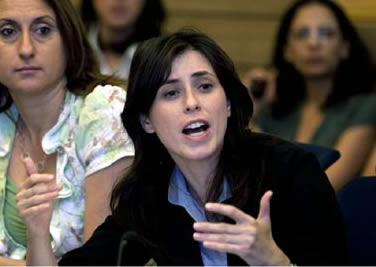
This is Tzipi Hotovely from Likud, the youngest member of the Knesset and a proponent of some radical rethinking on the Israeli-Palestinian conflict. “The taboo that forbids talk about any option other than the two-state solution is almost anti-democratic. It’s like brain-gagging,” says Hotovely.

The one-state solution generally associated with the Israeli right and the settler movement does not usually go by that name. Eretz Yisrael, or Greater Israel, comes in various sizes but to its proponents it is seen as land on which Jews belong and to which Palestinians can be allowed to make no claim. But as Noam Sheizaf describes in this week’s Haaretz magazine cover story, a new trend is emerging on the right presenting a one-state solution that would offer Palestinians equal rights and full citizenship in an expanded Israeli state that includes the whole of the West Bank.

A number of figures on the right are presenting their own versions of this vision and so far they have not formed a political camp, yet many of their observations are based on a political realism that cannot be found among liberal Zionists. Indeed, they expose the fact that the advocates of a two-state solution are not merely victims of wishful thinking; they now bear the primary responsibility for the perpetuation of the conflict.

A one-state solution promoted by diehard Zionists might sound too toxic an idea for any Palestinian to entertain seriously, yet who can currently question the assertion that the prospects for the creation of a sovereign Palestinian state have never looked so bleak?

Perhaps more to the point, it needs to be remembered that the creation of a Palestinian state is and always has been a false promise if regarded as an ultimate goal and not simply a means to an end.

The goal of every legitimate political struggle is the creation of a fair society. Each struggle focuses on the most glaring forms of injustice — discrimination based on class, ethnicity, gender, sexual orientation, nationality, or faith. But as these struggles coalesce around the specific forms of inequality they seek to redress, they often lose sight of their overarching purpose by allowing political means to be turned into political goals. Rather than diluting the power of political elites, one elite ends up making way for another. The fact that a new elite might have closer ties to a wider population will allow it to operate in a more sympathetic context, but sooner or later the core political problem will reemerge: that any majority cannot indefinitely tolerate being governed by a minority whose primary loyalty is to its own narrow interests.

The one-state rightwing Zionists — at least as they are presented in this Haaretz article — are unequivocal in asserting that they refuse to abandon the requirement that Israel remains a Jewish state. What they fail to explain is how in practice Jews and non-Jews would have equal rights if, for instance, Jews retained the privilege enshrined in the Law of Return.

Moshe Arens says: “first of all, we need to take care of the Israeli Arabs who are citizens. That is also essential if we are thinking of giving citizenship to Palestinians from Judea and Samaria [the West Bank]. Only if they see that the Arabs have it good in Israel will they think it might be good for them, too.”

OK. But this begs the question: why is it that 62 years after its creation, Israel has not bridged the gap between its nature as a Jewish state and its claim to be a democratic state? Does its failure to take care of its non-Jewish citizens not expose the inherent contradiction in trying to merge the state’s Jewish and democratic identities?

A single state as envisioned by figures on the Israeli right may be more viable than the two-state solution, but eventually it will have to shed the shackles to which Zionism has always been bound: the idea that there can ever be any legitimacy to any form of ethnic or religious supremacy.

Facebooktwittermail

An Iranian nuclear espionage mystery

ABC News reports:

The CIA has lost one of its most valued former spies.

Iranian nuclear scientist Shahram Amiri, who defected to the US, is now on his way back home to Tehran after a very messy and public re-defection. ABC News obtained exclusive photos of Amiri leaving Washington’s Dulles International Airport late Tuesday night on a commercial flight to Doha, Qatar, en route to Iran.

Amiri was escorted directly to the jetway entrance by a security officer. He was flanked by what appeared to be a U.S. official and a representative from the Pakistani Embassy in Washington. He boarded the Qatar Airways flight ahead of the other passengers, and spoke only to his companions. After more than a year in the US, Amiri claimed he had never really defected. In a series of videos released on the internet, he insisted that he had been kidnapped, drugged and tortured by the CIA. The US flatly denies that it ever held Amiri against his will.

The Washington Post columnist and unofficial spokesman for the CIA, David Ignatius, attributes Amiri’s departure to a change of heart.

The CIA has struggled for decades with how to handle defectors better so that they are happy in a strange new land. The agency periodically tries to improve its tradecraft in working with these skittish guests. But defectors are trouble. They are like small boats in a heavy sea, not sure which way is home.

But Ignatius concedes that it is hard to understand why the Iranian scientist would have defected while leaving his wife and child behind. That detail, along with the deaths of Ardeshire Hassanpour and Masoud Alimohammadi, might seem to reinforce the claim that Amiri was in fact abducted and that all three cases be seen in the context of a US-backed, Israeli-led covert war targeting Iran’s nuclear programme.

What seems more likely however, is that the Iranians took the CIA for a ride — that Amiri’s “defection” took place so the Iran could glean more about the extent of American knowledge about its nuclear program and that the information he gathered was worth more valuable than the information he gave away.

Facebooktwittermail