Category Archives: Editorials

CAMPAIGN 08 EDITORIAL: With attention to the unseen

Words in context

Suppose Thomas Jefferson and the other founding fathers of American democracy had been able to see into the future. As they looked forward to the America of 2008, what would have held their attention more firmly?

That the society they helped form was to make such significant advances towards equality that two people who once would not even have been able to vote would now be vying to become president?

Or, that a momentous democratic choice might hinge on the effect of a few emotive phrases uttered by a man not even running for office?

A couple of days ago in Time magazine, Joe Klein wrote:

Whether Obama survives now will depend on the most important and overlooked part of his speech [in Philadelphia] — the final section, in which he challenged the public and, especially, the media to stow the sensationalism: “We can play Reverend Wright’s sermons on every channel, every day … and make the only question in this campaign whether or not the American people think that I somehow believe or sympathize with his most offensive words,” he said. “But if we do, I can tell you that in the next election we’ll be talking about some other distraction … And nothing will change … Or, at this moment in this election, we can come together and say, ‘Not this time.'”

And that is the existential challenge of 2008: whether we will have a big election or a small one. Will we have a serious conversation about the enormous problems confronting the country — the wars, the economic crisis, the looming environmental cataclysm — or will we allow the same old carnival of swift boats and sound bites? The answer depends on the candidates, of course, and on the media — where cynicism too often passes for insight. But most of all, it depends on you.

Klein notes that Obama challenged the public “and especially the media” to turn away from the distractions that could prevent this from being “a big election,” yet he almost immediately lets the media off the hook. The existential challenge of 2008, he says, most of all “depends on you.”

Taken literally, that’s indisputable. We’re the ones who get to decide how we vote. Yet what Klein does — what everyone in the media does when their preeminent loyalty attaches to their paycheck — is to refuse to point a spotlight on the individuals who shape the news from the shadows.

In every single newsroom on every single day, commercial and political decisions are being made while cloaked under the pretense that events themselves are the overwhelming force that steers editorial judgment. But consider how little we actually know about the decision-making process that triggered what has become the most explosive story in the presidential campaign.

On Good Morning America on March 13, Brian Ross with the stealth of a terrorist who is just about to set off a bomb, uttered these seemingly innocent words: “… an ABC News review of more than a dozen sermons… ” — and we all know what followed.

What we don’t know, but what could be as illuminating as the DVDs themselves, is what led ABC News to be conducting a review of Rev Jeremiah Wright’s sermons in the first place.

For months, everyone who had been paying much attention knew that Wright’s connection with Obama had the potential to wreak political havoc. In an interview with the New York Times in March 2007, Rev Wright’s explanation for why he had been disinvited from Obama’s presidential announcement was that the senator had told him, “You can get kind of rough in the sermons, so what we’ve decided is that it’s best for you not to be out there in public.”

It was a decision that drew criticism from other black leaders because, as Al Sharpton put it, “the issue is standing by your own pastor.” A month earlier, a Rolling Stone article had identified Wright as an emblem of Obama’s “radical roots.” And a year later, Tim Russert as presidential debate moderator-cum-inquisitor had cited Wright in order to find out whether Obama was willing to denounce and reject Louis Farrakhan.

So, while every cable news channel has followed ABC News‘ lead and made Rev Wright campaign issue #1, no one has been pressing the ABC News investigative team to explain how exactly it came to set the political agenda.

Was the Good Morning America story the fruit of a tenacious piece of investigative journalism, or might it on the contrary have been an altogether lazy piece of journalism — a case of someone saying, “Here’s the ammo. All you need to do is load and fire”?

When news isn’t new then this issue of timing means that newsmaking is taking place inside the newsroom. The media has become manufacturer. Might we be allowed to become privy to the process?

For instance, it’s obvious why the ABC News editors would deem a line such as “America’s chickens are coming home to roost” as newsworthy. But how did they decide that most of what came immediately after that line was irrelevant. Would most Americans not have responded in a different way if they had then heard Wright say:

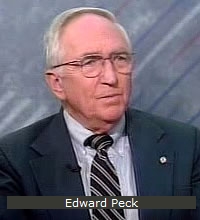
Violence begets violence. Hatred begets hatred. And terrorism begets terrorism. A white ambassador [Edward Peck] said that y’all, not a black militant. Not a reverend who preaches about racism. An ambassador whose eyes are wide open and who is trying to get us to wake up and move away from this dangerous precipice upon which we are now poised. The ambassador said the people we have wounded don’t have the military capability we have. But they do have individuals who are willing to die and take thousands with them. And we need to come to grips with that.

edward-peck.jpgRev Wright was telling his congregation, pay attention to this white man, Edward Peck. It’s worth listening to what he has to say. It’s worth taking into consideration the opinion of a man who had been the Deputy Director of the White House Task Force on Terrorism under President Ronald Reagan, former Deputy Coordinator, Covert Intelligence Programs at the State Department, U.S. Ambassador and Chief of Mission to Iraq (1977-1980), and a 32-year veteran of the Foreign Service. At least, as far as Rev Wright was concerned, Edward Peck was worth listening to and that’s what he told his congregation.

On October 8, 2001, on CNN, Peck was asked: “Wouldn’t this war against terrorism be a mistake if we stop at Osama bin Laden and don’t take out Saddam Hussein as well?”

Peck said it would not be a mistake because, “when you take out Saddam Hussein, the key question you have to ask then is, what happens after that? And we don’t have a clue. Nobody knows, but it’s probably going to be bad. And a lot of people are going to be very upset about that, because that really is not written into our role in this world is to decide who rules Iraq.”

Rev Wright suggested that “in the wake of the American tragedy” of 9/11, in a process of self-examination, it would really be in America’s interests to listen to people such as Edward Peck. ABC News and much of the rest of the media would rather that we pay attention to a few ill-chosen phrases.

Facebooktwittermail

CAMPAIGN 08 & EDITORIAL: When did betrayal become a duty?

When did betrayal become a duty?

According to the conventional wisdom among those who understand the way politics works, Barak Obama has for several days needed to do something with Rev Jeremiah Wright: “throw him under the bus.”

Obama refused to do so. He refused to treat his association with his pastor as a liability that political expediency would dictate he must disown. Some might see that as a foolish act of loyalty, yet if we were to pause for a moment there might be another and much more obvious explanation — an explanation that Obama himself has already provided: the YouTube clips of Rev Wright are not the definitive representation of who he is.

Consider for a second something that seems to have received very little if any attention. For a week we have been seeing the same clips over and over again. If these truly provide a well-rounded representation of Rev Wright’s character, why have we not seen more? We know these clips came from DVDs of sermons freely available. There must be hours of sermons from which other clips could be taken, so why just these few fleeting snippets?

The most obvious explanation is that so far, for no lack of effort, no one has been able to cull anything else that is particularly damning. Indeed, anything else might actually have the effect of diluting the impact of what has already been so widely disseminated. In other words, if people saw more of Rev Wright they might find him much less shocking.

It is presumably for that reason that Trinity Church has made other YouTube clips available. Critics will no doubt regard this as an effort at damage control, yet when the church says that they see their pastor as a victim of a “modern-day lynching,” it’s not hard to understand why — especially if you take the time to listen to some of the other things he has to say.

Here then are a couple of clips of Rev Wright (and one his successor, Rev Otis Moss III) that are unlikely to appear on Fox News, CNN or ABC any day soon:

Congregation defends Obama’s ex-pastor

The Rev. Jeremiah Wright spent 36 years teaching this congregation how to recognize injustice, and his parishioners sense it all around them now. On Sunday, more than 3,000 of them filled Trinity United Church of Christ on the city’s South Side to pray for their former pastor. They read a handout that described Wright’s newfound infamy as a “modern-day lynching.” They scrawled his name in tribute on the inside of their service programs and applauded as Wright’s protege, the Rev. Otis Moss III, stepped to the pulpit.

“No matter what they want,” Moss said, “we will not shut up.”

A simmering controversy over Wright’s provocative rhetoric and his connection to Sen. Barack Obama ignited last week after some of his old sermons were aired, prompting the Democratic presidential candidate to condemn them and severing Wright’s connection to the campaign. But inside this mega-church that Wright built up from financial ruin, his most loyal listeners offered a different interpretation: It is Wright, and black theology in its entirety, that is misunderstood. [complete article]

Facebooktwittermail

CAMPAIGN 08 EDITORIAL: Rising to the Wright challenge

Rising to the Wright challenge

The “dirt” on Rev. Jeremiah Wright has been around for years, so why has ABC News chosen to highlight Obama’s controversial pastor now?

The race fire has been lit and those who believe it serves their political interests are happy to pour fuel on the flames.

How should Obama respond? It’s time for some jujitsu.

Let’s not confuse the package with the content.

In and of themselves, Wright’s statements are not totally outrageous. (I know. Some people will think it’s outrageous for me to say that.) What makes what he’s saying so inflammatory isn’t just what he’s saying but the way he’s saying it:

Wright is the scary, fiery, black preacher: the kind who might incite an insurrection. Contrast his tone, his body language, and his theatrical force with the calm, comforting, sensible message and sweet tone that comes from some of America’s favorite gentle men of God, Jerry Falwell and Pat Robertson:

Unless Wright’s passion — Wright’s unwhiteness — is really the issue, then instead of responding to his statements with some new formulation of reject-and-denounce, how about grabbing this bull by the horns and saying, OK, you want race to be a campaign issue? Let’s go for it!

“God damn America for treating our citizens as less than human,” says Rev Wright. Is this pure anti-American vitriol, or does Wright have a point?

One in a hundred Americans are behind bars.

That America, the land of the free, should have more people in prison than any other nation on earth is an issue that surely merits national attention.

If America’s prison population of 2.3 million was confined to one state, it would be a state bigger than New Mexico.

Among 20-34 year old black men, one in nine is incarcerated. This is a social disaster and it should be a national disgrace.

When it comes to issues such as this, the only people who can hold their hands on their hearts and say God Bless America are the shareholders of companies like Corrections Corporation of America who have seen their stock value and revenues steadily increase for the last eight years.

What should we be talking about? Rev Wright’s intemperate rhetoric? Or some of the things he’s calling attention to — even if he calls so loudly he might be hard to hear?

Facebooktwittermail

CAMPAIGN 08 EDITORIAL: A monstrous attack?

A monstrous attack?

What’s worse? Being called a monster, or being likened to Kenneth Starr? I guess it depends on who’s keeping score.

samantha-power.jpgSamantha Power could have referred to Hillary Clinton as Lady Macbeth. She could have said that Barak Obama’s Democratic opponent is displaying an “unalloyed lust for power.” She could have said that Clinton seems to have become “unhinged” — so desperate to win the nomination that she is jeopardizing the Democratic party’s chances of winning back the White House.

Had she said any of these things, Power would now still be a key adviser to Senator Obama. Instead, she used the utterly shocking word “monster.” She fucked up — and at the very same time that she was acknowledging that the Obama campaign “f***** up in Ohio.” (Note that The Scotsman, a newspaper whose journalistic integrity compelled to run with this important story, is also so high-minded that it must protect its readers from the shocking f-word.)

This then is the state of politics and the way it gets reported: lies, distortions, exaggeration and deviousness provoke neither shock nor penalty, but an ill-chosen word and an indiscreet honest expression — this is what must always be denounced and rejected.

Power needed to acknowledge that she had blundered, but she didn’t need to resign. Her remarks were inexcusable not because of their content but because she was dumb enough to express them to a reporter.

Facebooktwittermail

CAMPAIGN 08 EDITORIAL: How was Hillary tested?

How was Hillary tested?

crisis-manager.gif

It’s 3 a.m. and your children are safe and asleep. But there’s a phone in the White House and it’s ringing.

Something’s happening in the world. Your vote will decide who answers that call, whether it’s someone who already knows the world’s leaders, knows the military — someone tested and ready to lead in a dangerous world.

It’s 3 a.m. and your children are safe and asleep. Who do you want answering the phone?

We’ve all seen the “red phone” ad — an ad that implicitly questions whether Barak Obama has enough experience to deal with an international crisis. Hillary Clinton has been tested and is ready to lead in a dangerous world — or so we are meant to believe.

But that begs the question: what was the test? CNN anchor Kiran Chentry pressed Clinton for an answer:

Can you tell us what specific experience in handling a crisis that you can point to that would make you better equipped to handle that White House phone at 3 a.m.?

This is the first “specific experience in handling a crisis” that Clinton cited:

You know, I was involved for fifteen years in, you know, foreign policy and security policy — you know, I helped to bring peace to Northern Ireland.

Hillary and her campaign have had five days to come up with her best shot at a credible answer to this question. On Feb 29, Mark Penn, Howard Wolfson and Lee Feinstein, Clinton’s national security director, were stumped. The best they could come up with after a very long pause was to say she’s been endorsed by many high ranking members of the uniformed military.

So, when Hillary puts bringing peace to Northern Ireland at the top of her national security resume — the best example she has of a specific experience she’s had in handling a crisis — she must be on solid ground. Right? Apparently not.

While she played a role in the Northern Ireland Process, she had no direct part in the negotiations. This is confirmed by Senator George Mitchell, the Clinton administration’s leading Northern Ireland peace negotiator.

Hillary helped organize seminars and conferences under the banner of ‘Vital Voices‘ which particularly engaged women in the Peace Process and built momentum towards the Good Friday Agreement. She also co-hosted with Bill a number of events in the White House around St Patrick’s Day, the Investment Conference and so forth. No doubt these were all valuable contributions in helping bring peace to Northern Ireland but by no stretch of the imagination can any of this be described as experience in handling an international crisis.

Hillary’s contribution to the peace process did not come in any 3am moments — these were more like 3pm interludes during which, in the words of a political reporter for the Belfast Telegraph, she contributed to the “mood music” that made an eventual settlement possible.

The Washington Post‘s Fact Checker who in January assessed Clinton’s claims about her role in Northern Ireland, concluded that it was “more symbolic than substantive.”

Foreign policy experience and familiarity with world leaders are obviously valuable assets in any newly-elected president, but the ability to handle a crisis cannot hinge on the notion that this is familiar territory. On the contrary, effective crisis management is all about having the temperament and the judgment to remain calm at the very moment when everyone is saying, “We didn’t see this coming. What do we do?”

Hillary wants us to rely on her experience, yet when push comes to shove and she’s up against the reality that her experience is much more limited than she now claims, what will she do then? What will she do when at 3am she’s faced with a crisis and nothing in her experience provides her with a template for action?

The challenge for whoever answers the phone at 3am is not one of memory recall. It’s not about thinking I’ve been here before so I know what to do. Least of all is about a gnawing awareness that I claimed I was here before so I better pretend I know what to do.

It’s about calmness and clarity. It’s about confidence in the capabilities of the administration that you put together. It’s about having the diligence to stay well-briefed. It’s about not getting knocked off balance when suddenly you enter unfamiliar territory. At the most critical moment, it’s about having a clear eye in the face of the unforeseen.

Facebooktwittermail

CAMPAIGN 08 EDITORIAL: The Obama cult meme

The Obama cult meme

“I just have a very bad feeling about the way things are going,” says Paul Krugman in the New York Times as he anticipates the “backlash against Obamamania.”

“Barack Obama, the wunderkind of US politics, has long basked in adulatory press coverage for his historic White House bid — but a media backlash appears to be building,” reports Jitendra Joshi for AFP. “Some Obama supporters fret already that his campaign has the trappings of a messianic cult, as thousands upon thousands pack auditoriums to bask in his uplifting oratory.”

“Obama’s high-flown, inspirational rhetoric often feeds into the impression of a political campaign veering into the realms of religion – never more so than when he declared in a victory speech that ‘we are the ones we’ve been waiting for,'” writes Helen Kennedy in the New York Daily News. “The line is the title of a 2006 Alice Walker book, but some saw it as another sign of the emerging Cult of Obama.”

And in Slate, John Dickerson asks, “Isn’t the generation that Obama has so successfully courted usually the first to toss overhyped products, even the overhyped products with which they were at first so enthralled? More generally, shouldn’t Democrats who have complained that George Bush was elected on the strength of a popularity contest be nervous that this blossoming Obamadulation is getting out of hand?”

So what’s going on here? Charles Krauthammer notes that in his post-Super Tuesday string of wins, “Obama has been able to win these electoral victories and dazzle crowds in one new jurisdiction after another, even as his mesmeric power has begun to arouse skepticism and misgivings among the mainstream media.”

There’s a message in that for Mr Krauthammer et al: the opinion writers and the talking heads — the media sages whose knowledge of politics has so much greater depth than the average Joe — are actually wielding very little influence. Who’d’ve thunk it? Of course many of them would in false modesty dismiss any suggestion that they are attempting to exercise influence, but at the very least, these are the people who make a living on the claim they know how to take a political pulse.

The backlash — and it is clearly a media backlash — probably has much more to do with journalism than it has with what’s going on across America. Journalists like to play a game of political impartiality. It’s never particularly convincing, but anyone who’s getting paid to be a messenger doesn’t want to be accused of distorting the message. At the same time, journalists are people and if the story you’re covering involves large numbers of people being swept up by a wave of enthusiasm, it’s hard not to get infected by at least a smidgen of that enthusiasm. The media backlash is an effort through which the media is now trying to disinfect itself.

So now let’s turn to the cult question — though first I should spell out where I stand.

I didn’t pay too much attention to the presidential race until the beginning of the primaries. I haven’t signed up on the mailing lists of any of the campaigns. I haven’t attended any political rallies. I don’t find “Yes We Can” a particularly compelling or moving slogan. The will.i.am “Yes We Can” video didn’t make me want to chant along — I can only name three of the people in it and one them is Barak Obama. I see change as the one certainty in life and thus not a choice. But when it comes time to vote, unless something totally unexpected happens, I’ll be voting for Obama. I will not be acting under the influence of a higher power.

Since the word “cult” has now been used so widely, the first thing we need to do is get clear about the defining characteristics of a cult. Some social scientists like to run through a checklist to determine whether a social grouping should be called a cult, but anyone who has encountered one or been in one knows that they are actually quite easy to distinguish.

The single most important feature of a cult is that it involves the sublimation of individual will and judgment through surrender to an external authority. That authority may come in the form of a charismatic teacher or it may be suffused across a group. In either case a social order exists that undermines the validity, authenticity, and moral authority of the cult member’s personal autonomy and judgment. Let thy will — not my will — be done.

This is where cults and social movements intersect. Both attach a higher value to the social fabric than to its individual strands. Where they differ — and this is all-important — is that one attempts to be inclusive in a widening circle of solidarity, whereas the other sees itself located in a spiritually embattled world. On the inside are the chosen, the saved, the enlightened; on the outside are lost souls. Social movements are in the business of empowering individuals collectively, not saving them.

By this measure, there is no cult of Obama. At the same time, Obama obviously has a fan base and some Obama fans can be as goofy as any others. Where the cult-analysis gets the Obama phenomenon completely wrong is the implication that the mass rallies are a vanguard that somehow sucks in much wider support.

Charles Krauthammer wants his readers to believe that we are witnessing the greatest political scam of all time as a “silver-tongued freshman senator has found a way to sell hope,” that he doesn’t attempt to explain how Obama closes the sale. Everyone acknowledges that Obama is appealing, inspiring and a great speaker, but these observations don’t explain the Obama phenomenon.

If the product was all in the packaging, the Obama product has plenty of strong selling points: good looks, an easy smile, a golden baritone, a rousing orator. But that isn’t enough. He’s also a bit skinny, looks even more youthful than his mere 46 years, and his debating skills don’t match his speaking skills.

No, the Obama hook isn’t a silver tongue or a mysterious ability to provoke intemperate enthusiasm; it is that he is believable. He has pulled off a miracle that no one thought possible: in spite of his being a politician, people actually believe what he’s saying. What makes him believable is something anyone can recognize even if they don’t know its name: authenticity. This is more than sincerity. It isn’t simply that Obama means what he says but what he says resonates in who he is.

Whereas an election campaign can generally do more than prove or disprove the proposition of electability, Obama’s campaign is itself a demonstration of his ability to deliver what he promises in his presidency: that he can bring people together, bridge divisions, and inspire support. He isn’t just providing a foretaste of what an Obama presidency might look like and passing the litmus test of “looking presidential”; he’s exercising the closest thing to presidential leadership that anyone could have prior to entering office.

Facebooktwittermail

EDITORIAL: For the New York Times, self-confidence on ethics poses its own risk — prigs can fall too

New York Times Exclusive Rumor: McCain in bed with lobbyist… maybe… at least we talked to a couple of people who thought that some other people might think that it looked like that was happening… maybe… at least we thought this was fit to print… at least fit to print if The New Republic was going to run it anyway

gordonbennett.jpgJim Rutenberg, Marilyn W. Thompson, David D. Kirkpatrick, and Stephen Labaton, along with research by Barclay Walsh and Kitty Bennett — a veritable posse of journalists! Are they all hoping they have a shot at getting a Pulizer prize? I don’t think so. This is about strength in numbers. No one wants to carry the can for a story destined for a special place in the New York Times‘ hall of fame for lousy journalism.

Now if John McCain really was in bed with a lobbyist that would be real news. Not necessarily something that the Times could bring itself to condense into a pithy little, no-nonsense, blaring headline.

Instead we have this story: “For McCain, Self-Confidence on Ethics Poses Its Own Risk.” Which is to say, there are indications that John McCain may have exercised an error in judgment by thinking that his own confidence in his own integrity meant that others would share that same confidence even when presented with the appearance that he might in fact be acting with a lack of integrity. (R.D. Laing would appreciate that — read Knots and you’ll know what I mean.) Oh, and by the way, McCain might actually have been having an affair. But we don’t know that — we just know that a few people thought that might be happening, but we don’t know who those people are, just that they included two associates “who said they had become disillusioned with the senator.” And that’s news? Gordon Bennett!

Facebooktwittermail

EDITORIAL: Point of view

Point of view

On yesterday’s confessions page, the New York Times, with due humility and a heavy heart acknowledged that it had been unwittingly complicit in the ultimate journalistic crime. On Tuesday, a front-page article dealt with the case of Abdul Razzaq Hekmati, an Afghan war hero who died recently after five years detention in Guantanamo. The article included in the byline the name of a journalist who the editors of the Times were shocked and dismayed to discover was a man with a point of view.

Andy Worthington, a freelance journalist who worked on the article under contract with The New York Times and was listed as its co-author, did some of the initial reporting but was not involved in all of it, and The Times verified the information he provided.

The Times stands by the information in the article but it doesn’t want to stand by Mr Worthington. Why? Because, “he takes the position that Guantanamo is part of what he describes as a cruel and misguided response by the Bush administration to the Sept. 11 attacks. He has also expressed strong criticism of Guantanamo in articles published elsewhere.” Had the Times been aware that Mr Worthington was guilty of having an “outspoken position” his name would not have been allowed to enter the hallowed territory reserved for opinionless truth seekers like Judith Miller.

Facebooktwittermail

EDITORIAL: Neoconservatism 2.0

Neoconservatism 2.0

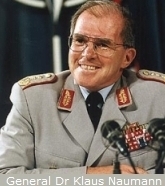
klaus-naumann.jpg“We cannot survive in a world in which we are confronted with people who do not share our values, who unfortunately are in the majority in terms of numbers, and who are extremely hungry to see success. So, if we want to survive, we have to stand together. And I think that is a view which the majority in Europe shares, and I think also the majority in the United States understands.”

When the post-Bush era starts a year from now, much of America and most of the world will let out a big sigh of relief. But we won’t be out of the woods. The leading neoconservatives might have been thoroughly discredited and effectively marginalized, but in a sense, they were always merely a caricature of important trends in the Western outlook that have much deeper roots, much greater breadth, and in the course of history have wrought much more destruction than did the small minds that shaped the Bush agenda.

Outside the glare of media attention a new circle of proponents of this outlook has emerged and their objectives are no less sweeping than those that gave rise to the neocons’ dream of a New American Century. The advocates of this new vision are regarded by others and see themselves as hard-headed realists. As retired generals, none will ever be dubbed a “chickenhawk.” But what the generals have in mind could very well provide the building blocks for what could fittingly be called, neoconservatism 2.0.

Important lessons have been learned. This time America won’t place itself in the bullseye as a target for global animosity. Instead, rather than striving for the preservation of the American hegemon, now the primary objective is the defense of the West, providing security for the citizens of every nation between Finland and Alaska. The Manichaean terms of a war of good against evil are being dropped; instead the conflict is being framed in dryly abstract terms: certainty versus irrationality. And just to make it clear that this is unequivocally about the preservation of secular Western preeminence, Zionism is kept well out of the picture.

The new message comes from a group of retired generals who self-effacingly describe themselves as “dinosaurs” and are known affectionately to their acolytes as “the gang of five.” Their aim is to restructure and empower NATO — a mission which will likely capture the interest of few outside the foreign policy communities on either side of the Atlantic. After all, how many Americans even know what the letters N-A-T-O stand for? Yet underpinning this objective there is a wider goal no less sweeping and not far removed from that advocated by Bernard Lewis, Norman Podhoretz and their merry band of followers: the defense of the West from the threat posed by those who do not share our values.

This time the plot unfolds not inside the reason-insulated walls of the American Enterprise Institute but instead comes from a bastion of realism, the Center for Strategic and International Studies in Washington DC. It was there recently that five distinguished military leaders presented their vision for a new world order in a manifesto they title, Towards a Grand Strategy for an Uncertain World – Renewing Transatlantic Partnership. [PDF] In his introduction to the so-called “Gang of Five,” CSIS president, John Hamre, described them as “some of the best minds that we have in defense intellectual circles”
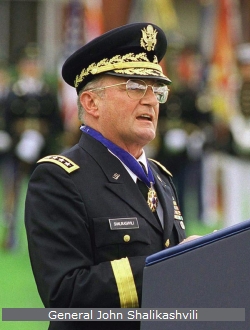
john_shalikashvili.jpgThey are, from the United States, former Chairman of the Joint Chiefs of Staff and former NATO Supreme Allied Commander in Europe, General John Shalikashvili, joined from Europe by General Dr Klaus Naumann (former Chief of the Defence Staff of Germany and former Chairman of the Military Committee of NATO), Field Marshal Lord Inge (former Chief of the Defence Staff of the United Kingdom), Admiral Jacques Lanxade (former Chief of the Defence Staff of France and former Ambassador to Tunisia) and General Henk van den Breemen (former Chief of the Defence Staff of the Netherlands). They have all served together in NATO.

Put together any group of retired generals and it’s predictable that they will hanker after some of their lost power, but when it comes to this particular group their credentials guarantee that even in retirement their authority is hard to ignore. As commentator Dr Pascal Boniface notes, one can assume that “former military chiefs of staff are not free riders. Their document is probably a way to test ideas for NATO’s current leaders: since the latter cannot afford to be so blunt publicly, they let their former colleagues do it for them.”

The palliative that the generals present for a Western world threatened by disorder should be seen for what it is — a martial vision:

We seek to uphold a common and stable experience, shunning the arbitrary in favour of closure in debate. Certainty can promote strong society and social interdependence. While 100 per cent certainty may be unattainable, it is clear that in periods of great – even overwhelming – uncertainty something serious is happening to our institutions and our societies.

Certainty in our world is today being eroded by a proliferation of information, knowledge and choice. The erosion of certainty is accelerated by rapid technological, social and cultural change. On occasion, that change occurs too fast for some of our major institutions to cope with.

In certain important senses, we are today operating in a mist. Through that current mist a wide range of challenges are appearing. The challenges are acute, and no less so because our certainties are in retreat. If they were stronger, our resolve to address these problems might have stiffened. But the loss of familiar certainties reveals that we lack such resolve.

While the generals have as their stated aim, to provide “security for the citizens of all nations between Finland and Alaska,” they clearly lack confidence that in its current state the West can save itself from the corrosive effects of irrationality. In their eyes, an insidious process has already weakened our culture. What they call, “the problem of the rise of the irrational,” the generals perceive in “soft examples, such as the cult of celebrity, which demonstrate the decline of reason,” and in “harder examples, such as the decline of respect for logical argument and evidence, a drift away from science in a civilisation that is deeply technological,” and finally in their ultimate example, “the rise of religious fundamentalism, which, as political fanaticism, presents itself as the only source of certainty.”

At this point one might say, they’re entitled to their opinion and at least in America, with its deeply-rooted anti-intellectual tendencies, we might welcome some strong voices willing to speaking out in defense of reason. Even if the outlook of the Gang of Five expresses a form of cultural imperialism, is it not at the same time in its own terms quite reasonable?

If the Grand Strategy often seems measured and thoughtful, it is not until we come to the generals’ views on deterrence that it becomes clear that this is a genuinely radical manifesto. Understandably this is the part of the document that caught a few headlines:

One truly indispensable element of any strategy in the 21st century is deterrence. This will no longer be deterrence by punishment, nor the threat of total destruction, which served us so well in preserving peace during the Cold War.

In the Post-Westphalian world, and against non-state actors, such deterrence does not work. What is needed is a new deterrence, which conveys a single, unambiguous message to all enemies: There is not, and never will be, any place where you can feel safe; a relentless effort will be made to pursue you and deny you any options you might develop to inflict damage upon us.

Deterrence in our time thus still avails itself of creating uncertainty in the opponent’s mind – no longer reactively but proactively. What is needed is a policy of deterrence by proactive denial, in which pre-emption is a form of reaction when a threat is imminent, and prevention is the attempt to regain the initiative in order to end the conflict.

As deterrence might occasionally either be lost or fail, the ability to restore deterrence through escalation at any time is another element of a proactive strategy.

Escalation is intimately linked to the option of using an instrument first. A strategy that views escalation as an element can, therefore, neither rule out first use nor regard escalation as pre-programmed and inevitable. Escalation and de-escalation must be applied flexibly. Escalation is thus no longer a ladder on which one steps from rung to rung; it is much more a continuum of actions, as though there is a ‘trampoline’ that permits the action to be propelled up into the sky at one moment and just to stand still the next.

Such a concept of interactive escalation requires escalation dominance, the use of a full bag of both carrots and sticks – and indeed all instruments of soft and hard power, ranging from the diplomatic protest to nuclear weapons. As flexible escalation and de-escalation are the crucial instruments in gaining and maintaining the initiative, fast decision making is of the essence. The traditional forms and methods of governments and international organisations will today (in a world of instantaneous global communications) no longer be capable of meeting this requirement. Thus a thorough review and adaptation is required. Nuclear weapons are the ultimate instrument of an asymmetric response – and at the same time the ultimate tool of escalation. Yet they are also more than an instrument, since they transform the nature of any conflict and widen its scope from the regional to the global. Regrettably, nuclear weapons – and with them the option of first use – are indispensable, since there is simply no realistic prospect of a nuclear-free world.

What might this mean in practical terms?

The future we are facing requires more, not less, international integration; but as the national state is – and will remain for the foreseeable future – the core of decision making, we must stress that governments need to think about adapting the organisation of government, as well as about dramatic changes in national decision making.

The generals regard winning “the hearts and minds of their own people” as one of the many challenges facing Western governments. They also believe that we have already entered a “Post-Westphalian world” in which the nation state has lost much of its power. While many observers who might share a similar view would see at this time a need for the rejuvenation of democracy, for these distinguished military thinkers the security of the West hinges on a “restoration of certainty” derived from a greatly empowered Western alliance under the auspices of NATO.

Whereas in the narrative of the post-Cold War history of nation states we were, until quite recently, living in a world where the power of the United States was unchallenged, the authors of the Grand Strategy implicitly envisage a new unipolar moment in which among international entities NATO can assume a position of unchallenged supremacy. They claim that NATO’s actions would remain tethered to the will of nation states (“the core of decision making”), yet the NATO they envision would appear to have more power and less accountability than the United States has had under George Bush. It would be led by a triumvirate directorate — the President of the United States, the Secretary General of NATO, and the soon-to-be-established President of the European Council. There can be little doubt that the latter two would be subservient to the former. And while the generals seem to be purposefully vague in saying that there need to be adaptations in the organization of government, along with “dramatic changes in national decision making,” the thinly-veiled implication is that NATO must be unshackled from the currently slow moving wheels of democracy and international consensus building.

As a military entity, the new NATO would have the greatest destructive power that any nation can now wield, minus the inflexibility (whose actual source is political accountability — not that the authors care to mention this), providing military forces with the very same strengths that terrorists now use to such great effect:

Asymmetry will be used by all conflict parties, which means both that our side must be more prepared for the unexpected than ever before, and that the opponent must never know how, where or when we will act. To act asymmetrically could well be an instrument in regaining the initiative and could require deployment of the full range of options, from diplomacy to military intervention. Nuclear escalation is the ultimate step in responding asymmetrically, and at the same time the most powerful way of inducing uncertainty in an opponent’s mind.

It is important, furthermore, to have dominance over the opponent’s ability to calculate his risks. It is a very important element of strategy to keep things unpredictable for the opponent, who must never be able to know, or calculate, what action we will take. It is essential to maintain this dimension of psychological warfare by instilling fear in an opponent, to retain an element of surprise and thus deny him the opportunity of calculating the risk.

What the authors neglect to spell out is that there is actually only one way of credibly employing such a strategy: A willingness to engage in nuclear escalation would have to be proved through the use of nuclear weapons; otherwise it will be seen as an empty threat.

When the Grand Strategy was presented to the foreign-policy wonks at CSIS, the nuclear issue was not even mentioned. The realists would prefer to couch this strategic initiative in the seemingly benign terms of a much-needed renewal of the much-revered transatlantic alliance. This, they want to suggest, is a significant departure from the unilateralism of the Bush era and a recommitment to cooperation and a recognition of mutual dependence between long-allied nations. This is a welcome return to internationalism.

Select the right strands of the analysis and this is what one might come up with. But then we have to return to Gen. Klaus Naumann’s unvarnished remarks that appears at the top of this article. The issue here is not merely about re-tooling the operational structure of NATO; it’s about beating back the barbarians who are pounding at the gates. They, he says, out number us. Our survival is at stake. If we are going to effectively defend ourselves we need to unleash our ultimate strength and enter a brave new world of nuclear warfare. This goes beyond the boilerplate of “keeping all options on the table” — this is about shaping expectations by using those options.

As a policy document, who is to say whether the Grand Strategy will soon be forgotten and gather dust as quickly as have so many others. Its significance, however, may lay elsewhere, not as much in its details but as an enunciation of a broadly felt sense that Western power is threatened; that the relative stability of the West has been a testament to our values more than our ability to dominate the rest of the world; that the enterprise of Westernizing the world is now doomed to fail and that self-preservation has become the primary challenge.

To those who regard Western global dominance as a testament to the West’s inherent superiority, Western power must be guarded vigilantly. What the Western preservationists fail to admit is that the civilization they are so desperate to defend, no longer exists.

Facebooktwittermail

EDITORIAL: Having reason to doubt the CIA

Having reason to doubt the CIA

On the basis of an interview with CIA director Michael V. Hayden, the Washington Post reports that “The CIA has concluded that members of al-Qaeda and allies of Pakistani tribal leader Baitullah Mehsud were responsible for last month’s assassination of former Pakistani prime minister Benazir Bhutto, and that they also stand behind a new wave of violence threatening that country’s stability.” Describing this as the “most definitive public assessment by a U.S. intelligence official,” the Post says that Hayden’s “view mirrors the Pakistani government’s assertions.” The New York Times cites an anonymous American intelligence official who “said that ‘different pieces of information‘ had pointed toward Mr. Mehsud’s responsibility, but he would not provide any details.” The Los Angeles Times says that, “The CIA assessment concurred with that of Pakistani officials.” Washington and Musharraf see eye to eye when it comes to the Bhutto assassination.

What the leading American newspaper’s have done is to gently massage a story in such a way that they avoid pointing out that either the director of the CIA is a fool or that he regards the reporters he talks to as suckers. Hayden told the Post that the assassination “was done by that network around Baitullah Mehsud. We have no reason to question that.” An intelligence official told the New York Times that there were “powerful reasons” for believing this, and the Los Angeles Times was told that “There is certainly no reason to doubt that Mahsud was behind this.”

This is the epitome of faith-based intelligence. It is no more conclusive than any other expression of faith. To report Hayden’s statement as a “definitive public assessment,” is to dress up an opinion with the trappings of authority for no other reason than that it came out of the mouth of the director of the CIA. Hayden said it. It is therefore a definitive statement. He’s bald and appears to have a big brain. It must be true.

In response to demands for an international inquiry into Bhutto’s assassination, President Musharraf acquiesed by allowing investigators from Scotland Yard to visit Pakistan. In the parts of the Hayden interview that were reported, he made no reference to that inquiry. That should perhaps come as no surprise, since according to Raw Story‘s Larisa Alexandrovna, “British investigators are not examining the question of who killed Benazir Bhutto. They were only charged with identifying the cause of her death.” She cites both Scotland Yard and an MI6 spokesman as her sources.

There seems little reason to doubt that the CIA and the White House think that their interests are not going to be served by efforts to unravel the mystery around this event. But even if that is the case, General Hayden could boost his own credibility and that of the Agency by avoiding treating conjecture as conclusive. Intelligence might be described as a craft of informed conjecture, but speculation is only as good as the information on which it is based. If Hayden can only say that he has no reason to doubt that Meshud was behind the killing, it seems reasonable to infer that he has yet to be shown any compelling evidence for reaching that conclusion.

Facebooktwittermail

EDITORIAL: Fake friendly-fire

Richard Cohen’s Farrakhan test

Anticipation of the “swiftboating” of Barak Obama is a partially misplaced fear in as much as it focuses on the likelihood of delightfully crude attacks of the kind Karl Rove could be expected to craft. Much more insidious is the form of attack — a kind of fake friendly-fire — that comes from commentators like Richard Cohen.

“It’s important to state right off that nothing in Obama’s record suggests he harbors anti-Semitic views,” says Cohen in the Washington Post. Though Cohen professes “admiration” for Obama, he says, “I wonder about his mettle.”

What Cohen is doing with his Obama and anti-Semitism association is playing with the same line of deceit that George Bush and Dick Cheney like to use in linking Saddam Hussein and 9/11. Bring the terms into close proximity and then bounce them back and forth between sentences. If someone asks, “Are you suggesting that Saddam was responsible for 9/11?” or, “Are you implying that Barak Obama does not object to anti-Semitism?”, then the swift response is, “I said no such thing.” But after the denial comes the repetition. It’s a coward’s line of attack.

It’s one thing to make a provocative argument and stir up debate, but Cohen’s commentary, far from being an appeal to reason is a blatant effort to poison a political process. He is doing what so many a political operative does which is to look at the audience he hopes to influence and then try and pick out all its weaknesses — its fear, suspicion, bigotry and ignorance. These he sees as a valuable pool of resources that can be exploited to further his political agenda. But do you really think, Mr. Cohen, that we need another presidency that rests on a foundation of fear and ignorance?

Facebooktwittermail

EDITORIAL: It’s not the end of times – just the end of Bush

It’s too late, baby

Yesterday, in an address to government and business leaders in Abu Dhabi, President Bush said, “Iran’s actions threaten the security of nations everywhere. So the United States is strengthening our longstanding security commitments with our friends in the Gulf — and rallying friends around the world to confront this danger before it is too late.”

Bush may take comfort in the knowledge that, according to Prime Minister Ehud Olmert’s spokesman Mark Regev and as the Jerusalem Post reports, “Israel and the US are ‘on the same page‘ regarding the gravity of the Iranian nuclear threat and their commitment to thwart it.” Even so, when Bush says “before its too late” to his Arab friends, most of them are probably taking comfort in completing that line with, “before its too late… for Bush to do anything about it.” He frets about only twelve months left on the clock — the rest of the world can’t wait for his term to end.

Witness the spectacle of an international “incident” that after a few days has devolved into a debate about a Filipino Monkey. The only comfort the White House can take from this drama is that the press never even noticed when the stage upon which it was set, came into question.

Iranian speedboats threatened US warships in international waters in the Straits of Hormuz. So far only one analyst — Kaveh L Afrasiabi, writing in Asia Times — has pointed out the most basic factual error in this account: there are no international waters in the Straits of Hormuz.

Let’s repeat that: there are no international waters in the Straits of Hormuz. The U.S. ships were in Iranian territorial waters exercising the “right of transit passage” afforded to them in international law by the UN Convention on the Law of the Sea (UNCLOS) which the United States has signed but which Congress has yet to ratify. This is why in the video of the incident, a U.S. naval officer can be heard saying, “I am engaged in transit passage in accordance with international law.”

However provocatively the Iranian speedboats might have been behaving, if from the outset, this incident had been reported as occurring inside Iranian territorial waters, the Pentagon’s first task would have been to educate the press and the public about some of the technicalities of international law as it applies to the Straits of Hormuz. That lesson would have sucked the air out of the story and Bush would have landed in Tel Aviv deprived of what he was clearly eager to employ in his latest round of fear-mongering rhetoric. Absent this rallying cry, there might have been a tiny possibility that he pay a bit of attention to the real concerns that resonate across the region.

Facebooktwittermail

EDITORIAL: Judicial complicity in torture

U.S. Court of Appeals decides that at Guantanamo, torture’s part of the job, but not to worry, the victims aren’t people

Suppose a United States Court of Appeals decided that even if torture is illegal, torturers cannot be prosecuted because “torture is a foreseeable consequence of the military’s detention of suspected enemy combatants.” And suppose the same court when approached by plaintiffs who have alleged that “high-level U.S. government officials treated them as less than human,” told those plaintiffs that the court itself did not regard them as “persons.” Would such a legal ruling merit great attention in the Washington Post or the New York Times? Apparently not.

What the U.S. Court of Appeals for the District of Columbia Circuit decided last Friday, was that, as James Oliphant reported in the Baltimore Sun, “even if torture and religious abuse were illegal, defendants were immune under the Constitution because they could not have reasonably known that detainees at Guantanamo had any constitutional rights.”

As Eric Lewis, a lawyer for the detainees said, “It is an awful day for the rule of law and common decency when a court finds that torture is all in a days’ work for the secretary of defense and senior generals.” It is also an awful day when the leading newspapers in America regard this event as worthy of nothing more than a cursory mention.

What the federal court of appeals has in effect done is to undergird a culture of torture. They have concocted a legal defense for individuals who might want to shield themselves behind a line of defense that failed the Nazis: we were just following orders. And they have constructed a legalistic artifice that dovetails into the mindset that facilitates torture: the de-humanization of the victims.

Facebooktwittermail

EDITORIAL: The vanishing facade of democracy

The vanishing facade of democracy

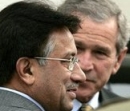
The undemocratic tendencies of Pervez Musharraf have never deeply offended President Bush. Even after declaring a state of emergency, firing the Supreme Court and jailing most of his political opponents, Bush claimed that, “truly,” Musharraf was “somebody who believes in democracy.” Bush, on the other hand, is somebody who truly believes in loyalty. This is the glue that holds together the edifice of his own power. Musharraf might be Bush’s most dangerous friend but the fear of what might happen if the general feels betrayed indicates why, in the name of democracy, the president has so far only asked his friend to set aside his military uniform but not relinquish the presidency.

pervez-and-george.jpgAccording to Bruce Riedel, former CIA officer, National Security Council staff member and now a Brookings fellow, when Deputy Secretary of State John D. Negroponte went to Islamabad in September, “he basically delivered a message to Musharraf that we would stand by him, but he needed a democratic facade on the government, and we thought Benazir was the right choice for that face.”

The message from the Bush administration to Musharraf over the last seven years has been consistent: the appearance of democracy (or at least the promise of democracy) is more important than democracy itself.

Now, after it turns out that democracy will need a new face in Pakistan, we learn from Bhutto’s aides, that there is damning evidence that Pakistan’s Inter-Services Intelligence agency, have been busy laying the groundwork for rigging the upcoming parliamentary elections. Bhutto’s Pakistan People’s Party (PPP) has prepared a detailed report that Benazir Bhutto herself planned to share with two members of Congress in a meeting due to take place the day she was assassinated. The PPP trusted Senator Arlen Specter, a Republican, and Democratic Congressman Patrick Kennedy, rather than representatives from the Bush administration which they regard as too closely aligned with Musharraf. From The Independent we learn that:

The report compiled by the PPP apparently includes information on an alleged “safehouse” being run by the ISI in a neighbourhood of Islamabad called G-5, from which the rigging operation was run. “It was compiled from sources within the [intelligence] services who were working directly with Benazir Bhutto,” said Mr Lashari [a member of the PPP election monitoring cell].

The report names a recently retired ISI officer who has allegedly been running the rigging unit and claims he worked in tandem with another named senior intelligence officer. It also claims that US aid funds were being used for the projects.

At the heart of the scheme, the report says, was a project in which ballot papers – stamped in favour of the Pakistan Muslim League-Q (PML-Q), which supports Mr Musharraf – were to be produced by the intelligence agencies in about 100 constituencies. Mr Lashari said the effort was directed at constituencies where the result was likely to be decided by a small margin, so it would not be obvious. “They diverted money from aid activities. We had evidence of where they were spending the money,” he added.

Is it possible that the Bush administration already knew of, or had received intimations that Musharaff’s intelligence services had such a scheme in operation? Even before Bhutto’s assassination and while expectations of vote rigging remained high, the administration had no qualms about sending an assistant secretary of state up to Capitol Hill to assert in the face of deep skepticism that, “I do think they can have a good election. They can have a credible election. They can have a transparent election and a fair election.”

The aroma of complicity (which it should be noted necessitates neither foreknowledge, nor support, but simply acquiescence) is perhaps evident in the way Washington responded to Bhutto’s assassination. First came the chorus that this was the dastardly work of al Qaeda, or one of its allies, the Taliban leader, Baitullah Meshud, who is effectively the Amir of South Waziristan. Then some intelligence sources started pulling back from that line and instead suggested that this was the work of al Qaeda infiltrators in the lower echelons of Pakistan’s intelligence services. What no administration official was willing to concede was that the jihadists might in this instance have been acting as minions for high-ranking intelligence officers.

Ever since 9/11, President Bush has been a captive of his own for-us-or-against-us logic when it comes to dealing with Pervez Musharraf. If Musharraf could not be painted as an ally, the risks of turning him into an enemy seemed too daunting to contemplate. In Musharraf’s hands, nuclear deterrence became a principle with new meaning as it served to deter threats to a regime rather than a state.

Pakistan’s nuclear arsenal continues to protect Musharraf’s power for as long as Washington is paralyzed by the fear that nuclear material could slip out of his control and fall into the hands of al Qaeda. What Bush wants us to view as the Musharraf nuclear insurance policy is in fact a nuclear protection racket. Fearful of the mayhem that the boss’ removal might unleash, we have funneled billions of dollars in aid to Pakistan’s military, no strings attached, all in the tenuous name of keeping the neighborhood safe.

To those with a firm grasp on power, democracy must always appear risky and threatening. Democracy necessarily entails the dispersal of power and challenges the claims of those who would make themselves the guardians of power. Yet the pledge that all such guardians effectively make with the people they claim to be serving amounts to this: Trust me, because I can’t trust you.

Facebooktwittermail

EDITORIAL: Who killed Benazir Bhutto?

Who killed Bhutto?

The fact that al Qaeda has claimed responsibility for assassinating Benazir Bhutto really means nothing. After all, Mustafa Abu al-Yazid, al Qaeda’s liason to the Taliban, can be confident that the Pakistani government is not going to deny his claim. Indeed, Interior Ministry spokesman Javed Iqbal Cheema told a news conference today, “We have intelligence intercepts indicating that al Qaeda leader Baitullah Mehsud is behind her assassination.” (The Interior Ministry also claims Bhutto was not shot!) Bhutto herself believed that Mehsud might have been behind the October bombing from which she escaped unscathed soon after her return to Pakistan. Mehsud had been quoted in the Pakistani press as having promised to “welcome” Bhutto with a suicide bombing. What received less attention was that the Waziristan tribal leader denied making any such threats to Bhutto. As Rahimullah Yusufzai reported in The News on October 18:

Though it is clear that Baitullah Mehsud hasn’t threatened Benazir Bhutto with suicide bombing, one should keep in mind that anyone intending to launch such an attack would not brag about it publicly. Benazir Bhutto has provoked the militants and Jihadis with some of her recent pro-US and anti-al-Qaeda and anti-Taliban statements and one should, therefore, not rule out the possibility of suicide bombings targeting her. But that could happen once she is in power and has the authority to order military operations against the militants. At present, she doesn’t possess the authority to cause harm to the militants and it appears that the latter would prefer to wait and see as to how she acts once she is in power.

Political pragmatism might not be what one would expect from an Islamic extremist, but tribal leaders such as Mehsud, even though they impose a harsh form of Islamic rule should be seen as territorial commanders. As such, they are not averse to deal-making. Whatever promises Bhutto might have made to her American friends, Mehsud and his allies would have had good reason to adopt a wait-and-see approach rather than follow the script that says that Bhutto, the Western-friendly, democratic Muslim woman, would, once in office, remain an implacable foe. After all, as prime minister of Pakistan she once led one of only three governments in the world that recognized the Taliban government of Afghanistan.

What is interesting about the Interior Ministry’s claim about Meshud’s involvement in Bhutto’s assassination is that although Bhutto herself lent credence to the claim by connecting Meshud with the October bombing, she also named others — names that we can be sure no Interior Ministry spokesman will ever link to her assassination: former Chief Minister Chaudhry Parvez Elahi, former ISI chief Hamid Gul, Hassan Afzal, former Deputy Chairman of the National Accountability Bureau (NAB), and Intelligence Bureau chief Brig (Retd) Ijaz Shah. Given that only a matter of weeks ago, Bhutto saw these men as a threat to her life, it appears a bit premature for so many analysts to have confidently concluded that al Qaeda is the culprit.

See also, Bhutto said she’d blame Musharraf if killed (CNN) and Who killed Benazir? (Noah Shachtman).

Facebooktwittermail

EDITORIAL: When reason prevails

When reason prevails

To some political observers there is something vaguely disappointing about witnessing events shaped by reason. Reasonable behavior is somewhat predictable and lacks the zest and drama of the unexpected.

In as much as news-watching is driven by the stimulating effect of the shock of the new, there is then a tendency for one revelation to trigger a desire that this be followed by a cascade of revelations. In the current context, this is provoking a notion that now, anything could happen.

In a game of whack-a-mole, as soon as the National Intelligence Estimate had knocked down the notion of the “mad mullahs”, the image of “mad dog” Israel popped up.

For the past several years, U.S. intelligence analysts have doubted hawkish U.S. and Israeli rhetoric that Iran is dominated by “mad mullahs” — clerics whose fanatical religious views might lead to irrational decisions. In the new NIE, the analysts forcefully posit an alternative view of an Iran that is rational, susceptible to diplomatic pressure and, in that sense, can be “deterred.”

“Tehran’s decisions are guided by a cost-benefit approach rather than a rush to a weapon irrespective of the political, economic and military costs,” states the NIE. Asked if this meant the Iranian regime would be “deterrable” if it did obtain a weapon, a senior official responded, “That is the implication.” He added: “Diplomacy works. That’s the message.”

But not so fast, says Seymour Hersh — “there’s always Israel… Israel can always decide to take military action.” And on CNN last night, Hersh continued. “I’m told that Olmert had a private discussion with Bush about it during Annapolis — before Annapolis. Bush briefed him about it.” This contradicts National Security Adviser Stephen Hadley’s claim that Bush was not briefed on the NIE until Wednesday — the day after the Annapolis Conference. Indeed, there is further evidence that the Israelis were informed well before the conference.

In today’s Haaretz, Amos Harel writes:

Israel has known about the report for more than a month. The first information on it was passed on to Defense Minister Ehud Barak, and to Shaul Mofaz, who is the minister responsible for the strategic dialog with the Americans. The issue was also discussed at the Annapolis summit by Barak and U.S. Secretary of Defense Robert Gates, and it seems also between Bush and Prime Minister Ehud Olmert.

What surprised Israel is the sharp turn from the previous line presented by the DNI [Director of National Intelligence, Mike McConnell], and the fact the report was made public. Based on his short comments yesterday, it seems Barak, like Olmert, is trying to avoid open disagreement with the U.S. government.

But the issue of the NIE is expected to create tension on two levels. It will cloud the tight cooperation between the two countries intelligence agencies, since now it will no longer look as if it is only a disagreement over timing, but a fundamental disagreement over Iran’s intentions. It will also cause a feeling of distress on the Israeli side, as now it will seem that the U.S. is abandoning Israel to fight alone.

But is there really much likelihood that Israel would take on the fight alone?

Some would argue that Israel’s September 6 strike on Syria was intended as a warning shot — a signal to Tehran that “mad dog” Israel can, if it chooses, just as easily strike Iranian targets. At the time, it was certainly easy to accept such an interpretation. Now, things look different.

It seems more reasonable — in accordance with the principle of Ockham’s razor (cleaving to the simplest explanation) — to believe that bombs dropped on Syria were intended to send a message to Syria, not Iran. The message? Just because of last summer’s mess in Lebanon, don’t get the idea that you’d stand a chance in a military confrontation with Israel. We can hit you whenever we want, wherever we want. Now we’ve made that clear, we’re ready to talk.

When it comes to Iran, the political challenge now is for those who until very recently were hysterically presenting Iran as the greatest threat to the world, to make an about face without losing face and say that Iran can now effectively be engaged.

Those still feeling the sting of the NIE’s claims will predictably revive Rumsfeld’s line of reasoning that the absence of evidence is not evidence of absence. But this always was, and remains, a faultless yet deceptive line of reasoning since the absence of evidence is not evidence of concealment. Just as there are still those who believe that Saddam Hussein’s WMD were never found because they were so well hidden, the same line is being used again: “The Israelis interpret the evidence to mean the Iranians have almost certainly continued to conduct their military nuclear program in secret.”

That’s all well and good, but while the masters-of-secrecy argument might have some limited value in sustaining the image of Iran’s government as a nefarious and deceptive entity, at the same time, it’s hard to plausibly argue in favor of missile strikes on targets so well hidden that their locations are unknown.

The neocons know the game is up and some of them are being surprisingly quick to concede the fact. Norman Podhoretz sees the intelligence community engaged in a scheme to “head off the possibility that the President may order air strikes on the Iranian nuclear installations.” But even if the father of neoconservatism doesn’t like what he sees, he concedes that the plot has worked.

Robert Kagan, perhaps the most nimble-minded among the neocons, says, “With its policy tools broken, the Bush administration can sit around isolated for the next year. Or it can seize the initiative, and do the next administration a favor, by opening direct talks with Tehran.” Part of Kagan’s motive for advocating talks now is that this “would give the United States a better chance to frame the discussion, at home and abroad.” Which is to say, a better chance for Kagan and his friends to frame the issues.

Be that as it may, the opportunity that has now opened up needs to be grasped. The question is, who is going to quickest off the mark in becoming the strongest advocate of a bold and strategic policy shift? Those who have nothing to advocate will do no more than sustain the culture of political reactivity in which nothing really gets said and nothing much gets done.

So far there are no signs that inside Bush’s brain there are any new neuronal pathways being tickled by an action potential. It’s time for Iran to “come clean” he says — and Ahmadinejad could say just the same. If the absence of cunning is a precondition for U.S.-Iranian talks, they’re not going to happen.

But Bush’s isn’t the only voice that needs to be heard right now. There are a bunch of folks waltzing around America at the moment claiming they want to lead the nation. OK. Now’s the time to show your mettle. And just in case anyone needs reminding: whether or not Iran has an active program for developing nuclear weapons, it does remain the strategically most important country in the Middle East.

The release of the NIE may have the effect of making presidential candidates think that Iran can quietly be dropped from the political agenda. This would be a mistake. The opportunity here is not limited to finding a new way to approach Iran; with some courage and imagination the conversation could actually start to shift away from its myopic focus on national security threats and towards a new focus on engagement. Instead of talking about how America must lead the world, save the world or protect itself from the world, it’s time to start talking about working together and raising America’s awareness of a convergence of national and global interests.

Facebooktwittermail

EDITORIAL: Diplomacy on the ascent

A “different dynamic” in American diplomacy

If war follows the failure of diplomacy, it’s natural that the failure of war should lead to the resurrection of diplomacy. George Bush might not clearly grasp this, but there are strong indications that it is obvious to many of his closest advisers. The latest evidence comes from Lebanon.

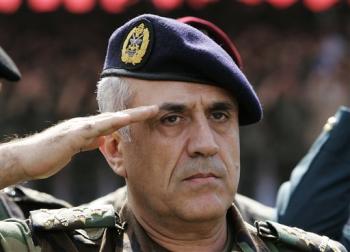
genmichelsuleiman.jpgFor the last week, Lebanon has been without a president but now, after a standoff that has lasted months, the political factions (always simplistically described in the Western media as being pro-Western or pro-Syrian) appear to have agreed on a compromise. Washington didn’t make it happen but it could have stood in the way. Instead, the administration is now willing to accept that Lebanon’s next president, Syria’s preferred candidate, will be General Michel Suleiman.

Some commentators predicted this outcome months ago. Back on August 15, a blogger calling himself, “Outlaw Josey Wales,” wrote, “The powers-that-be have decided General Michel Suleiman/Sleiman will be the next president of Lebanon.” Today, the Wall Street Journal (via Syria Comment) reports:

In recent days [pro-Western] March 14 politicians, with Washington’s consent, agreed to a compromise candidate for the presidency. Gen. Michel Suleiman, commander of the Lebanese Armed Forces, worked closely with Damascus during its military occupation of Lebanon and is already receiving support from some of Syria’s Lebanese political allies.

March 14 leaders say the general’s selection, while not their first choice, could help stabilize Lebanon, because of his leadership of a Lebanese military increasingly viewed as a unifying force in their country.

“Michel Suleiman is well-known to the Hezbollah and the Syrians,” said Walid Jumblatt, a key leader of March 14. “If the Syrians don’t want Suleiman, it means they don’t want stability in Lebanon.”

The concession on the Lebanese president comes amid a broader push by the U.S. and its allies to re-engage Damascus in other ways. American and Israeli strategists view this initiative as aimed at breaking Syria’s alliance with Iran, Hezbollah and the Palestinian militant group Hamas, which have all increased their influence across the Middle East in recent years. It is also aimed at gaining greater support from Syria in cutting off militants infiltrating into Iraq.

The administration wants to characterize the Lebanese presidential choice as a concession by its allies:

A high-ranking US official was quoted by the Kuwait News Agency (KUNA) as saying that Washington has no objections to agreements among the Lebanese on the election of army commander General Michel Suleiman for president. “The US did not strike any deal with Syria regarding Lebanon at the Annapolis conference,” the official, who spoke on condition of anonymity told KUNA. “We understand the concerns of the Lebanese on this issue,” he added. “The US is separating Lebanon from the other pending problems in the region.” The US official said that Lebanon is not up for negotiation, especially not with Syria. “We only refer to Lebanese-Syrian relations when we are calling on Damascus to stop meddling in Lebanon’s internal affairs,” he said.

Mark those words carefully: If the US did not strike any deal with Syria regarding Lebanon at the Annapolis conference it was because the deal had been struck in advance. This is what the New York Times reports:

Syria, the most important outside influence over Lebanese politics, had hesitated until the last minute over whether to attend the conference.

Immediately after the talks, Syrian allies in Lebanon endorsed the first major political breakthrough. Analysts say the talks could thaw strained relations between Syria and the United States.

“The Syrians did not want to go to Annapolis, and without them the conference would have been a failure and would have weakened the Arabs,” said Talal Atrissi, a political analyst and sociologist at Lebanese University. “The Syrians traded their participation, which did not cost them anything, with a deal on the Lebanese presidency.”

Another breakthrough then came after the conference when on Thursday, Christian leader Michel Aoun, a retired general and a former army chief who was seeking the presidency himself and is backed by Syria, indicated that he is “open” to Suleiman becoming president. Lebanese commentator, Michael Young, that day had written, “Aoun will swallow poison before saying yes to Suleiman.” I guess the poison was less bitter than Young imagined.

So why should observers in the United States be surprised by the latest turn of events in the generally mystifying process of Lebanese politics? Here’s why. This is what the astute Syrian political analyst and journalist Sami Moubayed has to say:

…if the Syrians are able to get their way, they would opt for Michel Suleiman, the current army commander. Washington DC is not too enthusiastic about him because he is politically independent; too independent for Washington’s taste. He is committed to combating Israel, supporting Hizbullah, and friendship with Syria. His one slogan has been “Israel is the enemy”, something that greatly pleases Damascus but is frowned upon by 14 March. If elected, he would certainly work for a greater role for Hizbullah in the government, and might even turn a blind eye to their activities in south Lebanon, as did Elias Hrawi in the early 1990s, and Lahoud in 1998-2006. Also to the displeasure of 14 March was a recent remark by the army commander, “Fatah Al-Islam is linked to Al-Qaeda not Syria.”

Washington has plenty of reasons not to like Suleiman. The fact that they have now given their consent to his becoming Lebanon’s next president makes it quite transparent: the realpolitik faction inside the administration is not simply ready to do business with Syria — business is already underway.

Facebooktwittermail

The Annapolis Peace Train

The Annapolis Peace Train – destination unknown

annapoliscompass.jpg
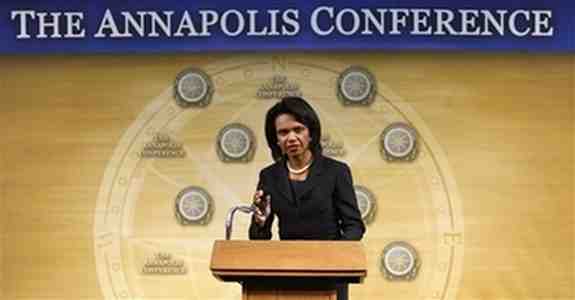
For an event which right up to the last minute was scrambling in search of content (Glenn Kessler provides a useful decoding of the declaration), no effort was spared in putting together a solid stage presentation. The image behind Rice says it all: a compass.

Annapolis was all about pointing in a direction. And as if to underline the fact that there isn’t even a consensus on what that direction should be, the big compass had embedded within it lots of smaller compasses suggesting multiple bearings. All aboard, the peace train is on its way — somewhere.

More than a few commentators were ready to mainline this stuff. David Ignatius notes that “very words ‘peace process’ have a narcotic effect,” — here we have a precious opportunity to dull the pain. “In a Middle East that is already far too volatile, this tranquilizing aspect of the Annapolis process is useful — and shouldn’t be squandered.”

Touchy-feely Jonathan Freedland gets off on what he describes as a “remarkable passage” from Ehud Olmert. This is what Olmert said:

For dozens of years, many Palestinians have been living in camps, disconnected from the environment in which they grew, wallowing in poverty, neglect, alienation, bitterness and a deep, unrelenting sense of deprivation. I know that this pain and deprivation is one of the deepest foundations which fomented the ethos of hatred towards us.

But if Olmert really feels the Palestinians’ pain, how come he’s just about to cut off the electricity to Gaza? An Israeli leader who acknowledges Palestinian suffering and its roots even while he persists in inflicting more suffering is not expressing the empathy that Freedland wants to hear. This is honey-sweetened sadism.

Meanwhile, the mono-metaphor presidency stays perfectly on track. Oblivious to the ambiguity in using the imagery of warfare to describe a peace process, Bush insists that “the battle is underway for the future of the Middle East” and that “we must not cede victory to the extremists.” For observers happy to go along with this worn-out framing of this as a conflict between “moderates” and “extremists,” Hamas and Iran are characterized as the spoilers. It’s as though, absent the extremists, the conflict would have been resolved decades ago. Really?

Who forced 450,000 Israelis to live outside Israel’s internationally recognized borders, largely on seized private Palestinian land? Those who refuse to acknowledge the unambiguous direction of the trendline (shown below), do so because they are unwilling to hear anyone utter its real name: colonization.

The Annapolis skeptics scoff at the connivance of the latest re-branding of the peace process, not because they hate peace but because they can see that the political substance of this enterprise is not aimed at a just and lasting resolution of the conflict. It aims at the perpetuation of a process intended to go on for as long as it takes to destroy the will of those who resist.
settler-growth.jpg
Are we to believe that an Israel that is willing to wall off its Palestinian problem, successfully placing it out of sight and out of mind for most Israelis, will, at some point in the future when no longer faced with any violent opposition, turn around and make magnanimous “concessions”? Or is it much more reasonable to assume that the peace that Israel seeks is merely acquiescence to the status quo?

Facebooktwittermail