Category Archives: Editorials

EDITORIAL: Pakistan and the road to nuclear redemption

Pakistan and the road to nuclear redemption

If Frederick Kagan and Michael O’Hanlon were bloggers their ruminations on how to safeguard Pakistan’s nuclear arsenal would be contemptuously dismissed. But when an architect of the “Surge” and his Brookings Institute sidekick turn their attention to Pakistan, there’s good reason to be concerned. This back-of-an-envelope military planning from nominal experts is likely to garner some unwarranted attention. For one thing, since the White House regards the Surge as a stunning success, it’s natural that Kagan (and Surge cheerleader O’Hanlon) will receive a sympathetic ear. And though their counsel is singularly lacking in substance, a president with little interest in detail is unlikely to notice its absence.

Consider this statement from Kagan and O’Hanlon’s op-ed in which the dream of American military salvation ( “send in the Marines”, “here comes the cavalry”) is once again invoked:

One possible plan would be a Special Forces operation with the limited goal of preventing Pakistan’s nuclear materials and warheads from getting into the wrong hands. Given the degree to which Pakistani nationalists cherish these assets, it is unlikely the United States would get permission to destroy them. Somehow, American forces would have to team with Pakistanis to secure critical sites and possibly to move the material to a safer place.

But this is not a plan; it’s a brain fart. Any plan, however brief, however elemental, however broad its brush strokes, cannot include the adverb somehow. Somehow is how in search of a plan. But there’s good reason Kagan and O’Hanlon wistfully say “somehow”: the Pakistanis thus far have had no interest in revealing to their overbearing American friends the locations of these critical sites. The idea that the Pakistani military or any faction within it would in effect hand over the prize jewels of Pakistan’s national defense for American safekeeping — even if that was in “a remote redoubt within Pakistan” — is laughable. There can be little doubt that American officials have already been provided with multiple assurances that the components of this arsenal are already secure in a number of remote redoubts. Clear evidence (from the point of view of Pakistan’s military) that these sites are secure is that the Americans don’t know their whereabouts.

As the New York Times noted this weekend, a U.S. sponsored, post-9/11 plan to safeguard Pakistan’s nuclear weapons,

…has been hindered by a deep suspicion among Pakistan’s military that the secret goal of the United States was to gather intelligence about how to locate and, if necessary, disable Pakistan’s arsenal, which is the pride of the country.

So, it would seem that while Washington indulges in hair brain schemes for safeguarding Pakistani nukes, Pakistan’s military is less concerned about these weapons falling into the hands of militants than it fears America using Pakistan’s instability as a ruse for implementing a unilateral disarmament scheme.

Kagan and O’Hanlon, sensing that pro-American Pakistanis might be in short supply, have nevertheless devised a Plan B — sort of. This one requires, “a sizable combat force — not only from the United States, but ideally also other Western powers and moderate Muslim nations.” Our theoreticians are confident that the “longstanding effectiveness of Pakistan’s security forces,” will provide sufficient time for a U.S.-led coalition to be deployed. The American troops won’t come from Iraq or Afghanistan — South Korea? This is one of the many details still to be worked out.

Now we get to the really interesting passage, indicating that our Iraq war supporters have made great strides during post-invasion therapy. From here on, annotation rather than commentary is required:

…if we got a large number of troops into the country, what would they do? [Excellent question. This indicates that K&H understand that it’s vital to have a plan when sending thousands of American troops into unfamiliar territory.] The most likely directive would be to help Pakistan’s military and security forces hold the country’s center — primarily the region around the capital, Islamabad, and the populous areas like Punjab Province to its south. [Again, top marks to our theoreticians for assuming that it would be a good idea to steer clear of the hornets’ nest of Karachi.]

We would also have to be wary of internecine warfare within the Pakistani security forces. Pro-American moderates could well win a fight against extremist sympathizers on their own. [Let’s hear it for the Anbar Awakening.] But they might need help if splinter forces or radical Islamists took control of parts of the country containing crucial nuclear materials. The task of retaking any such regions and reclaiming custody of any nuclear weapons would be a priority for our troops. [We can go after the WMD and find them this time. We know they’re there…. We just have to find them.]

If a holding operation in the nation’s center was successful, we would probably then seek to establish order in the parts of Pakistan where extremists operate. Beyond propping up the state, this would benefit American efforts in Afghanistan by depriving terrorists of the sanctuaries they have long enjoyed in Pakistan’s tribal and frontier regions.

Brilliant! Kagan and O’Hanlon have really hit on the masterstroke — a U.S. invasion of Pakistan’s tribal territories. Now all those Democrats who said Iraq was a distraction from the war on terrorism will be forced on board. Who would have anticipated that the fall of Musharraf might provide such a golden opportunity?

And just in case Vice President Cheney doesn’t have time to study the Kagan-O’Hanlon plan in detail, here’s the summary: We’re going to find the WMD, defeat al Qaeda, and when the dust settles, Pakistan will be back on the path to democracy. After such a glorious success, by November 2008 everyone will have forgotten about Iraq.


Facebooktwittermail

EDITORIAL & ANALYSIS: Negroponte – the messenger without a message

Negroponte goes to schmooze with the indispensable General

negroponte.jpgSo, Deputy Secretary of State, John Negroponte, is rushing off to Islamabad (via Africa). Having last week told Congress that the Bush administration regards General Musharraf as “indispensable,” Negroponte is now going to say what?

Several times today the New York Times has insisted on referring to Negroponte as an “envoy” even though at the White House press gaggle this morning, press secretary Dana Perino made it clear that the administration wants to dampen expectations that anything of consequence may follow from the Negroponte-Musharraf tête-à-tête:

MS. PERINO: I think that description was a little bit too strong in terms of “envoy.” Deputy Secretary Negroponte will be traveling there later in the week. I believe that’s who they were referring to [as an “envoy”].

Q But why is “envoy” too strong?

MS. PERINO: Well, he’s not going in terms of — he’s not going in a different capacity than what he is, which is the Deputy Secretary of State.

Later in the day, State Department spokesman Tom Casey was at pains to “deal with some of the other stories that were out there today that seemed to talk about some kind of special envoy or talk of him as a special envoy to Pakistan.” He was eager to impress upon those most obstinate members of the press who were still referring to him as an envoy that Negroponte is not an envoy.

Here’s where he cut to the chase after being asked whether Deputy Secretary Negroponte would be taking any special letter or any kind of message from Secretary Rice or President Bush other than to repeat what has already been said. “No, I think you’ll expect him to, again, deliver the same kind of message that we’ve already talked about publicly before. I’m not aware,” Casey said, “of him carrying any kind of special proposals or letters or things like that.”

So there we have it. Negroponte is not an envoy because he doesn’t have anything to say that hasn’t already been said before.

Will he have any time for sightseeing? Pick up any souvenirs? Maybe join in one of those festive get-togethers that all the lawyers are having.

I do have one suggestion though: He might want to consider compressing his Africa schedule by a few days. Otherwise, by the time he shows up in Islamabad, the General might be too busy to have the Deputy Secretary of State over for tea and scones.

His bridges burned, Musharraf has nowhere to turn

With pressure mounting on him at home and from abroad, the chances that General Pervez Musharraf will survive politically are looking increasingly bleak.

The prospects of a power-sharing deal with the opposition leader Benazir Bhutto that would have enabled Musharraf to cling on to power as president are diminishing rapidly. The more pressure Musharraf is applying on Bhutto, the more she is pushing back.

Today, as she was put under house arrest for the second time in five days, the opposition leader moved closer to a clean break with Musharraf.

For the first time, Bhutto called on him to resign as president altogether, adding for good measure that she could never serve in a government under him. Anyone associated with the general, she said, “gets contaminated”. [complete article]

Miscalculations

Musharraf’s miscalculations were abetted by the United States, which until recently all but ignored the political aspects of counterinsurgency in Pashtun territory. The Bush Administration, distracted by the war in Iraq, and conditioned by its long dependence on Pakistan’s Army, outsourced its Pakistan policy to Musharraf and bankrolled his narrow, increasingly self-defeating strategies. Of the approximately ten billion dollars in overt funds delivered to Pakistan since September 11th, for example, less than a hundred million has gone toward education, an issue about which Musharraf has spoken often but done very little.

The Pakistani Army’s intermittent attempts to suppress the Pashtun Islamists have failed, and these reversals have recently produced stresses within the military not witnessed since the country broke in half, in 1971: the humiliating surrender and capture of hundreds of Pakistani soldiers and local Pashtun paramilitaries, which have led to prisoner exchanges with the Taliban; reports of desertion and mutiny; and a succession of demoralizing battlefield defeats. About fifteen per cent of Pakistan’s Army officers are Pashtun, and the danger of revolt or division among them is deepening. [complete article]

See also, Musharraf’s army losing ground in insurgent areas (WP) and The answer in Pakistan (Thomas R. Pickering, Carla Hills and Morton Abramowitz).

Facebooktwittermail

EDITORIAL: Nuclear risks and nuclear realities

Nuclear risks and nuclear realities

General Musharraf today tossed a bone to his lapdogs in Washington — a promise of elections — and the White House wagged its tail and quickly applauded what it sees as “a good thing” — even while Pakistan’s dictator continued to bludgeon his political opponents. Three Pakistani politicians and a union leader were charged with treason today for making anti-government speeches and now face possible death sentences and in an attempt to thwart a protest rally, 500 members of Benazir Bhutto’s opposition party were arrested.

Having been a steady recipient of US aid — his military receives $100 million monthly in direct cash transfers which Musharraf can use however he pleases — the general is unlikely to be moved by threats that he might not be rewarded with any more F-16s.

Musharraf’s power and the White House’s impotence was further reinforced by the image of Deputy Secretary of State John Negroponte appearing on Capitol Hill in defense of Bush’s “indispensable” ally. “No country has done more in inflicting damage on the Taliban,” Negroponte said, yet in a little noticed development, it seems possible that even while Musharraf was instituting martial law in Pakistan and releasing Taliban prisoners, in Afghanistan Pakistan’s intelligence services might have had a role in the assassination of one of the Taliban’s most serious opponents. “The killing of Sayed Mustafa Kazimi, the 45-year-old Hazara Shi’ite leader from Parwan province of Afghanistan, to the northwest of Kabul, bears all the hallmark of a political assassination,” writes M K Bhadrakumar in Asia Times. He continues:

Evidently, those who plotted his assassination had a grand design. The Taliban lack the political sophistication to work with such foresight and planning. Of course, the Taliban have an old feud with the Hazara Shi’ites dating to the murder of Mazari in March 1995, when the Taliban, already approaching Kabul, entrapped him after inviting him for peace talks. He was tortured and murdered before his body was thrown out of a helicopter somewhere near Ghazni.

Observers of the Afghan scene may have forgotten the incident, but what comes readily to mind is that the suspicion still lingers that Mazari’s murder was the handiwork of Pakistan’s Inter-Services Intelligence (ISI).

The finger of suspicion must once again turn to the ISI over Kazimi’s killing, which raises the issue of what would be gained by removing him from the political landscape.

First, he comes from a region of Afghanistan which is very sensitive. Those who know the Afghan chessboard would acknowledge the supreme importance of controlling the provinces of Baghlan and Parwan. They form the gateway to the northern Amu Darya region, the Panjshir Valley to the east and the central Hazarajat region respectively.

Control of the mountain passes to the west of Baghlan was bitterly contested between the Taliban and the Northern Alliance. The hub was extremely important strategically. In political terms, it is possible to say that without exercising control of the hub, there can be no effective unity between the non-Pashtun ethnic groups of Tajiks and Hazaras (and even the Uzbekis).

Baghlan connects the predominantly Tajik areas with the Hazarajat region and is also on the main communication line between Kabul and Mazar-i-Sharif in the Amu Darya region. Baghlan itself is a mosaic where Pushtuns, Tajiks and Hazaras have traditionally vied for influence and control.

Kazimi hailed from Parwan and did much of his political work in his early years in Baghlan province, where he was quite popular. There is no better way of creating volatility, if not mayhem, in that sensitive region than through a political assassination. The ISI has used targeted political assassinations with devastating effect in Afghanistan many a time at critical junctures on the battlefield.

As everyone knows, Washington can only focus its attention on one thing at a time and with all eyes now on Pakistan, opportunities for reckless maneuvers present themselves elsewhere. Yet there are compelling reasons why Pakistan now looks like the most dangerous country in the world. Washington’s confidence in the security of Pakistan’s nuclear arsenal is largely invested in its confidence in one man: Lt. Gen. Khalid Kidwai, head of the special branch of the military known as the Strategic Plans Division in charge of operations and security. Kidwai represents what one former State Department official describes a the only “safe box within Pakistan’s army.” Irrespective of Kidwai’s close ties to U.S. military officials, the inherent vulnerability of Pakistan’s nuclear weapons has long been understood.

In October 2001, nuclear weapons expert, David Albright wrote:

Several observers have suggested that if Pakistan suffers a coup by forces hostile to the United States, the US military should be ready to provide security over the nuclear weapons (or even to take the weapons out of Pakistan entirely) without the permission of the Pakistani authorities.13 Others have raised the possibility of asking President Musharraf to allow the United States or China to take possession of Pakistan’s nuclear weapons during a coup.

Although such responses appear possible in theory, their implementation could be extremely difficult and dangerous. A U.S. military action to seize or cripple Pakistan’s strategic nuclear assets may encourage India to take similar action, in essence to finish the job. Even if India does nothing, a new Pakistani government may launch any remaining nuclear weapons at U.S. forces or against India.

In addition, removing the nuclear weapons would not be enough. The new government would inherit the facilities to make nuclear weapons. Extensive bombing would thus be required at several nuclear sites, including the relatively large Khushab reactor and New Labs reprocessing plant. These types of attacks risk the release of a large amount of radiation if they are to ensure that the facility is not relatively quickly restored to operation.

No wonder Washington is now in a state of paralysis. The administration’s fears will only be reinforced as critics such as Senator Biden compares Pakistan to Iran when in 1979 it shook off its own US-backed dictator.

As for present-day Iran, President Ahmadinejad’s announcement that Iran has 3,000 working uranium-enriching centrifuges is leading to renewed fears that Israel might respond by bombing the country’s nuclear facilities. In a familiar pattern, this warning was reported in The Times and then echoed around the Israeli press. Israel’s Transportation Minister Shaul Mofaz, who is also a former defense minister and IDF chief of General Staff, told the Conference of Presidents of Major American Jewish organizations in New York, “Iran’s nuclear program is proceeding like an express train. The diplomatic efforts to thwart Iran are like a slow train. If we cannot derail the Iranian train from the tracks, we are on the verge of a nuclear era that will totally alter the regional reality.” Yet the longer the crisis in Pakistan continues, the more widely it will be recognized that, as Ariel Sharon might have put, the nuclear realities on the ground are more significant than those that lie beyond the horizon.

Indeed, as one observer astutely notes:

An Iranian-instigated chemical or biological attack against Israel or the United States has been within the capability of the Iranian regime for at least a decade, and yet they have not launched one. Nor have the Iranians committed 9/11-style terrorist spectaculars against the U.S. homeland despite the relative ease and low cost of such attacks.

All this suggests that Iran understands, and respects, the limits of its aggression. Despite the end times rhetoric issuing forth from its demagogic president, the country has assiduously avoided acts that would invite a massive military retaliation. This is not indicative of a nation longing for a nuclear conflagration.

If Washington is to develop a new way of approaching Iran, the substance of one such means of engagement was outlined in Congress yesterday by Flynt Leverett. Testifying to the House Subcommittee on National Security and Foreign Affairs, Leverett said:

…when one asks Iranian diplomats, academics and officials what is required from the United States to condition a fundamental improvement in U.S.-Iranian relations, these Iranian interlocutors routinely talk about American acceptance of the Islamic Republic and recognition of a legitimate Iranian role in the region—and it is precisely American acceptance of the Islamic Republic and recognition of legitimate Iranian interests that is the core of what I describe as a “security guarantee”.

If in the eyes of President Bush, Pakistan’s military dictator can appear “indispensable,” is Iran’s desire for recognition of its own legitimacy really such a tall order? For this or any future administration to undergo such a shift in its alignments it needs to put aside the prism through which only strategic threats and assets can be seen and recognize that it is dealing with people and with nations. America’s interests can ultimately only be served by respecting the interests of others.

Facebooktwittermail

EDITORIAL: The real world of torture

Jack Bauer vs. Abdallah Higazy — Fiction vs. Reality

jackbauer.jpgabdallah-higazy.jpg

According to a new CNN poll, 69 percent of Americans believe that waterboarding is a form of torture. Even so, a staggering 40 percent of Americans polled believe that the US government should be allowed to use this form of torture to get information from suspected terrorists.

Commentators on this issue have expressed moral outrage — “waterboarding is killing America’s soul,” proclaims the Philadelphia Daily News‘ “Attytood.” Some see this as an afront to American pride — Keith Olbermann challenges President Bush by saying, “[We don’t condone torture] because we’re Americans, sir, and we’re better than that. We’re better than you.” While there are those who express indifference — the Wall Street Journal regards this as “mostly a political sideshow.”

Yet for those 40 percent of Americans who favor the use of torture, their view has in all likelihood been clearly expressed by Democratic Senator, Charles Schumer, who in a 2004 Senate hearing said:

I think there are probably very few people in this room or in America who would say that torture should never ever be used, particularly if thousands of lives are at stake. . . . It is easy to sit back in the armchair and say that torture can never be used, but when you are in the foxhole it is a very different deal. And I respect, I think we all respect the fact that the President is in the foxhole every day.

This then is how the issue is being framed: on one side are those who see themselves adopting the moral high ground — though their critics perceive them as being holier-than-thou, starry-eyed idealists; and on the other side are those who believe in the necessity of making tough choices in extreme circumstances — though their opponents see them as having lost their moral bearings.

At the center of this debate is an argument of perceived necessity. And the narrative that animates this argument, borrowed from Israel and used there in an earlier debate on the legitimacy of torture, is the “ticking bomb” scenario.

The scenario itself is fanciful. We are all familiar with the suspense movie in which the reality of what is feared is confirmed by making the audience privilege to the whereabouts of a bomb and the time left before it will explode. In post-9/11 America the impact of such dramas has been heightened by the likes of Fox TV’s fictional counter-terrorism agent, Jack Bauer. Let’s face it, for a population that forms most of its understanding of the world through television, such imagery has a visceral impact. But in Israel itself, where the danger of terrorism is more tangible and ubiquitous, the ticking bomb scenario is itself no less a product of fiction and has served no less as a political tool. As Stephen Langfur wrote in 1996:

Israel wants to present itself as an enlightened democracy on the Western model, but it has locked itself into the role of Occupier, with the result that toward part of the population under its control it must behave like a police-state. The “ticking bomb scenario” offers an exceptional, border-line situation, in which everyone can understand that even an enlightened democracy might have to use torture. What Israel does, therefore, is to extend the fantasy of the bomb in the crowded building to include analogous situations—even remotely analogous. Israel can then allow its security apparatus to approach interrogations as if they were all “ticking bombs.” Thus it can keep wearing the mask of an enlightened democracy, while functioning like a police-state. The “ticking bomb scenario,” for which torture is useless, “koshers” other situations where torture can be useful.

Indeed, Langfur points out that Israeli General Security Service officials used the ticking bomb argument to intimidate judges. After all, who would be willing to curtail an interrogation and thereafter be accused of having failed to prevent carnage? Yet in practice, so-called ticking bombs turned out to be prisoners who had been held in detention for weeks — plenty of time for plots to be revised and for the seeming inevitability of any attack to evaporate.

If an interrogation method’s “necessity” was to be based on the magnitude of a risk averted, then any technique applied to bring about the desired result would surely be justifiable. On what basis could one say that it was acceptable to use waterboarding to make the prisoner fear that he was about to drown, yet bleach could not be poured in his eyes, if in both cases the justification for the brutality was the necessity of saving innocent Israeli or American lives? If brutality can be graded on a scale, then on what basis can we say that in one instance the end justify the means while in another it does not, when necessity is determined by the end and not the means?

The issue here cannot be addressed or resolved by considering fictional scenarios. Instead we need to focus on reality and fortunately there is already one case that provides the perfect litmus test: the case of Abdallah Higazy.

On December 17, 2001, Higazy was detained and questioned by the FBI and then held as a material witness, suspected of being an accomplice in the 9/11 attacks on the World Trade Center in New York. He had been staying in a nearby hotel and was thought to have been in possession of an air-band transceiver capable of air-to-air and air-to-ground communication that could have been used as a beacon to direct the hijacked aircraft into their targets, the Twin Towers. As a terrorist suspect Higazy was as hot as they get.

Under interrogation he kept on changing his story. He had to be lying. FBI agents said they gave Higazy a “polygraph” yet the United States Court of Appeals opinion [PDF] quotes the suspect as saying that the test produced “intense pain.” The court opinion states that “Higazy asked whether anybody else had ever suffered physical pain during the polygraph, to which [FBI Special Agent Michael] Templeton replied: “[i]t never happened to anyone who told the truth.” Was Higazy being given a polygraph or was he being electrocuted?

The court opinion continues:

Higazy alleges that during the polygraph, Templeton told him that he should cooperate, and explained that if Higazy did not cooperate, the FBI would make his brother “live in scrutiny” and would “make sure that Egyptian security gives [his] family hell.” Templeton later admitted that he knew how the Egyptian security forces operated: “that they had a security service, that their laws are different than ours, that they are probably allowed to do things in that country where they don’t advise people of their rights, they don’t – yeah, probably about torture, sure.”

If so-called harsh interrogation methods can be justified, Abdallah Higazy was surely the perfect candidate to be given the third degree. He was suspected of having played an instrumental role in the worst terrorist attack the world has ever seen. This must have been — as Vice President Cheney would say — a no-brainer. Or not?

Anyone familiar with the name, Abdallah Higazy, will of course know that he was completely innocent. The FBI quickly realized as much when a few weeks after Higazy’s detention an airline pilot showed up looking for the radio transceiver he had left behind when he had been evacuated from his hotel on September 11.

When FBI Special Agent Templeton was interrogating his suspect, were Cheney’s words from September 16, 2001, still fresh in his mind?

We also have to work, though, sort of the dark side, if you will. We’ve got to spend time in the shadows in the intelligence world. A lot of what needs to be done here will have to be done quietly, without any discussion, using sources and methods that are available to our intelligence agencies, if we’re going to be successful. That’s the world these folks operate in, and so it’s going to be vital for us to use any means at our disposal, basically, to achieve our objective.

Templeton certainly went to the dark side, but the terrorist he was after wasn’t there. The question that needs to be addressed now and that needs to be the concern of the next attorney general is not what methods of interrogation can be applied in a ticking bomb scenario; it is this: how should the law have protected Abdallah Higazy?

Interrogation is a means of inquiry, not a method of punishment. In the war on terrorism, the presumption of innocence should not be treated as a legal luxury — it is a recognition that suspects are not always (contrary to what the administration would have us believe) the worst of the worst, but on the contrary that with unfortunate frequency they have included the innocent.

Forget about ticking time bombs and remember Abdallah Higazy. After all, those who now want to justify torture do so in the name of protecting the innocent.

Facebooktwittermail

EDITORIAL: The box on the Euphrates

The box on the Euphrates

Writing in The American Conservative, former CIA officer Philip Giraldi sees in the Syrian-nuclear-reactor story the hallmarks of a disinformation campaign:

In the intelligence community, a disinformation operation is a calculated attempt to convince an audience that falsehoods about an adversary are true, either to discredit him or, in an extreme case, to justify military action. When such a campaign is properly conducted, information is leaked to numerous outlets over a period of time, creating the impression of a media consensus that the story is true, as each new report validates earlier ones.
[…]
The [news] pieces [on the target of the Israeli air attack in Syria] have a common thread: they rely entirely on information provided by Israeli sources without independent corroboration. And the ongoing play they are getting in the international media, without much critical commentary and without direct attribution to Israel, mark them as classic disinformation.

As nuclear proliferation expert Jeffery Lewis notes, the latest revelation — that the “box-on-the-Euphrates” is at least four years old, its existence having already been noted by the intelligence community (IC) — provides a compelling explanation why national security adviser Stephen J. Hadley has kept such a tight lid on the dissemination of the “new” intelligence: “we’d already looked at the building and Hadley knew what the IC would say.”

In the absence of further hard evidence, the ensuing commentary and analysis, most of which is extremely sketchy, has nevertheless become conventional wisdom in part because a few usually reliable sources have given the narrative a veneer of credibility:

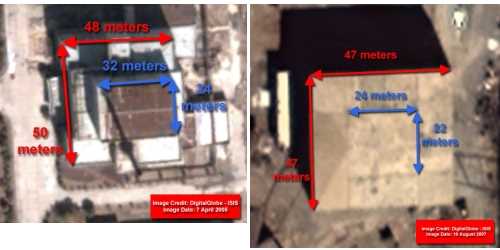
    — Respected former IAEA inspector, David Albright, has lent support to the idea that the box resembles the North Korean Yongbyon reactor based on not a lot more than the fact that the two buildings share the same diameter footprint. But whereas Yongbyon comprises a larger box with smaller boxes stacked on top of it, the image of the Syrian cube has been helpfully marked up with locations for imaginary boxes. “There also appears to be a faint square on top of the Syrian building’s roof. It is unclear whether something would be built there, but its dimensions, 24 meters by 22 meters, are consistent with the subsequent construction of an upper roof.” Four years after this faint square was first photographed, it remained a faint square [PDF].

boxes.jpg

    Global Security‘s John Pike refers to the site as being located in “the middle of nowhere” — everyone has now seen images of the barren location — yet one only needs to spend a few minutes on Google Earth to discover that the Box on the Euphrates lies right in the middle of Syria’s agricultural heartland with sizable communities either direction from this supposedly isolated location.

middle of nowhere

    This makes it all the more strange that nothing in the images appear to indicate the existence of a secure perimeter to this facilitiy — something that can easily be discerned if one looks at similar resolution images of, for instance, Israel’s nuclear facility at Dimona. However laid-back the Syrians might be, I’d wager that come the day that there was anything of high value at this site, there would be some serious security to keep out unwelcome intruders.
    — Washington’s high priest of gossip, Chris Nelson, after originally being convinced that the facility was related to Scud missile assembly, has now been won over to the nuclear reactor theory. The “evidence” that shifted his opinion? The fact that US-North Korea negotiator Chris Hill, in his recent Congressional testimony, did not refuted the theory. The absence of a denial is the same as an affirmation? Not according to my understanding of logic.

So what do we really know at this point?

A large cube-shaped building next to the Euphrates was visible from space in 2003. Given its size it must have taken a while to construct. The primary structure looked pretty much the same from above in August 2007. New images reveal that it’s not there now, the site has been leveled and it is reasonable to assume that the site clearing occured after, and very likely as a result of, an Israeli air force attack on September 6, 2007.

Do we have hard evidence that Syria was engaged in constructing a nuclear reactor? Not yet. Are any journalists hunting down that hard evidence? Probably not — why go to the trouble when you can kick back and get paid for schmoozing with John Bolton.

Meanwhile, IAEA director Mohamed ElBaradei is pissed off about the “bomb first and then ask questions later” approach. “I think it undermines the system and it doesn’t lead to any solution to any suspicion, because we are the eyes and ears of the international community. It’s only the agencies and inspectors who can go and verify the information.” He notes that in all the years that John Bolton and his cohorts have been making accusations about a Syrian nuclear program, “we have not received information about any nuclear-related activities, clandestine nuclear-related activities in Syria.”

Perhaps then we can infer that the real target of the Israeli strike was not a nuclear facility: it was the IAEA inspections processa troublesome log that the neocons are eager to clear off the road leading to Tehran.

Facebooktwittermail

EDITORIAL: Ahmadinejad’s free speech

Ahmadinejad’s free speech

Mahmoud Ahmadinejad did something yesterday that neither President Bush nor Vice-President Cheney have the courage to do: stand up and speak in front of an unfriendly college audience. How can America’s leaders claim that they are defending freedom when they are so clearly afraid of it?

In the Bush-Cheney lexicon, “free speech” is something that can be confined to a zone out of earshot and out of sight; it is something whose value is cathartic rather than political. They regard free speech as a form of free expression that serves the psychological needs of the individual rather than the political needs of a healthy democracy.

America has over the last six years become infected by this impoverished view of free speech. It is a right that seemingly only benefits those who exercise it, while society merely tolerates its performance. Thus, as he introduced President Ahmadinejad, Columbia president Lee Bollinger wanted to assure the nation that no one in his illustrious university was in jeopardy of being influenced by anything that Iran’s president might say. Continue reading

Facebooktwittermail

EDITORIAL: Deconstructing the neocon nuclear narrative

Deconstructing the neocon nuclear narrative

Why can the neocons never get their story straight?

Because they’ve figured out the ending but they’re still working on the plot.

The end is the end of the Islamic State of Iran, but the first draft of the narrative that was supposed to lead there — through Baghdad — took a major detour, providing Iran with the opportunity to become more powerful than ever.

Even so, a few lessons have been learned from the atrociously written Iraq story.

Don’t talk about “WMD,” is one such lesson. The only weapons worth talking about (as frequently as possible) are nuclear. Fortunately (if you’re a neocon) the press continues to be as obliging as ever in repeating whatever you say. Continue reading

Facebooktwittermail

EDITORIAL: How to counter terrorism

How to counter terrorism

Marine Maj. Gen. Douglas M. Stone is on a mission to promote to promote “religious enlightenment.” The programs he oversees as commander of U.S. detention facilities in Iraq, are designed to shape Iraqi detainees and “bend them back to our will.” It sounds like Stalinism.

The idea of rehabilitating jihadists isn’t new; this just sounds like a somewhat mangled version of a program that was devised in Yemen and has been applied with great success. Yet the philosophical approach is profoundly different. Contrast Stone’s aim of bending wills in what he calls “the battlefield of the mind,” with the approach masterminded by former judge Hamoud Abdulhameed al-Hittar, who is now the Minister of Human Rights in Yemen.

This is how Hittar lays the foundation for his work:

Dialogue is a part of human nature. The first step in the creation of human beings was dialogue.

The Qur’an addresses the idea of dialogue with people we don’t agree with. The Pharaoh called himself a god. He said that he was the creator of Mankind. And even then, God granted a dialogue with the Pharaoh. This is an example for us to talk with people, regardless of how bad they are. No matter how much we agree or disagree with them, we should not avoid talking with them.

It is under this principle, that we dialogue with the people from Afghanistan [returning jihadists]. In the tradition found in all religious scriptures, as transmitted by Muhammad, Jesus, Moses, Jonas, etc., dialogue is a necessity.

Continue reading

Facebooktwittermail

EDITORIAL: Neoconservative terrorism

Neoconservative terrorism

If neoconservatives experienced the same level of fear that they seem intent on promoting, then it is possible that they might be suffering from what could be called pre-traumatic stress disorder. The fact is, they are far too calm and calculating to be victims of any kind of trauma, and given their focus on fueling widespread fear, the best way of understanding what they do is to say that they are artful practitioners of a particular form of terrorism. That is to say, their intent is to use blind emotion as the means for forcing the adoption of a political agenda that cannot withstand critical analysis.

For conventional terrorists, acts of violence are the means through which a small organization lacking a grassroots constituency can exert broad political influence by employing the instrument of broad-based fear. Neoconservatives, on the other hand, while no greater in number than say the membership of al Qaeda, have much more direct access to the levers of political influence and thus have no need to employ the crude techniques of the average terrorist. Nevertheless, like every terrorist, they see fear as the indispensable tool for furthering their political aims.

Their latest campaign, aimed at stoking hysteria in the Islamophobic West, is what The Observer describes as:

… a series of piecemeal leaks from US officials that gave the impression of being co-ordinated, a narrative … laid out that combined nuclear skulduggery and the surviving members of the ‘axis of evil’: Iran, North Korea and Syria.

Central to this narrative is an event wrapped in mystery: Israel’s strike on unknown targets in Syria and a “suspicious” North Korean freighter, Al Hamed, whereabouts unknown, cargo unknown, ownership unknown.

This is classic smoke and mirrors — there are no substantive allegations and thus nothing to refute. Everything is suggestive — suggestive of the possibility of a strike on Iran, or the outbreak of a long-feared war between Israel and Syria. Yet among the competing theories about what purpose lay behind Israel’s sudden strike — and one has to assume this occurred with Washington’s foreknowledge, consent and support — one detail provides a clear indication that whatever the physical target might have been, the target audience was not in Damascus. Dion Nissenbaum writes:

Hours before the Israeli strike, Prime Minister Ehud Olmert reportedly sent word to Syria that it had no hostile intentions. Syrian leaders complained bitterly this week that Olmert’s message was a diversion meant to get Syria to drop its guard before the strike.

Syria’s leaders would of course bitterly complain — after all they were being treated like fools — yet what Olmert seems to have done was in effect to provide Syria with a heads up whose purpose was to make it clear that Israel had no intention of starting a war. A game was in play, Syria’s sovereignty would be treated with contempt — as it has so often been before — but the audience for this performance was located outside the region, in Washington, Europe, and at the UN. If Syria was to protest too loudly, it would compel itself to retaliate. In the interlude, a contrived silence keeps the peace, but at the same time the authors of this peace are framing it quite intently as a prelude to war.

Facebooktwittermail

EDITORIAL: From yellow cake to cement

From yellow cake to cement

The Israeli government has learned that Bashar Al-Assad recently bought significant quantities of cement from North Korea.”

OK. Maybe this line won’t make it into the president’s next State of the Union speech, but we should be in no doubt that once again the neocons are on the loose and in response the Washington Post and New York Times have dutifully put on their dunce caps. Continue reading

Facebooktwittermail

EDITORIAL: As Israel bombs Syria, the United States prepares to attack Iran

As Israel bombs Syria, the United States prepares to attack Iran

With contradictory statements coming from unnamed Bush administration officials, there continues to be speculation around the purpose and significance of Israel’s incursion into Syrian airspace last week. The New York Times reports that:

One Bush administration official said Israel had recently carried out reconnaissance flights over Syria, taking pictures of possible nuclear installations that Israeli officials believed might have been supplied with material from North Korea. The administration official said Israeli officials believed that North Korea might be unloading some of its nuclear material on Syria.

While Associated Press says that:

Israeli warplanes targeted weapons destined for Hezbollah in a strike last week in northeastern Syria, a U.S. government official said Wednesday, even as Syria and Israel remained silent on the incident. […] U.S. officials have declined to comment on whether the suspected weapons targeted might have originated in North Korea, whether the aircraft passed over Turkey on their way into or out of Syria or whether Israel had used weapons from the United States in the airstrike.

Given that North Korea has just opened up its nuclear facilities to American inspectors and it recently entered into a bilateral agreement with the U.S. saying it will disable its nuclear facilities by the end of this year, the North Korean angle to the Syrian story looks to me like a smokescreen.

In World Politics Review, Frida Ghitis points out that:

Israel is undoubtedly developing contingency plans in case it decides it must stop Iran’s nuclear program. If it decides to bomb Iran’s nuclear installations, a possible flight route could take it over the Syria-Turkey border, along Northern Iraq’s friendly Kurdish region, and into Iran. Flying safely over Syria would be key to the success of the mission against Iran.

It is becoming increasingly clear, however, that Israel will not need to follow through with such plans. Fox News reports that:

Political and military officers, as well as weapons of mass destruction specialists at the State Department, are now advising Secretary of State Condoleezza Rice that the diplomatic approach [to Iran] favored by [Under Secretary of State for Political Affairs Nicholas] Burns has failed and the administration must actively prepare for military intervention of some kind. Among those advising Rice along these lines are John Rood, the assistant secretary for the Bureau of International Security and Nonproliferation; and a number of Mideast experts, including Ambassador James Jeffrey, deputy White House national security adviser under Stephen Hadley and formerly the principal deputy assistant secretary for Near Eastern affairs.

Consequently, according to a well-placed Bush administration source, “everyone in town” is now participating in a broad discussion about the costs and benefits of military action against Iran, with the likely timeframe for any such course of action being over the next eight to 10 months, after the presidential primaries have probably been decided, but well before the November 2008 elections.

The discussions are now focused on two basic options: less invasive scenarios under which the U.S. might blockade Iranian imports of gasoline or exports of oil, actions generally thought to exact too high a cost on the Iranian people but not enough on the regime in Tehran; and full-scale aerial bombardment.

On the latter course, active consideration is being given as to how long it would take to degrade Iranian air defenses before American air superiority could be established and U.S. fighter jets could then begin a systematic attack on Iran’s known nuclear targets.

Most relevant parties have concluded such a comprehensive attack plan would require at least a week of sustained bombing runs, and would at best set the Iranian nuclear program back a number of years — but not destroy it forever. Other considerations include the likelihood of Iranian reprisals against Tel Aviv and other Israeli population centers; and the effects on American troops in Iraq. There, officials have concluded that the Iranians are unlikely to do much more damage than they already have been able to inflict through their supply of explosives and training of insurgents in Iraq.

That is a mind-boggling assertion. Do these officials regard IEDs to be as powerful as Iranian missiles or that the latter are no more dangerous than an IED? The Iranians themselves have been quite blunt in their warnings:

[Former head of Iran’s Revolutionary Guard,] General Rahim Yahya Safavi, Jaafari’s predecessor and now special military advisor to supreme leader Ayatollah Ali Khamenei, had warned last week that the United States did not appreciate how at risk its troops were.

“It can not evaluate the vulnerability of its 200,000 troops in the region since we have accurately identified all of their camps,” said Safavi.

It’s hard not to believe that at the beginning of a war with Iran, the United States might lose more troops than it has over the course of four and a half years in Iraq.

But if anyone thinks that General Petraeus seems like far too prudent a commander to allow his forces to become so vulnerable, his comments in an interview given to The Independent on Monday offer no reassurance:

General Petraeus strongly implied that it would soon be necessary to obtain authorisation to take action against Iran within its own borders, rather than just inside Iraq. “There is a pretty hard look ongoing at that particular situation” he said.

See also, N. Korea: Israeli invasion of Syrian airspace ‘dangerous provocation’ (Ynet) and Nuclear? Chemical? Missiles? What was hit? (Joshua Landis).

Facebooktwittermail

EDITORIAL: Mysterious disappearances (and releases) in Pakistan

Mysterious disappearances (and releases) in Pakistan

On July 13, 2004, Muhammad Naeem Noor Khan, a 25-year-old computer engineer, was detained by Pakistani military intelligence. The following month a Reuters report quoted a Pakistani intelligence source saying that:

“After [Khan’s] capture he admitted being an al Qaeda member and agreed to send emails to his contacts… He sent encoded emails and received encoded replies. He’s a great hacker and even the US agents said he was a computer whiz.”

Last weekend US officials said someone held secretly by Pakistan was the source of the bulk of the information justifying the [elevated Homeland Security “orange”] alert [which, just by chance, coincided with the Democratic National Convention] .

The New York Times obtained Khan’s name independently, and US officials confirmed it when it appeared in the paper the next morning.

None of those reports mentioned that Khan had been under cover helping the authorities catch al Qaeda suspects, and that his value in that regard was destroyed by making his name public.

A day later, Britain hastily rounded up terrorism suspects, some of whom are believed to have been in contact with Khan while he was under cover.

Washington has portrayed those arrests as a major success, saying one of the suspects, named Abu Musa al-Hindi or Abu Eissa al-Hindi, was a senior al Qaeda figure.

But British police have acknowledged the raids were carried out in a rush.

For the following three years, Khan remained in detention — but was never charged. This week, his case — along with that of over 200 other missing people — came before Pakistan’s Supreme Court. It was then revealed for the first time that Khan had in fact been quietly released a month earlier (July 24, 2007). The New York Times reports that, “American officials declined to speak for the record on Monday, but said they were dismayed at the news of his release.” They may have been dismayed but that’s not quite the same as saying they weren’t already aware of what had happened.

This story is hard to unravel and so far no one in the U.S. media seems to think it’s worth the effort. But there are numerous questions that need to be answered. Did the Bush administration receive advance notice of Khan’s release? Does the administration support the efforts of Pakistan’s Supreme Court to uphold the law and secure the release of uncharged detainees? Or, is the administration currently looking for new venues of secret detention outside Pakistan in order to avoid the risk of detainees being granted their legal rights?

Given the focus that this administration has generally had in finding ways to maneuver around the law, one assumes that it is currently busy exercising its well-honed skills in the outlaw domain where it most comfortably operates.

But as for America’s attitude towards Pakistan’s invisible prisoners — what does it say about us if we have more concern about a government’s efficiency in clamping down on terrorism than we have about its use of what at other times would have been seen as the instruments of state terrorism?

Who wields the more dangerous power? The terrorist who might blow up innocent people, or the government that can make suspicious people “disappear”?

Facebooktwittermail

EDITORIAL: Maliki: Iraq ‘can find friends elsewhere’

Maliki: Iraq ‘can find friends elsewhere’

In response to Senator Carl Levin’s call for the Iraqi prime minister’s ouster and President Bush’s expression of “frustration,” Nouri al-Maliki’s response was blunt:

“No one has the right to place timetables on the Iraq government. It was elected by its people,” he said at a press conference in Damascus at the end of a three-day visit to Syria.

“Those who make such statements are bothered by our visit to Syria. We will pay no attention. We care for our people and our constitution and can find friends elsewhere,” al-Maliki said.

After a recent trip to Tehran and while now being welcomed by President Bashar Assad, Maliki had no need to name the friends he is courting. And the more alienated he becomes from Washington, the more appealing it might seem to forge a Sunni-Shia alliance that unites Iraq, Iran, and Syria. That nightmare scenario is going to precipitate some serious back-peddling from Washington, but in the end geography is likely to be the decisive factor. 2000km of shared borders is a reality that Washington can’t change — unless that is, the partitionists win. But that’s an option about which even Cheney long ago made clear his skepticism.

Facebooktwittermail

EDITORIAL: Iran isn’t scared

Iran isn’t scared

The latest move in the U.S.’s escalating rhetoric aimed at Iran is Maj. Gen. Rick Lynch’s claim — no evidence provided — that 50 members of Iran’s Revolutionary Guard Corps (IRGC) are training Shiite militias, south of Baghdad, the area under Lynch’s command. He hasn’t caught any of them but he knows they’re there. He also confirms that after spending two months patrolling a 125-mile stretch of the Iraq-Iran border, his troops haven’t once intercepted shipments of illegal weapons. I guess it just goes to show what a devilishly cunning enemy Iran is: it can sneak in sophisticated bombs and train militias how to use them, all without getting caught.

What the U.S. seems to be doing is providing “proof” (threadbare as usual) as to why the Revolutionary Guard needs to be labeled as an SDGT (“specially designated global terrorist”). I’m sure Joe Lieberman thinks the argument is iron-clad.

What seems much less clear is whether there is any real strategic thinking going on here. Robert Baer says he has been told by an administration official, “IRGC IED’s are a casus belli for this administration. There will be an attack on Iran.” It’s a simple as that. Baer writes, “The feeling in the Administration is that we should have taken care of the IRGC a long, long time ago.”

Nothing better optimizes American hubris than the expression “taking care” — as though the solution to any problem merely hinges on whether the all-powerful U.S. of A. gets around to deciding to fix it. Meanwhile the world — convinced that the United States is much better at breaking than fixing — shudders at the prospect that the Pentagon is getting ready to engage in another bout of Middle East problem-solving.

As for how Iran is reacting to the administration’s increasingly bellicose rhetoric? It seems to be eagerly lapping it up.

The Ayatollah’s are far too sophisticated to use an expression like “bring ’em on,” but in effect, that’s what they are saying. Associated Press reports that last week,

Ayatollah Ahmad Khatami [not to be confused with former president Mohammad Khatami], who does not hold a government post but once a month delivers the official Friday prayer sermon, told thousands of worshippers at Tehran University in a speech broadcast on radio that the designation [SDGT] showed that the Guards were doing something right.

“I believe the U.S. decision for including the Guards in the list of terrorist organizations is an honor and a golden card in their file,” he said. “Whenever your enemy is saying something bad about an organization, it shows that the organization has been effective,” he added.

Now, in a move that seems calculated to demonstrate who really holds greater political influence in Baghdad — Tehran or Washington — Iranian President Mahmoud Ahmadinejad has accepted an invitation to the Iraqi capital. I doubt that President Bush will be able to avail himself of a similar photo opportunity.

Facebooktwittermail

EDITORIAL: How the Bush administration gave in to terrorism

By Paul Woodward, War in Context, August 20, 2007

Iraq Study Group ReportThe lie embedded in the conception of the “war on terrorism” was that it embodied the expression of American strength. On the contrary, what it did was capitalize on American fear by fostering the illusion that we could find safety through the might of the Bush administration. Anything that expanded that might would supposedly make us safer, while anything that diminished it would place us in jeopardy.

The goal of terrorism is and always will be to maximize the political scope and impact of isolated events. “Success” derives not from the act of violence itself but from the response that this triggers.

When Mariane Pearl was asked how the murder of her husband, Daniel Pearl, had changed her life’s purpose, her response was simple and resolute:

I think the point is that it hasn’t changed. That is my main achievement. Things like that happen to you, and the people that hurt you expect it to change your purpose. Part of my “revenge” was that my purpose wouldn’t change–not how I live, the work that I do or my approach to the world.

Historically, this is what “standing up to terrorism” has always meant and it is the reason politicians would insist, “we will not give in to terrorism.” But this is precisely what the Bush administration did — al Qaeda hoped to provoke a massive reaction; it was given exactly what it wanted.

Suppose the administration’s response had been low-key, bureaucratic, diplomatic, and political: air traffic halted for 24 hours; a comprehensive review and rapid improvement of airport and airline security procedures; likewise an overhaul of intelligence operations; a diplomatic initiative to lead an internationally coordinated response to terrorist threats; a regional political initiative drawing in support from Iran and Pakistan to apply pressure on the Taliban to shut down al Qaeda — not a shot fired. What rational person can dispute that had the administration adopted such a strategy the Middle East and the rest of the world would now be in much better shape and America would now be much less vulnerable to another major terrorist attack?

But that didn’t happen. Instead, President Bush declared a “war” and rather than performing an act of bold leadership, he capitulated to al Qaeda. A small organization that would never have the capacity to wage war was handed the greatest possible reward: it was elevated to the status of being an awesome global entity and absurdly treated as though it paralleled Nazi Germany and the Stalinist Soviet Union. Al Qaeda’s limited organizational reach was transcended by its being provided with unlimited ideological reach.

The iconic power and political significance of September 11 was a product not simply of the events themselves, but derived from the reaction that those events elicited from the American government and the media. That response elevated and sustained a level of public fear sufficient to short-circuit reason, marginalize dissent, and subvert the democratic process. Six years later, the political damage persists and continues to shape American politics.

For this reason, the challenge for the next president goes beyond the need to reengage the world (a goal whose importance I would not diminish in the slightest way); it is nothing short of attempting to restore democracy within what — even before Bush and Cheney entered the picture — was already an enfeebled political system.

Facebooktwittermail

EDITORIAL: ‘There is always something to be afraid of, because the threat is an ongoing threat’

‘There is always something to be afraid of, because the threat is an ongoing threat’

“Vague Threat Prompts Steps by the Police,” says the small headline in the New York Times‘ NY/Region section. The mayor’s office issues a statement saying that the city’s threat level has not changed. Meanwhile, the New York Post, issues its own “terror alert” with the headline, “NYPD ON THE ALERT FOR QAEDA ‘BOMB’,” and reports that “officers were mobilized and checkpoints set up throughout the city – at the Lincoln and Holland tunnels and various locations in lower Manhattan, including the Financial District – to conduct searches and monitor suspicious activity.”

Did something happen or did nothing happen? The man who triggered the alert stated philosophically (or hysterically), “There is always something to be afraid of, because the threat is an ongoing threat.”

Whatever else might have happened (or not happened) yesterday, it’s hard not to wonder whether this was a practice run; an exercise to answer this question: If a notorious Israeli propagandist shouts BOO! can he make New York jump? The Giuliani campaign is perhaps already reflecting on the results.

Here’s how Israel’s Ynet reports what happened:

Be it true or false, imaginary or realistic, DEBKAfile’s Giora Shamis can rest easy on Saturday, after having spun New York police into a frenzy following a Debka report that al-Qaeda might be plotting to detonate a dirty bomb in the city.

Moments before updating his site with new information obtained from world-wide sources, Shamis talked with Ynet and refused to take full credit for the incident.

“The New York Police didn’t have to take my information seriously,” he said. “They had other information, additional to ours.”

A Department of Homeland Security spokesman said, “There’s no information that leads us to believe that there’s an imminent threat.” So, contrary to the DEBKAfile editor’s assertion that NYPD had “other information,” it does not sound as if this was the case.

What can we infer from this incident?

If the NYPD, in coordination with the Department of Homeland Security, is willing to deploy hundreds of police in response to nothing more than a dubious piece of “intelligence” from a highly politically-motivated Israeli web site, it appears that U.S. homeland counter-terrorism operations are extremely easy to manipulate.

Terrorist organizations will take note of this fact and be able to exploit it in a number of ways. They will understand that:

1. Provoking false alarms is economically draining.
2. The more easily security measures can be triggered, the less confidence the public will have that government agencies actually have access to reliable intelligence.
3. The more often false alarms happen, the more complacent the public will become.
4. The more often security services are unnecessarily deployed, the less attentive they will become.
5. Provided with a heightened level of complacency among security services and the public, it will become easier to launch a terrorist attack.

The bottom line is that fear-mongering makes America more — not less — vulnerable to terrorism.

To be strong on terrorism means refusing to be governed by fear. Even though there is always something to be afraid of, it does not serve our interests to live in perpetual fear. Necessary vigilance needs to be coupled with a sense of proportion and a measure of skepticism. In the long run, the fear of terrorism can pose a greater threat than terrorism itself. What was true before 9/11 remains true today: The average American is vastly more at risk of being killed by an automobile than by a terrorist. In the last six years approximately 250,000 Americans have been killed in traffic accidents. There are no reports that any of the vehicles involved were being driven by members of al Qaeda.

Facebooktwittermail

EDITORIAL: Who’s in the best position to play a constructive role in Iraq?

Who’s in the best position to play a constructive role in Iraq?

In his patronizing, familiar style, President Bush yesterday said he’d need to have a “heart-to-heart” with his “friend,” Prime Minister Maliki, if the latter continues to insist that Iran is playing a constructive role in Iraq. Then, to drive his message home, Bush switched from friendly to aggressive by saying, “Now, is he [Maliki] trying to get Iran to play a more constructive role? I presume he is. But that doesn’t – what my question is – well, my message to him is, is that when we catch you playing a non-constructive role there will be a price to pay.” Bush staffers were then forced to untangle Bush’s ambiguous syntax by saying that it was Iran — not Maliki — that will pay the price. Vice President Cheney has already volunteered that that price could include airstrikes against suspected training camps in Iran run by the Quds force.

With a casus belli such as “catching a truckload of fighters or weapons crossing into Iraq from Iran,” the long-feared war against Iran now seems unlikely to start with a shock-and-awe strike on Iran’s nuclear facilities. Instead, a series of “incidents” spread out over a period of months might escalate into a conflict from which neither side can back down. If this happens, I would argue that it reflects a Cheney-inspired political strategy for circumnavigating high level dissent inside the Pentagon.

For some time, rumors have been circulating in Washington that a significant number of generals would resign rather than support military action against Iran. Yet in the scenario I describe, it would only be after the fact (and too late for anyone to preemptively threaten resignation) before everyone agreed that the threshold of war had already been crossed. The window of opportunity for a principled rebellion is rapidly closing.

Meanwhile, the White House’s more immediate preoccupation seems to be whether it’s going to continue treating Maliki as a friend or turn him into a foe.

If and when Maliki has this promised/threatened heart-to-heart with the president, he might consider asking Bush how Iraqis should interpret the following two contrasting images.

To Iran’s west we see an American-led reconstruction process in Iraq that after four years has yielded meager results. Oil production remains below pre-war levels, electricity supply in Baghdad is under a third of what it was, unemployment is around 50%, and 70% of Iraqis lack adequate water supplies. Until quite recently, the U.S. was characterizing “terrorism” — not Iran — as the primary obstacle to Iraq’s progress.

To the east of Iran, Herat (Afghanistan’s western-most city) is now being hailed as a demonstration of “the positive influence of Iran” — those being the words of Mohammed Rafiq Shahir, president of Herat’s Council of Professionals. Since 2001, “Herat has attracted $350 million in private investment for industry – more than any other Afghan city, including Kabul, which is some 10 times larger. In total, 250 medium- and large-scale factories have been built.” The driving force behind this economic boom has been Iran. It has built a highway to the nearby border and it has hooked Herat into the Iranian power grid.

No wonder that — unlike Bush — Afghanistan’s president, Hamid Karzai, views his Persian neighbors positively. At the same time, Nuri al-Maliki might well look forward to the day that Iraq is able to purchase cheap electricity from nuclear-powered Iranian power stations.

At the end of the day, what should be more important? Having friendly relations with your immediate neighbors or pleasing a distant, unpredictable and unreliable superpower?

Facebooktwittermail

EDITORIAL: Sustaining culture

Sustaining culture

We live in a culture marked by its inattention to the unseen. Small wonder that as we trample on other cultures we neither recognize the damage we are doing nor anticipate the unforeseen and unwanted consequences we will later reap.

In “Ancient Nomads Offer Insights to Modern Crises,” the New York Times provides a fascinating glimpse into some of the less-considered reasons why America got Iraq wrong.

Ilan Greenberg writes:

Recent investigations have challenged long-held views of nomadic culture as purely transient, with little impact on the urban, sophisticated societies that emerged later.

Instead, scientists like [Washington University archaeologist] Dr. Frachetti are discovering that nomadic cultures are flexible, switching between transient and more sedentary ways of life, and assimilating and inventing new ideas and technologies. Nomads created durable political cultures that still influence the way those countries interact with outsiders or negotiate internal power struggles.

While the view that tribe and clan — the basic building blocks of nomadic, or semi-transient societies — influence the contemporary politics of some countries is nothing new, specialists in nomadic studies argue that policy makers have overlooked important “cultural intelligence,” like family relationships, when analyzing governments that grew out of tribal traditions.

“Families, tribes these are the things that matter here,” said Oraz Jandosov, co-chairman of a Kazakhstan opposition political party. “Foreigners talk about these things, but it’s only talk. They don’t understand them.”

Countries like Iraq and Afghanistan may take on the trappings of modern, Western nation-states, with parliaments, justice departments and other governmental agencies, researchers say. But politics are still driven by the customs and institutions of nomadism, in which political disputes were settled at the level of family, clan and tribe.

“In and of itself you can’t graft what happened two thousand years ago and say that’s what it is today, but it helps to understand how these societies have found successful strategies and how they respond to outside forces,” Dr. Frachetti said. “By not exploring the depth to which nomadic populations have contributed to local political systems, we are naive to an important aspect of the social fabric of parts of the Near East and Central Asia.”

The United States military has learned the importance of tribes in Iraq, as evidenced by its policy of arming Sunni Arab tribal chiefs in Anbar Province to fight the leading insurgent group there, Al Qaeda in Mesopotamia.

Yet, despite calls for a deeper appreciation of cultures far from the mainstream, “the United States government hasn’t been willing to pony up the money to educate” policy makers on “these areas with deep nomadic traditions,” said a Central Asia specialist working for the United States government.

* * *

The conceit of those of us who inhabit technologically advanced societies is that we are as advanced as our technology. (Keep that thought in mind next time your computer or your car breaks down.)

I would contend, to the contrary, that the more we (as Thoreau said) become the tools of our tools, the more we lose our mastery of and appreciation for the real building blocks of culture. The advancement, sophistication, and development of our societies has brought with it an unremitting cultural impoverishment.

As we become expert in text messaging, we become less adept in conversation. We acquire megabytes of iTunes but never learn or pass along a single ballad. We know the storylines in many a TV show yet are barely acquainted with ancient narratives from epic verse and drama. The cultural repositories that once provided the primary stock in popular image, phrasing, and metaphor, have been marginalized by a mass media that operates in the thrall of manipulative advertising techniques and commercial imperatives.

Before we can be expected to respect and understand other cultures, we first need to appreciate culture itself. And while, with justification, we worry about the loss of natural resources and an imperiled environment, we need to pay closer attention to those equally fragile resources that can only be sustained within and between human beings. Otherwise we will end up impoverished and ultimately destroyed by our own wealth.

Facebooktwittermail