Category Archives: US government

The Israeli threat to global security

A USB memory stick carrying the Stuxnet malware is believed to have provided intruders with access to Iran’s nuclear program. The same technique was used in November 2008 to break into CENTCOM, providing a foreign government with unfiltered access to the Pentagon’s command of the wars in Iraq and Afghanistan. Did both attacks come from the same source?

Earlier this week, Reuters reported:

Cyber warfare has quietly grown into a central pillar of Israel’s strategic planning, with a new military intelligence unit set up to incorporate high-tech hacking tactics, Israeli security sources said on Tuesday.

Israel’s pursuit of options for sabotaging the core computers of foes like Iran, along with mechanisms to protect its own sensitive systems, were unveiled last year by the military intelligence chief, Major-General Amos Yadlin.

The government of Prime Minister Benjamin Netanyahu has since set cyber warfare as a national priority, “up there with missile shields and preparing the homefront to withstand a future missile war”, a senior source said on condition of anonymity.

Back in 1997, when the US did not overtly support political assassinations, President Clinton intervened to save the life of Khalid Meshaal. The Hamas political bureau chief had been poisoned by Mossad operatives (carrying stolen Canadian passports) on the streets of Jordan’s capital, Amman.

Clinton wasn’t trying to help Hamas but knew that a peace treaty he had helped broker between Israel and Jordan would be in jeopardy if Prime Minister Netanyahu thought he could disregard the sovereignty of Jordan and carry out assassinations with impunity. Likewise, neither King Hussein nor the Canadian government believed that Israeli actions showing a flagrant disregard for the authority of their respective governments could go unanswered.

Netanyahu would probably have found Clinton’s pressure unpersuasive were it not for the fact that the Israeli operatives had already been arrested. In exchange for their release, the Israelis supplied the antidote that saved Meshaal’s life while also releasing the Hamas spiritual leader Sheikh Ahmed Yassin.

Then came 9/11.

Before long, Yassin had been assassinated, the US was using Israeli methods of torture in its campaign against an amorphous Islamic threat, Israel’s own war crimes were sanctioned by the US in the name of the war on terrorism, and the use of stolen foreign passports by Mossad agents committing murder on foreign soil provoked nothing more than a diplomatic slap on the wrists.

When suspected Israeli agents were reported this week to be conducting surveillance on the NSA in Utah, the national security breach did not provoke a murmur in the national media — even though a string of similar incidents prior to 9/11 raised questions about whether Israel could have had foreknowledge of the attacks.

The willingness of this and the previous administration to allow Israel to disregard international law shows that even if the Israel lobby can no longer flourish like a night flower, its power is barely diminished. Even so, the appearance of the Stuxnet malware should be a wake-up call to every government around the world that refuses to place Israel’s national interests above its own.

In its conception, Stuxnet can be viewed very much like a targeted killing — but one designed to attack silently and leave no trace of its origin.

It’s creators understood that they had designed an exceedingly dangerous weapon and so they made sure its damage could be contained. But it seems not to have worked according to plan and so caution got tossed out of the window. Apparently, Israel did what it has done so many times before: pursued what it regarded as its own interests with an utter disregard for the international consequences.

Computerworld reports:

The original infection method, which relied on infected USB drives, included a counter that limited the spread to just three PCs, said [Liam] O Murchu [operations manager with Symantec’s security response]. “It’s clear that the attackers did not want Stuxnet to spread very far,” he said. “They wanted it to remain close to the original infection point.”

O Murchu’s research also found a 21-day propagation window; in other words, the worm would migrate to other machines in a network only for three weeks before calling it quits.

Those anti-propagation measures notwithstanding, Stuxnet has spread widely. Why?

Kaspersky’s [Roel] Schouwenberg [a senior antivirus researcher] believes it’s because the initial attack, which relied on infected USB drives, failed to do what Stuxnet’s makers wanted.

“My guess is that the first variant didn’t achieve its target,” said Schouwenberg, referring to the worm’s 2009 version that lacked the more aggressive propagation mechanisms, including multiple Windows zero-day vulnerabilities. “So they went on to create a more sophisticated version to reach their target.”

That more complex edition, which O Murchu said was developed in March of this year, was the one that “got all the attention,” according to Schouwenberg. But the earlier edition had already been at work for months by then — and even longer before a little-known antivirus vendor from Belarus first found it in June. “The first version didn’t spread enough, and so Stuxnet’s creators took a gamble, and abandoned the idea of making it stealthy,” said Schouwenberg.

In Schouwenberg’s theory, Stuxnet’s developers realized their first attempt had failed to penetrate the intended target or targets, and rather than simply repeat the attack, decided to raise the ante.

“They spent a lot of time and money on Stuxnet,” Schouwenberg said. “They could try again [with the USB-only vector] and maybe fail again, or they could take the risk of it spreading by adding more functionality to the worm.”

O Murchu agreed that it was possible the worm’s creators had failed to infect, and thus gain control, of the industrial systems running at their objective(s), but said the code itself didn’t provide clear clues.

What is clear, O Murchu said in a news conference Friday morning, is that Stuxnet evolved over time, adding new ways to spread on networks in the hope of finding specific PLCs (programming logic control) hardware to hijack. “It’s possible that [the attackers] didn’t manage to get to all of their targets [with the earlier version],” O Murchu said. “The increased sophistication of Stuxnet in 2010 may indicate that they had not reached their target.”

With the proliferation of Stuxnet, Schouwenberg said that the country or countries that created the worm may have themselves been impacted by its spread. But that was likely a calculated risk the worm’s developers gladly took.

And that risk may have been quite small. “Perhaps they knew that their own critical infrastructure wouldn’t be affected by Stuxnet because it’s not using Siemens PLCs,” Schouwenberg said.

The danger now posed by Stuxnet is not simply through its direct proliferation but by virtue of the fact that it provides a blueprint that can be adapted by other parties who would otherwise lack the resources to create malware this sophisticated from scratch.

What might have been conceived as a tool to prevent the creation of a weapon of mass destruction could itself be turned into a WMD.

The Washington Post reports:

“Stuxnet opened Pandora’s box,” said Ralph Langner, a German researcher whose early analysis of the worm’s ability to target control systems raised public awareness of the threat. “We don’t need to be concerned about Stuxnet, but about the next-generation malware we will see after Stuxnet.”

Sean McGurk, director of the U.S. National Cybersecurity and Communications Integration Center at the Department of Homeland Security, said that the department posted its first report to industry recommending steps to mitigate the effects of Stuxnet on July 15. But “not even two days later,” he said, a hacker Web site posted the code so that others could use it to exploit the vulnerabilities in Microsoft.

“So we know that once the information is out in the wild, people are taking it and they’re modifying it,” he said.

In other words, what started as an Israeli cyber attack on nuclear installations in Iran could end up crashing the US powergrid or causing havoc anywhere else on the globe.

Even before Stuxnet loomed over the horizon, serious warnings were being issued about the United States’ vulnerability to a crippling cyber attack, yet thus far none of those raising the alarm have pointed to the ways in which Israel’s cyber warfare capabilities may now indirectly or directly threaten the United States and its interests.

– – –

Late last year, 60 Minutes reported on America’s vulnerability to a major cyber attack.

Facebooktwittermail

Does every disaster present an American diplomatic opportunity?

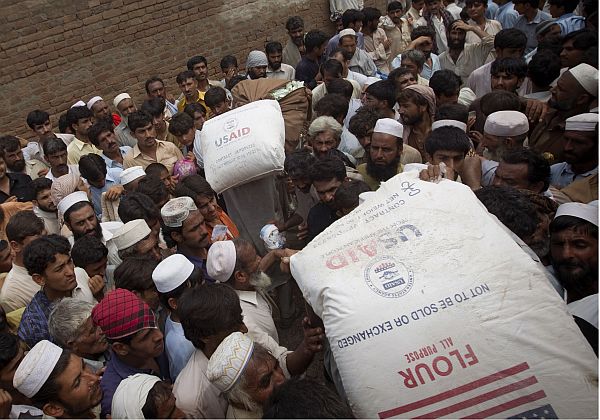
Did the Washington Post‘s David Ignatius really travel all the way to Pir Sabak, west of Islamabad in flood-devastated Pakistan, just to ask the villagers there what they think of America?

When I arrived, villagers were erecting a big tent to serve as a mosque — even before they had built a school for their kids. When I asked what they thought about America, they had no criticisms. “We are in a time of need, and we are looking for help from anywhere,” said Mohammed Ali, a white-bearded man who was helping raise the canvas mosque.

The U.S. military has been working hard to provide flood assistance, but most of that is invisible to Pakistanis. They read about American drone attacks but not about helicopters bringing food supplies. That lack of recognition upsets U.S. officials, but they haven’t been able to change it.

On a day’s tour of the northern flood zone, I saw posters for Turkish, British and other European relief groups, but not one sign of American help. That’s a missed opportunity. These people still need help desperately, and they will remember those who visibly provided it.

I guess if USAID takes Ignatius’ message to heart, they might start producing multi-lingual labeling for aid packaging. But as the Post columnist learned, those in desperate need don’t care too much about where the help comes from.

As for what changes perceptions, it’s a shame Ignatius wasn’t in Pir Shabak a month ago during the visit by Baroness Warsi, Britain’s first Muslim minister and Chairwoman of the Conservative Party.

Just imagine if the US government could send a Muslim woman cabinet level official on a diplomatic mission to a Muslim country — or for that matter, on a trip to Florida or Tennessee!

While men like Imam Feisal Rauf are struggling to win acceptance for Muslims within American society, Sayeeda Hussain Warsi can speak confidently as a Muslim feminist and British political leader who exemplifies what it means to create a modern pluralistic society.

Facebooktwittermail

“Who did we get today?”

Bob Woodward’s new book, Obama’s Wars, reveals that the White House was so enamored with the CIA’s drone missile campaign in Pakistan, that chief of staff Rahm Emanuel would regularly call the CIA director, Leon Panetta, asking, “Who did we get today?”

Emanuel may have been posing the question because, like President Obama, he shares a perverse thrill in remote killing. Or, he might have asked because Predator warfare turns out to be far less accurate than it proponents would like us to believe.

A legal dispute that was being hammered out in a Boston court this summer, revealed that in its haste to deploy drones, the CIA was willing to use location analysis software that could result in strikes that would be as much as 42 feet off target!

That’s the difference between aiming at one house and destroying the house next door.

Leaving aside the question about how accurate ones intelligence might be about who is inhabiting either house, or the legal issues of what constitutes the battlefield and what can justify extrajudicial killing, or the moral issue of defining innocent bystanders as “collateral damage” — this looks like a case of not being able to shoot straight.

The Register reports:

The CIA is implicated in a court case in which it’s claimed it used an illegal, inaccurate software “hack” to direct secret assassination drones in central Asia.

The target of the court action is Netezza, the data warehousing firm that IBM bid $1.7bn for on Monday [Sept 20]. The case raises serious questions about the conduct of Netezza executives, and the conduct of CIA’s clandestine war against senior jihadis in Afganistan and Pakistan.

The dispute surrounds a location analysis software package – “Geospatial” – developed by a small company called Intelligent Integration Systems (IISi), which like Netezza is based in Massachusetts. IISi alleges that Netezza misled the CIA by saying that it could deliver the software on its new hardware, to a tight deadline.

When the software firm then refused to rush the job, it’s claimed, Netezza illegally and hastily reverse-engineered IISi’s code to deliver a version that produced locations inaccurate by up to 13 metres [42 feet]. Despite knowing about the miscalculations, the CIA accepted the software, court submissions indicate.

This report comes on the heals of an earlier report which revealed that the military’s use of unencrypted communications channels in Iraq allowed militants to view live video images being transmitted by drones. As the Wall Street Journal reported in December:

Militants in Iraq have used $26 off-the-shelf software to intercept live video feeds from U.S. Predator drones, potentially providing them with information they need to evade or monitor U.S. military operations.

Senior defense and intelligence officials said Iranian-backed insurgents intercepted the video feeds by taking advantage of an unprotected communications link in some of the remotely flown planes’ systems. Shiite fighters in Iraq used software programs such as SkyGrabber — available for as little as $25.95 on the Internet — to regularly capture drone video feeds, according to a person familiar with reports on the matter.

Given that President Obama has authorized as many drone attacks since the end of March as his predecessor did in the previous four years, and given that in Pakistan there is a widespread belief that these attacks indiscriminately kill innocent people, and given that this perception is fueling a deepening hatred of America, one might imagine that revelations about the weaknesses of the drone program would result in a serious reexamination of its value.

On the contrary, the CIA is now intensifying its campaign of missile attacks and launched more drone strikes this month than at any time in the previous six years.

(For more background on the Geospatial story, see this report.)

Facebooktwittermail

Expanding secrecy and diminishing privacy in Obama’s America

The US government might not have enough evidence to issue an arrest warrant for a US citizen but it claims the right to kill such a person and to keep secret its reasons for doing so.

The U.S.-born cleric Anwar al-Aulaqi is now on the CIA and Joint Special Operations Command capture-or-kill list of suspected terrorists. He is not however on the FBI’s most-wanted terrorist list and has not been indicted. It is believed that he is being hunted down and that he will be killed, if his exact whereabouts become known, but even if that is the case, this “does not foreclose Anwar al-Aulaqi’s access to the courts,” claim Barack H Obama, Robert M Gates and Leon E Panetta, the defendants in a federal case brought by Aulaqi’s father.

Nasser al-Aulaqi has an old-fashioned conception of justice and believes his son has a right to due process and not be subject to a summary execution.

As Glenn Greenwald points out:

[W]hat’s most notable here is that one of the arguments the Obama DOJ raises to demand dismissal of this lawsuit is “state secrets”: in other words, not only does the President have the right to sentence Americans to death with no due process or charges of any kind, but his decisions as to who will be killed and why he wants them dead are “state secrets,” and thus no court may adjudicate their legality.

At the very same time that this administration is pushing to expand the boundaries of state secrecy and extra-judicial power it also wants to restrict citizens’ rights to privacy as it seeks sweeping new regulations for the internet that would provide the government with the means to access all electronic communications.

The New York Times reports:

Essentially, officials want Congress to require all services that enable communications — including encrypted e-mail transmitters like BlackBerry, social networking Web sites like Facebook and software that allows direct “peer to peer” messaging like Skype — to be technically capable of complying if served with a wiretap order. The mandate would include being able to intercept and unscramble encrypted messages.

In the post 9/11 national security culture, arguments in favor of the expansion of government power are invariably framed in terms of enhancing the security services’ ability to track down “bad guys.” But as the article notes, enhanced surveillance capabilities will also create opportunities of others.

Several privacy and technology advocates argued that requiring interception capabilities would create holes that would inevitably be exploited by hackers.

Steven M. Bellovin, a Columbia University computer science professor, pointed to an episode in Greece: In 2005, it was discovered that hackers had taken advantage of a legally mandated wiretap function to spy on top officials’ phones, including the prime minister’s.

“I think it’s a disaster waiting to happen,” he said. “If they start building in all these back doors, they will be exploited.”

The Greek case — sometimes referred to as the Greek Watergate — is interesting for several reasons. As the Times in another report today on the Stuxnet attack notes, “The level of skill needed to pull off the [Greek] operation and the targets strongly indicated that the culprit was a government.”

Indeed, the list of targets alone makes it hard to imagine that this was anything other than an intelligence agency-run operation. The phones bugged included not only those of the Greek prime minister and his wife but also, IEEE Spectrum reported, those of:

…the ministers of national defense, foreign affairs, and justice, the mayor of Athens, and the Greek European Union commissioner… Others belonged to members of civil rights organizations, peace activists, and antiglobalization groups; senior staff at the ministries of National Defense, Public Order, Merchant Marine, and Foreign Affairs; the New Democracy ruling party; the Hellenic Navy general staff; and a Greek-American employee at the United States Embassy in Athens.

Given the context of the then-upcoming 2004 Athens Olympics which were widely regarded as a potential target for a major act of terrorism, it seems quite likely that this was a CIA-run operation.

Since we live in what is still widely regarded as the “freest” nation on earth, as the Obama administration quietly moves to expand its powers, we should have no doubt that the national security culture that is being established here as a new normal, will also serve as a model for other nations that will justify even more extreme restrictions on civil liberties by virtue of the similarities these measures bear to the American way.

The architecture of world government is not being crafted at the United Nations but behind closed doors at the NSA and the CIA. The people we should be most afraid of are the people who promise to make us feel safe.

Facebooktwittermail

Terrorist group gets support from US Congress

At Foreign Policy, Patrick Disney writes:

It’s been over two months since the toughest Iran sanctions ever approved by Congress were signed into law, three months since the UN’s latest resolution, and 15 months since Iran’s post-election demonstrations began. Despite all of this, Iran’s clerical government is not crumbling, nor has Iran shown any sign of giving in to the West on its nuclear program.

Recent weeks have seen a renewed discussion of military options for stopping Iran’s nuclear program – kicked off by Jeffrey Goldberg’s cover article in the Atlantic. But there is also a campaign underway to promote a different option on Iran: regime change, via Iranian dissidents in exile.

Members of Congress led by Rep. Bob Filner (D-CA) have introduced a resolution calling on the Secretary of State and the President to throw the support of the United States behind an exiled Iranian terrorist group seeking to overthrow the Iranian regime and install themselves in power. Calling the exiled organization “Iran’s main opposition,” Filner is urging the State Department to end the blacklisting of the Mujahedin-e Khalq (MEK) — a group listed by the State Department as a Foreign Terrorist Organization (FTO). The resolution currently has 83 cosponsors and is gaining significant ground.

This follows a call for US military action against Iran, made by a prominent Republican senator.

Sen. Lindsey Graham of South Carolina said Monday that the United States must be prepared to use military force to prevent Iran from acquiring a nuclear weapon — and added that the last-resort step should be taken with the goal of overthrowing Iranian President Mahmoud Ahmadinejad.

Graham, a military lawyer and a senior Republican on the Senate Armed Services Committee, became the first senator to support direct U.S. military intervention in Iran, saying it should not involve ground troops but be launched by U.S. warplanes and ships.

“If you use military force against Iran, you’ve opened up Pandora’s box,” Graham told the American Enterprise Institute in Washington. “If you allow Iran to get a nuclear weapon, you’ve emptied Pandora’s box. I’d rather open up Pandora’s box than empty it.”

Graham’s unusual public support for overturning Ahmadinejad and the ruling council of Shiite Muslim clerics that he nominally heads recalled President George W. Bush’s controversial policy of regime change to invade Iraq in 2003 and overthrow dictator Saddam Hussein.

Facebooktwittermail

Israel now in proximity talks with the US

Ever since — with much fanfare in Washington — Israel entered into direct talks with the Palestinian team led by acting president Mahmoud Abbas, the Palestinians have insisted that the continuation of the talks would hinge on a continuation of a nominal settlement freeze due to expire on Sunday. Thus far, Israeli Prime Minister Netanyahu has yet to agree to extend the so-called freeze. (With East Jerusalem excluded and work continuing on 3,000 housing units, it was never an actual freeze.)

The New York Times now reports that the Israelis want to cut a deal: that the US should release the infamous Israeli spy Jonathan Pollard in exchange for a three-month extension of the freeze. An Israel Army Radio report is cited which “said a private individual had been asked to try to gauge the potential of such an offer ‘discreetly and informally’ with American officials.”

Why are the Israelis being so coy as to require the use of an intermediary at a time when Israeli and US officials are in constant direct communication?

Since 1987, Pollard, a US citizen who became an Israeli citizen in 1995, has been serving life in prison for spying on behalf of Israel. Israeli leaders and the Israel lobby in the US have subsequently engaged in a long-running campaign for his release. In 2007 Benjamin Netanyahu made a campaign pledge that if he became prime minister he would seek Pollard’s release.

At the end of the nineties there were hints, Israelis claimed, that Bill Clinton, at a critical juncture during Israeli-Palestinian peace negotiations, might be willing to yield to their requests. The US intelligence community immediately voiced strong objections.

As Seymour Hersh reported in 1999:

The President’s willingness to consider clemency for Pollard so upset the intelligence community that its leaders took an unusual step: they began to go public. In early December, four retired admirals who had served as director of Naval Intelligence circulated an article, eventually published in the Washington Post, in which they argued that Pollard’s release would be “irresponsible” and a victory for what they depicted as a “clever public relations campaign.” Since then, sensitive details about the secrets Pollard gave away have been made public by CBS and NBC.

In the course of my own interviews for this account, the officials who knew the most about Jonathan Pollard made it clear that they were talking because they no longer had confidence that President Clinton would do what they believed was the right thing — keep Pollard locked up. Pollard, these officials told me, had done far more damage to American national security than was ever made known to the public; for example, he betrayed elements of four major American intelligence systems. In their eyes, there is no distinction between betraying secrets to an enemy, such as the Soviet Union, and betraying secrets to an ally.

Officials are loath to talk publicly about it, but spying on allies is a fact of life: the United States invests billions annually to monitor the communications of its friends. Many American embassies around the world contain a clandestine intercept facility that targets diplomatic communications. The goal is not only to know the military and diplomatic plans of our friends but also to learn what intelligence they may be receiving and with whom they share information. “If a friendly state has friends that we don’t see as friends,” one senior official explained, sensitive intelligence that it should not possess — such as that supplied by Pollard — “can spread to others.” Many officials said they were convinced that information Pollard sold to the Israelis had ultimately wound up in the hands of the Soviet Union.

Pollard has now served 23 years in jail. Let’s suppose President Flexibility likes the chiropractic manipulation the Israelis now want to give him. What does the US get in return?

The charade of Israeli-Palestinian talks gets dragged on until after the mid-term elections. Maybe during that time the administration can get a marginally useful story about how it’s advancing the peace process.

But let’s be even sunnier in our outlook. Let’s suppose that after an extension, the US then wins an unimaginable victory: an Israeli agreement to a permanent settlement freeze.

Big deal.

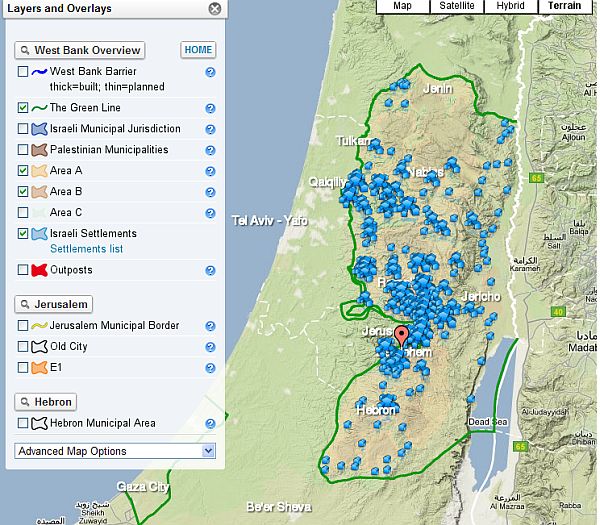
As a new map produced by Americans For Peace Now makes clear, Israelis already have their feet firmly planted throughout the occupied West Bank. Freezing settlement growth really does nothing to end the occupation.

Facebooktwittermail

The New York Times reveals a few open secrets

The Fort

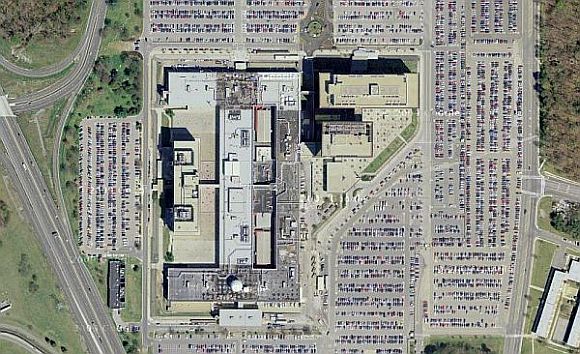
At the New York Times, Scott Shane divulges a national security secret: the National Security Agency (shown in the Google Earth image above) is known by the nickname the Fort. I guess you’d call that the definition of hiding in plain sight since the NSA is located in Fort Meade.

Apparently anyone in the locality could tell you the NSA headquarters is known as the Fort and Shane would not know that that’s supposed to be a secret had he not obtained a copy of a banned book available on eBay.

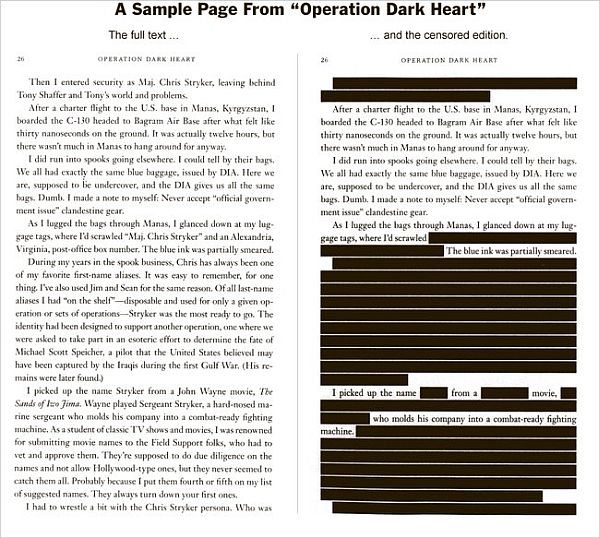
[T]hat nickname is one of hundreds of supposed secrets Pentagon reviewers blacked out in the new, censored edition of an intelligence officer’s Afghan war memoir. The Defense Department is buying and destroying the entire uncensored first printing of “Operation Dark Heart,” by Anthony Shaffer, a lieutenant colonel in the Army Reserve and former Defense Intelligence Agency officer, in the name of protecting national security.

Another supposed secret removed from the second printing: the location of the Central Intelligence Agency’s training facility — Camp Peary, Va., a fact discoverable from Wikipedia. And the name and abbreviation of the Iranian Revolutionary Guard Corps, routinely mentioned in news articles. And the fact that Sigint means “signals intelligence.”

Not only did the Pentagon black out Colonel Shaffer’s cover name in Afghanistan, Chris Stryker, it deleted the source of his pseudonym: the name of John Wayne’s character in the 1949 movie “The Sands of Iwo Jima.”

The redactions offer a rare glimpse behind the bureaucratic veil that cloaks information the government considers too important for public airing.

The New York Times is generous enough to provide a kind of Wikileaks teaser — a single page of the redacted and unredacted book.

Was it out of deference to St Martin’s Press or the Pentagon that the Times refrained from divulging more of the redactions?

And was the NSA so “liberal” in its use of redaction because they want to keep secret the criteria they use for defining secrecy, or because when it comes to secrecy, government officials in the post 9/11 era know that no one ever gets fired for over-classification?

Facebooktwittermail

Washington Post comes late to the Stryker ‘kill team’ story

The Washington Post reports:

The U.S. soldiers hatched a plan as simple as it was savage: to randomly target and kill an Afghan civilian, and to get away with it.

For weeks, according to Army charging documents, rogue members of a platoon from the 5th Stryker Combat Brigade, 2nd Infantry Division, floated the idea. Then, one day last winter, a solitary Afghan man approached them in the village of La Mohammed Kalay. The “kill team” activated the plan.

One soldier created a ruse that they were under attack, tossing a fragmentary grenade on the ground. Then others opened fire.

According to charging documents, the unprovoked, fatal attack on Jan. 15 was the start of a months-long shooting spree against Afghan civilians that resulted in some of the grisliest allegations against American soldiers since the U.S. invasion in 2001. Members of the platoon have been charged with dismembering and photographing corpses, as well as hoarding a skull and other human bones.

The subsequent investigation has raised accusations about whether the military ignored warnings that the out-of-control soldiers were committing atrocities. The father of one soldier said he repeatedly tried to alert the Army after his son told him about the first killing, only to be rebuffed.

Two more slayings would follow. Military documents allege that five members of the unit staged a total of three murders in Kandahar province between January and May. Seven other soldiers have been charged with crimes related to the case, including hashish use, attempts to impede the investigation and a retaliatory gang assault on a private who blew the whistle.

Army officials have not disclosed a motive for the killings and macabre behavior. Nor have they explained how the attacks could have persisted without attracting scrutiny. They declined to comment on the case beyond the charges that have been filed, citing the ongoing investigation.

But a review of military court documents and interviews with people familiar with the investigation suggest the killings were committed essentially for sport by soldiers who had a fondness for hashish and alcohol.

The accused soldiers, through attorneys and family members, deny wrongdoing. But the case has already been marked by a cycle of accusations and counter-accusations among the defendants as they seek to pin the blame on each other, according to documents and interviews.

The Army has scheduled pre-trial hearings in the case this fall at Joint Base Lewis-McChord, home of the Stryker brigade. (The unit was renamed the 2nd Stryker Brigade, 2nd Infantry Division, when it returned from Afghanistan in July.) Military officials say privately that they worry the hearings will draw further attention to the case, with photos and other evidence prompting anger among the Afghan civilians whose support is critical to the fight against the Taliban.

Does the Washington Post share the military’s concern about the effects of publicity around this case? It has certainly taken the newspaper a long time to get around to covering this story.

The case was reported by the Seattle Times in early June.

A June 16 report said:

Premeditated murder, the crime that the soldiers are charged with, is the most serious of four murder charges that can be levied under the military code of justice, according to Eugene Fidell, who teaches military law at Yale University. It carries the death penalty.

In cases involving multiple soldiers, military prosecutors, like their civilian counterparts, may sometimes cut deals with some defendants to gain evidence against other defendants.

“The prosecutors’ door is likely to open, and they may have to make some wrenching decisions about whom to make a deal with to gain evidence,” Fidell said.

There are hints that the Washington Post itself may now be part of just such a prosecution process as indicated by the weight its report gives to the testimony of Spc. Adam Winfield, one of the accused soldiers.

Facebooktwittermail

Arming the insurgencies of the future

Guns are very durable — ownership tends to be transient.

The New York Times examines a weapons cache which provides a snapshot of the arsenal that the Taliban in Marja — the part of Helmand Province that has seen the most sustained fighting of 2010 — have been using against US marines.

In this collection, a third of the weapons are bolt-actions rifles from World War II or earlier.

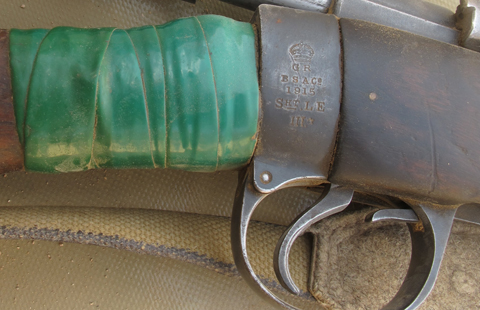
The photograph above shows a 1915 Lee Enfield rifle — a gun that was manufactured in the millions to defend the British Empire.

Did the manufacturers have the slightest idea that they were making weapons that would outlast an empire?

What does the fact that the US military is now locked in a stalemate against an irregular force with vastly inferior weaponry say about the return American taxpayers are getting from a defense budget that dwarfs all others?

Would the Marines be significantly worse off if they too carried Lee Enfields?

But here’s the serious question:

When Britain was amassing an arsenal to defend its empire, it spent a tiny fraction of what the US now spends producing an array of weapons far less potent than those the Pentagon now requires.

If we assume that, just as was the case for the British, the American arsenal far outlasts the American empire, what kind of world will we see a hundred years from now when America is a shadow of its former self and fighters across the planet are wielding M16 rifles instead of Lee Enfields?

The defense of America leads inexorably to the weaponization of the planet.

Facebooktwittermail

What would Cheney say?

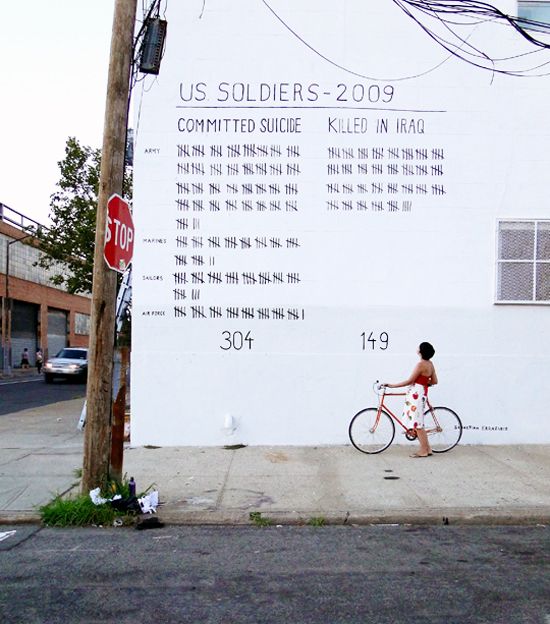
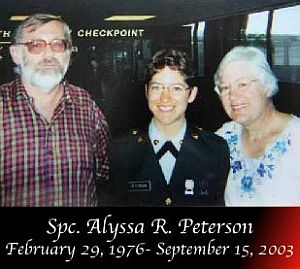
Greg Mitchell reports (parts one and two) on the suicide of Spc. Alyssa Peterson, one of the first women soldiers to die in Iraq. She took her own life exactly seven years ago after being reprimanded for showing empathy for Iraqi prisoners who were undergoing interrogation. All records of the techniques being used have been destroyed but there seems little doubt that the Iraqis were being tortured.

The 27-year-old’s parents didn’t even know their daughter was in Iraq until they were informed of her death. The fact that she committed suicide was concealed by the military for several more years — the most likely reason for the cover-up being that it was Peterson’s unwillingness to participate in torture that drove her to take her own life.

Kayla Williams, a US Army sergeant who served with Peterson, described the impact of participating in interrogations which she could see clearly contravened the Geneva Conventions.

Fellow soldiers, echoing then vice-president Dick Cheney, told the young sergeant that “the old rules no longer applied because this was a different world. This was a new kind of war.” But Williams said: “it really made me feel like we were losing that crucial moral higher ground, and we weren’t behaving in the way that Americans are supposed to behave.”

“It also made me think,” Williams says, “what are we as humans, that we do this to each other? It made me question my humanity and the humanity of all Americans. It was difficult, and to this day I can no longer think I am a really good person and will do the right thing in the right situation.”

As the famous Milgram experiment demonstrated, individuals who choose to do the right thing — especially when that demands defying authority — are usually in a minority. The much more prevalent tendency is a willingness to follow orders and suspend ones own moral judgment — even when that involves participating in torture.

Should Alyssa Peterson have been turned away from the military on the grounds that she was too humane, her conscience too strong, for her to serve in the US Army? She ended up being reprimanded for showing empathy to Iraqi prisoners. As the official investigation of her death revealed: “She said that she did not know how to be two people; she… could not be one person in the cage [where prisoners were apparently tortured] and another outside the wire.”

Suppose before she took her life, Dick Cheney had had an opportunity to council her, what would he have said? Or suppose Cheney was now to speak to her father, what would he say?

Empathy is a liability in wartime? Americans need to set aside their humanity when they put on a uniform?

Peterson’s ability to empathize with Iraqi prisoners was no doubt in large part an expression of her character and her humanity, yet to an extent it must also have resulted from the humanizing effect of understanding and speaking Arabic. In spite of the dehumanizing effect of seeing men stripped of their dignity, she must also have been able to see beyond that and through their words seen not mere “terrorist” suspects, but fathers with daughters and sons with parents.

Recognition of humanity is not something we can pick up or discard whenever it seems expedient — whenever cast aside it henceforth becomes increasingly difficult to rediscover.

The choice to cross over to the “dark side” is a choice that may prove impossible to reverse. At 27 Alyssa Peterson seems to have understood that. As far as we can tell, Dick Cheney has not even attempted to find the way back.

Facebooktwittermail

CIA views Israeli intelligence service as worst US ally

In the Washington Post, Jeff Stein reports:

The CIA took an internal poll not long ago about friendly foreign intelligence agencies.

The question, mostly directed to employees of the clandestine service branch, was: Which are the best allies among friendly spy services, in terms of liaison with the CIA, and which are the worst? In other words, who acts like, well, friends?

“Israel came in dead last,” a recently retired CIA official told me the other day.

Not only that, he added, throwing up his hands and rising from his chair, “the Israelis are number three, with China number one and Russia number two,” in terms of how aggressive they are in their operations on U.S. soil.

Israel’s undercover operations here, including missions to steal U.S. secrets, are hardly a secret at the FBI, CIA and other U.S. intelligence agencies. From time to time, in fact, the FBI has called Israeli officials on the carpet to complain about a particularly brazen effort to collect classified or other sensitive information, in particular U.S. technical and industrial secrets.

Former CIA officer, Philip Giraldi, adds:

FBI sources indicate that the increase in Mossad activity is a major problem, particularly when Israelis are posing as U.S. government officials, but they also note that there is little they can do to stop it as the Justice Department refuses to initiate any punitive action or prosecutions of the Mossad officers who have been identified as involved in the illegal activity.

Giraldi also recounts a recent incident in which a man who identified himself as an Israeli government official, threatened a survivor of the USS Liberty attack, “saying that the people who had been killed on board had gotten what they deserved.”

Israel’s official line has always been that the incident in which 34 US servicemen were killed and 170 wounded during the Israeli attack on the clearly-flagged American naval vessel in 1967, was an accident.

Facebooktwittermail

Treatment for PTSD may be killing veterans

Associated Press reports:

Andrew White returned from a nine-month tour in Iraq beset with signs of post-traumatic stress disorder: insomnia, nightmares, constant restlessness. Doctors tried to ease his symptoms using three psychiatric drugs, including a potent anti-psychotic called Seroquel.

Thousands of soldiers suffering from PTSD have received the same medication over the last nine years, helping to make Seroquel one of the Veteran Affairs Department’s top drug expenditures and the No. 5 best-selling drug in the nation.

Several soldiers and veterans have died while taking the pills, raising concerns among some military families that the government is not being up front about the drug’s risks. They want Congress to investigate.

In White’s case, the nightmares persisted. So doctors recommended progressively larger doses of Seroquel. At one point, the 23-year-old Marine corporal was prescribed more than 1,600 milligrams per day — more than double the maximum dose recommended for schizophrenia patients.

A short time later, White died in his sleep.

“He was told if he had trouble sleeping he could take another (Seroquel) pill,” said his father, Stan White, a retired high school principal.

Activist, Vince Boehm, communicated with the Whites and told Beyond Meds:

Stan and Shirley White lost two sons to war. Robert White, a staff sergeant, was killed in Afghanistan in 2005, when his Humvee was hit by a rocket-propelled grenade. But the death of Robert’s younger brother Andrew, who survived Iraq only to succumb to a different battle, is in some ways “harder to accept” says his father.

Struggling with PTSD compounded by grief over the death of his brother, Andrew sought help from VA doctors. Their first line of defense was to prescribe him 20 mg of Paxil, 4 mg of Klonopin and 50 mg of Seroquel. These medications helped at first, but later proved ineffective. Instead of changing the course of treatment, the doctors responded by continually increasing his dosage until the Seroquel alone reached a whopping 1600 mg per day. Within weeks of Andrew’s death, three more young West Virginia veterans died while being treated for PTSD with the same drugs, prompting Stan and Shirley White to begin a mission to find out what the deaths have in common.

Earlier this year, Martha Rosenberg reported on the same deadly cocktail being used to treat PTSD:

Sgt. Eric Layne’s death was not pretty.

A few months after starting a drug regimen combining the antidepressant Paxil, the mood stabilizer Klonopin and a controversial anti-psychotic drug manufactured by pharmaceutical giant AstraZeneca, Seroquel, the Iraq war veteran was “suffering from incontinence, severe depression [and] continuous headaches,” according to his widow, Janette Layne.

Soon he had tremors. ” … [H]is breathing was labored [and] he had developed sleep apnea,” Layne said.

Janette Layne, who served in the National Guard during Operation Iraqi Freedom along with her husband, told the story of his decline last year, at official FDA hearings on new approvals for Seroquel. On the last day of his life, she testified, Eric stayed in the bathroom nearly all night battling acute urinary retention (an inability to urinate). He died while his family slept.

Sgt. Layne had just returned from a seven-week inpatient program at the VA Medical Center in Cincinnati where he was being treated for post-traumatic stress disorder (PTSD). A video shot during that time, played by his wife at the FDA hearings, shows a dangerously sedated figure barely able to talk.

Sgt. Layne was not the first veteran to die after being prescribed medical cocktails including Seroquel for PTSD.

In the last two years, Pfc. Derek Johnson, 22, of Hurricane, West Virginia; Cpl. Andrew White, 23, of Cross Lanes, West Virginia; Cpl. Chad Oligschlaeger, 21, of Roundrock, Texas; Cpl. Nicholas Endicott, 24, of Pecks Mill, West Virginia; and Spc. Ken Jacobs, 21, of Walworth, New York have all died suddenly while taking Seroquel cocktails.

Facebooktwittermail

CIA making secret payments to members of Karzai administration

The Washington Post reports:

The CIA is making secret payments to multiple members of President Hamid Karzai’s administration, in part to maintain sources of information in a government in which the Afghan leader is often seen as having a limited grasp of developments, according to current and former U.S. officials.

The payments are long-standing in many cases and designed to help the agency maintain a deep roster of allies within the presidential palace. Some aides function as CIA informants, but others collect stipends under more informal arrangements meant to ensure their accessibility, a U.S. official said.

The CIA has continued the payments despite concerns that it is backing corrupt officials and undermining efforts to wean Afghans’ dependence on secret sources of income and graft.

The U.S. official, speaking on condition of anonymity, said a significant number of officials in Karzai’s administration are on the payroll. Paul Gimigliano, a CIA spokesman, disputed that characterization, saying, “This anonymous source appears driven by ignorance, malice or both.”

A former agency official said the payments were necessary because “the head of state is not going to tell you everything” and because Karzai often seems unaware of moves that members of his own government make.

The disclosure comes as a corruption investigation into one of Karzai’s senior national security advisers – and an alleged agency informant – puts new strain on the already fraying relationship between Washington and Kabul.

Facebooktwittermail

Wikileaks — short on intelligence

Maybe Wikileaks has come to the cynical conclusion that in the contemporary media environment the headline is more important than the story.

CIA Red Cell Memorandum on United States “exporting terrorism”

That sounds like damning material. Plans to insert US-trained terrorists into Iran or Venezuela perhaps? Is Wikileaks exposing yet more dirty secrets from the CIA’s ugly history?

No.

Indeed, if we are to define a leak as the revelation of confidential information in which the public has a compelling interest — information that must be published as a matter of conscience — then the latest offering from Wikileaks hardly qualifies being described as a leak. Indeed, the US intelligence community may actually regard the release of such a report as something that overall enhances their public image.

This Red Cell report has a couple of interesting details — confirmation that there are those in the US government who understand that Jewish terrorism has played a significant role in triggering Palestinian terrorism, and (reading between the lines) that CIA officers engaged in kidnapping can be perceived as American terrorists — but the overarching topic here is not a secret acknowledgment that the US government has been involved in promoting and exporting terrorism.

If Wikileaks wants to provide the best public service it is capable of, it needs to focus attention on improving its image. It has made the medium more important than the message as though we should be more interested in Wikileaks than the leaks. Instead of the brand “Wikileaks” signalling the release of important information, it now signals a theatrical drama in which Julian Assange demands a spotlight while he is supposedly jousting with the dark forces of government. Is that what he and his cohorts want to be known as? A band of attention seekers?

Whistleblowing is a noble exercise in which individuals follow the dictates of their conscience and place public interest above personal interest. I assume that Wikileaks was created as a way of honoring such a spirit.

Facebooktwittermail

CIA wants to cover up US war crimes in Yemen

A missile strike on December 17 in Yemen last year that killed 41 people including 21 children and 14 women was most likely the result of a US cruise missile strike — an opening shot in a US military campaign that began without notice and has never been officially confirmed.

Amnesty International says it has obtained photographs apparently showing the remnants of missiles known to be held only by U.S. forces at the site of the air strike against al Qaeda suspects.

“The Yemeni authorities have a duty to ensure public safety and to bring to justice those engaged in attacks that deliberately target members of the public, but when doing so they must abide by international law,” said Malcolm Smart, Amnesty International’s Director for the Middle East and North Africa Programme. “Enforced disappearances, torture and other ill-treatment, and extrajudicial executions are never permissible, and the Yemeni authorities must immediately cease these violations.”

“It is particularly worrying that states such as Saudi Arabia and the USA are directly or indirectly aiding the Yemeni government in a downward spiral away from previously improving human rights record.”

The Washington Post now reports that the CIA is likely to have a larger role in President Obama’s expanding war in Yemen.

Proponents of expanding the CIA’s role argue that years of flying armed drones over Pakistan have given the agency expertise in identifying targets and delivering pinpoint strikes. The agency’s attacks also leave fewer telltale signs.

“You’re not going to find bomb parts with USA markings on them,” the senior U.S. official said.

Facebooktwittermail

Iran enhances its capacity to shut down the global oil supply

The lesson of the famous Millennium 2002 Challenge was that a cumbersome military machine that over-invests in high tech weaponry is vulnerable to swarming attacks. In the $250 million war game such an attack resulted in most of the US fleet being sunk within hours.

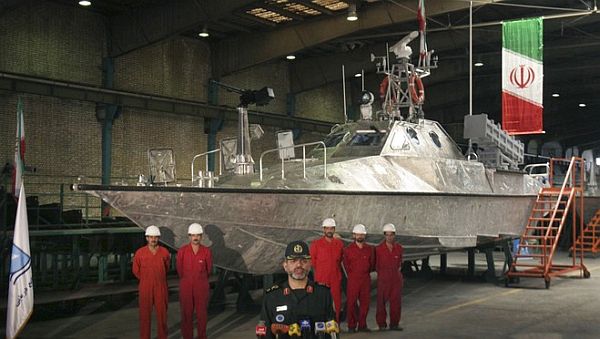
With the development of the F-35 Joint Strike Fighter — the most expensive defense program ever — going ahead, it looks like the Pentagon is still stuck in the past. Iran on the other hand — the country that grasps the jugular vein through which most of the world’s oil supply flows (the Strait of Hormuz) — today made clear that it knows exactly how to flex its muscles in that arena and it will do so with vessels designed for lethal swarming.

AFP reports:

Iran began mass-producing two high-speed variants of missile-launching assault boats on Monday, warning its enemies not to “play with fire” as it boosts security along its coastline.

The inauguration of the production lines for the Seraj and Zolfaqar speedboats comes a day after President Mahmoud Ahmadinejad unveiled Iran’s home-built bomber drone, which he said would deliver “death” to Iran’s enemies.

The United States expressed concern about the Islamic republic’s growing military capabilities.

Iran’s state news agency IRNA reported that the Seraj (Lamp) and Zolfaqar (named after Shiite Imam Ali’s sword) boats would be manufactured at the marine industries complex of the defence ministry.

Defence Minister Ahmad Vahidi opened the assembly lines, saying the vessels would help to strengthen Iran’s defences, IRNA said.

“Today, the Islamic Republic of Iran is relying on a great defence industry and the powerful forces of Sepah (Revolutionary Guards) and the army, with their utmost strength, can provide security to the Persian Gulf, the Sea of Oman and Strait of Hormuz,” Vahidi said.

He issued a stern warning to Iran’s foes.

“The enemy must be careful of its adventurous behaviour and not play with fire because the Islamic Republic of Iran’s response would be unpredictable,” IRNA quoted him as saying.

“If enemies attack Iran, the Islamic Republic of Iran’s reaction will not be restricted to one area. The truth of our defence doctrine is that we will not attack any country and that we extend our hand to all legitimate countries.”

Meanwhile, in yet another response to Jeffrey Goldberg’s prediction of an Israeli attack on Iran, the former UN chief weapons inspector, David Kay, suggests that Israel is using the issue in order to press the Obama administration to ease its pressure on settlements and the need to make concessions to the Palestinians.

… Israel is engaged in psychological warfare with the Obama administration — and it only partly concerns Iran.

With regard Iran, Israel clearly understands that any unilateral military action it took against Iran without U.S. knowledge and support could have consequence of strategic importance for Israel and might even make an attack on Iran of limited benefit. Israel would much rather have the U.S. with it in an attack on Iran, or, even better, would be if the U.S. executed the attack entirely on its own.

But beyond Iran, of probably greater importance to the current Israeli government is avoiding the Obama administration pushing it into a choice between settlements and territorial arrangements with the Palestinians that it is unwilling to make and permanent damage to its relationship with the U.S. Hyping the Iranian nuclear program and the need for early military action is a nice bargaining counter. The U.S. certainly cannot join or lead an attack on Iran while pushing the Israeli government to the brink on settlements and concessions to the Palestinians. Or if the U.S. wants to avoid an imminent Israeli strike, it must make concessions to Israel on the Palestinian issues.

Facebooktwittermail

Iran targeted in cyber attack

Last September, Reuters reported: “Israel has been developing “cyber-war” capabilities that could disrupt Iranian industrial and military control systems. Few doubt that covert action, by Mossad agents on the ground, also features in tactics against Iran. An advantage of sabotage over an air strike may be deniability.”

Now it seems, such an attack may have occurred in recent months.

“Looks like this malware was made for espionage,” was the assessment of industry analyst Frank Boldewin when describing the recently discovered computer worm, known has Stuxnet. It targets Siemens SCADA (supervisory control and data acquisition) management systems that control energy utilities, transportation, and other vital systems. Elias Levy, senior technical director with Symantec Security Response, said: “The most we can say is whoever developed these particular threats was targeting companies in those geographic areas,” when explaining why this particular trojan has had its greatest impact in Iran.

It is just two months since the newly-created United States Cyber Command based at Fort Meade, Maryland, became operational. The creation of CYBERCOM is ostensibly a response to the United States’ vulnerability to cyber attacks. “Given our increasing dependency on cyberspace, this new command will bring together the resources of the department to address vulnerabilities and meet the ever-growing array of cyberthreats to our military systems,” Defense Secretary Robert Gates said in a statement.

But as Robert Fry, a former Deputy Commanding General of coalition forces in Iraq, notes, “the speed of cyber operations places a premium on first strike and so inverts the Clausewitzian principle of the inherent advantage of defense.” Thus, as Federal Computer Week points out: “CYBERCOM also oversees offensive cyber capabilities, and that involves developing weapons and the doctrine that governs when and how those weapons can be used.”

Did we just witness one of the opening shots in a cyber war against Iran? Stuxnet is, according to Andy Greenberg, “the first publicly-known threat, aside from occasional unattributed reports, to target the long-vulnerable infrastructure systems.” As such, the most likely instigator of such an attack would be a hostile government.

The question is: which government? Israel and/or the United States have to be the prime suspects.

Facebooktwittermail